EP0092525A1 - Nichtbenetzbare Füllkörper für eine Elektrolysezelle zur Herstellung von Aluminium - Google Patents
Nichtbenetzbare Füllkörper für eine Elektrolysezelle zur Herstellung von Aluminium Download PDFInfo
- Publication number
- EP0092525A1 EP0092525A1 EP83810164A EP83810164A EP0092525A1 EP 0092525 A1 EP0092525 A1 EP 0092525A1 EP 83810164 A EP83810164 A EP 83810164A EP 83810164 A EP83810164 A EP 83810164A EP 0092525 A1 EP0092525 A1 EP 0092525A1
- Authority
- EP
- European Patent Office
- Prior art keywords
- aluminum
- cathode
- pool
- cryolite
- molten
- Prior art date
- Legal status (The legal status is an assumption and is not a legal conclusion. Google has not performed a legal analysis and makes no representation as to the accuracy of the status listed.)
- Withdrawn
Links
- 229910052782 aluminium Inorganic materials 0.000 title claims abstract description 123
- 238000012856 packing Methods 0.000 title claims abstract description 35
- AZDRQVAHHNSJOQ-UHFFFAOYSA-N alumane Chemical compound [AlH3] AZDRQVAHHNSJOQ-UHFFFAOYSA-N 0.000 title description 3
- XAGFODPZIPBFFR-UHFFFAOYSA-N aluminium Chemical compound [Al] XAGFODPZIPBFFR-UHFFFAOYSA-N 0.000 claims abstract description 118
- 238000005363 electrowinning Methods 0.000 claims abstract description 21
- 229910001610 cryolite Inorganic materials 0.000 claims description 43
- PNEYBMLMFCGWSK-UHFFFAOYSA-N aluminium oxide Inorganic materials [O-2].[O-2].[O-2].[Al+3].[Al+3] PNEYBMLMFCGWSK-UHFFFAOYSA-N 0.000 claims description 41
- 239000000463 material Substances 0.000 claims description 21
- 239000000203 mixture Substances 0.000 claims description 12
- 229910052593 corundum Inorganic materials 0.000 claims description 10
- 229910001845 yogo sapphire Inorganic materials 0.000 claims description 10
- MCMNRKCIXSYSNV-UHFFFAOYSA-N ZrO2 Inorganic materials O=[Zr]=O MCMNRKCIXSYSNV-UHFFFAOYSA-N 0.000 claims description 8
- 239000011819 refractory material Substances 0.000 claims description 7
- 229910004369 ThO2 Inorganic materials 0.000 claims description 6
- ZCUFMDLYAMJYST-UHFFFAOYSA-N thorium dioxide Chemical compound O=[Th]=O ZCUFMDLYAMJYST-UHFFFAOYSA-N 0.000 claims description 6
- CJNBYAVZURUTKZ-UHFFFAOYSA-N hafnium(IV) oxide Inorganic materials O=[Hf]=O CJNBYAVZURUTKZ-UHFFFAOYSA-N 0.000 claims description 5
- 229910016384 Al4C3 Inorganic materials 0.000 claims description 3
- 229910003564 SiAlON Inorganic materials 0.000 claims description 3
- -1 SiAlOn Inorganic materials 0.000 claims description 3
- 229910016459 AlB2 Inorganic materials 0.000 claims description 2
- 229910017083 AlN Inorganic materials 0.000 claims 1
- 230000003247 decreasing effect Effects 0.000 abstract 1
- OKTJSMMVPCPJKN-UHFFFAOYSA-N Carbon Chemical compound [C] OKTJSMMVPCPJKN-UHFFFAOYSA-N 0.000 description 10
- 239000011449 brick Substances 0.000 description 9
- QYEXBYZXHDUPRC-UHFFFAOYSA-N B#[Ti]#B Chemical compound B#[Ti]#B QYEXBYZXHDUPRC-UHFFFAOYSA-N 0.000 description 7
- 229910033181 TiB2 Inorganic materials 0.000 description 7
- 230000015572 biosynthetic process Effects 0.000 description 6
- 238000005868 electrolysis reaction Methods 0.000 description 6
- 229910002804 graphite Inorganic materials 0.000 description 6
- 239000010439 graphite Substances 0.000 description 6
- QVGXLLKOCUKJST-UHFFFAOYSA-N atomic oxygen Chemical compound [O] QVGXLLKOCUKJST-UHFFFAOYSA-N 0.000 description 5
- 230000006870 function Effects 0.000 description 5
- 229910052760 oxygen Inorganic materials 0.000 description 5
- 239000001301 oxygen Substances 0.000 description 5
- KLZUFWVZNOTSEM-UHFFFAOYSA-K Aluminium flouride Chemical compound F[Al](F)F KLZUFWVZNOTSEM-UHFFFAOYSA-K 0.000 description 4
- 229910052799 carbon Inorganic materials 0.000 description 4
- 238000002845 discoloration Methods 0.000 description 4
- 238000004090 dissolution Methods 0.000 description 4
- PQXKHYXIUOZZFA-UHFFFAOYSA-M lithium fluoride Chemical compound [Li+].[F-] PQXKHYXIUOZZFA-UHFFFAOYSA-M 0.000 description 4
- 230000037361 pathway Effects 0.000 description 4
- 230000004907 flux Effects 0.000 description 3
- TWNQGVIAIRXVLR-UHFFFAOYSA-N oxo(oxoalumanyloxy)alumane Chemical compound O=[Al]O[Al]=O TWNQGVIAIRXVLR-UHFFFAOYSA-N 0.000 description 3
- 238000009736 wetting Methods 0.000 description 3
- 230000009471 action Effects 0.000 description 2
- 239000000654 additive Substances 0.000 description 2
- 230000008901 benefit Effects 0.000 description 2
- WUKWITHWXAAZEY-UHFFFAOYSA-L calcium difluoride Chemical compound [F-].[F-].[Ca+2] WUKWITHWXAAZEY-UHFFFAOYSA-L 0.000 description 2
- 229910001634 calcium fluoride Inorganic materials 0.000 description 2
- 239000010406 cathode material Substances 0.000 description 2
- 230000008859 change Effects 0.000 description 2
- 239000011530 conductive current collector Substances 0.000 description 2
- 230000007797 corrosion Effects 0.000 description 2
- 238000005260 corrosion Methods 0.000 description 2
- 238000003780 insertion Methods 0.000 description 2
- 230000037431 insertion Effects 0.000 description 2
- 230000035515 penetration Effects 0.000 description 2
- 230000009467 reduction Effects 0.000 description 2
- 239000000126 substance Substances 0.000 description 2
- 229910000831 Steel Inorganic materials 0.000 description 1
- RTAQQCXQSZGOHL-UHFFFAOYSA-N Titanium Chemical compound [Ti] RTAQQCXQSZGOHL-UHFFFAOYSA-N 0.000 description 1
- 230000004075 alteration Effects 0.000 description 1
- 239000010405 anode material Substances 0.000 description 1
- 230000000712 assembly Effects 0.000 description 1
- 238000000429 assembly Methods 0.000 description 1
- 239000006227 byproduct Substances 0.000 description 1
- 239000007795 chemical reaction product Substances 0.000 description 1
- 238000010276 construction Methods 0.000 description 1
- 239000000356 contaminant Substances 0.000 description 1
- 238000001816 cooling Methods 0.000 description 1
- 230000001419 dependent effect Effects 0.000 description 1
- 230000005672 electromagnetic field Effects 0.000 description 1
- 230000002708 enhancing effect Effects 0.000 description 1
- 238000011156 evaluation Methods 0.000 description 1
- 238000009472 formulation Methods 0.000 description 1
- 238000007654 immersion Methods 0.000 description 1
- 239000012535 impurity Substances 0.000 description 1
- 238000007689 inspection Methods 0.000 description 1
- 230000003993 interaction Effects 0.000 description 1
- 238000004519 manufacturing process Methods 0.000 description 1
- 230000028161 membrane depolarization Effects 0.000 description 1
- 229910052751 metal Inorganic materials 0.000 description 1
- 239000002184 metal Substances 0.000 description 1
- 238000000034 method Methods 0.000 description 1
- 238000012986 modification Methods 0.000 description 1
- 230000004048 modification Effects 0.000 description 1
- 239000012768 molten material Substances 0.000 description 1
- 230000008569 process Effects 0.000 description 1
- 230000000717 retained effect Effects 0.000 description 1
- 230000035939 shock Effects 0.000 description 1
- 239000010802 sludge Substances 0.000 description 1
- 239000007787 solid Substances 0.000 description 1
- 239000010959 steel Substances 0.000 description 1
- 238000012360 testing method Methods 0.000 description 1
- 230000008646 thermal stress Effects 0.000 description 1
- 239000010936 titanium Substances 0.000 description 1
- 229910052719 titanium Inorganic materials 0.000 description 1
- 239000011800 void material Substances 0.000 description 1
Images
Classifications
-
- C—CHEMISTRY; METALLURGY
- C25—ELECTROLYTIC OR ELECTROPHORETIC PROCESSES; APPARATUS THEREFOR
- C25C—PROCESSES FOR THE ELECTROLYTIC PRODUCTION, RECOVERY OR REFINING OF METALS; APPARATUS THEREFOR
- C25C3/00—Electrolytic production, recovery or refining of metals by electrolysis of melts
- C25C3/06—Electrolytic production, recovery or refining of metals by electrolysis of melts of aluminium
- C25C3/08—Cell construction, e.g. bottoms, walls, cathodes
Definitions
- This invention relates to the metal electrowinning cells, and particularly to cells for the electrowinning of aluminum. More specifically, this invention relates to cathode arrangements for use in these aluminum electrowinning cells.
- Aluminum is commonly produced by electrowinning aluminum from Al203 (alumina) at about 900°C to 1,000°C. Aluminum oxide being electrowon frequently is dissolved in molten Na 3 AlF 6 (cryolite) that generally contains other additives helpful to the electrowinning process such as CaF 2 , AlF 3 and LiF.
- anode and cathode are arranged in vertical spaced configuration within the cell, the anode being uppermost. Reduction of aluminum oxide to aluminum occurs at the cathode which customarily is positioned at the bottom or floor of the cell. Oxygen is electrochemically disassociated from Al 2 O 3 , in most commercial cells combining with carbonacious material comprising the cell anode and being emitted from the cell as CO and C0 2 .
- Cryolite is an aggressive chemical necessitating use of a cathode material substantially resistant to this aggressive cryolite.
- a cathode material substantially resistant to this aggressive cryolite.
- One popular choice is the use of molten aluminum as a cathode. While use of other cathodes such as bare graphite in contact with cryolite has been contemplated, formation of undesirable by-products such as aluminum carbides has discouraged use. In many commercial cells, this cathode often covers substantially the entire, floor of the cell which typically can be 6 feet wide by 18 or more feet in length.
- the cathode In utilizing aluminum for cathode purposes in a cell, typically the cathode is included in an assembly of a cathodic current feeder covered by a pool of aluminum ranging in depth, depending upon the cell, from a few inches to in excess of a foot, but generally about 6 inches.
- the aluminum pool functions effectively as a cathode and also serves to protect current feeders made from materials less than fully resistant to cell contents.
- These aluminum pool type cell cathode assemblies contain conductive current collectors. Where these conductive current collectors are utilized in certain cell configurations, these collectors contribute to an electrical current flow within the cell that is not perpendicular to the cell bottom. These nonperpendicular electrical currents can interact with strong magnetic fields established around cells by current flow through busses and the like to contribute to strong electromagnetic fluxes within the cell.
- cryolite In cells employing a pool of aluminum covering the cathode floor of' the cell, the cryolite, containing Al 2 0 3 to be electrolyzed, floats atop this aluminum pool. The cell anodes are immersed in this cryolite layer.
- the cathode particularly where non wettable by molten aluminum is in generally continuous contact with molten cryolite.
- This aggressive material in contact with a graphite or carbon cathode, can contribute to material loss from the cathode and can trigger formation of such undesirables as aluminum carbides.
- carbon or graphite for use as a drained cathode material of construction is therefore of quite limited utility due to possible service life constraints and carbide contaminant formation.
- the molten cryolite contributes to TiB 2 corrosion by fluxing reaction products of TiB 2 and aluminum generated near grain boundaries of the material. While it is known that in aluminum electrowinning cells essentially pure TiB 2 does not exhibit as substantial a corrosion susceptibility as does lower purity TiB 2 , cost and availability factors seriously limit the use of TiB 2 sufficiently pure to withstand the aggressive cell environment.
- the present invention provides an improved cathode assembly for use in an aluminum electrowinning cell.
- the improved cathode is intended for use in an aluminum electrowinning cell having an anode and cathode in vertical spaced relationship within the cell, the anode being immersed in a molten cryolite pool.
- the improved cathode assembly includes a cathodic current feeder arranged in vertical spaced. relationship with the anode.
- a pool of molten aluminum covers the cathodic current feeder with the molten cryolite in which the anode is immersed being atop the molten aluminum.
- Immersed in the molten aluminum is a packed bed of loose packing elements.
- the elements are of a refractory material non-wettable by aluminum, and are substantially resistant to attack by molten aluminum and cryolite while immersed in the aluminum.
- the loose packed bed elements are disposed atop the current feeder relatively uniformly to a predetermined depth not greater than the depth of the aluminum pool atop the cathodic current feeder.
- the packing elements should be each sufficiently large to permit continuous electrical current pathways of molten aluminum between the cathodic current feeder and the molten cryolite atop the molten aluminum, notwithstanding the packing elements being non-wettable by molten aluminum. That is, the packing should not be so densely arranged as to preclude the presence of molten aluminum from substantial void volume within the packed bed by virtue of surface tension.
- the packing functions to suppress wave motion in the molten aluminum cathode resulting from magnetic flux from electrical currents flowing non-perpendicularly to the flow of the aluminum electrowinning cell.
- the anode, immersed in the molten cryolite can be arranged to be in closer proximity to the molten aluminum cathode. Voltage required for aluminum electrowinning is reduced by this anode cathode arrangement in close proximity, and power requirements for cell operation are correspondingly reduced.
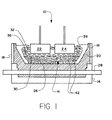
- Fig. 1 is a cross sectional representation of an aluminum electrowinning cell embodying the loosely packed bed elements of the invention.
- Fig. 1 shows in cross section a representation of an aluminum electrowinning cell 10.
- the cell includes a base 14 and sidewalls 16, 18, generally of steel, surrounding the cell.
- the cell includes a cathodic current feeder 20 and anodes 22, 24.
- the base and sidewalls enclose the cathodic current feeder 20 which in this best embodiment functions also as a cell liner. Portions 26 of the liner define a floor of the cell. Well known refractory materials and graphite are suitable for fabricating this.current feeder 20, as are other suitable or conventional materials.
- a current buss 28, embedded in the feeder 20 provides electrical current for distribution within the cell 10. The buss 28 is connected to an external source of electrical current (not shown).
- the anodes 22, 24 are arranged in vertical spaced relationship with the current feeder portions 26 defining the floor of the cell.
- the anodes 22,24 are separated from the cathodic current feeder by two pools 30, 32 of molten material.
- One pool 30 comprises essentially molten aluminum. This molten aluminum pool functions as a cathode for electrowinning of aluminum within the cell. While the pool consists essentially of aluminum, impurities customarily associated with aluminum produced electrolytically may be present.
- the remaining pool 32 is comprised of molten cryolite, Na 3 A1F 6 , containing dissolved A1 2 0 3 .
- a number of cryolite formulations that include additives such as CaF 2 , LiF, and AlF 3 for enhancing electrolysis of the Al 2 O 3 to aluminum are possible and are contemplated as being utilized within the scope of the invention.
- This cryolite layer being less dense than the molten aluminum, floats upon the aluminum.
- An interface 36 separates the molten aluminum 30 from the molten cryolite 32.
- An insulating layer 39 is provided to resist heat flow from the cell 10. While a variety of well-known structures are. available for making this insulating structure, commonly the insulating layer 39 is crystallized contents of the electrolytic cell.
- the anodes 22, 24 are fabricated from any suitable or conventional material and immersed in a cryolite phase 32 contained in the cell. Since oxygen is released in some form at the anode, the anode material must be either resistant to attack by oxygen or should be made of a material that can be agreeably reacted with the evolving oxygen, preferably producing a lower anode half cell voltage by virtue of reactive depolarization. Typically, carbon or graphite is utilized.
- the anodes 22, 24 should be arranged for vertical movement within the cell so that a desired spacing can be maintained between the anode and cathode notwithstanding the anode being consumed by evolved oxygen.
- a packed bed 41 of loose elements 42 is positioned in the cell, in the molten aluminum pool 30.
- These elements are formed of a substance substantially non-wettable by aluminum.
- the elements are maintained in the molten aluminum at a level at or below the interface between the molten aluminum and molten cryolite, the depth to which the elements are packed being substantially uniform across the cell.
- the elements should be not further than 5 centimeters from the interface, but should not extend substantially above the interface, particularly where the elements 42 may be subject to aggressive attack by the cryolite.
- the packed bed elements can be of any shape. It is preferred that the shapes provide, when packed, substantial interstices through the packed bed to assure that aluminum fills gaps in the packing to maintain uniform electrical conductivity through the packed pool of aluminum. Particularly, packing in the form of berl saddles, Intalox saddles, Raschig rings and equiaxed shapes such as cylinders and spheres are much preferred; however randomly shaped packing, blocks or bricks may also suffice.
- the packing is fabricated from a material substantially non-wettable by molten aluminum, with alumina, Al 2 O 3 , being much preferred. Since alumina is soluble in the molten cryolite, and since aluminum is being electrolyzed from alumina dissolved in the cryolite layer 32, it is important that the alumina packing be maintained reliably beneath the interface. Immersion in the molten aluminum shields the packing elements from aggressive attack by the cryolite.
- suitable materials for fabrication of the packing include AlN, A1 4 C 3 , AlB 12 , BN, SiAlON, AlB 2 , ZrO 2 , Hf0 2 , ThO 2 , mixtures of these refractory materials and mixtures with aluminum oxide. Particularly, preferred are Al 2 O 3 , Al 4 C 3 , SiAlON, ZrO 2 , HfO 2 and ThO 2 , mixtures thereof, and mixtures thereof with Al 2 O 3 .
- Electrical conductivity of the packing elements is relatively unimportant. Conductivity pathways through the aluminum immersing the packing provide the substantial current routes between the cathodic current feeder and the interface 36 where active electrowinning occurs. Where the packing provides interstices too small to permit a substantial number of electrical pathways through the aluminum non-wettable packed bed from the current feeder to the interface, than an unacceptably elevated voltage in operating the cell results.
- the packing elements 42 arranged in the cell and immersed in the molten aluminum function to suppress wave formation and propagation in the molten aluminum. Reduced wave action permits quite close anode spacing to the molten aluminum cathode interface 36. This close spacing reduces voltage requirements in operating the cell, thereby reducing power consumption. In order to dampen effectively wave formation in the molten aluminum, it is preferred that the packing be quite close to the-interface while remaining immersed in the molten aluminum. Spacings between the packing and the interface of greater than about 5 centimeters generally will provide less than satisfactory performance in dampening wave motion.
- non-wettable materials such as alumina for packing materials can offer a substantial cost advantage over the use of expensive wettable materials such as titanium boride.
- electrical conductivity in the packing material is not required.
- suitable packing elements 42 range in size from about .1 centimeters to about 5 centimeters, with packing in a size range of from 1 centimeter to 3 centimeters being preferred.
- Alumina tubes fabricated from McDanel Grade 998 alumina, some tubes 39 millimeter (mm) O.D. x 90 mm tall, having a 2 mm wall and some 12.7 mm O.D. x 90 mm tall and having a 2 mm wall were inserted vertically into a laboratory cell containing 600 grams of molten aluminum, interfacing with a thin layer of molten cryolite mix. The tubes protruded slightly through the interface. The cell was held at 1,000°C for one hour; then cooled to room temperature and the solid aluminum containing the alumina tubes was cross-sectioned. It was found that aluminum had completely encapsulated the alumina and filled the tubes.
- alumina had fractured, it is believed, due to thermal shock and a small section of the 12.7 mm O.D. tubing was found laying horizontally at the bottom of the cell, completely filled by aluminum. Sections of the alumina tubes protruding through the aluminum into the cryolite had the typical appearance of poor wetting' by aluminum with an apparent contact angle greater than 90°.
- Raschig rings of alumina, McDanel Grade 998, 29 mm O.D. x 7 mm with a wall thickness of 2 mm were placed in an alumina crucible 54 mm O.D. x 45 mm deep and covered with 150 grams of aluminum shot, Alfa 3.2 mm.
- the crucible was fitted with an alumina covered graphite current feeder to form a cathode assembly.
- the cathode assembly was inserted into a larger alumina crucible, 73 mm I.D. x 152 mm tall, with a 4 mm wall, and 500 grams of cryolite mix was added to cover the cathode assembly.
- a carbon anode was attached to the larger crucible in contact with the cryolite, thereby forming an aluminum electrowinning cell which was then inserted into a ' crucible furnace.
- electrowinning of aluminum was undertaken with an average cell voltage of 3.52 V and at a cathode current density of 0.5 A/cm 2 for 5.5 hours.
- alumina aluminum-non-wettable elements in a commercial cell was evaluated by insertion of packing elements into a commercial cell for controlled periods of time.
- Packing elements utilized were fused-cast alumina bricks, preheated, for four hours prior to insertion into a 60 kiloampere vertical stud Soderberg cell.
- the fused-cast bricks, some measuring 95 x 110 x 148 mm and some 110 x 148 x 187 mm, were lowered into the cell at the edge of the anode shadow and placed on the bottom of the cell.
- the bricks were exposed to the commercial cell environment for periods of 15 minutes, 1 week, and 41 ⁇ 2 months.
Landscapes
- Chemical & Material Sciences (AREA)
- Engineering & Computer Science (AREA)
- Chemical Kinetics & Catalysis (AREA)
- Electrochemistry (AREA)
- Materials Engineering (AREA)
- Metallurgy (AREA)
- Organic Chemistry (AREA)
- Electrolytic Production Of Metals (AREA)
Applications Claiming Priority (2)
| Application Number | Priority Date | Filing Date | Title |
|---|---|---|---|
| US37056582A | 1982-04-21 | 1982-04-21 | |
| US370565 | 1982-04-21 |
Publications (1)
| Publication Number | Publication Date |
|---|---|
| EP0092525A1 true EP0092525A1 (de) | 1983-10-26 |
Family
ID=23460220
Family Applications (1)
| Application Number | Title | Priority Date | Filing Date |
|---|---|---|---|
| EP83810164A Withdrawn EP0092525A1 (de) | 1982-04-21 | 1983-04-19 | Nichtbenetzbare Füllkörper für eine Elektrolysezelle zur Herstellung von Aluminium |
Country Status (4)
| Country | Link |
|---|---|
| EP (1) | EP0092525A1 (de) |
| JP (1) | JPS5913087A (de) |
| AU (1) | AU1369583A (de) |
| NO (1) | NO831398L (de) |
Cited By (4)
| Publication number | Priority date | Publication date | Assignee | Title |
|---|---|---|---|---|
| US4737254A (en) * | 1985-09-06 | 1988-04-12 | Alcan International Limited | Linings for aluminium reduction cells |
| WO1994013861A1 (en) * | 1992-12-17 | 1994-06-23 | Comalco Aluminium Limited | Electrolysis cell for metal production |
| WO2010146369A1 (en) * | 2009-06-18 | 2010-12-23 | Metalysis Limited | Feedstock |
| CN106011942A (zh) * | 2016-07-29 | 2016-10-12 | 四川华索自动化信息工程有限公司 | 一种基于信号电平调节电路的铝电解用自动加料控制系统 |
Citations (6)
| Publication number | Priority date | Publication date | Assignee | Title |
|---|---|---|---|---|
| DE3041680A1 (de) * | 1979-12-05 | 1981-06-11 | Schweizerische Aluminium AG, 3965 Chippis | Kathodenanordnung fuer einen schmelzflusselektrolyseofen |
| EP0033630A1 (de) * | 1980-01-28 | 1981-08-12 | Diamond Shamrock Corporation | Elektrolytische Zelle für die elektrolytische Gewinnung von Aluminium aus geschmolzenen Salzen |
| DE3110490A1 (de) * | 1980-04-03 | 1981-12-24 | Schweizerische Aluminium AG, 3965 Chippis | Schmelzflusselektrolysezelle zur herstellung von aluminium |
| US4308115A (en) * | 1980-08-15 | 1981-12-29 | Aluminum Company Of America | Method of producing aluminum using graphite cathode coated with refractory hard metal |
| DE3024172A1 (de) * | 1980-06-27 | 1982-01-21 | Schweizerische Aluminium AG, 3965 Chippis | Kathode fuer eine schmelzflusselektrolysezelle |
| FR2508496A2 (fr) * | 1981-02-24 | 1982-12-31 | Pechiney Aluminium | Elements cathodiques amovibles en refractaire electroconducteur pour la production d'aluminium par le procede hall-heroult |
-
1983
- 1983-04-19 EP EP83810164A patent/EP0092525A1/de not_active Withdrawn
- 1983-04-20 AU AU13695/83A patent/AU1369583A/en not_active Abandoned
- 1983-04-20 NO NO831398A patent/NO831398L/no unknown
- 1983-04-21 JP JP7083083A patent/JPS5913087A/ja active Pending
Patent Citations (6)
| Publication number | Priority date | Publication date | Assignee | Title |
|---|---|---|---|---|
| DE3041680A1 (de) * | 1979-12-05 | 1981-06-11 | Schweizerische Aluminium AG, 3965 Chippis | Kathodenanordnung fuer einen schmelzflusselektrolyseofen |
| EP0033630A1 (de) * | 1980-01-28 | 1981-08-12 | Diamond Shamrock Corporation | Elektrolytische Zelle für die elektrolytische Gewinnung von Aluminium aus geschmolzenen Salzen |
| DE3110490A1 (de) * | 1980-04-03 | 1981-12-24 | Schweizerische Aluminium AG, 3965 Chippis | Schmelzflusselektrolysezelle zur herstellung von aluminium |
| DE3024172A1 (de) * | 1980-06-27 | 1982-01-21 | Schweizerische Aluminium AG, 3965 Chippis | Kathode fuer eine schmelzflusselektrolysezelle |
| US4308115A (en) * | 1980-08-15 | 1981-12-29 | Aluminum Company Of America | Method of producing aluminum using graphite cathode coated with refractory hard metal |
| FR2508496A2 (fr) * | 1981-02-24 | 1982-12-31 | Pechiney Aluminium | Elements cathodiques amovibles en refractaire electroconducteur pour la production d'aluminium par le procede hall-heroult |
Cited By (6)
| Publication number | Priority date | Publication date | Assignee | Title |
|---|---|---|---|---|
| US4737254A (en) * | 1985-09-06 | 1988-04-12 | Alcan International Limited | Linings for aluminium reduction cells |
| WO1994013861A1 (en) * | 1992-12-17 | 1994-06-23 | Comalco Aluminium Limited | Electrolysis cell for metal production |
| US5658447A (en) * | 1992-12-17 | 1997-08-19 | Comalco Aluminium Limited | Electrolysis cell and method for metal production |
| WO2010146369A1 (en) * | 2009-06-18 | 2010-12-23 | Metalysis Limited | Feedstock |
| EA023858B1 (ru) * | 2009-06-18 | 2016-07-29 | Металисиз Лимитед | Исходное сырье |
| CN106011942A (zh) * | 2016-07-29 | 2016-10-12 | 四川华索自动化信息工程有限公司 | 一种基于信号电平调节电路的铝电解用自动加料控制系统 |
Also Published As
| Publication number | Publication date |
|---|---|
| NO831398L (no) | 1983-10-24 |
| AU1369583A (en) | 1983-10-27 |
| JPS5913087A (ja) | 1984-01-23 |
Similar Documents
| Publication | Publication Date | Title |
|---|---|---|
| EP0094353B1 (de) | Aluminium benetzbare Materialien | |
| US4560448A (en) | Aluminum wettable materials for aluminum production | |
| US4596637A (en) | Apparatus and method for electrolysis and float | |
| US4865701A (en) | Electrolytic reduction of alumina | |
| US5279715A (en) | Process and apparatus for low temperature electrolysis of oxides | |
| US4376690A (en) | Cathode for a cell for fused salt electrolysis | |
| EP0072043B1 (de) | Elektrolytische Herstellung von Aluminium | |
| US4622111A (en) | Apparatus and method for electrolysis and inclined electrodes | |
| US6692631B2 (en) | Carbon containing Cu-Ni-Fe anodes for electrolysis of alumina | |
| US5015343A (en) | Electrolytic cell and process for metal reduction | |
| US4224128A (en) | Cathode assembly for electrolytic aluminum reduction cell | |
| EP0126555A1 (de) | Elektrolytische Zelle und Verfahren | |
| US4664760A (en) | Electrolytic cell and method of electrolysis using supported electrodes | |
| US4544457A (en) | Dimensionally stable drained aluminum electrowinning cathode method and apparatus | |
| WO1989002489A1 (en) | Cathode current collector for aluminum production cells | |
| EP0544737B1 (de) | Aluminium-schmelzzelle ohne wandschutz durch den festen elektrolyten | |
| US5135621A (en) | Composite cell bottom for aluminum electrowinning | |
| EP0033630B1 (de) | Elektrolytische Zelle für die elektrolytische Gewinnung von Aluminium aus geschmolzenen Salzen | |
| US4118304A (en) | Electrolytic alumina reduction cell with heat radiation reducing means | |
| CA1224746A (en) | Cell for the refining of aluminum | |
| US4504366A (en) | Support member and electrolytic method | |
| US5203971A (en) | Composite cell bottom for aluminum electrowinning | |
| EP0092525A1 (de) | Nichtbenetzbare Füllkörper für eine Elektrolysezelle zur Herstellung von Aluminium | |
| GB2065174A (en) | Cathodes for electrolytic furnaces | |
| US4410403A (en) | Electrolysis method |
Legal Events
| Date | Code | Title | Description |
|---|---|---|---|
| PUAI | Public reference made under article 153(3) epc to a published international application that has entered the european phase |
Free format text: ORIGINAL CODE: 0009012 |
|
| AK | Designated contracting states |
Designated state(s): AT BE CH DE FR GB IT LI LU NL SE |
|
| STAA | Information on the status of an ep patent application or granted ep patent |
Free format text: STATUS: THE APPLICATION IS DEEMED TO BE WITHDRAWN |
|
| 18D | Application deemed to be withdrawn |
Effective date: 19840627 |
|
| RIN1 | Information on inventor provided before grant (corrected) |
Inventor name: KONICEK, M.G. Inventor name: WHEELER, D.J. Inventor name: SEN, R.K. |