EP0092724A1 - Verfahren zur Herstellung von faserhaltigen Polyurethanformteilen mit farblich inhomogenen, fasrig verteilte Farbkontraste aufweisenden Oberflächen und entsprechende Formteile - Google Patents
Verfahren zur Herstellung von faserhaltigen Polyurethanformteilen mit farblich inhomogenen, fasrig verteilte Farbkontraste aufweisenden Oberflächen und entsprechende Formteile Download PDFInfo
- Publication number
- EP0092724A1 EP0092724A1 EP83103476A EP83103476A EP0092724A1 EP 0092724 A1 EP0092724 A1 EP 0092724A1 EP 83103476 A EP83103476 A EP 83103476A EP 83103476 A EP83103476 A EP 83103476A EP 0092724 A1 EP0092724 A1 EP 0092724A1
- Authority
- EP
- European Patent Office
- Prior art keywords
- fibers
- color
- polyurethane
- fiber
- colored
- Prior art date
- Legal status (The legal status is an assumption and is not a legal conclusion. Google has not performed a legal analysis and makes no representation as to the accuracy of the status listed.)
- Withdrawn
Links
- 239000000835 fiber Substances 0.000 title claims abstract description 75
- 239000004814 polyurethane Substances 0.000 title claims abstract description 34
- 229920002635 polyurethane Polymers 0.000 title claims abstract description 33
- 238000000034 method Methods 0.000 title claims abstract description 20
- 238000004519 manufacturing process Methods 0.000 title claims abstract description 13
- 239000000203 mixture Substances 0.000 claims abstract description 20
- 230000001413 cellular effect Effects 0.000 claims abstract description 10
- 238000005520 cutting process Methods 0.000 claims abstract description 7
- 238000000465 moulding Methods 0.000 claims description 12
- 238000004040 coloring Methods 0.000 claims description 8
- 239000011541 reaction mixture Substances 0.000 claims description 8
- 239000000126 substance Substances 0.000 claims description 7
- 230000000740 bleeding effect Effects 0.000 claims description 5
- 239000000654 additive Substances 0.000 description 9
- 244000144992 flock Species 0.000 description 9
- 229920001228 polyisocyanate Polymers 0.000 description 9
- 239000005056 polyisocyanate Substances 0.000 description 9
- 239000000975 dye Substances 0.000 description 8
- 230000000694 effects Effects 0.000 description 7
- 238000002156 mixing Methods 0.000 description 7
- 150000001875 compounds Chemical class 0.000 description 5
- 238000012545 processing Methods 0.000 description 5
- 239000007858 starting material Substances 0.000 description 5
- 239000000463 material Substances 0.000 description 4
- 239000002245 particle Substances 0.000 description 4
- 239000000049 pigment Substances 0.000 description 4
- 229920000728 polyester Polymers 0.000 description 4
- 229920005862 polyol Polymers 0.000 description 4
- 150000003077 polyols Chemical class 0.000 description 4
- 229920003225 polyurethane elastomer Polymers 0.000 description 4
- UPMLOUAZCHDJJD-UHFFFAOYSA-N 4,4'-Diphenylmethane Diisocyanate Chemical compound C1=CC(N=C=O)=CC=C1CC1=CC=C(N=C=O)C=C1 UPMLOUAZCHDJJD-UHFFFAOYSA-N 0.000 description 3
- 229920000297 Rayon Polymers 0.000 description 3
- 239000007795 chemical reaction product Substances 0.000 description 3
- 239000003086 colorant Substances 0.000 description 3
- 239000006260 foam Substances 0.000 description 3
- 239000007788 liquid Substances 0.000 description 3
- 229920002239 polyacrylonitrile Polymers 0.000 description 3
- 229920000642 polymer Polymers 0.000 description 3
- 229920002994 synthetic fiber Polymers 0.000 description 3
- 239000012209 synthetic fiber Substances 0.000 description 3
- 239000004970 Chain extender Substances 0.000 description 2
- 239000004952 Polyamide Substances 0.000 description 2
- PPBRXRYQALVLMV-UHFFFAOYSA-N Styrene Chemical compound C=CC1=CC=CC=C1 PPBRXRYQALVLMV-UHFFFAOYSA-N 0.000 description 2
- XAGFODPZIPBFFR-UHFFFAOYSA-N aluminium Chemical compound [Al] XAGFODPZIPBFFR-UHFFFAOYSA-N 0.000 description 2
- 229910052782 aluminium Inorganic materials 0.000 description 2
- 206010061592 cardiac fibrillation Diseases 0.000 description 2
- 239000003795 chemical substances by application Substances 0.000 description 2
- 238000009826 distribution Methods 0.000 description 2
- 229920001971 elastomer Polymers 0.000 description 2
- 239000000806 elastomer Substances 0.000 description 2
- 230000002600 fibrillogenic effect Effects 0.000 description 2
- 239000002657 fibrous material Substances 0.000 description 2
- 239000003365 glass fiber Substances 0.000 description 2
- 238000013508 migration Methods 0.000 description 2
- 230000005012 migration Effects 0.000 description 2
- 239000013518 molded foam Substances 0.000 description 2
- 239000002991 molded plastic Substances 0.000 description 2
- 229920003023 plastic Polymers 0.000 description 2
- 239000004033 plastic Substances 0.000 description 2
- 229920002647 polyamide Polymers 0.000 description 2
- 238000005507 spraying Methods 0.000 description 2
- LCZVSXRMYJUNFX-UHFFFAOYSA-N 2-[2-(2-hydroxypropoxy)propoxy]propan-1-ol Chemical compound CC(O)COC(C)COC(C)CO LCZVSXRMYJUNFX-UHFFFAOYSA-N 0.000 description 1
- 244000198134 Agave sisalana Species 0.000 description 1
- 239000004604 Blowing Agent Substances 0.000 description 1
- 244000025254 Cannabis sativa Species 0.000 description 1
- 235000012766 Cannabis sativa ssp. sativa var. sativa Nutrition 0.000 description 1
- 235000012765 Cannabis sativa ssp. sativa var. spontanea Nutrition 0.000 description 1
- 240000000491 Corchorus aestuans Species 0.000 description 1
- 235000011777 Corchorus aestuans Nutrition 0.000 description 1
- 235000010862 Corchorus capsularis Nutrition 0.000 description 1
- 229920000742 Cotton Polymers 0.000 description 1
- 239000004641 Diallyl-phthalate Substances 0.000 description 1
- 240000006240 Linum usitatissimum Species 0.000 description 1
- 235000004431 Linum usitatissimum Nutrition 0.000 description 1
- 229920002821 Modacrylic Polymers 0.000 description 1
- SJEYSFABYSGQBG-UHFFFAOYSA-M Patent blue Chemical compound [Na+].C1=CC(N(CC)CC)=CC=C1C(C=1C(=CC(=CC=1)S([O-])(=O)=O)S([O-])(=O)=O)=C1C=CC(=[N+](CC)CC)C=C1 SJEYSFABYSGQBG-UHFFFAOYSA-M 0.000 description 1
- 239000004793 Polystyrene Substances 0.000 description 1
- 229920005830 Polyurethane Foam Polymers 0.000 description 1
- 229920001328 Polyvinylidene chloride Polymers 0.000 description 1
- 229920002334 Spandex Polymers 0.000 description 1
- 239000000980 acid dye Substances 0.000 description 1
- 239000004760 aramid Substances 0.000 description 1
- 229920003235 aromatic polyamide Polymers 0.000 description 1
- 239000010425 asbestos Substances 0.000 description 1
- 239000000981 basic dye Substances 0.000 description 1
- 239000011230 binding agent Substances 0.000 description 1
- QUDWYFHPNIMBFC-UHFFFAOYSA-N bis(prop-2-enyl) benzene-1,2-dicarboxylate Chemical compound C=CCOC(=O)C1=CC=CC=C1C(=O)OCC=C QUDWYFHPNIMBFC-UHFFFAOYSA-N 0.000 description 1
- 239000000872 buffer Substances 0.000 description 1
- 235000009120 camo Nutrition 0.000 description 1
- 239000012876 carrier material Substances 0.000 description 1
- 238000005266 casting Methods 0.000 description 1
- 229920002678 cellulose Polymers 0.000 description 1
- 239000001913 cellulose Substances 0.000 description 1
- 235000005607 chanvre indien Nutrition 0.000 description 1
- 238000005253 cladding Methods 0.000 description 1
- 230000015271 coagulation Effects 0.000 description 1
- 238000005345 coagulation Methods 0.000 description 1
- 239000011248 coating agent Substances 0.000 description 1
- 238000000576 coating method Methods 0.000 description 1
- 239000006103 coloring component Substances 0.000 description 1
- 239000012141 concentrate Substances 0.000 description 1
- 238000010276 construction Methods 0.000 description 1
- 229920001577 copolymer Polymers 0.000 description 1
- RGLYKWWBQGJZGM-ISLYRVAYSA-N diethylstilbestrol Chemical compound C=1C=C(O)C=CC=1C(/CC)=C(\CC)C1=CC=C(O)C=C1 RGLYKWWBQGJZGM-ISLYRVAYSA-N 0.000 description 1
- 150000002009 diols Chemical class 0.000 description 1
- 238000007598 dipping method Methods 0.000 description 1
- 238000004090 dissolution Methods 0.000 description 1
- 238000000578 dry spinning Methods 0.000 description 1
- 238000004043 dyeing Methods 0.000 description 1
- 238000007590 electrostatic spraying Methods 0.000 description 1
- 238000001125 extrusion Methods 0.000 description 1
- 239000000945 filler Substances 0.000 description 1
- 239000007850 fluorescent dye Substances 0.000 description 1
- 239000000156 glass melt Substances 0.000 description 1
- 238000000227 grinding Methods 0.000 description 1
- 239000005337 ground glass Substances 0.000 description 1
- 239000011487 hemp Substances 0.000 description 1
- 230000001771 impaired effect Effects 0.000 description 1
- 238000010348 incorporation Methods 0.000 description 1
- 239000004615 ingredient Substances 0.000 description 1
- 238000002347 injection Methods 0.000 description 1
- 239000007924 injection Substances 0.000 description 1
- 239000001023 inorganic pigment Substances 0.000 description 1
- 239000012764 mineral filler Substances 0.000 description 1
- 239000000178 monomer Substances 0.000 description 1
- 238000010137 moulding (plastic) Methods 0.000 description 1
- 229930014626 natural product Natural products 0.000 description 1
- 210000000056 organ Anatomy 0.000 description 1
- 239000012860 organic pigment Substances 0.000 description 1
- 239000003973 paint Substances 0.000 description 1
- 229920005575 poly(amic acid) Polymers 0.000 description 1
- 229920005906 polyester polyol Polymers 0.000 description 1
- 229920000098 polyolefin Polymers 0.000 description 1
- 229920002223 polystyrene Polymers 0.000 description 1
- 239000011496 polyurethane foam Substances 0.000 description 1
- 229920000915 polyvinyl chloride Polymers 0.000 description 1
- 239000004800 polyvinyl chloride Substances 0.000 description 1
- 239000005033 polyvinylidene chloride Substances 0.000 description 1
- 238000012805 post-processing Methods 0.000 description 1
- 238000002360 preparation method Methods 0.000 description 1
- 230000001681 protective effect Effects 0.000 description 1
- 239000002994 raw material Substances 0.000 description 1
- 239000000985 reactive dye Substances 0.000 description 1
- 230000003014 reinforcing effect Effects 0.000 description 1
- 239000012783 reinforcing fiber Substances 0.000 description 1
- 229910052895 riebeckite Inorganic materials 0.000 description 1
- 239000007787 solid Substances 0.000 description 1
- 238000003860 storage Methods 0.000 description 1
- 238000012360 testing method Methods 0.000 description 1
- 230000007704 transition Effects 0.000 description 1
- 239000002966 varnish Substances 0.000 description 1
- 238000002166 wet spinning Methods 0.000 description 1
- 210000002268 wool Anatomy 0.000 description 1
Classifications
-
- C—CHEMISTRY; METALLURGY
- C08—ORGANIC MACROMOLECULAR COMPOUNDS; THEIR PREPARATION OR CHEMICAL WORKING-UP; COMPOSITIONS BASED THEREON
- C08J—WORKING-UP; GENERAL PROCESSES OF COMPOUNDING; AFTER-TREATMENT NOT COVERED BY SUBCLASSES C08B, C08C, C08F, C08G or C08H
- C08J9/00—Working-up of macromolecular substances to porous or cellular articles or materials; After-treatment thereof
- C08J9/0085—Use of fibrous compounding ingredients
-
- C—CHEMISTRY; METALLURGY
- C08—ORGANIC MACROMOLECULAR COMPOUNDS; THEIR PREPARATION OR CHEMICAL WORKING-UP; COMPOSITIONS BASED THEREON
- C08K—Use of inorganic or non-macromolecular organic substances as compounding ingredients
- C08K7/00—Use of ingredients characterised by shape
- C08K7/02—Fibres or whiskers
- C08K7/04—Fibres or whiskers inorganic
- C08K7/14—Glass
-
- C—CHEMISTRY; METALLURGY
- C08—ORGANIC MACROMOLECULAR COMPOUNDS; THEIR PREPARATION OR CHEMICAL WORKING-UP; COMPOSITIONS BASED THEREON
- C08L—COMPOSITIONS OF MACROMOLECULAR COMPOUNDS
- C08L1/00—Compositions of cellulose, modified cellulose or cellulose derivatives
-
- C—CHEMISTRY; METALLURGY
- C08—ORGANIC MACROMOLECULAR COMPOUNDS; THEIR PREPARATION OR CHEMICAL WORKING-UP; COMPOSITIONS BASED THEREON
- C08L—COMPOSITIONS OF MACROMOLECULAR COMPOUNDS
- C08L23/00—Compositions of homopolymers or copolymers of unsaturated aliphatic hydrocarbons having only one carbon-to-carbon double bond; Compositions of derivatives of such polymers
-
- C—CHEMISTRY; METALLURGY
- C08—ORGANIC MACROMOLECULAR COMPOUNDS; THEIR PREPARATION OR CHEMICAL WORKING-UP; COMPOSITIONS BASED THEREON
- C08L—COMPOSITIONS OF MACROMOLECULAR COMPOUNDS
- C08L27/00—Compositions of homopolymers or copolymers of compounds having one or more unsaturated aliphatic radicals, each having only one carbon-to-carbon double bond, and at least one being terminated by a halogen; Compositions of derivatives of such polymers
- C08L27/02—Compositions of homopolymers or copolymers of compounds having one or more unsaturated aliphatic radicals, each having only one carbon-to-carbon double bond, and at least one being terminated by a halogen; Compositions of derivatives of such polymers not modified by chemical after-treatment
- C08L27/04—Compositions of homopolymers or copolymers of compounds having one or more unsaturated aliphatic radicals, each having only one carbon-to-carbon double bond, and at least one being terminated by a halogen; Compositions of derivatives of such polymers not modified by chemical after-treatment containing chlorine atoms
-
- C—CHEMISTRY; METALLURGY
- C08—ORGANIC MACROMOLECULAR COMPOUNDS; THEIR PREPARATION OR CHEMICAL WORKING-UP; COMPOSITIONS BASED THEREON
- C08L—COMPOSITIONS OF MACROMOLECULAR COMPOUNDS
- C08L33/00—Compositions of homopolymers or copolymers of compounds having one or more unsaturated aliphatic radicals, each having only one carbon-to-carbon double bond, and only one being terminated by only one carboxyl radical, or of salts, anhydrides, esters, amides, imides or nitriles thereof; Compositions of derivatives of such polymers
- C08L33/18—Homopolymers or copolymers of nitriles
- C08L33/20—Homopolymers or copolymers of acrylonitrile
-
- C—CHEMISTRY; METALLURGY
- C08—ORGANIC MACROMOLECULAR COMPOUNDS; THEIR PREPARATION OR CHEMICAL WORKING-UP; COMPOSITIONS BASED THEREON
- C08L—COMPOSITIONS OF MACROMOLECULAR COMPOUNDS
- C08L67/00—Compositions of polyesters obtained by reactions forming a carboxylic ester link in the main chain; Compositions of derivatives of such polymers
-
- C—CHEMISTRY; METALLURGY
- C08—ORGANIC MACROMOLECULAR COMPOUNDS; THEIR PREPARATION OR CHEMICAL WORKING-UP; COMPOSITIONS BASED THEREON
- C08L—COMPOSITIONS OF MACROMOLECULAR COMPOUNDS
- C08L75/00—Compositions of polyureas or polyurethanes; Compositions of derivatives of such polymers
- C08L75/04—Polyurethanes
-
- C—CHEMISTRY; METALLURGY
- C08—ORGANIC MACROMOLECULAR COMPOUNDS; THEIR PREPARATION OR CHEMICAL WORKING-UP; COMPOSITIONS BASED THEREON
- C08L—COMPOSITIONS OF MACROMOLECULAR COMPOUNDS
- C08L77/00—Compositions of polyamides obtained by reactions forming a carboxylic amide link in the main chain; Compositions of derivatives of such polymers
-
- C—CHEMISTRY; METALLURGY
- C08—ORGANIC MACROMOLECULAR COMPOUNDS; THEIR PREPARATION OR CHEMICAL WORKING-UP; COMPOSITIONS BASED THEREON
- C08J—WORKING-UP; GENERAL PROCESSES OF COMPOUNDING; AFTER-TREATMENT NOT COVERED BY SUBCLASSES C08B, C08C, C08F, C08G or C08H
- C08J2375/00—Characterised by the use of polyureas or polyurethanes; Derivatives of such polymers
- C08J2375/04—Polyurethanes
-
- Y—GENERAL TAGGING OF NEW TECHNOLOGICAL DEVELOPMENTS; GENERAL TAGGING OF CROSS-SECTIONAL TECHNOLOGIES SPANNING OVER SEVERAL SECTIONS OF THE IPC; TECHNICAL SUBJECTS COVERED BY FORMER USPC CROSS-REFERENCE ART COLLECTIONS [XRACs] AND DIGESTS
- Y10—TECHNICAL SUBJECTS COVERED BY FORMER USPC
- Y10S—TECHNICAL SUBJECTS COVERED BY FORMER USPC CROSS-REFERENCE ART COLLECTIONS [XRACs] AND DIGESTS
- Y10S521/00—Synthetic resins or natural rubbers -- part of the class 520 series
- Y10S521/92—Cellular product containing a dye or pigment
Definitions
- the invention relates to a process for the production of fiber-containing, optionally cellular polyurethane molded parts with color-inhomogeneous, fibrously distributed color contrasting surfaces by incorporating fibers as an effect component into the polyurethane reaction components, and the corresponding molded parts.
- molded parts made of expanded or solid polyurethanes are provided with a surface coloration by adding pigments, dyes or both to the reaction components. It is also known that colored surfaces can be obtained by subsequent treatment of the molded parts, e.g. Dipping in dye baths, by spraying, by casting or by the so-called “in-mold coating” process can be produced.
- a disadvantage of this method is that by adding conventional coloring ingredients a homogeneously colored surface is created for the liquid components, which leaves the typical impression of a plastic surface.
- a surface is not always desirable for certain articles, for example fashionable shoe soles.
- Colored post-treatment such as applying paint, by spraying, also enables color-inhomogeneous surfaces to be achieved.
- the aftertreatment requires a higher cost and can only be achieved, for example, with directly foamed shoe soles using special measures (covering the shoe upper with stencils).
- an application of varnish results in a typical surface appearance, which is well known and is increasingly rejected for fashion reasons.
- fiber-filled polyurethane elastomers have also become known, in particular those based on cut and ground glass fiber additives - cf. DE-OS 2 056 740, the fibers being said to have reinforcing effects.
- the use of organic reinforcing fibers is described in DE-OS 2 220 306 and DE-OS 2 164 381.
- DE-OS 2 419 527 discloses a process for the production of decorative plastic moldings from molding compositions containing colored components.
- such polymers are mixed into the molding compositions (for example unsaturated, glass- and asbestos-containing polyesters, dissolved in styrene / diallyl phthalate monomers).
- Particles eg granular polystyrene
- the polymer particles have a different color than the molding compound and are processed under conditions such as melt or extrusion that the polymer particles show a certain degree of dissolution necessary for the decorative purpose.
- the blended particles can be granular, flaky or thread-like in accordance with the desired decorative purpose. This creates natural stone-like, decorative effects with blurred color transitions.
- the method can be used particularly with suitable treatment of the fiber flock e.g. with Doroflocs, (BAYER AG, Leverkusen) with easy incorporation and even distribution of the fiber flocks in the polyurethane raw materials using conventional mixing devices (propeller stirrer, toothed disk stirrer, turbo stirrer) available in the relevant industry. Furthermore, it was found that the colored fiber flakes in the carrier medium do not tend to settle or float and, as a result, no special measures are required during processing to prevent these faults.
- the invention thus relates to a process for the production of fiber-containing, optionally cellular, polyurethane molded parts, preferably polyurethane-elastomer molded parts, with color-inhomogeneous, fibrously distributed color contrasts and fashionably appealing surfaces by a known reaction of, optionally cellular, polyurethane Shaped reaction mixtures in preferably closed forms, characterized in that colored fibers or fiber mixtures in a cutting length of 0.1 to 6 mm, preferably 0.4 to 3 mm, and a titer of 0.1 to 25 dtex, preferably 1 to 20 dtex, particularly preferably 1.3 to 17 dtex, which show no bleeding of their content of coloring substances and do not dissolve in the starting components of the polyurethanes, in amounts of 0.1 to 10% by weight, preferably 0.15 to 3 % By weight, particularly preferably 0.2 to 2% by weight, based on the fiber-containing reaction mixture, of one or more of the starting compos or part of it.
- the invention further relates to molded parts, especially shoe soles and uppers, based on homogeneous or cellular polyurethanes with a density of> 350 kg / m 3 to the density of the polyurethane elastomer, which may not be expanded with other fillers and other additives, preferably with a Density ⁇ 450 kg / m3, with a color-inhomogeneous, fibrously distributed color contrast surface, containing colored fibers or fiber mixtures in a cutting length of 0.1 to 6 mm, preferably 0.4 to 3 mm, and a titer of 0.1 to 25 dtex, preferably 1.0 to 20 dtex, particularly preferably 1.3 to 17 dtex, which show no bleeding of their coloring matter content and do not dissolve in the starting components of the polyurethanes, in amounts of 0.1 to 10% by weight, preferably 0.15 to 3% by weight, particularly preferably 0.2 up to 2% by weight, based on the polyurethane.
- the colored fibers are preferably added to the component containing polyhydroxyl compounds. This can also be done by adding only some of the polyhydroxyl compounds to the fibers. However, the fibers can also be added to the component containing polyisocyanate or a possibly further component such as chain extenders or other additional components. If instead of a one-stage reaction leading to the polyurethane using the two-stage process over NCO prepolymers, the fibers can also be added to the NCO prepolymer.
- fibers as an additional component into the mixing vessel or into the mixing chamber only during the mixing of the reaction components, one or more fiber concentrates being used in e.g. can use relatively small amounts of the polyhydroxyl compounds.
- fiber concentrates being used in e.g. can use relatively small amounts of the polyhydroxyl compounds.
- different or differently colored flock fibers can be incorporated into the polyurethane-forming materials and special color effects can be achieved in the end product.
- the colored fibers to be used according to the invention are preferably natural or synthetic colored fibers which form a color contrast with the polyurethane carrier material, which is itself undyed but can also be colored.
- the type of the resulting, color-inhomogeneous surfaces with a "vivid" grain type colored surface of the polyurethane molding also depends on the type, shape, thickness and length of the fibers used.
- the dimensions of the colored fibers are primarily upwards from those for the manufacture of the molded part le used machines or mixing and / or conveying organs limited. In contrast, it has been shown that if the dimensions of the fibers are too small, a less high-contrast surface or a color-homogeneous surface is produced.
- colored fibers with a cutting length of 0.1 to 6 mm, but preferably 0.4 to 3 mm, must be used according to the invention. For milled or fibrillated fibers, mixtures with a maximum fiber length of 6 mm are used.
- the titer of the fibers used extends from 0.1 to 25 dtex, but preferably from 1.0 to 20 dtex, particularly preferably 1.3 to 17 dtex. Furthermore, the surface appearance depends on the amount of fiber added. According to the invention, there are additives of 0.1 to 10% by weight, but preferably 0.15 to 3% by weight and particularly 0.2 to 2% by weight, based on the entire reaction mixture leading to the polyurethane, including all additives in Fraqe.
- the colored fibers can also be used in the form of mixtures of fibers of different chemical structures, differently shaped fiber cross sections and different titers, different lengths and possibly varying thicknesses within the fiber length. Mixtures of differently colored fibers can also be used or color effects can be achieved by varying color mixtures. Colored fibers of the type known as flock fibers for flocking surfaces have proven particularly suitable.
- all fibrous natural products can be used in natural (colored) form as natural fiber material. It is e.g. fibers made of cotton, wool, flax, hemp, jute, bast, palm fiber, sisal and others, e.g. are colored with dyes in contrast to the polyurethane.
- fibers made of chemical materials which meet the conditions according to the invention are suitable as synthetic fibers.
- fibers are from modified natural materials such as viscose or from chemical materials such as synthetic fibers made of polyamide, polyacrylonitrile, polyester, aramid, elastane, modacrylic, polyvinyl chloride, polyvinylidene chloride, polyolefins and / or various copolymers which can be converted into fiber form.
- commercial flock fiber material is preferably used e.g. made of polyamide, viscose, polyacrylonitrile or polyester.
- pigments or dyes must be used which, after the colored flock fibers have been mixed into the carrier medium, preferably into the polyhydroxyl compounds, do not migrate (bleeding).
- selected basic dyes for example AstrazonQY dyes, have proven themselves in connection with polyacrylonitrile fibers, reactive dyes for polyamic acid dyes or for cellulose or viscose fibers.
- Colored fibers with inorganic pigments or poorly soluble organic pigments as colorants are generally my bloodless. The fibers must be colored beyond their own color and differentiate sufficiently in terms of color depth from the polyurethane mass, which itself can also be colored.
- dyeing therefore, in general, based on the weight of the fiber, more than 0.4% by weight of dye or pigment, preferably more than 0.75% by weight, mostly more than 1% by weight of dye or pigment, used.
- fibers with fluorescent dyes, fluorescent colors, colored opalescent additives (pearlescent additives) and other coloring additives can also be used.
- the fibers themselves can be produced by dry and wet spinning processes, by coagulation processes, by fibrillation or electrostatic spraying or by mechanical comminution such as cutting, tearing, grinding, fibrillation. It can also multicomponent fibers Bifilarfasern with curling tendency, textured threads or bändchenförmi g e be used threads.
- the surface of the fibers is usually treated with such customary preparations or other surface-modifying agents that they can be easily distributed in the starting materials for polyurethane production.
- Particularly suitable fibers of this type are the commercially available "flock fibers" offered for flocking purposes.
- glass fibers spun from colored glass melts
- glass fibers spun from colored glass melts
- suitable colored glass fibers can only be produced in limited colors and with a technologically and economically few practicable method of working, which is unsuitable.
- the colored fibers must have a sufficient migration resistance of the dye used.
- the migration behavior can be tested by storing the mixture of colored fibers and the reaction component serving as a carrier at the corresponding processing temperature of this component (e.g. polyester polyol / fiber mixture at 50 ° C).
- the duration of this test must extend over the practical storage time of the mixture of reaction component and fiber flock (at least two hours), preferably -24 hours.
- molded parts to be produced according to the invention are shoe soles, shoe heels, shoe uppers, outsoles foamed in one operation, soles with a multi-layer structure, elastic rubber-like buffers, recessed grips, safety covers, cushion parts, for example in automobile construction, mats, surfboard pads, protective caps, pillows, covers, housings, furniture parts , Cladding or chair moldings.
- the molded parts which are particularly preferably to be produced according to the invention are soft, semi-hard or hard, preferably semi-hard and preferably cellular polyurethane moldings with a closed outer skin, as are known in a manner known per se by reacting reaction mixtures which react to form polyurethane molded plastics in closed molds are available under "over-charging".
- the amount of the reaction mixture introduced into the mold is dimensioned such that the average density of the resulting molded body is above the density of a corresponding, freely foamed, that is to say, for example, obtained in an open mold, foam.
- reaction mixtures known per se are preferably also processed in one stage using the known two-component mixing units.
- relevant literature see, for example, "Integral foams” from Piechota / Rschreib, pages 26-56 or "Economical production of PUR molded parts” VDI-Verlag Düsseldorf (1981), pages 123-136).
- the process according to the invention can also be carried out according to the prepolymer principle, i.e. for example, in such a way that the moldings are produced from previously prepared NCO prepolymers and suitable chain extenders, if appropriate with the use of the customary auxiliaries and additives.
- the shaped bodies according to the invention are preferably semi-hard polyurethane elastomers with a closed outer skin and preferably a cellular core, i.e. the known starting materials which react to form such elastomers are preferably used in carrying out the process according to the invention.
- the density of the elastomers according to the invention is at least 350 kg / m 3 , preferably at least 450 kgjm 3 and can be used in the case of moldings which are weakly or not foamed and possibly contain mineral fillers up to 1,400, preferably up to 1,200 kg / m 3 .
- the method according to the invention is used in particular for the production of shoe soles and upper.
- Examples 1 and 2 below describe the production of polyurethane shoe soles.
- An aluminum mold tempered to 40 ° C was used for this.
- the amount of the foamable mixture was measured so that molded articles with a bulk density of 500 kg / m 3 resulted.
- the reaction components are processed on a low-pressure machine from DESMA, which is especially suitable for the production of polyurethane shoe soles (Injection Unit PSA 70 from DESMA-Werke GmbH, D-2807 Achim).
- the delivery and metering of the reaction components was done via gear pumps.
- the reaction components are mixed by a high-speed mixing screw.
- the polyisocyanate component consisted of a semi-prepolymer with an NCO content of 20% by weight, produced by reacting 4,4'-diisocyanato-diphenylmethane with the polyester diol mentioned above.
- Components A) and B) are processed in compliance with an NCO index of 100.
- the polyisocyanate component consists of a reaction product of 4,4'-diisocyanatodiphenylmethane with an equimolar mixture of di- and tripropylene glycol.
- the reaction product has an NCO content of 24% by weight.
- Components A) and B) were processed in compliance with an NCO index of 100.
- the polyisocyanate component corresponded to the polyisocyanate component of Example 1.
- Components A) and B) were mixed equimolecularly with one another and placed in an aluminum mold with the dimensions 200x200x10 mm and heated to 40 ° C. After a mold life of 3 minutes, the result was a flexible, massive, i.e. non-foamed molded body with a color-inhomogeneous surface.
- Example 3 Using the mold described in Example 3, a mixture of A) and B) is processed to a molded foam while maintaining an NCO index of 100, the amount of the foamable mixture being measured such that a bulk density of the molded body of 500 kg / m 3 resulted. After a mold life of 5 minutes, a rigid polyurethane foam molded body with a color-inhomogeneous surface texture resulted.
Landscapes
- Chemical & Material Sciences (AREA)
- Health & Medical Sciences (AREA)
- Chemical Kinetics & Catalysis (AREA)
- Medicinal Chemistry (AREA)
- Polymers & Plastics (AREA)
- Organic Chemistry (AREA)
- Engineering & Computer Science (AREA)
- Materials Engineering (AREA)
- Footwear And Its Accessory, Manufacturing Method And Apparatuses (AREA)
- Compositions Of Macromolecular Compounds (AREA)
- Molding Of Porous Articles (AREA)
- Reinforced Plastic Materials (AREA)
- Laminated Bodies (AREA)
- Casting Or Compression Moulding Of Plastics Or The Like (AREA)
Abstract
Die Erfindung betrifft ein neuartiges Verfahren zu Herstellung von, gegebenenfalls zellulären, Polyurethanformteilen mit farblich inhomogenen, fasrig verteilte Farbkontraste aufweisenden, modisch ansprechenden Oberflächen, bei welchem man bei der an sich bekannten Herstellung derartiger Formteile mindestens einer der Ausgangskomponenten oder einem Teil hiervon farbige Fasern oder Fasergemische in einer Schnittlänge von 0,1 bis 6 mm und einem Titer von 0,1 bis 25 dtex einverleibt, sowie die entsprechenden Formteile mit einer farblich inhomogenen, fasrig verteilte Farbkontraste aufweisenden Oberfläche.
Description
- Die Erfindung betrifft ein Verfahren zur Herstellung von faserhaltigen, gegebenenfalls zellulären Polyurethan-Formteilen mit farblich inhomogene, fasrig verteilte Farbkontraste aufweisenden Oberflächen durch Einarbeitung von Fasern als Effektkomponente in die Polyurethan-Reaktionskomponenten, sowie die entsprechenden Formteile.
- Es ist bekannt, daß man Formteile aus expandierten oder massiven Polyurethanen mit einer Oberflächenfärbung durch Hinzufügung von Pigmenten, Farbstoffen oder beiden zu den Reaktionskomponenten versieht. Es ist weiterhin bekannt, daß farbige Oberflächen durch nachträgliche Behandlung der Formteile, z.B. Tauchen in Farbbäder, durch Spritzen, durch Gießen oder durch das sog. "in-mould-coating"-Verfahren hergestellt werden können.
- Ein Nachteil dieser Verfahren besteht darin, daß durch den Zusatz von herkömmlichen färbenden Bestandteilen zu den flüssigen Komponenten eine homogen gefärbte Oberfläche entsteht, die den typischen Eindruck einer Kunststoff-Oberfläche hinterläßt. Eine solche Oberfläche ist jedoch für bestimmte Artikel, z.B. modische Schuhsohlen, nicht immer erwünscht. Durch farbliche Nachbehandlung z.B. Lackauftrag.durch Spritzen, lassen sich ebenfalls farblich inhomogene Oberflächen erzielen. Die Nachbehandlung erfordert jedoch einen höheren Kostenaufwand und läßt sich z.B. bei direkt angeschäumten Schuhsohlen nur unter Anwendung besonderer Maßnahmen (Abdecken des Schuhoberteiles durch Schablonen) verwirklichen. Außerdem ergibt z.B. ein Auftrag von Lacken ein typisches Oberflächenbild, welches hinlänglich bekannt ist und aus modischen Aspekten heraus mehr und mehr abgelehnt wird.
- Es sind auch prinzipiell schon fasergefüllte Polyurethan-Elastomere bekannt geworden, insbesondere solche, welche auf Basis von geschnittenen und gemahlenen Glasfaserzusätzen - vgl. DE-OS 2 056 740, wobei die Fasern Verstärkungswirkungen aufweisen sollen. Die Verwendung auch organischer Verstärkungsfasern wird in der DE-OS 2 220 306 und DE-OS 2 164 381 beschrieben.
- Aus der DE-OS 2 419 527 ist ein Verfahren zur Herstellung dekorativer Kunststoff-Formkörper aus gefärbte Komponenten enthaltenden Formmassen bekannt geworden. Man mischt hierzu in die Formmassen (z.B. ungesättigte, glas-/und asbestfaser-haltige Polyester, gelöst in Styrol-/Diallylphthalat-Monomeren) solche Polymerisat-Teilchen (z.B. gekörntes Polystyrol) ein, welche zumindest teilweise unter den bei der Verformung vorliegenden Bedingungen in dem Bindemittel der Formmasse löslich sind. Dabei haben die Polymerisat-Teilchen eine andere Farbe als die Formmasse und werden unter solchen Bedingungen, z.B. über Schmelze oder Extrusion, verarbeitet, daß die Polymerisat-Teilchen einen bestimmten, für den dekorativen Zweck notwendigen Grad der Auflösung zeigen. Die eingemischten Teilchen können entsprechend dem gewünschten dekorativen Zweck korn-, schuppen- oder fadenförmig sein. Es entstehen natursteinartige, dekorative Effekte mit verwischten Farbübergängen.
- Es wurde nun gefunden, daß man modisch ansprechende Formteile aus Polyurethanen mit farblich inhomogene, fasrig verteilte Farbkontraste aufweisenden Oberflächen durch den Zusatz von farbigem, sog. Faserflock (kurze, geschnittene oder anderweitig zerkleinerte Fasern) als farbgebende oder zusätzlich farbgebende Bestandteile zu den Reaktionskomponenten des Polyurethans erhält, ohne daß die Verarbeitung der flüssigen Reaktionskomponenten beeinträchtigt wird. Der erwünschte farbige Oberflächeneffekt entsteht dabei direkt aus den flüssigen Reaktionskomponenten während der Reaktion, ohne daß irgendeine Nachbearbeitung der Formteile zur Farbgebung notwendig wird. Die Verarbeitung der Polyurethan-Reaktionskomponenten kann dabei auf den herkömmlichen, in der einschlägigen Industrie vorhandenen Verarbeitungsmaschinen erfolgen, ohne daß die mechanischen Eigenschaften der farbige Kontraste aufweisenden Formteile wesentlich beeinträchtigt werden.
- Das Verfahren läßt sich besonders bei geeigneter Behandlung des Faserflocks z.B. mit Doroflocs, (BAYER AG, Leverkusen) in problemloser Einarbeitung und gleichmäßiger Verteilung des Faserflocks in den Polyurethan-Ausgangsmaterialien durch herkömmliche, in der einschlägigen Industrie vorhandenen Mischeinrichtungen (Propeller-Rührer, Zahnscheiben-Rührer, Turbo-Rührer) durchführen. Weiterhin wurde gefunden, daß die farbigen Faserflocken im Trägermedium nicht zum Absetzen oder Aufschwimmen neigen und dadurch bei der Verarbeitung, keine besonderen Maßnahmen erforderlich sind, um diese Störungen zu verhindern.
- Gegenstand der Erfindung ist somit ein Verfahren zur Herstellung von faserhaltigen, gegebenenfalls zellulären Polyurethan-Formteilen, vorzugsweise Polyurethan-Elastomer-Formteilen, mit farblich inhomogenen, fasrig verteilte Farbkontraste aufweisenden, modisch ansprechenden Oberflächen durch an sich bekannte Umsetzung von zu, gegebenenfalls zellulären, Polyurethan-Formteilen ausreagierenden Reaktionsgemischen in vorzugsweise geschlossenen Formen, dadurch gekennzeichnet, daß man farbige Fasern oder Fasergemische in einer Schnittlänge von 0,1 bis 6 mm, vorzugsweise 0,4 bis 3 mm, und einem Titer von 0,1 bis 25 dtex, vorzugsweise 1 bis 20 dtex, besonders bevorzugt 1,3 bis 17 dtex, welche kein Ausbluten ihres Gehaltes an färbenden Stoffen zeigen und sich nicht in den Ausgangskomponenten der Polyurethane lösen, in Mengen von 0,1 bis 10 Gew.-%, bevorzugt 0,15 bis 3 Gew.-%, besonders bevorzugt 0,2 bis 2 Gew.-%, bezogen auf das faserhaltige Reaktionsgemisch, einem oder mehreren der Ausgangskomponenten oder einem Teil davon zumischt.
- Gegenstand der Erfindung sind ferner Formteile, speziell Schuhsohlen und -schäfte auf der Basis von homogenen oder zellulären Polyurethanen mit einer Dichte von >350 kg/m3 bis zur Dichte des gegebenenfalls mit weiteren Füllstoffen und anderen Zusatzstoffen nicht expandierten Polyurethan-Elastomeren, vorzugsweise mit einer Dichte ≥ 450 kg/m3 ,
mit einer farblich inhomogenen, fasrig verteilte Farbkontraste aufweisenden Oberfläche,
enthaltend farbige Fasern oder Fasergemische in einer Schnittlänge von 0,1 bis 6 mm, vorzugsweise 0,4 bis 3 mm, und einem Titer von 0,1 bis 25 dtex, vorzugsweise 1,0 bis 20 dtex, besonders bevorzugt 1,3 bis 17 dtex, welche kein Ausbluten ihres Gehaltes an färbenden Stoffen zeigen und sich nicht in den Ausgangskomponenten der Polyurethane lösen, in Mengen von 0,1 bis 10 Gew.-%, bevorzugt 0,15 bis 3 Gew.-%, besonders bevorzugt 0,2 bis, 2 Gew.-%, bezogen auf das Polyurethan. - Die Erfindung kann nach unterschiedlichen Arten der Durchführung realisiert werden. So setzt man die farbigen Fasern vorzugsweise der Polyhydroxylverbindungen enthaltenden Komponente zu. Dies kann auch durch Zusatz der Fasern nur zu einem Teil der Polyhydroxylverbindungen geschehen. Die Fasern können jedoch auch der Polyisocyanat enthaltenden Komponente oder einer eventuell weiteren Komponente wie Kettenverlängerungsmitteln oder sonstigen Zusatzkomponenten beigegeben werden. Wenn statt einer einstufigen, zum Polyurethan führenden Reaktion nach dem Zweistufen-Verfahren über NCO-Prepolymere gearbeitet wird, kann der Zusatz der Fasern auch zum NCO-Prepolymer erfolgen.
- Eine weitere Möglichkeit besteht darin, die Fasern erst während der Vermischung der Reaktionskomponenten als zusätzliche Komponente in das Mischgefäß bzw. in die Mischkammer einzubringen, wobei man ein oder mehrere Faser-Konzentrate in z.B. relativ geringen Mengen der Polyhydroxylverbindungen benutzen kann. Hierdurch lassen sich auch unterschiedliche oder unterschiedlich farbige Flockfasern in die Polyurethan-bildenden Massen einbringen und es lassen sich besondere farbliche Effekte im Endprodukt erzielen.
- Bei den erfindungsgemäß zu verwendenden farbigen Fasern handelt es sich vorzugsweise um natürliche oder synthetische farbige Fasern, die mit dem Polyurethan-Trägermaterial, welches selbst ungefärbt ist aber auch gefärbt sein kann, einen farblichen Kontrast bilden.
- Die Art der sich damit ergebenden, farblich inhomogenen - Oberflächen mit einer "belebten" Maserungsart farbigen Oberfläche des Polyurethan-Formteils hängt ebenfalls von der Art, der Form, der Dicke und der Länge der verwendeten Fasern ab.
- Die Abmessungen der farbigen Fasern werden nach oben hin in erster Linie von der für die Herstellung der Formteile benutzten Maschinen bzw. Misch- und/oder Förderorgane begrenzt. Dagegen hat sich gezeigt, daß bei zu geringen Abmessungen-der Fasern eine weniger kontrastreiche, bzw. eine farblich homogene Oberfläche entsteht. Zur Erzielung des gewünschten Oberflächenbildes muß man erfindungsgemäß farbige Fasern mit einer Schnittlänge von 0,1 bis 6 mm, vorzugsweise jedoch 0,4 bis 3 mm einsetzen. Bei gemahlenen oder fibrillierten Fasern verwendet man Gemische mit einer maximalen Faserlänge von 6 mm.
- Der Titer der verwendeten Fasern erstreckt sich erfindungsgemäß auf 0,1 bis 25 dtex, vorzugsweise jedoch von 1,0 bis 20 dtex, besonders bevorzugt 1,3 bis 17 dtex. Weiterhin ist das Oberflächenbild von der Menge des zugesetzten Faseranteils abhängig. Erfindungsgemäß kommen Zusätze von 0,1 bis 10 Gew.-%, vorzugsweise jedoch 0,15 bis 3 Gew.-% und besonders von 0,2 bis 2 Gew.-%, bezogen auf das gesamte zum Polyurethan führende Reaktionsgemisch, einschließlich aller Zusätze in Fraqe. Es können die farbigen Fasern auch in Form von Mischunqen von Fasern verschiedenen chemischen Aufbaus, verschieden geformter Faserquerschnitte und verschiedener Titer, verschiedener Länge und gegebenenfalls variierender Dicke innerhalb der Faserlänge verwendet werden. Ferner können Mischungen von verschiedenfarbigen Fasern eingesetzt werden bzw. Farbeffekte durch variierende Farbmischungen erzielt werden. Besonders geeignet haben sich solche farbigen Fasern, wie sie als Flockfasern zum Beflocken von Oberflächen bekannt sind, erwiesen.
- Als natürliches Fasermaterial können erfindungsgemäß alle fasrigen Naturprodukte in farbiger (gefärbter) Form eingesetzt werden. Es handelt sich dabei z.B. um Fasern aus Baumwolle, Wolle, Flachs, Hanf, Jute, Bast, Palmfaser, Sisal und anderen, welche z.B. mit Farbstoffen kontrastreich zum Polyurethan gefärbt sind.
- Als synthetische Fasern eignen sich alle Fasern aus Chemiewerkstoffen, die die erfindungsgemäßen Bedingungen erfüllen. So werden Fasern z.B. aus modifizierten Naturstoffen wie Viskose oder aus Chemiewerkstoffen wie synthetischen Fasern aus Polyamid, Polyacrylnitril, Polyester, Aramid, Elasthan, Modacryl, Polyvinylchlorid, Polyvinylidenchlorid, Polyolefinen und/oder verschiedenen Copolymerisaten, die sich in Faserform überführen lassen, eingesetzt. Vorzugsweise wird jedoch handelsübliches Flockfasermaterial z.B. aus Polyamid, Viskose, Polyacrylnitril oder Polyester eingesetzt.
- Um den gewünschten Farbkontrast der Formteil-Oberflächen zu erhalten, müssen Pigmente oder Farbstoffe verwendet werden, die nach dem Einmischen der farbigen Flockfasern in das Trägermedium, vorzugsweise in die Polyhydroxylverbindungen, nicht migrieren (Ausbluten). Dafür haben sich z.B. in Verbindung mit Polyacrylnitril-Fasern ausgesuchte basische Farbstoffe z.B. AstrazonQY-Farbstoffe bewährt, für'Polyamidsäurefarbstoffe oder für Cellulose- bzw. Viskose-Fasern Reaktivfarbstoffe. Farbige Fasern mit anorganischen Pigmenten oder schwerlöslichen organischen Pigmenten als farbgebenden Mittel sind im allgemeinen ausblutfest. Die Fasern müssen über ihre Eigenfarbe hinaus farbig sein und in der Farbtiefe hinreichend gegenüber der Polyurethanmasse, die selbst auch gefärbt sein kann, differenzieren. Zur Färbung werden daher im allgemeinen, bezogen auf das Gewicht der Faser, mehr als 0,4 Gew.-% Farbstoff oder Farbpigment, bevorzugt mehr als 0,75 Gew.-%, zumeist mehr als 1 Gew.-% Farbstoff oder Farbpigment, verwendet. Für besondere Effekte können auch Fasern mit Fluoreszenz-Farbstoffen, Tagesleuchtfarben, farbig opaleszierenden Zusätzen (perlmuttartigen Zusätzen) und sonstigen farbgebenden Zusätzen verwendet werden.
- Die Fasern selbst können dabei nach Trocken- und Naßspinnverfahren, nach Koagulationsverfahren, durch Fibrillieren oder elektrostatisches Sprühen oder auch durch mechanische Zerkleinerung wie Schneiden, Reißen, Mahlen, Fibrillieren hergestellt werden. Es können auch Mehrkomponentenfasern, Bifilarfasern mit Kräuselungstendenz, texturierte Fäden oder bändchenförmige Fäden eingesetzt werden. Die Fasern werden an ihrer Oberfläche zumeist mit solchen üblichen Präparationen oder sonstigen Oberflächen modifizierenden Mitteln behandelt, daß sie sich leicht in den Ausgangsmaterialien der Polyurethan-Herstellung verteilen lassen. Besonders geeignete Fasern dieser Art sind die für Beflockungszwecke angebotenen handelsüblichen "Flockfasern".
- Anstelle von natürlichen oder synthetischen Fasern können auch Glasfasern (Silidatfasern), welche aus farbigen Glasschmelzen ersponnen wurden, eingesetzt werden. Ein solches Vorgehen ist jedoch in der Praxis wenig bevorzugt, da sich geeignete farbige Glasfasern nur in begrenzten Farbtönen und technologisch-wirtschaftlich wenige praktikabler Arbeitsweise herstellen lassen, ungeeignet.
- Die farbigen Fasern müssen erfindungsgemäß eine ausreichende Migrationsbeständigkeit des verwendeten Farbstoffs aufweisen. Eine Prüfung des Migrationsverhaltens kann durch Lagern des Gemisches von farbigen Fasern und der als Träger dienenden Reaktionskomponente bei der entsprechenden Verarbeitungstemperatur dieser Komponente erfolgen (z.B. Polyesterpolyol/Faser-Abmischung bei 50°C). Die Zeitdauer dieser Prüfung muß sich über die praktische Lagerzeit des Gemisches von Reaktionskomponente und Faserflock erstrecken (zumindest zwei Stunden), vorzugsweise-24 Stunden.
- Als farbige Fasern sollen nur solche verwendet werden, welche sich in den Reaktionskomponenten bzw. während der Polyurethan-bildenden Reaktion nicht auflösen oder zum Teil lösen. Beispiele für erfindungsgemäß herzustellende Formteile sind Schuhsohlen, Schuhabsätze, Schuhschäfte, in einem Arbeitsgang angeschäumte Laufsohlen, Sohlen in mehrschichtigem Aufbau, elastische gummiartige Puffer, Griffmulden, Sicherheitsblenden, Polsterteile, z.B. im Automobilbau, Matten, Surfbretterauflagen, Schutzkappen, Kissen, Abdeckungen, Gehäuse, Möbelteile, Verkleidungen oder Stuhl-Formteile.
- Bei den besonders bevorzugt erfindungsgemäß herzustellenden Formteilen handelt es sich um weiche, halbharte oder harte, vorzugsweise halbharte und vorzugsweise zelluläre Polyurethan-Formkörper mit einer geschlossenen Außenhaut, wie sie in an sich bekannter Weise durch Umsetzung von, zu Polyurethan-Formkunststoffen ausreagierenden Reaktionsgemischen in geschlossenen Formen unter "over-charging" erhältlich sind. Bei dieser bekannten Methode wird die Menge des in die Form eingebrachten Reaktionsgemisches so bemessen, daß die durchschnittliche Dichte des resultierenden Formkörpers über der Dichte eines entsprechenden, frei geschäumten, d.h. beispielsweise in einer offenen Form erhaltenen, Schaumstoffes liegt. Durch geeignete Wahl der Art und Menge der eingesetzten Ausgangsmaterialien, sowie Hilfs- und Zusatzmittel, sowie durch an sich bekannte Steuerung der Formtemperatur lassen sich so die unterschiedlichsten Formschaumstoffe mit mehr oder weniger stark ausgebildeter Außenhaut und gegebenenfalls mit integraler Dichteverteilung oder aber auch - bei Verzicht auf die Mitverwendung von Treibmitteln - massive Formkunststoffe erhalten. Desgleichen kann die Härte der erfindungsgemäß herzustellenden Formkörper durch geeignete Wahl der Art und Menge der eingesetzten Ausgangsmaterialien in an sich bekannter Weise eingestellt werden. Die chemische Natur der Ausgangsmaterialien, sowie die Zusammensetzung der Rezepturen ist nicht erfindungswesentlich und kann der einschlägigen Literatur entnommen werden (vgl. diesbezüglich z.B. "Integralschaumstoffe" von Piechota/Röhr, Carl Hanser Verlag, München/Wien, Seiten 14-23 oder Kunststoff-Handbuch, Bd. VII, "Polyurethane" von Vieweg/ Höchtlen, Carl Hanser Verlag, München).
- Vorzugsweise erfolgt auch beim erfindungsgemäßen Verfahren die Verarbeitung der an sich bekannten Reaktionsgemische einstufig mit Hilfe der bekannten Zweikomponenten-Mischaggregate. Auch diesbezüglich kann auf die einschlägige Literatur verwiesen.werden (vgl. z.B. "Integralschaumstoffe" von Piechota/Röhr, Seiten 26-56 oder "Wirtschaftliches Herstellen von PUR-Formteilen" VDI-Verlag Düsseldorf (1981), Seiten 123-136).
- Das erfindungsgemäße Verfahren kann jedoch auch nach dem Prepolymerprinzip erfolgen, d.h. beispielsweise dergestalt, daß man die Formkörper aus vorab hergestellten NCO-Prepolymeren und geeigneten Kettenverlängerungsmitteln, gegebenenfalls unter Mitverwendung der üblichen Hilfs- und Zusatzmittel herstellt.
- Bei den erfindungsgemäßen Formkörpern handelt es sich vorzugsweise um halbharte Polyurethan-Elastomere mit einer geschlossenen Außenhaut und vorzugsweise zellförmigem Kern hergestellt, d.h. es werden bei der Durchführung des erfindungsgemäßen Verfahrens vorzugsweise die bekannten, zu derartigen Elastomeren ausreagierenden Ausgangsmaterialien eingesetzt.
- Erfindungswesentlich ist einzig und allein die bereits erwähnte Mitverwendung der farbigen Fasern in den oben genannten Mengen.
- Die Dichte der erfindungsgemäßen Elastomeren beträgt mindestens 350 kg/m3, vorzugsweise mindestens 450 kgjm3 und kann im Falle von schwach oder nicht geschäumten, evtl. mineralische Füllstoffe enthaltenden Formkörpern bis zu 1.400, vorzugsweise bis zu 1.200 kg/m3, betragen. Wie bereits ausgeführt, dient das erfindungsgemäße Verfahren insbesondere der Herstellung von Schuhsohlen und -schäften.
- Die nachstehenden Beispiele dienen der weiteren Erläuterung des erfindungsgemäßen Verfahrens.
- In den nachfolgenden Beispielen 1 und 2 wird die Herstellung von Polyurethan-Schuhsohlen beschrieben. Hierzu wurde eine auf 40°C temperierte Aluminiumform verwendet. Die Menge des schaumfähigen Gemisches wurde so bemessen, daß Formkörper einer Rohdichte von 500 kg/m3 resultierten. Die Verarbeitung der Reaktionskomponenten erfolgt auf einer Niederdruckmaschine der Firma DESMA, die speziell für die Herstellung von Polyurethan-Schuhsohlen geeignet ist (Injection Unit PSA 70 der Firma DESMA-Werke GmbH, D-2807 Achim). Die Förderung und Dosierung der Reaktionskomponenten geschah über Zahnradpumpen. Das Vermischen der Reaktionskomponenten erfolgt durch eine hochtourige Mischschnecke.
-


- Die Polyisocyanat-Komponente bestand aus einem Semi-Prepolymeren mit einem NCO-Gehalt von 20 Gew.-%, hergestellt durch Umsetzung von 4,4'-Diisocyanato-diphenylmethan mit dem oben genannten Polyesterdiol.
- Die Komponenten A) und B) werden unter Einhaltung einer NCO-Kennzahl von 100 verarbeitet.
- Nach einer Formstandzeit von 4 Min. wird eine flexible Schuhsohle erhalten, die eine farblich inhomogene Oberfläche aufweist, wobei der farbliche Oberflächeneffekt mit einer feinen Marmorierung verglichen werden kann. Die einzelnen Fasern sind mit dem bloßen Auge hierbei nicht zu erkennen.
-
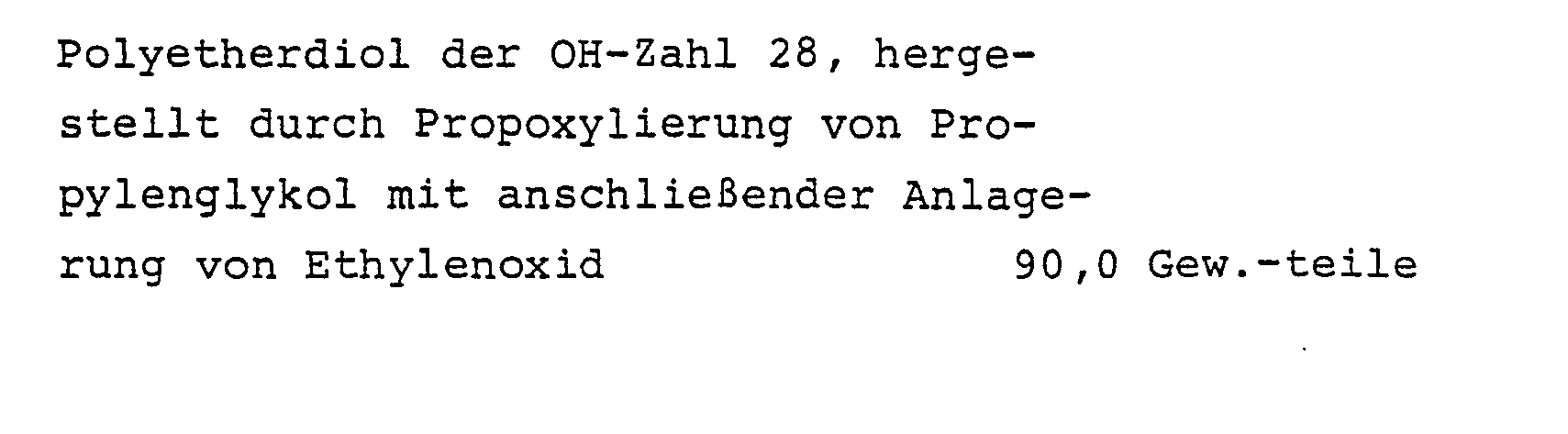

- Die Polyisocyanat-Komponente besteht aus einem Umsetzungsprodukt von 4,4'-Diisocyanato-diphenylmethan mit einem äquimolaren Gemisch aus Di- und Tripropylenglykol. Das Umsetzungsprodukt weist einen NCO-Gehalt von 24 Gew.-% auf.
- Die Komponenten A) und B) wurden unter Einhaltung einer NCO-Kennzahl von 100 verarbeitet.
- Nach einer Formstandzeit von 4 Min. wurde eine Schuhsohle mit einer farblich inhomogenen Oberfläche erhalten.
-


- Die Polyisocyanat-Komponente entsprach der Polyisocyanat-Komponente des Beispiels 1.
- Die Komponenten A) und B) wurden äquimolekular miteinander vermischt und in eine auf 40°C temperierte Aluminiumform der Abmessung 200x200x10 mm gegeben. Nach einer Formstandzeit von 3 Min. resultierte ein flexibler, massiver, d.h. nicht-geschäumter Formkörper mit einer farblich inhomogenen Oberfläche.
-


- Carbodiimid-modifiziertes 4,4'-Diisocyanato-diphenylmethan mit einem NCO-Gehalt von 30 %.
- Unter Verwendung der in Beispiel 3 beschriebenen Form wird ein Gemisch aus A) und B) unter Einhaltung einer NCO-Kennzahl von 100 zu einem Formschaumstoff verarbeitet, wobei die Menge des schäumfähigen Gemisches so bemessen wurde, daß eine Rohdichte des Formkörpers von 500 kg/m3 resultierte. Nach einer Formstandzeit von 5 Min. resultierte ein starrer Polyurethanschaumstoff-Formkörper mit einer farblich inhomogenen Oberflächenbeschaffenheit.
Claims (2)
1. Verfahren zur Herstellung von faserhaltigen, gegebenenfalls zellulären Polyurethan-Formteilen mit farblich inhomogenen, fasrig verteilte Farbkontraste aufweisenden, modisch ansprechenden Oberflächen durch an sich bekannte Umsetzung von zu, gegebenenfalls zellulären, Polyurethan-Formteilen ausreagierenden Reaktionsgemischen in geschlossenen Formen, dadurch gekennzeichnet, daß man farbige Fasern oder Fasergemische mit einer Schnittlänge von 0,1 bis 6 mm und einem Titer von 0,1 bis 25 dtex, welche kein Ausbluten ihres Gehalts an färbenden Stoffen zeigen und sich nicht in den Ausgangskomponenten der Polyurethane lösen, in Mengen von 0,1 bis 10 Gew.-%, bezogen auf das faserhaltige Reaktionsgemisch, einem oder mehreren der Ausgangskomponenten oder einem Teil davon zumischt.
2. Formteile auf der Basis von homogenen oder zellulären Polyurethanen mit einer Dichte von 5:350 kg/ m3 mit einer farblich inhomogenen, fasrig verteilte Farbkontraste aufweisenden Oberfläche, enthaltend farbige Fasern oder Fasergemische in einer Schnittlänge von 0,1 bis 6 mm mit einem Titer von 0,1 bis 25 dtex, welche kein Ausbluten ihres Gehalts an färbenden Stoffen zeigen und sich nicht in den Ausgangskomponenten der Polyurethane lösen, in Mengen von 0,1 bis 10 Gew.-%, bezogen auf das Polyurethan.
Applications Claiming Priority (2)
| Application Number | Priority Date | Filing Date | Title |
|---|---|---|---|
| DE3215260 | 1982-04-23 | ||
| DE19823215260 DE3215260A1 (de) | 1982-04-23 | 1982-04-23 | Verfahren zur herstellung von faserhaltigen polyurethanformteilen mit farblich inhomogenen, fasrig verteilte farbkontraste aufweisenden oberflaechen und entsprechende formteile |
Publications (1)
| Publication Number | Publication Date |
|---|---|
| EP0092724A1 true EP0092724A1 (de) | 1983-11-02 |
Family
ID=6161803
Family Applications (1)
| Application Number | Title | Priority Date | Filing Date |
|---|---|---|---|
| EP83103476A Withdrawn EP0092724A1 (de) | 1982-04-23 | 1983-04-11 | Verfahren zur Herstellung von faserhaltigen Polyurethanformteilen mit farblich inhomogenen, fasrig verteilte Farbkontraste aufweisenden Oberflächen und entsprechende Formteile |
Country Status (5)
| Country | Link |
|---|---|
| US (1) | US4456707A (de) |
| EP (1) | EP0092724A1 (de) |
| JP (1) | JPS58191124A (de) |
| DE (1) | DE3215260A1 (de) |
| ES (1) | ES8402324A1 (de) |
Families Citing this family (5)
| Publication number | Priority date | Publication date | Assignee | Title |
|---|---|---|---|---|
| US7185468B2 (en) | 2002-10-31 | 2007-03-06 | Jeld-Wen, Inc. | Multi-layered fire door and method for making the same |
| WO2005106155A1 (en) * | 2004-04-21 | 2005-11-10 | Jeld-Wen, Inc. | Fiber-reinforced composites and building structures comprising fiber-reinforced composites |
| US8486711B2 (en) | 2004-10-22 | 2013-07-16 | Bayer Materialscience Llc | Highly fluorescent markers for fluids or articles |
| KR100838820B1 (ko) | 2006-05-15 | 2008-06-17 | 진양화학 주식회사 | 열가소성 폴리우레탄 수지 조성물 |
| USD867346S1 (en) * | 2018-01-19 | 2019-11-19 | Dynamic Ear Company B.V. | Ambient filter |
Citations (4)
| Publication number | Priority date | Publication date | Assignee | Title |
|---|---|---|---|---|
| DE2419527A1 (de) * | 1973-04-26 | 1974-11-14 | All Decostone Nv | Verfahren zur herstellung dekorativer kunststoffartikel, sowie formkoerper, hergestellt gemaess diesem verfahren |
| DE2220306B2 (de) * | 1971-04-26 | 1977-07-21 | Bndgestone Tire Co Ltd, Tokio | Verstaerkung von polyurethanelastomeren mit organischen fasern |
| DE2924426A1 (de) * | 1978-11-24 | 1980-06-04 | Grace W R & Co | Polyurethan-schaumstoff |
| DE3016713A1 (de) * | 1979-05-03 | 1980-11-20 | Le I Tekstilnoj I Legkoj Promy | Poroeses offenzelliges fuellstoffhaltiges reaktionsfaehiges material |
Family Cites Families (9)
| Publication number | Priority date | Publication date | Assignee | Title |
|---|---|---|---|---|
| US3024209A (en) * | 1959-05-27 | 1962-03-06 | Minerals & Chem Philipp Corp | Polyurethane foam containing inorganic pigment coated with polymeric material |
| BE759129A (fr) * | 1969-11-18 | 1971-05-18 | Atlantic Richfield Co | Compositions d'urethanes elastomeres charges de fibres |
| US3968182A (en) * | 1971-04-26 | 1976-07-06 | Bridgestone Tire Company Limited | Urethane rubber compositions reinforced with chopped organic fibers |
| BE793041A (fr) * | 1971-12-23 | 1973-06-20 | Bayer Ag | Resines de polyurethanes dures renforcees et aptes au formage reversible a la chaleur |
| US3904557A (en) * | 1972-10-26 | 1975-09-09 | Grace W R & Co | Method for production of a multicolored urethane sponge |
| US4137215A (en) * | 1973-04-26 | 1979-01-30 | Stamicarbon, B.V. | Process for preparing decorative plastics articles, as well as products prepared according to the process |
| US4182700A (en) * | 1976-07-20 | 1980-01-08 | Benton William J | Elastomeric polyurethane film containing dispersed discrete aggregates of liquid crystal and method of making the same |
| US4102831A (en) * | 1976-10-12 | 1978-07-25 | Osgood Alan A | Imparting anlsotropy to foams by orienting added fibers whereby said fibers become parallely aligned |
| US4201846A (en) * | 1977-11-25 | 1980-05-06 | W. R. Grace & Co. | Dimensionally stable polyurethane foam |
-
1982
- 1982-04-23 DE DE19823215260 patent/DE3215260A1/de not_active Withdrawn
-
1983
- 1983-04-11 US US06/484,067 patent/US4456707A/en not_active Expired - Fee Related
- 1983-04-11 EP EP83103476A patent/EP0092724A1/de not_active Withdrawn
- 1983-04-21 JP JP58069290A patent/JPS58191124A/ja active Pending
- 1983-04-22 ES ES521768A patent/ES8402324A1/es not_active Expired
Patent Citations (4)
| Publication number | Priority date | Publication date | Assignee | Title |
|---|---|---|---|---|
| DE2220306B2 (de) * | 1971-04-26 | 1977-07-21 | Bndgestone Tire Co Ltd, Tokio | Verstaerkung von polyurethanelastomeren mit organischen fasern |
| DE2419527A1 (de) * | 1973-04-26 | 1974-11-14 | All Decostone Nv | Verfahren zur herstellung dekorativer kunststoffartikel, sowie formkoerper, hergestellt gemaess diesem verfahren |
| DE2924426A1 (de) * | 1978-11-24 | 1980-06-04 | Grace W R & Co | Polyurethan-schaumstoff |
| DE3016713A1 (de) * | 1979-05-03 | 1980-11-20 | Le I Tekstilnoj I Legkoj Promy | Poroeses offenzelliges fuellstoffhaltiges reaktionsfaehiges material |
Also Published As
| Publication number | Publication date |
|---|---|
| ES521768A0 (es) | 1984-01-16 |
| ES8402324A1 (es) | 1984-01-16 |
| DE3215260A1 (de) | 1983-10-27 |
| JPS58191124A (ja) | 1983-11-08 |
| US4456707A (en) | 1984-06-26 |
Similar Documents
| Publication | Publication Date | Title |
|---|---|---|
| DE69030659T2 (de) | Verstärkte Polymermatrix und Mikro- und Makrofasern enthaltendes Produkt | |
| DE2552804C2 (de) | Polyamidharzmasse | |
| EP2909256B1 (de) | Nachwachsende rohstoffe enthaltender verbundwerkstoff sowie verfahren zu seiner herstellung | |
| DE1934348A1 (de) | Blockmischpolymerisate auf der Basis von Polystyrol und Polyisopren | |
| DE3417369A1 (de) | Verbindung aus zusammengesetztem material unter verwendung von abfall-kunstfaser | |
| AT509801A1 (de) | Gefärbte flammgehemmte zelluloseformkörper | |
| DE2735220A1 (de) | Haftmittelzusammensetzung | |
| DE1569183A1 (de) | Eine Verbesserung des Fliessverhaltens und der Verformbarkeit von Polyurethanmassen | |
| DD298128A5 (de) | Verfahren zur herstellung gefuellter waermehaertbarer verbindungen des polyurethantyps und erhaltene verbindungen | |
| DE2129028A1 (de) | Synthetischer Belag fur Spielfelder und Sportanlagen und Verfahren zu deren Herstellung | |
| DE3215260A1 (de) | Verfahren zur herstellung von faserhaltigen polyurethanformteilen mit farblich inhomogenen, fasrig verteilte farbkontraste aufweisenden oberflaechen und entsprechende formteile | |
| DE3017899A1 (de) | Verfahren zur herstellung von pur- gebundenen gummigranulatmatten | |
| DE3145290C2 (de) | Verfahren zur Herstellung von elastischen Formkörpern, insbesondere von Fußbettsohlen, aus weichgemachten Kautschukmischungen | |
| DE69829265T2 (de) | Giessverfahren für Polyurethane unter Verwendung eines internen Formtrennmittels und daraus hergestellte Formkörper | |
| DE69929333T2 (de) | Gebundener schaum und herstellungsverfahren dafür | |
| DE2302893A1 (de) | Undurchlaessiges textilmaterial und verfahren zu dessen herstellung | |
| DE2546373A1 (de) | Verfahren zum verformen geschaeumter gegenstaende | |
| DE2320655A1 (de) | Gummiaehnliche polymere zusammensetzung | |
| DE19919111C2 (de) | Ledermahlgut enthaltende Zusammensetzung für die Herstellung von Formteilen, Verfahren zur Herstellung bzw. Anwendung der Formteile | |
| DE1669374C (de) | Verfahren zum Herabsetzen der Spinntemperatur beim Herstellen von gefärbten Polypropylenfasern | |
| DE69311242T2 (de) | Absatz für Schuh | |
| AT274371B (de) | Verfahren zur Herstellung von vernetzten Formkörpern aus thermoplastisch verarbeitbaren Polyurethanen | |
| DE1215362B (de) | Verfahren zur Herstellung von vernetzten Polyurethanformkoerpern mit verbesserten dynamischen Eigenschaften | |
| DE870759C (de) | Gegenstand aus Schwammkautschuk | |
| DE733097C (de) | Verfahren zur Herstellung von Phenol-Formaldehydharzpressmassen |
Legal Events
| Date | Code | Title | Description |
|---|---|---|---|
| PUAI | Public reference made under article 153(3) epc to a published international application that has entered the european phase |
Free format text: ORIGINAL CODE: 0009012 |
|
| 17P | Request for examination filed |
Effective date: 19830411 |
|
| AK | Designated contracting states |
Designated state(s): DE FR GB IT |
|
| STAA | Information on the status of an ep patent application or granted ep patent |
Free format text: STATUS: THE APPLICATION HAS BEEN WITHDRAWN |
|
| 18W | Application withdrawn |
Withdrawal date: 19850611 |
|
| RIN1 | Information on inventor provided before grant (corrected) |
Inventor name: HILLE, LOTHAR, ING. GRAD. Inventor name: LUEDKE, HEIMO, DR. Inventor name: HANSJOSTEN, NIKOLAUS |