EP0092747A1 - Verfahren, zusätzliche Vorrichtung und System für farbige Computergrafikfotografie - Google Patents
Verfahren, zusätzliche Vorrichtung und System für farbige Computergrafikfotografie Download PDFInfo
- Publication number
- EP0092747A1 EP0092747A1 EP83103673A EP83103673A EP0092747A1 EP 0092747 A1 EP0092747 A1 EP 0092747A1 EP 83103673 A EP83103673 A EP 83103673A EP 83103673 A EP83103673 A EP 83103673A EP 0092747 A1 EP0092747 A1 EP 0092747A1
- Authority
- EP
- European Patent Office
- Prior art keywords
- pixel groups
- color pixel
- constant color
- image
- constant
- Prior art date
- Legal status (The legal status is an assumption and is not a legal conclusion. Google has not performed a legal analysis and makes no representation as to the accuracy of the status listed.)
- Granted
Links
Images


Classifications
-
- G—PHYSICS
- G06—COMPUTING OR CALCULATING; COUNTING
- G06K—GRAPHICAL DATA READING; PRESENTATION OF DATA; RECORD CARRIERS; HANDLING RECORD CARRIERS
- G06K15/00—Arrangements for producing a permanent visual presentation of the output data, e.g. computer output printers
- G06K15/02—Arrangements for producing a permanent visual presentation of the output data, e.g. computer output printers using printers
- G06K15/12—Arrangements for producing a permanent visual presentation of the output data, e.g. computer output printers using printers by photographic printing, e.g. by laser printers
- G06K15/1233—Arrangements for producing a permanent visual presentation of the output data, e.g. computer output printers using printers by photographic printing, e.g. by laser printers using a cathode-ray tube or an optical-fibre tube
-
- G—PHYSICS
- G06—COMPUTING OR CALCULATING; COUNTING
- G06F—ELECTRIC DIGITAL DATA PROCESSING
- G06F3/00—Input arrangements for transferring data to be processed into a form capable of being handled by the computer; Output arrangements for transferring data from processing unit to output unit, e.g. interface arrangements
- G06F3/002—Specific input/output arrangements not covered by G06F3/01 - G06F3/16
-
- G—PHYSICS
- G06—COMPUTING OR CALCULATING; COUNTING
- G06K—GRAPHICAL DATA READING; PRESENTATION OF DATA; RECORD CARRIERS; HANDLING RECORD CARRIERS
- G06K2215/00—Arrangements for producing a permanent visual presentation of the output data
- G06K2215/0082—Architecture adapted for a particular function
- G06K2215/0094—Colour printing
Definitions
- This invention relates generally to a method and apparatus for making and photographing computer graphic images and, more particularly, to a method and apparatus for making and photographing computer graphic colored images utilizing a minimum size computer memory.
- a method for defining and photographing a graphic image comprises the steps of first defining and storing within a computer memory the graphic image to be photographed as a plurality of constant color pixel groups. The time during which a selected photosensitive material must be exposed to a selected light color intensity for each of the constant color pixel groups is next determined. the determined exposure times are then ordered for each of the constant color pixel groups into either a progressively increasing or decreasing sequence. Each of the constant color pixel groups are thereafter visually displayed at the selected light color and intensity for its determined exposure time to the photosensitive material.
- the output from the cathode ray beam drive 34 is directed to a black-and-white cathode ray tube 40 having a display screen 38 overlapped by a rotatably mounted filter wheel 42.
- the filter wheel 42 comprises the three primary red, green, and blue color filters each one of which may be selectively moved into overlying relationship with respect to the display screen 38 by a motor drive 44.
- the light from the display screen 38 is transmitted through a selected one of the red, green, and blue filters of the filter wheel 42 to a lens 46 from which it is imaged on the surface of a photosensitive material as shown at 48.
- the cathode ray tube 40, the filter wheel 42, the lens 46, and the photosensitive material 48 are all housed in a suitable lighttight chamber (not shown in the drawing).
- Motor 44 is controlled by a motor control 50 which receives an output control signal from the filter wheel control 26.
- the first step that the user takes is to code and store the image to be photographed in the RAM 18 as shown by block I in the flow chart of FIG. 2.
- the user is presented with program menus and questions which allow him to proceed in the following manner.
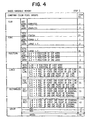
- the user may first be requested to define the text of the image to be photographed in response to which he may enter by way of the keyboard 12 those words which he would wish to appear as text in the image as shown in the first part of the tabulation of FIG. 4.
- the basic variable memory 20 would tabulate these words as shown in FIG. 4.
- the user is thus able to select a maximum of thirty words of text as shown in this example which words are stored in the variable memory 30.
- variable memory 30 The user might next be asked to select a particular font for the text which he has previously entered into the variable memory 30.
- each tabulation of a particular type of font operates only to qualify a corresponding word of text and thus no new items are added to the righthand column of FIG. 4.
- the user may thereafter be asked by the computer program to designate the position of each word of text to which he might respond by way of the keyboard 12 by providing the tabulated position data as shown in FIG. 4.
- the first word of text is located by a first set of numbers designating the x position of the first word on the monitor 36 and a second set of numbers designating the Y position of the first word on the monitor 36.
- the position of the second word is then defined by a first set of numbers designating the x position of the second word on the monitor 36 and a second set of numbers designating the y position of the second word on the monitor and so on down the list until the position of the last or thirtieth word is designated.
- no new items are added to the righthand column of FIG. 4 since the tabulation of position data corresponds to the words of the text previously tabulated.
- the user might next be asked to define any lines which he wishes to define on the image which may be utilized as part of a chart, diagram, graph, etc.
- the user thereafter enters by way of keyboard 12 a first set of numbers designating the x position of the first end of the first line which he wishes to define on the image.
- a second set of numbers is thereafter entered to define the y position of the first end point of the first line followed by a third set of numbers to designate the x position of the second end point of the first line and a fourth set of numbers to designate the y position of the second end point of the first line.
- This data is tabulated as shown in FIG. 4 and stored in the variable memory 30 in the aforementioned manner.
- the user may next be asked to define the rectangle to which he can respond through the keyboard 12 by entering a first set of numbers defining the x position of the first end point of the diagonal of the rectangle, a second set of numbers designating the y position of the first end point of the diagonal of the rectangle, a third set of numbers designating the x position of the second endpoint of the diagonal of the rectangle, and a fourth set of numbers designating the y position of the second endpoint of the diagonal of the rectangle as shown tabulated in FIGi 4.
- the information tabulated in FIG. 4 is stored in the variable memory 30 in the aforementioned manner.
- Other rectangles may be defined in the
- the rectangle may be designated by four sets of numbers in order to save computer memory capacity since it is not necessary to define each pixel in the rectangle by a tabulated data point.
- the user might lastly be asked to select one color from as many as 64 different colors for each of the aforementioned items to which he would again respond by way of the keyboard to provide the color tabulation as shown in FIG. 4 which again would be stored by the variable memory 30. Since each color corresponds to a previously-identified item, there are no new items added to the righthand column of FIG. 4 by the tabulated color designations.
- each item having a color so designated will hereinafter be referred to as a constant color pixel group (CCPG).
- each rectangle or line tabulated in FIG. 4 constitutes an individual constant color pixel group (CCPG) and each word of text may also constitute a constant color pixel group (CCPG).
- CCPG constant color pixel group
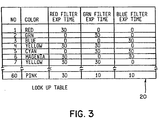
- each of the 64 different colors from which the user may choose to designate each constant color pixel group is tabulated as a function of its exposure time in the three primary red, green, and blue colors for a given exposure light intensity and film speed sensitivity.
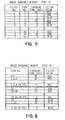
- the computer program implements step II as shown in the flow chart of FIG. 2 to determine the exposure times for each item or constant color pixel group (CCPG) utilizing the tabulated exposure times of FIG. 3 to provide a new tabulation of exposure times for each item (CCPG) as shown in FIG. 5 which is subsequently stored in the variable memory 30.
- the exposure time for each constant color pixel group (CCPG) through each of the three primary red, green, and blue color filters is determined from the look-up table 20 by the central processing unit 14 and thereafter stored in the variable memory 30 in the form as shown in FIG. 5.
- the central processing unit 14 thereafter provides a command by way of the filter wheel control 26 to the motor control 50 to, in turn, actuate the motor 44 and drive the filter wheel 42 to its starting position which as shown may be with the red filter aligned between the display screen 38 and the lens 46 as illustrated by step III in the flow chart of FIG. 2.
- the central processing unit 14 thereafter operates in accordance with step IV of the flow chart of TIG. 2 to sort the constant color pixel groupings (CCPG's) into a descending order of exposure times for the red filter position as shown tabulated in the upper portion of FIG. 6 which tabulation is also stored in the variable memory 30.
- CCPG's constant color pixel groupings
- more than one item or constant color pixel group may require the same exposure time through the red color filter as, for example, both items one and two require thirty seconds for exposure through the red color filter.
- the constant color pixel groups (CCPG's) are ordered in a progressively decreasing sequence, those items requiring the longest exposure times are included throughout the lefthand column with each succeeding item or constant color pixel group (CCPG) in the ordered sequence of exposure times being added until all the constant color pixel groups (CCPG's) requiring the least time of exposure are tabulated.
- items one and two require the longest time of exposure (thirty seconds) through the red color filter and are thus tabulated first in.the ordered sequence of exposure times.
- Item number eight requires twenty-five seconds of exposure time through the red color filter and thus is tabulated next along with items one and two which require more than twenty-five seconds of exposure to the red color filter.
- the minimum exposure time required through the red color filter is four seconds, and thus all the items which require any exposure at all through the red color filter are included in this tabulation.
- the central processing unit 14 implements the next step as shown in block V of the flow chart of FIG. 2 by getting the next item to be exposed from the ordered tabulation of items in FIG. 6 which for the first items in our example would be items one and two.
- the next step implemented by the central processing unit 14 as shown in block VI of FIG. 2 operates to set all the bits to binary logic fl's in the image memory 22 which correspond to the items to be displayed (item numbers one and two).
- the central processing unit 14 times the exposure by way of the timer program 28 to wait for the difference between the exposure time of this group of items (CCPG's) and the exposure time of the next succeeding group of items (CCPG's) which difference for the example as shown in FIG. 6 is five seconds.
- the exposure is timed as shown in step VIII of FIG. 2 and thereafter ended by a stop command from the central processing unit 14 to the CRT 40 by way of the video converter 32 and CRT beam drive 34 as shown in step IX of the flow chart of FIG. 2.
- the central processing unit 14 thereafter commands a repeat of the aforementioned steps for all of the items to be exposed through the red filter as shown in step X of the flow chart of FIG. 2.
- the next item (CCPG) to be drawn for exposure in step VI of the flow chart of FIG. 2 in our example is item eight to which the film must be exposed for twenty-five seconds.
- item eight in addition to the two previously-drawn items one and two are displayed next for exposure to the film.
- the central processing unit 14 continues the program until those items requiring the least exposure through the red color filter are displayed on the screen 38 for the minimum exposure time which in our example from FIG. 6 is four seconds.
- each succeeding display on the CRT will show the previously-displayed items (CCPG's) and the exposure time for each step will be equal to the difference between the exposure time for that group of items (CCPG's) and the exposure time for the next succeeding group of items (CCPG's) on the tabulated list of FIG. 6.
- the aforementioned steps are repeated for all the color filter positions as shown by step XI in the flow chart of FIG. 2.
- the filter is moved to the next filter position which in our example is the green filter position and all the items (CCPG's) to which the film is to be exposed through the green filter are listed in descending order of exposure times as shown by the middle portion of the tabulated list in FIG. 6.
- the process is repeated in the aforementioned manner until all the items (CCPG's) to which the film is to be exposed through the green filter are exposed for their appropriate exposure times.
- Step XI of the flow chart of FIG. 2 is again repeated by the central processing unit 14 to move the filter wheel 42 so that the blue filter overlies the screen 38 whereupon the process is repeated for all the items (CCPG's) to which the film 48 is to be exposed by way of the blue filter.
- the image memory 22 need only be required to store a bit of information signifying whether the electron beam is either on or off for each pixel of the image to be displayed thereby substantially reducing the heretofore required memory for such computer imaging systems.
- step IV of the flow chart of FIG. 2 describes listing the items (CCPG's) in descending order of exposure times
- the items (CCPG's) could alternatively be listed in a progressively increasing order of exposure times so as to reverse the order of sequence as tabulated in the list of FIG. 6.
- all of the items (CCPG's) to be exposed to any particular filter color would be displayed first thereafter eliminating from the visual display each succeeding item (CCPG's) in the ordered sequence so as to finally display only the last of the items (CCPG's) which require the longest exposure times and which in the example shown in FIG. 6 for the red color filter would be item numbers one and two.
- CRT 40 is illustrated, it will be equally apparent to also utilize any light source arrangement emitting light in the red, green, and blue spectrum in place of the CRT.
- CRT 40 has been described as being controlled by the central processing unit to end the display of each group of items (CCPG's) during each incremental exposure time, it would be equally apparent that this timing function could be accomplished by an appropriate shutter arrangement timed by the central processing unit. It will also be apparent that the (CCPG's) could alternatively be generated with select electronic circuits instead of the aforementioned computer implemented algorithms.
Landscapes
- Engineering & Computer Science (AREA)
- Physics & Mathematics (AREA)
- Theoretical Computer Science (AREA)
- General Engineering & Computer Science (AREA)
- General Physics & Mathematics (AREA)
- Optics & Photonics (AREA)
- Human Computer Interaction (AREA)
- Controls And Circuits For Display Device (AREA)
- Projection-Type Copiers In General (AREA)
- Printers Or Recording Devices Using Electromagnetic And Radiation Means (AREA)
- Control Of Exposure In Printing And Copying (AREA)
Applications Claiming Priority (2)
| Application Number | Priority Date | Filing Date | Title |
|---|---|---|---|
| US36871182A | 1982-04-15 | 1982-04-15 | |
| US368711 | 1982-04-15 |
Publications (2)
| Publication Number | Publication Date |
|---|---|
| EP0092747A1 true EP0092747A1 (de) | 1983-11-02 |
| EP0092747B1 EP0092747B1 (de) | 1986-10-15 |
Family
ID=23452425
Family Applications (1)
| Application Number | Title | Priority Date | Filing Date |
|---|---|---|---|
| EP19830103673 Expired EP0092747B1 (de) | 1982-04-15 | 1983-04-15 | Verfahren, zusätzliche Vorrichtung und System für farbige Computergrafikfotografie |
Country Status (4)
| Country | Link |
|---|---|
| EP (1) | EP0092747B1 (de) |
| JP (1) | JPH0664305B2 (de) |
| CA (1) | CA1203005A (de) |
| DE (1) | DE3367036D1 (de) |
Cited By (4)
| Publication number | Priority date | Publication date | Assignee | Title |
|---|---|---|---|---|
| EP0096348B1 (de) * | 1982-06-07 | 1986-10-08 | Polaroid Corporation | System und Verfahren zum Definieren und Anzeigen eines Bildesfür eine photographische Wiedergabe |
| EP0453660A1 (de) * | 1990-04-26 | 1991-10-30 | Agfa-Gevaert N.V. | Datenverschaffendes Verfahren |
| EP0750275A3 (de) * | 1989-10-24 | 1998-02-04 | Canon Kabushiki Kaisha | Aufzeichnungsgerät |
| US6278805B1 (en) * | 1999-05-13 | 2001-08-21 | Eastman Kodak Company | System for composing color transforms using class information |
Families Citing this family (1)
| Publication number | Priority date | Publication date | Assignee | Title |
|---|---|---|---|---|
| JPS6326646A (ja) * | 1986-07-21 | 1988-02-04 | Apetsukusu:Kk | コンピユ−タ−グラフイツクスプリントカ−ド及びその製造方法 |
Citations (1)
| Publication number | Priority date | Publication date | Assignee | Title |
|---|---|---|---|---|
| EP0006161A1 (de) * | 1978-06-02 | 1980-01-09 | Mathematical Applications Group, Inc. | Datenverarbeitungsanlage mit Diapositivausgabe |
Family Cites Families (3)
| Publication number | Priority date | Publication date | Assignee | Title |
|---|---|---|---|---|
| JPS50130453A (de) * | 1974-02-15 | 1975-10-15 | ||
| JPS51104827A (en) * | 1975-03-12 | 1976-09-17 | Hitachi Ltd | crt karaahaadokopiisochi |
| JPS5333141A (en) * | 1976-09-09 | 1978-03-28 | Jeol Ltd | Automatic converting device for converting monochrome picture into color one |
-
1983
- 1983-04-14 CA CA000425887A patent/CA1203005A/en not_active Expired
- 1983-04-14 JP JP58066287A patent/JPH0664305B2/ja not_active Expired - Lifetime
- 1983-04-15 DE DE8383103673T patent/DE3367036D1/de not_active Expired
- 1983-04-15 EP EP19830103673 patent/EP0092747B1/de not_active Expired
Patent Citations (1)
| Publication number | Priority date | Publication date | Assignee | Title |
|---|---|---|---|---|
| EP0006161A1 (de) * | 1978-06-02 | 1980-01-09 | Mathematical Applications Group, Inc. | Datenverarbeitungsanlage mit Diapositivausgabe |
Cited By (7)
| Publication number | Priority date | Publication date | Assignee | Title |
|---|---|---|---|---|
| EP0096348B1 (de) * | 1982-06-07 | 1986-10-08 | Polaroid Corporation | System und Verfahren zum Definieren und Anzeigen eines Bildesfür eine photographische Wiedergabe |
| EP0750275A3 (de) * | 1989-10-24 | 1998-02-04 | Canon Kabushiki Kaisha | Aufzeichnungsgerät |
| US6198840B1 (en) | 1989-10-24 | 2001-03-06 | Canon Kabushiki Kaisha | Recording apparatus |
| US6535631B1 (en) | 1989-10-24 | 2003-03-18 | Canon Kabushiki Kaisha | Recording apparatus |
| US6731791B2 (en) | 1989-10-24 | 2004-05-04 | Canon Kabushiki Kaisha | Recording apparatus |
| EP0453660A1 (de) * | 1990-04-26 | 1991-10-30 | Agfa-Gevaert N.V. | Datenverschaffendes Verfahren |
| US6278805B1 (en) * | 1999-05-13 | 2001-08-21 | Eastman Kodak Company | System for composing color transforms using class information |
Also Published As
| Publication number | Publication date |
|---|---|
| DE3367036D1 (en) | 1986-11-20 |
| JPS58195391A (ja) | 1983-11-14 |
| EP0092747B1 (de) | 1986-10-15 |
| CA1203005A (en) | 1986-04-08 |
| JPH0664305B2 (ja) | 1994-08-22 |
Similar Documents
| Publication | Publication Date | Title |
|---|---|---|
| US4536848A (en) | Method and apparatus for colored computer graphic photography | |
| US4488244A (en) | Computer graphic system with foreground/background discrimination | |
| US5533181A (en) | Image animation for visual training in a simulator | |
| EP0586082B1 (de) | Umscharte Maske mit Farbtabelle | |
| US5155588A (en) | Color correction and apparatus for photographic reproduction | |
| JPS6255137B2 (de) | ||
| EP0357385A2 (de) | Bildverarbeitungsverfahren und -anordnung | |
| US4736310A (en) | Page make-up system | |
| JPS58106541A (ja) | デイジタル的にデイスプレイされる色彩像の色補正用装置及び方法 | |
| KR20030019427A (ko) | 프리뷰화상의 표시방법 및 프리뷰화상 표시장치 | |
| US5218350A (en) | Image processing method for dodging with softened edge transitions | |
| EP0092747B1 (de) | Verfahren, zusätzliche Vorrichtung und System für farbige Computergrafikfotografie | |
| EP0601116A1 (de) | Verfahren und vorrichtung zum erzeugen von aliasfreien anzeigebildern mit halo. | |
| US5487140A (en) | Data processing apparatus for obtaining pattern-image data | |
| EP0887768A2 (de) | Graphisches Verarbeitungsgerät und -verfahren | |
| US5325471A (en) | Method of and apparatus for modifying image by adjusting modification coefficients | |
| US5923314A (en) | Image processing system | |
| JPS63161489A (ja) | キャラクタ表示装置 | |
| JPS6146839B2 (de) | ||
| US5890179A (en) | Figure editing apparatus and method for displaying edited objects in a form different from objects not yet edited | |
| EP0308506A1 (de) | Bildbehandlungsvorrichtung | |
| JP2977319B2 (ja) | 電子ブラシ制御方法及びその装置 | |
| EP0404397B1 (de) | Bildverarbeitungssystem | |
| US5739827A (en) | Image processing method and apparatus | |
| US4868677A (en) | Electroluminescent line scanner with moveable filter |
Legal Events
| Date | Code | Title | Description |
|---|---|---|---|
| PUAI | Public reference made under article 153(3) epc to a published international application that has entered the european phase |
Free format text: ORIGINAL CODE: 0009012 |
|
| AK | Designated contracting states |
Designated state(s): DE FR GB IT NL |
|
| 17P | Request for examination filed |
Effective date: 19840426 |
|
| GRAA | (expected) grant |
Free format text: ORIGINAL CODE: 0009210 |
|
| AK | Designated contracting states |
Kind code of ref document: B1 Designated state(s): DE FR GB IT NL |
|
| REF | Corresponds to: |
Ref document number: 3367036 Country of ref document: DE Date of ref document: 19861120 |
|
| ITF | It: translation for a ep patent filed | ||
| ET | Fr: translation filed | ||
| PLBE | No opposition filed within time limit |
Free format text: ORIGINAL CODE: 0009261 |
|
| STAA | Information on the status of an ep patent application or granted ep patent |
Free format text: STATUS: NO OPPOSITION FILED WITHIN TIME LIMIT |
|
| 26N | No opposition filed | ||
| GBPC | Gb: european patent ceased through non-payment of renewal fee | ||
| PG25 | Lapsed in a contracting state [announced via postgrant information from national office to epo] |
Ref country code: GB Effective date: 19881122 |
|
| ITTA | It: last paid annual fee | ||
| PGFP | Annual fee paid to national office [announced via postgrant information from national office to epo] |
Ref country code: FR Payment date: 19970307 Year of fee payment: 15 |
|
| PGFP | Annual fee paid to national office [announced via postgrant information from national office to epo] |
Ref country code: DE Payment date: 19970321 Year of fee payment: 15 |
|
| PGFP | Annual fee paid to national office [announced via postgrant information from national office to epo] |
Ref country code: NL Payment date: 19970327 Year of fee payment: 15 |
|
| PG25 | Lapsed in a contracting state [announced via postgrant information from national office to epo] |
Ref country code: FR Free format text: THE PATENT HAS BEEN ANNULLED BY A DECISION OF A NATIONAL AUTHORITY Effective date: 19980430 |
|
| PG25 | Lapsed in a contracting state [announced via postgrant information from national office to epo] |
Ref country code: NL Free format text: LAPSE BECAUSE OF NON-PAYMENT OF DUE FEES Effective date: 19981101 |
|
| NLV4 | Nl: lapsed or anulled due to non-payment of the annual fee |
Effective date: 19981101 |
|
| PG25 | Lapsed in a contracting state [announced via postgrant information from national office to epo] |
Ref country code: DE Free format text: LAPSE BECAUSE OF NON-PAYMENT OF DUE FEES Effective date: 19990202 |
|
| REG | Reference to a national code |
Ref country code: FR Ref legal event code: ST |