EP0092894B1 - Verfahren zum Reparieren von glasfaserverstärkten Kunststoffteilen - Google Patents
Verfahren zum Reparieren von glasfaserverstärkten Kunststoffteilen Download PDFInfo
- Publication number
- EP0092894B1 EP0092894B1 EP19830300171 EP83300171A EP0092894B1 EP 0092894 B1 EP0092894 B1 EP 0092894B1 EP 19830300171 EP19830300171 EP 19830300171 EP 83300171 A EP83300171 A EP 83300171A EP 0092894 B1 EP0092894 B1 EP 0092894B1
- Authority
- EP
- European Patent Office
- Prior art keywords
- weight
- amount
- parts
- repair material
- ethylenically unsaturated
- Prior art date
- Legal status (The legal status is an assumption and is not a legal conclusion. Google has not performed a legal analysis and makes no representation as to the accuracy of the status listed.)
- Expired
Links
Images

Classifications
-
- B—PERFORMING OPERATIONS; TRANSPORTING
- B29—WORKING OF PLASTICS; WORKING OF SUBSTANCES IN A PLASTIC STATE IN GENERAL
- B29C—SHAPING OR JOINING OF PLASTICS; SHAPING OF MATERIAL IN A PLASTIC STATE, NOT OTHERWISE PROVIDED FOR; AFTER-TREATMENT OF THE SHAPED PRODUCTS, e.g. REPAIRING
- B29C73/00—Repairing of articles made from plastics or substances in a plastic state, e.g. of articles shaped or produced by using techniques covered by this subclass or subclass B29D
- B29C73/02—Repairing of articles made from plastics or substances in a plastic state, e.g. of articles shaped or produced by using techniques covered by this subclass or subclass B29D using liquid or paste-like material
-
- C—CHEMISTRY; METALLURGY
- C08—ORGANIC MACROMOLECULAR COMPOUNDS; THEIR PREPARATION OR CHEMICAL WORKING-UP; COMPOSITIONS BASED THEREON
- C08F—MACROMOLECULAR COMPOUNDS OBTAINED BY REACTIONS ONLY INVOLVING CARBON-TO-CARBON UNSATURATED BONDS
- C08F290/00—Macromolecular compounds obtained by polymerising monomers on to polymers modified by introduction of aliphatic unsaturated end or side groups
- C08F290/08—Macromolecular compounds obtained by polymerising monomers on to polymers modified by introduction of aliphatic unsaturated end or side groups on to polymers modified by introduction of unsaturated side groups
- C08F290/14—Polymers provided for in subclass C08G
-
- C—CHEMISTRY; METALLURGY
- C08—ORGANIC MACROMOLECULAR COMPOUNDS; THEIR PREPARATION OR CHEMICAL WORKING-UP; COMPOSITIONS BASED THEREON
- C08J—WORKING-UP; GENERAL PROCESSES OF COMPOUNDING; AFTER-TREATMENT NOT COVERED BY SUBCLASSES C08B, C08C, C08F, C08G or C08H
- C08J7/00—Chemical treatment or coating of shaped articles made of macromolecular substances
- C08J7/08—Heat treatment
-
- H—ELECTRICITY
- H01—ELECTRIC ELEMENTS
- H01B—CABLES; CONDUCTORS; INSULATORS; SELECTION OF MATERIALS FOR THEIR CONDUCTIVE, INSULATING OR DIELECTRIC PROPERTIES
- H01B1/00—Conductors or conductive bodies characterised by the conductive materials; Selection of materials as conductors
- H01B1/20—Conductive material dispersed in non-conductive organic material
- H01B1/24—Conductive material dispersed in non-conductive organic material the conductive material comprising carbon-silicon compounds, carbon or silicon
-
- C—CHEMISTRY; METALLURGY
- C08—ORGANIC MACROMOLECULAR COMPOUNDS; THEIR PREPARATION OR CHEMICAL WORKING-UP; COMPOSITIONS BASED THEREON
- C08J—WORKING-UP; GENERAL PROCESSES OF COMPOUNDING; AFTER-TREATMENT NOT COVERED BY SUBCLASSES C08B, C08C, C08F, C08G or C08H
- C08J2333/00—Characterised by the use of homopolymers or copolymers of compounds having one or more unsaturated aliphatic radicals, each having only one carbon-to-carbon double bond, and only one being terminated by only one carboxyl radical, or of salts, anhydrides, esters, amides, imides, or nitriles thereof; Derivatives of such polymers
-
- Y—GENERAL TAGGING OF NEW TECHNOLOGICAL DEVELOPMENTS; GENERAL TAGGING OF CROSS-SECTIONAL TECHNOLOGIES SPANNING OVER SEVERAL SECTIONS OF THE IPC; TECHNICAL SUBJECTS COVERED BY FORMER USPC CROSS-REFERENCE ART COLLECTIONS [XRACs] AND DIGESTS
- Y10—TECHNICAL SUBJECTS COVERED BY FORMER USPC
- Y10T—TECHNICAL SUBJECTS COVERED BY FORMER US CLASSIFICATION
- Y10T428/00—Stock material or miscellaneous articles
- Y10T428/20—Patched hole or depression
-
- Y—GENERAL TAGGING OF NEW TECHNOLOGICAL DEVELOPMENTS; GENERAL TAGGING OF CROSS-SECTIONAL TECHNOLOGIES SPANNING OVER SEVERAL SECTIONS OF THE IPC; TECHNICAL SUBJECTS COVERED BY FORMER USPC CROSS-REFERENCE ART COLLECTIONS [XRACs] AND DIGESTS
- Y10—TECHNICAL SUBJECTS COVERED BY FORMER USPC
- Y10T—TECHNICAL SUBJECTS COVERED BY FORMER US CLASSIFICATION
- Y10T428/00—Stock material or miscellaneous articles
- Y10T428/31504—Composite [nonstructural laminate]
- Y10T428/31511—Of epoxy ether
-
- Y—GENERAL TAGGING OF NEW TECHNOLOGICAL DEVELOPMENTS; GENERAL TAGGING OF CROSS-SECTIONAL TECHNOLOGIES SPANNING OVER SEVERAL SECTIONS OF THE IPC; TECHNICAL SUBJECTS COVERED BY FORMER USPC CROSS-REFERENCE ART COLLECTIONS [XRACs] AND DIGESTS
- Y10—TECHNICAL SUBJECTS COVERED BY FORMER USPC
- Y10T—TECHNICAL SUBJECTS COVERED BY FORMER US CLASSIFICATION
- Y10T428/00—Stock material or miscellaneous articles
- Y10T428/31504—Composite [nonstructural laminate]
- Y10T428/31551—Of polyamidoester [polyurethane, polyisocyanate, polycarbamate, etc.]
- Y10T428/31565—Next to polyester [polyethylene terephthalate, etc.]
-
- Y—GENERAL TAGGING OF NEW TECHNOLOGICAL DEVELOPMENTS; GENERAL TAGGING OF CROSS-SECTIONAL TECHNOLOGIES SPANNING OVER SEVERAL SECTIONS OF THE IPC; TECHNICAL SUBJECTS COVERED BY FORMER USPC CROSS-REFERENCE ART COLLECTIONS [XRACs] AND DIGESTS
- Y10—TECHNICAL SUBJECTS COVERED BY FORMER USPC
- Y10T—TECHNICAL SUBJECTS COVERED BY FORMER US CLASSIFICATION
- Y10T428/00—Stock material or miscellaneous articles
- Y10T428/31504—Composite [nonstructural laminate]
- Y10T428/31551—Of polyamidoester [polyurethane, polyisocyanate, polycarbamate, etc.]
- Y10T428/31573—Next to addition polymer of ethylenically unsaturated monomer
- Y10T428/31576—Ester monomer type [polyvinylacetate, etc.]
-
- Y—GENERAL TAGGING OF NEW TECHNOLOGICAL DEVELOPMENTS; GENERAL TAGGING OF CROSS-SECTIONAL TECHNOLOGIES SPANNING OVER SEVERAL SECTIONS OF THE IPC; TECHNICAL SUBJECTS COVERED BY FORMER USPC CROSS-REFERENCE ART COLLECTIONS [XRACs] AND DIGESTS
- Y10—TECHNICAL SUBJECTS COVERED BY FORMER USPC
- Y10T—TECHNICAL SUBJECTS COVERED BY FORMER US CLASSIFICATION
- Y10T428/00—Stock material or miscellaneous articles
- Y10T428/31504—Composite [nonstructural laminate]
- Y10T428/31786—Of polyester [e.g., alkyd, etc.]
- Y10T428/31794—Of cross-linked polyester
-
- Y—GENERAL TAGGING OF NEW TECHNOLOGICAL DEVELOPMENTS; GENERAL TAGGING OF CROSS-SECTIONAL TECHNOLOGIES SPANNING OVER SEVERAL SECTIONS OF THE IPC; TECHNICAL SUBJECTS COVERED BY FORMER USPC CROSS-REFERENCE ART COLLECTIONS [XRACs] AND DIGESTS
- Y10—TECHNICAL SUBJECTS COVERED BY FORMER USPC
- Y10T—TECHNICAL SUBJECTS COVERED BY FORMER US CLASSIFICATION
- Y10T428/00—Stock material or miscellaneous articles
- Y10T428/31504—Composite [nonstructural laminate]
- Y10T428/31855—Of addition polymer from unsaturated monomers
- Y10T428/31909—Next to second addition polymer from unsaturated monomers
- Y10T428/31928—Ester, halide or nitrile of addition polymer
-
- Y—GENERAL TAGGING OF NEW TECHNOLOGICAL DEVELOPMENTS; GENERAL TAGGING OF CROSS-SECTIONAL TECHNOLOGIES SPANNING OVER SEVERAL SECTIONS OF THE IPC; TECHNICAL SUBJECTS COVERED BY FORMER USPC CROSS-REFERENCE ART COLLECTIONS [XRACs] AND DIGESTS
- Y10—TECHNICAL SUBJECTS COVERED BY FORMER USPC
- Y10T—TECHNICAL SUBJECTS COVERED BY FORMER US CLASSIFICATION
- Y10T428/00—Stock material or miscellaneous articles
- Y10T428/31504—Composite [nonstructural laminate]
- Y10T428/31855—Of addition polymer from unsaturated monomers
- Y10T428/31935—Ester, halide or nitrile of addition polymer
Definitions
- This invention relates to a method for repairing glass fiber reinforced thermoset plastic parts which may contain an in-mold coating.
- the present invention provides a method for repairing surface defects in thermoset fiberglass reinforced polyester or vinyl ester resin moldings such as FRP parts, particularly those which will be subsequently electrostatically coated.
- FRP parts thermoset fiberglass reinforced polyester or vinyl ester resin moldings
- an FRP part which may have been in-mold coated, can be repaired to cover surface defects and subsequently electrostatically painted.
- the method according to the present invention comprises
- the repair materials can be used to repair thermoset FRP (unsaturated polyester-styrene-glass fiber) parts which may or may not have been in-mold coated with isocyanate based in-mold coatings or non-isocyanate based in-mold coatings.
- the FRP substrate may or may not be electrically conductive, and the in-mold coating on the surface of the FRP part may or may not be electrically conductive.
- This repair material when cured has good sandability and also retains its original volume after several oven bake cycles including those used for curing cathodic electrocoat primers (very low shrinkage). This material does not require additional priming before electrostatic painting operations can be done. Many of the common paint systems presently in use in the automotive finishing industry adhere and perform excellently over the repaired areas. This repair material can be coated over itself in multiple applications with no adverse effects. The repair material is useful primarily for cosmetic repairs and not structural type repair; also the repair material can withstand the 205°C+ (400°F+) temperatures required to cure the electro-coat dip primers now used in the automotive industry. For example, as a conductive repair system, this material is processable through electrodeposition dip primer processes such as the .automotive "ELPO"@ and "E coat@” oven cycles of the Detroit automobile manufacturers.
- the polymerizable or crosslinkable diacrylate terminated polyurethane oligomer may be a polyesterurethane diacrylate, a polyetherurethane diacrylate or a polyesteretherurethane diacrylate or other polyurethane oligomer having more than two acrylate groups.
- These materials may be made by reacting a polyetherdiol (e.g., a polypropylene ether diol), polyesterdiol (e.g., a polyethylene adipate diol) and/or a polyetherester diol (e.g., a polypropylene ether adipate diol), or triol etc., and so forth with a diisocyanate like tolylene diisocayanate, 4,4'-diphenylmethane diisocayanate, hexamethylene diisocyanate and the like in an amount sufficient to form an isocyanate terminated polyurethane prepolymer which is then reacted with hydroxy propyl acrylate, hydroxy ethyl acrylate, hydroxy ethyl methacrylate and so forth to form the diacrylate terminated polyurethane oligomer or polymer.
- a polyetherdiol e.g., a polyprop
- acrylate terminated polyurethane oligomers may be used.
- the term "acrylate” as used here includes methacrylate and ethacrylates as well as acrylates. Of these materials it is preferred to use a diacrylate polyesterurethane oligomer.
- Acrylate terminated polyurethane oligomers e.g., curable by light, ultraviolet, electric beam and/or infrared and so forth, are well known and sometimes are referred to as irradiation or radiation curable materials.
- the epoxy based oligomer having at least two acrylate (or methacrylate or ethacrylate) groups may be prepared by reacting acrylic acid, methacrylic acid or ethacrylic acid and so forth with an epoxy based oligomer or resin such as a Bisphenol A epoxy, a tetrabromo Bisphenol A epoxy, phenolic novolak epoxy, tetraphenylolethane epoxy, dicycloaliphatic epoxy and so forth. Mixtures of these epoxy based oligomers may be used. Of these materials it is preferred to use a diacrylate terminated Bisphenol A epoxy oligomer. These materials are well known. For more information on these materials see "Heat Resistant Vinyl Ester Resin". M. B. Launikitis, Technical Bulletin, SC:116-76, Shell Chemical Company, June 1976 and Shell Chemical Company Technical Bulletins SC:16-76 and SC:60-78.
- the polyester based oligomer having a plurality of internal ethylenically unsaturated groups used may be made by copolymerizing maleic anhydride and an alkylene oxide of 2 to 4 carbon atoms such as propylene oxide, ethylene oxide, butylene oxide, isobutylene oxide and so forth and mixture thereof. Propylene oxide and mixtures of propylene oxide and ethylene oxide are preferred.
- the alkylene oxide may be used in a molar ratio greater than the maleic anhydride to provide a polyester which is essentially or all OH terminated, e.g., a polyester diol.
- maleic anhydride Up to about 50 mol % of the maleic anhydride may be replaced with a saturated anhydride such as phthalic anhydride or other anhydride and mixture thereof.
- a telogen like fumaric acid also., may be used. It is preferred to use maleic anhydride.
- These unsaturated polyesters may be made in benzene, styrene or other solvent using a double metal cyanide catalyst as shown in US-A-3,538,043.
- an isomerization catalyst such as piperidine is used to isomerize the maleate double bonds of the polyester to fumarate double bonds.
- Morpholine also, may be used as an isomerization catalyst as shown by US-A-3,576,909.
- polyesters may have molecular weights of from about 800 to 2500, preferably from about 1000 to 1500.
- Polyesters made by reacting maleic anhydride or maleic acid, fumaric acid, itaconic acid, or citraconic acid with a glycol like propylene glycol, dipropylene glycol, 1,4-butane diol, bisphenol A and so forth including minor amounts of phthalic acid or phthalic anhydride and other diols and dicarboxylic acids may be used.
- the substantially aliphatic polyesters like the fumarate polyesters made using the double metal cyanide catalysts as described above are preferable to use. For more information on making unsaturated polyesters see "Encyclopedia of Polymer Science and Technology" Interscience Publishers, a division of John Wiley & Sons, Inc., New York, Vol. 11, 1969, pages 129 to 168.
- diacrylate terminated polyurethane oligomer or the diacrylate terminated epoxy based oligomer
- An organic free-radical or free radical generating initiator such as a peroxide is used to catalyze the copolymerization or crosslinking of the ethylenically unsaturated oligomer and the other ethylenically unsaturated materials.
- free-radical initiators include tertiary butyl perbenzoate, tertiary butyl peroctoate in dially phthalate, diacetyl peroxide in dimethyl phthalate, dibenzoyl peroxide, di(p-chlorobenzoyl) peroxide in dibutyl phthalate, di(2,4-dichlorobenzoyl) peroxide with dibutyl phthalate, dilauroyl peroxide, methyl ethyl ketone peroxide, cyclohexanone peroxide in dibutyl phthalate, 3,5-dihydroxy-3,4-dimethyl-1,2-dioxacyclopentane, t-butylperoxy(2-ethyl hexanoate), caprylyl peroxide, 2,5-dimethyl-2,5-di(benzoyl peroxy) hexane, 1-hydroxy cyclohexyl hydroperoxide-1,
- a preferred initiator to use is tertiary butyl perbenzoate.
- the peroxide initiator should be used in an amount sufficient to overcome the effect of the inhibitor and to cause crosslinking or curing of the ethylenically unsaturated materials. In general the peroxide initiator may be used in an amount of up to about 5%, preferably up to about 2%, by weight based on the weight of the ethylenically unsaturated materials employed in the repair material.
- An accelerator is used for the peroxide initiator and may be a material such as a drier, e.g., cobalt octoate.
- a drier e.g., cobalt octoate.
- Other materials which may be used are zinc naphthenate, lead naphthenate, cobalt naphthenate and manganese naphthenate.
- Soluble Co, Mn and Pb salts of linoleic acid also, may be used. Only small amounts by weight of the accelerator need be used. In general the accelerator is used in an amount of from about 0.05 to 2 parts by weight per 100 parts by weight of the polynierizable oligomer.
- a minor amount by weight of a zinc salt of a fatty acid having at least 10 carbon atoms is employed in the repair material or repair composition and appears to function as a release agent and as a secondary accelerator for the cure.
- Fatty acids are well known. See “Organic Chemistry,” Fieser and Fieser, D. C. Heath and Company, Boston, 1944, pages 88, 381-390, 398 and 401 and "Hackh's Chemical Dictionary,” Grant, McGraw Hill Book Company, New York, 1969, page 261. Mixtures of zinc salts of the fatty acids can be used. Examples of some zinc salts are zinc palmitate, zinc stearate, zinc ricinoleate and the like.
- the zinc salt of a saturated fatty acid such as zinc stearate. See, also, “Whittington's Dictionary of Plastics,” Whittington, Technomic Publishing Co., Inc., Stamford, Conn., 1968, pages 35, 102 and 261.
- the zinc salt generally is used in an amount such as from about 0.2 to 5 parts by weight per 100 parts by weight of the polymerizable oligomer.
- a calcium salt of a fatty acid having at least 10 carbon atoms e.g., from about 0.2 to 5 parts by weight of calcium salt per 100 parts by weight of the polymerizable oligomer, are used in the repair material as a release agent and to control the rate of the cure.
- Fatty acids are well known as shown above. Mixtures of calcium salts of the fatty acids can be used. Examples of some calcium salts are calcium stearate, calcium palimitate, calcium oleate and the like. It is preferred to use the calcium salt of a saturated fatty acid like calcium stearate.
- Polyvinyl acetate is employed as a low-shrink or low profile additive in the repair material. It, also, improves paint adhesion.
- the polyvinyl acetate is employed in a minor amount by weight as compared to the total weight of the ethylenically unsaturated materials in the repair material or repair composition and sufficient for future paint adhesion. In general the polyvinyl acetate is employed in an amount of from about 30 to 80 parts by weight per 100 parts by weight of the polymerizable oligomer.
- a copolymerizable ethylenically unsaturated monomer is used in an amount at least sufficient to copolymerize with and to crosslink the polymerizable oligomer and includes styrene (preferred), alpha methyl styrene, vinyl toluene, t-butyl styrene, chlorostyrene, methyl methacrylate, diallyl phthalate (with styrene or methyl methacrylate and the like), triallyl cyanurate, triallyl isocyanurate, divinyl benzene, methyl acrylate and so forth and mixtures thereo.
- the unsaturated monomer is used generally in a total amount of from about 80 to 150 parts by weight per 100 parts by weight of the polymerizable oligomer.
- a mono ethlenically unsaturated compound having a -CO- group and having a -NH 2 , -NH- and/or -OH group is used in the repair material for further copolymerization and crosslinking and to improve hardness of the resulting coating.
- Examples of such monomeric compounds are hydroxyl propyl methacrylate (preferred), hydroxyethyl methacrylate, hydroxy ethyl acrylate, hydroxy ethyl crotonate, hydroxypropyl acrylate, hydroxy polyoxypropylene acrylate, hydroxy polyoxypropylene methacrylate, hydroxy polyoxyethylene methacrylate, acrylamide, methacrylamide, N-hydroxymethyl acrylamide, N-hydroxymethyl methacrylamide and so forth and mixtures of the same. These compounds generally may be used in an amount of from about 20 to 120 parts by weight of 100 parts by weight of the polymerizable oligomer.
- liquid copolymerizable or crosslinkable acrylate compound having from 2 to 4 vinyl groups, being free of urethane, cycloaliphatic and aromatic groups and having an average molecular weight of up to about 1500.
- examples of such compounds include trimethylol propane trimethacrylate, trimethylol propane triacrylate, pentaerythritol tetracrylate, triethylene glycol diacrylate, tetraethylene glycol diacrylate, tetraethylene glycol dimethacrylate, 1,3-butylene glycol diacrylate, polyethylene glycol diacrylate, polypropylene glycol diacrylate, polyethylene glycol dimethacrylate or polyoxyethylene glycol dimethacrylate (preferred), pentaerythritol triacrylate, 1,6-hexanediol diacrylate, polypropylene glycol dimethacrylate, polyethylene propylene glycol diacrylate, and so forth and mixtures thereof.
- reactive polyfunctional monomers may be made by reacting unsaturated acids and alcohols, they may contain some OH and/or COOH groups.
- the reactive polyfunctional monomers may be used generally in an amount of from about 20 to 120 parts by weight per 100 parts by weight of the polymerizable oligomer.
- the unsaturated materials mentioned above are used in an amount sufficient to provide on cure (e.g., polymerization, copolymerization and/or crosslinking) a thermoset composition.
- inhibitors are preferably added in the desired amount to the repair material or composition or are provided in the raw materials before use.
- inhibitors are hydroquinone, benzoquinone, p-t-butyl catechol and the like and mixture thereof.
- the repair material additionally is filled or compounded to give the desired viscosity and flow to the composition and to afford the desired physical properties to the resulting thermoset repair material.
- Fillers also, may improve adhesion.
- examples of such fillers and compounding ingredients are inorganic or mineral fillers like clay, talc, MgO, Mg(OH) 2 , CaC0 3 and silica, red iron oxide, Ti0 2 , carbon black including conductive carbon black, color pigments, antidegradants, U-V absorbers, calcium silicate, paraffin wax, hollow glass or resin micro-spheres, thickening agents, other low shrink additives and the like.
- the inorganic filler is used in an amount of from about 50 to 150 parts by weight per 100 parts by weight of the polymerizable oligomer.
- Talc is a preferred inorganic or mineral filler.
- an electroconductive filler like conductive carbon black enables the coating to be painted by standard electrostatic painting techniques.
- Such conductive carbon black is used in an amount of from about 5 to 20 parts by weight per 100 parts by weight of the polymerizable oligomer.
- These fillers and compounding ingredients should be used in amounts sufficient to provide satisfactory results. However, care should be exercised in the use of high filler contents as this may give high viscosities and result in flow and handling difficulties. It is not desirable to use in the repair material or repair composition of this invention materials like carboxylated butadiene-styrene block copolymers or fatty alcohol phosphates.
- materials like polyvinylacetate may be dissolved in a reactive monomer like styrene.
- the viscosity of the oligomers may be reduced by dilution with styrene and the like.
- the ingredients of the repair material should be readily mixed and handled at ambient or room temperature or temperatures below the polymerization temperature so that they may be readily used for repairing FRPs.
- the ingredients may be warmed or heated before or during mixing and mixed in steps to facilitate thorough mixing, dispersion and solution of the same.
- the repair material exhibits a shelf-life at room temperature (about 25°C) of about a week, and without the initiator it exhibits a shelf life of several months at room temperature.
- the initiator is preferably added to the composition and thoroughly mixed therewith just before use.
- All of the ingredients of the repair material or repair composition should be kept dry or have a minimal amount of moisture or the water content should be controlled to obtain reproducible results and to prevent pore formation. Mixing of the ingredients of the repair material should be thorough.
- Molding apparatus and methods may be formed in US ⁇ A ⁇ 4,076,780; US-A-4,076,788; US-A-4,081,578; US-A-4,082,486, US-A-4,189,517; US-A-4,222,929 US-A-4,245,006, US-A-4,239,796 and US-A-4,239,808 and in GB-A-2078231.
- the processes or methods of the present invention can be used in the repair of automobile parts such as grille and headlamp assemblies, deck hoods, fenders, door panels and roofs as well as in the repair of food trays, appliance and electrical components, furniture, machine covers and guards, bathroom components, structural panels and so forth made from FRPs.
- the glass fiber reinforced thermoset plastic (FRP) such as the polyester rexin or vinyl ester resin and glass fiber composition substrate can be a sheet molding compound (SMC) or a bulk molding compound (BMC), or other thermosetting FRP material as well as a high strength molding compound (HMC) or a thick molding compound.
- the FRP substrate can have from about 10 to 75% by weight of glass fibers.
- the SMC compound usually contains from about 25 to 30% by weight of glass fibers while the MHC compound may contain from about 55 to 60% by weight of glass fibers.
- the glass fiber reinforced thermoset plastic (FRP) substrate can be rigid or semirigid (may contain a flexibilizing moiety such as an adipate group in the polyester).
- the substrate also, may contain other flexibilizing polymers, the elastomers and plastomers, such as the styrene-butadiene block copolymers.
- Unsaturated polyester glass fiber thermosets are known as shown by "Modern Plastics Encylopedia," 1975-1976, October, 1975, Vol. 52, No.
- the repair materials of the present invention can give rapid cures and show good adhesion to paints.
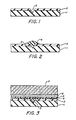
- the gouge or defect in the surface of a cured in-mold coated (conductive coating) FRP part was cleaned out by scraping, routing, or debridement of loose substrate.
- the surface should be dust, grease and foreign material free by wiping, cleaning and so forth.
- the repair material was then applied to the defective area in a manner to squeeze the air from the defects recessed areas. There should be an excess of the repair material over the defective area.
- a piece of MYLAR@ film was laid over the wet repair material so that it did not entrap air between the MYLAR film and repair liquid.
- a heating mat or mantle capable of generating at least about 140°C (about 280°F) after 5 minutes of applied voltage at 67-68 volts A.C. was placed over the MYLAR@ film and then pressure was applied.
- Pressure is very critical to this technique. It has been found that to avoid any substantial shrinkage a range of from about 0.18 to 0.35 MPa (about 26 to 50 psi) is effective with from about 0.025 to 0.35 MPa (about 36 to 50 psi) being better. Lower pressures below 0.35 MPa (36 psi) can be used provided the repair material has been thoroughly degassed and has not been allowed to redissolve any air. The lower pressures usually are not as reliable and the subsequent repairs exhibit a tendency for greater shrinkage rates during subsequent baking operations.
- the pressure was applied by means of a sandbag.
- the coated part was cured under pressure and at a temperature of at least about 120°C (280°F) and up to about 215°C (415°F) for from about 5 to 20 minutes.
- the defect After repairing, the defect should be difficult to feel. If there is a slight observable indication of where the defect was, this can generally be removed by standard buffing or standard finishing operations. The repaired area can now be painted or finished as desired with no further shrinkage.
- composition A 93.90 parts by weight of composition A were mixed with 1.41 parts by weight of tertiary butyl perbenzoate and 4.69 parts by weight of styrene to form repair material A-I.
- 99.76 parts by weight of composition B are mixed with 0.21 part by weight of zinc stearate, 0.03 part by weight of cobalt octoate (12% as Co in mineral oil) and 2.00 parts by weight of tertiary-butyl perbenzoate to form repair material B-II.
- Repair materials A-I and B-II are stable (no gelling) for from 7 to 10 days at about 20 to 25°C (70° to 80°F). If as pointed out above low pressures are used during curing of the repair material on the substrate, the repair material first should be degassed at about 40 to 45°C (100 to 110°F) under 63.5 cm (25") vacuum for about 30 minutes.
- LP-90@-Bakelite@ LP-90-40% by weight of polyvinyl acetate in styrene, viscosity of 1.8 Pa.s(1,800 centipoises) at 25°C. (Model LVT Brookfield viscometer #4 spindle at 60 rpm), specific gravity 20/20°C. (H 2 0 1 ) of 1.008 and solidification temperature of 5°C Union Carbide Corp.
- Uvithane@ 783 a polymerizable urethane based material or oligomer, a diacrylate terminated polyesterurethane prepolymer.
- a viscous liquid (Kg/I 1.3 at 25°C) having a viscosity at 49°C of 60-200 Pa.s (600-2000 poise) and at 82°C of 50-110 poise, having an unsaturation (equiv./100 grams) of 0.17-0.205 and having an isocyanate content (%) of .3 max. Thiokol/Chemical Division, Thiokol Corporation.
- Chemlink® 600 or CL 600-Polyoxyethylene glycol 600 dimethacrylate Molecular weight of about 770. C 36 H 66 O 17 . The Ware Chemical Corp.
- Vulcano-XC-72B N472. Conductive furnace carbon black. Cabot Corp.
Landscapes
- Chemical & Material Sciences (AREA)
- Health & Medical Sciences (AREA)
- Chemical Kinetics & Catalysis (AREA)
- Medicinal Chemistry (AREA)
- Polymers & Plastics (AREA)
- Organic Chemistry (AREA)
- Physics & Mathematics (AREA)
- Engineering & Computer Science (AREA)
- Thermal Sciences (AREA)
- Mechanical Engineering (AREA)
- Dispersion Chemistry (AREA)
- Spectroscopy & Molecular Physics (AREA)
- Compositions Of Macromolecular Compounds (AREA)
- Paints Or Removers (AREA)
- Macromonomer-Based Addition Polymer (AREA)
- Casting Or Compression Moulding Of Plastics Or The Like (AREA)
- Moulding By Coating Moulds (AREA)
- Lining Or Joining Of Plastics Or The Like (AREA)
Claims (9)
Applications Claiming Priority (2)
| Application Number | Priority Date | Filing Date | Title |
|---|---|---|---|
| US06/370,873 US4409270A (en) | 1982-04-22 | 1982-04-22 | Method for repairing glass fiber reinforced plastic parts and product |
| US370873 | 1982-04-22 |
Publications (3)
| Publication Number | Publication Date |
|---|---|
| EP0092894A2 EP0092894A2 (de) | 1983-11-02 |
| EP0092894A3 EP0092894A3 (en) | 1985-08-14 |
| EP0092894B1 true EP0092894B1 (de) | 1988-06-01 |
Family
ID=23461548
Family Applications (1)
| Application Number | Title | Priority Date | Filing Date |
|---|---|---|---|
| EP19830300171 Expired EP0092894B1 (de) | 1982-04-22 | 1983-01-13 | Verfahren zum Reparieren von glasfaserverstärkten Kunststoffteilen |
Country Status (5)
| Country | Link |
|---|---|
| US (1) | US4409270A (de) |
| EP (1) | EP0092894B1 (de) |
| JP (1) | JPS5935764B2 (de) |
| CA (1) | CA1192453A (de) |
| DE (1) | DE3376813D1 (de) |
Families Citing this family (45)
| Publication number | Priority date | Publication date | Assignee | Title |
|---|---|---|---|---|
| US4559240A (en) * | 1983-11-23 | 1985-12-17 | Herbert Jr Kenneth | Method for repairing fiberglass boat hulls |
| US4560428A (en) * | 1984-08-20 | 1985-12-24 | Rockwell International Corporation | System and method for producing cured composites |
| US4692195A (en) * | 1986-06-09 | 1987-09-08 | Allen Danny T | Method for repairing and reinforcing a plastic tote |
| US4737330A (en) * | 1986-06-11 | 1988-04-12 | Volkswagen Ag | Process for creating internal strains in a component part of fiber-reinforced plastic layers subjected to tensile stresses |
| US4800054A (en) * | 1987-06-05 | 1989-01-24 | Roestenberg Jerome R | Method for shaping a molding compound applied to a surface for modifying the surface |
| US4855173A (en) * | 1988-08-11 | 1989-08-08 | Dore Peter B | Repair process for a fibre reinforced structure |
| US5118454A (en) * | 1991-05-02 | 1992-06-02 | Davidson Textron Inc. | Method for repairing voids in vinyl skin covered urethane foam products |
| US5451351A (en) * | 1991-09-13 | 1995-09-19 | Composite Components, Inc. | Method for rehabilitating a pipe with a liner having an electrically conductive layer |
| US5358779A (en) * | 1992-06-26 | 1994-10-25 | Gencorp Inc. | Enhanced surface appearance of glass fiber reinforced plastics (FRP) |
| US5266139A (en) * | 1992-10-02 | 1993-11-30 | General Dynamics Corporation, Space Systems Division | Continuous processing/in-situ curing of incrementally applied resin matrix composite materials |
| US5470609A (en) * | 1992-12-07 | 1995-11-28 | Gencorp Inc. | Repair of plastic substrates utilizing powder coating compositions |
| US5674565A (en) * | 1993-06-23 | 1997-10-07 | Cambridge Industries, Inc. | Liquid thermoset sealers and sealing process for molded plastics |
| US5993906A (en) * | 1993-06-23 | 1999-11-30 | Cambridge Industries, Inc. | Edge seal process and product |
| US5486321A (en) * | 1993-12-01 | 1996-01-23 | Spatenka; Gary W. | Method for auto body repair |
| US5601676A (en) * | 1994-02-25 | 1997-02-11 | The Board Of Trustees Operating Michigan State University | Composite joining and repair |
| US5595692A (en) * | 1994-09-13 | 1997-01-21 | United Technologies Corporation | Method of repairing resin impregnated articles |
| US5714104A (en) * | 1995-06-12 | 1998-02-03 | Outboard Marine Corporation | Method of molding FRP parts |
| EP0790276A3 (de) * | 1996-02-14 | 1998-05-13 | Basf Aktiengesellschaft | Verfahren zur Herstellung von flächigen Polyurethan-Formteilen |
| US6004418A (en) * | 1997-10-28 | 1999-12-21 | Lear Corporation | Method of joining a cover material to a substrate utilizing electrically conductive bonding |
| US5928448A (en) * | 1997-11-01 | 1999-07-27 | Northrop Grumman Corporation | Dowel adhesive method for repair of ceramic matrix composites |
| US6099671A (en) * | 1998-05-20 | 2000-08-08 | Northrop Grumman Corporation | Method of adhering ceramic foams |
| US6284175B1 (en) * | 1999-04-29 | 2001-09-04 | Northrop Grumman Corporation | Method for reducing reflected radio frequency electromagnetic radiation |
| US6306508B1 (en) * | 1999-05-24 | 2001-10-23 | Great Barrier Systems, Inc. | Restorative coating method for plastic and glass |
| FR2804686B1 (fr) * | 2000-02-08 | 2003-07-04 | Inst Francais Du Petrole | Preforme souple expansible et durcissable contenant des resines insaturees, pour le tubage d'un puits ou d'une canalisation |
| JP2004529840A (ja) * | 2001-03-26 | 2004-09-30 | エイコス・インコーポレーテッド | 構造体と修復用組成物におけるカーボンナノチューブ |
| US6834913B2 (en) * | 2002-11-13 | 2004-12-28 | Visteon Global Technologies, Inc. | Structural composite air handling duct |
| DE102004018047A1 (de) * | 2004-04-08 | 2005-11-10 | Tesa Ag | Verfahren zum dauerhaften Verschließen von Löchern insbesondere in Blechen oder in Kunststoffteilen von Automobilkarosserien |
| US8790485B2 (en) | 2005-02-25 | 2014-07-29 | Bell Helicopter Textron Inc. | Single vacuum debulk composite panel repair |
| US20080211252A1 (en) * | 2005-12-19 | 2008-09-04 | Ppg Industries Ohio, Inc. | Method and apparatus for repairing bed-liner coatings |
| KR101280828B1 (ko) * | 2008-07-02 | 2013-07-02 | 엘지디스플레이 주식회사 | 기판결함의 수리방법 |
| US10160172B2 (en) | 2014-08-06 | 2018-12-25 | GM Global Technology Operations LLC | Mechanical interlocking realized through induction heating for polymeric composite repair |
| JP5777789B1 (ja) * | 2014-10-30 | 2015-09-09 | 三菱重工業株式会社 | 人工欠陥材料及びfrp構造体の製造方法 |
| CN105328921B (zh) * | 2015-10-08 | 2019-02-15 | 上海车功坊智能科技股份有限公司 | 一种玻璃钢、碳纤维复合材料的修复方法 |
| US10695993B2 (en) * | 2016-01-15 | 2020-06-30 | GM Global Technology Operations LLC | In-situ polymerization of polyamides for composite part repair |
| US10589477B2 (en) * | 2016-05-02 | 2020-03-17 | GM Global Technology Operations LLC | Cosmetic repair of a thermoplastic carbon fiber composite |
| ES1158187Y (es) * | 2016-05-13 | 2016-08-29 | Plastic Repair System 2011 S L | Producto de plastico reparado |
| FR3059940B1 (fr) * | 2016-12-12 | 2021-03-19 | Commissariat Energie Atomique | Procede de formation d'un empilement et empilement |
| CN110536876B (zh) | 2017-04-17 | 2022-06-14 | 信越化学工业株式会社 | 顺磁性石榴石型透明陶瓷、磁光材料和磁光器件 |
| US10611104B2 (en) | 2017-06-15 | 2020-04-07 | GM Global Technology Operations LLC | Heating elements for repair of molding defects for carbon fiber thermoplastic composites |
| EP3498682B1 (de) | 2017-12-12 | 2022-03-30 | Shin-Etsu Chemical Co., Ltd. | Zubereitung von einem sinterfähigen pulver eines komplexoxids mit granatstruktur und herstellung von transparenten keramiken |
| JP6879264B2 (ja) | 2018-05-18 | 2021-06-02 | 信越化学工業株式会社 | 常磁性ガーネット型透明セラミックス、磁気光学材料及び磁気光学デバイス |
| JP6881391B2 (ja) | 2018-05-24 | 2021-06-02 | 信越化学工業株式会社 | 焼結用複合酸化物粉末の製造方法及び透明セラミックスの製造方法 |
| JP6911811B2 (ja) | 2018-05-30 | 2021-07-28 | 信越化学工業株式会社 | ファラデー回転子用透明セラミックスの製造方法 |
| CN113085229B (zh) * | 2021-04-22 | 2022-02-15 | 同济大学 | 碳纤维增强热固性树脂基复合材料分层损伤修复装置及方法 |
| US20250129261A1 (en) * | 2023-09-06 | 2025-04-24 | Shiloh Spoo | Material and System for Minimizing Light Refraction in Glass Crack Repair |
Family Cites Families (13)
| Publication number | Priority date | Publication date | Assignee | Title |
|---|---|---|---|---|
| US3713926A (en) * | 1969-12-05 | 1973-01-30 | Vyna Chem Inc | Method for patching materials |
| US3887413A (en) * | 1973-08-07 | 1975-06-03 | Vinyltron Corp | Method for repairing plastic materials |
| US4081578A (en) * | 1974-06-27 | 1978-03-28 | The General Tire & Rubber Company | In-mold coating composition and method of applying same |
| US4242415A (en) * | 1978-12-26 | 1980-12-30 | Ici Americas Inc. | In-mold coating compositions containing functional group terminated liquid polymers |
| US4189517A (en) * | 1978-11-08 | 1980-02-19 | The General Tire & Rubber Company | Low-shrink in-mold coating |
| US4208456A (en) * | 1979-03-08 | 1980-06-17 | The General Tire & Rubber Company | Repair of FRP parts |
| US4235952A (en) * | 1979-03-21 | 1980-11-25 | The General Tire & Rubber Company | Bond seam coating of FRP moldings |
| US4245006A (en) * | 1979-05-18 | 1981-01-13 | The General Tire & Rubber Company | Low-pressure low-temperature in-mold coating method |
| US4239808A (en) * | 1979-06-13 | 1980-12-16 | The General Tire & Rubber Company | In-mold coating of sheet molding compound moldings |
| US4239796A (en) * | 1979-06-21 | 1980-12-16 | The General Tire & Rubber Company | In-mold coating of structural foams and resultant product |
| CA1163410A (en) * | 1980-05-01 | 1984-03-13 | Robert F. Navin | Method for making coated molded articles |
| DE3020285A1 (de) * | 1980-05-28 | 1981-12-03 | Hilti AG, 9494 Schaan | Verfahren zur reparatur von werkstuecken |
| US4331735A (en) * | 1980-06-26 | 1982-05-25 | The General Tire & Rubber Company | One component in-mold coating |
-
1982
- 1982-04-22 US US06/370,873 patent/US4409270A/en not_active Expired - Fee Related
- 1982-11-29 CA CA000416609A patent/CA1192453A/en not_active Expired
-
1983
- 1983-01-13 EP EP19830300171 patent/EP0092894B1/de not_active Expired
- 1983-01-13 DE DE8383300171T patent/DE3376813D1/de not_active Expired
- 1983-04-18 JP JP58067160A patent/JPS5935764B2/ja not_active Expired
Also Published As
| Publication number | Publication date |
|---|---|
| EP0092894A3 (en) | 1985-08-14 |
| US4409270A (en) | 1983-10-11 |
| DE3376813D1 (en) | 1988-07-07 |
| JPS58191123A (ja) | 1983-11-08 |
| JPS5935764B2 (ja) | 1984-08-30 |
| CA1192453A (en) | 1985-08-27 |
| EP0092894A2 (de) | 1983-11-02 |
Similar Documents
| Publication | Publication Date | Title |
|---|---|---|
| US4409270A (en) | Method for repairing glass fiber reinforced plastic parts and product | |
| EP0396837B1 (de) | In der Form hitzehärtbare Überzugszusammensetzungen | |
| EP0622386B1 (de) | Leitfähige Formbeschichtungen | |
| US4515710A (en) | In-mold coating composition | |
| US4414173A (en) | In-mold coating | |
| US4331735A (en) | One component in-mold coating | |
| CA2049895C (en) | Fast cure in-mold coating | |
| US4534888A (en) | In-mold coating | |
| CA1186429A (en) | In-mold coating | |
| CA1141126A (en) | Low-pressure low-temperature in-mold coating method | |
| US4374238A (en) | One component in-mold coating composition comprising a composition having a plurality of polymerizable ethylenic double bonds and a material containing isocyanate | |
| US4508785A (en) | In-mold coating | |
| US4529757A (en) | Thermosetting resin patching compound | |
| JP3103633B2 (ja) | 型内被覆組成物 | |
| JP2521592B2 (ja) | 金型内被覆組成物 | |
| AU551772B2 (en) | Patching compound |
Legal Events
| Date | Code | Title | Description |
|---|---|---|---|
| PUAI | Public reference made under article 153(3) epc to a published international application that has entered the european phase |
Free format text: ORIGINAL CODE: 0009012 |
|
| AK | Designated contracting states |
Designated state(s): DE FR GB IT |
|
| PUAL | Search report despatched |
Free format text: ORIGINAL CODE: 0009013 |
|
| AK | Designated contracting states |
Designated state(s): DE FR GB IT |
|
| 17P | Request for examination filed |
Effective date: 19850703 |
|
| 17Q | First examination report despatched |
Effective date: 19861015 |
|
| RAP1 | Party data changed (applicant data changed or rights of an application transferred) |
Owner name: GENCORP INC. |
|
| GRAA | (expected) grant |
Free format text: ORIGINAL CODE: 0009210 |
|
| AK | Designated contracting states |
Kind code of ref document: B1 Designated state(s): DE FR GB IT |
|
| REF | Corresponds to: |
Ref document number: 3376813 Country of ref document: DE Date of ref document: 19880707 |
|
| ET | Fr: translation filed | ||
| ITF | It: translation for a ep patent filed | ||
| PLBE | No opposition filed within time limit |
Free format text: ORIGINAL CODE: 0009261 |
|
| STAA | Information on the status of an ep patent application or granted ep patent |
Free format text: STATUS: NO OPPOSITION FILED WITHIN TIME LIMIT |
|
| 26N | No opposition filed | ||
| PGFP | Annual fee paid to national office [announced via postgrant information from national office to epo] |
Ref country code: GB Payment date: 19891231 Year of fee payment: 8 |
|
| PGFP | Annual fee paid to national office [announced via postgrant information from national office to epo] |
Ref country code: FR Payment date: 19900115 Year of fee payment: 8 |
|
| PGFP | Annual fee paid to national office [announced via postgrant information from national office to epo] |
Ref country code: DE Payment date: 19900125 Year of fee payment: 8 |
|
| ITTA | It: last paid annual fee | ||
| PG25 | Lapsed in a contracting state [announced via postgrant information from national office to epo] |
Ref country code: GB Effective date: 19910113 |
|
| GBPC | Gb: european patent ceased through non-payment of renewal fee | ||
| PG25 | Lapsed in a contracting state [announced via postgrant information from national office to epo] |
Ref country code: FR Effective date: 19910930 |
|
| PG25 | Lapsed in a contracting state [announced via postgrant information from national office to epo] |
Ref country code: DE Effective date: 19911001 |
|
| REG | Reference to a national code |
Ref country code: FR Ref legal event code: ST |