EP0093284A2 - Laminé thermoplastique ayant une couche externe de voile masquée - Google Patents
Laminé thermoplastique ayant une couche externe de voile masquée Download PDFInfo
- Publication number
- EP0093284A2 EP0093284A2 EP83103518A EP83103518A EP0093284A2 EP 0093284 A2 EP0093284 A2 EP 0093284A2 EP 83103518 A EP83103518 A EP 83103518A EP 83103518 A EP83103518 A EP 83103518A EP 0093284 A2 EP0093284 A2 EP 0093284A2
- Authority
- EP
- European Patent Office
- Prior art keywords
- polymer
- sheet
- laminate
- film layer
- polymer film
- Prior art date
- Legal status (The legal status is an assumption and is not a legal conclusion. Google has not performed a legal analysis and makes no representation as to the accuracy of the status listed.)
- Withdrawn
Links
- 239000004744 fabric Substances 0.000 title claims abstract description 45
- 229920001169 thermoplastic Polymers 0.000 title description 19
- 239000004416 thermosoftening plastic Substances 0.000 title description 17
- 229920000642 polymer Polymers 0.000 claims abstract description 107
- 229920006254 polymer film Polymers 0.000 claims abstract description 52
- 238000010438 heat treatment Methods 0.000 claims abstract description 41
- 238000000034 method Methods 0.000 claims abstract description 19
- 230000006872 improvement Effects 0.000 claims abstract description 7
- 230000002787 reinforcement Effects 0.000 claims description 14
- 238000010030 laminating Methods 0.000 claims description 10
- 239000004952 Polyamide Substances 0.000 claims description 6
- 229920002647 polyamide Polymers 0.000 claims description 6
- 239000010410 layer Substances 0.000 description 55
- 239000000835 fiber Substances 0.000 description 28
- 239000011152 fibreglass Substances 0.000 description 20
- 239000011521 glass Substances 0.000 description 14
- 239000000945 filler Substances 0.000 description 13
- 229920002292 Nylon 6 Polymers 0.000 description 11
- 239000000203 mixture Substances 0.000 description 11
- 238000002844 melting Methods 0.000 description 7
- 230000008018 melting Effects 0.000 description 7
- 239000000454 talc Substances 0.000 description 7
- 229910052623 talc Inorganic materials 0.000 description 7
- 229920001778 nylon Polymers 0.000 description 6
- -1 that is Polymers 0.000 description 6
- 239000004677 Nylon Substances 0.000 description 5
- 238000005470 impregnation Methods 0.000 description 5
- 239000000463 material Substances 0.000 description 5
- 239000011159 matrix material Substances 0.000 description 5
- 229920005989 resin Polymers 0.000 description 5
- 239000011347 resin Substances 0.000 description 5
- 239000002131 composite material Substances 0.000 description 4
- 229920001577 copolymer Polymers 0.000 description 4
- 238000003475 lamination Methods 0.000 description 4
- 229910052751 metal Inorganic materials 0.000 description 4
- 239000002184 metal Substances 0.000 description 4
- 239000002667 nucleating agent Substances 0.000 description 4
- VYPSYNLAJGMNEJ-UHFFFAOYSA-N silicon dioxide Inorganic materials O=[Si]=O VYPSYNLAJGMNEJ-UHFFFAOYSA-N 0.000 description 4
- 229920005992 thermoplastic resin Polymers 0.000 description 4
- PPBRXRYQALVLMV-UHFFFAOYSA-N Styrene Natural products C=CC1=CC=CC=C1 PPBRXRYQALVLMV-UHFFFAOYSA-N 0.000 description 3
- 239000000654 additive Substances 0.000 description 3
- 238000001816 cooling Methods 0.000 description 3
- 238000004049 embossing Methods 0.000 description 3
- 239000003365 glass fiber Substances 0.000 description 3
- 230000000704 physical effect Effects 0.000 description 3
- 229920000728 polyester Polymers 0.000 description 3
- 229920000573 polyethylene Polymers 0.000 description 3
- 229920000098 polyolefin Polymers 0.000 description 3
- 239000000047 product Substances 0.000 description 3
- 230000003014 reinforcing effect Effects 0.000 description 3
- 239000002356 single layer Substances 0.000 description 3
- 239000007787 solid Substances 0.000 description 3
- 239000002344 surface layer Substances 0.000 description 3
- OKTJSMMVPCPJKN-UHFFFAOYSA-N Carbon Chemical compound [C] OKTJSMMVPCPJKN-UHFFFAOYSA-N 0.000 description 2
- 239000004698 Polyethylene Substances 0.000 description 2
- 239000004743 Polypropylene Substances 0.000 description 2
- 239000004793 Polystyrene Substances 0.000 description 2
- WNLRTRBMVRJNCN-UHFFFAOYSA-N adipic acid Chemical compound OC(=O)CCCCC(O)=O WNLRTRBMVRJNCN-UHFFFAOYSA-N 0.000 description 2
- 239000010425 asbestos Substances 0.000 description 2
- VTYYLEPIZMXCLO-UHFFFAOYSA-L calcium carbonate Substances [Ca+2].[O-]C([O-])=O VTYYLEPIZMXCLO-UHFFFAOYSA-L 0.000 description 2
- 239000006229 carbon black Substances 0.000 description 2
- 230000015556 catabolic process Effects 0.000 description 2
- 229920002678 cellulose Polymers 0.000 description 2
- 239000000470 constituent Substances 0.000 description 2
- 238000006731 degradation reaction Methods 0.000 description 2
- JBKVHLHDHHXQEQ-UHFFFAOYSA-N epsilon-caprolactam Chemical compound O=C1CCCCCN1 JBKVHLHDHHXQEQ-UHFFFAOYSA-N 0.000 description 2
- 229920000578 graft copolymer Polymers 0.000 description 2
- NAQMVNRVTILPCV-UHFFFAOYSA-N hexane-1,6-diamine Chemical compound NCCCCCCN NAQMVNRVTILPCV-UHFFFAOYSA-N 0.000 description 2
- 230000007246 mechanism Effects 0.000 description 2
- 150000002739 metals Chemical class 0.000 description 2
- 229920001155 polypropylene Polymers 0.000 description 2
- 229920002223 polystyrene Polymers 0.000 description 2
- 230000008569 process Effects 0.000 description 2
- 229910052895 riebeckite Inorganic materials 0.000 description 2
- 239000000243 solution Substances 0.000 description 2
- 239000012815 thermoplastic material Substances 0.000 description 2
- 229920001187 thermosetting polymer Polymers 0.000 description 2
- VXNZUUAINFGPBY-UHFFFAOYSA-N 1-Butene Chemical compound CCC=C VXNZUUAINFGPBY-UHFFFAOYSA-N 0.000 description 1
- OEPOKWHJYJXUGD-UHFFFAOYSA-N 2-(3-phenylmethoxyphenyl)-1,3-thiazole-4-carbaldehyde Chemical compound O=CC1=CSC(C=2C=C(OCC=3C=CC=CC=3)C=CC=2)=N1 OEPOKWHJYJXUGD-UHFFFAOYSA-N 0.000 description 1
- SLXKOJJOQWFEFD-UHFFFAOYSA-N 6-aminohexanoic acid Chemical compound NCCCCCC(O)=O SLXKOJJOQWFEFD-UHFFFAOYSA-N 0.000 description 1
- ZOXJGFHDIHLPTG-UHFFFAOYSA-N Boron Chemical compound [B] ZOXJGFHDIHLPTG-UHFFFAOYSA-N 0.000 description 1
- 229920008347 Cellulose acetate propionate Polymers 0.000 description 1
- DQEFEBPAPFSJLV-UHFFFAOYSA-N Cellulose propionate Chemical compound CCC(=O)OCC1OC(OC(=O)CC)C(OC(=O)CC)C(OC(=O)CC)C1OC1C(OC(=O)CC)C(OC(=O)CC)C(OC(=O)CC)C(COC(=O)CC)O1 DQEFEBPAPFSJLV-UHFFFAOYSA-N 0.000 description 1
- 239000004609 Impact Modifier Substances 0.000 description 1
- 239000006057 Non-nutritive feed additive Substances 0.000 description 1
- 229920002302 Nylon 6,6 Polymers 0.000 description 1
- 229910000831 Steel Inorganic materials 0.000 description 1
- BZHJMEDXRYGGRV-UHFFFAOYSA-N Vinyl chloride Chemical compound ClC=C BZHJMEDXRYGGRV-UHFFFAOYSA-N 0.000 description 1
- 238000005299 abrasion Methods 0.000 description 1
- 239000002318 adhesion promoter Substances 0.000 description 1
- 239000001361 adipic acid Substances 0.000 description 1
- 235000011037 adipic acid Nutrition 0.000 description 1
- 239000002671 adjuvant Substances 0.000 description 1
- 150000001336 alkenes Chemical class 0.000 description 1
- XFBXDGLHUSUNMG-UHFFFAOYSA-N alumane;hydrate Chemical class O.[AlH3] XFBXDGLHUSUNMG-UHFFFAOYSA-N 0.000 description 1
- PNEYBMLMFCGWSK-UHFFFAOYSA-N aluminium oxide Inorganic materials [O-2].[O-2].[O-2].[Al+3].[Al+3] PNEYBMLMFCGWSK-UHFFFAOYSA-N 0.000 description 1
- 125000003368 amide group Chemical group 0.000 description 1
- 229960002684 aminocaproic acid Drugs 0.000 description 1
- 239000002216 antistatic agent Substances 0.000 description 1
- 229920003235 aromatic polyamide Polymers 0.000 description 1
- 239000000440 bentonite Substances 0.000 description 1
- 229910000278 bentonite Inorganic materials 0.000 description 1
- SVPXDRXYRYOSEX-UHFFFAOYSA-N bentoquatam Chemical compound O.O=[Si]=O.O=[Al]O[Al]=O SVPXDRXYRYOSEX-UHFFFAOYSA-N 0.000 description 1
- 238000000071 blow moulding Methods 0.000 description 1
- 229910052796 boron Inorganic materials 0.000 description 1
- IAQRGUVFOMOMEM-UHFFFAOYSA-N butene Natural products CC=CC IAQRGUVFOMOMEM-UHFFFAOYSA-N 0.000 description 1
- 235000010216 calcium carbonate Nutrition 0.000 description 1
- AXCZMVOFGPJBDE-UHFFFAOYSA-L calcium dihydroxide Chemical compound [OH-].[OH-].[Ca+2] AXCZMVOFGPJBDE-UHFFFAOYSA-L 0.000 description 1
- 239000000920 calcium hydroxide Substances 0.000 description 1
- 229910001861 calcium hydroxide Inorganic materials 0.000 description 1
- BRPQOXSCLDDYGP-UHFFFAOYSA-N calcium oxide Chemical compound [O-2].[Ca+2] BRPQOXSCLDDYGP-UHFFFAOYSA-N 0.000 description 1
- 239000000292 calcium oxide Substances 0.000 description 1
- ODINCKMPIJJUCX-UHFFFAOYSA-N calcium oxide Inorganic materials [Ca]=O ODINCKMPIJJUCX-UHFFFAOYSA-N 0.000 description 1
- VNSBYDPZHCQWNB-UHFFFAOYSA-N calcium;aluminum;dioxido(oxo)silane;sodium;hydrate Chemical compound O.[Na].[Al].[Ca+2].[O-][Si]([O-])=O VNSBYDPZHCQWNB-UHFFFAOYSA-N 0.000 description 1
- 229910052799 carbon Inorganic materials 0.000 description 1
- 239000001913 cellulose Substances 0.000 description 1
- 229920006218 cellulose propionate Polymers 0.000 description 1
- 239000004927 clay Substances 0.000 description 1
- 229920006026 co-polymeric resin Polymers 0.000 description 1
- 230000001427 coherent effect Effects 0.000 description 1
- 239000003086 colorant Substances 0.000 description 1
- 238000007906 compression Methods 0.000 description 1
- 230000006835 compression Effects 0.000 description 1
- 239000007859 condensation product Substances 0.000 description 1
- 239000007822 coupling agent Substances 0.000 description 1
- 238000005520 cutting process Methods 0.000 description 1
- 230000001627 detrimental effect Effects 0.000 description 1
- 230000000694 effects Effects 0.000 description 1
- 229920001971 elastomer Polymers 0.000 description 1
- 238000005265 energy consumption Methods 0.000 description 1
- 239000003822 epoxy resin Substances 0.000 description 1
- 238000001125 extrusion Methods 0.000 description 1
- 239000010433 feldspar Substances 0.000 description 1
- 239000012765 fibrous filler Substances 0.000 description 1
- 239000012467 final product Substances 0.000 description 1
- 239000004811 fluoropolymer Substances 0.000 description 1
- 229920002313 fluoropolymer Polymers 0.000 description 1
- 238000009472 formulation Methods 0.000 description 1
- 239000002223 garnet Substances 0.000 description 1
- 239000010439 graphite Substances 0.000 description 1
- 229910002804 graphite Inorganic materials 0.000 description 1
- LNEPOXFFQSENCJ-UHFFFAOYSA-N haloperidol Chemical compound C1CC(O)(C=2C=CC(Cl)=CC=2)CCN1CCCC(=O)C1=CC=C(F)C=C1 LNEPOXFFQSENCJ-UHFFFAOYSA-N 0.000 description 1
- 239000012760 heat stabilizer Substances 0.000 description 1
- 229920001519 homopolymer Polymers 0.000 description 1
- 238000001746 injection moulding Methods 0.000 description 1
- 229910052500 inorganic mineral Inorganic materials 0.000 description 1
- NLYAJNPCOHFWQQ-UHFFFAOYSA-N kaolin Chemical compound O.O.O=[Al]O[Si](=O)O[Si](=O)O[Al]=O NLYAJNPCOHFWQQ-UHFFFAOYSA-N 0.000 description 1
- 229910052622 kaolinite Inorganic materials 0.000 description 1
- 239000004611 light stabiliser Substances 0.000 description 1
- 239000000314 lubricant Substances 0.000 description 1
- 238000004519 manufacturing process Methods 0.000 description 1
- 229910044991 metal oxide Inorganic materials 0.000 description 1
- 150000004706 metal oxides Chemical class 0.000 description 1
- 229910000697 metglas Inorganic materials 0.000 description 1
- 239000010445 mica Substances 0.000 description 1
- 229910052618 mica group Inorganic materials 0.000 description 1
- 239000004005 microsphere Substances 0.000 description 1
- 239000011707 mineral Substances 0.000 description 1
- 235000010755 mineral Nutrition 0.000 description 1
- 239000002557 mineral fiber Substances 0.000 description 1
- 239000010449 novaculite Substances 0.000 description 1
- 239000011236 particulate material Substances 0.000 description 1
- 229920001568 phenolic resin Polymers 0.000 description 1
- 239000005011 phenolic resin Substances 0.000 description 1
- 239000000049 pigment Substances 0.000 description 1
- 229920003023 plastic Polymers 0.000 description 1
- 239000004033 plastic Substances 0.000 description 1
- 239000004014 plasticizer Substances 0.000 description 1
- 229920002492 poly(sulfone) Polymers 0.000 description 1
- 239000004417 polycarbonate Substances 0.000 description 1
- 229920000515 polycarbonate Polymers 0.000 description 1
- 229920000647 polyepoxide Polymers 0.000 description 1
- 229920001225 polyester resin Polymers 0.000 description 1
- 239000004645 polyester resin Substances 0.000 description 1
- 229920000139 polyethylene terephthalate Polymers 0.000 description 1
- 239000005020 polyethylene terephthalate Substances 0.000 description 1
- 238000006116 polymerization reaction Methods 0.000 description 1
- 229920006324 polyoxymethylene Polymers 0.000 description 1
- 229920002635 polyurethane Polymers 0.000 description 1
- 239000004814 polyurethane Substances 0.000 description 1
- 229920005749 polyurethane resin Polymers 0.000 description 1
- 239000004800 polyvinyl chloride Substances 0.000 description 1
- 229920000915 polyvinyl chloride Polymers 0.000 description 1
- 238000002360 preparation method Methods 0.000 description 1
- 239000010453 quartz Substances 0.000 description 1
- 238000003303 reheating Methods 0.000 description 1
- 239000012260 resinous material Substances 0.000 description 1
- 239000005060 rubber Substances 0.000 description 1
- 238000007665 sagging Methods 0.000 description 1
- 150000003839 salts Chemical class 0.000 description 1
- 229910000275 saponite Inorganic materials 0.000 description 1
- 238000006748 scratching Methods 0.000 description 1
- 230000002393 scratching effect Effects 0.000 description 1
- 239000000377 silicon dioxide Substances 0.000 description 1
- 238000009987 spinning Methods 0.000 description 1
- 239000010959 steel Substances 0.000 description 1
- KKEYFWRCBNTPAC-UHFFFAOYSA-L terephthalate(2-) Chemical compound [O-]C(=O)C1=CC=C(C([O-])=O)C=C1 KKEYFWRCBNTPAC-UHFFFAOYSA-L 0.000 description 1
- 229920001897 terpolymer Polymers 0.000 description 1
- 238000007666 vacuum forming Methods 0.000 description 1
- 229940117958 vinyl acetate Drugs 0.000 description 1
- 229920002554 vinyl polymer Polymers 0.000 description 1
- 239000010456 wollastonite Substances 0.000 description 1
- 229910052882 wollastonite Inorganic materials 0.000 description 1
Images

Classifications
-
- B—PERFORMING OPERATIONS; TRANSPORTING
- B32—LAYERED PRODUCTS
- B32B—LAYERED PRODUCTS, i.e. PRODUCTS BUILT-UP OF STRATA OF FLAT OR NON-FLAT, e.g. CELLULAR OR HONEYCOMB, FORM
- B32B27/00—Layered products comprising a layer of synthetic resin
- B32B27/12—Layered products comprising a layer of synthetic resin next to a fibrous or filamentary layer
-
- B—PERFORMING OPERATIONS; TRANSPORTING
- B29—WORKING OF PLASTICS; WORKING OF SUBSTANCES IN A PLASTIC STATE IN GENERAL
- B29B—PREPARATION OR PRETREATMENT OF THE MATERIAL TO BE SHAPED; MAKING GRANULES OR PREFORMS; RECOVERY OF PLASTICS OR OTHER CONSTITUENTS OF WASTE MATERIAL CONTAINING PLASTICS
- B29B13/00—Conditioning or physical treatment of the material to be shaped
- B29B13/02—Conditioning or physical treatment of the material to be shaped by heating
- B29B13/023—Half-products, e.g. films, plates
-
- B—PERFORMING OPERATIONS; TRANSPORTING
- B29—WORKING OF PLASTICS; WORKING OF SUBSTANCES IN A PLASTIC STATE IN GENERAL
- B29C—SHAPING OR JOINING OF PLASTICS; SHAPING OF MATERIAL IN A PLASTIC STATE, NOT OTHERWISE PROVIDED FOR; AFTER-TREATMENT OF THE SHAPED PRODUCTS, e.g. REPAIRING
- B29C65/00—Joining or sealing of preformed parts, e.g. welding of plastics materials; Apparatus therefor
- B29C65/02—Joining or sealing of preformed parts, e.g. welding of plastics materials; Apparatus therefor by heating, with or without pressure
- B29C65/14—Joining or sealing of preformed parts, e.g. welding of plastics materials; Apparatus therefor by heating, with or without pressure using wave energy, i.e. electromagnetic radiation, or particle radiation
- B29C65/1403—Joining or sealing of preformed parts, e.g. welding of plastics materials; Apparatus therefor by heating, with or without pressure using wave energy, i.e. electromagnetic radiation, or particle radiation characterised by the type of electromagnetic or particle radiation
- B29C65/1412—Infrared [IR] radiation
-
- B—PERFORMING OPERATIONS; TRANSPORTING
- B29—WORKING OF PLASTICS; WORKING OF SUBSTANCES IN A PLASTIC STATE IN GENERAL
- B29C—SHAPING OR JOINING OF PLASTICS; SHAPING OF MATERIAL IN A PLASTIC STATE, NOT OTHERWISE PROVIDED FOR; AFTER-TREATMENT OF THE SHAPED PRODUCTS, e.g. REPAIRING
- B29C65/00—Joining or sealing of preformed parts, e.g. welding of plastics materials; Apparatus therefor
- B29C65/02—Joining or sealing of preformed parts, e.g. welding of plastics materials; Apparatus therefor by heating, with or without pressure
- B29C65/14—Joining or sealing of preformed parts, e.g. welding of plastics materials; Apparatus therefor by heating, with or without pressure using wave energy, i.e. electromagnetic radiation, or particle radiation
- B29C65/1429—Joining or sealing of preformed parts, e.g. welding of plastics materials; Apparatus therefor by heating, with or without pressure using wave energy, i.e. electromagnetic radiation, or particle radiation characterised by the way of heating the interface
- B29C65/1432—Joining or sealing of preformed parts, e.g. welding of plastics materials; Apparatus therefor by heating, with or without pressure using wave energy, i.e. electromagnetic radiation, or particle radiation characterised by the way of heating the interface direct heating of the surfaces to be joined
-
- B—PERFORMING OPERATIONS; TRANSPORTING
- B29—WORKING OF PLASTICS; WORKING OF SUBSTANCES IN A PLASTIC STATE IN GENERAL
- B29C—SHAPING OR JOINING OF PLASTICS; SHAPING OF MATERIAL IN A PLASTIC STATE, NOT OTHERWISE PROVIDED FOR; AFTER-TREATMENT OF THE SHAPED PRODUCTS, e.g. REPAIRING
- B29C65/00—Joining or sealing of preformed parts, e.g. welding of plastics materials; Apparatus therefor
- B29C65/02—Joining or sealing of preformed parts, e.g. welding of plastics materials; Apparatus therefor by heating, with or without pressure
- B29C65/18—Joining or sealing of preformed parts, e.g. welding of plastics materials; Apparatus therefor by heating, with or without pressure using heated tools
-
- B—PERFORMING OPERATIONS; TRANSPORTING
- B29—WORKING OF PLASTICS; WORKING OF SUBSTANCES IN A PLASTIC STATE IN GENERAL
- B29C—SHAPING OR JOINING OF PLASTICS; SHAPING OF MATERIAL IN A PLASTIC STATE, NOT OTHERWISE PROVIDED FOR; AFTER-TREATMENT OF THE SHAPED PRODUCTS, e.g. REPAIRING
- B29C66/00—General aspects of processes or apparatus for joining preformed parts
- B29C66/004—Preventing sticking together, e.g. of some areas of the parts to be joined
-
- B—PERFORMING OPERATIONS; TRANSPORTING
- B29—WORKING OF PLASTICS; WORKING OF SUBSTANCES IN A PLASTIC STATE IN GENERAL
- B29C—SHAPING OR JOINING OF PLASTICS; SHAPING OF MATERIAL IN A PLASTIC STATE, NOT OTHERWISE PROVIDED FOR; AFTER-TREATMENT OF THE SHAPED PRODUCTS, e.g. REPAIRING
- B29C66/00—General aspects of processes or apparatus for joining preformed parts
- B29C66/01—General aspects dealing with the joint area or with the area to be joined
- B29C66/02—Preparation of the material, in the area to be joined, prior to joining or welding
- B29C66/024—Thermal pre-treatments
- B29C66/0242—Heating, or preheating, e.g. drying
-
- B—PERFORMING OPERATIONS; TRANSPORTING
- B29—WORKING OF PLASTICS; WORKING OF SUBSTANCES IN A PLASTIC STATE IN GENERAL
- B29C—SHAPING OR JOINING OF PLASTICS; SHAPING OF MATERIAL IN A PLASTIC STATE, NOT OTHERWISE PROVIDED FOR; AFTER-TREATMENT OF THE SHAPED PRODUCTS, e.g. REPAIRING
- B29C66/00—General aspects of processes or apparatus for joining preformed parts
- B29C66/70—General aspects of processes or apparatus for joining preformed parts characterised by the composition, physical properties or the structure of the material of the parts to be joined; Joining with non-plastics material
- B29C66/73—General aspects of processes or apparatus for joining preformed parts characterised by the composition, physical properties or the structure of the material of the parts to be joined; Joining with non-plastics material characterised by the intensive physical properties of the material of the parts to be joined, by the optical properties of the material of the parts to be joined, by the extensive physical properties of the parts to be joined, by the state of the material of the parts to be joined or by the material of the parts to be joined being a thermoplastic or a thermoset
- B29C66/739—General aspects of processes or apparatus for joining preformed parts characterised by the composition, physical properties or the structure of the material of the parts to be joined; Joining with non-plastics material characterised by the intensive physical properties of the material of the parts to be joined, by the optical properties of the material of the parts to be joined, by the extensive physical properties of the parts to be joined, by the state of the material of the parts to be joined or by the material of the parts to be joined being a thermoplastic or a thermoset characterised by the material of the parts to be joined being a thermoplastic or a thermoset
- B29C66/7392—General aspects of processes or apparatus for joining preformed parts characterised by the composition, physical properties or the structure of the material of the parts to be joined; Joining with non-plastics material characterised by the intensive physical properties of the material of the parts to be joined, by the optical properties of the material of the parts to be joined, by the extensive physical properties of the parts to be joined, by the state of the material of the parts to be joined or by the material of the parts to be joined being a thermoplastic or a thermoset characterised by the material of the parts to be joined being a thermoplastic or a thermoset characterised by the material of at least one of the parts being a thermoplastic
-
- B—PERFORMING OPERATIONS; TRANSPORTING
- B29—WORKING OF PLASTICS; WORKING OF SUBSTANCES IN A PLASTIC STATE IN GENERAL
- B29C—SHAPING OR JOINING OF PLASTICS; SHAPING OF MATERIAL IN A PLASTIC STATE, NOT OTHERWISE PROVIDED FOR; AFTER-TREATMENT OF THE SHAPED PRODUCTS, e.g. REPAIRING
- B29C70/00—Shaping composites, i.e. plastics material comprising reinforcements, fillers or preformed parts, e.g. inserts
- B29C70/68—Shaping composites, i.e. plastics material comprising reinforcements, fillers or preformed parts, e.g. inserts by incorporating or moulding on preformed parts, e.g. inserts or layers, e.g. foam blocks
- B29C70/685—Shaping composites, i.e. plastics material comprising reinforcements, fillers or preformed parts, e.g. inserts by incorporating or moulding on preformed parts, e.g. inserts or layers, e.g. foam blocks by laminating inserts between two plastic films or plates
-
- B—PERFORMING OPERATIONS; TRANSPORTING
- B32—LAYERED PRODUCTS
- B32B—LAYERED PRODUCTS, i.e. PRODUCTS BUILT-UP OF STRATA OF FLAT OR NON-FLAT, e.g. CELLULAR OR HONEYCOMB, FORM
- B32B27/00—Layered products comprising a layer of synthetic resin
- B32B27/34—Layered products comprising a layer of synthetic resin comprising polyamides
-
- B—PERFORMING OPERATIONS; TRANSPORTING
- B32—LAYERED PRODUCTS
- B32B—LAYERED PRODUCTS, i.e. PRODUCTS BUILT-UP OF STRATA OF FLAT OR NON-FLAT, e.g. CELLULAR OR HONEYCOMB, FORM
- B32B38/00—Ancillary operations in connection with laminating processes
- B32B38/0036—Heat treatment
- B32B38/004—Heat treatment by physically contacting the layers, e.g. by the use of heated platens or rollers
-
- B—PERFORMING OPERATIONS; TRANSPORTING
- B32—LAYERED PRODUCTS
- B32B—LAYERED PRODUCTS, i.e. PRODUCTS BUILT-UP OF STRATA OF FLAT OR NON-FLAT, e.g. CELLULAR OR HONEYCOMB, FORM
- B32B38/00—Ancillary operations in connection with laminating processes
- B32B38/08—Impregnating
-
- B—PERFORMING OPERATIONS; TRANSPORTING
- B29—WORKING OF PLASTICS; WORKING OF SUBSTANCES IN A PLASTIC STATE IN GENERAL
- B29C—SHAPING OR JOINING OF PLASTICS; SHAPING OF MATERIAL IN A PLASTIC STATE, NOT OTHERWISE PROVIDED FOR; AFTER-TREATMENT OF THE SHAPED PRODUCTS, e.g. REPAIRING
- B29C66/00—General aspects of processes or apparatus for joining preformed parts
- B29C66/70—General aspects of processes or apparatus for joining preformed parts characterised by the composition, physical properties or the structure of the material of the parts to be joined; Joining with non-plastics material
- B29C66/71—General aspects of processes or apparatus for joining preformed parts characterised by the composition, physical properties or the structure of the material of the parts to be joined; Joining with non-plastics material characterised by the composition of the plastics material of the parts to be joined
-
- B—PERFORMING OPERATIONS; TRANSPORTING
- B29—WORKING OF PLASTICS; WORKING OF SUBSTANCES IN A PLASTIC STATE IN GENERAL
- B29C—SHAPING OR JOINING OF PLASTICS; SHAPING OF MATERIAL IN A PLASTIC STATE, NOT OTHERWISE PROVIDED FOR; AFTER-TREATMENT OF THE SHAPED PRODUCTS, e.g. REPAIRING
- B29C66/00—General aspects of processes or apparatus for joining preformed parts
- B29C66/70—General aspects of processes or apparatus for joining preformed parts characterised by the composition, physical properties or the structure of the material of the parts to be joined; Joining with non-plastics material
- B29C66/72—General aspects of processes or apparatus for joining preformed parts characterised by the composition, physical properties or the structure of the material of the parts to be joined; Joining with non-plastics material characterised by the structure of the material of the parts to be joined
- B29C66/721—Fibre-reinforced materials
- B29C66/7212—Fibre-reinforced materials characterised by the composition of the fibres
-
- B—PERFORMING OPERATIONS; TRANSPORTING
- B32—LAYERED PRODUCTS
- B32B—LAYERED PRODUCTS, i.e. PRODUCTS BUILT-UP OF STRATA OF FLAT OR NON-FLAT, e.g. CELLULAR OR HONEYCOMB, FORM
- B32B2309/00—Parameters for the laminating or treatment process; Apparatus details
- B32B2309/02—Temperature
-
- Y—GENERAL TAGGING OF NEW TECHNOLOGICAL DEVELOPMENTS; GENERAL TAGGING OF CROSS-SECTIONAL TECHNOLOGIES SPANNING OVER SEVERAL SECTIONS OF THE IPC; TECHNICAL SUBJECTS COVERED BY FORMER USPC CROSS-REFERENCE ART COLLECTIONS [XRACs] AND DIGESTS
- Y10—TECHNICAL SUBJECTS COVERED BY FORMER USPC
- Y10T—TECHNICAL SUBJECTS COVERED BY FORMER US CLASSIFICATION
- Y10T156/00—Adhesive bonding and miscellaneous chemical manufacture
- Y10T156/10—Methods of surface bonding and/or assembly therefor
- Y10T156/1002—Methods of surface bonding and/or assembly therefor with permanent bending or reshaping or surface deformation of self sustaining lamina
- Y10T156/1007—Running or continuous length work
-
- Y—GENERAL TAGGING OF NEW TECHNOLOGICAL DEVELOPMENTS; GENERAL TAGGING OF CROSS-SECTIONAL TECHNOLOGIES SPANNING OVER SEVERAL SECTIONS OF THE IPC; TECHNICAL SUBJECTS COVERED BY FORMER USPC CROSS-REFERENCE ART COLLECTIONS [XRACs] AND DIGESTS
- Y10—TECHNICAL SUBJECTS COVERED BY FORMER USPC
- Y10T—TECHNICAL SUBJECTS COVERED BY FORMER US CLASSIFICATION
- Y10T156/00—Adhesive bonding and miscellaneous chemical manufacture
- Y10T156/10—Methods of surface bonding and/or assembly therefor
- Y10T156/1002—Methods of surface bonding and/or assembly therefor with permanent bending or reshaping or surface deformation of self sustaining lamina
- Y10T156/1043—Subsequent to assembly
- Y10T156/1044—Subsequent to assembly of parallel stacked sheets only
-
- Y—GENERAL TAGGING OF NEW TECHNOLOGICAL DEVELOPMENTS; GENERAL TAGGING OF CROSS-SECTIONAL TECHNOLOGIES SPANNING OVER SEVERAL SECTIONS OF THE IPC; TECHNICAL SUBJECTS COVERED BY FORMER USPC CROSS-REFERENCE ART COLLECTIONS [XRACs] AND DIGESTS
- Y10—TECHNICAL SUBJECTS COVERED BY FORMER USPC
- Y10T—TECHNICAL SUBJECTS COVERED BY FORMER US CLASSIFICATION
- Y10T156/00—Adhesive bonding and miscellaneous chemical manufacture
- Y10T156/10—Methods of surface bonding and/or assembly therefor
- Y10T156/1052—Methods of surface bonding and/or assembly therefor with cutting, punching, tearing or severing
- Y10T156/1054—Methods of surface bonding and/or assembly therefor with cutting, punching, tearing or severing and simultaneously bonding [e.g., cut-seaming]
-
- Y—GENERAL TAGGING OF NEW TECHNOLOGICAL DEVELOPMENTS; GENERAL TAGGING OF CROSS-SECTIONAL TECHNOLOGIES SPANNING OVER SEVERAL SECTIONS OF THE IPC; TECHNICAL SUBJECTS COVERED BY FORMER USPC CROSS-REFERENCE ART COLLECTIONS [XRACs] AND DIGESTS
- Y10—TECHNICAL SUBJECTS COVERED BY FORMER USPC
- Y10T—TECHNICAL SUBJECTS COVERED BY FORMER US CLASSIFICATION
- Y10T156/00—Adhesive bonding and miscellaneous chemical manufacture
- Y10T156/10—Methods of surface bonding and/or assembly therefor
- Y10T156/1052—Methods of surface bonding and/or assembly therefor with cutting, punching, tearing or severing
- Y10T156/1056—Perforating lamina
- Y10T156/1057—Subsequent to assembly of laminae
-
- Y—GENERAL TAGGING OF NEW TECHNOLOGICAL DEVELOPMENTS; GENERAL TAGGING OF CROSS-SECTIONAL TECHNOLOGIES SPANNING OVER SEVERAL SECTIONS OF THE IPC; TECHNICAL SUBJECTS COVERED BY FORMER USPC CROSS-REFERENCE ART COLLECTIONS [XRACs] AND DIGESTS
- Y10—TECHNICAL SUBJECTS COVERED BY FORMER USPC
- Y10T—TECHNICAL SUBJECTS COVERED BY FORMER US CLASSIFICATION
- Y10T156/00—Adhesive bonding and miscellaneous chemical manufacture
- Y10T156/10—Methods of surface bonding and/or assembly therefor
- Y10T156/1052—Methods of surface bonding and/or assembly therefor with cutting, punching, tearing or severing
- Y10T156/1084—Methods of surface bonding and/or assembly therefor with cutting, punching, tearing or severing of continuous or running length bonded web
-
- Y—GENERAL TAGGING OF NEW TECHNOLOGICAL DEVELOPMENTS; GENERAL TAGGING OF CROSS-SECTIONAL TECHNOLOGIES SPANNING OVER SEVERAL SECTIONS OF THE IPC; TECHNICAL SUBJECTS COVERED BY FORMER USPC CROSS-REFERENCE ART COLLECTIONS [XRACs] AND DIGESTS
- Y10—TECHNICAL SUBJECTS COVERED BY FORMER USPC
- Y10T—TECHNICAL SUBJECTS COVERED BY FORMER US CLASSIFICATION
- Y10T156/00—Adhesive bonding and miscellaneous chemical manufacture
- Y10T156/10—Methods of surface bonding and/or assembly therefor
- Y10T156/1052—Methods of surface bonding and/or assembly therefor with cutting, punching, tearing or severing
- Y10T156/1084—Methods of surface bonding and/or assembly therefor with cutting, punching, tearing or severing of continuous or running length bonded web
- Y10T156/1085—One web only
-
- Y—GENERAL TAGGING OF NEW TECHNOLOGICAL DEVELOPMENTS; GENERAL TAGGING OF CROSS-SECTIONAL TECHNOLOGIES SPANNING OVER SEVERAL SECTIONS OF THE IPC; TECHNICAL SUBJECTS COVERED BY FORMER USPC CROSS-REFERENCE ART COLLECTIONS [XRACs] AND DIGESTS
- Y10—TECHNICAL SUBJECTS COVERED BY FORMER USPC
- Y10T—TECHNICAL SUBJECTS COVERED BY FORMER US CLASSIFICATION
- Y10T156/00—Adhesive bonding and miscellaneous chemical manufacture
- Y10T156/10—Methods of surface bonding and/or assembly therefor
- Y10T156/1089—Methods of surface bonding and/or assembly therefor of discrete laminae to single face of additional lamina
- Y10T156/1092—All laminae planar and face to face
-
- Y—GENERAL TAGGING OF NEW TECHNOLOGICAL DEVELOPMENTS; GENERAL TAGGING OF CROSS-SECTIONAL TECHNOLOGIES SPANNING OVER SEVERAL SECTIONS OF THE IPC; TECHNICAL SUBJECTS COVERED BY FORMER USPC CROSS-REFERENCE ART COLLECTIONS [XRACs] AND DIGESTS
- Y10—TECHNICAL SUBJECTS COVERED BY FORMER USPC
- Y10T—TECHNICAL SUBJECTS COVERED BY FORMER US CLASSIFICATION
- Y10T428/00—Stock material or miscellaneous articles
- Y10T428/31504—Composite [nonstructural laminate]
- Y10T428/31725—Of polyamide
- Y10T428/31728—Next to second layer of polyamide
- Y10T428/31732—At least one layer is nylon type
-
- Y—GENERAL TAGGING OF NEW TECHNOLOGICAL DEVELOPMENTS; GENERAL TAGGING OF CROSS-SECTIONAL TECHNOLOGIES SPANNING OVER SEVERAL SECTIONS OF THE IPC; TECHNICAL SUBJECTS COVERED BY FORMER USPC CROSS-REFERENCE ART COLLECTIONS [XRACs] AND DIGESTS
- Y10—TECHNICAL SUBJECTS COVERED BY FORMER USPC
- Y10T—TECHNICAL SUBJECTS COVERED BY FORMER US CLASSIFICATION
- Y10T428/00—Stock material or miscellaneous articles
- Y10T428/31504—Composite [nonstructural laminate]
- Y10T428/31725—Of polyamide
- Y10T428/31739—Nylon type
- Y10T428/31743—Next to addition polymer from unsaturated monomer[s]
-
- Y—GENERAL TAGGING OF NEW TECHNOLOGICAL DEVELOPMENTS; GENERAL TAGGING OF CROSS-SECTIONAL TECHNOLOGIES SPANNING OVER SEVERAL SECTIONS OF THE IPC; TECHNICAL SUBJECTS COVERED BY FORMER USPC CROSS-REFERENCE ART COLLECTIONS [XRACs] AND DIGESTS
- Y10—TECHNICAL SUBJECTS COVERED BY FORMER USPC
- Y10T—TECHNICAL SUBJECTS COVERED BY FORMER US CLASSIFICATION
- Y10T428/00—Stock material or miscellaneous articles
- Y10T428/31504—Composite [nonstructural laminate]
- Y10T428/31725—Of polyamide
- Y10T428/31739—Nylon type
- Y10T428/31743—Next to addition polymer from unsaturated monomer[s]
- Y10T428/31746—Polymer of monoethylenically unsaturated hydrocarbon
-
- Y—GENERAL TAGGING OF NEW TECHNOLOGICAL DEVELOPMENTS; GENERAL TAGGING OF CROSS-SECTIONAL TECHNOLOGIES SPANNING OVER SEVERAL SECTIONS OF THE IPC; TECHNICAL SUBJECTS COVERED BY FORMER USPC CROSS-REFERENCE ART COLLECTIONS [XRACs] AND DIGESTS
- Y10—TECHNICAL SUBJECTS COVERED BY FORMER USPC
- Y10T—TECHNICAL SUBJECTS COVERED BY FORMER US CLASSIFICATION
- Y10T442/00—Fabric [woven, knitted, or nonwoven textile or cloth, etc.]
- Y10T442/60—Nonwoven fabric [i.e., nonwoven strand or fiber material]
- Y10T442/674—Nonwoven fabric with a preformed polymeric film or sheet
Definitions
- This invention relates to a polymer sheet having a surface fabric veil layer masked by a surface polymer film layer; and a method of heating such a laminate.
- Thermoplastic laminates comprising a polymer and a reinforcement means are known in the art. Such known laminates and methods of their preparation are disclosed in many patents and publications. Examples of reinforced thermoplastic laminates are disclosed in U.S. Patent Nos.: 4,302,269; 4,291,084; 4,269,884; 4,255,219; 4,238,266; 4,240,857; 4,098,943; 4,044,188; 3,745,140; 3,833,453; 3,765,998; 3,850,723; 3,318,757; 3,531,369. These patents are a nonlimiting illustration of the state of the art of reinforced thermoplastic laminates and are incorporated by reference.
- Thermoplastic reinforced laminates known in the art are either shaped into articles of manufacture immediately upon being laminated, or are put into some blank form.
- the thermoplastic laminate blank is later reheated and formed into the desired shape.
- a problem which has been encountered during the reheating of thermoplastic blanks is that the thermoplastic material becomes soft and sticky.
- the surface adheres to supporting means in the means to heat the laminate blank causing the laminate blank to deform while being removed from the supporting means.
- One solution to this problem is to place a thin fiberglass fabric veil on the surface of the laminate. This veil is located between the laminate and the laminate support in the heating means.
- the thin fiber glass veil can be laminated to the surface of the laminate during lamination.
- 4,238,266 discloses the use of a surface fiberglass veil layer and its advantages.
- This veil prevents the heated laminate from adhering to the laminate support surface.
- laminate support surfaces are usually oven shelves, or conveyor belt surfaces either solid or foraminous.
- the difficulty in removing the heated laminate results not only in a disruption of the laminate surface where it adheres to the laminate support but also results in distortion of the laminate as the laminate is attempted to be removed from the laminate support.
- the surface veil prevents the laminate from sagging after it has been heated.
- the use of this type of veil is generally detrimental to smooth surface appearance and results in the veil being only partially impregnated into the surface of the laminate. Not only is the surface appearance somewhat deteriorated, but when the veil is made of glass it results in a scratchy surface with exposed fiberglass which easily breaks off and is difficult to handle.
- the present invention is an improved polymer sheet.
- polymer sheet includes single layer polymer sheets and laminates, including a laminate of the type having a laminate body comprising a polymer and a reinforcement means.
- the improvement is at least one surface polymer film layer and a fabric veil, preferably a fiberglass fabric veil laminated between each surface polymer film layer and the surface of the polymer sheet or laminate body.
- the surface polymer film layer is from 0.1 to 10 mils (0.0025 to 0.25 mm) in thickness, and preferably 0.25 to 2 mils (0.00625 to 0.05 mm) in thickness.
- the present invention also includes a method of heating a polymer sheet, preferably a laminate of the type having a laminate body comprising a polymer and a reinforcement means.
- the heating means has a heating means support.
- At least one fabric veil layer is laminated to the surface of the polymer sheet.
- the polymer sheet is placed on the heating means support of the heating means with the surface polymer film layer of contact with the heating means support.
- the polymer sheet is heated and removed from the heating means support.
- the polymer sheet does not adhere to the heating means support upon being heated in the heating means.
- the surface of the polymer sheet on which the fabric veil and polymer film layer are applied is smooth without fibers from the fabric veil protruding therefrom.
- the surface has excellent appearance and can easily be handled.
- the present invention is an improved polymer sheet, and method of heating a polymer sheet.
- the term polymer sheet includes single layer polymer sheets and laminates.
- the single layer sheets can optionally contain fillers and/or reinforcement.
- the preferred polymer sheet of the present invention is a laminate having a laminate body comprising a polymer and a reinforcing means.
- the laminate body can be a polymer laminate as known in the art and includes those described in the Background of the Invention.
- the laminate reinforcement means can be a fabric layer embedded in the polymer or laminated with the polymer. Alternately, the reinforcement means can be a fiberous or particulate material blended or mixed in a polymer layer.
- the improved polymer sheet of the present invention includes and is preferably a polymer laminate having a laminate body comprising such a polymer and reinforcement means.
- the improvement is at least one surface polymer film layer, from 0.1 to 10 mils (0.0025 to 0.25 mm) in thickness and preferably 0.25 to 2 mils (0.00625 to 0.05 mm) in thickness, and a fabric veil laminated between each surface polymer film layer and the laminate body.
- the fabric veil is from 0.1 to 5 ounces per square yard (3.39 to 169.52 g/m ) preferably .5 to 3 ounces per square yard (16.95 to 101.72 g/m 2 ) of fine fibers.
- the fibers can have an average diameter of from about 5 to about 25 micrometers, preferably 7 to 20 micrometers.
- the fiberous veil can be either woven or nonwoven fibers, with nonwoven fibers preferable.
- the fabric veil useful in the present invention can be made from a wide variety of fibers having a melting point higher than the polymer in the polymer sheet and the surface film layer polymer.
- Fibers suitable for use in the fabric veil include fiberglass, asbestos, carbon, graphite, boron, cellulose, titanates, polyesters, polyamides, polyaramids, polyacrylics, metallics, amorphous metals such as those sold under the tradename of METGLAS(5, by Allied Corporation and mixtures thereof.
- the preferred material for use in the fabric layer of the laminate of the present invention is fiberglass.
- the surface polymer film layer can be made of any polymer which will adhere to the polymer sheet.
- the surface polymer film layer is a thermoplastic polymer.
- the surface polymer layer is from 0.1 to 20 mils (0.0025 to 0.50 mm), preferably from 0.1 to 10 mils (0.0025 to 0.25 mm), more preferably from 0.2 to 5 mils (0.005 to 0.125 mm), yet more preferably from 0.25 to 3 mils (0.0625 to 0.075 mm), and most preferably 0.25 to 2 mils (0.0625 to 0.05 mm) thick.
- the surface polymer film layer should be thick enough to coat and/or embed the fabric veil yet not be too thick to prevent the effects of the fabric veil in preventing the polymer sheet from sticking to the heating means support in the heating means when the polymer sheet is heated or reheated.
- thermoplastic polymers which can be used as surface polymer film layer polymers in laminates of the present invention and in accordance with the methods of the present invention include the various thermoplastic materials normally used in injection molding, extrusion, vacuum forming, blow molding, fiber spinning, or similar thermoplastic processing techniques.
- the surface polymer can be the same or different from the polymer in the laminate body.
- the surface polymer should be compatible with and adhere to the polymer in the polymer sheet, or laminate body.
- thermoplastics for the surface polymer film layer compositions are the polyamides, that is, polymers having regularly recurring amide groups as an integral part of the main groups as an integral part of the main chain.
- Polyamides such as nylon 6,6 (a condensation product of hexamethylene diamine and adipic acid) and nylon 6 (the polymerization product of epsilonaminocaproic acid or caprolactam) are examples of two polyamides or nylons.
- Polyolefins may also be employed, including polymers and copolymers of ethylene, propylene, methylpentene and blends thereof.
- Other polymers which can be utilized include polyurethane, polysulfone, polycarbonate and linear polyesters such as polyethylene terephthalate and polybutlyene terephthalate; cellulose esters such as cellulose acetate, and cellulose propionate; halogenated polyolefins and polyacetals.
- thermoplastic resinous materials which may be utilized in making the surface polymer film layer of the invention include, the alkenyl aromatic resins typified by polystyrene, styrene copolymers, blends and graft copolymers the alkenyl aromatic resins typified by polystyrene copolymers, blends and graft copolymer of styrene and rubber and the like.
- the invention may be practiced utilizing polyvinyl chloride or copolymers of vinyl chloride or vinylidene chloride.
- polymer Also included in the term polymer are blends or copolymers of two or more polymeric materials.
- Illustrative of such polymers are polyethylene/polypro- pylene, ethylene-acrylic acid-vinylacetate terpolymers and the like.
- the present invention includes a method of heating a polymer sheet, preferably of the type having a laminate body comprising a polymer and a reinforcement means as described above and discussed in the Background of the Invention.
- the method of the present invention is directed to heating the laminate in a heating means having a heating means support.
- these heating means are ovens having shelves on which the polymer sheet is supported.
- the heating means can be ovens through which conveyor belts convey the laminates.
- the polymer sheets are supported on the conveyor belts.
- the conveyor belts can have solid or formainous surfaces.
- a typical foraminous belt used to convey polymer sheets is a chain link type metal conveyor belt.
- a typical solid conveyor belt is made of a fluoropolymer.
- a fabric veil layer is laminated to at least one surface of the polymer sheet.
- the laminate thus formed is placed on the heating means support within the heating means with the surface polymer film layer in contact with the laminate support.
- the polymer sheet is heated, and removed from the heating means support. It is recognized that the improved polymer sheet of the present invention can be cooled after lamination and reheated or preheated for subsequent processing, such as stamping.
- the polymer sheet can easily be removed from an oven heating surface without adhering to the heating means support.
- the surface of the polymer sheet which was in contact with the heating means support in the heating means has good surface appearance and does not have fibers from the fabric veil protruding through the surface to cause a dull and porous surface appearance. Veils made of brittle fabrics such as fiberglass do not result in handling difficulties, or abrasion of the fibers.
- a preferred polymer sheet is a laminate body comprising a body portion, which is preferably a reinforced layer comprised of a long glass mat embedded in a thermoplastic matrix, laminated to at least one surface portion, which is preferably a polymeric surface sheet layer which can optionally contain particulate and/or fibrous filler.
- the preferred laminate body polymer and surface polymer film layer is polycaprolactam. Processing conditions in the description that follows are made considering the polymer to be polycaprolactam.
- the laminate body is made by a process described in U.S. Pat. 4,240,857, hereby incorporated by reference.
- the body portion is at least one long fiberglass nonwoven mat embedded in a polycaprolactam matrix and the surface portion is a surface sheet of polycaprolactam containing a filler.
- thermoplastic resin such as polycaprolactam, short glass and particulate filler and is extruded same through the die of extruder 16.
- the extruder is heated to from 550°F (287.8°C) to 750°F (398.9°C), preferably 550°F to 650°F and most preferably from 560°F (293.3°C) to 600°F (315.66°C).
- the extrudate passes from the die to the nip of rolls 71 and 76 of roller stack 17.
- the rolls are heated to at least 280°F (137.8°C) to 400°F (204.4°C) and most preferably 290°F (143.3°C) to 350°F (l76.7°C).
- Roll 71 optionally has an engraved pattern or roughened surface.
- Roll 76 is preferably embossed.
- a polymer film 31 such as a polyepsiloncaprolactam film is fed from polymer film roll 32 onto roll 71 to the nip of rolls 71 and 76.
- a fiber veil 33 such as a fiberglass veil is fed from fiber roll 34 on to the polymer film 31 on roll 71.
- the layer of polymer film 31 and fiber veil 33, with the polymer film 31 located between roll 71 and fiber veil 33 pass to the nip of rolls 71 and 76.
- the extrudate passes to the nip of rolls 71 and 76, with the fiber veil between the polymer film and the extrudate.
- a sheet 15 is produced which is embossed by roller 71 of stack 17 so as to form an embossed surface 72 thereon containing a plurality of projections 74.
- Sheet 15 has the fiber veil 33 laminated between the polymer extrudate and the polymer film 31 on surface 75 opposite the side containing projections 74. Sheet 15 becomes a surface portion of the laminate.
- the extruder and rolls immediately after the die of the extruder are heated to higher temperatures when a fiberglass veil and surface polymer film layer are used than when they are not used.
- the extruder is heated to 40-80°F (4.4-26.7°C), preferably 50-70°F (10.0-21.1°C) hotter and the rolls are 20-60°F, (-6.7- + 15.6°C), preferably 30-50°F (-1.1- + 10.0°C) hotter when using a surface film and fiberglass veil on the outer layer than when they are not used.
- the polymeric composition of the surface portion is heated to from 550°F (287.8°C) and 750°F (398.9°C) prior to lamination with the fabric veil and polymer film layer. This assures that there is sufficient heat in the surface portion for the polymer film layer to melt and the surface portion forms a coherent laminate which will not delaminate.
- thermoplastic sheet 13 is a surface portion produced from extruder 11 and embossed in similar fashion as sheet 15 by roller 73 of stack 14.
- sheet 13 does not contain a fiber veil and polymer film layer.
- Extruder 11 is heated to from 500°F (260.0°C) to 750°F (398.9°C), preferably 520°F (271.1°C) to 650°F (343.3°C), and most preferably 520°F (271.1°C) to 560°F (293.3°C).
- the roll stack 14 temperature is at least 250°F (121.1°C), preferably from 250°F (121.1°C) to 400°F (204.4°C) and most preferably 250°F (121.1°C) to 280°F (137.8°C).
- This sheet 13 can optionally have a layer of fiber veil and outer layer of polymer film in the manner of sheet 15. Processing conditions must be modified accordingly.
- the body portion of the laminate is a layer of fiberglass mat embedded in thermoplastic.
- a third extruder 19 feeds a thermoplastic sheet 20 into laminating rolls 21 simultaneously with sheets 13 and 15, and long glass mat or mats 23 which are fed from roll or rolls 24.
- Sheet 20 should be in a molten condition at the point where the sheets converge on the rolls 21 and sheets 13 and 15 are preferably below the melting point of the polymer so that projections 74 position the glass mat or mats 23 within the molten sheet 20 during impregnation of the mat(s) 23 by the sheet 20.
- Extruder 19 is heated to 550°F (287.8°C) to 750°F (398.9°C), preferably 550°F (287.8°C) to 650°F (343.3°C) and most preferably 560°F (293.3°C) to 575°F (301.7°C).
- the roll stack 21 is heated to at least 280°F (137.8°C), preferably 280°F (137.8°C) to 400°F (204.4°C), and most preferably 280°F (137.8°C) to 350°F (176.7°C). Roll temperatures depend on and vary with line speed. In this manner, the long glass reinforcing mat becomes substantially encased in the sheet 20 and does not affect surface qualities of sheets 13 and 15 when they are laminated together.
- the sheet is subsequently cut with cutter mechanism 26 on conveyor 27 and fed to stacking table 28.
- the clearance between rolls 21(a) and 21(b) is less than the combined thickness of the four components 13, 15, 20 and 23. (Thickness of mat 23 is measured under little or no compression.) This causes impregnation of mat 23 by sheet 20, and lamination of the resulting product to sheets 13 and 15.
- the temperature of the sheet 20 is preferably above (at least 10°C above) the thermoplastic melting point to provide adequate residual heat to allow for cooling of sheet 20 between the extruder die 30 and the roll stack 21 and allow the glass mat to be uniformly impregnated thereby.
- the sheet is 50°C (10.0°C) to 100°C (37.8°C) above the polymer melting point at the point of convergence between rolls 21(a) and 21(b). Heating the sheet to a temperature higher than 350°C (176.7°C) in the extruder may cause degradation of the polymer and results in excessive energy consumption.
- the pressure applied by rolls 21(a) and 21(b) should range from 100 to 1500 pounds per linear inch (11.3 to 169.5 N.m) and preferably from 150 to 400 pounds per linear inch, (16.9 to 45.2 N.m), to ensure adequate bonding of the layers and impregnation of the glass mat 23 by sheet 20.
- Rolls 21(a) and 21(b) must have adequate diameter and wall thickness and bearings of sufficient load bearing capacity to prevent excessive deflection of rolls 21(a) and 21(b).
- Sheet 13 after leaving embossing stack 14, contacts roll 21(d) and then roll 21(a).
- Sheet 15 after leaving embossing stack 17, contacts roll 21(c) and then roll 21(b).
- Rolls 21(c) and 21(d) are maintained at a temperature close to but below the polymer melting point, preferably 5° to 40°C below the polymer melting point.
- Rolls 21(a) and 21(b) are maintained at a temperature 10° to 70°C below the polymer melting point.
- the temperatures of rolls 21(a), 21(b), 21(c) and 21(d) and infrared heaters 30(a), 30(b) are adjusted so that the temperature of sheets 13 and 15 is high enough to achieve strong bonding of sheets 13 and 15 to sheet 20, but not so high as to result in sticking of sheet 13 to roll 21(d) or 21(c) or of sheet 15 to roll 21(a) or 21(b), softening of projections 74 or degradation of the surface quality of sheet 25.
- Cooling rolls such as rolls 29(a) and 29(b), can be used to quickly lower the temperature J f laminate 25 sufficiently for easy cutting on cutter mechanism 26.
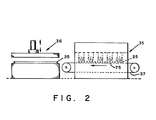
- Figure 2 illustrates preheating a laminated sheet 25 in oven 35.
- the sheet 25 is placed on the surface of conveyor 37 with side 75 of sheet 25 contacting the conveyor.
- sheet 25 is easily removed from conveyor 37 without deformation.
- the sheet can be removed manually or automatically. Manual removal can be merely picking the sheet up by hand or using a spatula like tool.
- the sheet can be formed in a stamping press 36. Upon being stamped, the side of the stamped article corresponding to sheet side 75 is smooth with good appearance. There are no protrusions of fiber from the veil 33 through the polymer film 31 to cause a rough appearance or discomfort upon handling.
- the polymer sheet can be made of a polymer and a reinforcement means.
- the reinforcement means may be one or more fabric layers which are laminated with polymers or embedded within polymers.
- the fibers in the laminate body can be in the form of filaments, threads, yarns, rovings, chopped fiber, scrim, swirl mat, woven rovings, cloth and the like.
- the preferred fibrous reinforcements are mineral fibers such as glass fiber. Glass fiber provides optimum strength characteristics and is readily available in many forms.
- Fibrous swirl mats used as reinforcement in the laminate or in the fabric veil are usually used in an impregnated form. These impregnated fabrics are generally treated with a resin solution to both bind the fibers and wet the fibers.
- the resinous plastic used to impregnate or coat the fabric or fibers used in the laminate body or fabric veil of the present invention can include both thermosetting and thermoplastic resins.
- the thermosetting resins are: crosslinked or crosslinkable epoxy resins, polyester resins, polyurethane resins, olefin polymers, phenolic resins and the like.
- thermoplastic resins are uncrosslinked olefins such as ethylene polymers, propylene polymers, butene polymers and vinyl polymers. Intended to be included with this definition are both the homopolymer and copolymer resins.
- the polymer of the polymer sheet as well as the polymer used in the surface layer can include a variety of additives, including fillers and other minor additives.
- the most desirable sheets include filler.
- the functions of the particulate filler are: (1) to increase the modulus and stiffness of the composite sheet and (2) to provide a more economical composition.
- Fillers may be selected from a wide variety of minerals, metals, metal oxides, siliceous materials, metal salts, and mixtures thereof. These fillers may optionally be treated with various coupling agents or adhesion promoters, as is known to those skilled in the art. Advantageous physical properties are achieved if the filler material has a Young's modulus of 10 7 psi or greater and at least a Young's modulus twice as great as that of the polymer.
- fillers included in these categories are alumina, aluminum hydrates, feldspar, asbestos, talc, calcium carbonates, clay, carbon black, quartz, novaculite and other forms of silica, kaolinite, bentonite, garnet, mica, saponite, beidellite, calcium oxide, calcium hydroxide, wollaston- ite, etc.
- the foregoing recited fillers are illustrative only and are not meant to limit the scope of fillers that can be utilized in this invention.
- sheet formulations include antistatic agents, plasticizers, lubricants, nucleating agents, impact modifiers, colorants, heat and light stabilizers, or other similar processing aids and adjuvants.
- Pigments such as carbon black are useful to hide the fiber veil which is immediately below the polymer film.
- a nucleating agent for the nylon is the preferred nucleating agent.
- 0.5 percent to 1.5 percent or more talc by weight of the nylon is incorporated into the sheet.
- the sheet contains 1 percent talc based on the weight of the nylon.
- Talc or other nucleating agents may alternatively be employed in similar amounts with nylon or other crystalline polymers.
- thermoplastic resin is, of course, the matrix which binds the other constituents together.
- the resin influences the mechanical and physical properties of the composite sheet. If a stamped product having an extremely high thermal resistance is required, for example, a nylon or linear polyester would be utilized as the matrix rather than polyethylene or polypropylene.
- a laminate was made using the equipment and process of the type illustrated in Figure 1 and described in the corresponding description in the Description of the Preferred Embodiments. Reference characters correspond to those in Figure 1.
- Infrared heaters (30) were not used. The line speed was about 1 1/2 feet/minute (0.46 m/min.).
- a top layer 13, or surface portion, of polycaprolactam containing 30 percent by weight short glass fibers (less than 1/8 inch long (0.32 cm)), 19 percent glass microspheres 12 micrometers in diameter, and one percent talc was extruded through a single screw extruder (11) at an average temperature 520°F (271°C). The top layer is extruded through a die set at 0.1 inches (0.254 cm).
- the extrudate passed between two rolls (14), one of which was embossed (72).
- the rolls are heated to 250°F (121°C).
- a bottom layer (15), or bottom surface portion, similar to the top layer was extruded at 580°F (304°C).
- a surface polymer film and a glass veil at room temperature were fed to the nip of the two rolls (17) at the outlet of the die.
- the rolls are heated to 290°F (143°C).
- the veil was between the extrudate layer and the surface polymer film layer.
- the fiberglass veil and polymer surface film layer were fed to the side of the extrudate opposite to the side which was embossed by the embossing roll (76).
- the top layer (13) and the bottom layer (15) passed to the nip of a third set of rolls (21) with their embossed sides facing each other.
- the rolls (21) are heated to 290°F (143°C).
- Polycaprolactam containing about 29 percent by weight of glass microshperes about 12 micrometers in diameter, and about one percent talc was extruded through a single screw extruder (19) at an average temperature of 560°F (293°C).
- Long fiberglass mats and the extrudate which passed from the die of extruder (19) were fed to the nip of rolls 21a and 21b.
- the long fiberglass mat is nonwoven glass and 3.63 oz/ft 2 (1.11 kg/m2).
- the long fiberglass mat embeded into the extrudate from extruder 19 to form the body portion of the laminate.
- the surface sheets (13) and (15) were laminated to the opposite sides of the body portion. The laminate was cooled to room temperature.
- the laminate passed from rolls (21) through cooling rolls (29) at room temperature and was cut into sheets.
- the buried veil was made of 0.2 oz/ft 2 (0.061 kg/m 2 ) continuous, nonwoven fiberglass.
- the polymer surface film was made of heat stabilized polycaprolactam. Laminates were made using polymer surface films of 0.6, 1.0, 1.5 mils (0.015, 0.025, 0.038 mm).
- the laminates at room temperature were placed in an oven and were heated on a steel oven shelf for 2 minutes at 600°F (3l6°C).
- the laminates were easily removed from the oven shelf manually. There was no adhesion to the oven shelf nor distortion of the laminates upon removal. Surface appearance was good, and the surface could be touched without feeling protruding fibers.
Landscapes
- Engineering & Computer Science (AREA)
- Mechanical Engineering (AREA)
- Physics & Mathematics (AREA)
- Electromagnetism (AREA)
- Thermal Sciences (AREA)
- Health & Medical Sciences (AREA)
- Toxicology (AREA)
- Chemical & Material Sciences (AREA)
- Composite Materials (AREA)
- Laminated Bodies (AREA)
Applications Claiming Priority (2)
| Application Number | Priority Date | Filing Date | Title |
|---|---|---|---|
| US375239 | 1982-05-05 | ||
| US06/375,239 US4471018A (en) | 1982-05-05 | 1982-05-05 | Thermoplastic laminate having masked surface fabric veil layer |
Publications (2)
| Publication Number | Publication Date |
|---|---|
| EP0093284A2 true EP0093284A2 (fr) | 1983-11-09 |
| EP0093284A3 EP0093284A3 (fr) | 1985-01-09 |
Family
ID=23480088
Family Applications (1)
| Application Number | Title | Priority Date | Filing Date |
|---|---|---|---|
| EP83103518A Withdrawn EP0093284A3 (fr) | 1982-05-05 | 1983-04-12 | Laminé thermoplastique ayant une couche externe de voile masquée |
Country Status (4)
| Country | Link |
|---|---|
| US (1) | US4471018A (fr) |
| EP (1) | EP0093284A3 (fr) |
| JP (1) | JPS58201641A (fr) |
| CA (1) | CA1197167A (fr) |
Cited By (2)
| Publication number | Priority date | Publication date | Assignee | Title |
|---|---|---|---|---|
| EP0447223A1 (fr) * | 1990-03-15 | 1991-09-18 | Mitsubishi Petrochemical Company Limited | Procédé pour la préparation d'articles thermoplastiques renforcés |
| EP0697280A1 (fr) * | 1994-06-24 | 1996-02-21 | General Electric Company | Structures stratifiées thermoformables et méthodes de fabrication |
Families Citing this family (17)
| Publication number | Priority date | Publication date | Assignee | Title |
|---|---|---|---|---|
| US4612238A (en) * | 1977-07-18 | 1986-09-16 | Allied Corporation | Fiber reinforced multi-ply stampable thermoplastic sheet |
| GB2139950B (en) * | 1983-04-28 | 1987-02-04 | Honda Motor Co Ltd | Composite sound and heat insulating board |
| US4790972A (en) * | 1986-05-16 | 1988-12-13 | Rampart Packaging Inc. | Method for stacking billets and thermoforming |
| US4873133A (en) * | 1986-09-11 | 1989-10-10 | General Electric Company | Fiber reinforced stampable thermoplastic sheet |
| US5034077A (en) * | 1989-09-05 | 1991-07-23 | Jack Pata | Method for thermoforming and bonding a paint-coated polymeric film to a substrate |
| US5124227A (en) * | 1990-03-15 | 1992-06-23 | Graphics Technology International Inc. | Protective overcoats for diazo type layers |
| US5534337A (en) * | 1993-04-05 | 1996-07-09 | Cobale Company, L.L.C. | Thermoset reinforced corrosion resistant laminates |
| US5480705A (en) * | 1993-06-24 | 1996-01-02 | Minnesota Mining And Manufacturing Company | High strength non-chlorinated multi-layered polymeric article |
| US6497787B1 (en) | 2000-04-18 | 2002-12-24 | Owens-Corning Veil Netherlands B.V. | Process of manufacturing a wet-laid veil |
| US6818282B2 (en) * | 2002-05-14 | 2004-11-16 | Awi Licensing Company | Resilient flooring structure with encapsulated fabric |
| US7253127B2 (en) * | 2002-10-07 | 2007-08-07 | Precision Fabrics Group, Inc. | Colored reinforced articles of manufacture and method of making the same |
| US7109135B2 (en) * | 2002-12-03 | 2006-09-19 | Central Products Company | Soft tactile coating for multi-filament woven fabric |
| US20050025949A1 (en) * | 2002-12-19 | 2005-02-03 | Grove Dale A. | Deformable veil and process for manufacturing same |
| US7981501B2 (en) * | 2008-12-02 | 2011-07-19 | GM Global Technology Operations LLC | Laminated composites and methods of making the same |
| EP2548720B1 (fr) * | 2011-07-18 | 2017-06-21 | Cetex Institut für Textil- und Verarbeitungsmaschinen gemeinnützige GmbH | Procédé et dispositif de fabrication d'une feuille pré-imprégnée thermoplastique |
| EP2787862B1 (fr) | 2011-12-08 | 2017-06-07 | Herman Miller, Inc. | Elément de support de corps composite et procédés pour la fabrication et le recyclage de cet élément |
| USD703457S1 (en) | 2013-06-07 | 2014-04-29 | Herman Miller, Inc. | Chair |
Family Cites Families (6)
| Publication number | Priority date | Publication date | Assignee | Title |
|---|---|---|---|---|
| CA837044A (en) * | 1970-03-17 | Robert E. Byrne, Jr. | Reinforced plastic laminate | |
| NL7015947A (fr) * | 1969-12-31 | 1971-07-02 | ||
| CA1013114A (en) * | 1970-03-25 | 1977-07-05 | Anthony M. Fazzari | Glass reinforced composites with improved surface and process |
| BE791510A (fr) * | 1971-11-24 | 1973-05-17 | Johns Manville | Substrat muni d'un revetement et son procede de fabrication |
| US4181551A (en) * | 1978-06-12 | 1980-01-01 | Allied Chemical Corporation | Method of producing stamped plastic articles |
| US4240857A (en) * | 1978-08-08 | 1980-12-23 | Allied Chemical Corporation | Fiber reinforced multi-ply stampable thermoplastic sheet |
-
1982
- 1982-05-05 US US06/375,239 patent/US4471018A/en not_active Expired - Lifetime
-
1983
- 1983-04-12 EP EP83103518A patent/EP0093284A3/fr not_active Withdrawn
- 1983-05-04 CA CA000427401A patent/CA1197167A/fr not_active Expired
- 1983-05-06 JP JP58079214A patent/JPS58201641A/ja active Pending
Cited By (3)
| Publication number | Priority date | Publication date | Assignee | Title |
|---|---|---|---|---|
| EP0447223A1 (fr) * | 1990-03-15 | 1991-09-18 | Mitsubishi Petrochemical Company Limited | Procédé pour la préparation d'articles thermoplastiques renforcés |
| EP0697280A1 (fr) * | 1994-06-24 | 1996-02-21 | General Electric Company | Structures stratifiées thermoformables et méthodes de fabrication |
| US5895709A (en) * | 1994-06-24 | 1999-04-20 | General Electric Company | Multi-layer thermoformable laminates and methods of their manufacture |
Also Published As
| Publication number | Publication date |
|---|---|
| CA1197167A (fr) | 1985-11-26 |
| JPS58201641A (ja) | 1983-11-24 |
| EP0093284A3 (fr) | 1985-01-09 |
| US4471018A (en) | 1984-09-11 |
Similar Documents
| Publication | Publication Date | Title |
|---|---|---|
| US4471018A (en) | Thermoplastic laminate having masked surface fabric veil layer | |
| US4612238A (en) | Fiber reinforced multi-ply stampable thermoplastic sheet | |
| US4269884A (en) | Fiber reinforced multi-ply stampable thermoplastic sheet | |
| US4098943A (en) | Fiber reinforced multi-ply stampable thermoplastic sheet | |
| US4297408A (en) | Laminates of cloth and filled crystalline polypropylene and a method for making them | |
| US4240857A (en) | Fiber reinforced multi-ply stampable thermoplastic sheet | |
| US4469543A (en) | Lamination of highly reinforced thermoplastic composites | |
| US4044188A (en) | Stampable thermoplastic sheet reinforced with multilength fiber | |
| US4923547A (en) | Process for producing composite molded articles from nonwoven mat | |
| EP0255315B1 (fr) | Procédé pour la fabrication de feuilles laminées en matière thermoplastique renforcée et objets fabriqués à partir de celles-ci | |
| EP0109505A2 (fr) | Structure polymère composite estampable contenant une couche de blindage contre les interférences électromagnétiques | |
| EP0966560A1 (fr) | Mats en fils de fibres de verre, composites thermoplastiques renforces a l'aide de ces derniers et procedes de fabrication correspondants | |
| US4238266A (en) | Process of forming a glass fiber reinforced, stampable thermoplastic laminate | |
| AU5230396A (en) | Glass-fiber-containing nonwoven polymer web, and process for preparing same | |
| US4302269A (en) | Process of forming a fiber reinforced, stampable thermoplastic laminate | |
| CA1132325A (fr) | Feuille thermoplastique emboutissable, multicouche, renforcee de fibres | |
| EP0088584B1 (fr) | Procédé de fabrication d'une matière thermoplastique moulée ou moulable renforcée de fibres | |
| EP0221336A2 (fr) | Procédé pour préparer des laminés aptes à être estampés à base de téréphtalates de polyéthylène renforcés par des films de verre et articles estampés ainsi obtenus | |
| WO2002026463A2 (fr) | Procede de fabrication simultanee de stratifies moules | |
| US4181551A (en) | Method of producing stamped plastic articles | |
| CA1137724A (fr) | Feuille thermoplastique a pli multiple, renforcee de fibre de verre, a former par matricage | |
| JPS58124616A (ja) | 繊維強化積層材料から成形部材を作る方法 | |
| US2875474A (en) | Process of shaping resin-impregnated filamentary material | |
| JP2579568B2 (ja) | ガラス繊維強化シートの製造方法 | |
| CA1133369A (fr) | Procede d'obtention de lamines de tissu et de polypropylene cristallin charge |
Legal Events
| Date | Code | Title | Description |
|---|---|---|---|
| PUAI | Public reference made under article 153(3) epc to a published international application that has entered the european phase |
Free format text: ORIGINAL CODE: 0009012 |
|
| AK | Designated contracting states |
Designated state(s): CH DE FR GB IT LI |
|
| PUAL | Search report despatched |
Free format text: ORIGINAL CODE: 0009013 |
|
| AK | Designated contracting states |
Designated state(s): CH DE FR GB IT LI |
|
| 17P | Request for examination filed |
Effective date: 19850226 |
|
| 17Q | First examination report despatched |
Effective date: 19860129 |
|
| STAA | Information on the status of an ep patent application or granted ep patent |
Free format text: STATUS: THE APPLICATION IS DEEMED TO BE WITHDRAWN |
|
| 18D | Application deemed to be withdrawn |
Effective date: 19860610 |
|
| RIN1 | Information on inventor provided before grant (corrected) |
Inventor name: GREGOR, JOHN ANTHONY Inventor name: RANDLE, MARGARET MARIE Inventor name: KRITCHEVSKY, GINA RACHEL Inventor name: MACKEY, JOSPEH EDGAR Inventor name: WIEDERSPAHN, WILLIAM FRANK |