EP0093668A1 - Mikrokapseln mit einer Wand aus netzförmig verknüpftem Milcheiweiss und Verfahren zur Herstellung derselben - Google Patents
Mikrokapseln mit einer Wand aus netzförmig verknüpftem Milcheiweiss und Verfahren zur Herstellung derselben Download PDFInfo
- Publication number
- EP0093668A1 EP0093668A1 EP83400862A EP83400862A EP0093668A1 EP 0093668 A1 EP0093668 A1 EP 0093668A1 EP 83400862 A EP83400862 A EP 83400862A EP 83400862 A EP83400862 A EP 83400862A EP 0093668 A1 EP0093668 A1 EP 0093668A1
- Authority
- EP
- European Patent Office
- Prior art keywords
- microcapsules
- milk
- emulsion
- crosslinking agent
- water
- Prior art date
- Legal status (The legal status is an assumption and is not a legal conclusion. Google has not performed a legal analysis and makes no representation as to the accuracy of the status listed.)
- Granted
Links
- 239000003094 microcapsule Substances 0.000 title claims abstract description 70
- 238000002360 preparation method Methods 0.000 title claims abstract description 7
- 102000014171 Milk Proteins Human genes 0.000 title claims abstract description 6
- 108010011756 Milk Proteins Proteins 0.000 title claims abstract description 6
- 235000021239 milk protein Nutrition 0.000 title claims abstract description 6
- 238000000034 method Methods 0.000 title claims description 20
- 238000004132 cross linking Methods 0.000 claims abstract description 16
- 239000003431 cross linking reagent Substances 0.000 claims abstract description 15
- 230000001588 bifunctional effect Effects 0.000 claims abstract description 5
- 239000003153 chemical reaction reagent Substances 0.000 claims abstract description 5
- 235000013336 milk Nutrition 0.000 claims description 32
- 239000008267 milk Substances 0.000 claims description 32
- 210000004080 milk Anatomy 0.000 claims description 32
- 239000000839 emulsion Substances 0.000 claims description 20
- XLYOFNOQVPJJNP-UHFFFAOYSA-N water Substances O XLYOFNOQVPJJNP-UHFFFAOYSA-N 0.000 claims description 20
- 239000000126 substance Substances 0.000 claims description 16
- 238000004945 emulsification Methods 0.000 claims description 13
- 239000003921 oil Substances 0.000 claims description 13
- 239000002904 solvent Substances 0.000 claims description 13
- 238000003756 stirring Methods 0.000 claims description 13
- 239000003960 organic solvent Substances 0.000 claims description 12
- 238000005119 centrifugation Methods 0.000 claims description 10
- 239000000203 mixture Substances 0.000 claims description 9
- 239000000843 powder Substances 0.000 claims description 8
- 239000000725 suspension Substances 0.000 claims description 8
- 239000013543 active substance Substances 0.000 claims description 7
- 239000003995 emulsifying agent Substances 0.000 claims description 7
- 235000020183 skimmed milk Nutrition 0.000 claims description 7
- 238000005406 washing Methods 0.000 claims description 6
- 238000010908 decantation Methods 0.000 claims description 5
- 239000011541 reaction mixture Substances 0.000 claims description 5
- ZNZYKNKBJPZETN-WELNAUFTSA-N Dialdehyde 11678 Chemical compound N1C2=CC=CC=C2C2=C1[C@H](C[C@H](/C(=C/O)C(=O)OC)[C@@H](C=C)C=O)NCC2 ZNZYKNKBJPZETN-WELNAUFTSA-N 0.000 claims description 4
- SXRSQZLOMIGNAQ-UHFFFAOYSA-N Glutaraldehyde Chemical compound O=CCCCC=O SXRSQZLOMIGNAQ-UHFFFAOYSA-N 0.000 claims description 4
- 125000001931 aliphatic group Chemical group 0.000 claims description 4
- 125000003118 aryl group Chemical group 0.000 claims description 4
- 125000004432 carbon atom Chemical group C* 0.000 claims description 4
- 150000008280 chlorinated hydrocarbons Chemical class 0.000 claims description 4
- 238000004108 freeze drying Methods 0.000 claims description 4
- 239000004094 surface-active agent Substances 0.000 claims description 4
- LXEJRKJRKIFVNY-UHFFFAOYSA-N terephthaloyl chloride Chemical compound ClC(=O)C1=CC=C(C(Cl)=O)C=C1 LXEJRKJRKIFVNY-UHFFFAOYSA-N 0.000 claims description 4
- -1 dicarboxylic acid halide Chemical class 0.000 claims description 3
- 238000007865 diluting Methods 0.000 claims description 3
- 239000006185 dispersion Substances 0.000 claims description 3
- 238000007710 freezing Methods 0.000 claims description 3
- 230000008014 freezing Effects 0.000 claims description 3
- 238000004519 manufacturing process Methods 0.000 claims description 3
- 239000005057 Hexamethylene diisocyanate Substances 0.000 claims description 2
- 239000010775 animal oil Substances 0.000 claims description 2
- IRXBNHGNHKNOJI-UHFFFAOYSA-N butanedioyl dichloride Chemical compound ClC(=O)CCC(Cl)=O IRXBNHGNHKNOJI-UHFFFAOYSA-N 0.000 claims description 2
- WMPOZLHMGVKUEJ-UHFFFAOYSA-N decanedioyl dichloride Chemical compound ClC(=O)CCCCCCCCC(Cl)=O WMPOZLHMGVKUEJ-UHFFFAOYSA-N 0.000 claims description 2
- 125000005442 diisocyanate group Chemical group 0.000 claims description 2
- 230000001804 emulsifying effect Effects 0.000 claims description 2
- 238000001704 evaporation Methods 0.000 claims description 2
- 230000008020 evaporation Effects 0.000 claims description 2
- 125000000524 functional group Chemical group 0.000 claims description 2
- RRAMGCGOFNQTLD-UHFFFAOYSA-N hexamethylene diisocyanate Chemical compound O=C=NCCCCCCN=C=O RRAMGCGOFNQTLD-UHFFFAOYSA-N 0.000 claims description 2
- DVKJHBMWWAPEIU-UHFFFAOYSA-N toluene 2,4-diisocyanate Chemical compound CC1=CC=C(N=C=O)C=C1N=C=O DVKJHBMWWAPEIU-UHFFFAOYSA-N 0.000 claims description 2
- 239000008158 vegetable oil Substances 0.000 claims description 2
- 235000013311 vegetables Nutrition 0.000 claims description 2
- 238000004090 dissolution Methods 0.000 claims 1
- 235000020603 homogenised milk Nutrition 0.000 claims 1
- 235000019198 oils Nutrition 0.000 description 11
- RTZKZFJDLAIYFH-UHFFFAOYSA-N Diethyl ether Chemical compound CCOCC RTZKZFJDLAIYFH-UHFFFAOYSA-N 0.000 description 8
- 239000011521 glass Substances 0.000 description 7
- 239000000243 solution Substances 0.000 description 7
- 238000013019 agitation Methods 0.000 description 6
- 229920000136 polysorbate Polymers 0.000 description 6
- 229950008882 polysorbate Drugs 0.000 description 6
- LFQSCWFLJHTTHZ-UHFFFAOYSA-N Ethanol Chemical compound CCO LFQSCWFLJHTTHZ-UHFFFAOYSA-N 0.000 description 5
- 229920001213 Polysorbate 20 Polymers 0.000 description 5
- 235000008390 olive oil Nutrition 0.000 description 5
- 239000004006 olive oil Substances 0.000 description 5
- 239000000256 polyoxyethylene sorbitan monolaurate Substances 0.000 description 5
- 235000010486 polyoxyethylene sorbitan monolaurate Nutrition 0.000 description 5
- 235000008939 whole milk Nutrition 0.000 description 5
- 108090000790 Enzymes Proteins 0.000 description 4
- 102000004190 Enzymes Human genes 0.000 description 4
- PRXRUNOAOLTIEF-ADSICKODSA-N Sorbitan trioleate Chemical compound CCCCCCCC\C=C/CCCCCCCC(=O)OC[C@@H](OC(=O)CCCCCCC\C=C/CCCCCCCC)[C@H]1OC[C@H](O)[C@H]1OC(=O)CCCCCCC\C=C/CCCCCCCC PRXRUNOAOLTIEF-ADSICKODSA-N 0.000 description 4
- KNHUKKLJHYUCFP-UHFFFAOYSA-N clofibrate Chemical compound CCOC(=O)C(C)(C)OC1=CC=C(Cl)C=C1 KNHUKKLJHYUCFP-UHFFFAOYSA-N 0.000 description 4
- 229960001214 clofibrate Drugs 0.000 description 4
- 239000003814 drug Substances 0.000 description 4
- 235000019441 ethanol Nutrition 0.000 description 4
- 230000002496 gastric effect Effects 0.000 description 4
- 230000000968 intestinal effect Effects 0.000 description 4
- 239000007788 liquid Substances 0.000 description 4
- 239000011877 solvent mixture Substances 0.000 description 4
- YMWUJEATGCHHMB-UHFFFAOYSA-N Dichloromethane Chemical compound ClCCl YMWUJEATGCHHMB-UHFFFAOYSA-N 0.000 description 3
- ABBQHOQBGMUPJH-UHFFFAOYSA-M Sodium salicylate Chemical compound [Na+].OC1=CC=CC=C1C([O-])=O ABBQHOQBGMUPJH-UHFFFAOYSA-M 0.000 description 3
- 239000002775 capsule Substances 0.000 description 3
- 239000003795 chemical substances by application Substances 0.000 description 3
- 235000020247 cow milk Nutrition 0.000 description 3
- 229960004890 diethylpropion Drugs 0.000 description 3
- ICFXZZFWRWNZMA-UHFFFAOYSA-N diethylpropion hydrochloride Chemical compound [Cl-].CC[NH+](CC)C(C)C(=O)C1=CC=CC=C1 ICFXZZFWRWNZMA-UHFFFAOYSA-N 0.000 description 3
- 239000012153 distilled water Substances 0.000 description 3
- 229940079593 drug Drugs 0.000 description 3
- 238000002955 isolation Methods 0.000 description 3
- VLKZOEOYAKHREP-UHFFFAOYSA-N n-Hexane Chemical compound CCCCCC VLKZOEOYAKHREP-UHFFFAOYSA-N 0.000 description 3
- 230000003287 optical effect Effects 0.000 description 3
- 239000008188 pellet Substances 0.000 description 3
- 239000002994 raw material Substances 0.000 description 3
- 235000020122 reconstituted milk Nutrition 0.000 description 3
- 229960004025 sodium salicylate Drugs 0.000 description 3
- 238000002560 therapeutic procedure Methods 0.000 description 3
- PZNPLUBHRSSFHT-RRHRGVEJSA-N 1-hexadecanoyl-2-octadecanoyl-sn-glycero-3-phosphocholine Chemical compound CCCCCCCCCCCCCCCCCC(=O)O[C@@H](COP([O-])(=O)OCC[N+](C)(C)C)COC(=O)CCCCCCCCCCCCCCC PZNPLUBHRSSFHT-RRHRGVEJSA-N 0.000 description 2
- HEDRZPFGACZZDS-UHFFFAOYSA-N Chloroform Chemical compound ClC(Cl)Cl HEDRZPFGACZZDS-UHFFFAOYSA-N 0.000 description 2
- 239000004147 Sorbitan trioleate Substances 0.000 description 2
- 239000004480 active ingredient Substances 0.000 description 2
- 239000012530 fluid Substances 0.000 description 2
- 150000002632 lipids Chemical class 0.000 description 2
- YGSDEFSMJLZEOE-UHFFFAOYSA-N salicylic acid Chemical compound OC(=O)C1=CC=CC=C1O YGSDEFSMJLZEOE-UHFFFAOYSA-N 0.000 description 2
- 239000007787 solid Substances 0.000 description 2
- 235000019337 sorbitan trioleate Nutrition 0.000 description 2
- 229960000391 sorbitan trioleate Drugs 0.000 description 2
- 239000008347 soybean phospholipid Substances 0.000 description 2
- JNYAEWCLZODPBN-JGWLITMVSA-N (2r,3r,4s)-2-[(1r)-1,2-dihydroxyethyl]oxolane-3,4-diol Chemical compound OC[C@@H](O)[C@H]1OC[C@H](O)[C@H]1O JNYAEWCLZODPBN-JGWLITMVSA-N 0.000 description 1
- 239000000592 Artificial Cell Substances 0.000 description 1
- VEXZGXHMUGYJMC-UHFFFAOYSA-M Chloride anion Chemical compound [Cl-] VEXZGXHMUGYJMC-UHFFFAOYSA-M 0.000 description 1
- XDTMQSROBMDMFD-UHFFFAOYSA-N Cyclohexane Chemical compound C1CCCCC1 XDTMQSROBMDMFD-UHFFFAOYSA-N 0.000 description 1
- 102000001554 Hemoglobins Human genes 0.000 description 1
- 108010054147 Hemoglobins Proteins 0.000 description 1
- 238000012695 Interfacial polymerization Methods 0.000 description 1
- 241001465754 Metazoa Species 0.000 description 1
- 241000269980 Pleuronectidae Species 0.000 description 1
- XSTXAVWGXDQKEL-UHFFFAOYSA-N Trichloroethylene Chemical group ClC=C(Cl)Cl XSTXAVWGXDQKEL-UHFFFAOYSA-N 0.000 description 1
- 150000001447 alkali salts Chemical class 0.000 description 1
- 230000004075 alteration Effects 0.000 description 1
- 239000007900 aqueous suspension Substances 0.000 description 1
- 108010051210 beta-Fructofuranosidase Proteins 0.000 description 1
- 230000015572 biosynthetic process Effects 0.000 description 1
- 238000009835 boiling Methods 0.000 description 1
- 230000003139 buffering effect Effects 0.000 description 1
- 150000001735 carboxylic acids Chemical class 0.000 description 1
- ZYZWOSIRFVIBRH-UHFFFAOYSA-N chloroform;cyclohexane Chemical compound ClC(Cl)Cl.C1CCCCC1 ZYZWOSIRFVIBRH-UHFFFAOYSA-N 0.000 description 1
- 235000020186 condensed milk Nutrition 0.000 description 1
- 235000014113 dietary fatty acids Nutrition 0.000 description 1
- 102000038379 digestive enzymes Human genes 0.000 description 1
- 108091007734 digestive enzymes Proteins 0.000 description 1
- 238000010790 dilution Methods 0.000 description 1
- 239000012895 dilution Substances 0.000 description 1
- 238000001493 electron microscopy Methods 0.000 description 1
- 239000000194 fatty acid Substances 0.000 description 1
- 229930195729 fatty acid Natural products 0.000 description 1
- 230000002349 favourable effect Effects 0.000 description 1
- 235000013305 food Nutrition 0.000 description 1
- 229910052500 inorganic mineral Inorganic materials 0.000 description 1
- 239000001573 invertase Substances 0.000 description 1
- 235000011073 invertase Nutrition 0.000 description 1
- 239000002960 lipid emulsion Substances 0.000 description 1
- 210000004185 liver Anatomy 0.000 description 1
- 239000012528 membrane Substances 0.000 description 1
- 229910052751 metal Inorganic materials 0.000 description 1
- 239000002184 metal Substances 0.000 description 1
- 238000000386 microscopy Methods 0.000 description 1
- 239000011707 mineral Substances 0.000 description 1
- 150000007522 mineralic acids Chemical class 0.000 description 1
- 231100000252 nontoxic Toxicity 0.000 description 1
- 230000003000 nontoxic effect Effects 0.000 description 1
- 238000000879 optical micrograph Methods 0.000 description 1
- 238000000399 optical microscopy Methods 0.000 description 1
- 150000007524 organic acids Chemical class 0.000 description 1
- 150000007530 organic bases Chemical class 0.000 description 1
- FJKROLUGYXJWQN-UHFFFAOYSA-N papa-hydroxy-benzoic acid Natural products OC(=O)C1=CC=C(O)C=C1 FJKROLUGYXJWQN-UHFFFAOYSA-N 0.000 description 1
- 239000008194 pharmaceutical composition Substances 0.000 description 1
- 239000012460 protein solution Substances 0.000 description 1
- 230000000717 retained effect Effects 0.000 description 1
- 229960004889 salicylic acid Drugs 0.000 description 1
- 150000003839 salts Chemical class 0.000 description 1
- 239000012047 saturated solution Substances 0.000 description 1
- 238000004626 scanning electron microscopy Methods 0.000 description 1
- 239000006228 supernatant Substances 0.000 description 1
- 230000001052 transient effect Effects 0.000 description 1
- 235000015112 vegetable and seed oil Nutrition 0.000 description 1
- 239000000341 volatile oil Substances 0.000 description 1
Images

Classifications
-
- B—PERFORMING OPERATIONS; TRANSPORTING
- B01—PHYSICAL OR CHEMICAL PROCESSES OR APPARATUS IN GENERAL
- B01J—CHEMICAL OR PHYSICAL PROCESSES, e.g. CATALYSIS OR COLLOID CHEMISTRY; THEIR RELEVANT APPARATUS
- B01J13/00—Colloid chemistry, e.g. the production of colloidal materials or their solutions, not otherwise provided for; Making microcapsules or microballoons
- B01J13/02—Making microcapsules or microballoons
- B01J13/06—Making microcapsules or microballoons by phase separation
- B01J13/14—Polymerisation; cross-linking
- B01J13/16—Interfacial polymerisation
-
- A—HUMAN NECESSITIES
- A61—MEDICAL OR VETERINARY SCIENCE; HYGIENE
- A61K—PREPARATIONS FOR MEDICAL, DENTAL OR TOILETRY PURPOSES
- A61K9/00—Medicinal preparations characterised by special physical form
- A61K9/48—Preparations in capsules, e.g. of gelatin, of chocolate
- A61K9/50—Microcapsules having a gas, liquid or semi-solid filling; Solid microparticles or pellets surrounded by a distinct coating layer, e.g. coated microspheres, coated drug crystals
- A61K9/5005—Wall or coating material
- A61K9/5021—Organic macromolecular compounds
- A61K9/5052—Proteins, e.g. albumin
-
- A—HUMAN NECESSITIES
- A61—MEDICAL OR VETERINARY SCIENCE; HYGIENE
- A61K—PREPARATIONS FOR MEDICAL, DENTAL OR TOILETRY PURPOSES
- A61K9/00—Medicinal preparations characterised by special physical form
- A61K9/48—Preparations in capsules, e.g. of gelatin, of chocolate
- A61K9/50—Microcapsules having a gas, liquid or semi-solid filling; Solid microparticles or pellets surrounded by a distinct coating layer, e.g. coated microspheres, coated drug crystals
- A61K9/5005—Wall or coating material
- A61K9/5063—Compounds of unknown constitution, e.g. material from plants or animals
-
- A—HUMAN NECESSITIES
- A61—MEDICAL OR VETERINARY SCIENCE; HYGIENE
- A61K—PREPARATIONS FOR MEDICAL, DENTAL OR TOILETRY PURPOSES
- A61K9/00—Medicinal preparations characterised by special physical form
- A61K9/48—Preparations in capsules, e.g. of gelatin, of chocolate
- A61K9/50—Microcapsules having a gas, liquid or semi-solid filling; Solid microparticles or pellets surrounded by a distinct coating layer, e.g. coated microspheres, coated drug crystals
- A61K9/5089—Processes
Definitions
- the present invention relates to wall-mounted microcapsules obtained by crosslinking milk proteins and their preparation process.
- the invention relates to microcapsules containing in particular, but not exclusively, a pharmaceutically active substance.
- the microca p sules according to the invention can indeed also contain other substances such as food substances and in particular essential oils.
- microcapsules are artificial organelles which are of great interest for the pharmaceutical formulation of various drugs.
- the inclusion of an active principle in a microscopic spherule indeed makes it possible to ensure its transient protection with respect to denaturing agents, such as digestive enzymes. It is necessary that the wall of the spherule has all the guarantees of safety and biodegradability linked to use in human therapy.
- the object of the present invention makes it possible in particular to solve the problems mentioned above.
- microcapsules according to the present invention are characterized in that they have a wall external obtained by interfacial crosslinking of milk proteins using a crosslinking agent in particular constituted by a bifunctional acylating reagent or by a dialdehyde such as glutaraldehyde.
- the present invention applies to the microencapsulation of pharmaceutically active substances of any kind, among which mention will be made, by way of example, of water-soluble substances, such as alkali salts of carboxylic acids, for example salicylic acid, the salts of a mineral or organic acid and of an organic base, for example amfepramone hydrochloride, as well as oily substances and liposoluble substances, such as vegetable oils, for example olive oil, animal oils, for example cod and halibut liver oils, or other drugs, for example clofibrate.
- water-soluble substances such as alkali salts of carboxylic acids, for example salicylic acid, the salts of a mineral or organic acid and of an organic base, for example amfepramone hydrochloride
- oily substances and liposoluble substances such as vegetable oils, for example olive oil, animal oils, for example cod and halibut liver oils, or other drugs, for example clofibrate.
- the microcapsules are obtained from milk to which the microencapsulation process by emulsion-crosslinking, developed by MCLEVY et al. (RAMBOURG (P): "On the microencapsulation of invertase and hemoglobin: from interfacial polymerization to the emulsion-crosslinking process ". Doctoral thesis, 3rd cycle, liable Paris-Sud, UER Chimie Thérapeutique, 1980, LEVY (MC), RAMBOURG (P) and LEVY (J), 2nd Int. Technological Congress Pharm. Paris 1980, III, 15-24 Microencapsulation III).
- MCLEVY et al. MCLEVY et al.
- the milk is dispersed into fine globules in an immiscible organic solvent, by the addition of an emulsifying agent and by stirring.
- the substance which will be encapsulated is added beforehand to the milk.
- the milk used is cow's milk, possibly homogenized, whole or partially skimmed. Milk reconstituted from condensed milk or whole or partially skimmed milk is used without inconvenience.
- the organic solvent used during this first emulsification step is advantageously chosen so that it is not miscible with water, that its density is substantially between 0.7 and 1.1, and that the crosslinking agent used in the second phase dissolves there.
- a binary mixture consisting of a chlorinated hydrocarbon with one or two carbon atoms such as chloroform, methylene chloride or trichlorethylene and a non-chlorinated hydrocarbon comprising from 5 to 7 carbon atoms, such as hexane or cyclohexane.
- the emulsifying agent used during this first step is a surfactant such as a sorbitan and fatty acid ester or any other surfactant chosen by a person skilled in the art in order to prepare a water-type emulsion in oil.
- Sorbitan trioleate (Span 85®) is used with profit.
- Such an emulsion can easily be obtained by stirring, for example by means of a glass anchor driven mechanically inside a centrifuge tube. A rotation speed of between approximately 1000 and approximately 2000 revolutions per minute, continued for at least approximately three minutes is then sufficient to carry out the emulsification.
- the milk emulsification step can be preceded by the production of a very fine primary emulsion of an oil, vegetable or animal in milk.
- a mechanical stirrer is then used which allows a higher speed of rotation, for example advantageously between approximately 10,000 and approximately 20,000 revolutions per minute, and the oil is emulsified in milk in the presence of an emulsifying agent chosen by l skilled in the art for obtaining an oil in water type emulsion, for example polysorbate (Tween 20 ”) or soy lecithin.
- an emulsifying agent chosen by l skilled in the art for obtaining an oil in water type emulsion, for example polysorbate (Tween 20 ") or soy lecithin.
- Tween 20 polysorbate
- This variant also applies to an oil containing a fat-soluble substance in solution and to an oily active principle.
- the very fine primary emulsion of oil in milk is then used in the same way as milk in the first emulsification step, described above.
- the wall of the microcapsules is formed by crosslinking in particular by means of an acylating bifunctional reagent, such as a dicarboxylic acid halide, a diisocyanate, where the two functional groups are both carried by a aromatic ring, or separated by an aliphatic chain of 2 to 10 carbon atoms, or carried, one by an aromatic ring, the other by a juxtanuclear aliphatic chain, for example, succinyl dichloride, sebacoyl dichloride, terephthaloyl dichloride, toluene diisocyanate, hexamethylene diisocyanate, or also by a dialdehyde such as glutaraldehyde.
- an acylating bifunctional reagent such as a dicarboxylic acid halide, a diisocyanate
- the two functional groups are both carried by a aromatic ring, or separated by an aliphatic chain of 2 to 10 carbon atoms,
- the crosslinking agent is added, preferably in solution in the organic solvent already used in the first step, to the milk emulsion kept under stirring.
- This operation is carried out at a temperature between the freezing point and the boiling point of the liquids used, most often at ordinary temperature.
- a concentration of the crosslinking agent in the solvent mixture varying from saturation to a concentration of 0.1 M is compatible with obtaining microcapsules.
- Favorable conditions for the preparation of microcapsules are generally obtained when the solution of the crosslinking agent is added to the milk emulsion in a volume substantially equal to the volume of solvent used to prepare said emulsion.
- the third stage of isolation of the microcapsules is carried out by diluting the reaction mixture by means of a solvent or a mixture of solvents, then by subjecting the suspension of microcapsules to a succession of decantations and washes.
- Decantation can advantageously be replaced by centrifugation, for example 350 x g, 30 seconds.
- the dry microcapsules are obtained by evaporation of the ether or of the alcohol when one of these solvents has been used in the final phase of washing, or also by lyophilization of a suspension of microcapsules in water, subjected beforehand to a freezing.
- microcapsules prepared from milk according to the characteristics of the invention are presented under light microscopy, in the form of well individualized spherules, generally of yellow color, the diameter of which can vary between 25 and 300 ⁇ .
- Spherules of larger size can be obtained when the emulsification and crosslinking operations are carried out with an agitation speed of less than 1000 revolutions per minute.
- microcapsules are prepared from whole milk, or when a primary emulsion of an oil in skim milk has been produced according to the variant indicated above, they contain fine lipid globules with a diameter of approximately 1 at about 3 ⁇ .
- the lyophilized microcapsules have collapsed walls and quickly regain a spherical shape by rehydration.
- the microcapsules prepared from milk and a diacid chloride such as terephthaloyl chloride show no microscopically visible alteration after 3 hours at 37 ° C. After 8 hours of contact, approximately 70% of the microcapsules are still intact. On the other hand, the wall of all the microcapsules is lysed in less than 5 minutes in an artificial intestinal medium.
- the contents of the centrifuge tube are transferred to a beaker containing 30 ml of solvent mixture.
- the microcapsules formed are dispersed by manual stirring using a glass shaker for 1 to 2 minutes. This suspension is subjected to centrifugation (350 x g, 30 seconds).
- the centrifugation pellet is resuspended in 20 ml of 95 ° alcohol, manually stirred (glass shaker) for 1 to 2 minutes and centrifuged again under the same conditions. Three identical alcohol washing operations are carried out. At the end of these, the centrifugation pellet is suspended in 100 ml of distilled water.
- microcapsules obtained are presented under optical microscopy in the form of regular and well individualized spheres with a diameter of 25 to 300 microns, colored in yellow. They contain the lipids of milk in the form of fine globules with a diameter of 1 to 2 microns.
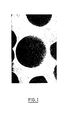
- FIG. 1 represents an optical microscopy image (magnification 300 times) of the microcapsules obtained in accordance with Example 1.
- aqueous suspension is frozen at -10 ° and lyophilized. 0.75 g of a microcapsule powder is obtained.
- 50 mg of powder of lyophilized microcapsules are suspended in 1 ml of water and added to 15 ml of artificial gastric liquid at pH 1.2 (U.S.P. XIX), in a water bath at 37 °.
- Optical microscopic examination shows that the wall of the microcapsules is not damaged after 3 hours. After 8 hours, 70% of the microcapsules still retained their integrity.
- the milk is reconstituted by adding water in the proportions prescribed by the manufacturer.
- a variant consists in using proportionally smaller amounts of water, which gives higher density microcapsules. This is how the amount of water added can be reduced up to 4 ml for 1 g of whole milk powder, and up to 3 ml for 1 g of skim milk powder.
- FIG. 2 represents a scan electron microscopy (1000 times magnification) of the microcapsules prepared from milk reconstituted in accordance with Example 2.
- Example 1 The protocol described in Example 1 is reproduced, here replacing the 3 ml of whole milk with 3 ml of reconstituted milk (1 g of skimmed milk + 4 ml of water) containing in solution 100 mg of sodium salicylate.
- the contents of the centrifuge tube are transferred to a beaker containing 30 ml of solvent mixture.
- the microcapsules are dispersed by manual stirring using a glass shaker for 1 to 2 minutes. This suspension is subjected to centrifugation (350 x g, 30 seconds). The centrifugation residue is resuspended in 20 ml of ether, stirred manually (glass shaker) for 1 to 2 minutes and subjected to decantation. The supernatant is removed.
- the microcapsules are washed again with ether and then dried in the open air.
- Example 3 The protocol described in Example 3 is reproduced by replacing, during the emulsification, sodium salicylate with 100 mg of amfepramone hydrochloride.
- the mixture is stirred for 6 minutes at 13,000 revolutions per minute using a double metal blade. A very fine emulsion of oil in milk is thus obtained. Under an optical microscope, the oil globules have a size of 1 to 2 microns.
- Example 5 The protocol described in Example 5 is reproduced by replacing the polysorbate with soy lecithin (0.6 g). The microcapsules obtained are washed using a 5% (v / v) solution of polysorbate (Tween 20®) in distilled water. After 3 successive washes, the centrifugation pellet is washed with pure water and the suspension of microcapsules in water is subjected to lyophilization.
- Example 5 The protocol described in Example 5 is reproduced, replacing the olive oil with 3 ml of clofibrate.
- microcapsules obtained are lyophilized. A pale yellow microcapsule powder is thus obtained.
- the clofibrate globules (1 to 2 u) are distinguished inside the microcapsules.
Landscapes
- Health & Medical Sciences (AREA)
- Chemical & Material Sciences (AREA)
- Life Sciences & Earth Sciences (AREA)
- Public Health (AREA)
- Pharmacology & Pharmacy (AREA)
- Epidemiology (AREA)
- Bioinformatics & Cheminformatics (AREA)
- Animal Behavior & Ethology (AREA)
- General Health & Medical Sciences (AREA)
- Engineering & Computer Science (AREA)
- Veterinary Medicine (AREA)
- Medicinal Chemistry (AREA)
- Organic Chemistry (AREA)
- Dispersion Chemistry (AREA)
- Chemical Kinetics & Catalysis (AREA)
- Botany (AREA)
- Zoology (AREA)
- Manufacturing Of Micro-Capsules (AREA)
- Medicinal Preparation (AREA)
- Peptides Or Proteins (AREA)
- Compositions Of Macromolecular Compounds (AREA)
Priority Applications (1)
| Application Number | Priority Date | Filing Date | Title |
|---|---|---|---|
| AT83400862T ATE16152T1 (de) | 1982-05-04 | 1983-04-29 | Mikrokapseln mit einer wand aus netzfoermig verknuepftem milcheiweiss und verfahren zur herstellung derselben. |
Applications Claiming Priority (2)
| Application Number | Priority Date | Filing Date | Title |
|---|---|---|---|
| FR8207735A FR2526328A1 (fr) | 1982-05-04 | 1982-05-04 | Microcapsules a paroi obtenue par reticulation des proteines du lait, et leur procede de preparation |
| FR8207735 | 1982-05-04 |
Publications (3)
| Publication Number | Publication Date |
|---|---|
| EP0093668A1 true EP0093668A1 (de) | 1983-11-09 |
| EP0093668B1 EP0093668B1 (de) | 1985-10-23 |
| EP0093668B2 EP0093668B2 (de) | 1990-06-20 |
Family
ID=9273705
Family Applications (1)
| Application Number | Title | Priority Date | Filing Date |
|---|---|---|---|
| EP83400862A Expired - Lifetime EP0093668B2 (de) | 1982-05-04 | 1983-04-29 | Mikrokapseln mit einer Wand aus netzförmig verknüpftem Milcheiweiss und Verfahren zur Herstellung derselben |
Country Status (5)
| Country | Link |
|---|---|
| EP (1) | EP0093668B2 (de) |
| JP (1) | JPS58205538A (de) |
| AT (1) | ATE16152T1 (de) |
| DE (1) | DE3361057D1 (de) |
| FR (1) | FR2526328A1 (de) |
Cited By (4)
| Publication number | Priority date | Publication date | Assignee | Title |
|---|---|---|---|---|
| EP0275358A1 (de) * | 1986-12-15 | 1988-07-27 | Ohkawara Kakohki Co., Ltd. | Mikrokapseln und Verfahren zur Herstelllung |
| EP0306971A3 (de) * | 1987-09-09 | 1990-10-03 | Richard B. Bankert | Verwendung von Milchfettkügelchen als Träger für Arzneimittel und als Mikroflotationsmittel in Immuntestverfahren und bei der Zell/Molekül-Trennung |
| US6022501A (en) * | 1996-08-15 | 2000-02-08 | American Cyanamid Company | pH-sensitive microcapsules |
| WO2012175776A1 (es) * | 2011-06-22 | 2012-12-27 | Consejo Superior De Investigaciones Científicas (Csic) | Procedimiento de obtención de micro-, submicro- y nanocápsulas basado en proteínas del suero de la leche |
Families Citing this family (2)
| Publication number | Priority date | Publication date | Assignee | Title |
|---|---|---|---|---|
| FR2565102B1 (fr) * | 1984-06-05 | 1987-03-20 | Paris Sud Universite | Microcapsules biodegradables a base de serumalbumine, leur preparation et leur application a la liberation in situ de medicuments |
| JP6108382B2 (ja) * | 2012-09-04 | 2017-04-05 | 国立大学法人九州大学 | 新規イオン液体およびその用途 |
Citations (3)
| Publication number | Priority date | Publication date | Assignee | Title |
|---|---|---|---|---|
| US3137631A (en) * | 1959-12-01 | 1964-06-16 | Faberge Inc | Encapsulation in natural products |
| FR2251366A1 (en) * | 1973-11-16 | 1975-06-13 | Ciba Geigy Ag | Encapsulation of water-immiscible substances - using polymeric polyfunctional cpd and polyacrolein cpd |
| FR2444497A1 (fr) * | 1978-12-19 | 1980-07-18 | Mars Inc | Procede de micro-encapsulation |
Family Cites Families (1)
| Publication number | Priority date | Publication date | Assignee | Title |
|---|---|---|---|---|
| JPS55109443A (en) * | 1978-12-19 | 1980-08-22 | Mars Inc | Microocapsulizing process |
-
1982
- 1982-05-04 FR FR8207735A patent/FR2526328A1/fr active Granted
-
1983
- 1983-04-29 AT AT83400862T patent/ATE16152T1/de not_active IP Right Cessation
- 1983-04-29 EP EP83400862A patent/EP0093668B2/de not_active Expired - Lifetime
- 1983-04-29 DE DE8383400862T patent/DE3361057D1/de not_active Expired
- 1983-05-04 JP JP58078856A patent/JPS58205538A/ja active Pending
Patent Citations (3)
| Publication number | Priority date | Publication date | Assignee | Title |
|---|---|---|---|---|
| US3137631A (en) * | 1959-12-01 | 1964-06-16 | Faberge Inc | Encapsulation in natural products |
| FR2251366A1 (en) * | 1973-11-16 | 1975-06-13 | Ciba Geigy Ag | Encapsulation of water-immiscible substances - using polymeric polyfunctional cpd and polyacrolein cpd |
| FR2444497A1 (fr) * | 1978-12-19 | 1980-07-18 | Mars Inc | Procede de micro-encapsulation |
Cited By (6)
| Publication number | Priority date | Publication date | Assignee | Title |
|---|---|---|---|---|
| EP0275358A1 (de) * | 1986-12-15 | 1988-07-27 | Ohkawara Kakohki Co., Ltd. | Mikrokapseln und Verfahren zur Herstelllung |
| EP0306971A3 (de) * | 1987-09-09 | 1990-10-03 | Richard B. Bankert | Verwendung von Milchfettkügelchen als Träger für Arzneimittel und als Mikroflotationsmittel in Immuntestverfahren und bei der Zell/Molekül-Trennung |
| US6022501A (en) * | 1996-08-15 | 2000-02-08 | American Cyanamid Company | pH-sensitive microcapsules |
| US6500447B1 (en) | 1996-08-15 | 2002-12-31 | Basf Aktiengesellschaft | pH-sensitive microcapsules |
| WO2012175776A1 (es) * | 2011-06-22 | 2012-12-27 | Consejo Superior De Investigaciones Científicas (Csic) | Procedimiento de obtención de micro-, submicro- y nanocápsulas basado en proteínas del suero de la leche |
| ES2395553A1 (es) * | 2011-06-22 | 2013-02-13 | Consejo Superior De Investigaciones Científicas (Csic) | Procedimiento de obtención de micro-, submicro- y nanocápsulas basado en proteínas del suero de la leche. |
Also Published As
| Publication number | Publication date |
|---|---|
| JPS58205538A (ja) | 1983-11-30 |
| FR2526328B1 (de) | 1984-10-19 |
| FR2526328A1 (fr) | 1983-11-10 |
| ATE16152T1 (de) | 1985-11-15 |
| DE3361057D1 (en) | 1985-11-28 |
| EP0093668B1 (de) | 1985-10-23 |
| EP0093668B2 (de) | 1990-06-20 |
Similar Documents
| Publication | Publication Date | Title |
|---|---|---|
| EP0095968B1 (de) | Mikrokapseln mit Wänden aus einer Mischung von vernetzten Polyholosiden und Proteinen sowie Verfahren zu deren Herstellung | |
| EP0170540B1 (de) | Verfahren zur Herstellung von biologisch abbaubaren Mikrokapseln auf Basis von Serumalbumin | |
| EP0611326B1 (de) | Herstellungsverfahren von nanokapseln mit auf vernetzten proteinen basierenden wänden; derart hergestellte nanokapseln und diese enthaltende kosmetika, pharmazeutika und lebensmittel | |
| EP0655946A1 (de) | Verwendung einer transacyelierungsreaktion zur herstellung von mikropartikeln | |
| EP0930936B1 (de) | Verfahren zur herstellung von aktive stoffe enthaltenden mikrokapseln und mit einem polymer umgehüllten | |
| Youan et al. | Protein release profiles and morphology of biodegradable microcapsules containing an oily core | |
| EP1102581B1 (de) | Zur bildung einer mikroemulsion fähigen zusammensetzung mit verlängerter freisetzung des wirkstoffs | |
| EP0966268B1 (de) | Partikeln,insbesondere mikro- oder nanopartikeln aus quervernetzten pflanzlichen proteinen,verfahren zu deren herstellung und diese enthaltende arzneimittel oder kosmetika oder nahrungsmittelzubereitungen | |
| EP1003488B1 (de) | Verfahren zur herstellung von nanokapseln des vesikulären typs | |
| FR2491351A1 (fr) | Procede de microcapsulation | |
| WO1997000623A1 (fr) | Vehicules de principes actifs a base de tensioactifs non ioniques et leurs applications notamment dans les domaines alimentaire, cosmetique et pharmaceutique | |
| EP0608207A1 (de) | Arzneizusammensetzungen enthaltend Nanokapseln | |
| FR2688422A1 (fr) | Microcapsules a parois en polysaccharides contenant des fonctions alcools primaires, et compositions en contenant. | |
| EP1590077B1 (de) | System zur mikroverkapselung und ihre verwendungen | |
| FR2571963A1 (fr) | Composition a usage cosmetique ou pharmaceutique contenant des niosomes et au moins un polyamide hydrosoluble et procede de preparation de cette composition. | |
| EP0093668B1 (de) | Mikrokapseln mit einer Wand aus netzförmig verknüpftem Milcheiweiss und Verfahren zur Herstellung derselben | |
| Zhang et al. | An improvement of double emulsion technique for preparing bovine serum albumin-loaded PLGA microspheres | |
| EP3432729A1 (de) | Nanokapseln mit einem fettlöslichen wirkstoff, herstellung und verwendungen | |
| FR2803202A1 (fr) | Compositions pharmaceutiques destinees a une adminstration par voie orale | |
| FR2790975A1 (fr) | Milieux sous forme de dispersions complexes, leur procede de preparation et leurs utilisations | |
| WO1999027907A1 (fr) | Procede perfectionne pour eviter la degradation d'un principe actif | |
| WO2015011419A1 (fr) | Nanoparticules lipidiques multicompartimentées | |
| EP0542965B1 (de) | Als milchfettkoerperchenersatz verwendbares koerperchen, desselben enthaeltende zusammenstellung, und verfahren zur herstellung desselben | |
| FR2832312A1 (fr) | Procede de preparation de microparticules sans solvant toxique, microparticules obtenues selon ce procede, utilisations et compositions pharmaceutiques | |
| FR2748673A1 (fr) | Microparticules de polymere reticule contenant une matiere organique, procede de preparation de ces microparticules |
Legal Events
| Date | Code | Title | Description |
|---|---|---|---|
| PUAI | Public reference made under article 153(3) epc to a published international application that has entered the european phase |
Free format text: ORIGINAL CODE: 0009012 |
|
| AK | Designated contracting states |
Designated state(s): AT BE CH DE GB IT LI LU NL SE |
|
| 17P | Request for examination filed |
Effective date: 19840424 |
|
| ITF | It: translation for a ep patent filed | ||
| GRAA | (expected) grant |
Free format text: ORIGINAL CODE: 0009210 |
|
| AK | Designated contracting states |
Designated state(s): AT BE CH DE GB IT LI LU NL SE |
|
| REF | Corresponds to: |
Ref document number: 16152 Country of ref document: AT Date of ref document: 19851115 Kind code of ref document: T |
|
| REF | Corresponds to: |
Ref document number: 3361057 Country of ref document: DE Date of ref document: 19851128 |
|
| BECN | Be: change of holder's name |
Effective date: 19851023 |
|
| PG25 | Lapsed in a contracting state [announced via postgrant information from national office to epo] |
Ref country code: LU Free format text: LAPSE BECAUSE OF NON-PAYMENT OF DUE FEES Effective date: 19860430 |
|
| PLBI | Opposition filed |
Free format text: ORIGINAL CODE: 0009260 |
|
| 26 | Opposition filed |
Opponent name: MARS INCORPORATED Effective date: 19860723 |
|
| NLR1 | Nl: opposition has been filed with the epo |
Opponent name: MARS INCORPORATED |
|
| RAP2 | Party data changed (patent owner data changed or rights of a patent transferred) |
Owner name: ETABLISSEMENT PUBLIC DIT: CENTRE NATIONAL DE LA R |
|
| PGFP | Annual fee paid to national office [announced via postgrant information from national office to epo] |
Ref country code: AT Payment date: 19900319 Year of fee payment: 8 |
|
| PGFP | Annual fee paid to national office [announced via postgrant information from national office to epo] |
Ref country code: LU Payment date: 19900406 Year of fee payment: 8 |
|
| PGFP | Annual fee paid to national office [announced via postgrant information from national office to epo] |
Ref country code: CH Payment date: 19900412 Year of fee payment: 8 |
|
| PGFP | Annual fee paid to national office [announced via postgrant information from national office to epo] |
Ref country code: DE Payment date: 19900421 Year of fee payment: 8 |
|
| PGFP | Annual fee paid to national office [announced via postgrant information from national office to epo] |
Ref country code: GB Payment date: 19900423 Year of fee payment: 8 |
|
| PGFP | Annual fee paid to national office [announced via postgrant information from national office to epo] |
Ref country code: SE Payment date: 19900426 Year of fee payment: 8 |
|
| ITTA | It: last paid annual fee | ||
| PGFP | Annual fee paid to national office [announced via postgrant information from national office to epo] |
Ref country code: NL Payment date: 19900430 Year of fee payment: 8 |
|
| PUAH | Patent maintained in amended form |
Free format text: ORIGINAL CODE: 0009272 |
|
| STAA | Information on the status of an ep patent application or granted ep patent |
Free format text: STATUS: PATENT MAINTAINED AS AMENDED |
|
| PGFP | Annual fee paid to national office [announced via postgrant information from national office to epo] |
Ref country code: BE Payment date: 19900515 Year of fee payment: 8 |
|
| ITF | It: translation for a ep patent filed | ||
| 27A | Patent maintained in amended form |
Effective date: 19900620 |
|
| AK | Designated contracting states |
Kind code of ref document: B2 Designated state(s): AT BE CH DE GB IT LI LU NL SE |
|
| NLR2 | Nl: decision of opposition | ||
| NLR3 | Nl: receipt of modified translations in the netherlands language after an opposition procedure | ||
| R20 | Corrections of a patent specification |
Effective date: 19900803 |
|
| PG25 | Lapsed in a contracting state [announced via postgrant information from national office to epo] |
Ref country code: GB Effective date: 19910429 Ref country code: AT Effective date: 19910429 |
|
| PG25 | Lapsed in a contracting state [announced via postgrant information from national office to epo] |
Ref country code: SE Effective date: 19910430 Ref country code: LI Effective date: 19910430 Ref country code: CH Effective date: 19910430 Ref country code: BE Effective date: 19910430 |
|
| BERE | Be: lapsed |
Owner name: CENTRE NATIONAL DE LA RECHERCHE SCIENTIFIQUE CNRS Effective date: 19910430 |
|
| PG25 | Lapsed in a contracting state [announced via postgrant information from national office to epo] |
Ref country code: NL Effective date: 19911101 |
|
| NLV4 | Nl: lapsed or anulled due to non-payment of the annual fee | ||
| REG | Reference to a national code |
Ref country code: CH Ref legal event code: PL |
|
| GBPC | Gb: european patent ceased through non-payment of renewal fee | ||
| PG25 | Lapsed in a contracting state [announced via postgrant information from national office to epo] |
Ref country code: DE Effective date: 19920201 |
|
| EUG | Se: european patent has lapsed |
Ref document number: 83400862.5 Effective date: 19911108 |