EP0093682A1 - Emballage en carton muni de renforts - Google Patents
Emballage en carton muni de renforts Download PDFInfo
- Publication number
- EP0093682A1 EP0093682A1 EP83420077A EP83420077A EP0093682A1 EP 0093682 A1 EP0093682 A1 EP 0093682A1 EP 83420077 A EP83420077 A EP 83420077A EP 83420077 A EP83420077 A EP 83420077A EP 0093682 A1 EP0093682 A1 EP 0093682A1
- Authority
- EP
- European Patent Office
- Prior art keywords
- reinforcement
- reinforcements
- uprights
- wood
- upper edge
- Prior art date
- Legal status (The legal status is an assumption and is not a legal conclusion. Google has not performed a legal analysis and makes no representation as to the accuracy of the status listed.)
- Granted
Links
- 230000002787 reinforcement Effects 0.000 title claims abstract description 43
- 238000012856 packing Methods 0.000 title abstract 5
- 239000002023 wood Substances 0.000 claims abstract description 16
- 239000000463 material Substances 0.000 claims abstract description 13
- 238000004806 packaging method and process Methods 0.000 claims description 34
- 238000004026 adhesive bonding Methods 0.000 claims description 3
- 239000011093 chipboard Substances 0.000 description 2
- 238000004519 manufacturing process Methods 0.000 description 2
- 230000003014 reinforcing effect Effects 0.000 description 2
- 238000003860 storage Methods 0.000 description 2
- 230000000712 assembly Effects 0.000 description 1
- 238000000429 assembly Methods 0.000 description 1
- 235000013399 edible fruits Nutrition 0.000 description 1
- 235000012055 fruits and vegetables Nutrition 0.000 description 1
- 230000035939 shock Effects 0.000 description 1
- 238000005728 strengthening Methods 0.000 description 1
- 238000009423 ventilation Methods 0.000 description 1
Images


Classifications
-
- B—PERFORMING OPERATIONS; TRANSPORTING
- B65—CONVEYING; PACKING; STORING; HANDLING THIN OR FILAMENTARY MATERIAL
- B65D—CONTAINERS FOR STORAGE OR TRANSPORT OF ARTICLES OR MATERIALS, e.g. BAGS, BARRELS, BOTTLES, BOXES, CANS, CARTONS, CRATES, DRUMS, JARS, TANKS, HOPPERS, FORWARDING CONTAINERS; ACCESSORIES, CLOSURES, OR FITTINGS THEREFOR; PACKAGING ELEMENTS; PACKAGES
- B65D5/00—Rigid or semi-rigid containers of polygonal cross-section, e.g. boxes, cartons or trays, formed by folding or erecting one or more blanks made of paper
- B65D5/001—Rigid or semi-rigid containers of polygonal cross-section, e.g. boxes, cartons or trays, formed by folding or erecting one or more blanks made of paper stackable
- B65D5/005—Separate or attached stacking elements
- B65D5/007—Wooden elements affixed to the container blank before or during erection
Definitions
- the present invention relates to a cardboard packaging with raised heads, comprising a rectangular bottom, two large lateral faces articulated at the bottom, and two small lateral faces articulated at the bottom and assembled to the large lateral faces, at the four corners of the packaging, by means pieces of wood or similar material used as reinforcements.
- Cardboard packaging which can be used in particular for the transport of agricultural products such as fruit, their storage and presentation at the point of sale, replacing traditional wooden cases, generally has heads and angles reinforced so as to ensure their protection against shocks and allow their stacking.
- the stiffening of the heads and angles of these packages is most often achieved by doubling or even tripling the thicknesses of cardboard, which requires folding and relatively complex assemblies, and obviously increases the surface area of cardboard necessary for the manufacture of a determined volume packaging. This solution is expensive if one wishes to obtain a truly effective strengthening of the packaging.
- Cardboard packaging is also known in which the reinforcement is carried out by means of attached wooden elements, located in particular at the four corners of the packaging.
- the use of this type of reinforcement obviously contributes to the rigidity and the mechanical resistance of the packages considered, but it leads to a production which is currently neither rational nor economical, since the wooden reinforcing elements are separate and numerous parts for a single package, which must all be fixed individually to the main cardboard part of the package.
- these reinforcements are not used to ensure the relative immobilization in all directions of identical packages stacked-See French patents 1,132,327, 2,063,355 and 2,302,923.
- the present invention overcomes these drawbacks by providing reinforcing means which simplify the assembly of the packaging, while effectively contributing to its stacking.
- the reinforcements consist, at each end of the packaging, of a single piece of wood or similar material, forming both uprights and at at least one cross-piece connecting the two uprights together, said single piece being fixed externally against one of the small lateral faces and also being fixed, by its upright parts, at the ends of the large lateral faces which are extended beyond the ends of the background.
- the complete packaging is thus obtained by means of a single thickness of cardboard, supplemented only by two pieces of reinforcement of particular conformation, advantageously achievable in molded wood chipboard.
- These two reinforcements can be glued or stapled against the outside of the two small side faces; they are also glued or stapled to the ends of the large side faces and thus ensure the assembly of the packaging, avoiding all the parts usually folded at the ends of the cardboard faces.
- each reinforcement of wood or similar material compnr ⁇ te a crosspiece which substantially follows the upper edge of the side face against which it is fixed, the upper edge of said crosspiece however being located higher that the upper edge of the adjacent side face, while the tops of the two uprights of the reinforcement are flush with the upper edge of said side face.
- the packaging is produced from a single plate of cardboard, forming the rectangular bottom (1), the two large lateral faces (2) connected to the longitudinal sides of the bottom (1) according to fold lines (3), and the two small side faces (4) connected to the transverse sides of the bottom (1) along fold lines (5).
- the two large lateral faces (2) are extended beyond the lines (5) and each have a notched central region (6), so that the mounted package has two raised heads (7) at its ends (see Figure 2 ).
- each small side face (4) a single reinforcement piece (8), in particular made of molded wood chipboard.
- the part (8) or "reinforcement” forms two uprights (9), which follow the two vertical edges (10) of the adjacent small side face (4), and a crosspiece (11), which connects the tops of the two uprights (9) substantially following the upper edge (12) of the adjacent small side face (4).
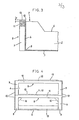
- the tops of the two uprights (9) are flush with the upper edge (12) of the face (4), while the upper edge (13) of the crosspiece (11) is located higher than the upper edge (12) of the face (4), this height difference being clearly visible in Figure 3 where it is indicated (e).
- each reinforcement (8) are fixed against the adjacent face (4) of cardboard by means of staples (14), or by gluing.
- the small side faces (4) are raised vertically, by folding the cardboard along the lines (5).
- the large lateral faces (2) are also raised vertically, by folding the cardboard along the lines (3); the ends of the large faces (2), which extend beyond the fold lines (5) delimiting the bottom (1), are applied laterally against the uprights (9) of the reinforcements (8), and are fixed on these uprights by means of staples or by gluing.
- a cardboard packaging is thus obtained, with a bottom (1), two large side faces (2), and two small side faces (4) provided with reinforcements (8) made of wood-based material.
- This packaging is suitable for the transport, storage and presentation of agricultural products, in particular fruit and vegetables.
- the packaging has the advantage of being stackable, as illustrated by FIG. 4 which represents two stacked packages.
- the legs of the uprights (9) of the reinforcement (8) of the upper packaging are supported on the tops of the uprights (9) of the reinforcement (8) of the lower packaging.
- each reinforcement (8) can also comprise a second crosspiece (15), which connects its two uprights (9) to their base by substantially following the lower edge (5) of the adjacent side face (4), so that the reinforcement (8) has the general shape of a rectangular frame.
- Reinforced zones (16) can also be provided, on each reinforcement (8), at the junction of the two uprights and of the cross-member (11), or of the cross-members (11 and 15).
- the reinforcements can still have shapes more complex, for example by multiplying the amounts or by adding oblique elements, according to their dimensions and the desired resistance.
- additional reinforcements of wood or similar material can be fixed against the large side faces.
- the cardboard or wooden parts of the packaging can, finally, include various features such as grips, ventilation holes, various prints, etc., depending on the use intended for the packaging.
Landscapes
- Engineering & Computer Science (AREA)
- Life Sciences & Earth Sciences (AREA)
- Wood Science & Technology (AREA)
- Mechanical Engineering (AREA)
- Cartons (AREA)
- Buffer Packaging (AREA)
- Forms Removed On Construction Sites Or Auxiliary Members Thereof (AREA)
- Laminated Bodies (AREA)
- Packages (AREA)
- Packaging Of Machine Parts And Wound Products (AREA)
Abstract
Description
- La présente invention concerne un emballage en carton à têtes surélevées, comprenant un fond rectangulaire, deux grandes faces latérales articulées au fond, et deux petites faces latérales articulées au fond et assemblées aux grandes faces latérales, aux quatre angles de l'emballage, au moyen de pièces en bois ou matériau similaire servant de renforts.
- Les emballages en carton, utilisables notamment pour le transport des produits agricoles tels que fruits, leur stockage et leur présentation sur les lieux de vente, en remplacement des caisses traditionnelles en bois, possèdent généralement des têtes et angles renforcés de manière à assurer leur protection contre les chocs et à permettre leur gerbage. La rigidification des têtes et angles de ces emballages est le plus souvent réalisée en doublant ou même en triplant les épaisseurs de carton, ce qui nécessite des pliages et des assemblages relativement complexes, et augmente évidemment la surface de carton nécessaire pour la fabrication d'un emballage de volume déterminé. Cette solution est coûteuse si l'on désire obtenir un renforcement véritablement efficace de l'emballage.
- On connaît par ailleurs des emballages en carton dans lesquels le renforcement est réalisé au moyen d'éléments rapportés en bois, se situant notamment aux quatre angles de l'emballage. L'utilisation de ce genre de renforts contribue évidemment à la rigidité et à la résistance mécanique des emballages considérés, mais elle conduit à une fabrication qui n'est actuellement ni rationnelle, ni économique, du fait que les éléments de renforcement en bois sont des pièces séparées et nombreuses pour un seul emballage, qui doivent être toutes fixées individuellement sur la partie principale en carton de l'emballage. De plus, ces renforts ne sont pas mis à profit pour assurer l'immobilisation relative en toutes direction d'emballages identiques empilés-Voir les brevets français 1 132 327, 2 063 355 et 2 302 923.
- La présente invention remédie à ces inconvénients, en fournissant des moyens de renforcement apportant une simplification à l'assemblage de l'emballage, tout en contribuant efficacement à son gerbage.
- A cet effet, dans l'emballage en carton muni de renforts objet de la présente invention, les renforts sont constitués, à chaque extrémité de l'emballage, par une pièce unique en bois ou matériau similaire, formant à la fois deux montants et au moins une traverse reliant entre eux les deux montants, ladite pièce unique étant fixée extérieurement contre l'une des petites faces latérales et étant fixée également, par ses parties formant montants, aux extrémités des grandes faces latérales qui sont prolongées au-delà des extrémités du fond.
- L'emballage complet est ainsi obtenu au moyen d'une épaisseur unique de carton, complétée seulement par deux pièces de renforcement de conformation particulière, réalisables avantageusement en aggloméré de bois moulé. Ces deux renforts peuvent Être collés ou agrafés contre l'extérieur des deux petites faces latérales ; ils sont également collés ou agrafés aux extrémités des grandes faces latérales et assurent ainsi l'assemblage de l'emballage en évitant toutes les parties habituellement repliées aux extrémités des faces en carton.
- Suivant un mode de réalisation préféré de l'invention, chaque renfort en bois ou matériau similaire compnr~ te une traverse qui suit sensiblement le bord supérieur de la face latérale contre laquelle il est fixé , le bord supérieur de ladite traverse étant cependant situé plus haut que le bord supérieur de la face latérale adjacente, tandis que les sommets des deux montants du renfort affleurent le bord supérieur de ladite face latérale. On obtient de cette manière des décrochements, permettant le gerbage des emballages, avec un emboîtement assurant une immobilisation relative en toutes directions de deux emballages superposés.
- De toute façon, l'invention sera bien comprise, et - d'autres caractéristiques seront mises en évidence, à l'aide de la description qui suit, en référence au dessin schématique annexé représentant, à titre d'exemple non limitatif, une forme d'exécution de cet emballage en carton muni de renforts :
- Figure 1 représente l'emballage à plat, vu par dessous, avec ses renforts ;
- Figure 2 est une vue en perspective de l'emballage partiellement monté ;
- Figure 3 est une vue partielle en coupe suivant 3-3 de figure 2, passant par une extrémité de l'emballage ;
- Figure 4 représente deux emballages empilés, vus par une extrémité.
- Comme le montre plus particulièrement la figure 1, l'emballage est réalisé à partir d'une plaque unique de carton, formant le fond rectangulaire (1), les deux grandes faces latérales (2) reliées aux côtés longitudinaux du fond (1) suivant des lignes de pliage (3), et les deux petites faces latérales (4) reliées aux côtés transversaux du fond (1) suivant des lignes de pliage (5). Les deux grandes faces latérales (2) sont prolongés au-delà des lignes(5) et présentent chacune une région centrale échancrée (6), de sorte que l'emballage monté possède deux têtes surélevées (7) à ses extrémités (voir figure 2).
- Contre l'extérieur de chaque petite face latérale (4) est fixée une pièce unique de renforcement (8), notamment réalisée en aggloméré de bois moulé. La pièce (8) ou "renfort" forme deux montants (9), qui suivent les deux bords verticaux (10) de la petite face latérale adjacente (4), et une traverse (11), qui relie entre eux les sommets des deux montants (9) en suivant sensiblement le bord supérieur (12) de la petite face latérale adjacente (4). Les sommets des deux montants (9) affleurent le bord supérieur (12) de la face (4), alors que le bord supérieur (13) de la traverse (11) est situé plus haut que le bord supérieur (12) de la face (4), cet écart de hauteur étant bien visible sur la figure 3 où il est indiqué (e).
- Les montants (9) et la traverse (11) de chaque renfort(8)sont fixés contre la face adjacente (4) en carton au moyen d'agrafes (14), ou encore par collage. Après fixation des renforts (8), les petites faces latérales (4) sont relevées à la verticale, par pliage du carton suivant les lignes (5). Les grandes faces latérales (2) sont également relevées à la verticale, par pliage du carton suivant les lignes (3) ; les extrémités des grandes faces (2), qui se prolongent au-delà des lignes de pliage (5) délimitant le fond (1), sont appliquées latéralement contre les montants (9) des renforts (8), et sont fixées sur ces montants au moyen d'agrafes ou par collage.
- On obtient ainsi un emballage en carton, avec un fond (1), deux grandes faces latérales (2), et deux petites faces latérales (4) munies des renforts (8) en matériau à base de bois. Cet emballage est adapté pour le transport, le stockage et la présentation de produits agricoles, notamment de fruits et de légumes.
- L'emballage a pour avantage d'être gerbable, comme illustré par la figure 4 qui représente deux emballages empilés. Les pieds des montants (9) du renfort (8) de l'emballage supérieur sont appuyés sur les sommets des montants (9) du renfort (8) de l'emballage inférieur. La partie de la traverse (11) du renfort (8) de l'emballage inférieur, faisant saillie au-dessus du bord supérieur (12) de la face (4), maintient l'emballage supérieur en réalisant un véritable emboîtement.
- La figure 4 montre que chaque renfort (8) peut comprendre encore une seconde traverse (15), qui relie ses deux montants (9) à leur base en suivant sensiblement le bord inférieur (5) de la face latérale adjacente (4), de manière que le renfort (8) présente la forme générale d'un cadre rectangulaire. Des zones renforcées (16) peuvent en outre être prévues, sur chaque renfort (8), à la jonction des deux montants et de la traverse (11), ou des traverses (11 et 15).
- Les renforts peuvent encore présenter des formes plus complexes, par exemple en multipliant les montants ou en ajoutant des éléments obliques, selon leurs dimensions et la résistance recherchée. Pour augmenter la rigidité de l'emballage, des renforts supplémentaires en bois ou matériau similaire peuvent être fixés contre les grandes faces latérales. Les parties en carton ou en bois de l'emballage peuvent, enfin, comporter diverses particularités telles que poignées de préhension, trous d'aération, impressions diverses,..., selon l'utilisation prévue pour l'emballage.
Claims (7)
Priority Applications (1)
| Application Number | Priority Date | Filing Date | Title |
|---|---|---|---|
| AT83420077T ATE18377T1 (de) | 1982-04-30 | 1983-04-29 | Mit verstaerkungen versehene verpackung aus pappe. |
Applications Claiming Priority (2)
| Application Number | Priority Date | Filing Date | Title |
|---|---|---|---|
| FR8207931A FR2525990B1 (fr) | 1982-04-30 | 1982-04-30 | Emballage en carton muni de renforts |
| FR8207931 | 1982-04-30 |
Publications (2)
| Publication Number | Publication Date |
|---|---|
| EP0093682A1 true EP0093682A1 (fr) | 1983-11-09 |
| EP0093682B1 EP0093682B1 (fr) | 1986-03-05 |
Family
ID=9273814
Family Applications (1)
| Application Number | Title | Priority Date | Filing Date |
|---|---|---|---|
| EP83420077A Expired EP0093682B1 (fr) | 1982-04-30 | 1983-04-29 | Emballage en carton muni de renforts |
Country Status (7)
| Country | Link |
|---|---|
| EP (1) | EP0093682B1 (fr) |
| AT (1) | ATE18377T1 (fr) |
| DE (1) | DE3362391D1 (fr) |
| ES (1) | ES271876Y (fr) |
| FR (1) | FR2525990B1 (fr) |
| GR (1) | GR78550B (fr) |
| PT (1) | PT76612A (fr) |
Cited By (2)
| Publication number | Priority date | Publication date | Assignee | Title |
|---|---|---|---|---|
| US5786110A (en) * | 1992-06-22 | 1998-07-28 | Arizona Board Of Regents | Alkali-metal-ion conducting electrolytes |
| US5843943A (en) * | 1994-12-29 | 1998-12-01 | The Regents Of The University Of California | Compounds for inhibition of ceramide-mediated signal transduction |
Citations (5)
| Publication number | Priority date | Publication date | Assignee | Title |
|---|---|---|---|---|
| FR1083357A (fr) * | 1953-09-15 | 1955-01-07 | Perfectionnement aux emballages en carton et nouveaux types d'emballages en résultant | |
| FR1132327A (fr) * | 1955-10-01 | 1957-03-07 | Emballages Et Des Bois Contrep | Emballage perfectionné |
| FR1186306A (fr) * | 1957-08-29 | 1959-08-20 | Plateau à fruits réutilisable-modèle démontable | |
| FR2063355A5 (fr) * | 1969-10-13 | 1971-07-09 | Berlorier Georges | |
| FR2302923A1 (fr) * | 1975-03-03 | 1976-10-01 | Girard Claude | Emballage mixte notamment carton-bois |
-
1982
- 1982-04-30 FR FR8207931A patent/FR2525990B1/fr not_active Expired
-
1983
- 1983-04-28 GR GR71253A patent/GR78550B/el unknown
- 1983-04-28 PT PT76612A patent/PT76612A/fr unknown
- 1983-04-29 ES ES1983271876U patent/ES271876Y/es not_active Expired
- 1983-04-29 EP EP83420077A patent/EP0093682B1/fr not_active Expired
- 1983-04-29 DE DE8383420077T patent/DE3362391D1/de not_active Expired
- 1983-04-29 AT AT83420077T patent/ATE18377T1/de active
Patent Citations (5)
| Publication number | Priority date | Publication date | Assignee | Title |
|---|---|---|---|---|
| FR1083357A (fr) * | 1953-09-15 | 1955-01-07 | Perfectionnement aux emballages en carton et nouveaux types d'emballages en résultant | |
| FR1132327A (fr) * | 1955-10-01 | 1957-03-07 | Emballages Et Des Bois Contrep | Emballage perfectionné |
| FR1186306A (fr) * | 1957-08-29 | 1959-08-20 | Plateau à fruits réutilisable-modèle démontable | |
| FR2063355A5 (fr) * | 1969-10-13 | 1971-07-09 | Berlorier Georges | |
| FR2302923A1 (fr) * | 1975-03-03 | 1976-10-01 | Girard Claude | Emballage mixte notamment carton-bois |
Cited By (2)
| Publication number | Priority date | Publication date | Assignee | Title |
|---|---|---|---|---|
| US5786110A (en) * | 1992-06-22 | 1998-07-28 | Arizona Board Of Regents | Alkali-metal-ion conducting electrolytes |
| US5843943A (en) * | 1994-12-29 | 1998-12-01 | The Regents Of The University Of California | Compounds for inhibition of ceramide-mediated signal transduction |
Also Published As
| Publication number | Publication date |
|---|---|
| ES271876U (es) | 1983-10-16 |
| ES271876Y (es) | 1984-04-16 |
| DE3362391D1 (en) | 1986-04-10 |
| FR2525990A1 (fr) | 1983-11-04 |
| ATE18377T1 (de) | 1986-03-15 |
| PT76612A (fr) | 1983-05-01 |
| GR78550B (fr) | 1984-09-27 |
| EP0093682B1 (fr) | 1986-03-05 |
| FR2525990B1 (fr) | 1985-07-12 |
Similar Documents
| Publication | Publication Date | Title |
|---|---|---|
| EP3102494B1 (fr) | Plateau en matière en feuille de carton a montage manuel et flan pour la réalisation d'un tel plateau | |
| EP1674003B1 (fr) | Structure de sommier de literie et procédé de fabrication d'une telle structure | |
| EP0093682B1 (fr) | Emballage en carton muni de renforts | |
| EP0538098A1 (fr) | Emballage de carton empilable avec des renforts d'angle | |
| FR2594800A1 (fr) | Caisse en carton fixee sur palette et pliable a plat | |
| FR2755948A1 (fr) | Perfectionnement aux emballages du type plateaux realises en carton ondule ou en matiere similaire | |
| EP1695915B1 (fr) | Caisse palette en carton | |
| FR2677608A1 (fr) | Caisse d'emballage renforcee, pliable en x. | |
| FR2751304A1 (fr) | Plot ou ensemble de plots en carton, pour caisses ou palettes | |
| FR2854137A1 (fr) | Nouvel emballage gerbable en un materiau semi-rigide, de type plateau ou barquette | |
| FR2691443A1 (fr) | Conditionnement perfectionné du type des plateaux à fruits, en un matériau semi-rigide tel que le carton ondulé. | |
| FR2820405A1 (fr) | Plateau pour le conditionnement d'un ou plusieurs produits | |
| EP0619795A1 (fr) | Emballage pliant du type des caisses-palettes. | |
| FR2710903A1 (fr) | Emballage-plateau pour fruits, légumes et analogues. | |
| FR2734789A1 (fr) | Plaque pour la realisation de claies | |
| FR2898108A1 (fr) | Emballage rigide qui protege et presente les produits sur le dessus de l'emballage | |
| FR2676423A1 (fr) | Plateau a quatre diedres plus specialement pour le transport et la conservation de fromages ronds et analogues. | |
| FR2815017A1 (fr) | Plateau gerbable de transport de produits | |
| FR2558805A1 (fr) | Nouvel emballage carton pour fruits et legumes | |
| BE1005279A0 (fr) | Plateau gerbable en carton. | |
| EP0628489B1 (fr) | Emballage pliant du type des caisses-palettes | |
| FR2814438A1 (fr) | Conditionnement gerbale en un materiau semi-rigide et flan predecoupe et refoule pour la realisation de ce conditionnement | |
| FR2696417A1 (fr) | Emballage tel que plateau, cageot, barquette ... pour le conditionnement de produits divers. | |
| FR2635091A1 (fr) | Plateau-emballage pour fruits | |
| FR2795388A1 (fr) | Plateau de conditionnement et flan pour son obtention |
Legal Events
| Date | Code | Title | Description |
|---|---|---|---|
| PUAI | Public reference made under article 153(3) epc to a published international application that has entered the european phase |
Free format text: ORIGINAL CODE: 0009012 |
|
| AK | Designated contracting states |
Designated state(s): AT BE CH DE GB IT LI LU NL SE |
|
| 17P | Request for examination filed |
Effective date: 19840114 |
|
| RAP1 | Party data changed (applicant data changed or rights of an application transferred) |
Owner name: CARTOBOIS |
|
| GRAA | (expected) grant |
Free format text: ORIGINAL CODE: 0009210 |
|
| AK | Designated contracting states |
Kind code of ref document: B1 Designated state(s): AT BE CH DE GB IT LI LU NL SE |
|
| REF | Corresponds to: |
Ref document number: 18377 Country of ref document: AT Date of ref document: 19860315 Kind code of ref document: T |
|
| REF | Corresponds to: |
Ref document number: 3362391 Country of ref document: DE Date of ref document: 19860410 |
|
| ITF | It: translation for a ep patent filed | ||
| PG25 | Lapsed in a contracting state [announced via postgrant information from national office to epo] |
Ref country code: LU Free format text: LAPSE BECAUSE OF NON-PAYMENT OF DUE FEES Effective date: 19860430 |
|
| PGFP | Annual fee paid to national office [announced via postgrant information from national office to epo] |
Ref country code: NL Payment date: 19860430 Year of fee payment: 4 Ref country code: AT Payment date: 19860430 Year of fee payment: 4 |
|
| PLBE | No opposition filed within time limit |
Free format text: ORIGINAL CODE: 0009261 |
|
| STAA | Information on the status of an ep patent application or granted ep patent |
Free format text: STATUS: NO OPPOSITION FILED WITHIN TIME LIMIT |
|
| 26N | No opposition filed | ||
| PG25 | Lapsed in a contracting state [announced via postgrant information from national office to epo] |
Ref country code: AT Effective date: 19870429 |
|
| PG25 | Lapsed in a contracting state [announced via postgrant information from national office to epo] |
Ref country code: SE Effective date: 19870430 Ref country code: LI Effective date: 19870430 Ref country code: CH Effective date: 19870430 |
|
| BERE | Be: lapsed |
Owner name: CARTOBOIS Effective date: 19870430 |
|
| PG25 | Lapsed in a contracting state [announced via postgrant information from national office to epo] |
Ref country code: NL Effective date: 19871101 |
|
| NLV4 | Nl: lapsed or anulled due to non-payment of the annual fee | ||
| GBPC | Gb: european patent ceased through non-payment of renewal fee | ||
| REG | Reference to a national code |
Ref country code: CH Ref legal event code: PL |
|
| PG25 | Lapsed in a contracting state [announced via postgrant information from national office to epo] |
Ref country code: DE Effective date: 19880101 |
|
| PG25 | Lapsed in a contracting state [announced via postgrant information from national office to epo] |
Ref country code: GB Effective date: 19881122 |
|
| PG25 | Lapsed in a contracting state [announced via postgrant information from national office to epo] |
Ref country code: BE Effective date: 19890430 |
|
| EUG | Se: european patent has lapsed |
Ref document number: 83420077.6 Effective date: 19880906 |