EP0094234A2 - Logische Verknüpfungsschaltung mit Koppeltransistoren - Google Patents
Logische Verknüpfungsschaltung mit Koppeltransistoren Download PDFInfo
- Publication number
- EP0094234A2 EP0094234A2 EP83302602A EP83302602A EP0094234A2 EP 0094234 A2 EP0094234 A2 EP 0094234A2 EP 83302602 A EP83302602 A EP 83302602A EP 83302602 A EP83302602 A EP 83302602A EP 0094234 A2 EP0094234 A2 EP 0094234A2
- Authority
- EP
- European Patent Office
- Prior art keywords
- pass
- variables
- function
- truth table
- state
- Prior art date
- Legal status (The legal status is an assumption and is not a legal conclusion. Google has not performed a legal analysis and makes no representation as to the accuracy of the status listed.)
- Granted
Links
Images







Classifications
-
- G—PHYSICS
- G06—COMPUTING OR CALCULATING; COUNTING
- G06F—ELECTRIC DIGITAL DATA PROCESSING
- G06F7/00—Methods or arrangements for processing data by operating upon the order or content of the data handled
- G06F7/38—Methods or arrangements for performing computations using exclusively denominational number representation, e.g. using binary, ternary, decimal representation
- G06F7/48—Methods or arrangements for performing computations using exclusively denominational number representation, e.g. using binary, ternary, decimal representation using non-contact-making devices, e.g. tube, solid state device; using unspecified devices
- G06F7/50—Adding; Subtracting
- G06F7/501—Half or full adders, i.e. basic adder cells for one denomination
- G06F7/503—Half or full adders, i.e. basic adder cells for one denomination using carry switching, i.e. the incoming carry being connected directly, or only via an inverter, to the carry output under control of a carry propagate signal
-
- G—PHYSICS
- G06—COMPUTING OR CALCULATING; COUNTING
- G06F—ELECTRIC DIGITAL DATA PROCESSING
- G06F7/00—Methods or arrangements for processing data by operating upon the order or content of the data handled
- G06F7/38—Methods or arrangements for performing computations using exclusively denominational number representation, e.g. using binary, ternary, decimal representation
- G06F7/48—Methods or arrangements for performing computations using exclusively denominational number representation, e.g. using binary, ternary, decimal representation using non-contact-making devices, e.g. tube, solid state device; using unspecified devices
- G06F7/50—Adding; Subtracting
-
- H—ELECTRICITY
- H03—ELECTRONIC CIRCUITRY
- H03K—PULSE TECHNIQUE
- H03K19/00—Logic circuits, i.e. having at least two inputs acting on one output; Inverting circuits
- H03K19/02—Logic circuits, i.e. having at least two inputs acting on one output; Inverting circuits using specified components
- H03K19/08—Logic circuits, i.e. having at least two inputs acting on one output; Inverting circuits using specified components using semiconductor devices
- H03K19/094—Logic circuits, i.e. having at least two inputs acting on one output; Inverting circuits using specified components using semiconductor devices using field-effect transistors
- H03K19/0944—Logic circuits, i.e. having at least two inputs acting on one output; Inverting circuits using specified components using semiconductor devices using field-effect transistors using MOSFET or insulated gate field-effect transistors, i.e. IGFET
- H03K19/09441—Logic circuits, i.e. having at least two inputs acting on one output; Inverting circuits using specified components using semiconductor devices using field-effect transistors using MOSFET or insulated gate field-effect transistors, i.e. IGFET of the same canal type
-
- H—ELECTRICITY
- H03—ELECTRONIC CIRCUITRY
- H03K—PULSE TECHNIQUE
- H03K19/00—Logic circuits, i.e. having at least two inputs acting on one output; Inverting circuits
- H03K19/20—Logic circuits, i.e. having at least two inputs acting on one output; Inverting circuits characterised by logic function, e.g. AND, OR, NOR, NOT circuits
- H03K19/21—EXCLUSIVE-OR circuits, i.e. giving output if input signal exists at only one input; COINCIDENCE circuits, i.e. giving output only if all input signals are identical
- H03K19/215—EXCLUSIVE-OR circuits, i.e. giving output if input signal exists at only one input; COINCIDENCE circuits, i.e. giving output only if all input signals are identical using field-effect transistors
-
- H—ELECTRICITY
- H03—ELECTRONIC CIRCUITRY
- H03K—PULSE TECHNIQUE
- H03K23/00—Pulse counters comprising counting chains; Frequency dividers comprising counting chains
-
- H—ELECTRICITY
- H03—ELECTRONIC CIRCUITRY
- H03M—CODING; DECODING; CODE CONVERSION IN GENERAL
- H03M11/00—Coding in connection with keyboards or like devices, i.e. coding of the position of operated keys
- H03M11/02—Details
-
- G—PHYSICS
- G06—COMPUTING OR CALCULATING; COUNTING
- G06F—ELECTRIC DIGITAL DATA PROCESSING
- G06F2207/00—Indexing scheme relating to methods or arrangements for processing data by operating upon the order or content of the data handled
- G06F2207/38—Indexing scheme relating to groups G06F7/38 - G06F7/575
- G06F2207/48—Indexing scheme relating to groups G06F7/48 - G06F7/575
- G06F2207/4802—Special implementations
- G06F2207/4816—Pass transistors
Definitions
- This invention relates to logic circuits and in particular to a logical element known as a PASS transistor and to logic circuits formed using PASS transistors so as to substantially reduce the number of active devices required to implement logic functions.
- Boolean logic expressions may be realized through classical logic design methods with networks of combinational logic. Logic networks using MOS technology are often formed with NAND, NOR and Inversion gates since these structures are easily implemented.
- the PASS transistor is another common MOS structure. See “Introduction to VLSI Systems" by Mead and Conway, pages 24 and 25, for example, for a description of PASS transistors. Classical logic design methods, however, do not result in networks of PASS transistors.
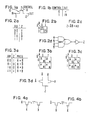
- Figure la shows the PASS transistor with its logical function.
- transistor 10 passes the logic state at input lead 11 to output lead 12.
- the input and output leads of an MOS transistor may be arbitrarily chosen because an MOS transistor is bidirectional.
- the input lead shall hereafter be defined as the terminal driven by the source of a logic state.
- the output lead 12 of PASS transistor 10 typically applies the passed logic state to the input lead of another series connected logic structure.
- Output leads of a number of PASS transistors may be joined to drive the same input of a logic structure provided that all PASS transistors whose controls are asserted are passing the same logic state.
- PASS transistors as bidirectional transmission gates is described in an article entitled "VLSI: A New Frontier for Systems Designers" published in the January 1982 Computer Journal of the IEEE by Douglas G. Fairbairn, which is hereby incorporated by reference.
- logic networks are fabricated using PASS transistors so as to maximize the regularity of the resulting logic circuitry.
- the resulting logical networks give significant topological, power and speed advantages over prior art logic circuits when used to form combinational logic.
- the use of the PASS transistor as a logic element yields several advantages over the NAND, NOR and inverter structures used in prior art logic circuits such as MOS- integrated logic circuits.
- the PASS transistor dissipates no significant steady state power.
- arrays of PASS transistors form structures of regular topology often consuming less area for a given logical function than consumed by NAND, NOR and inverter arrays.
- combinational logic formed with PASS transistors often reduces the signal propagation delay through a network.
- the major disadvantage of the PASS transistor is that the voltage level of the logic high signal on its output lead is degraded due to the characteristics of the field effect transistor used as the PASS transistor, this can be overcome by careful circuit design. However, after passing a logic high level through one PASS transistor, no significant further degradation of voltage level occurs when the signal is passed through N additional PASS transistors assuming no PASS transistor control input is driven by the output of another PASS transistor.
- FIG. 2a shows the truth table for an Exclusive NOR or equivalence gate.
- the truth table information is then entered into a Karnaugh map.
- the output function is reduced and read from the Karnaugh map using looping techniques.
- a Karnaugh map reduction of the Exclusive NOR truth table is shown in Figure 2b, with the Boolean expression shown in Figure 2c.
- the function is then implemented using logic AND function and OR function gates. The implementation of this function with prior art logic structures requires two AND functions and one OR function.
- a possible MOS configuration has two nodes which dissipate power, two gate delays and consists of 7 transistors.
- input variables A and B are both low and the output variable B is high.
- Z may be formed by passing the inversion of A or the inversion of B (i.e. A or B).
- B is high.
- Z is low, 3 may be formed by passing A or the inverse of B (i.e. A or B).
- the PASS functions of the other two states are similarly obtained and shown in the truth table in Figure 3a.
- a "care” state is an input state for which the output state must be defined and is often referred to simply as a "state”.
- PASS function guarantees that the passed variables are the same logic level in a given state.
- a possible mapping for the equivalence gate using PASS transistors is to pass the inverse of B when A is low and to pass B when A is high. This mapping is shown in Figure 3c.
- A is the CONTROL function that passes the PASS function B and A is the CONTROL function that passes the PASS function B.
- the PASS transistor network obtained is shown in Figure 3d.
- the PASS transistor Exclusive NOR shown in Figure 3d dissipates no significant steady state power, has one PASS transistor delay and consists of only two transistors. Thus a substantial power, speed and area savings over the classical logic design methods is realized.
- a "CONTROL” variable is the input variable which drives the control terminal of a PASS transistor.
- a "PASS” variable is the input variable which drives the input terminal of a PASS transistors and which is passed to the output terminal when the PASS transistor is turned on.
- Regularity may be maximized in the CONTROL function if the CONTROL functions can be looped such that they are functions of only the control variables. Regularity in the PASS function may be maximized by making the PASS function independent of the control variables. This independence may be established through the use of the following identities.
- the iterative combinational array is a class of combinational logic for which the area of one circuit configuration versus another may easily be compared. Area may be compared by drawing the layout of one element of the array.
- a useful circuit illustrative of iterative combinational arrays is the digital magnitude comparator.
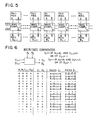
- the first step in designing the magnitude comparator is to establish a truth table as illustrated in Figure 6.
- the possible passed variables are then added to the truth table to define the PASS functions for each state and these passed variables are entered into a modified Karnaugh map. (In simple cases, where the identical pass variables associated with different states can be identified from the truth table, the modified Karnaugh map can be omitted). Groups of passed variables are then ready to be looped (i.e. identified and circled for ease of reference). Since C i+1 and D i+1 influence directly C i and D i , respectively, these are good choices for passed variables.
- the CONTROL functions are functions of only variables A i and B i and the PASS functions C i+1 and D i+1 are independent of A i and B i .
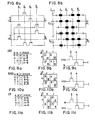
- the circuit schematic of the PASS transistor array is shown in Figure 8a and the integrated circuit layout in N channel MOS technology is shown in Figure 8b.
- an MOS transistor is depicted by the crossing of two perpendicular lines and a conductive crossunder is depicted by a dark rectangle.
- the gate electrodes are the vertical lines labeled A i , A i , B i and B i and the horizontal lines labeled C i+1 and D i+1 comprise diffused conductive lines and source and drain regions.
- the basic design method for constructing a logic circuit using the PASS transistor as the basic element is as follows:
- FIGS 3a through 3d discussed above, illustrate this procedure. As explained above, in some cases, step 3 can be omitted.
- Figures 9a, 9b and 9c illustrate, respectively, this method for specifying the PASS transistor logic circuit representing an AND gate.
- a PASS transistor logic circuit is implemented using only two PASS transistors as compared to three to five transistors using the prior art implementation.
- Figures 10a, 10b and 10c illustrate, respectively, the truth table, Karnaugh plot and logic circuit implemented using PASS transistors for a NAND gate. Again, the inherent simplicity of the logic circuit utilizing PASS transistors in accordance with this invention is apparent.
- Figures lla, llb and llc illustrate, respectively, the truth table, Karnaugh plot and logic network constructed using PASS transistors of an OR gate.
- the PASS function A has been replaced with the supply voltage V DD in accordance with the identity of Figure 4a.
- Figures 12a, 12b and 12c illustrate, respectively, the truth table, Karnaugh plot and logic circuitry of a NOR gate constructed using PASS transistors.
- the PASS function A has been replaced with the reference voltage V SS in accordance with the identity of Figure 4b.
- Figures 13a, 13b and 13c illustrate, respectively, the truth table, Karnaugh plot and logic circuit constructed using PASS transistors of an exclusive OR gate.
- Figures 14a, 14b and 14c illustrate, respectively, the truth table, Karnaugh plot and logic circuit constructed using PASS transistors of an exclusive NOR gate.
- Each of the structures shown in Figures 9c, 10c, llc, 12c, 13c and 14c uses only two PASS transistors. Each PASS transistor is controlled either by the A or A signal. Each of the logic circuits is capable of producing an appropriate output state in response to any one of the four different possible input states of the two input variables A, B. In Figures 9c, lOc, llc and 12c, none of the PASS variables are related to the CONTROL variables as a result of use of the identities of Figures 4a and 4b. The result is an inherent simplicity in each of the circuits.
- Figures 15a, 15b, 15c and 15d illustrate the implementation of a full adder using the methodology and rules of this invention.
- the carry associated with the full adder (Figure 15d) can be implemented using eight (8) PASS transistors as opposed to a much more complex implementation using standard prior art logic components as illustrated, for example, in Figure 7-3 on page 123 of "Introduction to the Basic Computer” by Donald Eadie, published in 1968 by Prentice-Hall, Inc., Inglewood Cliffs, New Jersey, which is hereby incorporated by reference.
- the sum circuit is formed using another eight (8) PASS transistors and is shown in Figure 16a, 16b and 16c which illustrate the truth table, Karnaugh plot, and PASS transistor implementation, respectively, of a summing network.
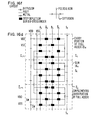
- Figure 16d illustrates the layout of the implementation of the circuitry shown in Figure 16c in terms of PASS transistors.
- the regularity and orthogonality of the CONTROL functions and PASS functions is readily apparent from this description.
- the structure is implemented using N channel MOS transistors and the different component layers are indicated as shown by the key associated with the Figure.
- the polysilicon (denoted as "poly") comprises the gate electrodes of the N channel MOS transistors and the diffusion comprises the source and drain regions of these transistors as well as the conductive interconnects between the source and drain regions of adjacent transistors.
- Figure 16d which shows the carry portion of a full adder 15d, the sum network 16c and a complementary carry portion of a full adder derived from the full adder of 15d
- the structure 16d is laid out using N+ diffusions (denoted by the line with an X) polycrystalline silicon (denoted by the straight line) and metal (denoted by the straight line with a cross mark).
- N+ diffusions denoted by the line with an X
- polycrystalline silicon denoted by the straight line
- metal dedenoted by the straight line with a cross mark
- Deep depletion buried cross unders are denoted as dark rectangles.
- the buried cross unders serve as conductive paths for current.
- the MOS transistor is denoted schematically as shown in Figure 16f wherein the polysilicon gate line is orthogonal to an N+ diffusion line.
- Figure 16d represents one portion of an 8-bit adding circuitry and is designed to mate topologically with adjacent portions of the circuitry as shown in Figure 16f.
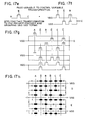
- Figures 17a and 17b illustrate the truth table and the modified Karnaugh map for a priority encoder.
- FIG. 17b A similar analysis for the output variable E is shown in the second part of the modified Karnaugh map of Figure 17b.
- the particular logic shown is implemented in circuit form as shown in Figure 17c and has a layout as shown in Figure 17d.
- the layout of Figure 17d is keyed identically to that of Figure 16d.
- the key to the layout in Figure 16d applies equally to that in Figure 17d and to the other drawings such as shown in Figures 8b, 17h and 19f in this specification.
- the PASS variables can then be transformed as shown in Figure 17e and 17f to simplify the structure shown in Figure 17d to form the circuit shown in Figure 17g.
- the circuit in Figure 17g is substantially simpler in terms of topological layout although it contains 16 transistors to the 10 shown in Figure 17c.
- the 16 transistors shown in Figure 17g allow a more rational arrangement of the voltage power lines VDD, VSS and the signal input lines A, A, B, B and C, C.
- Figure 17h illustrates schematically the actual layout of the PASS transistors shown in Figure 17g.
- the comparison between Figure 17c illustrates the type of trade-offs available using the logic system described herein.
- Figure 18a illustrates the schematic block diagram of a binary up/down counter.
- the truth table for this counter is illustrated in Figure 18b.
- Input variables D, T i-1 and Q i control the state of the output variables D i and T i .
- the modified Karnaugh map for output variable D i is shown in Figure 18c and for output variable T i is shown in Figure 18d.
- the output variable T i is generated by the looped PASS functions as illustrated in Figure 18d.
- This structure is shown as implemented in the top two lines of the circuit of Figure 18e.
- the T i output variable is generated by four paths of functions reflecting the four different possible sets of CONTROL functions and PASS functions necessary to generate all possible combinations of T i output signals.
- the T i-1 input signal is passed by the transistors 184 and 185 controlled by the Q i CONTROL signal and the D CONTROL signal, respectively, and for DT i-1 equals 00 or 01 and Q i equals 1, by transistors 182 and 183 controlled by the Q i input signal and the D input signal, respectively.
- Figure 19a illustrates in schematic block diagram form the input and output signals to and from a binary up counter.
- Figure 19b gives the truth table for the input variables T i-1 and Q i and their relationship to the output variables D i and T i .
- Figures 19c and 19d give the modified Karnaugh plots for the output variables D i and T i , respectively, as a function of the input variables T i-1 and Q i .
- Figure 19e illustrates the circuit implementation of the logic using the PASS transistors of this invention derived using the input variables T i-1 and Q i wherein Q i as shown in Karnaugh plot 19d has only the value VSS per the equivalent circuit of Figure 4b.
- Figure 19f illustrates the layout schematically of the circuit shown in Figure 19e.
- Figure 20a gives the truth table for a JK flip-flop with inputs JK and Q and output D.
- Figure 20b shows the modified Karnaugh map for the truth table of Figure 20a.
- Figure 20c shows the circuit implementation of the flip-flop using the PASS functions of this invention. Note that the circuit implementation requires only two PASS transistors reflecting only two looped PASS functions in the modified Karnaugh plot of Figure 20b.
- Figure 20d shows schematically the extremely simple implementation of this structure using again the key shown in Figure 16d.
- Figure 21a illustrates a schematic block diagram of a shift left/hold circuit and the input and output variables to this circuit.
- the input variable C, Q i-1 and Q i produce an output variable D i .
- the modified Karnaugh plot for this circuit is illustrated in Figure 2lc and is implemented as shown in Figure 21d by a two-transistor circuit.
- the schematic layout of this two-transistor circuit is illustrated in Figure 21e.
- the structures of this invention are, as seen from the last two implementations in particular, extremely simple compared to prior art logic implementations.
- the topological advantages of this invention are achieved together with significant reductions in the complexity of components.
- Structures made in accordance with this invention have increased packing density in terms of logic function per unit area and thus possess either smaller size with commensurate increased yield or a substantially larger number of devices formed on a chip of silicon material.
- the devices described above are to be implemented in standard semiconductor processing technology such as N channel MOS technology.
- the invention is capable of being implemented in other semiconductor technologies including P channel MOS technology and CMOS technologies.
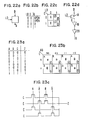
- the design of a dynamic D latch is another example of the use of the PASS transistor high impedance state.
- the function of a D latch is to store one bit of information. The information is updated to the logic level of the data input when the load signal LD is asserted high, as shown by the truth table of Figure 22b.
- the data is stored in the form of charge on the gate capacitance of a buffer amplifier 19 ( Figure 22d), when the load signal LD is low.
- the PASS variables are entered into the appropriate states of the Karnaugh map in Figure 22c with X's assigned to the states where charge storage takes place. The map is reduced by grouping the PASS variables in the states without X's. Thus no variable is passed in the charge storage state.
- the resulting PASS network with buffers is shown in the schematic diagram of Figure 22d.
- FIG. 23a-23c show the derivation of a combinational PASS network in accordance with one embodiment of this invention.
- the three variable truth table of Figure 23a is decomposed into two truth tables ( Figure 24a) each having two variables.
- the truth table of Figure 23a is decomposed about the variable A into the two truth tables of Figure 24a.
- the Karnaugh maps of Figure 24b are reduced to form the functions X and Y as depicted in Figure 24c.
- the two circuits providing output signals X and Y of Figure 24c are then joined to form the circuit of Figure 24d providing output signal Z by passing X when A is low and passing Y when A is high.
- the resulting circuit of Figure 24d shows a reduction from 8 transistors (Figure 23c) to 6 transistors ( Figure 24d) to implement the three variable function illustrated in the truth table of Figure 23a.
Landscapes
- Engineering & Computer Science (AREA)
- Physics & Mathematics (AREA)
- General Physics & Mathematics (AREA)
- Theoretical Computer Science (AREA)
- Mathematical Analysis (AREA)
- Pure & Applied Mathematics (AREA)
- Computing Systems (AREA)
- General Engineering & Computer Science (AREA)
- Computational Mathematics (AREA)
- Mathematical Optimization (AREA)
- Computer Hardware Design (AREA)
- Mathematical Physics (AREA)
- Power Engineering (AREA)
- Logic Circuits (AREA)
Priority Applications (1)
| Application Number | Priority Date | Filing Date | Title |
|---|---|---|---|
| AT83302602T ATE41276T1 (de) | 1982-05-10 | 1983-05-09 | Logische verknuepfungsschaltung mit koppeltransistoren. |
Applications Claiming Priority (4)
| Application Number | Priority Date | Filing Date | Title |
|---|---|---|---|
| US06/376,895 US4541067A (en) | 1982-05-10 | 1982-05-10 | Combinational logic structure using PASS transistors |
| US376895 | 1982-05-10 | ||
| US06/447,817 US4566064A (en) | 1982-05-10 | 1982-12-08 | Combinational logic structure using PASS transistors |
| US447817 | 1982-12-08 |
Publications (3)
| Publication Number | Publication Date |
|---|---|
| EP0094234A2 true EP0094234A2 (de) | 1983-11-16 |
| EP0094234A3 EP0094234A3 (en) | 1984-10-17 |
| EP0094234B1 EP0094234B1 (de) | 1989-03-08 |
Family
ID=27007609
Family Applications (1)
| Application Number | Title | Priority Date | Filing Date |
|---|---|---|---|
| EP83302602A Expired EP0094234B1 (de) | 1982-05-10 | 1983-05-09 | Logische Verknüpfungsschaltung mit Koppeltransistoren |
Country Status (4)
| Country | Link |
|---|---|
| US (1) | US4566064A (de) |
| EP (1) | EP0094234B1 (de) |
| CA (1) | CA1242771A (de) |
| DE (1) | DE3379371D1 (de) |
Cited By (17)
| Publication number | Priority date | Publication date | Assignee | Title |
|---|---|---|---|---|
| US4577124A (en) * | 1983-07-28 | 1986-03-18 | Kabushiki Kaisha Toshiba | CMOS Logic circuit |
| EP0179568A1 (de) * | 1984-10-11 | 1986-04-30 | American Microsystems, Incorporated | Multipliziererschaltung mit Passiertransistoren und Konstruktionsverfahren derselben |
| US4710649A (en) * | 1986-04-11 | 1987-12-01 | Raytheon Company | Transmission-gate structured logic circuits |
| EP0200821A3 (de) * | 1982-05-10 | 1988-02-17 | American Microsystems, Incorporated | Kombinatorische logische Schaltungsstruktur mit Pass-Transistoren |
| WO1988003727A1 (en) * | 1986-11-07 | 1988-05-19 | Concurrent Logic, Inc. | Programmable logic cell and array |
| EP0187697A3 (de) * | 1985-01-04 | 1988-10-26 | Advanced Micro Devices, Inc. | Abgeglichene logische CMOS-Schaltungen |
| EP0187698A3 (de) * | 1985-01-04 | 1989-06-28 | Advanced Micro Devices, Inc. | Symmetrische Volladdiererschaltung |
| US4845633A (en) * | 1985-12-02 | 1989-07-04 | Apple Computer Inc. | System for programming graphically a programmable, asynchronous logic cell and array |
| US4870302A (en) * | 1984-03-12 | 1989-09-26 | Xilinx, Inc. | Configurable electrical circuit having configurable logic elements and configurable interconnects |
| EP0249040A3 (en) * | 1986-06-11 | 1990-09-19 | Kabushiki Kaisha Toshiba | Booth's conversion circuit |
| US5019736A (en) * | 1986-11-07 | 1991-05-28 | Concurrent Logic, Inc. | Programmable logic cell and array |
| US5089973A (en) * | 1986-11-07 | 1992-02-18 | Apple Computer Inc. | Programmable logic cell and array |
| US5144166A (en) * | 1990-11-02 | 1992-09-01 | Concurrent Logic, Inc. | Programmable logic cell and array |
| US5155389A (en) * | 1986-11-07 | 1992-10-13 | Concurrent Logic, Inc. | Programmable logic cell and array |
| EP0204034B1 (de) * | 1985-04-17 | 1994-11-09 | Xilinx, Inc. | Konfigurierbare logische Matrix |
| WO1997028604A1 (en) * | 1996-02-01 | 1997-08-07 | Samsung Electronics Co., Ltd. | Energy economized pass-transistor logic circuit and full adder using the same |
| AT525255B1 (de) * | 2022-03-06 | 2023-02-15 | Harald Iglseder Dipl Ing | Flexibles Logikgatter |
Families Citing this family (47)
| Publication number | Priority date | Publication date | Assignee | Title |
|---|---|---|---|---|
| USRE34363E (en) | 1984-03-12 | 1993-08-31 | Xilinx, Inc. | Configurable electrical circuit having configurable logic elements and configurable interconnects |
| US4633220A (en) * | 1984-11-29 | 1986-12-30 | American Microsystems, Inc. | Decoder using pass-transistor networks |
| US4792909A (en) * | 1986-04-07 | 1988-12-20 | Xerox Corporation | Boolean logic layout generator |
| US4964056A (en) * | 1987-03-25 | 1990-10-16 | Hitachi, Ltd. | Automatic design system of logic circuit |
| US4916627A (en) * | 1987-12-02 | 1990-04-10 | International Business Machines Corporation | Logic path length reduction using boolean minimization |
| US5237513A (en) * | 1989-11-20 | 1993-08-17 | Massachusetts Institute Of Technology | Optimal integrated circuit generation |
| US5200907A (en) * | 1990-04-16 | 1993-04-06 | Tran Dzung J | Transmission gate logic design method |
| US5040139A (en) * | 1990-04-16 | 1991-08-13 | Tran Dzung J | Transmission gate multiplexer (TGM) logic circuits and multiplier architectures |
| US5198705A (en) | 1990-05-11 | 1993-03-30 | Actel Corporation | Logic module with configurable combinational and sequential blocks |
| US5122685A (en) * | 1991-03-06 | 1992-06-16 | Quicklogic Corporation | Programmable application specific integrated circuit and logic cell therefor |
| US5416367A (en) * | 1991-03-06 | 1995-05-16 | Quicklogic Corporation | Programmable application specific integrated circuit and logic cell therefor |
| US5162666A (en) * | 1991-03-15 | 1992-11-10 | Tran Dzung J | Transmission gate series multiplexer |
| US5282147A (en) * | 1991-08-02 | 1994-01-25 | International Business Machines Corporation | Method and apparatus for optimizing a logic network |
| US5751592A (en) * | 1993-05-06 | 1998-05-12 | Matsushita Electric Industrial Co., Ltd. | Apparatus and method of supporting functional design of logic circuit and apparatus and method of verifying functional design of logic circuit |
| US5754823A (en) * | 1995-02-23 | 1998-05-19 | Datalogic, Inc. | Configurable I/O system using logic state arrays |
| US5936426A (en) | 1997-02-03 | 1999-08-10 | Actel Corporation | Logic function module for field programmable array |
| US6051031A (en) * | 1997-02-05 | 2000-04-18 | Virage Logic Corporation | Module-based logic architecture and design flow for VLSI implementation |
| US6003059A (en) * | 1997-02-21 | 1999-12-14 | International Business Machines Corp. | Carry select adder using two level selectors |
| US5982198A (en) * | 1997-03-19 | 1999-11-09 | Honeywell Inc. | Free inverter circuit |
| US6367062B1 (en) | 1999-02-18 | 2002-04-02 | Hewlett-Packard Company | System and method for detecting an excessive number of series-connected pass FETs |
| US6701290B1 (en) * | 1999-02-18 | 2004-03-02 | Hewlett-Packard Development Company, L.P. | Method and apparatus for evaluating the design quality of network nodes |
| JP3608970B2 (ja) * | 1999-03-16 | 2005-01-12 | 富士通株式会社 | 論理回路 |
| US6178352B1 (en) | 1999-05-07 | 2001-01-23 | Woodside Biomedical, Inc. | Method of blood pressure moderation |
| US6268807B1 (en) * | 2000-02-01 | 2001-07-31 | Lara Technology, Inc. | Priority encoder/read only memory (ROM) combination |
| US6779158B2 (en) * | 2001-06-15 | 2004-08-17 | Science & Technology Corporation @ Unm | Digital logic optimization using selection operators |
| US8044787B2 (en) * | 2008-10-07 | 2011-10-25 | Eaton Corporation | Discrete sensor inputs |
| US8965511B2 (en) | 2011-08-30 | 2015-02-24 | Valencia Technologies Corporation | Implantable electroacupuncture system and method for reducing hypertension |
| US8805512B1 (en) | 2011-08-30 | 2014-08-12 | Valencia Technologies Corporation | Implantable electroacupuncture device and method for reducing hypertension |
| US9066845B2 (en) | 2012-03-06 | 2015-06-30 | Valencia Technologies Corporation | Electrode configuration for an implantable electroacupuncture device |
| US8938297B2 (en) | 2011-09-23 | 2015-01-20 | Valencia Technologies Corporation | Implantable electroacupuncture device and method for treating cardiovascular disease |
| US8996125B2 (en) | 2011-09-23 | 2015-03-31 | Valencia Technologies Corporation | Implantable electroacupuncture system and method for treating cardiovascular disease |
| US9173811B2 (en) | 2011-09-29 | 2015-11-03 | Valencia Technologies Corporation | Implantable electroacupuncture system and method for treating depression and similar mental conditions |
| US9198828B2 (en) | 2011-09-29 | 2015-12-01 | Valencia Technologies Corporation | Implantable electroacupuncture device and method for treating depression, bipolar disorder and anxiety |
| US9433786B2 (en) | 2012-03-06 | 2016-09-06 | Valencia Technologies Corporation | Implantable electroacupuncture system and method for treating Parkinson's disease and essential tremor |
| US8954143B2 (en) | 2012-03-06 | 2015-02-10 | Valencia Technologies Corporation | Radial feed through packaging for an implantable electroacupuncture device |
| US8942816B2 (en) | 2012-03-06 | 2015-01-27 | Valencia Technologies Corporation | Implantable electroacupuncture device and method for treating dyslipidemia |
| US9078801B2 (en) | 2012-03-06 | 2015-07-14 | Valencia Technologies Corporation | Implantable electroacupuncture device and method for treating erectile dysfunction |
| US9364390B2 (en) | 2012-03-06 | 2016-06-14 | Valencia Technologies Corporation | Implantable electroacupuncture device and method for treating obesity |
| US9314399B2 (en) | 2012-03-06 | 2016-04-19 | Valencia Technologies Corporation | Implantable electroacupuncture system and method for treating dyslipidemia and obesity |
| US9827421B2 (en) | 2012-03-12 | 2017-11-28 | Valencia Technologies Corporation | Methods and systems for treating a chronic low back pain condition using an implantable electroacupuncture device |
| US9327134B2 (en) | 2012-03-12 | 2016-05-03 | Valencia Technologies Corporation | Implantable electroacupuncture device and method |
| US9089716B2 (en) | 2012-03-12 | 2015-07-28 | Valencia Technologies Corporation | Circuits and methods for using a high impedance, thin, coin-cell type battery in an implantable electroacupuncture device |
| US8942808B2 (en) | 2012-03-12 | 2015-01-27 | Valencia Technologies Corporation | Stimulation paradigm to improve blood pressure dipping in an implantable electroacupuncture device |
| US9724512B2 (en) | 2012-09-28 | 2017-08-08 | Valencia Technologies Corporation | Implantable electroacupuncture system and method for treating parkinson's disease and essential tremor through application of stimului at or near an acupoint on the chorea line |
| WO2014159433A1 (en) | 2013-03-12 | 2014-10-02 | Valencia Technologies Corporation | Electrode configurations for an implantable electroacupuncture device |
| WO2014165111A2 (en) | 2013-03-12 | 2014-10-09 | Valencia Technologies Corporation | Implantable electroacupuncture device employing a high impedance coin-cell battery as a primary power source |
| US11069683B2 (en) | 2018-10-05 | 2021-07-20 | Ics Llc | Self restoring logic structures |
Family Cites Families (15)
| Publication number | Priority date | Publication date | Assignee | Title |
|---|---|---|---|---|
| US944001A (en) * | 1907-05-29 | 1909-12-21 | Wallace Oscar Sheafor | Chemical-closet. |
| US940013A (en) * | 1908-08-17 | 1909-11-16 | David J Havenstrite | Apparatus for harvesting and cutting plate-ice. |
| US940020A (en) * | 1909-04-14 | 1909-11-16 | Thomas G Plant | Lip-turning machine. |
| US940008A (en) * | 1909-06-17 | 1909-11-16 | Julius H Gugler | Combined primary and secondary battery system. |
| US938005A (en) * | 1909-09-16 | 1909-10-26 | Borindum Extraction Company | Apparatus for pulverizing, desulfurizing, or oxidizing metallic and other ores. |
| US3427445A (en) * | 1965-12-27 | 1969-02-11 | Ibm | Full adder using field effect transistor of the insulated gate type |
| US3705409A (en) * | 1970-12-09 | 1972-12-05 | Ibm | Tableau network design system |
| UST940020I4 (en) | 1974-04-17 | 1975-11-04 | Automatic circuit generation process and apparatus | |
| UST940008I4 (en) | 1974-05-17 | 1975-11-04 | Automated logic mapping system | |
| UST944001I4 (de) | 1974-06-13 | 1976-03-02 | ||
| UST938005I4 (en) | 1974-08-28 | 1975-09-02 | Cd cd cd | |
| UST940013I4 (en) | 1974-09-17 | 1975-11-04 | Network design process using multiple performance functions | |
| US4233524A (en) * | 1978-07-24 | 1980-11-11 | National Semiconductor Corporation | Multi-function logic circuit |
| US4386403A (en) * | 1979-12-31 | 1983-05-31 | International Business Machines Corp. | System and method for LSI circuit analysis |
| US4377849A (en) * | 1980-12-29 | 1983-03-22 | International Business Machines Corporation | Macro assembler process for automated circuit design |
-
1982
- 1982-12-08 US US06/447,817 patent/US4566064A/en not_active Expired - Lifetime
-
1983
- 1983-05-09 EP EP83302602A patent/EP0094234B1/de not_active Expired
- 1983-05-09 CA CA000427707A patent/CA1242771A/en not_active Expired
- 1983-05-09 DE DE8383302602T patent/DE3379371D1/de not_active Expired
Cited By (19)
| Publication number | Priority date | Publication date | Assignee | Title |
|---|---|---|---|---|
| EP0200821A3 (de) * | 1982-05-10 | 1988-02-17 | American Microsystems, Incorporated | Kombinatorische logische Schaltungsstruktur mit Pass-Transistoren |
| US4577124A (en) * | 1983-07-28 | 1986-03-18 | Kabushiki Kaisha Toshiba | CMOS Logic circuit |
| US4870302A (en) * | 1984-03-12 | 1989-09-26 | Xilinx, Inc. | Configurable electrical circuit having configurable logic elements and configurable interconnects |
| EP0179568A1 (de) * | 1984-10-11 | 1986-04-30 | American Microsystems, Incorporated | Multipliziererschaltung mit Passiertransistoren und Konstruktionsverfahren derselben |
| EP0187697A3 (de) * | 1985-01-04 | 1988-10-26 | Advanced Micro Devices, Inc. | Abgeglichene logische CMOS-Schaltungen |
| EP0187698A3 (de) * | 1985-01-04 | 1989-06-28 | Advanced Micro Devices, Inc. | Symmetrische Volladdiererschaltung |
| EP0204034B1 (de) * | 1985-04-17 | 1994-11-09 | Xilinx, Inc. | Konfigurierbare logische Matrix |
| US4845633A (en) * | 1985-12-02 | 1989-07-04 | Apple Computer Inc. | System for programming graphically a programmable, asynchronous logic cell and array |
| US4710649A (en) * | 1986-04-11 | 1987-12-01 | Raytheon Company | Transmission-gate structured logic circuits |
| EP0249040A3 (en) * | 1986-06-11 | 1990-09-19 | Kabushiki Kaisha Toshiba | Booth's conversion circuit |
| WO1988003727A1 (en) * | 1986-11-07 | 1988-05-19 | Concurrent Logic, Inc. | Programmable logic cell and array |
| US5019736A (en) * | 1986-11-07 | 1991-05-28 | Concurrent Logic, Inc. | Programmable logic cell and array |
| US5089973A (en) * | 1986-11-07 | 1992-02-18 | Apple Computer Inc. | Programmable logic cell and array |
| US5155389A (en) * | 1986-11-07 | 1992-10-13 | Concurrent Logic, Inc. | Programmable logic cell and array |
| US4918440A (en) * | 1986-11-07 | 1990-04-17 | Furtek Frederick C | Programmable logic cell and array |
| US5144166A (en) * | 1990-11-02 | 1992-09-01 | Concurrent Logic, Inc. | Programmable logic cell and array |
| WO1997028604A1 (en) * | 1996-02-01 | 1997-08-07 | Samsung Electronics Co., Ltd. | Energy economized pass-transistor logic circuit and full adder using the same |
| AT525255B1 (de) * | 2022-03-06 | 2023-02-15 | Harald Iglseder Dipl Ing | Flexibles Logikgatter |
| AT525255A4 (de) * | 2022-03-06 | 2023-02-15 | Harald Iglseder Dipl Ing | Flexibles Logikgatter |
Also Published As
| Publication number | Publication date |
|---|---|
| EP0094234A3 (en) | 1984-10-17 |
| DE3379371D1 (en) | 1989-04-13 |
| US4566064A (en) | 1986-01-21 |
| EP0094234B1 (de) | 1989-03-08 |
| CA1242771A (en) | 1988-10-04 |
Similar Documents
| Publication | Publication Date | Title |
|---|---|---|
| US4566064A (en) | Combinational logic structure using PASS transistors | |
| US4541067A (en) | Combinational logic structure using PASS transistors | |
| US4622648A (en) | Combinational logic structure using PASS transistors | |
| US6690206B2 (en) | Semiconductor integrated circuit device | |
| CN1329989C (zh) | 半导体集成电路器件 | |
| USRE38059E1 (en) | Semiconductor integrated logic circuit device using a pass transistor | |
| US4591993A (en) | Methodology for making logic circuits | |
| US20010043084A1 (en) | Semiconductor integrated circuit apparatus | |
| US11916056B2 (en) | Semiconductor integrated circuit device | |
| EP0270219A2 (de) | Paralleles EXKLUSIV-OR- und EXKLUSIV-NOR-Gatter mit reduziertem Schaltaufwand | |
| US5814846A (en) | Cell apparatus and method for use in building complex integrated circuit devices | |
| US3980897A (en) | Logic gating system and method | |
| JPS61179616A (ja) | ワイヤ−ド・アンドfet論理ゲ−ト | |
| EP0200821A2 (de) | Kombinatorische logische Schaltungsstruktur mit Pass-Transistoren | |
| EP0092176B1 (de) | Basiszelle für integrierte Verknüpfungsschaltungsfelder | |
| US4868420A (en) | Flip-flop circuit | |
| JP3216409B2 (ja) | 半導体集積回路装置 | |
| US6480875B1 (en) | Adder circuit and associated layout structure | |
| Wang et al. | A high-speed single-phase-clocked CMOS priority encoder | |
| US6911846B1 (en) | Method and apparatus for a 1 of N signal | |
| CN117952058A (zh) | 芯片布局结构及布局方法、芯片 | |
| KR19980044335A (ko) | 다중 전원전압을 가지는 반도체 메모리 장치 | |
| KR100464952B1 (ko) | 논리회로를이용한4-2컴프레서 | |
| CA1236220A (en) | Multiplier circuitry using pass transistors | |
| JP3209399B2 (ja) | ゲートアレイ集積回路 |
Legal Events
| Date | Code | Title | Description |
|---|---|---|---|
| PUAI | Public reference made under article 153(3) epc to a published international application that has entered the european phase |
Free format text: ORIGINAL CODE: 0009012 |
|
| AK | Designated contracting states |
Designated state(s): AT DE FR GB IT NL SE |
|
| PUAL | Search report despatched |
Free format text: ORIGINAL CODE: 0009013 |
|
| AK | Designated contracting states |
Designated state(s): AT DE FR GB IT NL SE |
|
| 16A | New documents despatched to applicant after publication of the search report | ||
| 17P | Request for examination filed |
Effective date: 19841220 |
|
| 17Q | First examination report despatched |
Effective date: 19860916 |
|
| R17C | First examination report despatched (corrected) |
Effective date: 19870611 |
|
| GRAA | (expected) grant |
Free format text: ORIGINAL CODE: 0009210 |
|
| AK | Designated contracting states |
Kind code of ref document: B1 Designated state(s): AT DE FR GB IT NL SE |
|
| PG25 | Lapsed in a contracting state [announced via postgrant information from national office to epo] |
Ref country code: SE Effective date: 19890308 Ref country code: NL Effective date: 19890308 Ref country code: IT Free format text: LAPSE BECAUSE OF FAILURE TO SUBMIT A TRANSLATION OF THE DESCRIPTION OR TO PAY THE FEE WITHIN THE PRESCRIBED TIME-LIMIT;WARNING: LAPSES OF ITALIAN PATENTS WITH EFFECTIVE DATE BEFORE 2007 MAY HAVE OCCURRED AT ANY TIME BEFORE 2007. THE CORRECT EFFECTIVE DATE MAY BE DIFFERENT FROM THE ONE RECORDED. Effective date: 19890308 Ref country code: AT Effective date: 19890308 |
|
| REF | Corresponds to: |
Ref document number: 41276 Country of ref document: AT Date of ref document: 19890315 Kind code of ref document: T |
|
| REF | Corresponds to: |
Ref document number: 3379371 Country of ref document: DE Date of ref document: 19890413 |
|
| ET | Fr: translation filed | ||
| NLV1 | Nl: lapsed or annulled due to failure to fulfill the requirements of art. 29p and 29m of the patents act | ||
| PLBE | No opposition filed within time limit |
Free format text: ORIGINAL CODE: 0009261 |
|
| STAA | Information on the status of an ep patent application or granted ep patent |
Free format text: STATUS: NO OPPOSITION FILED WITHIN TIME LIMIT |
|
| 26N | No opposition filed | ||
| REG | Reference to a national code |
Ref country code: FR Ref legal event code: TP Ref country code: FR Ref legal event code: CD |
|
| REG | Reference to a national code |
Ref country code: GB Ref legal event code: IF02 |
|
| REG | Reference to a national code |
Ref country code: FR Ref legal event code: TP |
|
| REG | Reference to a national code |
Ref country code: FR Ref legal event code: TP |
|
| PGFP | Annual fee paid to national office [announced via postgrant information from national office to epo] |
Ref country code: FR Payment date: 20020417 Year of fee payment: 20 |
|
| PGFP | Annual fee paid to national office [announced via postgrant information from national office to epo] |
Ref country code: GB Payment date: 20020501 Year of fee payment: 20 |
|
| PGFP | Annual fee paid to national office [announced via postgrant information from national office to epo] |
Ref country code: DE Payment date: 20020520 Year of fee payment: 20 |
|
| PG25 | Lapsed in a contracting state [announced via postgrant information from national office to epo] |
Ref country code: GB Free format text: LAPSE BECAUSE OF EXPIRATION OF PROTECTION Effective date: 20030508 |
|
| REG | Reference to a national code |
Ref country code: GB Ref legal event code: PE20 |