EP0094515B1 - Méthode dans un systèmede traitement de mots pour mettre des pages marquées par un curseur dans une file d'attente - Google Patents
Méthode dans un systèmede traitement de mots pour mettre des pages marquées par un curseur dans une file d'attente Download PDFInfo
- Publication number
- EP0094515B1 EP0094515B1 EP83103803A EP83103803A EP0094515B1 EP 0094515 B1 EP0094515 B1 EP 0094515B1 EP 83103803 A EP83103803 A EP 83103803A EP 83103803 A EP83103803 A EP 83103803A EP 0094515 B1 EP0094515 B1 EP 0094515B1
- Authority
- EP
- European Patent Office
- Prior art keywords
- document
- page
- pages
- task
- Prior art date
- Legal status (The legal status is an assumption and is not a legal conclusion. Google has not performed a legal analysis and makes no representation as to the accuracy of the status listed.)
- Expired
Links
Images


Classifications
-
- G—PHYSICS
- G06—COMPUTING OR CALCULATING; COUNTING
- G06F—ELECTRIC DIGITAL DATA PROCESSING
- G06F40/00—Handling natural language data
- G06F40/10—Text processing
- G06F40/166—Editing, e.g. inserting or deleting
Definitions
- the present invention pertains to word processing and more particularly to specifying pages of a document in a typing task to be printed when a subsequent print task is loaded.
- Word processing is particularly useful in the revision of documents which have been previously created. When changes made in certain pages of a document do not require reprinting of the entire document, the operators productivity is enhanced if only revised pages have to be printed.
- US-A-3 701 972 relates to a method for queuing pages of a document in a word processing system during creation or revision of the document for printing in a subsequent task.
- the pint task programme (Print mode) is summoned when creation or revision of the document is complete (Edit mode has been finished).
- Document pages are designated with a page identification information (changing pointers) which are stored in a page queue so that sequential memory pages are allocated and printed on a first come first serve basis.
- page identification information changing pointers
- the system of US-A-3 701 972 does not sequentially store the page identification information each time the operator strikes a print key but only after the operator strikes 30 times a carriage return key.
- a method in a word processing system for queuing cursored pages of a document during creation or revision of the document, for printing in a subsequent print task.
- the operator designates cursored pages of the document to be printed by striking the Print key.
- Page indentification information representing the name of the document, the disk where the document is stored and the page number to be printed is sequentially stored in a page print queue in the system memory.
- the operator continues to designate up to 25 pages to be printed until the document is completely created or revised.
- a set of print task programs is then loaded in the system.
- Page identification information in the page print queue is then retrieved from the system memory. Document pages corresponding to the page identification information stored in the page print queue are then printed on a first-in, first-out basis.
- the present invention provides a method for specifying up to 25 pages of a document to be printed in a subsequent printing task. This permits the operator to specify during a typing task only the selected pages of the document to be printed, making it unnecessary to print the entire document when only revised pages are desired.
- the pages may be queued sequentially, or randomly during the typing task.
- information identifying the document and specific page is saved and automatically placed in a page sprint queue which is stored in system memory to be later retrieved and used for printing during a print task overlay.
- an information processing system 10 which comprises a work station 12 connected to an auxiliary store which in this system is a diskette storage 14.
- the work station 12 includes a display screen 16, which is typically a cathode ray tube.
- Work station 12 further includes a keyboard 18, which has keys for entering alphanumeric characters, as well as predefined commands.
- the operator enters commands through keyboard 18 to call up information which is stored in diskette storage 14.
- the operators command may consist of one or more keystrokes.
- the information which is called up is displayed on a display screen 16 so that the operator can edit the displayed information to accomplish such tasks as entering new information, revising information, moving information from one location to another and deleting stored information.
- the operator also has the capability to manipulate the stored information to perform other operations, to select and modify records stored in the files in a diskette storage 14.
- the operator has the capability of carrying out conventional word processing editing together with the data based manipulations.
- a document file is stored in the diskette storage 14.
- the file is made up of the group of documents.
- Each document contains text fields which include alphanumeric and function characters as well as control characters used by the information processing system to indicated the nature and location of characters on the display screen 16. These control characters include, for example, line end codes, page end codes, tabs and carriage returns.
- the operator enters a command into the work station 12 which causes a document to be read from the diskette storage 14.
- the document is transmitted to an input/output buffer 20 where it is temporarily stored.
- the document in the input/output buffer 20 is then transmitted to a data display buffer 22.
- the document in the data display buffer 22 is transferred to a text storage buffer 24.
- Screen 16 displays the information stored in text storage buffer 24.
- the displayed document is edited by the operator in entering commands and characters through keyboard 18 to alter the field stored in text storage buffer 24.
- the text field in text storage buffer 24 is returned to display buffer 22 and incorporated into the text. This produces an edited document which the operator can then cause to be transferred into the intput/ output buffer 20 for storage on the diskette storage 14.
- the edited documents are retrieved from the diskette storage 14 to the input/ output buffer 20 where it is furnished to the print data buffer 26 and eventually printed out by the printer 28 under the interactive control of the operator by the method of the presnet invention.
- Tasks are grouped into sets which have similar codes defined by the task selection menu.
- the operator selects a task by typing the appropriate ID on the prompt line and depressing the Enter key. Once the Enter key is depressed, the program for the selected task set will be loaded into the system unless it is already loaded.
- the operator is returned to the task selection menu to select a different task or reselect the same task.
- typical task sets include typing tasks, word diskette tasks, program diskette tasks and paginate tasks.
- a separate set of print tasks programs must be loaded into the system following completion of the typing tasks.
- print tasks must be one of the tasks sets which can be selected.
- typing tasks and the print tasks relate to the present invention.
- Typing tasks are concerned with the creation, revision and reformatting of documents.
- the operator will have the option to request that the cursored page be queued for printing by pressing the Print key.
- the page will be queued for printing and will begin printing (without the operator having to initiate printing of the queued pages) once the operator has selected the print task from the selection menu and the print task programs are loaded into the system.
- the Print key When the Print key is depressed during a typing task to indicate that the cursored page is to be printed, an entry indentifying the document and the page to be printed will be made in the page print queue, unless it is full.
- the system When an entry is made in the page print queue, the system will display a message so indicating, or, if the queue is full, a message that the operator will not be able to queue any further pages for printing until the print task has been selected and the queued pages have been printed.
- the page print queue may contain entries for up to 25 pages of a single document which has been selected for printing. Printing of the pages of a document will be made on a first-in, first-out (FIFO) basis.
- FIG. 3 illustrates the logic of the page queuing feature.
- the task selection menu is displayed to the operator in step 40.
- the typing task selection item A is entered
- the typing task programs are loaded into the system at step 42 and the typing task menu is displayed to the operator at step 44.
- the operator selects item A or B indicating that a document is to be created or revised.
- the system determines at step 48 whether any keystroke has hit the Print key, indicating that the page should be printed. If so, indentifying information including the document name, disk name and page number of the cursored page of the document is stored in step 50.
- the page print queue information is stored in the system memory. Since the addresses available for storage vary at any given time, a pointer containing the starting address of the page print queue is stored in the central vector table. By accessing the central vector table during a subsequent print task, the system can obtain the starting address of the page print queue and retrieve page identification information for the pages to be printed.
- the dotted line in Figure 3 indicates the sequential transfer of page identification information into the page print queue in the system memory.
- step 52 determines whether the End key, signifying the end of the document creation or revision, has been activated. If not, additional text is created on a new document page or revisions are made on a subsequent document page and processed as in step 46. If the End key has been activated at 52, the creation or revision task is terminated and the typing task menu is again displayed to the operator in step 44. If additional document creation and/or revision is necessary, an appropriate selection of item A or B is made at step 44 and the creation or revision task described above is repeated with pages being queued, if desired, and replacing any queued pages from a previous document. Otherwise, the operator selects item C, the "go to task" selection, which terminates all typing tasks and causes the task selection menu to be displayed at step 40. At this point, another task will be selected from the menu at step 40.
- the print task item E of the menu
- the print task overlay 54 illustrated in Figure 4.
- the print task programs are loaded at step 56 and at step 58, the background printing process 60 ( Figure 5) is initialized.
- the page print queue is interrogated to determine if any queued pages have been specified. If so, a request is sent at step 64 to the background printing process 60, which causes the first queued page to begin printing. The queue meanwhile is again interrogated and the process is repeated on a first-in, first-out basis until all queued pages have been submitted to the background print process for printing. If no pages were specified, or once all queued pages have been submitted to the background print process, the print task menu is displayed to the operator at step 66. This gives the operator an additional opportunity to submit documents to be printed to a document print queue, to change the order of the document print queue or delete a document in the document print queue.
- Request A-C pertaining to submissions, deletions or changes to the document print queue are submitted as indicated generally in step 68.
- the print task menu is again displayed and another task is selected, or the same task is reselected.
- the operator selects the "go to task" selection G.
- the document print queue information is obtained and interrogated at step 72 to determine if any documents have been queued. If so, a message is posted at step 74 indicating that the printer is busy and the print task menu is displayed, since the print task is a foreground task and all related activity in this task must have been completed before exiting the print tasks.
- exit is made from the print task programs at step 75 and the operator is returned to the task selection menu by a path 76 to reselect the next task.
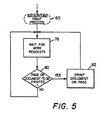
- Figure 5 illustrates the background printing process 60 which operates asynchronously with respect to the foreground printing tasks which provide operator interaction with the printed queue.
- process 60 waits at step 78 for a work request until a request is received at step 64.
- the program interrogates the page print queue or document print queue to determine if a page or document has been specified for printing. If so, the page or document is printed at step 82 and the program awaits at step 78 until a new request is received. This process is repeated until the operator exits from the print tasks at 75 and the background print process is terminated.
- the present invention thus provide a method of designating specific pages in a document to be printed while the operator is executing a typing task such as creating or revising a document.
- Page identification information corresponding to the specified pages is sequentially placed in a page print queue in the system memory and the pages are subsequently printed out when the typing tasks are completed and the printing tasks programs are loaded. This occurs in a background printing process in conjunction with operator submission of queued documents for printing.
Landscapes
- Engineering & Computer Science (AREA)
- Theoretical Computer Science (AREA)
- Health & Medical Sciences (AREA)
- Artificial Intelligence (AREA)
- Audiology, Speech & Language Pathology (AREA)
- Computational Linguistics (AREA)
- General Health & Medical Sciences (AREA)
- Physics & Mathematics (AREA)
- General Engineering & Computer Science (AREA)
- General Physics & Mathematics (AREA)
- Record Information Processing For Printing (AREA)
- Document Processing Apparatus (AREA)
Claims (5)
Applications Claiming Priority (2)
| Application Number | Priority Date | Filing Date | Title |
|---|---|---|---|
| US37926782A | 1982-05-17 | 1982-05-17 | |
| US379267 | 2003-03-04 |
Publications (3)
| Publication Number | Publication Date |
|---|---|
| EP0094515A2 EP0094515A2 (fr) | 1983-11-23 |
| EP0094515A3 EP0094515A3 (en) | 1987-04-08 |
| EP0094515B1 true EP0094515B1 (fr) | 1989-07-05 |
Family
ID=23496538
Family Applications (1)
| Application Number | Title | Priority Date | Filing Date |
|---|---|---|---|
| EP83103803A Expired EP0094515B1 (fr) | 1982-05-17 | 1983-04-20 | Méthode dans un systèmede traitement de mots pour mettre des pages marquées par un curseur dans une file d'attente |
Country Status (2)
| Country | Link |
|---|---|
| EP (1) | EP0094515B1 (fr) |
| DE (1) | DE3380152D1 (fr) |
Family Cites Families (2)
| Publication number | Priority date | Publication date | Assignee | Title |
|---|---|---|---|---|
| US3701972A (en) * | 1969-12-16 | 1972-10-31 | Computer Retrieval Systems Inc | Data processing system |
| US3805248A (en) * | 1972-07-21 | 1974-04-16 | Ultronic Systems Corp | Data processing printout system |
-
1983
- 1983-04-20 EP EP83103803A patent/EP0094515B1/fr not_active Expired
- 1983-04-20 DE DE8383103803T patent/DE3380152D1/de not_active Expired
Also Published As
| Publication number | Publication date |
|---|---|
| EP0094515A2 (fr) | 1983-11-23 |
| DE3380152D1 (en) | 1989-08-10 |
| EP0094515A3 (en) | 1987-04-08 |
Similar Documents
| Publication | Publication Date | Title |
|---|---|---|
| EP0094496B1 (fr) | Capacité à former une file d'attente dans un travail par le premier plan | |
| JP2537482B2 (ja) | ドキュメントプロセッシング装置 | |
| EP0427264B1 (fr) | Système automatique de génération d'icÔnes | |
| US4125868A (en) | Typesetting terminal apparatus having searching and merging features | |
| EP0536077A2 (fr) | Procédé pour améliorer la recherche interactive dans une base de données | |
| EP0650129B1 (fr) | Méthode, système et support lisible par ordinateur pour le formatage automatique d'un texte sélectionné par l'utilisateur | |
| US5173854A (en) | Distributed text editing system with remote terminal transmits successive audit messages each identifying individual editing operation | |
| US4587631A (en) | Automatic text adjustment | |
| US5091878A (en) | Word processing apparatus | |
| JPS631618B2 (fr) | ||
| US4663736A (en) | File deletion system in a file unit | |
| US4996640A (en) | Data processing system | |
| US5189731A (en) | Character processing system having editing function | |
| JP3107309B2 (ja) | 複数データ・ブロツクの処理方法およびそのシステム | |
| EP0094515B1 (fr) | Méthode dans un systèmede traitement de mots pour mettre des pages marquées par un curseur dans une file d'attente | |
| JP3108031B2 (ja) | かな漢字変換用ソフトウェアを用いて文字を入力する際のコマンド入力方法およびその方法をコンピュータに実行させるためのプログラムを記録したコンピュータ読み取り可能な記録媒体 | |
| JPS6316783B2 (fr) | ||
| JPS6214853B2 (fr) | ||
| JPH0375912B2 (fr) | ||
| JPH0326422B2 (fr) | ||
| CA1168368A (fr) | Justification automatique de texte | |
| JP3023681B2 (ja) | 文書処理装置 | |
| JPS58172770A (ja) | 日本語ワ−ドプロセツサ | |
| JPH0572270B2 (fr) | ||
| JPH06266487A (ja) | 情報処理装置およびヘルプ情報提供方法 |
Legal Events
| Date | Code | Title | Description |
|---|---|---|---|
| PUAI | Public reference made under article 153(3) epc to a published international application that has entered the european phase |
Free format text: ORIGINAL CODE: 0009012 |
|
| AK | Designated contracting states |
Designated state(s): DE FR GB IT |
|
| 17P | Request for examination filed |
Effective date: 19840320 |
|
| PUAL | Search report despatched |
Free format text: ORIGINAL CODE: 0009013 |
|
| AK | Designated contracting states |
Kind code of ref document: A3 Designated state(s): DE FR GB IT |
|
| 17Q | First examination report despatched |
Effective date: 19880926 |
|
| GRAA | (expected) grant |
Free format text: ORIGINAL CODE: 0009210 |
|
| AK | Designated contracting states |
Kind code of ref document: B1 Designated state(s): DE FR GB IT |
|
| PG25 | Lapsed in a contracting state [announced via postgrant information from national office to epo] |
Ref country code: IT Free format text: LAPSE BECAUSE OF FAILURE TO SUBMIT A TRANSLATION OF THE DESCRIPTION OR TO PAY THE FEE WITHIN THE PRESCRIBED TIME-LIMIT;WARNING: LAPSES OF ITALIAN PATENTS WITH EFFECTIVE DATE BEFORE 2007 MAY HAVE OCCURRED AT ANY TIME BEFORE 2007. THE CORRECT EFFECTIVE DATE MAY BE DIFFERENT FROM THE ONE RECORDED. Effective date: 19890705 |
|
| REF | Corresponds to: |
Ref document number: 3380152 Country of ref document: DE Date of ref document: 19890810 |
|
| ET | Fr: translation filed | ||
| PLBE | No opposition filed within time limit |
Free format text: ORIGINAL CODE: 0009261 |
|
| STAA | Information on the status of an ep patent application or granted ep patent |
Free format text: STATUS: NO OPPOSITION FILED WITHIN TIME LIMIT |
|
| 26N | No opposition filed | ||
| PGFP | Annual fee paid to national office [announced via postgrant information from national office to epo] |
Ref country code: GB Payment date: 19910327 Year of fee payment: 9 Ref country code: FR Payment date: 19910327 Year of fee payment: 9 |
|
| PGFP | Annual fee paid to national office [announced via postgrant information from national office to epo] |
Ref country code: DE Payment date: 19910418 Year of fee payment: 9 |
|
| PG25 | Lapsed in a contracting state [announced via postgrant information from national office to epo] |
Ref country code: GB Effective date: 19920420 |
|
| GBPC | Gb: european patent ceased through non-payment of renewal fee | ||
| PG25 | Lapsed in a contracting state [announced via postgrant information from national office to epo] |
Ref country code: FR Effective date: 19921230 |
|
| PG25 | Lapsed in a contracting state [announced via postgrant information from national office to epo] |
Ref country code: DE Effective date: 19930101 |
|
| REG | Reference to a national code |
Ref country code: FR Ref legal event code: ST |