EP0095511A1 - Dispositif pour les soins des dents - Google Patents
Dispositif pour les soins des dents Download PDFInfo
- Publication number
- EP0095511A1 EP0095511A1 EP82104615A EP82104615A EP0095511A1 EP 0095511 A1 EP0095511 A1 EP 0095511A1 EP 82104615 A EP82104615 A EP 82104615A EP 82104615 A EP82104615 A EP 82104615A EP 0095511 A1 EP0095511 A1 EP 0095511A1
- Authority
- EP
- European Patent Office
- Prior art keywords
- holder
- handle
- toothbrush
- pawl
- underside
- Prior art date
- Legal status (The legal status is an assumption and is not a legal conclusion. Google has not performed a legal analysis and makes no representation as to the accuracy of the status listed.)
- Withdrawn
Links
- 210000003813 thumb Anatomy 0.000 claims abstract description 19
- 238000003780 insertion Methods 0.000 claims abstract description 16
- 230000037431 insertion Effects 0.000 claims abstract description 16
- 241000549893 Carphochaete Species 0.000 claims abstract description 3
- 241000628997 Flos Species 0.000 claims description 15
- 230000007246 mechanism Effects 0.000 claims description 9
- 238000012544 monitoring process Methods 0.000 claims description 7
- 102000004315 Forkhead Transcription Factors Human genes 0.000 claims description 5
- 108090000852 Forkhead Transcription Factors Proteins 0.000 claims description 5
- 238000004804 winding Methods 0.000 claims description 2
- 230000000903 blocking effect Effects 0.000 abstract description 3
- 238000004140 cleaning Methods 0.000 description 18
- 238000000034 method Methods 0.000 description 13
- 230000001680 brushing effect Effects 0.000 description 3
- 230000000694 effects Effects 0.000 description 3
- 239000000463 material Substances 0.000 description 3
- 230000007704 transition Effects 0.000 description 3
- 238000005520 cutting process Methods 0.000 description 2
- 210000003811 finger Anatomy 0.000 description 2
- 230000006872 improvement Effects 0.000 description 2
- 230000003993 interaction Effects 0.000 description 2
- 230000008569 process Effects 0.000 description 2
- 208000027418 Wounds and injury Diseases 0.000 description 1
- 238000013459 approach Methods 0.000 description 1
- 230000008901 benefit Effects 0.000 description 1
- 235000009508 confectionery Nutrition 0.000 description 1
- 230000006378 damage Effects 0.000 description 1
- 208000002925 dental caries Diseases 0.000 description 1
- 239000000551 dentifrice Substances 0.000 description 1
- 238000013461 design Methods 0.000 description 1
- 230000002349 favourable effect Effects 0.000 description 1
- 239000010794 food waste Substances 0.000 description 1
- 210000004247 hand Anatomy 0.000 description 1
- 238000002347 injection Methods 0.000 description 1
- 239000007924 injection Substances 0.000 description 1
- 208000014674 injury Diseases 0.000 description 1
- 235000012054 meals Nutrition 0.000 description 1
- 208000028169 periodontal disease Diseases 0.000 description 1
- 230000002028 premature Effects 0.000 description 1
- 238000003825 pressing Methods 0.000 description 1
- 230000002265 prevention Effects 0.000 description 1
- 238000011160 research Methods 0.000 description 1
- 238000005096 rolling process Methods 0.000 description 1
- 238000007493 shaping process Methods 0.000 description 1
- 230000000638 stimulation Effects 0.000 description 1
- 229920001169 thermoplastic Polymers 0.000 description 1
- 239000004416 thermosoftening plastic Substances 0.000 description 1
- 210000000332 tooth crown Anatomy 0.000 description 1
- 238000009966 trimming Methods 0.000 description 1
Images

Classifications
-
- A—HUMAN NECESSITIES
- A46—BRUSHWARE
- A46B—BRUSHES
- A46B5/00—Brush bodies; Handles integral with brushware
- A46B5/0095—Removable or interchangeable brush heads
-
- A—HUMAN NECESSITIES
- A46—BRUSHWARE
- A46B—BRUSHES
- A46B15/00—Other brushes; Brushes with additional arrangements
- A46B15/0055—Brushes combined with other articles normally separate from the brushing process, e.g. combs, razors, mirrors
-
- A—HUMAN NECESSITIES
- A46—BRUSHWARE
- A46B—BRUSHES
- A46B15/00—Other brushes; Brushes with additional arrangements
- A46B15/0055—Brushes combined with other articles normally separate from the brushing process, e.g. combs, razors, mirrors
- A46B15/0069—Brushes fitted with a interdental devices, e.g. toothpick
-
- A—HUMAN NECESSITIES
- A46—BRUSHWARE
- A46B—BRUSHES
- A46B15/00—Other brushes; Brushes with additional arrangements
- A46B15/0055—Brushes combined with other articles normally separate from the brushing process, e.g. combs, razors, mirrors
- A46B15/0075—Brushes with an additional massage device
-
- A—HUMAN NECESSITIES
- A46—BRUSHWARE
- A46B—BRUSHES
- A46B15/00—Other brushes; Brushes with additional arrangements
- A46B15/0055—Brushes combined with other articles normally separate from the brushing process, e.g. combs, razors, mirrors
- A46B15/0077—Brushes fitted with a mirror
-
- A—HUMAN NECESSITIES
- A61—MEDICAL OR VETERINARY SCIENCE; HYGIENE
- A61C—DENTISTRY; APPARATUS OR METHODS FOR ORAL OR DENTAL HYGIENE
- A61C15/00—Devices for cleaning between the teeth
- A61C15/04—Dental floss; Floss holders
- A61C15/046—Flossing tools
- A61C15/048—Flossing tools with heads removable from handle, e.g. interchangeable heads
-
- A—HUMAN NECESSITIES
- A46—BRUSHWARE
- A46B—BRUSHES
- A46B2200/00—Brushes characterized by their functions, uses or applications
- A46B2200/10—For human or animal care
- A46B2200/1066—Toothbrush for cleaning the teeth or dentures
Definitions
- the invention relates to a device for caring for the teeth with a toothbrush, the end of the handle facing away from the bristle head is designed as an insertion end for a holder and as part of a tensioning mechanism which removes the freedom of movement of the holder and toothbrush.
- the invention is based on previously known toothbrushes, in which the multiple parts provided by the separability of the handle and holder either serve to bring the toothbrush into a reduced size, e.g. to move a more suitable unit for travel or to use several toothbrushes with a holder, which can then be assigned to individual people, which is the case with many electrically powered toothbrushes, for example.
- toothbrushes do not provide adequate dental care if the person concerned is to prevent tooth decay and periodontal disease.
- suitable materials for the bristles, better shaping of the bristle trimming and / or the toothbrush handle, and, if appropriate, the use of medical dentifrices can provide adequate prevention.
- dental care facilities cannot achieve optimal cleaning results.
- such toothbrushes are not changed often enough, although a toothbrush will wear out in about 3 months if used properly.
- the rotation method requires circular movements, while the so-called red / white method requires vertical movements from the gums to the tooth crown.
- red / white method requires vertical movements from the gums to the tooth crown.
- bass technique With the rolling method, a stimulation of the gum line is achieved at the same time, while with the so-called bass technique, slight horizontal and simultaneously shaking movements are to be carried out.
- tooth brushing methods must be applied individually. They are generally difficult to track with the known toothbrushes and lead to premature fatigue, so that the cleaning effect lags behind the expected result. In particular, it is difficult to get children used to such methods.
- the invention has for its object to form a toothbrush of the type mentioned in a simple manner so that it enables an effective execution of any cleaning method and is also set up to additionally perform the interdental spaces and / or the dentures cleaning processes and, if necessary, to control their success .
- the toothbrush forms part of a multi-part set of dental care and tooth monitoring instruments, each of which has a handle which corresponds to the end of the toothbrush handle, and in that the holder in a unit ends on a locking end of the actuating button closing the holder Grip receiving handle and a thumb rest combined, which receives the locking piece formed at the insertion end of the stem.
- a handle which correspond to those components of the toothbrush which ensure that the handle and Excluding holder connection with the holder is guaranteed, the effort for optimal dental care is simplified by the exploitability of the holder for handling the various instruments.
- These can also include other special brushes, such as those that are particularly suitable for cleaning the interdental spaces and hard-to-reach areas for crooked teeth that need to be subjected to orthodontic treatment. Since you also split the holder on a thumb rest and a handle, you get on the one hand an ergonomic shape of the holder, which in particular when brushing the teeth or dentures pushes out the time of fatigue so far that the different cleaning methods can be used with sufficient success.
- the voluminous handle provides space for a locking mechanism which enables a sufficiently strong positive and non-positive connection, so that despite the tapering of the holder required for ergonomic reasons, a firm connection of the locking piece with the holder serving as the frame of the tensioning mechanism can be produced.
- the invention has the advantage that it enables effective dental care in a simple manner, which can be divided into four stages.
- the optimal toothbrushing method can be carried out several times a day, which is recommended after every meal, but always after sweet dishes and at least three times a day.
- the interdental spaces have to be cleaned, for example, with a toothbrush or dental floss suitable for this purpose, after which a check is carried out, for example, with the aid of a tooth monitoring instrument oral mirror to be counted.
- used dental care instruments in particular worn toothbrushes, can be removed from the set and replaced with unused instruments of the same type, for which the effort is relatively low.
- the holder has flat and parallel sides and a back which is curved like the underside and which runs parallel to the underside in the grip piece and which converges on one side in the thumb rest with the straight back. It has proven to be useful to increase the grip of the handle.
- This is done according to the invention in particular in that the underside of the thumb rest has a corrugation starting from its shoulder, which covers the adjoining regions of the sides and extends to the end of the holder.
- an ergonomic improvement is also possible by including at least a part of the handle of the respective instrument in the thumb rest area.
- the respective handle is offset with a collar against the insertion end and has a handle attachment on the collar, the lateral surfaces of which are flush with the side, back and front part surfaces.
- the collar provides a smooth transition of the parts so that the handle can adapt to the holder and the handle.
- a dental care instrument designed as a dental floss holder which has a fork head on a stem, the fork tips of which can be wrapped with the ends of a dental floss section, which is cut off from a dental floss coil accommodated on the fork head.
- the tensioning mechanism according to the invention is preferably designed to be non-positive and positive, in order to achieve the required security when excluding freedom of movement.
- This tensioning mechanism uses the elasticity of the material of the parts, which are preferably molded from a thermoplastic, for example injection molded.
- the blocker is provided with a switch cam for the locking piece sitting at the end of the respective handle and with a stop which limits an axial stroke of the locking piece in the holder with a bar formed in the latter, which in turn has one at the insertion end of the handle trained pawl brings about the positive engagement of the holder with the respective instrument.
- the parts can be dimensioned so that at the rear end of the axial stroke of the switching cams the plug-in end of the handle and the pawl is in front of the bar at the front end of the idle stroke. Then it is possible to push the insertion end so far into the holder that the button connected to the lock comes out of the end of the holder as soon as the pawl is locked behind the bar.
- the fit of the parts is absolutely secure because of the pawl and the stop partially overlap axially and therefore the play of the parts in the holder is switched off.
- the button By pressing the button, the pawl can be pushed over the bar as a result of the axial stroke which is thereby diameter, and the stem of the element in question can thereby be unlocked.
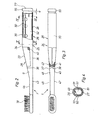
- a toothbrush 1 shown in two views in FIG. 1 below forms part of a multi-part cleaning set of dental care and tooth monitoring instruments.
- Shown in Fig. 1 is an interstice brush at 2 and a mouth mirror at 3 as a monitoring instrument, which consists of a frame 4, a concave mirror 5, a frame holder 6 and a handle 7, the parts 4, 6 and 7 forming a structural unit.
- a monitoring instrument which consists of a frame 4, a concave mirror 5, a frame holder 6 and a handle 7, the parts 4, 6 and 7 forming a structural unit.
- Each of the instruments shown at 1, 2 and 3 has matching parts. These include the stem attachment 9, which ends at a collar 8 and forms a structural unit with the respective stem 7, 10, 11 under an insertion end 12, which is the same for all instruments.
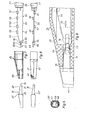
- the insertion end consists of a shaft 13 with a recess 14 on one side, which is delimited by a roof-shaped bevel 15 of the shaft extension 13 'and a surface 16 of the shaft tip 17 which is parallel in the shaft extension 13.
- the shaft 13 has a rectangular cross section, which is the same everywhere in the shaft attachment 13 ′ and is tapered in the shaft tip 17 through the inclined surface 15 and through an inclined lower surface 18.
- the surface 19 opposite the surface 18, which is flush with the corresponding surface 20 of the shaft extension 13 ' in turn carries an arcuate recess 21, so that the shaft tip 17 forms a pawl generally designated 22.
- the collar 8 is delimited by an essentially circular ring surface 23, from which, however, a roof-shaped cutting edge 23 'projects forward.
- the holder 24 can be seen in particular in FIGS. It combines a tubular handle 25 and a thumb rest 26 in one unit. 4 has a cross section that is the same everywhere. In this, a semicircular arc 27 delimits the back 28 of the handle 25 and a curve 29 corresponding to the underside 30 of the handle. The arches 27 and 29 are connected to flat and parallel sides 31 and 32.
- the underside 33 in the thumb rest 26 is angled on one side in the direction of the back 28 and converges with it.
- the approach 34 of the bend represents the beginning of the thumb rest, in which the back 28 of the handle passes and is drawn at 35.
- the handle ends at an outside at 36 circular collar, which has a rectangular border on the inside, which corresponds to the cross section of the pin 13. Accordingly, a roof-shaped recess 38 is provided in the collar surface 37, into which the roof-shaped cutting edge 23 ′ on the collar 8 fits. In this way, an additional anti-rotation device is created, which also prevents the instruments from being incorrectly assembled with the holder 24.
- the thumb rest 26 has on its underside 33 a corrugation 40 which is divided into two parallel fields 41 and 42, which covers the adjoining regions of the sides which correspond to the side parts 31 and 32 in the holder 24 and to the end, i.e. extend to the collar 36 of the holder 24.
- the respective handle After assembly with the holder 24, the respective handle is supported with its collar 8 on the collar 36 in such a way that there is a smooth transition of the back and bottom surfaces of the respective handle attachment 9 to the corresponding surfaces of the thumb rest 26.
- the back surface 43 of the respective handle is flush with the back surfaces 28 and 35, while the underside 44 of the handle runs parallel to the back surface 43 only in the outer region.
- Conical transitions 45, 46 are provided for the side surfaces 47, 48 of the stem. In the toothbrush shown in FIGS. 2 to 4, this results in an ergonomically favorable design of all parts, in which the handle 25 of the holder is gripped with the four fingers of one hand and the thumb is held on the corrugated surfaces 41, 42 of the support 26 which ensures fatigue-free handling when brushing.
- an axially parallel and cross-sectionally rectangular guide strip 50 is formed, which forms a structural unit with the parts of the holder 24.
- the handle 25 is hollow, as shown at 51 in FIG. 4.
- the blocker designated 52 of a clamping mechanism to be described in detail below.
- the lock 52 has a plate-shaped body which is delimited in the rear by essentially parallel edges 53, 54 and forms a structural unit with a push button 55.
- the edge 53 converges at 56 with the edge 54.
- Cams 57 and 58 correspond to the width of the guide bar 50, so that a straight guide in the axial direction for the blocker 52 arises from the interaction of the guide cam pairs 57 and 58 with the bar 50.
- a switching cam 64 which forms a structural unit with a hook-shaped stop 65 and the plate body of the lock 52.
- the end face 66 of the switching cam 64 together with the hook jaw face 67, delimits an axial stroke which the lock 52 can execute relative to an arcuate strip 68 (FIG. 6) of the thumb rest 26 and which is recognizable by the dash-dotted position of the parts.
- the bar 68 is seated in a rectangular recess 69 at the free end 70 of the thumb rest 26.
- the lock 52 can be pushed into the holder 24 from behind until the stop 67 slides over the rounded head of the strip 68 and is supported behind it on the adjoining surface 71. This enables the elasticity of the parts 64 and 67.
- the lock 52 can carry out an idle stroke in the holder 24, the rear end position of which is indicated by the position of the lock shown at 73, while its front end End position is dash-dotted at 74 in Fig. 6.
- the user wants to use one of the instruments shown in FIG. 1, for example the toothbrush shown in FIGS. 2 to 4 in the lower illustration of FIG. 1, he inserts the insertion end 12 of the relevant instrument into the rectangular recess 69. This is initially possible without noticeable resistance until the curved end face 75 of the pawl 22 lies in the end face 65 of the stop 67. A further insertion of the insertion end 12 presupposes the overcoming of a resistance which results from the close fit of the recess 66, the recess 71 and the pawl 22, as a result of which a positive connection occurs.
- the button 55 In the end position described, the button 55, as can be seen from the illustration in FIGS. 2 and 3, emerges from the end of the holder 24 into the idle stroke designated there by a. If the user has carried out the tooth cleaning associated with the instrument, he presses with the thumb on the correspondingly designed end face 77 of the button 55 and thereby shifts the lock 52 axially by the stroke a. Due to the positive connection between the pawl 22 and the switching cam 64, the pawl 22 with its recess 21 is pushed back over the curved surface of the strip 68.
- toothbrush 1 has the usual bristle trim 78
- instrument 2 serves with its bristles tufts 79 for cleaning the interdental spaces or the parts of a denture.
- a dental floss holder 80 is shown.
- the stem not shown in this case carries at its free end a fork with a fork head 8.1 and two fork prongs 82, 83, the tips 84, 85 of which can be wrapped with the ends 86, 87 of a section 88 of dental floss.
- a recess 89 of the head 81 there is a floss of dental floss, from which the section 88 can be unwound and renewed.
- This dental floss holder 80 makes it possible, above all, to clean the interdental spaces and the contact points between the teeth in the posterior region.
- a locking head not shown, on the back of the dental floss holder 80, the section 88 is unwound from the winding 89 in a length of 20-30 cm and extended after the cleaning process of a tooth space, so that new floss is used for each new tooth space.
Landscapes
- Health & Medical Sciences (AREA)
- Dentistry (AREA)
- Epidemiology (AREA)
- Life Sciences & Earth Sciences (AREA)
- Animal Behavior & Ethology (AREA)
- General Health & Medical Sciences (AREA)
- Public Health (AREA)
- Veterinary Medicine (AREA)
- Brushes (AREA)
Priority Applications (1)
| Application Number | Priority Date | Filing Date | Title |
|---|---|---|---|
| EP82104615A EP0095511A1 (fr) | 1982-05-27 | 1982-05-27 | Dispositif pour les soins des dents |
Applications Claiming Priority (1)
| Application Number | Priority Date | Filing Date | Title |
|---|---|---|---|
| EP82104615A EP0095511A1 (fr) | 1982-05-27 | 1982-05-27 | Dispositif pour les soins des dents |
Publications (1)
| Publication Number | Publication Date |
|---|---|
| EP0095511A1 true EP0095511A1 (fr) | 1983-12-07 |
Family
ID=8189055
Family Applications (1)
| Application Number | Title | Priority Date | Filing Date |
|---|---|---|---|
| EP82104615A Withdrawn EP0095511A1 (fr) | 1982-05-27 | 1982-05-27 | Dispositif pour les soins des dents |
Country Status (1)
| Country | Link |
|---|---|
| EP (1) | EP0095511A1 (fr) |
Cited By (5)
| Publication number | Priority date | Publication date | Assignee | Title |
|---|---|---|---|---|
| EP0247254A1 (fr) * | 1984-08-21 | 1987-12-02 | Raymond Ernest | Appareil d'hygiène buccale pourvu d'un jeu d'accessoires |
| EP2156765A4 (fr) * | 2007-06-04 | 2010-03-03 | Masahiro Tanuma | Brosse à dents avec système lumineux |
| GB2467511A (en) * | 2008-07-28 | 2010-08-04 | Paul Murphy | Tooth care implement |
| WO2017143382A1 (fr) * | 2016-02-24 | 2017-08-31 | Erskine Holdco Pty Ltd | Adaptateur pour dispositifs d'hygiène buccale |
| DE102023003411B3 (de) | 2023-08-18 | 2024-07-18 | Hermann Klaas | Multifunktionszahnreinigungsgerät |
Citations (15)
| Publication number | Priority date | Publication date | Assignee | Title |
|---|---|---|---|---|
| DE95323C (fr) * | ||||
| US1719426A (en) * | 1927-09-03 | 1929-07-02 | Einar K Gade | Toothbrush |
| US1774031A (en) * | 1929-07-13 | 1930-08-26 | Mclellan Charles | Rotary toothbrush |
| US1859425A (en) * | 1931-03-18 | 1932-05-24 | Harry D Bell | Toothbrush |
| US1861363A (en) * | 1931-07-01 | 1932-05-31 | Scheuner Charles | Quick detachable handle for tools |
| US1887913A (en) * | 1932-01-09 | 1932-11-15 | Harry D Bell | Toothbrush |
| US2139593A (en) * | 1936-05-23 | 1938-12-06 | Milton W Kohler | Tooth brush |
| US2236627A (en) * | 1939-01-16 | 1941-04-01 | Earl J Mcwhirter | Toothbrush and head |
| US2615247A (en) * | 1950-06-06 | 1952-10-28 | Dorse M Waters | Tool handle fastening |
| FR58747E (fr) * | 1949-02-05 | 1954-03-22 | Perfectionnements aux brosses à dents démontables | |
| US3672377A (en) * | 1971-01-05 | 1972-06-27 | Paul G Greenacre | Dental care appliance |
| GB1449407A (en) * | 1974-03-04 | 1976-09-15 | Feather Ind Ltd | Handle for releasably holding a flat blade |
| FR2450579A1 (fr) * | 1979-03-08 | 1980-10-03 | Payen Raoul | Appareil d'hygiene buccale |
| US4227276A (en) * | 1979-02-07 | 1980-10-14 | Ginsburg Stephen J | Toothbrush with thermally deformable handle |
| GB2044089A (en) * | 1979-03-02 | 1980-10-15 | Kent & Sons Ltd G B | Disposable head toothbrush |
-
1982
- 1982-05-27 EP EP82104615A patent/EP0095511A1/fr not_active Withdrawn
Patent Citations (15)
| Publication number | Priority date | Publication date | Assignee | Title |
|---|---|---|---|---|
| DE95323C (fr) * | ||||
| US1719426A (en) * | 1927-09-03 | 1929-07-02 | Einar K Gade | Toothbrush |
| US1774031A (en) * | 1929-07-13 | 1930-08-26 | Mclellan Charles | Rotary toothbrush |
| US1859425A (en) * | 1931-03-18 | 1932-05-24 | Harry D Bell | Toothbrush |
| US1861363A (en) * | 1931-07-01 | 1932-05-31 | Scheuner Charles | Quick detachable handle for tools |
| US1887913A (en) * | 1932-01-09 | 1932-11-15 | Harry D Bell | Toothbrush |
| US2139593A (en) * | 1936-05-23 | 1938-12-06 | Milton W Kohler | Tooth brush |
| US2236627A (en) * | 1939-01-16 | 1941-04-01 | Earl J Mcwhirter | Toothbrush and head |
| FR58747E (fr) * | 1949-02-05 | 1954-03-22 | Perfectionnements aux brosses à dents démontables | |
| US2615247A (en) * | 1950-06-06 | 1952-10-28 | Dorse M Waters | Tool handle fastening |
| US3672377A (en) * | 1971-01-05 | 1972-06-27 | Paul G Greenacre | Dental care appliance |
| GB1449407A (en) * | 1974-03-04 | 1976-09-15 | Feather Ind Ltd | Handle for releasably holding a flat blade |
| US4227276A (en) * | 1979-02-07 | 1980-10-14 | Ginsburg Stephen J | Toothbrush with thermally deformable handle |
| GB2044089A (en) * | 1979-03-02 | 1980-10-15 | Kent & Sons Ltd G B | Disposable head toothbrush |
| FR2450579A1 (fr) * | 1979-03-08 | 1980-10-03 | Payen Raoul | Appareil d'hygiene buccale |
Cited By (7)
| Publication number | Priority date | Publication date | Assignee | Title |
|---|---|---|---|---|
| EP0247254A1 (fr) * | 1984-08-21 | 1987-12-02 | Raymond Ernest | Appareil d'hygiène buccale pourvu d'un jeu d'accessoires |
| EP2156765A4 (fr) * | 2007-06-04 | 2010-03-03 | Masahiro Tanuma | Brosse à dents avec système lumineux |
| GB2467511A (en) * | 2008-07-28 | 2010-08-04 | Paul Murphy | Tooth care implement |
| GB2467511B (en) * | 2008-07-28 | 2011-01-19 | Paul Murphy | A tooth care implement |
| CN102159116A (zh) * | 2008-07-28 | 2011-08-17 | 保罗·墨菲 | 健齿器具 |
| WO2017143382A1 (fr) * | 2016-02-24 | 2017-08-31 | Erskine Holdco Pty Ltd | Adaptateur pour dispositifs d'hygiène buccale |
| DE102023003411B3 (de) | 2023-08-18 | 2024-07-18 | Hermann Klaas | Multifunktionszahnreinigungsgerät |
Similar Documents
| Publication | Publication Date | Title |
|---|---|---|
| DE3855221T2 (de) | Rotierende zahnbürtse mit doppelbürste | |
| DE69229796T2 (de) | Selbsteinstellbare dreiseitige zahnbürste | |
| DE69027935T2 (de) | Zahnbürste für zahnzwischenräume | |
| EP0500839A1 (fr) | Appareil d'hygiene dentaire sans soies | |
| DE69937109T2 (de) | Zahnbürste und herstellungsverfahren | |
| DE69312501T2 (de) | Zahnseidenabgabevorrichtung und Applikator | |
| EP0417212B1 (fr) | Ajutage de nettoyage pour les soins dentaires | |
| DE4226659A1 (de) | Reinigungswerkzeug für ein elektrisch betriebenes Zahnreinigungsgerät | |
| WO1998036703A1 (fr) | Appareil automatique de nettoyage des espaces interdentaires | |
| DE68916949T2 (de) | Zahnreinigungsanordnung. | |
| DE60118587T2 (de) | Mundraumgeräte | |
| CH710348A2 (de) | Interdentalbürste. | |
| EP0098910B1 (fr) | Brosse à dents pour l'enlèvement des dépôts sur les dents humaines et pour les soins dentaires | |
| DE1253668B (de) | Stiellose Zahn- und Zahnfleischmassagebuerste | |
| DE3152404T1 (de) | Zahnhygiene-werkzeug | |
| DE102005026268B4 (de) | Zahnzwischenraumreiniger sowie Verfahren zu dessen Herstellung | |
| DE7533143U (de) | Ahnbuerste | |
| DE19654557A1 (de) | Apparat zur automatischen Reinigung von Zahnzwischenräumen | |
| EP4021728B1 (fr) | Guide de nettoyage pour un nettoyage dentaire, procédé de fabrication et produit logiciel | |
| EP3773326B1 (fr) | Dispositif de nettoyage de dents | |
| DE69124388T2 (de) | Zahnhygienisches gerät | |
| DE3226656C2 (de) | Zahnbürste | |
| DE102009022501B4 (de) | Zahnbürste | |
| DE102006040241A1 (de) | Griff für Geräte zur Körper- und Schönheitspflege | |
| DE29509846U1 (de) | Interdentalzahnbürste |
Legal Events
| Date | Code | Title | Description |
|---|---|---|---|
| PUAI | Public reference made under article 153(3) epc to a published international application that has entered the european phase |
Free format text: ORIGINAL CODE: 0009012 |
|
| AK | Designated contracting states |
Designated state(s): AT BE CH DE FR GB IT LI LU NL SE |
|
| STAA | Information on the status of an ep patent application or granted ep patent |
Free format text: STATUS: THE APPLICATION IS DEEMED TO BE WITHDRAWN |
|
| 18D | Application deemed to be withdrawn |
Effective date: 19840808 |
|
| RIN1 | Information on inventor provided before grant (corrected) |
Inventor name: HINZ, ROLF, DR. MED. DENT. |