EP0095536B1 - Représentation d'images de caractères sous forme condensée pour mémorisation en calculateur - Google Patents
Représentation d'images de caractères sous forme condensée pour mémorisation en calculateur Download PDFInfo
- Publication number
- EP0095536B1 EP0095536B1 EP82302816A EP82302816A EP0095536B1 EP 0095536 B1 EP0095536 B1 EP 0095536B1 EP 82302816 A EP82302816 A EP 82302816A EP 82302816 A EP82302816 A EP 82302816A EP 0095536 B1 EP0095536 B1 EP 0095536B1
- Authority
- EP
- European Patent Office
- Prior art keywords
- vector
- character
- mark
- strokes
- dot matrix
- Prior art date
- Legal status (The legal status is an assumption and is not a legal conclusion. Google has not performed a legal analysis and makes no representation as to the accuracy of the status listed.)
- Expired
Links
Images


Classifications
-
- G—PHYSICS
- G06—COMPUTING OR CALCULATING; COUNTING
- G06K—GRAPHICAL DATA READING; PRESENTATION OF DATA; RECORD CARRIERS; HANDLING RECORD CARRIERS
- G06K15/00—Arrangements for producing a permanent visual presentation of the output data, e.g. computer output printers
- G06K15/02—Arrangements for producing a permanent visual presentation of the output data, e.g. computer output printers using printers
-
- G—PHYSICS
- G09—EDUCATION; CRYPTOGRAPHY; DISPLAY; ADVERTISING; SEALS
- G09G—ARRANGEMENTS OR CIRCUITS FOR CONTROL OF INDICATING DEVICES USING STATIC MEANS TO PRESENT VARIABLE INFORMATION
- G09G5/00—Control arrangements or circuits for visual indicators common to cathode-ray tube indicators and other visual indicators
- G09G5/22—Control arrangements or circuits for visual indicators common to cathode-ray tube indicators and other visual indicators characterised by the display of characters or indicia using display control signals derived from coded signals representing the characters or indicia, e.g. with a character-code memory
- G09G5/24—Generation of individual character patterns
- G09G5/246—Generation of individual character patterns of ideographic or arabic-like characters
-
- G—PHYSICS
- G06—COMPUTING OR CALCULATING; COUNTING
- G06K—GRAPHICAL DATA READING; PRESENTATION OF DATA; RECORD CARRIERS; HANDLING RECORD CARRIERS
- G06K2215/00—Arrangements for producing a permanent visual presentation of the output data
- G06K2215/0002—Handling the output data
- G06K2215/002—Generic data access
- G06K2215/0028—Generic data access characterised by the format per se
Definitions
- This invention relates to the compressed representation of high resolution characters, especially Chinese characters and other ideographic characters, in computer storage and to the transforming of this compressed representation into a high resolution dot matrix in a manner especially suitable for raster output.
- This invention is particularly useful in connection with a fast, high resolution, character generator and typesetting controller in a computerized laser system for typesetting books and newspapers in Chinese as well as in other languages, but it also has application to a CRT typesetter.
- a run length coding technique has been widely used to represent high resolution character images by a lot of typesetters including the CRT typesetter known as Digisit from Hell Corporation in West Germany, the IBM full page typesetter used in the Japanese newspaper "The Economic News” and the Laser Comp of British Monotype Corporation.
- CRT typesetter known as Digisit from Hell Corporation in West Germany
- IBM full page typesetter used in the Japanese newspaper "The Economic News”
- Laser Comp of British Monotype Corporation instead of storing the whole dot matrix of a character, it only records the beginning and the length of separate black sections in each horizontal (or vertical) line of the character.
- the original dot matrix of the character can be faithfully reproduced and the storage required can be reduced by one-half.
- the Song typeface strokes are classified into ten basic patterns determined solely by the direction of vectors.
- the character information consists of control data and vector data.
- the control data mainly indicates the stroke density besides the total number of vectors whilst the vector data indicates the start and end point of vectors.
- the strokes of Chinese characters in printing can be classified into two kinds, the regular stroke consisting of horizontal, vertical and turn strokes and the irregular strokes.
- the former account for over half of the strokes occurring in Chinese characters according to statistics.
- the regular strokes are composed of straight segments and starting, ending and turning features which are regular in shape and they can be precisely described by only 3 to 6 bytes of information.
- regular strokes are represented by starting, ending or turning features which are the major variable parts of a regular stroke and the number of possible shapes of these sorts of items are limited. They can therefore be stored in the memory beforehand and only a relatively small number of them are necessary so that for example the ordinal numbers 0 to 15 can be used to represent up to 16 different starting features for each stroke, e.g. a vertical stroke or whatever. Thereafter only a few bits of information are necessary to represent length, width and angle of various slants.
- the vector information which is used depicts the contour or outline and this contour or outline is made up of a series of approximately straight segments which, when joined together, give the approximate curved contour of the overall stroke.
- No concept such as this contained in the above noted IBM Bulletin in the preparation of high quality printing for Chinese characters, the ten basic patterns chosen and illustrated are far from enough to enable high quality printing to be achieved.
- a basic size is selected from which all other sizes can be reproduced.
- 10.5 point or 3.68 mm 2
- Characters of basic size are considered to be drawn on a grid with 96x96 units.
- the vertical strokes can be represented by 32 to 40 bits information comprising:
- the horizontal strokes of Song typeface and display Song typeface Chinese characters can be represented by 24 to 32 bits information comprising:
- the horizontal strokes of boldface Chinese characters can be represented by 24 to 32 bits of information comprising:
- the horizontal strokes of imitation Song typeface Chinese characters in which the horizontal strokes are equally divided into left half part and right half part can be represented by 32 to 40 bits of information comprising:
- the turn strokes of Song typeface and display Song typeface Chinese characters can be represented by 40 to 48 bits of information comprising:
- the turn strokes of boldface Chinese characters can be represented by 40 bits of information comprising:
- the turn strokes of imitation Song typeface Chinese characters can be represented by 40 to 48 bits of information comprising:
- the shapes of various starting and ending features are stored in memory and the corresponding ordinal number is included in the 32-bit compressed representation.
- the compressed representation of the curved extension which is in the form of an irregular stroke without the information about X, Y coordinates of the starting point, should preferably follow immediately the compressed representation of that regular stroke to reduce the information required.
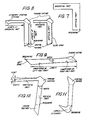
- the vertical stroke with a flat edge in boldface Chinese characters which is depicted in Figure 5, can be represented by 32 bits similar to that of display Song typeface.
- the turn stroke of Song typeface and display Song typeface as depicted in Figure 8 and Figure 9 can be represented by 40 bits:
- the horizontal stroke of imitation Song typeface as described in Figure 9 can be regarded as equally divided into left half and right half part with possibly a different degree of slant and is represented by 32 bits:
- the left edge is a straight segment with identical increments in X and Y directions. According to statistics, there are four different increments: 2 to 5 units (on a 96x96 grid).
- the slant of the lower edge can be measured by the difference between Y coordinate of the start point of the edge and that of the end point of the edge.
- Vertical stroke and turn stroke may have a curved extension in the lower part as shown in Figure 11.
- the 2 or 3 bits normally designating the ending feature are all ones, it means that the vertical stroke or turn stroke has a curved extension represented in the form of irregular stroke, which will be illustrated later.
- irregular stroke in Chinese characters and characters of other languages, irregular stroke can be represented by a series of variable length and direction vectors, i.e. vectors whose sign (positive or negative) gives direction, which approximate to the curved contour, and if the error caused by the approximation is controlled to less than half a unit on a grid with 96x96 units, we have found that output quality will not be significantly impaired.
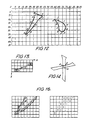
- a "point” is represented by a sequence of vectors AB, BC, CD, DE, EF, FG, GH, HI, IJ, JA with point A as start point of the stroke.
- the start point of a stroke is expressed as X, Y coordinates and each vector is expressed as signed, i.e. plus or minus, increments of X, Y coordinates (AX, AY).
- X, Y coordinates in Figure 12, the shape of the "point" shown on the right of Figure 12 may be represented as follows:
- the invention uses a control byte to discriminate cases of vectors length, e.g. three cases can be distinguished-less than 8, less than 16 and not less than 16.
- the irregular stroke on the left of Figure 12 consisting of 11 vectors can be represented by the following 14 bytes:
- the compressed representation achieved has then to be transformed into a corresponding dot matrix and so according to another aspect of the invention the procedure comprises:
- This procedure can be performed for example, by a microprogram stored in a bipolar PROM (Programmable Read Only Memory).
- This algorithm is an optimized one which generates nearest digitised dots to a vector.
- 2-bit mark has to be written into the corresponding position of the marked dot matrix. This can be achieved as follows:
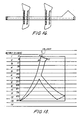
- the 2-bit mark at each dot position of a vector is determined jointly by the quadrant in which the vector lies and by whether Y is varied in the respective steps as follows:
- the 2-bit mark to be written into the node of two vectors is determined by the quadrants in which the first and second vectors lie and the variation of Y in the last and present step in respect to the node as follows:
- the 2-bit mark may be written into the same position of the marked dot matrix more than once during the generation of a character image because intersection of strokes is allowed. Then the final 2-bit mark of the marked dot matrix is determined jointly by the old mark previously written and by the mark to be written as follows:
- the imitation Song typeface Chinese character as shown in Figure 14 consists of a horizontal regular stroke and a vertical regular stroke.
- the marked dot matrix is cleared, that is, a V-mark is written into all positions.
- a B-mark has been written into the dot position F and G.
- the vertical stroke is being generated, a E-mark is to be written into position G and a B-mark is to be written into dot position F. Therefore the final 2-bit mark at a position must be determined jointly by the old mark already written and by the new mark to be written.
- the final 2-bit mark at dot position G should be an I-mark; the final 2-bit mark at dot position F should still be a B-mark, but an additional B-mark must be written into the right side of dot position G (i.e. dot position H), otherwise the number of B-mark in this line would be less than that of E-mark and an error would be caused.
- a check is made as to whether the number of B-marks is equal to that of E-marks in each line of the marked dot matrix and a warning signal generated if any inequality occurs.
- the final 2-bit mark at the node of two vectors can be generated by a 256x2 PROM or a 256x3 PROM wherein the address of the PROM consists of:
- Dots of a vector other than the node can be regarded as a special case of the above where the two quadrants are the same.
- the marked dot matrix must now be transformed into a final dot matrix to be outputted.
- a 2-bit depth counter is included in the device to record the depth of the B-mark: when a B-mark is encountered, the depth counter is incremented by 1; when an E-mark is encountered, the depth counter is decremented by 1. The contents of the depth counter determine whether a V-mark should be transformed into "1".
- Two dots of the marked dot matrix can be transformed in a single cycle to increase speed.
- Two bits of the final dot matrix generated in a single cycle and the new state of the depth counter are the function of following 6 bits:
- the method used in b is to scale each node first and then obtain Ax and ⁇ y of scaled vector by computing the difference between the coordinates of two respected scaled nodes; the method used in a is to scale the length of vector directly.
- Method b requires more computation, but rounding off errors will not be accumulated during the scaling of a series of vectors.
- the result is intolerable and can be avoided by using method a to scale the width of three types of regular strokes.
- the scaling is performed during step a of the transformation procedure described above and can be achieved by using a PROM as follows:
- 12 point is a principal character size
- 36 point three times of 12 point
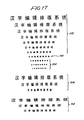
- Figure 17 illustrates how characters can be scaled from a basic character size shown as the line 100.
- This line shows 8 characters in boldface type, and the portion marked 102 shows various stages of increased size. Characters which can be formed from the line 100 by equal enlargement in the X and Y directions whilst the portion marked 104 shows various stages of decreased size characters which can be formed from the line 100 by equal reductions in the X and Y directions.
- font variants are shown which can be formed again from the basic size characters in the line 100 by greater change in the Y and X directions relative the X and Y directions, respectively.
- a complex page layout for a laser typesetter with which output is made by a raster pattern, is generated from the dot matrix prepared.
- the arrangement used to prepare the dot matrix can be connected to a drum type laser typesetter with four laser beams in parallel.
- the main mechanical parts of the laser typesetter move continuously and any pause of the raster output is not allowed during the output of a whole page. Therefore, the generation of complex page layout for a laser typesetter is much more difficult than the case of a CRT where page layout can be generated on the screen character by character and the generation can pause at any point. It would be time-consuming and unacceptable to buffer the dots of an entire page layout (about 10 8 bits) onto disc store before output of that page.
- the generation of the dot matrix by the arrangement described above must always be faster than the raster output of the laser typesetter in any circumstances. Any delay in supplying data would result in error on the output film.
- the dot matrix producing device is connected to a general purpose computer, which is shared by a lot of terminal users and supports a dedicated time sharing operating system and a composition language compiler. Users may define the required page layouts by using various composition commands contained in the language, which are intermixed with the text to be composed and are interpreted by the compiler to produce the necessary page layout description information.
- a page is divided into rows and each row contains a variable number (e.g. up to 64) of sections with each section consisting of a predefined fixed number (e.g. 8, 16 or 32) of scan lines.
- a predefined fixed number e.g. 8, 16 or 32
- RAM random access memory
- the dot matrices of a series of characters in a row are generated and buffered not character by character but rather section by section.
- buffer A and buffer B if there are M characters in a row, then the order of generation and buffering of dot matrices for the row is as follows:
- the device When the first section of all M characters has been generated and buffered into buffer A, the device begins to generate the second section of these M characters and put into buffer B while buffer A is being fetched by the laser typesetter for raster output. The above operation is continued until all the sections of the current row are generated, buffered and output.
- the division of a page into rows and the division of each row into sections is made by software of the general purpose computer connected to the present device. Normally the rows correspond to natural lines and in most cases each row contains only a natural line of characters. The sole difference is that the number of scan lines contained in each row must be the multiple of the predefined fixed number of scan lines in a section. If, for example, the predefined fixed number is 8, then a row may contain, for example, 120, or 128 or 136 scan lines but 129 scan lines are not allowed. Such a division of page layout is especially beneficial to the simplification of the dot matrix producing device, which allows the use of only two small alternative output buffers to generate any complex page layout at high speed for raster output. If a scan line of the largest page on the film to be exposed by the laser consists of 8192 dots, then the capacity of the output buffer should be 8x8192 bits (here 8 is the predefined fixed number of scan lines in each section).
- the information for precise description of page layout is produced by and can be fetched row by row from a general purpose computer and is specially designed to cater for the need of generating and buffering characters section by section.
- the description information for a row is temporarily stored in a local memory during generation of dot matrices and is arranged in the order of rows and can be composed of five types of 16-bit indicators which will be described in detail later. Some brief explanation is given here.
- the description information for each row begins with a 16-bit "beginning of row” indicator which marks the beginning of a row and indicates the number of sections it contains.
- a scan line counter is used to record how many sections have been processed. If the contents of this counter reach the value designated in the "beginning of row” indicator, it means that all the sections in the current row have been processed.
- Each character in the row must be accompanied by a "X position” indicator which defines its absolute X position on the page.
- Y position of the characters is defined by a "Y position” indicator, which can be shared by a series of characters.
- the relative Y position of the character (or characters) in the current row designates the relative Y position of the character (or characters) in the current row, that is, the difference in Y direction between the first line of the character and the first line of the current row. It should be noted that this value may be negative as well as positive. A negative value means that the character crosses two rows, that is, the upper part of the character lies in the above row, and the lower part is in the current row. This situation might occur in some complex page layout and cannot be avoided by careful division of the page because vertical arrangement of newspaper headlines is allowed and complex mathematical formula cannot be explicitly divided into separate rows without character crossing.
- the distinctive feature of "Y position" indicator makes it easier to generate and buffer characters section by section.
- Y position indicator combined with the scan line counter is used to determine which section of the character is to be generated during each transformation.
- the scan line counter is cleared when a new row is encountered and is incremented by N when a section of all characters in the row has been processed (here N is the predefined fixed number of scan lines contained in a section).
- N is the predefined fixed number of scan lines contained in a section.
- the beginning Y position of the current section to be generated is equal to the difference between the contents of the scan line counter and the relative Y position defined by the "Y position" indicator.
- the scan line counter becomes 8 and section [-5, 2] of the character should be generated, which means that the first three lines (0, 1, 2) of the character are to be generated, that is, any vector of the character lying (or partly lying) in the first three lines should be transformed into dot matrix (here only vectors AB, CA).
- section [3, 10] of the character should be generated, and so on.
- a yet further feature of the invention relates to the technique of generating characters section by section at high speed.
- Transformation into a dot matrix is performed only for those vectors which lie (or partly lie) in the current section.
- Steps b and c described above fortransforming of the compressed representation into a dot matrix are time-consuming because a large number of dots has to be dealt with, but steps a and b can be performed in parallel with step c by using two alternative buffers to store a section of marked dot matrix for each of two separate characters.
- Step c is performed only for a section of dot matrix; and step b is performed only for those vectors which lie (or partly lie) in the current section.
- Step a must be performed for all the vectors of a character if the character is not entirely above (or below) the current section. But most vectors would be outside the current section and can be skipped.
- multiple 2-bit depth counters can be used to facilitate the buffering of parallel dots generated from multiple lines of a marked dot matrix into the same location of the output buffer, as required by a laser typesetter with multiple outputs in parallel.
- main typeface in each book, that is the typeface for most part of the text.
- the number of main typeface Chinese characters occurring in a book is usually much larger than that of other typefaces of Chinese characters.
- Song typeface is used as the main typeface.
- imitation Song typeface or regular script typeface is also used as the main typeface.
- a user can denote the main typeface by a composition command.
- the most frequently used Chinese characters e.g. 3,000, in the main typeface with the internal code numbers from 0 to 2999 may be always transmitted to the local memory from the disc store of the general purpose computer without any selection so as to reduce the amount of processing required by the statistics and selection. It should be noted that these 3,000 characters would account for over 80% of the characters occurring in a book and thus the processing time required by the statistics and selection for other characters is negligible as compared with the time of raster output.
- Figure 22 shows a block diagram of a preferred embodiment of the present invention.
Landscapes
- Engineering & Computer Science (AREA)
- Physics & Mathematics (AREA)
- General Physics & Mathematics (AREA)
- Theoretical Computer Science (AREA)
- Computer Hardware Design (AREA)
- General Engineering & Computer Science (AREA)
- Controls And Circuits For Display Device (AREA)
- Image Processing (AREA)
- Editing Of Facsimile Originals (AREA)
Claims (19)

Priority Applications (3)
| Application Number | Priority Date | Filing Date | Title |
|---|---|---|---|
| EP82302816A EP0095536B1 (fr) | 1982-06-01 | 1982-06-01 | Représentation d'images de caractères sous forme condensée pour mémorisation en calculateur |
| AT82302816T ATE26034T1 (de) | 1982-06-01 | 1982-06-01 | Darstellung von zeichenbildern in kompakter form fuer rechnerspeicherung. |
| DE8282302816T DE3275777D1 (en) | 1982-06-01 | 1982-06-01 | The representation of character images in a compact form for computer storage |
Applications Claiming Priority (1)
| Application Number | Priority Date | Filing Date | Title |
|---|---|---|---|
| EP82302816A EP0095536B1 (fr) | 1982-06-01 | 1982-06-01 | Représentation d'images de caractères sous forme condensée pour mémorisation en calculateur |
Publications (2)
| Publication Number | Publication Date |
|---|---|
| EP0095536A1 EP0095536A1 (fr) | 1983-12-07 |
| EP0095536B1 true EP0095536B1 (fr) | 1987-03-18 |
Family
ID=8189688
Family Applications (1)
| Application Number | Title | Priority Date | Filing Date |
|---|---|---|---|
| EP82302816A Expired EP0095536B1 (fr) | 1982-06-01 | 1982-06-01 | Représentation d'images de caractères sous forme condensée pour mémorisation en calculateur |
Country Status (3)
| Country | Link |
|---|---|
| EP (1) | EP0095536B1 (fr) |
| AT (1) | ATE26034T1 (fr) |
| DE (1) | DE3275777D1 (fr) |
Cited By (1)
| Publication number | Priority date | Publication date | Assignee | Title |
|---|---|---|---|---|
| CN106774973A (zh) * | 2016-11-17 | 2017-05-31 | 浙江传媒学院 | 一种基于汉字的结构和风格的字形生成方法 |
Families Citing this family (11)
| Publication number | Priority date | Publication date | Assignee | Title |
|---|---|---|---|---|
| US4573199A (en) * | 1984-05-09 | 1986-02-25 | International Business Machines Corp. | Kanji/Chinese font generation by scaling |
| GB2214676A (en) * | 1988-01-19 | 1989-09-06 | Benchmark Technologies | Character generation |
| US5280577A (en) * | 1988-01-19 | 1994-01-18 | E. I. Du Pont De Nemours & Co., Inc. | Character generation using graphical primitives |
| US5018217A (en) * | 1988-09-26 | 1991-05-21 | Brother Kogyo Kabushiki Kaisha | Data converting apparatus having means for changing ornamental stroke end data of character outline |
| US5050103A (en) * | 1989-05-12 | 1991-09-17 | Adobe Systems Incorporated | Method for displaying kanji characters |
| JP2883633B2 (ja) * | 1989-05-29 | 1999-04-19 | ブラザー工業 株式会社 | データ変換装置 |
| JPH0481892A (ja) * | 1990-07-25 | 1992-03-16 | Brother Ind Ltd | アウトラインデータ処理装置 |
| US5959634A (en) * | 1993-12-09 | 1999-09-28 | Canon Kabushiki Kaisha | Character generating system employing thickening or narrowing of characters |
| JP3628523B2 (ja) * | 1998-09-03 | 2005-03-16 | シャープ株式会社 | 情報処理装置およびパターン生成プログラムを記録した記録媒体 |
| US10719430B2 (en) * | 2017-06-26 | 2020-07-21 | Nanjing University | Sketch-guided GUI test generation for mobile applications |
| CN109740140B (zh) * | 2018-12-28 | 2023-07-11 | 北京百度网讯科技有限公司 | 页面排版方法、装置和计算机设备 |
Family Cites Families (2)
| Publication number | Priority date | Publication date | Assignee | Title |
|---|---|---|---|---|
| US4251871A (en) * | 1978-09-29 | 1981-02-17 | International Business Machines Corporation | Method and apparatus for storing and reconstructing Chinese-like characters |
| EP0009662B1 (fr) * | 1978-09-29 | 1983-11-16 | International Business Machines Corporation | Méthode et dispositif pour mémoriser et reproduire des caractères du genre chinois |
-
1982
- 1982-06-01 DE DE8282302816T patent/DE3275777D1/de not_active Expired
- 1982-06-01 EP EP82302816A patent/EP0095536B1/fr not_active Expired
- 1982-06-01 AT AT82302816T patent/ATE26034T1/de not_active IP Right Cessation
Cited By (1)
| Publication number | Priority date | Publication date | Assignee | Title |
|---|---|---|---|---|
| CN106774973A (zh) * | 2016-11-17 | 2017-05-31 | 浙江传媒学院 | 一种基于汉字的结构和风格的字形生成方法 |
Also Published As
| Publication number | Publication date |
|---|---|
| EP0095536A1 (fr) | 1983-12-07 |
| DE3275777D1 (en) | 1987-04-23 |
| ATE26034T1 (de) | 1987-04-15 |
Similar Documents
| Publication | Publication Date | Title |
|---|---|---|
| US4331955A (en) | Method and apparatus for smoothing outlines | |
| CA1311311C (fr) | Reduction des donnees dans les affichages d'images graphiques pleine page | |
| US4298945A (en) | Character generating method and apparatus | |
| US4199815A (en) | Typesetter character generating apparatus | |
| US4555802A (en) | Compaction and decompaction of non-coded information bearing signals | |
| CA1140679A (fr) | Generateur de caracteres complexes | |
| US4345245A (en) | Method and apparatus for arranging segmented character groups in a digital typesetter | |
| US4338673A (en) | Phototypesetting system and method | |
| EP0095536A1 (fr) | Représentation d'images de caractères sous forme condensée pour mémorisation en calculateur | |
| GB2033307A (en) | Digital typesetter | |
| CN1014835B (zh) | 产生字形的方法及其系统 | |
| GB1558458A (en) | Raster printing system | |
| JPH05204363A (ja) | ドットマトリクス装置における輪郭字体文字生成のための高速垂直走査−変換・充填方法及びその装置 | |
| JP2761890B2 (ja) | 線発生装置及びディスプレイ装置 | |
| GB2115657A (en) | Method of storing characters and photo-typsetting apparatus | |
| JP3009525B2 (ja) | ベクトル画像描画装置 | |
| JPH0562348B2 (fr) | ||
| JP3034140B2 (ja) | 文字生成方法及びその装置 | |
| KR900016908A (ko) | 고품질 패턴 발생장치 및 방법 | |
| Mergler et al. | One approach to computer assisted letter design | |
| Wang et al. | A high resolution Chinese character generator | |
| JP2630843B2 (ja) | 直線描画方法及び装置 | |
| JPS6133231B2 (fr) | ||
| JP2907826B2 (ja) | 文字フォント管理装置 | |
| JPH06102852A (ja) | フォントデータ作成展開方式 |
Legal Events
| Date | Code | Title | Description |
|---|---|---|---|
| PUAI | Public reference made under article 153(3) epc to a published international application that has entered the european phase |
Free format text: ORIGINAL CODE: 0009012 |
|
| AK | Designated contracting states |
Designated state(s): AT BE CH DE FR GB IT LI LU NL SE |
|
| 17P | Request for examination filed |
Effective date: 19840605 |
|
| GRAA | (expected) grant |
Free format text: ORIGINAL CODE: 0009210 |
|
| AK | Designated contracting states |
Kind code of ref document: B1 Designated state(s): AT BE CH DE FR GB IT LI LU NL SE |
|
| PG25 | Lapsed in a contracting state [announced via postgrant information from national office to epo] |
Ref country code: SE Effective date: 19870318 Ref country code: NL Effective date: 19870318 Ref country code: LI Effective date: 19870318 Ref country code: IT Free format text: LAPSE BECAUSE OF FAILURE TO SUBMIT A TRANSLATION OF THE DESCRIPTION OR TO PAY THE FEE WITHIN THE PRESCRIBED TIME-LIMIT;WARNING: LAPSES OF ITALIAN PATENTS WITH EFFECTIVE DATE BEFORE 2007 MAY HAVE OCCURRED AT ANY TIME BEFORE 2007. THE CORRECT EFFECTIVE DATE MAY BE DIFFERENT FROM THE ONE RECORDED. Effective date: 19870318 Ref country code: FR Free format text: THE PATENT HAS BEEN ANNULLED BY A DECISION OF A NATIONAL AUTHORITY Effective date: 19870318 Ref country code: CH Effective date: 19870318 Ref country code: BE Effective date: 19870318 Ref country code: AT Effective date: 19870318 |
|
| REF | Corresponds to: |
Ref document number: 26034 Country of ref document: AT Date of ref document: 19870415 Kind code of ref document: T |
|
| REF | Corresponds to: |
Ref document number: 3275777 Country of ref document: DE Date of ref document: 19870423 |
|
| PG25 | Lapsed in a contracting state [announced via postgrant information from national office to epo] |
Ref country code: LU Free format text: LAPSE BECAUSE OF NON-PAYMENT OF DUE FEES Effective date: 19870630 |
|
| REG | Reference to a national code |
Ref country code: CH Ref legal event code: PL |
|
| EN | Fr: translation not filed | ||
| NLV1 | Nl: lapsed or annulled due to failure to fulfill the requirements of art. 29p and 29m of the patents act | ||
| PLBE | No opposition filed within time limit |
Free format text: ORIGINAL CODE: 0009261 |
|
| STAA | Information on the status of an ep patent application or granted ep patent |
Free format text: STATUS: NO OPPOSITION FILED WITHIN TIME LIMIT |
|
| 26N | No opposition filed | ||
| PGFP | Annual fee paid to national office [announced via postgrant information from national office to epo] |
Ref country code: GB Payment date: 19940524 Year of fee payment: 13 |
|
| PGFP | Annual fee paid to national office [announced via postgrant information from national office to epo] |
Ref country code: DE Payment date: 19940608 Year of fee payment: 13 |
|
| PG25 | Lapsed in a contracting state [announced via postgrant information from national office to epo] |
Ref country code: GB Effective date: 19950601 |
|
| GBPC | Gb: european patent ceased through non-payment of renewal fee |
Effective date: 19950601 |
|
| PG25 | Lapsed in a contracting state [announced via postgrant information from national office to epo] |
Ref country code: DE Effective date: 19960301 |