EP0095557A1 - Polypeptide mit antagonistischen Eigenschaften gegenüber der Substanz P, Verfahren zu ihrer Herstellung, deren Verwendung und Verfahren zum Reinigen von Polypeptiden - Google Patents
Polypeptide mit antagonistischen Eigenschaften gegenüber der Substanz P, Verfahren zu ihrer Herstellung, deren Verwendung und Verfahren zum Reinigen von Polypeptiden Download PDFInfo
- Publication number
- EP0095557A1 EP0095557A1 EP83101523A EP83101523A EP0095557A1 EP 0095557 A1 EP0095557 A1 EP 0095557A1 EP 83101523 A EP83101523 A EP 83101523A EP 83101523 A EP83101523 A EP 83101523A EP 0095557 A1 EP0095557 A1 EP 0095557A1
- Authority
- EP
- European Patent Office
- Prior art keywords
- polypeptides
- amino acids
- phe
- amino acid
- resin
- Prior art date
- Legal status (The legal status is an assumption and is not a legal conclusion. Google has not performed a legal analysis and makes no representation as to the accuracy of the status listed.)
- Granted
Links
- 108090000765 processed proteins & peptides Proteins 0.000 title claims abstract description 47
- 102000004196 processed proteins & peptides Human genes 0.000 title claims abstract description 33
- 229920001184 polypeptide Polymers 0.000 title claims abstract description 27
- 238000000034 method Methods 0.000 title claims abstract description 13
- 230000008569 process Effects 0.000 title claims abstract description 9
- 238000002360 preparation method Methods 0.000 title claims abstract description 8
- 238000000746 purification Methods 0.000 title claims abstract description 5
- 230000003042 antagnostic effect Effects 0.000 title description 6
- CWWARWOPSKGELM-SARDKLJWSA-N methyl (2s)-2-[[(2s)-2-[[2-[[(2s)-2-[[(2s)-2-[[(2s)-5-amino-2-[[(2s)-5-amino-2-[[(2s)-1-[(2s)-6-amino-2-[[(2s)-1-[(2s)-2-amino-5-(diaminomethylideneamino)pentanoyl]pyrrolidine-2-carbonyl]amino]hexanoyl]pyrrolidine-2-carbonyl]amino]-5-oxopentanoyl]amino]-5 Chemical compound C([C@@H](C(=O)NCC(=O)N[C@@H](CC(C)C)C(=O)N[C@@H](CCSC)C(=O)OC)NC(=O)[C@H](CC=1C=CC=CC=1)NC(=O)[C@H](CCC(N)=O)NC(=O)[C@H](CCC(N)=O)NC(=O)[C@H]1N(CCC1)C(=O)[C@H](CCCCN)NC(=O)[C@H]1N(CCC1)C(=O)[C@@H](N)CCCN=C(N)N)C1=CC=CC=C1 CWWARWOPSKGELM-SARDKLJWSA-N 0.000 title description 2
- 150000001413 amino acids Chemical class 0.000 claims abstract description 47
- 150000003839 salts Chemical class 0.000 claims abstract description 11
- 239000002253 acid Substances 0.000 claims abstract description 8
- 238000004440 column chromatography Methods 0.000 claims abstract description 5
- 239000000825 pharmaceutical preparation Substances 0.000 claims abstract description 4
- 239000011347 resin Substances 0.000 claims description 36
- 229920005989 resin Polymers 0.000 claims description 36
- WEVYAHXRMPXWCK-UHFFFAOYSA-N Acetonitrile Chemical compound CC#N WEVYAHXRMPXWCK-UHFFFAOYSA-N 0.000 claims description 22
- 239000000203 mixture Substances 0.000 claims description 11
- 125000001433 C-terminal amino-acid group Chemical group 0.000 claims description 4
- 208000037265 diseases, disorders, signs and symptoms Diseases 0.000 claims description 4
- 238000010532 solid phase synthesis reaction Methods 0.000 claims description 3
- 206010020772 Hypertension Diseases 0.000 claims description 2
- 230000001684 chronic effect Effects 0.000 claims description 2
- 208000035475 disorder Diseases 0.000 claims description 2
- 229920005990 polystyrene resin Polymers 0.000 claims description 2
- 206010061218 Inflammation Diseases 0.000 claims 1
- 239000012059 conventional drug carrier Substances 0.000 claims 1
- 230000004054 inflammatory process Effects 0.000 claims 1
- 239000000546 pharmaceutical excipient Substances 0.000 claims 1
- -1 Val Chemical class 0.000 abstract description 11
- 150000001875 compounds Chemical class 0.000 abstract description 7
- 235000001014 amino acid Nutrition 0.000 abstract 4
- 229940127557 pharmaceutical product Drugs 0.000 abstract 1
- QTBSBXVTEAMEQO-UHFFFAOYSA-N Acetic acid Chemical compound CC(O)=O QTBSBXVTEAMEQO-UHFFFAOYSA-N 0.000 description 49
- 229940024606 amino acid Drugs 0.000 description 37
- OKKJLVBELUTLKV-UHFFFAOYSA-N Methanol Chemical compound OC OKKJLVBELUTLKV-UHFFFAOYSA-N 0.000 description 24
- ZMXDDKWLCZADIW-UHFFFAOYSA-N N,N-Dimethylformamide Chemical compound CN(C)C=O ZMXDDKWLCZADIW-UHFFFAOYSA-N 0.000 description 14
- 239000000243 solution Substances 0.000 description 14
- 239000000126 substance Substances 0.000 description 13
- QDZOEBFLNHCSSF-PFFBOGFISA-N (2S)-2-[[(2R)-2-[[(2S)-1-[(2S)-6-amino-2-[[(2S)-1-[(2R)-2-amino-5-carbamimidamidopentanoyl]pyrrolidine-2-carbonyl]amino]hexanoyl]pyrrolidine-2-carbonyl]amino]-3-(1H-indol-3-yl)propanoyl]amino]-N-[(2R)-1-[[(2S)-1-[[(2R)-1-[[(2S)-1-[[(2S)-1-amino-4-methyl-1-oxopentan-2-yl]amino]-4-methyl-1-oxopentan-2-yl]amino]-3-(1H-indol-3-yl)-1-oxopropan-2-yl]amino]-1-oxo-3-phenylpropan-2-yl]amino]-3-(1H-indol-3-yl)-1-oxopropan-2-yl]pentanediamide Chemical compound C([C@@H](C(=O)N[C@H](CC=1C2=CC=CC=C2NC=1)C(=O)N[C@@H](CC(C)C)C(=O)N[C@@H](CC(C)C)C(N)=O)NC(=O)[C@@H](CC=1C2=CC=CC=C2NC=1)NC(=O)[C@H](CCC(N)=O)NC(=O)[C@@H](CC=1C2=CC=CC=C2NC=1)NC(=O)[C@H]1N(CCC1)C(=O)[C@H](CCCCN)NC(=O)[C@H]1N(CCC1)C(=O)[C@H](N)CCCNC(N)=N)C1=CC=CC=C1 QDZOEBFLNHCSSF-PFFBOGFISA-N 0.000 description 11
- 102400000096 Substance P Human genes 0.000 description 10
- 101800003906 Substance P Proteins 0.000 description 10
- COLNVLDHVKWLRT-QMMMGPOBSA-N L-phenylalanine Chemical compound OC(=O)[C@@H](N)CC1=CC=CC=C1 COLNVLDHVKWLRT-QMMMGPOBSA-N 0.000 description 8
- 230000008878 coupling Effects 0.000 description 8
- 238000010168 coupling process Methods 0.000 description 8
- 238000005859 coupling reaction Methods 0.000 description 8
- 239000000047 product Substances 0.000 description 8
- 238000003786 synthesis reaction Methods 0.000 description 8
- QGZKDVFQNNGYKY-UHFFFAOYSA-N Ammonia Chemical compound N QGZKDVFQNNGYKY-UHFFFAOYSA-N 0.000 description 7
- 230000015572 biosynthetic process Effects 0.000 description 7
- ROHFNLRQFUQHCH-YFKPBYRVSA-N L-leucine Chemical compound CC(C)C[C@H](N)C(O)=O ROHFNLRQFUQHCH-YFKPBYRVSA-N 0.000 description 6
- LRQKBLKVPFOOQJ-YFKPBYRVSA-N L-norleucine Chemical compound CCCC[C@H]([NH3+])C([O-])=O LRQKBLKVPFOOQJ-YFKPBYRVSA-N 0.000 description 6
- 239000005557 antagonist Substances 0.000 description 6
- 238000006243 chemical reaction Methods 0.000 description 6
- 229910001868 water Inorganic materials 0.000 description 6
- KDXKERNSBIXSRK-YFKPBYRVSA-N L-lysine Chemical compound NCCCC[C@H](N)C(O)=O KDXKERNSBIXSRK-YFKPBYRVSA-N 0.000 description 5
- OUYCCCASQSFEME-QMMMGPOBSA-N L-tyrosine Chemical compound OC(=O)[C@@H](N)CC1=CC=C(O)C=C1 OUYCCCASQSFEME-QMMMGPOBSA-N 0.000 description 5
- KDXKERNSBIXSRK-UHFFFAOYSA-N Lysine Natural products NCCCCC(N)C(O)=O KDXKERNSBIXSRK-UHFFFAOYSA-N 0.000 description 5
- ZMANZCXQSJIPKH-UHFFFAOYSA-N Triethylamine Chemical compound CCN(CC)CC ZMANZCXQSJIPKH-UHFFFAOYSA-N 0.000 description 5
- 210000000056 organ Anatomy 0.000 description 5
- 125000006239 protecting group Chemical group 0.000 description 5
- 238000012360 testing method Methods 0.000 description 5
- AGPKZVBTJJNPAG-WHFBIAKZSA-N L-isoleucine Chemical compound CC[C@H](C)[C@H](N)C(O)=O AGPKZVBTJJNPAG-WHFBIAKZSA-N 0.000 description 4
- FAPWRFPIFSIZLT-UHFFFAOYSA-M Sodium chloride Chemical compound [Na+].[Cl-] FAPWRFPIFSIZLT-UHFFFAOYSA-M 0.000 description 4
- 125000003277 amino group Chemical group 0.000 description 4
- 238000004458 analytical method Methods 0.000 description 4
- 230000008602 contraction Effects 0.000 description 4
- 230000000694 effects Effects 0.000 description 4
- 238000004128 high performance liquid chromatography Methods 0.000 description 4
- XLYOFNOQVPJJNP-UHFFFAOYSA-N water Substances O XLYOFNOQVPJJNP-UHFFFAOYSA-N 0.000 description 4
- 241000700199 Cavia porcellus Species 0.000 description 3
- QIVBCDIJIAJPQS-SECBINFHSA-N D-tryptophane Chemical compound C1=CC=C2C(C[C@@H](N)C(O)=O)=CNC2=C1 QIVBCDIJIAJPQS-SECBINFHSA-N 0.000 description 3
- RTZKZFJDLAIYFH-UHFFFAOYSA-N Diethyl ether Chemical compound CCOCC RTZKZFJDLAIYFH-UHFFFAOYSA-N 0.000 description 3
- XEKOWRVHYACXOJ-UHFFFAOYSA-N Ethyl acetate Chemical compound CCOC(C)=O XEKOWRVHYACXOJ-UHFFFAOYSA-N 0.000 description 3
- ZDXPYRJPNDTMRX-UHFFFAOYSA-N Glutamine Chemical compound OC(=O)C(N)CCC(N)=O ZDXPYRJPNDTMRX-UHFFFAOYSA-N 0.000 description 3
- 239000004793 Polystyrene Substances 0.000 description 3
- ONIBWKKTOPOVIA-UHFFFAOYSA-N Proline Chemical compound OC(=O)C1CCCN1 ONIBWKKTOPOVIA-UHFFFAOYSA-N 0.000 description 3
- DTQVDTLACAAQTR-UHFFFAOYSA-N Trifluoroacetic acid Chemical compound OC(=O)C(F)(F)F DTQVDTLACAAQTR-UHFFFAOYSA-N 0.000 description 3
- 239000000556 agonist Substances 0.000 description 3
- 229910021529 ammonia Inorganic materials 0.000 description 3
- 238000005915 ammonolysis reaction Methods 0.000 description 3
- 238000004587 chromatography analysis Methods 0.000 description 3
- 239000003480 eluent Substances 0.000 description 3
- 238000010828 elution Methods 0.000 description 3
- 239000000706 filtrate Substances 0.000 description 3
- 210000003405 ileum Anatomy 0.000 description 3
- 230000014759 maintenance of location Effects 0.000 description 3
- 239000000463 material Substances 0.000 description 3
- COLNVLDHVKWLRT-UHFFFAOYSA-N phenylalanine Chemical compound OC(=O)C(N)CC1=CC=CC=C1 COLNVLDHVKWLRT-UHFFFAOYSA-N 0.000 description 3
- 229920002223 polystyrene Polymers 0.000 description 3
- 229920006395 saturated elastomer Polymers 0.000 description 3
- 239000008030 superplasticizer Substances 0.000 description 3
- 238000004809 thin layer chromatography Methods 0.000 description 3
- 210000001519 tissue Anatomy 0.000 description 3
- OUYCCCASQSFEME-UHFFFAOYSA-N tyrosine Chemical compound OC(=O)C(N)CC1=CC=C(O)C=C1 OUYCCCASQSFEME-UHFFFAOYSA-N 0.000 description 3
- BDNKZNFMNDZQMI-UHFFFAOYSA-N 1,3-diisopropylcarbodiimide Chemical compound CC(C)N=C=NC(C)C BDNKZNFMNDZQMI-UHFFFAOYSA-N 0.000 description 2
- ASOKPJOREAFHNY-UHFFFAOYSA-N 1-Hydroxybenzotriazole Chemical compound C1=CC=C2N(O)N=NC2=C1 ASOKPJOREAFHNY-UHFFFAOYSA-N 0.000 description 2
- QIVBCDIJIAJPQS-VIFPVBQESA-N L-tryptophane Chemical compound C1=CC=C2C(C[C@H](N)C(O)=O)=CNC2=C1 QIVBCDIJIAJPQS-VIFPVBQESA-N 0.000 description 2
- ROHFNLRQFUQHCH-UHFFFAOYSA-N Leucine Natural products CC(C)CC(N)C(O)=O ROHFNLRQFUQHCH-UHFFFAOYSA-N 0.000 description 2
- TWRXJAOTZQYOKJ-UHFFFAOYSA-L Magnesium chloride Chemical compound [Mg+2].[Cl-].[Cl-] TWRXJAOTZQYOKJ-UHFFFAOYSA-L 0.000 description 2
- 241001465754 Metazoa Species 0.000 description 2
- AFVFQIVMOAPDHO-UHFFFAOYSA-N Methanesulfonic acid Chemical compound CS(O)(=O)=O AFVFQIVMOAPDHO-UHFFFAOYSA-N 0.000 description 2
- QIVBCDIJIAJPQS-UHFFFAOYSA-N Tryptophan Natural products C1=CC=C2C(CC(N)C(O)=O)=CNC2=C1 QIVBCDIJIAJPQS-UHFFFAOYSA-N 0.000 description 2
- KZSNJWFQEVHDMF-UHFFFAOYSA-N Valine Chemical compound CC(C)C(N)C(O)=O KZSNJWFQEVHDMF-UHFFFAOYSA-N 0.000 description 2
- 230000009471 action Effects 0.000 description 2
- GZCGUPFRVQAUEE-SLPGGIOYSA-N aldehydo-D-glucose Chemical compound OC[C@@H](O)[C@@H](O)[C@H](O)[C@@H](O)C=O GZCGUPFRVQAUEE-SLPGGIOYSA-N 0.000 description 2
- QGZKDVFQNNGYKY-UHFFFAOYSA-O ammonium group Chemical group [NH4+] QGZKDVFQNNGYKY-UHFFFAOYSA-O 0.000 description 2
- RDOXTESZEPMUJZ-UHFFFAOYSA-N anisole Chemical compound COC1=CC=CC=C1 RDOXTESZEPMUJZ-UHFFFAOYSA-N 0.000 description 2
- AIYUHDOJVYHVIT-UHFFFAOYSA-M caesium chloride Chemical compound [Cl-].[Cs+] AIYUHDOJVYHVIT-UHFFFAOYSA-M 0.000 description 2
- 238000003776 cleavage reaction Methods 0.000 description 2
- IJKVHSBPTUYDLN-UHFFFAOYSA-N dihydroxy(oxo)silane Chemical compound O[Si](O)=O IJKVHSBPTUYDLN-UHFFFAOYSA-N 0.000 description 2
- XBDQKXXYIPTUBI-UHFFFAOYSA-N dimethylselenoniopropionate Natural products CCC(O)=O XBDQKXXYIPTUBI-UHFFFAOYSA-N 0.000 description 2
- 201000010099 disease Diseases 0.000 description 2
- 125000002485 formyl group Chemical group [H]C(*)=O 0.000 description 2
- 239000003112 inhibitor Substances 0.000 description 2
- 230000002401 inhibitory effect Effects 0.000 description 2
- 210000000936 intestine Anatomy 0.000 description 2
- 239000003456 ion exchange resin Substances 0.000 description 2
- 229920003303 ion-exchange polymer Polymers 0.000 description 2
- COTNUBDHGSIOTA-UHFFFAOYSA-N meoh methanol Chemical compound OC.OC COTNUBDHGSIOTA-UHFFFAOYSA-N 0.000 description 2
- 229930182817 methionine Natural products 0.000 description 2
- 210000003249 myenteric plexus Anatomy 0.000 description 2
- 210000005036 nerve Anatomy 0.000 description 2
- 210000004126 nerve fiber Anatomy 0.000 description 2
- 230000000144 pharmacologic effect Effects 0.000 description 2
- 239000008363 phosphate buffer Substances 0.000 description 2
- 230000007017 scission Effects 0.000 description 2
- 239000011780 sodium chloride Substances 0.000 description 2
- 239000007790 solid phase Substances 0.000 description 2
- 238000001179 sorption measurement Methods 0.000 description 2
- 239000000725 suspension Substances 0.000 description 2
- IMUSLIHRIYOHEV-ZETCQYMHSA-N (2s)-2-[(2-methylpropan-2-yl)oxycarbonylamino]-4-methylsulfanylbutanoic acid Chemical compound CSCC[C@@H](C(O)=O)NC(=O)OC(C)(C)C IMUSLIHRIYOHEV-ZETCQYMHSA-N 0.000 description 1
- ZIOCIQJXEKFHJO-QMMMGPOBSA-N (2s)-2-[(2-methylpropan-2-yl)oxycarbonylamino]hexanoic acid Chemical compound CCCC[C@@H](C(O)=O)NC(=O)OC(C)(C)C ZIOCIQJXEKFHJO-QMMMGPOBSA-N 0.000 description 1
- OIXLLKLZKCBCPS-RZVRUWJTSA-N (2s)-2-azanyl-5-[bis(azanyl)methylideneamino]pentanoic acid Chemical compound OC(=O)[C@@H](N)CCCNC(N)=N.OC(=O)[C@@H](N)CCCNC(N)=N OIXLLKLZKCBCPS-RZVRUWJTSA-N 0.000 description 1
- NWUYHJFMYQTDRP-UHFFFAOYSA-N 1,2-bis(ethenyl)benzene;1-ethenyl-2-ethylbenzene;styrene Chemical compound C=CC1=CC=CC=C1.CCC1=CC=CC=C1C=C.C=CC1=CC=CC=C1C=C NWUYHJFMYQTDRP-UHFFFAOYSA-N 0.000 description 1
- NIGWMJHCCYYCSF-QMMMGPOBSA-N 4-chloro-L-phenylalanine Chemical compound OC(=O)[C@@H](N)CC1=CC=C(Cl)C=C1 NIGWMJHCCYYCSF-QMMMGPOBSA-N 0.000 description 1
- ODKSFYDXXFIFQN-UHFFFAOYSA-N Arginine Chemical compound OC(=O)C(N)CCCNC(N)=N ODKSFYDXXFIFQN-UHFFFAOYSA-N 0.000 description 1
- UXVMQQNJUSDDNG-UHFFFAOYSA-L Calcium chloride Chemical compound [Cl-].[Cl-].[Ca+2] UXVMQQNJUSDDNG-UHFFFAOYSA-L 0.000 description 1
- ONIBWKKTOPOVIA-SCSAIBSYSA-N D-Proline Chemical compound OC(=O)[C@H]1CCCN1 ONIBWKKTOPOVIA-SCSAIBSYSA-N 0.000 description 1
- COLNVLDHVKWLRT-MRVPVSSYSA-N D-phenylalanine Chemical compound OC(=O)[C@H](N)CC1=CC=CC=C1 COLNVLDHVKWLRT-MRVPVSSYSA-N 0.000 description 1
- NIGWMJHCCYYCSF-UHFFFAOYSA-N Fenclonine Chemical compound OC(=O)C(N)CC1=CC=C(Cl)C=C1 NIGWMJHCCYYCSF-UHFFFAOYSA-N 0.000 description 1
- DHMQDGOQFOQNFH-UHFFFAOYSA-N Glycine Chemical compound NCC(O)=O DHMQDGOQFOQNFH-UHFFFAOYSA-N 0.000 description 1
- FFEARJCKVFRZRR-BYPYZUCNSA-N L-methionine Chemical compound CSCC[C@H](N)C(O)=O FFEARJCKVFRZRR-BYPYZUCNSA-N 0.000 description 1
- 125000000174 L-prolyl group Chemical group [H]N1C([H])([H])C([H])([H])C([H])([H])[C@@]1([H])C(*)=O 0.000 description 1
- KZSNJWFQEVHDMF-BYPYZUCNSA-N L-valine Chemical compound CC(C)[C@H](N)C(O)=O KZSNJWFQEVHDMF-BYPYZUCNSA-N 0.000 description 1
- 239000004472 Lysine Substances 0.000 description 1
- LRHPLDYGYMQRHN-UHFFFAOYSA-N N-Butanol Chemical compound CCCCO LRHPLDYGYMQRHN-UHFFFAOYSA-N 0.000 description 1
- XUYPXLNMDZIRQH-LURJTMIESA-N N-acetyl-L-methionine Chemical compound CSCC[C@@H](C(O)=O)NC(C)=O XUYPXLNMDZIRQH-LURJTMIESA-N 0.000 description 1
- 241000283973 Oryctolagus cuniculus Species 0.000 description 1
- PQLVXDKIJBQVDF-UHFFFAOYSA-N acetic acid;hydrate Chemical compound O.CC(O)=O PQLVXDKIJBQVDF-UHFFFAOYSA-N 0.000 description 1
- PBCJIPOGFJYBJE-UHFFFAOYSA-N acetonitrile;hydrate Chemical compound O.CC#N PBCJIPOGFJYBJE-UHFFFAOYSA-N 0.000 description 1
- 230000021736 acetylation Effects 0.000 description 1
- 238000006640 acetylation reaction Methods 0.000 description 1
- 230000001270 agonistic effect Effects 0.000 description 1
- 150000007933 aliphatic carboxylic acids Chemical class 0.000 description 1
- 150000001412 amines Chemical class 0.000 description 1
- 230000003459 anti-dromic effect Effects 0.000 description 1
- 210000003403 autonomic nervous system Anatomy 0.000 description 1
- 230000008901 benefit Effects 0.000 description 1
- 230000027455 binding Effects 0.000 description 1
- 238000009739 binding Methods 0.000 description 1
- 230000004071 biological effect Effects 0.000 description 1
- 230000008827 biological function Effects 0.000 description 1
- 230000005540 biological transmission Effects 0.000 description 1
- 239000008280 blood Substances 0.000 description 1
- 210000004369 blood Anatomy 0.000 description 1
- 244000309464 bull Species 0.000 description 1
- 239000001110 calcium chloride Substances 0.000 description 1
- 229910001628 calcium chloride Inorganic materials 0.000 description 1
- 125000004432 carbon atom Chemical group C* 0.000 description 1
- UBAZGMLMVVQSCD-UHFFFAOYSA-N carbon dioxide;molecular oxygen Chemical compound O=O.O=C=O UBAZGMLMVVQSCD-UHFFFAOYSA-N 0.000 description 1
- 125000003178 carboxy group Chemical group [H]OC(*)=O 0.000 description 1
- 210000003850 cellular structure Anatomy 0.000 description 1
- 125000004218 chloromethyl group Chemical group [H]C([H])(Cl)* 0.000 description 1
- 238000011097 chromatography purification Methods 0.000 description 1
- 208000037976 chronic inflammation Diseases 0.000 description 1
- 230000006020 chronic inflammation Effects 0.000 description 1
- 238000004140 cleaning Methods 0.000 description 1
- 230000002860 competitive effect Effects 0.000 description 1
- 210000004087 cornea Anatomy 0.000 description 1
- 238000010511 deprotection reaction Methods 0.000 description 1
- 238000001514 detection method Methods 0.000 description 1
- KJOZJSGOIJQCGA-UHFFFAOYSA-N dichloromethane;2,2,2-trifluoroacetic acid Chemical compound ClCCl.OC(=O)C(F)(F)F KJOZJSGOIJQCGA-UHFFFAOYSA-N 0.000 description 1
- 230000001079 digestive effect Effects 0.000 description 1
- BGRWYRAHAFMIBJ-UHFFFAOYSA-N diisopropylcarbodiimide Natural products CC(C)NC(=O)NC(C)C BGRWYRAHAFMIBJ-UHFFFAOYSA-N 0.000 description 1
- 239000003814 drug Substances 0.000 description 1
- 239000003937 drug carrier Substances 0.000 description 1
- 238000001035 drying Methods 0.000 description 1
- 210000003890 endocrine cell Anatomy 0.000 description 1
- LHWWETDBWVTKJO-UHFFFAOYSA-N et3n triethylamine Chemical compound CCN(CC)CC.CCN(CC)CC LHWWETDBWVTKJO-UHFFFAOYSA-N 0.000 description 1
- 238000002474 experimental method Methods 0.000 description 1
- 239000000284 extract Substances 0.000 description 1
- 239000000835 fiber Substances 0.000 description 1
- XLYOFNOQVPJJNP-ZSJDYOACSA-N heavy water Substances [2H]O[2H] XLYOFNOQVPJJNP-ZSJDYOACSA-N 0.000 description 1
- 230000002267 hypothalamic effect Effects 0.000 description 1
- 210000003016 hypothalamus Anatomy 0.000 description 1
- 230000000968 intestinal effect Effects 0.000 description 1
- 210000004347 intestinal mucosa Anatomy 0.000 description 1
- 230000007794 irritation Effects 0.000 description 1
- AGPKZVBTJJNPAG-UHFFFAOYSA-N isoleucine Natural products CCC(C)C(N)C(O)=O AGPKZVBTJJNPAG-UHFFFAOYSA-N 0.000 description 1
- 229960000310 isoleucine Drugs 0.000 description 1
- 210000001630 jejunum Anatomy 0.000 description 1
- 210000003734 kidney Anatomy 0.000 description 1
- 230000002147 killing effect Effects 0.000 description 1
- 229910001629 magnesium chloride Inorganic materials 0.000 description 1
- 238000005259 measurement Methods 0.000 description 1
- 210000000713 mesentery Anatomy 0.000 description 1
- 229940098779 methanesulfonic acid Drugs 0.000 description 1
- UZKWTJUDCOPSNM-UHFFFAOYSA-N methoxybenzene Substances CCCCOC=C UZKWTJUDCOPSNM-UHFFFAOYSA-N 0.000 description 1
- 238000006386 neutralization reaction Methods 0.000 description 1
- FEMOMIGRRWSMCU-UHFFFAOYSA-N ninhydrin Chemical compound C1=CC=C2C(=O)C(O)(O)C(=O)C2=C1 FEMOMIGRRWSMCU-UHFFFAOYSA-N 0.000 description 1
- 230000000269 nucleophilic effect Effects 0.000 description 1
- 210000000496 pancreas Anatomy 0.000 description 1
- 238000010647 peptide synthesis reaction Methods 0.000 description 1
- 210000004560 pineal gland Anatomy 0.000 description 1
- 230000003389 potentiating effect Effects 0.000 description 1
- 239000002244 precipitate Substances 0.000 description 1
- 230000036316 preload Effects 0.000 description 1
- 235000019260 propionic acid Nutrition 0.000 description 1
- 210000002307 prostate Anatomy 0.000 description 1
- IUVKMZGDUIUOCP-BTNSXGMBSA-N quinbolone Chemical compound O([C@H]1CC[C@H]2[C@H]3[C@@H]([C@]4(C=CC(=O)C=C4CC3)C)CC[C@@]21C)C1=CCCC1 IUVKMZGDUIUOCP-BTNSXGMBSA-N 0.000 description 1
- 230000005855 radiation Effects 0.000 description 1
- 238000003127 radioimmunoassay Methods 0.000 description 1
- 239000011541 reaction mixture Substances 0.000 description 1
- 230000009467 reduction Effects 0.000 description 1
- 238000011160 research Methods 0.000 description 1
- 230000000717 retained effect Effects 0.000 description 1
- 210000003296 saliva Anatomy 0.000 description 1
- 210000003079 salivary gland Anatomy 0.000 description 1
- 230000028327 secretion Effects 0.000 description 1
- 230000001953 sensory effect Effects 0.000 description 1
- 238000007086 side reaction Methods 0.000 description 1
- 210000000813 small intestine Anatomy 0.000 description 1
- 210000000329 smooth muscle myocyte Anatomy 0.000 description 1
- 229910000030 sodium bicarbonate Inorganic materials 0.000 description 1
- AJPJDKMHJJGVTQ-UHFFFAOYSA-M sodium dihydrogen phosphate Chemical compound [Na+].OP(O)([O-])=O AJPJDKMHJJGVTQ-UHFFFAOYSA-M 0.000 description 1
- 229910000162 sodium phosphate Inorganic materials 0.000 description 1
- 239000002904 solvent Substances 0.000 description 1
- 230000004936 stimulating effect Effects 0.000 description 1
- 239000011550 stock solution Substances 0.000 description 1
- 210000003523 substantia nigra Anatomy 0.000 description 1
- 238000006467 substitution reaction Methods 0.000 description 1
- QQWYQAQQADNEIC-RVDMUPIBSA-N tert-butyl [(z)-[cyano(phenyl)methylidene]amino] carbonate Chemical compound CC(C)(C)OC(=O)O\N=C(/C#N)C1=CC=CC=C1 QQWYQAQQADNEIC-RVDMUPIBSA-N 0.000 description 1
- WROMPOXWARCANT-UHFFFAOYSA-N tfa trifluoroacetic acid Chemical compound OC(=O)C(F)(F)F.OC(=O)C(F)(F)F WROMPOXWARCANT-UHFFFAOYSA-N 0.000 description 1
- 210000003437 trachea Anatomy 0.000 description 1
- 125000004044 trifluoroacetyl group Chemical group FC(C(=O)*)(F)F 0.000 description 1
- 210000003932 urinary bladder Anatomy 0.000 description 1
- 239000004474 valine Substances 0.000 description 1
- 230000024883 vasodilation Effects 0.000 description 1
- 238000005406 washing Methods 0.000 description 1
- 239000003643 water by type Substances 0.000 description 1
Images

Classifications
-
- C—CHEMISTRY; METALLURGY
- C07—ORGANIC CHEMISTRY
- C07K—PEPTIDES
- C07K5/00—Peptides containing up to four amino acids in a fully defined sequence; Derivatives thereof
- C07K5/04—Peptides containing up to four amino acids in a fully defined sequence; Derivatives thereof containing only normal peptide links
- C07K5/06—Dipeptides
- C07K5/06008—Dipeptides with the first amino acid being neutral
- C07K5/06017—Dipeptides with the first amino acid being neutral and aliphatic
- C07K5/06034—Dipeptides with the first amino acid being neutral and aliphatic the side chain containing 2 to 4 carbon atoms
- C07K5/06043—Leu-amino acid
-
- C—CHEMISTRY; METALLURGY
- C07—ORGANIC CHEMISTRY
- C07K—PEPTIDES
- C07K7/00—Peptides having 5 to 20 amino acids in a fully defined sequence; Derivatives thereof
- C07K7/04—Linear peptides containing only normal peptide links
- C07K7/22—Tachykinins, e.g. Eledoisins, Substance P; Related peptides
-
- A—HUMAN NECESSITIES
- A61—MEDICAL OR VETERINARY SCIENCE; HYGIENE
- A61K—PREPARATIONS FOR MEDICAL, DENTAL OR TOILETRY PURPOSES
- A61K38/00—Medicinal preparations containing peptides
Definitions
- the present invention relates to new polypeptides which have pronounced antagonistic properties against substance P, a process for their preparation, their use in combating diseases and pharmaceutical preparations containing them.
- the invention further relates to an advantageous method for purifying polypeptides.
- Euler and Gaddum ((1931), J. Physiol. (London) 72, 74-87) were the first to describe a biological activity from tissue extracts that had a contraction-stimulating effect on the jejunum of the guinea pig and a blood vessel-expanding effect in rabbits. They called the activity "Substance P”, but were unable to isolate the responsible compound in its pure form. This only happened later, when Leeman and Hammerschlag 1967 (Endocrinology 81, 803-810) found the salivary effect of a hypothalamic fraction. As a result of this simple detection system, the working group was able to maintain the effective principle in a homogeneous form (Chang & Leeman 1979, J. Biol. Chem.
- Substance P has been detected in a variety of different tissues and cellular structures. Since this was done in most cases by radioimmunological methods, the literature speaks of ISP (immunoreactive substance P). Organs in which ISP occurs are: mammalian intestine, salivary gland, trachea, pancreas, kidney, bladder, prostate, substantia nigra, hypothalamus, pineal gland, dorsal horn.
- ISP is apparently located in nerves that belong to the autonomic nervous system and primary sensory nerve fibers (e.g. fibers that are responsible for the transmission of pain). ISP was found in the myenteric plexus (Auerbach plexus) and in scattered nerve fibers between the smooth muscle cells of the small intestine. ISP also occurs in endocrine cells of the intestinal mucosa.
- a major advantage in researching the biological functions of substance P would be an inhibitor that specifically blocks the action of the peptide.
- D-Pro 2 , D-Phe 7 , D-Trp 9- SP (Folkers et al. (1981) Acta Physiol. Scand. 111, 505-506; Rosell et al. - (1981) Acta Physiol. Scand. 111, 381-382) inhibits the contraction of the guinea pig ileum by SP, that by SP-induced saliva secretion and by antidromic nerve irritation and by SP-induced vasodilation.
- the object of the present invention is to find new polypeptides which have a practically exclusive antagonistic effect against substance P and which are suitable as medicaments for humans and animals for combating certain diseases. Furthermore, the invention is based on the problem of purifying polypeptides in a simple and excellent manner, so that they can be used properly for the stated purpose.
- the process for the preparation of the polypeptides mentioned is characterized in that, in a manner known per se, the C-terminal amino acid and then the other amino acids or the physiologically acceptable acid, for which i.a. the symbol V can stand, couple and split off the carrier resin.
- the solid phase method is described in detail by Merrifield in (R.B. Merrifield (1963), J. Amer. Chem. Soc. 85, 2149-2154).
- the chloromethylated polystyrene (1% crosslinked) described there is expediently used as the solid phase.
- the C-terminal amino acid is generally first covalently bound to the resin. This is done appropriately through implementation. the Cs salts of the Boc amino acids with the chloromethyl groups of the resin. An ester bond is formed between the resin and the peptide with the escape of CsCl. Apart from the carboxyl group, the amino acid must not carry any other groups which are reactive during the coupling. For example, the t-butyloxycarbonyl group (Boc) can be used to block the alpha-NH 2 group. The entire peptide is then gradually built up on the first C-terminal amino acid coupled to the resin.
- Boc t-butyloxycarbonyl group
- the t-butyloxycarbonyl group (Boc) can be introduced with amino acids such as Pro, Gly, Phe, Ile, Leu, Nle, Met, D-Trp with the help of 2- (t-butyloxycarbonyloxymino) -2-phenylacetonitrile (Boc-ON) (M. Itoh, D. Hagiwara, T. Kamiya (1975), Tetrahedron Letters 4,393).
- D-Trp (For) can, for example, according to M. Ohno, S. Tsukamoto, S. Makisuma, N. Izumiyu (1972) Bull. Chem. Soc. Yep 45, 2852.
- the representation of Boc-Arg (HCl) ⁇ H 2 0 can, for example, according to Kamushiro, Blake, Li (1972) J. Amer. Chem. Soc. 94, 2855.
- the temporary protective group After the introduction of the first amino acid, the temporary protective group must be split off. This can be done, for example, acidolytically with trifluoroacetic acid - methylene chloride.
- 10% by volume of anisole is advantageously added to the reaction mixture.
- the ammonium group must first be converted into the free amine group in order to enable the next coupling.
- the trifluoroacetyl salt of the bound amino acid is present after the Boc protective group has been cleaved off by trifluoroacetic acid.
- the ammonium group must be converted into the form of the free amine. This is done with triethylamine.
- the coupling with the second amino acid can then be carried out.
- reaction sequence cleavage of the Boc protective group release of the amino group from its salt bond coupling with the next Boc amino acid is carried out until all amino acids are coupled to the resin.
- the ninhydrin test according to Kaiser (Kaiser, E., Coloscott, RL Bössinger, CC, Cook, PL (1970) Anal. Biochem. 34, 595- 598) examined on a small resin sample whether free amino groups are still detectable (blue color). If so, the resin must either be re-coupled to prevent the formation of peptides lacking an amino acid or acetylated. These peptides would be very difficult to separate from the actual product during final cleaning.
- the symbol V preferably represents the amino acids Arg, Lys, Orn or Pro.
- the symbol X preferably represents the amino acid Gln.
- V stands for a physiologically acceptable acid residue, this is expediently the residue of a lower aliphatic carboxylic acid with 1 to 6 carbon atoms, preferably acetic acid and particularly preferably propionic acid.
- the last 5 amino acids as defined in the formula I are essential. On the other hand, it is not essential which amino acids stand for the symbols V and X. If V and X represent amino acids, they are heptapeptides. If X is a simple bond, it is hexapeptides.
- the pharmacological action of the compounds according to the invention is therefore largely independent of which amino acids represent the symbols V and / or X. Since the Ver Bindings according to the invention advantageously have a certain water solubility, in order to be able to use them pharmacologically advantageously, the amino acids for which the symbols V and X stand should not both be very non-polar.
- the invention thus also relates to the use of the polypeptides mentioned or their pharmaceutically acceptable salts for combating, in particular chronic, painful conditions and high blood pressure disorders.
- chronic, painful conditions and high blood pressure disorders include e.g. also chronic inflammation of the cornea of the eye, which can be caused by various circumstances, e.g. due to permanent exposure to UV light, IR radiation or chemical compounds.
- the invention furthermore relates to pharmaceutical preparations which contain one or more of the abovementioned peptides or their pharmaceutically acceptable salts together with customary pharmaceutical carriers and / or auxiliaries.
- polypeptides according to the invention have an extremely pronounced antagonistic property with no discernible agonistic effect on substance P.
- the invention further relates to a process for the purification of polypeptides by column chromatography, which is characterized in that the solution of the polypeptide is adsorbed on a polystyrene ion exchange resin and is eluted with water-acetonitrile-acetic acid mixtures with increasing content of acetonitrile.
- a polystyrene ion exchange resin the corresponding commercially available resins can be used, such as, among others. are mentioned in the examples.
- the adsorption is carried out with a solution of the polypeptide, advantageously in aqueous acetic acid, the acetic acid content advantageously being about 20 to 80% by weight, preferably 40 to 60 and particularly preferably about 50% by weight.
- the column made of the exchange resin is expediently equilibrated with acetic acid, the concentration of which in this case is expediently in the range from about 2 to 40, preferably 2 to 20 and particularly preferably 4 to 8% by weight.
- the mixture is then eluted with water / acetonitrile / acetic acid mixtures, the first step being expediently only with aqueous acetic acid. Then with water acetonitrile acetic acid.
- acetonitrile and acetic acid in this aqueous mixture is advantageously 2 to 20% by weight, preferably approximately 4 to 8% by weight.
- Gradual or continuous elution can be used. With gradual elution, the acetonitrile content is gradually increased, with continuous elution continuously.
- the appropriate ratios between acetonitrile and acetic acid can be determined by simple experiments depending on the amino acid to be purified.
- amino acids used and the amino acids designated in the formula with the abbreviations are in each case the L configuration, insofar as nothing is involved. other is indicated.
- the substance showed a single, symmetrical peak (carrier: silica gel 60) in the following superplasticizer systems: running distance: 15 cm.
- the Tyrode solution was heated to 38 ° C. in an organ bath. Each preparation retained its full contractility for 4 to 7 hours, intestinal sections of 4 cm were tied on both sides and hung in the organ bath. The contractions of the preparation were recorded under isotonic measuring conditions using a lever on a kymograph drum. A felt-tip pen, which was attached as a page pen, was used for writing. The load arm was 225 mm, the power arm 20 mm long. The preload was approx. 0.3 g, the paper feed 5 mm / min. The organ bath held 10 ml.
- test substances were added in volumes of 20 to 100 ⁇ l and immediately distributed in the organ bath due to the gassing. All added test substances were dissolved in Tyrode solution or diluted with Tyrode solution from a stock solution.
- Test substances substance P (Serva) or norleucine-SP (Ferring, Kiel) served as agonists in doses between 10 -9 and 10 -7 M.
- SP or Nle-SP was applied in a concentration between 10 -9 and 10 -7 M, washed out after approx. 2 min.
- SP (Nle-SP) was again administered in the same dose in order to check whether the original contraction strength was reached.
- compound 4 the peptide that is one amino acid shorter, has low, but significant, inhibitory activity.
Landscapes
- Chemical & Material Sciences (AREA)
- Organic Chemistry (AREA)
- Genetics & Genomics (AREA)
- Biochemistry (AREA)
- Biophysics (AREA)
- General Health & Medical Sciences (AREA)
- Health & Medical Sciences (AREA)
- Medicinal Chemistry (AREA)
- Molecular Biology (AREA)
- Proteomics, Peptides & Aminoacids (AREA)
- Life Sciences & Earth Sciences (AREA)
- Medicines That Contain Protein Lipid Enzymes And Other Medicines (AREA)
- Peptides Or Proteins (AREA)
- Preparation Of Compounds By Using Micro-Organisms (AREA)
Abstract
Description
- Die vorliegende Erfindung betrifft neue Polypeptide, die ausgeprägte antagonistische Eigenschaften gegenüber der Substanz P besitzen, ein Verfahren zu ihrer Herstellung, deren Verwendung bei der Bekämpfung von Krankheiten und sie enthaltende pharmazeutische Präparate. Die Erfindung betrifft weiterhin ein vorteilhaftes Verfahren zur Reinigung von Polypeptiden.
- Euler und Gaddum ((1931), J. Physiol. (London) 72, 74-87) beschrieben als erste eine biologische Aktivität aus Gewebsextrakten, die eine kontraktionsstimulierende Wirkung am Jejunum des Meerschweinchens und eine blutgefäßerweiternde Wirkung beim Kaninchen hatte. Sie nannten die Aktivität "Substanz P", waren allerdings nicht in der Lage, die verantwortliche Verbindung in reiner Form zu isolieren. Dies gelang erst später, als Leeman und Hammerschlag 1967 (Endocrinology 81, 803-810) die speichelfördernde Wirkung einer Hypothalamusfraktion fanden. Infolge dieses einfachen Nachweissystems war die Arbeitsgruppe in der Lage, das wirksame Prinzip in homogener Form zu erhalten (Chang & Leeman 1979, J. Biol. Chem. 245, 4784-4790). Es handelte sich um ein Peptid der folgenden Struktur:

- Substanz P wurde in einer Vielzahl von verschiedenen Geweben und zellulären Strukturen nachgewiesen. Da dies in den meisten Fällen durch radioimmunologische Methoden geschah, wird in der Literatur von ISP (immunoreactive Substance P) gesprochen. Organe, in denen ISP vorkommt, sind: Säugetierdarm, Speicheldrüse, Trachea, Pankreas, Niere, Blase, Prostata, Substantia nigra, Hypothalamus, Zirbeldrüse, Dorsalhorn.
- ISP ist offensichtlich in Nerven lokalisiert, die dem autonomen Nervensystem und primären sensorischen Nervenfasern (z.B. Fasern, die für die Schmerzweiterleitung verantwortlich sind) angehören. ISP wurde im Plexus myentericus (Auerbach'scher Plexus) und in verstreuten Nervenfasern zwischen den glatten Muskelzellen des Dünndarmes gefunden. Außerdem kommt ISP in endokrinen Zellen.der Darmmucosa vor.
- Ein großer Vorteil bei der Erforschung der biologischen Funktionen von Substanz P wäre ein Inhibitor, der spezifisch die Wirkung des Peptides blockiert.
- Kürzlich gelang es, spezifische und kompetitive Inhibitoren zu synthetisieren. Es handelt sich hierbei um Substanzen, bei denen die Aminosäuren in den Positionen 2, 7 und 9 gegen andere Aminosäuren ausgetauscht sind. D-Pro2, D-Phe7, D-Trp9-SP (Folkers et al. (1981) Acta Physiol. Scand. 111, 505-506; Rosell et al.- (1981) Acta Physiol. Scand. 111, 381-382) inhibiert die Kontraktion des Meerschweinchenileums durch SP, die durch SP-induzierte Speichelsekretion und die durch antidrome Nervenreizung sowie durch SP-induzierte Vasodilatation.
- Der vorliegenden Erfindung liegt die Aufgabenstellung zugrunde neue Polypeptide zu finden, die eine praktisch ausschließliche antagonistische Wirkung gegenüber Substanz P haben und als Arzneimittel für Menschen und Tiere zur Bekämpfung gewisser Krankheiten geeignet sind. .Weiterhin liegt der Erfindung die Aufgabenstellung zugrunde, Polypeptide in einfacher und vorzüglicher Weise zu reinigen, so daß sie für den genannten Verwendungszweck einwandfrei eingesetzt werden können.
- Gegenstand der vorliegenden Erfindung sind demgemäß Polypeptide der Formel

- V eine in der Natur vorkommende Aminosäure oder einen physiologisch unbedenklichen Säurerest,
- X eine in der Natur vorkommende Aminosäure oder eine einfache Bindung,
- Y eine der Aminosäuren Phe, Ile, Val, Tyr und L-p-Cl-Phe, und
- Z die Aminosäuren Met oder Nle darstellen und deren Size.
- Das Verfahren zur Herstellung der genannten Polypeptide ist dadurch gekennzeichnet, daß man in an sich bekannter Weise nach der Festphasenmethode an ein Trägerharz zuerst die C-terminale Aminosäure und dann daran die anderen Aminosäuren bzw. die physiologisch unbedenkliche Säure, für die u.a. das Symbol V stehen kann, koppelt und das Trägerharz abspaltet. Die Festphasenmethode ist im einzelnen beschrieben von Merrifield in (R.B. Merrifield (1963), J. Amer. Chem. Soc. 85, 2149-2154). Als Festphase wird zweckmäßig das dort beschriebene chlormethylierte Polystyrol (1 % quervernetzt) verwendet.
- Bei der Festphasensynthese von Peptiden wird im allgemeinen zuerst die C-terminale Aminosäure kovalent an das Harz gebunden. Dies geschidt zweckmäßig durch Umsetzung. der Cs-Salze der Boc-Aminosäuren mit den Chlormethylgruppen des Harzes. Es wird unter Austritt von CsCl eine Esterbindung zwischen Harz und Peptid geknüpft. Die Aminosäure darf außer der Carboxylgruppe keine weiteren, während der Kopplung reaktiven Gruppen tragen. Zur Blockierung der alpha-NH2-Gruppe kann z.B. die t-Butyloxycarbonylgruppe (Boc) verwendet werden. An der an das Harz gekoppelten ersten C-terminalen Aminosäure wird dann das gesamte Peptid schrittweise aufgebaut.
- Die t-Butyloxycarbonylgruppe (Boc) kann bei den Aminosäuren wie Pro, Gly, Phe, Ile, Leu, Nle, Met, D-Trp mit Hilfe von 2-(t-Butyloxycarbonyloxymino)-2-phenylacetonitril (Boc-ON) eingeführt werden (M. Itoh, D. Hagiwara, T. Kamiya (1975), Tetrahedron Letters 4 393).
- D-Trp (For) kann z.B. nach M. Ohno, S. Tsukamoto, S. Makisuma, N. Izumiyu (1972) Bull. Chem. Soc. Jap. 45, 2852 hergestellt werden. Die Darstellung von Boc-Arg (HCl) · H20 kann z.B. nach Kamushiro, Blake, Li (1972) J. Amer. Chem. Soc. 94, 2855 erfolgen.
- Nach Einführung der ersten Aminosäure muß die temporäre Schutzgruppe abgespalten werden. Dies kann z.B. acidolytisch mit Trifluoressigsäure - Methylenchlorid erfolgen. Um die während der Reaktion gebildeten t-Butylkationen, die mit nukleophilen Zentren der wachsenden Peptidkette Nebenreaktionen eingehen können, abzufangen, wird der Reaktionsmischung zweckmäßig noch 10 Vol-% Anisol zugesetzt.

- Wenn nach der Abspaltung der Schutzgruppe die gebundene Aminosäure in Form eines Salzes vorliegt, muß die Ammoniumgruppe zunächst in die freie Amingruppe übergeführt werden, um die nächste Kopplung ermöglichen zu können. Bei der oben beschriebenen bevorzugten Ausführungsform liegt nach der Abspaltung der Boc-Schutzgruppe durch Trifluoressigsäure das Trifluoracetylsalz der gebundenen Aminosäure vor. Um die nächste Kopplung ermöglichen zu können, muß die Ammoniumgruppe in die Form des freien Amins überführt werden. Dies geschieht mit Triäthylamin.

- Anschließend kann die Kopplung mit der zweiten Aminosäure durchgeführt werden. i

- Die Reaktionsfolge: Abspaltung der Boc-Schutzgruppe Freisetzung der Aminogruppe aus ihrer Salzbindung Kopplung-mit der nächsten Boc-Aminosäure wird so lange durchgeführt, bis alle Aminosäuren an das Harz gekoppelt sind.
- Nach der Kopplung der Boc-geschützten Aminosäure mit den freien Aminogruppen des Harzes oder der Peptidkette wird mit dem Ninhydrintest nach Kaiser (Kaiser, E., Coloscott, R.L. Bössinger, C.C., Cook, P.L. (1970) Anal. Biochem. 34, 595-598) an einer kleinen Harzprobe untersucht, ob noch freie Aminogruppen nachweisbar sind (Blaufärbung). Wenn dies der Fall ist, muß das Harz entweder einer neuen Kopplung unterzogen werden, um die Bildung von Peptiden, denen eine Aminosäure fehlt, zu unterbinden, oder acetyliert werden. Diese Peptide wären bei der Endreinigüng nur seh schwer vom eigentlichen Produkt abtrennbar.

- In der obigen allgemeinen Formel I steht das Symbol V vorzugsweise für die Aminosäuren Arg, Lys, Orn oder Pro. Das Symbol X steht vorzugsweise für die Aminosäure Gln.
- Wenn das Symbol V für einen physiologisch unbedenklichen Säurerest steht, handelt es sich hierbei zweckmäßig um den Rest einer niederen aliphatischen Carbonsäure mit 1 bis 6 Kohlenstoffatomen, vorzugsweise Essigsäure und besonders vorzugsweise Propionsäure.
- In den.Polypeptiden der Formel I gemäß der Erfindung sind wesentlich die 5 letzten Aminosäuren, wie sie in der Formel I definiert sind. Dagegen ist es nicht wesentlich, welche Aminosäuren für die Symbole V und X stehen. Wenn V und X Aminosäuren bedeuten, handelt es sich um Heptapeptide. Wenn X eine einfache Bindung darstellt, handelt es sich um Hexapeptide. Die pharmakologische Wirkung der Verbindungen gemäß der Erfindung ist also weitgehend unabhängig davon, welche Aminosäuren für die Symbole V und/oder X stehen. Da die Verbindungen gemäß der Erfindung zweckmäßig eine gewisse Wasserlöslichkeit besitzen, um sie vorteilhaft pharmakologisch anwenden zu können, sollten die Aminosäuren, für die die Symbole V und X stehen, nicht beide sehr unpolar sein. Die oben genannten bevorzugten Aminosäuren für diese Symbole sind unter diesem Gesichtspunkt bevorzugt. Der Fachmann kann leicht andere Aminosäuren .einsetzen die ebenfalls eine gewisse Polarität aufweisen und zur Folge haben, daß die Polypeptide gemäß der Erfindung eine genügende Wasserlöslichkeit besitzen. Wegen der leichteren Zugänglichkeit werden in der Natur vor.- kommende Aminosäuren gemäß der Erfindung eingesetzt. .Grundsätzlich ist es aber auch möglich nur synthetisch zugängliche Aminosäuren zu verwenden.
- Gegenstand der Erfindung ist also auch die Verwendung der genannten Polypeptide oder deren pharmazeutisch annehmbare Salze bei der Bekämpfung von, insbesondere chronischen, Schmerzzuständen und Bluthochdruckerkrankungen. Dazu gehören z.B. auch chronische Entzündungen der Hornhaut des Auges, die durch verschiedene Umstände hervorgerufen sein können, z.B. durch andauernde Aussetzung gegenüber UV-Licht, IR-Strahlung oder chemische Verbindungen.
- Weiterhin sind Gegenstand der Erfindung pharmazeutische Präparate, die ein oder mehrere der oben genannten Peptide oder deren pharmazeutisch annehmbare Salze zusammen mit üblichen pharmazeutischen Träger- und/oder Hilfsstoffen enthalten.
- Die Polypeptide gemäß der Erfindung besitzen eine außerordentlich ausgeprägte antagonistische Eigenschaft ohne erkennbare agonistische Wirkung gegenüber Substanz P.
- Die in der Beschreibung verwendeten Abkürzungen haben die folgende Bedeutung:
Abkürzungen - 1-HBT 1-Hydroxybenzotriazol
- DIC Diisopropylcarbodiimid
- TFA Trifluoressigsäure
- Et3N Triäthylamin
- Boc t-Butyloxycarbonyl
- For Formyl
- DMP Dimethylformamid
- MeOH Methanol
- Nle Norleucin
- Met Methionin
- Leu Leucin
- Trp Tryptophan
- Phe Phenylalanin
- Gln Glutamin
- Pro Prolin
- Arg Arginin
- Tyr Tyrosin
- Ile Isoleucin
- Val Valin
- L-p-Cl-Phe p-Chlorphenylalanin
- Lys Lysin
- Orn Ornit thin
- Gegenstand der Erfindung ist weiterhin ein Verfahren zur Reinigung von Polypeptiden durch Säulenchromatographie, das dadurch gekennzeichnet ist, daß die Lösung des Polypeptids an ein Polystyrol-Ionenaustauscherharz adsorbiert und mit Wasser-Acetonitril-Essigsäuregemischen mit zunehmendem Gehalt an Acetonitril eluiert wird. Als Polystyrol-Ionenaustauscherharze können die im Handel erhältlichen entsprechenden Harze eingesetzt werden, wie sie u.a. in den Beispielen genannt sind.
- Die Adsorbtion erfolgt mit einer Lösung des Polypeptids, zweckmäßig in wäßriger Essigsäure, wobei der Gehalt an Essigsäure zweckmäßig etwa 20 bis 80 Gew.-%, vorzugs-weise 40 bis 60 und besonders bevorzugt etwa 50 Gew.-% beträgt. Vor der Adsorbtion wird die Säule aus dem Austauscherharz zweckmäßig mit Essigsäure äquilibriert, wobei deren Konzentration in diesem Fall zweckmäßig im Bereich von etwa 2 bis 40, vorzugsweise 2 bis 20 und besonders bevorzugt 4 bis 8 Gew.-% liegt. Dann wird mit Wasser-Acetonitril-Essigsäuregemischen eluiert, wobei zunächst zweckmäßig nur mit wäßriger Essigsäure eluiert wird. Dann wird mit Wasser-Acetonitril-Essigsäurege. mischen mit ansteigendem Acetonitrilgehalt eluiert. Der Anteil an Essigsäure und gegebenenfalls Acetonitril in diesem wäßrigen Gemischen beträgt zweckmäßig 2 bis 20 Gew..-%, vorzugsweise etwa 4 bis 8 Gew.-%. Es kann eine graduelle oder kontinuierliche Elution vorgenommen werden. Bei der graduellen Elution wird der Gehalt an Acetonitril schrittweise, bei der kontinuierlichen Elution kontinuierlich erhöht. Die jeweils zweckmäßigen Verhältnisse zwischen Acetonitril und Essigsäure können je nach der zu reinigenden Aminosäure durch einfache Versuche ermittelt werden.
- Anhand der nachfolgenden Beispiele wird die Erfindung weiter erläutert.
- Bei den eingesetzten Aminosäuren und den in der Formel mit den Abkürzungen bezeichneten Aminosäuren handelt es sich jeweils um die L-Konfiguration, soweit nichts . anderes angegeben ist.
- A) Kopplung der ersten Aminosäure an das Harz (F. Gisin (1973) Helv. Chim. Acta 56, 1976).
- 2,5 g Boc-Met-OH und 1.63 g Cs2CO3 wurden in 25 ml H2O gelöst. Die Lösung wurde zur Trockne eingeengt und im Vakuum getrocknet. Der Rückstand wurde in 30 ml DMF gelöst, mit 5 g chlormethyliertem Polystyrolharz (1 % quervernetzt, 1 meq Cl/g Harz) versetzt und 4 Tage bei Raumtemperatur gerührt. Danach wurde vom Lösungsmittel abfiltriert und das Harz 3 x mit je 50 ml DMF, 2 x mit 50 ml MeOH, 2 x mit 50 ml DMF, 1 x mit 50 ml MeOH und 2 x mit je 50 ml Diäthyläther gewaschen.
- Nach dem Trocknen wurden 5,83 g Boc-Met-O-CH2-Harz erhalten. Der Substitutionsgrad betrug 77 %. Um Boc-Nle-OH an das Harz zu koppeln, wurde analog verfahren.
- Im folgenden werden die einzelnen Schritte, die mit dem Harz in ein- und derselben manuellen Peptidsyntheseapparatur durchgeführt wurden, ausführlich dargestellt. Die Mengen sind für 5 g Harz angegeben.
-
- a) Neutralisation

- b) Kopplung der Aminosäure

- c) Abspaltung der Boc-Schutzuppe

- d) Acetylierung des Harzes

- B) Synthese des Peptideharzes Arg-Gln-D-Trp-Phe-D-Trp-Leu-Met-NH2
- a) Die Synthese dieses Peptides wurde erreicht durch das Hintereinanderschalten der im vorausgehenden Abschnitt beschriebenen Reaktionsschritte in der in der folgenden Tabelle angegebenen Reaktionsfolge. Die Synthese wurde gestartet mit 5 g polychlormethyliertem Harz 0,77 meq Boc-Met/g Harz:

- b) Ammonolyse und Deprotektion 2,0 g Boc-Arg(HCl)-Gln-D-Trp-Phe-D-Trp-Leu-Met-0-Harz wurden in 15 ml Methanol, das mit Ammoniak gesättigt war, suspendiert. Die Mischung wurde 48 h bei Raumtemperatur gerührt und anschließend filtiert und das Filtrat eingedampft. Das resultierende Öl wurde mit 50 ml Essigsäureäthylester verrieben und über Nacht bei 00 stehengelassen. Der Niederschlag wurde abfiltriert (750 mg). Dieses Material wurde in einer Mischung aus 10 ml DMF, 5 ml 10 N HCl und 5 ml H2O gelöst und 2 h bei Raumtemperatur gerührt. Die Lösung wurde eingedampft, in Wasser-Essigsäure aufgenommen und lyophilisiert.
- c) Säulenchromatographie an Servachrom XAD-2 (eingetragenes Warenzeichen) Eine Säule aus Servachrom XAD-2, 100-120 mesh (24 x 2,5 cm) wurde mit 6 % AcOH äquilibriert. Die Substanz (etwa 600 mg) wurde in 30 % AcOH (5 ml) gelöst und auf die Säule aufgetragen. Dann wurde mit einem Gemisch aus 470 ml H20, 30 ml AcOH und 88 ml CH3CN chromatographiert. Die Fließrate betrug 0,4 ml/min, die Fraktionsgröße 10 ml. Die gewünschte Substanz wurde in den Fraktionen 51-105 eluiert. Diese wurden gesammelt, eingedampft und lyophilisiert. Ausbeute: 160 mg (120 µmol, 15 % d. Th. bez. auf Boc-Met-Gehalt des Harzes).
- Die Substanz zeigte einen einzigen symmetrischen Peak in dem folgenden HPLC-System:
- Säule: p-Bondapak C18
- Fließmittel: CH3CN-K-Phosphatpuffer pH 3.0 .0.1 M=35-65 Fließrate: 1.5 ml/min
- Retentionszeit: 8.33 min
- Die Substanz zeigte in den folgenden Fließmittelsystemen einen einzigen, symmetrischen Peak (Träger: Kieselgel 60): Laufstrecke: 15 cm.

- Etwa 1 mg Peptid wurde bei 110° 24 h in 1 ml 6 N HCl hydrolysiert. Es wurden die folgenden Ergebnisse erhalten: Glu 1.03 (1), Met 1.0 (1), Leu 0.94 (1), Phe 0.97 (1), Arg 1.06 (1).
-
- a) Die Synthese dieser Peptide wurde erreicht durch das Hintereinanderschalten der in Beispiel l genauer beschriebenen Reaktionsschritte in der in der Tabelle angegebenen Reaktionsfolge. Die Synthese wurde gestartet mit 5,83 g Boc-Met-O-Harz (0,77 meq Boc-Met/g Harz).
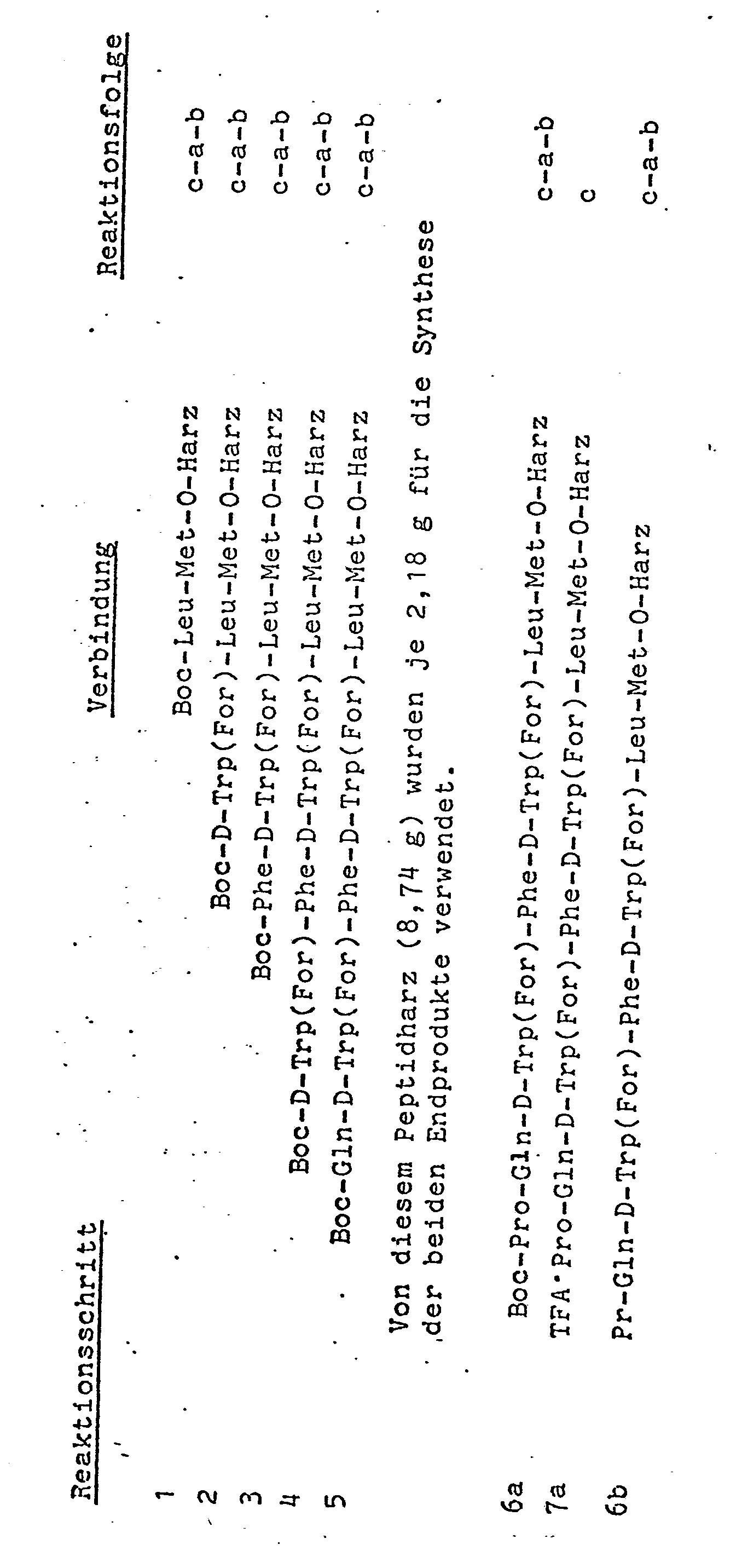
- b) Ammonolyse von H-Pro-Gln-D-Trp(For)-Phe-D-Trp(For)-Leu-Met-O-CH2-Harz Das Harz (2.33 g) wurde mit 20 ml Methanol, das vorher bei 0° mit gasförmigem Ammoniak gesättigt worden war, übergossen und 24 h bei Raumtemperatur in einem gut verschlossenen Rundkolben gerührt. Anschließend wurde die Suspension filtriert und das Harz 5 x mit je 50 ml Methanol gewaschen. Das Gewicht des getrockneten Harzes betrug dann 1.3 g. Das klare Filtrat wurde eingedampft und der ölige Rückstand i.V. getrocknet. Gewicht: 1.06 g.
- c) Säulenchromatographische Reinigung von H-Pro-Gln-D-Trp-Phe-D-Trp-Leu-Met-NH2 Das Produkt aus b) wurde,gelöst in 10 ml 50%iger AcOH an einer Säule aus Servachrom XAD-2 (100-120 mesh, 2.5x45 cm), die vorher mit 6%iger Essigsäure äquilibriert worden war, aufgetragen. Es wurde nacheinander mit den folgenden Fließmitteln eluiert:
- 1. 400 ml 6% AcoH
- 2. 400 ml 6% AcOH-CH3CN=9:1
- .3. 400 ml 6% AcOH-CH3CN=8:2
- 4. 400 ml 6% AcOH-CH3CN=7:3
- 5. 800 ml 6% AcOH-CH3CN=6:4
- d) Analytik:
- HPLC: Das Produkt zeigt einen einzigen symmetrischen Peak bei der Chromatographie in dem folgenden System:
- Säule: µ-Bondapak C18 (Fa. Waters) (2,4 x 300 mm) Fließmittel: CH3CN (40%)-0.1 M K-Phosphatpuffer pH . 3.0 (60%) Die beobachtete Retentionszeit betrug 15.8 min (Fließrate 1.5 ml/min)
- DC: Die Substanz zeigte einen einzigen symmetrischen Fleck in 4 verschiedenen Systemen. Als feste Phase dienten Merck-Fertigplatten Kieselgel 60 (5x20 cm)

- Glu 1.06 (1), Pro1.07 (1), Met 0.94 (1), Leu 0.99 (1), Phe 0.92 (1), NH3 1.96 (2), Trp 2.05 (2).
- e) Ammonolyse von Propionyl-Gln-D-Trp(For)-Phe-D-Trp(For) -Leu-Met-O-CH2-Harz Das Harz (2.15 g) wurde mit 20 ml Methanol, das vorher bei 0° mit gasförmigem Ammoniak gesättigt worden war, in einem gut verschlossenen Rundkolben 24 h gerührt. Anschließend wurde die Suspension filtriert und das Harz 5 x mit 30 ml Methanol gewaschen. Das Gewicht des Harzes betrug dann 1.22 g. Das klare Filtrat wurde eingedampft und der ölige Rückstand i.V. getrocknet. Gewicht: 900 mg.
- f) Säulenchromatographische Reinigung Propionyl-Gln-D-Trp-Phe-D-Trp-Leu-Met-NH2 Das Produkt wurde in 10 ml 50% AcOH gelöst und auf eine Säule aus Servachrom XAD-2 (100-120 mesh, 2.5 x 45 cm), die vorher mit 6%iger Essigsäure äquilibiert worden war, aufgetragen. Es wurde nacheinander mit den folgenden Fließmitteln eluiert:Die Fließrate betrug 10 ml/25 min, die Fraktionsgröße 10 ml. Das Produkt wurde in den Fraktionen 171-189 eluiert. Die Lösung wurde lyophilisiert. Ausbeute: 93 mg (chromatographisch reines Produkt) + 240 mg (chromatographisch leicht verunreinigt).

- g) Analytik: HPLC: Es wurden unter denselben Bedingungen gearbeitet wie oben beschrieben. Die Substanz zeigte einen einzelnen symmetrischen Peak mit einer Retentionszeit von 18 min.
- DC (DUnnschichtchromatographie): Die Substanz zeigte einen einzelnen symmetrischen Fleck in vier verschiedenen Fließmittelsystemen:

- Meerschweinchen Ileum wurde nach dem Töten der Tiere herausgeschnitten, durch Ziehen am caudalen Ende von Mesenterien weitgehend befreit und mit Tyrode-Lösung von Verdauungsprodukten befreit. Vom caudalen Ende wurden ca. 25 cm verworfen und daran anschließend mehrere 4 cm lange Darmabschnitte abgetrennt und in Tyrode-Lösung aufbewahrt. Die Tyrode-Lösung wurde mit Carbogen '(95 % 02e 5 % C02) begast. Die Tyrode-Lösung enthielt pro Liter folgende Substanzen:
- 8 g NaCl; 2 g KC1; 1,3 g CaCl2·2H2O;
- 2, g MgCl2·6H2O; 10 g NaHC03; 0,58 g NaH2PO4·1H2O;
- 11 g D(+)-Glucose.
- Die Tyrode-Lösung wurde in einem Organbad auf 38°C temperiert. Jedes Präparat behielt seine volle Kontraktionsfähigkeit für 4 bis 7 Stunden, Darmabschnitte von 4 cm wurden auf beiden Seiten abgebunden und im Organbad aufgehängt. Die Kontraktionen des Präparates wurden unter isotonischen Meßbedingungen über einen Hebel auf einer Kymographen-Trommel aufgezeichnet. Zum Schreiben diente ein Filzschreiber, der als Seitenschreiber angebracht war. Der Lastarm war 225 mm, der Kraftarm 20 mm lang. Die Vorlast betrug ca. 0.3 g, der Papiervorschub 5 mm/ min. Das Organbad faßte 10 ml.
- In der Regel wurden die Testsubstanzen in Volumina von 20 bis 100 µl zugesetzt und durch die Begasung augenblicklich im Organbad verteilt. Alle zugesetzten Testsubstanzen wurden in Tyrode-Lösung gelöst bzw. mit Tyrode-Lösung aus einer Stammlösung verdünnt.
- Testsubstanzen: als Agonisten dienten Substanz P (Serva) oder Norleucin-SP (Ferring, Kiel) in Dosen zwischen 10-9 und 10-7 M. Als potentielle Antagonisten wurden getestet:

- Die Verminderung der relativen Kontraktion der Ileum Präparate als Folge der Anwendung von SP-Analogen wurde als Maß für die relative Wirksamkeit als Antagonisten angesehen.
- Alle getesteten Analoge von Substanz-P: Verbindungen 1, 2, 3 und 4 besitzen Substanz-P-antagonisierende Wirkung, wenn sie in einer Konzentration von 10-5M eingesetzt werden. Dabei ergibt sich eine Abhängigkeit von der Dosis des Agonisten (SP oder Nle-SP). Im unteren Dosisbereich sind die Antagonisten stärker wirksam als im oberen Bereich.
- Zum Vergleich der Wirksamkeit zwischen den verschiedenen Antagonistensind in der TABELLE ihre Hemmwirkungen dargestellt, wenn der Agonist in einer Konzentration von 10-8M, der Antagonist 10-5M.vorliegt.

- Niedrige, jedoch bedeutende Hemmwirkung, besitzt dagegen Verbindung 4, das um eine Aminosäure kürzere Peptid.
- Originaldarstellungen der isotonischen Meßdaten finden sich in der Abbildung 1.
Claims (8)


Priority Applications (1)
| Application Number | Priority Date | Filing Date | Title |
|---|---|---|---|
| AT83101523T ATE17124T1 (de) | 1982-02-19 | 1983-02-18 | Polypeptide mit antagonistischen eigenschaften gegenueber der substanz p, verfahren zu ihrer herstellung, deren verwendung und verfahren zum reinigen von polypeptiden. |
Applications Claiming Priority (2)
| Application Number | Priority Date | Filing Date | Title |
|---|---|---|---|
| DE3205991 | 1982-02-19 | ||
| DE19823205991 DE3205991A1 (de) | 1982-02-19 | 1982-02-19 | Polypeptide, verfahren zu ihrer herstellung, deren verwendung und verfahren zum reinigen von polypeptiden |
Publications (2)
| Publication Number | Publication Date |
|---|---|
| EP0095557A1 true EP0095557A1 (de) | 1983-12-07 |
| EP0095557B1 EP0095557B1 (de) | 1985-12-27 |
Family
ID=6156185
Family Applications (1)
| Application Number | Title | Priority Date | Filing Date |
|---|---|---|---|
| EP83101523A Expired EP0095557B1 (de) | 1982-02-19 | 1983-02-18 | Polypeptide mit antagonistischen Eigenschaften gegenüber der Substanz P, Verfahren zu ihrer Herstellung, deren Verwendung und Verfahren zum Reinigen von Polypeptiden |
Country Status (4)
| Country | Link |
|---|---|
| US (1) | US4501733A (de) |
| EP (1) | EP0095557B1 (de) |
| AT (1) | ATE17124T1 (de) |
| DE (2) | DE3205991A1 (de) |
Families Citing this family (6)
| Publication number | Priority date | Publication date | Assignee | Title |
|---|---|---|---|---|
| US4839465A (en) * | 1987-01-20 | 1989-06-13 | Sterling Drug Inc. | Di-(D-tryptophyl and/or tetrahydropyridoindolylcarbonyl)-containing peptide amides and process for preparation thereof |
| US5877277A (en) * | 1987-09-24 | 1999-03-02 | Biomeasure, Inc. | Octapeptide bombesin analogs |
| US5331089A (en) * | 1988-03-25 | 1994-07-19 | Merck Sharpe & Dohme, Ltd. | Peptides useful as tachykinin agonists |
| US5328927A (en) * | 1992-03-03 | 1994-07-12 | Merck Sharpe & Dohme, Ltd. | Hetercyclic compounds, processes for their preparation and pharmaceutical compositions containing them |
| RU2129436C1 (ru) * | 1997-04-10 | 1999-04-27 | Институт элементоорганических соединений им.А.Н.Несмеянова РАН | Адъюванты |
| RU2184568C2 (ru) * | 2000-10-19 | 2002-07-10 | Всероссийский научно-исследовательский и технологический институт биологической промышленности | Способ определения токсичности и реактогенности масляных адъювантов и их компонентов |
Family Cites Families (4)
| Publication number | Priority date | Publication date | Assignee | Title |
|---|---|---|---|---|
| US4223020A (en) * | 1979-03-30 | 1980-09-16 | Beckman Instruments, Inc. | Synthetic peptides having pituitary growth hormone releasing activity |
| US4223019A (en) * | 1979-03-30 | 1980-09-16 | Beckman Instruments, Inc. | Synthetic peptides having pituitary growth hormone releasing activity |
| US4224316A (en) * | 1979-03-30 | 1980-09-23 | Beckman Instruments, Inc. | Synthetic peptides having pituitary growth hormone releasing activity |
| US4223021A (en) * | 1979-03-30 | 1980-09-16 | Beckman Instruments, Inc. | Synthetic peptides having pituitary growth hormone releasing activity |
-
1982
- 1982-02-19 DE DE19823205991 patent/DE3205991A1/de not_active Withdrawn
-
1983
- 1983-02-16 US US06/467,187 patent/US4501733A/en not_active Expired - Lifetime
- 1983-02-18 DE DE8383101523T patent/DE3361591D1/de not_active Expired
- 1983-02-18 EP EP83101523A patent/EP0095557B1/de not_active Expired
- 1983-02-18 AT AT83101523T patent/ATE17124T1/de not_active IP Right Cessation
Non-Patent Citations (1)
| Title |
|---|
| EUROPEAN JOURNAL OF PHARMACOLOGY, Band 77, Nr. 2-3, 1982, CARANIKAS et al. "Antagonists of substance P", Seiten 205-206 * |
Also Published As
| Publication number | Publication date |
|---|---|
| EP0095557B1 (de) | 1985-12-27 |
| DE3205991A1 (de) | 1983-09-01 |
| DE3361591D1 (en) | 1986-02-06 |
| ATE17124T1 (de) | 1986-01-15 |
| US4501733A (en) | 1985-02-26 |
Similar Documents
| Publication | Publication Date | Title |
|---|---|---|
| DE68928667T2 (de) | Peptide als arzneimittel | |
| DE69105270T2 (de) | D-2-alkyltryptophan enthaltende biologisch aktive peptide. | |
| DE69323337T2 (de) | Derivate des Parathormons | |
| DE69117788T2 (de) | Parathyroid-Hormon-Antagonisten | |
| DE2435027C2 (de) | Nonapeptidamide und Verfahren zu ihrer Herstellung | |
| DE69108738T2 (de) | Nonapeptide als bombesinantagonisten. | |
| DE2616399C2 (de) | Desamino-1,7-dicarbacalcitonine und Verfahren zu ihrer Herstellung | |
| DE69202182T2 (de) | Octapeptid oder Heptapeptidderivate, Verfahren zu deren Herstellung sowie Medikamente, die diese Verbindungen enthalten und Verwendung derselben. | |
| DE2321174A1 (de) | Nonapeptidamidderivate und verfahren zu ihrer herstellung | |
| DE69221486T2 (de) | Bombesinanaloge | |
| DE3782010T2 (de) | Vom calcitonin-gen abgeleitete peptidderivate. | |
| DE2634416A1 (de) | Peptide, verfahren zu ihrer herstellung und sie enthaltende arzneimittel | |
| DE69228277T2 (de) | PACAP-Derivate mit c-AMP-produzierenden Eigenschaften | |
| DE69231404T2 (de) | Endothelinantagonisten | |
| DE60214135T2 (de) | Modifizierte derivate von cck-8 | |
| DE60133654T2 (de) | Arzneimittel enthaltend analgetische peptide | |
| DE3783579T2 (de) | Derivate des alpha-anp und ihre herstellung. | |
| DE2822951A1 (de) | Neue polypeptide mit thymusaktivitaet oder antagonistischer aktivitaet und verfahren zu ihrer herstellung | |
| DE69003172T2 (de) | Synthetische Peptid-Antagonisten von Neurokinin A, deren Salze und respektive Herstellungsverfahren. | |
| DE69028692T2 (de) | Substance P Antagoniste | |
| EP0095557B1 (de) | Polypeptide mit antagonistischen Eigenschaften gegenüber der Substanz P, Verfahren zu ihrer Herstellung, deren Verwendung und Verfahren zum Reinigen von Polypeptiden | |
| AT394727B (de) | Verfahren zur herstellung von neuen gonadoliberin-derivaten | |
| EP0292729A2 (de) | Neue Festphasen-Peptidsynthesemethoden | |
| DE2408324A1 (de) | Tripeptide und verfahren zu ihrer herstellung | |
| DE3314357A1 (de) | Vasopressin-analoga, ihre herstellung und pharmazeutische mittel |
Legal Events
| Date | Code | Title | Description |
|---|---|---|---|
| PUAI | Public reference made under article 153(3) epc to a published international application that has entered the european phase |
Free format text: ORIGINAL CODE: 0009012 |
|
| AK | Designated contracting states |
Designated state(s): AT CH DE FR GB IT LI NL SE |
|
| 17P | Request for examination filed |
Effective date: 19840529 |
|
| GRAA | (expected) grant |
Free format text: ORIGINAL CODE: 0009210 |
|
| AK | Designated contracting states |
Designated state(s): AT CH DE FR GB IT LI NL SE |
|
| REF | Corresponds to: |
Ref document number: 17124 Country of ref document: AT Date of ref document: 19860115 Kind code of ref document: T |
|
| ITF | It: translation for a ep patent filed | ||
| REF | Corresponds to: |
Ref document number: 3361591 Country of ref document: DE Date of ref document: 19860206 |
|
| ET | Fr: translation filed | ||
| PLBE | No opposition filed within time limit |
Free format text: ORIGINAL CODE: 0009261 |
|
| STAA | Information on the status of an ep patent application or granted ep patent |
Free format text: STATUS: NO OPPOSITION FILED WITHIN TIME LIMIT |
|
| 26N | No opposition filed | ||
| ITTA | It: last paid annual fee | ||
| REG | Reference to a national code |
Ref country code: CH Ref legal event code: PUE Owner name: FERRING ARZNEIMITTEL GMBH Ref country code: CH Ref legal event code: PFA Free format text: AMRING VERMOEGENSVERWALTUNG GMBH |
|
| ITPR | It: changes in ownership of a european patent |
Owner name: CAMBIO RAGIONE SOCIALE;AMRING VERMOGENSVERWALTUNGS |
|
| ITPR | It: changes in ownership of a european patent |
Owner name: CESSIONE;FERRING ARZNEIMITTEL GMBH |
|
| NLT1 | Nl: modifications of names registered in virtue of documents presented to the patent office pursuant to art. 16 a, paragraph 1 |
Owner name: AMRING VERMOEGENSVERWALTUNG GMBH TE KIEL, BONDSREP |
|
| NLS | Nl: assignments of ep-patents |
Owner name: FERRING ARZNEIMITTEL GMBH TE KIEL, BONDSREPUBLIEK |
|
| REG | Reference to a national code |
Ref country code: FR Ref legal event code: TP Ref country code: FR Ref legal event code: CD |
|
| PGFP | Annual fee paid to national office [announced via postgrant information from national office to epo] |
Ref country code: CH Payment date: 19920129 Year of fee payment: 10 |
|
| PGFP | Annual fee paid to national office [announced via postgrant information from national office to epo] |
Ref country code: FR Payment date: 19920130 Year of fee payment: 10 |
|
| PGFP | Annual fee paid to national office [announced via postgrant information from national office to epo] |
Ref country code: GB Payment date: 19920210 Year of fee payment: 10 |
|
| REG | Reference to a national code |
Ref country code: GB Ref legal event code: 732 |
|
| PGFP | Annual fee paid to national office [announced via postgrant information from national office to epo] |
Ref country code: AT Payment date: 19920227 Year of fee payment: 10 |
|
| PGFP | Annual fee paid to national office [announced via postgrant information from national office to epo] |
Ref country code: NL Payment date: 19920229 Year of fee payment: 10 |
|
| PGFP | Annual fee paid to national office [announced via postgrant information from national office to epo] |
Ref country code: DE Payment date: 19920422 Year of fee payment: 10 |
|
| PGFP | Annual fee paid to national office [announced via postgrant information from national office to epo] |
Ref country code: SE Payment date: 19930121 Year of fee payment: 11 |
|
| PG25 | Lapsed in a contracting state [announced via postgrant information from national office to epo] |
Ref country code: GB Effective date: 19930218 Ref country code: AT Effective date: 19930218 |
|
| PG25 | Lapsed in a contracting state [announced via postgrant information from national office to epo] |
Ref country code: SE Effective date: 19930219 |
|
| PG25 | Lapsed in a contracting state [announced via postgrant information from national office to epo] |
Ref country code: LI Effective date: 19930228 Ref country code: CH Effective date: 19930228 |
|
| PG25 | Lapsed in a contracting state [announced via postgrant information from national office to epo] |
Ref country code: NL Effective date: 19930901 |
|
| GBPC | Gb: european patent ceased through non-payment of renewal fee |
Effective date: 19930218 |
|
| NLV4 | Nl: lapsed or anulled due to non-payment of the annual fee | ||
| PG25 | Lapsed in a contracting state [announced via postgrant information from national office to epo] |
Ref country code: FR Effective date: 19931029 |
|
| REG | Reference to a national code |
Ref country code: CH Ref legal event code: PL |
|
| PG25 | Lapsed in a contracting state [announced via postgrant information from national office to epo] |
Ref country code: DE Effective date: 19931103 |
|
| REG | Reference to a national code |
Ref country code: FR Ref legal event code: ST |
|
| EUG | Se: european patent has lapsed |
Ref document number: 83101523.5 Effective date: 19930912 |