EP0095894A2 - 6 Alpha-methylprednisolone derivatives - Google Patents
6 Alpha-methylprednisolone derivatives Download PDFInfo
- Publication number
- EP0095894A2 EP0095894A2 EP83303027A EP83303027A EP0095894A2 EP 0095894 A2 EP0095894 A2 EP 0095894A2 EP 83303027 A EP83303027 A EP 83303027A EP 83303027 A EP83303027 A EP 83303027A EP 0095894 A2 EP0095894 A2 EP 0095894A2
- Authority
- EP
- European Patent Office
- Prior art keywords
- methyl
- dione
- pregnadiene
- hydroxy
- group
- Prior art date
- Legal status (The legal status is an assumption and is not a legal conclusion. Google has not performed a legal analysis and makes no representation as to the accuracy of the status listed.)
- Ceased
Links
- VHRSUDSXCMQTMA-PJHHCJLFSA-N 6alpha-methylprednisolone Chemical class C([C@@]12C)=CC(=O)C=C1[C@@H](C)C[C@@H]1[C@@H]2[C@@H](O)C[C@]2(C)[C@@](O)(C(=O)CO)CC[C@H]21 VHRSUDSXCMQTMA-PJHHCJLFSA-N 0.000 title claims description 3
- 150000001875 compounds Chemical class 0.000 claims abstract description 137
- VHRSUDSXCMQTMA-UHFFFAOYSA-N 11,17-dihydroxy-17-(2-hydroxyacetyl)-6,10,13-trimethyl-7,8,9,11,12,14,15,16-octahydro-6h-cyclopenta[a]phenanthren-3-one Chemical class CC12C=CC(=O)C=C1C(C)CC1C2C(O)CC2(C)C(O)(C(=O)CO)CCC21 VHRSUDSXCMQTMA-UHFFFAOYSA-N 0.000 claims abstract description 61
- 125000001495 ethyl group Chemical group [H]C([H])([H])C([H])([H])* 0.000 claims abstract description 29
- 125000001997 phenyl group Chemical group [H]C1=C([H])C([H])=C(*)C([H])=C1[H] 0.000 claims abstract description 13
- 125000004178 (C1-C4) alkyl group Chemical group 0.000 claims abstract description 9
- 125000004435 hydrogen atom Chemical group [H]* 0.000 claims abstract description 6
- 125000001501 propionyl group Chemical group O=C([*])C([H])([H])C([H])([H])[H] 0.000 claims abstract description 3
- 239000007788 liquid Substances 0.000 claims description 9
- 125000000217 alkyl group Chemical group 0.000 claims description 7
- 239000002674 ointment Substances 0.000 claims description 4
- 239000006071 cream Substances 0.000 claims description 2
- 239000006210 lotion Substances 0.000 claims description 2
- 239000000843 powder Substances 0.000 claims description 2
- 239000008194 pharmaceutical composition Substances 0.000 claims 2
- WXJZDKXRBIIYGD-KQCWPWFGSA-N [(6s,8s,9s,10r,11s,13s,14s,17r)-11-hydroxy-17-[2-(2-methoxyacetyl)oxyacetyl]-6,10,13-trimethyl-3-oxo-7,8,9,11,12,14,15,16-octahydro-6h-cyclopenta[a]phenanthren-17-yl] propanoate Chemical compound C1([C@@H](C)C2)=CC(=O)C=C[C@]1(C)[C@@H]1[C@@H]2[C@@H]2CC[C@@](C(=O)COC(=O)COC)(OC(=O)CC)[C@@]2(C)C[C@@H]1O WXJZDKXRBIIYGD-KQCWPWFGSA-N 0.000 claims 1
- LKEBXMFYPGAXKB-HCYCZVMCSA-N [2-[(6S,8S,9S,10R,11S,13S,14S,17S)-11-hydroxy-6,10,13-trimethyl-3-oxo-6,7,8,9,11,12,14,15,16,17-decahydrocyclopenta[a]phenanthren-17-yl]-2-oxoethyl] 2-propanoyloxybutanoate Chemical compound C(CC)(=O)OC(C(=O)OCC([C@H]1CC[C@H]2[C@@H]3C[C@@H](C4=CC(C=C[C@]4(C)[C@H]3[C@H](C[C@]12C)O)=O)C)=O)CC LKEBXMFYPGAXKB-HCYCZVMCSA-N 0.000 claims 1
- HQUQZUZFSZKBTF-BYJOOZCFSA-N [2-[(6s,8s,9s,10r,11s,13s,14s,17r)-11-hydroxy-6,10,13-trimethyl-3-oxo-17-propanoyloxy-7,8,9,11,12,14,15,16-octahydro-6h-cyclopenta[a]phenanthren-17-yl]-2-oxoethyl] 3-methylbutanoate Chemical compound C1([C@@H](C)C2)=CC(=O)C=C[C@]1(C)[C@@H]1[C@@H]2[C@@H]2CC[C@@](C(=O)COC(=O)CC(C)C)(OC(=O)CC)[C@@]2(C)C[C@@H]1O HQUQZUZFSZKBTF-BYJOOZCFSA-N 0.000 claims 1
- 239000003085 diluting agent Substances 0.000 claims 1
- 239000011505 plaster Substances 0.000 claims 1
- 238000011282 treatment Methods 0.000 abstract description 12
- 230000003110 anti-inflammatory effect Effects 0.000 abstract description 10
- 238000002360 preparation method Methods 0.000 abstract description 4
- 208000037265 diseases, disorders, signs and symptoms Diseases 0.000 abstract description 3
- 208000026935 allergic disease Diseases 0.000 abstract description 2
- 208000006673 asthma Diseases 0.000 abstract description 2
- 230000002500 effect on skin Effects 0.000 abstract description 2
- 239000000043 antiallergic agent Substances 0.000 abstract 1
- 125000002496 methyl group Chemical group [H]C([H])([H])* 0.000 description 125
- XEKOWRVHYACXOJ-UHFFFAOYSA-N Ethyl acetate Natural products CCOC(C)=O XEKOWRVHYACXOJ-UHFFFAOYSA-N 0.000 description 118
- YMWUJEATGCHHMB-UHFFFAOYSA-N Dichloromethane Chemical compound ClCCl YMWUJEATGCHHMB-UHFFFAOYSA-N 0.000 description 108
- 239000000203 mixture Substances 0.000 description 91
- UHOVQNZJYSORNB-UHFFFAOYSA-N Benzene Chemical compound C1=CC=CC=C1 UHOVQNZJYSORNB-UHFFFAOYSA-N 0.000 description 90
- 239000000243 solution Substances 0.000 description 77
- OKKJLVBELUTLKV-UHFFFAOYSA-N Methanol Chemical compound OC OKKJLVBELUTLKV-UHFFFAOYSA-N 0.000 description 72
- ZMANZCXQSJIPKH-UHFFFAOYSA-N Triethylamine Chemical compound CCN(CC)CC ZMANZCXQSJIPKH-UHFFFAOYSA-N 0.000 description 69
- 238000004458 analytical method Methods 0.000 description 64
- LFQSCWFLJHTTHZ-UHFFFAOYSA-N Ethanol Chemical compound CCO LFQSCWFLJHTTHZ-UHFFFAOYSA-N 0.000 description 58
- VYPSYNLAJGMNEJ-UHFFFAOYSA-N Silicium dioxide Chemical compound O=[Si]=O VYPSYNLAJGMNEJ-UHFFFAOYSA-N 0.000 description 58
- 239000000741 silica gel Substances 0.000 description 58
- 229910002027 silica gel Inorganic materials 0.000 description 58
- 238000001819 mass spectrum Methods 0.000 description 53
- 239000012295 chemical reaction liquid Substances 0.000 description 41
- 239000013078 crystal Substances 0.000 description 41
- 238000000034 method Methods 0.000 description 41
- XLYOFNOQVPJJNP-UHFFFAOYSA-N water Substances O XLYOFNOQVPJJNP-UHFFFAOYSA-N 0.000 description 37
- ZMXDDKWLCZADIW-UHFFFAOYSA-N N,N-Dimethylformamide Chemical compound CN(C)C=O ZMXDDKWLCZADIW-UHFFFAOYSA-N 0.000 description 33
- CDBYLPFSWZWCQE-UHFFFAOYSA-L Sodium Carbonate Chemical compound [Na+].[Na+].[O-]C([O-])=O CDBYLPFSWZWCQE-UHFFFAOYSA-L 0.000 description 33
- JUJWROOIHBZHMG-UHFFFAOYSA-N Pyridine Chemical compound C1=CC=NC=C1 JUJWROOIHBZHMG-UHFFFAOYSA-N 0.000 description 30
- 230000000704 physical effect Effects 0.000 description 30
- 239000011541 reaction mixture Substances 0.000 description 29
- 238000004809 thin layer chromatography Methods 0.000 description 29
- 238000012746 preparative thin layer chromatography Methods 0.000 description 26
- WFDIJRYMOXRFFG-UHFFFAOYSA-N Acetic anhydride Chemical compound CC(=O)OC(C)=O WFDIJRYMOXRFFG-UHFFFAOYSA-N 0.000 description 24
- 229940086542 triethylamine Drugs 0.000 description 23
- JOXIMZWYDAKGHI-UHFFFAOYSA-N toluene-4-sulfonic acid Chemical compound CC1=CC=C(S(O)(=O)=O)C=C1 JOXIMZWYDAKGHI-UHFFFAOYSA-N 0.000 description 22
- PMZURENOXWZQFD-UHFFFAOYSA-L Sodium Sulfate Chemical compound [Na+].[Na+].[O-]S([O-])(=O)=O PMZURENOXWZQFD-UHFFFAOYSA-L 0.000 description 18
- 239000012043 crude product Substances 0.000 description 18
- -1 steroid compounds Chemical class 0.000 description 18
- 238000000746 purification Methods 0.000 description 17
- XKRFYHLGVUSROY-UHFFFAOYSA-N Argon Chemical compound [Ar] XKRFYHLGVUSROY-UHFFFAOYSA-N 0.000 description 16
- 238000006243 chemical reaction Methods 0.000 description 16
- 229910000029 sodium carbonate Inorganic materials 0.000 description 16
- UMJSCPRVCHMLSP-UHFFFAOYSA-N pyridine Natural products COC1=CC=CN=C1 UMJSCPRVCHMLSP-UHFFFAOYSA-N 0.000 description 15
- 239000002904 solvent Substances 0.000 description 14
- ZKQFHRVKCYFVCN-UHFFFAOYSA-N ethoxyethane;hexane Chemical compound CCOCC.CCCCCC ZKQFHRVKCYFVCN-UHFFFAOYSA-N 0.000 description 13
- 239000000706 filtrate Substances 0.000 description 13
- 239000007787 solid Substances 0.000 description 13
- MUBZPKHOEPUJKR-UHFFFAOYSA-N Oxalic acid Chemical compound OC(=O)C(O)=O MUBZPKHOEPUJKR-UHFFFAOYSA-N 0.000 description 11
- 239000003246 corticosteroid Substances 0.000 description 11
- 238000003756 stirring Methods 0.000 description 10
- 230000010933 acylation Effects 0.000 description 9
- 238000005917 acylation reaction Methods 0.000 description 9
- 230000000694 effects Effects 0.000 description 9
- KDCIHNCMPUBDKT-UHFFFAOYSA-N hexane;propan-2-one Chemical compound CC(C)=O.CCCCCC KDCIHNCMPUBDKT-UHFFFAOYSA-N 0.000 description 9
- 229910052739 hydrogen Inorganic materials 0.000 description 9
- 125000000956 methoxy group Chemical group [H]C([H])([H])O* 0.000 description 9
- 229910052786 argon Inorganic materials 0.000 description 8
- VEXZGXHMUGYJMC-UHFFFAOYSA-N Hydrochloric acid Chemical compound Cl VEXZGXHMUGYJMC-UHFFFAOYSA-N 0.000 description 7
- 238000004440 column chromatography Methods 0.000 description 7
- 125000001153 fluoro group Chemical group F* 0.000 description 7
- 125000004123 n-propyl group Chemical group [H]C([H])([H])C([H])([H])C([H])([H])* 0.000 description 7
- WYVAMUWZEOHJOQ-UHFFFAOYSA-N propionic anhydride Chemical compound CCC(=O)OC(=O)CC WYVAMUWZEOHJOQ-UHFFFAOYSA-N 0.000 description 7
- 238000012360 testing method Methods 0.000 description 7
- 229940079593 drug Drugs 0.000 description 6
- 239000003814 drug Substances 0.000 description 6
- 230000000144 pharmacologic effect Effects 0.000 description 6
- 239000000047 product Substances 0.000 description 6
- 239000000126 substance Substances 0.000 description 6
- 125000002252 acyl group Chemical group 0.000 description 5
- 239000007864 aqueous solution Substances 0.000 description 5
- YHASWHZGWUONAO-UHFFFAOYSA-N butanoyl butanoate Chemical compound CCCC(=O)OC(=O)CCC YHASWHZGWUONAO-UHFFFAOYSA-N 0.000 description 5
- LSACYLWPPQLVSM-UHFFFAOYSA-N isobutyric acid anhydride Chemical compound CC(C)C(=O)OC(=O)C(C)C LSACYLWPPQLVSM-UHFFFAOYSA-N 0.000 description 5
- 125000001449 isopropyl group Chemical group [H]C([H])([H])C([H])(*)C([H])([H])[H] 0.000 description 5
- RMIODHQZRUFFFF-UHFFFAOYSA-N methoxyacetic acid Chemical compound COCC(O)=O RMIODHQZRUFFFF-UHFFFAOYSA-N 0.000 description 5
- 125000004108 n-butyl group Chemical group [H]C([H])([H])C([H])([H])C([H])([H])C([H])([H])* 0.000 description 5
- DMQYKUUJCPNYMS-UHFFFAOYSA-N o-propanethioyl propanethioate Chemical compound CCC(=S)OC(=S)CC DMQYKUUJCPNYMS-UHFFFAOYSA-N 0.000 description 5
- 150000002905 orthoesters Chemical class 0.000 description 5
- IJGRMHOSHXDMSA-UHFFFAOYSA-N Atomic nitrogen Chemical compound N#N IJGRMHOSHXDMSA-UHFFFAOYSA-N 0.000 description 4
- QOSSAOTZNIDXMA-UHFFFAOYSA-N Dicylcohexylcarbodiimide Chemical compound C1CCCCC1N=C=NC1CCCCC1 QOSSAOTZNIDXMA-UHFFFAOYSA-N 0.000 description 4
- RTZKZFJDLAIYFH-UHFFFAOYSA-N Diethyl ether Chemical compound CCOCC RTZKZFJDLAIYFH-UHFFFAOYSA-N 0.000 description 4
- 239000002253 acid Substances 0.000 description 4
- 238000004821 distillation Methods 0.000 description 4
- 238000001914 filtration Methods 0.000 description 4
- 238000010438 heat treatment Methods 0.000 description 4
- JYGXADMDTFJGBT-VWUMJDOOSA-N hydrocortisone Chemical compound O=C1CC[C@]2(C)[C@H]3[C@@H](O)C[C@](C)([C@@](CC4)(O)C(=O)CO)[C@@H]4[C@@H]3CCC2=C1 JYGXADMDTFJGBT-VWUMJDOOSA-N 0.000 description 4
- 125000002887 hydroxy group Chemical group [H]O* 0.000 description 4
- 239000012071 phase Substances 0.000 description 4
- 238000007142 ring opening reaction Methods 0.000 description 4
- 201000004624 Dermatitis Diseases 0.000 description 3
- 229940124599 anti-inflammatory drug Drugs 0.000 description 3
- 239000008366 buffered solution Substances 0.000 description 3
- 239000007795 chemical reaction product Substances 0.000 description 3
- KRKNYBCHXYNGOX-UHFFFAOYSA-N citric acid Chemical compound OC(=O)CC(O)(C(O)=O)CC(O)=O KRKNYBCHXYNGOX-UHFFFAOYSA-N 0.000 description 3
- 125000004122 cyclic group Chemical group 0.000 description 3
- 238000011156 evaluation Methods 0.000 description 3
- 239000011261 inert gas Substances 0.000 description 3
- GNVRJGIVDSQCOP-UHFFFAOYSA-N n-ethyl-n-methylethanamine Chemical compound CCN(C)CC GNVRJGIVDSQCOP-UHFFFAOYSA-N 0.000 description 3
- 229910052757 nitrogen Inorganic materials 0.000 description 3
- 238000000655 nuclear magnetic resonance spectrum Methods 0.000 description 3
- 229960005205 prednisolone Drugs 0.000 description 3
- OIGNJSKKLXVSLS-VWUMJDOOSA-N prednisolone Chemical compound O=C1C=C[C@]2(C)[C@H]3[C@@H](O)C[C@](C)([C@@](CC4)(O)C(=O)CO)[C@@H]4[C@@H]3CCC2=C1 OIGNJSKKLXVSLS-VWUMJDOOSA-N 0.000 description 3
- 150000003512 tertiary amines Chemical class 0.000 description 3
- 230000003639 vasoconstrictive effect Effects 0.000 description 3
- JAFMOTJMRSZOJE-UHFFFAOYSA-N 1,1,1-trimethoxybutane Chemical compound CCCC(OC)(OC)OC JAFMOTJMRSZOJE-UHFFFAOYSA-N 0.000 description 2
- ISULZYQDGYXDFW-UHFFFAOYSA-N 3-methylbutanoyl chloride Chemical compound CC(C)CC(Cl)=O ISULZYQDGYXDFW-UHFFFAOYSA-N 0.000 description 2
- VEXZGXHMUGYJMC-UHFFFAOYSA-M Chloride anion Chemical compound [Cl-] VEXZGXHMUGYJMC-UHFFFAOYSA-M 0.000 description 2
- IAZDPXIOMUYVGZ-UHFFFAOYSA-N Dimethylsulphoxide Chemical compound CS(C)=O IAZDPXIOMUYVGZ-UHFFFAOYSA-N 0.000 description 2
- YCKRFDGAMUMZLT-UHFFFAOYSA-N Fluorine atom Chemical compound [F] YCKRFDGAMUMZLT-UHFFFAOYSA-N 0.000 description 2
- 206010033546 Pallor Diseases 0.000 description 2
- VMHLLURERBWHNL-UHFFFAOYSA-M Sodium acetate Chemical compound [Na+].CC([O-])=O VMHLLURERBWHNL-UHFFFAOYSA-M 0.000 description 2
- 101100054666 Streptomyces halstedii sch3 gene Proteins 0.000 description 2
- 238000010521 absorption reaction Methods 0.000 description 2
- KXKVLQRXCPHEJC-UHFFFAOYSA-N acetic acid trimethyl ester Natural products COC(C)=O KXKVLQRXCPHEJC-UHFFFAOYSA-N 0.000 description 2
- 150000008065 acid anhydrides Chemical class 0.000 description 2
- 230000001154 acute effect Effects 0.000 description 2
- 125000003545 alkoxy group Chemical group 0.000 description 2
- 125000004849 alkoxymethyl group Chemical group 0.000 description 2
- 208000010668 atopic eczema Diseases 0.000 description 2
- 229910052799 carbon Inorganic materials 0.000 description 2
- 239000003795 chemical substances by application Substances 0.000 description 2
- 238000007796 conventional method Methods 0.000 description 2
- 150000002148 esters Chemical class 0.000 description 2
- 230000001747 exhibiting effect Effects 0.000 description 2
- 229910052731 fluorine Inorganic materials 0.000 description 2
- 150000004820 halides Chemical class 0.000 description 2
- 125000005843 halogen group Chemical group 0.000 description 2
- 229960000890 hydrocortisone Drugs 0.000 description 2
- IXCSERBJSXMMFS-UHFFFAOYSA-N hydrogen chloride Substances Cl.Cl IXCSERBJSXMMFS-UHFFFAOYSA-N 0.000 description 2
- 229910000041 hydrogen chloride Inorganic materials 0.000 description 2
- 239000012535 impurity Substances 0.000 description 2
- 125000004184 methoxymethyl group Chemical group [H]C([H])([H])OC([H])([H])* 0.000 description 2
- 230000004048 modification Effects 0.000 description 2
- 238000012986 modification Methods 0.000 description 2
- 239000012074 organic phase Substances 0.000 description 2
- XGISHOFUAFNYQF-UHFFFAOYSA-N pentanoyl chloride Chemical compound CCCCC(Cl)=O XGISHOFUAFNYQF-UHFFFAOYSA-N 0.000 description 2
- BWHMMNNQKKPAPP-UHFFFAOYSA-L potassium carbonate Chemical compound [K+].[K+].[O-]C([O-])=O BWHMMNNQKKPAPP-UHFFFAOYSA-L 0.000 description 2
- 239000001632 sodium acetate Substances 0.000 description 2
- 235000017281 sodium acetate Nutrition 0.000 description 2
- 230000003595 spectral effect Effects 0.000 description 2
- 238000001228 spectrum Methods 0.000 description 2
- 150000003431 steroids Chemical group 0.000 description 2
- PEHFQQWAINXOQG-UHFFFAOYSA-N (2-methoxyacetyl) 2-methoxyacetate Chemical compound COCC(=O)OC(=O)COC PEHFQQWAINXOQG-UHFFFAOYSA-N 0.000 description 1
- NDQXKKFRNOPRDW-UHFFFAOYSA-N 1,1,1-triethoxyethane Chemical compound CCOC(C)(OCC)OCC NDQXKKFRNOPRDW-UHFFFAOYSA-N 0.000 description 1
- FGWYWKIOMUZSQF-UHFFFAOYSA-N 1,1,1-triethoxypropane Chemical compound CCOC(CC)(OCC)OCC FGWYWKIOMUZSQF-UHFFFAOYSA-N 0.000 description 1
- HDPNBNXLBDFELL-UHFFFAOYSA-N 1,1,1-trimethoxyethane Chemical compound COC(C)(OC)OC HDPNBNXLBDFELL-UHFFFAOYSA-N 0.000 description 1
- XUXVVQKJULMMKX-UHFFFAOYSA-N 1,1,1-trimethoxypentane Chemical compound CCCCC(OC)(OC)OC XUXVVQKJULMMKX-UHFFFAOYSA-N 0.000 description 1
- WSLDOOZREJYCGB-UHFFFAOYSA-N 1,2-Dichloroethane Chemical compound ClCCCl WSLDOOZREJYCGB-UHFFFAOYSA-N 0.000 description 1
- RYHBNJHYFVUHQT-UHFFFAOYSA-N 1,4-Dioxane Chemical compound C1COCCO1 RYHBNJHYFVUHQT-UHFFFAOYSA-N 0.000 description 1
- OCFYTOIAJLLHDS-UHFFFAOYSA-N 1-ethoxybutane-1,1-diol Chemical compound CCCC(O)(O)OCC OCFYTOIAJLLHDS-UHFFFAOYSA-N 0.000 description 1
- WMIGSQPKTRUNMH-UHFFFAOYSA-N 1-methoxy-3-methylbutane-1,1-diol Chemical compound COC(O)(O)CC(C)C WMIGSQPKTRUNMH-UHFFFAOYSA-N 0.000 description 1
- QKPVEISEHYYHRH-UHFFFAOYSA-N 2-methoxyacetonitrile Chemical compound COCC#N QKPVEISEHYYHRH-UHFFFAOYSA-N 0.000 description 1
- VHRSUDSXCMQTMA-UWKORSIYSA-N 6-methylprednisolone Chemical compound C([C@@]12C)=CC(=O)C=C1C(C)C[C@@H]1[C@@H]2[C@@H](O)C[C@]2(C)[C@@](O)(C(=O)CO)CC[C@H]21 VHRSUDSXCMQTMA-UWKORSIYSA-N 0.000 description 1
- ZCYVEMRRCGMTRW-UHFFFAOYSA-N 7553-56-2 Chemical compound [I] ZCYVEMRRCGMTRW-UHFFFAOYSA-N 0.000 description 1
- 208000024893 Acute lymphoblastic leukemia Diseases 0.000 description 1
- 208000014697 Acute lymphocytic leukaemia Diseases 0.000 description 1
- CPELXLSAUQHCOX-UHFFFAOYSA-M Bromide Chemical compound [Br-] CPELXLSAUQHCOX-UHFFFAOYSA-M 0.000 description 1
- WKBOTKDWSSQWDR-UHFFFAOYSA-N Bromine atom Chemical compound [Br] WKBOTKDWSSQWDR-UHFFFAOYSA-N 0.000 description 1
- ZAMOUSCENKQFHK-UHFFFAOYSA-N Chlorine atom Chemical compound [Cl] ZAMOUSCENKQFHK-UHFFFAOYSA-N 0.000 description 1
- 206010012438 Dermatitis atopic Diseases 0.000 description 1
- 206010012442 Dermatitis contact Diseases 0.000 description 1
- SUAKHGWARZSWIH-UHFFFAOYSA-N N,N‐diethylformamide Chemical compound CCN(CC)C=O SUAKHGWARZSWIH-UHFFFAOYSA-N 0.000 description 1
- 208000006664 Precursor Cell Lymphoblastic Leukemia-Lymphoma Diseases 0.000 description 1
- XBDQKXXYIPTUBI-UHFFFAOYSA-M Propionate Chemical compound CCC([O-])=O XBDQKXXYIPTUBI-UHFFFAOYSA-M 0.000 description 1
- 201000004681 Psoriasis Diseases 0.000 description 1
- HEDRZPFGACZZDS-MICDWDOJSA-N Trichloro(2H)methane Chemical compound [2H]C(Cl)(Cl)Cl HEDRZPFGACZZDS-MICDWDOJSA-N 0.000 description 1
- 206010047139 Vasoconstriction Diseases 0.000 description 1
- VNYXWHQJKOPMMK-YPYQNWSCSA-N [(6s,8s,9s,10r,11s,13s,14s,17r)-17-(2-acetyloxyacetyl)-11-hydroxy-6,10,13-trimethyl-3-oxo-7,8,9,11,12,14,15,16-octahydro-6h-cyclopenta[a]phenanthren-17-yl] 2-methoxyacetate Chemical compound C1([C@@H](C)C2)=CC(=O)C=C[C@]1(C)[C@@H]1[C@@H]2[C@@H]2CC[C@@](C(=O)COC(C)=O)(OC(=O)COC)[C@@]2(C)C[C@@H]1O VNYXWHQJKOPMMK-YPYQNWSCSA-N 0.000 description 1
- DGQORWVTUJHWLB-YCPSOXMQSA-N [2-[(6S,8S,9S,10R,11S,13S,14S,17S)-11-hydroxy-10,13-dimethyl-3-oxo-6-propanethioyloxy-6,7,8,9,11,12,14,15,16,17-decahydrocyclopenta[a]phenanthren-17-yl]-2-oxoethyl] acetate Chemical compound C(C)(=O)OCC([C@H]1CC[C@H]2[C@@H]3C[C@@H](C4=CC(C=C[C@]4(C)[C@H]3[C@H](C[C@]12C)O)=O)OC(CC)=S)=O DGQORWVTUJHWLB-YCPSOXMQSA-N 0.000 description 1
- AEFWIIUGQGWQEN-HUCUVGNTSA-N [2-[(6s,8s,9s,10r,11s,13s,14s,17r)-11-hydroxy-17-(2-methoxyacetyl)oxy-6,10,13-trimethyl-3-oxo-7,8,9,11,12,14,15,16-octahydro-6h-cyclopenta[a]phenanthren-17-yl]-2-oxoethyl] butanoate Chemical compound C1([C@@H](C)C2)=CC(=O)C=C[C@]1(C)[C@@H]1[C@@H]2[C@@H]2CC[C@](OC(=O)COC)(C(=O)COC(=O)CCC)[C@@]2(C)C[C@@H]1O AEFWIIUGQGWQEN-HUCUVGNTSA-N 0.000 description 1
- HUWFGYPPJSRPFS-HUCUVGNTSA-N [2-[(6s,8s,9s,10r,11s,13s,14s,17r)-11-hydroxy-6,10,13-trimethyl-3-oxo-17-propanethioyloxy-7,8,9,11,12,14,15,16-octahydro-6h-cyclopenta[a]phenanthren-17-yl]-2-oxoethyl] butanoate Chemical compound C1([C@@H](C)C2)=CC(=O)C=C[C@]1(C)[C@@H]1[C@@H]2[C@@H]2CC[C@](OC(=S)CC)(C(=O)COC(=O)CCC)[C@@]2(C)C[C@@H]1O HUWFGYPPJSRPFS-HUCUVGNTSA-N 0.000 description 1
- 238000000862 absorption spectrum Methods 0.000 description 1
- 125000002777 acetyl group Chemical group [H]C([H])([H])C(*)=O 0.000 description 1
- 230000002378 acidificating effect Effects 0.000 description 1
- 239000003470 adrenal cortex hormone Substances 0.000 description 1
- 238000013019 agitation Methods 0.000 description 1
- 150000001412 amines Chemical class 0.000 description 1
- 230000003266 anti-allergic effect Effects 0.000 description 1
- 230000002804 anti-anaphylactic effect Effects 0.000 description 1
- 239000002260 anti-inflammatory agent Substances 0.000 description 1
- 230000003356 anti-rheumatic effect Effects 0.000 description 1
- 201000008937 atopic dermatitis Diseases 0.000 description 1
- 150000007514 bases Chemical class 0.000 description 1
- SLUNEGLMXGHOLY-UHFFFAOYSA-N benzene;hexane Chemical compound CCCCCC.C1=CC=CC=C1 SLUNEGLMXGHOLY-UHFFFAOYSA-N 0.000 description 1
- PASDCCFISLVPSO-UHFFFAOYSA-N benzoyl chloride Chemical compound ClC(=O)C1=CC=CC=C1 PASDCCFISLVPSO-UHFFFAOYSA-N 0.000 description 1
- 125000003236 benzoyl group Chemical group [H]C1=C([H])C([H])=C(C([H])=C1[H])C(*)=O 0.000 description 1
- SNHRLVCMMWUAJD-SUYDQAKGSA-N betamethasone valerate Chemical compound C1CC2=CC(=O)C=C[C@]2(C)[C@]2(F)[C@@H]1[C@@H]1C[C@H](C)[C@@](C(=O)CO)(OC(=O)CCCC)[C@@]1(C)C[C@@H]2O SNHRLVCMMWUAJD-SUYDQAKGSA-N 0.000 description 1
- 230000015572 biosynthetic process Effects 0.000 description 1
- GDTBXPJZTBHREO-UHFFFAOYSA-N bromine Substances BrBr GDTBXPJZTBHREO-UHFFFAOYSA-N 0.000 description 1
- 229910052794 bromium Inorganic materials 0.000 description 1
- 239000006227 byproduct Substances 0.000 description 1
- 150000001718 carbodiimides Chemical class 0.000 description 1
- 125000004432 carbon atom Chemical group C* 0.000 description 1
- FGGUAEKPLDMWSF-HMHFYOQSSA-N chembl2376821 Chemical compound O([C@@H]1[C@@H]2[C@@H]3O[C@]3(CO)[C@@H](O)[C@@]3(O)[C@H]([C@]2([C@H](C)C[C@@]1(O1)C(C)=C)O2)C[C@@H]([C@@H]3O)C)C21C1=CC=CC=C1 FGGUAEKPLDMWSF-HMHFYOQSSA-N 0.000 description 1
- 238000007385 chemical modification Methods 0.000 description 1
- 239000000460 chlorine Substances 0.000 description 1
- 229910052801 chlorine Inorganic materials 0.000 description 1
- 238000004587 chromatography analysis Methods 0.000 description 1
- 208000032852 chronic lymphocytic leukemia Diseases 0.000 description 1
- 230000000052 comparative effect Effects 0.000 description 1
- 208000010247 contact dermatitis Diseases 0.000 description 1
- 239000000356 contaminant Substances 0.000 description 1
- 238000001816 cooling Methods 0.000 description 1
- 150000001886 cortisols Chemical class 0.000 description 1
- RKHQGWMMUURILY-UHRZLXHJSA-N cortivazol Chemical compound C([C@H]1[C@@H]2C[C@H]([C@]([C@@]2(C)C[C@H](O)[C@@H]1[C@@]1(C)C2)(O)C(=O)COC(C)=O)C)=C(C)C1=CC1=C2C=NN1C1=CC=CC=C1 RKHQGWMMUURILY-UHRZLXHJSA-N 0.000 description 1
- 238000000354 decomposition reaction Methods 0.000 description 1
- 239000012024 dehydrating agents Substances 0.000 description 1
- 238000007865 diluting Methods 0.000 description 1
- 201000010099 disease Diseases 0.000 description 1
- 208000035475 disorder Diseases 0.000 description 1
- 230000008030 elimination Effects 0.000 description 1
- 238000003379 elimination reaction Methods 0.000 description 1
- 125000005745 ethoxymethyl group Chemical group [H]C([H])([H])C([H])([H])OC([H])([H])* 0.000 description 1
- 230000029142 excretion Effects 0.000 description 1
- 230000002349 favourable effect Effects 0.000 description 1
- 239000011737 fluorine Substances 0.000 description 1
- 210000000245 forearm Anatomy 0.000 description 1
- NGGMYCMLYOUNGM-CSDLUJIJSA-N fumagillin Chemical compound C([C@H]([C@H]([C@@H]1[C@]2(C)[C@H](O2)CC=C(C)C)OC)OC(=O)\C=C\C=C\C=C\C=C\C(O)=O)C[C@@]21CO2 NGGMYCMLYOUNGM-CSDLUJIJSA-N 0.000 description 1
- 229910052736 halogen Inorganic materials 0.000 description 1
- 150000002367 halogens Chemical class 0.000 description 1
- 238000001727 in vivo Methods 0.000 description 1
- 239000012442 inert solvent Substances 0.000 description 1
- 238000002329 infrared spectrum Methods 0.000 description 1
- 150000007529 inorganic bases Chemical class 0.000 description 1
- PNDPGZBMCMUPRI-UHFFFAOYSA-N iodine Chemical compound II PNDPGZBMCMUPRI-UHFFFAOYSA-N 0.000 description 1
- 229910052740 iodine Inorganic materials 0.000 description 1
- 239000011630 iodine Substances 0.000 description 1
- 125000000959 isobutyl group Chemical group [H]C([H])([H])C([H])(C([H])([H])[H])C([H])([H])* 0.000 description 1
- 238000005259 measurement Methods 0.000 description 1
- 230000004060 metabolic process Effects 0.000 description 1
- 229960004584 methylprednisolone Drugs 0.000 description 1
- 125000004092 methylthiomethyl group Chemical group [H]C([H])([H])SC([H])([H])* 0.000 description 1
- 239000002395 mineralocorticoid Substances 0.000 description 1
- 150000007524 organic acids Chemical class 0.000 description 1
- 235000006408 oxalic acid Nutrition 0.000 description 1
- 125000004430 oxygen atom Chemical group O* 0.000 description 1
- 239000003973 paint Substances 0.000 description 1
- 239000000825 pharmaceutical preparation Substances 0.000 description 1
- 239000011736 potassium bicarbonate Substances 0.000 description 1
- 229910000028 potassium bicarbonate Inorganic materials 0.000 description 1
- 235000015497 potassium bicarbonate Nutrition 0.000 description 1
- 229910000027 potassium carbonate Inorganic materials 0.000 description 1
- 235000011181 potassium carbonates Nutrition 0.000 description 1
- TYJJADVDDVDEDZ-UHFFFAOYSA-M potassium hydrogencarbonate Chemical compound [K+].OC([O-])=O TYJJADVDDVDEDZ-UHFFFAOYSA-M 0.000 description 1
- 230000003389 potentiating effect Effects 0.000 description 1
- 150000003116 prednisolone derivatives Chemical class 0.000 description 1
- FKRCODPIKNYEAC-UHFFFAOYSA-N propionic acid ethyl ester Natural products CCOC(=O)CC FKRCODPIKNYEAC-UHFFFAOYSA-N 0.000 description 1
- 239000000376 reactant Substances 0.000 description 1
- 230000035484 reaction time Effects 0.000 description 1
- 238000001953 recrystallisation Methods 0.000 description 1
- 238000011160 research Methods 0.000 description 1
- 238000000926 separation method Methods 0.000 description 1
- 230000035939 shock Effects 0.000 description 1
- 238000004904 shortening Methods 0.000 description 1
- 239000008149 soap solution Substances 0.000 description 1
- 235000017550 sodium carbonate Nutrition 0.000 description 1
- 229910052938 sodium sulfate Inorganic materials 0.000 description 1
- 235000011152 sodium sulphate Nutrition 0.000 description 1
- 125000001424 substituent group Chemical group 0.000 description 1
- 229910052717 sulfur Inorganic materials 0.000 description 1
- 125000004434 sulfur atom Chemical group 0.000 description 1
- 238000010998 test method Methods 0.000 description 1
- IECKAVQTURBPON-UHFFFAOYSA-N trimethoxymethylbenzene Chemical compound COC(OC)(OC)C1=CC=CC=C1 IECKAVQTURBPON-UHFFFAOYSA-N 0.000 description 1
- 230000025033 vasoconstriction Effects 0.000 description 1
- 238000005406 washing Methods 0.000 description 1
Classifications
-
- C—CHEMISTRY; METALLURGY
- C07—ORGANIC CHEMISTRY
- C07J—STEROIDS
- C07J21/00—Normal steroids containing carbon, hydrogen, halogen or oxygen having an oxygen-containing hetero ring spiro-condensed with the cyclopenta(a)hydrophenanthrene skeleton
-
- C—CHEMISTRY; METALLURGY
- C07—ORGANIC CHEMISTRY
- C07J—STEROIDS
- C07J31/00—Normal steroids containing one or more sulfur atoms not belonging to a hetero ring
- C07J31/006—Normal steroids containing one or more sulfur atoms not belonging to a hetero ring not covered by C07J31/003
-
- C—CHEMISTRY; METALLURGY
- C07—ORGANIC CHEMISTRY
- C07J—STEROIDS
- C07J5/00—Normal steroids containing carbon, hydrogen, halogen or oxygen, substituted in position 17 beta by a chain of two carbon atoms, e.g. pregnane and substituted in position 21 by only one singly bound oxygen atom, i.e. only one oxygen bound to position 21 by a single bond
- C07J5/0046—Normal steroids containing carbon, hydrogen, halogen or oxygen, substituted in position 17 beta by a chain of two carbon atoms, e.g. pregnane and substituted in position 21 by only one singly bound oxygen atom, i.e. only one oxygen bound to position 21 by a single bond substituted in position 17 alfa
- C07J5/0053—Normal steroids containing carbon, hydrogen, halogen or oxygen, substituted in position 17 beta by a chain of two carbon atoms, e.g. pregnane and substituted in position 21 by only one singly bound oxygen atom, i.e. only one oxygen bound to position 21 by a single bond substituted in position 17 alfa not substituted in position 16
Definitions
- the present invention relates to a new class of 6a-methylprednisolone derivatives, and more particularly to new 17a-acyloxy 21-hydroxy- or -acyloxy- 110-hydroxy-6a-methyl-1,4-pregnadiene-3,20-dione derivatives possessing useful pharmacological activities.
- corticosteroid compounds have been clinically employed for the purpose of exhibiting an antirheumatic effect, antiinflammatory effect, anti-allergic effect and/or antianaphylactic shock effect.
- the application of corticosteroid compounds has been most widespread as locally effect external drugs rather than internal drugs in conjunction with their utility for their antiinflammatory effect, so that various types of externally applicable corticosteroid drugs are now commercially available, not only for clinical purposes, but also for general use.
- corticosteroid compounds are already known which are derived from hydrocortisone, which is regarded as the fundamental compound ' of these corticosteroid compounds, by significantly modifying or designing it in such manner that one or more hydroxy groups, methyl groups, halogen (bromine, chlorine or fluorine) atoms and/or double bonds are introduced into the skeleton structure of the fundamental compound, or the originally existing hydroxy groups are esterified or acetonized.
- these corticosteroid compounds are those bearing a fluorine atom at the 9- of 6-position of the fundamental steroid structure.
- These corticosteroid compounds are certainly excellent corticoid drugs possessing strong pharmacological effects, but on the other hand, involve a problem of safety in connection with the compounds to which the fluorine radical has been introduced, thus necessitating the physicians' particular attention to the clinical use of these compounds.
- the metabolism and excretion of these compounds in vivo are taken into consideration, it can hardly be said, depending on the administration term or dose, that no problems arise in respect of safety, even if such compounds are used as externally applied drugs.
- Japanese Laid-open Patent Application Sho.56-8611S discloses 17a-propionyl-6a-methyl- prednisolone and 17a,21-dipropionyl-6a-methylprednisolone obtained by such a modification.
- This prior art succeeded in the elimination of the harmful fluorine substituent from the steroid molecule, but the result of such a modification revealed only a failure in maintaining the expected pharmacological effects and a very poor improvement in antiinflammatory effect.
- no steriod compoind has been reported or put into practical use as an externally applied strong antiinflammatory drug.
- corticosteroid compounds free of any harmful fluorine substituent which have a structure similar to the naturally occurring corticosteroid compounds and which exhibit a strong antiinflammatory activiry
- new corticosteroid compounds derived from 6a-methylprednisolone by acylation of its 17a-hydroxy group with specific acyl reactants are devoid of a harmful fluorine substituent and exhibit a strong local antiinflammatory activity so that these compounds may be used as external antiinflammatory drugs.
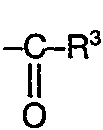
- the present invention provides a new 6a-methylprednisolone derivative of the general formula: wherein R1 is a hydrogen atom or the group where R 3 is a straight or once-branched chain C 1-4 alkyl group, a phenyl group or a lower.alkoxy- or alkylthio-methyl group, and R 2 is a straight or once-branched chain C 1-4 alkyl group, a phenyl group or a lower alkoxy- or alkylthio- methyl group, with the proviso that when R 2 is an ethyl group, R 1 is not a hydrogen atom or R 3 is not an ethyl group.
- the 6 ⁇ n,ethylprednisolone derivatives of the general formula (I) are 17a-acyl compounds or 17 ⁇ ,21- diacyl compounds depending on the definition of R 1 .
- R 2 and R 3 may be the same or different.
- Illustrative of the straight or once-branched chain C 1-4 alkyl groups are, for example, methyl, ethyl, n-propyl, isopropyl, n-butyl and isobutyl groups.
- the phenyl group is preferably an unsubstituted phenyl group, but may be a phenyl group substituted on the benzene ring with one or two lower alkyl groups.
- Examples of the lower alkoxymethyl group include methoxymethyl, ethoxymethyl, n-propoxymethyl, isopropoxymethyl and n-butoxymethyl group, with methoxymethyl being the most preferred.
- lower alkylthio-methyl group examples include those corresponding to the above-mentioned alkoxymethyl groups, in which a sulfur atom is substituted for the oxygen atom.
- a preferred example of the alkylthiomethyl group is the methylthiomethyl group.
- lower alkyl or lower alkoxy group as used herein, is meant an alkyl or alkoxy group containing from 1 to 4 carbon atoms.
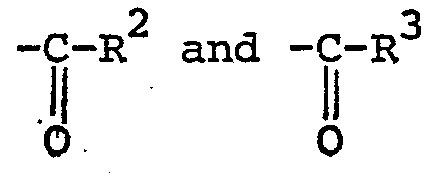
- acyl group represented by the groupings include acetyl, propionyl, n-butyryl,isobutyryl, n-valeryl, isovaleryl, benzoyl, p-methylbenzoyl. methoxyacetyl, ethoxyacetyl, methioacetyl and ethylthioacetyl groups.
- R 2 is the same as R 3 , the two groupings represent the same acyl group.
- the 6a-methylprednisolone derivatives of the present invention represented by the general formula (I) are new compounds. Particularly preferred in the present invention are the compounds represented by the general formulae: and
- R 2 ' is a straight or once-branched C 3-4 alkyl group, a phenyl group or a lower alkoxy-or alkylthiomethyl group
- R 1' is the group where R 3 has the same meaning as given above
- R 2 " is a straight or once-branched chain C 1-4 alkyl group or a lower alkoxy-or alkylthio-methyl group.
- the present invention particularly relates to those 6a-methylprednisolone compounds of the general formula (I) wherein at least one of the substituents R 1 and R 2 has one of the above mentioned- preferred meanings.
- Prednisolone itself is a ⁇ 1 -derivative of hydrocortisone and has a reduced mineral corticoid activity, which is a side effect of hydrocortisone.
- a prednisolone derivative obtained by introducing a methyl group into the 6a-position of prednisolone is 6a-methylprednisolone which is 15 to 20% higher in expected activity than the prednisolone itself and is an efficient drug exhibiting outstanding activity against acute and chronic lymphoid leukemia.
- the compounds of the present invention are 6a-methylprednisolone derivatives carrying a specific acyl group or groups in their 17a-position or 17a,21-positions.
- the new 6a-methylprednisolone derivatives of the present invention can be prepared according to various processes known per se.
- One of the preferred processes comprises, for example, the following steps:
- the 17 ⁇ -acyloxy-11 ⁇ ,21-dihydroxy compound of the general formula (II) obtained above is reacted with a compound of the general formula wherein R 3 has the same meaning as given above and X is a hydroxyl group, a halogen atom or the group R 3 - CO - O - where R 3 has the same meaning as given above, to form a compound of the general formula: wherein R11 and R 2 have the same meaning as given above.
- the ortho ester of the formula (V) is suitably selected according to the acyl substituent R 2 to be introduced into the 17a-hydroxy group of the starting 6a-methylprednisolone of the general formula (IV).
- a methyl or ethyl group is selected as the lower alkyl group R 4 in view of the ease of preparation and availability of the ortho ester.
- ethyl or methyl orthoacetate, orthopropionate, orthobutyrate, orthoisobutyrate, orthovalerate, orthoisovalerate, orthobenzoate, orthomethoxyacetate and orthomethylthioacetate may be used.
- the compound of general formula (VII) is also suitably selected according to the acyl substituent to be introduced into the 21-hydroxy group of the 17a-acyl-6a-methyl- prednisolone of the general formula (II) intermediately formed.
- This acylating compound is preferably used in the form of a functionally reactive derivative thereof, such as an acid halide or an acid anhydride in the presence of a base usually selected from a tertiary organic amine, e.g. triethylamine, a pyridine.
- a dehydrating agent such as a carbodiimide, e.g. N,N'dichlohexyl- carbodiimide to the reaction system.
- the cyclic 17a,21-ortho ester of 6a-methyl- prednisolone of the general formula (VI) is generally prepared by adding an ortho ester of the general formula (V) and a small amount of p-toluenesulfonic acid to a solution of 6a-methylprednisolone of the formula (IV) in a solvent and heating the mixture with stirring in an atmosphere of an inert gas or under a current of an inert gas.
- the solvent for dissolving 6a-methylprednisolone are, for example, inert poloar solvents such as dimethylformamide, diethylformamide, dimethylsulfoxide or dioxane.
- Nitrogen or argon is usually employed as the inert gas.
- the temperature usually adopted for heating the reaction mixture is within the range of from 60°C to 120°C, preferably of from 70°C to 110°C, and the heating time is generally within the period of from 30 minutes to 15 hours, preferably from 1 hour to 8 hours. No special limitation exists is the proportion of the starting 6a-methylprednisolone to the ortho ester, but the latter is advantageously employed in molar excess.
- the liquid reaction mixture is treated with a weak base and taken up in an ester or alkylene halide.
- a tertiary amine such as pyridine and triethylamine as well as a ' weak inorganic base such as sodium carbonate, potassium carbonate and potassium bicarbonate may be used.
- the addition of such a weak base to the reaction mixture is effectibe to inhibit any decomposition of the resultant 17a,21-ortho ester (VI), thus serving to increase the yield of the product. Accordingly, this treatment is recommended or rather necessary in the preparation of the 17a,21-ortho esters.
- Preferred examples of the ester and alkylene halide to be mixed with the reaction mixture include ethyl acetate, methyl acetate, methylene chloride and ethylene chloride.
- the organid phase is then washed thoroughly with water filtered to remove any solid impurities, dried with an inert dehydrating substance such as anhydrous sodium sulfate and concentrated under atmospheric or subatmospheric pressure. All of these treatments are conducted according to conventional methods usually adopted for after-treatments of reaction products.
- the residue thus obtained is then crystallized from acetone-hexane. If it is difficult to crystallize out the product, the residue may be purified by the aid of column chromatography on silica gel impregnated with triethylamine. Usually, however, the crude product obtained as a crystalline or amorphous solid substance is used as such for the next step, o.e., the ring-opening reaction of the cyclic ortho ester
- the ring-opening reaction of the resultant cyclic 17a,21-ortho ester of the general formula (VI) is carried our by the aid of an acid normally in the presence of a suitable solvent, for example, a lower alkanol such as methanol.
- a suitable solvent for example, a lower alkanol such as methanol.
- This reaction proceeds very smoothly, but usually with the formation of the 17a-acylated compound aimed at together with a small amount of the corresponding 21-acylated compound as by-product. It is therefore recommended to adjust the acidic conditions employed to a pH range of 2 to 4 in order to obtain the desired 17a-acylated compound selectively.
- Such a pH range can usually'be made up by the addition of an organic acid such as oxalic acid or citric acid to the reaction system.
- a buffered solution having a pH value of 3 - 4 can be used to achieve a favourable result. It has now been surprisingly found by the present inventors that the use of a small amount of iodine (I 2 ) for the ring-opening reaction of the cyclic ortho ester serves to increase the yield of the desired 17a-acylated compound.
- Column chromatography using silica gel is usually employed to eliminate the contaminant thereby obtaining the desired 17a-acylated compound in a purer form.
- preparative thin layer chromatography using silica gel as the absorption agent may also be utilized for this purpose.
- the 21-hydroxy group of the 17a-acylated compounds thus obtained is acylated according to a method known per se with an acylating compound of the general formula (VII).
- This acylation is advantageously carried out by using the compound of the general formula (II) and a compound of the general formula (VII) wherein X is a halogen atom or the group R 3 -CO-O- in the presence of a tertiary amine such as triethylamine or pyridine. This acylation is promoted very smoothly under mild conditions.
- the acylation will usually be completed at ambient or room temperature within a period of from 1 to 40 hours, preferably 2-30 hours. It is possible to warm the reaction mixture slightly to accelerate the reaction thereby shortening the reaction time.
- the acylation can be carried out under milder conditions, for example, at 0°C for 20 to 40 minutes.
- the above acylation is normally carried out in the presence of an excess amount of a tertiary amine in an inert solvent such methylene chloride.
- the reaction mixture can be treated according to conventional methods, for example, by diluting the reaction mixture with a suitable solvent such as ethyl acetate, washing the organic phase with water sufficiently, filtering the organic phase to remove any solid impurities and then concentrated, usually under reduced pressure.
- a suitable solvent such as ethyl acetate
- the crude 17a,21-diacylated product thus obtained can be purified by a method known per se by recrystallization, for example, from acetone-hexane or by means of column chromatography or preparative thin layer chromatography using silica gel. It is also possible to subject a residue obtained by concentrating the reaction mixture directly to such chromatography treatment for purification.
- the new 6a-methylprednisolone derivatives obtained by the above one- or two-step acylation processes were shown to be 17 ⁇ -acyloxy-11 ⁇ ,.21-dihydroxy-6 ⁇ -methyl-1.4-pregnadiene-3,20-dione compounds or 17a,21-diacyloxy-ll&-hydroxy-6a-methyl-l,4-pregnadiene-3,20-dione compounds by subjecting the derivatives to analysis including the measurements of infra-red absorption spectra (IR), nuclear magnetic resonance spectra (NMR), mass spectra (MS) and elementary analysis.
- IR infra-red absorption spectra
- NMR nuclear magnetic resonance spectra
- MS mass spectra
- the new 6a-methylprednisolone derivatives of the present invention by the general formula (I) exhibit a strong local antiinflammatory activity and thus can be utilized clinically for the treatment of various dermal disorders, for example, acute or chronic eczema, contact dermatitis, eczema seborrhoicorum, atopic dermatitis, eczema infantum and psoriasis vulgaris.
- the new compounds of the present invention can also be utilized for treating asthma and various other allergic diseases.
- the 6a-methylprednisolone derivatives can be used in various types of pharmaceutical preparations, for example, ointments, creams, lotions, liquid paints, plasters and powders.
- the antiinflammatory activity exhibited by the new 6a-methyl-prednisolone derivatives is extremely good and this fact can be proved by evaluating the activity according to the vasoconstriction test. Given below is the test method for the evaluation of the pharmacological activity and results thereof.
- the compounds of the present invention posses an extremely strong vasoconstrictive activity in comparison with the starting 6 -methylprednisolone.
- Some of the compounds of the present invention are found to be much more effective in the activity than commercially available betamethasone 17-valerate.
- This compound was colorless and amorphous but was confirmed to be pure in view of its physical properties and as the results of various analyses shown hereunder.
- a mixture of 2.0 g of 6a-methylprednisolone, 2.0g of methyl orthobenzoate, 8 ml of dimethylformamide and 0.09 g of p-toluene- sulfonic acid was heated at 30°C with stirring under an argon- current for 5 hours.
- To this reacticn liquid were then added at room temperature 4 ml of a 10 % aqueous solution of sodium carbonate, 40 ml of water and 100 ml of ethyl acetate, and the mixture was shaken. The ethyl acetate layer was separated, washed with water, dried over anhydrous sodium carbonate and filtered.
- reaction liquid was concentrated under reduced pressure and the obtained residue was directly subjected to preparative thin layer chromatography (silica gel) for purification and then recrystallized from ether-hexane whereby 203 mg (yield: 81.2%) of the title compound was obtained as colorless platelet crystals. Shown below are physical properties and various analytical data of this compound.
- reaction liquid was concentrated under reduced pressure and the obtained residue was purified by subjecting it directly to preparative thin layer chromatography (silica gel) and recrystallized from ether-hexane whereby 216 mg (yield: 86.4%) of the title compound was obtained as colorless needle crystals. Shown below are physical properties and various analytical data of this compound.
- reaction liquid was concentrated under reduced pressure and the resultant residue was subjected to preparative thin layer chromatography (silica gel) for purification and then recrystallized from ether-hexane whereby 132 mg (yield: 82.5%) of the title compound was obtained as needle crystals. Shown below are physical properties and various analytical data of this compound.
- reaction liquid was concentrated under reduced pressure and the resultant residue was subjected to preparative thin layer chromatography for purification and then recrystallized from ether-hexane whereby 168 mg (yield: 81.6%) of the title compound was obtained as colorless platelet crystals. Shown below are physical properties and various analytical data of this compound.
- reaction liquid was concentrated under reduced pressure and the resultant residue was subjected to preparative thin layer chromatography (silica gel)for purification and then recrystallized from ether-hexane whereby 87 mg (yield: 37.0%) of the title compound was obtained as colorless needle crystals. Shown below are physical properties and various analytical data of this compound.
- reaction liquid was concentrated under reduced pressure and the resultant residue was subjected directly to preparative thin layer chromatography (silica gel) for purification and then recrystallized from ether-hexane whereby 204 mg (yield: 79.4%) of the title compound was obtained as colorless platelet crystals. Shown below are physical properties and various analytical data of this compound.
- reaction liquid was concentrated under reduced pressure and the resultant residue was subjected directly to preparative thin layer chromatography (silica gel) for purification and then recrystallized from ether-hexane whereby 211 mg (yield: 82.1%) of the title compound was obtained as colorless platelet crystals. Shown below are physical properties and various analytical data of this compound.
- the ethyl orthomethoxyacetate used in this Example was obtained by reacting methoxyacetonitrile with hydrogen chloride in dry ethanol and then treating the resultant ethyl iminoether hydrochloride with ethanol.
Landscapes
- Chemical & Material Sciences (AREA)
- Organic Chemistry (AREA)
- Health & Medical Sciences (AREA)
- General Health & Medical Sciences (AREA)
- Steroid Compounds (AREA)
- Pharmaceuticals Containing Other Organic And Inorganic Compounds (AREA)
- Acyclic And Carbocyclic Compounds In Medicinal Compositions (AREA)
Abstract

Description
- The present invention relates to a new class of 6a-methylprednisolone derivatives, and more particularly to new 17a-acyloxy 21-hydroxy- or -acyloxy- 110-hydroxy-6a-methyl-1,4-pregnadiene-3,20-dione derivatives possessing useful pharmacological activities.
- In recent years, a number of corticosteroid compounds have been clinically employed for the purpose of exhibiting an antirheumatic effect, antiinflammatory effect, anti-allergic effect and/or antianaphylactic shock effect. Very recently, the application of corticosteroid compounds has been most widespread as locally effect external drugs rather than internal drugs in conjunction with their utility for their antiinflammatory effect, so that various types of externally applicable corticosteroid drugs are now commercially available, not only for clinical purposes, but also for general use. A wide variety of corticosteroid compounds are already known which are derived from hydrocortisone, which is regarded as the fundamental compound' of these corticosteroid compounds, by significantly modifying or designing it in such manner that one or more hydroxy groups, methyl groups, halogen (bromine, chlorine or fluorine) atoms and/or double bonds are introduced into the skeleton structure of the fundamental compound, or the originally existing hydroxy groups are esterified or acetonized.
- At the present time, the majority of these steroid compounds are those bearing a fluorine atom at the 9- of 6-position of the fundamental steroid structure. These corticosteroid compounds are certainly excellent corticoid drugs possessing strong pharmacological effects, but on the other hand, involve a problem of safety in connection with the compounds to which the fluorine radical has been introduced, thus necessitating the physicians' particular attention to the clinical use of these compounds. When the metabolism and excretion of these compounds in vivo are taken into consideration, it can hardly be said, depending on the administration term or dose, that no problems arise in respect of safety, even if such compounds are used as externally applied drugs. Although fluorine-containing corticosteroid compounds are still commerciall available as potent antiinflammatory drugs, the use of the compounds themselves for clinical treatment is limited because of their harmful fluorine substituent. Accordingly, an attempt has also been made to develop a new class of corticosteroid compounds free of the harmful fluorine substituent, whilst maintaining their useful pharmacological activities. Such attempts include the chemical modification of the fundamental compound, which, so far reported, is the acylation of the hydroxy group originally eXisting in the basic compounds. For Example, Japanese Laid-open Patent Application Sho.56-8611S discloses 17a-propionyl-6a-methyl- prednisolone and 17a,21-dipropionyl-6a-methylprednisolone obtained by such a modification. This prior art succeeded in the elimination of the harmful fluorine substituent from the steroid molecule, but the result of such a modification revealed only a failure in maintaining the expected pharmacological effects and a very poor improvement in antiinflammatory effect. At the present time, therefore, no steriod compoind has been reported or put into practical use as an externally applied strong antiinflammatory drug. Thus, there is still a great demand in this art for further developing a new class of steroid compounds free from any harmful substitutents but enhanced in their expected pharmacological activities to a practically acceptable level.
- We have now developed a new class of 6a-methylprednisolone derivatives possessing a strong local anti- inflammatory effect.
- As a result of extensive research to develop a new class of corticosteroid compounds free of any harmful fluorine substituent which have a structure similar to the naturally occurring corticosteroid compounds and which exhibit a strong antiinflammatory activiry, it has now been found that new corticosteroid compounds derived from 6a-methylprednisolone by acylation of its 17a-hydroxy group with specific acyl reactants are devoid of a harmful fluorine substituent and exhibit a strong local antiinflammatory activity so that these compounds may be used as external antiinflammatory drugs.
- Accordingly, the present invention provides a new 6a-methylprednisolone derivative of the general formula:


- The 6α n,ethylprednisolone derivatives of the general formula (I) are 17a-acyl compounds or 17α,21- diacyl compounds depending on the definition of R1. In the general formula (I), R2 and R3 may be the same or different.
- Illustrative of the straight or once-branched chain C1-4 alkyl groups are, for example, methyl, ethyl, n-propyl, isopropyl, n-butyl and isobutyl groups. The phenyl group is preferably an unsubstituted phenyl group, but may be a phenyl group substituted on the benzene ring with one or two lower alkyl groups. Examples of the lower alkoxymethyl group include methoxymethyl, ethoxymethyl, n-propoxymethyl, isopropoxymethyl and n-butoxymethyl group, with methoxymethyl being the most preferred. Examples of the lower alkylthio-methyl group include those corresponding to the above-mentioned alkoxymethyl groups, in which a sulfur atom is substituted for the oxygen atom. A preferred example of the alkylthiomethyl group is the methylthiomethyl group. By the term "lower alkyl or lower alkoxy group" as used herein, is meant an alkyl or alkoxy group containing from 1 to 4 carbon atoms.
- Accordingly, typical examples of the acyl group represented by the groupings

- The 6a-methylprednisolone derivatives of the present invention represented by the general formula (I) are new compounds. Particularly preferred in the present invention are the compounds represented by the general formulae:


- In these formulae, R 2' is a straight or once-branched C 3-4 alkyl group, a phenyl group or a lower alkoxy-or alkylthiomethyl group, R1' is the group

- Prednisolone itself is a Δ1 -derivative of hydrocortisone and has a reduced mineral corticoid activity, which is a side effect of hydrocortisone. A prednisolone derivative obtained by introducing a methyl group into the 6a-position of prednisolone is 6a-methylprednisolone which is 15 to 20% higher in expected activity than the prednisolone itself and is an efficient drug exhibiting outstanding activity against acute and chronic lymphoid leukemia. The compounds of the present invention are 6a-methylprednisolone derivatives carrying a specific acyl group or groups in their 17a-position or 17a,21-positions.
- The new 6a-methylprednisolone derivatives of the present invention can be prepared according to various processes known per se. One of the preferred processes comprises, for example, the following steps:
- 6a-Methylprednisolone of the formula (IV):


- If a 17a,21-diacyloxy derivative is aimed at as the end product, the 17α-acyloxy-11β,21-dihydroxy compound of the general formula (II) obtained above is reacted with a compound of the general formula


- The ortho ester of the formula (V) is suitably selected according to the acyl substituent R2 to be introduced into the 17a-hydroxy group of the starting 6a-methylprednisolone of the general formula (IV). Usually, a methyl or ethyl group is selected as the lower alkyl group R4 in view of the ease of preparation and availability of the ortho ester. In particular, ethyl or methyl orthoacetate, orthopropionate, orthobutyrate, orthoisobutyrate, orthovalerate, orthoisovalerate, orthobenzoate, orthomethoxyacetate and orthomethylthioacetate may be used.
- The compound of general formula (VII) is also suitably selected according to the acyl substituent

- In detail, the cyclic 17a,21-ortho ester of 6a-methyl- prednisolone of the general formula (VI) is generally prepared by adding an ortho ester of the general formula (V) and a small amount of p-toluenesulfonic acid to a solution of 6a-methylprednisolone of the formula (IV) in a solvent and heating the mixture with stirring in an atmosphere of an inert gas or under a current of an inert gas. Illustrative of the solvent for dissolving 6a-methylprednisolone are, for example, inert poloar solvents such as dimethylformamide, diethylformamide, dimethylsulfoxide or dioxane. Nitrogen or argon is usually employed as the inert gas. The temperature usually adopted for heating the reaction mixture is within the range of from 60°C to 120°C, preferably of from 70°C to 110°C, and the heating time is generally within the period of from 30 minutes to 15 hours, preferably from 1 hour to 8 hours. No special limitation exists is the proportion of the starting 6a-methylprednisolone to the ortho ester, but the latter is advantageously employed in molar excess. After heating, the liquid reaction mixture is treated with a weak base and taken up in an ester or alkylene halide. As the weak base, a tertiary amine such as pyridine and triethylamine as well as a ' weak inorganic base such as sodium carbonate, potassium carbonate and potassium bicarbonate may be used. The addition of such a weak base to the reaction mixture is effectibe to inhibit any decomposition of the resultant 17a,21-ortho ester (VI), thus serving to increase the yield of the product. Accordingly, this treatment is recommended or rather necessary in the preparation of the 17a,21-ortho esters. Preferred examples of the ester and alkylene halide to be mixed with the reaction mixture include ethyl acetate, methyl acetate, methylene chloride and ethylene chloride. The organid phase is then washed thoroughly with water filtered to remove any solid impurities, dried with an inert dehydrating substance such as anhydrous sodium sulfate and concentrated under atmospheric or subatmospheric pressure. All of these treatments are conducted according to conventional methods usually adopted for after-treatments of reaction products. The residue thus obtained is then crystallized from acetone-hexane. If it is difficult to crystallize out the product, the residue may be purified by the aid of column chromatography on silica gel impregnated with triethylamine. Usually, however, the crude product obtained as a crystalline or amorphous solid substance is used as such for the next step, o.e., the ring-opening reaction of the cyclic ortho ester
- The ring-opening reaction of the resultant cyclic 17a,21-ortho ester of the general formula (VI) is carried our by the aid of an acid normally in the presence of a suitable solvent, for example, a lower alkanol such as methanol. This reaction proceeds very smoothly, but usually with the formation of the 17a-acylated compound aimed at together with a small amount of the corresponding 21-acylated compound as by-product. It is therefore recommended to adjust the acidic conditions employed to a pH range of 2 to 4 in order to obtain the desired 17a-acylated compound selectively. Such a pH range can usually'be made up by the addition of an organic acid such as oxalic acid or citric acid to the reaction system. Alternatively, a buffered solution having a pH value of 3 - 4 can be used to achieve a favourable result. It has now been surprisingly found by the present inventors that the use of a small amount of iodine (I2) for the ring-opening reaction of the cyclic ortho ester serves to increase the yield of the desired 17a-acylated compound. The reaction mixture thus obtained generally contains the desired 17α=acylated compound and a small amount of the contaminating 21-acylated compound. Column chromatography using silica gel is usually employed to eliminate the contaminant thereby obtaining the desired 17a-acylated compound in a purer form. Alternatively, preparative thin layer chromatography using silica gel as the absorption agent may also be utilized for this purpose.
- When 17a,21-diacylated 6a-methylprednisolone compounds of general formula (III) are to be prepared as the end products, the 21-hydroxy group of the 17a-acylated compounds thus obtained is acylated according to a method known per se with an acylating compound of the general formula (VII). This acylation is advantageously carried out by using the compound of the general formula (II) and a compound of the general formula (VII) wherein X is a halogen atom or the group R3-CO-O- in the presence of a tertiary amine such as triethylamine or pyridine. This acylation is promoted very smoothly under mild conditions. When the acylating compound is used in the form of an acid anhydride, the acylation will usually be completed at ambient or room temperature within a period of from 1 to 40 hours, preferably 2-30 hours. It is possible to warm the reaction mixture slightly to accelerate the reaction thereby shortening the reaction time.
- When the acylating compound is used in the form of an acid halide (chloride or bromide), the acylation can be carried out under milder conditions, for example, at 0°C for 20 to 40 minutes. The above acylation is normally carried out in the presence of an excess amount of a tertiary amine in an inert solvent such methylene chloride. It is preferable to employ the acylating agent in a slightly stoichiometrical excess of the 17a-acyl compound of the general formula (II). If the acylating compound remains unreacted in the reaction mixture, it can easily be decomposed by the addition of a lower alkanol to the reaction mixture. After completion of the reaction, the reaction mixture can be treated according to conventional methods, for example, by diluting the reaction mixture with a suitable solvent such as ethyl acetate, washing the organic phase with water sufficiently, filtering the organic phase to remove any solid impurities and then concentrated, usually under reduced pressure.
- The crude 17a,21-diacylated product thus obtained can be purified by a method known per se by recrystallization, for example, from acetone-hexane or by means of column chromatography or preparative thin layer chromatography using silica gel. It is also possible to subject a residue obtained by concentrating the reaction mixture directly to such chromatography treatment for purification.
- The new 6a-methylprednisolone derivatives obtained by the above one- or two-step acylation processes were shown to be 17α-acyloxy-11β,.21-dihydroxy-6α-methyl-1.4-pregnadiene-3,20-dione compounds or 17a,21-diacyloxy-ll&-hydroxy-6a-methyl-l,4-pregnadiene-3,20-dione compounds by subjecting the derivatives to analysis including the measurements of infra-red absorption spectra (IR), nuclear magnetic resonance spectra (NMR), mass spectra (MS) and elementary analysis.
- The new 6a-methylprednisolone derivatives of the present invention by the general formula (I) exhibit a strong local antiinflammatory activity and thus can be utilized clinically for the treatment of various dermal disorders, for example, acute or chronic eczema, contact dermatitis, eczema seborrhoicorum, atopic dermatitis, eczema infantum and psoriasis vulgaris. The new compounds of the present invention can also be utilized for treating asthma and various other allergic diseases. For the treatment of these diseases, the 6a-methylprednisolone derivatives can be used in various types of pharmaceutical preparations, for example, ointments, creams, lotions, liquid paints, plasters and powders.
- The antiinflammatory activity exhibited by the new 6a-methyl-prednisolone derivatives is extremely good and this fact can be proved by evaluating the activity according to the vasoconstriction test. Given below is the test method for the evaluation of the pharmacological activity and results thereof.
- Teat method:
- From the compounds of the present invention represented by the general formula (I) and compounds for comparative tests (controls), ointments containing these compounds each in a concentration of 0.01% were prepared. These ointments were randomly applied in a definite amount (about 20mg) by a controller having no concern with the evaluation of activity onto a plastic bandage to prepare test pieces for a patch test (Finn Chamber; Epitest Ltd. Oy, Finland). Each of these test pieces was applied onto the skin in the flexor aspects of both forearms of 10 healthy adult males. After the lapse of 16 hours, all the test pieces of the plastic bandage were peeled off and the compounds remaining on the skin were gently washed off with a soap solution.
- Evaluation:
- The vasoconstrictive activity in terms of the degree of blanching on the skin after 2 hours and 6 hours was determined by 2 judging persons using the following four degrees:


- As is evident from the results given in Tables 1 and 2, the compounds of the present invention posses an extremely strong vasoconstrictive activity in comparison with the starting 6 -methylprednisolone. Some of the compounds of the present invention are found to be much more effective in the activity than commercially available betamethasone 17-valerate.
- The present invention will now be described in more detail in the following Examples in which the new compounds of the present invention and the preparation thereof are illustrated.
- (a) In 6 ml of dimethylformamide was dissolved 374 mg of 6a-methylprednisolone. To this solution were added 380 mg of ethyl orthobutyrate and then 9 mg of p-toluenesulfonic acid. The mixture was heated at 80°C with stirring for 1.5 hours in a stream of argon and the reaction liquid was poured into 50 ml of ethyl acetate. To the liquid mixture were added immediately 1 ml of a 10% solution of sodium carbonate and 30 ml of water. The mixture was well shaken and the ethyl acetate phase was ;separated, washed twice with 30 ml of water and dried over anhydrous sodium sulfate. The solution was then filtered and the filtrate was evaporated to obtain a crude crystalline substance which was recrystallized from acetone-hexane whereby 430 mg (yield: 90.9%) of 6a-methylprednisolone 17a,21-ethyl orthobutyrate was obtained as colorless needle crystals.
- M.P. 164.0-166.0°C (with decomp.)
- IR vKBr max cm -1. 3340, 1720, 1645
- MS m/e: 473 (M++1), 472 (M+),427, 356, 311, 297, 279, 161, 136, 135 (base peak), 121
- Elementary analysis (as C28H4006):
- Calc. (%) C 71.16; H 8.53 Found (%) C 71.03; H 8.71
- In 8 ml of methanol was dissolved 400 mg of 6a-methyl- prednisolone 17c.,21-ethyl- orthobutyrate. To this solution was added 1 ml of 2N-oxalic acid, and the mixture was warmed for 30 minutes at 40-45°C. The solvent was removed by distillation under reduced pressure and 80 ml of ethyl acetate was added to the residue. The ethyl acetate solution was washed twice with 30 ml of water, dried over anhydrous sodium sulfate and evaporated under subatmospheric pressure to obtain a crude product, which was subjected to column chromatograptiy on silica gel and fractionated with methylene chloride for purification whereby 302 mg (yield: 80.2%) of 17α-butyryloxy-11β,21-dihydroxy-6α-methyl-1,4-pregnadiene-3,20-dione was-obtained.
- This compound was colorless and amorphous but was confirmed to be pure in view of its physical properties and as the results of various analyses shown hereunder.
- TLC (silica gel): Rf 0.51 (single spot, benzene:ethanol = 5:1)
- IRVKBr max cm-1 . 3400, 1720, 1710, 1650
- NMRdCDCl3 : 0.80-1.20 (9H, m, -CH2CH3, C18 -CH 3 and C6α -CH 3), 1.47 (3H, s, C19 -CH3), 4.26 (2H, br.s, C21 -CH2), 4.52(1H, br, C11-CH) ,. 6.03 (1H, s, C4 -CH), 6.28 (lH, d, J=10Hz, C2 -CH), 7.36 (lH, d, J=lOHz, C1 -CH)
- MS m/e : 445 (M++ 1), 444 (M+), 413 (M+- 31),356, 327, 309, 297, 279, 161, 136 (base peak), 135, 121
- Elementary analysis (as C26H36O6):
- Calc. (%) H70.24 H 8.16
- Found (%) H 70.12 ; H 8.29
- (b) In 2 ml of dimethylformamide was dissolved 200 mg of 6a-methylprednisolone. To this solution were added 180 mg of methyl orthobutyrate and 8 mg of p-toluenesulfonic acid. The mixture was heated at 110°C under a nitrogen current with stirring for one hour. To the reaction liquid were added at room temperature 1ml of pyridine and 50 ml of ethyl acetate, and the mixture was washed twice with 30 ml of water. The ethyl acetate phase was dried over anhydrous.sodium sulfate and filtered. The filtrate was concentrated to obtain a crude product which was then recrystallized from acetone-hexane whereby 175 mg (yield: 71.3%) of 6a-methylprednisolone 17a,21-methyl orthobutyrate was obtained.
- --- Next, 100 mg of this compound was dissolved in 6 ml of methanol and 0.5 ml of a buffered solution of sodium acetate was added. The mixture was stirred overnight at room temperature and the reaction liquid was treated in the same manner as described in the foregoing (a) to obtain a crude product which was subjected to preparative thin layer chromatography on silica gel for purification whereby 71 mg (yield: 72.8%) of 17a-butyryloxy-118,21-dihydroxy-6a-methyl-1,4-pregnadiene-3,20-dione was obtained. This compound was in agreement in physical properties and analytical data with that obtained in the above (a).
- (a) In 6 ml of dimethylformamide was dissolved 750 mg of 6a-methylprednisolone. To this solution were added 890 mg of methyl orthobutyrate and then 34 mg of p-toluenesulfonic acid. The mixture was heated at 80°C with stirring in a stream of argon for one hour and then 80 ml of ethyl acetate was poured into the reaction liquid. Then, 2 ml of a 10% solution of sodium carbonate was immediately added to the reaction liquid, and 50 ml of water was added thereto. The liquid mixture was well shaken and the ethyl acetate layer was separated, washed with water and dried over anhydrous sodium sulfate. The ethyl acetate was distilled off and the resultant crude crystalline product was recrystallized whereby 862 mg (yield: 93.9%) of 6a-methylprednisolone 17a,21-methyl orthoisobutyrate was obtained as colorless needle crystals (m.p. 172.0-175.0°C with decomp.).
- Analytical data of this compound were as follows:
- IRvKBr max cm-1 : 3320 (OH), 1715 (C=O), 1645 (C=O)
- MS m/e : 459 (M++1), 458 (M+), 427 (M+-31). 325, 297, 279, 161, 136 (base peak), 135, 121
- Elementary analysis (as C27H3806) Calc. (%) C 70.71 ; H 8.35 Found (%) C 70.58 ; H 8.41
- In 20 ml of methanol was dissolved 460 mg of the thus obtained 6a-methylprednisolone 17a,21-methyl orthoisobutyrate. To this solution was added 1 ml of 2N-oxalic acid, and the mixture was warmed at 40-50°C for 10 minutes. The solvent was distilled off under reduced pressure and 50 ml of ethyl acetate was added to the residue. The ethyl acetate solution was washed with water and dried over anhydrous sodium sulfate, and the solvent was removed by distillation under reduced pressure to obtain a crystalline residue which was then subjected to column chromatography on silica gel, eluted and fractionated with methylene chloride whereby 344 mg (yield: 77.3%) of 118.21-dihydroxy-17a-isobutyryloxy-6a-methyl-1,4-pregnadiene-3,20-dione was obtained. This compound was a colorless amorphous substance but was confirmed to be pure in view of the following physical properties and spectra:
- TLC (silica gel): Rf 052 (single spot, benzene : ethanol = 4:1)
- IRVKBr max cm-1 : 3400 (OH), 1720 (C=O), 1710 (C=O), 1650 (C=O)
- NMRdCDCI3 : 0.95 (3H, s, C18 -CH3), 1.15 (6H, d,

- MS m/e 445 (M++1) , 444 (M+) , 413 (M+-31), 358, 297, 279, 161, 136, 135 (base peak), 121
- Elementary analysis (as C26H36O6) Calc. (%) C 70.24 ; H 8.16 Found (%) C 70.28 ; H 8.31
- (b) To 3 ml of methylene chloride was added 100 mg of 6a-methylprednisolone 17a,21-methyl orthoisobutyrate obtained in the foregoing (a). To this mixture was added under agitation 5 mg of iodine, and the reaction was allowed to proceed at room temperature for 30 minutes. The reaction liquid was then concentrated under reduced pressure and the resultant crude product was subjected to preparative thin layer chromatography (silica gel) whereby 82 mg of 11β,21-dihydroxy-17α-isobutyryloxy-6a-methyl-1,4-pregnadiene-3,20-dione was obtained. This compound was in agreement in physical properties and spectrum data in IR, NMR and MS with the title compound obtained in the preceding (a).
- In ml of dimethylformamide was dissolved 374 mg of 6a-methylprednisolone. To this solution were added 324 mg of methyl orthovalerate and then 17 mg of p-toluenesulfonic acid. The mixture was heated at 90°C with stirring under an argon current for-5 hours. To the reaction liquid were then added at room temperature 50 ml of ethyl acetate and 0.5 ml of a 10% aqueous solution of sodium carbonate. To this mixture was further added 30 ml of water, and the whole was well shaken. The ethyl acetate layer was separated, washed twice with 30 ml of water and then dried over anhydrous sodium sulfate. The ethyl acetate solution was filtered and the filtrate was concentrated to obtain a crude product which was then subjected to a separation treatment using column chromatography on silica gel impregnated with triethylamine whereby 433 mg (yield: 91.7%) of 6a-methyl- prednisolone 17a,21-methyl orthovalerate was obtained as a colorless amorphous solid. Shown below are various analytical data of this compound.
- IRvKBr max cm-1 . 3400 (OH), 1720 (C=O), 1645 (C=O)
- MS m/e : 473 (M++1), 472 (M+), 441, 356, 297, 279, 161, 136, 135 (base peak), 121, 85
- Elementary analysis (as C28H40O6) Calc. (%) C 71.16 ; H 8.53 Found (%) C 71.23; H 8.69
- In 8 ml of methanol was dissolved 236 mg of the 6a-methyl- prednisolone 17a,21-methyl orthovalerate thus obtained, and the solution was warmed at 40°C. To the solution was added 0.5 ml of 2N-oxalic acid, and the mixture was warmed with stirring for 10 minutes. The solvent was then distilled off under reduced pressure and the resultant residue was subjected to preparative thin layer chromatography whereby 187 mg (yield: 81.7%) of 118, 21-dihydroxy-6α-methyl-17α-valeryloxy-1,4-pregnadiene-3,20-dione was obtained as a colorless amorphous solid. The structure of this compound was confirmed by the following physical properties and results of various analyses:
- TLC : Rf 0.53 (silica gel, single spot, benzene : ethanol = 4:1)
- IRVKBr max cm-1 . 3400 (OH),1720 (C=O), 1715 (C=O), 1655 (C=O)
- max
- NMRδppm (CDC13) : 0.95 (3H, s, C18 -CH3), 0.88-1.25 (3H, m, CH2CH2CH2CH3), 1.11 (3H, d, J=6Hz, C6a -CH 3), 1.52 (3H, s, C19 -CH3), 4.28 (2H, s, C21 -CH2), 4.52 (1H, br, C11 -CH), 6.02 (lH, br.s, C4 -CH), 6.24 (1H, d, J=10 Hz, C2 -CH), 7.38 (lH, d, J=10 Hz, C1 -CH)
- MS m/e : 459 (M++1.) , 458 (M+), 441, 440, 427, 356, 327, 325, 297, 281, 279, 161, 136 (base peak), 135, 121, 85
- Elementary analysis (as C 27 H 38 0 6) Calc. (%) C 70:72 ; H 8.35 Found (%) C 70.59 ; H 8.53
- In 6 ml of dimethylformamide was dissolved 749 mg of 6a-methylprednisolone. To this solution were added 973 mg of methyl orthoisovalerate and 34 mg of p-toluenesulfonic acid, and the mixture was heated at 80°C with stirring under an argon current for one hour. To the reaction liquid were then added at room temperature 80 ml of ethyl acetate, 0.5 ml of a 10% solution of sodium carbonate and 30 ml of water, and the mixture was well shaken. The ethyl acetate layer was separated, washed twice with 30 ml of water and dried over anhydrous sodium sulfate. The ethyl acetate solution was filtered and the filtrate was concentrated to obtain a crude product which was then recrystallized from benzene-hexane whereby 783 mg (yield: 82:8%) of 6a-methylprednisolone 17a,21-methyl orthoisovalerate was obtained as colorless needle crystals.
- M.P.168.0-171.0°C (with decomp.)
- IRVKBr max cm-1 IRvkbr max cm-1: 3400, 1715, 1650
- MS m/e: 473 (M++1), 472 (M+), 441 (M+-31), 356, 297, 161, 136, 135 (base peak), 1.21
- Elementary analysis (as C28-H40O6) Calc. (%) . C- 71.16 H 8.53 Found(% ) C' 71.01 ; H 8.41
- In 20 ml of methanol was dissolved 720 mg of 6a-methyl- prednisolone 17c,21-methyl orthoisovalerate. To the solution was added 2 ml of 2N-oxalic acid, and the mixture was warmed at 40°C for 15 minutes. The solvent was then distilled off and 80 ml of ethyl acetate was added to the residue. The ethyl acetate phase was washed with 1 ml of a 10% solution of sodium carbonate and 30 ml of water, dried over anhydrous sodium sulfate and concentrated to obtain a crude product which was then subjected to column chromatography on silica gel whereby 486 mg (yield: 69.5%) of 11β,21-dihydroxy-17α-isovaleryloxy-6α-methyl-1,4-pregnadiene-3,20-dione was obtained. This compound was colorless and amorphous but was confirmed to be pure in view of the its physical properties and various analytical data shown below.
- TLC (silica gel) : Rf 0.53 (single spot, benzene : ethanol= 4:1)
- IRvKBr max cm-1 . 3400, 1720, 1710, 1650
- NMRdCDCl3 : 0.90 (3H, s, C18 -CH3), 0.96 (6H, s,

- MS m/e : 459 (M+ +1), 458 (M+), 440 (M+-18), 427 (M+-31), 356, 338, 327, 325, 281, 161, 136 (base peak), 135, 121
- Elementary analysis (as C 27 H 38 0 6) Calc. (%) C 70.71 H 8.35 Found (%) C 70.62 H 8.57
- A mixture of 2.0 g of 6a-methylprednisolone, 2.0g of methyl orthobenzoate, 8 ml of dimethylformamide and 0.09 g of p-toluene- sulfonic acid was heated at 30°C with stirring under an argon- current for 5 hours. To this reacticn liquid were then added at room temperature 4 ml of a 10% aqueous solution of sodium carbonate, 40 ml of water and 100 ml of ethyl acetate, and the mixture was shaken. The ethyl acetate layer was separated, washed with water, dried over anhydrous sodium carbonate and filtered.
- The filtrate was concentrated under reduced pressure and the resultant crude product was subjected to column chromatography on silica gel impregnated with triethylamine and eluted with methylene chloride whereby 1.75 g (yield: 66.4%) of 6a-methylprednisolone 17a,21-methyl orthobenzoate was obtained, which showed a single spot in TLC (silica gel).
- Although this compound was a colorless amorphous substance, it was identified by the following IR-absorption and mass spectral data and the result of elementary analysis:
- IRvKBr max Cm -1 . 3350 (OH), 1715 (C=O), 1645 (C=O)
- MS m/e : 493 (M++1), 492 (M+)., 475, 461 (M+-31), 356, 297, 279, 161, 136, 135, 105 (base peak), 77
- Elementary analysis (as C30H36O6) Calc. (%) C 73.14 ; H 7.37 Found (%) C 73.02 ; H 7.49
- In 30 ml of methanol was dissolved 1.5 g of the 6a-methyl- prednisolone 17α7,21-methyl-orthobenzoate thus obtained. To this solution was added 15 ml of a sodium acetate buffered solution, and the mixture was warmed at 40°C for 10 minutes. The solvent was distilled off under reduced pressure and the resulting residue was subjected to preparative thin layer chromatography (silica gel) whereby 1.17 g (yield: 80.8%) of 17a-benzoyloxy-11β,21-dihydroxy-6α-methyl-1,4-pregnadiene-3,20-dione was obtained as a colorless amorphous substance. The physical-properties and spectral data of this compounds are as follows:
- TLC (silica gel) : Rf 0.53 single spot, benzene:ethanol = 4:1)
- IRV KBr max cm-1: 3α00 (OH), 1710 (C=O), 1705 (C=O), 1650 (C=O)
- NMRdCDCI3 : 1.04 (3H, s, C18 -CH3); 1.14 (3H, d, C6α -CH3), 1.48 (3H, s, C19 -CH3), 4.32 (2H, s, C21 -CH 2), 4.57 (lH, br, C11 -CH), 6.06 (1H, s, C4 -CH), 6.30 (1H, d, J=10Hz, C2 -CH), 7.35 (lH, d, J=10Hz, C1 -CH), 7.40-8.10 (5H, m, Ph)
- MSm/e : 479 (M++l), 478 (M+), 447 (M+-31), 327, 309, 297, 281, 161, 136, 135, 122, 105 (base peak), 77
- Elementary analysis (as C 29 H 34 0 6) Calc. (%) C 72.78 ; H 7.16 Found (%) C 72.89 ; H 7.33
- To 3 ml of dimethylformamide was dissolved 749 mg of 6a-methylprednisolone. To this solution were added 649 mg of ethyl orthoacetate and 17 mg of p-toluenesulfonic acid, and the mixture was heated at 75°C with stirring for 1.5 hours.
- To the reaction liquid were then added at room temperature successively 80 ml of ethyl acetate, 0.5 ml of a 10% solution of sodium carbonate and 30 ml of water, and the mixture was shaken. The ethyl acetate layer was separated, washed twice with 30 ml of water, dried over anhydrous sodium sulfate and filtered. The filtrate was concentrated to obtain a crude product as a crystalline solid, which was recrystallized from acetone-hexane whereby 822 mg (yield: 92.5%) of 6a-methyl- prednisolone 17a,21-ethyl orthoacetate was obtained as colorless needle crystals.
- M.P. 134.0-136.0°C (with decomp.)
- IRVKBr max cm-1:
- IRV KBr max cm -1 3440, 1715, 1650
- max MS m/e : 445 (M++1), 444 (M+), 399, 356, 297, 279, 237, 161, 136, 135 (base peak), 121
- Elementary analysis (as C26H36O6 Calc. (%) C 70.24 ; H 8.16 Found (%) C 70.13 ; H 8.08
- In 8 ml of methanol was dissolved 270 mg of 6a-methyl- prednisolone 17a,21-ethyl orthoacetate. To this solution was added 1.5 ml of 2N-oxalic acid, and the mixture was heated at 40°C for 10 minutes. The reaction liquid was concentrated and the resultant residue was well shaken with 50 ml of ethyl acetate, 1 ml of a 10% solution of sodium carbonate and 30 ml of water. The ethyl acetate layer was separated, washed twice with 30 ml of water, dried over anhydrous sodium sulfate and filtered. The filtrate was concentrated to obtain a crude product which was then subjected to preparative thin layer chromatography on silica gel whereby 177 mg (yield: 69.8%) of 17a-acetoxy-118,21-dihydroxy-6a-methyl-1,4-pregnadiene-3,20-dione was obtained.
- In 3 ml of methylene chloride was dissolved 114 mg of the thus obtained 17a-acetyl compound. To this solution were added 56 mg of acetic anhydride and 101 mg of triethylamine and the mixture was stirred at room temperature for 8 hours. To the solution was added 1 ml of dry methanol, and the mixture was allowed to stand overnight and concentrated under reduced pressure. The resultant residue was purified by subjecting it directly to preparative thin layer chromatography (silica gel) and then recrystallized from acetone-hexane whereby 105 mg (yield: 83.3%)
- of 17α,21-diacetoxy-11β-hydroxy-6α-methyl-1,4-pregnadiene-3,20-dione was obtained as colorless fine needle crystals. Below are physical properties and various analytical data of this compound.
- M.P. 221.0-224.0°C
- TLC (silica gel): Rf 0.37 (single spot, benzene:ethanol = 10:1)
- IRvkBr max cm-1 . 3380, 1755, 1730, 1650
- HMRdCDCI3 : 1.03 (3H, s, C18 -CH3). 1.13 (3H, d, J=7.0Hz, C6α -CH3), 1.47 (3H, s, C19 -CH3), 2.05 (3H, s, C 17 -COCH3), 2.17 (3H, s, C21 -COCH3), 4.47 (1H, br, C11 -CH), 4.81 (2H, d, J=4.5Hz, C21 -CH2), 6.01 (lH, s, C4 -CH), 6.25 (lH, d, J=10Hz, C2 -CH), 7.27 (1H, d, J=10Hz, C1 -CH)
- MS m/e : 459 (M++1), 458 (M+), 441, 440 (M+-18), 338, 356, 325, 297, 279, 189, 161, 136 (base peak), 135, 121, 43
- Elementary analysis (as C26H34O7) Calc. (%) C 68.10 ; H 7.47 Found (%) C 67.91 ; H 7.21
- In 4 ml of dimethylformamide was dissolved 1.12 g of 6a-methylprednisolone. To this solution were added 1.06 g of ethyl orthopropionate and 0.026 g of p-toluenesulfonic acid, and the mixture was heated with stirring under an argon current at 80°C for 1.5 hours Next, 100 ml cf ethyl acetate and 0.5 ml of a 10% aqueous solution of sodium carbonate were added to the reaction liquid at room temperature and then 50 ml of water was also added thereto. This mixture was well shaken and the ethyl acetate layer was separated, washed twice with 30 ml of water and dried over anhydrous sodium sulfate. After filtration, the filtrate was concentrated and the resultant crude product was recrystallized from ether whereby 1.28 g (yield: 92.8%) of 6c-methylprednisolone 17a,21-ethyl orthopropionate was obtained as colorless needle crystals. Below are physical properties and various analytical data of this compound.
- M.P. 160.0 - 164.0°C (with decomp.)
- IRvKBrmax cm-1: 3350 (OH), 1720 (C=O), 1645 (C=O)
- MS m/e : 459 (M++1), 458 (M+ ),441,430, 413, 395, 356, 311, 297, 279, 237, 161, 136, 135 (base peak), 121, 57
- Elementary analysis (as C27H38O6) Calc. (%) C 70.71 ; H 8.35 Found (%) C 70.59 ; H 8.47
- In 8 ml of methanol was dissolved 320 mg of the 6a-methyl- prednisolone 17a,21-ethyl orthopropionate. To this solution was added 1.5 ml of 2N-oxalic acid, and the mixture was heated at 40°C for 10 minutes. The resultant reaction liquid was concentrated under reduced pressure. To the residue were added successively 50 ml of ethyl acetate, 0.5 ml of a 10% solution of sodium carbonate and 30 ml of water, and the mixture was well shaken. The ethyl acetate layer was separated, dried over anhydrous sodium sulfate and concentrated to obtain a crude product which was then subjected to preparative thin layer chromatography on silica gel whereby 235 mg (yield: 78.3%) of 11β,21-dihydroxy-6α-methyl-17α-propionyloxy-1,4-pregnadiene-3,20-dione was obtained.
- In 4 ml of methylene chloride was dissolved 210 mg of this compound. To this solution were added 400 mg of triethylamine and 120 mg of acetic anhydride, and the mixture was stirred for 7 hours at room temperature. To this reaction liquid was then added 1 ml of methanol, and the mixture was stirred for further 2 hours and then concentrated under reduced pressure. The resultant residue was directly subjected to preparative thin layer chromatography (silica gel) for purification and then recrystallized from ether to obtain 187 mg (yield: 80.6%) of the title compound as colorless fine needle crystals. Shown below are physical properties and various analytical data of this compound.
- M.P. 129.0 - 131.0°C
- TLC (silica gel) : Rf 0.37 (single spot; benzene:ethanol = 10:1)
- IRVKBr max cm-1: 3380, 1755, 1730, 1650
- NMRδCDCl3 : 1.06 (3H, s, C18 -CH3}, 1.15 (3H, d, J=6.OHz, C6α -CH3), 1.12 (3H, t, J=8Hz, CH2CH3); 1.48 (3H, s, C19 -CH3), 2.18 (3H, s, COCH3): 4.52 (1H, br, C11 -CH), 4.80 (2H, d, J=4.0Hz, C21 -CH2), 6.05 (1H, s, C4 -CH), 6.28 (lH, d, J=10Hz, C2 -CH), 7.33 (lH, d, J=10Hz, C1 -CH)
- MSm/e : 473 (M++1), 472 (M+),455. 454, 418, 401, 398, 327, 325, 299, 297, 281, 279, 185, 161, 136, 135, 121, 91, 57 (base peak), 43
- Elementary analysis (as C27H36O7) Calc. (%) C 68.62 ; H 7.68 Found (%) C 68.42 ; H 7.42
- In 4 ml of methylene chloride was dissolved 208 mg of 17a-acetaxy-11β,21-dihydroxy-6α-methyl-1,4-pregnadiene-3,20-dione obtained according to the method described in Example 6. To this solution was added 202 mg of triethylamine, and the mixture was ice-cooled. Next, 140 mgofbenzoyl chloride was directly added to the solution and the mixture was stirred for one hour.
- To the solution was further added 1 ml of methanol, and the mixture was stirred for one hour. The reaction liquid was concentrated under reduced pressure and the resultant residue was directly subjected to preparative thin layer chromatography (silica gel) for purification whereby 204 mg (yield: 78.5%) of the title compound was obtained as a colorless amorphous solid. The structure of this compound was confirmed by the following physical properties and results of various analyses:
- M.P. 135.5 - 138.5°C (as reference)
- TLC (silica gel) : Rf 0.41 (single spot; benzene:ethanol = 10:1)
- IRvKBr max cm-1 : 3400, 1735, 1720, 1650
- NMRdCDCI3 : 1.07 (3H, s, C18 -CH3), 1.12 (3H, d, J=6Hz, C6α -CH3), 1.46 (3H, s, C19 -CH3), 2.08 (3H, s, COCH3), 4.52 (lH, br, C11 -CH), 5.00 (2H, d, J=4.0Hz, C21 -CH2), 6.00 (lH, s, C4 -CH), 6.26 (lH, d, J=10Hz, C2 -CH), 7.26 (lH, d, J=10Hz, C1 -CH), 7.30-8.25 (5H, m, Ph)
- MS-m/e : 521 (M++1), 520 (M+), 503, 502, 460, 413, 385, 325, 297, 279, 239, 161, 136, 135, 121, 105 (base peak), 77, 43
- Elementary analysis (as C31H36O7) Calc. (%) C 71.52; H 6.97 Found (%) C 71.72 ; H 7.26
- In 4 ml of methylene chloride was dissolved 178 mg of 17a-acetoxy-11β,21-dihydroxy-6α-methyl-1,4-pregnadiene-3,20-dione obtained according to the method described in Example 6. To this solution was added 395 mg of propionic anhydride and 480 mg of pyridine, and the mixture was stirred for 19 hours at room temperature. The reaction liquid was treated as described in Example 6 whereupon 170 mg (yield: 85.0%) of the title compound was obtained as colorless needle crystals. Shown below are physical properties and various analytical data of this compound. M.P. 161.5 - 163.5°C
- TLC (silica gel) : Rf 0.38 (single spot; benzene:ethanol = 10:1)
- IR

- NMRδCDCl3 : 0.89-1.27 (9H, m, -CH2CH3, C18 -CH 3 and C6α -CH3), 1.45 (3H, s, C19 -CH3), 2.02 (3H, s, -COCH3), 4.50 (1H, br, C11 -CH), 4.77 (2H, d, J=6Hz, C2i -CH2), 6.07 (lH, s, C4 -CH), 6.31 (lH, d, J=10Hz, C2 -CH), 7.37 (1H, d, J=lOHz, C1 -CH)
- MS m/e : 473 (M++1), 472 (M+), 455, 454, 412, 346, 337, 325, 297, 279, 189, 161, 136 (base peak), 135, 121
- Elementary analysis (as C27H36O7) Calc. (%) C 68.62 ; H 7.68 Found (%) C 68.57 ; H 7.73
- In 4 ml of methylene chloride was dissolved 215 mg of 11β,21-dihydroxy-6a-methyl-17a-propionyloxy-1,4-pregnadiene-3,20-dione obtained according to the method described in Example 7. To this solution were added 404 mg of triethylamine and 316 mg of butyric anhydride, and the mixture was stirred for 18 hours at room temperature. Next, 2 ml of methanol was added to this reaction liquid and the mixture was stirred for further 4 hours. The reaction liquid was concentrated under reduced pressure and the obtained residue was directly subjected to preparative thin layer chromatography (silica gel) for purification and then recrystallized from ether-hexane whereby 203 mg (yield: 81.2%) of the title compound was obtained as colorless platelet crystals. Shown below are physical properties and various analytical data of this compound.
- M.P. 112.5 - 114.5°C
- TLC (silica gel) : Rf 0.40 (single spot; benzene:ethanol = 10:1)
- IR

- NMRδCDCl3 : 0.98-1.23 (9H, m, CH2CH2CH3, CH2CH3 and C6α -CH3), 1.05 (3H, s, C18 -CH3), 1.47 (3H, s, C19 -CH3), 4.51 (1H, br, C11 -CH), 4.77 (2H, d, J=5.0Hz, C21 -CH 2), 6.02 (lH, s, C4 -CH), 6.27 (lH, d, J=10Hz, C2 -CH), 7.28 (lH, d, J=lOHz, C1 -CH)
- MS m/e : 501 (M++1), 500 (M+), 483, 482, 426, 411, 365, 356, 338, 325, 297, 279, 189, 187, 161, 136 (base peak), 135, 121, 91, 71, 57
- Elementary analysis (as C29H40O7) Calc. (%) C 69.57 ; H 8.05 Found (%) C 69.59 ; H 7.82
- In 4 ml of methylene chloride was dissolved 215 mg of 11β,21-dihydroxy-6α-methyl-17α-propionyloxy-1,4-pregnadiene-3,20-dione obtained according to the method as described in Example 7. To this solution were added 348 mg of diethylmethylamine and 316 mg of isobutyric anhydride, and the mixture was stirred for 18 hours at room temperature. Next, 2 ml of methanol was added to the mixture and the whole was stirred for 3 hours. The reaction liquid was concentrated under reduced pressure and the obtained residue was purified by subjecting it directly to preparative thin layer chromatography (silica gel) and recrystallized from ether-hexane whereby 216 mg (yield: 86.4%) of the title compound was obtained as colorless needle crystals. Shown below are physical properties and various analytical data of this compound.
- M.P. 144.0 - 146.0°C
- TLC (silica gel): Rf 0.41 (single spot; benzene:ethanol = 10:1)
- IR

- NMRδCDCl3 : 1.06 (3H, s, C18-CH3), 1.25 (6H, d, J=6Hz,
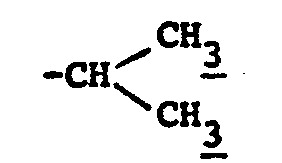
- MS m/e : 501 (M++1), 500 (M+), 483, 482, 426, 411, 365, 356, 325, 297, 279, 189, 187, 161, 136 (base peak), 135 121, 91, 71, 57
- Elementary analysis (as C29H40O7) Calc. (%): C 69.57 ; H 8.05 Found (%): C 69.63 ; H 8.16
- In 4 ml of methylene chloride was dissolved 235 mg of 11β,21-dihydroxy-6α-methyl-17α-propionyloxy-1,4-pregnadiene-3,20-dione obtained according to the method as described in Example 7. To this solution were added 120 mg of benzoyl chloride and 133 mg of pyridine, and the mixture was stirred for 22 hours at room temperature. The reaction liquid was then treated in the same manner as described in Example 8 whereupon 246 mg (yield: 84.3%) of the title compound was obtained. This compound was a colorless amorphous solid but was confirmed to be pure in view of its physical properties and results of various analyses shown below. TLC (silica gel): Rf 0.43 (single spot; benzene:ethanol = 10:1)
- IR

- NMRδCDCl3 : 1.00-1.23 (9H, m, -CH2CH3, C18 -CH 3 and C6a -CH3), 1 . 45 (3H , s , C19 -CH 3), 4.48 (1H, br, C11 -CH), 5.00 (2H, d, J=5Hz, C21 -CH2), 6.05 (lH, s, C4 -CH), 6.28 (1H, d, J=10HZ, C2 -CH), 7.23-8.18 (6H, m, C1 -CH and Ph)
- MS m/e : 535 (M++1), 534 (M+), 516, 460, 399, 325, 297, 279 161, 136, 135, 121, 106, 105 (base peak), 77
- Elementary analysis (as C32H38O7) Calc. (%): C 71.89 ; H 7.16 Found (%) : C 71.72 ; H 7.30
- In 2 ml of methylene chloride was dissolved 65 mg of 17a-butyryloxy-11β,21-dihydroxy-6α-methyl-1,4 -pregnadiene-3,20-dione obtained according to the method as described in Example 1-(a). To this solution were dissolved 0.2 ml of pyridine and 0.2 ml of acetic anhydride, and the mixture was stirred for 6 hours at room temperature. To the mixture was added 2 ml of methanol, and the whole was stirred for further 2 hours. Ethyl acetate (50 ml) was added to the reaction liquid and the mixture was treated in the same manner as described in Example 6 whereupon 56 mg (yield: 78.9%) of the title compound was obtained as colorless fine needle crystals. Shown below are physical properties and various analytical data of this compounds.
- M.P. 158.5 - 160.5°C
- TLC (silica gel): Rf 0.38 (single spot; benzene:ethanol = 10:1)
- IR

- NMRδCDCl3 : 0.96 (3H, t, J=7Hz, CH2CH2CH3), 1.06 (3H, s, C18 -CH3), 1.15 (3H, d, J=6Hz, C6a -CH3), 1.48 (3H, s, C19 -CH3), 2.19 (3H, s, COCH3), 4.48 (lH, br, C11 -CH), 4.79 (2H, d, J=4Hz, C21 -CH2), 6.03 (lH, s, C4 -CH), 6.26 (lH, d, J=lOHz, C2 -CH), 7.31 (lH, d, J=10Hz, C1 -CH)
- MS m/e : 487 (M++1), 486 (M+), 469, 398, 383, 356, 325, 297, 279, 263, 189, 161, 136 (base peak), 135, 121, 91, 71, 43
- Elementary analysis (as C28H38O7) Calc. (%): C 69.12 ; H 7.87 Found (%): C 68.83 ; H 7.95
- In 2 ml of methylene chloride was dissolved 145 mg of 17a-butyryloxy-11β,21-dihydroxy-6α-methyl-1,4-pregnadiene-3,20-dione obtained according to the method as described in Example 1-(a). To this solution were added 210 mg of pyridine and 150 mg of propionic anhydride, and the mixture was stirred for 24 hours at room temperature. To this reaction liquid was added 50 ml of ethyl acetate, and the liquid mixture was washed successively with 30 ml of water, 10 ml of a 1% solution of sodium carbonate, 30 ml of water, 10 ml of 1% hydrochloric acid and twice 30 ml of water and then dried over anhydrous sodium sulfate. The mixture was filtered and the filtrate was concentrated to obtain a crude product which was then purified by means of preparative thin layer chromatography (silica gel) and recrystallized from acetone-hexane whereby 145 mg (yield: 88.8%) of the title compound was obtained as colorless needle crystals.
- M.P. 121.0 - 122.5°C
- TLC (silica gel): Rf 0.41 (single spot; benzene:ethanol = 10:1)
- IR

- NMRδCDCl3 : 1.02 (6H, t, J=7Hz, CH2CH3x2), 1.02 (3H, s, C18 -CH3), 1.18 (3H, d, J=6Hz, C6a -CH3), 1.44 (3H, s, C19 -CH3), 4.48 (1H, br, C11 -CH), 4.73 (2H, d, J=5Hz, C21 -CH2), 6.00 (1H, s, C4 -CH), 6.24 (lH, d, J=lOHz, C2 -CH), 7.30 (lH, d, J=lOHz, C1 -CH)
- MS m/e : 501 (M++1), 500 (M+), 482, 413, 325, 297, 279, 161, 136 (base peak), 135, 121
- Elementary analysis (as C29H40O7) Calc. (%): C 69.57 ; H 8.05 - Found (%): C 69.71 ; H 8.16
- In 2 ml of methylene chloride was dissolved 105 mg of 17α-butyryloxy-11β,21-dihydroxy-6α-methyl-1,4-pregnadiene-3,20-dione obtained according to the method as described in Example 1-(a). To this solution were added 187 mg of butyric anhydride and 186 mg of pyridine, and the mixture was stirred for 24 hours at room temperature. To this reaction liquid was added 50 ml of ethyl acetate, and the ethyl acetate solution was washed successively with 30 ml of water, 2 ml of a 10% solution of sodium carbonate, 30 ml of water, 2 ml of 10% hydrochloric acid and twice 30 ml of water and dried over anhydrous sodium sulfate. The solution was filtered and the filtrate was concentrated to obtain a crude product which was then subjected to preparative thin layer chromatography (silica gel) for purification and then recrystallized from acetone-hexane whereby 115 mg (yield: 95.4%) of the title compound was obtained as colorless needle crystals. Shown below are physical properties and various analytical data of this compound.
- M.P. 142.0 - 144.0°C
- TLC (silica gel): Rf 0.42 (single spot; benzene:ethanol = 10:1)
- IR

- NMRδCDCl3 : 0.97 (3H, s, C18 -CH3), 1.07 (6H, s, -CH2CH3x2), 1.15 (3H, d, J=6Hz, C6α -CH3), 1.48 (3H, s, C19 -CH3), 4.53 (lH, br, C11 -CH), 4.80 (2H, d, J=5Hz, C21 -CH 2), 6.09 (lH, s, C4 -CH), 6.32 (lH, d, J=10Hz, C2 -CH), 7.34 (1H, d, J=10Hz, C1 -CH)
- MS m/e : 515 (M++1), 514 (M+), 496, 427, 297, 279, 161, 136 135, 121, 71 (base peak)
- Elementary analysis (as C30H42O7) Calc. (%): C 70.01 ; H 8.23 Found (%): C 70.18 ; H 8.43
- In 4 ml of methylene chloride was dissolved 180 mg of 11β,21-dihydroxy-17α-isobutyryloxy-6α-methyl-1,4-pregnadiene-3,20-dione obtained according to the method as described in Example 2-(a). To this solution were added 200 mg of triethyl- amine and 102 mg of acetic anhydride, and the mixture was stirred for 7 hours at room temperature. To the reaction liquid was added 2 ml of methanol, and the mixture was stirred for further 2 hours and then concentrated under reduced pressure.
- The resultant residue was subjected to preparative thin layer chromatography (silica gel) for purification and then recrystallized from ether-hexane whereby 158 mg (yield: 81.0%) of the ti,tle compound was obtained as colorless platelet crystals.
- Shown below are physical properties and various analytical data of this compound.
- M.P. 141.5 - 143.5°C
- TLC (silica gel): Rf 0.39 (single spot; benzene:ethanol = 10:1)
- IR

- NMRδCDCl3 : 1.03 (3H, s, C18-CH3), 1.10 (3H, m, C6α -CH3), 1.13 (6H, d, J=8Hz,

- MS m/e : 487 (M++1), 486 (M+), 469, 468, 413, 398, 351, 325, 297, 279, 263, 161, 136, 135, 121, 91, 71, 43 (base peak)
- Elementary analysis (as C28H38O7) Calc. (%) : C -69.11 ; H 7.87 Found (%): C 68.91 ; H 8.00
- In 4 ml of methylene chloride was dissolved 160 mg of 17α-butyryloxy-11β,21-dihydroxy-6α-methyl-1,4-pregnadiene-3,20-dione obtained according to the method as described in Example 1-(a). To this solution were added 171 mg of isobutyric anhydride and 174 mg of diethylmethylamine, and the mixture was stirred for 18 hours at room temperature. The reaction liquid was concentrated under reduced pressure and the resultant residue was subjected to preparative thin layer chromatography for purification and then recrystallized from ether-hexane whereby 165 mg (yield: 89.2%) of the title compound was obtained as colorless platelet crystals. Shown below are physical properties and various analytical data of this compound. M.P. 154.5 - 156.5°C
- TLC (silica gel): Rf 0.43 (single spot; benzene:ethanol = 10:1)
- IR

- NMRδCDCl3 : 0.95 (3H, m, CH2CH2CH3), 1.05 (3H, s, C18 -CH3), 1.23 (6H, d, J=6Hz,

- ,-MS m/e : 515 (M++1), 514 (M+), 497, 496, 426, 379, 356, 325, 309, 297,:279, 205, 189, 187, 161, 136, 135, 121, 91, 71 (base peak)
- Elementary analysis (as C30H42O7) Calc. (%) : C 70.01 ; H 8.23 Found (%): C 70,03 ; H 8.42
- In 5 ml of benzene was dissolved 120 mg of 11β,21-dihydroxy-17α-isobutyryloxy-6α-methyl-1,4-pregnadiene-3,20-dione obtained according to the method as described in Example 2-(a). To this solution were added 130 mg of propionic anhydride and 0.5 ml of pyridine, and the mixture was stirred for 24 hours at room temperature. The reaction mixture was treated in the same manner as described in Example 6 and the resultant crude product was recrystallized from acetone-hexane whereby 120 mg (yield: 88.7%) of the title compound was obtained as colorless needle crystals. Shown below are physical properties and various analytical data of this compound.
- M.P. 128.0 - 131.0°C
- TLC (silica gel): Rf 0.41 (single spot; benzene:ethanol = 10:1)
- IR
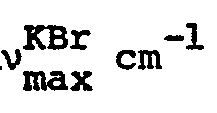
- NMRδCDCl3 : 1.08-1.32 (15H, m,

- MS m/e : 501 (M++1), 500 (M+), 482 (M+-18), 413, 297, 279, 161, 136 (base peak), 135, 121
- Elementary analysis (as C29H40O7) Calc. (%): C 69.57 ; H 8.05 Found (%): C 69.72 ; H 8.09
- In 5 ml of benzene was dissolved 222 mg of 11β,21-dihydroxy-17α-isobutyryloxy-6α-methyl-1,4-pregnadiene-3,20-dione obtained according to the method as described in Example 2-(a). To this solution were added 237 mg of isobutyric anhydride and 0.5 ml of pyridine, and the mixture was stirred for 24 hours at room temperature. The reaction liquid was treated in the same manner as described in Example 6 and 171 mg (yield: 66.4%) of the title compound was obtained as colorless needle crystals. Shown below are physical properties and various analytical data of this compound.
- M.P. 165.6 - 166.5°C
- TLC (silica gel): Rf 0.43 (single spot; benzene:ethanol = 10:1)
- IR

- NMRδCDCl3 : 1.05-1.27 (18H, m,

- MS m/e : 515 (M++1), 514 (M+), 496, 427, 297, 279, 161, 136 (base peak), 135, 121
- Elementary analysis (as C30H42O7) Calc. (%): C 70.01 ; H 8.23 Found (%): C 70.16 ; H 8.21
- In 4 ml of methylene chloride were dissolved 147 mg of 11β,21-dihydroxy-6α-methyl-17α-valeryloxy-1,4-pregnadiene-3,20-dione obtained according to the method as described in Example 3. To this solution were added 200 mg of triethylamine and 102 mg of acetic anhydride, and the mixture was stirred for 8 hours at room temperature. To the reaction liquid was added 1 ml of methanol, and the mixture was stirred for further 2 hours.
- The reaction liquid was concentrated under reduced pressure and the resultant residue was subjected to preparative thin layer chromatography (silica gel) for purification and then recrystallized from ether-hexane whereby 132 mg (yield: 82.5%) of the title compound was obtained as needle crystals. Shown below are physical properties and various analytical data of this compound.
- M.P. 175.0 - 177.0°C
- TLC (silica gel): Rf 0.40 (single spot; benzene:ethanol = 10:1)
- IR

- NMRδCDCl3 : 0.91-1.25 (3H, m, CH2CH2CH2CH3), 1.02 (3H, s, C18 -CH3), 1.12 (3H, d, J=7Hz, C6a -CH3), 1.48 (3H, s, C19 -CH3), 2.17 (3H, s, COCH3), 4.49 (lH, br, C11 -CH), 4.78 (2H, d, J=4Hz, C21 -CH2), 6.03 (lH, s, C4 -CH), 6.27 (lH, d, J=10Hz, C2 -CH), 7.29 (lH, d, J=10Hz, C1 -CH)
- MS m/e : 501 (M++1), 500 (M+), 482, 427, 398, 365, 325, 297, 279, 263, 189, 161, 136 (base peak), 135, 121, 91, 85, 73, 59, 57, 43
- Elementary analysis (as C 29 H 40 0 7) Calc. (%): C 69.57 ; H 8.05 Found (%): C 69.43 ; H 8.15
- In 4 ml of methylene chloride were dissolved 180 mg of 11β,21-dihydroxy-17α-isobutyryloxy-6α-methyl-1,4-pregnadiene-3,20-dione obtained according to the method as described in Example 2-(a). To this solution were added 200 mg of triethylamine and 158 mg of butyric anhydride, and the mixture was stirred for 20 hours at room temperature. To the reaction liquid was added 1 ml of methanol, and the mixture was stirred for further 2 hours. The reaction liquid was concentrated under reduced pressure and the resultant residue was subjected to preparative thin layer chromatography for purification and then recrystallized from ether-hexane whereby 168 mg (yield: 81.6%) of the title compound was obtained as colorless platelet crystals. Shown below are physical properties and various analytical data of this compound.
- M.P. 121.0 - 123.5°C
- TLC (silica gel): Rf 0.43 (single spot; benzene:ethanol = 10:1)
- IR

- NMRδCDCl3 : 1.00 (3H, m, CH2CH2CH3), 1.06 (3H, s, C18 -CH3), 1.14 (3H, m, C6a -CH3), 1.16 (6H, d, J=7Hz,

- MS m/e : 515 (M++1), 514 (M+), 497, 496, 426, 413, 379, 356, 325, 297, 279, 221, 205, 189, 161, 136, 135, 121, 91, 71, 43 (base peak)
- Elementary analysis (as C30H42O7) Calc. (%): C 70.01 ; H 8.23 Found (%): C 69.95 ; H 8.14
- In 5 ml of benzene was dissolved 310 mg of 11β,21-dihydroxy-17a-isovaleryloxy-6a-methyl-1,4-pregnadiene-3,20-dione obtained according to the method as described in Example 4. To this solution were added 240 mg of propionic anhydride and 0.5 ml of pyridine, and the mixture was stirred for 20 hours at room temperature. The reaction liquid was treated in the same manner as described in Example 6 whereby 279 mg (yield: 80.1%) of the title compound was obtained as colorless needle crystals. Shown below are physical properties and various analytical data of this compound.
- M.P. 163.5 - 164.5°C
- TLC (silica gel): Rf 0.43 (single spot; benzene:ethanol = 10:1)
- IR

- NMRδCDCl3 : 0.90-1.20 (15H, m,

- MS m/e : 515 (M++1), 514 (M+), 499, 356, 325, 297, 279, 161, 136 (base peak), 135, 121
- Elementary analysis (as C30H42O7) Calc. (%): C 70.01 ; H 8.23 Found (%): C 70.23 ; H 8.45
- In 3 ml of methylene chloride was dissolved 176 mg of 11β,21-dihydroxy-6α-methyl-17α-valeryloxy-l,4-pregnadiene-3,20-dione. To this solution were added 316 mg of pyridine and 250 mg of propionic anhydride, and the mixture was stirred for 24 hours at room temperature. Next, 50 ml of ethyl acetate was added to the reaction liquid and the liquid mixture was washed successively with 30 ml of water, 1 ml of a 10% solution of sodium carbonate, 30 ml of water, 2 ml of 10% HCl and 30 ml of water and then dried over anhydrous sodium sulfate. After filtration of the liquid mixture, the filtrate was concentrated and the resultant residue was subjected to preparative thin layer chromatography (silica gel) for purification whereby 165 mg (yield: 83.3%) of the title compound was obtained as colorless needle crystals. Shewn below are physical properties and various analytical data of this compound.
- M.P. 183.0 - 184.0°C
- TLC (silica gel): Rf 0.42 (single spot; benzene:ethanol = 10:1)
- IR

- NMRδCDCl3 : 1.00 (6H, t, J=8Hz, CH2CH3 x 2), 1.00 (3H, s, C18 -CH3), 1.16 (3H, d, J=6Hz, C6a -CH3), 1.42 (3H, s, C19 -CH3), 4.47 (lH, br, C11 -CH), 4.78 (2H, d, J=5Hz, C21 -CH2), 6.00 (lH, s, C4 -CH), 6.23 (1H, d, J=lOHz, C2 -CH), 7.30 (lH, d, J=lOHz; C1 -CH)
- MS m/e : 515 (M++1), 514 (M+), 496 (M+-18), 297, 279, 161, 136 (base peak), 135, 121,
- Elementary analysis (as C30H42O7) Calc. (%): C 70.01 ; H 8.23 Found (%): C 69.88 ; H 8.41
- In 4 ml of methylene chloride was dissolved 92 mg of 11β, 21-dihydroxy-17a-isovaleryloxy-6a-methyl-1,4-pregnadiene-3,20-dione.
- To this solution were added 200 mg of triethylamine and 102 mg of acetic anhydride, and the mixture was stirred for 8 hours at room temperature. To the reaction liquid was added 1 ml of methanol, and the mixture was stirred for further 2 hours.
- The reaction liquid was concentrated under reduced pressure and the resultant residue was subjected to preparative thin layer chromatography (silica gel)for purification and then recrystallized from ether-hexane whereby 87 mg (yield: 37.0%) of the title compound was obtained as colorless needle crystals. Shown below are physical properties and various analytical data of this compound.
- M.P. 178.5 - 180.5°C
- TLC (silica gel): Rf 0.39 (single spot; benzenezethanol = 10:1)
- IR
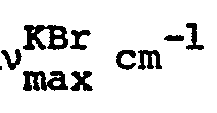
- NMRδCDCl3 : 0.91 (3H, m, C18 -CH3), 1.01 (6H, d, J=3Hz,

- MS m/e : 501 (M++1), 500 (M+), 483, 427, 398, 365, 325, 315, 297, 279, 263, 189, 187, 161, 136 (base peak), 135 121, 91, 85, 57, 43
- Elementary analysis (as C28H38O7) Calc. (%): C 69.12 ; H 7.87 Found (%): C 69.33 ; H 8.14
- In 4 ml of methylene chloride was dissolved 208 mg of 17a-acetoxy-118,21-dihydroxy-6a-methyl-1,4-pregnadiene-3,20-dione obtained according to the method as described in Example 6.
- To this solution was added 0.5 ml of pyridine, and the mixture was ice-cooled. To the mixture was added slowly a solution of 241 mg of valeryl chloride in 2 ml of methylene chloride, and the mixture was stirred for one hour. To this reaction liquid was added 60 ml of ethyl acetate, and the mixture was washed successively with 30 ml of water, 10 ml of a dilute aqueous solution of sodium carbonate, 30 ml of water, 5 ml of dilute hydrochloric acid and twice 30 ml of water and dried over anhydrous sodium sulfate. After filtration, the filtrate was concentrated and the resultant residue was subjected to preparative thin layer chromatography (silica gel) for purification whereby 186 mg (yield: 87.4%) of the title compound was obtained as colorless needle crystals (recrystallized from ether-hexane). Shown below are physical properties and various analytical data of this compound.
- M.P. 148.0 - 150.0°C
- TLC (silica gel): Rf 0.42 (single spot; benzene:ethanol = 10:1)
- IR

- NMRδCDCl3 : 0.93 (3H, m, CH2CH2CH2CH3), 1.03 (3H, s, C18 -CH3), 1.12 (3H, d, J=7Hz, C6a -CH3), 1.46 (3H, s, C19 -CH3), 2.05 (3H, s, COCH3), 4.49 (1H, br, C11 -CH), 4.76 (2H, d, J=4Hz, C21 -CH2), 6.03 (lH, s, C4 -CH), 6.27 (1H, d, J=10Hz, C2-CH), 7.29 (lH, d, J=10Hz, C1 -CH)
- MS m/e : 501 (M++1), 500 (M+), 483 (M+-17), 482 (M+-18), 440, 425, 356, 325, 297, 279, 189, 161, 136 (base peak), 135, 121, 85, 57, 43
- Elementary analysis (as C29H40O7) Calc. (%): C 69.57 ; H 8.05 Found (%): C 69.60 ; H 8.15
- In 4 ml of methylene chloride was dissolved 208 mg of 11β, 21-dihydroxy-17α-acetoxy-6α-methyl-1,4-pregnadiene-3,20-dione obtained according to the method as described in Example 6. To this solution was added 202 mg of triethylamine and the solution was cooled externally with ice., To this solution was added slowly a solution of 120 mg of isovaleryl chloride in 1 ml of methylene chloride, and the mixture was stirred for 1.5 hours.
- To the reaction liquid was added 1 ml of methanol, and the mixture was further stirred for one hour. The reaction liquid was concentrated under reduced pressure and the resultant residue was directly subjected to preparative thin layer chromatography (silica gel) for purification and then recrystallized from ether-hexane whereby 195 mg (yield: 78.0%) of the title compound was obtained as colorless fine needle crystals. Shown below are physical properties and various analytical data of this compound. M.P. 126.5 - 129.5°C
- TLC (silica gel): Rf 0.41 (single spot; benzene:ethanol = 10:1)
- IR

- NMRδCDCl3 : 0.92 (3H, s, C18 -CH3), 1.03 (6H, s-like,

- MS m/e : 501 (M++1), 500 (M+), 483, 482, 440, 425, 356, 325, 297, 279, 189, 161, 136 (base peak), 135, 121, 85, 57, 43
- Elementary analysis (as C29H40O7) Calc. (%): C 69.57 ; H 8.05 Found (%): C 69.46; H 8.10
- In 4 ml of methylene chloride was dissolved 215 mg of 11β,21-dihydroxy-6α-methyl-17α-propionyloxy-1,4-pregnadiene-3,20-dione obtained according to the method as described in Example 7. To this solution was added 348 mg of diethylmethylamine, and the mixture was cooled externally with ice. To the solution was slowly added 240 mg of valeryl chloride, and the mixture was stirred for 1.5 hours. To the reaction liquid was added 2 ml of methanol, and the mixture was further stirred for 2 hours. The reaction liquid was concentrated under reduced pressure and the resultant residue was subjected directly to preparative thin layer chromatography (silica gel) for purification and then recrystallized from ether-hexane whereby 204 mg (yield: 79.4%) of the title compound was obtained as colorless platelet crystals. Shown below are physical properties and various analytical data of this compound.
- M.P. 141.5 - 143.0°C
- TLC (silica gel): Rf 0.43 (single spot; benzene:ethanol = 10:1)
- IR

- NMRδCDCl3 : 0.94-1.25 (6H, m, CH2CH3 and CH2CH2CH2CH3), 1.07 (3H, s, C18 -CH3), 1.14 (3H, d, J=6Hz, C6α -CH3), 1.48 (3H , s , C19 -CH3), 4.49 (1H, br, C11 -CH), 4.79 (2H, d, J=4Hz, C21 -CH2), 6.03 (1H, s, C4-CH), 6.28 (lH,.d, J=10Hz, C2 -CH), 7.32 (lH, d, J=10Hz, C1 -CH)
- MS m/e : 515 (M++1), 514 (M+), 497, 496, 440, 425, 399, 379, 356, 338, 297, 279, 189, 187, 161, 136 (base peak), 135, 91, 85, 57
- Elementary analysis (as C30H42O7) Calc. (%): C 70.01; H 8.23 Found (%): C 69.79 H 8.07
- In 4 ml of methylene chloride was dissolved 215 mg of 11β, 21-dihydroxy-6α-methyl-17α-propionyloxy-1,4-pregnadiene-3,20-dione obtained according to the method as described in Example 7. To this solution was added 202 mg of triethylamine, and the mixture was stirred under external ice-cooling. To this solution was added slowly 120 mg of isovaleryl chloride, and the mixture was stirred for one hour. After the addition of 1 ml of methanol, the mixture was further stirred for one hour. The reaction liquid was concentrated under reduced pressure and the resultant residue was subjected directly to preparative thin layer chromatography (silica gel) for purification and then recrystallized from ether-hexane whereby 211 mg (yield: 82.1%) of the title compound was obtained as colorless platelet crystals. Shown below are physical properties and various analytical data of this compound.
- M.P. 124.5-126.0°C
- TLC (silica gel): Rf 0.42 (single spot; benzene:ethanol = 10:1)
- IR

- NMRδCDCl3 : 0.93 (3H, s, C18 -CH3), 0.95-1.21 (6H, m, C6α -CH3 and CH2CH3), 1.02 (6H, s,

- MS m/e : 515 (M++1), 514 (M+), 497, 496, 440, 425, 399, 379, 356, 338, 325, 297, 279, 189, 187, 161, 136 (base peak), 135, 121, 91, 85, 57
- Elementary analysis (as C 30 H 42 0 7) Calc. (%): C 70.01 ; H 8.23 Found (%): C 69.86 ; H 8.35
- In 4 ml of methylene chloride was dissolved 215 mg of 11β,21-dihydroxy-6a-methyl-17a-propionyloxy-1,4-pregnadiene-3,20-dione. To this solution were added 180 mg of methoxyacetic acid and 412 mg of N,N'-dicyclohexylcarbodiimide, and the mixture was stirred for 48 hours at room temperature. The solvent was distilled off and 50 ml of ethyl acetate was added to the residue. The mixture was washed with 2 ml of a dilute aqueous solution of Na2CO3 and 20 ml of water. The ethyl acetate layer was washed twice with 20 ml of water, dried over anhydrous sodium sulfate and then filtered. The filtrate was concentrated and the resultant residue was subjected to preparative thin layer chromatography whereby 184 mg (yield: 73.3%) of the title compound was obtained. This compound was a colorless amorphous solid but its structure was confirmed as a result of the following analyses:
- IR

- NMRδCDCl3 : 1.06 (3H, s, C18 -CH3), 1.20 (3H, t, J=7.0Hz, -CH2CH3), 1.22 (3H, d, J=6Hz, C6a -CH3), 1.46 (3H, s, C19 -CH3), 3.48 (3H, s, OCH3), 4.20 (2H, s, COCH20)
- MS m/e : 503 (M++1), 502 (M+), 484, 428, 297, 279, 136 (base peak), 135, 91, 74, 73, 57, 45
- Elementary analysis (as C28H38O8) Calc. (%): C 66.91; H 7.62 Found (%): C 67.17; H 7.53
- Using 222 mg of 17a-butyryloxy-11β,21-dihydroxy-6α-methyl-1,4-pregnadiene-3,20-dione obtained according to the method as described in Example 1-(a), the reaction with methoxyacetic acid was carried out in the same manner as described in Example 29 and the after-treatment was also carried out similarly to obtain the title compound. This crude product was then recrystallized from ether-hexane to give 179 mg (yield: 69.4%) of the pure product as colorless needle crystals.
- M.P. 111.5 - 113.0°C
- IR
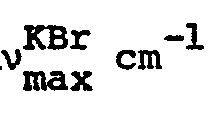
- NMRδCDCl3 : 0.92-1.08 (3H, m, CH2CH2CH3), 1.04 (3H, s, C18 -CH3), 1.10 (3H, d, J=6Hz, C6α -CH3), 1.44 (3H, s, C19 -CH3), 3.48 (3H, s, OCH3), 4.18 (2H, s, COCH20)
- MS m/e : 517 (M++1), 516 (M+), 499, 498, 325, 297, 279, 161, 136 (base peak), 135, 121, 91, 71, 45
- Elementary analysis (as C29H40O8) Calc. (%): C 67.42; H 7.80 Found (%): C 67.37; H 7.85
- Using 215 mg of 11β,21-dihydroxy-17α-isobutyryloxy-6α-methyl-1,4-pregnadiene-3,20-dione obtained according to the method as described in Example 2-(a), the reaction with methoxyacetic acid was carried out in the same manner as described in Example 29 and the after-treatment was also carried out similarly to obtain the title compound. This crude product was recrystallized from ether-hexane to give 192 mg (yield: 77.4%) of the pure product.
- M.P. 119.0 - 121.0°C
- IR

- NMRδCDCl3 : 1.07 (3H, s, C18 -CH3), 1.12 (6H, d, J=8Hz, CH(CH3)2 ), 1.48 (3H, s, C19 -CH3), 3.47 (3H, s, OCH3); 4.17 (2H, COCH20)
- MS m/e : 517 (M++1), 516 (M+), 498, 427, 325, 297, 279, 161, 136 (base peak), 135, 73, 71, 45
- Elementary analysis (as C29H40O8) Calc. (%): C 67.42 ; H 7.80 Found (%): C 67.28 ; H 7.93
- In 4 ml of dimethylformamide was dissolved 748 mg of 6a--methylprednisolone. To this solution was added 768 mg of ethyl orthomethoxyacetate, and the mixture was heated at 75°C under an argon current. To the reaction liquid was then added 17 mg of anhydrous p-toluenesulfonic acid, and the mixture was stirred for 2 hours at the same temperature. The reaction mixture was then treated in the same manner as described in Example 1-(a) whereby 826 mg (yield: 87.1%) of 6a-methylprednisolone 17α,21- ethyl orthomethoxyacetate was obtained as colorless needle crystals. This compound was a mixture of its stereoisomers.
- The ethyl orthomethoxyacetate used in this Example was obtained by reacting methoxyacetonitrile with hydrogen chloride in dry ethanol and then treating the resultant ethyl iminoether hydrochloride with ethanol. B.P. 177.0 - 180.0°C.
- In 8 ml of methanol was dissolved 237 mg of the above 6a-methylprednisolone 17a,21-ethyl orthomethoxyacetate. To this solution was 1 ml of 2N-oxalic acid, and the mixture was warmed at 40°C for 10 minutes. The solvent was removed by distillation under reduced pressure and the residue was treated in the same manner as described in Example 1-(b) whereby 138 mg (yield: (1.9%) of the title compound was obtained as a colorless amorphous solid. The structure of this compound was confirmed by the following analytical results:
- IR

- NMδCDCl3 : 1.10 (3H, s, C18 -CH3), 1.26 (3H, d, J=6Hz, C6α -CH3), 1.47 (3H, s, C19 -CH3), 3.39 (3H, s, OCH3), 4.00 (2H, s, COCH2O), 4.35 (2H, s, C21 -CH2), 4.51 (1H, br.s, C11 -CH), 6.08 (1H, s, C4 -CH), 6.33 (1H, d, J=10Hz, C2 -CH), 7.26 (1H, d, J=10Hz, C1 -CH)
- MS m/e : 447 (M++1), 446 (M+), 428, 357, 298, 161, 136 (base peak), 135, 121, 45
- Elementary analysis (as C25H34O7) Calc. (%): C 67.25; H 7.67 Found (%): C 67.01; H 7.81
- - in 4 ml of methylene chloride was dissolved 223 mg of 11β,21-dihydroxy-17α-methoxyacetoxy-6α-methyl-1,4-pregnadiene-3,20-dione Obtained, according to the method as described in Example 32. To this solution were added 404 mg of triethylamine and 204 mg of acetic anhydride, and the mixture was stirred for 5 hours at room temperature. The reaction mixture was then treated in the same manner as described in Example 7 whereby 186 mg (yield: 76.2%) of the title compound was obtained as colorless needle crystals.
- M.P. 149.5 - 151.5°C
- IR

- NMRδCDCl3 : 1.05 (3H, s, C18 -CH3), 1.13 (3H, d, J=6Hz, C6a -CH 3), 1.48 (3H, s, C19 -CH3), 2.14 (3H, s, COCH3), 3.42 (3H, s, OCH3), 3.99 (2H, s, COCH20)
- MS m/e : 489 (M++1), 488 (M+), 470, 398, 325, 297, 279, 161, 136 (base peak), 135, 121, 45, 43
- Elementary analysis (as C27H36O8) Calc. (%): C 66.38 ; H 7.43 Found (%): C 66.30 ; H 7.56
- In 2 ml of methylene chloride was dissolved 223 mg of 11β,21-dihydroxy-17α-methoxyacetoxy-6α-methyl-1,4-pregnadiene-3,20-dione obtained according to the method as described in Example 32. To this solution were added 404 mg of triethylamine and 208 mg of propionic anhydride, and the mixture was stirred for 5 hours at room temperature. The reaction mixture was then treated in the same manner as described in Example 7 whereby 157 mg (yield: 62.5%) of the title compound was obtained as colorless needle crystals.
- M.P. 114.5 - 116.5°C
- IR

- NMRδCDCl3 : 1.06 (3H, s, C18 -CH3), 1.17 (3H, m, CH2CH3), 1.22 (3H, d, J=6Hz, C6a -CH3), 1.47 (3H, s, C 19 -CH 3), 3.40 (3H, s, OCH3), 4.00 (2H, s, COCH2O)
- MS m/e : 503 (M++1), 502 (M+), 484, 412, 398, 325, 297, 279, 161, 136 (base peak), 135, 121, 57, 45
- Elementary analysis (as C28H38O8) Calc. (%): C 66.91 ; H 7.62 Found (%): C 67.13 ; H 7.58
- In 2 ml of methylene chloride was dissolved 223 mg of 11β,21-dihydroxy-17α-methoxyacetoxy-6α-methyl-1,4-pregnadiene-3,20-dione obtained according to the method as described in Example 32. To this solution were added 404 mg of triethylamine and 253 mg of butyric anhydride, and the mixture was stirred for 5 hours at room temperature. The reaction mixture was then treated in the same manner as described in Example 7 whereby 178 mg (yield: 69.0%) of the title compound was obtained as colorless needle crystals.
- M.P. 132.0 - 133.5°C
- IR

- NMRδCDCl3 : 1.10 (3H, s, C18 -CH3),: 1.15 (3H, m, CH2CH3), 1.47 (3H, s, C19 -CH3), 3.42 (3H, s, OCH3), 4.00 (2H, s, COCH2O)
- MS m/e : 517 (M++1), 516 (M+), 498 (M+-18), 426, 412, 356, 297, 279, 136 (base peak), 135, 121, 71, 45
- Elementary analysis (as C29H40O8) Calc. (%): C 67.42 ; H 7.80 Found (%): C 67.48; H 7.71
- In 2 ml of methylene chloride was dissolved 223 mg of 11β,21-dihydroxy-17α-methoxyacetoxy-6α-methyl-1,4-pregnadiene-3,20-dione obtained according to the method as described in Example 32. To this solution were added 404 mg of triethylamine and 253 mg of isobutyric anhydride, and the mixture was stirred for 5 hours at room temperature. The reaction mixture was then treated in the same manner as described in Example 7 whereby 168 mg (yield: 65.1%) of the title compound was obtained as colorless needle crystals.
- M.P. 148.0 - 149.5°C
- IR

- NMRδCDCl3 : 1.10 (3H, s, C18 -CH3), 1.23 (6H, d, J=7Hz, CH(CH3)2 ), 1.48 (3H, s, C19 -CH3), 3.42 (3H, s, OCH3), 4.01 (2H, s, COCH20)
- MS m/e : 517 (M++1), 516 (M+), 498, 426, 325, 297, 279, 136 (base peak), 135, 121, 71, 45
- Elementary analysis (as C29H40O8) Calc. (%): C 67.42 ; H 7.80 Found (%): C 67.28 ; H 7.97
- In 4 ml of methylene chloride was dissolved 223 mg of 11β,21-dihydroxy-17α-methoxyacetoxy-6α-methyl-1,4-pregnadiene-3,20-dione obtained according to the method as described in Example 32. To this solution were added 216 mg of methoxyacetic acid and 453 mg of N,N'-dicyclohexylcarbodiimide, and the mixture was stirred for 46 hours at room temperature. The reaction mixture was then treated in the same manner as described in Example 29 whereby 157 mg (yield: 60.6%) of the title compound was obtained. This compound was a colorless amorphous solid but its structure was confirmed by the following analytical results:
- IR

- NMRδCDCl3 : 1.06 (3H, s, C18 -CH3), 1.12 (3H, d, J=6Hz, C6α-CH3), 1.43 (3H, s, C19 -CH3), 3.42 (3H, s, C17 -OCOCH2OCH3), 3.49 (3H, s, C 21 -OOOCH2OQH3), 4.00 (2H, s, C17 -COOCH2), 4.20 (2H, s, C 21 -OCOCH2)
- MS m/e : 519 (M++1), 518 (M+), 500, 428, 325, 297, 279, 161 136 (base peak), 135, 121, 60, 45
- Elementary analysis (as C28H38O9) Calc. (%): C 64.85; H 7.39 Found (%): C 64.91; H 7.27
- In 4 ml of methylene chloride was dissolved 235 mg of 116,21-dihydroxy-6a-methyl-17a-propionyloxy-1,4-pregnadiene-3,20-dione obtained according to the method as described in Example 7. To this solution were added 202 mg of triethylamine and 266 mg of methylthioacetic anhydride, and the mixture was stirred for one hour at room temperature. The reaction mixture was then treated in the same manner as described in Example 7 whereby 207 mg (yield: 72.6%) of the title compound was obtained as colorless needle crystals.
- M.P. 126.0 - 127.5°C
- IR

- NMRδCDCl3 : 1 . 06 (3H, s, C18 -CH3), 1.12 (3H, t, J=8Hz, CH2CH3) 1.46(3H , s , C19 -CH 3), 2.25 (3H, s, SCH3), 3.31 (2H, s, COCH2S)
- -MS m/e : 519 (M++1), 518 (M+), 426, 356, 325, 297, 279, 161, 136 135, 121, 61 (base peak), 57
- Elementary analysis (as C28H38O7S) Calc. (%): C 64.84; H 7.38 Found (%): C 64.63 ; H 7.31
- Using 335 mg of 17α-butyryloxy-11β,21-dihydroxy-6α-methyl-1,4-pregnadiene-3,20-dione obtained according to the method as described in Example 1-(a), the reaction with methylthioacetic anhydride was carried out in the same manner as described in Example 38, and the reaction mixture was treated in the same , manner as described in Example 7 whereby 294 mg (yield: 73.7%) of the title compound was obtained as colorless needle crystals.
- M.P. 173.0- 174.0°C
- IR

- NMRδCDCl3 : 1.07 (3H, s, C18 -CH3), 1.48 (3H, s, C19 -CH3), 2.25 (3H, s, SCH3), 3.34 (2H, s, COCH2S)
- MS m/e : 533 (M++1), 532 (M+), 443, 429, 425, 397, 325, 297, 279, 161, 136, 135, 121, 71, 61 (base peak)
- Elementary analysis (as C29H40O7S) Calc. (%): C 65.39 ; H 7.57 Found (%): C 65.52; H 7.55
- Using 80 mg of 11β,21-dihydroxy-17α-isobutyryloxy-6α-methyl-1,4-pregnadiene-3,20-dione obtained according to the method as described in Example 2-(a), the reaction with methylthioacetic anhydride was carried out in the same manner as described in Example 38, and the reaction mixture was treated in the same manner as described in Example 7 whereby 86 mg (yield: 89.6%) of the title compound was obtained as colorless needle crystals.
- M.P. 136.0 - 138.0°C
- IR

- NMRδCDCl3 : 1.05 (3H, s, C18 -CH3), 1.12 (6H, d, J=8Hz, CH(CH3)2), 1.46 (3H, s, C19 -CH3), 2.25 (3H, s, SCH3), 3.31 (2H, s, COCH2S)
- MS m/e : 533 (M++1), 532 (M+), 429, 325, 297, 279, 161, 136, 135, 121, 71, 61 (base peak)
- Elementary analysis (as C29H40O7S) Calc. (%): C 65.39 ; H 7.57 Found (%): C 65.26 ; H 7.65
- Using 150 mg of 11β,21-dihydroxy-17α-methoxyacetoxy-6α-methyl-1,4-pregnadiene-3,20-dione obtained according to the method as described in Example 32, the reaction with methylthioacetic anhydride was carried out in the same manner as described in Example 38 and the reaction mixture was treated in the same manner as described in Example 7 whereby 123 mg (yield: .68.3%) of the title compound was obtained as a colorless amorphous solid. The structure of this compound was confirmed by the following analytical results:
- IR

- NMRδCDCl3 : 1.10 (3H, s, C18 -CH3), 1.22 (3H, d, J=6Hz, C6α-CH3),; 1.48 (3H, s, C19 -CH3), 2.28 (3H, s, SCH3), 3.37 (2H, s, COCH2S), 3.46 (3H, s, OCH3), 4.03 (2H, s, COCH20)
- MS m/e :535 (M++1) , 534 (M+), 445, 356, 325, 297, 279, 161, 136, 135, 121, 61, 45 (base peak)
- Elementary analysis (as C28H38O8S) Calc. (%): C 62.90 ; H 7.16 Found (%): C 63.04 ; H 7.09
- In 8 ml of dimethylformamide was dissolved 1.88 g of 6α-methylprednisolone. To this solution was added 1.6 g of ethyl orthomethylthioacetate, and the mixture was heated at 75°C under an argon current. To this reaction liquid was then added 43 mg of anhydrous p-toluenesulfonic acid, and the mixture was stirred for one hour at the same temperature. The reaction mixture was then treated in the same manner as described in Example 1-(a) whereby 2.15.g (yield: 87.8%) of 6a-methylprednisolone 17a,21-ethyl orthomethylthioacetate was obtained as colorless needle crystals.
- M.P. 184.0 - 186.0°C
- IR

- NMRδCDCl3 : 0.87 (3H, s, C18 -CH3), 1.10 (3H, t, J=7Hz, CH2CH3)' 1.12 (3H, d, J=6Hz, C6α-CH3), 1.47 (3H, s, C19 -CH 3), 2.16 (3H, s, SCH3), 2.84 (2H, s,COCH2SCH3), 3.57 (2H, q, J=7Hz, CH2CH3)
- MS-m/e : 491 (H++1), 490 (M+), 445, 429, 357, 297, 279, 161 136, 135 (base peak), 121, 61
- Elmentary analysis (as C27H38O6S) Calc. (%): C 66.09 ; H 7.81 Found (%): C 66.13 ; H 7.75
- To 6 ml of methanol was dissolved 210 mg of the above 6a-methylprednisolone 17a,21-ethyl orthomethylthioacetate. To this solution was added 0.5 ml of 2N-oxalic acid, and the mixture was stirred for 10 minutes at 40°C. The solvent was removed by distillation under reduced pressure and the residue was treated in the same manner as described in Example 1-(b) whereby 143 mg (yield: 71.9%) of the title compound was obtained as a colorless amorphous solid. The structure of this compound was confirmed by the following analytical results:
- IR

- NMRδCDCl3 : 0.98 (3H, s, C18 -CH3), 1.12 (3H, d, J=6Hz, C6α -CH3), 1.48 (3H, s, C19 -CH3), 2.16 (3H, s, SCH3), 3.15 (2H, s, COCH2S)
- MS m/e : 463 (M++1), 462 (M+), 444, 431, 356, 325, 297, 279, 161, 136, 135, 121, 91, 61 (base peak)
- Elementary analysis (as C25H34O6S) Calc. (%): C 64.91 ; H 7.44 Found (%): C 65.03 ; H 7.38
- In 4 ml of methylene chloride was dissolved 180 mg of 11β,21-dihydroxy-6α-methyl-17α-methylthioacetoxy-1,4-pregnadiene-3,20-dione obtained according to the method as described in Exampel 42. To this solution were added methoxyacetic anhydride prepared separately from methoxyacetic acid and then triethylamine, - and the mixture was stirred for one hour at room temperature. The reaction mixture was then treated in the same manner as described in Example 7 whereby 259 mg (yield: 89.6%) of the title compound was obtained as colorless needle crystals.
- M.P. 112.0 - 114.0°C
- IR

- NMRδCDCl3 : 1.07 (3H, s, C18 -CH3), 1.28 (3H, d, J=6.5Hz, C6α -CH3), 1.49 (3H, s, C19 -CH3), 2.18 (3H, s, SCH3), 3.13 (2H, s, COCH2S), 3.47 (3H, s, COCH2OCH3), 4.20 (2H, s, COCH2OCH3)
- MS m/e : 535 (M++1), 534 (M+), 517, 516, 427, 413, 325, 297, 293, 279, 161, 136, 135, 121, 91, 61 (base peak), 45
- Elementary analysis (as C28H38O8S) Calc. (%): C 62.90 ; H 7.16 Found (%): C 62.82 ; H 7.25
- Using 250 mg of 11β,21-dihydroxy-6α-methyl-17α-methylthio- acetoxy-1,4-pregnadiene-3,20-dione obtained according to the method as described in Example 42, the reaction with methylthioacetic anhydride was carried out in the same manner as described in Example 38 and the reaction mixture was treated in the same manner as described in Example 7 whereby 215 mg (yield: 72.4%) of the title compound was obtained as colorless needle crystals.
- M.P. 175.0 - 177.0°C
- IR

- NMRδCDCl3 : 1.06 (3H, s, C18 -CH3), 1.15 (3H, d, J=4Hz, C6α-CH3), 1.47 (3H, s, C19 -CH3), 2.19 (3H, s, C7 -OCOCH2SCH3), 2.25 (3H, s, C21-OCOCH2SCH3) , 3.12 (2H, s, C17-OCOCH2S), 3.33 (2H, s, C21 -OCOCH2S)
- MS m/e : 551 (M++1), 550 (M+), 444, 426, 356, 325, 297, 279, 161, 136, 135, 121, 81 (base peak)
- Elementary analysis (as C28H38O7S2) Calc. (%): C 61.07 ; H 6.95 Found (%): C 61.22 ; H 6.82
- Using 232 mg of 11β,21-dihydroxy-6α-methyl-17α-methylthio- acetoxy-1,4-pregnadiene-3,20-dione obtained according to the method as described in Example 42, the reaction with acetic anhydride was carried out in the same manner as described in Example 7 and the reaction mixture was treated similarly whereby 213mg (yield: 84.5%) of the title compound was obtained as colorless needle crystals.
- M.P. 149.0 - 151.0°C
- IR

- NMRδCDCl3 : 1.03 (3H, s, C18 -CH3), 1.10 (3H, d, J=8Hz, C6α-CH3), 1.47 (3H, s, C19 -CH3), 2.15 (3H, s, SCH3), 2.19 (3H, s, COCH3), 3.12 (2H, s, COCH2S).
- MS m/e : 505 (M++1), 504 (M+), 356, 325, 297, 279, 161, 136 135, 121, 61 (base peak), 43
- Elementary analysis (as C27H36O7S) Calc. (%) : C 64.26 ; H 7.19 Found (%): C 64.47 ; H 7.14
- Example 46 11β-Hydroxy-6α-methyl-17α-methylthioacetoxy-21-propionyloxy-l,4-pregnadiene-3,20-dione
- Using 232 mg of 11β,21-dihydroxy-6α-methyl-17α-methylthio- acetoxy-1,4-pregnadiene-3,20-dione obtained according to the method as described in Example 42, the reaction with propionic anhydride was carried out in the same manner as described in Example 18 with exception that triethylamine was used instead of pyridine, and the reaction mixture was treated in the same manner as described in Example 7 whereby 224 mg (yield: 86.5%) of the title compound was obtained as colorless needle crystals. M.P. 117.0 - 119.0°C
- IR

- NMRδCDCl3 : 1.02 (3H, s, C18 -CH3), 1.15 (3H, t, J=8Hz, CH2CH3), 1.45 (3H, s, C19 -CH3), 2.16 (3H, s, SCH3), 3.12 (2H, s, COCH2S)
- MS m/e : 519 (M++1), 518 (M+), 500, 325, 297, 279, 161, 136 135, 121, 91, 61 (base peak), 57
- Elementary analysis (as C28H3807 S) Calc. (%): C 64.84 ; H 7.38 Found (%): C 64.92 ; H 7.61
- Using 232 mg of 11β,21-dihydroxy-6α-methyl-17α-methylthio- acetoxy-1,4-pregnadiene-3,20-dione obtained according to the method as described in Example 42, the reaction with butyric anhydride was carried out in the same manner as described in Example 10 and the reaction mixture was treated similarly whereby 231 mg (yield: 86.8%) of the title compound was obtained.
- M.P. 126.0 - 128.0°C
- IR

- NMRδCDCl3 : 1.00 (3H, s, C18 -CH3), 1.02 (3H, t, J=8Hz, CH2CH2CH3), 1.44 (3H, s, C19 -CH3), 2.18 (3H, s, SCH3), 3.10 (2H, s, COCH2S)
- MS m/e : 533 (M++1), 532 (M+), 514, 325, 297, 279, 161, 136, 135, 121, 91, 71, 61 (base peak)
- Elementary analysis (as C29H40O7S) Calc. (%): C 65.39 ; H 7.57 Found (%): C 65.51 ; H 7.30
- Using 232 mg of 11β,21-dihydroxy-6α-methyl-17α-methylthio- acetoxy-1,4-pregnadiene-3,20-dione, the reaction with isobutyric anhydride was carried out in the same manner as described in Example 11 and the reaction mixture was treated similarly whereby 224 mg (yield: 84.2%) of the title compound was obtained as colorless needle crystals.
- M.P. 151.0 - 152.0°C
- IR

- NMRδCDCl3 : 1.02 (3H, s, C18 -CH3), 1.22 (6H, d, J=7Hz, CH(CH3)2 ), 1.44 (3H, s, C19 -CH3),2.18 (3H, s, SCH3), 3.10 (2H, s, COCH2S)
- MS m/e : 533 (M++1), 532 (M+), 514, 356, 325, 297, 279, 161, 136, 135, 121, 91, 71, 61 (base peak)
- Elementary analysis (as C29H40O7S) Calc. (%): C 65.39 ; H 7.57 Found (%): C 65.47 ; H 7.49
Claims (14)


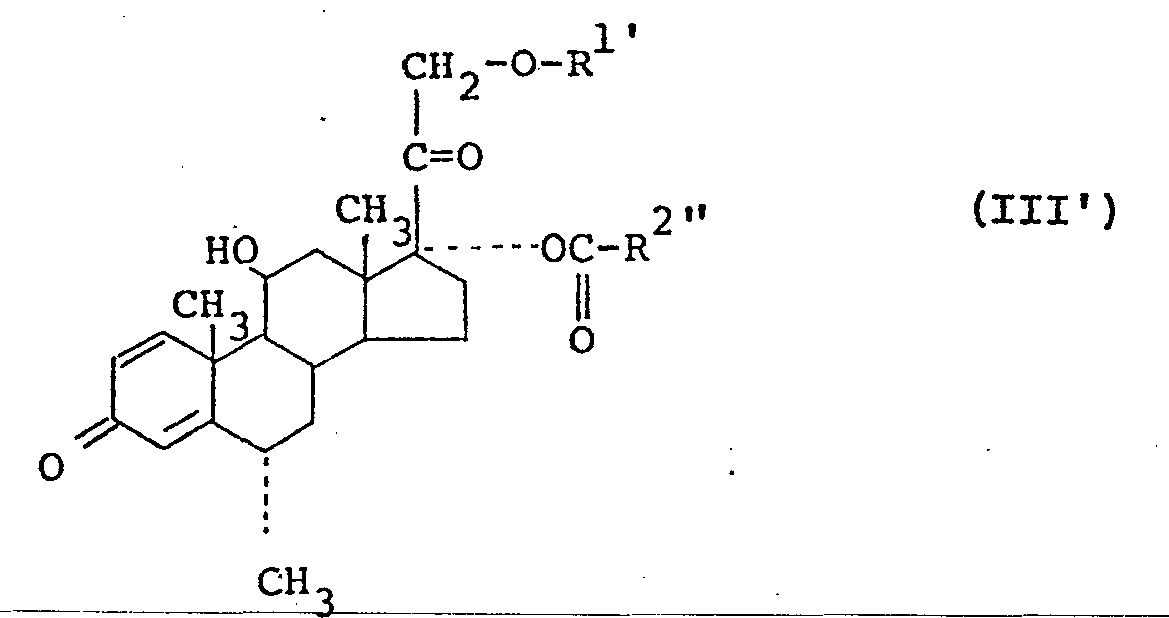

Applications Claiming Priority (6)
| Application Number | Priority Date | Filing Date | Title |
|---|---|---|---|
| JP91389/82 | 1982-05-31 | ||
| JP9138982A JPS58208299A (en) | 1982-05-31 | 1982-05-31 | 6alpha-methylprednisolone 17,21-diester |
| JP11401182A JPS597200A (en) | 1982-07-02 | 1982-07-02 | 6alpha-methylpredonisolone 17alpha-ester compound |
| JP114011/82 | 1982-07-02 | ||
| JP6687283A JPS59193900A (en) | 1983-04-15 | 1983-04-15 | Novel 6alpha-methylpredonisolone 17alpha-ester derivative |
| JP66872/83 | 1983-04-15 |
Publications (2)
| Publication Number | Publication Date |
|---|---|
| EP0095894A2 true EP0095894A2 (en) | 1983-12-07 |
| EP0095894A3 EP0095894A3 (en) | 1985-01-02 |
Family
ID=27299285
Family Applications (1)
| Application Number | Title | Priority Date | Filing Date |
|---|---|---|---|
| EP83303027A Ceased EP0095894A3 (en) | 1982-05-31 | 1983-05-25 | 6 alpha-methylprednisolone derivatives |
Country Status (3)
| Country | Link |
|---|---|
| US (1) | US4567172A (en) |
| EP (1) | EP0095894A3 (en) |
| ES (1) | ES8407066A1 (en) |
Cited By (8)
| Publication number | Priority date | Publication date | Assignee | Title |
|---|---|---|---|---|
| DE3344834A1 (en) * | 1983-12-08 | 1985-06-13 | Schering AG, 1000 Berlin und 4709 Bergkamen | NEW HYDROCORTISON AND PREDNISOLON DERIVATIVES |
| US4587236A (en) * | 1981-08-18 | 1986-05-06 | Schering Aktiengesellschaft | Novel 6α-methylprednisolone derivatives, their preparation, and their use |
| WO1998020151A1 (en) * | 1996-11-02 | 1998-05-14 | Duramed Europe Limited | A method for the preparation of steroid compounds |
| US6835724B2 (en) | 1993-10-05 | 2004-12-28 | Aventis Pharma Deutschland Gmbh | Corticoid 17,21-dicarboxylic esters and corticosteroid 17-carboxylic ester 21-carbonic esters, processes for their preparation and pharmaceuticals containing these compounds |
| CN1978457B (en) * | 2005-12-05 | 2010-06-09 | 浙江大学 | Production method of 6α-methylprednisolone and derivatives thereof |
| WO2010136940A1 (en) * | 2009-05-29 | 2010-12-02 | Pfizer Limited | Novel glucocorticoid receptor agonists |
| WO2011130877A1 (en) * | 2010-04-21 | 2011-10-27 | 天津金耀集团有限公司 | Crystalline form of methylprednisolone aceponate monohydrate and preparation methods thereof |
| CN111748010A (en) * | 2019-03-29 | 2020-10-09 | 天津药业研究院有限公司 | Methylprednisolone aceponate anhydrous crystal form and composition thereof |
Families Citing this family (5)
| Publication number | Priority date | Publication date | Assignee | Title |
|---|---|---|---|---|
| IT1199619B (en) * | 1985-01-03 | 1988-12-30 | Oece Ind Chimiche Spa | ADDITIVED PAINTS |
| CN100439388C (en) * | 2006-10-11 | 2008-12-03 | 汪家振 | The synthetic method of methylprednisolone propionate |
| CN101659689B (en) * | 2008-08-25 | 2013-07-03 | 天津金耀集团有限公司 | Methylprednisolone derivative |
| CN103193845B (en) * | 2013-04-19 | 2015-07-08 | 中国科学院上海有机化学研究所 | Method for synthesizing intermediate of 17-hydroxy acylated cortical hormone steroid medicament |
| CN107840865A (en) * | 2016-09-20 | 2018-03-27 | 天津金耀集团有限公司 | A kind of preparation method of methylprednisolone |
Family Cites Families (7)
| Publication number | Priority date | Publication date | Assignee | Title |
|---|---|---|---|---|
| GB1047518A (en) * | 1963-06-11 | 1966-11-02 | Glaxo Lab Ltd | 17ª-monoesters of 11,17,21-trihydroxy steroid compounds |
| DE2144405A1 (en) * | 1971-09-04 | 1973-03-08 | Merck Patent Gmbh | Saponification of pregnane series esters - using silica gel |
| EP0030615B1 (en) * | 1979-11-16 | 1984-08-29 | STEROSYNT Ltd. | 6-alpha-9-alpha-difluoro-16-beta-methyl-prednisolone-17,21 diesters and pharmaceutical compositions containing them |
| US4343799A (en) * | 1981-03-20 | 1982-08-10 | The Upjohn Company | Use of derivatives of 6α-methylprednisolone for the prevention or reduction of adriamycin-induced cardiotoxicity |
| IL66432A0 (en) * | 1981-08-04 | 1982-12-31 | Plurichemie Anstalt | Process for the preparation of steroidal esters |
| DE3133081A1 (en) * | 1981-08-18 | 1983-03-10 | Schering Ag, 1000 Berlin Und 4619 Bergkamen | NEW 6 (ALPHA) METHYLPREDNISOLONE DERIVATIVES, THEIR PRODUCTION AND USE |
| DE3133082A1 (en) * | 1981-08-18 | 1983-03-10 | Schering Ag, 1000 Berlin Und 4619 Bergkamen | NEW HYDROCORTISON DERIVATIVES, THEIR PRODUCTION AND USE |
-
1983
- 1983-05-25 EP EP83303027A patent/EP0095894A3/en not_active Ceased
- 1983-05-27 US US06/498,636 patent/US4567172A/en not_active Expired - Fee Related
- 1983-05-30 ES ES522823A patent/ES8407066A1/en not_active Expired
Cited By (10)
| Publication number | Priority date | Publication date | Assignee | Title |
|---|---|---|---|---|
| US4587236A (en) * | 1981-08-18 | 1986-05-06 | Schering Aktiengesellschaft | Novel 6α-methylprednisolone derivatives, their preparation, and their use |
| DE3344834A1 (en) * | 1983-12-08 | 1985-06-13 | Schering AG, 1000 Berlin und 4709 Bergkamen | NEW HYDROCORTISON AND PREDNISOLON DERIVATIVES |
| US6835724B2 (en) | 1993-10-05 | 2004-12-28 | Aventis Pharma Deutschland Gmbh | Corticoid 17,21-dicarboxylic esters and corticosteroid 17-carboxylic ester 21-carbonic esters, processes for their preparation and pharmaceuticals containing these compounds |
| WO1998020151A1 (en) * | 1996-11-02 | 1998-05-14 | Duramed Europe Limited | A method for the preparation of steroid compounds |
| CN1978457B (en) * | 2005-12-05 | 2010-06-09 | 浙江大学 | Production method of 6α-methylprednisolone and derivatives thereof |
| WO2010136940A1 (en) * | 2009-05-29 | 2010-12-02 | Pfizer Limited | Novel glucocorticoid receptor agonists |
| CN102448978A (en) * | 2009-05-29 | 2012-05-09 | 辉瑞有限公司 | Novel Glucocorticoid Receptor Agonists |
| WO2011130877A1 (en) * | 2010-04-21 | 2011-10-27 | 天津金耀集团有限公司 | Crystalline form of methylprednisolone aceponate monohydrate and preparation methods thereof |
| CN111748010A (en) * | 2019-03-29 | 2020-10-09 | 天津药业研究院有限公司 | Methylprednisolone aceponate anhydrous crystal form and composition thereof |
| CN111748010B (en) * | 2019-03-29 | 2023-12-08 | 天津药业研究院股份有限公司 | Methylprednisolone aceponate anhydrous crystal type and composition thereof |
Also Published As
| Publication number | Publication date |
|---|---|
| US4567172A (en) | 1986-01-28 |
| ES522823A0 (en) | 1984-08-16 |
| ES8407066A1 (en) | 1984-08-16 |
| EP0095894A3 (en) | 1985-01-02 |
Similar Documents
| Publication | Publication Date | Title |
|---|---|---|
| US4472393A (en) | 3,20-Dioxo-1,4-pregnadiene-17α-ol 17-aromatic heterocycle carboxylates | |
| FI80888C (en) | FOERFARANDE FOER FRAMSTAELLNING AV TERAPEUTISKT VERKANDE STEROIDA KARBOXYLSYRAESTRAR. | |
| CA2050812C (en) | Pregna-1,4-diene-3,20-dione-16-17-acetal-21 esters, process for their preparation, compositions, and methods for the treatment of inflammatory conditions | |
| US4242334A (en) | Corticoid 17-(alkyl carbonates) and processes for their preparation | |
| US5733901A (en) | Prednisolone derivatives | |
| US4619921A (en) | Polyhalogeno-steroids | |
| US4567172A (en) | 6α-Methylprednisolone derivatives | |
| US5362721A (en) | Corticoid-17-alkyl-carbonates substituted in the 17-position, process for their preparation and pharmaceuticals containing them | |
| CA1064905A (en) | Terpenoid esters of steroids | |
| EP0023856B1 (en) | 17-((hydroxymethyl)(formamide) methylene) steroid derivatives, their preparation, their utilization in the introduction of the hydroxyacetyl side chain | |
| EP0072546B1 (en) | Hydrocortisone derivatives, their preparation and their utilization | |
| CA1101410A (en) | Polyhalogenated steroids | |
| AU2604801A (en) | Process for preparing 17alpha-acetoxy-11beta-(4-N,N-(dimethylamino)phenyl)-21- methoxy-19-norpregna-4,9-diene-3,20-dione, intermediates useful in the process, and processes for preparing such intermediates | |
| US4243664A (en) | Novel corticoids | |
| US4990612A (en) | 16α-methylation process | |
| US3971772A (en) | Steroidal[16α,17-b]1,4-dioxanes and Steroidal[16α,17-b]1,4-dioxins | |
| EP0003341B1 (en) | 11,17-substituted pregnanes, their preparation and application for the preparation of pharmaceutical compositions | |
| US4968822A (en) | 21-alkoxysteroid compounds | |
| EP0520879A2 (en) | New 16-methyl substituted steroid derivatives of pregna-1,4-dien-3,20-dione, their preparation, their use in the preparation of 16-methylene substituted steroids and new intermediates therefor | |
| EP0149222A2 (en) | 6-Alpha, 16 alpha-dimethyl corticoids | |
| US4155917A (en) | Process for preparing D-homo oxasteroids | |
| CA1244404A (en) | 17- (substituted thio)-17-(substituted dithio)androstenes | |
| JPS6246557B2 (en) | ||
| CA1250571A (en) | 6 -methylprednisolone derivatives and their manufacture and use | |
| GB1603281A (en) | Derivatives of 9-fluoroprednisolone |
Legal Events
| Date | Code | Title | Description |
|---|---|---|---|
| PUAI | Public reference made under article 153(3) epc to a published international application that has entered the european phase |
Free format text: ORIGINAL CODE: 0009012 |
|
| AK | Designated contracting states |
Designated state(s): BE CH DE FR GB IT LI NL SE |
|
| 17P | Request for examination filed |
Effective date: 19840412 |
|
| PUAL | Search report despatched |
Free format text: ORIGINAL CODE: 0009013 |
|
| AK | Designated contracting states |
Designated state(s): BE CH DE FR GB IT LI NL SE |
|
| STAA | Information on the status of an ep patent application or granted ep patent |
Free format text: STATUS: THE APPLICATION HAS BEEN REFUSED |
|
| 18R | Application refused |
Effective date: 19870809 |
|
| RIN1 | Information on inventor provided before grant (corrected) |
Inventor name: SUGAI, SABURO Inventor name: YOSHIDA, SEIICHIRO Inventor name: OKAZAKI, TOKUJI Inventor name: KAMANO, YOSHIAKI Inventor name: AKABOSHI, SANYA |