EP0096201A1 - Reaktor zur kontinuierlichen Durchführung von Polymerisationen in hochviskosen Medien - Google Patents
Reaktor zur kontinuierlichen Durchführung von Polymerisationen in hochviskosen Medien Download PDFInfo
- Publication number
- EP0096201A1 EP0096201A1 EP83103946A EP83103946A EP0096201A1 EP 0096201 A1 EP0096201 A1 EP 0096201A1 EP 83103946 A EP83103946 A EP 83103946A EP 83103946 A EP83103946 A EP 83103946A EP 0096201 A1 EP0096201 A1 EP 0096201A1
- Authority
- EP
- European Patent Office
- Prior art keywords
- reactor
- tube
- reactor according
- mixing elements
- webs
- Prior art date
- Legal status (The legal status is an assumption and is not a legal conclusion. Google has not performed a legal analysis and makes no representation as to the accuracy of the status listed.)
- Granted
Links
- 238000006116 polymerization reaction Methods 0.000 title claims abstract description 10
- 238000002156 mixing Methods 0.000 claims abstract description 14
- 230000003068 static effect Effects 0.000 claims abstract description 9
- 238000006243 chemical reaction Methods 0.000 claims description 24
- 239000004793 Polystyrene Substances 0.000 claims description 7
- 229920002223 polystyrene Polymers 0.000 claims description 5
- 238000000034 method Methods 0.000 claims description 4
- 238000004519 manufacturing process Methods 0.000 claims description 3
- 239000000376 reactant Substances 0.000 claims description 3
- PPBRXRYQALVLMV-UHFFFAOYSA-N Styrene Chemical compound C=CC1=CC=CC=C1 PPBRXRYQALVLMV-UHFFFAOYSA-N 0.000 description 12
- 229920000642 polymer Polymers 0.000 description 6
- 239000000047 product Substances 0.000 description 6
- 239000000178 monomer Substances 0.000 description 5
- 238000005204 segregation Methods 0.000 description 4
- 230000007306 turnover Effects 0.000 description 4
- 238000012546 transfer Methods 0.000 description 3
- 238000010276 construction Methods 0.000 description 2
- 238000013461 design Methods 0.000 description 2
- 239000000203 mixture Substances 0.000 description 2
- 238000013021 overheating Methods 0.000 description 2
- 238000004064 recycling Methods 0.000 description 2
- 238000012360 testing method Methods 0.000 description 2
- 239000000654 additive Substances 0.000 description 1
- 230000000996 additive effect Effects 0.000 description 1
- 239000007795 chemical reaction product Substances 0.000 description 1
- 230000000052 comparative effect Effects 0.000 description 1
- 239000002826 coolant Substances 0.000 description 1
- 238000001816 cooling Methods 0.000 description 1
- 238000007334 copolymerization reaction Methods 0.000 description 1
- 230000003247 decreasing effect Effects 0.000 description 1
- 238000007323 disproportionation reaction Methods 0.000 description 1
- 230000000694 effects Effects 0.000 description 1
- 238000002474 experimental method Methods 0.000 description 1
- 230000017525 heat dissipation Effects 0.000 description 1
- 238000010438 heat treatment Methods 0.000 description 1
- 238000000265 homogenisation Methods 0.000 description 1
- 230000006698 induction Effects 0.000 description 1
- 239000003999 initiator Substances 0.000 description 1
- 150000002978 peroxides Chemical class 0.000 description 1
- 239000000049 pigment Substances 0.000 description 1
- 239000004033 plastic Substances 0.000 description 1
- 229920003023 plastic Polymers 0.000 description 1
- 238000010526 radical polymerization reaction Methods 0.000 description 1
- 239000012429 reaction media Substances 0.000 description 1
- 239000011541 reaction mixture Substances 0.000 description 1
- 239000002904 solvent Substances 0.000 description 1
- 238000003756 stirring Methods 0.000 description 1
Images

Classifications
-
- B—PERFORMING OPERATIONS; TRANSPORTING
- B01—PHYSICAL OR CHEMICAL PROCESSES OR APPARATUS IN GENERAL
- B01J—CHEMICAL OR PHYSICAL PROCESSES, e.g. CATALYSIS OR COLLOID CHEMISTRY; THEIR RELEVANT APPARATUS
- B01J19/00—Chemical, physical or physico-chemical processes in general; Their relevant apparatus
- B01J19/24—Stationary reactors without moving elements inside
- B01J19/2415—Tubular reactors
- B01J19/2435—Loop-type reactors
-
- B—PERFORMING OPERATIONS; TRANSPORTING
- B01—PHYSICAL OR CHEMICAL PROCESSES OR APPARATUS IN GENERAL
- B01F—MIXING, e.g. DISSOLVING, EMULSIFYING OR DISPERSING
- B01F25/00—Flow mixers; Mixers for falling materials, e.g. solid particles
- B01F25/40—Static mixers
- B01F25/42—Static mixers in which the mixing is affected by moving the components jointly in changing directions, e.g. in tubes provided with baffles or obstructions
-
- C—CHEMISTRY; METALLURGY
- C08—ORGANIC MACROMOLECULAR COMPOUNDS; THEIR PREPARATION OR CHEMICAL WORKING-UP; COMPOSITIONS BASED THEREON
- C08F—MACROMOLECULAR COMPOUNDS OBTAINED BY REACTIONS ONLY INVOLVING CARBON-TO-CARBON UNSATURATED BONDS
- C08F12/00—Homopolymers and copolymers of compounds having one or more unsaturated aliphatic radicals, each having only one carbon-to-carbon double bond, and at least one being terminated by an aromatic carbocyclic ring
- C08F12/02—Monomers containing only one unsaturated aliphatic radical
- C08F12/04—Monomers containing only one unsaturated aliphatic radical containing one ring
- C08F12/06—Hydrocarbons
- C08F12/08—Styrene
-
- B—PERFORMING OPERATIONS; TRANSPORTING
- B01—PHYSICAL OR CHEMICAL PROCESSES OR APPARATUS IN GENERAL
- B01J—CHEMICAL OR PHYSICAL PROCESSES, e.g. CATALYSIS OR COLLOID CHEMISTRY; THEIR RELEVANT APPARATUS
- B01J2219/00—Chemical, physical or physico-chemical processes in general; Their relevant apparatus
- B01J2219/00049—Controlling or regulating processes
- B01J2219/00051—Controlling the temperature
- B01J2219/00074—Controlling the temperature by indirect heating or cooling employing heat exchange fluids
- B01J2219/00087—Controlling the temperature by indirect heating or cooling employing heat exchange fluids with heat exchange elements outside the reactor
- B01J2219/00094—Jackets
-
- B—PERFORMING OPERATIONS; TRANSPORTING
- B01—PHYSICAL OR CHEMICAL PROCESSES OR APPARATUS IN GENERAL
- B01J—CHEMICAL OR PHYSICAL PROCESSES, e.g. CATALYSIS OR COLLOID CHEMISTRY; THEIR RELEVANT APPARATUS
- B01J2219/00—Chemical, physical or physico-chemical processes in general; Their relevant apparatus
- B01J2219/18—Details relating to the spatial orientation of the reactor
- B01J2219/185—Details relating to the spatial orientation of the reactor vertical
-
- B—PERFORMING OPERATIONS; TRANSPORTING
- B01—PHYSICAL OR CHEMICAL PROCESSES OR APPARATUS IN GENERAL
- B01J—CHEMICAL OR PHYSICAL PROCESSES, e.g. CATALYSIS OR COLLOID CHEMISTRY; THEIR RELEVANT APPARATUS
- B01J2219/00—Chemical, physical or physico-chemical processes in general; Their relevant apparatus
- B01J2219/19—Details relating to the geometry of the reactor
- B01J2219/194—Details relating to the geometry of the reactor round
- B01J2219/1941—Details relating to the geometry of the reactor round circular or disk-shaped
- B01J2219/1943—Details relating to the geometry of the reactor round circular or disk-shaped cylindrical
Definitions
- the invention relates to a reactor according to the preamble of claim 1.
- batch-operated reactors or continuous reactors with a uniform residence time of the reaction mixture are suitable.
- stirred containers can no longer be used / and the mixture must be reacted in molds, e.g. in filter presses (see Gerrens, H .: Chem.-Ing.-Techn. 52 (1980)).
- the homogeneous continuous stirred tank reactor gives the narrowest molecular weight distribution. It is the so-called Schulz-Flory distribution.
- the inconsistency is defined by the ratio of the weight average molecular weight M to the number average molecular weight M N.
- the continuous technical polymerization of styrene in bulk or solution therefore takes place in well-stirred continuous stirred tanks, stirred tank cascades and tower reactors.
- the tower reactor possibly with prepolymerization in a continuous stirred tank reactor, is suitable, as described, for example, by De Bell, JM et al, in "German Plastics Practice", published by De Bell, Richardson, Springfield, Ma. (1946), and U.S. Patents 2,496,653 and 2,727,884 are known.
- Cooling coils are installed in the towers for better heat dissipation.
- temperature profiles can by suitable supply and discharge of heat set (see FIG. U S P S 2,727,884).
- stirred tank cascades are used (see GB-PS 1.175.262). Depending on the degree of conversion and the changing viscosity range, different types of stirrers and reactor types are used. The same applies to stirred tank reactor cascades which are not followed by a reaction storm (see CA-PS 864.047).
- the object of the invention is to carry out the radical polymerization of monomers, for example styrene, in order to achieve a narrow molar mass distribution in a reactor which is simple in construction records and in which local overheating and segregation with much less energy expenditure than in the known reactors can be avoided.
- monomers for example styrene
- this reactor behaves like a continuous system with complete backmixing. If high conversions are aimed for, however, the reaction rate in a single-stage reactor with complete backmixing becomes relatively slow and the necessary reaction volumes become relatively large.
- a multi-stage design of a reactor is advantageously used, a prepolymerizer being combined with a downstream piston flow reactor.
- the reaction medium is very viscous, simple unstirred tubes cannot be used as the reactor. Because of the developing laminar speed profile, there would be a very wide dwell time distribution with almost complete segregation.
- a further advantage is the possibility of being able to add reactants continuously and locally distributed, for example for copolymerization and for specifically influencing the molar mass and the molar mass distribution, into the reactor.
- the entire polymerization reactor technically simply realizes the desired system of a reactor with complete backmixing with a subsequent piston flow reactor. It should be noted that the piston flow characteristic despite the extreme axial viscosity gradient, which is maintained by a change in turnover from 30 to 96%, and that there is no breakthrough of partially reacted medium.
- the drawing shows a schematic representation in a longitudinal section of a polymerization reactor 1 which can be used, for example, to obtain polystyrene.
- the reactor 1 consists of a tube, but it can also consist of several tubes arranged in parallel.
- the reactor has three sections I, II and III, in which mixing elements 2 are arranged, which advantageously have the structure specified in claim 7.
- a return line IV connected to the reactor tube between sections I and II and having a feed pump 3 is connected.
- the sections I, II and III of the reactor tube 1 are each surrounded by a double jacket 4, 5, 6, which is surrounded by a heating or cooling medium during operation depending on the reaction conditions.
- An additional component for example an initiator, such as peroxides or a monomer which is the same or different than that which is introduced into section 1 via line 9 by means of a metering pump 10 can be passed through this line
- Monomer for example styrene or an additive, for example oil or a pigment, can be fed in.
- a second monomer can either be premixed into the reactor or introduced separately via a line 11 by means of a metering pump 12.
- Section I and recycle IV form a prepolymerizer, the conversion to recycle being 30-60%, for example, in the production of polystyrene, and the ratio of recycled to the amount of styrene fed continuously through line 9 is preferably less than 10.
- the prepolymerizer is closed with a valve 13 arranged in the reactor 1 and the preliminary product is circulated until the desired conversion is reached.
- the piston flow reactor I, II is then started by opening the valve 13.
- reaction product is then removed from the reactor with high conversion.
- the mixing elements 2 bring about homogeneous mixing and ensure a uniform reaction temperature over the entire tube cross section of the reactor 1.
- a reactor according to the drawing is used to polymerize styrene.
- the entire reactor is filled with static mixing elements of the type known from DE-OS 29 43 688 already mentioned.
- the reactor can be heated or cooled by double jackets in order to be able to set the desired temperatures in the reactor.
- Section I + return IV form the recycle part (prepolymerizer)
- Section II + Section III form the tubular reactor part with piston flow characteristics
- the recycle ratio can surprisingly be reduced to 10 without changing the polymer.
- the energy input p per kg of polymer is reduced by about 25 times.
- a reactor as shown in the drawing and described in the exemplary embodiment is also used.
- Example 2-4 in contrast to Example 1, sections II and III (tubular reactor part with piston flow characteristics) are also in operation, and the total conversion is correspondingly higher than in Example 1.
- circuit part and piston flow part is particularly advantageous.
Landscapes
- Chemical & Material Sciences (AREA)
- Chemical Kinetics & Catalysis (AREA)
- Organic Chemistry (AREA)
- Health & Medical Sciences (AREA)
- Medicinal Chemistry (AREA)
- Polymers & Plastics (AREA)
- Dispersion Chemistry (AREA)
- Polymerisation Methods In General (AREA)
Abstract
Description
- Die Erfindung betrifft einen Reaktor gemäss dem Oberbegriff von Anspruch 1.
- Nach den bisher bekannten Verfahren zur Polymerisation in Substanz oder Lösungsmittel bis zu hohen Umsätzen kommen absatzweise betriebene Reaktoren oder kontinuierliche Reaktoren mit einheitlicher Verweilzeit des Reaktionsgemisches in Frage.
- Bei diskontinuierlichem Betrieb können bis zu Umsätzen von 80 % Rührbehälter eingesetzt werden. Da die Viskosität während der Umsetzung stark ansteigt (vergl. Zimmerman , R.L., et al.: Adv. Chem. Ser. 34 (1962)) werden je nach Viskositätsbereich unterschiedliche Rührertypen vorgeschlagen (vergl. Coyle, C.K., et al.: Can. J. Chem. Eng. 48 (1970) und Uhl, V.W.; Voznick, H.P.: Chem. Eng. Prog. 56 (1960)).
- Mangelnde Rührintensität führt zu örtlichen Ueberhitzungen (verg. Uhl, V.W.: Voznick, H.P.: Chem. Eng. Prog. 56 (196O)) und kann ausgeprägte Temperaturspitzen während des Reaktionsablaufs hervorrufen (vergl. Biesenberger, J.A. et al.: Appl. Pol. Symp. 26 (1975)). Selbstverständlich kann durch Erhöhen der Rüherdrehzahl der Wärmeaustausch intensiviert werden. Eine Drehzahlerhöhung um 103 erhöht den Wärmeüber-2 gang um ca. 10 . Der relative Energieeintrag steigt jedoch um etwa 107 (vergl. Simon, R.H.M., Chappelear, D.C., in Polymerisation Reactors and Processes ACS Symp. Ser. 104 (1979) Seite 71. Herausgeber: J.N. Henderson, T.C.Bouton). Man erreicht daher schnell Bereiche, in denen netto keine Wärme mehr abgeführt werden kann.
- Bei Umsetzungen über 80 % lassen sich gerührte Behälter einsetzen nicht mehr/und das Gemisch muss in Formen, z.B, in Filterpressen ausreagiert werden (vergl. Gerrens, H.: Chem.-Ing.-Techn. 52 (1980)).
- Zur Herstellung eines möglichst einheitlichen Polymeren, das durch Monomerenverknüpfung mit Abbruch gebildet wird (z.B. Polystyrol) muss für zeitlich und örtlich konstante Temperaturen und Konzentrationen gesorgt werden. Daher gibt der homogene kontinuierliche Rührkessel-Reaktor die engste Molmassenverteilung. Es handelt sich dabei um die sogenannte Schulz-Flory-Verteilung. Die Uneinheitlichkeiten liegen zwischen U = 1,5 für Kombinationsabbruch und U = 2,0 für Disproportionierung. Die Uneinheitlichkeit ist durch das Verhältnis Molmassengewichtsmittel M zu Molmassenzahlenmittel MN definiert.
- In absatzweise betriebenen isothermen Reaktoren und kontinuierlichen isothermen Kolbenflussreaktoren (ideale Strömungsrohre) wird eine breitere Molmassenverteilung erhalten, was auf die Konzentrationsprofile zurückgeführt werden kann. Treten jedoch in einem kontinuierlich betriebenen Rührkessel Segregationen auf, so nimmt die Molmassenverteilung weiter zu und wird sogar breiter als die im kontinuierlichen Kolbenflussreaktor erreichbare (vergl. Gerrens, H.: Chem.-Ing.-Tech. 52 (1980)).
- Die kontinuierliche technische Polymerisation von Styrol in Substanz oder Lösung erfolgt demnach in gut gerührten kontinuierlichen Rührkesseln, Rührkesselkaskaden und Turmreaktoren. Wird ein möglichst hoher Umsatz angestrebt, bietet sich der Turmreaktor, u.U. mit Vorpolymerisation in einem kontinuierlichen Rührkesselreaktor an, wie sie beispielsweise aus De Bell, J.M. et al, in "German Plastics Practice", Herausgeber De Bell, Richardson, Springfield, Ma. (1946), und den US-PS 2.496.653 und 2.727.884 bekannt sind. Zur besseren Wärmeabfuhr sind in den Türmen Kühlschlangen angebracht. In den Turmreaktoren können Temperaturprofile durch geeignete Zu- und Abfuhr von Wärme eingestellt werden (vergl. US-PS 2.727.884). Wird die Vorpolymerisation bis zu relativ hohen Umsätzen durchgeführt, kommen Rührkesselkaskaden zum Einsatz (vergl. GB-PS 1.175.262). Je nach Umsatzgrad und damit wechselndem Viskositätsbereich werden verschiedene Rührertypen und Reaktorformen eingesetzt. Das gleiche gilt für Rührkesselreaktorkaskaden, denen kein Reaktionssturm nachgeschaltet ist (vergl. CA-PS 864.047).
- Der Energieaufwand für Mischen und Wärmeübergang wird in diesen Einrichtungen bei höherer Viskosität derart gross, dass die Polymerisation schon bei relativ niedrigen Umsätzen abgebrochen wird.
- Demgegenüber liegt der Erfindung die Aufgabe zugrunde, die radikalische Polymerisation von Monomeren, z.B. Styrol zum Erreichen einer engen Molmassenverteilung in einem Reaktor durchzuführen, der sich durch einfache Konstruktion auszeichnet und in dem örtliche Ueberhitzungen und Segregationen mit wesentlich geringerem Energieaufwand als in den bekannten Reaktoren vermieden werden können.
- Diese Aufgabe wird mit Hilfe der im Kennzeichen des Anspruchs 1 angegebenen Mittel gelöst.
- Dieser Reaktor verhält sich im Abschnitt bis zur Rückführung wie ein kontinuierliches System mit vollständiger Rückvermischung. Werden hohe Umsätze angestrebt, so wird die Reaktionsgeschwindigkeit in einem einstufigen Reaktor mit vollständiger Rückvermischung jedoch relativ klein und die notwendigen Reaktionsvolumina werden relativ gross.
- Vorteilhaft wird daher nach der Erfindung eine mehrstufige Ausbildung eines Reaktors verwendet, wobei ein Vorpolymerisator mit einem nachgeschalteten Kolbenflussreaktor kombiniert wird. Da das Reaktionsmedium jedoch sehr zäh ist, lassen sich einfache ungerührte Rohre als Reaktor nicht verwenden. Wegen des sich ausbildenden laminaren Geschwindigkeitsprofils käme es zu einer sehr breiten Verweilzeitverteilung bei nahezu vollständiger Segregation.
- Bei der polymer1sation1z.B. von Styrol kommt es nun darauf an, einen hinreichend hohen Wärmeübergang zur Abführung der Reaktionswärme aus dem hochviskosen Medium zu gewährleisten und gleichzeitig für eine kurze Mischzeit zum Homogenisieren des zugeführten niederviskosen Reaktanden mit dem Gemisch zu sorgen. Der erfindungsgemässe Einsatz von statischen Mischelementen löst dieses Problem.
- Eine Anzahl von statischen Mischern, die zur Erreichung der obengenannten Ziele eingesetzt werden können, sind z.B. in der Veröffentlichung "Chem.-Ing.-Tech." 52 (1980) beschrieben. Als besonders geeignet haben sich Mischertypen erwiesen, wie sie aus der DE-OS 29 43 688 bekannt sind.
- Bei der Erfindung wurde erstmals erkannt, dass die Charakteristik eines idealen kontinuierlichen Rührkesselreaktors aufrechterhalten werden kann, selbst wenn das Rückführverhältnis relativ klein ist und bei hohen Umsätzen gearbeitet wird. Unerwartet ist das Ergebnis, dass auch bei niedrigen Rückführverhältnissen die Uneinheitlichkeit des Polymeren, derjenigen des theoretisch berechneten, ideal mischenden Reaktors entspricht. Eine mit abnehmendem Rückführverhältnis auftretende Segregation tritt demzufolge nicht in Erscheinung. Ebenso unerwartet ist, dass die Produktqualität, d.h. die Molmasse und die Breite der Molmassenverteilung im anschliessenden Kolbenflussteil nur unwesentlich verändert wird. Es kann damit in Bereichen gearbeitet werden, die üblicherweise nur mit speziell konstruierten Rührreaktoren zugänglich sind, wobei die einzubringende Energie bei der erfindungsgemässen Ausbildung eines Reaktors etwa um eine Grössenordnung niedriger ist. Zu einer besonders wirtschaftlichen Erreichung eines hohen Umsatzes kann die Rückführung des Polymeren nicht vom Reaktorausgang aus, sondern nach einer Zwischenlänge erfolgen. Als weiterer Vorteil ist die Möglichkeit zu nennen, kontinuierlich örtlich verteilt Reaktanden, z.B. zur Copolymerisation und zur gezielten Beeinflussung der Molmasse und der Molmassenverteilung in den Reaktor zugeben zu können. Der gesamte Polymerisationsreaktor realisiert technisch einfach das angestrebte System eines Reaktors mit vollständiger Rückvermischung mit anschliessendem Kolbenflussreaktor. Es ist darauf hinzuweisen, dass die Kolbenflusscharakteristik trotz der extremen axialen Viskositätsgradienten, die durch eine Umsatzänderung von 30 auf 96 % auftritt erhalten bleibt, und dass es nicht zu Durchbrüchen von teilweise reagiertem Medium kommt.
- Die Erfindung wird nachstehend anhand eines in der Zeichnung dargestellten Ausführungsbeispiels erläutert.
- Die Zeichnung zeigt in schematischer Darstellungsweise in einem Längsschnitt einen Polymerisationsreaktor 1, der beispielsweise zur Gewinnung von Polystyrol dienen kann. Im Ausführungsbeispiel besteht der Reaktor 1 aus einem Rohr, jedoch kann er auch aus mehreren, parallel angeordneten Rohren bestehen.
- Der Reaktor weist drei Abschnitte I, II und III auf, in welchen Mischelemente 2 angeordnet sind, die vorteilhaft die im Anspruch 7 angegebene Struktur aufweisen. An der Zuführungsstelle des Reaktors ist eine, mit dem Reaktorrohr zwischen den Abschnitten I und II verbundene, eine Förderpumpe 3 aufweisende Rückführung IV angeschlossen.
- Die Abschnitte I, II und III des Reaktorrohrs 1 sind jeweils von einem Doppelmantel 4, 5, 6 umgeben, welche während des Betriebes je nach den Reaktionsbedingungen von einem Heiz- oder Kühlmittel umströmt werden.
- Schliesslich mündet in das Reaktionsrohr 1 zwischen den Abschnitten II und III, welche einen Kolbenflussreaktor bilden, eine Zuführleitung 7, in welcher eine Dosierpumpe 8 angeordnet ist. Durch diese Leitung kann eine zusätzliche Komponente, z.B. ein Initiator, wie z.B. Peroxide bzw. ein gleiches oder anderes Monomer als das über die Leitung 9 mittels einer Dosierpumpe 10 in den Abschnitt 1 eingeleitete Monomer, z.B. Styrol oder ein Additiv, wie beispielsweise Oel oder ein Pigment eingespeist werden.
- Zur Erzeugung eines anderen Produktes kann beispielsweise bei einer anderen Polymerisationsreaktion über eine Leitung 11 mittels einer Dosierpumpe 12 ein zweites Monomer in den Reaktor entweder vorgemischt oder getrennt eingeleitet werden. Der Abschnitt I und die Rückführung IV bilden einen Vorpolymerisator, wobei beispielsweise bei der Gewinnung von Polystyrol der Umsatz bis zur Rückführung 30 - 60 % beträgt, und das Verhältnis von zurückgeführter zu der durch Leitung 9 kontinuierlich zugeführten Styrolmenge vorzugsweise kleiner als 10 ist.
- Beim Anfahren des Reaktors 1 wird der Vorpolymerisator mit einem, im Reaktor 1 angeordneten Ventil 13 abgeschlossen und das Vorprodukt solange im Kreislauf umgewälzt, bis der gewünschte Umsatz erreicht ist.
- Anschliessend wird der Kolbenflussreaktor I, II durch Oeffnen des Ventils 13 in Betrieb gesetzt.
- Am Austritt 14 wird dann das Reaktionsprodukt mit hohem Umsatz dem Reaktor entnommen.
- Wie bereits an vorstehender Stelle erwähnt, bewirken die Mischelemente 2 eine homogene Vermischung und sorgen für eine gleichmässige Reaktionstemperatur über den gesamten Rohrquerschnitt des Reaktors 1.
- Im folgenden werden Zahlenbeispiele für die Gewinnung von Polystyrol in einem erfindungsgemäss ausgebildeten Reaktor angegeben.
- Zur Polymerisation von Styrol wird ein Reaktor entsprechend der Zeichnung verwendet.
- Der gesamte Reaktor ist mit statischen Mischelementen vom Typ, wie sie aus der bereits erwähnten DE-OS 29 43 688 bekannt sind, aufgefüllt.
- Der Reaktor kann durch Doppelmäntel geheizt oder gekühlt werden, um dem gewünschten Umsatz entsprechende Temperaturen im Reaktor einstellen zu können.
- Abschnitt I + Rückführung IV bilden den Kreislaufteil (Vorpolymerisator)
- Abschnitt II + Abschnit III bilden den Rohrreaktorteil mit Kolbenflusscharakteristik
- In diesem 1. Beispiel soll der Einfluss des Rückführverhältnisses auf die Produktqualität verdeutlicht werden. Dazu wird nur der Betrieb des Kreislaufteils alleine betrachtet.
-

- (Vo und VR sind in der Zeichnung eingetragen)
-

-
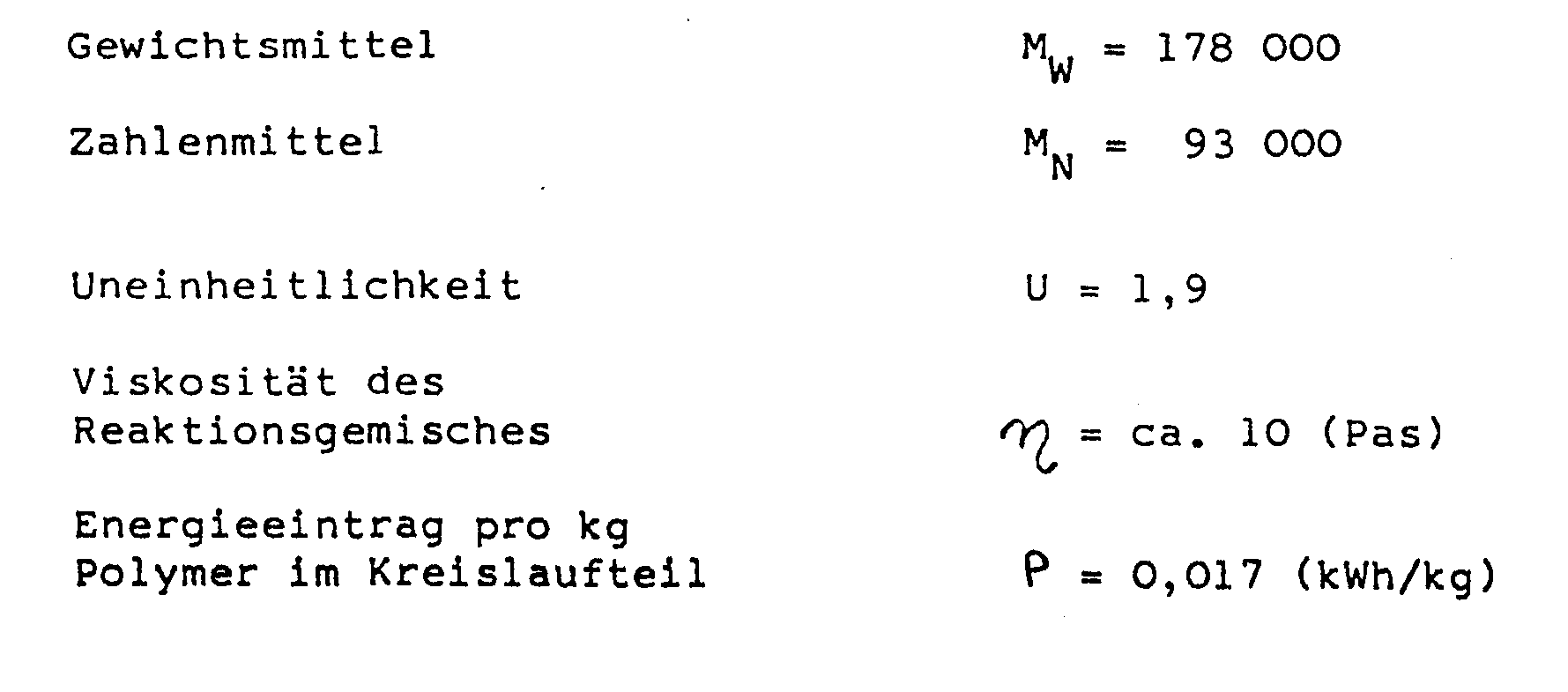
- In einem zweiten Versuch wurde nun nur das Rückführverhältnis R geändert, um die Auswirkungen auf die Produktqualität zu prüfen.
- Rückführverhältnis R = 10
- Umsatz XB = 60 %
-

- Wie das Beispiel zeigt, kann das Rückführverhältnis überraschend bis auf 10 verkleinert werden, ohne dass dadurch das Polymer verändert wird.
- Der Energieeintrag p pro kg Polymer wird dadurch um etwa das 25-fache reduziert.
- Es wird ebenfalls ein Reaktor verwendet, wie er in der Zeichnung dargestellt ist und im Ausführungsbeispiel beschrieben ist.
- In den Beispielen 2 - 4 sind im Gegensatz zu Beispiel 1 die Abschnitte II und III (Rohrreaktorteil mit KolbenflUsscharakteristik) ebenfalls in Betrieb, und der Gesamtumsatz ist entsprechend höher als im Beispiel 1.

- Aus diesen drei Beispielen wird ersichtlich, dass die Produktqualität im Kolbenflussteil nicht wesentlich verändert wird, sofern die Reaktionstemperatur in diesem etwa gleich wie diejenige im Kreislauf teil ist.
- Der Energieeintrag pro kg Polymeres wird für diese Reaktorausführung aber geringer als für den reinen Kreislaufreaktor (vergL Zahlenbeispiel 1) und der erreichbare Umsatz beträgt nahezu 100 %.
- deshalb In diesen drei Ausführungsbeispielen ist / die Kombination von Kreislaufteil und Kolbenflussteil besonders vorteilhaft.
Claims (8)
Applications Claiming Priority (2)
| Application Number | Priority Date | Filing Date | Title |
|---|---|---|---|
| CH3410/82A CH649230A5 (de) | 1982-06-03 | 1982-06-03 | Reaktor zur kontinuierlichen durchfuehrung von polymerisationen in hochviskosen medien. |
| CH3410/82 | 1982-06-03 |
Publications (2)
| Publication Number | Publication Date |
|---|---|
| EP0096201A1 true EP0096201A1 (de) | 1983-12-21 |
| EP0096201B1 EP0096201B1 (de) | 1987-07-15 |
Family
ID=4255384
Family Applications (1)
| Application Number | Title | Priority Date | Filing Date |
|---|---|---|---|
| EP83103946A Expired EP0096201B1 (de) | 1982-06-03 | 1983-04-22 | Reaktor zur kontinuierlichen Durchführung von Polymerisationen in hochviskosen Medien |
Country Status (5)
| Country | Link |
|---|---|
| EP (1) | EP0096201B1 (de) |
| JP (1) | JPS591515A (de) |
| CA (1) | CA1199750A (de) |
| CH (1) | CH649230A5 (de) |
| DE (1) | DE3372442D1 (de) |
Cited By (9)
| Publication number | Priority date | Publication date | Assignee | Title |
|---|---|---|---|---|
| EP0145325A3 (en) * | 1983-11-18 | 1986-06-11 | Reed International P.L.C. | Production of emulsion polymers |
| EP0307238A3 (en) * | 1987-09-11 | 1989-08-09 | Dainippon Ink And Chemicals, Inc. | Production of styrene resins by continuous bulk polymerization |
| EP0254304A3 (en) * | 1986-07-25 | 1989-11-23 | Dainippon Ink And Chemicals, Inc. | Process for producing high impact styrene resin by continuous bulk polymerization |
| EP0755945A1 (de) | 1995-07-26 | 1997-01-29 | Sulzer Chemtech AG | Verfahren und Einrichtung zum Durchführen einer Polymerisation in einem Rohrreaktor |
| WO2007031478A1 (en) * | 2005-09-12 | 2007-03-22 | Akzo Nobel Coatings International B.V. | Loop reactor for emulsion polymerisation |
| WO2007060412A1 (en) * | 2005-11-22 | 2007-05-31 | Nitech Solutions Limited | Improved apparatus and method for temperature controlled processes |
| EP2565572A1 (de) | 2011-09-02 | 2013-03-06 | Aurotec GmbH | Wärmetauscherleitungsystem |
| CN115055154A (zh) * | 2022-06-30 | 2022-09-16 | 武汉纺织大学 | 一种聚合物液相增黏装置和方法 |
| IT202100017519A1 (it) * | 2021-07-02 | 2023-01-02 | Versalis Spa | Procedimento per la preparazione di polimeri vinilaromatici. |
Families Citing this family (4)
| Publication number | Priority date | Publication date | Assignee | Title |
|---|---|---|---|---|
| JPH07116257B2 (ja) * | 1987-05-19 | 1995-12-13 | 花王株式会社 | スチレン系重合体の製造方法 |
| AU3720099A (en) | 1998-04-28 | 1999-11-16 | Heriot-Watt University | Method and apparatus for phase separated synthesis |
| JP4727958B2 (ja) * | 2004-08-19 | 2011-07-20 | 旭有機材工業株式会社 | ノボラック型フェノール樹脂の製造方法 |
| JP6976245B2 (ja) * | 2015-11-11 | 2021-12-08 | フルイテック インヴェスト アーゲー | 連続法による化学反応を行うための装置 |
Citations (5)
| Publication number | Priority date | Publication date | Assignee | Title |
|---|---|---|---|---|
| US3052664A (en) * | 1958-04-30 | 1962-09-04 | Shell Oil Co | Polymerization of vinyl aromatic compounds |
| US3620506A (en) * | 1970-07-07 | 1971-11-16 | Fmc Corp | Fluid-mixing device |
| US4016348A (en) * | 1972-02-22 | 1977-04-05 | Adams George F | Reactor process and apparatus for continuous polymerization |
| DE2634471A1 (de) * | 1976-07-31 | 1978-02-02 | Wilhelm Seifert | Kontinuierlich und auch diskontinuierlich arbeitender dynamisch-statischer verweilzeit-reaktor |
| EP0010571A1 (de) * | 1978-11-02 | 1980-05-14 | Heinz Prof. Dr.-Ing. Blenke | Verfahren und Vorrichtung zur Durchführung (bio-)chemischer Reaktionen und verfahrenstechnischer Grundoperationen in fluiden Systemen |
Family Cites Families (1)
| Publication number | Priority date | Publication date | Assignee | Title |
|---|---|---|---|---|
| JPS516870A (ja) * | 1974-07-08 | 1976-01-20 | Unitika Ltd | Renzokujugosochiniokeru seiryukongosochi |
-
1982
- 1982-06-03 CH CH3410/82A patent/CH649230A5/de not_active IP Right Cessation
-
1983
- 1983-04-22 EP EP83103946A patent/EP0096201B1/de not_active Expired
- 1983-04-22 DE DE8383103946T patent/DE3372442D1/de not_active Expired
- 1983-05-10 CA CA000427817A patent/CA1199750A/en not_active Expired
- 1983-06-02 JP JP58098750A patent/JPS591515A/ja active Granted
Patent Citations (5)
| Publication number | Priority date | Publication date | Assignee | Title |
|---|---|---|---|---|
| US3052664A (en) * | 1958-04-30 | 1962-09-04 | Shell Oil Co | Polymerization of vinyl aromatic compounds |
| US3620506A (en) * | 1970-07-07 | 1971-11-16 | Fmc Corp | Fluid-mixing device |
| US4016348A (en) * | 1972-02-22 | 1977-04-05 | Adams George F | Reactor process and apparatus for continuous polymerization |
| DE2634471A1 (de) * | 1976-07-31 | 1978-02-02 | Wilhelm Seifert | Kontinuierlich und auch diskontinuierlich arbeitender dynamisch-statischer verweilzeit-reaktor |
| EP0010571A1 (de) * | 1978-11-02 | 1980-05-14 | Heinz Prof. Dr.-Ing. Blenke | Verfahren und Vorrichtung zur Durchführung (bio-)chemischer Reaktionen und verfahrenstechnischer Grundoperationen in fluiden Systemen |
Cited By (21)
| Publication number | Priority date | Publication date | Assignee | Title |
|---|---|---|---|---|
| EP0145325A3 (en) * | 1983-11-18 | 1986-06-11 | Reed International P.L.C. | Production of emulsion polymers |
| EP0254304A3 (en) * | 1986-07-25 | 1989-11-23 | Dainippon Ink And Chemicals, Inc. | Process for producing high impact styrene resin by continuous bulk polymerization |
| US4952627A (en) * | 1986-07-25 | 1990-08-28 | Dainippon Ink And Chemicals, Inc. | Process for producing high impact styrene resin by continuous bulk polymerization |
| EP0307238A3 (en) * | 1987-09-11 | 1989-08-09 | Dainippon Ink And Chemicals, Inc. | Production of styrene resins by continuous bulk polymerization |
| US4948847A (en) * | 1987-09-11 | 1990-08-14 | Dainippon Ink And Chemicals, Inc. | Production of styrene resins by continuous bulk polymerization |
| EP0755945A1 (de) | 1995-07-26 | 1997-01-29 | Sulzer Chemtech AG | Verfahren und Einrichtung zum Durchführen einer Polymerisation in einem Rohrreaktor |
| US5602216A (en) * | 1995-07-26 | 1997-02-11 | Sulzer Chemtech Ag | Process and apparatus for performing a polymerisation in a tube reactor |
| CN101262940B (zh) * | 2005-09-12 | 2011-03-30 | 克朗布兰德斯有限公司 | 乳液聚合用回路反应器 |
| US7858715B2 (en) | 2005-09-12 | 2010-12-28 | Crown Brands Limited | Loop reactor for emulsion polymerisation |
| WO2007031478A1 (en) * | 2005-09-12 | 2007-03-22 | Akzo Nobel Coatings International B.V. | Loop reactor for emulsion polymerisation |
| EP2484438A1 (de) * | 2005-09-12 | 2012-08-08 | Celanese International Corporation | Schlaufenreaktor zur Emulsionspolymerisierung |
| US9101901B2 (en) | 2005-11-22 | 2015-08-11 | Nitech Solutions Limited | Apparatus and method for temperature controlled processes |
| CN101312783B (zh) * | 2005-11-22 | 2011-04-06 | 倪泰克解决方案有限公司 | 用于温度控制过程的改进的设备和方法 |
| US10212953B2 (en) | 2005-11-22 | 2019-02-26 | Nitech Solutions Limited | Apparatus and method for temperature controlled processes |
| WO2007060412A1 (en) * | 2005-11-22 | 2007-05-31 | Nitech Solutions Limited | Improved apparatus and method for temperature controlled processes |
| WO2013030402A2 (de) | 2011-09-02 | 2013-03-07 | Aurotec Gmbh | Wärmetauscherleitungssystem |
| EP2565572A1 (de) | 2011-09-02 | 2013-03-06 | Aurotec GmbH | Wärmetauscherleitungsystem |
| IT202100017519A1 (it) * | 2021-07-02 | 2023-01-02 | Versalis Spa | Procedimento per la preparazione di polimeri vinilaromatici. |
| WO2023275746A1 (en) * | 2021-07-02 | 2023-01-05 | Versalis S.P.A. | Process for the preparation of vinylaromatic polymers |
| CN115055154A (zh) * | 2022-06-30 | 2022-09-16 | 武汉纺织大学 | 一种聚合物液相增黏装置和方法 |
| CN115055154B (zh) * | 2022-06-30 | 2023-07-21 | 武汉纺织大学 | 一种聚合物液相增黏装置和方法 |
Also Published As
| Publication number | Publication date |
|---|---|
| EP0096201B1 (de) | 1987-07-15 |
| CH649230A5 (de) | 1985-05-15 |
| CA1199750A (en) | 1986-01-21 |
| DE3372442D1 (en) | 1987-08-20 |
| JPS591515A (ja) | 1984-01-06 |
| JPH0113726B2 (de) | 1989-03-08 |
Similar Documents
| Publication | Publication Date | Title |
|---|---|---|
| EP0752268B1 (de) | Verfahren und Vorrichtung zur kontinuierlichen Herstellung von Polymeren | |
| DE3880242T3 (de) | Herstellungsverfahren von Styrolharzen durch kontinuierliche Massenpolymerisation. | |
| EP0755945B1 (de) | Verfahren und Einrichtung zum Durchführen einer Polymerisation in einem Rohrreaktor | |
| EP1086143B1 (de) | Verfahren und vorrichtung zur kontinuierlichen herstellung von polymerisaten | |
| EP0096201B1 (de) | Reaktor zur kontinuierlichen Durchführung von Polymerisationen in hochviskosen Medien | |
| DE2836689C2 (de) | Kontinuierliches Verfahren zur Herstellung von Akrylnitril-Butadien-Styrol-Mischpolymerisaten und Vorrichtung zu dessen Durchführung | |
| DE68913247T2 (de) | Entgasung einer ein Polymer und flüchtige Bestandteile enthaltenden Flüssigkeit. | |
| WO1998012229A1 (de) | Verfahren zur herstellung von methylmethacrylat-polymeren in einem kreislaufreaktor | |
| EP0752270A2 (de) | Verfahren und Vorrichtung zur kontinuierlichen Herstellung von Polymeren | |
| DE2146337A1 (de) | Verfahren zur Herstellung eines schlagzähen alkenylaromatischen Polymeren | |
| DE19524180A1 (de) | Verfahren und Vorrichtung zur kontinuierlichen Herstellung von Polymeren | |
| DE69115382T2 (de) | Verfahren zur Herstellung von schlagfesten Polystyrenharzen durch kontinuierliche Massenpolymerisation | |
| EP0865821A1 (de) | Verwendung eines Mehrstufenrührers zur Herstellung von Polymerisaten | |
| DE4235785A1 (de) | Verfahren und Vorrichtung zur kontinuierlichen Polymerisation | |
| EP0519266B1 (de) | Verfahren zur Herstellung von Vinylpolymeren | |
| DE69407633T2 (de) | Extruder | |
| DE3041108C2 (de) | ||
| WO2022032401A1 (de) | Vorrichtung zur zu- oder abfuhr von wärme, zur durchführung von reaktionen, und zum mischen und dispergieren von strömenden medien | |
| DE2705556B2 (de) | Polymerisationsreaktor | |
| DE1046886B (de) | Verfahren und Vorrichtung zur Polymerisation von Olefinen nach dem Niederdruckverfahren von Ziegler | |
| EP1592718B1 (de) | Verfahren zur durchführung einer massepolymerisation | |
| DE69805949T2 (de) | Vorrichtung und Verfahren zum Herstellen von Schaumstoffperlen aus Styrolharz | |
| DE3202292C2 (de) | Verfahren zur kontinuierlichen Bildung eines Säurefluorids | |
| DD290991A7 (de) | Verfahren zum betreiben von polymerisationsreaktoren | |
| DE1645611C (de) | Verfahren und Vorrichtung zur kontinuierlichen Lösungspolymerisation |
Legal Events
| Date | Code | Title | Description |
|---|---|---|---|
| PUAI | Public reference made under article 153(3) epc to a published international application that has entered the european phase |
Free format text: ORIGINAL CODE: 0009012 |
|
| AK | Designated contracting states |
Designated state(s): DE FR GB IT NL SE |
|
| RBV | Designated contracting states (corrected) |
Designated state(s): DE FR GB IT NL SE |
|
| 17P | Request for examination filed |
Effective date: 19840613 |
|
| ITF | It: translation for a ep patent filed | ||
| GRAA | (expected) grant |
Free format text: ORIGINAL CODE: 0009210 |
|
| AK | Designated contracting states |
Kind code of ref document: B1 Designated state(s): DE FR GB IT NL SE |
|
| REF | Corresponds to: |
Ref document number: 3372442 Country of ref document: DE Date of ref document: 19870820 |
|
| ET | Fr: translation filed | ||
| PLBE | No opposition filed within time limit |
Free format text: ORIGINAL CODE: 0009261 |
|
| STAA | Information on the status of an ep patent application or granted ep patent |
Free format text: STATUS: NO OPPOSITION FILED WITHIN TIME LIMIT |
|
| 26N | No opposition filed | ||
| ITTA | It: last paid annual fee | ||
| EAL | Se: european patent in force in sweden |
Ref document number: 83103946.6 |
|
| PGFP | Annual fee paid to national office [announced via postgrant information from national office to epo] |
Ref country code: SE Payment date: 19950322 Year of fee payment: 13 |
|
| PG25 | Lapsed in a contracting state [announced via postgrant information from national office to epo] |
Ref country code: SE Effective date: 19960423 |
|
| EUG | Se: european patent has lapsed |
Ref document number: 83103946.6 |
|
| PGFP | Annual fee paid to national office [announced via postgrant information from national office to epo] |
Ref country code: GB Payment date: 20000313 Year of fee payment: 18 |
|
| PGFP | Annual fee paid to national office [announced via postgrant information from national office to epo] |
Ref country code: NL Payment date: 20000320 Year of fee payment: 18 Ref country code: DE Payment date: 20000320 Year of fee payment: 18 |
|
| PGFP | Annual fee paid to national office [announced via postgrant information from national office to epo] |
Ref country code: FR Payment date: 20000327 Year of fee payment: 18 |
|
| PG25 | Lapsed in a contracting state [announced via postgrant information from national office to epo] |
Ref country code: GB Free format text: LAPSE BECAUSE OF NON-PAYMENT OF DUE FEES Effective date: 20010422 |
|
| PG25 | Lapsed in a contracting state [announced via postgrant information from national office to epo] |
Ref country code: FR Free format text: THE PATENT HAS BEEN ANNULLED BY A DECISION OF A NATIONAL AUTHORITY Effective date: 20010430 |
|
| PG25 | Lapsed in a contracting state [announced via postgrant information from national office to epo] |
Ref country code: NL Free format text: LAPSE BECAUSE OF NON-PAYMENT OF DUE FEES Effective date: 20011101 |
|
| GBPC | Gb: european patent ceased through non-payment of renewal fee |
Effective date: 20010422 |
|
| NLV4 | Nl: lapsed or anulled due to non-payment of the annual fee |
Effective date: 20011101 |
|
| PG25 | Lapsed in a contracting state [announced via postgrant information from national office to epo] |
Ref country code: DE Free format text: LAPSE BECAUSE OF NON-PAYMENT OF DUE FEES Effective date: 20020201 |
|
| REG | Reference to a national code |
Ref country code: FR Ref legal event code: ST |