EP0096738A1 - Verfahren zur Durchführung von chemischen Reaktionen unter Beteiligung von atomarem Wasserstoff - Google Patents
Verfahren zur Durchführung von chemischen Reaktionen unter Beteiligung von atomarem Wasserstoff Download PDFInfo
- Publication number
- EP0096738A1 EP0096738A1 EP83104200A EP83104200A EP0096738A1 EP 0096738 A1 EP0096738 A1 EP 0096738A1 EP 83104200 A EP83104200 A EP 83104200A EP 83104200 A EP83104200 A EP 83104200A EP 0096738 A1 EP0096738 A1 EP 0096738A1
- Authority
- EP
- European Patent Office
- Prior art keywords
- hydrogen
- atomic hydrogen
- molecular
- mbar
- oxygen
- Prior art date
- Legal status (The legal status is an assumption and is not a legal conclusion. Google has not performed a legal analysis and makes no representation as to the accuracy of the status listed.)
- Granted
Links
Images
Classifications
-
- C—CHEMISTRY; METALLURGY
- C01—INORGANIC CHEMISTRY
- C01B—NON-METALLIC ELEMENTS; COMPOUNDS THEREOF; METALLOIDS OR COMPOUNDS THEREOF NOT COVERED BY SUBCLASS C01C
- C01B3/00—Hydrogen; Gaseous mixtures containing hydrogen; Separation of hydrogen from mixtures containing it; Purification of hydrogen; Reversible storage of hydrogen
- C01B3/0094—Atomic hydrogen
-
- Y—GENERAL TAGGING OF NEW TECHNOLOGICAL DEVELOPMENTS; GENERAL TAGGING OF CROSS-SECTIONAL TECHNOLOGIES SPANNING OVER SEVERAL SECTIONS OF THE IPC; TECHNICAL SUBJECTS COVERED BY FORMER USPC CROSS-REFERENCE ART COLLECTIONS [XRACs] AND DIGESTS
- Y02—TECHNOLOGIES OR APPLICATIONS FOR MITIGATION OR ADAPTATION AGAINST CLIMATE CHANGE
- Y02E—REDUCTION OF GREENHOUSE GAS [GHG] EMISSIONS, RELATED TO ENERGY GENERATION, TRANSMISSION OR DISTRIBUTION
- Y02E60/00—Enabling technologies; Technologies with a potential or indirect contribution to GHG emissions mitigation
- Y02E60/30—Hydrogen technology
- Y02E60/32—Hydrogen storage
Definitions
- the present invention relates to a method for carrying out chemical reactions in which atomic hydrogen is involved. These are chemical reactions that are initiated by radicals and take place as chain reactions. For many such reactions, atomic hydrogen is suitable for starting and continuing. For example, atomic hydrogen causes the dehydrogenation of alkanes, the hydrogenation of alkenes, the splitting of hydrocarbons, the splitting off of alkyl groups from alkylaromatics, and the formation of hydrazine from ammonia.
- atomic hydrogen in the steam cracking of hydrocarbons to produce olefins is described in JA-AS 72 43 522.
- the atomic hydrogen was generated in particular by heating molecular hydrogen to 2900 ° C. using a plasma stream.
- the molecular hydrogen contains only 5% atomic hydrogen.
- the atomic hydrogen is generated by decomposing another component in the presence of molecular hydrogen.
- Hydrocarbons and other low molecular weight organic compounds are mentioned as further components.
- the decomposition of the added component creates radicals that generate atomic hydrogen from the molecular hydrogen in subsequent steps.
- the decomposition takes place by pyrolysis or partial combustion of the additive.
- Other processes, particularly those used in basic research generate atomic hydrogen by silent electrical discharges in molecular hydrogen, by photolysis of hydrogen-containing compounds or by microwave discharges of molecular hydrogen in an inert medium. It is characteristic of all of these processes for the production of atomic hydrogen that atomic hydrogen is obtained in relatively low concentrations and with a relatively high expenditure of energy.
- the combustion of molecular hydrogen with a substoichiometric amount of oxygen is used for this.
- Both pure oxygen and air can be used as an oxygen source.
- the combustion of the hydrogen takes place as a chain reaction. Due to the excess hydrogen, high hydrogen atom concentrations are built up in the after-reaction zone of the flame.
- the concentration of the hydrogen atoms can be controlled and at the same time the concentration of oxygen-containing radicals can be completely suppressed.
- an H 2/0 2 molar ratio from 2.3 to 5.0, preferably 2.8 - 4.0 applied.
- the life of the generated H atoms can be controlled by the geometry of the burner arrangement and by variations in the pressure in the burner chamber.
- Another feature for carrying out the chemical reaction is the feed arrangement for the respective reactant.
- This arrangement is distinguished by the fact that the reactant is admixed directly at the place where the H atoms are formed, in particular in the postreaction zone mentioned, in such a way that the production of the H atoms is not influenced thereby.
- the JA-AS mentioned at the outset also describes the partial combustion of methane to produce hydrocarbon radicals which form atomic hydrogen with externally added molecular hydrogen.
- radicals are mainly produced as by-products, which trigger undesired secondary and secondary reactions.
- the reaction mixture of the burner formed which contains small amounts of H atoms, is passed into a spatially separated second process stage in which a middle distillate cut (182-255 ° C.) with the previously described reaction mixture at 800 ° C. and a residence time of 0.72 sec is implemented.
- H atoms are generated in a fuel-rich hydrogen-oxygen or hydrogen-air flame, especially under negative pressure. Either a premix flame (with appropriate safety precautions) is used, or the flame is stabilized on a multi-diffusion burner. Depending on the level of the set pressure, hydrogen atom concentrations of up to 30 mol% are built up in the after-reaction zone of the flame.
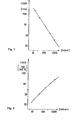
- the lifespan of the H atoms at pressures from 10 mbar to atmospheric pressure is between 300 ms and 0.3 ms. 1 shows the half-life of the hydrogen atoms in ms as a function of the pressure in mbar for a hydrogen-air flame.
- the flows of H atoms in this pressure range are between 0.3 kg / m l h and 300 kg / m 2 h.
- Fig. 2 shows the H atom flow in kg / m l h depending on the pressure in mbar also for a hydrogen air flame.
- an optimal pressure To achieve maximum sales, an optimal pressure must be selected. It results from the requirement for a high H atom flow with a sufficiently long lifespan for the hydrogen atoms in order to achieve complete mixing with the reactant.
- the most favorable pressure is between 10 and 1500 mbar, the range being preferred from 10 to 900 mbar, in particular 50 to 500 mbar.
- the most favorable pressure range for a hydrogen-air flame is e.g. B. at 400 mbar. In this case, a hydrogen atom flow of 10 kg / m 2 h can be generated.
- the most favorable temperature for the reaction can be determined by a suitable device in the reactant inflow, e.g. B. adjustable a heat exchanger.
Landscapes
- Chemical & Material Sciences (AREA)
- Organic Chemistry (AREA)
- Engineering & Computer Science (AREA)
- Combustion & Propulsion (AREA)
- Inorganic Chemistry (AREA)
- Organic Low-Molecular-Weight Compounds And Preparation Thereof (AREA)
- Hydrogen, Water And Hydrids (AREA)
- Catalysts (AREA)
- Oxygen, Ozone, And Oxides In General (AREA)
Abstract
Description
- Die vorliegende Erfindung betrifft ein Verfahren zur Durchführung chemischer Reaktionen, an denen atomarer Wasserstoff beteiligt ist. Es handelt sich um chemische Reaktionen, die durch Radikale eingeleitet werden und als Kettenreaktionen ablaufen. Für viele derartige Reaktionen ist atomarer Wasserstoff zum Starten und Weiterführen geeignet. So bewirkt atomarer Wasserstoff beispielsweise die Dehydrierung von Alkanen, die Hydrierung von Alkenen, die Spaltung von Kohlenwasserstoffen, die Abspaltung von Alkylgruppen aus Alkylaromaten, die Bildung von Hydrazin aus Ammoniak.
- Die Anwendung von atomarem Wasserstoff bei der Dampfspaltung von Kohlenwasserstoffen zur Erzeugung von Olefinen ist in JA-AS 72 43 522 beschrieben. Hier wurde der atomare Wasserstoff insbesondere durch Erhitzen von molekularem Wasserstoff auf 2900 °C mittels eines Plasmastromes erzeugt. Trotz der hohen Temperatur, die mit energieaufwendigen Verfahren erzeugt werden muß, enthält der molekulare Wasserstoff nur 5 % atomaren Wasserstoff.
- Nach anderen dort beschriebenen Verfahren wird der atomare Wasserstoff durch Zersetzung einer weiteren Komponente in Gegenwart von molekularem Wasserstoff erzeugt. Als weitere Komponente werden genannt Kohlenwasserstoffe und andere niedermolekulare organische Verbindungen.
- Durch die Zersetzung der zugesetzten Komponente entstehen Radikale, die in Folgeschritten aus dem molekularen Wasserstoff atomaren Wasserstoff erzeugen. Die Zersetzung erfolgt durch Pyrolyse oder partielle Verbrennung des Zusatzes. Andere, insbesondere in der Grundlagenforschung verwendete Verfahren erzeugen atomaren Wasserstoff durch stille elektrische Entladungen in molekularem Wasserstoff, durch Photolyse wasserstoffhaltiger Verbindungen oder durch Mikrowellenentladungen von molekularem Wasserstoff in einem inerten Medium. Allen diesen Verfahren zur Gewinnung von atomarem Wasserstoff ist es eigen, daß atomarer Wasserstoff in relativ geringen Konzentrationen und mit relativ hohem Energieaufwand gewonnen wird.
- Für die Anwendung in technischen Prozessen ist es notwendig, atomaren Wasserstoff in einer möglichst einfachen Anordnung bei möglichst geringem Energieaufwand in hoher und dabei steuerbarer Konzentration zu gewinnen.
- Erfindungsgemäß dient hierfür die Verbrennung von molekularem Wasserstoff mit einer unterstöchiometrischen Menge an Sauerstoff. Dabei kann sowohl Reinsauerstoff als auch Luft als Sauerstoffquelle verwendet werden. In der Wasserstoff-Sauerstoff-Flamme läuft die Verbrennung des Wasserstoffes als Kettenreaktion ab. Durch den überschuß an Wasserstoff werden in der Nachreaktionszone der Flamme hohe Wasserstoffatom-Konzentrationen aufgebaut. Durch Variation des Wasserstoff- zu Sauerstoffverhältnisses kann die Konzentration der Wasserstoffatome gesteuert werden und gleichzeitig die Konzentration sauerstoffhaltiger Radikale völlig unterdrückt werden. Im allgemeinen wird ein H2/02-Molverhältnis von 2,3 - 5,0, vorzugsweise 2,8 - 4,0 angewendet. Durch die Geometrie der Brenneranordnung und durch Variationen des Drucks im Brennerraum kann die Lebensdauer der erzeugten H-Atome gesteuert werden. Ein weiteres Merkmal zur Ausführung der chemischen Reaktion ist die Zuführungsanordnung für den jeweiligen Reaktanden. Diese Anordnung zeichnet sich dadurch aus, daß der Reaktand unmittelbar am Ort der Entstehung der H-Atome, insbesondere in der erwähnten Nachreaktionszone so zugemischt wird, daß die Erzeugung der H-Atome dadurch nicht beeinflußt wird.
- In der eingangs erwähnten JA-AS wird auch die partielle Verbrennung von Methan zur Erzeugung von Kohlenwasserstoffradikalen beschrieben, die mit von außen zugesetztem molekularen Wasserstoff atomaren Wasserstoff bilden. Bei dieser Art der Erzeugung von Wasserstoff-Atomen entstehen als Nebenprodukte hauptsächlich Radikale, die unerwünschte Folge-und Nebenreaktionen auslösen. Das gebildete, in geringen Mengen H-Atome enthaltende Reaktionsendgemisch des Brenners wird in eine räumlich getrennte zweite Verfahrensstufe geführt, in der ein Mitteldestillatschnitt (182 - 255 °C) mit dem zuvor beschriebenen Reaktionsgemisch bei 800 °C und einer Verweilzeit von 0,72 sec. umgesetzt wird.
- Gemäß vorliegender Erfindung werden H-Atome in einer brennstoffreichen Wasserstoff-Sauerstoff- oder Wasserstoff-Luft- Flamme insbesondere bei Unterdruck erzeugt. Dabei wird entweder eine Vormischflamme (mit entsprechenden Sicherheitsvorkehrungen) benutzt, oder die Flamme auf einem Multidiffusionsbrenner stabilisiert. Je nach Höhe des eingestellten Druckes werden in der Nachreaktionszone der Flamme H-Atom-Konzentrationen bis zu 30 Mol-% aufgebaut. Die Lebensdauer der H-Atome liegt bei Drücken von 10 mbar bis Atmosphärendruck zwischen 300 ms und 0,3 ms. In Fig. 1 ist für eine Wasserstoff-Luftflamme die Halbwert-Lebensdauer der H-Atome in ms in Abhängigkeit vom Druck in mbar dargestellt. Die Flüsse an H-Atomen betragen in diesem Druckbereich zwischen 0,3 kg/mlh und 300 kg/m2h. Fig. 2 zeigt den H-Atomfluß in kg/mlh in Abhängigkeit vom Druck in mbar ebenfalls für eine Wasserstoff-Luftflamme.
- Zur Erzielung eines maximalen Umsatzes muß ein optimaler Druck gewählt werden. Er ergibt sich aus der Forderung nach hohem H-Atomfluß bei ausreichend hoher Lebensdauer der Wasserstoffatome, um eine vollständige Durchmischung mit dem Reaktanden zu erreichen. In der Regel liegt der günstigste Druck zwischen 10 und 1500 mbar, bevorzugt wird der Bereich von 10 bis 900 mbar, insbesondere 50 bis 500 mbar. Erfolgt die Durchmischung durch Diffusionsprozesse, so liegt der günstigste Druckbereich für eine Wasserstoff-Luft-Flamme z. B. bei 400 mbar. In diesem Falle kann ein Wasserstoff-Atomfluß von 10 kg/m2h erzeugt werden. Die für die Reaktion günstigste Temperatur ist durch eine geeignete Vorrichtung im ReaktandenzufluB, z. B. einem Wärmetauscher einstellbar.
Claims (3)
Priority Applications (1)
| Application Number | Priority Date | Filing Date | Title |
|---|---|---|---|
| AT83104200T ATE17111T1 (de) | 1982-05-03 | 1983-04-29 | Verfahren zur durchfuehrung von chemischen reaktionen unter beteiligung von atomarem wasserstoff. |
Applications Claiming Priority (2)
| Application Number | Priority Date | Filing Date | Title |
|---|---|---|---|
| DE3216391 | 1982-05-03 | ||
| DE19823216391 DE3216391A1 (de) | 1982-05-03 | 1982-05-03 | Verfahren zur durchfuehrung chemischer reaktionen |
Publications (2)
| Publication Number | Publication Date |
|---|---|
| EP0096738A1 true EP0096738A1 (de) | 1983-12-28 |
| EP0096738B1 EP0096738B1 (de) | 1985-12-27 |
Family
ID=6162505
Family Applications (1)
| Application Number | Title | Priority Date | Filing Date |
|---|---|---|---|
| EP83104200A Expired EP0096738B1 (de) | 1982-05-03 | 1983-04-29 | Verfahren zur Durchführung von chemischen Reaktionen unter Beteiligung von atomarem Wasserstoff |
Country Status (4)
| Country | Link |
|---|---|
| US (1) | US4664904A (de) |
| EP (1) | EP0096738B1 (de) |
| AT (1) | ATE17111T1 (de) |
| DE (2) | DE3216391A1 (de) |
Families Citing this family (17)
| Publication number | Priority date | Publication date | Assignee | Title |
|---|---|---|---|---|
| US6024935A (en) * | 1996-01-26 | 2000-02-15 | Blacklight Power, Inc. | Lower-energy hydrogen methods and structures |
| US20090129992A1 (en) * | 1997-07-22 | 2009-05-21 | Blacklight Power, Inc. | Reactor for Preparing Hydrogen Compounds |
| US20090123356A1 (en) * | 1997-07-22 | 2009-05-14 | Blacklight Power, Inc. | Inorganic hydrogen compounds |
| US20090142257A1 (en) * | 1997-07-22 | 2009-06-04 | Blacklight Power, Inc. | Inorganic hydrogen compounds and applications thereof |
| WO1999005735A1 (en) * | 1997-07-22 | 1999-02-04 | Black Light Power, Inc. | Inorganic hydrogen compounds, separation methods, and fuel applications |
| CA2466953A1 (en) * | 2001-11-14 | 2003-08-14 | Blacklight Power, Inc. | Hydrogen power, plasma, and reactor for lasing, and power conversion |
| US20040095705A1 (en) * | 2001-11-28 | 2004-05-20 | Mills Randell L. | Plasma-to-electric power conversion |
| US20030129117A1 (en) * | 2002-01-02 | 2003-07-10 | Mills Randell L. | Synthesis and characterization of a highly stable amorphous silicon hydride as the product of a catalytic hydrogen plasma reaction |
| US20040118348A1 (en) * | 2002-03-07 | 2004-06-24 | Mills Randell L.. | Microwave power cell, chemical reactor, and power converter |
| AU2003234301A1 (en) * | 2002-05-01 | 2003-11-17 | Blacklight Power, Inc. | Diamond synthesis |
| EP1628909A2 (de) * | 2003-04-15 | 2006-03-01 | Blacklight Power, Inc. | Plasmareaktor und verfahren zur herstellung von niederenergetischen wasserstoffspezies |
| US7188033B2 (en) * | 2003-07-21 | 2007-03-06 | Blacklight Power Incorporated | Method and system of computing and rendering the nature of the chemical bond of hydrogen-type molecules and molecular ions |
| WO2005041368A2 (en) | 2003-10-24 | 2005-05-06 | Blacklight Power, Inc. | Novel molecular hydrogen gas laser |
| EP1702212A4 (de) * | 2004-01-05 | 2009-01-21 | Blacklight Power Inc | Verfahren und system zur berechnung und darstellung der beschaffenheit von atomen und atomionen |
| WO2005116630A2 (en) * | 2004-05-17 | 2005-12-08 | Blacklight Power, Inc. | Method and system of computing and rendering the nature of the excited electronic states of atoms and atomic ions |
| US20070198199A1 (en) * | 2004-07-19 | 2007-08-23 | Mills Randell L | Method and system of computing and rendering the nature of the chemical bond of hydrogen-type molecules and molecular ions |
| US20080304522A1 (en) * | 2006-04-04 | 2008-12-11 | Mills Randell L | Catalyst laser |
Citations (1)
| Publication number | Priority date | Publication date | Assignee | Title |
|---|---|---|---|---|
| DE301364C (de) * |
-
1982
- 1982-05-03 DE DE19823216391 patent/DE3216391A1/de not_active Withdrawn
-
1983
- 1983-04-29 EP EP83104200A patent/EP0096738B1/de not_active Expired
- 1983-04-29 DE DE8383104200T patent/DE3361615D1/de not_active Expired
- 1983-04-29 AT AT83104200T patent/ATE17111T1/de not_active IP Right Cessation
-
1985
- 1985-09-25 US US06/779,616 patent/US4664904A/en not_active Expired - Fee Related
Patent Citations (1)
| Publication number | Priority date | Publication date | Assignee | Title |
|---|---|---|---|---|
| DE301364C (de) * |
Also Published As
| Publication number | Publication date |
|---|---|
| DE3361615D1 (en) | 1986-02-06 |
| EP0096738B1 (de) | 1985-12-27 |
| US4664904A (en) | 1987-05-12 |
| DE3216391A1 (de) | 1983-11-03 |
| ATE17111T1 (de) | 1986-01-15 |
Similar Documents
| Publication | Publication Date | Title |
|---|---|---|
| EP0096738B1 (de) | Verfahren zur Durchführung von chemischen Reaktionen unter Beteiligung von atomarem Wasserstoff | |
| EP1288182B1 (de) | Verfahren zur direkten methanpyrolyse | |
| DE2943200C2 (de) | ||
| DE19914226A1 (de) | Verfahren zur Herstellung von Acetylen und Synthesegas | |
| DE1206404B (de) | Verfahren zur Herstellung schwefeldioxidhaltiger Gase aus ammoniumsalzhaltigen Abfallschwefelsaeuren | |
| US2912475A (en) | Manufacture of low molecular unsaturated hydrocarbons | |
| DE10041739A1 (de) | Vormisch-Brennerblock für partielle Oxidationsprozesse | |
| DE69933403T2 (de) | Verfahren zur autothermen Dampfreformierung einer Kohlenwasserstoffeinspeisung | |
| Morrison et al. | Validity of Rate Factors in Free Radical Aromatic Substitution | |
| WO2020127838A2 (de) | Verfahren und vorrichtung zur herstellung von wasserstoff, kohlenmonoxid und einem kohlenstoffhaltigen produkt | |
| CH720593A1 (de) | Dissoziationsverfahren und system zur dissoziation von kohlendioxid und/oder methan | |
| DE1297098B (de) | Verfahren zur Herstellung von Acetylen und Olefinen | |
| DE1668371C3 (de) | Verbund-Verfahren zur Herstellung von Harnstoff aus Ammoniak und Kohlendioxid sowie vorf Ammoniak aus den Elementen | |
| DE677820C (de) | Verfahren zur Herstellung von Blausaeure | |
| EP0324207A2 (de) | Verfahren zum Erzeugen eines kohlenmonoxidreichen Gases durch Spalten von Kohlenwasserstoffen | |
| DE2639807C3 (de) | Verfahren zur hydrierenden Umwandlung von Kohlenwasserstoffen | |
| DE850900C (de) | Verfahren zur Herstellung eines Gases fuer die Zementierung von Stahl | |
| DE2052543B2 (de) | Verfahren zur Herstellung von Acetylen-Aetylen-Gemischen | |
| DE1050752B (de) | Verfahren zur Herstellung von Formaldehyd aus Methan | |
| DE2316084C2 (de) | Verfahren zur Herstellung von Reduktionsgas | |
| DE675431C (de) | Herstellung von an Verunreinigungen armem Kohlenstoff, insbesondere von Russ und Wasserstoff | |
| DE886898C (de) | Verfahren zur Gewinnung von technisch reinem Benzol | |
| DE1198811B (de) | Verfahren zur thermischen Spaltung von Kohlenwasserstoffen | |
| DE582665C (de) | ||
| DE2026429C3 (de) | Verfahren zur Herstellung von Vinylchlorid |
Legal Events
| Date | Code | Title | Description |
|---|---|---|---|
| PUAI | Public reference made under article 153(3) epc to a published international application that has entered the european phase |
Free format text: ORIGINAL CODE: 0009012 |
|
| AK | Designated contracting states |
Designated state(s): AT BE CH DE FR GB IT LI LU NL SE |
|
| RAP1 | Party data changed (applicant data changed or rights of an application transferred) |
Owner name: VEBA OEL AG |
|
| 17P | Request for examination filed |
Effective date: 19840526 |
|
| GRAA | (expected) grant |
Free format text: ORIGINAL CODE: 0009210 |
|
| ITF | It: translation for a ep patent filed | ||
| AK | Designated contracting states |
Designated state(s): AT BE CH DE FR GB IT LI LU NL SE |
|
| REF | Corresponds to: |
Ref document number: 17111 Country of ref document: AT Date of ref document: 19860115 Kind code of ref document: T |
|
| REF | Corresponds to: |
Ref document number: 3361615 Country of ref document: DE Date of ref document: 19860206 |
|
| ET | Fr: translation filed | ||
| PLBE | No opposition filed within time limit |
Free format text: ORIGINAL CODE: 0009261 |
|
| STAA | Information on the status of an ep patent application or granted ep patent |
Free format text: STATUS: NO OPPOSITION FILED WITHIN TIME LIMIT |
|
| 26N | No opposition filed | ||
| ITTA | It: last paid annual fee | ||
| PGFP | Annual fee paid to national office [announced via postgrant information from national office to epo] |
Ref country code: BE Payment date: 19940210 Year of fee payment: 12 |
|
| PGFP | Annual fee paid to national office [announced via postgrant information from national office to epo] |
Ref country code: AT Payment date: 19940310 Year of fee payment: 12 |
|
| PGFP | Annual fee paid to national office [announced via postgrant information from national office to epo] |
Ref country code: SE Payment date: 19940321 Year of fee payment: 12 |
|
| PGFP | Annual fee paid to national office [announced via postgrant information from national office to epo] |
Ref country code: LU Payment date: 19940331 Year of fee payment: 12 |
|
| PGFP | Annual fee paid to national office [announced via postgrant information from national office to epo] |
Ref country code: DE Payment date: 19940408 Year of fee payment: 12 |
|
| PGFP | Annual fee paid to national office [announced via postgrant information from national office to epo] |
Ref country code: GB Payment date: 19940419 Year of fee payment: 12 |
|
| PGFP | Annual fee paid to national office [announced via postgrant information from national office to epo] |
Ref country code: CH Payment date: 19940425 Year of fee payment: 12 |
|
| PGFP | Annual fee paid to national office [announced via postgrant information from national office to epo] |
Ref country code: FR Payment date: 19940429 Year of fee payment: 12 |
|
| PGFP | Annual fee paid to national office [announced via postgrant information from national office to epo] |
Ref country code: NL Payment date: 19940430 Year of fee payment: 12 |
|
| EPTA | Lu: last paid annual fee | ||
| EAL | Se: european patent in force in sweden |
Ref document number: 83104200.7 |
|
| PG25 | Lapsed in a contracting state [announced via postgrant information from national office to epo] |
Ref country code: LU Free format text: LAPSE BECAUSE OF NON-PAYMENT OF DUE FEES Effective date: 19950429 Ref country code: GB Effective date: 19950429 Ref country code: AT Effective date: 19950429 |
|
| PG25 | Lapsed in a contracting state [announced via postgrant information from national office to epo] |
Ref country code: SE Effective date: 19950430 Ref country code: LI Effective date: 19950430 Ref country code: CH Effective date: 19950430 Ref country code: BE Effective date: 19950430 |
|
| BERE | Be: lapsed |
Owner name: VEBA OEL A.G. Effective date: 19950430 |
|
| PG25 | Lapsed in a contracting state [announced via postgrant information from national office to epo] |
Ref country code: NL Effective date: 19951101 |
|
| REG | Reference to a national code |
Ref country code: CH Ref legal event code: PL |
|
| PG25 | Lapsed in a contracting state [announced via postgrant information from national office to epo] |
Ref country code: FR Effective date: 19951229 |
|
| NLV4 | Nl: lapsed or anulled due to non-payment of the annual fee |
Effective date: 19951101 |
|
| GBPC | Gb: european patent ceased through non-payment of renewal fee |
Effective date: 19950429 |
|
| PG25 | Lapsed in a contracting state [announced via postgrant information from national office to epo] |
Ref country code: DE Effective date: 19960103 |
|
| EUG | Se: european patent has lapsed |
Ref document number: 83104200.7 |
|
| REG | Reference to a national code |
Ref country code: FR Ref legal event code: ST |