EP0096884B1 - Radar Doppler à impulsions avec un discriminateur de durée d'impulsions - Google Patents
Radar Doppler à impulsions avec un discriminateur de durée d'impulsions Download PDFInfo
- Publication number
- EP0096884B1 EP0096884B1 EP19830105790 EP83105790A EP0096884B1 EP 0096884 B1 EP0096884 B1 EP 0096884B1 EP 19830105790 EP19830105790 EP 19830105790 EP 83105790 A EP83105790 A EP 83105790A EP 0096884 B1 EP0096884 B1 EP 0096884B1
- Authority
- EP
- European Patent Office
- Prior art keywords
- pulse
- output
- integration circuit
- circuit
- signal
- Prior art date
- Legal status (The legal status is an assumption and is not a legal conclusion. Google has not performed a legal analysis and makes no representation as to the accuracy of the status listed.)
- Expired
Links
- 230000001629 suppression Effects 0.000 claims description 8
- 238000001514 detection method Methods 0.000 description 8
- 238000002592 echocardiography Methods 0.000 description 4
- 230000010354 integration Effects 0.000 description 4
- 230000001427 coherent effect Effects 0.000 description 3
- 238000011156 evaluation Methods 0.000 description 2
- 230000005540 biological transmission Effects 0.000 description 1
- 230000015572 biosynthetic process Effects 0.000 description 1
- 230000003111 delayed effect Effects 0.000 description 1
- 230000001419 dependent effect Effects 0.000 description 1
- 238000010586 diagram Methods 0.000 description 1
- 238000001914 filtration Methods 0.000 description 1
- 230000002452 interceptive effect Effects 0.000 description 1
- 238000005070 sampling Methods 0.000 description 1
- 230000008054 signal transmission Effects 0.000 description 1
- 238000009751 slip forming Methods 0.000 description 1
- 230000001360 synchronised effect Effects 0.000 description 1
- 230000002123 temporal effect Effects 0.000 description 1
Images

Classifications
-
- G—PHYSICS
- G01—MEASURING; TESTING
- G01S—RADIO DIRECTION-FINDING; RADIO NAVIGATION; DETERMINING DISTANCE OR VELOCITY BY USE OF RADIO WAVES; LOCATING OR PRESENCE-DETECTING BY USE OF THE REFLECTION OR RERADIATION OF RADIO WAVES; ANALOGOUS ARRANGEMENTS USING OTHER WAVES
- G01S7/00—Details of systems according to groups G01S13/00, G01S15/00, G01S17/00
- G01S7/02—Details of systems according to groups G01S13/00, G01S15/00, G01S17/00 of systems according to group G01S13/00
- G01S7/28—Details of pulse systems
- G01S7/285—Receivers
- G01S7/292—Extracting wanted echo-signals
- G01S7/2921—Extracting wanted echo-signals based on data belonging to one radar period
Definitions
- the invention relates to a pulse Doppler radar device with the features mentioned in the preamble of claim 1.
- CFAR circuits To suppress external interference signals caused by continuous interference transmitters, it is known to use so-called CFAR circuits. It is also known to suppress synchronous pulse interferers (intermittent line interferers or noise interferers) which occupy several distance channels using a pulse length discriminator (DE-A-28 23 419). With this circuit arrangement, by forming the difference between the signal amplitudes of successive distance channels, a criterion can be formed for the beginning or the end of a flying object or interference signals. If the maximum pulse length specified for flying objects is exceeded, the received signal is interpreted as an interference signal and can be suppressed.
- Flying object signals covered by interference signals are recognized.
- a prerequisite for the desired function of the pulse length discriminator is that the amplitudes of interfering and superimposed flying object signals remain unchanged when the signal is evaluated in front of the pulse length discriminator.
- Short single impulses that can have different causes e.g. Movement signal echoes from overreach ranges when using a pulse repetition time that changes from transmit pulse to transmit pulse are not suppressed by the pulse length discriminator.
- the invention has for its object to extend the interference suppression in signal processing with pulse length discriminator to disturbing individual pulses. According to the invention, this object is achieved by the features mentioned in claim 1.
- All the pulses detected by means of the individual pulse detection during each sampling period lead to a brief interruption in the signal transmission and are blanked out in this way.
- the individual pulse detection takes place in a circuit by forming the difference between the signal amplitudes at the output of the rectifier and at the output of the post-integration circuit and by comparing the difference with a predetermined signal-dependent value.
- This comparison value is one of all signals offered to the radar receiver, e.g. Target echo signals, interference pulses, target echoes with superimposed interference pulses formed normalized target amplitude curve, the energy and amplitude curve of which corresponds approximately to the smallest detectable target.
- a pulse Doppler radar device of a known type with an antenna 1 is equipped on the input side with a transmit / receive switch 3 and a transmit oscillator 4.
- the switching of the transmit / receive switch 2 is carried out by a clock generator 2.
- the input signal reaches a mixer stage 5, the local oscillator of which is designated by 6.
- the demodulated received signals are fed to a moving character filter 7 (MTI filter) which has a larger number of distance channels.
- the moving character filter suppresses echo signals that come from fixed characters, while moving character echo signals are transmitted virtually undamped. It may be appropriate to carry out the signal processing in digital form, i.e. after mixing stage 5 to switch on an analog-to-digital converter indicated by dashed lines.
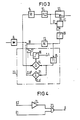
- Fig. 2 is a signal processing extended by a circuit for single pulse suppression path shown.
- the essential circuit parts are a controllable switch 12, which is inserted between the pulse length discriminator 10 and the display device 11 in such a way that it can interrupt the transmission path to the display device 11 and a circuit branch branched off from the signal processing path at the input of the post-integration circuit 9 and which is a further one contains non-coherent integration circuit 13 and a circuit 22 for single pulse detection.
- These circuit parts together with a video threshold 19 and a control logic 20, which are at the output of the integration circuit 13, provide the criterion (H or L signal) for the actuation of the switch 12 in the presence of a disruptive single pulse.
- a single pulse not suppressed in the pulse length discriminator 10 cannot reach the display device 11, since the single pulse detection 22 previously opened the controllable switch 12.
- Target echoes, interference pulses, target echoes with superimposed interference pulses are formed as a standardized target amplitude value, the energy of which corresponds approximately to the smallest detectable target. If the difference value at the output of the subtractor exceeds the predetermined value AA, then there is an interference pulse which causes the comparator 16 to emit a signal which controls the switch 18.
- the input of the post-integration circuit 13 is separated from the rectifier 8 and at the same time the switch 18 connects the input and output of the post-integration circuit 13, so that a feedback loop is formed which contains an adder 21 in addition to the delay line 15.
- the adder 21 has the task of adding a value AA 'to the feedback output signal of the post-integration, which corresponds, for example, approximately to the normalized signal amplitude.
- a default value AA "forms the input signal of the post-integration circuit 13, which corresponds, for example, to the smallest detectable movement signal.
- the feedback loop is opened by means of the switch 18 and the output of the rectifier 8 is connected to the input of the post-integration circuit 13.
- the normalized signal amplitude value AA which leads to the detection of the interference pulse in the comparator 16, does not have to have the same size as the value AA 'added in the adder 21 to the output signal of the non-coherent integration circuit 13 delayed by a reception period.
- the default value AA "can be used to create optimal suppression of interference pulses.
- the circuit of the control logic 20 is shown in FIG. 4.
- the two inputs E1 and E2 are connected to the output of the pulse length discriminator 10 and the video threshold 19.
- the output signal of the pulse length discriminator 10 is fed directly via the input E1 and the output signal of the video threshold 19 via an inverter 24 to a NAND gate 23.
- the output A supplies the control signal for the switch 12.
- the control signal "L" is only generated in the case of a "single pulse". In this case, the PLD path is interrupted, so the individual pulses do not reach the display device 11.
Landscapes
- Engineering & Computer Science (AREA)
- Radar, Positioning & Navigation (AREA)
- Remote Sensing (AREA)
- Computer Networks & Wireless Communication (AREA)
- Physics & Mathematics (AREA)
- General Physics & Mathematics (AREA)
- Radar Systems Or Details Thereof (AREA)
Claims (2)
Applications Claiming Priority (2)
| Application Number | Priority Date | Filing Date | Title |
|---|---|---|---|
| DE3222474 | 1982-06-15 | ||
| DE19823222474 DE3222474A1 (de) | 1982-06-15 | 1982-06-15 | Puls-doppler-radargeraet mit einem pulslaengen-diskriminator |
Publications (3)
| Publication Number | Publication Date |
|---|---|
| EP0096884A2 EP0096884A2 (fr) | 1983-12-28 |
| EP0096884A3 EP0096884A3 (en) | 1984-07-18 |
| EP0096884B1 true EP0096884B1 (fr) | 1988-11-09 |
Family
ID=6166106
Family Applications (1)
| Application Number | Title | Priority Date | Filing Date |
|---|---|---|---|
| EP19830105790 Expired EP0096884B1 (fr) | 1982-06-15 | 1983-06-13 | Radar Doppler à impulsions avec un discriminateur de durée d'impulsions |
Country Status (2)
| Country | Link |
|---|---|
| EP (1) | EP0096884B1 (fr) |
| DE (1) | DE3222474A1 (fr) |
Family Cites Families (12)
| Publication number | Priority date | Publication date | Assignee | Title |
|---|---|---|---|---|
| NL222208A (fr) * | 1956-12-20 | |||
| US3365718A (en) * | 1965-08-31 | 1968-01-23 | Philips Corp | Device for disturbance suppression in a radar equipment |
| GB1291255A (en) * | 1969-01-24 | 1972-10-04 | Marconi Co Ltd | Improvements in or relating to radars |
| NL6908606A (fr) * | 1969-06-06 | 1970-12-08 | ||
| US4122452A (en) * | 1974-03-12 | 1978-10-24 | Sanders Associates, Inc. | Jamming signal cancellation system |
| US4068233A (en) * | 1976-08-13 | 1978-01-10 | Raytheon Company | Radar system having interference rejection |
| DE2807205C2 (de) * | 1978-02-20 | 1985-04-04 | Siemens AG, 1000 Berlin und 8000 München | Schaltungsanordnung zur Erzielung einer konstanten Falschsignalrate |
| DE2823419A1 (de) * | 1978-05-29 | 1979-12-06 | Siemens Ag | Schaltungsanordnung zur unterdrueckung von stoersignalen in puls-doppler-radarempfaengern |
| DE2840938A1 (de) * | 1978-09-20 | 1980-03-27 | Siemens Ag | Puls-doppler-radarempfaenger mit mti- filter und stoerungsunterdrueckungsschaltungen |
| DE2939512C3 (de) * | 1979-09-28 | 1982-02-25 | Siemens AG, 1000 Berlin und 8000 München | Schaltungsanordnung zur Nebenzipfelunterdrückung in Radargeräten |
| DE3012036C2 (de) * | 1980-03-28 | 1982-06-24 | Siemens AG, 1000 Berlin und 8000 München | Puls-Doppler-Radar mit einer CFAR-Schwelle |
| FR2512210A1 (fr) * | 1981-08-28 | 1983-03-04 | Thomson Csf | Dispositif d'elimination des echos mobiles de ne trace et des echos parasites dans un radar |
-
1982
- 1982-06-15 DE DE19823222474 patent/DE3222474A1/de not_active Withdrawn
-
1983
- 1983-06-13 EP EP19830105790 patent/EP0096884B1/fr not_active Expired
Also Published As
| Publication number | Publication date |
|---|---|
| EP0096884A2 (fr) | 1983-12-28 |
| EP0096884A3 (en) | 1984-07-18 |
| DE3222474A1 (de) | 1983-12-15 |
Similar Documents
| Publication | Publication Date | Title |
|---|---|---|
| DE3640449C1 (de) | Einrichtung zum Bestimmen der Entfernung zwischen zwei Objekten,insbesondere zwei Kraftfahrzeugen | |
| DE2749497C2 (fr) | ||
| DE69118247T2 (de) | Radargerät mit Störungsindikator und Empfangsvorrichtung mit Störungsindikator | |
| DE69026998T2 (de) | Bistatischer Radarzielsucher mit Entfernungsauftastschaltung | |
| DE3782856T2 (de) | Radar, geschuetzt gegen regenechos und verfahren zum schutz eines radars gegen regenechos. | |
| EP0096883B1 (fr) | Radar Doppler à impulsions avec un discriminateur de durée d'impulsions | |
| DE2546615A1 (de) | Stoerfleckfilter fuer ein puls- doppler-radargeraet | |
| DE2155074C3 (de) | Schaltungsanordnung zur Unterdrückung länger als die Nutzimpulse dauernder, insbesondere gewobbelter, Störsignale für einen Puls-Radarempfänger | |
| DE3041459C2 (fr) | ||
| DE1124103B (de) | Impulsgetastetes Radargeraet mit Unterdrueckung von Stoerzielanzeigen | |
| DE2823419A1 (de) | Schaltungsanordnung zur unterdrueckung von stoersignalen in puls-doppler-radarempfaengern | |
| DE69634188T2 (de) | Radar System | |
| DE2840938A1 (de) | Puls-doppler-radarempfaenger mit mti- filter und stoerungsunterdrueckungsschaltungen | |
| EP0096884A2 (fr) | Radar Doppler à impulsions avec un discriminateur de durée d'impulsions | |
| DE2159106C1 (de) | Puls-Radarempfänger mit Unterdrückung kurzzeitiger Störungen durch Vergleich aufeinanderfolgender Zielamplitudenwerte | |
| EP0260670B1 (fr) | Procédé de réduction des indications de cibles fausses dans un radar Doppler à impulsions | |
| DE2833065C2 (de) | Schaltungsanordnung zur Unterdrückung störender Empfangssignale für einen Puls-Doppler-Radarempfänger | |
| DE2325364A1 (de) | Anordnung zum entdecken eines schwachen nutzsignals in rausch- oder stoersignalen | |
| DE19604676A1 (de) | Verfahren zur Unterdrückung von Störsignalen bei einem Pulsdopplerradar | |
| DE2540584A1 (de) | Puls-doppler-radargeraet mit variabler pulsfrequenz | |
| DE2641689C2 (de) | Pulsradargerät mit Einrichtungen zur Integration der Empfangssignale | |
| DE2500877C3 (de) | Anordnung zur Unterdrückung von Störimpulsen in einem Impulsdopplerradarempfänger | |
| EP0060323A1 (fr) | Radar Doppler à impulsion à fréquence de répétition des impulsions variable | |
| DE2204096A1 (de) | Pulsdoppler-radargeraet mit entfernungskanaelen | |
| DE2222421C1 (de) | Radarempfaenger mit Filtern und einem Begrenzer zur Stoerungsunterdrueckung |
Legal Events
| Date | Code | Title | Description |
|---|---|---|---|
| PUAI | Public reference made under article 153(3) epc to a published international application that has entered the european phase |
Free format text: ORIGINAL CODE: 0009012 |
|
| AK | Designated contracting states |
Designated state(s): FR GB IT NL |
|
| PUAL | Search report despatched |
Free format text: ORIGINAL CODE: 0009013 |
|
| AK | Designated contracting states |
Designated state(s): FR GB IT NL |
|
| 17P | Request for examination filed |
Effective date: 19841221 |
|
| 17Q | First examination report despatched |
Effective date: 19860929 |
|
| D17Q | First examination report despatched (deleted) | ||
| GRAA | (expected) grant |
Free format text: ORIGINAL CODE: 0009210 |
|
| AK | Designated contracting states |
Kind code of ref document: B1 Designated state(s): FR GB IT NL |
|
| GBT | Gb: translation of ep patent filed (gb section 77(6)(a)/1977) | ||
| ET | Fr: translation filed | ||
| ITF | It: translation for a ep patent filed | ||
| PG25 | Lapsed in a contracting state [announced via postgrant information from national office to epo] |
Ref country code: GB Effective date: 19890613 |
|
| PLBE | No opposition filed within time limit |
Free format text: ORIGINAL CODE: 0009261 |
|
| STAA | Information on the status of an ep patent application or granted ep patent |
Free format text: STATUS: NO OPPOSITION FILED WITHIN TIME LIMIT |
|
| 26N | No opposition filed | ||
| PG25 | Lapsed in a contracting state [announced via postgrant information from national office to epo] |
Ref country code: NL Effective date: 19900101 |
|
| GBPC | Gb: european patent ceased through non-payment of renewal fee | ||
| NLV4 | Nl: lapsed or anulled due to non-payment of the annual fee | ||
| PG25 | Lapsed in a contracting state [announced via postgrant information from national office to epo] |
Ref country code: FR Free format text: LAPSE BECAUSE OF NON-PAYMENT OF DUE FEES Effective date: 19900228 |
|
| REG | Reference to a national code |
Ref country code: FR Ref legal event code: ST |