EP0097242B1 - Laser à émeraude - Google Patents
Laser à émeraude Download PDFInfo
- Publication number
- EP0097242B1 EP0097242B1 EP19830104765 EP83104765A EP0097242B1 EP 0097242 B1 EP0097242 B1 EP 0097242B1 EP 19830104765 EP19830104765 EP 19830104765 EP 83104765 A EP83104765 A EP 83104765A EP 0097242 B1 EP0097242 B1 EP 0097242B1
- Authority
- EP
- European Patent Office
- Prior art keywords
- laser
- laser medium
- medium
- crystal
- emerald
- Prior art date
- Legal status (The legal status is an assumption and is not a legal conclusion. Google has not performed a legal analysis and makes no representation as to the accuracy of the status listed.)
- Expired
Links
- 241000579895 Chlorostilbon Species 0.000 title description 25
- 229910052876 emerald Inorganic materials 0.000 title description 25
- 239000010976 emerald Substances 0.000 title description 25
- 239000013078 crystal Substances 0.000 claims description 27
- 230000001427 coherent effect Effects 0.000 claims description 16
- 230000005855 radiation Effects 0.000 claims description 16
- 229910020489 SiO3 Inorganic materials 0.000 claims description 6
- 229910052782 aluminium Inorganic materials 0.000 claims description 2
- XAGFODPZIPBFFR-UHFFFAOYSA-N aluminium Chemical compound [Al] XAGFODPZIPBFFR-UHFFFAOYSA-N 0.000 claims description 2
- 230000003595 spectral effect Effects 0.000 claims description 2
- 230000003287 optical effect Effects 0.000 description 6
- 230000009102 absorption Effects 0.000 description 5
- 238000010521 absorption reaction Methods 0.000 description 5
- 230000005284 excitation Effects 0.000 description 5
- 238000005086 pumping Methods 0.000 description 5
- 239000000523 sample Substances 0.000 description 5
- 230000009471 action Effects 0.000 description 4
- 239000012530 fluid Substances 0.000 description 4
- 230000005283 ground state Effects 0.000 description 4
- 230000010287 polarization Effects 0.000 description 4
- 238000001228 spectrum Methods 0.000 description 4
- 239000011651 chromium Substances 0.000 description 3
- 239000002019 doping agent Substances 0.000 description 3
- 230000009103 reabsorption Effects 0.000 description 3
- 230000007704 transition Effects 0.000 description 3
- 229910052724 xenon Inorganic materials 0.000 description 3
- FHNFHKCVQCLJFQ-UHFFFAOYSA-N xenon atom Chemical compound [Xe] FHNFHKCVQCLJFQ-UHFFFAOYSA-N 0.000 description 3
- MCSXGCZMEPXKIW-UHFFFAOYSA-N 3-hydroxy-4-[(4-methyl-2-nitrophenyl)diazenyl]-N-(3-nitrophenyl)naphthalene-2-carboxamide Chemical compound Cc1ccc(N=Nc2c(O)c(cc3ccccc23)C(=O)Nc2cccc(c2)[N+]([O-])=O)c(c1)[N+]([O-])=O MCSXGCZMEPXKIW-UHFFFAOYSA-N 0.000 description 2
- IJGRMHOSHXDMSA-UHFFFAOYSA-N Atomic nitrogen Chemical compound N#N IJGRMHOSHXDMSA-UHFFFAOYSA-N 0.000 description 2
- VYZAMTAEIAYCRO-UHFFFAOYSA-N Chromium Chemical compound [Cr] VYZAMTAEIAYCRO-UHFFFAOYSA-N 0.000 description 2
- 230000008901 benefit Effects 0.000 description 2
- 239000003795 chemical substances by application Substances 0.000 description 2
- 229910052804 chromium Inorganic materials 0.000 description 2
- 239000011248 coating agent Substances 0.000 description 2
- 238000000576 coating method Methods 0.000 description 2
- 239000011521 glass Substances 0.000 description 2
- 150000002500 ions Chemical class 0.000 description 2
- 229910052743 krypton Inorganic materials 0.000 description 2
- -1 krypton ion Chemical class 0.000 description 2
- 239000000463 material Substances 0.000 description 2
- QSHDDOUJBYECFT-UHFFFAOYSA-N mercury Chemical compound [Hg] QSHDDOUJBYECFT-UHFFFAOYSA-N 0.000 description 2
- 229910052753 mercury Inorganic materials 0.000 description 2
- 238000000034 method Methods 0.000 description 2
- DGAQECJNVWCQMB-PUAWFVPOSA-M Ilexoside XXIX Chemical compound C[C@@H]1CC[C@@]2(CC[C@@]3(C(=CC[C@H]4[C@]3(CC[C@@H]5[C@@]4(CC[C@@H](C5(C)C)OS(=O)(=O)[O-])C)C)[C@@H]2[C@]1(C)O)C)C(=O)O[C@H]6[C@@H]([C@H]([C@@H]([C@H](O6)CO)O)O)O.[Na+] DGAQECJNVWCQMB-PUAWFVPOSA-M 0.000 description 1
- ZLMJMSJWJFRBEC-UHFFFAOYSA-N Potassium Chemical compound [K] ZLMJMSJWJFRBEC-UHFFFAOYSA-N 0.000 description 1
- 239000006096 absorbing agent Substances 0.000 description 1
- 238000000862 absorption spectrum Methods 0.000 description 1
- 229910052768 actinide Inorganic materials 0.000 description 1
- 150000001255 actinides Chemical class 0.000 description 1
- 239000011149 active material Substances 0.000 description 1
- 230000004075 alteration Effects 0.000 description 1
- 230000003321 amplification Effects 0.000 description 1
- XKRFYHLGVUSROY-UHFFFAOYSA-N argon Substances [Ar] XKRFYHLGVUSROY-UHFFFAOYSA-N 0.000 description 1
- 229910052786 argon Inorganic materials 0.000 description 1
- 229910052614 beryl Inorganic materials 0.000 description 1
- 229910052792 caesium Inorganic materials 0.000 description 1
- TVFDJXOCXUVLDH-UHFFFAOYSA-N caesium atom Chemical compound [Cs] TVFDJXOCXUVLDH-UHFFFAOYSA-N 0.000 description 1
- 239000000919 ceramic Substances 0.000 description 1
- 229910001430 chromium ion Inorganic materials 0.000 description 1
- 229910001602 chrysoberyl Inorganic materials 0.000 description 1
- 238000000295 emission spectrum Methods 0.000 description 1
- 230000005281 excited state Effects 0.000 description 1
- 230000004907 flux Effects 0.000 description 1
- 229910052500 inorganic mineral Inorganic materials 0.000 description 1
- DNNSSWSSYDEUBZ-UHFFFAOYSA-N krypton atom Chemical compound [Kr] DNNSSWSSYDEUBZ-UHFFFAOYSA-N 0.000 description 1
- 239000007788 liquid Substances 0.000 description 1
- 238000005259 measurement Methods 0.000 description 1
- 239000011707 mineral Substances 0.000 description 1
- 229910052757 nitrogen Inorganic materials 0.000 description 1
- 238000003199 nucleic acid amplification method Methods 0.000 description 1
- 230000010355 oscillation Effects 0.000 description 1
- 229910052700 potassium Inorganic materials 0.000 description 1
- 239000011591 potassium Substances 0.000 description 1
- 229910052761 rare earth metal Inorganic materials 0.000 description 1
- 150000002910 rare earth metals Chemical class 0.000 description 1
- 230000009467 reduction Effects 0.000 description 1
- 238000002310 reflectometry Methods 0.000 description 1
- 230000001172 regenerating effect Effects 0.000 description 1
- 229910052701 rubidium Inorganic materials 0.000 description 1
- IGLNJRXAVVLDKE-UHFFFAOYSA-N rubidium atom Chemical compound [Rb] IGLNJRXAVVLDKE-UHFFFAOYSA-N 0.000 description 1
- 229910052708 sodium Inorganic materials 0.000 description 1
- 239000011734 sodium Substances 0.000 description 1
- 239000007787 solid Substances 0.000 description 1
- 230000002123 temporal effect Effects 0.000 description 1
- 231100000331 toxic Toxicity 0.000 description 1
- 230000002588 toxic effect Effects 0.000 description 1
- 229910052723 transition metal Inorganic materials 0.000 description 1
- 150000003624 transition metals Chemical class 0.000 description 1
- XLYOFNOQVPJJNP-UHFFFAOYSA-N water Substances O XLYOFNOQVPJJNP-UHFFFAOYSA-N 0.000 description 1
Images

Classifications
-
- H—ELECTRICITY
- H01—ELECTRIC ELEMENTS
- H01S—DEVICES USING THE PROCESS OF LIGHT AMPLIFICATION BY STIMULATED EMISSION OF RADIATION [LASER] TO AMPLIFY OR GENERATE LIGHT; DEVICES USING STIMULATED EMISSION OF ELECTROMAGNETIC RADIATION IN WAVE RANGES OTHER THAN OPTICAL
- H01S3/00—Lasers, i.e. devices using stimulated emission of electromagnetic radiation in the infrared, visible or ultraviolet wave range
- H01S3/02—Constructional details
- H01S3/025—Constructional details of solid state lasers, e.g. housings or mountings
-
- H—ELECTRICITY
- H01—ELECTRIC ELEMENTS
- H01S—DEVICES USING THE PROCESS OF LIGHT AMPLIFICATION BY STIMULATED EMISSION OF RADIATION [LASER] TO AMPLIFY OR GENERATE LIGHT; DEVICES USING STIMULATED EMISSION OF ELECTROMAGNETIC RADIATION IN WAVE RANGES OTHER THAN OPTICAL
- H01S3/00—Lasers, i.e. devices using stimulated emission of electromagnetic radiation in the infrared, visible or ultraviolet wave range
- H01S3/05—Construction or shape of optical resonators; Accommodation of active medium therein; Shape of active medium
- H01S3/06—Construction or shape of active medium
- H01S3/0602—Crystal lasers or glass lasers
- H01S3/0606—Crystal lasers or glass lasers with polygonal cross-section, e.g. slab, prism
-
- H—ELECTRICITY
- H01—ELECTRIC ELEMENTS
- H01S—DEVICES USING THE PROCESS OF LIGHT AMPLIFICATION BY STIMULATED EMISSION OF RADIATION [LASER] TO AMPLIFY OR GENERATE LIGHT; DEVICES USING STIMULATED EMISSION OF ELECTROMAGNETIC RADIATION IN WAVE RANGES OTHER THAN OPTICAL
- H01S3/00—Lasers, i.e. devices using stimulated emission of electromagnetic radiation in the infrared, visible or ultraviolet wave range
- H01S3/05—Construction or shape of optical resonators; Accommodation of active medium therein; Shape of active medium
- H01S3/06—Construction or shape of active medium
- H01S3/0602—Crystal lasers or glass lasers
- H01S3/061—Crystal lasers or glass lasers with elliptical or circular cross-section and elongated shape, e.g. rod
-
- H—ELECTRICITY
- H01—ELECTRIC ELEMENTS
- H01S—DEVICES USING THE PROCESS OF LIGHT AMPLIFICATION BY STIMULATED EMISSION OF RADIATION [LASER] TO AMPLIFY OR GENERATE LIGHT; DEVICES USING STIMULATED EMISSION OF ELECTROMAGNETIC RADIATION IN WAVE RANGES OTHER THAN OPTICAL
- H01S3/00—Lasers, i.e. devices using stimulated emission of electromagnetic radiation in the infrared, visible or ultraviolet wave range
- H01S3/09—Processes or apparatus for excitation, e.g. pumping
- H01S3/091—Processes or apparatus for excitation, e.g. pumping using optical pumping
- H01S3/0915—Processes or apparatus for excitation, e.g. pumping using optical pumping by incoherent light
-
- H—ELECTRICITY
- H01—ELECTRIC ELEMENTS
- H01S—DEVICES USING THE PROCESS OF LIGHT AMPLIFICATION BY STIMULATED EMISSION OF RADIATION [LASER] TO AMPLIFY OR GENERATE LIGHT; DEVICES USING STIMULATED EMISSION OF ELECTROMAGNETIC RADIATION IN WAVE RANGES OTHER THAN OPTICAL
- H01S3/00—Lasers, i.e. devices using stimulated emission of electromagnetic radiation in the infrared, visible or ultraviolet wave range
- H01S3/09—Processes or apparatus for excitation, e.g. pumping
- H01S3/091—Processes or apparatus for excitation, e.g. pumping using optical pumping
- H01S3/094—Processes or apparatus for excitation, e.g. pumping using optical pumping by coherent light
-
- H—ELECTRICITY
- H01—ELECTRIC ELEMENTS
- H01S—DEVICES USING THE PROCESS OF LIGHT AMPLIFICATION BY STIMULATED EMISSION OF RADIATION [LASER] TO AMPLIFY OR GENERATE LIGHT; DEVICES USING STIMULATED EMISSION OF ELECTROMAGNETIC RADIATION IN WAVE RANGES OTHER THAN OPTICAL
- H01S3/00—Lasers, i.e. devices using stimulated emission of electromagnetic radiation in the infrared, visible or ultraviolet wave range
- H01S3/10—Controlling the intensity, frequency, phase, polarisation or direction of the emitted radiation, e.g. switching, gating, modulating or demodulating
- H01S3/106—Controlling the intensity, frequency, phase, polarisation or direction of the emitted radiation, e.g. switching, gating, modulating or demodulating by controlling devices placed within the cavity
-
- H—ELECTRICITY
- H01—ELECTRIC ELEMENTS
- H01S—DEVICES USING THE PROCESS OF LIGHT AMPLIFICATION BY STIMULATED EMISSION OF RADIATION [LASER] TO AMPLIFY OR GENERATE LIGHT; DEVICES USING STIMULATED EMISSION OF ELECTROMAGNETIC RADIATION IN WAVE RANGES OTHER THAN OPTICAL
- H01S3/00—Lasers, i.e. devices using stimulated emission of electromagnetic radiation in the infrared, visible or ultraviolet wave range
- H01S3/14—Lasers, i.e. devices using stimulated emission of electromagnetic radiation in the infrared, visible or ultraviolet wave range characterised by the material used as the active medium
- H01S3/16—Solid materials
- H01S3/1601—Solid materials characterised by an active (lasing) ion
- H01S3/162—Solid materials characterised by an active (lasing) ion transition metal
- H01S3/1623—Solid materials characterised by an active (lasing) ion transition metal chromium, e.g. Alexandrite
-
- H—ELECTRICITY
- H01—ELECTRIC ELEMENTS
- H01S—DEVICES USING THE PROCESS OF LIGHT AMPLIFICATION BY STIMULATED EMISSION OF RADIATION [LASER] TO AMPLIFY OR GENERATE LIGHT; DEVICES USING STIMULATED EMISSION OF ELECTROMAGNETIC RADIATION IN WAVE RANGES OTHER THAN OPTICAL
- H01S3/00—Lasers, i.e. devices using stimulated emission of electromagnetic radiation in the infrared, visible or ultraviolet wave range
- H01S3/14—Lasers, i.e. devices using stimulated emission of electromagnetic radiation in the infrared, visible or ultraviolet wave range characterised by the material used as the active medium
- H01S3/16—Solid materials
- H01S3/163—Solid materials characterised by a crystal matrix
- H01S3/1631—Solid materials characterised by a crystal matrix aluminate
-
- H—ELECTRICITY
- H01—ELECTRIC ELEMENTS
- H01S—DEVICES USING THE PROCESS OF LIGHT AMPLIFICATION BY STIMULATED EMISSION OF RADIATION [LASER] TO AMPLIFY OR GENERATE LIGHT; DEVICES USING STIMULATED EMISSION OF ELECTROMAGNETIC RADIATION IN WAVE RANGES OTHER THAN OPTICAL
- H01S3/00—Lasers, i.e. devices using stimulated emission of electromagnetic radiation in the infrared, visible or ultraviolet wave range
- H01S3/23—Arrangements of two or more lasers not provided for in groups H01S3/02 - H01S3/22, e.g. tandem arrangements of separate active media
- H01S3/2308—Amplifier arrangements, e.g. MOPA
Definitions
- This invention relates to lasers and, more particularly, to a solid-state laser whose laser medium is a single crystal of emerald (Be 3 Al 2 (SiO 3 ) 6 :Cr 3+ ).
- alexandrite BeAI 2 0 4 :Cr 3+
- chrysoberyl structure U.S. Patent 3,997,853
- tunability U.S. Patent 4,272,733
- a laser that comprises a laser medium comprising a single crystal of emerald (Be3A12(SiO3)6:Cr”) and pump means for exciting the laser medium to emit coherent radiation.
- the laser includes mirrors forming an optical resonator adapted for maintaining laser oscillations between the mirrors.
- the output of the laser is broadly tunable; thus, if the laser includes tuning means the output can be selected at any wavelength in the deep red to near infrared range of the electromagnetic spectrum.
- a 4-level laser is a class of lasers characterized by the fact that the terminal level for the laser transition is not the ground state of the ion. In these lasers there can be little if any reabsorption of laser emission by the unexcited ground state ions within the laser host. This permits low threshold, high efficiency operation of the laser.
- the laser transition involves the simultaneous emission of a photon and a phonon, so any reabsorption of this emission requires the simultaneous absorption of both quanta. The probability of this reabsorption is understandably low, so the threshold for emerald 4-level laser action is low.
- the tunable laser of the present invention avoids the disadvantages of both tunable dye lasers and previously known vibronic lasers other than alexandrite.
- High power operation can be achieved without need for_auxiliary equipment; Q-switched operation is possible; and the laser medium is stable and neither toxic nor corrosive. Emission is partly in the visible portion of the spectrum.
- alexandrite laser gain increases with increasing temperature.
- a laser amplifier that comprises:
- the laser medium employed in this invention comprises a single crystal of emerald, Be 3 AI 2 (S I O 3 ) 6 :Cr 3+.
- the emerald is excited by a pump source of incoherent or coherent radiation and emits coherent radiation at a wavelength in the deep red to near infrared range of the electromagnetic spectrum.
- a tuning means may be incorporated in the laser to permit the output wavelength to be selected.
- Emerald, chromium-doped beryl is a hexagonal crystal that occurs naturally and that can also be prepared synthetically by flux growth or hydrothermal growth (U.S. Patents 3,567,642; 3,567,643; and 3,723,337). Hydrothermal growth is generally preferred, because higher optical quality crystals can be grown by that method.
- the unique axis of the crystal is the c axis.
- an emerald crystal is preferably either rod-shaped or slab-shaped.
- a slab preferably has a substantially rectangular cross-section in a plane normal to its long dimension, with the width/thickness ratio of the rectangle equal to or greater than 2.
- the long dimension is perpendicular to the c axis of the crystal to provide high gain.
- the long dimension may be parallel to the c-axis.
- the crystal should be cut so as to minimize breakup of the beam that is passed through the long dimension of the laser medium.
- Beam breakup is caused by planes in the crystal having slightly different indices of refraction. Each of these "growth" planes, along which the index of refraction is constant, is parallel to the others and perpendicular to the direction of fastest crystal growth. Beam breakup can be observed by passing a probe beam through the crystal at a small angle to the growth planes. Directing the probe beam parallel to these planes minimizes (or almost eliminates) beam breakup. Beam breakup can also be minimized by orienting the crystal so that the beam forms a large angle with the planes - 15° or more, preferably 90°.
- the laser rod axis should be aligned exactly parallel to those planes.
- the laser beam follows a zigzag path, making the angle between planes and beam on the order of 30° and substantially eliminating breakup.
- the growth planes in a crystal can best be determined with a probe beam.
- the growth direction is nearly, but not necessarily exactly, perpendicular to the seed plate, and the growth planes are frequently parallel to a large natural facet of the fully-grown crystal.
- the emerald laser medium is optically pumped.
- the chromium dopant concentration is preferably in the range from 0.002 to 20 atom percent with respect to aluminum sites, more preferably from 0.1 to 10 atom percent.
- Suitable pump lamps are those that emit strongly in the wavelength region in which emerald absorbs, for example lamps which emit at wavelengths shorter than 700 nm are suitable.
- Such lamps include gaseous discharge lamps, filled with xenon and/ or krypton and designed to operate either continuous wave (cw) or pulsed, and metallic vapor sources such as mercury, sodium, cesium, rubidium, and/or potassium.
- cw mercury arc lamp has been found particularly suitable as a pumping source for cw laser operation, and a pulsed xenon arc lamp particularly suitable as a pumping source for pulsed laser operation.
- the emerald laser medium may be pumped with a coherent light source, either pulsed or cw, that emits in the wavelength region in which emerald absorbs.
- a coherent light source either pulsed or cw
- the krypton ion and argon ion lasers are representative.
- cw excitation the krypton ion and argon ion lasers are representative.
- cw excitation the krypton ion and argon ion lasers are representative.
- a coherent source having adequate power and an emission wavelength below 695 nm would be an effective pump for the present laser. Examples of suitable sources are doubled Nd:YAG, excimer lasers, and nitrogen lasers.
- the laser of the present invention may optionally include means for Q-switching.
- the Q-switch "spoils" the quality factor, Q, of the cavity for an interval of time during which energy is stored. At the appropriate moment, the Q-switch is turned to the high gain condition, and the stored energy in the medium is suddenly released in a "giant pulse" of very short duration.
- Q-switch means may comprise a saturable dye absorber, an acoustooptic Q-switch, or a polarizer and Pockels cell placed in the beam path.
- the polarizer may be omitted, particularly at low excitation power.
- the laser may also be mode-locked to produce pulse widths inversely related to the bandwidth.
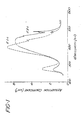
- the rod used in the measurements shown in Figure 2 had its hexagonal (c) axis at 45° to the rod axis so that the two polarization directions gave different results ⁇ one direction corresponds to E-Lc and the other to E//c.
- the polarization direction corresponding to larger absorption at 700 nm is called E max and the perpendicular polarization is E min .
- any conventional tuning means may be used.
- suitable tuning means include a prism, optical grating, birefringent filter, multilayer dielectric coated filter, or lens having longitudinal chromatic aberration.
- a birefringent filter of the general type described by G. Holtom and O. Teschke, "Design of a Birefringent Filter for High-Power Dye Lasers", IEEE J. Quantum Electron, QE-10, 577 (1974). This type of filter is sometimes referred to as a "Lyot filter”. (B. Lyot, Compt. Rend. 197, 1593 (1933).
- a high power emerald laser may comprise the basic laser, as described above, as the "oscillator stage" of a laser amplifier.
- the amplifier uses such an oscillator stage to provide input radiation for one or more "amplifier stages", which typically include an emerald crystal and flashlamp, or other pump source, mounted inside an optical cavity.
- Temperature control means may be any of those well known in the art; for example, a circulating fluid adapted for absorbing heat from, or transmitting heat to, the laser medium.
- the circulating fluid may be air, water, a cryogenic liquid, etc.
- a heater is used to control the fluid temperature when necessary.
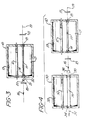
- FIG. 3 illustrates a laser apparatus of this invention.
- the laser medium 11, comprising an emerald crystal, and pumping source 12 are housed in container 10, which has a highly reflective inner surface 13 which defines an elliptical cavity. Reflection at surface 13 may be diffuse or specular.
- the axes of the laser medium 11 and the pumping source 12 are each located along a focal line of the ellipse formed by container 10.
- Laser medium 11 is normally provided with coated ends 14 and 15 having a conventional dielectric anti-reflection coating.
- Completely reflecting mirror 17, optional tuning element 20, and partially reflecting mirror 18 are positioned external to container 10 along cylindrical axis 19 of laser medium 11. Lasing action is evidenced by emission of highly collimated coherent radiation whose wavelength is determined by the orientation of the tuning element 20.
- the radiation shown as arrow 16, emanates from partially reflecting mirror 18.
- Mirrors 17 and 18 may both be partially reflecting. If necessary to maintain the desired operating temperature, laser medium 11 and pumping ' source 12 are cooled by a fluid circulated through container 10.
- An optional Q-switch is shown as comprising polarizer 21 and Pockels cell 22.
- an amplifier stage may be used with the apparatus of Figure 3 in a high power laser system of this invention.
- the apparatus of Figure 3 is then considered the "oscillator stage" of the amplifier.
- the amplifier stage is located in the output beam of the oscillator stage. It consists essentially of a container 30 which has a highly reflective inner surface 33 which defines an elliptical cavity.
- An amplifier rod 31, excited by flash lamp 32, is normally provided with coated ends 34 and 35 having a conventional dielectric anti-reflection coating.
- the amplifier rod may be of larger diameter than the oscillator rod 11, in which case a beam expanding telescope 36 is located between the stages in order to match the beam size to the rod size.
- the amplifier stage normally does not have mirrors at its ends to form a cavity, and the amplification of the oscillator output occurs during only one pass of the laser beam through the amplifier rod.
- the amplifier may be fitted with partially reflecting mirrors to feed back part of the amplifier output into the amplifying medium.
- the spectral and temporal characteristics of the output of this regenerative oscillator can then be determined by injecting a suitably tailored signal from the primary oscillator in a manner similar to that employed with the single pass amplifier. More than one amplifier stage may be used.
- the amplified output shown as arrow 37 emanates from amplifier rod 31.
- An emerald rod 19 mm longx4 mm diameter was cut from a hydrothermally grown crystal with its hexagonal axis at 45° to the rod axis.
- the rod was mounted in a water-cooled ceramic flashlamp housing.
- the optical cavity had a reflective mirror at one end and a 95% output mirror at the other end. Both mirrors were concave, with a 4 um focal length.
- the rod was pumped with two 80 p s-duration xenon' flashlamps operating in parallel.
- the laser emitted 6.8 mJ at 757.4 nm. With output mirrors - having different reflectivity spectra, the laser emitted at 751.1, 753.8, 758.8, and 759.2 nm.
Landscapes
- Physics & Mathematics (AREA)
- Electromagnetism (AREA)
- Engineering & Computer Science (AREA)
- Plasma & Fusion (AREA)
- Optics & Photonics (AREA)
- Lasers (AREA)
Claims (10)
- . 1. Laser comprenant:un milieu laser comprenant un monocristal de Be3Al2(SiO3)6:Cr3+, etun moyen de pompage pour exciter le milieu laser pour qu'il émette un rayonnement cohérent.
- 2. Laser selon la revendication 1, dans lequel le milieu laser a sensiblement la forme d'un barreau cylindrique dont la grande dimension est selon l'axe du cylindre.
- 3. Laser selon la revendication 1, dans lequel le milieu laser a sensiblement la forme d'une lame ayant une section sensiblement rectangulaire dans un plan normal à sa grande dimension.
- 4. Laser selon l'une des revendications 2 ou 3, dans lequel la grande dimension du cristal est sensiblement perpendiculaire à l'axe c du cristal.
- 5. Laser selon la revendication 1, dans lequel la concentration en Cr3+ est dans une gamme comprise entre 0,001 et 10 atomes pour cent par rapport aux sites d'aluminium.
- 6. Laser selon la revendication 1, dans lequel le moyen de pompage comprend une source de lumière en impulsions cohérente ou incohérente émettant à des longueurs d'onde inférieures à 700 nm.
- 7. Laser selon la revendication 1, dans lequel le moyen de pompage comprend une source lumineuse continue cohérente ou incohérente émettant à des longueurs d'onde inférieures à 700 nm.
- 8. Laser selon la revendication 1, comprenant en outre des moyens pour commander la température du milieu laser.
- 9. Laser selon la revendication 1, comprenant en outre des moyens pour accorder le rayonnement cohérent dans une gamme spectrale allant du rouge à l'infrarouge.
- 10. Amplificateur laser comprenant:le laser de la revendication 1 pour émettre un premier faisceau de rayonnement cohérent;un second milieu laser comprenant un monocristal de Be3AI2(SiO3)6:Cr", ce second milieu laser étant positionné dans le premier faisceau de rayonnement cohérent; etun moyen de pompage pour exciter le second milieu laser pour émettre un second faisceau de rayonnement cohérent.
Applications Claiming Priority (2)
| Application Number | Priority Date | Filing Date | Title |
|---|---|---|---|
| US38931782A | 1982-06-17 | 1982-06-17 | |
| US389317 | 1982-06-17 |
Publications (3)
| Publication Number | Publication Date |
|---|---|
| EP0097242A2 EP0097242A2 (fr) | 1984-01-04 |
| EP0097242A3 EP0097242A3 (en) | 1985-07-24 |
| EP0097242B1 true EP0097242B1 (fr) | 1987-01-21 |
Family
ID=23537755
Family Applications (1)
| Application Number | Title | Priority Date | Filing Date |
|---|---|---|---|
| EP19830104765 Expired EP0097242B1 (fr) | 1982-06-17 | 1983-05-14 | Laser à émeraude |
Country Status (4)
| Country | Link |
|---|---|
| EP (1) | EP0097242B1 (fr) |
| JP (1) | JPS594091A (fr) |
| CA (1) | CA1206243A (fr) |
| DE (1) | DE3369439D1 (fr) |
Families Citing this family (1)
| Publication number | Priority date | Publication date | Assignee | Title |
|---|---|---|---|---|
| US4599727A (en) * | 1984-10-26 | 1986-07-08 | Massachusetts Institute Of Technology | Strontium aluminum fluoride laser |
Family Cites Families (2)
| Publication number | Priority date | Publication date | Assignee | Title |
|---|---|---|---|---|
| US4272733A (en) * | 1978-10-20 | 1981-06-09 | Allied Chemical Corporation | Broadly tunable chromium-doped beryllium aluminate lasers and operation thereof |
| US4464761A (en) * | 1981-12-18 | 1984-08-07 | Alfano Robert R | Chromium-doped beryllium aluminum silicate laser systems |
-
1983
- 1983-05-14 DE DE8383104765T patent/DE3369439D1/de not_active Expired
- 1983-05-14 EP EP19830104765 patent/EP0097242B1/fr not_active Expired
- 1983-05-27 CA CA000429036A patent/CA1206243A/fr not_active Expired
- 1983-06-15 JP JP10760483A patent/JPS594091A/ja active Granted
Also Published As
| Publication number | Publication date |
|---|---|
| JPS594091A (ja) | 1984-01-10 |
| DE3369439D1 (en) | 1987-02-26 |
| EP0097242A3 (en) | 1985-07-24 |
| CA1206243A (fr) | 1986-06-17 |
| EP0097242A2 (fr) | 1984-01-04 |
| JPH0414518B2 (fr) | 1992-03-13 |
Similar Documents
| Publication | Publication Date | Title |
|---|---|---|
| CA1126844A (fr) | Lasers d'aluminate de beryllium dope au chrome, a large gamme de longueurs d'onde, et utilisation | |
| US5488626A (en) | Method of and apparatus for pumping of transition metal ion containing solid state lasers using diode laser sources | |
| US5182759A (en) | Apparatus and method for pumping of a weakly absorbing lasant material | |
| US5623510A (en) | Tunable, diode side-pumped Er: YAG laser | |
| US4841530A (en) | Cr-doped scandium borate laser | |
| US5802083A (en) | Saturable absorber Q-switches for 2-μm lasers | |
| US4490822A (en) | Cr-Doped yttrium gallium garnet laser | |
| US4167712A (en) | Praseodymium blue-green laser system | |
| US4809283A (en) | Method of manufacturing chromium-doped beryllium aluminate laser rod and lasers incorporating the rods therein | |
| US4464761A (en) | Chromium-doped beryllium aluminum silicate laser systems | |
| US5414724A (en) | Monolithic self Q-switched laser | |
| US5742632A (en) | Ho:LuLF and Ho:Tm:LuLF laser materials | |
| CA1214251A (fr) | Laser a grenat de gadolinium et de gallium dope au chrome | |
| EP0457523B1 (fr) | Dispositif de pompage d'un milieu laser faiblement absorbant | |
| EP0319332B1 (fr) | Système laser à forstérite dopée au chrome | |
| EP0097242A2 (fr) | Laser à émeraude | |
| US4599727A (en) | Strontium aluminum fluoride laser | |
| US5734669A (en) | 1.3 μm lasers using Nd3+ doped apatite crystals | |
| JPS5824030B2 (ja) | 波長を広く整調しうるレ−ザ | |
| Berenberg et al. | Solid-state microlasers pumped by miniature flashlamps | |
| Lutz et al. | Optimization of the excitation characteristics of a flashlamp-pumped titanium sapphire laser | |
| Lüthy et al. | Solid state lasers | |
| Dinerman et al. | Continuous wave and pulsed laser operation at 3 μm in Er3+-doped crystals | |
| Koselja et al. | Ti: sapphire laser with long-pulse lamp pumping | |
| Crlld | Flashlamp Pumped Ti: AI20 3 Laser Studies |
Legal Events
| Date | Code | Title | Description |
|---|---|---|---|
| PUAI | Public reference made under article 153(3) epc to a published international application that has entered the european phase |
Free format text: ORIGINAL CODE: 0009012 |
|
| AK | Designated contracting states |
Designated state(s): DE FR GB IT |
|
| 17P | Request for examination filed |
Effective date: 19841210 |
|
| PUAL | Search report despatched |
Free format text: ORIGINAL CODE: 0009013 |
|
| AK | Designated contracting states |
Designated state(s): DE FR GB IT |
|
| 17Q | First examination report despatched |
Effective date: 19860527 |
|
| ITF | It: translation for a ep patent filed | ||
| GRAA | (expected) grant |
Free format text: ORIGINAL CODE: 0009210 |
|
| AK | Designated contracting states |
Kind code of ref document: B1 Designated state(s): DE FR GB IT |
|
| REF | Corresponds to: |
Ref document number: 3369439 Country of ref document: DE Date of ref document: 19870226 |
|
| ET | Fr: translation filed | ||
| PLBE | No opposition filed within time limit |
Free format text: ORIGINAL CODE: 0009261 |
|
| STAA | Information on the status of an ep patent application or granted ep patent |
Free format text: STATUS: NO OPPOSITION FILED WITHIN TIME LIMIT |
|
| 26N | No opposition filed | ||
| PGFP | Annual fee paid to national office [announced via postgrant information from national office to epo] |
Ref country code: GB Payment date: 19910502 Year of fee payment: 9 |
|
| PGFP | Annual fee paid to national office [announced via postgrant information from national office to epo] |
Ref country code: FR Payment date: 19910522 Year of fee payment: 9 |
|
| ITTA | It: last paid annual fee | ||
| PGFP | Annual fee paid to national office [announced via postgrant information from national office to epo] |
Ref country code: DE Payment date: 19910531 Year of fee payment: 9 |
|
| PG25 | Lapsed in a contracting state [announced via postgrant information from national office to epo] |
Ref country code: GB Effective date: 19920514 |
|
| GBPC | Gb: european patent ceased through non-payment of renewal fee |
Effective date: 19920514 |
|
| PG25 | Lapsed in a contracting state [announced via postgrant information from national office to epo] |
Ref country code: FR Effective date: 19930129 |
|
| PG25 | Lapsed in a contracting state [announced via postgrant information from national office to epo] |
Ref country code: DE Effective date: 19930202 |
|
| REG | Reference to a national code |
Ref country code: FR Ref legal event code: ST |