EP0097444A2 - Verfahren zur Anzeige eines Leiterdiagrams - Google Patents
Verfahren zur Anzeige eines Leiterdiagrams Download PDFInfo
- Publication number
- EP0097444A2 EP0097444A2 EP83303226A EP83303226A EP0097444A2 EP 0097444 A2 EP0097444 A2 EP 0097444A2 EP 83303226 A EP83303226 A EP 83303226A EP 83303226 A EP83303226 A EP 83303226A EP 0097444 A2 EP0097444 A2 EP 0097444A2
- Authority
- EP
- European Patent Office
- Prior art keywords
- symbols
- data
- operand
- relay
- display
- Prior art date
- Legal status (The legal status is an assumption and is not a legal conclusion. Google has not performed a legal analysis and makes no representation as to the accuracy of the status listed.)
- Withdrawn
Links
Images



Classifications
-
- G—PHYSICS
- G05—CONTROLLING; REGULATING
- G05B—CONTROL OR REGULATING SYSTEMS IN GENERAL; FUNCTIONAL ELEMENTS OF SUCH SYSTEMS; MONITORING OR TESTING ARRANGEMENTS FOR SUCH SYSTEMS OR ELEMENTS
- G05B19/00—Program-control systems
- G05B19/02—Program-control systems electric
- G05B19/04—Program control other than numerical control, i.e. in sequence controllers or logic controllers
- G05B19/05—Programmable logic controllers, e.g. simulating logic interconnections of signals according to ladder diagrams or function charts
- G05B19/056—Programming the PLC
-
- G—PHYSICS
- G05—CONTROLLING; REGULATING
- G05B—CONTROL OR REGULATING SYSTEMS IN GENERAL; FUNCTIONAL ELEMENTS OF SUCH SYSTEMS; MONITORING OR TESTING ARRANGEMENTS FOR SUCH SYSTEMS OR ELEMENTS
- G05B2219/00—Program-control systems
- G05B2219/10—Plc systems
- G05B2219/13—Plc programming
- G05B2219/13048—Display of ladder, RLD, RLL, KOP
Definitions
- This invention relates to a method of displaying a ladder diagram. More specifically, the invention relates to a latter diagram display method in a numerical control system for executing sequence processing in response to commands from a numerical control unit on the basis of a sequence program stored previously in memory, the results of processing being delivered to a machine tool, and for displaying the sequence executed by the sequence program on a display device in the form of a ladder diagram using at least relay contact symbols and relay symbols.
- Numerical control systems permit various mechanical elements in machine tools to be controlled on the basis of commands issued by a numerical control device which incorporates an operator's panel.
- a hardwired switch network or so-called “magnetics” unit comprising a multiplicity of relays is connected between the numerical control device, commonly referred to as an NC device, and the machine tool.
- Prescribed ones of these relays are actuated in response to the commands issued by the NC device, whereby the prescribed elements of the machine tool are caused to operate in the manner specified by the commands.
- These commands may be entered directly from the operator's panel, or may be generated in response to programmed M-function and S-function instructions. Disadvantages encountered in the conventional systems of the above type are the large size of the apparatus and the high cost entailed by the large number of relays, as well.as poor reliability attributed to mechanical failure of the relays.
- sequence controllers also known as programmable sequence controllers
- programmable sequence controllers are now the most widely used means for performing, through program processing, the function of the magnetics unit.
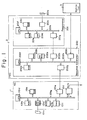
- a programmable sequence controller (referred to hereinafter as a PSC device) according to the prior art is illustrated in Fig. 1.
- Numeral 1 denotes a numerical control device
- 2 the conventional PSC installed separately of the numerical control device 1
- 3 a machine tool.
- the numerical control device includes a paper tape 101a bearing machining commands in punched form, a paper tape reader lOla' for reading the paper tape, a random access memory (RAM) 101b for storing the machining commands read in from the paper tape 101a, a read-only memory (ROM) 101c storing a control program for controlling the numerical control device 1, a central processing unit (CPU) 101d for executing processing in accordance with a machining command program or the control program, a transceiver unit 101e for the purpose of sending data to and receiving data from the sequence controller 2, and an arithmetic circuit 101f comprising a so-called pulse interpolating circuit which receives as inputs thereto signals indicative of amounts of movement X o , Y o along the X and Y axes, respectively, and a signal indicative of feed speed F, for producing interpolated pulses X , y p by performing a well-known arithmetic pulse interpolation operation based on these signal inputs.
- the numerical control device 1 also includes a manual data input unit (MDI unit)) 101h that is mounted on the operator's panel of the numerical control device 1 for entering single blocks of machining command data when, say, adding to-or modifying such data. Also provided is a universal display unit 101i for displaying, e.g., NC program data, cutter offset, and the present position of a tool. Note that the display unit and MDI unit may be constructed as a single unit. The aforementioned units lOla' through 101f are interconnected by a bus line 101g.
- MDI unit manual data input unit
- the PSC device 2 comprises a programmer 201 for converting an entered sequence program into machine language and for correcting the sequence program, and a sequence controller proper 202.
- the programmer 201 includes a paper tape 201a bearing a correspondence table (described below) and a sequence program in punched form, a paper tape reader 201b for reading the paper tape 201a, and a random access memory (RAM) 201c for storing the sequence program.
- a sequence program performs the function of a magnetics unit, expressing the function thereof in logical form using operation codes and operands which make up a program.
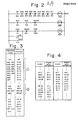
- a ladder diagram constituting part of the magnetics unit shown in Fig. 2 may be programmed as depicted in Fig. 3. In Fig.
- the operation codes in the sequence program are given by RD, AND, WRT, OR, AND-NOT and so on.
- RD is a read operation instruction, AND a logical product instruction, WRT a write operation instruction, OR a logical sum instruction, and AND ⁇ NOT an instruction for logical multiplication with a negated value.
- MF, M28,..., AUT, - M03... represent the operands of the sequence program in symbolic representation, the logical values whereof are stored at prescribed addresses and prescribed bits in a data memory 202a, described below, located within the sequence controller proper 202.
- the PSC device 2 based on the group of instructions (1) shown in Fig. 3, executes the following logical operation:
- the programmer 201 further includes a correspondence table 201d for storing the corresponding relationships between the symbols MF, AUT... constituting the operands of the sequence program, and storage locations of the data memory 202a.
- a correspondence table 201d for storing the corresponding relationships between the symbols MF, AUT... constituting the operands of the sequence program, and storage locations of the data memory 202a.
- An example of what is stored in the correspondence table is illustrated in Fig. 4. It will be seen that the symbol AUT corresponds to the first bit of the tenth address of the data memory 10, that symbol M03 corresponds to the second bit of the tenth address, and likewise through symbol C R A, which corresponds to the second bit of the 42nd address.
- the ladder diagram of Fig. 2 also shows the symbols matched with the corresponding storage locations.
- the programmer 201 is also provided with a read-only memory (ROM) 20le for storing, e.g., a control program for controlling the overall programmer 201, as well as a language translator program for translating the sequence program read in from the paper tape 201a into machine language.
- the programmer 201 further comprises a central processing unit (CPU) 201f for executing, e.g., translation and correction of the sequence program in accordance with the program stored in the ROM 201e, and a transceiving unit 201g having a butter or the like for sending data to and receiving data from the sequence controller proper 202.
- the foregoing units constituting the programmer 201 are interconnected by a bus line 2o-lh.
- the sequence controller proper 202 includes the data memory 202a mentioned above.
- the data memory 202a establishes correspondence between each relay contact of the magnetics unit shown in Fig. 2 and a single bit, the on/off (closed/open) condition of a relay contact being represented by logical "1" or logical "0", respectively, in the corresponding bit.
- the operator places the system in the automatic mode using the operator's panel.
- the relay contact AUT in the power sequence circuit would be placed in the ON condition.
- logical "1" is stored in the first bit of the tenth address in data memory 202a.
- the sequence controller proper 202 also includes a transceiving unit 202b having a buffer or the like for supervising the transmission and reception of data with the programmer 201, a RAM 202c for storing the sequence program translated into machine language by the programmer 201, a data input/output unit 202d for supervising the transmission and reception of data with the machine tool 3, a ROM 202e for storing the control program which controls the overall sequence controller proper 202, a central processing unit 202f for executing prescribed sequence processing in accordance with the control program and sequence program, and a transceiving unit 202g for sending data to and receiving data from the numerical control device 1.
- the units constituting the sequence controller proper 202 are interconnected by a bus line 202h.
- Fig. 5 is a block diagram showing the data input/output unit 202d in greater detail.
- the data input/output unit 202d comprises a data input circuit DI and a data output circuit DO.
- the data input circuit DI includes receivers R 1 through R n which receive signals from various limit switches and relay contacts RC 1 through RC n delivered from the machine side on cables L 11 through L 1n , AND gates G 1 through G n receiving the outputs of the respective receivers R 1 through R n , and a decoder DEC 1 which decodes address signals received from an address bus ABUS to open predetermined ones of the AND gates, the AND gate output being sent out on the data bus DBUS.
- the data output circuit DO includes flip-flops (or latch circuits if desired) L 1 through L m for storing such signals as forward and reverse spindle rotation signals to be delivered to the machine tool 3, drivers D 1 through D m provided for corresponding ones of the flip-flops (flip-flop will be abbreviated to FF hereinafter) L 1 through L m for delivering the output signals from the FFs to the machine tool 3 via cables L 21 through L 2m to actuate relays Ry 1 through Ry m , and a decoder DEC 2 which decodes address signals received from the address bus ABUS to place predetermined ones of the FFs in a settable or resettable state, and which stores in predetermined FFs the data received from the data bus DBUS.
- flip-flops or latch circuits if desired
- a control signal bus CBUS is provided for sending and receiving control signals.
- the abovementioned cables L 11 through L 1n and t 21 through 12m interconnect the data input/output unit 202d and the machine tool so that data may be sent and received between them.
- the PSC device 2 operates in the following manner. First, a table showing the correspondence between symbols and storage locations is prepared while referring to the ladder diagram (Fig. 2) of the magnetics circuit, and the table is punched in a paper tape. A sequence program also is prepared in the above-described manner using operation codes and symbols (operands) and is similarly punched into the paper tape 201a. Next, the punched tape 201a is read by the paper tape reader 201b to store the correspondence table in table 201d and the sequence program in the RAM 201c. When the foregoing has been accomplished the PSC device 2 starts executing the language processing program stored in the ROM 201e, reads the instructions in the sequence program out of the RAM 201c in successive fashion and converts the operation codes and operands into machine language.
- the PSC device uses the correspondence table, which is stored in the table 201d, to convert each operand into the machine word representing the prescribed address and bit of the data memory 202a.
- the sequence program converted into these machine words is transferred to and stored in the RAM 202c through the transceiver unit 201g of the programmer 201 and the transceiver unit 202b of the sequence controller 202.
- the sequence controller 202 now is capable of executing sequence processing.
- the CPU 202f reads the sequence program instructions successively out of the RAM 202c one instruction at a time, executes sequence processing from the first to the last instructions of the sequence program and then returns to the first instruction to repeat the cycle.
- the PSC 2 steps through the sequence program cyclically in repetitive fashion and at high speed.
- a command such as the command M03 for forward spindle rotation is issued by the numerical control device 101.
- logical "1" is written into the data memory 202a in the first bit of the 66th address where the M-function is to be stored, in the first bit of the 67th address where the M-code signal Mll is to be stored, and in the second bit of the 67th address where the M-code signal M12 is to be stored.
- a forward rotation end signal (logical "1") from the machine tool side, which signal is produced by closure of the relay contact RC 1 , is stored in a prescribed bit of the data memory 202a (Fig. 1) through the cable L 11 , receiver R 1 , AND gate G 1 and data bus DBUS. Sequence programming then continues and the numerical control device 1 is informed of completion of the forward rotation operation. This ends the sequence step for forward rotation of the spindle.
- the PSC device 2 is provided with the programmer 201.
- An arrangement as shown in Fig. 6 is possible, however, in which the programmer 201 and transceiver unit 202b are deleted, a sequence program already converted into machine language is read in from the numerical control device 1 by reading means (such as the paper tape reader 101a l ) and is stored in the RAM 202c through the transceiver units lOle and 202g.
- the RAM 202c moreover, it is possible to use a ROM for storing a sequence program comprising machine language.
- the numerical control device 1 and PSC device 2 are shown to be provided separately in Figs.
- Fig. 7 portions similar to those shown in Fig. 1 are designated by like reference characters.
- Numeral 101k denotes the abovementioned ROM for storing the sequence program expressed in machine language.
- the numerical control system having the construction shown in Figs. 1, 6 and 7 is capable of displaying a ladder diagram on the universal display unit 101i in order to facilitate sequence program debugging and maintenance processing.
- an object of the present invention is to provide a ladder diagram display method through which a sequence operation can be readily comprehended, and which permits debugging and maintenance to be performed in a simple manner.
- Another object of the present invention is to provide a ladder diagram display method through which the conditions indicated by control relays can be displayed together with a ladder diagram.
- a further object of the present invention is to provide a ladder diagram display method through which the on/off conditions of control relays can be displayed together with a ladder diagram.
- Fig. 8 showing a block diagram of a numerical control system for practicing a method of displaying a ladder diagram according to the present invention.
- the system includes a numerical control tape 301a bearing machining commands in punched form, a tape reader 301a' for reading in the NC data from the tape 301a, a RAM 301b for storing the NC data read in by the tape reader 301a', a ROM 301c for storing a control program, a data memory 301d comprising a RA M for storing the results of both numerical control processing and sequence processing, and a ROM 30le for storing a sequence program expressed in machine language.
- the ROM 301e in addition to a sequence program storage area SPA, is provided with storage areas SLA, SCA, TCA in which various items of information have been stored for displaying comments. More specifically, the storage areas SLA, SCA, TCA store the following data, respectively:
- a manual data input unit (MDI) 301g is included in the system of Fig. 8
- a display unit 301h is included in the system of Fig. 8
- a data input/output unit 301i for supervising the input and output of data with the machine tool 3.
- MDI manual data input unit
- a display unit 301h is included in the system of Fig. 8
- a data input/output unit 301i is structurally similar to the data input/output unit 202d shown in Fig. 5.
- a pulse interpolator 301j which receives as inputs thereto signals indicative of amounts of movement X o , Y o along the X and Y axes, respectively, and a signal indicative of feed speed F, for producing interpolation pulses X , Y p by performing a well-known arithmetic pulse interpolation operation based on these signal inputs. All of the foregoing units are under the control of a data processing unit 301m. Numeral 301n denotes an operator's panel. All units are interconnected by a bus line 301n.
- the display unit 301h comprises a display controller DPC, constituted by a computer, for executing processing which includes processing to convert a sequence program, transferred from the ROM 301e, into picture information, a refresh memory RF M connected to the display controller DPC for storing the picture information obtained by the convetion processing performed by the display controller DPC, and a memory MEM for storing (a) the data giving the correspondence between the abovementioned symbols and the storage locations of the data memory 301d, (b) the data giving the correspondence between the symbols and the names of conditions indicated by these symbols, and (c) data giving the correspondence between the symbols and the on/off states (expressed by logical values "1", "0") of the control relays corresponding to these symbols.
- a display controller DPC constituted by a computer, for executing processing which includes processing to convert a sequence program, transferred from the ROM 301e, into picture information
- a refresh memory RF M connected to the display controller DPC for storing the picture information obtained by the convetion processing performed by
- a character generator CG for storing various alphanumeric characters and symbolic patterns illustrative of a ladder diagram
- an image memory IMM for successively storing items of picture data generated by the character generator CG based on the picture information stored in the refresh memory RFM, whereby all picture information for displaying a single picture is stored
- a luminance signal memory LSM for storing a luminance signal generated by the display control unit DPC
- a timing signal generator TSG for read control units RCC 1 , RCC 2 , a luminance control unit LCC, a beam deflection control unit DCC, and a cathode-ray tube CRT.
- the character generator CG stores not only alphanumeric patterns but also symbolic graphics for displaying ladder diagrams. Examples of these symbolic graphics are as shown in Fig. 10, in which (a) is a symbol indicating a normally open relay contact and (b) a symbol indicating a normally closed relay contact. Fig. 10(e) depicts a relay. The remaining symbolic graphics illustrate various connections.
- the display control unit DPC generates the aforementioned luminance signal so as to make a relay contact symbol or relay symbol corresponding to a logical "1" operand, brighter than that of relay contact symbol or relay symbol corresponding to a logical "0" operand. As mentioned above, the luminance signal is stored in the luminance signal memory LSM.
- the timing signal generator TSG generates a timing signal for reading stored information out of the image memory IMM and luminance signal memory LSM, and a timing signal for deflecting the electron beam of the CRT.
- the read control units RCC 1 , RCC 2 responds to the timing signal from the timing signal generator TSG by reading stored information out of the image memory IMM and luminance signal memory LSM, respectively, and delivering the information to the luminance control unit LCC.
- the latter controls the luminance of the CRT based on the information received, diminishing the brightness of relay symbols corresponding to logical "0" operands, and intensifying the brightness of relay symbols corresponding to logical "1" operands.
- the beam deflection control unit DCC deflects the CRT electron beam horizontally and vertically in sync with the timing signal received from the timing signal generator TSG.
- the CRT displays a ladder diagram the luminance of which is controlled in accordance with the on/off conditions ("1", "0" logic of the operands) of the relays.
- Fig. 11 is a partially enlarged view of a ladder diagram as displayed by the CRT in accordance with the present invention.
- "MF”, “M28”, “M03”, “AUT”, “SPCCW”, and “SPCW” are control relay symbols.
- "SPINDLE CLOCKWISE ROTATION COMMAND” and "SPINDLE ROTATING CLOCKWISE” are the names of the conditions ot the symbols M03, SPCW, respectively.
- the fine lines in Fig. 11 are not displayed on the display unit. In other words, the only lines that appear are those that interconnect the relays and relay contacts.
- a one-line portion of the display comprises a name display section, a symbol display section and an address display section.
- a condition display section is provided at the end of each line.
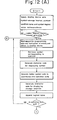
- picture information for each display section of a one-line portion of the CRT screen namely picture information for the name display section, symbol display section and address display section shown in F ig. 11, is obtained from one item of sequence program data and is stored in the working memory WM.
- step (h) If the decision is "NO”, processing returns to step (b), the next item of sequence program data is read, and steps (c) through (g) are repeated.
- step (i) If the decision in step (g) is "YES", on the other hand, indicating that the operation code is a read instruction, then the name of the condition corresponding to the operand is read out of the memory MEM, a character code is generated for displaying the name of the condition in the condition display section at the rightmost side of the line, and the code is stored in the working memory WM.
- step (k) The next step calls for a decision as to whether all of the sequence program data have been converted into picture information.
- the decision is "NO"
- the system returns to step (b) and the foregoing processing is repeated until all of the sequence program data have been converted into picture information, thereby ending the conversion processing.
- the display control unit DPC reads the picture information out of the refresh memory RFM sequentially.
- the display control unit DPC goes to the character generator CG to read out character patterns and symbolic patterns corresponding to the picture information read out of the refresh memory RFM, stores these patterns in the image memory IMM, and stores a luminance signal, contained in the picture information, in the luminance signal memory LSM.
- a ladder diagram picture and the luminance signal are stored in the image meory IMM and luminance signal memory LSM, respectively.
- the on or off state of a relay is distinguished by the brightness of the relay symbol. The same can be accomplished by altering the color of the relay symbol to indicate its condition.
Landscapes
- Physics & Mathematics (AREA)
- General Physics & Mathematics (AREA)
- Engineering & Computer Science (AREA)
- Automation & Control Theory (AREA)
- Programmable Controllers (AREA)
- Testing And Monitoring For Control Systems (AREA)
Applications Claiming Priority (2)
| Application Number | Priority Date | Filing Date | Title |
|---|---|---|---|
| JP96488/82 | 1982-06-05 | ||
| JP57096488A JPS58213304A (ja) | 1982-06-05 | 1982-06-05 | ラダ−ダイヤグラム表示方式 |
Publications (2)
| Publication Number | Publication Date |
|---|---|
| EP0097444A2 true EP0097444A2 (de) | 1984-01-04 |
| EP0097444A3 EP0097444A3 (de) | 1984-08-01 |
Family
ID=14166453
Family Applications (1)
| Application Number | Title | Priority Date | Filing Date |
|---|---|---|---|
| EP83303226A Withdrawn EP0097444A3 (de) | 1982-06-05 | 1983-06-03 | Verfahren zur Anzeige eines Leiterdiagrams |
Country Status (2)
| Country | Link |
|---|---|
| EP (1) | EP0097444A3 (de) |
| JP (1) | JPS58213304A (de) |
Cited By (8)
| Publication number | Priority date | Publication date | Assignee | Title |
|---|---|---|---|---|
| GB2163927A (en) * | 1984-08-31 | 1986-03-05 | Gen Electric | Graphic display for a numerical control system |
| FR2599896A1 (fr) * | 1986-06-06 | 1987-12-11 | Comp Generale Electricite | Procede pour solidariser par thermocompression un tube en alumine beta ou beta seconde et un support en ceramique isolante dans un generateur electrochimique sodium-soufre et generateurs electrochimiques en faisant application |
| EP0251699A3 (en) * | 1986-06-24 | 1989-12-20 | Westinghouse Electric Corporation | A logic diagram compiler executor |
| EP0331060A3 (en) * | 1988-02-29 | 1990-09-12 | Allen-Bradley Company | Programmable controller with stored tokenized source code |
| GB2233120A (en) * | 1989-04-18 | 1991-01-02 | Emergency Reaction Systems Lim | Computer-aided design equipment |
| EP0416509A3 (en) * | 1989-09-04 | 1992-03-04 | Omron Corporation | Programmable controller, and method and apparatus for programming same |
| EP0424056A3 (en) * | 1989-10-16 | 1992-09-16 | Ge Fanuc Automation North America, Inc. | Programmable logic controllers and the expression of relay ladder diagrams |
| CN112327744A (zh) * | 2020-11-20 | 2021-02-05 | 深圳市海浦蒙特科技有限公司 | 用于可编程逻辑控制器的梯形图与指令表互相转换方法 |
Families Citing this family (3)
| Publication number | Priority date | Publication date | Assignee | Title |
|---|---|---|---|---|
| JPS61120203A (ja) * | 1984-11-15 | 1986-06-07 | Meidensha Electric Mfg Co Ltd | プログラムロ−ダ |
| JPS6428703A (en) * | 1987-07-24 | 1989-01-31 | Fuji Electric Co Ltd | Programming device for programmable controller |
| JPH0736202U (ja) * | 1994-11-18 | 1995-07-04 | 富士電機株式会社 | プログラマブルコントローラのプログラミング装置 |
Family Cites Families (3)
| Publication number | Priority date | Publication date | Assignee | Title |
|---|---|---|---|---|
| US4247901A (en) * | 1979-01-09 | 1981-01-27 | Westinghouse Electric Corp. | Programmable dual stack relay ladder diagram line solver and programming panel therefor with prompter |
| JPS5642805A (en) * | 1979-09-18 | 1981-04-21 | Fanuc Ltd | Sequence producing system for sequence controller controlling machine tool |
| DE2950102C2 (de) * | 1979-12-13 | 1982-09-02 | Institut für Rundfunktechnik GmbH, 8000 München | Einrichtung zum visuellen Überwachen eines Prozeßablaufs |
-
1982
- 1982-06-05 JP JP57096488A patent/JPS58213304A/ja active Pending
-
1983
- 1983-06-03 EP EP83303226A patent/EP0097444A3/de not_active Withdrawn
Cited By (8)
| Publication number | Priority date | Publication date | Assignee | Title |
|---|---|---|---|---|
| GB2163927A (en) * | 1984-08-31 | 1986-03-05 | Gen Electric | Graphic display for a numerical control system |
| FR2599896A1 (fr) * | 1986-06-06 | 1987-12-11 | Comp Generale Electricite | Procede pour solidariser par thermocompression un tube en alumine beta ou beta seconde et un support en ceramique isolante dans un generateur electrochimique sodium-soufre et generateurs electrochimiques en faisant application |
| EP0251699A3 (en) * | 1986-06-24 | 1989-12-20 | Westinghouse Electric Corporation | A logic diagram compiler executor |
| EP0331060A3 (en) * | 1988-02-29 | 1990-09-12 | Allen-Bradley Company | Programmable controller with stored tokenized source code |
| GB2233120A (en) * | 1989-04-18 | 1991-01-02 | Emergency Reaction Systems Lim | Computer-aided design equipment |
| EP0416509A3 (en) * | 1989-09-04 | 1992-03-04 | Omron Corporation | Programmable controller, and method and apparatus for programming same |
| EP0424056A3 (en) * | 1989-10-16 | 1992-09-16 | Ge Fanuc Automation North America, Inc. | Programmable logic controllers and the expression of relay ladder diagrams |
| CN112327744A (zh) * | 2020-11-20 | 2021-02-05 | 深圳市海浦蒙特科技有限公司 | 用于可编程逻辑控制器的梯形图与指令表互相转换方法 |
Also Published As
| Publication number | Publication date |
|---|---|
| JPS58213304A (ja) | 1983-12-12 |
| EP0097444A3 (de) | 1984-08-01 |
Similar Documents
| Publication | Publication Date | Title |
|---|---|---|
| US4415965A (en) | Programmable sequence controller | |
| US5406473A (en) | Programmable controller | |
| EP0089193B1 (de) | Verfahren und Gerät zum Anzeigen von Leiterdiagrammen | |
| CA1305238C (en) | Control system with diagnostic logic | |
| EP0380684B1 (de) | System zur ferndiagnose einer numerischen steuerung | |
| US4616307A (en) | Programmable controller alarm display method | |
| US4736340A (en) | Processor generating control programs for a programmable controller | |
| US5986425A (en) | Numerical controller | |
| US5126956A (en) | Method and apparatus for displaying segments of a ladder diagram which turn on an operator specified relay | |
| JP3306832B2 (ja) | オペレータ・メッセージ伝達機能を有するプログラマブル制御装置 | |
| EP0137852A1 (de) | Numerisches kontrollsystem | |
| US4628442A (en) | Centralized peripheral interface with a numerical control unit | |
| EP0092312B1 (de) | Verfahren und Gerät zum Anzeigen von Leiterdiagrammen | |
| EP0025666A2 (de) | Verfahren und System zur numerischen Steuerung | |
| US4396973A (en) | Programmable sequence controller | |
| US5198737A (en) | Programmable controller for industrial robots | |
| US5359530A (en) | Animated plotting method in NC apparatus for multi-system lathe | |
| JPS58213304A (ja) | ラダ−ダイヤグラム表示方式 | |
| EP0089194B1 (de) | Verfahren und Gerät zum Anzeigen von Leiterdiagrammen | |
| US4212081A (en) | Programmable sequence controller with auxiliary function decoding circuit | |
| US5323308A (en) | Programmable control system | |
| GB2099667A (en) | Programming system with CRT and display unit | |
| JPS59214908A (ja) | ラダ−図表示方式 | |
| US5257181A (en) | Programmable control system | |
| KR840001219B1 (ko) | 프로그램 가능 순차 제어기 |
Legal Events
| Date | Code | Title | Description |
|---|---|---|---|
| PUAI | Public reference made under article 153(3) epc to a published international application that has entered the european phase |
Free format text: ORIGINAL CODE: 0009012 |
|
| AK | Designated contracting states |
Designated state(s): DE FR GB |
|
| PUAL | Search report despatched |
Free format text: ORIGINAL CODE: 0009013 |
|
| AK | Designated contracting states |
Designated state(s): DE FR GB |
|
| 17P | Request for examination filed |
Effective date: 19841221 |
|
| 17Q | First examination report despatched |
Effective date: 19860514 |
|
| STAA | Information on the status of an ep patent application or granted ep patent |
Free format text: STATUS: THE APPLICATION IS DEEMED TO BE WITHDRAWN |
|
| 18D | Application deemed to be withdrawn |
Effective date: 19860925 |
|
| RIN1 | Information on inventor provided before grant (corrected) |
Inventor name: NAGAMINE, TSUYOSHI Inventor name: INOUE, TSUYOSHI Inventor name: NOZAWA, RYOICHIRO |