EP0097618A1 - Laser-Schneideverfahren für einen thermoplastischen Faden oder eine Textilfaser - Google Patents
Laser-Schneideverfahren für einen thermoplastischen Faden oder eine Textilfaser Download PDFInfo
- Publication number
- EP0097618A1 EP0097618A1 EP83810261A EP83810261A EP0097618A1 EP 0097618 A1 EP0097618 A1 EP 0097618A1 EP 83810261 A EP83810261 A EP 83810261A EP 83810261 A EP83810261 A EP 83810261A EP 0097618 A1 EP0097618 A1 EP 0097618A1
- Authority
- EP
- European Patent Office
- Prior art keywords
- filament
- fiber
- laser beam
- fibers
- wire
- Prior art date
- Legal status (The legal status is an assumption and is not a legal conclusion. Google has not performed a legal analysis and makes no representation as to the accuracy of the status listed.)
- Withdrawn
Links
- 239000000835 fiber Substances 0.000 title claims abstract description 39
- 238000000034 method Methods 0.000 title claims abstract description 15
- 239000004753 textile Substances 0.000 title claims abstract description 9
- 229920001169 thermoplastic Polymers 0.000 title description 2
- 239000004416 thermosoftening plastic Substances 0.000 title description 2
- 239000012815 thermoplastic material Substances 0.000 claims abstract description 11
- 238000005520 cutting process Methods 0.000 claims description 10
- 230000009471 action Effects 0.000 claims description 3
- 230000005855 radiation Effects 0.000 claims description 3
- 238000004519 manufacturing process Methods 0.000 abstract description 8
- 230000015572 biosynthetic process Effects 0.000 abstract description 3
- 239000002657 fibrous material Substances 0.000 abstract 1
- 238000010438 heat treatment Methods 0.000 abstract 1
- 238000010586 diagram Methods 0.000 description 9
- NIXOWILDQLNWCW-UHFFFAOYSA-N acrylic acid group Chemical group C(C=C)(=O)O NIXOWILDQLNWCW-UHFFFAOYSA-N 0.000 description 4
- 230000003287 optical effect Effects 0.000 description 4
- 230000008569 process Effects 0.000 description 4
- 238000006073 displacement reaction Methods 0.000 description 3
- 238000002485 combustion reaction Methods 0.000 description 2
- 238000009940 knitting Methods 0.000 description 2
- 230000035807 sensation Effects 0.000 description 2
- 230000008901 benefit Effects 0.000 description 1
- 230000000694 effects Effects 0.000 description 1
- 239000004744 fabric Substances 0.000 description 1
- 230000006870 function Effects 0.000 description 1
- 230000004927 fusion Effects 0.000 description 1
- 230000006872 improvement Effects 0.000 description 1
- 238000012417 linear regression Methods 0.000 description 1
- 239000000463 material Substances 0.000 description 1
- 238000002844 melting Methods 0.000 description 1
- 230000008018 melting Effects 0.000 description 1
- 210000000056 organ Anatomy 0.000 description 1
- 230000009467 reduction Effects 0.000 description 1
Images

Classifications
-
- D—TEXTILES; PAPER
- D04—BRAIDING; LACE-MAKING; KNITTING; TRIMMINGS; NON-WOVEN FABRICS
- D04B—KNITTING
- D04B9/00—Circular knitting machines with independently-movable needles
- D04B9/12—Circular knitting machines with independently-movable needles with provision for incorporating pile threads
-
- D—TEXTILES; PAPER
- D01—NATURAL OR MAN-MADE THREADS OR FIBRES; SPINNING
- D01G—PRELIMINARY TREATMENT OF FIBRES, e.g. FOR SPINNING
- D01G1/00—Severing continuous filaments or long fibres, e.g. stapling
- D01G1/02—Severing continuous filaments or long fibres, e.g. stapling to form staple fibres not delivered in strand form
- D01G1/025—Severing continuous filaments or long fibres, e.g. stapling to form staple fibres not delivered in strand form by thermic means, e.g. laser
-
- D—TEXTILES; PAPER
- D06—TREATMENT OF TEXTILES OR THE LIKE; LAUNDERING; FLEXIBLE MATERIALS NOT OTHERWISE PROVIDED FOR
- D06C—FINISHING, DRESSING, TENTERING OR STRETCHING TEXTILE FABRICS
- D06C13/00—Shearing, clipping or cropping surfaces of textile fabrics; Pile cutting; Trimming seamed edges
- D06C13/06—Removing floats
Definitions
- the subject of the present invention is a method for cutting, by laser, a filament or a textile fiber made of thermoplastic material.
- patent CH 560 772 discloses a process for converting textile filaments according to which a ribbon of textile filaments to be converted is tensioned while subjecting it to the action of a radiant energy source.
- the textile fibers are cut either by the combustion of a natural fiber, or by the melting of a thermoplastic material.
- a pseudospheric surface is formed at the ends thus cut, the diameter of which is greater than that of the fibers. This surface results from the surface tension of the thermoplastic material following its fusion during the cutting of the fibers.
- thermoplastic wires in particular for creating corrugations
- the object of the present invention is not only to remedy to address the shortcomings of known thermal cutting processes, but it also makes it possible to form tapered ends on the cut elements and, therefore, to make these ends more pleasant to the touch.
- the subject of the present invention is a method for cutting, by laser, a filament or a textile fiber of thermoplastic material, in which this filament or fiber is subjected to the radiation of a laser focused on the area of the filament or fiber desired for sectioning, characterized in that a tensile stress is applied to this filament or fiber and that, by the laser, thermal energy is supplied to said zone of the filament or fiber in sufficient quantity to bring it only in a viscoelastic state, the whole so that, thanks to the combined action of the tensile stress and the thermal energy brought to said zone of the filament or fiber, a stretching of this zone is produced, subdividing the filament or fiber in two sections whose opposite ends receive a shape that tapers gradually, by stretching the thermoplastic material, to become pointed at the end of this tapering and separate by the top of their po respective inte.
- the replacement of at least part of the ends of fibers comprising droplets by tapered points makes it possible to increase the value of the product obtained: in fact, obtaining tapered points, otherwise impossible by using a mechanical cutting means, allows you to get closer to the appearance of animal hair appearing in particular on the surface of natural fur, which results in a velvety sensation pleasant to the touch.
- the present invention can therefore not only be advantageously applied to the manufacture of velvet but, in addition, to the production of synthetic furs.
- Figure 1 shows a variable speed motor 1 whose shaft 2 is rotatably mounted between two bearings 3, 4 and carries a disc 5.
- This disc is equipped with pairs of pins 6, 7, only one of which is visible in the drawing, arranged radially around the axis 2.
- One of the pins of each pair receives the end of a spring 8 while the other is used to fix one end of a wire 9, of thermoplastic material, the second end of which is attached to the free end of the spring 8 the latter thus stretching the wire between the two pins.
- the device also carries a laser source 10 capable of generating a focused beam of light 12 by means of an optical system, represented schematically by a simple lens 11, and directing this beam perpendicular to the upper face of the disc 5.
- this wire is exerted a determined traction using the spring 8 and the disk 5 is rotated by the motor 1 so that, by turning, each wire 9, distributed on the disk successively cut the beam 12 focused by the lens 11.
- the rotational speed V. of the disc 5 is chosen such that the wire 9 cuts the laser beam for a sufficient time so that the thermoplastic material of the wire is heated so as to take on a viscoelastic consistency. Therefore, and under the effect of the traction which is applied to the wire by the spring 8, this wire stretches in the impact zone of the laser. It is the diameter f of the cross section of the laser beam through which the wire passes which determines the length of this area.
- the appearance of the tapered portions of the fibers essentially depends, on the one hand, on the diameter of the laser beam and, on the other hand, on the tensile force applied to the wire 9 by the spring 8. Furthermore, to a lesser extent , this aspect also depends on the temperature reached by the fibers, and therefore on the thermal energy transmitted to these fibers.
- the ordinate N represents the proportion of tapered fibers relative to the total number of fibers cut according to the stress resulting from the tensile force applied to the wire 9 by the spring 8, for a constant power P of the laser beam and a constant speed V o of displacement of the wire relative to the laser beam 12.
- Diagram 2 shows that there is a relationship between the stress resulting from the for this traction applied to the wire 9 by the spring 8 and the proportion of tapered points.
- n represents the efficiency of the optical system.
- the lines d 1 and d 2 were obtained by a "linear regression" involving the value of the stresses ⁇ i1 and ⁇ i2 constituting the limits of the intervals D i corresponding to given proportions Ni of tapered points.
- the position of the intervals D i depends on the value of the specific power q i if the speed of movement V I is fixed. These lines are substantially parallel to each other.
- a variation in the speed V 1 of displacement of the wire 9 with respect to the laser beam 12 implies an inversely proportional variation in the energy received from the beam 12 by this wire.
- a decrease in the speed from V 1 to V 2 results in an increase mentation of the energy transmitted to the wire, therefore a reduction in the stresses ⁇ i1 and ⁇ i2 , which results, in the diagram of figure 3, by a bringing together of the lines d 1 and d 2 of the origin of the system d 'axes ⁇ -q (lines of 1 and 2 ).
- the acrylic yarns of 30 and 107 Tex were cut, subjected to a tensile force producing a stress between 2 and 5 N / Tex, by means of a laser with a power varying between 140 and 450 W.
- the efficiency of the optical system was 0.88.
- the numerical values corresponding to obtaining a majority of tapered tips have been summarized in the table below:
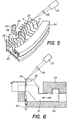
- FIGS. 5 and 6 show partial views, one in perspective, the other in section, of a circular knitting machine in which a diagrammatic representation is shown.
- the tensioning member for the wire loops 29 is constituted by a projection 23 situated at the upper end of the plate spout 22 (FIG. 6).
- This member makes it possible to drive the portion of the wire 29, constituting a loop 31, in the recoil movement of the plate 21 consecutive to the formation of this loop and, by this recoil movement, to subject this wire to a traction force.
- the laser beam, coming from the source 27, is directed by the optical system 26 on the loop portion in contact with the tensioning member 23 as soon as, by its new recoil, the plate has reached the position in which the tension in the thread becomes sufficient to obtain fibers with tapered points.
- the manufacturing method described above is capable of replacing the shaving operation, involved in the production of knitted velvet, thanks to a loop cutting operation which is integrated into the knitting process. It makes it possible to remedy the loss of material occurring during shaving, while improving the quality of the product obtained by the creation of tapered tips.
Landscapes
- Engineering & Computer Science (AREA)
- Textile Engineering (AREA)
- Physics & Mathematics (AREA)
- Optics & Photonics (AREA)
- Treatment Of Fiber Materials (AREA)
- Chemical Or Physical Treatment Of Fibers (AREA)
- Professional, Industrial, Or Sporting Protective Garments (AREA)
Applications Claiming Priority (2)
| Application Number | Priority Date | Filing Date | Title |
|---|---|---|---|
| CH3739/82 | 1982-06-17 | ||
| CH373982 | 1982-06-17 |
Publications (1)
| Publication Number | Publication Date |
|---|---|
| EP0097618A1 true EP0097618A1 (de) | 1984-01-04 |
Family
ID=4262453
Family Applications (1)
| Application Number | Title | Priority Date | Filing Date |
|---|---|---|---|
| EP83810261A Withdrawn EP0097618A1 (de) | 1982-06-17 | 1983-06-14 | Laser-Schneideverfahren für einen thermoplastischen Faden oder eine Textilfaser |
Country Status (2)
| Country | Link |
|---|---|
| EP (1) | EP0097618A1 (de) |
| WO (1) | WO1984000040A1 (de) |
Cited By (3)
| Publication number | Priority date | Publication date | Assignee | Title |
|---|---|---|---|---|
| US5079810A (en) * | 1990-12-28 | 1992-01-14 | E. I. Du Pont De Nemours And Company | Ultrasonic cutting of fabric tufts to provide improved retention of tuft indentity during use |
| DE19734331A1 (de) * | 1997-08-08 | 1999-02-11 | Maute & Renz Textil Gmbh | Verfahren zur Herstellung von Plüschware |
| KR100823063B1 (ko) * | 2005-02-03 | 2008-04-18 | 엔이씨 엘씨디 테크놀로지스, 엘티디. | 백라이트 유닛 및 이를 이용한 액정 디스플레이 디바이스 |
Families Citing this family (1)
| Publication number | Priority date | Publication date | Assignee | Title |
|---|---|---|---|---|
| JP2769656B2 (ja) * | 1992-03-27 | 1998-06-25 | 日本甜菜製糖株式会社 | 農業用耐腐紙とその製法 |
Citations (4)
| Publication number | Priority date | Publication date | Assignee | Title |
|---|---|---|---|---|
| FR1557362A (de) * | 1967-03-28 | 1969-02-14 | ||
| FR2049824A5 (de) * | 1969-06-03 | 1971-03-26 | Velcro Sa Soulie | |
| FR2085142A5 (de) * | 1970-03-26 | 1971-12-17 | Snia Viscosa | |
| JPS5015908B1 (de) * | 1969-09-29 | 1975-06-09 |
-
1983
- 1983-06-14 EP EP83810261A patent/EP0097618A1/de not_active Withdrawn
- 1983-06-14 WO PCT/CH1983/000074 patent/WO1984000040A1/de not_active Ceased
Patent Citations (4)
| Publication number | Priority date | Publication date | Assignee | Title |
|---|---|---|---|---|
| FR1557362A (de) * | 1967-03-28 | 1969-02-14 | ||
| FR2049824A5 (de) * | 1969-06-03 | 1971-03-26 | Velcro Sa Soulie | |
| JPS5015908B1 (de) * | 1969-09-29 | 1975-06-09 | ||
| FR2085142A5 (de) * | 1970-03-26 | 1971-12-17 | Snia Viscosa |
Cited By (3)
| Publication number | Priority date | Publication date | Assignee | Title |
|---|---|---|---|---|
| US5079810A (en) * | 1990-12-28 | 1992-01-14 | E. I. Du Pont De Nemours And Company | Ultrasonic cutting of fabric tufts to provide improved retention of tuft indentity during use |
| DE19734331A1 (de) * | 1997-08-08 | 1999-02-11 | Maute & Renz Textil Gmbh | Verfahren zur Herstellung von Plüschware |
| KR100823063B1 (ko) * | 2005-02-03 | 2008-04-18 | 엔이씨 엘씨디 테크놀로지스, 엘티디. | 백라이트 유닛 및 이를 이용한 액정 디스플레이 디바이스 |
Also Published As
| Publication number | Publication date |
|---|---|
| WO1984000040A1 (fr) | 1984-01-05 |
Similar Documents
| Publication | Publication Date | Title |
|---|---|---|
| CA1168147A (fr) | Dispositif pour la coupe de fils continus, notamment de fils de verre | |
| EP0085634B1 (de) | Verfahren und Einrichtung zur Herstellung eines Garns | |
| FR2620633A1 (fr) | Procede et dispositif pour la realisation d'un faisceau de filaments, notamment de fibres creuses semi-permeables | |
| FR2903424A1 (fr) | Fil en dents de scie pour la fabrication d'une garniture pour un rouleau ou un element de cardage d'une machine de salle de filature. | |
| EP0162787A1 (de) | Verfahren zum Herstellen eines umsponnenen Garnes | |
| CA1118588A (fr) | Dispositif de coupe et d'ouverture | |
| EP0553000A1 (de) | Nähverfahren für ein Faserteil | |
| WO1984000040A1 (fr) | Procede pour sectionner, par laser, un filament | |
| FR2727989A1 (fr) | Aiguilleteuse a tige coulissante | |
| FR2522341A1 (fr) | Procede et dispositif pour la fabrication de tissus en fibres naturelles, et tissu ainsi obtenu | |
| EP0098230B1 (de) | Verfahren und Vorrichtung zum Herstellen von Coregarn aus Fasern | |
| NL7915043A (nl) | Open eind gesponnen garen met verdikkingen en werkwijze en inrichting voor het vervaardigen ervan. | |
| EP0168357B1 (de) | Vorrichtung zum Drehen und gleichzeitigen Verziehen von Lunte auf einer Ringspinnmaschine | |
| JPS5824552B2 (ja) | カットパイルの製造方法および装置 | |
| BE389893A (de) | ||
| EP0089299B1 (de) | Streckverfahren für eine faserartige Textilstruktur und Vorrichtung dafür | |
| EP1249523A1 (de) | Wirrwalze und ihre Verwendung | |
| RU2167962C1 (ru) | Игла для гарнитуры ленточных и гребнечесальных машин | |
| BE371861A (de) | ||
| BE567495A (de) | ||
| FR2621615A1 (fr) | Procede de mesure du resultat du grattage d'une bande d'etoffe, et machine a gratter avec dispositif de mise en oeuvre du procede | |
| BE450761A (de) | ||
| FR2605023A1 (fr) | Tissus a etat de surface modifie et procede pour les obtenir. | |
| FR2562566A1 (fr) | Appareil destine a separer en deux nappes de type velours un produit textile ou paratextile compose de deux nappes retenant tendu entre elles deux un reseau de fils textiles naturels, synthetiques ou metalliques | |
| BE423854A (de) |
Legal Events
| Date | Code | Title | Description |
|---|---|---|---|
| PUAI | Public reference made under article 153(3) epc to a published international application that has entered the european phase |
Free format text: ORIGINAL CODE: 0009012 |
|
| AK | Designated contracting states |
Designated state(s): AT BE CH DE FR GB IT LI LU NL SE |
|
| STAA | Information on the status of an ep patent application or granted ep patent |
Free format text: STATUS: THE APPLICATION IS DEEMED TO BE WITHDRAWN |
|
| 18D | Application deemed to be withdrawn |
Effective date: 19840905 |
|
| RIN1 | Information on inventor provided before grant (corrected) |
Inventor name: SEILER, THOMAS Inventor name: ZURCHER, ERWIN |