EP0097650B1 - An insulating body based on mineral wool, and a method for its manufacture - Google Patents
An insulating body based on mineral wool, and a method for its manufacture Download PDFInfo
- Publication number
- EP0097650B1 EP0097650B1 EP82902179A EP82902179A EP0097650B1 EP 0097650 B1 EP0097650 B1 EP 0097650B1 EP 82902179 A EP82902179 A EP 82902179A EP 82902179 A EP82902179 A EP 82902179A EP 0097650 B1 EP0097650 B1 EP 0097650B1
- Authority
- EP
- European Patent Office
- Prior art keywords
- mineral wool
- board
- clay slurry
- slurry
- clay
- Prior art date
- Legal status (The legal status is an assumption and is not a legal conclusion. Google has not performed a legal analysis and makes no representation as to the accuracy of the status listed.)
- Expired
Links
- 239000011490 mineral wool Substances 0.000 title claims abstract description 54
- 238000000034 method Methods 0.000 title claims abstract description 16
- 238000004519 manufacturing process Methods 0.000 title claims abstract description 12
- NLYAJNPCOHFWQQ-UHFFFAOYSA-N kaolin Chemical compound O.O.O=[Al]O[Si](=O)O[Si](=O)O[Al]=O NLYAJNPCOHFWQQ-UHFFFAOYSA-N 0.000 claims abstract description 24
- 239000000440 bentonite Substances 0.000 claims abstract description 18
- 229910000278 bentonite Inorganic materials 0.000 claims abstract description 18
- SVPXDRXYRYOSEX-UHFFFAOYSA-N bentoquatam Chemical compound O.O=[Si]=O.O=[Al]O[Al]=O SVPXDRXYRYOSEX-UHFFFAOYSA-N 0.000 claims abstract description 18
- 239000004927 clay Substances 0.000 claims abstract description 9
- 239000000463 material Substances 0.000 claims abstract description 9
- 239000007767 bonding agent Substances 0.000 claims abstract description 7
- 230000006835 compression Effects 0.000 claims abstract description 3
- 238000007906 compression Methods 0.000 claims abstract description 3
- 238000005470 impregnation Methods 0.000 claims description 6
- 239000002002 slurry Substances 0.000 abstract description 16
- 239000000835 fiber Substances 0.000 abstract description 8
- -1 bentonite slurry Chemical compound 0.000 abstract 1
- 239000000047 product Substances 0.000 description 13
- 239000000203 mixture Substances 0.000 description 4
- XLYOFNOQVPJJNP-UHFFFAOYSA-N water Substances O XLYOFNOQVPJJNP-UHFFFAOYSA-N 0.000 description 4
- 239000011230 binding agent Substances 0.000 description 3
- 239000003365 glass fiber Substances 0.000 description 3
- 239000011810 insulating material Substances 0.000 description 3
- 238000010521 absorption reaction Methods 0.000 description 2
- 239000002518 antifoaming agent Substances 0.000 description 2
- 230000005540 biological transmission Effects 0.000 description 2
- KGBXLFKZBHKPEV-UHFFFAOYSA-N boric acid Chemical compound OB(O)O KGBXLFKZBHKPEV-UHFFFAOYSA-N 0.000 description 2
- 239000004327 boric acid Substances 0.000 description 2
- 239000000378 calcium silicate Substances 0.000 description 2
- 229910052918 calcium silicate Inorganic materials 0.000 description 2
- OYACROKNLOSFPA-UHFFFAOYSA-N calcium;dioxido(oxo)silane Chemical compound [Ca+2].[O-][Si]([O-])=O OYACROKNLOSFPA-UHFFFAOYSA-N 0.000 description 2
- 239000003795 chemical substances by application Substances 0.000 description 2
- 239000012467 final product Substances 0.000 description 2
- 229910052500 inorganic mineral Inorganic materials 0.000 description 2
- 238000009413 insulation Methods 0.000 description 2
- 239000011707 mineral Substances 0.000 description 2
- 239000002994 raw material Substances 0.000 description 2
- 238000003756 stirring Methods 0.000 description 2
- 239000000126 substance Substances 0.000 description 2
- 239000000654 additive Substances 0.000 description 1
- 238000013019 agitation Methods 0.000 description 1
- 238000005452 bending Methods 0.000 description 1
- 239000011449 brick Substances 0.000 description 1
- 230000000694 effects Effects 0.000 description 1
- 239000000839 emulsion Substances 0.000 description 1
- SLGWESQGEUXWJQ-UHFFFAOYSA-N formaldehyde;phenol Chemical compound O=C.OC1=CC=CC=C1 SLGWESQGEUXWJQ-UHFFFAOYSA-N 0.000 description 1
- 229910052751 metal Inorganic materials 0.000 description 1
- 239000002184 metal Substances 0.000 description 1
- 239000003921 oil Substances 0.000 description 1
- 229920001568 phenolic resin Polymers 0.000 description 1
- 238000002360 preparation method Methods 0.000 description 1
- 230000005855 radiation Effects 0.000 description 1
- 229920006395 saturated elastomer Polymers 0.000 description 1
- 239000013049 sediment Substances 0.000 description 1
- 239000000344 soap Substances 0.000 description 1
Images
Classifications
-
- C—CHEMISTRY; METALLURGY
- C04—CEMENTS; CONCRETE; ARTIFICIAL STONE; CERAMICS; REFRACTORIES
- C04B—LIME, MAGNESIA; SLAG; CEMENTS; COMPOSITIONS THEREOF, e.g. MORTARS, CONCRETE OR LIKE BUILDING MATERIALS; ARTIFICIAL STONE; CERAMICS; REFRACTORIES; TREATMENT OF NATURAL STONE
- C04B41/00—After-treatment of mortars, concrete, artificial stone or ceramics; Treatment of natural stone
- C04B41/009—After-treatment of mortars, concrete, artificial stone or ceramics; Treatment of natural stone characterised by the material treated
-
- B—PERFORMING OPERATIONS; TRANSPORTING
- B28—WORKING CEMENT, CLAY, OR STONE
- B28B—SHAPING CLAY OR OTHER CERAMIC COMPOSITIONS; SHAPING SLAG; SHAPING MIXTURES CONTAINING CEMENTITIOUS MATERIAL, e.g. PLASTER
- B28B19/00—Machines or methods for applying the material to surfaces to form a permanent layer thereon
- B28B19/003—Machines or methods for applying the material to surfaces to form a permanent layer thereon to insulating material
-
- C—CHEMISTRY; METALLURGY
- C04—CEMENTS; CONCRETE; ARTIFICIAL STONE; CERAMICS; REFRACTORIES
- C04B—LIME, MAGNESIA; SLAG; CEMENTS; COMPOSITIONS THEREOF, e.g. MORTARS, CONCRETE OR LIKE BUILDING MATERIALS; ARTIFICIAL STONE; CERAMICS; REFRACTORIES; TREATMENT OF NATURAL STONE
- C04B41/00—After-treatment of mortars, concrete, artificial stone or ceramics; Treatment of natural stone
- C04B41/45—Coating or impregnating, e.g. injection in masonry, partial coating of green or fired ceramics, organic coating compositions for adhering together two concrete elements
- C04B41/50—Coating or impregnating, e.g. injection in masonry, partial coating of green or fired ceramics, organic coating compositions for adhering together two concrete elements with inorganic materials
- C04B41/5025—Coating or impregnating, e.g. injection in masonry, partial coating of green or fired ceramics, organic coating compositions for adhering together two concrete elements with inorganic materials with ceramic materials
- C04B41/5037—Clay, Kaolin
-
- C—CHEMISTRY; METALLURGY
- C04—CEMENTS; CONCRETE; ARTIFICIAL STONE; CERAMICS; REFRACTORIES
- C04B—LIME, MAGNESIA; SLAG; CEMENTS; COMPOSITIONS THEREOF, e.g. MORTARS, CONCRETE OR LIKE BUILDING MATERIALS; ARTIFICIAL STONE; CERAMICS; REFRACTORIES; TREATMENT OF NATURAL STONE
- C04B41/00—After-treatment of mortars, concrete, artificial stone or ceramics; Treatment of natural stone
- C04B41/60—After-treatment of mortars, concrete, artificial stone or ceramics; Treatment of natural stone of only artificial stone
- C04B41/61—Coating or impregnation
- C04B41/65—Coating or impregnation with inorganic materials
- C04B41/68—Silicic acid; Silicates
Definitions
- the present invention relates to an insulating body based on mineral wool, and to a method for its manufacture.
- Insulating troughs made from various materials and, for example, mineral wool are-used for the insulation of pipes, for example. Such troughs have usually been more or less soft, which means that the insulating material around the pipe cannot withstand being walked on; an insulation which can be walked on is a normal requirement in industrial plants.
- rockwool bricks which have a high compressive strength. They are manufactured by mixing fluffed rockwool with clay slurry and by taking up the thereby obtained mix onto a rotating drum by means of a vacuum, whereby it at the same time is pre-dried by suction to a moisture content of approx. 65%. The layer is removed from the drum pressed into the form of a board, cut to suitable dimensions, and dried in a furnace.
- the advantages of the method are that an insulating product having a high compressive strength is obtained and that an inexpensive mineral wool can also be used for raw material, and thus the method is economical.
- Its disadvantages are that the conductivity factor of the product is considerably higher than that of a conventional mineral wool product, and that the product is heavy, i.e. its bulk density is approx. 200-300 k g /m 3 .
- GB-A-490877 which is equivalent to SE-102960, describes a glass fibre heat insulating material in which a powdered substance is caused to adhere to the glass fibres to prevent heat transmission by radiation from fibre to fibre.
- a powdered substance is caused to adhere to the glass fibres to prevent heat transmission by radiation from fibre to fibre.
- One of the powdered substances mentioned in this document is bentonite clay.
- GB-A-490877 It is mentioned in GB-A-490877 that a very small amount may be used and it is also mentioned that a possible way to cause it to adhere to the fibres is to incorporate it into an emulsion of oil, water and soap. Details of the glass fibre material are not given: there is however no suggestion of achieving any properties other than reduced radiated heat transmission. None is suggested touching on the compressive strength.
- GB-A-704610 and DE-A-1784432 both disclosed felted mineral webs in which the fibres are randomly crossing each other.
- the object of GB-A-704610 is to improve the production of mineral wool webs while the object of DE-A-1784432 is to improve the sound insulating properties of such a web.
- a binding agent should be drawn into the felted mineral webs by suction, with one side of the web being subjected to vacuum and the other side contacted with the binding agent. After impregnation with the binding agent the bodies are dried and hardened by heat.
- the present invention provides a tubular or board-like insulating body based on mineral wool.
- This body is, as is known per se, bonded by means of an organic bonding agent and has its fibres oriented so as to extend mainly perpendicularly to the radius if the body is tubular or mainly parallel to the main planes of a board-like body.
- the bodies of the present invention are characterised in that the body contains clay material up to 40% by weight, which gives the body an enhanced compressive strength with a compression of 5% of up to 120 kN/m 2 , and has a heat conductivity value of 0,032-0,048 W/mK.
- the mineral wool fibres contained in the product of the present invention are orientated in the best possible manner for preventing the transfer of heat and the clay material serves to improve the compressive strength.
- An insulating body according to this invention can be made by applying vacuum to one side of a mineral wool body to be impregnated with clay and contacting the opposite side with a clay slurry in order to saturate the mineral wool with clay slurry, whereafter the saturated mineral wool body is dried at an elevated temperature.
- a tubular mineral wool body to be impregnated is placed around a perforated core and immersed in a clay slurry in a vessel, and the core is connected to a source of vacuum in order to cause clay slurry to be absorbed into the mineral wool body, whereafter the impregnated mineral wool body is removed from the core and dried at an elevated temperature.
- a mineral wool board to be impregnated is placed in a vessel provided with a perforated tray so as to be supported by the tray, the vessel is filled with clay slurry up to a point above the mineral wool board, and a vacuum is created under the tray in order to cause the clay slurry to be absorbed into the mineral wool board, whereafter the impregnated mineral wool board is removed from the vessel and dried at an elevated temperature.
- the clay slurry sucked through the mineral wool piece can be recycled into the vessel.
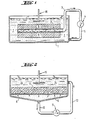
- Figure 1 depicts schematically the manufacture of an insulating trough by the above method and Figure 2 depicts in a corresponding manner the manufacture of a board-like insulating body.
- 1 indicates a vessel in which a perforated core 2 can be placed; the core is connected by means of conduit 3 to a pump 4 which creates a vacuum.
- a tubular piece 6 shaped from mineral wool in a manner known per se is placed around the core 2, clay slurry 7 is introduced into the vessel 1, and the pump 4 is started, whereupon clay slurry is absorbed into the mineral wool body in a very short time.
- the impregnation time is about 10 s.
- the clay slurry can be returned to the vessel 1 via a pipe 5.
- the mineral wool body is removed from the core and dried in a furnace at an elevated temperature, which can advantageously be approx. 200°C.
- the vessel 8 is provided with a perforated tray 9. That part of the vessel 8 which is below the tray 9 is connected by conduit 10 to a pump 11 which creates a vacuum.
- a board-like mineral wool body 13 made in a manner known per se is placed on top of the tray 9, clay slurry 14 is fed into the vessel up to a point above the board 13, and the pump 11 is started, whereby clay slurry is absorbed into the board 13.
- the clay slurry can be returned from the pump 11 via a conduit 12 into that part of the vessel 8 which is above the tray 9.
- the mineral wool board 13 is removed and dried in a furnace in the manner described above.
- One clay material suitable for use in the invention is bentonite.
- concentration of the slurry being absorbed i.e. its bentonite content, or the amount of the slurry can be used for affecting the bentonite content of the completed product, which for its part has a direct effect on the compressive strength of the product.
- the viscosity of the slurry sets a limit on the bentonite content, since viscosity for its part sets a limit on the absorption of the slurry into mineral wool. If the viscosity is too high, a sediment of bentonite is formed on the surface of the mineral wool, and this layer prevents further absorption of slurry into the mineral wool, and furthermore, the body of mineral wool may collapse owing to the vacuum prevailing inside or below it.
- the bentonite content of the slurry to be used may be at maximum 10 percent by weight, in which case the water content may be respectively approx. 88-90 percent by weight.
- the slurry may contain a bonding agent such as phenol formaldehyde, its amount being preferably at maximum 2 percent by weight, an anti-foaming agent, the amount of which is preferably at maximum 1 percent by weight, and an agent such as boric acid, which increases the strength of the final product, the amount of this agent being preferably at maximum 0.5 percent by weight.
- the amounts given for the additives correspond to the presented maximum limit for the bentonite content, and they vary in proportion to the bentonite content.
- the slurry is prepared in such a way that water is added to boric acid, thereafter the bentonite is mixed with the water and, for example, after half an hour's stirring the anti-foaming agent is added, and finally the bonding agent is added.
- the fibers serve as a good supporting structure for the product, and the orientation of the fibers is more advantageous in terms of heat conductivity than it is in previously known products made from a mix.
- the continuous fiber network which serves as a frame is also a significant improvement in terms of the bending strength of the product, as compared with a product made from a mix.
- the bulk density of the mineral wool piece used in the method according to the invention may vary within a rather wide range, for example 70-180 kg /m 3 .
- the addition of clay to the mineral wool increases not only the compressive strength of the product but also its resistance to heat.
- the organic bonding agent used in conventional mineral wool insulants burns off at a temperature as low as approx. 250°C, but a product made by the method according to the invention resists temperatures up to 800°C at least.
- Insulating troughs were made in the manner described above using bentonite slurry for the impregnation.
- the bentonite content and viscosity of the bentonite slurry used, the density of the mineral wool used as raw material, and the bentonite content, compressive strength, heat conductivity and density of the obtained final product are given in the table below.
Landscapes
- Chemical & Material Sciences (AREA)
- Engineering & Computer Science (AREA)
- Ceramic Engineering (AREA)
- Materials Engineering (AREA)
- Structural Engineering (AREA)
- Organic Chemistry (AREA)
- Inorganic Chemistry (AREA)
- Mechanical Engineering (AREA)
- Thermal Insulation (AREA)
- Laminated Bodies (AREA)
- Nonwoven Fabrics (AREA)
Applications Claiming Priority (2)
| Application Number | Priority Date | Filing Date | Title |
|---|---|---|---|
| FI812298A FI67751C (fi) | 1981-07-22 | 1981-07-22 | Pao mineralull baserad isolationskropp och foerfarande foer frmstaellning daerav |
| FI812298 | 1981-07-22 |
Publications (2)
| Publication Number | Publication Date |
|---|---|
| EP0097650A1 EP0097650A1 (en) | 1984-01-11 |
| EP0097650B1 true EP0097650B1 (en) | 1986-05-14 |
Family
ID=8514589
Family Applications (1)
| Application Number | Title | Priority Date | Filing Date |
|---|---|---|---|
| EP82902179A Expired EP0097650B1 (en) | 1981-07-22 | 1982-07-19 | An insulating body based on mineral wool, and a method for its manufacture |
Country Status (7)
| Country | Link |
|---|---|
| EP (1) | EP0097650B1 (da) |
| DE (1) | DE3271137D1 (da) |
| DK (1) | DK159213B (da) |
| ES (1) | ES8308023A1 (da) |
| FI (1) | FI67751C (da) |
| IT (1) | IT1155567B (da) |
| WO (1) | WO1983000369A1 (da) |
Families Citing this family (6)
| Publication number | Priority date | Publication date | Assignee | Title |
|---|---|---|---|---|
| US4557973A (en) * | 1983-12-28 | 1985-12-10 | United States Gypsum Company | Fire resistant gypsum board containing mineral wool fibers and method |
| GB2306177A (en) * | 1995-10-12 | 1997-04-30 | Tenmat Ltd | Fibrous board |
| GB9606979D0 (en) * | 1996-04-02 | 1996-06-05 | Rockwool Int | Man-made vitreous fibre products and their production |
| TW328526B (en) * | 1996-09-17 | 1998-03-21 | Interlego Ag | A toy building set |
| DE19803915C1 (de) * | 1998-02-02 | 1999-06-10 | Infra Folienkabel Gmbh | Verfahren zur Herstellung von Baustoffplatten unter Verwendung von Gips und nach dem Verfahren hergestellte Baustoffplatte |
| AT508787B1 (de) | 2009-09-24 | 2011-06-15 | Klein Michael | Wechselrahmen und system zur dreidimensionalen zusammenfügung mehrerer wechselrahmen mittels verbindungselementen |
Citations (1)
| Publication number | Priority date | Publication date | Assignee | Title |
|---|---|---|---|---|
| GB490877A (en) * | 1937-08-26 | 1938-08-23 | Mij Exploitatie Octrooien Nv | Improvements in heat insulations |
Family Cites Families (2)
| Publication number | Priority date | Publication date | Assignee | Title |
|---|---|---|---|---|
| GB704610A (en) * | 1948-10-01 | 1954-02-24 | Grunzweig & Hartmann G M B H | Improvements in the production of moulded bodies from mineral wool and binding agents |
| AT265092B (de) * | 1967-06-05 | 1968-09-25 | Voest Ag | Verfahren und Vorrichtung zum Herstellen von Rohrisolierschalen aus Mineral- oder Glaswollematten |
-
1981
- 1981-07-22 FI FI812298A patent/FI67751C/fi not_active IP Right Cessation
-
1982
- 1982-07-19 EP EP82902179A patent/EP0097650B1/en not_active Expired
- 1982-07-19 WO PCT/FI1982/000029 patent/WO1983000369A1/en not_active Ceased
- 1982-07-19 DE DE8282902179T patent/DE3271137D1/de not_active Expired
- 1982-07-20 IT IT67934/82A patent/IT1155567B/it active
- 1982-07-21 ES ES514204A patent/ES8308023A1/es not_active Expired
-
1983
- 1983-02-25 DK DK092683A patent/DK159213B/da not_active Application Discontinuation
Patent Citations (1)
| Publication number | Priority date | Publication date | Assignee | Title |
|---|---|---|---|---|
| GB490877A (en) * | 1937-08-26 | 1938-08-23 | Mij Exploitatie Octrooien Nv | Improvements in heat insulations |
Also Published As
| Publication number | Publication date |
|---|---|
| DK159213B (da) | 1990-09-17 |
| ES514204A0 (es) | 1983-07-01 |
| IT1155567B (it) | 1987-01-28 |
| FI67751C (fi) | 1985-05-10 |
| EP0097650A1 (en) | 1984-01-11 |
| DE3271137D1 (en) | 1986-06-19 |
| DK92683A (da) | 1983-02-25 |
| ES8308023A1 (es) | 1983-07-01 |
| DK92683D0 (da) | 1983-02-25 |
| FI812298L (fi) | 1983-01-23 |
| WO1983000369A1 (en) | 1983-02-03 |
| FI67751B (fi) | 1985-01-31 |
| IT8267934A0 (it) | 1982-07-20 |
Similar Documents
| Publication | Publication Date | Title |
|---|---|---|
| US5945044A (en) | Wood cement board and a manufacturing method thereof | |
| US2634208A (en) | Building board | |
| JPS6153206B2 (da) | ||
| US4297311A (en) | Method of manufacturing improved mineral board | |
| US4289536A (en) | Glass fiber reinforced cements and process for manufacture of same | |
| EP0097650B1 (en) | An insulating body based on mineral wool, and a method for its manufacture | |
| US8197642B2 (en) | Inorganic board and method for manufacturing the same | |
| US2451446A (en) | Light-weight fiber containing product | |
| EP0068742A1 (en) | Shaped articles | |
| US4179303A (en) | Method of producing structural insulation materials containing at least 50 percent xonotlite | |
| JP2000109380A (ja) | 軽量無機質板 | |
| CA1139793A (en) | Glass fiber reinforced cements and process for manufacturing of same | |
| US3736163A (en) | Fiber reenforced insulating segments | |
| US4093488A (en) | Process for the production of building material elements, particularly building boards | |
| EP0001539B1 (en) | A method for the production of a fibrous mat or sheet | |
| US2353271A (en) | Loose-fill composition material | |
| SU872522A1 (ru) | Способ изготовлени теплоизол ционных изделий | |
| JPH06126876A (ja) | 難燃性断熱材 | |
| SU1143728A1 (ru) | Сырьева смесь дл изготовлени теплоизол ционного материала | |
| SU966085A1 (ru) | Композици дл изготовлени теплоизол ционного материала | |
| US2415647A (en) | Preformed structural material | |
| WO2025115680A1 (ja) | ボード材およびボード材の製造方法 | |
| NO159312B (no) | Isolasjonslegeme paa basis av mineralull og en fremgangsmaate for fremstilling derav. | |
| KR940006187B1 (ko) | 암면판재의 제조방법 | |
| SU947144A1 (ru) | Способ производства минераловатных и стекловолокнистых изделий |
Legal Events
| Date | Code | Title | Description |
|---|---|---|---|
| PUAI | Public reference made under article 153(3) epc to a published international application that has entered the european phase |
Free format text: ORIGINAL CODE: 0009012 |
|
| 17P | Request for examination filed |
Effective date: 19830804 |
|
| AK | Designated contracting states |
Designated state(s): DE FR GB NL SE |
|
| GRAA | (expected) grant |
Free format text: ORIGINAL CODE: 0009210 |
|
| AK | Designated contracting states |
Kind code of ref document: B1 Designated state(s): DE FR GB NL SE |
|
| REF | Corresponds to: |
Ref document number: 3271137 Country of ref document: DE Date of ref document: 19860619 |
|
| ET | Fr: translation filed | ||
| PLBE | No opposition filed within time limit |
Free format text: ORIGINAL CODE: 0009261 |
|
| STAA | Information on the status of an ep patent application or granted ep patent |
Free format text: STATUS: NO OPPOSITION FILED WITHIN TIME LIMIT |
|
| 26N | No opposition filed | ||
| PGFP | Annual fee paid to national office [announced via postgrant information from national office to epo] |
Ref country code: GB Payment date: 19920714 Year of fee payment: 11 |
|
| PGFP | Annual fee paid to national office [announced via postgrant information from national office to epo] |
Ref country code: DE Payment date: 19920722 Year of fee payment: 11 |
|
| PGFP | Annual fee paid to national office [announced via postgrant information from national office to epo] |
Ref country code: SE Payment date: 19920724 Year of fee payment: 11 |
|
| PGFP | Annual fee paid to national office [announced via postgrant information from national office to epo] |
Ref country code: NL Payment date: 19920731 Year of fee payment: 11 Ref country code: FR Payment date: 19920731 Year of fee payment: 11 |
|
| PG25 | Lapsed in a contracting state [announced via postgrant information from national office to epo] |
Ref country code: GB Effective date: 19930719 |
|
| PG25 | Lapsed in a contracting state [announced via postgrant information from national office to epo] |
Ref country code: SE Effective date: 19930720 |
|
| PG25 | Lapsed in a contracting state [announced via postgrant information from national office to epo] |
Ref country code: NL Effective date: 19940201 |
|
| GBPC | Gb: european patent ceased through non-payment of renewal fee |
Effective date: 19930719 |
|
| NLV4 | Nl: lapsed or anulled due to non-payment of the annual fee | ||
| PG25 | Lapsed in a contracting state [announced via postgrant information from national office to epo] |
Ref country code: FR Effective date: 19940331 |
|
| PG25 | Lapsed in a contracting state [announced via postgrant information from national office to epo] |
Ref country code: DE Effective date: 19940401 |
|
| REG | Reference to a national code |
Ref country code: FR Ref legal event code: ST |
|
| EUG | Se: european patent has lapsed |
Ref document number: 82902179.9 Effective date: 19940210 |