EP0097729A1 - Procédé pour rouler la pâte - Google Patents
Procédé pour rouler la pâte Download PDFInfo
- Publication number
- EP0097729A1 EP0097729A1 EP82105613A EP82105613A EP0097729A1 EP 0097729 A1 EP0097729 A1 EP 0097729A1 EP 82105613 A EP82105613 A EP 82105613A EP 82105613 A EP82105613 A EP 82105613A EP 0097729 A1 EP0097729 A1 EP 0097729A1
- Authority
- EP
- European Patent Office
- Prior art keywords
- knitting
- belt
- basic
- band
- channel
- Prior art date
- Legal status (The legal status is an assumption and is not a legal conclusion. Google has not performed a legal analysis and makes no representation as to the accuracy of the status listed.)
- Granted
Links
- 238000004898 kneading Methods 0.000 claims abstract description 13
- 238000009940 knitting Methods 0.000 claims description 127
- 230000007423 decrease Effects 0.000 claims description 2
- 241000209140 Triticum Species 0.000 description 9
- 235000021307 Triticum Nutrition 0.000 description 9
- 230000000694 effects Effects 0.000 description 3
- 230000000630 rising effect Effects 0.000 description 2
- 238000010276 construction Methods 0.000 description 1
- 230000008878 coupling Effects 0.000 description 1
- 238000010168 coupling process Methods 0.000 description 1
- 238000005859 coupling reaction Methods 0.000 description 1
- 230000005484 gravity Effects 0.000 description 1
- 238000005096 rolling process Methods 0.000 description 1
Images

Classifications
-
- A—HUMAN NECESSITIES
- A21—BAKING; EDIBLE DOUGHS
- A21C—MACHINES OR EQUIPMENT FOR MAKING OR PROCESSING DOUGHS; HANDLING BAKED ARTICLES MADE FROM DOUGH
- A21C7/00—Machines which homogenise the subdivided dough by working other than by kneading
- A21C7/01—Machines which homogenise the subdivided dough by working other than by kneading with endless bands
-
- B—PERFORMING OPERATIONS; TRANSPORTING
- B65—CONVEYING; PACKING; STORING; HANDLING THIN OR FILAMENTARY MATERIAL
- B65G—TRANSPORT OR STORAGE DEVICES, e.g. CONVEYORS FOR LOADING OR TIPPING, SHOP CONVEYOR SYSTEMS OR PNEUMATIC TUBE CONVEYORS
- B65G41/00—Supporting frames or bases for conveyors as a whole, e.g. transportable conveyor frames
- B65G41/001—Supporting frames or bases for conveyors as a whole, e.g. transportable conveyor frames with the conveyor adjustably mounted on the supporting frame or base
- B65G41/002—Pivotably mounted
Definitions
- the invention is directed to a device for the circular kneading of dough with a cross-sectionally approximately V-shaped knitting channel from / two opposing endless belts, which abut one another approximately at the apex of the knitting channel.
- cone and belt round knitting devices which have an open knitting channel
- cone and belt round knitting devices in which a fixed, rising knitting surface cooperates with a circumferential knitting body or knitting belt in such a way that the piece of dough is worked up on the running knitting surface and knitted into a ball with a finish.
- the running active surface tends to pull the dough piece, especially if it consists of a soft dough, under the rising fixed active surface.
- Such devices are therefore of limited use.
- the knitting belts forming the V-shaped knitting channel are driven at different speeds and in opposite directions, the speed difference between the two belts determining the direction of transport and the speed of the dough pieces.
- the device according to DE-OS 2 104 416 is characterized by a cross-sectionally approximately V-shaped trough made of two endless knitting bands and a knitting beam forming a trough side cheek, which carries out sliding movements in the direction of the trough.
- the ribbon rounder is suitable for wheat and wheat mixed doughs, but it loses its usefulness for processing rye and rye mixed doughs, which is an increased tension the skin of the dough piece is not tolerated and consequently cracked and brittle result from such processing.
- the knitting device consists of a circular trough formed around an axis and formed between two mutually enclosing jacket surfaces in connection with a bottom, the one jacket surface revolving with the bottom as a unit and additionally several radially directed extensions of the rolling cross section prevent the dough pieces to be tipped over.
- This device is also only suitable for processing wheat or mixed wheat dough. In addition, it is difficult to adapt to dough pieces of different sizes.
- a knitting device that is equally well suited for processing wheat and wheat mixed doughs, such as rye and rye mixed doughs, and, moreover, is easily able to produce dough pieces of different sizes in the same quality and to act in multiple rows.
- the invention is based on the principle of a belt rounder.
- the basic knitting band is adjustably mounted about two axes lying at right angles to one another in the plane, and that the knitting band is about a pivot point in the region of its deflecting roller arranged at the inlet end of the basic knitting band is pivotally mounted between a course approximately parallel to a course approximately diagonally to the basic knitting belt and that the pivotable end of this knitting belt executes an oscillating movement in the swiveling plane of the knitting belt, the amplitude of which is adjustable.
- the intensity of the knitting work exerted by the knitting channel on the piece of dough can largely be adapted to the dough being processed.
- the active intensity can practically be adjusted between the value 0 and a maximum, which allows the processing of pure rye dough to pure wheat dough and dough weights of, for example, 30 g to 1,500 g.
- the basic knitting band is arranged to be steplessly adjustable about an axis transversely to its direction of movement by approximately 25-40 ° and about an axis longitudinally to its direction of movement by approximately 10-20 °.
- the basic knitting band is hinged to a base plate along one side and this is pivotably hinged to the frame of the device about a side running at an angle thereto.
- the pivoting of the base plate on the one hand and the base knitting tape on the other hand relative to the base plate result in the various components of the lateral and longitudinal slope of the knitting channel.
- the device is characterized by a portal frame overlapping the basic knitting band, on which the drive of the Basic knitting belt, as well as the knitting belt with its drive and finally the oscillating drive for the knitting belt are arranged.
- the construction can be realized with a few elements and can be designed in an uncomplicated and clear manner.
- the knitting band is adjustable in height and is pivotably mounted on the portal frame in order to change the opening angle of the knitting channel about its longitudinal axis.
- the further development lies in the fact that the plane of the knitting band has a twist and in such a way that the opening angle of the knitting channel decreases from the inlet end to the outlet end. The opening angle can change continuously from about 90 ° at the inlet end to about 45 ° at the outlet end.
- Another feature of the invention provides that a stripper is arranged on the long side of the knitting belt facing the basic knitting belt, which is slidably mounted into the knitting channel beyond the level of the belt strand delimiting the knitting channel.
- the adjustability of this squeegee changes the cross section of the knitting channel and thus adapts it to the size of the piece of dough to be processed.
- the largest pieces of dough are processed in the maximum feed position of the scraper, and the smallest pieces of dough are processed in the opposite position, namely when the scraper no longer projects beyond the knitting belt.
- the end of the knitting band carrying out the oscillating movement is mounted in a sliding guide arranged on the portal frame.
- the knitting band describes a reciprocating oscillating movement in a plane approximately parallel to the plane of the basic knitting band around its pivot point.
- the oscillating drive is adjustably mounted in a guide of the portal frame transversely to the direction of movement of the basic knitting band, the oscillating drive can follow the adjusting movement of the knitting band over the basic knitting band.
- the vibratory drive is infinitely variable and has an eccentric cam disc which is adjacent to it for the purpose of transferring the drive to the knitting belt.
- the return movement of the knitting belt takes place on the one hand under the effect of gravity through the inclined setting of the knitting belt with the basic knitting belt, but also through the resistance emanating from the piece of dough to be processed.
- the amplitude adjustment of the oscillating movement serves within the scope of the invention an adjustable stop limiting its return stroke, which frame can be mounted directly or indirectly on the portal.
- the device according to the invention can be satisfied with a knitting band over the basic knitting band.
- a plurality of knitting bands arranged essentially in parallel and of an analog design are assigned to the basic knitting machine. This multiplies the performance of the device.
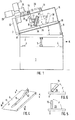
- the base plate 2 is mounted on a base frame 1 of the device, specifically by means of a hinge 4 arranged on its narrow side 3 so that it can be adjusted relative to the base frame 1.
- the device 5, which is only indicated schematically, is used for stepless adjustment and can both have a spindle drive and can thus be actuated by hand or can be pneumatic or hydraulic.
- the angle of attack ⁇ is between about 0 and 20 °.
- the basic knitting band designated as a whole by 6, is arranged, for this purpose it is provided on its longitudinal side 7 with a hinge 8.
- the device 9 which is supported on the one hand on the base plate 2 and, on the other hand, engages with its head 10 on the frame of the base knitting tape 6, which is not shown in detail, serves to adjust the basic knitting band 6 relative to the base plate 2.
- the angle of attack ⁇ is approximately 25-40 °.
- the endless belt of this basic knitting belt 6 runs in the direction of the arrow 11.
- a motor 13 provided with a step-up gear 12 serves for the drive. This drive is infinitely adjustable.
- the basic knitting band 6 is spanned by a double portal frame 14 in the embodiment shown, which is firmly connected to the frame of the basic knitting band 6.
- this frame 14 carries the drive 13, the drive device 12, 13 for the basic knitting band 6.
- It also carries the knitting band 15, which together with the basic knitting band 6 forms the knitting channel, the opening angle of which is denoted by ⁇ .
- the frame 16 of the knit band 15 is pivotally attached to a bracket 18 about the joints 17 has a height adjustment device and is fastened to a square support tube 19 which in turn is mounted on the portal frame 14.
- One end 20 of the rod 19 is pivotable about the axis 21 which is perpendicular to the basic knitting band 6, as indicated by the arrow 22.
- a drive motor 23 with the downstream gear 24, which drives an eccentric cam 25, which in turn rests on the square support rod 19, is used for the oscillating movement of this knitting belt 15.
- the counterforce opposing the system results from the gravitational effect of the knitting belt 15 with its holder and the resistance of the pieces of dough to be processed in the knitting channel 26.
- the return stroke of the oscillating movement 22 is limited by a stop 27, which is continuously adjustable, for example by means of a spindle drive 28 via the handwheel 29.
- the drive 23, 24 is mounted on a support plate 30 which is slidably and fixably mounted in a guide 31 attached to the portal frame 14.
- the knitting band 15 can be pivoted from a position approximately parallel to the side edge 32 of the basic knitting band 6 to a position in which it extends approximately diagonally over the basic knitting band 6.
- 3 shows an intermediate pivoting position of the knitting belt 15.
- the motor 34 provided with a gear 33 serves to drive the swirl 15.
- the frame of the knitting belt 15 arranged above the basic knitting belt 6 has a twist, as a result of which the knitting channel 26 has an angle of approximately in the region of its inlet end (section V - V in FIG. 4) 90 ° on while it is in the area of its outlet end (Section VI - VI in Fig. 4) has an angle ⁇ of about 45 °.
- This twisting of the knitting band 15 is generally predetermined and unchangeable for the particular application of the device.
- the knitting belt 15 is provided on its narrow side, which is approximately adjacent to the basic knitting belt 6, with a scraper 36 which can be adjusted beyond the plane of the strand 37 delimiting the knitting channel 26.
- a scraper 36 which can be adjusted beyond the plane of the strand 37 delimiting the knitting channel 26.
- the maximum adjustment x of this scraper 36 is shown.
- the active channel 26 is blunted in its tip and is therefore more suitable for processing larger pieces of dough.
- the scraper 36 is retracted and the knitting belt 15 is practically in direct contact with the basic knitting belt 6, the knitting channel 26 is tapered in cross-section, which makes it particularly suitable for processing smaller pieces of dough.
- the description covers a device with only one knitting belt 15 arranged over a knitting belt 6.
- one or more further knitting belts 38 parallel to the knitting belt 15, which are designed analogously to the knitting belt 15 and are mounted on the portal frame 14.
- the two tra-tubes 19 are connected to one another by a coupling rod 39, so that they carry out the same oscillating movement 22 starting from the drive 23, 24, 25.
- the rotating direction 40 of the knitting belt 15 is directed in the opposite direction. Because the basic knitting belt 6 rotates faster than the knitting belt 15, the dough pieces as a whole are moved in the knitting channel 26 in the direction of the arrow 11.
Landscapes
- Engineering & Computer Science (AREA)
- Life Sciences & Earth Sciences (AREA)
- Food Science & Technology (AREA)
- Mechanical Engineering (AREA)
- Knitting Machines (AREA)
- Manufacturing And Processing Devices For Dough (AREA)
Priority Applications (3)
| Application Number | Priority Date | Filing Date | Title |
|---|---|---|---|
| EP19820105613 EP0097729B1 (fr) | 1982-06-25 | 1982-06-25 | Procédé pour rouler la pâte |
| DE8282105613T DE3270974D1 (en) | 1982-06-25 | 1982-06-25 | Device for rounding dough |
| YU159182A YU159182A (en) | 1982-06-25 | 1982-07-21 | Device for dressing dough |
Applications Claiming Priority (1)
| Application Number | Priority Date | Filing Date | Title |
|---|---|---|---|
| EP19820105613 EP0097729B1 (fr) | 1982-06-25 | 1982-06-25 | Procédé pour rouler la pâte |
Publications (2)
| Publication Number | Publication Date |
|---|---|
| EP0097729A1 true EP0097729A1 (fr) | 1984-01-11 |
| EP0097729B1 EP0097729B1 (fr) | 1986-05-07 |
Family
ID=8189102
Family Applications (1)
| Application Number | Title | Priority Date | Filing Date |
|---|---|---|---|
| EP19820105613 Expired EP0097729B1 (fr) | 1982-06-25 | 1982-06-25 | Procédé pour rouler la pâte |
Country Status (3)
| Country | Link |
|---|---|
| EP (1) | EP0097729B1 (fr) |
| DE (1) | DE3270974D1 (fr) |
| YU (1) | YU159182A (fr) |
Cited By (4)
| Publication number | Priority date | Publication date | Assignee | Title |
|---|---|---|---|---|
| AU611574B2 (en) * | 1988-06-21 | 1991-06-13 | Moffat Pty Limited | Bread moulders |
| EP0494600A1 (fr) * | 1991-01-05 | 1992-07-15 | A. FRITSCH GMBH & CO. KG | Procédé et appareil pour mettre la pâte en boules |
| WO1993017560A1 (fr) * | 1992-03-06 | 1993-09-16 | Holtkamp Holding B.V. | Appareil diviseur de pate de boulangerie |
| ES2283181A1 (es) * | 2005-04-12 | 2007-10-16 | Eulalia Puig Martinez | Maquina heñidora. |
Citations (5)
| Publication number | Priority date | Publication date | Assignee | Title |
|---|---|---|---|---|
| US2086160A (en) * | 1935-12-16 | 1937-07-06 | Logan Co Inc | Conveyer |
| DE938363C (de) * | 1951-11-15 | 1956-01-26 | Werner & Pfleiderer | Teigwirkmaschine mit gegensinnig umlaufenden endlosen Koerpermantelflaechen |
| FR1188349A (fr) * | 1957-12-13 | 1959-09-22 | Transporteur à bande perfectionné | |
| US3990685A (en) * | 1974-08-14 | 1976-11-09 | Enrique Suay Balaguer | Kneading apparatus for breadmaking |
| GB2077180A (en) * | 1980-06-06 | 1981-12-16 | Kemper Kate | Apparatus for shaping dough |
-
1982
- 1982-06-25 EP EP19820105613 patent/EP0097729B1/fr not_active Expired
- 1982-06-25 DE DE8282105613T patent/DE3270974D1/de not_active Expired
- 1982-07-21 YU YU159182A patent/YU159182A/xx unknown
Patent Citations (5)
| Publication number | Priority date | Publication date | Assignee | Title |
|---|---|---|---|---|
| US2086160A (en) * | 1935-12-16 | 1937-07-06 | Logan Co Inc | Conveyer |
| DE938363C (de) * | 1951-11-15 | 1956-01-26 | Werner & Pfleiderer | Teigwirkmaschine mit gegensinnig umlaufenden endlosen Koerpermantelflaechen |
| FR1188349A (fr) * | 1957-12-13 | 1959-09-22 | Transporteur à bande perfectionné | |
| US3990685A (en) * | 1974-08-14 | 1976-11-09 | Enrique Suay Balaguer | Kneading apparatus for breadmaking |
| GB2077180A (en) * | 1980-06-06 | 1981-12-16 | Kemper Kate | Apparatus for shaping dough |
Cited By (4)
| Publication number | Priority date | Publication date | Assignee | Title |
|---|---|---|---|---|
| AU611574B2 (en) * | 1988-06-21 | 1991-06-13 | Moffat Pty Limited | Bread moulders |
| EP0494600A1 (fr) * | 1991-01-05 | 1992-07-15 | A. FRITSCH GMBH & CO. KG | Procédé et appareil pour mettre la pâte en boules |
| WO1993017560A1 (fr) * | 1992-03-06 | 1993-09-16 | Holtkamp Holding B.V. | Appareil diviseur de pate de boulangerie |
| ES2283181A1 (es) * | 2005-04-12 | 2007-10-16 | Eulalia Puig Martinez | Maquina heñidora. |
Also Published As
| Publication number | Publication date |
|---|---|
| EP0097729B1 (fr) | 1986-05-07 |
| DE3270974D1 (en) | 1986-06-12 |
| YU159182A (en) | 1986-04-30 |
Similar Documents
| Publication | Publication Date | Title |
|---|---|---|
| DE3738619A1 (de) | Entgratvorrichtung fuer einen industrieroboter | |
| DE2546892C2 (de) | Vorrichtung zum Blanchieren von geschälten, eßbaren Nüssen | |
| DE2000433C3 (de) | Vorrichtung zum Abrunden und Polieren der Enden biegsamer Kunststoffborsten oder Bürstenhaare | |
| CH652003A5 (de) | Vorrichtung zum rundwirken von teigstuecken. | |
| DE1063570B (de) | Ausbreitvorrichtung fuer die Zufuehr-vorrichtung einer Buegelmaschine | |
| EP0097729B1 (fr) | Procédé pour rouler la pâte | |
| DE3842674A1 (de) | Sich hin- und herbewegendes messerschneidgeraet mit flexiblem antriebsteil | |
| DE1535992B2 (de) | Vorrichtung zum Aufschneiden und Breitstrecken von schlauchförmiger Maschenware | |
| EP0494891B1 (fr) | Demeleur multiballes | |
| DE2527643C2 (de) | Maschine zum Schleifen konkav gewölbter Werkstücke | |
| DE202009004809U1 (de) | Rohrausschleifmaschine mit einstellbarer Seitenführung des Schleifbandes | |
| EP0494600B1 (fr) | Procédé et appareil pour mettre la pâte en boules | |
| DE8218257U1 (de) | Vorrichtung zum rundwirken von teig | |
| DE2758014B2 (de) | Vorrichtung zum Entgraten der Längskante eines längsbewegten Metallbandes | |
| DE3733906A1 (de) | Umlenkvorrichtung fuer einen produktstrom, insbesondere von in schuppenform herangefuehrten papierprodukten | |
| DE3640051A1 (de) | Teigrundwirkvorrichtung | |
| EP0230261A1 (fr) | Accessoire épandeur de balles et menues pailles pour moissonneuse-batteuse | |
| DE102020204024B3 (de) | Baugruppe und anlage zur herstellung pastöser formteile | |
| DE611278C (de) | Formmaschine zur Herstellung laengsgeschlitzter Teigstuecke | |
| DE2557752C2 (de) | Vorrichtung zum Rundwirken von Teig | |
| DE554204C (de) | Vorrichtung zum Zerschneiden eines Stranges mit stetigem Laengsvorschub | |
| DE3021329C2 (de) | Vorichtung zum Rundwirken von Teigstücken | |
| DE1207254B (de) | Schneidvorrichtung fuer Zigarettenstrang-maschinen mit einem nach Art einer konischen Schraube (Holzschraube) mit gleichbleibender Steigung ausgebildeten Messer | |
| DE3109683C2 (de) | Vorrichtung zum Rundwirken von Teigstücken | |
| DE929219C (de) | Vorrichtung zum Aussichten von Koernern von annaehernd kugeliger Gestalt mittels eines Foerderbandes |
Legal Events
| Date | Code | Title | Description |
|---|---|---|---|
| PUAI | Public reference made under article 153(3) epc to a published international application that has entered the european phase |
Free format text: ORIGINAL CODE: 0009012 |
|
| AK | Designated contracting states |
Designated state(s): BE DE FR GB IT NL |
|
| 17P | Request for examination filed |
Effective date: 19840404 |
|
| GRAA | (expected) grant |
Free format text: ORIGINAL CODE: 0009210 |
|
| AK | Designated contracting states |
Kind code of ref document: B1 Designated state(s): BE DE FR GB IT NL |
|
| PG25 | Lapsed in a contracting state [announced via postgrant information from national office to epo] |
Ref country code: NL Effective date: 19860507 Ref country code: IT Free format text: LAPSE BECAUSE OF FAILURE TO SUBMIT A TRANSLATION OF THE DESCRIPTION OR TO PAY THE FEE WITHIN THE PRESCRIBED TIME-LIMIT;WARNING: LAPSES OF ITALIAN PATENTS WITH EFFECTIVE DATE BEFORE 2007 MAY HAVE OCCURRED AT ANY TIME BEFORE 2007. THE CORRECT EFFECTIVE DATE MAY BE DIFFERENT FROM THE ONE RECORDED. Effective date: 19860507 Ref country code: FR Free format text: THE PATENT HAS BEEN ANNULLED BY A DECISION OF A NATIONAL AUTHORITY Effective date: 19860507 Ref country code: BE Effective date: 19860507 |
|
| REF | Corresponds to: |
Ref document number: 3270974 Country of ref document: DE Date of ref document: 19860612 |
|
| EN | Fr: translation not filed | ||
| NLV1 | Nl: lapsed or annulled due to failure to fulfill the requirements of art. 29p and 29m of the patents act | ||
| PLBE | No opposition filed within time limit |
Free format text: ORIGINAL CODE: 0009261 |
|
| STAA | Information on the status of an ep patent application or granted ep patent |
Free format text: STATUS: NO OPPOSITION FILED WITHIN TIME LIMIT |
|
| 26N | No opposition filed | ||
| PGFP | Annual fee paid to national office [announced via postgrant information from national office to epo] |
Ref country code: GB Payment date: 19890630 Year of fee payment: 8 |
|
| PGFP | Annual fee paid to national office [announced via postgrant information from national office to epo] |
Ref country code: DE Payment date: 19890703 Year of fee payment: 8 |
|
| PG25 | Lapsed in a contracting state [announced via postgrant information from national office to epo] |
Ref country code: GB Effective date: 19900625 |
|
| GBPC | Gb: european patent ceased through non-payment of renewal fee | ||
| PG25 | Lapsed in a contracting state [announced via postgrant information from national office to epo] |
Ref country code: DE Effective date: 19910301 |