EP0097731B1 - Elektrisches Einspurgleis - Google Patents
Elektrisches Einspurgleis Download PDFInfo
- Publication number
- EP0097731B1 EP0097731B1 EP19820105671 EP82105671A EP0097731B1 EP 0097731 B1 EP0097731 B1 EP 0097731B1 EP 19820105671 EP19820105671 EP 19820105671 EP 82105671 A EP82105671 A EP 82105671A EP 0097731 B1 EP0097731 B1 EP 0097731B1
- Authority
- EP
- European Patent Office
- Prior art keywords
- rails
- rerailer
- guide
- wheels
- vehicle
- Prior art date
- Legal status (The legal status is an assumption and is not a legal conclusion. Google has not performed a legal analysis and makes no representation as to the accuracy of the status listed.)
- Expired
Links
- 239000004020 conductor Substances 0.000 claims description 40
- 239000002184 metal Substances 0.000 description 9
- 238000010276 construction Methods 0.000 description 8
- 238000005192 partition Methods 0.000 description 8
- 229920003023 plastic Polymers 0.000 description 6
- 239000012212 insulator Substances 0.000 description 3
- 230000004048 modification Effects 0.000 description 3
- 238000012986 modification Methods 0.000 description 3
- 229910001361 White metal Inorganic materials 0.000 description 2
- 230000003137 locomotive effect Effects 0.000 description 2
- 238000000034 method Methods 0.000 description 2
- 239000010969 white metal Substances 0.000 description 2
- 238000010137 moulding (plastic) Methods 0.000 description 1
- 125000000391 vinyl group Chemical group [H]C([*])=C([H])[H] 0.000 description 1
Images




Classifications
-
- A—HUMAN NECESSITIES
- A63—SPORTS; GAMES; AMUSEMENTS
- A63H—TOYS, e.g. TOPS, DOLLS, HOOPS OR BUILDING BLOCKS
- A63H19/00—Model railways
- A63H19/30—Permanent way; Rails; Rail-joint connections
-
- A—HUMAN NECESSITIES
- A63—SPORTS; GAMES; AMUSEMENTS
- A63H—TOYS, e.g. TOPS, DOLLS, HOOPS OR BUILDING BLOCKS
- A63H19/00—Model railways
- A63H19/36—Model railway structures, e.g. kinds of arrangement of several units in containers, or on plates, or in combination with scenics for toy purposes
- A63H2019/365—Devices for putting or removing vehicles on or from the rails, e.g. ramps
Definitions
- This invention relates to an electric rerailer provided with guide ways for guiding the wheels of a vehicle of a model railway onto rails, in more particularly to a rerailer for power-driven vehicle such as locomotive, motive power car or the like.
- a rerailer has been used as a guide member for guiding a vehicle onto rails.
- a conventional rerailer as known e.g. from DE-C-845 463 is constructed in the form of an inclined surface. The width of the guide groove is narrowed at the lower section of the inclined surface so as to guide the wheels on both sides of the vehicle onto rails.
- the conventional rerailer as described above is useful for guiding carriages and wagons because they can freely move on the inclined surface of the rerailer under their own weight.
- power-driven vehicles such as locomotives and motive power cars cannot move on the inclined surface under their own weight because their motors and speed reducing mechanism serve as brakes. Therefore, the power-driven vehicles must be guided onto ra-lis by manuaiiy moving them.
- the primary object of the present invention is to provide an improved rerailer for a model railway. Another object of the present invention is to provide a rerailer for automatically guiding a power-driven vehicle onto rails.
- the specific object of the present invention is to provide an electric rerailer capable of supplying a drive current to a power-driven vehicle placed on the rerailer, and electrically moving the vehicle onto rails.
- the rerailer in accordance with the present invention is characterized in that the surfaces of said guide ways are formed by discrete electric conductors used respectively for the left and right wheels of said vehicle and separated from each other by a central insulating member, said conductors being capable of being electrically contacted with the rails for the left and the right wheels respectively.
- the conductors forming the surfaces of the guide rails (various types of guide paths such as groove-like paths, plane-like paths with a central partition wall and the like are herein called guide rails) transmits a drive current to the vehicle via the outer-most circumference of wheels so as to move the vehicle on the rerailer and guide it onto the rails.
- the electric rerailer in accordance with the present invention has an extremely simple construction suitable to guide a power-driven vehicle.
- the rerailer in accordance with the present invention can automatically move a power-driven vehicle onto the rails, and can of course be used also for guiding vehicles such as carriages which are not power driven.
- the rerailer may take an inclined form or a horizontal plane form. When it is horizontal, the vehicle being rerailed can easily be moved onto the rails by slightly pushing the vehicle forwards.
- Figures 1 to 4 show an embodiment of the inclined base type rerailer capable of being releasably mounted on rails in accordance with the present invention.
- a rerailer 10 is placed on rails 1 a and 1b of a model railway, and provided with guide rails 12a and 12b for guiding the left and right wheels of a vehicle on an inclined surface 11.
- the guide rails 12a and 12b are in the form of shallow grooves the outer edges of which are defined by guide walls 13a and 13b.
- the guide walls 13a and 13b protrude inwardly at the lower section of the inclined surface 11 so as to guide the wheels onto the rails 1a and 1b.
- the guide walls 13a and 13b guide the large diameter sections (flanges) 21a and 21 b of wheels 2a and 2b shown in Figure 3 inwardly towards the middle between the guide walls 13a and 13b so as to place the small diameter sections 22a and 22b of the wheels 2a and 2b on the rails 1a a and 1b.
- a central guide wall 14 which prevents the vehicle from greatly deviating towards the guide wall 13a or 13b and which serves as a central partition for separating the guide rails 12a and 12b from each other.
- the surfaces of the guide rails 12a and 12b are formed by electric conductors.
- the surfaces thereof are formed by plate-like metal strips 15a and 15b, which are fitted by their elasticity to plastic rerailer base 16 having the inclined surface 11, as best seen in Figure 4.
- a turned-back end 152b of the metal strip 15b is fixed by its elasticity to a lower thick wall section 16a of the rerailer base 16, and the other turned-back end 151 b of the metal strip 15b is fixed by its elasticity to an upper thick-wall section 16b of the rerailer base 16.
- the metal strip 15a is similarly constructed to have turned-back ends 152a and 151a.
- the plate-like metal strip conductors 15a and 15b forming the surfaces of the guide rails 12a and 12b are electrically isolated from each other.
- the turned-back ends 151a a and 151b of these conductors 15a and 15b contact the rails 1 a and 1 b respectively.
- the rerailer 10 is provided with a positioning means for properly positioning the rerailer body on the rails in such a way that wheels guide outlets 17a and 17b at the lower end of the rerailer 10 ( Figure 2) are positioned just inside the rails 1 a and 1b respectively so as to guide the wheels thereto.
- the positioning means may comprise recesses which are formed at the bottom of the rerailer body so as to fit snugly on the rails. Or, as shown in Figure 3, sections 18, 19a and 19b may be protruded downwardly from the rerailer body at the center and on both sides thereof, and the recesses formed among them may be placed on the rails 1a and 1b. In any case, the metal strip conductors 15a and 15b should contact the rails 1a and 1 respectively.
- the metal strips 15a and 15b forming the surfaces of the guide rails 12a and 12b are turned back at both ends and fitted by their own elasticity to the rerailer base.
- This fitting method is advantageous for simplifying the construction and process for assembling the rerailer.
- the metal strips 15a and 15b may be of any other form insofar as they can be fixed to the rerailer base and parts of them contact with the rails.
- the metal strips 15a and 15b may be of any construction having flat sections forming the surfaces of the guide rails 12a and 12b and the sections for electrically connecting the flat sections to the rails 1 a and 1b b respectively.
- the guide rails 12a and 12b are provided with the central guide wall 14 for separating them and with the outer guide walls 13a and 13b.
- this construction may be modified in various ways.
- outer walls 26 may be provided on the outlet side of the rerailer, and an inner wall 27 may be provided on the inlet side of the rerailer.
- conductors 30a and 30b are electrically isolated from each other by an electric insulating section 30.
- the electric insulating section 30 may be formed by an insulator or a gap positioned between the conductors 30a and 30b.
- the rerailer has an inclined surface and is placed on the rails.
- the rerailer may have a horizontal surface instead of the inclined surface.
- a rerailer having two horizontal guide rails is placed on the rails of a model railway.
- the horizontal surfaces on which the wheels of a vehicle are guided are formed by conductors, and the conductors are electrically contacted with the rails.
- Outlets for the vehicle may be formed on both ends of the rerailer to allow a power-driven vehicle to be driven forwards or backwards and guided onto rails.
- Figures 6A and 6B show another embodiment of the rerailer in accordance with the present invention, which has a horizontal surface and is placed on rails.
- This embodiment is characterized by an extremely simplified construction in which the rerailer body is formed by the conductors themselves.
- a pair of flat conductor plates 31 a and 31 b serving as the guide rails are sandwiched and fixed between an upper plate 32a and a lower plate 32b of an I-shaped insulating plastic holder 32 serving also as a central partition wall.
- the central partition wall 32 has wide end sections 32c and 32d, whose ends associated with rails 1a and 1b are widened to a width approximately equal to the inside width between the rails 1a and 1b.
- the conductor plates 31 a and 31 b are respectively provided with longitudinal slits 33a and 33b at both ends. Inner portions 34a and 34b of the conductor plates 31 a and 31 b defining the slits 33a and 33b are bent downwardly inside the rails 1a and 1b, so that large diameter sections 21 a and 21 b of wheels 2a and 2b can move downwardly and small diameter sections 22a and 22b can be smoothly placed on the rails 1a a and 1b.
- FIG. 6A and 6B The embodiment shown in Figures 6A and 6B is practically very convenient because it has a simple construction and because power-driven vehicles can be moved either forwards or backwards to be placed on the rails.
- the insulating plastic holder 32 may take various shapes instead of the I-shaped sectional form. It is also possible to position the conductor plates on a plastic plate in parallel with each other at an interval, and fix them to the plastic plate with screws.
- the rerailer is placed on the rails when it is used, and removed therefrom after a vehicle has been guided and moved onto the rails.
- the rerailer When the rerailer is used, it is first placed on the rails, and the conductors of the rerailer are electrically connected to the rails. Thereafter, a power-driven vehicle is placed on the guide rails of the rerailer in such a manner that the wheels on one side of the vehicle are placed on one conductor, and the wheels on the other side of the other conductor.
- the rails are then energized in the same way as normally used for starting the power-driven vehicle by use of a controller.
- An electric current is fed from the rail to the conductor and then to the large diameter section of the wheel to the drive motor in the vehicle to start the vehicle.
- the started motor-driven vehicle is guided along the outer walls or the inner wall onto the rails and thereafter runs on the rails in the usual manner. In this way, the motor-driven vehicle is guided onto the rails by the rerailer in accordance with the present invention.
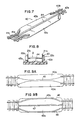
- FIGS 7 and 8 show a further embodiment of the rerailer in accordance with the present invention, which is of the type incorporated between the rails.
- a rerailer 40 comprises conductor guide plates 43a, 43b having connection rails 41 a, 41 b and 42a, 42b at opposite ends, and a guide wall 44 serving as a partition provided at the center of the conductor guide plates 43, 43b.
- the connection rails 41a and 42a for the left wheels (or right wheels, depending on the direction in which the vehicle faces) are electrically connected to a conductor guide plate 43a for the left (right) wheels.
- the connection rails 41 b and 42b for the right (left) wheels are electrically connected to a conductor guide plate 43b for the right (left) wheels.
- the guide plates 43a and 43b made of conductors are electrically isolated from each other by the guide wall 44.
- large diameter sections 21a a and 21b of wheels 2 electrically contact the surfaces of the conductor guide plates 43a and 43b respectively, while small diameter sections 22a and 22b and a slip-proof vinyl ring 20 do not.
- the guide wall 44 serving as the central partition works in the same way as the inner wall 27 in Figure 5C, and the ends of the rails 41 a, 41 b, 42a and 42b on the guide plate side are flared outwardly so as to work in the same way as the outer walls 26 in Figure 5C.
- this construction may be varied in various ways.
- connection rails may be straight and a central guide wall 45 may be widened at both ends adjacent to the connection rails.
- the connection rails may be straight, and outer walls 46 may be bent inwardly at both ends adjacent to the connection rails. In the latter case, a central insulator or partition 47 is necessary for electrically isolating conductors 43a and 43b from each other.
- the conductors may be separated at their intermediate portions by a clearance therebetween and be spaced apart and fixed to each other in the vicinity of both ends.
- the rails may be integrally connected with the outer walls to form rails 48a and 48b serving as guide walls fixed to the outer edges of conductor plates 49a and 49b respectively, and a central guide wall 50 may be positioned between the conductor plates 49a and 49b.
- This construction is identical with that in which the outer walls 46 in Figure 9B are integrally connected with the rails and the central guide wall in Figure 9A or 7 is positioned therebetween.
- the central guide wall 50 may of course be replaced by a clearance between the conductor plates 49a and 49b.
- the guide rails of the rerailer are provided with either the outer walls or the inner wall, it is of course necessary to determine the width of the conductor of each guide rail so that the wheels on one side cannot go onto the conductor for the wheels on the other side or fall off the conductor.
- the width of each conductor must always smaller than the distance between the large diameter sections 21 a and 21 b of the wheels.
- the distance from the outer edge of one conductor to the inner edge of the other conductor must always be larger than the distance between the large diameter sections 21 a and 21b b of the wheels.
- FIGS 10A to 10D show a still further embodiment of the rerailer in accordance with the present invention.
- the rerailer is of the type placed on the rails and corresponds to a modification of a combination of Figures 5C and 5D.
- conductive inclined base pieces 61a a and 61b b made of a white metal or the like in a form symmetrical with each other are coupled by an insulating holder 62 made of a plastic or the like in I-shaped sectional form.
- a clearance 63 is provided between the inclined base pieces 61 a and 61 b.
- the inclined base pieces 61a a and 61 have respective outer guide walls 64a and 64b extending over their entire length and protruding inwardly adjacent to their lower ends.
- the pieces 61a a and 61 b also have inner guide walls 65a and 65b which protrude outwardly opposite to the protrusions of the outer guide walls 64a and 64b.
- the outer wall 64a and the inner wall 65a are formed integrally with the inclined base piece 61a, while the outer wall 64b and the inner wall 65b are integrated with the piece 61b.
- On the bottoms of the inclined base pieces 61a and 61b b are provided recesses 66a and 66b for fitting with the rails at several positions in an easy and reliable manner.
- the central insulating holder 62 and the outer guide walls 64a, 64b define therebetween wheel guide rails 67a and 67b so as to guide the wheels of a power-driven vehicle via the protrusions of the inner and outer walls onto the rails.
- inclined base pieces 61a, 61b are integrally formed of a white metal or the like and can very easily be combined by use of the insulating holder 62 obtained by plastic molding.
- the rerailer thus made exhibits a good outer appearance and is suitable for practical use.
- Figure 11 shows an even further embodiment of the rerailer in accordance with the present invention, which is particularly suitable for wide rails generally called O-gauge rails.
- two conductive rails 71a a and 71 for wheels are spaced apart from each other, and fixed on an insulating base 73 at the rear ends and on an insulating holder 74 at the front ends.
- the rails 71a and 71b are electrically contacted with the rails 1a and 1b at the front ends 75a and 75b respectively.
Landscapes
- Toys (AREA)
Claims (4)
Priority Applications (2)
| Application Number | Priority Date | Filing Date | Title |
|---|---|---|---|
| DE8282105671T DE3273734D1 (en) | 1982-06-26 | 1982-06-26 | Electric rerailer |
| EP19820105671 EP0097731B1 (de) | 1982-06-26 | 1982-06-26 | Elektrisches Einspurgleis |
Applications Claiming Priority (1)
| Application Number | Priority Date | Filing Date | Title |
|---|---|---|---|
| EP19820105671 EP0097731B1 (de) | 1982-06-26 | 1982-06-26 | Elektrisches Einspurgleis |
Publications (2)
| Publication Number | Publication Date |
|---|---|
| EP0097731A1 EP0097731A1 (de) | 1984-01-11 |
| EP0097731B1 true EP0097731B1 (de) | 1986-10-15 |
Family
ID=8189105
Family Applications (1)
| Application Number | Title | Priority Date | Filing Date |
|---|---|---|---|
| EP19820105671 Expired EP0097731B1 (de) | 1982-06-26 | 1982-06-26 | Elektrisches Einspurgleis |
Country Status (2)
| Country | Link |
|---|---|
| EP (1) | EP0097731B1 (de) |
| DE (1) | DE3273734D1 (de) |
Families Citing this family (4)
| Publication number | Priority date | Publication date | Assignee | Title |
|---|---|---|---|---|
| SE0402786L (sv) * | 2004-11-15 | 2006-02-21 | Brio Ab | Skenelement för leksaksjärnväg |
| US7938068B2 (en) | 2008-08-28 | 2011-05-10 | Mattel, Inc. | Toy track section with alignment feature |
| DE102013007647B3 (de) * | 2013-05-06 | 2014-06-26 | Sew-Eurodrive Gmbh & Co Kg | Anlage, umfassend ein entlang einer Schienenstrecke, insbesondere entlang eines Schienenteils, bewegbares Schienenfahrzeug |
| DE102013007646B3 (de) * | 2013-05-06 | 2014-10-30 | Sew-Eurodrive Gmbh & Co Kg | Anlage, umfassend ein entlang einer Schienenstrecke, insbesondere entlang eines Schienenteils, bewegbares Schienenfahrzeug |
Family Cites Families (3)
| Publication number | Priority date | Publication date | Assignee | Title |
|---|---|---|---|---|
| US1888760A (en) * | 1932-05-18 | 1932-11-22 | Flower Harry Butler | Self-railing trackway |
| DE845463C (de) * | 1950-02-08 | 1953-05-04 | Maerklin & Cie G M B H Geb | Mit aus uebernormaler Spurweite in die normale Spurweite uebergehenden Fuehrungsschienen versehenes Einspurgleis |
| DE821324C (de) * | 1950-02-08 | 1951-11-15 | Maerklin & Cie G M B H Geb | Vorrichtung fuer Spielzeug- oder Modelleisenbahnen |
-
1982
- 1982-06-26 EP EP19820105671 patent/EP0097731B1/de not_active Expired
- 1982-06-26 DE DE8282105671T patent/DE3273734D1/de not_active Expired
Also Published As
| Publication number | Publication date |
|---|---|
| DE3273734D1 (en) | 1986-11-20 |
| EP0097731A1 (de) | 1984-01-11 |
Similar Documents
| Publication | Publication Date | Title |
|---|---|---|
| CA2169946C (en) | Switch system for personal rapid transit | |
| EP0088452A2 (de) | Materialtransportsystem | |
| US4493265A (en) | Electric rerailer for a model railway | |
| JPS6426581U (de) | ||
| US4860662A (en) | Linear motor truck apparatus | |
| EP0097731B1 (de) | Elektrisches Einspurgleis | |
| MY100942A (en) | Toy cog railway | |
| WO2004042147B1 (en) | Toy vehicle slot track | |
| US4632038A (en) | Monorail vehicular system | |
| US5816169A (en) | Model monorail system | |
| EP0697306A1 (de) | Gleitschienenlaufbahn, insbesondere für Fahrzeugsitze | |
| US5027712A (en) | Monorail train suspended from guideway | |
| US3934515A (en) | Transportation system | |
| US3837286A (en) | System for operating miniature vehicles | |
| JP2989170B2 (ja) | モノレール型走行玩具 | |
| US3016845A (en) | Toy and track assembly | |
| US3953938A (en) | Means for supporting a toy craft | |
| US3695513A (en) | Curve track system for toy vehicles | |
| US2659317A (en) | Toy locomotive | |
| US2636087A (en) | Current collecting means for toy vehicles | |
| US1825968A (en) | Motor vehicle toy apparatus | |
| CA2500019A1 (en) | Toy train track adapter | |
| JPS63142178U (de) | ||
| JPH0115557Y2 (de) | ||
| CN220286125U (zh) | 一种燕尾槽铜型材结构 |
Legal Events
| Date | Code | Title | Description |
|---|---|---|---|
| PUAI | Public reference made under article 153(3) epc to a published international application that has entered the european phase |
Free format text: ORIGINAL CODE: 0009012 |
|
| AK | Designated contracting states |
Designated state(s): DE FR GB IT |
|
| 17P | Request for examination filed |
Effective date: 19840607 |
|
| GRAA | (expected) grant |
Free format text: ORIGINAL CODE: 0009210 |
|
| AK | Designated contracting states |
Kind code of ref document: B1 Designated state(s): DE FR GB IT |
|
| REF | Corresponds to: |
Ref document number: 3273734 Country of ref document: DE Date of ref document: 19861120 |
|
| ITF | It: translation for a ep patent filed | ||
| ET | Fr: translation filed | ||
| PLBE | No opposition filed within time limit |
Free format text: ORIGINAL CODE: 0009261 |
|
| STAA | Information on the status of an ep patent application or granted ep patent |
Free format text: STATUS: NO OPPOSITION FILED WITHIN TIME LIMIT |
|
| 26N | No opposition filed | ||
| PG25 | Lapsed in a contracting state [announced via postgrant information from national office to epo] |
Ref country code: GB Effective date: 19880626 |
|
| GBPC | Gb: european patent ceased through non-payment of renewal fee | ||
| PG25 | Lapsed in a contracting state [announced via postgrant information from national office to epo] |
Ref country code: FR Free format text: LAPSE BECAUSE OF NON-PAYMENT OF DUE FEES Effective date: 19890228 |
|
| PG25 | Lapsed in a contracting state [announced via postgrant information from national office to epo] |
Ref country code: DE Effective date: 19890301 |
|
| REG | Reference to a national code |
Ref country code: FR Ref legal event code: ST |