EP0098478B1 - Verfahren zur Herstellung von 7-Amino-1-dethia-1-oxa-3-hydroymethyl-cephem-4-carbonsäuren - Google Patents
Verfahren zur Herstellung von 7-Amino-1-dethia-1-oxa-3-hydroymethyl-cephem-4-carbonsäuren Download PDFInfo
- Publication number
- EP0098478B1 EP0098478B1 EP83106171A EP83106171A EP0098478B1 EP 0098478 B1 EP0098478 B1 EP 0098478B1 EP 83106171 A EP83106171 A EP 83106171A EP 83106171 A EP83106171 A EP 83106171A EP 0098478 B1 EP0098478 B1 EP 0098478B1
- Authority
- EP
- European Patent Office
- Prior art keywords
- general formula
- solvent
- compounds
- reacted
- acid
- Prior art date
- Legal status (The legal status is an assumption and is not a legal conclusion. Google has not performed a legal analysis and makes no representation as to the accuracy of the status listed.)
- Expired
Links
- 0 *C1CCCCC1 Chemical compound *C1CCCCC1 0.000 description 4
Classifications
-
- C—CHEMISTRY; METALLURGY
- C07—ORGANIC CHEMISTRY
- C07D—HETEROCYCLIC COMPOUNDS
- C07D405/00—Heterocyclic compounds containing both one or more hetero rings having oxygen atoms as the only ring hetero atoms, and one or more rings having nitrogen as the only ring hetero atom
- C07D405/02—Heterocyclic compounds containing both one or more hetero rings having oxygen atoms as the only ring hetero atoms, and one or more rings having nitrogen as the only ring hetero atom containing two hetero rings
- C07D405/06—Heterocyclic compounds containing both one or more hetero rings having oxygen atoms as the only ring hetero atoms, and one or more rings having nitrogen as the only ring hetero atom containing two hetero rings linked by a carbon chain containing only aliphatic carbon atoms
-
- A—HUMAN NECESSITIES
- A61—MEDICAL OR VETERINARY SCIENCE; HYGIENE
- A61P—SPECIFIC THERAPEUTIC ACTIVITY OF CHEMICAL COMPOUNDS OR MEDICINAL PREPARATIONS
- A61P31/00—Antiinfectives, i.e. antibiotics, antiseptics, chemotherapeutics
- A61P31/04—Antibacterial agents
-
- C—CHEMISTRY; METALLURGY
- C07—ORGANIC CHEMISTRY
- C07D—HETEROCYCLIC COMPOUNDS
- C07D319/00—Heterocyclic compounds containing six-membered rings having two oxygen atoms as the only ring hetero atoms
- C07D319/04—1,3-Dioxanes; Hydrogenated 1,3-dioxanes
- C07D319/06—1,3-Dioxanes; Hydrogenated 1,3-dioxanes not condensed with other rings
-
- C—CHEMISTRY; METALLURGY
- C07—ORGANIC CHEMISTRY
- C07D—HETEROCYCLIC COMPOUNDS
- C07D505/00—Heterocyclic compounds containing 5-oxa-1-azabicyclo [4.2.0] octane ring systems, i.e. compounds containing a ring system of the formula:, e.g. oxacephalosporins; Such ring systems being further condensed, e.g. 2,3-condensed with an oxygen-, nitrogen- or sulfur-containing hetero ring
-
- C—CHEMISTRY; METALLURGY
- C07—ORGANIC CHEMISTRY
- C07D—HETEROCYCLIC COMPOUNDS
- C07D513/00—Heterocyclic compounds containing in the condensed system at least one hetero ring having nitrogen and sulfur atoms as the only ring hetero atoms, not provided for in groups C07D463/00, C07D477/00 or C07D499/00 - C07D507/00
- C07D513/02—Heterocyclic compounds containing in the condensed system at least one hetero ring having nitrogen and sulfur atoms as the only ring hetero atoms, not provided for in groups C07D463/00, C07D477/00 or C07D499/00 - C07D507/00 in which the condensed system contains two hetero rings
- C07D513/10—Spiro-condensed systems
Definitions
- the present invention relates to a new process for the preparation of 7-amino-t-dethia-1 - oxa-3-hydroxy-methyl-cephem-4-carboxylic acids.
- the method according to the invention has a number of advantages. For example, since all of the skeleton and substituent atoms have already been introduced with the formation of the azetidinone ring and only simple reduction, substitution or elimination reactions are required, which, moreover, take place in excellent yields, the attachment of further skeleton and substituent atoms to the intact azetidinone ring can be dispensed with to obtain the compounds of the general formulas (I), (11) and (III).
- R 2 preferably represents benzyl or benzhydryl, optionally substituted by methoxy or nitro, 1-ethoxycarbonyloxyethyl, pivaloyloxymethyl, acetoxymethyl, phthalidyl, ⁇ -trimethylsilylethyl, ⁇ -haloethyl or ⁇ -trichloroethyl or the like , protecting group which can be split off by ß-elimination.
- the compounds (IV) are acetone acetals.
- R 3 means one optionally by an ester group or a Carbonyl-substituted alkyl radical having up to 5 carbon atoms Since this radical is split off again in the reaction sequence according to the invention, it is naturally also possible to use many radicals R 3 other than those mentioned.
- R 1 preferably denotes the benzyloxycarbonyl group or the radical R 1 ' -CO- of a carboxylic acid, where R 1 'preferably corresponds to the radicals (1) to (17), the radicals in the Residual aryl groups can be substituted by one or two methoxy, hydroxy, amino or aminomethyl groups, which in turn can be acylated by acetyl, propionyl, methoxycarbonyl, ethoxycarbonyl or - in the case of amino groups - mesyl or sulfo groups, and where aliphatic and Heterocyclic carboxyl and amino groups should be protected by protective groups such as benzyl, benzhydryl, trimethylsilylethyl or Z-, BOC-, trityl or cyanoethoxycarbonyl.
- strong bases in addition to butyllithium are, for example, phenyllithium, lithium diisopropyl amide, lithium hexamethyl disilazanide, potassium tert-butoxide, sodium amide, dimethyl sulfoxide -potassium, lithium hydroxide, sodium ethoxide, sodium carbonate, potassium carbonate, except as diluents tetrahydrofuran for example, dioxane, dimethoxyethane, ammonia, dimethyl sulfoxide, methanol, hexamethylphosphoric triamide, dimethylformamide, except as the alkylating agent, methyl iodide, for example, dimethyl sulfate, methyl sulfonate, methyl trifluoromethanesulfonate, trimethyloxonium tetrafluoroborate,
- the reaction is carried out at temperatures from -78 ° C to + 40 ° C.
- the diluents used include dichloromethane, for example dichloroethane, chlorobenzene, toluene, chloroform, ethyl acetate, tetrahydrofuran, Dioxane, diethyl ether, as bases in addition to triethylamine, for example piperidine, N-methylmorpholine, picolone, lutidine, potassium carbonate, NaOH and phase transfer reagents such as, for example, crown ethers.
- dichloromethane for example dichloroethane, chlorobenzene, toluene, chloroform, ethyl acetate, tetrahydrofuran, Dioxane, diethyl ether, as bases in addition to triethylamine, for example piperidine, N-methylmorpholine, picolone, lutidine, potassium carbonate, NaOH and phase transfer reagents such as, for example, crown ethers.
- the reaction is carried out at temperatures from -40 to + 60 ° C.
- the reaction is carried out at temperatures from -30 ° C to + 90 ° C.
- the diluents used are, for example, water, acetonitrile, dichloromethane, dichloroethane, chlorobenzene, tetrahydrofuran, dimethylformamide, hexamethylphosphoric triamide, dimethyl sulfoxide, nitrobenzene, Nitromethane, sulfolane and, if bases are added due to the release of acids from the activated carboxylic acid R 1 '-COOH or the reagent introducing benzyloxycarbonyl groups, come as bases, for example, sodium hydroxide solution, sodium bicarbonate, pyridine, piperidine, picoline, N-methylmorpholine, diisopropylamine , Triethylamine, 4-dimethylaminopyridine, polyvinylpyridine, or basic ion exchanger in question.
- bases for example, sodium hydroxide solution, sodium bicarbonate, pyridine, piperidine, picoline, N-methylmorpholine, diiso
- R'-COOH carboxylic acids activated on the carboxyl group are, for example, acids of the following formulas in this reaction in protected or unprotected form:
- All activation methods customary in peptide or ⁇ -lactam antibiotic chemistry such as, for example, the acid chloride, carbodiimide, mixed anhydride or activated ester method, can be used to activate the carboxylic acids R'-COOH.
- chlorine or chlorine or sulfuryl chloride include, for example, N-chlorosuccinimide, trichloroisocyanuric acid, chlorosulfonic acid in a diluent which is inert to chlorination, such as for example dichlorobenzene, glacial acetic acid, nitrobenzene, carbon tetrachloride, chloroform, ethyl acetate, dichloromethane, tert-butyl methyl ether.
- the chlorination step is carried out at temperatures from -80 to + 100 ° C.
- reaction mixture was stirred into 120 ml of saturated aqueous sodium bicarbonate solution and the solution was extracted three times with 50 ml of tert-butyl methyl ether each. Drying the organic phase and removal of the solvent in vacuo gave 3.76 g (98%) of a light yellow oil.
- a stream of hydrogen sulfide was passed at 0 ° C. into the solution of 2.44 g (5.8 mmol) of the azide from Example 12 and 0.96 ml (6.9 mmol) of triethylamine in 60 ml of dichloromethane until the IR Spectrum of a sample no more azide (2100 cm- 1 ) was detectable (1-2 h).
- the solvent was removed in vacuo, the residue was dissolved in 20 ml of dry chloroform and 0.48 g (6.0 mmol) of pyridine, and 1.03 g (6.0 mmol) of phenoxyacetyl chloride in 25 ml of chloroform were added dropwise at -5.degree. The reaction mixture was stirred at 20 ° C.
Landscapes
- Chemical & Material Sciences (AREA)
- Organic Chemistry (AREA)
- Health & Medical Sciences (AREA)
- Communicable Diseases (AREA)
- Oncology (AREA)
- Chemical Kinetics & Catalysis (AREA)
- General Chemical & Material Sciences (AREA)
- Medicinal Chemistry (AREA)
- Nuclear Medicine, Radiotherapy & Molecular Imaging (AREA)
- Pharmacology & Pharmacy (AREA)
- Life Sciences & Earth Sciences (AREA)
- Animal Behavior & Ethology (AREA)
- General Health & Medical Sciences (AREA)
- Public Health (AREA)
- Veterinary Medicine (AREA)
- Nitrogen And Oxygen Or Sulfur-Condensed Heterocyclic Ring Systems (AREA)
- Pharmaceuticals Containing Other Organic And Inorganic Compounds (AREA)
Description
- Die vorliegende Erfindung betrifft ein neues Verfahren zur Herstellung von 7-Amino-t -dethia-1 - oxa-3-hydroxy-methyl-cephem-4-carbonsäuren.
- Es ist bereits bekannt geworden, dass 7-Amino-1-dethia-1-oxa-3-hydroxymethyl-cephem-4-carbonsäuren synthetisch aus 3-Azido-4-meth- ylthio-azetidinon-1 -a-phosphono-essigsäure durch Chlorierung, Substitution mit Monoacetyl-1,3-dihydroxyaceton und nachfolgende Wittig-Reaktion und Reduktion der Azidogruppe zugänglich ist (Merck, DOS 2355209, 6.11.1972; Cama und Christensen, J. Am. Chem. Soc., 96, 7582 (1974); Yoshioka et al., Tetrahedron Letters 1979, 4287; Uyeo et al., J. Am. Chem. Soc. 101, 4403 (1979)), doch ist bei diesem Verfahren ein dreistufiger Aufbau des an das Azetidinonringsystem ankondensierten hydrierten Oxazinringsystems erforderlich, weil die Einführung des Ringfragments 1-3 in zwei Stufen am vorgefertigten Azetidinonring erfolgen muss, was angesichts der bekannten Empfindlichkeit der Azetidinone von Nachteil ist.
- Ferner ist bereits bekannt geworden, dass 7-Amino-1-dethia-1-oxa-3-hydroxymethyl-cephem-4-carbonsäuren aus 3-Amino-azetidinon-4-chlor-1-essigsäuren oder 3,4-Oxazolinoazetidinon-essigsäuren zugänglich sind, die am a-C-Atom der Essigsäure einen Isopropenyl- oder Isopropylidenrest tragen und aus Penicillinen durch Ringöffnungs- und Entschwefelungsreaktionen zugänglich sind (Wolfe et al., Can. J. Chem. 52, 3996 (1974); Belgische Patentschrift Nr. 832174; Aoki et al., Tetrahedron Letters, 1979, 4327), doch ist bei diesem Verfahren eine Oxidation der Seitenkette am Azetidinonring bis zur erwünschten Hydroxymethylstufe (oder deren Oxidationsstufen- äquivalent) notwendig und - da sie in Gegenwart des empfindlichen 3-Amino-substituierten Azetidinonrings durchgeführtwerden muss-schwierig durchführbar.
- Eine Zusammenfassung des Standes der Technikgeben M. Narisada et al., J. Antibiotics, 35,463 (1982).
- Es wurde nun gefunden, dass man 7-Amino-1- dethia-1 -oxa-3-hydroxymethyl-cephem-4-carbonsäuren und ihre Derivate der allgemeinen Formel (I)


- R1 Wasserstoff oder ein in Cephalosporinen üblichen Acylrest einer organischen Carbonsäure, insbesondere mit bis zu 20 Kohlenstoffatomen oder die gegebenenfalls substituierte Benzyloxycarbonylgruppe ist, und
- R2 eine Carboxylschutzgruppe oder einen pharmazeutisch verwendbaren Esterrest bedeutet, dadurch erhält, dass man Verbindungen der allgemeinen Formel (IV)
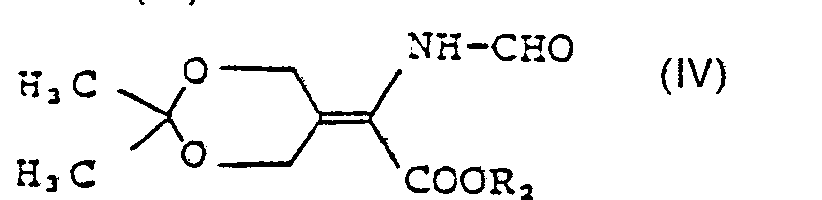
- R2 die oben angegebene Bedeutung hat, in einem Lösungsmittel,beispielsweise Dimethoxyethan, mit einem Schwefelungsmittel, beispielsweise Lawesson-Reagenz, zu Verbindungen der allgemeinen Formel (V)

- R2 die oben angegebene Bedeutung hat, umsetzt, diese anschliessend mit einer starken Base, beispielsweise Butyllithium, in einem Lösungsmittel, beispielsweise Tetrahydrofuran, bei niedrigen Temperaturen, beispielsweise bei -78° C und anschliessend mit einem Alkylierungsmittel, beispielsweise Methyljodid, zu Verbindungen der allgemeinen Formel (VI)


- R2 die oben angegebene Bedeutung hat, und
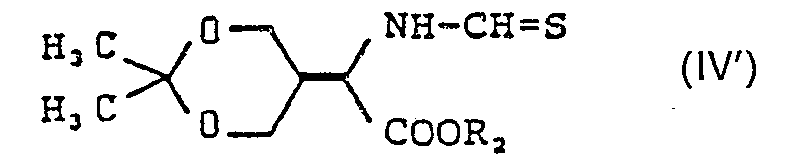
- R3 gegebenenfalls substituiertes Alky! bedeutet, umsetzt, oder indem man Verbindungen der allgemeinen Formel (IV') oder (IV")


- R2 die oben angegebene Bedeutung hat, mit einem Alkylierungsmittel zu Verbindungen der allgemeinen Formel (VI) oder (VI') umsetzt, diese anschliessend mit einem aktivierten Derivat einer Säure beispielsweise dem Säurechlorid der allgemeinen Formel (VII)
-

- X Azido oder Phthalimido bedeutet, in Gegenwart einer Base, beispielsweise Triethylamin, in einem Lösungsmittel, beispielsweise Methylenchlorid, zu Verbindungen der allgemeinen Formel (VIII)


- R2, R3 und X die oben angegebene Bedeutung haben,
umsetzt, diese anschliessend im Falle, dass X Azido ist, mit einem Reduktionsmittel, beispielsweise Schwefelwasserstoff, in Gegenwart eines Amins, beispielsweise Triethylamin, in einem Lösungsmittel, beispielsweise Methylenchlorid oder im Falle, dass X Phthalimido ist, mit Phthalimid spaltenden Reagenzien, beispielsweise Hydrazin, zu Verbindungen der allgemeinen Formel (IX)

- R2 und R3 die oben angegebene Bedeutung haben,
umsetzt, diese anschliessend mit einer an der Carboxylgruppe aktivierten Carbonsäure R1'-COOH, bei der R1' einen organischen Rest bis zu 19 Kohlenstoffatomen bedeutet oder diese anschliessend mit Reagenzien wie z. B. Benzyloxycarbonylchlorid umsetzt, die die gegebenenfalls substituierte Benzyloxycarbonylgruppe einzuführen vermögen, zu Verbindungen der allgemeinen Formel (X)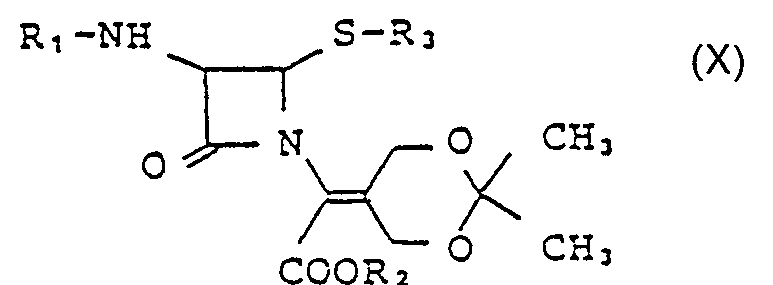

- R1, R2 und R3 die oben angegebene Bedeutung haben,
umsetzt und die Verbindungen der allgemeinen Formel (X) anschliessend mit einem Chlorierungsmittel wie Chlor oder Sulfurylchlorid in einem gegen Chlorierung inerten Lösungsmittel wie Chloroform oder Essigester und anschliessend mit einer Protonensäure wie Trifluoressigsäure oder mit einer Lewissäure wie BF3 im gleichen Lösungsmittel zu Verbindungen der allgemeinen Formel (I) oder (II) umsetzt und die Verbindungen der allgemeinen Formel (X') mit einem Chlorierungsmittel wie Chlor oder Sulfurylchlorid in einem gegen Chlorierung inerten Lösungsmittel wie Chloroform oder Essigester und anschliessend mit einer Protonensäure wie Trifluoressigsäure oder mit einer Lewissäure wie BF3 zu Verbindungen der allgemeinen Formel (III)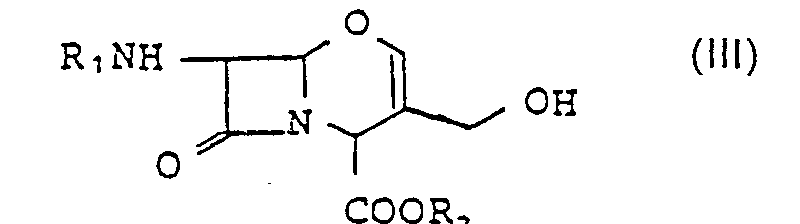
- R, und R2 die oben angegebene Bedeutung haben.
- Die Überführung der Verbindung der allgemeinen Formel (X) bzw. (X') in die Verbindungen der allgemeinen Formel (I), (II) bzw. (III) kann auch durch Umsetzung mit einem Chlorierungsmittel wie Chlor oder Sulfurylchlorid in einem gegen Chlorierung inerten Lösungsmittel wie Chloroform oder Essigester, anschliessende wässerige Aufarbeitung bei pH 7 zu Zwischenprodukten der allgemeinen Formel (XI) bzw. deren Doppelbindungsisomeren der allgemeinen Formel (XI')


- R2 die oben angegebene Bedeutung hat, und
- R1" die Bedeutung von R1' hat und zusätzlich gegebenenfalls substituiertes Benzyloxy bedeutet, und deren weitere Umsetzung mit Protonensäuren wie Trifluoressigsäure oder Lewissäuren wie Bortrifluorid erfolgen.
- Es ist als ausgesprochen überraschend zu bezeichnen, dass gemäss der erfindungsgemässen Umsetzungsfolge der Aufbau des 7-Amino-1 - dethia-1 -oxa-3-hydroxymethyl-cephem-4-carbonsäuresystems ohne Durchführung von Oxidationsreaktionen am intakten Azetidinonringsystem erfolgt und dass ein zweistufiger Aufbau des ankondensierten hydrierten Oxazinringsystems erfolgt, weil man erwarten musste, dass ein derartiger Aufbau nur unter Zuhilfenahme von Oxidationsreaktionen am intakten Azetidinonringsystem oder mittels eines mindestens dreistufigen Aufbaus des ankondensierten hydrierten Ringsystems erfolgen könne.
- Das erfindungsgemässe Verfahren weist eine Reihe von Vorteilen auf. So kann beispielsweise dadurch, dass bereits mit Knüpfung des Azetidinonrings alle Gerüst- und Substituentenatome eingeführt sind und nur noch einfache Reduktions-, Substitutions- oder Eliminierungsreaktionen erforderlich sind, die überdies in ausgezeichneten Ausbeuten ablaufen, auf die Anknüpfung weitererGerüst- und Sustituentenatomeam intakten Azetidinonring verzichtet werden, um die Verbindungen der allgemeinen Formeln (I), (11) und (III) zu erhalten.
- Verwendet man die Verbindung (XII) als Ausgangsmaterial, so lässt sich der Reaktionsablauf durch das folgende Formelschema wiedergeben:

- In der allgemeinen Formel (IV) steht R2 vorzugsweise für gegebenenfalls durch Methoxy oder Nitro substituiertes Benzyl oder Benzhydryl, für 1-Ethoxy-carbonyloxyethyl, Pivaloyloxymethyl, Acetoxymethyl, Phthalidyl, für β-Trimethylsilylethyl, β-Halogenethyl oder β-Trichlorethyl oder eine ähnliche, durch ß-Eliminierung abspaltbare Schutzgruppe.
- Die Verbindungen (IV) sind Acetonacetale.
- Die Herstellung der Verbindungen (IV), (IV') und (IV") ist in den Beispielen beschrieben oder in analoger Weise durchführbar. In den allgemeinen Formeln (VI) und (VI') bedeutet R3 einen gegebenenfalls durch eine Estergruppe oder eine Carbonylgruppe substituierten Alkylrest mit bis zu 5 Kohlenstoffatomen. Da dieser Rest in der erfindungsgemässen Reaktionsfolge wieder abgespalten wird, können naturgemäss auch viele andere als die genannten Reste R3 eingesetzt werden.
- In den allgemeinen Formeln (X) und (X') bedeutet R1 vorzugsweise die Benzyloxycarbonylgruppe oder den Rest R1'-CO- einer Carbonsäure, wobei R1' vorzugsweise den Resten (1 ) bis (17) entspricht, wobei die in den Resten vorkommenden Arylgruppen durch ein oder zwei Methoxy-, Hydroxy-, Amino- oder Aminomethylgruppen substituiert sein können, die ihrerseits durch Acetyl, Propionyl, Methoxycarbonyl, Ethoxycarbonyl oder - im Falle von Aminogruppen - Mesyl- oder Sulfogruppen acyliert sein können, und wobei aliphatische und heterocyclische Carboxyl- und Aminogruppen durch Schutzgruppen wie Benzyl, Benzhydryl, Trimethylsilylethyl bzw. Z-, BOC-, Trityl oder Cyanethoxycarbonyl geschützt vorliegen sollten.


- Bei der erfindungsgemässen Herstellung der Verbindungen der allgemeinen Formel (V) aus den Verbindungen der allgemeinen Formel (IV) kommen als Verdünnungsmittel beispielsweise Dimethoxyethan, Diglyme, Triglyme, Tetrahydrofuran, Dioxan, Diethylether, t-Butylmethylether, Dichlormethan, Tetrachlorkohlenstoff, 1,2-Dichlorethan, 1,1,2-Trichlorethan, Trichlorethylen, Chlorbenzol, Dichlorbenzol, Chloroform, Ethylacetat, Anilin, Piperidin, Toluol, Cyclohexan, Acetonitril, Nitromethan, als Schwefelungsmittel beispielsweise 2,4-Bis(4-methoxyphenyl)-2,4-di- thioxo-1,3,2,4-dithiadi-phosphetan (Lawesson-Reagenz), 2,4-Bis(4-chlorphenyl)-2,4-dithioxo-1,3,2,4-dithiadiphosphetan, 2,4-Diphenyl-2,4-dithioxo-1,3,2,4-dithiadiphosphetan, Phosphorpentasulfid, Phosphortrisulfid, Dischwefeltetranitrid, Tetraschwefeltetranitrid, Trithiazylchlorid, elementarer Schwefel, Polyschwefeldichlorid in Frage.
- Bei der erfindungsgemässen Herstellung der Verbindungen der allgemeinen Formel (VI) bzw. (VI') aus den Verbindungen der allgemeinen Formel (V) kommen als starke Basen ausser Butyllithium beispielsweise Phenyllithium, Lithiumdiisopropyiamid, Lithiumhexamethyldisilazanid, Kalium-tert.-butylat, Natriumamid, Dimethylsulfoxid-Kalium, Lithiumhydroxid, Natriumethanolat, Natriumcarbonat, Kaliumcarbonat, als Verdünnungsmittel ausser Tetrahydrofuran beispielsweise Dioxan, Dimethoxyethan, Ammoniak, Dimethylsulfoxid, Methanol, Hexamethylphosphorsäuretriamid, Dimethylformamid, als Alkylierungsmittel ausser Methyljodid beispielsweise Dimethylsulfat, Methylsulfonat, Methyltrifluormethansulfonat, Trimethyloxonium-tetrafluoroborat, Allylbromid, Benzylbromid, Isopropyliodid, in Frage. Die gleichen Alkylierungsmittel kommen bei der erfindungsgemässen Umsetzung der Verbindungen der allgemeinen Formel (lV') bzw. (IV") zu den Verbindungen der allgemeinen Formel (VI) bzw. (VI') in Frage.
- Die Umsetzung wird bei Temperaturen von -78°C bis +40°C durchgeführt.
- Bei der erfindungsgemässen Herstellung der Verbindungen der allgemeinen Formel (VIII) bzw. (VIII') aus Verbindungen der allgemeinen Formel (VI) bzw. (VI') kommen als Verdünnungsmittel ausser Dichlormethan beispielsweise Dichlorethan, Chlorbenzol, Toluol, Chloroform, Ethylacetat, Tetrahydrofuran, Dioxan, Diethylether, als Basen ausser Triethylamin beispielsweise Piperidin, N-Methylmorpholin, Picolon, Lutidin, Kaliumcarbonat, NaOH und Phasentransfer-Reagenzien wie beispielsweise Kronenether in Frage.
- Die Umsetzung wird bei Temperaturen von -40 bis +60°C durchgeführt.
- Bei der erfindungsgemässen Herstellung der Verbindungen der allgemeinen Formel (IX) bzw. (lX') aus Verbindungen der allgemeinen Formel (VIII) bzw. (VIII'), in denen X Azido bedeutet, kommen als Reduktionsmittel neben Schwefelwasserstoff/Pyridin beispielsweise Wasserstoff-Palladium- Kohle, Wasserstoff-Platin, Zink-Eisessig,Zinn-(II)-chlorid-Eisessig, wenn X Phthalimid bedeutet als imidspaltende Reagenzien neben Hydrazin beispielsweise substituierte Hydrazine und als Verdünnungsmittel beispielsweise Wasser, Dichlormethan, Dimethylformamid, Chlorbenzol, Toluol, Ethylacetat, Tetrahydrofuran, Ethanol, Eisessig in Frage.
- Die Umsetzung wird bei Temperaturen von -30°C bis +90°C durchgeführt.
- Bei der erfindungsgemässen Herstellung der Verbindungen der allgemeinen Formel (X) bzw. (X') aus Verbindungen der allgemeinen Formel (IX) kommen als Verdünnungsmittel beispielsweise Wasser, Acetonitril, Dichlormethan, Dichlorethan, Chlorbenzol, Tetrahydrofuran, Dimethylformamid, Hexamethylphosphorsäuretriamid, Dimethylsulfoxid, Nitrobenzol, Nitromethan, Sulfolan und im Falle, dass Basen wegen der Freisetzung von Säuren aus der aktivierten Carbonsäure R1'-COOH oder dem Benzyloxycarbonylgruppen einführenden Reagenz zugegeben werden, kommen als Basen beispielsweise Natronlauge, Natriumbicarbonat, Pyridin, Piperidin, Picolin, N-Methylmorpholin, Diisopropylamin, Triethylamin, 4-Dimethylaminopyridin, Polyvinylpyridin, oder basische lonenaustauscher in Frage.
- Die Umsetzung wird bei Temperaturen von -80° C bis +60° C durchgeführt. Als an der Carboxylgruppe aktivierte Carbonsäuren R'-COOH kommen bei dieser Umsetzung in geschützter oder ungeschützter Form beispielsweise Säuren der folgenden Formeln in Frage:


- Zur Aktivierung der Carbonsäuren R'-COOH kommen alle in der Peptid- oder β-Lactamantibiotikachemie gebräuchlichen Aktivierungsmethoden wie beispielsweise die Säurechlorid-, Carbodiimid-, gemischte Anhydrid- oder aktivierte Estermethode in Frage.
- Bei der erfindungsgemässen Herstellung der Verbindungen der allgemeinen Formel (I), (II) oder (III) aus Verbindungen der allgemeinen Formel (X) kommen als Chlorierungsmittel neben Chlor oder Sulfurylchlorid beispielsweise N-Chlorsuccinimid, Trichlorisocyanursäure, Chlorsulfonsäure in einem gegen Chlorisierung inerten Verdünnungsmittel wie beispielsweise Dichlorbenzol, Eisessig, Nitrobenzol, Tetrachlorkohlenstoff, Chloroform, Essigester, Dichlormethan, tert.-Butyl-methylether in Frage. Der Chlorierungsschritt wird bei Temperaturen von -80 bis +100° C durchgeführt. Zur Cyclisierung zu den Verbindungen der allgemeinen Formeln (I) und (II) aus den chlorierten Verbindungen der allgemeinen Formel (X) und zu (III) aus (X') kommen als Protonensäuren beispielsweise Trifluoressigsäure, Trifluormethansulfonsäure, Perchlorsäure, Tetrafluorborwasserstoffsäure, Chlorwasserstoffsäure, Quadratsäure, p-Toluolsulfonsäure, Campfersulfonsäure, Polyphosphorsäure, als Lewissäuren beispielsweise Bortrifluorid, Zink(II)chlorid, Aluminiumchlorid, Zinn(IV)-chlorid, Quecksilber(II)chlorid, Siliciumtetrachlorid, Trimethylsilyltrifluormethansulfonat, Trimethylsilyltrifluoracetat, als Verdünnungsmittel beispielsweise Die Verdünnungsmittel des Chlorierungsschrittes in Frage. Bei der erfindungsgemässen Herstellung der Verbindungen der allgemeinen Formel (XI) bzw. (XI') aus den Chlorierungsprodukten der Verbindungen der allgemeinen Formel (X) bzw. (X') kommt anstelle der wässerigen Aufarbeitung bei etwa pH 7 beispielsweise die Aufarbeitung mit Natriumhydrogencarbonat-Lösung, Dinatriumhydrogenphosphat-Lösung oder der Kontakt zu Kieselgel bzw. basischem Aluminiumoxid in Frage.
- Eine Umwandlung der Produkte der allgemeinen Formeln (I), (II) und (III) ineinander und in andere bekannte 7-Amino-1-dethia-1-oxa-3-methyl-cephem-4-carbonsäuren, die an der Methylgruppe durchandere Reste als die OH-Gruppe substituiert sind, ist bei M. Narisada et al., J. Antibiotics, 35, 463 (1982) zusammengefasst dargestellt.

- Zu 10,0 g (80 mmol) 90% Kalium-tert.-butanolat in 50 ml wasserfreiem TH F unter N2 bei -60° C tropfte man 14,0 g (80 mmol) Isocyanessigsäure-benzylester (gelöst in 60 ml THF), rührte 10 min bei dieser Temperatur und tropfte 10,4 g (80 mmol) 2,2-Dimethyl-1,3-dioxan-5-on (in 40 ml THF) ein. Man setzte das Rühren fort (30 min bei -60°C und 30 min bei 0°C) und neutralisierte die Reaktionsmischung mit 4,8 g (80 mmol) Essigsäure in 200 ml Dichlormethan. Die Mischung wurde mit Wasser gewaschen (3x100 ml) über Natriumsulfat getrocknet und das Solvens im Vakuum entfernt. Man erhielt 19,8 g (81 %) Produkt vom Schmo. 80° C.
- IR (KBr): 333 (NH), 1743 (OC=O), 1698, 1671,1517 (NHC=O) 1646 cm-1 (C=C).
- 1H-NMR(CDCI3,δ):1,31 (s,2CH3),4,16und 4,38 (je s, OCH2), 5,13 (s) und 7,3 (m) (CH2C6H5), 7,60 und 8,06 (je br. s., NHCH=O).

- 3,66 g (12,0 mmol) 2-(2,2-Dimethyl-1,3-dioxan-5-yliden)- 2 -(formylamino)essigsäure-benzylester (Beispiel 1) in 37 ml wasser- und peroxidfreiem 1,2-Dimethoxyethan wurden mit 2,91 g (7,2 mmol) 2,4-Bis-(4-methoxyphenyl)-2,4-dithioxo- 1,3,2,4-dithiadiphosphetan (Lawesson-Reagenz) 20 min bei 20°C gerührt (DC-Kontrolle).
- Es wurde festgestellt, dass die Reaktion mit einigen Chargen von handelsüblichen oder selbsthergestelltem Lawesson-Reagenz nicht ansprang. Es liess sich in diesen Fällen «aktivieren», indem man es kurz unter Feuchtigkeitsausschluss mit dem 30fachen Volumen 1,2-Dimethoxyethan (auf -20°C gekühlt) ausspülte.
- Man rührte das Reaktionsgemisch in 120 ml gesättigte wässerige Natriumbicarbonat-Lösung ein und extrahierte die Lösung dreimal mit je 50 ml tert.-Butylmethylether. Trocknung der organischen Phase und Entfernung des Solvens im Vakuum ergab 3,76 g (98%) hellgelbes Öl.
- IR (KBr-Pressling): 1743 (C=O), 1580 cm-' (C=N).
- 1H-NMR (CDCLl): 8=1,27 und 1,38 (je s; 2 CH3), 3,78, 3,87, 3,95 und 4,08 (AB-Teile; 2 CH2), 4,73 (d, J=1,8 Hz; C-4-H), 5,24 (s; CH2Ph), 7,37 (s; C6H5), 8,07 (d, J=1,8 Hz; C-2-H).

- 230 mg (0,72 mmol) des ungereinigten Thiazolins (aus Beispiel 2), gelöst in 4 ml wasserfreiem Tetrahydrofuran unter N2, wurden bei -78°C mit 0,50 ml einer 1,55 n Lösung (0,77 mmol) n-Butyllithium in Hexan versetzt und 15 min bei dieser Temperatur gerührt. Dann fügte man 0,47 ml (0,75 mmol) Methyliodid hinzu und rührte 1 h bei -30°C und 3 h bei 0°C. Das Reaktionsgemisch wurde durch eine Glasfritte, die mit 1 cm Kieselgur bedeckt war, filtriert. Aus dem Filtrat gewann man nach Abziehen des Solvens im Vakuum 150 mg (62%) dunkles Öl.
- IR (KBr-Pressling): 1713 (C=O), 1588 cm-1 (C=N).
- 1 H-NMR (CDl3): 8=1,41 (s; 2 CH3), 2,40 (s; SCH3), 4,53 und 4,67 (je s, 2 CH2), 5,22 (s; CH2Ph), 7,36 (s; C6H5), 8,56 (s; N=C-H).

- Zur Lösung von 1,29 g (3,85 mmol) ungereinigtem Produkt von Beispiel 3 und von 0,80 ml (5,77 mmol) Triethylamin in 90 ml wasserfreiem Dichlormethan tropfte man unter Rühren bei 20° C binnen 90 min, 0,68 g (5,77 mmol) Azidoacetylchlorid in 10 m Dichlormethan. Man rührte 30 min nach, zog das Solvens bei Raumtemperatur im Vakuum ab und nahm den Rückstand mit 90 ml Toluol auf, filtrierte von den ausgefallenen Salzen ab, zog das Solvens im Vakuum ab und chromatographierte den Rückstand an 50 g Kieselgel mit Diethylether/Petrolether (1 :1 ), R,=0,35. Man erhielt 1,35g (84%) Produkt vom Schmp. 74°C (aus Petrolether).

- IR (KBr): 2100 (N3), 1775 (C=0-Lactam), 1718 (C=0-Ester),1625 und 1640 cm-1 (C=O).
- 1 H-NMR (CDCl3):8=1,40 (s; 2 CH3),1,98 (s; SCH3), 4,18 (AB-Teil, JAB=16,0 Hz; CH2O trans zur Carboxylgruppe), 4,44 (d, J=2,3 Hz; C-=-H), 4,48 (AB-Teil, d, JAB=16,0 Hz, J= 1,7 Hz; CH20 trans zur Estergruppe), 4,73 (AB-Teif, d, J=1,7 Hz; CH20 cis zur Estergruppe),4,78 (AB-Teil, s; CH20 cis zur Estergruppe), 4,98 (d, J=2,3 Hz; C-4-H), 5,12 und 5,36 (AB, JAB=11,8 Hz; CH2-Benzyl), 7,37 (s; C6H5).

- Zur Lösung von 0,64 g (1,53 mmol) Produkt von Beispiel 4 und 0,32 ml Triethylamin in 16 ml Dichlormethan leitete man bei 0°C so lange Schwefelwasserstoff, bis im IR-Spektrum einer Probe kein Azid (2100 cm-1) mehr nachweisbar war (1,5 h). Man entfernte das Solvens im Vakuum, nahm den Rückstand in 65 ml wasserfreiem Chloroform auf, fügte 0,26 ml (3,2 mmol) Pyridin hinzu und tropfte dann bei -5°C eine Chloroform-Lösung von 0,38 ml (0,32 mmol) Benzoylchlorid ein. Die Reaktionsmischung wurde 1 h bei 20°C gerührt, dann dreimal mit je 30 ml Phosphatpuffer (pH 7) ausgeschüttelt, über Natriumsulfat getrocknet und dann das Solvens im Vakuum entfernt.
- Die Chromatographie des Rückstands an Kieselgel (50 g) mit tert.-Butylmethylether/Petrol- ether (1:1) ergab 0,61 g (80%) Produkt vom Schmp. 67°C (aus tert.-Butylmethylether).
- IR (KBr): 3360 (NH), 1773 (C=O-Lactam), 1720 (C=O-Ester), 1668 und 1535 cm-1 (C=O-Amid).
- 1 H-NMR (CDCI3): 8=1,42 (s; 2 CH3), 2,07 (s; SCH3), 4,26 und 4,55 (AB, JAB=16,5 Hz; CH2O), 4,66 und 4,90 (AB, JAB=17,5 Hz; CH20), 5,15 (dd, J1=7,7 Hz; J2=2,5 Hz, C-=-H), 5,24 (d, J=2,5 Hz; C-4-H), 5,18 und 5,35 (AB, JAB=11,8 Hz; CH2-Benzyl), 7,30-7,00 (m; NH, Aromaten-H).
- 13C-NMR (CDCI3):8=12,4 (SCH3), 23,7 und 23,9 (2 CH3), 61,0 und 61,3 (2 CH2O), 62,4 (C-3), 68,0 (CH2-Benzyl), 68,2 (C-4), 100,8 (Acetonid-C-2), 115,7 (=C), 123,7, 128,8, 129,0, 132,3, 133,1 und 135,3 (Aromaten-C), 155,2 (N-C=), 162,6, 163,8 und 167,7 (C=O).

- Zu 106 mg (0,22 mmol) Produkt von Beispiel 5 in 5 ml trockenem Chloroform unter N2 fügt man bei -40°C 0,75 ml (0,22 mmol) einer 0,3 M Lösung von Chlor in Tetrachlorkohlenstoff. Nach 15 min. erwärmte man auf -15° C, rührte noch 3 h bei dieser Temperatur und zog dann im Vakuum - zuletzt bei 10-4 Torr, das Solvens und die flüchtigen Nebenprodukte bei -15°C ab (ca. 4 h). Zum Rückstand gab man 6 ml (auf -15°C gekühltes) Aceton und dann 6 ml Phosphatpuffer (pH 7) und rührte die Mischung noch 1 h bei 20°C. Dann extrahierte man mit Dichlormethan (3x je 10 ml), trocknete die Extrakte über Natriumsulfat und Natriumhydrogencarbonat. Das nach dem Abziehen des Solvens im Vakuum zurückbleibende Rohprodukt wurde über Kieselgel (neutral, 8 g) mittert.-Butylmethylether/Petrolether (1:1) chromatographiert. Man gewann 71 mg (72%) Produkt Rf=0,25, vom Schmp. 51°C (aus dem zur Chromatographie benutzten Gemisch).
- IR (KBR): 1784 (C=O-Lactam), 1720 (C=O-Ester) und 1635 cm-1 (C=N).
- 'H-NMR (CDCl3, δ): 1,30 (s, 2 CH3), 3,88 und 4,30, 4,63 und 4,67 (je AB-Teile, je OCH2), 5,02 und 5,23 (AB, J=12 Hz, OCH2PH), 7,25-7,45 und 7,80-7,95 (m, C6H5), 5,33 und 6,18 (je d, J=3,5 Hz, β-Lactam-Protonen).

- 24 mg (0,54 mmol) Produkt von Beispiel 6 wurden mit 0,4 ml Trifluoressigsäure unter N2 1 h bei -13°C gerührt Dann zog man das Solvens bei -10°C und 10-4 Torr ab (1 h), nahm den Rückstand mit0,5 ml Dichlormethan auf und chromatographierte die Lösung an 8 g Kieselgel mit tert.-Butylmethylether. Man gewann 9 mg (56%) einer 4:6-Mischung von trans-7-Benzoylamino-3-hydroxymethyl-1 -oxaceph-3-em-4-carbonssure-Butenolid und 3-(7-Oxo-3-phenyl-4-oxa-2,6-di- azabicyclo(3.2.0)hept-2-en-6-yl)-4-hydroxymethyl-2,5-dihydrofuran-2-on, diese liessen sich durch Chromatographie mit Toluol/tert.-Butylmethylether an Kieselgel (bei teilweiser Zersetzung) trennen.
- trans-7-Benzoy!amino-3-hydroxymethy)-1 -oxa- ceph-3-em-4-carbonsäure-butenolid
- IR (KBr): 1787 (C=O-Lactam), 1760 (C=O-Butenolid), 1658 und 1530 cm-1 (C=O-Amid).
- 1H-NMR (CDCI3, δ): 5,05 (dd, J=2,0 und 7,5 Hz, C-7-H), 6,57 (d, J=2,0 Hz, C-6-H), 4,42 und 4,81 (AB, J=15 Hz, OCH2-Butenolid), 4,93 (s, 2-CH2), 7,03 (d, J=7,5 Hz, NH), 7,25-8,05 (m, Phenyl).
- MS: C15H,ZN205 Ber. 300.0746 Gef.300.0746 3-(7-Oxo-3-phenyl-4-äxa-2,6-diazabicyclo-(3.2.0) hept-2-en-6-yl) -4-hydroxymethyl-2,5-dihydrofuran-2-on:
- IR (KBr): 1773 (C=O, Lactam), 1757 (C=O, Butenolid), 1673 (C=C), 1632 cm-1 (C=N).
- 1H-NMR (CDCI3, 8): 2,81 (br, s, OH), 5,46 und 6,88 (je d, J=3,4 Hz, β-Lactam-H), 4,40 und 4,70 (AB, J=15 Hz, OCH2-Butenolid), 4,90 und 4,92 (AB, CH2-OH), 7,2-8,1 (m, Phenyl).
- MS:C15H12N2O5 Ber,300.0746 Gef.300.0746

- Zu 20 mg (0,04 mmol) Produkt von Beispiel 5 in 1,5 ml trockenem Chloroform unter N2 fügte man 0,14 ml (0,04 mmol) einer 0,3 m Lösung von Chlor in Tetrachlormethan, erwärmte von -40°C auf -15°C und rührte 3 h bei dieser Temperatur. Man entfernte die flüchtigen Bestandteile im Vakuum (zuletzt bei 10-4 Torr, 4 h), nahm den Rückstand mit 0,5 ml trockenem Deutero-Chloroform auf und fügte 0,1 ml Trifluoressigsäure hinzu. Nach 10 min bei 20°C liessen sich 1H-NMR-spektroskopisch neben äquimolaren Mengen Aceton und Benzylalkohol nur Titelprodukt nachweisen.

- 59 mg (0,14 mmol) Produkt von Beispiel 4 in 2 ml trockenem Dichlormethan wurden mit 19 mg (0,14 mmol) wasserfreiem Zinkchlorid 12 h bei 20°C gerührt. Die Reaktionsmischung wurde an 10 g Kieselgel mit Diethylether chromatographiert und ergab 13 mg (34%) 8, Rf=0,23, als zähes farbloses Öl.
- 1 H-NMR (CDCI3, δ): 2,24 (s, SCH3), 4,55 (AB, J=16,2 Hz, OCH2), 4,65 und 4,94 (je d, J=2,6 Hz, C-3- und C-4-H).
- IR (CDCI3): 2103 (N3), 1770 und 1764 (je C=O und 1675 cm-1 (C=C).

- Zu 19,8 g (0,065 mol) 2-(2,2-Dimethyl-4,5- dehydro-1,3-dioxan-5-yl)-2-(N-formyl)aminoessigsäure-benzylester (Beispiel 1) und 18,2 g (0,180 mol) Triethylamin in 65 ml trockenem Dichlormethan wurden bei -15°C unter kräftigem Rühren 11,0 g (0,72 mol) Phosphoroxychlorid getropft. Das Gemisch wurde 2 h bei 20°C gerührt und-dann bei 15-20°C mit 65 ml einer 20%igen wässrigen K2C03-Lösung gerührt, bis keine CO2-Entwicklung mehr beobachtet wurde. Nach Waschen der organischen Phase mit Wasser (2x65 ml) wurde sie getrocknet und das Solvens im Vakuum abgezogen. Umkristallisation des Rückstands aus Diethylether/Petrolether (1 :1 ) ergab 11,0 g (61 %) Produkt vom Schmp. 78° C.
- IR (CClQ): 2110 (NC), 1735 (C=O), 1660 cm-1 (O-C=C-).
- 1H-NMR (CDCI3): 8=1,28 und 1,36 (je s; 2 CH3), 3,96 und 4,26 (AB-Teil; CH2), 4,68 (s; H), 5,13 (s; CH2-Benzyl), 6,56 (s; Vinyl- H 7,23 (s; C6H5).

- In 9,5 g (35 mmol) des Isocyanids aus Beispiel 10 und 2 ml Triethylamin in 50 ml Dichlormethan wurde bei 10-20° C Schwefelwasserstoff eingeleitet, bis im IR-Spektrum einer Probe kein Isocyanid (2100 cm-1) mehr nachweisbar war (1-2 h). Nach Zufügen von 10 ml Toluol wurde das Solvens im Vakuum abgezogen, der Rückstand mit 200 ml Ether aufgenommen, mit 1 N NaHZP04-Lösung und dann mit ges. KCI-Lösung gewaschen, die Lösung getrocknet. Nach dem Abziehen des Ethers im Vakuum blieben 10,3 g (100%) des Thioformamids zurück. Eine Analysenprobe wurde aus Diethylether/Petrolether (1:1) umkristallisiert (Schmp. 89°C).
- IR (KBr-Pressling): 3290 (NH), 1715 (C=O), 1665 cm-1 (=C).
- 1H-NMR (CCl4): δ=1,35 und 1,38 (je s; 2 CH3), 4,11 (s, breit; O-CH2), 5,20 und 5,23 (AB-Teil; CH2-Benzyl), 5,52 (d, J=7,0 Hz; H-C-CO2Bz), 6,56 (s, breit; O-CH=), 7,34 (s; C6H5), 8,2-8,4 (s, sehr breit; NH, tauscht mit D2O aus), 9,42 (d, J=6,0 Hz; CH=S).
- Analyse für C16H19NO4S (321,39):


- Zu 0,8 g (25 mmol) des ungereinigten Thioformamids aus Beispiel 11 in 30 ml trockenem Tetrahydrofuran unter N2 bei -78°C wurde eine Lösung von 3,0 g (25 mmol) von 90%igem Kalium- tert.-butanolat in 30 ml TH F getropft. Nach 15 min wurden 3,75 g (26 mmol) Methyljodid hinzugefügt, die Mischung auf 0°C erwärmt und 1 h bei dieser Temperatur gerührt. Das ausgefallene Natriumjodid wurde unter N2 über Kieselgur abfiltriert und das Solvens im Vakuum abgezogen. Das zurückbleibende gelbe Öl (8,4 g) wurde in 300 ml Dichlormethan (über P4010 destilliert) gelöst, mit 2,0 g (33 mmol) Triethylamin in Dichlormethan versetzt und unter kräftigem Rühren bei 20°C binnen 5 h 3,35 g (28 mmol) Azidoacetylchlorid in 50 ml CH2Cl2 eingetropft. Anschliessend wurde 30 min nachgerührt, das Solvens im Vakuum abgezogen, der Rückstand mit 100 ml Benzol aufgenommen, das ausgefallene Hydrochlorid abgesaugt und der Rückstand im Vakuum vom Solvens befreit. Chromatographie über 1 kg Kieselgel mit Diethylether/Petrolether (1 :1 ) ergab 5,0 g (48%) Produkt als 1 :1-Mischung der Diastereomeren R* und S* als hellgelbes Öl (R*, Rf=0,41; S*, Rf=0,33).
- IR (CCl4): 2095 (N3), 1765 (C=O-Lactam), 1735 (C=0-Ester), 1655 cm-1 (C=C).
- 1H-NMR (CCI4:
- R* 8=1,37 (s; 2 CH3),1,93 (s; SCH3), 4,14 (s, breit; Ring-CH2), 4,24 (s; H-C-C02-Bz), 4,32 (d, J=2,0 Hz;C-3-H), 4,39 (d, J=2,0 Hz; C-4-H), 5,15 (s, breit; CH2-Benzyl), 6,34 (s, breit; Ring-C=CH), 7,29 (s; C6H5).
- S* 8=1,37 (s; 2 CH3), 2,01 (s; SCH3), 4,04 und 4,14 (AB-Teil; Ring-CH2), 4,24 (s; H-C-CO2-Bz), 4,28 (d, J=2,0 Hz; C-4-H) -4,51 (d, J=2,0 Hz; C-3-H), 5,15 (s, breit; CH2-Benzyl), 6,44 (s, breit; Ring-C=CH), 7,29 (s; C6H5).

- In die Lösung von 2,44 g (5,8 mmol) des Azids aus Beispiel 12 und 0,96 ml (6,9 mmol) Triethylamin in 60 ml Dichlormethan wurde bei 0°C ein Schwefelwasserstoff-Strom geleitet, bis im IR-Spektrum einer Probe kein Azid (2100 cm-1) mehr nachweisbar war (1-2 h). Das Solvens wurde im Vakuum abgezogen, der Rückstand in 20 ml trockenem Chloroform und 0,48 g (6,0 mmol) Pyridin gelöst und bei -5°C 1,03 g (6,0 mmol) Phenoxyacetylchlorid in 25 ml Chloroform hinzugetropft. Die Reaktionsmischung wurde 1 h bei 20°C gerührt, mit Phosphatpuffer (pH=7) ausgeschüttelt, über MgS04 getrocknet und das Lösungsmittel im Vakuum entfernt und der Rückstand über 300 g Kieselgel mit Essigsäureethylester/Cyclohexan (1 :1 ) chromatographiert. Ausbeute 2,50 g (82%) gelbes Öl als 1:1-Mischung der Diastereomeren I (RF=0,41 ) und B (RF=0,36). Eine Probe des Diastereomeren B wurde durch Kristallisation aus Diethylether reingewonnen, Schmp. 51 °C.
- IR (CCl4):3200-3450 (NH), 1770 (C=O-Lactam), 1740 (C=0-Ester), 1690 (C=O-Amido), 1670 cm-1 (C=C).
- 1H-NMR (CDCl3):
- R* 8=1,44 und 1,46 (je s; 2 CH3), 2,02 (s; SCH3), 4,35 und 4,40 (AB-Teil; Ring-CH2), 4,48 (s; O-CH2-C=O), 4,53 (s; HC-CO2Bz), 4,77 (dd, J1=2,3 Hz, J2=8,7 Hz; C-3-H), 4,89 (d, J=2,3 Hz; C-4-H), 5,19 (s, breit; CH2-Benzyl), 6,80-7,45 (m; NH, O-C6H5).
- S* 8=1,39 und 1,43 (je s; 2 CH3), 2,04 (s; SCH3), 4,23 und 4,39 (AB-Teil; Ring-CH2), 4,46 (s; O-CH2-C=O), 4,53 (s; HC-C02-Bz), 4,73 (d, J=2,3 Hz; C-4-H), 4,88 (dd, J1=2,3 Hz, J2=8,0 Hz; C-3-H), 5,22 und 5,23 (AB-Teil; CH2-Benzyl), 6,55 (s, breit; Ring-C=C-H), 7,30 (s; C6H5-Benzyl), 6,80-7,45 (m; NH, O-C6H5).
- Analyse für C27H30N20S (526,61):

Claims (5)




Applications Claiming Priority (2)
| Application Number | Priority Date | Filing Date | Title |
|---|---|---|---|
| DE3225269 | 1982-07-06 | ||
| DE19823225269 DE3225269A1 (de) | 1982-07-06 | 1982-07-06 | Verfahren zur herstellung von 7-amino-1-dethia-1-oxa-3-hydroxymethyl-cephem-4-carbonsaeuren |
Publications (2)
| Publication Number | Publication Date |
|---|---|
| EP0098478A1 EP0098478A1 (de) | 1984-01-18 |
| EP0098478B1 true EP0098478B1 (de) | 1985-11-06 |
Family
ID=6167769
Family Applications (1)
| Application Number | Title | Priority Date | Filing Date |
|---|---|---|---|
| EP83106171A Expired EP0098478B1 (de) | 1982-07-06 | 1983-06-24 | Verfahren zur Herstellung von 7-Amino-1-dethia-1-oxa-3-hydroymethyl-cephem-4-carbonsäuren |
Country Status (6)
| Country | Link |
|---|---|
| US (1) | US4496723A (de) |
| EP (1) | EP0098478B1 (de) |
| JP (1) | JPS5921691A (de) |
| DE (2) | DE3225269A1 (de) |
| DK (1) | DK310583A (de) |
| ES (1) | ES523868A0 (de) |
Families Citing this family (2)
| Publication number | Priority date | Publication date | Assignee | Title |
|---|---|---|---|---|
| US4931262A (en) * | 1987-03-03 | 1990-06-05 | Dowa Mining Co., Ltd. | Method of treating H2 S containing gases |
| DE102004060038A1 (de) * | 2004-12-14 | 2006-06-22 | Bayer Materialscience Ag | Verfahren zur Herstellung flüssiger, lagerstabiler Carbodiimid- und/oder Uretonimingruppen aufweisender organischer Isocyanate mit niedriger Farbzahl |
Family Cites Families (4)
| Publication number | Priority date | Publication date | Assignee | Title |
|---|---|---|---|---|
| NL178005C (nl) * | 1972-11-06 | 1986-01-02 | Merck & Co Inc | Werkwijze voor het bereiden van een farmaceutisch preparaat met antibacteriele werking, alsmede werkwijze ter bereiding van een cefalosporine-antibioticum. |
| GB1510794A (en) * | 1974-08-06 | 1978-05-17 | Univ Kingston | 1-oxacephems and intermediates therefor |
| FR2361114A1 (fr) * | 1975-11-12 | 1978-03-10 | Shionogi & Co | Procede de preparation d'analogues de cephalosporine a propriete antibacterienne et nouveaux produits ainsi obtenus |
| JPS53101391A (en) * | 1977-02-15 | 1978-09-04 | Shionogi & Co Ltd | 1-oxadithiacephem compounds |
-
1982
- 1982-07-06 DE DE19823225269 patent/DE3225269A1/de not_active Withdrawn
-
1983
- 1983-06-20 US US06/506,731 patent/US4496723A/en not_active Expired - Fee Related
- 1983-06-24 DE DE8383106171T patent/DE3361171D1/de not_active Expired
- 1983-06-24 EP EP83106171A patent/EP0098478B1/de not_active Expired
- 1983-07-05 JP JP58121133A patent/JPS5921691A/ja active Pending
- 1983-07-05 ES ES523868A patent/ES523868A0/es active Granted
- 1983-07-05 DK DK310583A patent/DK310583A/da not_active Application Discontinuation
Non-Patent Citations (5)
| Title |
|---|
| CANADIAN JOURNAL OF CHEMISTRY, Vol. 52, 1974 Seiten 3996-3999 (S. WOLFE et al.) * |
| JOURNAL OF THE AMERICAN CHEMICAL SOCIETY, Vol. 101, 1979 Seiten 4403-4404 (S. UYEO et al.) * |
| JOURNAL OF THE AMERICAN CHEMICAL SOCIETY, Vol. 96, 1974 Seiten 7582-7584 (L.D. CAMA et al.) * |
| TETRAHEDRON LETTERS, Nr. 44, 1979 Seiten 4287-4290 (M. YOSHIOKA et al.) * |
| TETRAHEDRON LETTERS, Nr. 44, 1979 Seiten 4327-4330 (T. AOKI et al.) * |
Also Published As
| Publication number | Publication date |
|---|---|
| ES8403914A1 (es) | 1984-04-01 |
| DE3361171D1 (en) | 1985-12-12 |
| DK310583A (da) | 1984-01-07 |
| DK310583D0 (da) | 1983-07-05 |
| US4496723A (en) | 1985-01-29 |
| DE3225269A1 (de) | 1984-01-12 |
| EP0098478A1 (de) | 1984-01-18 |
| ES523868A0 (es) | 1984-04-01 |
| JPS5921691A (ja) | 1984-02-03 |
Similar Documents
| Publication | Publication Date | Title |
|---|---|---|
| DE69331089T2 (de) | Beta-Laktam und Cepham Verbindungen und Ihre Herstellung | |
| CH645902A5 (de) | Beta-lactam-zwischenverbindungen sowie verfahren zu ihrer herstellung. | |
| DE2632872A1 (de) | Verfahren zur herstellung von 2- und 3-cephem-4-carbonsaeure-verbindungen | |
| CH636618A5 (en) | 1-Oxadethiacepham compounds, and a process for preparing them | |
| DE2740280A1 (de) | 7-acylamino-8-oxo-3-oxa-1-azabicyclo eckige klammer auf 4.2.0 eckige klammer zu octan-2-carbonsaeure-derivate | |
| DE2831092A1 (de) | Dihydrotriazinylthiomethyloxacephalosporine und ihre salze sowie verfahren zu ihrer herstellung | |
| DE69216131T2 (de) | Verfahren zur Herstellung von Cephem-Derivaten | |
| US4585874A (en) | Process for preparing penem derivatives | |
| EP0098478A1 (de) | Verfahren zur Herstellung von 7-Amino-1-dethia-1-oxa-3-hydroymethyl-cephem-4-carbonsäuren | |
| DE2333256A1 (de) | Halogenpenam- und halogencephamderivate, verfahren zu ihrer herstellung und diese verbindungen enthaltende arzneimittel | |
| Albrecht et al. | C-Glycosyl nucleosides. VI. Synthesis of several 3-and 5-(. beta.-D-ribofuranosyl) isoxazoles | |
| US4036835A (en) | Process for preparing cephalosporins | |
| US4665166A (en) | Process for preparing cephalosporin compounds | |
| DE3521722C2 (de) | ||
| EP0101602B1 (de) | In 6-Stellung unsubstituierte 7-Oxo-4-oxa-diazabicyclo-(3.2.0)-hept-2-en Derivate, Verfahren zu ihrer Herstellung und ihre Verwendung als Zwischenprodukte zur Synthese von beta-Lactamantibiotika | |
| US4051129A (en) | Process for preparing 7-methoxycephalosporin compounds | |
| US3920696A (en) | 2s-carboxyalkylthio-3r-imidoazetidin-4-ones and compounds useful in their preparation | |
| DE2735408A1 (de) | 7 beta-amino-1-oxadethiacephalosporine | |
| US4067866A (en) | Process for preparing cephalosporins and certain novel 2β-thiohydrazo-azetidinones as intermediates | |
| DE2747364A1 (de) | Verfahren zur herstellung von 1- eckige klammer auf alpha(carboxy-4 -geschuetztes-hydroxybenzyl eckige klammer zu -3-acylaminoazetidin-2-on-estern | |
| CA1097652A (en) | Eprimerization process | |
| CH634555A5 (de) | Verfahren zur herstellung von mit nocardicin verwandten azetidinonen. | |
| CH661513A5 (de) | 14-de-(hydroxymethyl)-mycaminosyltylonolid-verbindungen. | |
| US4656264A (en) | Bicyclic azetidinone intermediates | |
| EP0087657B1 (de) | Verfahren zur Herstellung von 1-(4-Chlorbenzoyl)-5-methoxy-2-methyl-3-indolacetoxyessigsäure |
Legal Events
| Date | Code | Title | Description |
|---|---|---|---|
| PUAI | Public reference made under article 153(3) epc to a published international application that has entered the european phase |
Free format text: ORIGINAL CODE: 0009012 |
|
| 17P | Request for examination filed |
Effective date: 19830624 |
|
| AK | Designated contracting states |
Designated state(s): BE CH DE FR GB IT LI SE |
|
| ITF | It: translation for a ep patent filed | ||
| GRAA | (expected) grant |
Free format text: ORIGINAL CODE: 0009210 |
|
| AK | Designated contracting states |
Designated state(s): BE CH DE FR GB IT LI SE |
|
| ET | Fr: translation filed | ||
| REF | Corresponds to: |
Ref document number: 3361171 Country of ref document: DE Date of ref document: 19851212 |
|
| PG25 | Lapsed in a contracting state [announced via postgrant information from national office to epo] |
Ref country code: SE Effective date: 19860625 |
|
| PG25 | Lapsed in a contracting state [announced via postgrant information from national office to epo] |
Ref country code: LI Effective date: 19860630 Ref country code: CH Effective date: 19860630 Ref country code: BE Effective date: 19860630 |
|
| PLBE | No opposition filed within time limit |
Free format text: ORIGINAL CODE: 0009261 |
|
| STAA | Information on the status of an ep patent application or granted ep patent |
Free format text: STATUS: NO OPPOSITION FILED WITHIN TIME LIMIT |
|
| 26N | No opposition filed | ||
| BERE | Be: lapsed |
Owner name: BAYER A.G. Effective date: 19860630 |
|
| PG25 | Lapsed in a contracting state [announced via postgrant information from national office to epo] |
Ref country code: FR Free format text: LAPSE BECAUSE OF NON-PAYMENT OF DUE FEES Effective date: 19870227 |
|
| REG | Reference to a national code |
Ref country code: CH Ref legal event code: PL |
|
| PG25 | Lapsed in a contracting state [announced via postgrant information from national office to epo] |
Ref country code: DE Effective date: 19870303 |
|
| REG | Reference to a national code |
Ref country code: FR Ref legal event code: ST |
|
| GBPC | Gb: european patent ceased through non-payment of renewal fee | ||
| PG25 | Lapsed in a contracting state [announced via postgrant information from national office to epo] |
Ref country code: GB Effective date: 19881122 |
|
| EUG | Se: european patent has lapsed |
Ref document number: 83106171.8 Effective date: 19870505 |