EP0098566A2 - Kortikoidhaltige Zubereitung zur topischen Applikation - Google Patents
Kortikoidhaltige Zubereitung zur topischen Applikation Download PDFInfo
- Publication number
- EP0098566A2 EP0098566A2 EP83106510A EP83106510A EP0098566A2 EP 0098566 A2 EP0098566 A2 EP 0098566A2 EP 83106510 A EP83106510 A EP 83106510A EP 83106510 A EP83106510 A EP 83106510A EP 0098566 A2 EP0098566 A2 EP 0098566A2
- Authority
- EP
- European Patent Office
- Prior art keywords
- corticoid
- oil
- group
- water
- emulsion
- Prior art date
- Legal status (The legal status is an assumption and is not a legal conclusion. Google has not performed a legal analysis and makes no representation as to the accuracy of the status listed.)
- Granted
Links
- 0 C[C@](CC(C1[C@@]2(*)C(C)(CCC(C3)=O)C3[C@@](*)C1)C1(C)CC2O)C1C(C)=O Chemical compound C[C@](CC(C1[C@@]2(*)C(C)(CCC(C3)=O)C3[C@@](*)C1)C1(C)CC2O)C1C(C)=O 0.000 description 1
Classifications
-
- A—HUMAN NECESSITIES
- A61—MEDICAL OR VETERINARY SCIENCE; HYGIENE
- A61K—PREPARATIONS FOR MEDICAL, DENTAL OR TOILETRY PURPOSES
- A61K31/00—Medicinal preparations containing organic active ingredients
- A61K31/56—Compounds containing cyclopenta[a]hydrophenanthrene ring systems; Derivatives thereof, e.g. steroids
- A61K31/57—Compounds containing cyclopenta[a]hydrophenanthrene ring systems; Derivatives thereof, e.g. steroids substituted in position 17 beta by a chain of two carbon atoms, e.g. pregnane or progesterone
-
- A—HUMAN NECESSITIES
- A61—MEDICAL OR VETERINARY SCIENCE; HYGIENE
- A61K—PREPARATIONS FOR MEDICAL, DENTAL OR TOILETRY PURPOSES
- A61K47/00—Medicinal preparations characterised by the non-active ingredients used, e.g. carriers or inert additives; Targeting or modifying agents chemically bound to the active ingredient
- A61K47/44—Oils, fats or waxes according to two or more groups of A61K47/02-A61K47/42; Natural or modified natural oils, fats or waxes, e.g. castor oil, polyethoxylated castor oil, montan wax, lignite, shellac, rosin, beeswax or lanolin
-
- A—HUMAN NECESSITIES
- A61—MEDICAL OR VETERINARY SCIENCE; HYGIENE
- A61K—PREPARATIONS FOR MEDICAL, DENTAL OR TOILETRY PURPOSES
- A61K9/00—Medicinal preparations characterised by special physical form
- A61K9/0012—Galenical forms characterised by the site of application
- A61K9/0014—Skin, i.e. galenical aspects of topical compositions
-
- A—HUMAN NECESSITIES
- A61—MEDICAL OR VETERINARY SCIENCE; HYGIENE
- A61K—PREPARATIONS FOR MEDICAL, DENTAL OR TOILETRY PURPOSES
- A61K9/00—Medicinal preparations characterised by special physical form
- A61K9/10—Dispersions; Emulsions
- A61K9/107—Emulsions ; Emulsion preconcentrates; Micelles
- A61K9/113—Multiple emulsions, e.g. oil-in-water-in-oil
-
- A—HUMAN NECESSITIES
- A61—MEDICAL OR VETERINARY SCIENCE; HYGIENE
- A61P—SPECIFIC THERAPEUTIC ACTIVITY OF CHEMICAL COMPOUNDS OR MEDICINAL PREPARATIONS
- A61P29/00—Non-central analgesic, antipyretic or antiinflammatory agents, e.g. antirheumatic agents; Non-steroidal antiinflammatory drugs [NSAID]
Definitions
- the invention relates to the corticoid-containing preparation for topical application, as well as the process for the production thereof characterized in claim 8.
- any anti-inflammatory corticoid is suitable for producing the corticoid-containing preparation according to the invention.
- the corticoids characterized in claims 2 to 6 are particularly suitable for this purpose.
- Corticoids of the general formula I a according to claim 3, which are suitable for the preparation of the corticoid-containing preparations according to the invention, are hydrocortisone, prednisolone, 6a-methylhydrocortisone, 6a-methylprednisolone and their esters, such as hydrocortisone-21-acetate, hydrocortisone-17 -butyrate, the hydrocortisone-17-valerianate, the prednisolone-21-acetate, the prednisolone-17-valerianate, the 6a-methylhydrocortisone-21-acetate, the 6a-methylprednisolone-21-acetate, the 6 ⁇ -methylhydrocortisone-17-butyrate -21-acetate, the 6a-methylprednisolone-21-acetate-17-propionate, the 6a-methylhydrocortisone-17,21-dipropionate and the 21-acetoxy-17 ⁇ -ethoxymethoxy-11 ⁇ -hydroxy
- Corticoids of the general formula I b according to claim 4, which are suitable for the preparation of the corticoid-containing preparations according to the invention, are for example the fluocortolone, the clocortolone, the diflucortolone, the deoximetasone and their esters, such as the fluocortolone-21-acetate, the fluocortolone 21-capronate, the fluocortolone-21-trimethyl acetate, the clocortolone-21-capronate, the clocortolone-21-trimethyl acetate and the diflucortolone-21-valerianate.
- Corticoids of the general formula I c according to claim 5, which are suitable for the preparation of the corticoid-containing preparations according to the invention, are, for example, betamethasone, beclomethasone, fluprednylidene, clobetasol, dexamethasone, flumetmetasone, 9-chloroprednisolone and their esters, such as, for example, the betamethasone 17 valerianate, the betamethasone 17 benzoate, the betamethasone 17.21 dipropionate, the beclomethasone 17.21 dipropionate, the fluprednylidene 21 acetate, the clobetasol 17 propionate, that Flumetasone-21-trimethylacetate, the 9-chloro-prednisolone-21-acetate-17-propionate and the 9-chloro-prednisolone-17-butyrate-21-propionate.
- Corticoids of the general formula I d according to claim 6, which are suitable for the preparation of the corticoid-containing preparations according to the invention, are for example the triamcinolone, the triamcinolone acetamide, the halcinonide, the fluocinolone, the fluocinolone acetonide, the desonide, the fludroxicortide and their esters, such as the fluocinonide.
- those anti-inflammatory corticoids which do not fall under the structural formula mentioned in claim 2 are also suitable for producing the corticoid-containing preparations according to the invention.
- examples of such corticoids are those which differ from those of the formula I in that they carry a group COOR 10 (R10 means an alkyl group having up to 6 carbon atoms) instead of the group CH2Z - US Patents 3,824,260, 3,919,421 and 3,944,577.
- the fluocortin butyl ester may be mentioned as a corticoid of this structural class.
- Suitable corticoids are also, for example, those which differ from those of the formula II in that they carry a keto group in the 11-position. Clobetason-17-butyrate may be mentioned here as an example.
- the preparation according to the invention contains 0.005 to 2 and preferably 0.05 to 0.5 weight percent corticoid; the concentration of which is of course dependent on the relative effectiveness of the corticosteroid.
- the invention further relates to a process for the preparation of a corticoid-containing preparation in the form of an ointment, paste, cream or the like, which is characterized in that an oil / water emulsion and from is formed from the fat phase, aqueous phase, oil / water emulsifier and preservative Fat phase, aqueous phase and water / oil emulsifier produces a water / oil emulsion and that the two emulsions are intimately mixed with the addition of hydrophilic and / or lipophilic active ingredients under vacuum at a temperature between 20 and 40 ° C and then the finely dispersed obtained Mixture with fragrances.
- the two emulsion types are combined particularly gently at temperatures between 20 and 40 ° C, preferably at 30 ° C under vacuum, but nevertheless very intensively, in a stirrer container, so that finally a very fine dispersion of the two emulsions, the particle size of which is between 2 and 50 microns, preferably between 5 and 15 microns is achieved, then the two types of emulsion remain unchanged side by side in the cream produced.
- This emulsion system remains with considerable dilution, e.g. B. with liquid phase, stable. It is believed that the particle size as well as the interaction of the emulsifiers is important for the stability of this emulsion system. It is essential that the emulsions used are dispersed and not homogenized in the preparation of the cosmetic composition according to the invention.
- the two emulsions are preferably combined under a vacuum of 0.5 torr to 50 torr.
- the stirring speed depends on the agitator used and must be determined in a manner known per se.
- the oil / water emulsions and the water / oil emulsions can be prepared in a conventional manner using conventional emulsifiers (Kirk Othmer: Encyclopedia of Chemical Technology, 3rd edition, 1979; John Wiley &Sons; New York etc. Vol 8, Pages 900 to 930 and Dr. Dtto-Albrecht Neumüller: Römpps Chemie Lexikon 7th edition, 1973; Franck'sche Uerlags Stuttgart, pages 1009 to 1013).
- the waxes, emulsifiers and other additives used for these emulsions are the same as those conventionally used for emulsified skin care products (Dr. Otto-Albrecht Neumüller: Römpps Chemie Lexikon, 7th edition 1973; Franck'sche Verlags Stuttgart, page 1427 and 1428).
- An oil / water emulsion used in the cosmetic composition according to the invention can consist of hydrophilic and / or lipophilic active substances, fat phase, oil / water emulsifier, aqueous phase and preservatives.
- Suitable as the oily phase or as the fat phase in the oil / water emulsion are hydrocarbons such as petroleum jelly, paraffins or stearin, or waxes such as beeswax.
- Suitable oil / water emulsifiers are, for example, stearyl alcohol, polyoxyethylene stearates (such as MYRJ (R) ), complex emulsifiers (such as amphoterin (R) ) and sorbitan fatty acid esters (such as Span (R) ) or carboxyvinyl polymers (such as Carbopol ( R) ).
- the aqueous phase can additionally contain buffer substances, such as, for example, the disodium salt of ethylenediamine-N, N, N ', N'-tetraacetic acid and preservatives such as chloroquinaldol, parabens or benzalkonium chloride.
- the proportion of the inner emulsion in the oil / water emulsion is preferably 30 to 49% by weight, the particle size of the inner emulsion is preferably between 1 ⁇ m and 100 4 . When both phases are dispersed, it is crushed again and is below 50 ⁇ in the finished product.
- a water / oil emulsion which can be used in the corticoid-containing preparation according to the invention again consists of hydrophilic and / or lipophilic active substances, as are also used in the oil / water emulsion, fat phase, water / oil emulsifier and aqueous phase.
- hydrocarbons for example paraffins, and vaseline
- synthetic, vegetable and animal oils and waxes such as n live oil, peanut oil, fine bone oil, almond oil, lanolin, beeswax or sunflower oil
- fatty alcohols such as cetyl alcohol, myristyl alcohol, stearyl alcohol or ceryl alcohol
- fatty acid esters such as beeswax (Cera alba) or wax alcohol esters or mixed esters (such as Dehymuls (R) ).
- the proportion of the inner emulsion in the water / oil emulsion is preferably 30 to 49% by weight, the particle size of the inner emulsion is preferably between 1 ⁇ and 100 ⁇ . When both phases are dispersed, it is crushed again and is below 50 ⁇ in the finished product.
- the mixing ratio of oil / water emulsion and water / oil emulsion is preferably 20 to 80% by weight and in particular 35% to 65% oil / water emulsion.
- the finely dispersed system is additionally mixed with the micronized corticoid (grain size preferably 1 to 20 ⁇ ) and optionally also with fragrances, such as that of the Crematest (R) series, and stirred until the latter is evenly distributed.
- the micronized corticoid grain size preferably 1 to 20 ⁇
- fragrances such as that of the Crematest (R) series
- corticoid preparation according to the invention in the form of a cream can, for example, have the following composition:
- the information is given in percent by weight.
- 228.00 g of purified demineralized water are introduced into a melt of 220.00 g of petroleum jelly (DAB 8), 10.00 g of Dehymuls (R) and 10.00 g of Cera alba with vigorous stirring. The mixture is stirred until an emulsion with a particle size of 20-70 ⁇ is formed.
- DAB 8 petroleum jelly
- R Dehymuls
- R Cera alba
- the water / oil emulsion is introduced into the oil / water emulsion with vigorous stirring under a vacuum of 10 torr.
- the mixture is stirred until a dispersion with a particle size of 10 to 50 ⁇ is formed, the vacuum is removed, 5,000 g of hydrocortisone-21-acetate are added with stirring - particle size predominantly 1 to 20 ⁇ and 2.00 g of a fragrance by Crematest (R) and stir until both components are evenly distributed in the ointment base.
- the water / oil emulsion is introduced into the oil / water emulsion with vigorous stirring under a vacuum of 10 torr.
- the mixture is stirred until a dispersion with a particle size of 10 to 50 ⁇ is formed, the vacuum is removed and 1,000 g of 21-acetoxy-11 ⁇ -hydroxy-6 ⁇ -methyl-17 ⁇ -propionyloxy-1,4-pregnadiene are added with stirring.
- the water / oil emulsion is introduced into the oil / water emulsion with vigorous stirring under a vacuum of 10 torr.
- the mixture is stirred until a dispersion with a particle size of 10 to 50 ⁇ is formed, the vacuum is removed, 1,000 g of 21-acetoxy-17 ⁇ -butyryloxy-11 ⁇ -hydroxy-6 ⁇ -methyl-4-pregnen-3 are added with stirring, 20-dione - micronizes particle size predominantly 1 to 20 ⁇ and 2.00 g of a fragrance to Crematest (R) and stirs until both components are evenly distributed in the ointment base.
- the water / oil emulsion is introduced into the oil / water emulsion with vigorous stirring under a vacuum of 10 torr.
- the mixture is stirred until a dispersion with a particle size of 10 to 50 ⁇ is formed, the vacuum is removed and 1,000 g of 21-acetoxy-9a-chloro-11 ⁇ -hydroxy-17 ⁇ -propionyloxy-1,4-pregnadiene are added with stirring.
- the water / oil emulsion is introduced into the oil / water emulsion with vigorous stirring under a vacuum of 10 torr.
- the mixture is stirred until a dispersion with a particle size of 10 to 50 ⁇ is formed, the vacuum is removed, 0.500 g of clobetasol 17-propionate is added with stirring - particle size predominantly 1 to 20 ⁇ and 2.00 g of a fragrance by Crematest (R) and stir until both components are evenly distributed in the ointment base.
- the water / oil emulsion is introduced into the oil / water emulsion with vigorous stirring under a vacuum of 10 torr.
- the mixture is stirred until a dispersion with a particle size of 10 to 50 ⁇ is formed, the vacuum is removed, 1,000 g of diflucortolone-21-valerianate are added with stirring - particle size predominantly 1 to 20 ⁇ and 2.00 g of a fragrance by Crematest (R) and stir until both components are evenly distributed in the ointment base.
- the water / oil emulsion is introduced into the oil / water emulsion with vigorous stirring under a vacuum of 10 torr.
- the mixture is stirred until a dispersion with a particle size of 10 to 50 ⁇ is formed, the vacuum is removed and 1,000 g of 21-acetoxy-17 ⁇ -ethoxymethoxy-11 ⁇ -hydroxy-1,4-pregnadiene-3.20- are added with stirring.
Landscapes
- Health & Medical Sciences (AREA)
- Chemical & Material Sciences (AREA)
- General Health & Medical Sciences (AREA)
- Veterinary Medicine (AREA)
- Medicinal Chemistry (AREA)
- Animal Behavior & Ethology (AREA)
- Public Health (AREA)
- Pharmacology & Pharmacy (AREA)
- Life Sciences & Earth Sciences (AREA)
- Epidemiology (AREA)
- Oil, Petroleum & Natural Gas (AREA)
- Dermatology (AREA)
- Dispersion Chemistry (AREA)
- Rheumatology (AREA)
- Organic Chemistry (AREA)
- Nuclear Medicine, Radiotherapy & Molecular Imaging (AREA)
- General Chemical & Material Sciences (AREA)
- Chemical Kinetics & Catalysis (AREA)
- Pain & Pain Management (AREA)
- Medicinal Preparation (AREA)
- Cosmetics (AREA)
- Acyclic And Carbocyclic Compounds In Medicinal Compositions (AREA)
- Pharmaceuticals Containing Other Organic And Inorganic Compounds (AREA)
- Medicines Containing Material From Animals Or Micro-Organisms (AREA)
Abstract
Description
- Die Erfindung betrifft die in den Patentansprüchen 1 bis 7 kortikoidhaltige Zubereitung zur topischen Applikation, sowie das im Patentanspruch 8 gekennzeichnete Verfahren zu deren Herstellung.
- Grundsätzlich eignet sich jedes antiinflammatorisch wirksame Kortikoid zur Herstellung der erfindungsgemäßen kortikoidhaltigen Zubereitung. Bevorzugt geeignet sind hierzu aber die in den Patentansprüchen 2 bis 6 gekennzeichneten Kortikoide.
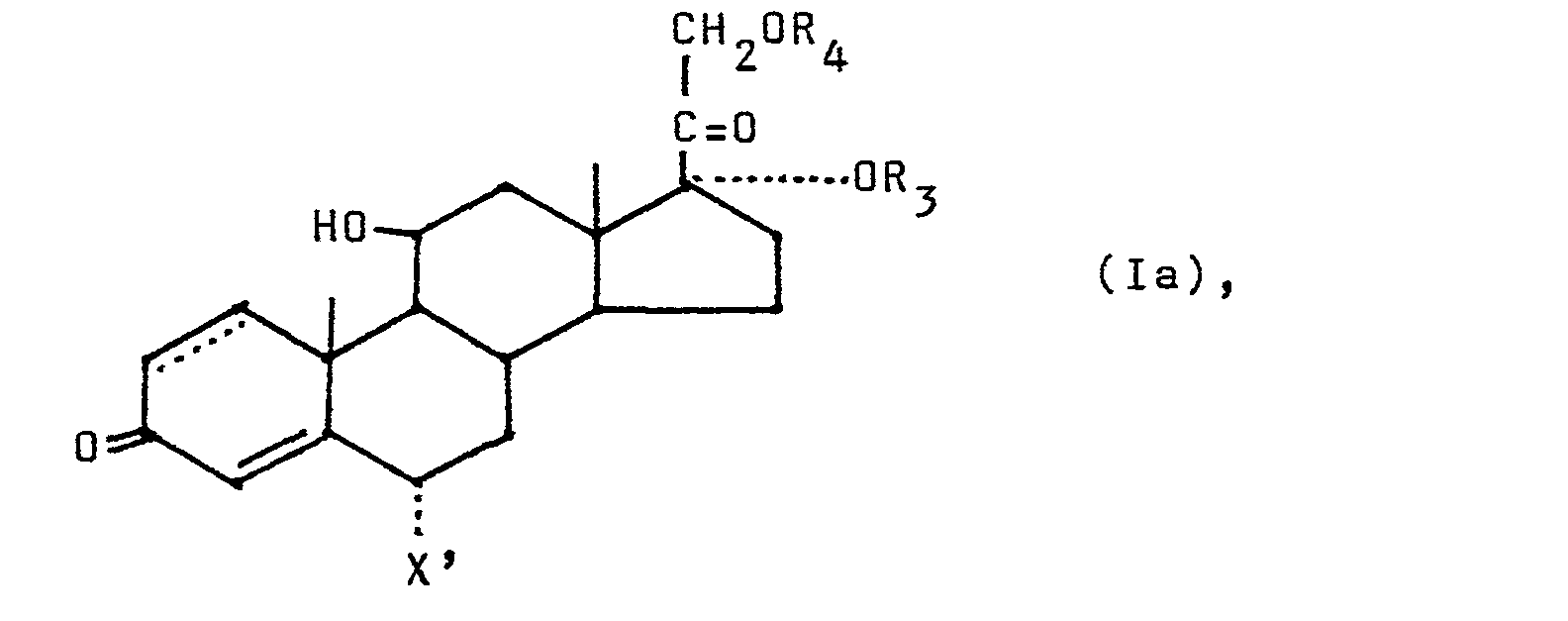
- Kortikoide der allgemeinen Formel I a gemäß Patentanspruch 3, die sich zur Herstellung der erfindungsgemäßen kortikoidhaltigen Zubereitungen eignen, sind Hydrocortison, Prednisolon, 6a-Methylhydrocortison, 6a-Methylprednisolon und deren Ester, wie zum Beispiel das Hydrocortison-21-acetat, das Hydrocortison-17-butyrat, das Hydrocortison-17-valerianat, das Prednisolon-21-acetat, das Prednisolon-17-valerianat, das 6a-Methylhydrocortison-21-acetat, das 6a-Methylprednisolon-21-acetat, das 6α-Methylhydrocortison-17-butyrat-21-acetat, das 6a-Methylprednisolon-21-acetat-17-propionat, das 6a-Methylhydrocortison-17,21-dipropionat und das 21-Acetoxy-17α-ethoxymethoxy-11β-hydroxy-1,4-pregnadien-3,20-dion.
- Kortikoide der allgemeinen Formel I b gemäß Patentanspruch 4, die sich zur Herstellung der erfindungsgemäßen kortikoidhaltigen Zubereitungen eignen, sind beispielsweise das Fluocortolon, das Clocortolon, das Diflucortolon, das Desoximetason und deren Ester, wie zum Beispiel das Fluocortolon-21-acetat, das Fluocortolon-21-capronat, das Fluocortolon-21-trimethylacetat, das Clocortolon-21-capronat, das Clocortolon-21-trimethylacetat und das Diflucortolon-21- valerianat.
- Kortikoide der allgemeinen Formel I c gemäß Patentanspruch 5, die sich zur Herstellung der erfindungsgemäßen kortikoidhaltigen Zubereitungen eignen, sind beispielsweise das Betamethason, das Beclomethason, das Fluprednyliden, das Clobetasol, das Dexamethason, das Flumetmetason, das 9-Chlorprednis.olon und deren Ester, wie zum Beispiel das Betamethason-17-valerianat, das Betamethason-17-benzoat, das Betamethason-17,21-dipropionat, das Beclomethason-17,21- dipropionat, das Fluprednyliden-21-acetat, das Clobetasol-17-propionat, das Flumetason-21-trimethylacetat, das 9-Chlor- prednisolon-21-acetat-17-propionat und das 9-Chlorpredni- solon-17-butyrat-21-propionat.
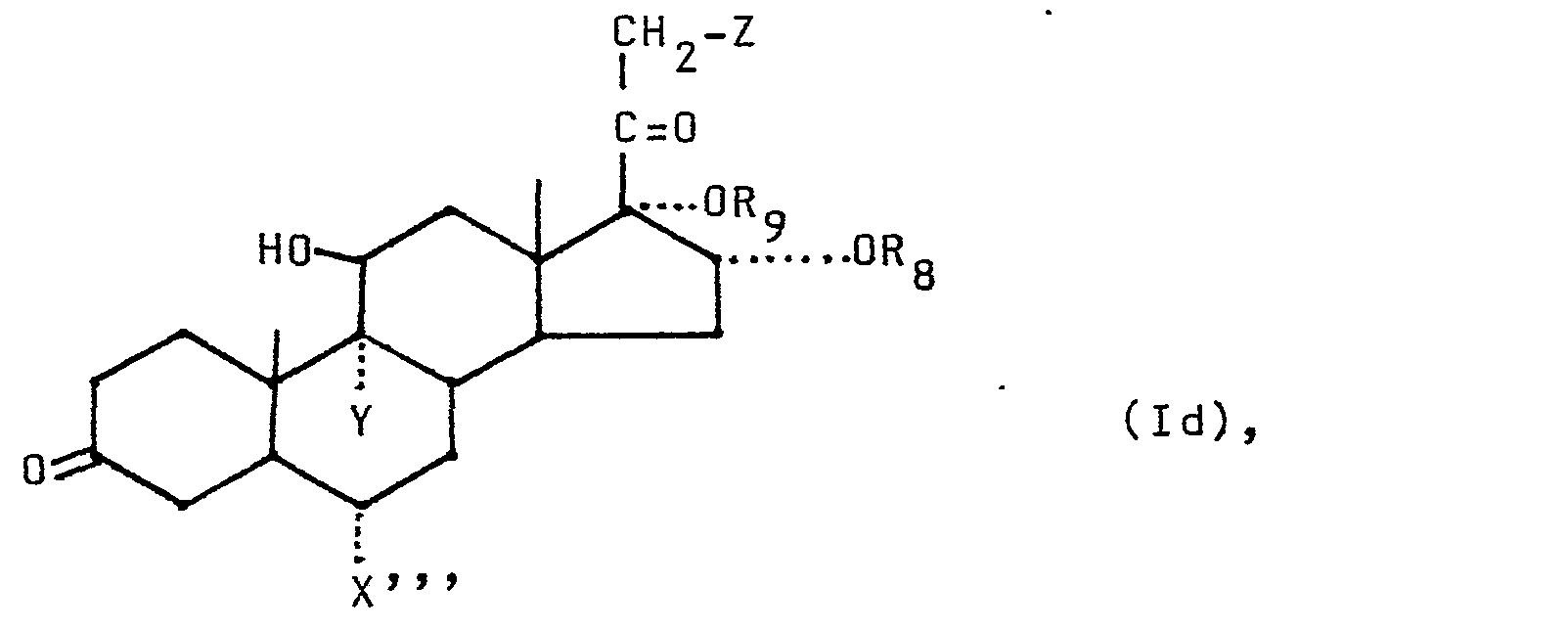
- Kortikoide der allgemeinen Formel I d gemäß Patentanspruch 6, die sich zur Herstellung der erfindungcgemäßen kortikoidhaltigen Zubereitungen eignen, sind beispielsweise das Triamcinolon, das Triamcinolon-acetamid, das Halcinonid, das Fluocinolon, das Fluocinolon-acetonid, das Desonid, das Fludroxicortid und deren Ester, wie zum Beispiel das Fluocinonid.
- Zur Herstellung der erfindungsgemäßen kortikoidhaltigen Zubereitungen sind aber auch solche antiinflammatorisch wirksamen Kortikoide geeignet, die nicht unter die im Anspruch 2 genannte Strukturformel fallen. Als solche seien beispielsweise Kortikoide genannt, die sich von denjenigen der Formel I dadurch unterscheiden, daß sie anstelle der Gruppierung CH2Z eine Gruppe COOR10 (R10 bedeutet eine Alkylgruppe mit bis zu 6 Kohlenstoffatomen) tragen - US-Patente 3,824,260, 3,919,421 und 3,944,577. Als ein Kortikoid dieser Strukturklasse sei beispielsweise der Fluocortinbutylester genannt. Geeignete Kortikoide sind aber auch beispielsweise solche, die sich von denjenigen der Formel II dadurch unterscheiden, daß sie in der 11-Position eine Ketogruppe tragen. Hier sei als Beispiel das Clobeta- son-17-butyrat genannt.
- Die erfindungsgemäße Zubereitung enthält 0,005 bis 2 und vorzugsweise 0,05 bis 0,5 Gewichtsprozent Kortikoid; die Konzentration desselben ist selbstverständlich von der relativen Wirksamkeit des Kortikoids abhängig.
- Die Erfindung betrifft weiter ein Verfahren zur Herstellung einer kortikoidhaltigen Zubereitung in Form einer Salbe, Paste, Creme oder dergleichen, das dadurch gekennzeichnet ist, daß man aus Fettphase, wässriger Phase, Öl/Wasser-Emulgator und Konservierungsmittel eine Öl/Wasser-Emulsion und aus Fettphase, wässriger Phase und Wasser/Öl-Emulgator eine Wasser/Öl-Emulsion herstellt und daß man die beiden Emulsionen unter Zusatz von hydrophilen und/oder lipophilen Wirkstoffen unter Vakuum bei einer Temperatur zwischen 20 und 40° C innig verrührt und darauf die erhaltene feindisperse Mischung mit Duftstoffen versetzt.
- Wenn es auch anscheinend im Hinblick auf die unterschiedlichen Bedürfnisse der Haut als naheliegend angesehen werden könnte, einfach die beiden Emulsionstypen zur Herstellung einer Creme zu. vermischen, um so den oben geschilderten Bedürfnissen der Haut zu genügen, so ist diese Vorgangsweise nicht ohne weiteres möglich. Dies deswegen, weil die beiden Emulsionstypen bisher nicht stabil nebeneinander aufrechterhalten werden konnten, sondern vielmehr in Abhängigkeit von den verwendeten Bestandteilen zumindest bald nach der Verarbeitung eine Umwandlung des einen in den anderen Emulsionstyp auftritt, sodaß im Endeffekt nur ein Emulsionstyp in der hergestellten Creme erhalten bleibt.
- Wenn nun die beiden Emulsionstypen bei Temperaturen zwischen 20 und 40° C, vorzugsweise bei 30° C unter Vakuum besonders schonend, dessen ungeachtet jedoch sehr intensiv, in einen Rührwerksbehälter vereinigt werden, sodaß schließlich eine sehr feine Dispersion der beiden Emulsionen, deren Teilchengröße zwischen 2 und 50 µm, vorzugsweise zwischen 5 und 15 µm beträgt erzielt wird, dann bleiben die beiden Emulsionstypen unverändert nebeneinander in der hergestellten Creme erhalten. Dieses Emulsionssystem bleibt bei erheblicher Verdünnung, z. B. mit Flüssigphase, stabil. Es wird angenommen, daß für die Stabilität dieses Emulsionssystems die Teilchengröße ebenso wie das Zusammenwirken der Emulgatoren von Bedeutung ist. Wesentlich ist, daß bei der Herstellung des erfindungsgemäßen kosmetischen Mittels die zum Einsatz kommenden Emulsionen dispergiert und nicht homogenisiert werden.
- Die Vereinigung der beiden Emulsionen erfolgt vorzugsweise unter einem Vakuum von 0,5 torr bis 50 torr. Die Rührgeschwindigkeit ist, wie dem Fachmann wohlbekannt ist, von dem verwendeten Rührwerk abhängig und muß in an sich bekannter Weise ermittelt werden.
- Die Öl/Wasser-Emulsionen und die Wasser/Öl-Emulsionen können in konventioneller Weise unter Verwendung konventioneller Emulgatoren hergestellt werden (Kirk Othmer: Enzyclopedia of Chemical Techno1ogy, 3. Auflage, 1979; John Wiley & Sons; New York etc. Vol 8, Seite 900 bis 930 und Dr. Dtto-Albrecht Neumüller: Römpps Chemie Lexikon 7. Auflage, 1973; Franck'sche Uerlagshandlung Stuttgart, Seite 1009 bis 1013). Die für diese Emulsionen verwendeten Wachse, Emulgatoren und übrigen Zusätze sind die gleichen, wie man sie konventioneller Weise bei emulgierten Hautpflegemitteln verwendet (Dr. Otto-Albrecht Neumüller: Römpps Chemie Lexikon, 7. Auflage 1973; Franck'sche Verlagshandlung Stuttgart, Seite 1427 und 1428).
- Eine im erfindungsgemäßen kosmetischen Mittel eingesetzte Öl/Wasser-Emulsion kann aus hydrophilen und/oder lipophilen Wirkstoffen, Fettphase, Öl/Wasser-Emulgator, wässriger Phase und Konservierungsmittel bestehen.
- Als hydrophile und/oder lipophile Wirkstoffe können Feuchthaltefaktoren (Hydrokomplexe), wie zum Beispiel Glycerin, Polyäthylenglykole oder Aminosäuregemische, Puroba-Oil (= Jajoba-Öl), Vitamine (vorzugsweise Vitamin A und E) Vitalkomplexe (wie zum Beispiel Placentaextrakte), Enzyme, Kräuterauszüge (wie zum Beispiel Hammamelis Extrakt oder Kamillenextrakt) oder Proteine (wie zum Beispiel Collagen) eingesetzt werden. Als ölige Phase oder als Fettphase in der Öl/Wasser-Emulsion eignen sich Kohlenwasserstoffe wie zum Beispiel Vaseline, Paraffine oder Stearin, oder Wachse wie zum Beispiel Bienenwachs. Geeignete Öl/Wasser-Emulgatoren sind beispielsweise Stearylalkohol, Polyoxyäthylenstearate (wie zum Beispiel MYRJ(R)), Komplexemulgatoren (wie zum Beispiel Amphoterin(R)) und Sorbitanfettsäureester (wie zum Beispiel Span(R)) oder Carboxyvinylpolymerisate (wie zum Beispiel Carbopol(R)). Die wässrige Phase kann zusätzlich noch Puffersubstanzen, wie zum Beispiel das Dinatriumsalz der Äthylendiamin-N,N,N',N'-tetraessigsäure und Konservierungsmittel wie Chlorquinaldol, Parabene oder Benzalkoniumchlorid enthalten.
- In der Öl/Wasser-Emulsion beträgt der Anteil der inneren Emulsion vorzugsweise 30 bis 49 Gew. %, die Teilchengröße der inneren Emulsion liegt vorzugsweise zwischen 1µ und 1004. Bei der Dispergierung beider Phasen wird sie nochmals zerkleinert und liegt im fertigen Produkt unterhalb von 50µ.
- Eine in der erfindungsgemäßen kortikoidhaltigen Zubereitung einsetzbare Wasser/Öl-Emulsion besteht wiederum aus hydrophilen und/oder lipophilen Wirkstoffen, wie sie auch in der Öl/Wasser-Emulsion verwendet werden, Fettphase, Wasser/ Öl-Emulgator und wässriger Phase. Als ölige Phase oder Fettphase der Wasser/ Öl-Emulsion können Kohlenwasserstoffe, z.B. Paraffine und Vaseline, synthetische, pflanzliche und tierische Öle bzw. Wachse (wie zum Beispiel nlivenöl, Erdnußöl, feines Knochenöl, Mandelöl, Lanolin, Bienenwachs oder Sonnenblumenöl) eingesetzt werden, als wässrige Phase gereinigtes demineralisiertes Wasser und als Wasser/Öl-Emulgator Wollfett (=Lanolin), Fettalkohole wie zum Beispiel Cetylalkohol, Myristylalkohol, Stearylalkohol oder Cerylalkohol, Fettsäureester, wie zum Beispiel Bienenwachs (Cera alba) oder Wachsalkoholester oder Mischester (wie zum Beispiel Dehymuls(R)).
- In der Wasser/Öl-Emulsion beträgt der Anteil der inneren Emulsion vorzugsweise 30 bis 49 Gew. %, die Teilchengröße der inneren Emulsion liegt vorzugsweise zwischen 1µ und 100µ. Bei der Dispergierung beider Phasen wird sie nochmals zerkleinert und liegt im fertigen Produkt unterhalb von 50µ.
- Das Mischungsverhältnis von Öl/Wasser-Emulsion und Wasser/Öl-Emulsion liegt vorzugsweise bei 20 bis 80 Gew. % und insbesondere bei 35 % bis 65 % Öl/Wasser-Emulsion.
- Das feindisperse System wird zusätzlich mit dem mikronisierten Kortikoid (Korngröße vorzugsweise 1 bis 20 µ) und gegebenenfalls noch mit Duftstoffen, wie zum Beispiel diejenige der Crematest(R)-Serie versetzt und bis zur gleichmäßigen Verteilung derselben gerührt.
- Die erfindungsgemäße kortikoidhaltige Zubereitung in Form einer Creme kann beispielsweise folgende Zusammensetzung haben:
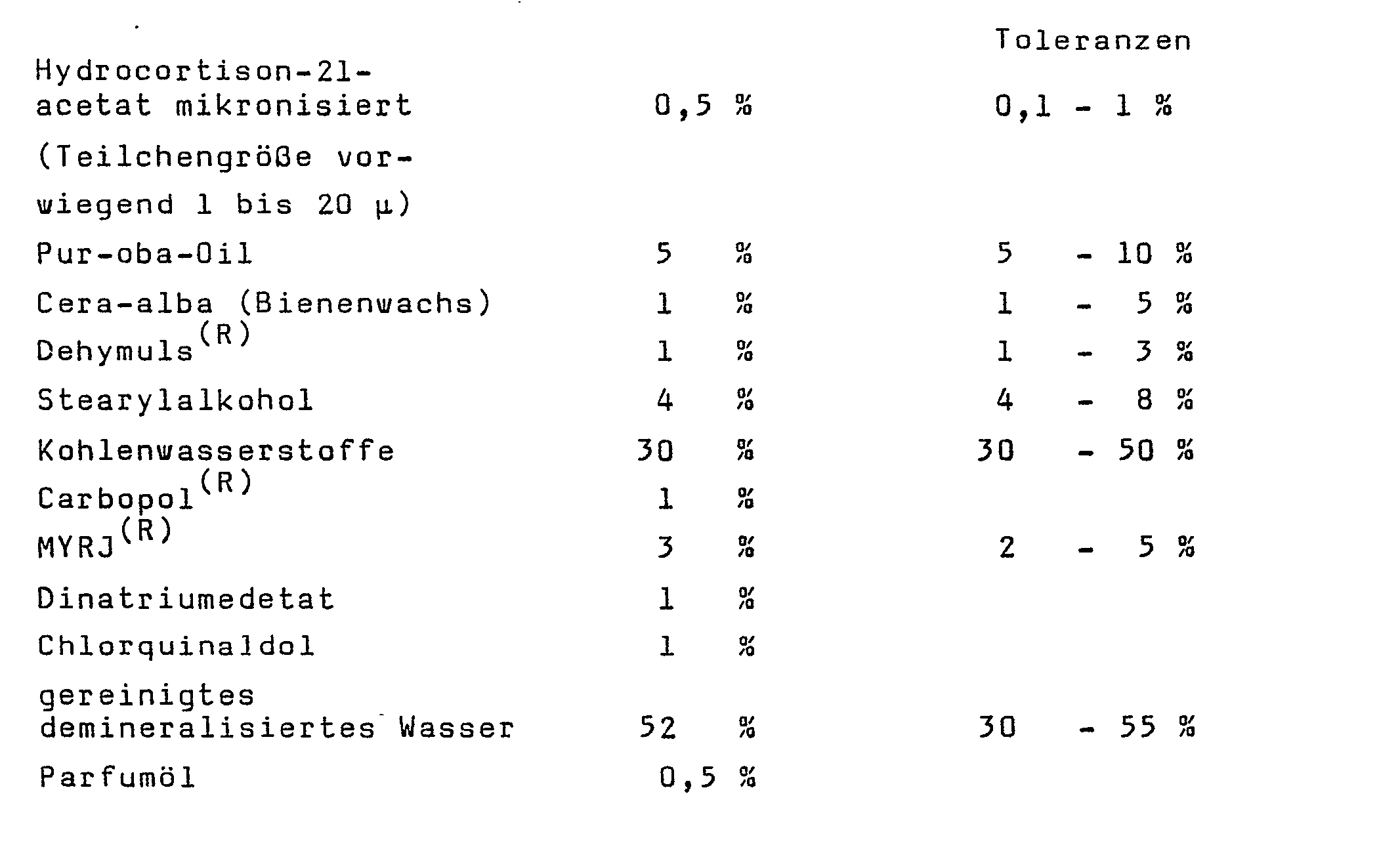
- Die Angaben sind in Gewichtsprozent aufgeführt.
- Die nachfolgenden Ausführungsbeispiele dienen zur Erläuterung des erfindungsgemäßen Verfahrens, welches mittels allen Vorrichtungen durchgeführt werden kann, die man konventioneller Weise zur Herstellung von Salben, Cremes etc. anwendet.
- Herstellung der Öl/Wasser-Emulsion.
- 10,00 g Dinatriumedetat und 10,00 g Chlorquinaldol werden in 300,00 g gereinigtem demineralisiertem Wasser gelöst und mit 10,00 g Carbopol(R) versetzt.
- Diese Mischung wird unter kräftigem Rühren in eine Schmelze von 80,00 g Vaseline (DAB 8) - DAB ist die Abkürzung für das Deutsche Arzneibuch, amtliche Ausgabe, 8. Auflage 1978 - 40,00 g Stearylalkohol, 30,00 g MYRJ(R) und 50,00 g Puroba-Öl eingetragen. Man rührt die Mischung noch solange, bis eine Emulsion mit einer Teilchengröße von 20-70 µ entsteht.
- Herstellung der Wasser/Öl-Emulsion.
- 228,00 g gereinigtes demineralisiertes Wasser werden unter kräftigem Rühren in eine Schmelze von 220,00 g Vaseline (DAB 8), 10,00 g Dehymuls(R) und 10,00 g Cera alba eingetragen. Man rührt die Mischung noch solange, bis eine Emulsion mit einer Teilchengröße von 20-70 µ entsteht.
- Herstellung einer Creme.
- Die Wasser/Öl-Emulsion wird unter kräftigem Rühren unter einem Vakuum von 10 torr in die Öl/Wasser-Emulsion eingetragen. Man rührt noch solange, bis eine Dispersion mit einer Teilchengröße von 10 bis 50 µ entsteht, entfernt das Vakuum, setzt unter Rühren noch 5,000 g Hydrocortison-21-acetat - mikronisiert Teilchengröße vorwiegend 1 bis 20 µ und 2,00 g eines Duftstoffes der Crematest(R) zu und rührt bis sich beide Komponenten in der Salbengrundlage gleichmäßig verteilt haben.
- Herstellung der Öl/Wasser-Emulsion.
- 10,00 g Dinatriumedetat und 10,00 g Chlorquinaldol werden in 300,00 g gereinigtem demineralisiertem Wasser gelöst und mit 10,00 g Carbopol(R) versetzt.
- Diese Mischung wird unter kräftigem Rühren in eine Schmelze von 80,00 g Vaseline (DAB 8) - DAB ist die Abkürzung für das Deutsche Arzneibuch, amtliche Ausgabe, 8. Auflage 1978 - 40,00 g Stearylalkohol, 30,00 g MYRJ(R) und 50,00 g Puroba-Öl eingetragen. Man rührt die Mischung noch solange, bis eine Emulsion mit einer Teilchengröße von 20-70 µ entsteht.
- Herstellung der Wasser/Öl-Emulsion.
- 227,00 g gereinigtes demineralisiertes Wasser werden unter kräftigem Rühren in eine Schmelze von 220,00 g Vaseline (DAB 8), 10,00 g Dehymuls(R) und 10,00 g Cera alba eingetragen. Man rührt die Mischung noch solange, bis eine Emulsion mit einer Teilchengröße von 20-70 µ entsteht.
- Herstellung einer Creme.
- Die Wasser/Öl-Emulsion wird unter kräftigem Rühren unter einem Vakuum von 10 torr in die Öl/Wasser-Emulsion eingetragen. Man rührt noch solange, bis eine Dispersion mit einer Teilchengröße von 10 bis 50 µ entsteht, entfernt das Vakuum, setzt unter Rühren noch 1,000 g 21-Acetoxy-11β-hydroxy-6α-methyl-17α-propionyloxy-1,4-pregnadien-3,20-dion - mikronisiert Teilchengröße vorwiegend 1 bis 20 µ und 2,00 g eines Duftstoffes der Crematest(R) zu und rührt bis sich beide Komponenten in der Salbengrundlage gleichmäßig verteilt haben.
- Herstellung der Öl/Wasser-Emulsion.
- 10,00 g Dinatriumedetat und 10,00 g Chlorquinaldol werden in 300,00 g gereinigtem demineralisiertem Wasser gelöst und mit 10,00 g Carbopol(R) versetzt.
- Diese Mischung wird unter kräftigem Rühren in eine Schmelze von 80,00 g Vaseline (DAB 8) - DAB ist die Abkürzung für das Deutsche Arzneibuch, amtliche Ausgabe, 8. Auflage 1978 - 40,00 g Stearylalkohol, 30,00 g MYRJ(R) und 50,00 g Puroba-Öl eingetragen. Man rührt die Mischung noch solange, bis eine Emulsion mit einer Teilchengröße von 20-70 µ entsteht.
- Herstellung der Wasser/Öl-Emulsion.
- 227,00 g gereinigtes demineralisiertes Wasser werden unter kräftigem Rühren in eine Schmelze von 220,00 g Vaseline (DAB 8), 10,00 g Dehymuls(R) und 10,00 g Cera alba eingetragen. Man rührt die Mischung noch solange, bis eine Emulsion mit einer Teilchengröße von 20-70 µ entsteht.
- Herstellung einer Creme.
- Die Wasser/Öl-Emulsion wird unter kräftigem Rühren unter einem Vakuum von 10 torr in die Öl/Wasser-Emulsion eingetragen. Man rührt noch solange, bis eine Dispersion mit einer Teilchengröße von 10 bis 50 µ entsteht, entfernt das Vakuum, setzt unter Rühren noch 1,000 g 21-Acetoxy-17α-butyryloxy-11β-hydroxy-6α-methyl-4-pregnen-3,20-dion - mikronisiert Teilchengröße vorwiegend 1 bis 20 µ und 2,00 g eines Duftstoffes der Crematest(R) zu und rührt bis sich beide Komponenten in der Salbengrundlage gleichmäßig verteilt haben.
- Herstellung der Öl/Wasser-Emulsion.
- 10,00 g Dinatriumedetat und 10,00 g Chlorquinaldol werden in 300,00 g gereinigtem demineralisiertem Wasser gelöst und mit 10,00 g Carbopol(R) versetzt.
- Diese Mischung wird unter kräftigem Rühren in eine Schmelze von 80,00 g Vaseline (DAB 8) - DAB ist die Abkürzung für das Deutsche Arzneibuch, amtliche Ausgabe, 8. Auflage 1978 - 40,00 g Stearylalkohol, 30,00 g MYRJ(R) und 50,00 g Puroba-Öl eingetragen. Man rührt die Mischung noch solange, bis eine Emulsion mit einer Teilchengröße von 20-70 µ entsteht.
- Herstellung der Wasser/Öl-Emulsion.
- 227,00 g gereinigtes demineralisiertes Wasser werden unter kräftigem Rühren in eine Schmelze von 220,00 g Vaseline (DAB 8), 10,00 g Dehymuls(R) und 10,00 g Cera alba eingetragen. Man rührt die Mischung noch solange, bis eine Emulsion mit einer Teilchengröße von 20-70 µ entsteht.
- Herstellung einer Creme.
- Die Wasser/Öl-Emulsion wird unter kräftigem Rühren unter einem Vakuum von 10 torr in die Öl/Wasser-Emulsion eingetragen. Man rührt noch solange, bis eine Dispersion mit einer Teilchengröße von 10 bis 50 µ entsteht, entfernt das Vakuum, setzt unter Rühren noch 1,000 g 21-Acetoxy-9a-chlor-11β-hydroxy-17α-propionyloxy-1,4-pregnadien-3,20-dion - mikronisiert Teilchengröße vorwiegend 1 bis 20 µ und 2,00 g eines Duftstoffes der Crematest(R) zu und rührt bis sich beide Komponenten in der Salbengrundlage gleichmäßig verteilt haben.
- Herstellung der Öl/Wasser-Emulsion.
- 10,00 g Dinatriumedetat und 10,00 g Chlorquinaldol werden in 300,00 g gereinigtem demineralisiertem Wasser gelöst und mit 10,00 g Carbopol(R) versetzt.
- Diese Mischung wird unter kräftigem Rühren in eine Schmelze von 80,00 g Vaseline (DAB 8) - DAB ist die Abkürzung für das Deutsche Arzneibuch, amtliche Ausgabe, 8. Auflage 1978 - 40,00 g Stearylalkohol, 30,00 g MYRJ(R) und 50,00 g Puroba-Ö1 eingetragen. Man rührt die Mischung noch solange, bis eine Emulsion mit einer Teilchengröße von 20-70 µ entsteht.
- Herstellung der Wasser/Öl-Emulsion.
- 227,50 g gereinigtes demineralisiertes Wasser werden unter kräftigem Rühren in eine Schmelze von 220,00 g Vaseline (DAB 8), 10,00 g Dehymuls(R) und 10,00 g Cera alba eingetragen. Man rührt die Mischung noch solange, bis eine Emulsion mit einer Teilchengröße von 20-70 µ entsteht.
- Herstellung einer Creme.
- Die Wasser/Öl-Emulsion wird unter kräftigem Rühren unter einem Vakuum von 10 torr in die Öl/Wasser-Emulsion eingetragen. Man rührt noch solange, bis eine Dispersion mit einer Teilchengröße von 10 bis 50 µ entsteht, entfernt das Vakuum, setzt unter Rühren noch 0,500 g Clobetasol-17-propionat - mikronisiert Teilchengröße vorwiegend 1 bis 20 µ und 2,00 g eines Duftstoffes der Crematest(R) zu und rührt bis sich beide Komponenten in der Salbengrundlage gleichmäßig verteilt haben.
- Herstellung der Öl/Wasser-Emulsion.
- 10,00 g Dinatriumedetat und 10,00 g Chlorquinaldol werden in 300,00 g gereinigtem demineralisiertem Wasser gelöst und mit 10,00 g Carbopol(R) versetzt.
- Diese Mischung wird unter kräftigem Rühren in eine Schmelze von 80,00 g Vaseline (DAB 8) - DAB ist die Abkürzung für das Deutsche Arzneibuch, amtliche Ausgabe, 8. Auflage 1978 - 40,00 g Stearylalkohol, 30,00 g MYRJ(R) und 50,00 g Puroba-Öl eingetragen. Man rührt die Mischung noch solange, bis eine Emulsion mit einer Teilchengröße von 20-70 µ entsteht.
- Herstellung der Wasser/Öl-Emulsion.
- 227,00 g gereinigtes demineralisiertes Wasser werden unter kräftigem Rühren in eine Schmelze von 220,00 g Vaseline (DAB 8), 10,00 g Dehymuls(R) und 10,00 g Cera alba eingetragen. Man rührt die Mischung noch solange, bis eine Emulsion mit einer Teilchengröße von 20-70 µ entsteht.
- Herstellung einer Creme.
- Die Wasser/Öl-Emulsion wird unter kräftigem Rühren unter einem Vakuum von 10 torr in die Öl/Wasser-Emulsion eingetragen. Man rührt noch solange, bis eine Dispersion mit einer Teilchengröße von 10 bis 50 µ entsteht, entfernt das Vakuum, setzt unter Rühren noch 1,000 g Diflucortolon-21-valerianat - mikronisiert Teilchengröße vorwiegend 1 bis 20 µ und 2,00 g eines Duftstoffes der Crematest(R) zu und rührt bis sich beide Komponenten in der Salbengrundlage gleichmäßig verteilt haben.
- Herstellung der Öl/Wasser-Emulsion.
- 10,00 g Dinatriumedetat und 10,00 g Chlorquinaldol werden in 300,00 g gereinigtem demineralisiertem Wasser gelöst und mit 10,00 g Carbopol(R) versetzt.
- Diese Mischung wird unter kräftigem Rühren in eine Schmelze von 80,00 g Vaseline (DAB 8) - DAB ist die Abkürzung für das Deutsche Arzneibuch, amtliche Ausgabe, 8. Auflage 1978 - 40,00 g Stearylalkohol, 30,00 g MYRJ(R) und 50,00 g Puroba-Öl eingetragen. Man rührt die Mischung noch solange, bis eine Emulsion mit einer Teilchengröße von 20-70 µ entsteht.
- Herstellung der Wasser/Öl-Emulsiön.
- 227,00 g gereinigtes demineralisiertes Wasser werden unter kräftigem Rühren in eine Schmelze von 220,00 g Vaseline (DAB 8), 10,00 g Dehymuls(R) und 10,00 g Cera alba eingetragen. Man rührt die Mischung noch solange, bis eine Emulsion mit einer Teilchengröße von 20-70 µ entsteht.
- Herstellung einer Creme.
- Die Wasser/Öl-Emulsion wird unter kräftigem Rühren unter einem Vakuum von 10 torr in die Öl/Wasser-Emulsion eingetragen. Man rührt noch solange, bis eine Dispersion mit einer Teilchengröße von 10 bis 50 µ entsteht, entfernt das Vakuum, setzt unter Rühren noch 1,000 g 21-Acetoxy-17α-ethoxymethoxy-11β-hydroxy-1,4-pregnadien-3,20-dion - mikronisiert Teilchengröße vorwiegend 1 bis 20 4 und 2,00 g eines Duftstoffes der Crematest(R) zu und rührt bis sich beide Komponenten in der Salbengrundlage gleichmäßig verteilt haben.
Claims (8)

..... eine Einfachbindung oder Doppelbindung,
..... eine Einfachbindung oder eine Doppelbindung,


Priority Applications (1)
| Application Number | Priority Date | Filing Date | Title |
|---|---|---|---|
| AT83106510T ATE66366T1 (de) | 1982-07-07 | 1983-07-04 | Kortikoidhaltige zubereitung zur topischen applikation. |
Applications Claiming Priority (2)
| Application Number | Priority Date | Filing Date | Title |
|---|---|---|---|
| DE3225848 | 1982-07-07 | ||
| DE19823225848 DE3225848A1 (de) | 1982-07-07 | 1982-07-07 | Kortikoidhaltige zubereitung zur topischen applikation |
Publications (3)
| Publication Number | Publication Date |
|---|---|
| EP0098566A2 true EP0098566A2 (de) | 1984-01-18 |
| EP0098566A3 EP0098566A3 (en) | 1985-05-22 |
| EP0098566B1 EP0098566B1 (de) | 1991-08-21 |
Family
ID=6168121
Family Applications (1)
| Application Number | Title | Priority Date | Filing Date |
|---|---|---|---|
| EP83106510A Expired - Lifetime EP0098566B1 (de) | 1982-07-07 | 1983-07-04 | Kortikoidhaltige Zubereitung zur topischen Applikation |
Country Status (10)
| Country | Link |
|---|---|
| US (1) | US4918065A (de) |
| EP (1) | EP0098566B1 (de) |
| JP (1) | JPS5976015A (de) |
| AT (1) | ATE66366T1 (de) |
| AU (1) | AU570639B2 (de) |
| CA (1) | CA1202238A (de) |
| DE (2) | DE3225848A1 (de) |
| DK (1) | DK312583A (de) |
| GB (1) | GB2123292A (de) |
| NZ (1) | NZ204775A (de) |
Cited By (2)
| Publication number | Priority date | Publication date | Assignee | Title |
|---|---|---|---|---|
| JPS6281317A (ja) * | 1985-09-28 | 1987-04-14 | バイヤ−スドルフ・アクチエンゲゼルシヤフト | ハイドロコ−チゾンジエステル含有クリ−ム |
| EP0217146A3 (en) * | 1985-09-28 | 1987-09-02 | Beiersdorf Aktiengesellschaft | W/o creams containing hydrocortisone diesters |
Families Citing this family (52)
| Publication number | Priority date | Publication date | Assignee | Title |
|---|---|---|---|---|
| DE3225849A1 (de) * | 1982-07-07 | 1984-01-19 | Schering Ag | Kortikoidhaltige zubereitung zur topischen applikation |
| JPS59137408A (ja) * | 1983-01-27 | 1984-08-07 | Taisho Pharmaceut Co Ltd | 軟膏 |
| JPS59139315A (ja) * | 1983-01-31 | 1984-08-10 | Taisho Pharmaceut Co Ltd | クリ−ム剤 |
| YU46838B (sh) * | 1986-02-14 | 1994-06-24 | Pero Dr. Višnjić | Postupak za dobijanje preparata za lečenje kožne bolesti psoriazisa |
| IL88076A (en) * | 1987-10-28 | 1993-01-14 | Nippon Shinyaku Co Ltd | Fat emulsions as drug carriers |
| US20020150539A1 (en) * | 1989-12-22 | 2002-10-17 | Unger Evan C. | Ultrasound imaging and treatment |
| US6001335A (en) * | 1989-12-22 | 1999-12-14 | Imarx Pharmaceutical Corp. | Contrasting agents for ultrasonic imaging and methods for preparing the same |
| US5776429A (en) * | 1989-12-22 | 1998-07-07 | Imarx Pharmaceutical Corp. | Method of preparing gas-filled microspheres using a lyophilized lipids |
| US5542935A (en) | 1989-12-22 | 1996-08-06 | Imarx Pharmaceutical Corp. | Therapeutic delivery systems related applications |
| US6146657A (en) * | 1989-12-22 | 2000-11-14 | Imarx Pharmaceutical Corp. | Gas-filled lipid spheres for use in diagnostic and therapeutic applications |
| US5585112A (en) * | 1989-12-22 | 1996-12-17 | Imarx Pharmaceutical Corp. | Method of preparing gas and gaseous precursor-filled microspheres |
| US6551576B1 (en) | 1989-12-22 | 2003-04-22 | Bristol-Myers Squibb Medical Imaging, Inc. | Container with multi-phase composition for use in diagnostic and therapeutic applications |
| US6088613A (en) | 1989-12-22 | 2000-07-11 | Imarx Pharmaceutical Corp. | Method of magnetic resonance focused surgical and therapeutic ultrasound |
| US5922304A (en) | 1989-12-22 | 1999-07-13 | Imarx Pharmaceutical Corp. | Gaseous precursor filled microspheres as magnetic resonance imaging contrast agents |
| US5469854A (en) * | 1989-12-22 | 1995-11-28 | Imarx Pharmaceutical Corp. | Methods of preparing gas-filled liposomes |
| GB9106686D0 (en) * | 1991-03-28 | 1991-05-15 | Hafslund Nycomed As | Improvements in or relating to contrast agents |
| US5874062A (en) * | 1991-04-05 | 1999-02-23 | Imarx Pharmaceutical Corp. | Methods of computed tomography using perfluorocarbon gaseous filled microspheres as contrast agents |
| US5205290A (en) | 1991-04-05 | 1993-04-27 | Unger Evan C | Low density microspheres and their use as contrast agents for computed tomography |
| DE59108924D1 (de) * | 1991-07-16 | 1998-02-19 | Schering Ag | Verfahren zur herstellung von mikronisierte wirkstoffe enthaltende halbfeste zubereitungen |
| GB9200388D0 (en) * | 1992-01-09 | 1992-02-26 | Nycomed As | Improvements in or relating to contrast agents |
| DE4333920A1 (de) * | 1993-10-05 | 1995-04-13 | Hoechst Ag | Corticoid-17,21-dicarbonsäureester sowie Corticosteroid-17-carbonsäureester-21-kohlensäureester, Verfahren zu deren Herstellung und diese enthaltende Arzneimittel |
| US7083572B2 (en) * | 1993-11-30 | 2006-08-01 | Bristol-Myers Squibb Medical Imaging, Inc. | Therapeutic delivery systems |
| US6743779B1 (en) | 1994-11-29 | 2004-06-01 | Imarx Pharmaceutical Corp. | Methods for delivering compounds into a cell |
| US5830430A (en) * | 1995-02-21 | 1998-11-03 | Imarx Pharmaceutical Corp. | Cationic lipids and the use thereof |
| US5632975A (en) * | 1995-03-09 | 1997-05-27 | Earles; R. Martin | Composition and method for treatment of dermatitis on the scalp |
| US5997898A (en) * | 1995-06-06 | 1999-12-07 | Imarx Pharmaceutical Corp. | Stabilized compositions of fluorinated amphiphiles for methods of therapeutic delivery |
| US6521211B1 (en) | 1995-06-07 | 2003-02-18 | Bristol-Myers Squibb Medical Imaging, Inc. | Methods of imaging and treatment with targeted compositions |
| US6231834B1 (en) | 1995-06-07 | 2001-05-15 | Imarx Pharmaceutical Corp. | Methods for ultrasound imaging involving the use of a contrast agent and multiple images and processing of same |
| US6033645A (en) * | 1996-06-19 | 2000-03-07 | Unger; Evan C. | Methods for diagnostic imaging by regulating the administration rate of a contrast agent |
| US6139819A (en) * | 1995-06-07 | 2000-10-31 | Imarx Pharmaceutical Corp. | Targeted contrast agents for diagnostic and therapeutic use |
| CA2252617A1 (en) | 1996-05-01 | 1997-11-06 | Imarx Pharmaceutical Corp. | Methods for delivering compounds into a cell |
| US6414139B1 (en) | 1996-09-03 | 2002-07-02 | Imarx Therapeutics, Inc. | Silicon amphiphilic compounds and the use thereof |
| DE69718519T2 (de) * | 1996-09-11 | 2003-11-06 | Imarx Pharmaceutical Corp., Tucson | Verbesserte verfahren zur diagnostischen bilderzeugung unter verwendung eines kontrastmittels und eines vasodilators |
| US5846517A (en) | 1996-09-11 | 1998-12-08 | Imarx Pharmaceutical Corp. | Methods for diagnostic imaging using a renal contrast agent and a vasodilator |
| US6143276A (en) * | 1997-03-21 | 2000-11-07 | Imarx Pharmaceutical Corp. | Methods for delivering bioactive agents to regions of elevated temperatures |
| US6537246B1 (en) * | 1997-06-18 | 2003-03-25 | Imarx Therapeutics, Inc. | Oxygen delivery agents and uses for the same |
| US6090800A (en) * | 1997-05-06 | 2000-07-18 | Imarx Pharmaceutical Corp. | Lipid soluble steroid prodrugs |
| US7452551B1 (en) | 2000-10-30 | 2008-11-18 | Imarx Therapeutics, Inc. | Targeted compositions for diagnostic and therapeutic use |
| US20050019266A1 (en) * | 1997-05-06 | 2005-01-27 | Unger Evan C. | Novel targeted compositions for diagnostic and therapeutic use |
| US6416740B1 (en) | 1997-05-13 | 2002-07-09 | Bristol-Myers Squibb Medical Imaging, Inc. | Acoustically active drug delivery systems |
| US6548047B1 (en) | 1997-09-15 | 2003-04-15 | Bristol-Myers Squibb Medical Imaging, Inc. | Thermal preactivation of gaseous precursor filled compositions |
| US6123923A (en) * | 1997-12-18 | 2000-09-26 | Imarx Pharmaceutical Corp. | Optoacoustic contrast agents and methods for their use |
| US20010003580A1 (en) | 1998-01-14 | 2001-06-14 | Poh K. Hui | Preparation of a lipid blend and a phospholipid suspension containing the lipid blend |
| US7208485B2 (en) * | 2003-01-13 | 2007-04-24 | Chemagis Ltd. | Crystalline forms of halobetasol propionate |
| US20040138192A1 (en) * | 2003-01-13 | 2004-07-15 | Chemagis Ltd. | Crystalline forms of halobetasol propionate |
| FR2856301B1 (fr) * | 2003-06-23 | 2007-08-03 | Galderma Res & Dev | Composition sous forme de spray comprenant un actif pharmaceutique, au moins un silicone volatile et une phase non polaire non volatile |
| EP2120868A4 (de) * | 2007-04-11 | 2010-08-25 | Perrigo Israel Phamaceuticals | Niedrigdosierte mometason-formulierungen |
| US8809307B2 (en) | 2010-11-22 | 2014-08-19 | Dow Pharmaceutical Sciences, Inc. | Pharmaceutical formulations containing corticosteroids for topical administration |
| US11957753B2 (en) | 2010-11-22 | 2024-04-16 | Bausch Health Ireland Limited | Pharmaceutical formulations containing corticosteroids for topical administration |
| US20140112959A1 (en) * | 2012-10-18 | 2014-04-24 | MiCal Pharmaceuticals LLC - H Series, a Series of MiCal Pharmaceuticals LLC, a Multi-Division Limite | Topical steroid composition and method |
| KR102643849B1 (ko) | 2015-06-18 | 2024-03-07 | 밸리언트 파마슈티컬즈 노오쓰 아메리카 엘엘씨 | 건선을 치료하기 위한 코르티코스테로이드 및 레티노이드를 포함하는 국소 조성물 |
| US11311482B2 (en) | 2017-05-12 | 2022-04-26 | Bausch Health Us, Llc | Topical compositions and methods for treating skin diseases |
Family Cites Families (15)
| Publication number | Priority date | Publication date | Assignee | Title |
|---|---|---|---|---|
| DE1106455B (de) * | 1959-05-29 | 1961-05-10 | Upjohn Co | Salbengrundlage |
| GB1013180A (en) * | 1962-10-30 | 1965-12-15 | Ici Ltd | Steroid compositions |
| FI44459B (de) * | 1968-10-25 | 1971-08-02 | K Rehtijaervi | |
| FR2112147B1 (de) * | 1970-11-09 | 1975-01-10 | Wenmaekers Paul | |
| CH566787A5 (de) * | 1972-06-09 | 1975-09-30 | Herzog Paul | |
| GB1478009A (en) * | 1973-04-02 | 1977-06-29 | Glaxo Lab Ltd | Pharmaceutical compositions |
| US4115313A (en) * | 1974-10-08 | 1978-09-19 | Irving Lyon | Bile acid emulsions |
| DE2514873C2 (de) * | 1975-04-05 | 1983-12-29 | Merck Patent Gmbh, 6100 Darmstadt | Salbengrundlage |
| US4070462A (en) * | 1976-10-26 | 1978-01-24 | Schering Corporation | Steroid ointment |
| US4284630A (en) * | 1978-03-22 | 1981-08-18 | Yu Ruey J | Stabilized water-in-oil emulsions |
| JPS56135416A (en) * | 1980-03-27 | 1981-10-22 | Mitsubishi Chem Ind Ltd | Pharmaceutical preparation for skin |
| SE8004580L (sv) * | 1980-06-19 | 1981-12-20 | Draco Ab | Farmaceutisk beredning |
| GB2084465B (en) * | 1980-10-06 | 1984-09-12 | Glaxo Group Ltd | Topically administrable pharmaceutical compositions containing anti-inflammatory steroids |
| ATA207181A (de) * | 1981-05-08 | 1983-09-15 | Schering Wien | Kosmetisches mittel und verfahren zu seiner herstellung |
| DE3225849A1 (de) * | 1982-07-07 | 1984-01-19 | Schering Ag | Kortikoidhaltige zubereitung zur topischen applikation |
-
1982
- 1982-07-07 DE DE19823225848 patent/DE3225848A1/de not_active Withdrawn
-
1983
- 1983-07-01 AU AU16470/83A patent/AU570639B2/en not_active Ceased
- 1983-07-01 NZ NZ204775A patent/NZ204775A/en unknown
- 1983-07-04 DE DE8383106510T patent/DE3382378D1/de not_active Expired - Lifetime
- 1983-07-04 EP EP83106510A patent/EP0098566B1/de not_active Expired - Lifetime
- 1983-07-04 AT AT83106510T patent/ATE66366T1/de not_active IP Right Cessation
- 1983-07-06 DK DK312583A patent/DK312583A/da not_active Application Discontinuation
- 1983-07-06 CA CA000431879A patent/CA1202238A/en not_active Expired
- 1983-07-06 JP JP58121700A patent/JPS5976015A/ja active Pending
- 1983-07-07 GB GB08318396A patent/GB2123292A/en not_active Withdrawn
-
1988
- 1988-10-17 US US07/258,055 patent/US4918065A/en not_active Expired - Fee Related
Cited By (5)
| Publication number | Priority date | Publication date | Assignee | Title |
|---|---|---|---|---|
| JPS6281317A (ja) * | 1985-09-28 | 1987-04-14 | バイヤ−スドルフ・アクチエンゲゼルシヤフト | ハイドロコ−チゾンジエステル含有クリ−ム |
| EP0217141A3 (en) * | 1985-09-28 | 1987-08-26 | Beiersdorf Aktiengesellschaft | W/o creams containing hydrocortisone diesters |
| EP0217146A3 (en) * | 1985-09-28 | 1987-09-02 | Beiersdorf Aktiengesellschaft | W/o creams containing hydrocortisone diesters |
| US4902682A (en) * | 1985-09-28 | 1990-02-20 | Beiersdorf Ag | W/O cream containing hydrocortisone diester |
| US5023251A (en) * | 1985-09-28 | 1991-06-11 | Beiersdorf Ag | O/W cream containing hydrocortisone diester |
Also Published As
| Publication number | Publication date |
|---|---|
| ATE66366T1 (de) | 1991-09-15 |
| DK312583D0 (da) | 1983-07-06 |
| DE3225848A1 (de) | 1984-01-19 |
| AU570639B2 (en) | 1988-03-24 |
| US4918065A (en) | 1990-04-17 |
| DK312583A (da) | 1984-01-08 |
| EP0098566B1 (de) | 1991-08-21 |
| CA1202238A (en) | 1986-03-25 |
| GB2123292A (en) | 1984-02-01 |
| EP0098566A3 (en) | 1985-05-22 |
| AU1647083A (en) | 1984-01-12 |
| GB8318396D0 (en) | 1983-08-10 |
| NZ204775A (en) | 1986-03-14 |
| DE3382378D1 (de) | 1991-09-26 |
| JPS5976015A (ja) | 1984-04-28 |
Similar Documents
| Publication | Publication Date | Title |
|---|---|---|
| EP0098566B1 (de) | Kortikoidhaltige Zubereitung zur topischen Applikation | |
| DE69505174T2 (de) | Fungizide Zusammensetzungen enthaltend eine Kombination von Bifonazol und Fluocinonid | |
| DE2757827A1 (de) | Arzneipraeparate mit einem gehalt an einem isosorbid-loesungsmittelsystem | |
| DE2806669A1 (de) | Arzneimittel | |
| DE3302898A1 (de) | Emulgierendes system | |
| DE3713494A1 (de) | Verfahren zur herstellung einer dispersion von lipidkuegelchen in einer waessrigen phase und nach diesem verfahren erhaeltliche dispersionen | |
| EP0540857B1 (de) | Verfahren zur Herstellung von stabilen, komplexen Emulsionssystemen des Typs Wasser-Öl-Wasser und Verwendung als kosmetische Präparate | |
| CA1085725A (en) | Topical steroid formulations | |
| EP0367103B1 (de) | Topische Salbe | |
| DE69912760T2 (de) | Verwendung von topischen formulierungen des öl-in-wasser typs, enthaltend galaktolipid material als emulsionsmittel, um eine länger anhaltende wirkung eines darin enthaltenen aktiven wirkstoffs zu vermitteln | |
| DE2309202A1 (de) | Arzneiformen mit mikroverkapseltem arzneimittelwirkstoff | |
| DE4345186A1 (de) | Corticosteroid enthaltende W/O-Lotion | |
| DE4018995C2 (de) | Corticoidsteroidhaltiges Mittel und Verfahren zur Verbesserung der therapeutischen Wirksamkeit von lipidlöslichen Corticosteroiden | |
| DE102004030044A1 (de) | Triterpenhaltiger Oleogelbildner, triterpenhaltiges Oleogel und Verfahren zur Herstellung eines triterpenhaltigen Oleogels | |
| DE2514873A1 (de) | Salbengrundlage | |
| EP0065929B1 (de) | Verfahren zur Herstellung eines kosmetischen Mittels | |
| EP0098568B1 (de) | Kortikoidhaltige Zubereitungen zur topischen Applikation | |
| EP0305407B1 (de) | Verwendung von dicarbonsäuren mit 7-13 kohlenstoffatomen oder physiologisch verträglichen salzen davon zur herstellung eines arzneimittels zur topischen behandlung von rosazea | |
| EP0153270B1 (de) | 1alpha, 2alpha-Methylen-6-methylen- und 6alpha-methyl-pregnene, Verfahren zu deren Herstellung und diese enthaltende pharmazeutische Präparate | |
| DE4344697A1 (de) | Corticosteroide enthaltende W/O-Lotion | |
| DE2646435A1 (de) | Verfahren zur herstellung einer stabilen oel/wasser-emulsion und diese enthaltende kosmetische mittel | |
| DE2347243A1 (de) | Pharmazeutische zusammensetzungen | |
| DE69328113T2 (de) | Verfahren zur herstellung von cremes | |
| EP0775517A1 (de) | Wasser/Öl-Mischemulgator sowie dessen Verwendung in kosmetischen und pharmazeutischen Zubereitungen | |
| DE3535509A1 (de) | Pharmazeutische praeparate |
Legal Events
| Date | Code | Title | Description |
|---|---|---|---|
| PUAI | Public reference made under article 153(3) epc to a published international application that has entered the european phase |
Free format text: ORIGINAL CODE: 0009012 |
|
| 17P | Request for examination filed |
Effective date: 19830704 |
|
| AK | Designated contracting states |
Designated state(s): AT BE CH DE FR GB IT LI LU NL SE |
|
| PUAL | Search report despatched |
Free format text: ORIGINAL CODE: 0009013 |
|
| AK | Designated contracting states |
Designated state(s): AT BE CH DE FR GB IT LI LU NL SE |
|
| 17Q | First examination report despatched |
Effective date: 19870604 |
|
| ITF | It: translation for a ep patent filed | ||
| GRAA | (expected) grant |
Free format text: ORIGINAL CODE: 0009210 |
|
| AK | Designated contracting states |
Kind code of ref document: B1 Designated state(s): AT BE CH DE FR GB IT LI LU NL SE |
|
| REF | Corresponds to: |
Ref document number: 66366 Country of ref document: AT Date of ref document: 19910915 Kind code of ref document: T |
|
| REF | Corresponds to: |
Ref document number: 3382378 Country of ref document: DE Date of ref document: 19910926 |
|
| ET | Fr: translation filed | ||
| GBT | Gb: translation of ep patent filed (gb section 77(6)(a)/1977) | ||
| PLBE | No opposition filed within time limit |
Free format text: ORIGINAL CODE: 0009261 |
|
| STAA | Information on the status of an ep patent application or granted ep patent |
Free format text: STATUS: NO OPPOSITION FILED WITHIN TIME LIMIT |
|
| 26N | No opposition filed | ||
| PGFP | Annual fee paid to national office [announced via postgrant information from national office to epo] |
Ref country code: AT Payment date: 19930611 Year of fee payment: 11 |
|
| PGFP | Annual fee paid to national office [announced via postgrant information from national office to epo] |
Ref country code: SE Payment date: 19930615 Year of fee payment: 11 |
|
| PGFP | Annual fee paid to national office [announced via postgrant information from national office to epo] |
Ref country code: BE Payment date: 19930621 Year of fee payment: 11 |
|
| PGFP | Annual fee paid to national office [announced via postgrant information from national office to epo] |
Ref country code: LU Payment date: 19930701 Year of fee payment: 11 |
|
| EPTA | Lu: last paid annual fee | ||
| PG25 | Lapsed in a contracting state [announced via postgrant information from national office to epo] |
Ref country code: LU Free format text: LAPSE BECAUSE OF NON-PAYMENT OF DUE FEES Effective date: 19940704 Ref country code: AT Effective date: 19940704 |
|
| PG25 | Lapsed in a contracting state [announced via postgrant information from national office to epo] |
Ref country code: SE Effective date: 19940705 |
|
| PG25 | Lapsed in a contracting state [announced via postgrant information from national office to epo] |
Ref country code: BE Effective date: 19940731 |
|
| BERE | Be: lapsed |
Owner name: SCHERING A.G. BERLIN UND BERGKAMEN Effective date: 19940731 |
|
| EUG | Se: european patent has lapsed |
Ref document number: 83106510.7 Effective date: 19950210 |
|
| EUG | Se: european patent has lapsed |
Ref document number: 83106510.7 |
|
| PGFP | Annual fee paid to national office [announced via postgrant information from national office to epo] |
Ref country code: GB Payment date: 19950616 Year of fee payment: 13 |
|
| PGFP | Annual fee paid to national office [announced via postgrant information from national office to epo] |
Ref country code: DE Payment date: 19950620 Year of fee payment: 13 |
|
| PGFP | Annual fee paid to national office [announced via postgrant information from national office to epo] |
Ref country code: CH Payment date: 19950622 Year of fee payment: 13 |
|
| PGFP | Annual fee paid to national office [announced via postgrant information from national office to epo] |
Ref country code: NL Payment date: 19950628 Year of fee payment: 13 |
|
| PG25 | Lapsed in a contracting state [announced via postgrant information from national office to epo] |
Ref country code: GB Effective date: 19960704 |
|
| PG25 | Lapsed in a contracting state [announced via postgrant information from national office to epo] |
Ref country code: LI Effective date: 19960731 Ref country code: CH Effective date: 19960731 |
|
| PGFP | Annual fee paid to national office [announced via postgrant information from national office to epo] |
Ref country code: FR Payment date: 19970106 Year of fee payment: 14 |
|
| PG25 | Lapsed in a contracting state [announced via postgrant information from national office to epo] |
Ref country code: NL Effective date: 19970201 |
|
| GBPC | Gb: european patent ceased through non-payment of renewal fee |
Effective date: 19960704 |
|
| REG | Reference to a national code |
Ref country code: CH Ref legal event code: PL |
|
| NLV4 | Nl: lapsed or anulled due to non-payment of the annual fee |
Effective date: 19970201 |
|
| PG25 | Lapsed in a contracting state [announced via postgrant information from national office to epo] |
Ref country code: DE Effective date: 19970402 |
|
| PG25 | Lapsed in a contracting state [announced via postgrant information from national office to epo] |
Ref country code: FR Free format text: LAPSE BECAUSE OF NON-PAYMENT OF DUE FEES Effective date: 19980331 |
|
| REG | Reference to a national code |
Ref country code: FR Ref legal event code: ST |
|
| PG25 | Lapsed in a contracting state [announced via postgrant information from national office to epo] |
Ref country code: FR Free format text: LAPSE BECAUSE OF NON-PAYMENT OF DUE FEES Effective date: 19960731 |