EP0098646A2 - Kälteempfindliches Relais - Google Patents
Kälteempfindliches Relais Download PDFInfo
- Publication number
- EP0098646A2 EP0098646A2 EP83200955A EP83200955A EP0098646A2 EP 0098646 A2 EP0098646 A2 EP 0098646A2 EP 83200955 A EP83200955 A EP 83200955A EP 83200955 A EP83200955 A EP 83200955A EP 0098646 A2 EP0098646 A2 EP 0098646A2
- Authority
- EP
- European Patent Office
- Prior art keywords
- cold
- relay according
- expansion
- memory alloy
- relay
- Prior art date
- Legal status (The legal status is an assumption and is not a legal conclusion. Google has not performed a legal analysis and makes no representation as to the accuracy of the status listed.)
- Withdrawn
Links
Images

Classifications
-
- G—PHYSICS
- G01—MEASURING; TESTING
- G01K—MEASURING TEMPERATURE; MEASURING QUANTITY OF HEAT; THERMALLY-SENSITIVE ELEMENTS NOT OTHERWISE PROVIDED FOR
- G01K5/00—Measuring temperature based on the expansion or contraction of a material
- G01K5/48—Measuring temperature based on the expansion or contraction of a material the material being a solid
- G01K5/483—Measuring temperature based on the expansion or contraction of a material the material being a solid using materials with a configuration memory, e.g. Ni-Ti alloys
-
- H—ELECTRICITY
- H01—ELECTRIC ELEMENTS
- H01H—ELECTRIC SWITCHES; RELAYS; SELECTORS; EMERGENCY PROTECTIVE DEVICES
- H01H37/00—Thermally-actuated switches
- H01H37/02—Details
- H01H37/32—Thermally-sensitive members
- H01H37/46—Thermally-sensitive members actuated due to expansion or contraction of a solid
Definitions
- the invention relates to a relay adapted to deliver a mechanical power output signal in response to cold as an imput signal, this means a relay in which a cold signal triggers off a mechanical movement of sufficient power to drive directly, without any amplification, mechanical control implements such as alarm elements, mechanic switches, hydraulic or pneumatic valves or mechanic brakes.
- Cold-sensible relays of the temperature-sensible resistance or semi-conductor type are already known for controlling levels, as shown e.g. in Belgian Patent No. 687,877.
- This sort of relay requires the presence of electric power, and this is not always possible or desirable in all applications, e.g. for reasons of independence in case of electric defects or explosion danger. In such cases, cold-sensible relays with sufficient output power must be developed.
- relays of the gasor steamcondensor type are known, e.g. from French Patent No. 2,313,707, respectively the international patent application WO 80/00382. But, due to the fact that these relays react through condensation, they can hardly produce a strong and prompt reaction to a cold signal.
- the relay comprises a chamber with an expansion-aperture, and a shape-memory alloy element located downstream the said expansion aperture.
- Shape-memory alloy elements have the property that they can suddenly change their shape, when exceeding a temperature threshold value, and have the original form again when returned to the original temperature.
- Such alloys are well known as such. For these alloys it was discovered that, when they are deformed from an original shape in the martensitic state at a temperature below A (the starting temperature of the inverse martensitic transformation) to another shape, and then heated to the temperature A (the end-temperature of this inverse martensitic transformation), that they recover their original shape either totally or partially. When, however, they are cooled down to below M (the end-temperature of the martensitic transformation), then they take again the other shape.
- A the starting temperature of the inverse martensitic transformation
- M the end-temperature of the martensitic transformation
- a “warm” stable form and another one, a “cold” stable form is then given in the following way to a body made of such alloy.
- a stable shape in "warm” state i.e. a form at a temperature above M, the starting temperature of the martensitic transformation
- a heat treatment e.g. by annealing and quenching.
- the body is brought in "cold” state (i.e. at a temperature below M f ), and deformed to a shape which is the stable shape in "cold” state.
- shape memory alloy element A body, made of such shape-memory alloy and having both stable shapes as explained hereinabove, is called hereinafter a "shape memory alloy element".
- a shape memory alloy element provides sufficient output power.
- the deformation develops an energy of the order of magnitude of 0,1 Joule per gram.
- the form of highest efficiency when the lengthwise deformation is utilized it then develops a high force with small displacement, whereas, when in the form of curved strips, it rather develops small forces with large displacement, in such a way that through a correct: choice of shape, one can obtain the desired proportion of force to displacement.
- elements are used in the form of a helicoidal spring, of which the stable positions correspond to a long, respectively small pitch of the helicoid.
- the shape memory alloy also leads to the fact that a sudden cold signal generates also a sudden change of form. But, for this sudden cold signal, a means is needed to generate, in a short time, a sufficient quantity of frigories, and in this relay, this is obtained by the expansion of a "cold-generating liquid" as determined hereinafter.
- the choice of the liquid will depend on the ambient temperature and pressure at which the liquid is stored before expansion, in the pressure of the atmosphere in which the liquid is expanded, and on the low temperature which must be reached. In order to have a large cooling effect, liquids with high evaporation heat are preferred.
- the ambient temperature will, in general, be a room temperature of about 20°C, and the pressure of the atmosphere in which the liquid is made to expand, will in general be the atmospheric pressure.
- a material will consequently be chosen of which the vapour pressure at room temperature is not too high, e.g. between 3 and 15 ato, and of which the gas phase is stable at the said low temperature and atmospheric pressure. Such substance will consequently have a boiling temperature (T ) at atmos- pheric pressure which is a little bit lower than the desired low temperature of 0°C, -30°C or -50°C which one wishes to reach.
- Such substances which can provoke, through sudden expansion from liquid to gas, a pronounced temperature drop of e.g. at least 10°C, but preferably more, are called "cold-generating liquids".
- a "chamber" with an “expansion-aperture” for the cold-generating liquid means the following.
- a fluid, liquid or gas which goes from one point at pressure p 1 to another point at pressure p 2 , will undergo a loss of head equal to p l -p 2 , which in general is distributed over the path from one point to the other.
- this loss of head is as much as possible concentrated in one point of this path.
- a "chamber” which has an aperture that gives passage towards the second point outside the chamber, which aperture is at least 10 times, but preferably at least 100 times smaller than the cross-sectional shape of that chamber, taken perpendicularly to the average direction in which the liquid flows away towards the aperture.
- a "chamber" can be embodied by a tube with a small aperture at one extremity, in which the loss of head of the flowing liquid is not formed by the hydraulic resistance of the tube, but takes place in the aperture itself.
- transition temperature of the used alloy be adapted to the temperature that reached after expansion of the cold-generating liquid. This can be done by using the right shape memory alloy composition as will be explained below. In general such transition temperature will range between 0°C and -50°C.
- transition temperature the transition temperature
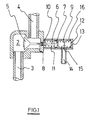
- the normal position of the stopcock 2 is the open position.
- the cold-generating liquid e.g. liquid butane or propane of a mixture of both
- tube 14 When passing through the aperture, this liquid expands to gas and provokes in the right part of cylinder 9 a temperature drop down to -50°C.
- Cylinder 9 further comprises a sufficiently large vent 16 towards the surrounding atmosphere in order to guarantee a nearly atmospheric pressure in the right part of the cylinder.
- the composition of spring 13 is chosen to have a transition temperature around -30°C. For the utilized Cu-AI-Zn alloys, this choice can be made with the help of the ternary diagram of Figure 2, which gives the percentages by weight of Cu and Al and correspond with the indicated Ms-transformation temperature.
- the expansion-aperture 15 itself can also be provided with a stop-valve 17 ( Figure 3) which is commanded for instance by mechanical means.
- the command-signal can be an independent signal from outside, but can also be furnished by the movement of the relay itself, in which case a means is created to obtain a relay with feedback.
- feedback is a means for giving a relay a memory-effect : the relay changes its position under the effect of an external command signal, but when the latter disappears, the relay stays in the assumed position. This is achieved, e.g. when the external signal is a movement (obtained by mechanical, pneumatic or other way) given to the piston 7 ( Figure 3) in the direction to the right against the spring 13 made of shape memory alloy.
- this piston 7 is such that, when in the right position, it opens the stop-valve 17, provoking the spring 13 to enter its cold state, so losing its pushing force to the left. This results in that the piston remains in its right position. The piston can then be brought back to its initial position to the left by a similar signal, but in the opposite sense.
- Figure 1 shows a system with a shape memory alloy element 13 in the form of a helicoidal spring, and with a helicoidal steel spring 11 under compression.
- the expansion force of the latter is mounted against the expansion of spring 13, but is smaller than the expansion force of spring 13 in its warm stable state. In this state, spring 13 is then in elongated position and spring 11 is compressed. In cold state, the spring 13 will then assume a short shape, by which spring 11 is then allowed to expand.
- the stable shapes in warm and cold state are either the short or the long form and in which the resilience of the springs does not work in the sense of elongation but of contraction.
- the springs are not necessarily of helicoidal form, but can have another form, such as the spiral form, of the form of a strip, bent over an angle ⁇ , which angle takes two different stable values.
- the relay has a first spring made of shape memory alloy and having a first and second stable position in warm, respectively cold state (i.e. above, respectively below the temperature range in which the change of shape occurs), and further has a second spring, mounted in such a way that the first one, when passing from the warm to the cold state moves the second one into the direction of its resilience or spring-back force, and when passing from the cold to the warm state moves the second one against its resilience.
- the signal by which the cold-generating liquid is led towards the expansion-aperture can be generated in several ways.
- the tube 14 can for instance be connected with a tank of such liquid, with a stop-valve between both, which can for instance be commanded by a mechanical end-lever, so that this lever with stop-valve acts as an end-switch which commands the supply of cold-generating liquid towards the relay.
- the chamber when in the form of a tube with the expansion-aperture at one of its axial extremities, to debouch with its other axial extremity into a pressure-tank with such cold-generating liquid, but with that extremity at a certain level between maximum and minimum possible level of the liquid in the tank.
- this level As long as this level is not reached, it will be the gas phase that enters the tubular chamber and escapes via the expansion-aperture, and then there is no cooling effect.
- the liquid level reaches the mouth of the tubular chamber, it will be the liquid that enters the chamber towards the expansion-aperture, and then the cooling-effect occurs.
- the relay can be used as liquid level detector.
- the invention is not limited to the helicoidal or other shape of the shape-memory alloy element, nor to the shape of the pieces that are put into movement by such element.
- the shape-memory-alloy element must, however, have been pretreated in order to have two stable positions, one in the cold and one in the warm state.
- the invention limited to the exact location where the shape-memory element is mounted with respect to the expansion-aperture, in so far as it is located in the stream of the gas that escapes from the expansion-aperture in order to undergo the cooling-down effect.
- This element can be mounted either inside a half-closed box or in the free atmosphere.
Landscapes
- Physics & Mathematics (AREA)
- Thermal Sciences (AREA)
- General Physics & Mathematics (AREA)
- Temperature-Responsive Valves (AREA)
- Separation By Low-Temperature Treatments (AREA)
Applications Claiming Priority (2)
| Application Number | Priority Date | Filing Date | Title |
|---|---|---|---|
| BE1010552 | 1982-07-05 | ||
| BE1/10552A BE893748A (nl) | 1982-07-05 | 1982-07-05 | Koudegevoelig relais |
Publications (2)
| Publication Number | Publication Date |
|---|---|
| EP0098646A2 true EP0098646A2 (de) | 1984-01-18 |
| EP0098646A3 EP0098646A3 (de) | 1985-05-22 |
Family
ID=3862943
Family Applications (1)
| Application Number | Title | Priority Date | Filing Date |
|---|---|---|---|
| EP83200955A Withdrawn EP0098646A3 (de) | 1982-07-05 | 1983-06-28 | Kälteempfindliches Relais |
Country Status (2)
| Country | Link |
|---|---|
| EP (1) | EP0098646A3 (de) |
| JP (1) | JPS5985488A (de) |
Cited By (2)
| Publication number | Priority date | Publication date | Assignee | Title |
|---|---|---|---|---|
| EP0153259A1 (de) * | 1984-02-14 | 1985-08-28 | Société Civile "G.I.R." | Polyvalenter Indikationsmechanismus zur Temperaturkontrolle |
| EP0699881A3 (de) * | 1992-08-13 | 1996-09-11 | Bodenseewerk Geraetetech | Kühlsystem zum Abkühlen eines Kühlobjektes auf tiefe Temperaturen mittels eines Joule-Thomson-Kühlers |
Families Citing this family (1)
| Publication number | Priority date | Publication date | Assignee | Title |
|---|---|---|---|---|
| JP6570777B1 (ja) * | 2019-02-13 | 2019-09-04 | 株式会社ナック | 排水システム |
Family Cites Families (6)
| Publication number | Priority date | Publication date | Assignee | Title |
|---|---|---|---|---|
| FR1465521A (fr) * | 1965-11-19 | 1967-01-13 | Commissariat Energie Atomique | Dispositif de détection du niveau d'un gaz liquéfié à l'intérieur d'un cryostat |
| GB1311003A (en) * | 1970-02-18 | 1973-03-21 | Hymatic Eng Co Ltd | Cryogenic cooling apparatus |
| FR2313707A1 (fr) * | 1975-06-02 | 1976-12-31 | Consiglio Nazionale Ricerche | Dispositif de controle du niveau de liquides cryogenes |
| FR2344639A1 (fr) * | 1976-03-18 | 1977-10-14 | Raychem Corp | Nouveaux alliages aptes a la reprise thermique |
| FR2432165A1 (fr) * | 1978-07-27 | 1980-02-22 | Carrou J Le | Procede et dispositifs pour controler le niveau d'un liquide |
| US4227646A (en) * | 1978-11-30 | 1980-10-14 | Delta Materials Research Limited | Temperature-responsive valve |
-
1983
- 1983-06-28 EP EP83200955A patent/EP0098646A3/de not_active Withdrawn
- 1983-07-05 JP JP12113083A patent/JPS5985488A/ja active Pending
Cited By (3)
| Publication number | Priority date | Publication date | Assignee | Title |
|---|---|---|---|---|
| EP0153259A1 (de) * | 1984-02-14 | 1985-08-28 | Société Civile "G.I.R." | Polyvalenter Indikationsmechanismus zur Temperaturkontrolle |
| FR2560992A1 (fr) * | 1984-02-14 | 1985-09-13 | Jehanno Jean Vincent | Mecanisme indicateur polyvalent pour le controle de temperatures |
| EP0699881A3 (de) * | 1992-08-13 | 1996-09-11 | Bodenseewerk Geraetetech | Kühlsystem zum Abkühlen eines Kühlobjektes auf tiefe Temperaturen mittels eines Joule-Thomson-Kühlers |
Also Published As
| Publication number | Publication date |
|---|---|
| JPS5985488A (ja) | 1984-05-17 |
| EP0098646A3 (de) | 1985-05-22 |
Similar Documents
| Publication | Publication Date | Title |
|---|---|---|
| US4509517A (en) | Kidney stone instrument | |
| US4848388A (en) | Emergency valve with test capability | |
| US4945727A (en) | Hydraulic shape memory alloy actuator | |
| US6427712B1 (en) | Ambient temperature shape memory alloy actuator | |
| US3403238A (en) | Conversion of heat energy to mechanical energy | |
| EP0131997B1 (de) | Verriegelungselement | |
| US5255809A (en) | Compressed gas container with shape memory alloy pressure relief member | |
| DE69727297T2 (de) | Impulsbetriebenes steuerventil | |
| US5079920A (en) | Hydraulic shape memory material stress to hydraulic pressure transducer | |
| EP0118152A1 (de) | Auf Temperatur ansprechendes Ventil | |
| US20070295016A1 (en) | Method for controlling an expansion valve and expansion valve, in particular for vehicle air-conditioning systems operated with CO2 as the refrigerant | |
| US10124197B2 (en) | Fire sprinkler valve actuator | |
| US5485884A (en) | Hydride operated reversible temperature responsive actuator and device | |
| US5014520A (en) | Control device having a coiled compression shape memory spring, refrigerator system utilizing the control device and methods of making the same | |
| EP0098646A2 (de) | Kälteempfindliches Relais | |
| DE2259807C2 (de) | Kryogenes Kühlsystem | |
| US3640091A (en) | Valve arrangement to provide temperature level control at cryogenic temperature ranges | |
| US5417367A (en) | Device for opening a pipe and an application of said device | |
| EP0699881A2 (de) | Kühlsystem zum Abkühlen eines Kühlobjektes auf tiefe Temperaturen mittels eines Joule-Thomson-Kühlers | |
| Stoeckel et al. | Use of Ni-Ti shape memory alloys for thermal sensor-actuators | |
| GB1578741A (en) | Temperature-actuatable valve control means | |
| Krishnan et al. | A shape memory alloy based cryogenic thermal conduction switch | |
| JPH0151907B2 (de) | ||
| JPH0587677B2 (de) | ||
| US11040230B2 (en) | Fire sprinkler valve actuator |
Legal Events
| Date | Code | Title | Description |
|---|---|---|---|
| PUAI | Public reference made under article 153(3) epc to a published international application that has entered the european phase |
Free format text: ORIGINAL CODE: 0009012 |
|
| AK | Designated contracting states |
Designated state(s): AT CH DE FR GB IT LI LU NL SE |
|
| PUAL | Search report despatched |
Free format text: ORIGINAL CODE: 0009013 |
|
| AK | Designated contracting states |
Designated state(s): AT CH DE FR GB IT LI LU NL SE |
|
| STAA | Information on the status of an ep patent application or granted ep patent |
Free format text: STATUS: THE APPLICATION IS DEEMED TO BE WITHDRAWN |
|
| 18D | Application deemed to be withdrawn |
Effective date: 19860122 |
|
| RIN1 | Information on inventor provided before grant (corrected) |
Inventor name: MAERTENS, JAAK |