EP0099082A1 - Hydrodynamischer Drehmomentwandler - Google Patents
Hydrodynamischer Drehmomentwandler Download PDFInfo
- Publication number
- EP0099082A1 EP0099082A1 EP19830106721 EP83106721A EP0099082A1 EP 0099082 A1 EP0099082 A1 EP 0099082A1 EP 19830106721 EP19830106721 EP 19830106721 EP 83106721 A EP83106721 A EP 83106721A EP 0099082 A1 EP0099082 A1 EP 0099082A1
- Authority
- EP
- European Patent Office
- Prior art keywords
- fluid
- blades
- circuit
- reaction member
- transmitter
- Prior art date
- Legal status (The legal status is an assumption and is not a legal conclusion. Google has not performed a legal analysis and makes no representation as to the accuracy of the status listed.)
- Withdrawn
Links
- 239000012530 fluid Substances 0.000 claims abstract description 112
- 238000006243 chemical reaction Methods 0.000 claims abstract description 78
- 238000010168 coupling process Methods 0.000 claims abstract description 57
- 238000005859 coupling reaction Methods 0.000 claims abstract description 57
- 230000008878 coupling Effects 0.000 claims abstract description 30
- 230000002093 peripheral effect Effects 0.000 claims abstract description 19
- 230000000694 effects Effects 0.000 claims abstract description 13
- 238000009434 installation Methods 0.000 claims description 12
- 239000003921 oil Substances 0.000 description 38
- 230000008901 benefit Effects 0.000 description 7
- 230000005540 biological transmission Effects 0.000 description 6
- 238000004519 manufacturing process Methods 0.000 description 6
- 238000001816 cooling Methods 0.000 description 5
- 238000005266 casting Methods 0.000 description 4
- 230000004048 modification Effects 0.000 description 4
- 238000012986 modification Methods 0.000 description 4
- 238000010276 construction Methods 0.000 description 3
- 230000008859 change Effects 0.000 description 2
- 239000010724 circulating oil Substances 0.000 description 2
- 238000000034 method Methods 0.000 description 2
- 230000007704 transition Effects 0.000 description 2
- 230000003466 anti-cipated effect Effects 0.000 description 1
- 238000002485 combustion reaction Methods 0.000 description 1
- 230000001419 dependent effect Effects 0.000 description 1
- 238000005553 drilling Methods 0.000 description 1
- 230000006698 induction Effects 0.000 description 1
- 230000003137 locomotive effect Effects 0.000 description 1
- 238000005461 lubrication Methods 0.000 description 1
- 238000000465 moulding Methods 0.000 description 1
- 238000013021 overheating Methods 0.000 description 1
- 230000009467 reduction Effects 0.000 description 1
- 238000007789 sealing Methods 0.000 description 1
- 230000035939 shock Effects 0.000 description 1
- 230000003068 static effect Effects 0.000 description 1
Images




Classifications
-
- F—MECHANICAL ENGINEERING; LIGHTING; HEATING; WEAPONS; BLASTING
- F16—ENGINEERING ELEMENTS AND UNITS; GENERAL MEASURES FOR PRODUCING AND MAINTAINING EFFECTIVE FUNCTIONING OF MACHINES OR INSTALLATIONS; THERMAL INSULATION IN GENERAL
- F16H—GEARING
- F16H61/00—Control functions within control units of change-speed- or reversing-gearings for conveying rotary motion ; Control of exclusively fluid gearing, friction gearing, gearings with endless flexible members or other particular types of gearing
- F16H61/38—Control of exclusively fluid gearing
- F16H61/48—Control of exclusively fluid gearing hydrodynamic
- F16H61/64—Control of exclusively fluid gearing hydrodynamic controlled by changing the amount of liquid in the working circuit
Definitions
- This invention relates to a hydrodynamic torque transmitter and to a transmission incorporating such a transmitter.
- torque transmitter is that commonly known as a fluid coupling in which fluid circulates around a circuit between bladed impeller and turbine members which can rotate relative to a fixed frame.
- torque transmitter is commonly known as a torque converter in which fluid circulates around a circuit between bladed impeller and turbine members which can rotate relative to a fixed frame, and in which an additional bladed member, known as a reaction member, is provided in the fluid circuit between the impeller and turbine and which is non-rotatable relative to the frame, the blades of the members being disposed and arranged to provide a torque multiplication effect.
- a torque converter in which fluid circulates around a circuit between bladed impeller and turbine members which can rotate relative to a fixed frame, and in which an additional bladed member, known as a reaction member, is provided in the fluid circuit between the impeller and turbine and which is non-rotatable relative to the frame, the blades of the members being disposed and arranged to provide a torque multiplication effect.
- a further known type of such transmitter is that commonly known as a torque converter-coupling and this is similar to a torque converter except that the reaction member is connected to the frame by way of a freewheel clutch so as to be free to rotate in the same direction as the impeller and turbine but is locked relative to the frame against rotation in the reverse direction.
- a transmission incorporating such a transmitter comprises a prime mover, e.g. a diesel engine, and a drive train to a driven element such as a wheel, the impeller being driven by the prime mover and the drive train being driven by the turbine.
- the drive train may include a multi-ratio change-speed gearbox which may be manually, automatically or semi-automatically shifted between ratios.
- a torque converter-coupling is normally used in such a transmission in preference to a torque converter or fluid coupling because of the better efficiency of the torque converter-coupling where the output torque demand for a particular driving condition does not require torque multiplication and the freewheel allows the reaction member to idle minimising drag losses.
- a torque converter-coupling has advantages over a fluid coupling because of its torque multiplication ability which can allow fewer gear steps to be used in the mufti-ratio change-speed gearbox for a given set of operating parameters. Moreover, a torque converter coupling is usually a "softer" match when the output is stalled having a lower torque capacity for a given engine speed. For example, where a vehicle such as a 'bus' is left in gear at a stop, the power losses are lower.
- Torque converter-coupling designs which incorporate a "lock-up” or "by-pass” clutch are commonly used to improve efficiency when the torque multiplication effect is not used. Many vehicles use the torque converter coupling purely as a starting device, the "lock-up” or “by-pass” clutch being used for general driving. However, the provision of a “lock-up” or “by-pass” clutch has the disadvantage of adding weight, bulk and cost to the installation.
- the present invention is intended to provide a hydrodynamic torque transmitter of low cost which, at high slip ratios, will give torque multiplication characteristics and which, at low slip ratios, will attain efficiencies comparable with those of fluid couplings.
- the present invention provides a hydrodynamic torque transmitter comprising a casing and first and second bladed members, said members being mounted for rotation relative to a frame, each bladed member having a peripheral wall and a plurality of blades extending transversely thereto so as to define a pocket between each pair of adjacent blades and bounded by the blades and peripheral watt, the pockets each having an open mouth, the open mouths of the pockets of one member being disposed in face-to-face relationship with the open mouths of the pockets of the other member so that the pockets co-operate to define a potential circuit for fluid around which, in use, fluid circulates to transmit torque between the bladed members, there being a reaction member disposed in the potential circuit between the first and second members and being prevented from rotation relative to the frame at least in the opposite direction of rotation to the first and second members, the blades of the first and second members and of the reaction member being disposed and arranged to produce a torque multiplication effect when, in use, fluid flows past the reaction member blades, each pocket comprising an unobst
- the casing rotates with one of said first and second members but, alternatively, both the first and second members may rotate relative to the casing.
- the first member may be an impeller and the second member a turbine.
- the reaction member may be fixed relative to the frame.
- reaction member may be provided with free-wheel clutch means to permit the reaction member to rotate relative to the frame in the same direction as the impeller and turbine but prevent rotation in the reverse direction.
- Means may be provided for circulating fluid into and out of the fluid circit, said means may include radial passage means provided in the reaction member blades for egress of fluid.
- a hydrodynamic torque transmitter installation comprising a torque transmitter according to the first aspect of the invention, wherein said fluid circuit is partly filled with fluid, the volume of fluid being such that, in use, at low slip ratios the fluid circulation in said circuit is such that the fluid does not at least substantially contact the reaction member whereby the transmitter has the characteristics of a fluid coupling, whilst at high slip ratios, the fluid circulation in said circuit is such that the fluid does contact the reaction member to provide a torque multiplication effect so that the transmitter functions as a torque converter where the reaction member is fixed to the frame.
- the fluid may be maintained within the fluid circuit.
- the fluid may be circulated into and out of the fluid circuit and, where said radial passage means are provided in the reaction member blades, then, in use, when the installation is operated under conditions of:
- the radial passage means may include a portion extending radially outwardly of their associated reaction member blades.
- a hydrodynamic torque transmitter installation comprising a torque transmitter according to the first aspect of the invention wherein said circuit is partly filled with fluid, the volume of fluid being such that, in use, at low slop ratios fluid circulation in said circuit is such that the fluid does not at least substantially contact the reaction member whereby the transmitter has the characteristics of a fluid coupling, whilst at high slip ratios, the fluid circulation in said circuit is such that the fluid does contact the reaction member to provide a torque multiplication effect so that the transmitter functions as a torque converter-coupling where the reaction member is coupled to the frame through a free-wheel clutch.
- the fluid circuit may be maintained fully filled with fluid.
- the transmitter of the present invention is not provided with the usual "torus” or “guide” hereinafter referred to as "guide” element of the turbine and impeller of a conventional torque converter or torque converter-coupling (which guide element is provided to constrain the circulation of fluid positively to the bladed circuit, eliminating spill off (and hence efficiency loss) as the oil passes along a particular blade channel), the complications in manufacture of the turbine and impeller members occasioned by the need to provide a separate core for each pocket is avoided in the present invention, thereby minimising production costs.
- the blades of the impeller and turbine are made of simple configuration so that again simple casting moulds may be used without the need for separate cores.
- at least the impeller has simple radial blades similar to those provided in a conventional fluid coupling and the turbine may also have similar blades although a small amount of "angle" or turn may be provided on one or both of the impellor and turbine to obtain particular characteristics for a given size of hydrodynamic unit but not so much as to require expensive moulding/casting techniques.
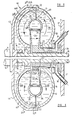
- a hydrodynamic torque transmitter embodying the invention which is of generally conventional torque converter form, comprising of the usual annular hollow two-part casing 10.
- the half of the casing 10 which is more remote from an input shaft 11 comprises a bladed impeller 12 driven from the shaft 11 by the other casing half 13.
- a bladed turbine 14 connected to an output shaft 15 journalled in bearings 16 provided on the casing half 13 and bearings (not shown) in a fixed frame 17.
- the impeller 12 and turbine 14 respectively constitute first and second torque transmitting members between which torque is transmitted by fluid which flows in a fluid circuit defined between the impeller and turbine.
- a pocket 18 is defined between each pair of adjacent blades 19 and the peripheral wall 20 of the impeller and having an open mouth M defined by the free edges 21 of the blades, and the circumferentially extending edge 22 of the peripheral wall 20 between adjacent blades 19 of the impeller 12.
- similar pockets 18a are defined between adjacent blades 19a being bounded by the blades 19a and the peripheral wall 20a and having an open mouth Ma defined by the free edges 21a and 22a of the blades and peripheral watt.
- the number of blades in impeller and turbine are generally different to minimise hydraulic shocks caused by blades passing each other.
- peripheral walls 20 and 20a are part circular and thus the outer periphery of the potential fluid circuit provided by the cooperating impeller and turbine is circular except for the small gaps illustrated.
- the fluid circuit may deviate from a true circle and may be elliptical, have a rectangular section with large corner radii, or even be asymmetrical.
- a bladed reaction member 23 Disposed at the inner periphery of the potential fluid circuit is a bladed reaction member 23 which is held against rotation by virtue of a sleeve 24 fixed to the frame 17.
- a seat 25 is provided between the impeller 12 and sleeve 24 and a seal 26 is provided between the frame 17 and the output shaft 15.
- the impeller and turbine do not have the conventional "guide” or “torus” element as conventionally provided in a torque converter to define a toroidal region between the peripheral wall 20 and the core member across which the blades 19 extend.
- the pockets between the blades 19 are not of toroidal shape but have a completely unobstructed open mouth M, Ma, the boundary of which is defined solely by the free edges 21, 21a and 22, 22a of the blades and wall 20, 20a therebetween as described above.
- the blades 19, of the impeller lie in a plane radial to and containing the axis of rotation of the impeller and thus are simple "radial" blades similar to those provided in a conventional fluid coupling.
- the blades 19a of the turbine are of similar configuration but the blades of one or both of the turbine and impeller may be provided with a small extent of "angle" or other non-planar contour to give a desired extent of torque multiplication in co-operation with the reaction member the blades of which are conventionally shaped.
- the hydrodynamic transmitter described above and illustrated with reference to Figure I or Figure 2 is not completely filled with fluid, so that it is only partially filled.
- Oil circulates along the above described potential circuit at a rate dependent upon the slip between the impeller and turbine.
- the impeller will induce a centrifugal head in the fluid which will enter the turbine at the radially outermost part of its periphery and then feed directly back into the impeller at the radially inner periphery thereof via the reaction member.
- FIG 3 there is illustrated a hydrodynamic torque transmitter of essentially similar construction to that illustrated in Figure I except that means are provided for feeding fluid through the torque converter by means of an external pump.
- the same reference numerals have been used as were used in Figure I to refer to corresponding parts,
- the exit path of fluid is illustrated, the entry path being illustrated in the modification shown in Figure 4 which is identical to that shown in Figure 3 except for the mounting of the reaction member 23a by means of a freewheel clutch 27a and analogous to the arrangement bearing the same reference numerals in Figure 2.
- the exit path is provided by means of a duct 30 in the sleeve 24 connected to a conduit 31 leading into the fixed frame 17 and then to a hydraulic supply circuit.
- FIG 4 the entry path of fluid is illustrated and comprises an entry conduit 32 leading to a further duct 33 provided in the sleeve 24, arrows illustrate the path of the fluid in Figures 3 and 4.
- the design may be such as to allow inlet and outlet flow paths to be reversed.
- FIGs 5 and 6 illustrate diagrammatically a conventional torque converter and torque converter-coupling respectively, again the same reference numerals have been used for corresponding parts as were used in Figures 3 and 4, and it will be seen that the only difference between the transmitters of Figures 5 and 6 and Figures 3 and 4 respectively is the provision of a guide member 35 on each of the impeller 12, turbine 14 and reaction member 23, 23a.
- the transmitters shown in Figures 5 and 6 differ from those illustrated in Figures I and 2 respectively in addition to the differences identified above compared with Figures 3 and 4 by the provision of inlet conduit and duct 32, 33 and outlet duct and conduit 30, 31.
- Figures 7 and 8 illustrate further hydrodynamic torque transmitters differing only in the provision of a freewheel reaction member 23a in Figure 8 compared with a fixed reaction member 23 in Figure 7.
- the transmitter illustrated in Figures 7 and 8 differs from that shown in Figures 5 and 6 only by omission of the entry conduit and duct 32, 33 and exit duct and conduit 30, 31.
- the devices illustrated in Figures 7 and 8 are partly filled with fluid in a similar manner to the transmitter of Figures I and 2 and embodying the invention.
- FIG 10 there is illustrated a comparison between the torque converter-coupling as shown in full line in Figure 9 and in dotted line in Figure 10, and comparable curves in full line illustrating the characteristics of a fluid coupling, i.e. a transmitter without any reaction member.
- a fluid coupling has a higher efficiency of coupling in the low slip area, see I in Figure 10, and a higher capacity at stall, see 2 in Figure 10.
- a torque converter-coupling provides torque multiplication compared with the unit torque transmission of a coupling, see 3 in Figure 10, and has advantageous efficiency at high slip, see 4 in Figure 10.
- the aim of the present invention is to provide a torque transmitter which has the characteristics of a torque converter at high slip and the characteristics of a fluid coupling at low slip and thus to combine the advantages of each type of transmitter.
- the object is to provide a torque transmitter which will give torque converter characteristics for starting purposes or for reducing the number of gearbox ratios necessary and which on high output speed, low slip or light load conditions, will attain efficiencies comparable with those of fluid couplings.
- the "softer" match feature at stall is required to reduce idling losses but the high speed, low slip capacity must be adequate in order to keep the size of the torque transmitter acceptable.
- a circulated unit as illustrated in Figure 4 may be provided and Figure 12 illustrates the performance characteristics thereof.
- the characteristics of Figure 9 are reproduced and those of the torque transmitter of Figure 4, shown in chain dotted line. It will be seen that in the low slip range the efficiency is comparable with that of a conventional torque converter-coupling and therefore the embodiment illustrated in Figure 4 has no performance characteristics which are advantageous compared with those of a conventional torque converter-coupling.
- the advantage of the embodiment shown in Figure 4 is that of reduced manufacturing costs because of the omission of the guide member and the simple turbine and impeller blades.
- Figure 13 illustrates the performance characteristics of the transmitter illustrated in Figure 3 where the reaction member is fixed to frame.
- the characteristics of Figure 9 are reproduced and those of the torque transmitter of Figure 3, shown in chain dotted line. It will be seen that all the characteristics are significantly poorer than that of a conventional torque converter let alone a torque converter-coupling and this demonstrates that the transmitter shown in Figure 3, whilst being more economical to produce than a conventional torque converter, has poorer performance characteristics and thus would not be likely to find commercial application since the saving in costs and manufacture would probably be more than off-set by the reduction in performance characteristics.
- Figure 14 illustrates performance characteristics of a conventional torque converter/converter-coupling when not provided with a circulating oil flow or if provided with a circulating oil flow then with a capacity limiter so that the volume of fluid within the transmitter is similar to that illustrated and described with reference to Figures I and 2.
- the fluid flow in the high slip region would be similar to that shown in Figure 7 and the fluid flow in the low slip region would be similar to that shown in Figure 8.
- the oil leaves the circuit via passages 44 formed, for example by drilling, in the blades 45 of the reaction member 23.
- the passages 44 communicate with an axially extending passage 46 formed in the sleeve 24 which communicates via pipes 47 with an oil outlet 48 displaced above the centreline of the transmitter.
- the outlet may be positioned, as indicated at 48b, below the centreline in which case a non-return valve 49 is provided having a light spring so that there is little restriction to outflow of oil.
- a non-return valve 49 is provided having a light spring so that there is little restriction to outflow of oil.
- Such a valve is provided to ensure that oil does not syphon off when the transmitter is stationary. It is important to note that back pressure is minimised and, if desired, more than one outlet passage 46 and associated pipes may be provided.
- an oil tube 50 is provided as an extension of the passage 44 in the impeller blades 45 for a reason hereinafter to be described, and the impeller and turbine blades may be cut back, as illustrated at 51.
- FIG 16 there is illustrated the condition of the transmitter under conditions of high slip, i.e. under conditions of torque multiplication.
- the impeller generates a head of oil which exceeds that generated by the turbine because of the lower speed of the turbine, and the generated circulation follows fully the turbine blading peripheral contour, passing then through the reaction member blades and thus giving torque multiplication.
- the transmitter therefore operates as illustrated in Figure 16 with oil entering through the passage 40, 41 and leaving through the passage 44 and extension tube 50.
- extension tubes 50 are provided to give sufficient head to cause outflow against any pipe resistance. It is considered that in certain circumstances the extension tubes 50 may not be required and therefore it is within the scope of the invention to omit these.
- resistance in outflow may be benefited by inclining the extension tubes 50 and/or mitreing the end to optimise pick-up conditions.
- Positioning of the pipes 50 and their configuration, and of the oil flow passages may be varied from that illustrated as proves necessary for particular operating circumstances.
- reaction member may be provided with a free wheel.
- reaction member Oil flows through the reaction member under high slip conditions thus giving torque conversion, but on low slip conditions the impeller and turbine generate fluid heads which are more nearly equal than under high slip conditions and an insufficient head is generated to cause flow through the reaction member.
- the reaction member may be fixed ( Figures 16-18 only) and the outer portions of the impeller and turbine blades act as a simple fluid coupling.
- the blades of the impeller and turbine are simple blades and there is no core member, manufacture of these components is considerably simplified since the separate core elements required to cast the impeller and turbine components when a central guide member is present are avoided and in addition the coring required to produce simple open blades is again more simple than with the complex blade shapes conventionally present in a torque converter or torque converter coupling.
- blade angularity may be provided in the impeller and turbine blades, it being possible to do this and retain simple casting techniques.
- the embodiment shown in Figures 16 to 18 has the additional advantage of oil circulation thereby providing cooling and facilitating the long life of seals and bearings.
- the need for an accurate volume of oil to be used is eliminated which is particularly helpful since the volume of oil varies with temprature and the self-compensating effect provided is a considerable advantage.
- the transmitters described hereinbefore are particularly suitable for use in a transmission driven by a turbo charged internal combustion engine such as a diesel engine and which includes a constant mesh change speed gear box.
- the transmission may be incorporated in a vehicle such as an omnibus, or other road vehicle or a railway locomotive or a rail car.
Landscapes
- Engineering & Computer Science (AREA)
- General Engineering & Computer Science (AREA)
- Physics & Mathematics (AREA)
- Fluid Mechanics (AREA)
- Mechanical Engineering (AREA)
- Control Of Fluid Gearings (AREA)
Applications Claiming Priority (4)
| Application Number | Priority Date | Filing Date | Title |
|---|---|---|---|
| GB8220673 | 1982-07-16 | ||
| GB8220673 | 1982-07-16 | ||
| GB838304732A GB8304732D0 (en) | 1982-07-16 | 1983-02-21 | Hydrodynamic torque transmitter |
| GB8304732 | 1983-02-21 |
Publications (1)
| Publication Number | Publication Date |
|---|---|
| EP0099082A1 true EP0099082A1 (de) | 1984-01-25 |
Family
ID=26283361
Family Applications (1)
| Application Number | Title | Priority Date | Filing Date |
|---|---|---|---|
| EP19830106721 Withdrawn EP0099082A1 (de) | 1982-07-16 | 1983-07-08 | Hydrodynamischer Drehmomentwandler |
Country Status (3)
| Country | Link |
|---|---|
| EP (1) | EP0099082A1 (de) |
| ES (1) | ES524158A0 (de) |
| GB (1) | GB2124345A (de) |
Cited By (1)
| Publication number | Priority date | Publication date | Assignee | Title |
|---|---|---|---|---|
| CN109236977A (zh) * | 2018-11-15 | 2019-01-18 | 沈阳工程学院 | 一种带冷却叶片和控制油路的可降工作温度的液力变矩器 |
Citations (10)
| Publication number | Priority date | Publication date | Assignee | Title |
|---|---|---|---|---|
| GB376877A (en) * | 1931-05-09 | 1932-07-21 | Daimler Co Ltd | Improvements in or relating to hydraulic transmission of power |
| GB377649A (en) * | 1930-10-22 | 1932-07-28 | Johann Nikolaus Kiep | Improvements in or relating to hydraulic power transmitters or couplings |
| US2404657A (en) * | 1945-01-26 | 1946-07-23 | Ford Motor Co | Transmission |
| FR1047002A (fr) * | 1951-12-20 | 1953-12-10 | Neyrpic Ets | Transmission hydraulique formant coupleur et convertisseur |
| US3124973A (en) * | 1964-03-17 | Hydrodynamic torque transmitting device | ||
| US3287908A (en) * | 1964-01-03 | 1966-11-29 | Borg Warner | Hydrokinetic torque converter |
| GB1118619A (en) * | 1964-09-22 | 1968-07-03 | Elmeg | Fottinger coupling |
| US3409968A (en) * | 1966-10-03 | 1968-11-12 | Borg Warner | Method of making a slotted blade by extruding |
| DE1750198A1 (de) * | 1968-04-06 | 1971-02-11 | Renk Ag Zahnraeder | Einrichtung zur Steuerung und Regelung des von einem hydrodynamischen Element ubertragbaren Drehmoments |
| DE2045959A1 (de) * | 1970-09-17 | 1972-03-23 | Daimler Benz Ag | Hydrodynamisches Getriebe |
Family Cites Families (2)
| Publication number | Priority date | Publication date | Assignee | Title |
|---|---|---|---|---|
| DD102448A1 (de) * | 1973-03-26 | 1973-12-12 | ||
| GB2111651A (en) * | 1981-12-08 | 1983-07-06 | Windsor Smith Claude P | Hydrodynamic drive coupling |
-
1983
- 1983-07-08 EP EP19830106721 patent/EP0099082A1/de not_active Withdrawn
- 1983-07-14 GB GB08319047A patent/GB2124345A/en not_active Withdrawn
- 1983-07-15 ES ES524158A patent/ES524158A0/es active Granted
Patent Citations (10)
| Publication number | Priority date | Publication date | Assignee | Title |
|---|---|---|---|---|
| US3124973A (en) * | 1964-03-17 | Hydrodynamic torque transmitting device | ||
| GB377649A (en) * | 1930-10-22 | 1932-07-28 | Johann Nikolaus Kiep | Improvements in or relating to hydraulic power transmitters or couplings |
| GB376877A (en) * | 1931-05-09 | 1932-07-21 | Daimler Co Ltd | Improvements in or relating to hydraulic transmission of power |
| US2404657A (en) * | 1945-01-26 | 1946-07-23 | Ford Motor Co | Transmission |
| FR1047002A (fr) * | 1951-12-20 | 1953-12-10 | Neyrpic Ets | Transmission hydraulique formant coupleur et convertisseur |
| US3287908A (en) * | 1964-01-03 | 1966-11-29 | Borg Warner | Hydrokinetic torque converter |
| GB1118619A (en) * | 1964-09-22 | 1968-07-03 | Elmeg | Fottinger coupling |
| US3409968A (en) * | 1966-10-03 | 1968-11-12 | Borg Warner | Method of making a slotted blade by extruding |
| DE1750198A1 (de) * | 1968-04-06 | 1971-02-11 | Renk Ag Zahnraeder | Einrichtung zur Steuerung und Regelung des von einem hydrodynamischen Element ubertragbaren Drehmoments |
| DE2045959A1 (de) * | 1970-09-17 | 1972-03-23 | Daimler Benz Ag | Hydrodynamisches Getriebe |
Cited By (2)
| Publication number | Priority date | Publication date | Assignee | Title |
|---|---|---|---|---|
| CN109236977A (zh) * | 2018-11-15 | 2019-01-18 | 沈阳工程学院 | 一种带冷却叶片和控制油路的可降工作温度的液力变矩器 |
| CN109236977B (zh) * | 2018-11-15 | 2023-08-15 | 沈阳工程学院 | 一种带冷却叶片和控制油路的可降工作温度的液力变矩器 |
Also Published As
| Publication number | Publication date |
|---|---|
| GB2124345A (en) | 1984-02-15 |
| GB8319047D0 (en) | 1983-08-17 |
| ES8405908A1 (es) | 1984-06-16 |
| ES524158A0 (es) | 1984-06-16 |
Similar Documents
| Publication | Publication Date | Title |
|---|---|---|
| US8561502B2 (en) | Dual drive pump system with one way clutches | |
| CN1167696A (zh) | 传动装置冷却系统 | |
| US3051273A (en) | Hydraulic brake | |
| US3734251A (en) | Hydrodynamic unit with mechanical drive clutch | |
| US5836157A (en) | Torque converter for motor vehicle | |
| EP0099082A1 (de) | Hydrodynamischer Drehmomentwandler | |
| US3941225A (en) | Speed limiting accessory drive system and apparatus therefor | |
| EP1172577B1 (de) | Flüssigkeitskupplung mit Prallplatte | |
| JP4420362B2 (ja) | 流体継手 | |
| US4096693A (en) | Torque converter fluid control system for power transmission system | |
| US5259191A (en) | Torque converter | |
| US3105396A (en) | Hydraulic torque converter | |
| US4080786A (en) | Hydrodynamic torque converters | |
| JP4303406B2 (ja) | 流体継手 | |
| EP0476433B1 (de) | Viskositätsbypasskupplung für Drehmomentwandler und dessen Dichtungsanordnung | |
| US5966934A (en) | Torque converter for motor vehicle | |
| US6745563B1 (en) | Axially reduced torque converter with axial pull stator | |
| US3768262A (en) | Cooling shroud plate for hydraulic torque transmitting mechanism | |
| CN112997027A (zh) | 变速器的工作介质回路 | |
| US4444009A (en) | Hydrodynamic torque converter | |
| US3204412A (en) | Torque converters | |
| JP4291937B2 (ja) | バッフルプレート付き流体継手 | |
| US2957459A (en) | Hydraulic fan drive | |
| JP4071499B2 (ja) | バッフルプレート付き流体継手 | |
| US12253147B2 (en) | Low inertia hydrodynamic launch device |
Legal Events
| Date | Code | Title | Description |
|---|---|---|---|
| PUAI | Public reference made under article 153(3) epc to a published international application that has entered the european phase |
Free format text: ORIGINAL CODE: 0009012 |
|
| AK | Designated contracting states |
Designated state(s): BE DE FR IT SE |
|
| 17P | Request for examination filed |
Effective date: 19840612 |
|
| STAA | Information on the status of an ep patent application or granted ep patent |
Free format text: STATUS: THE APPLICATION IS DEEMED TO BE WITHDRAWN |
|
| 18D | Application deemed to be withdrawn |
Effective date: 19851220 |
|
| RIN1 | Information on inventor provided before grant (corrected) |
Inventor name: SCHOFIELD, NORMAN |