EP0099337A2 - Titan und Titanhydrid in Netzform, sowie Verfahren zu deren Herstellung - Google Patents
Titan und Titanhydrid in Netzform, sowie Verfahren zu deren Herstellung Download PDFInfo
- Publication number
- EP0099337A2 EP0099337A2 EP83810312A EP83810312A EP0099337A2 EP 0099337 A2 EP0099337 A2 EP 0099337A2 EP 83810312 A EP83810312 A EP 83810312A EP 83810312 A EP83810312 A EP 83810312A EP 0099337 A2 EP0099337 A2 EP 0099337A2
- Authority
- EP
- European Patent Office
- Prior art keywords
- reticulate
- range
- binder
- slurry
- pore
- Prior art date
- Legal status (The legal status is an assumption and is not a legal conclusion. Google has not performed a legal analysis and makes no representation as to the accuracy of the status listed.)
- Withdrawn
Links
Images

Classifications
-
- B—PERFORMING OPERATIONS; TRANSPORTING
- B22—CASTING; POWDER METALLURGY
- B22F—WORKING METALLIC POWDER; MANUFACTURE OF ARTICLES FROM METALLIC POWDER; MAKING METALLIC POWDER; APPARATUS OR DEVICES SPECIALLY ADAPTED FOR METALLIC POWDER
- B22F3/00—Manufacture of workpieces or articles from metallic powder characterised by the manner of compacting or sintering; Apparatus specially adapted therefor ; Presses and furnaces
- B22F3/10—Sintering only
- B22F3/11—Making porous workpieces or articles
- B22F3/1121—Making porous workpieces or articles by using decomposable, meltable or sublimatable fillers
-
- B—PERFORMING OPERATIONS; TRANSPORTING
- B22—CASTING; POWDER METALLURGY
- B22F—WORKING METALLIC POWDER; MANUFACTURE OF ARTICLES FROM METALLIC POWDER; MAKING METALLIC POWDER; APPARATUS OR DEVICES SPECIALLY ADAPTED FOR METALLIC POWDER
- B22F3/00—Manufacture of workpieces or articles from metallic powder characterised by the manner of compacting or sintering; Apparatus specially adapted therefor ; Presses and furnaces
- B22F3/10—Sintering only
- B22F3/11—Making porous workpieces or articles
- B22F3/114—Making porous workpieces or articles the porous products being formed by impregnation
-
- C—CHEMISTRY; METALLURGY
- C01—INORGANIC CHEMISTRY
- C01B—NON-METALLIC ELEMENTS; COMPOUNDS THEREOF; METALLOIDS OR COMPOUNDS THEREOF NOT COVERED BY SUBCLASS C01C
- C01B6/00—Hydrides of metals including fully or partially hydrided metals, alloys or intermetallic compounds ; Compounds containing at least one metal-hydrogen bond, e.g. (GeH3)2S, SiH GeH; Monoborane or diborane; Addition complexes thereof
- C01B6/02—Hydrides of transition elements; Addition complexes thereof
-
- C—CHEMISTRY; METALLURGY
- C25—ELECTROLYTIC OR ELECTROPHORETIC PROCESSES; APPARATUS THEREFOR
- C25B—ELECTROLYTIC OR ELECTROPHORETIC PROCESSES FOR THE PRODUCTION OF COMPOUNDS OR NON-METALS; APPARATUS THEREFOR
- C25B1/00—Electrolytic production of inorganic compounds or non-metals
- C25B1/01—Products
- C25B1/34—Simultaneous production of alkali metal hydroxides and chlorine, oxyacids or salts of chlorine, e.g. by chlor-alkali electrolysis
- C25B1/46—Simultaneous production of alkali metal hydroxides and chlorine, oxyacids or salts of chlorine, e.g. by chlor-alkali electrolysis in diaphragm cells
-
- C—CHEMISTRY; METALLURGY
- C25—ELECTROLYTIC OR ELECTROPHORETIC PROCESSES; APPARATUS THEREFOR
- C25B—ELECTROLYTIC OR ELECTROPHORETIC PROCESSES FOR THE PRODUCTION OF COMPOUNDS OR NON-METALS; APPARATUS THEREFOR
- C25B11/00—Electrodes; Manufacture thereof not otherwise provided for
- C25B11/02—Electrodes; Manufacture thereof not otherwise provided for characterised by shape or form
- C25B11/03—Electrodes; Manufacture thereof not otherwise provided for characterised by shape or form perforated or foraminous
- C25B11/031—Porous electrodes
-
- C—CHEMISTRY; METALLURGY
- C25—ELECTROLYTIC OR ELECTROPHORETIC PROCESSES; APPARATUS THEREFOR
- C25B—ELECTROLYTIC OR ELECTROPHORETIC PROCESSES FOR THE PRODUCTION OF COMPOUNDS OR NON-METALS; APPARATUS THEREFOR
- C25B11/00—Electrodes; Manufacture thereof not otherwise provided for
- C25B11/04—Electrodes; Manufacture thereof not otherwise provided for characterised by the material
- C25B11/051—Electrodes formed of electrocatalysts on a substrate or carrier
- C25B11/052—Electrodes comprising one or more electrocatalytic coatings on a substrate
-
- C—CHEMISTRY; METALLURGY
- C25—ELECTROLYTIC OR ELECTROPHORETIC PROCESSES; APPARATUS THEREFOR
- C25B—ELECTROLYTIC OR ELECTROPHORETIC PROCESSES FOR THE PRODUCTION OF COMPOUNDS OR NON-METALS; APPARATUS THEREFOR
- C25B11/00—Electrodes; Manufacture thereof not otherwise provided for
- C25B11/04—Electrodes; Manufacture thereof not otherwise provided for characterised by the material
- C25B11/051—Electrodes formed of electrocatalysts on a substrate or carrier
- C25B11/055—Electrodes formed of electrocatalysts on a substrate or carrier characterised by the substrate or carrier material
- C25B11/057—Electrodes formed of electrocatalysts on a substrate or carrier characterised by the substrate or carrier material consisting of a single element or compound
- C25B11/067—Inorganic compound e.g. ITO, silica or titania
-
- C—CHEMISTRY; METALLURGY
- C25—ELECTROLYTIC OR ELECTROPHORETIC PROCESSES; APPARATUS THEREFOR
- C25B—ELECTROLYTIC OR ELECTROPHORETIC PROCESSES FOR THE PRODUCTION OF COMPOUNDS OR NON-METALS; APPARATUS THEREFOR
- C25B11/00—Electrodes; Manufacture thereof not otherwise provided for
- C25B11/04—Electrodes; Manufacture thereof not otherwise provided for characterised by the material
- C25B11/051—Electrodes formed of electrocatalysts on a substrate or carrier
- C25B11/073—Electrodes formed of electrocatalysts on a substrate or carrier characterised by the electrocatalyst material
- C25B11/075—Electrodes formed of electrocatalysts on a substrate or carrier characterised by the electrocatalyst material consisting of a single catalytic element or catalytic compound
-
- B—PERFORMING OPERATIONS; TRANSPORTING
- B22—CASTING; POWDER METALLURGY
- B22F—WORKING METALLIC POWDER; MANUFACTURE OF ARTICLES FROM METALLIC POWDER; MAKING METALLIC POWDER; APPARATUS OR DEVICES SPECIALLY ADAPTED FOR METALLIC POWDER
- B22F2998/00—Supplementary information concerning processes or compositions relating to powder metallurgy
-
- B—PERFORMING OPERATIONS; TRANSPORTING
- B22—CASTING; POWDER METALLURGY
- B22F—WORKING METALLIC POWDER; MANUFACTURE OF ARTICLES FROM METALLIC POWDER; MAKING METALLIC POWDER; APPARATUS OR DEVICES SPECIALLY ADAPTED FOR METALLIC POWDER
- B22F2999/00—Aspects linked to processes or compositions used in powder metallurgy
Definitions
- This invention relates to porous metal bodies, termed “reticulates", of titanium (Ti) and titanium hydride.
- reticulates we refer specifically to an open cell, or open pore (openly porous) metal or metal-like structure of arbitrary size in which a multiplicity of voids, whether cells, pores and/or passages are in open fluid communication with each other.
- a reticulate of this invention may be formed with a predetermined relatively uniform pore size and porosity in each unit volume of its structure.
- a reticulate may also be formed, if so desired, with a wide range of pore sizes in each unit volume.
- Preferred reticulates of this invention have an "open cell foam morphology" characterized by large pores (or “cells”) bounded by strands (also referred to as filaments or ribbons), the pores being interconnected.
- the strands are generally not circular but irregular in cross-section having an average thickness (measured in a direction at right angle to the direction in which width of a strand is measured) or an average equivalent diameter (assuming a circular cross-section) of less than 10 mils, and preferably in the range from about 0.2 mil to about 5 mils (0.005 inch), hence the term "thin-strand reticulate".
- Reticulates of this invention are formed from titanium hydride ("TiH Z reticulate”), and, from Ti metal derived by sintering the TiH 2 reticulate to obtain the Ti metal reticulate ("Ti reticulate”).
- Ti reticulate Ti metal reticulate supported on a refractory material such as a ceramic foam is referred to as "metal-like" because of its physical strength.
- Each reticulate has a porosity in excess of 30%, preferably in excess of 50%, and most preferably in the range from about 75-98%.
- the reticulates of this invention be essentially free of titanium carbide (TiC), that is, there should be less than 0.5 percent by weight (% by wt) of TiC, and preferably no more than 0.1% by wt more TiC than contained in the starting (original) TiH 2 powder.
- TiC titanium carbide
- Kamijo et al sponge metals like the Kamijo et al sponge metals have a framework extending in all directions in a continuous reticulated structure, all the pores being connected, though their pores are said to have a spherical shape.
- Such sponge metals cannot be produced by conventional 'loose sintering' or 'press sintering' of powder metals.
- These Kamijo et al sponge metals include those of pure metals such as nickel, copper and iron, as well as alloys such as Nichrome, though there is no enabling disclosure as to how such sponge metals may be prepared. Neither is there any suggestion that metal hydrides of any kind may be used to produce the sponge metals.
- Titanium hydride is generally represented as TiH 2 and will be so represented hereinafter.
- the Ti (metal) reticulate of this invention is in its most preferred embodiment, a "metal sponge” or “sponge metal” which should not be confused with “metal foam”.
- Metal foam consists of gas-containing discrete cells distributed in a metal matrix in a generally uniform manner, each cell being entirely enclosed and generally being not connected to any neighboring cell.
- the TiH 2 reticulate is an open cell structure.
- porous metal bodies are derived from powder metals is extensively discussed in texts and articles on powder metallurgy, and it is well known that such powder metal-derived porous bodies have relatively low porosity, less than about 30%, and that their pore size is determined by the size of the powder metal particles. What is not so well known is that porous bodies derived from powder metals have characteristics which are quite different from those of sponge metals.
- a powder of Ti metal is generally regarded as being difficultly sinterable and we know of no teaching in the prior art that TiH 2 powder may be substituted for Ti powder; or, that there was any compelling reason for forming a TiH 2 reticulate; or, that such a TiH Z reticulate may, if desired, be converted by sintering, to a Ti reticulate.
- a slurry was formed with finely divided metal, or metal oxide, or other metal compound in a fluid, optionally with a decomposable thickening agent, a metal hydride or a salt which will perform or provide for some binding action.
- An organic cellular or porous structure was coated with the slurry, and after drying, heated to a (first) temperature sufficient to reduce the organic structure to carbon, though there is no teaching as to what critical atmospheric control accomplishes this.
- This carbon structure, coated with powder of the original slurry is then heated to a (second) higher temperature than before to assure full carbonization of the organic structure.
- the fully carbonized structure which is essential to maintain the coherency of the particles to be sintered, is then heated to a (third) still higher temperature to sinter the powder into a foam product.
- the drawback of the aforesaid process is that sintering the fully carbonized structure results in the formation of a substantial quantity of carbides of those metals which are reactive with carbon at sintering temperatures even in an atmosphere which is inert with respect to Ti.
- Ti is such a reactive metal.
- a second peculiarity of TiH Z is critical to the formation of the sintered metal reticulates of this invention, namely, that upon sintering, the hydride undergoes a shrinkage in volume.
- TiH Z undergoes at least 10%, and generally about a 15% reduction in volume, so that there is a substantial contraction in volume from the original volume of the organic porous material impregnated with slurry.
- This shrinkage of volume of metal hydride particles exerts a particle-to-particle pressure sufficient to form a diffusion bond and sinter the particles.
- Such a diffusion bond was known to be formed only under relatively high pressure, as for example taught in "Titanium Powder Metallurgy by Decomposition Sintering of the Hydride" by Greenspan, J. et al. Titanium Science and Technology edited by Jaffee, R. I. et al., Vol. 1, Plenum Press (1973).
- a third peculiarity, critical to our invention, is that a slurry of TiH Z powder and a fugitive binder on a fugitive pore-former produces a self-supporting binderless TiH 2 reticulate when the binder and pore-former are driven off by heating in an inert oxygen-free atmosphere; or, if the slurry is coated on an inorganic reticulate pore-former, it produces a pore-former-supported binderless TiH 2 reticulate.
- the latter is independently useful as a hydrogenation catalyst for the hydrogenation of vegetable oils and the like.
- TiH Z is a known hydrogenation catalyst (see "Supported Titanium Hydride as a Hydrogenation Catalyst" by Lisichkin, G.V., et al, Vses Khim. Oeva 1978, 23(3) 356-7, Russia). Because this binderless structure can be freed of carbonaceous material at a temperature below about 400°C at which TiH 2 starts to decompose, it becomes possible to sinter the TiH 2 reticulates under helium or argon at essentially atmospheric pressure, to produce the thin-strand Ti reticulates of this invention.
- Metal hydrides and salts of metals have been used in the prior art as binders, particularly the metal hydrides, to produce metal foam as a result of their decomposition (see U.S.Patent No. 3,794,481).
- the TiH 2 used in the process of our invention is not a binder, and its decomposition upon sintering produces no foaming. Further, there was no reason to expect that a slurry of decomposable TiH 2 might be sintered without reaction with the components of the slurry at the elevated temperatures at which decomposition of TiH 2 occurs.
- a practical reticulate anode is preferably a relatively thick parallelepiped - industrial anodes range from about 5 cm to about 20 cm thick, and may be from 1 ft wide x 1 ft long, to as much as 5 ft wide x 6 ft long, - it was far from evident how effectively the proclivity for bubble formation could be countered by improved circulation attributable to large pores and high porosity of the anode.
- TiH 2 Ti metal, oxide, nitride, and other Ti compounds
- pore-former a fugitive pore-forming means or pore-precursor
- a self-supporting thin-strand TiH 2 reticulate is formed by coating an organic open cell pore-former, or discrete pore-former beads, pellets and the like, with a slurry of TiH 2 particles, binder and optionally solvent and/or viscosity modifiers, then eliminating the pore-former and all carbonaceous material at below about 400°C in an oxygen-free inert gas atmosphere without forming a carbonized structure.
- TiH z reticulate consisting essentially of TiH 2 powder in particle-to-particle contact forming a substantially uniform coating coherently supported on an inorganic carbon-free substrate having an open cell foam morphology, and pores characterized as hereinbefore, which reticulate is essentially free of titanium carbide (TiC).
- It is therefore a general object of this invention to provide a process for making a thin-strand reticulate of essentially pure Ti comprising, coating a pore-former substantially uniformly with a viscous (more than 100,000 cp) slurry of TiH 2 particles and binder present in a weight ratio of at least 2:1, and preferably from about 20:1 to about 50:1; eliminating the binder and pore-former at a temperature below about 400°C so as to form a green reticulate essentially free of carbonaceous material; and, heating the green reticulate in a helium or argon atmosphere at about 70 cm to about 80 cm Hg pressure, at a temperature sufficient to shrink the volume of a green self-supporting reticulate by at least about 10%, for long enough to sinter it without forming more than 0.1% by wt more TiC than was present in the TiH Z powder used to form the slurry.
- the process comprises coating an available ceramic foam with at least one, and on occasion several, coats of a more fluid slurry (less than 100,000 cp) than that used in the immediately prior embodiment hereinabove, eliminating the binder at below about 400°C in an inert gas atmosphere so as to leave essentially no carbonaceous material in the reticulate, then sintering as specified hereinabove.
- Beer-coated sintered Ti reticulate is surprisingly effective as an electrode in an electrolytic chlor-alkali cell.
- Beer-coated we refer to a catalytic coating comprising at least one platinum (Pt) group metal which is applied to the electrode, and which Pt group metal is then converted to its oxide.
- This invention is directed, in the first instance, to a reticulate of TiH 2 having (i) a porosity greater than 30%, more preferably greater than 50%, and most preferably in the range from about 75-98%; (ii) a pore size in the range from about 0.05 cm to about 1 cm, and preferably from about 0.1 to about 0.5 cm; and (iii) an average strand thickness, or equivalent diameter of less than 10 mils.
- a TiH 2 reticulate is referred to as a "green reticulate" or "greenware” because it is not sintered.
- This invention is most specifically directed, in its best mode, to a "large pore” reticulate having a porosity in the range from about 75-98%, easily visible pores being in the size range from about 0.05 cm to about 0.5 cm or larger; and, which reticulate, on the whole, visually resembles the morphology of the pore-former form which it (the reticulate) is derived so closely as to meet quite well the criterion of being visually substantially identical.
- such a TiH 2 reticulate is formed by coating an open cell organic or inorganic foam or sponge ("pore-former") having a porosity in the range from about 50-98% with a slurry cf TiH Z particles and binder.
- pore-former open cell organic or inorganic foam or sponge
- slurry we refer to a flowable liquid or fluid mixture the viscosity of which is sufficient to adherently coat the pore-former so as to provide a shaped mass of desirable, though arbitrary, dimensions suitable for a predetermined end use.
- such a TiH 2 reticulate is formed by dispersing, preferably substantially uniformly by blending with the slurrv, a mass of discrete pore-former particles, pellets or the like, and forming the slurry into a shaped mass.
- the size and shape of the pore-former particles determine, approximately, the pore size and porosity of the hydride reticulate when the particles are eliminated.
- This reticulate with uniformly relatively large pores is also characterized herein as having an open cell foam morphology.
- This invention is directed, in the second instance, to a sintered Ti metal reticulate derived from a slurry-coated pore-former by eliminating the binder, including, optionally, a solvent, dispersing and wetting agents, and/or thickening aids and emulsifiers and the like, if such are used, and also removing the pore-former at below about 400°C in an inert atmosphere of nitrogen, helium, argon or the like so as not to leave any carbonaceous material, or react with the Ti. Any carbonaceous material reacts with Ti to form TiC when the green reticulate is sintered.
- Essentially pure Ti is fomred without being subjected to any other pressure than substantially atmospheric pressure of helium or argon.
- the Ti is at least 99.5% pure and contains no more than 0.5% by wt TiC, or, no more than 0.1% by wt more TiC than contained in the starting (original) TiH Z powder, whichever is less.
- TiH 2 particles are not critical provided that they are small enough to form a stable quiescent dispersion in the slurry, so that the particles do not settle substantially.
- TiH 2 particles desirably have a primary particle size range from about 400 mesh (38 micrometers) to about 100 mesh (150 micrometers), U.S. Standard Test Sieves (wire cloth) it being preferred that they be smaller than 45 micrometers, that is, they pass through a 325 mesh sieve (-325 mesh).
- the binder must (i) result in the formation of a slurry having a viscosity in the range from about 20,000 cp to about 500,00 cp (centipoise) as determined by a Brooks R meter using a RVT#6 spindle; (ii) serve to adhere the metal hydride particles when the green reticulate is formed and (iii) be essentially unreactive with the metal hydride at a temperature sufficiently high to eliminate the binder prior to sintering the green reticulate. As little binder as possible is used, consistent with obtaining the desired adhesion, to facilitate complete elimination of the binder at a later time.
- a ratio of about 150 parts by wt of TiH Z particles for each part by wt of binder appears to be the upper limit of the ratio; the lower limit is preferably about 20:1, it being recognized that the morphology of the TiH2 particles, inter alia, will influence theseratios, and that at the lower ratios, it becomes increasingly difficult to eliminate the carbonaceous material.
- binders are starches, sugars, gums and the like, and thermosettable synthetic resinous materials capable of forming, upon cross linking, a machinable shaped mass.
- cross-linkable resins include the epoxy, polycarbonate and (meth)acrylate resins with molecular weights (mol wts) consistent with providing a slurry preferably having a viscosity near the top of the aforespecified range, it being preferred to use a slurry which is barely fluid at room temperature.
- Other commercially obtainable binders include thermoformable resins particularly poly(vinyl chloride), which is suitably plasticized, for example, with dioctyl- phtalate.
- the binder may include a solvent to adjust the viscosity of the slurry in the aforespecified range, provided the solvent may be volatilized without reacting with the hydride.
- volatile solvents include water, aliphatic primary and secondary lower alcohols having from about 1 to 6 carbon atoms, particularly isopropanol, aromatic hydrocarbons particularly xylene, toluene and benzene, acyclic and cyclic ketones, particularly acetone and cyclohexanone, tetrahydrofuran, dimethylformamide, mineral spirits and the like, which are driven off by drying and baking at about 200°C or lower.
- the preferred binder is a water soluble resin selected from the group consisting of the alkyl- and hydroxyalkyl ethers of cellulose and starch generally referred to as modified starches, methyl- and hydroxypropyl methyl-cellulose derivatives, hydroxyethylcellulose, carboxymethylcellulose, polyvinyl alcohol, polyvinylpyrrolidone, poly(acrylic acid) and its homologs, polyacrylamide, ethylene oxide polymers, and polyethylen- imine. Most preferred binder is polyvinyl alcohol (PVA) or polyacrylamide (PAAm) present in aqueous solution.
- PVA polyvinyl alcohol
- PAAm polyacrylamide
- a preferred viscous slurry includes from about 20 to about 50 parts by wt of TiH Z particles per part of binder, depending on the mol wt (viscosity) of the PVA or PAAm, and the morphology of the TiH Z particles.
- a viscosity modifier such as water and a water-soluble resin
- a wetting or dispersing agent such as water and a water-soluble resin
- the slurry containing the TiH Z powder, binder, solvent and other ingredients may be prepared in any convenient manner.
- One such method is to prepare a solution of the binder, etc. and gradually add the TiH Z particles, while stirring, until the desired consistency of slurry is obtained.
- PVA is the binder, it is simply dissolved in hot water and the particles added to the solution, while stirring, until the desired consistency for adhesion of slurry to the pore-former is obtained.
- the pore-former is a polyurethane foam
- it is simply dipped into, or otherwise coated with the slurry, excess slurry removed by blowing through the foam with a gas, preferably air, to make sure the pore-former is evenly coated and that all the voids are interconnected, and the slurry-coated foam is dried and baked to remove the water, resulting in a solvent-free reticulate which still is supported by the pore-former.
- the average pore size of the sintered structure will be slightly less than the average diameter of the voids in the greeen reticulate because of shrinkage which occurs upon sintering.
- the beads may range in size from about 0.05 cm to about 1 cm, but it is most preferred that they be relatively large in the range from about 0.1 to about 0.5 cm in diameter.
- the amount of beads used in relation to the slurry will depend upon the volume of individual beads and the size and shape of the shaped miss of slurry-coated beads to be formed. Clearly, there must be enough beads to provide essentially complete bead-to-bead contact between enough beads to provide a substantially fully interconnected pore structure when the beads are removed.
- the slurry-coated pore-former beads may be formed into a shaped mass by any suitable method, such as by slip casting, molding, manual forming and the like.
- the solvent is removed to accelerate the set of the binder, and this may be effected by drying and baking under subatmospheric (vacuum), atmospheric or superatmospheric pressure, preferably in an air convection oven.
- subatmospheric vacuum
- atmospheric or superatmospheric pressure preferably in an air convection oven.
- the beads may be removed by dissolving with a suitable solvent, polystyrene beads dissolving quite easily in acetone without dissolving the binder. More conveniently, the beads may be volatilized by heating in the range from about 200°C to about 400°C in argon.
- the binder Since the binder is critical to maintaining the self-supporting form of the shaped mass of hydride particles prior to elimination of the pore-former, it is essential that the binder not be removed except after, or essentially simultaneously with, removal of the pore-former.
- the pore-former is an inorganic material to be eliminated, it may be dissolved with an acid and/or alkali which does not react with TiH Z or the binder.
- a mass of generally spherular pellets of calcium carbonate may be used as the pore-former which dissolves in dilute HCl acid.
- a ceramic foam substrate may be retained.
- Removal of an organic binder is most preferably effected by simply heating the baked slurry-coated reticulate to below about 400°C under an inert atmosphere and for a time sufficient to eliminate the binder.
- the completeness of elimination of the carbonaceous material may be monitored by analysis of a purge stream which desirably should contain about 100 ppm carbon oxides, or less to avoid formation of TiC during sintering.
- the binder including solvent and additives (if used), and organic pore-former bi fugitive, so they may be eliminatad before sintering to leave a green reticulate which is essentially free of carbonaceous material. Therefore all such ingredients, namely the solvent, plasticizer, organic thickening agent, wetting and dispersing agents, and the like are materials which will either volatilize, decompose completely, or oxidize below 400°C without leaving a carbonized skeleton or a harmful carbonaceous residue.
- the pore-former need not be fugitive.
- the pore-former is an open cell refractory material, ceramic or glass foam, or an open cell foam of an alkali metal silicate or an alkaline earth metal silicate.
- the beads must necessarily be eliminated to provide the pores.
- the resulting green TiH Z reticulate consisting essentially of a self-supporting mass of adherent TiH 2 particles is fragile. A green reticulate supported on a refractory substrate is much less so.
- the self-supporting green TiH 2 reticulate is sintered in an aforespecified atmosphere of helium or argon, to obtain a shrinkage of at least 10% by volume, by heating at a temperature in the range from above about 600°C but below 1800°C, more preferably in the range from about 1100° to about 1500°C.
- TiH 2 is most effectively sintered at 1100° ⁇ 100°C. Sintering decomposes the TiH2 particles to Ti, coadhering the particles firmly to form a strong, sintered reticulate.
- a refractory material which is coated with a thin coating of TiH 2 will not shrink if there is no shrinkage of the refractory material, but the TiH 2 particles will shrink to form a skin of essentially pure Ti.
- the sintered highly porous reticulates of this invention provide less electrode overpotential, and also less resistance to the flow of fluids, particularly liquids, therethrough than is provided by less porous prior art sintered structures, our reticulates are especially useful as cell anodes in chloralkali cells.
- the titanium anode is coated with a catalyst, so that the reticulate functions as a catalyst support.
- Fabrication of anodes coated with catalysts ("Beer-catalysts") which improve the efficiency of the electrolysis, are taught in U.S. Patents Nos. 3,632,498; 3,711,385; and 3,751,296, the disclosures of which are incorporated by reference thereto as if fully set forth herein.
- the anodes are in physical contact with a membrane divider separating the cells into cathode and anode compartments.
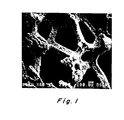
- Fig 1 is an enlarged view, magnified 60X, as seen in an electron photomicrograph of a Ti reticulate, identified geenrally by reference numeral 10.
- the reticulate was made by impregnating an open cell polyurethane foam as described in detail in Example I hereinbelow.
- the typical large pores 12 are in the size range from about 0.05 cm to about 0.5 cm. In addition to these large pores there is a multiplicity of much smaller pores in the range from about 10-125 micrometers which smaller pores are formed as a result of sintering effects on the green reticulate.
- a slurry was produced by mixing approximately 25 ml of boiling water, 500 g of -325 mesh TiH Z powder, and 2.5 g PVA. The very viscous paste-like slurry was heated while stirring to disperse the TiH Z particles thoroughly. The mixture was then blended with an equal volume of polystyrene beads from about 1 mm to about 3 mm diameter. This slurry-coated mass of beads is placed in a porous cylinder provided with a snugly fitting porous piston which is used to maintain sufficient pressure on the mass to assure bead-to-bead contact while the mass is dried in a vacuum oven maintained at about 100°C, overnight, so that substantially all the water is removed.
- the polystyrene beads were then dissolved and washed out with acetone leaving a reticulate having interconnected voids closely visually approximating the shape of the fugitive beads, and held together with dried binder.
- This reticulate was placed in a furnace and baked in an argon atmosphere maintained at very slightly above room pressure (to ensure that air does not leak into the furnace), for from about 3 to 6 hr at just below 400°C which eliminates the PVA, forming a self-supporting green TiH Z reticulate.
- This green reticulate is then heated for about 1 to 4 hr at from 1000°C to about 1300°C, again in an argon atmosphere at substantially ambient pressure, to produce a sintered Ti reticulate having pores in the size range about 10% smaller than the pores in the green reticulate, and a porosity of about 75%.
- the resin is allowed to harden while the beads are maintained in bead-to-bead contact, and the beads are subsequently dissolved and washed out as before to leave a porous structure in which essentially all pores are in open fluid communication.
- This structure is heated to volatilize the resin to yield a green self-supporting reticulate, and subsequently sintered, as described in example I hereinabove.
- the resulting Ti reticulate had a mean pore size of 2.2 mm and the large pores ranged from about 1.7 to about 2.6 mm.
- the porosity was about 80%.
- the sintered reticulate appeared visually identical to the unsintered alumina, and the pressure drop of both air and water through each of the reticulates was substantially the same.
- a 5% by wt solution in water was prepared using a commercially available PVA having a viscosity in water at 20°C of about 24-32 c p .
- PVA a viscosity in water at 20°C of about 24-32 c p .
- Into the solution was stirred -325 mesh TiH 2 powder until a paste-like slurry is formed in which the weight ratio of TiH 2 :slurry is about 50:1.
- This slurry is evenly distributed over one major surface of an open cell polyurethane foam (commercially designated as 10 pore per inch foam) so that the foam contains about 0.6 g TiH 2 /cc of foam.
- This specification is based on the geometrical volume of the foam, indicating that a 1 cm x 1 cm x 1 cm portion of the foam was coated with 0.6 g of powder distributed on the available surface to which the slurry may adhere.
- the coated foam is manipulated to coat all the unitary individual strands within the foam with slurry, and the foam is then 'blown out' with air under pressure to aid in distributing the slurry over all available surfaces.
- the slurry-coated foam is then dried in a convection oven to remove water, followed by heating at about 380°C, and sintering at about 1000°C, as before.
- the Ti reticulate so obtained closely resembled the original polyurethane foam on which the slurry was coated, though the volume of reticulate is about 10% smaller.
- the porosity of the foam is more than 80% and there is no significantly greater pressure drop through the reticulate than there is through the original foam.
- a Ti reticulate made by the procedure described in example IV hereinabove serves as a catalyst support for the evolution of ClO 2 from NaClO 4 .
- the reticulate was coated with a solution of 2 parts ruthenium chloiide, 2 parts rhodium chloride and 1 part titanium chloride in aqueous acidic colution and baked at 530°C for 7 mins.
- a portion weighing 0.9373 g immersed in a solution of 2N Na 2 ClO 4 and 10N H 2 SO 4 evolved 1.4x10 -6 moles/g/sec of C10 2 above the background evolution.
- the apparent surf-2 ace area was 16 cm .
- a cell indicated generally by reference numeral 20 which employs an anode made in accordance withe the instant invention.
- the cell includes a housing 22 divided by a separator 24 into anode 26 and cathode 28 compartments.
- the separator 24 may be a liquid (hydraulically) permeable diaphragm such as is conventionally used in industrial electrolytic cells; or, the separator may be a liquid impermeable cation exchange membrane preferably formed from a perfluorocarbon capable of providing, or being converted to provide, cation exchange functionality.
- the perfluorocarbon copolymer is a vinyl ether copolymer having pendant functional groups, such as the polymer NAFION, marketed by E. I. duPont Company.
- the perfluorocarbon having these pendant functional groups converted to provide active ion exchange sites is available in sheet form. These sites on the sheeted polymer provide ion exchange utility of the. perfluorocarbon polymer making it useful for cation exchange membranes and giving the polymer hydrophilic properties.
- the polymer is prepared from at least two monomers that include fluorine substituted sites. At least one of the monomers comes from a group that comprises vinyl fluoride, hexafluoropropylene, vinylidene fluoride, trifluoroethylene, chlorotrifluoroethylene, perfluoro (alkyl vinyl ether) , tetrafluoroethylene and mixtures thereof.
- At least one of the monomers comes from a grouping having members with functional groups capable of imparting cationic exchange characteristics to the final copolymer.
- Monomers containing pendant sulfonyl, carbonyl or, in some cases phosphonic acid based functional groups are typical examples. Esters,-amides or salts based upon the same functional groups can also be utilized.
- the particular chemical content or structure of the perfluorinated radical linking the sulfonyl group to the copolymer chain is not critical and may have fluorine, chlorine or hydrogen atoms attached to the carbon atom to which the sulfonyl group is attached, although the carbon atom to which the sulfonyl group is attached must also have at least one fluorine atom attached.
- the monomers are perfluorinated. If the sulfonyl group is attached directly to the chain, the carbon in the chain to which it is attached must have a fluorine atom attached to it.
- the R 1 radical of the formula above can be either branched or unbranched, i.e., straight chained, and can have one or more ether linkages.
- Illustrative of such sulfonyl halide containing comonomers are:
- a highly preferred copolymer is one of tetrafluoroethylene and perfluoro(3,6-dioxa-4-methyl-7-octenesulfonyl fluoride) comprising between 10 and 60 weight percent, and preferably between 25 to 40 weight percent, of the latter monomers.
- perfluorinated copolymers may be prepared in any of a number of well-known manners such as is shown and described in U.S. Patent Nos. 3,041,317; 2,393,967; 2,559,752 and 2,593,583.
- the copolymer is readily transformed into a copolymer containing ion exchange sites by conversion of the sulfonyl halide groups (-S0 2 F, SO 2 Cl or -SO 3 alkyl) to the form --SO 3 Z by saponification or the like wherein Z is. hydrogen; an alkali metal such as lithium, sodium, potassium, rubidium and cesium; a quaternary amine; or an alkaline earth metal such as beryllium, magnesium, calcium, strontium and barium.
- the converted copolymer contains sulfonyl group based ion exchange sites contained in side chains of the copolymer and attached to carbon atoms having at least one attached fluorine atom. Not all sulfonyl groups within the intermediate copolymer need be converted. The conversion may be accomplished in any suitable or customary manner such as is shown in U.S. Patent Nos. 3,770,547 and 3,784,399.
- Copolymeric perfluorocarbon having pendant carbonyl based cationic exchange functional groups can be prepared in any suitable or conventional manner such as in accordance with U.S. Patent No. 4,151,053 or Japanese Patent Application 52(1977)38486 or polymerized from a carbonyl functional group containing monomer derived from a sulfonyl group containing monomer by a method such as is shown in_U.S. Patent No. 4,151,053.
- Perfluorocarbons polymerized from these monomers can be satisfactorily utilized as membrane materials in the instant invention.
- the cell housing 22 is made from a material resistant to contents of the electrochemical cell in well known manner.
- the cathode compartment 28 includes a cathode 30 of any suitable or conventional configuration immersed in catholyte 32 contained in the compartment 28.
- This cathode can be reticulate in nature and be positioned to be in physical contact with the separator. Such reticulates should be openly porous and electrically conductive.
- a current feeder 34 electrically connects the cathode 30 with a source or electrical potential (not shown).
- the anode compartment 26 includes an openly porous reticulate anode 40 immersed in an anolyte 42.
- a current conductor 44 electrically connects the anode with the source of electrical potential.
- the current conductor 44 is preferably intermetallically connected to the anode 40 by welding, sintering or other suitable or conventional techniques.
- the reticulate anode is formed in accordance with the method of the best embodiment of the instant invention. Forming can be accomplished by piacement of the diluted dispersion in a cell housing 22 having a sheet metal separator in lieu of a diaphragm or membrane. Depending upon materials of construction of the cell housing, heating and / firing can also be accomplished within the cell confines, though it is generally preferable that the anode shape be removed for these functions.
- the anode 40 generally fills the anode compartment while being in substantial physical contact with whatever separator is being used within the cell.
- Anolyte inlets 46 and outlets 48 are provided upon the housing 22 and anolyte 42 is circulated through the openly porous structure of the anode. Circulation reduces bubble and concentration voltage overpotentials within the openly porous reticulate anode.
- the refractory metal precursor is preferably a valve metal or film forming metal precursor.
- the valve metals include titanium, preferred, aluminum, zirconium, tantalum, tungsten, niobium and hafnium. These valve metals, coated with electrocatalyst, provide generally efficaci.ous anode characteristics for halogen evolution from brine solutions of an alkali or alkaline earth metal salt of the halogen.
- anodes made in accordance with the instant invention can provide efficient utilization of available cation transfer areas of the membrane in a narrow gap configuration wherein the membrane substantially contacts the anode.
Landscapes
- Chemical & Material Sciences (AREA)
- Engineering & Computer Science (AREA)
- Organic Chemistry (AREA)
- Chemical Kinetics & Catalysis (AREA)
- Electrochemistry (AREA)
- Materials Engineering (AREA)
- Metallurgy (AREA)
- Inorganic Chemistry (AREA)
- Manufacturing & Machinery (AREA)
- Mechanical Engineering (AREA)
- Powder Metallurgy (AREA)
- Catalysts (AREA)
- Solid-Phase Diffusion Into Metallic Material Surfaces (AREA)
- Die Bonding (AREA)
- Hydrogen, Water And Hydrids (AREA)
- Electrodes For Compound Or Non-Metal Manufacture (AREA)
Applications Claiming Priority (2)
| Application Number | Priority Date | Filing Date | Title |
|---|---|---|---|
| US39674782A | 1982-07-09 | 1982-07-09 | |
| US396747 | 1982-07-09 |
Publications (2)
| Publication Number | Publication Date |
|---|---|
| EP0099337A2 true EP0099337A2 (de) | 1984-01-25 |
| EP0099337A3 EP0099337A3 (de) | 1986-02-05 |
Family
ID=23568476
Family Applications (1)
| Application Number | Title | Priority Date | Filing Date |
|---|---|---|---|
| EP83810312A Withdrawn EP0099337A3 (de) | 1982-07-09 | 1983-07-08 | Titan und Titanhydrid in Netzform, sowie Verfahren zu deren Herstellung |
Country Status (7)
| Country | Link |
|---|---|
| EP (1) | EP0099337A3 (de) |
| JP (1) | JPS5935691A (de) |
| AU (1) | AU1671483A (de) |
| DK (1) | DK319083A (de) |
| FI (1) | FI832516L (de) |
| IL (1) | IL69192A0 (de) |
| NO (1) | NO832519L (de) |
Cited By (3)
| Publication number | Priority date | Publication date | Assignee | Title |
|---|---|---|---|---|
| WO1997031738A1 (en) * | 1996-02-27 | 1997-09-04 | Astro Met, Inc. | Porous materials and method for producing |
| CN108854968A (zh) * | 2018-06-15 | 2018-11-23 | 同济大学 | 一种弹性可重复吸油密胺海绵及其制备方法 |
| CN110612173A (zh) * | 2017-05-16 | 2019-12-24 | 株式会社Lg化学 | 金属泡沫的制备方法 |
-
1983
- 1983-07-08 EP EP83810312A patent/EP0099337A3/de not_active Withdrawn
- 1983-07-08 IL IL69192A patent/IL69192A0/xx unknown
- 1983-07-09 JP JP58125361A patent/JPS5935691A/ja active Pending
- 1983-07-11 AU AU16714/83A patent/AU1671483A/en not_active Abandoned
- 1983-07-11 FI FI832516A patent/FI832516L/fi not_active Application Discontinuation
- 1983-07-11 NO NO832519A patent/NO832519L/no unknown
- 1983-07-11 DK DK319083A patent/DK319083A/da not_active Application Discontinuation
Non-Patent Citations (1)
| Title |
|---|
| No relevant document have been disclosed * |
Cited By (5)
| Publication number | Priority date | Publication date | Assignee | Title |
|---|---|---|---|---|
| WO1997031738A1 (en) * | 1996-02-27 | 1997-09-04 | Astro Met, Inc. | Porous materials and method for producing |
| CN110612173A (zh) * | 2017-05-16 | 2019-12-24 | 株式会社Lg化学 | 金属泡沫的制备方法 |
| US12097562B2 (en) | 2017-05-16 | 2024-09-24 | Lg Chem, Ltd. | Preparation method for metal foam |
| CN108854968A (zh) * | 2018-06-15 | 2018-11-23 | 同济大学 | 一种弹性可重复吸油密胺海绵及其制备方法 |
| CN108854968B (zh) * | 2018-06-15 | 2020-11-27 | 同济大学 | 一种弹性可重复吸油密胺海绵及其制备方法 |
Also Published As
| Publication number | Publication date |
|---|---|
| AU1671483A (en) | 1984-01-12 |
| FI832516A7 (fi) | 1984-01-10 |
| FI832516A0 (fi) | 1983-07-11 |
| FI832516L (fi) | 1984-01-10 |
| DK319083D0 (da) | 1983-07-11 |
| JPS5935691A (ja) | 1984-02-27 |
| IL69192A0 (en) | 1983-11-30 |
| NO832519L (no) | 1984-01-10 |
| EP0099337A3 (de) | 1986-02-05 |
| DK319083A (da) | 1984-01-10 |
Similar Documents
| Publication | Publication Date | Title |
|---|---|---|
| US4517069A (en) | Titanium and titanium hydride reticulates and method for making | |
| US4853101A (en) | Porous separator comprising inorganic/polymer composite fiber and method of making same | |
| US3980613A (en) | Method of manufacturing electrolysis cell diaphragms | |
| CA1184883A (en) | Ion exchange membrane with non-electrode layer for electrolytic processes | |
| US4720334A (en) | Diaphragm for electrolytic cell | |
| US4032427A (en) | Porous anode separator | |
| US4545886A (en) | Narrow gap electrolysis cells | |
| CA1118558A (en) | Method for forming microporous membrane material | |
| US4680101A (en) | Electrolyte permeable diaphragm including a polymeric metal oxide | |
| US5188712A (en) | Diaphragm for use in chlor-alkali cells | |
| US5015344A (en) | Electrodes with dual porosity | |
| AU583855B2 (en) | Non-organic/polymer fibre composite | |
| US4943496A (en) | Fuel cell, electrode for the cell and method of preparation thereof | |
| RU2070946C1 (ru) | Диафрагма для нанесения на электрод | |
| EP0026979A2 (de) | Elektrolysezelle und Verfahren zur Herstellung eines Alkalimetallhydroxyds und Chlor | |
| KR0174280B1 (ko) | 무석면음극소자 | |
| EP0470186A1 (de) | Poröses mehrschichtdiaphragma | |
| RU2146308C1 (ru) | Электроактивированный материал для катодных элементов и способ его изготовления | |
| US4031041A (en) | Cloth comprising asbestos fibers and method of producing said cloth | |
| BG62785B1 (bg) | Катоден елемент за електролиза на натриев хлорид | |
| US5192401A (en) | Diaphragm for use in chlor-alkali cells | |
| EP0026969A2 (de) | Verfahren zum Binden einer Elektrode an eine Kationenaustauschmembrane | |
| US4427523A (en) | Cathode for electrolysis of alkali metal chloride | |
| US4444640A (en) | Dimensionally stable asbestos-polytetrafluoroethylene diaphragms for chloralkali electrolytic cells | |
| NO832519L (no) | Nettverksgjenstander av ildfast metall og fremgangsmaate ved fremstilling derav |
Legal Events
| Date | Code | Title | Description |
|---|---|---|---|
| PUAI | Public reference made under article 153(3) epc to a published international application that has entered the european phase |
Free format text: ORIGINAL CODE: 0009012 |
|
| AK | Designated contracting states |
Designated state(s): AT BE CH DE FR GB IT LI LU NL SE |
|
| 17P | Request for examination filed |
Effective date: 19840528 |
|
| PUAL | Search report despatched |
Free format text: ORIGINAL CODE: 0009013 |
|
| AK | Designated contracting states |
Designated state(s): AT BE CH DE FR GB IT LI LU NL SE |
|
| STAA | Information on the status of an ep patent application or granted ep patent |
Free format text: STATUS: THE APPLICATION IS DEEMED TO BE WITHDRAWN |
|
| 18D | Application deemed to be withdrawn |
Effective date: 19860806 |
|
| RIN1 | Information on inventor provided before grant (corrected) |
Inventor name: VAUSS, ELVIN M., JR. Inventor name: SANE, AJIT Y. Inventor name: HARNEY, MARILYN J. |