EP0099567A2 - Essai enzymatique et méthode - Google Patents
Essai enzymatique et méthode Download PDFInfo
- Publication number
- EP0099567A2 EP0099567A2 EP83107042A EP83107042A EP0099567A2 EP 0099567 A2 EP0099567 A2 EP 0099567A2 EP 83107042 A EP83107042 A EP 83107042A EP 83107042 A EP83107042 A EP 83107042A EP 0099567 A2 EP0099567 A2 EP 0099567A2
- Authority
- EP
- European Patent Office
- Prior art keywords
- enzyme
- substrate
- activity
- cofactor
- modulator
- Prior art date
- Legal status (The legal status is an assumption and is not a legal conclusion. Google has not performed a legal analysis and makes no representation as to the accuracy of the status listed.)
- Granted
Links
Images




Classifications
-
- C—CHEMISTRY; METALLURGY
- C12—BIOCHEMISTRY; BEER; SPIRITS; WINE; VINEGAR; MICROBIOLOGY; ENZYMOLOGY; MUTATION OR GENETIC ENGINEERING
- C12Q—MEASURING OR TESTING PROCESSES INVOLVING ENZYMES, NUCLEIC ACIDS OR MICROORGANISMS; COMPOSITIONS OR TEST PAPERS THEREFOR; PROCESSES OF PREPARING SUCH COMPOSITIONS; CONDITION-RESPONSIVE CONTROL IN MICROBIOLOGICAL OR ENZYMOLOGICAL PROCESSES
- C12Q1/00—Measuring or testing processes involving enzymes, nucleic acids or microorganisms; Compositions therefor; Processes of preparing such compositions
Definitions
- the present invention concerns analytical enzyme assays and is particularly directed to improvements in the determination of enzymatic rates in analytical assays using specific enzyme modulators.
- the most useful property of that category of proteins known as enzymes is their power to catalyze particular chemical reactions. With very few exceptions, the presence and specific activity of enzymes are measured by the occurrence of specific reactions which convert substrate into end products. Typically, the quantity of active enzyme present in the reaction system is estimated from the speed of reaction under conditions such that the rate of reaction is limited by the concentration of enzyme. The measurement of the reaction velocity, regardless of the type of enzyme or the particular reaction system in which it is used, remains the most critical part of analytical assays. Inaccurate measurement of the enzymatic rate of reaction always reduces the accuracy and precision of the assay.
- a valuable addition to enzymatic analytical assays is the use of active modulators which can alter or modify the characteristic activity of the enzyme, most notably by a change in the speed of conversion of the substrate into product - the reaction velocity.
- active enzyme modulators include accelerators, agents able to increase the velocity of the enzyme reaction, and decelerators, which reduce the velocity of the reaction.
- the category of decelerators is very large and includes enzyme inhibitors which in turn may be subdivided into the classes of reversible inhibitors, irreversible inhibitors, and allosteric effectors.
- An analytical assay system for determining the quantity of an active enzyme modulator in an unknown test sample comprising an enzyme whose activity is altered in the presence of the active modulator; a substrate suitable for conversion into product by the enzyme; a cofactor whose presence is required by the enzyme for conversion of the substrate into reaction product; and means for regenerating at least one reactant from the enzymatic reaction products.
- the regenerated reactant can be either the substrate, the cofactor or both of these.
- the means for such regeneration may form at least one other product in addition to the reactant as a result of the regeneration, the formation of this other product serving as a qualitative and quantitative measure of the active enzyme modulator present in the test sample.
- the means for regenerating the reactant(s) stabilizes the enzyme velocity such that the reaction rate becomes essentially constant over substantial periods of time.
- the present invention is an improvement in analytical assay systems which measure the reaction velocity of an enzyme to determine the presence and concentration of the enzyme in a test sample of unknown composition.
- the analytical assay system comprises a substrate, a cofactor and an active enzyme whose catalytic conversion of substrate into product is followed to determine the amount of active enzyme present. After the enzymatic reaction rate is accurately measured, this rate, in conjunction with a standard curve plotting rate vs. enzyme concentration, will provide an accurate and precise determination of the amount of active enzyme present in the test sample.
- the amount of active enzyme, unaltered by the presence and influence of an active enzyme modulator is the only information sought.
- the change in the amount of active enzyme which remains catalytically functional in the presence of an unknown quantity of an active enzyme modulator is sought to determine the concentration of modulator, such modulators often being enzyme inhibitors.
- a well-known example of an active enzyme modulator is the reversible enzyme inhibitor, methotrexate.
- Methotrexate or its analog aminopterin is also useful when it is conjugated to a ligand (typically an antigen, antibody or therapeutic drug) to determine the total concentration of another corresponding ligand in the test sample.
- ligand typically an antigen, antibody or therapeutic drug
- assay methods have been identified earlier and need not be recited in detail again.
- the preferred embodiments of the present invention utilize one model analytical assay system employing the enzyme dihydrofolate reductase (hereinafter DHFR) and the reversible enzyme inhibitor, methotrexate.
- DHFR enzyme dihydrofolate reductase
- methotrexate the reversible enzyme inhibitor
- the dihydrofolate reductase (hereinafter DHFR) analytical assay system comprises an aqueous solution containing DHFR, dihydrofolate (hereinafter FH 2 ), the reduced cofactor nicotinamide adenine dinucleotide phosphate (hereinafter NADPH) and the various salts and buffers as described herein.
- the DHFR catalyzes the reduction of FH 2 to tetrahydrofolate (hereinafter FH 4 ) with the concomitant oxidation of NADPH to nicotinamide adenine dinucleotide phosphate (hereinafter NADP) as shown in Reaction Scheme 1.
- the velocity at which the DHFR reaction shown in Reaction Scheme 1 proceeds is measured by observing (and recording) the decrease of light absorbance of the reaction solution at 340 nanometers (hereinafter nm). Both FH 2 and NADPH absorb light at 340 nm almost equally at test concentrations. The reaction products, FH 4 and NADP, do not absorb light at this wavelength.
- the DHFR assay is rate limited by the quantity of catalytically active DHFR present in the assay system.
- the rate of reaction is determined by measuring the initial rate of substrate conversion as indicated by the decrease in light absorbance at 340 nm over time, the rate of decrease of absorbance being proportional to the active DHFR concentration in the assay.
- both the FH 2 and the NADPH initially be present and continuously remain in sufficiently high concentrations that the DHFR is saturated - that is, all the catalytic sites present on the enzyme be fully occupied with substrate at all times during the reaction.
- both substrate and cofactor absorb light at 340 nm there are practical limits as to how much of these reactants may be used in the assay. Specifically, because of the dual requirement that the reactants show a high absorbance at 340 nm and yet remain at saturation concentrations in proportion to the quantity of DHFR throughout the assay only a narrow range of DHFR concentrations can be used and accurately measured.
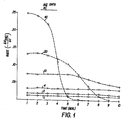
- the observed enzyme reaction rates were measured at varying times using different concentrations of DHFR, all reagents being held constant. Specifically, one milliliter (hereinafter ml) of Brown's reagent was incubated at 30°C, and the enzyme reaction initiated by addition of 20 p1 of DHFR solution at varying concentrations. A unit of DHFR activity is defined as that amount of enzyme catalyzing reduction of one micromole of FH 2 per minute. The rate of reaction was monitored by measuring the change in absorbance of light at 340 nm per minute at one minute intervals for 10 minutes. The results are graphically illustrated in Fig. 1.
- Fig. 1 shows that the Brown reagent formulation produces constant enzyme reaction rates with respect to time only at very low concentrations of DHFR.
- Fig. 1 further shows Reaction Scheme 1 to be a second order reaction in which the concentrations of both reactants, substrate (FH 2 ) and cofactor (NADPH), are the controlling factors.
- the concentrations of the substrate and cofactor must be substantially increased or the quantity of DHFR diluted to lower concentrations.
- Fig. 1 The data shown in Fig. 1 is plotted more informatively as a family of curves in Fig. 2, each curve representing the observed rates of different enzyme concentrations in milliunits per milliliter (hereinafter mU/ml) in the reaction mixture at varying times.
- the single solid line is extrapolated from the rate data obtained during the first minute of reaction time for enzyme concentrations below 10 mU/ml. It is apparent that the observed rates for DHFR fall dramatically from the single solid line as the enzyme concentration increases. Moreover, it is clear that some nonlinearity occurs with high DHFR concentrations even when the rates are measured during the first minute and the deviation from linearity at any given concentration of DHFR increases progressively with greater reaction time.
- G6PDH glucose-6-phosphate dehydrogenase
- the substrate for this additional enzyme is glucose-6-phosphate (hereinafter G6P) which is converted to delta-6 phosphogluconolactone (hereinafter 6-6PG).
- G6P glucose-6-phosphate
- 6-6PG delta-6 phosphogluconolactone
- G6PDH-and G-6-P comprise means for regeneration of NADPH from the NADP formed previously by the DHFR enzymatic reaction.
- This NADPH regeneration means will be more generally referred to as the means for the regeneration of cofactor.
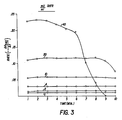
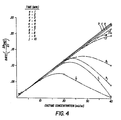
- Figs. 3 and 4 there appear the graphically plotted effect of the cofactor regeneration means upon the DHFR assay system.
- the data was obtained in the following manner. One ml of reagent was incubated at 37°C and the enzyme reaction initiated by addition of 20 pl of diluted DHFR solution varying in concentration from 0.0 to 40 mU/ml. The rate of reaction was monitored by measuring the change in light absorbance at 340 nm per minute at one minute intervals for 10 minutes.
- the NADPH regeneration means provide a substantially constant enzyme velocity even at high concentrations of DHFR over a test interval of 10 minutes.
- THe data in Fig. 3 was replotted in Fig. 4 to show that the cofactor regeneration means produces a marked improvement of linearity even at a 40 mU/ml DHFR concentration.
- the single solid straight line is obtained by extrapolation of rate data measured during the second minute of reaction. Only after the first four minutes of reaction time do the velocity rates for the DHFR reaction begin to deviate from the initial enzyme velocity rate. It is significant that the severity of these observed deviations are comparatively small when judged against those of the Brown reagent illustrated in Fig. 2.
- the overall effect of including the cofactor regeneration means in the DHFR assay system therefore, is to transform the DHFR second order reaction into a first order reaction where the concentration of NADPH no long is a factor controlling or affecting the enzymatic velocity.
- Figure 5 graphically compares the changes in observed reaction rates for the DHFR reaction over increasing time with and without the cofactor regenerating means in the presence of different concentrations of an active enzyme inhibitor.
- One ml of the reagent components of Table 3 were incubated at 37°C and the inhibition reaction initiated by addition of 20 pl of a 1 U/ml solution of DHFR.
- the rates of reaction were monitored by measuring either the change in absorbance at 340 nm at one minute intervals for 10 minutes. Data was obtained under identical conditions except that one set of assays contained regeneration means for NADPH (shown as solid line curves), while the other (shown as broken line curves) lacked the component G-6-PDH.
- All of the assay mixtures contained a constant amount of DHFR although the concentration of DHFR inhibitor was varied.
- the inhibitor used in this study was ligand conjugate of methotrexate, y-(5,5-diphenylhydantoin-3-aceto hydrazide)-methotrexate (hereafter MTX-DPH) which is used in immunoassays to measure the anticonvulsant drug, diphenylhydantoin (DPH).
- MTX-DPH was added at test concentrations of (a) 0 , (b) 1 x 10 8 M , (c) 5 x 10 -8 M, (d) 1 x 10 -7 M, (e) 5 x 10 -7 M, (f) 1 x 10 6 M .
- Figs. 5-7 reveal that as the inhibitor concentrations increases, the measurable DHFR activity decreases.
- the data in Figure 5 indicate that the DHFR assay method without cofactor regeneration means yields different but continuously decreasing rates for each test concentration of MTX-DPH, the inhibitor. It is apparent therefore, that a single test sample containing but one albeit unknown quantity of this inhibitor would empirically designate a wide variety of different reaction rates for DHFR, each of which would indicate a different concentration of MTX-DPH to be present in the one test sample. In comparison, only when the DHFR assay is combined with the cofactor regenerating means do the observed rates become constant and show zero slope over five minutes times.
- DHFR activity is expected to be inversely proportional to the concentration of the inhibitor, it is expected that graphical plots of DHFR reaction rates ( ⁇ A/ ⁇ t) in relation to the inverse of inhibitor concentration will yield substantially straight lines.
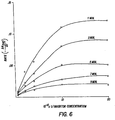
- Figures 6 and 7 show the effect of reaction time on the linearity of the DHFR assay in the presence of the ligand conjugated inhibitor, MTX-DPH, with and without cofactors regeneration means for NADPH.
- the data in Fig. 6 presented are identical to the broken line curves in Fig. 5, but the rates are plotted as an inverse function of the MTX-DPH concentration. Each curve corresponds to the linearity obtained when the rates were measured at the indicated times, 2 minute intervals being used for clarity.
- the concentrations of MTX-DPH used were: 5 x 10 $ M, 1 x 10 -7 M, 5 x 10 -7 M, 1 x 10 -6 M and 5 x 10 M respectively.
- the most dramatic improvement provided by the cofactor regeneration means in the DHFR assay system occurs in two zones: at relatively high inhibitor concentrations where the reaction rates are low; and at very low inhibitor concentrations over extended time intervals.
- a major reason why the cofactor regeneration system causes such a dramatic improvement in linearity of the rate response curves in the presence of an active enzyme modulator is that it effectively converts a bimolecular, second-order reaction into a unimolecular, first-order reaction. Again, this is accomplished by maintaining a constant concentration of NADPH above the Km value of DHFR for NADPH, thus simplifying the overall kinetics of the assay system.
- the preferred embodiment of the present invention additionally provides substrate regeneration means for the DHFR assay system by a nonenzymatic coupling of a tetrazolium dye, 3-(4,5-Dinethylthiazol-2-yl)-2,5-diphenyl-2H-tetrazolium Bromide (hereinafter MTT) with the DHFR produced FH 4 to regenerate FH 2 .
- MTT 3-(4,5-Dinethylthiazol-2-yl)-2,5-diphenyl-2H-tetrazolium Bromide
- the substrate regeneration means comprises the tetrazolium dye, MTT, which is added to the cofactor regeneration means and the DHFR assay earlier described to convert FH 4 into FH 2 .
- MTT tetrazolium dye
- the MTT combines with the FH 4 as it is produced by the DHFR to regenerate FH 2 with the concomitant formation of Red Formazan Dye as a by-product.
- Red Formazan Dye absorbs light only at 568 nm rather than at 340 nm. Accordingly, the regeneration of FH 2 may be followed in time by observation of an increasing absorbance at light at 568 nm indicating a mole for mole conversion of FH 4 into FH 2 .
- this substrate regeneration means When this substrate regeneration means is used in conjunction with the cofactor regeneration means in the DHFR assay system, this combination of regeneration reactions effectively transforms what was originally a second order reaction into a zero order reaction. Concomitantly, there is an additional substantial increase in the linearity of enzyme rate for the DHFR assay.
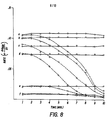
- Fig. 8 which compares the DHFR assay using the substrate regeneration means alone and in combination with the cofactor regeneration means in the presence of the enzyme inhibitor, MTX-DPH.
- TNe reagent components were as indicated in Table 4.
- One ml of the above inhibitor reagents were incubated at 37°C and inhibition reaction initiated by addition of 20 pl of stock solution of DHFR (1 U/ml). The rates of reaction were monitored by measuring the change in absorbance of light at 568 nm at one minute intervals for 10 minutes.
- Fig. 8 The results of these assays are illustrated graphically in Fig. 8 as a series of curves: the solid line curves represent the effect of both the NADPH and FH 2 regenerations means in tandem: the broken line curves portray the effect of the FH 2 regeneration means alone, the G6PDH component being absent.
- the inhibitor, MTX-DPH is present at test concentrations of (a) 0, (b) 1 x 10 -8 M, (c) 5 x 10 -8 M, (d) 1 x 10 -7 M, ( e ) 5 x 10 -7 M, and (f) 1 x 10 -6 M. It is readily apparent from Fig.
- Fig. 9 shows the effect of time on the linearity of the DHFR assay in the presence of MTX-DPH using only substrate regeneration means for FH 2 .
- the data are identical to that of the broken line curves in Fig. 8, but the rates are plotted as a function of inverse inhibitor concentration.
- Each curve in Fig. 9 corresponds to the linearity obtained when the rates were measured at the indicated times.
- the concentrations of MTX-DPH actually used were: 5 x 10 -8 M, 1 x 10 -7 M, 5 x 10 7 M , 1 x 10 6 M , and 5 x 10 -6 m respectively.
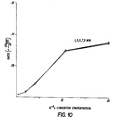
- Fig. 10 shows the additional improved linearity of the DHFR-inhibitor assay obtained when both regenerations means for FH 2 and NADPH are present.
- the data are identical to the solid line curves in Fig. 8, but the rates are again plotted as a function of inverse MTX-DPH concentration. Measurement times and inhibitor concentrations are identical to those in Fig. 9.
- the differing effects are believed to be caused by the difference in binding affinity, as measured by Km, between the enzyme DHFR and the substrate, FH2" compared to the binding affinity between DHFR for the cofactor NADPH.
- the differences in the respective binding affinities and the data of Figs. 6 and 9 demonstrate conclusively that the enzyme DHFR binds the FH 2 more strongly than the NADPH in the assay system. This observation becomes particularly useful under those test circumstances where the investigator must choose between using either the cofactor regeneration means or the substrate regeneration means alone to improve linearity of reaction velocity.
Landscapes
- Chemical & Material Sciences (AREA)
- Organic Chemistry (AREA)
- Life Sciences & Earth Sciences (AREA)
- Zoology (AREA)
- Wood Science & Technology (AREA)
- Proteomics, Peptides & Aminoacids (AREA)
- Health & Medical Sciences (AREA)
- Engineering & Computer Science (AREA)
- Microbiology (AREA)
- Biochemistry (AREA)
- Physics & Mathematics (AREA)
- Molecular Biology (AREA)
- Biotechnology (AREA)
- Biophysics (AREA)
- Analytical Chemistry (AREA)
- Immunology (AREA)
- Bioinformatics & Cheminformatics (AREA)
- General Engineering & Computer Science (AREA)
- General Health & Medical Sciences (AREA)
- Genetics & Genomics (AREA)
- Measuring Or Testing Involving Enzymes Or Micro-Organisms (AREA)
- Investigating Or Analysing Biological Materials (AREA)
Applications Claiming Priority (2)
| Application Number | Priority Date | Filing Date | Title |
|---|---|---|---|
| US39916882A | 1982-07-19 | 1982-07-19 | |
| US399168 | 1982-07-19 |
Publications (3)
| Publication Number | Publication Date |
|---|---|
| EP0099567A2 true EP0099567A2 (fr) | 1984-02-01 |
| EP0099567A3 EP0099567A3 (en) | 1984-05-30 |
| EP0099567B1 EP0099567B1 (fr) | 1989-10-11 |
Family
ID=23578432
Family Applications (1)
| Application Number | Title | Priority Date | Filing Date |
|---|---|---|---|
| EP19830107042 Expired EP0099567B1 (fr) | 1982-07-19 | 1983-07-18 | Essai enzymatique et méthode |
Country Status (5)
| Country | Link |
|---|---|
| EP (1) | EP0099567B1 (fr) |
| JP (1) | JPS5966895A (fr) |
| AU (1) | AU574646B2 (fr) |
| CA (1) | CA1222439A (fr) |
| DE (1) | DE3380698D1 (fr) |
Cited By (1)
| Publication number | Priority date | Publication date | Assignee | Title |
|---|---|---|---|---|
| US4835099A (en) * | 1986-11-20 | 1989-05-30 | Becton, Dickinson And Company | Signal enhancement in immunoassay by modulation of enzymatic catalysis |
Family Cites Families (7)
| Publication number | Priority date | Publication date | Assignee | Title |
|---|---|---|---|---|
| US4230797A (en) * | 1975-04-28 | 1980-10-28 | Miles Laboratories, Inc. | Heterogenous specific binding assay employing a coenzyme as label |
| US4134792A (en) * | 1976-12-06 | 1979-01-16 | Miles Laboratories, Inc. | Specific binding assay with an enzyme modulator as a labeling substance |
| GB1595101A (en) * | 1977-03-15 | 1981-08-05 | Hoffmann La Roche | Enzyme modifier immunoassay |
| IT1105734B (it) * | 1977-07-14 | 1985-11-04 | Syva Co | Prova di legame di competizione di antienzima omogeneo |
| DE2924249C2 (de) * | 1978-06-22 | 1989-04-27 | Miles, Inc., Elkhart, Ind., Us | Spezifische bindungs-untersuchungsmethode zur bestimmung eines liganden in einem fluessigen medium und reagentien zur durchfuehrung dieser methode |
| US4394449A (en) * | 1980-02-13 | 1983-07-19 | Modrovich Ivan Endre | Stabilization of coenzymes in aqueous solution |
| EP0099742A1 (fr) * | 1982-07-17 | 1984-02-01 | Grand Metropolitan Biotechnology Ltd. | Procédé de réaction enzymatique |
-
1983
- 1983-07-08 AU AU16666/83A patent/AU574646B2/en not_active Ceased
- 1983-07-18 DE DE8383107042T patent/DE3380698D1/de not_active Expired
- 1983-07-18 JP JP12958683A patent/JPS5966895A/ja active Granted
- 1983-07-18 CA CA000432658A patent/CA1222439A/fr not_active Expired
- 1983-07-18 EP EP19830107042 patent/EP0099567B1/fr not_active Expired
Cited By (1)
| Publication number | Priority date | Publication date | Assignee | Title |
|---|---|---|---|---|
| US4835099A (en) * | 1986-11-20 | 1989-05-30 | Becton, Dickinson And Company | Signal enhancement in immunoassay by modulation of enzymatic catalysis |
Also Published As
| Publication number | Publication date |
|---|---|
| EP0099567A3 (en) | 1984-05-30 |
| AU1666683A (en) | 1984-01-26 |
| JPS5966895A (ja) | 1984-04-16 |
| DE3380698D1 (en) | 1989-11-16 |
| CA1222439A (fr) | 1987-06-02 |
| JPH0443639B2 (fr) | 1992-07-17 |
| AU574646B2 (en) | 1988-07-14 |
| EP0099567B1 (fr) | 1989-10-11 |
Similar Documents
| Publication | Publication Date | Title |
|---|---|---|
| Galbán et al. | Direct determination of uric acid in serum by a fluorometric-enzymatic method based on uricase | |
| US4629697A (en) | Test system and procedure for the determination of NAD (P) H | |
| US4357420A (en) | Bioluminescence methods for enzymatic determinations | |
| Hatfield et al. | Threonine Deaminase from Bacillus subtilis: II. THE STEADY STATE KINETIC PROPERTIES | |
| Lagocki et al. | Kinetic analysis of the action of soybean lipoxygenase on linoleic acid. | |
| Carrico et al. | A method for monitoring specific binding reactions with cofactor labeled ligands | |
| Assolant-Vinet et al. | A novel enzyme membrane electrode for oxalate determination in foodstuffs | |
| Boo et al. | An improved method to measure nitrate/nitrite with an NO-selective electrochemical sensor | |
| Tang et al. | Electrochemical enzyme immunoassay for phenytoin by flow-injection analysis incorporating a redox coupling agent | |
| MAcGIBBON et al. | Evidence for two-step binding of reduced nicotinamide-adenine dinucleotide to aldehyde dehydrogenase | |
| EP0099567B1 (fr) | Essai enzymatique et méthode | |
| Schroeder et al. | Specific binding reactions monitored with ligand-cofactor conjugates and bacterial luciferase | |
| NL7906143A (nl) | Werkwijze voor het bepalen van glutamaatoxaalacetaat- transaminase of glutamaatpyruvaattransaminase en een reagenscombinatie, voor de bepaling hiervan. | |
| AU611218B2 (en) | Method for self-performing enzyme kinetics | |
| CA2111168A1 (fr) | Reactif simple stable sous forme liquide utilise pour le dosage du gaz carbonique dans le serum | |
| US5589349A (en) | Method for enzymatic analysis and reagant therefor | |
| EP0085954B1 (fr) | Incorporation de pyridoxalphosphate dans un agent analytique sec pour la détermination des enzymes | |
| JPS63226299A (ja) | アミノ酸の選択的定量法 | |
| EP0598620A2 (fr) | Système et kit analytique pour phosphatase | |
| Kamoun et al. | Ultramicromethod for determination of plasma uric acid. | |
| Bannister et al. | Development of amperometric biosensors for enzyme immunoassay | |
| Kayamori et al. | Enzymatic method for assaying uric acid in serum with a new tetrazolium salt produces water-soluble formazan dye | |
| Tiffany et al. | Feasibility of multiple simultaneous enzyme assays, for diagnostic purposes, with the GeMSAEC fast analyzer | |
| Tabata et al. | A chemiluminescence-flow injection analysis of serum 3-hydroxybutyrate using a bioreactor consisting of 3-hydroxybutyrate dehydrogenase and NADH oxidase | |
| Sánchez-Cabezudo et al. | Fluorimetric-flow injection determination of theophylline based on its inhibitory effect on immobilized alkaline phosphatase |
Legal Events
| Date | Code | Title | Description |
|---|---|---|---|
| PUAI | Public reference made under article 153(3) epc to a published international application that has entered the european phase |
Free format text: ORIGINAL CODE: 0009012 |
|
| AK | Designated contracting states |
Designated state(s): DE FR GB IT NL |
|
| PUAL | Search report despatched |
Free format text: ORIGINAL CODE: 0009013 |
|
| AK | Designated contracting states |
Designated state(s): DE FR GB IT NL |
|
| TCNL | Nl: translation of patent claims filed | ||
| 17P | Request for examination filed |
Effective date: 19841128 |
|
| RAP1 | Party data changed (applicant data changed or rights of an application transferred) |
Owner name: COOPERBIOMEDICAL, INC. |
|
| GRAA | (expected) grant |
Free format text: ORIGINAL CODE: 0009210 |
|
| AK | Designated contracting states |
Kind code of ref document: B1 Designated state(s): DE FR GB IT NL |
|
| REF | Corresponds to: |
Ref document number: 3380698 Country of ref document: DE Date of ref document: 19891116 |
|
| ET | Fr: translation filed | ||
| ITF | It: translation for a ep patent filed | ||
| RAP2 | Party data changed (patent owner data changed or rights of a patent transferred) |
Owner name: TECHNICON INSTRUMENTS CORPORATION(A DELAWARE CORPO |
|
| ITTA | It: last paid annual fee | ||
| PLBE | No opposition filed within time limit |
Free format text: ORIGINAL CODE: 0009261 |
|
| STAA | Information on the status of an ep patent application or granted ep patent |
Free format text: STATUS: NO OPPOSITION FILED WITHIN TIME LIMIT |
|
| 26N | No opposition filed | ||
| PGFP | Annual fee paid to national office [announced via postgrant information from national office to epo] |
Ref country code: FR Payment date: 19920610 Year of fee payment: 10 |
|
| PGFP | Annual fee paid to national office [announced via postgrant information from national office to epo] |
Ref country code: DE Payment date: 19920611 Year of fee payment: 10 |
|
| PGFP | Annual fee paid to national office [announced via postgrant information from national office to epo] |
Ref country code: GB Payment date: 19920626 Year of fee payment: 10 |
|
| PGFP | Annual fee paid to national office [announced via postgrant information from national office to epo] |
Ref country code: NL Payment date: 19920731 Year of fee payment: 10 |
|
| PG25 | Lapsed in a contracting state [announced via postgrant information from national office to epo] |
Ref country code: GB Effective date: 19930718 |
|
| PG25 | Lapsed in a contracting state [announced via postgrant information from national office to epo] |
Ref country code: NL Effective date: 19940201 |
|
| GBPC | Gb: european patent ceased through non-payment of renewal fee |
Effective date: 19930718 |
|
| NLV4 | Nl: lapsed or anulled due to non-payment of the annual fee | ||
| PG25 | Lapsed in a contracting state [announced via postgrant information from national office to epo] |
Ref country code: FR Effective date: 19940331 |
|
| PG25 | Lapsed in a contracting state [announced via postgrant information from national office to epo] |
Ref country code: DE Effective date: 19940401 |
|
| REG | Reference to a national code |
Ref country code: FR Ref legal event code: ST |