EP0100104B1 - Dérivés de muramyldipeptides - Google Patents
Dérivés de muramyldipeptides Download PDFInfo
- Publication number
- EP0100104B1 EP0100104B1 EP83107417A EP83107417A EP0100104B1 EP 0100104 B1 EP0100104 B1 EP 0100104B1 EP 83107417 A EP83107417 A EP 83107417A EP 83107417 A EP83107417 A EP 83107417A EP 0100104 B1 EP0100104 B1 EP 0100104B1
- Authority
- EP
- European Patent Office
- Prior art keywords
- compound
- alanyl
- thio
- acetamido
- deoxy
- Prior art date
- Legal status (The legal status is an assumption and is not a legal conclusion. Google has not performed a legal analysis and makes no representation as to the accuracy of the status listed.)
- Expired
Links
- 0 *C(C*1**N*C(N)=O)C(CO)OC(*)C1N* Chemical compound *C(C*1**N*C(N)=O)C(CO)OC(*)C1N* 0.000 description 5
Classifications
-
- C—CHEMISTRY; METALLURGY
- C07—ORGANIC CHEMISTRY
- C07K—PEPTIDES
- C07K9/00—Peptides having up to 20 amino acids, containing saccharide radicals and having a fully defined sequence; Derivatives thereof
- C07K9/001—Peptides having up to 20 amino acids, containing saccharide radicals and having a fully defined sequence; Derivatives thereof the peptide sequence having less than 12 amino acids and not being part of a ring structure
- C07K9/005—Peptides having up to 20 amino acids, containing saccharide radicals and having a fully defined sequence; Derivatives thereof the peptide sequence having less than 12 amino acids and not being part of a ring structure containing within the molecule the substructure with m, n > 0 and m+n > 0, A, B, D, E being heteroatoms; X being a bond or a chain, e.g. muramylpeptides
-
- A—HUMAN NECESSITIES
- A61—MEDICAL OR VETERINARY SCIENCE; HYGIENE
- A61P—SPECIFIC THERAPEUTIC ACTIVITY OF CHEMICAL COMPOUNDS OR MEDICINAL PREPARATIONS
- A61P37/00—Drugs for immunological or allergic disorders
- A61P37/02—Immunomodulators
- A61P37/04—Immunostimulants
Definitions
- This invention relates to novel muramyldipeptide derivatives having excellent immunoadjuvaant activity and prophylactic and therapeutic effects against microbial infections and antitumor activity and, more specifically, this invention relates to a muramyldipeptide derivative represented by the formula (I): wherein Ala represents alanine; Acyl represents an acyl group having 2 to 40 carbon atoms; R, and R 2 each represents a hydrogen atom, or R, and R 2 , when taken together, may form an alkylidene group having 1 to 6 carbon atoms; R 3 represents a hydrogen atom, an acyl group having 2 to 40 carbon atoms or an alkyl group having 1 to 40 carbon atoms; and R 4 represents a hydrogen atom or an alkyl group having 1 to 20 carbon atoms.
- Ala represents alanine
- Acyl represents an acyl group having 2 to 40 carbon atoms
- R, and R 2 each represents a hydrogen atom, or R, and R 2
- the compounds according to the present invention are of low toxicity and possess excellent immunoadjuvant activity and, therefore, can be useful for various diseases attributed to reduction in immunity function, for example, as prophylactic and therapeutic agents against microbial infections, antitumor agents and the like.
- the muramyldipeptide derivatives of the present invention are represented by the formula (I) wherein Ala represents alanine; Acyl represents an acyl group having 2 to 40 carbon atoms; R, and R 2 each represents a hydrogen atom, or R, and R 2 , when taken together, may form an alkylidene group having 1 to 6 carbon atoms; R 3 represents a hydrogen atom, an acyl group having 2 to 40 carbon atoms or an alkyl group having 1 to 40 carbon atoms; and R 4 represents a hydrogen atom or an alkyl group having 1 to 20 carbon atoms.
- Ala represents alanine
- Acyl represents an acyl group having 2 to 40 carbon atoms
- R, and R 2 each represents a hydrogen atom, or R, and R 2 , when taken together, may form an alkylidene group having 1 to 6 carbon atoms
- R 3 represents a hydrogen atom, an acyl group having 2 to 40 carbon atoms or an al
- a further preferred class of compounds according to the invention is that having the formula (1) above wherein R 1 and R 2 each represents a hydrogen atom; R 3 represents an acyl group having 2 to 40 carbon atoms; and R 4 represents an alkyl group having 1 to 20 carbon atoms.
- Particularly preferred compounds of the present invention are 2-acetamido-2-deoxy-1-S-decanoyl-3-0-(D-2-propanoyl-L-alanyl-D-isoglutamine methyl ester)-1-thio- ⁇ -D-glucopyranose, 2-acetamido-1-S-acetyl-2-deoxy-3-O-(D-2-propanoyl-L-alanyl-D-isoglutamine methyl ester)-1-thio- ⁇ -D-glucopyranose, 2-acetamido-2-deoxy-3-0-(D-2-propanoyl-L-alanyl-D-isoglutamine methyl ester)-1-thio- ⁇ -D-glucopyranose, 2-acetamido-2-deoxy-3-O-(D-2-propanoyl-L-alanyl-D-isoglutamine)-1-thio- ⁇ -D-glucopyranose, 2-acetamido
- the adjuvant activity was confirmed by the enhancing activity on the induction of delayed-type hypersensitivity to N-acetyltyrosine-3-azobenzene-4'-arsonic acid (hereinafter referred to as ABA-N-Ac-Tyr) in guinea pig.
- ABA-N-Ac-Tyr N-acetyltyrosine-3-azobenzene-4'-arsonic acid
- a water-in-oil emulsion prepared by mixing 50 pg/animal of ABA-N-Ac-Tyr and 100 pg/animal of each of the compounds of the present invention with Freund's incomplete adjuvant (hereinafter referred to as FIA) was administered to the soles of guinea pigs.
- FIA Freund's incomplete adjuvant
- 100 pg of 3-azobenzene-4'-arsonic acid bonded to bovine serum albumin hereinafter referred to as ABA-BSA
- ABA-BSA 3-azobenzene-4'-arsonic acid bonded to bovine serum albumin
- mice Groups of 20 STD-ddy male mice, 5 weeks of age, were used.
- Bacteria E. Coli E77156 which has been maintained in a freezed-culture was used.
- Treatment and Infection The animals were treated subcutaneously with 0.2 ml of each of the above solution or suspension (equivalent to 100 pg/mouse), followed by the subcutaneous challenge with E. coli 24 hours later.
- a mixture of tumor cells (Meth-A, 1.5 x 10 6 ) and 100 pg of Compound 20 of the present invention suspended in PBS was inoculated intradermally in BALB/c mice. Suppression of Meth-A growth in BALB/c on the 27th day after inoculation was found to be 5/9. The value is expressed in terms of the number of tumor-free mice/the number of mice tested.
- test compounds used in the above experiments (1), (2) and (3) are as follows.
- R s represents a hydrogen atom or an alkyl group having 1 to 6 carbon atoms
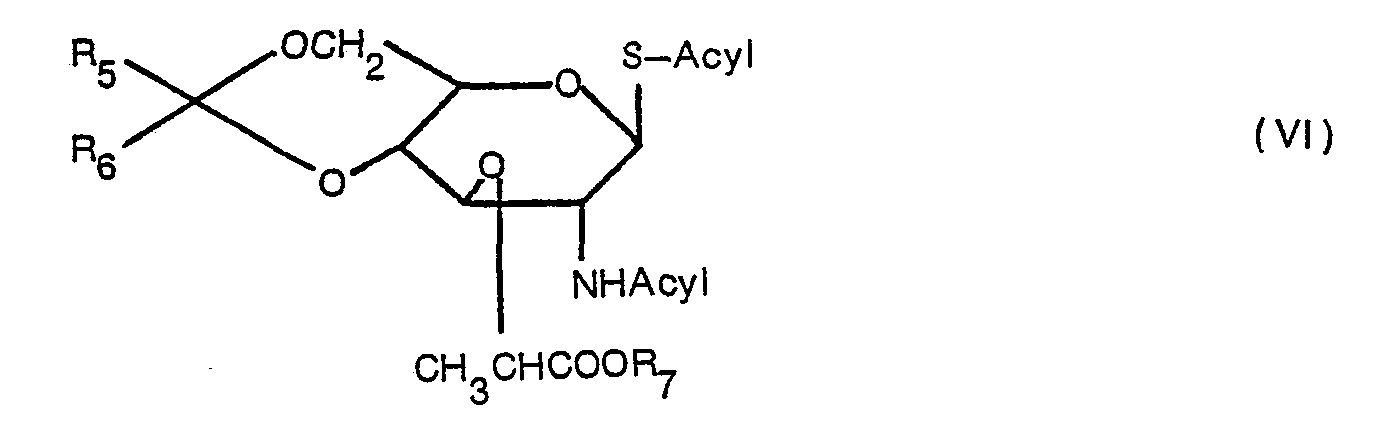
- R 6 and R 7 each represents an alkyl group having 1 to 6 carbon atoms.
- the compound (11) is oxidized in the presence of a solvent, such as dichloromethane, using a chromic anhydride-pyridine complex at a temperature of about 0°C to 60°C to obtain the compound (III).
- the compound (III) is reacted with a metal alcoholate in an alcohol solvent to obtain the compound (IV).
- the compound (IV) is dissolved in a solvent, such as a mixed solvent of dichloromethane and carbon tetrachloride, and then reacted with hexamethylphosphorus triamide [P(NMe 2 ) 3 ] at a low temperature, preferably -40°C or lower, to obtain the compound (V).
- the compound (V) is dissolved in a solvent or a mixture of solvents, for example, a mixture of dichloromethane and acetone, and reacted with an alkali thio-organic acid, for example, potassium thioacetate (CH 3 COSK), to obtain the compound (VI).
- the compound (VI) is reacted with an alkali hydroxide in the presence of a solvent, such as dioxane, to hydrolyze the S-acetyl group and alkoxycarbonyl group and then the hydrolysate is reacted with an organic acid anhydride such as acetic anhydride, and triethylamine to acylate the SH group thereby obtaining the compound (VII).
- the compound (VII) thus obtained is then condensed with an alanyl-isoglutamine alkyl ester to obtain the desired compound of the formula (I) wherein R, and R 2 are bonded together to form an alkylidene group; R 3 is an acyl group; and R 4 is an alkyl group.
- the above condensation reaction can be carried out by methods commonly employed for peptide syntheses, i.e., carbodiimide method, active ester method and acid anhydride method.
- the compound (VII) is dissolved in a solvent such as dioxane, and dicyclohexylcarbodiimide and N-hydroxysuccinic acid imide or 1-hydroxybenzotriazole are added to the solution at about 0°C to 60°C to form an active ester of the compound (VII).
- a solvent such as dioxane
- dicyclohexylcarbodiimide and N-hydroxysuccinic acid imide or 1-hydroxybenzotriazole are added to the solution at about 0°C to 60°C to form an active ester of the compound (VII).
- an L-alanyl-D-isoglutamine alkyl ester at about 0°C to 60°C to obtain the above-described compound (II).
- the S-acyl group of the compound (I) thus obtained can be converted into a free SH group by reacting the compound (I) with a metal alcoholate in an alcoholic solution at about 0°C to room temperature, followed by neutralization with a cation exchange resin.
- the thus obtained SH-compound may be converted into an S-acylated compound by reacting with an acyl halide in a solvent, such as dichloromethane, in the presence of an acid acceptor such as pyridine, at about -10 0 C to 50°C.
- the S-alkylated compound can be obtained by reacting the above S-acylated compound with a sodium alcoholate in an alcohol and, without conducting neutralization, the resulting product is then reacted with an alkyl halide at 0° to 40°C.
- the alkylidene group can be released by reacting with a 50-90% aqueous solution of acetic acid at room temperature to 100°C.
- the conversion of the alkoxycarbonyl group to a carboxyl group can be accomplished by reacting with an aqueous alkali hydroxide solution in an alcoholic solution at 0° to room temperature and then neutralizing with a cation exchange resin.
- reaction mixture was stirred at 45°C for 3 hours and passed through a column of silica gel (Wako-C-200, 20 g), and the column was eluted with ethyl acetate to obtain 170 mg (yield: 92%) of 2-acetamido-1-o-benzoyl-2-deoxy-4,6-O-isopropylidene-3-O-[D-1-(methoxycarbonyl)ethyl]- ⁇ -D-glucopyranose (compound III) having a melting point of 134-137°C.
- Example 10 60 mg of Compound 12 as prepared in Example 10 was dissolved in a mixture of 2 ml of anhydrous dichloromethane and 1 ml of pyridine, and 1 ml of dichloromethane containing 40 mg of hexadecanoyl chloride was added thereto under cooling. The reaction completed in 1 hour. To the reaction mixture was added 1 ml of methanol, and the mixture was concentrated under reduced pressure. The resulting syrup was extracted with chloroform, washed with water and dried over sodium sulfate.
- Example 1-(5) 80 mg of Compound 1 as prepared in Example 1-(5) was dissolved in 5 ml of absolute methanol, and 10 mg of sodium methoxide was added thereto. After the mixture was allowed to stand at room temperature for 1 hour, 5 ml of 0.2M potassium hydroxide was added thereto. Five minutes later, the base was removed by treating with Amberlite IRC-50 (H + ) resin, and the resin was washed with methanol.
- Eluant (a) gave 65 mg of amorphous 2-acetamido-2-deoxy-1-S-decanoyl-4,6-0-isopropylidene-3-O-(D-2-propanoyl-L-alanyl-D-isoglutamine methyl ester)-1-thio- ⁇ -D-glucopyranose.
Landscapes
- Chemical & Material Sciences (AREA)
- Health & Medical Sciences (AREA)
- Organic Chemistry (AREA)
- Immunology (AREA)
- General Health & Medical Sciences (AREA)
- Medicinal Chemistry (AREA)
- Life Sciences & Earth Sciences (AREA)
- Biochemistry (AREA)
- Biophysics (AREA)
- Genetics & Genomics (AREA)
- Molecular Biology (AREA)
- Proteomics, Peptides & Aminoacids (AREA)
- Crystallography & Structural Chemistry (AREA)
- Bioinformatics & Cheminformatics (AREA)
- Engineering & Computer Science (AREA)
- Chemical Kinetics & Catalysis (AREA)
- General Chemical & Material Sciences (AREA)
- Nuclear Medicine, Radiotherapy & Molecular Imaging (AREA)
- Pharmacology & Pharmacy (AREA)
- Animal Behavior & Ethology (AREA)
- Public Health (AREA)
- Veterinary Medicine (AREA)
- Medicines That Contain Protein Lipid Enzymes And Other Medicines (AREA)
- Peptides Or Proteins (AREA)
- Saccharide Compounds (AREA)
- Medicines Containing Antibodies Or Antigens For Use As Internal Diagnostic Agents (AREA)
Claims (11)



Applications Claiming Priority (2)
| Application Number | Priority Date | Filing Date | Title |
|---|---|---|---|
| JP57130705A JPS5920297A (ja) | 1982-07-27 | 1982-07-27 | ムラミルジペプチド誘導体 |
| JP130705/82 | 1982-07-27 |
Publications (2)
| Publication Number | Publication Date |
|---|---|
| EP0100104A1 EP0100104A1 (fr) | 1984-02-08 |
| EP0100104B1 true EP0100104B1 (fr) | 1986-01-29 |
Family
ID=15040646
Family Applications (1)
| Application Number | Title | Priority Date | Filing Date |
|---|---|---|---|
| EP83107417A Expired EP0100104B1 (fr) | 1982-07-27 | 1983-07-27 | Dérivés de muramyldipeptides |
Country Status (4)
| Country | Link |
|---|---|
| US (1) | US4606857A (fr) |
| EP (1) | EP0100104B1 (fr) |
| JP (1) | JPS5920297A (fr) |
| DE (1) | DE3362023D1 (fr) |
Cited By (1)
| Publication number | Priority date | Publication date | Assignee | Title |
|---|---|---|---|---|
| WO2011110723A1 (fr) * | 2010-03-12 | 2011-09-15 | Consejo Superior De Investigaciones Científicas (Csic) | Dérivés soufrés de n-acétylhexosamines et leur utilisation en tant qu'inhibiteurs de la division de cellules tumorales |
Families Citing this family (8)
| Publication number | Priority date | Publication date | Assignee | Title |
|---|---|---|---|---|
| JPS61197598A (ja) * | 1985-02-27 | 1986-09-01 | Akira Hasegawa | S−ムラミルジペプチド誘導体 |
| JPS61275299A (ja) * | 1985-05-29 | 1986-12-05 | Akira Hasegawa | デオキシムラミルジペプチド誘導体 |
| DE3604681A1 (de) * | 1986-02-14 | 1987-08-20 | Bayer Ag | Neue n-glycosylamidderivate, verfahren zu ihrer herstellung sowie ihre verwendung als arzneimittel |
| US4895835A (en) * | 1987-11-20 | 1990-01-23 | Nisshin Oil Mills, Ltd. | Muramyl peptide derivatives and use thereof |
| RU2083588C1 (ru) * | 1995-09-11 | 1997-07-10 | Безруков Михаил Васильевич | Способ получения мурамилпептидов |
| WO1998046251A1 (fr) * | 1997-04-11 | 1998-10-22 | Oleg Vitalievich Kaljuzhin | Regulateur immunologique, composition pharmaceutique possedant une activite antitumorale et additif alimentaire |
| US20020193295A1 (en) * | 2001-05-04 | 2002-12-19 | Emanuel Calenoff | Immunogenic peptides and uses thereof |
| EP3239139B1 (fr) | 2010-05-27 | 2020-10-28 | Ningbo Combireg Pharmaceutical Technology Co. Ltd | Synthèse chimique et effets antitumoraux et antimétastatiques d'un conjugué à double fonction |
Family Cites Families (10)
| Publication number | Priority date | Publication date | Assignee | Title |
|---|---|---|---|---|
| FR2321896A1 (fr) * | 1975-08-29 | 1977-03-25 | Anvar | Agents adjuvants immunologiques actifs en solution aqueuse |
| FR2326930A1 (fr) * | 1975-10-09 | 1977-05-06 | Anvar | Agents hydrosolubles depresseurs non specifiques des reponses immunitaires |
| FR2369292A1 (fr) * | 1976-11-02 | 1978-05-26 | Anvar | Agents adjuvants immunit |
| US4153684A (en) * | 1976-03-10 | 1979-05-08 | Agence Nationale De Valorisation De La Recherche (Anvar) | Immunizing and anti-infectious adjuvant agents constituted by N-acetyl-muramyl-L-alanyl-D-glutamic acid derivatives |
| US4082736A (en) * | 1976-04-26 | 1978-04-04 | Syntex (U.S.A.) Inc. | Novel immunological adjuvant compounds and methods of preparation thereof |
| GB1563561A (en) * | 1976-06-23 | 1980-03-26 | Daiichi Seiyaku Co | Muramyldipeptide derivatives and process for the preparation thereof |
| CA1185237A (fr) * | 1979-02-28 | 1985-04-09 | Yuichi Yamamura | Derives de 6 desoxyglucosamine-peptide; preparation et utilisation |
| JPS5618996A (en) * | 1979-06-21 | 1981-02-23 | Dai Ichi Seiyaku Co Ltd | Muramyldipeptide derivative |
| US4357322A (en) * | 1980-07-29 | 1982-11-02 | Syntex (U.S.A.) Inc. | Method of preventing, reducing or inhibiting inflammation |
| GR78246B (fr) * | 1981-01-23 | 1984-09-26 | Ciba Geigy Ag |
-
1982
- 1982-07-27 JP JP57130705A patent/JPS5920297A/ja active Granted
-
1983
- 1983-07-27 EP EP83107417A patent/EP0100104B1/fr not_active Expired
- 1983-07-27 DE DE8383107417T patent/DE3362023D1/de not_active Expired
- 1983-07-27 US US06/517,551 patent/US4606857A/en not_active Expired - Fee Related
Cited By (2)
| Publication number | Priority date | Publication date | Assignee | Title |
|---|---|---|---|---|
| WO2011110723A1 (fr) * | 2010-03-12 | 2011-09-15 | Consejo Superior De Investigaciones Científicas (Csic) | Dérivés soufrés de n-acétylhexosamines et leur utilisation en tant qu'inhibiteurs de la division de cellules tumorales |
| ES2365314A1 (es) * | 2010-03-12 | 2011-09-29 | Consejo Superior De Investigaciones Cientificas (Csic) | Derivados azufrados de n-acetilhexosaminas y su uso como inhibidores de la división de células tumorales. |
Also Published As
| Publication number | Publication date |
|---|---|
| DE3362023D1 (de) | 1986-03-13 |
| US4606857A (en) | 1986-08-19 |
| JPS5920297A (ja) | 1984-02-01 |
| EP0100104A1 (fr) | 1984-02-08 |
| JPH0330600B2 (fr) | 1991-04-30 |
Similar Documents
| Publication | Publication Date | Title |
|---|---|---|
| US4101536A (en) | Muramyldipeptide derivatives and process for the preparation thereof | |
| US4659825A (en) | Isomeric O-phosphonylmethyl derivatives of enantiomeric and racemic 9-(2,3-dihydroxypropyl)adenine | |
| US4317771A (en) | Muramyldipeptide derivatives | |
| HK85787A (en) | Lipophilic muramyl peptides, processes for their preparation and their use | |
| EP0014984B1 (fr) | Dérivés peptidiques de la glucosamine, leur préparation et leur utilisation | |
| US4307229A (en) | 6,6'-Diesters of trehalose and process for the synthesis thereof | |
| CS205025B2 (en) | Process for preparing derivatives of glukosamine | |
| EP0015468B1 (fr) | Dérivés peptidiques de la 6-déoxyglucosamine, leur préparation et leur utilisation | |
| EP0100104B1 (fr) | Dérivés de muramyldipeptides | |
| EP0228612A2 (fr) | Dérivé de l'alpha, alpha-tréhalose ainsi que procédé de préparation dudit composé | |
| DD202169A5 (de) | Verfahren zur herstellung von hexapyranoseverbindungen | |
| US4315913A (en) | Immunologically active dipeptidyl 2-amino-1,2-dideoxy-D-glucose derivatives and methods of preparation | |
| US4310514A (en) | Immunologically active dipeptidyl 5-0,6-0-acyl-2-amino-2-deoxy-D-glucofuranose derivatives and methods of preparation | |
| JPH0371440B2 (fr) | ||
| AU595987B2 (en) | Disaccharide derivatives | |
| EP0219070B1 (fr) | Procédé pour la préparation de dérivés de l'acide N-glycolylneuramique | |
| EP0222172B1 (fr) | Dérivé de l'acide N-glycolylneuraminique | |
| EP0013856B1 (fr) | Composés associant des restes peptidyliques ou aminoacylés à des groupes lipophyles et compositions pharmaceutiques les contenant | |
| CA1249400A (fr) | Derives de muramyldipeptide | |
| Kiso et al. | Synthesis of 1, 5-Anhydro-2-deoxy-4-O-phosphono-3-O-tetradecanoyl-2-[(3 R)-and (3 S)-3-Tetradecanoyloxytetradecanamido]-D-glucitol (GLA-40) Related to Bacterial Lipid A | |
| JPH0352478B2 (fr) | ||
| JPH0560474B2 (fr) | ||
| US3950325A (en) | Novel process for preparing 2,2'-cyclocytidine or 1-β-D-arabinofuranosyl cytosine | |
| US5432267A (en) | Amino sugar derivatives | |
| US4482545A (en) | Isoefrotomycin, process of preparation, pharmaceutical composition and method of using same |
Legal Events
| Date | Code | Title | Description |
|---|---|---|---|
| PUAI | Public reference made under article 153(3) epc to a published international application that has entered the european phase |
Free format text: ORIGINAL CODE: 0009012 |
|
| AK | Designated contracting states |
Designated state(s): CH DE FR GB IT LI |
|
| 17P | Request for examination filed |
Effective date: 19840430 |
|
| ITF | It: translation for a ep patent filed | ||
| GRAA | (expected) grant |
Free format text: ORIGINAL CODE: 0009210 |
|
| AK | Designated contracting states |
Designated state(s): CH DE FR GB IT LI |
|
| ET | Fr: translation filed | ||
| REF | Corresponds to: |
Ref document number: 3362023 Country of ref document: DE Date of ref document: 19860313 |
|
| PLBE | No opposition filed within time limit |
Free format text: ORIGINAL CODE: 0009261 |
|
| STAA | Information on the status of an ep patent application or granted ep patent |
Free format text: STATUS: NO OPPOSITION FILED WITHIN TIME LIMIT |
|
| 26N | No opposition filed | ||
| PGFP | Annual fee paid to national office [announced via postgrant information from national office to epo] |
Ref country code: GB Payment date: 19920717 Year of fee payment: 10 |
|
| PGFP | Annual fee paid to national office [announced via postgrant information from national office to epo] |
Ref country code: FR Payment date: 19920730 Year of fee payment: 10 |
|
| ITTA | It: last paid annual fee | ||
| PGFP | Annual fee paid to national office [announced via postgrant information from national office to epo] |
Ref country code: CH Payment date: 19920805 Year of fee payment: 10 |
|
| ITPR | It: changes in ownership of a european patent |
Owner name: CAMBIO RAGIONE SOCIALE;DAIICHI PHARMACEUTICAL CO., |
|
| PGFP | Annual fee paid to national office [announced via postgrant information from national office to epo] |
Ref country code: DE Payment date: 19920928 Year of fee payment: 10 |
|
| PG25 | Lapsed in a contracting state [announced via postgrant information from national office to epo] |
Ref country code: GB Effective date: 19930727 |
|
| PG25 | Lapsed in a contracting state [announced via postgrant information from national office to epo] |
Ref country code: LI Effective date: 19930731 Ref country code: CH Effective date: 19930731 |
|
| GBPC | Gb: european patent ceased through non-payment of renewal fee |
Effective date: 19930727 |
|
| PG25 | Lapsed in a contracting state [announced via postgrant information from national office to epo] |
Ref country code: FR Effective date: 19940331 |
|
| REG | Reference to a national code |
Ref country code: CH Ref legal event code: PL |
|
| PG25 | Lapsed in a contracting state [announced via postgrant information from national office to epo] |
Ref country code: DE Effective date: 19940401 |
|
| REG | Reference to a national code |
Ref country code: FR Ref legal event code: ST |