EP0100411B1 - Procédé de fabrication de fibres oxydées carbonisables et fibres de carbone - Google Patents
Procédé de fabrication de fibres oxydées carbonisables et fibres de carbone Download PDFInfo
- Publication number
- EP0100411B1 EP0100411B1 EP83105415A EP83105415A EP0100411B1 EP 0100411 B1 EP0100411 B1 EP 0100411B1 EP 83105415 A EP83105415 A EP 83105415A EP 83105415 A EP83105415 A EP 83105415A EP 0100411 B1 EP0100411 B1 EP 0100411B1
- Authority
- EP
- European Patent Office
- Prior art keywords
- fibers
- precursor
- cooling body
- recited
- carbon fibers
- Prior art date
- Legal status (The legal status is an assumption and is not a legal conclusion. Google has not performed a legal analysis and makes no representation as to the accuracy of the status listed.)
- Expired
Links
Images
Classifications
-
- D—TEXTILES; PAPER
- D01—NATURAL OR MAN-MADE THREADS OR FIBRES; SPINNING
- D01F—CHEMICAL FEATURES IN THE MANUFACTURE OF ARTIFICIAL FILAMENTS, THREADS, FIBRES, BRISTLES OR RIBBONS; APPARATUS SPECIALLY ADAPTED FOR THE MANUFACTURE OF CARBON FILAMENTS
- D01F9/00—Artificial filaments or the like of other substances; Manufacture thereof; Apparatus specially adapted for the manufacture of carbon filaments
- D01F9/08—Artificial filaments or the like of other substances; Manufacture thereof; Apparatus specially adapted for the manufacture of carbon filaments of inorganic material
- D01F9/12—Carbon filaments; Apparatus specially adapted for the manufacture thereof
- D01F9/14—Carbon filaments; Apparatus specially adapted for the manufacture thereof by decomposition of organic filaments
- D01F9/20—Carbon filaments; Apparatus specially adapted for the manufacture thereof by decomposition of organic filaments from polyaddition, polycondensation or polymerisation products
-
- D—TEXTILES; PAPER
- D01—NATURAL OR MAN-MADE THREADS OR FIBRES; SPINNING
- D01F—CHEMICAL FEATURES IN THE MANUFACTURE OF ARTIFICIAL FILAMENTS, THREADS, FIBRES, BRISTLES OR RIBBONS; APPARATUS SPECIALLY ADAPTED FOR THE MANUFACTURE OF CARBON FILAMENTS
- D01F9/00—Artificial filaments or the like of other substances; Manufacture thereof; Apparatus specially adapted for the manufacture of carbon filaments
- D01F9/08—Artificial filaments or the like of other substances; Manufacture thereof; Apparatus specially adapted for the manufacture of carbon filaments of inorganic material
- D01F9/12—Carbon filaments; Apparatus specially adapted for the manufacture thereof
- D01F9/14—Carbon filaments; Apparatus specially adapted for the manufacture thereof by decomposition of organic filaments
-
- D—TEXTILES; PAPER
- D01—NATURAL OR MAN-MADE THREADS OR FIBRES; SPINNING
- D01F—CHEMICAL FEATURES IN THE MANUFACTURE OF ARTIFICIAL FILAMENTS, THREADS, FIBRES, BRISTLES OR RIBBONS; APPARATUS SPECIALLY ADAPTED FOR THE MANUFACTURE OF CARBON FILAMENTS
- D01F9/00—Artificial filaments or the like of other substances; Manufacture thereof; Apparatus specially adapted for the manufacture of carbon filaments
- D01F9/08—Artificial filaments or the like of other substances; Manufacture thereof; Apparatus specially adapted for the manufacture of carbon filaments of inorganic material
- D01F9/12—Carbon filaments; Apparatus specially adapted for the manufacture thereof
- D01F9/14—Carbon filaments; Apparatus specially adapted for the manufacture thereof by decomposition of organic filaments
- D01F9/16—Carbon filaments; Apparatus specially adapted for the manufacture thereof by decomposition of organic filaments from products of vegetable origin or derivatives thereof, e.g. from cellulose acetate
-
- D—TEXTILES; PAPER
- D01—NATURAL OR MAN-MADE THREADS OR FIBRES; SPINNING
- D01F—CHEMICAL FEATURES IN THE MANUFACTURE OF ARTIFICIAL FILAMENTS, THREADS, FIBRES, BRISTLES OR RIBBONS; APPARATUS SPECIALLY ADAPTED FOR THE MANUFACTURE OF CARBON FILAMENTS
- D01F9/00—Artificial filaments or the like of other substances; Manufacture thereof; Apparatus specially adapted for the manufacture of carbon filaments
- D01F9/08—Artificial filaments or the like of other substances; Manufacture thereof; Apparatus specially adapted for the manufacture of carbon filaments of inorganic material
- D01F9/12—Carbon filaments; Apparatus specially adapted for the manufacture thereof
- D01F9/14—Carbon filaments; Apparatus specially adapted for the manufacture thereof by decomposition of organic filaments
- D01F9/20—Carbon filaments; Apparatus specially adapted for the manufacture thereof by decomposition of organic filaments from polyaddition, polycondensation or polymerisation products
- D01F9/21—Carbon filaments; Apparatus specially adapted for the manufacture thereof by decomposition of organic filaments from polyaddition, polycondensation or polymerisation products from macromolecular compounds obtained by reactions only involving carbon-to-carbon unsaturated bonds
-
- D—TEXTILES; PAPER
- D01—NATURAL OR MAN-MADE THREADS OR FIBRES; SPINNING
- D01F—CHEMICAL FEATURES IN THE MANUFACTURE OF ARTIFICIAL FILAMENTS, THREADS, FIBRES, BRISTLES OR RIBBONS; APPARATUS SPECIALLY ADAPTED FOR THE MANUFACTURE OF CARBON FILAMENTS
- D01F9/00—Artificial filaments or the like of other substances; Manufacture thereof; Apparatus specially adapted for the manufacture of carbon filaments
- D01F9/08—Artificial filaments or the like of other substances; Manufacture thereof; Apparatus specially adapted for the manufacture of carbon filaments of inorganic material
- D01F9/12—Carbon filaments; Apparatus specially adapted for the manufacture thereof
- D01F9/14—Carbon filaments; Apparatus specially adapted for the manufacture thereof by decomposition of organic filaments
- D01F9/20—Carbon filaments; Apparatus specially adapted for the manufacture thereof by decomposition of organic filaments from polyaddition, polycondensation or polymerisation products
- D01F9/21—Carbon filaments; Apparatus specially adapted for the manufacture thereof by decomposition of organic filaments from polyaddition, polycondensation or polymerisation products from macromolecular compounds obtained by reactions only involving carbon-to-carbon unsaturated bonds
- D01F9/22—Carbon filaments; Apparatus specially adapted for the manufacture thereof by decomposition of organic filaments from polyaddition, polycondensation or polymerisation products from macromolecular compounds obtained by reactions only involving carbon-to-carbon unsaturated bonds from polyacrylonitriles
-
- D—TEXTILES; PAPER
- D01—NATURAL OR MAN-MADE THREADS OR FIBRES; SPINNING
- D01F—CHEMICAL FEATURES IN THE MANUFACTURE OF ARTIFICIAL FILAMENTS, THREADS, FIBRES, BRISTLES OR RIBBONS; APPARATUS SPECIALLY ADAPTED FOR THE MANUFACTURE OF CARBON FILAMENTS
- D01F9/00—Artificial filaments or the like of other substances; Manufacture thereof; Apparatus specially adapted for the manufacture of carbon filaments
- D01F9/08—Artificial filaments or the like of other substances; Manufacture thereof; Apparatus specially adapted for the manufacture of carbon filaments of inorganic material
- D01F9/12—Carbon filaments; Apparatus specially adapted for the manufacture thereof
- D01F9/14—Carbon filaments; Apparatus specially adapted for the manufacture thereof by decomposition of organic filaments
- D01F9/32—Apparatus therefor
Definitions
- the invention relates to a process for producing carbon fibers comprising heating a precursor composed of continuous filaments in an oxidative atmosphere of 240 to 400°C to thereby convert the precursor to oxidized fibers and carbonizing the resulting oxidized fibers in an inert atmosphere of at least 800°C. Furthermore, the invention relates to a process for producing the carbonizable oxidized fibers to be converted to the carbon fibers.
- An object of the present invention is to provide a process for producing carbonizable oxidized fibers and carbon fibers which enables to convert precursor fibers to oxidized fibers in a short time without deteriorating mechanical properties of resulting carbon fibers.
- Another object of the present invention is to provide a process for producing carbonizable oxidized fibers and carbon fibers which enables to obtain oxidized fibers with high energy efficiency by facilitating temperature control of the precursor itself in the oxidative atmosphere.
- a further object of the present invention is to provide a process for producing carbonizable oxidized fibers and carbon fibers which enables to convert a large amount of precursor fibers to oxidized fibers in a short time without causing adhering of single filaments.
- the above-described objects can be attained by providing a cooling body in the oxidative atmosphere and bringing the precursor intermittently and repeatedly into contact with the cooling body.
- intermittent contact of the precursor with the above-described cooling body in the heat treatment of the precursor in an oxidative atmosphere lowers the temperature of the precursor by 5 to 30°C from the temperature before the contact and controls an oxidation-reaction rate of the precursor fibers.
- the contact time of the precursor per contact ranges from 0.1 to 3 seconds.
- a refrigeration medium is forcibly circulated inside the cooling body.
- any of organic polymer fibers such as acrylic fibers and polyvinyl alcohol fibers, pitch fibers or cellulose fibers can be used.
- acrylic fibers are preferable, because they easily provide carbon fibers having high elongation, high strength, and high modulus.
- the oxidative atmosphere of an elevated temperature for converting the precursor to oxidized fibers is the same as has been employed in a conventional process; that is, furnace is used in which an air heated to 240 to 400°C is circulated. Cooling bodies cooled by a refrigeration medium are disposed in this furnace, and the precursor is intermittently and repeatedly contacted with the cooling bodies.
- the precursor When heated in the 240 to 400°C oxidative atmosphere, the precursor undergoes an exothermic oxidation reaction, and the generated heat is accumulated in the precursor, resulting in an increase of the temperature of the precursor. Therefore, if the temperature of the oxidative atmosphere is too high or if the temperature-raising rate is too rapid, there results formation of a tarry product or adhesion of single filaments and, in the worst case, breakage or combustion of the filaments.
- the precursor is intermittently brought into contact with cooling bodies to intermittently cool the precursor while heating it in the high-temperature oxidative atmosphere. Therefore, the temperature of the precursor itself is controlled not to be abnormally increased while it is heated in the high-temperature oxidative atmosphere.
- the temperature of the oxidative atmosphere can be set at a higher level, whereby the oxidation step can be accelerated with preventing formation of pitch and tarry products and adhesion of single filaments to each other. Since formation of pitch and tarry products and adhesion of single filaments to each other are suppressed, the resulting oxidized fibers can be converted to carbon fibers with high performance.
- the temperature of the precursor in contact with the cooling roller is preferably controlled to a level 5 to 30°C lower than the temperature before being brought into contact with the cooling body.
- the contact time during which the precursor is brought into contact with the cooling body is controlled to be 0.1 to 3 seconds per contact. If the contact time is shorter than 0.1 second, there results insufficient cooling effect and, if longer than 3 seconds, there results less efficiency of raising the temperature of the precursor in the oxidative atmosphere, leading to reduction in thermal efficiency.
- a tarry product formed in the oxidation process of the precursor deposits and accumulates on the cooling bodies to inhibit cooling action of the cooling bodies and cause breaking of single filaments of the precursor.
- it serves to subject the precursor to a preliminary heat treatment prior to the oxidation treatment to thereby reduce the amount of formed tarry product to 5% or less.
- amount of formed tarry product means the difference in amount between the precursor before the treatment of heating for 5 minutes in a 250°C oxidative atmosphere and the precursor after the treatment, presented as wt%.
- the preliminary heat treatment for controlling the amount of formed tarry product to 5% or less can be easily conducted by bringing the precursor into contact with the surface of 150 to 240°C of a heating medium for 2 to 120 seconds prior to supplying it to the oxidative step.
- the preliminary heat treatment may be conducted in a different manner.
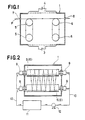
- Figures 1 and 2 show an oxidation furnace for converting a precursor to oxidized fibers.
- This furnace 1 has an inlet 3 and outlet 4 for a heating air which is to be introduced into the furnace for forming an oxidative atmosphere.
- the heating air is further circulated to be kept at 240 to 400°C in the furnace.
- Cooling bodies 5, 5 and 6, 6 composed of a pair of Nelson rollers are juxtaposed.
- Precursor P introduced into the furnace via inlet 7 is wound around the first cooling rollers 5, 5 plural times to repeatedly undergo intermittent cooling, then again wound around the next cooling rollers 6, 6 to similarly undergo repeated intermittent cooling, and comes out of the furnace via outlet 8.
- the precursor is preferably wound several ten times of more around each roller pair.
- Such intermittent repeated contact of precursor P with cooling rollers 5 and 6 is conducted for 0.1 to 3 seconds per contact as described hereinbefore. As a result, the temperature of precursor P itself is controlled to drop 5 to 30°C from the temperature before the contact.
- Each pair of cooling rollers 5 and 6 has a refrigeration medium-circulating path formed therein, and rotary joints 9 are connected to both axis ends. These rotary joints 9, 9 are also connected to refrigeration medium tank 11 and circulating pump via circulating pipe 10. Refrigeration medium in tank 11 is forcibly delivered by circulating pump 12 so as to travel through the path formed within cooling rollers 5 and 6 for controlling the surface temperature of the rollers at an almost definite level.
- the temperature of the refrigeration medium is controlled to be ⁇ 2°C in the tank 11.
- the cooling rollers are desirably controlled to have a temperature distribution in a longitudinal direction controlled within ⁇ 3°C by the circulation of the refrigeration medium. This control can be effected by, for example, controlling the flow rate of the refrigeration medium to be circulated through the rollers.
- cooling rollers in the furnace also function to convey the precursor, there is a merit of eliminating the necessity of providing additional conveying rollers.
- additional conveying rollers may be provided, if necessary.
- the cooling body used in the oxidation process of the present invention may be plates, pipes or the equivalent, and the cooling body may be used alone or in combination.
- the fibers are filaments or tows, a roll is preferable in regard to process efficiency.
- the oxidized fibers obtained by heat-treating a precursor in an oxidative atmosphere in the above-described manner are then heated in an inert gas atmosphere of at least 800°C-such as a nitrogen gas to carbonize. This carbonization can yield carbon fibers with high performance.
- the temperature of the oxidative atmosphere in the oxidative step can be set at a higher level without formation of a tarry product, adhesion of single filaments to each other, and non-uniform oxidation, because the temperature of the precursor itself is controlled by concurrently conducting intermittent instant cooling to thereby prevent accumulation of heat in the precursor. Therefore, the time required for the oxidation step is shortened to enhance productivity, and yet carbon fibers with high performance can be obtained.
- the process of the present invention enables to produce oxidized fibers with high energy efficiency by facilitating control of the temperature of the precursor itself in the oxidative atmosphere.
- 6600 dtex acrylic fiber yarn was baked for 18 minutes in a circulating hot air furnace in which two pairs of 200 mm diameter cooling rollers were disposed as guide rollers for conveying the yarn and which was kept at 260°C.
- the surface temperature of the cooling rollers was set to 250°C
- the contact time of the yarn with the cooling roller was controlled to 1.9 seconds per contact
- the total contact number was controlled to 130.
- the precursor travelled within the furnace at a speed of 10 m/min.
- Tensile strength, elongation, equilibrium moisture content, fluffing state, and degree of adhering between single filaments of the thus obtained oxidized fibers are shown in Table 1.
- Precursor fibers were oxidized and carbonized in the same manner as in Example 1 except for changing the migration speed of the precursor within the furnace and changing the contact time of the precursor with the cooling roller as shown in Table 2. Physical properties of the resulting oxidized fibers and carbon fibers are shown in Table 2.
- Example 2 When the same procedure as described in Example 1 was conducted except for continuously heating the precursor over 50 hours in a circulating hot air furnace to bake it, a tarry product was found to deposit on the surface of the cooling rollers, and staining of the resulting oxidized fibers and fluffing were observed.
- Example 2 When the same oxidation procedure as described in Example 1 was conducted except for not cooling the cooling rollers but isolating them by partition walls and circulating a 250°C air in the partitioned zone to cool the precursor, the surface temperature of the cooling rollers reached 265°C 15 minutes after initiation of heating due to accumulation of heat. Therefore, the temperature of the cooling air was controlled to adjust the temperature of the partitioned zone to 245°C for keeping the roller surface temperature to 260°C or less. As a result, the precursor could not be well oxidized by the heat treatment conducted for about 18 minutes, and oxidized fibers not burnt by the flame of a match was obtained only when the heating was continued for 33 minutes. In addition, the resulting oxidized fibers and the carbon fibers had only insufficient physical properties as shown in Table 4.
Landscapes
- Engineering & Computer Science (AREA)
- Chemical & Material Sciences (AREA)
- Chemical Kinetics & Catalysis (AREA)
- General Chemical & Material Sciences (AREA)
- Textile Engineering (AREA)
- Manufacturing & Machinery (AREA)
- Inorganic Fibers (AREA)
- Chemical Treatment Of Fibers During Manufacturing Processes (AREA)
Claims (9)
Priority Applications (1)
| Application Number | Priority Date | Filing Date | Title |
|---|---|---|---|
| AT83105415T ATE40420T1 (de) | 1982-06-07 | 1983-06-01 | Verfahren zur herstellung von verkohlungsfaehigen oxidierten fasern und kohlenstoffasern. |
Applications Claiming Priority (2)
| Application Number | Priority Date | Filing Date | Title |
|---|---|---|---|
| JP96303/82 | 1982-06-07 | ||
| JP57096303A JPS58214525A (ja) | 1982-06-07 | 1982-06-07 | 炭素繊維の製造法 |
Publications (3)
| Publication Number | Publication Date |
|---|---|
| EP0100411A2 EP0100411A2 (fr) | 1984-02-15 |
| EP0100411A3 EP0100411A3 (en) | 1987-02-04 |
| EP0100411B1 true EP0100411B1 (fr) | 1989-01-25 |
Family
ID=14161259
Family Applications (1)
| Application Number | Title | Priority Date | Filing Date |
|---|---|---|---|
| EP83105415A Expired EP0100411B1 (fr) | 1982-06-07 | 1983-06-01 | Procédé de fabrication de fibres oxydées carbonisables et fibres de carbone |
Country Status (5)
| Country | Link |
|---|---|
| US (1) | US4534920A (fr) |
| EP (1) | EP0100411B1 (fr) |
| JP (1) | JPS58214525A (fr) |
| AT (1) | ATE40420T1 (fr) |
| DE (1) | DE3379061D1 (fr) |
Families Citing this family (10)
| Publication number | Priority date | Publication date | Assignee | Title |
|---|---|---|---|---|
| US5193996A (en) * | 1983-10-13 | 1993-03-16 | Bp Chemicals (Hitco) Inc. | Method and system for producing carbon fibers |
| US4671907A (en) * | 1984-08-07 | 1987-06-09 | Sumitomo Metal Industries, Inc. | Method of manufacturing carbon materials |
| JPH0643645B2 (ja) * | 1987-09-28 | 1994-06-08 | 日東紡績株式会社 | ピッチ繊維の不融化方法 |
| GB2212161A (en) * | 1987-10-01 | 1989-07-19 | David William Martin | Fire resistant pile fabrics |
| WO1990010101A1 (fr) * | 1989-02-23 | 1990-09-07 | Mitsubishi Rayon Co., Ltd. | Installation d'ignifugeage |
| US5238672A (en) * | 1989-06-20 | 1993-08-24 | Ashland Oil, Inc. | Mesophase pitches, carbon fiber precursors, and carbonized fibers |
| USH1052H (en) | 1989-06-30 | 1992-05-05 | Method for stabilization of pan-based carbon fibers | |
| US6027337A (en) * | 1998-05-29 | 2000-02-22 | C.A. Litzler Co., Inc. | Oxidation oven |
| RU2167225C1 (ru) * | 1999-10-11 | 2001-05-20 | Всероссийский научно-исследовательский институт полимерных волокон с опытным заводом | Способ окисления полиакрилонитрильного жгута и устройство для его осуществления |
| RU2258104C1 (ru) * | 2004-01-15 | 2005-08-10 | Общество с ограниченной ответственностью "НПЦ" УВИКОМ" | Способ получения огнестойкого полиакрилонитрильного волокна для изготовления текстильных материалов |
Family Cites Families (19)
| Publication number | Priority date | Publication date | Assignee | Title |
|---|---|---|---|---|
| GB1257481A (fr) * | 1968-04-19 | 1971-12-22 | ||
| GB1405891A (en) * | 1971-06-28 | 1975-09-10 | Quimco Gmbh | Apparatus for producing carbon fibres |
| JPS516245B2 (fr) * | 1972-08-07 | 1976-02-26 | ||
| JPS5322575B2 (fr) * | 1974-05-14 | 1978-07-10 | ||
| USRE30414E (en) * | 1974-10-21 | 1980-10-07 | Toray Industries, Inc. | Process for producing a high tensile strength, high Young's modulus carbon fiber having excellent internal structure homogeneity |
| DE2546509C3 (de) * | 1974-10-21 | 1980-03-20 | Toray Industries, Inc., Tokio | Verfahren zur Herstellung von Kohlenstoffäden oder -fasern |
| JPS51119833A (en) * | 1975-04-08 | 1976-10-20 | Toho Rayon Co Ltd | A process for manufacturing carbon fibers |
| JPS5274026A (en) * | 1975-12-16 | 1977-06-21 | Toho Rayon Co Ltd | Antiflaming treatment of actylic fiber |
| DE2603029C3 (de) * | 1976-01-28 | 1979-08-23 | Hoechst Ag, 6000 Frankfurt | Verfahren zur Cyclisierung von Acrylnitrilpolymerisat-Fäden |
| US4100004A (en) * | 1976-05-11 | 1978-07-11 | Securicum S.A. | Method of making carbon fibers and resin-impregnated carbon fibers |
| US4186179A (en) * | 1977-05-30 | 1980-01-29 | Toray Industries, Inc. | Process for producing oxidized or carbon fibers |
| JPS53147821A (en) * | 1977-05-30 | 1978-12-22 | Toray Ind Inc | Production of carbon fiber |
| JPS5590621A (en) * | 1978-12-26 | 1980-07-09 | Kureha Chem Ind Co Ltd | Production of carbon fiber |
| US4389387A (en) * | 1978-12-26 | 1983-06-21 | Kureha Kagaku Kogyo Kabushiki Kaisha | Method for preparing carbon fibers |
| JPS55163217A (en) * | 1979-05-21 | 1980-12-19 | Sumitomo Chem Co Ltd | Improved preparation of carbon fiber |
| JPS5663014A (en) * | 1979-10-25 | 1981-05-29 | Toho Rayon Co Ltd | Flameproofing and carbonizing method of acrylonitrile fiber |
| JPS5742925A (en) * | 1980-08-22 | 1982-03-10 | Toho Rayon Co Ltd | Production of high-performance carbon fiber strand |
| JPS57112410A (en) * | 1980-12-27 | 1982-07-13 | Toho Rayon Co Ltd | Acrylonitrile fiber and its production |
| JPS5836216A (ja) * | 1981-08-22 | 1983-03-03 | Toho Rayon Co Ltd | 耐炎化繊維束の製造方法 |
-
1982
- 1982-06-07 JP JP57096303A patent/JPS58214525A/ja active Pending
-
1983
- 1983-06-01 EP EP83105415A patent/EP0100411B1/fr not_active Expired
- 1983-06-01 AT AT83105415T patent/ATE40420T1/de not_active IP Right Cessation
- 1983-06-01 DE DE8383105415T patent/DE3379061D1/de not_active Expired
- 1983-06-07 US US06/501,911 patent/US4534920A/en not_active Expired - Fee Related
Also Published As
| Publication number | Publication date |
|---|---|
| JPS58214525A (ja) | 1983-12-13 |
| EP0100411A2 (fr) | 1984-02-15 |
| ATE40420T1 (de) | 1989-02-15 |
| US4534920A (en) | 1985-08-13 |
| DE3379061D1 (en) | 1989-03-02 |
| EP0100411A3 (en) | 1987-02-04 |
Similar Documents
| Publication | Publication Date | Title |
|---|---|---|
| US4314981A (en) | Method for preparing carbon fibers | |
| US4610860A (en) | Method and system for producing carbon fibers | |
| EP0100411A2 (fr) | Procédé de fabrication de fibres oxydées carbonisables et fibres de carbone | |
| EP0426858B1 (fr) | Installation d'ignifugeage | |
| KR870000704B1 (ko) | 탄소섬유의 제조방법 및 장치 | |
| US5925591A (en) | Process for the production of hollow carbon fiber membranes | |
| US4820905A (en) | Carbonizing furnace | |
| US4389387A (en) | Method for preparing carbon fibers | |
| JPS6238444B2 (fr) | ||
| US4552743A (en) | Process for producing carbon fiber | |
| JPH0770828A (ja) | 炭素繊維の製造方法 | |
| JPS5853086B2 (ja) | 耐炎性繊維の製造法 | |
| JPH026625A (ja) | 耐炎化繊維の製造法 | |
| WO1987002391A1 (fr) | Procede de production de fibres de carbone | |
| JP4254191B2 (ja) | 黒鉛化炉および黒鉛化繊維の製造方法 | |
| US4988492A (en) | Method for infusibilizing pitch fibers | |
| JPS61174423A (ja) | 耐炎化繊維の製造法 | |
| JP2628658B2 (ja) | ピッチ系炭素繊維の不融化方法及び装置 | |
| JP2505495B2 (ja) | 耐炎化繊維の製造方法 | |
| JPH01118623A (ja) | 前駆体繊維の耐炎化方法 | |
| JPH04214414A (ja) | 炭素繊維の製造方法 | |
| JPH02154013A (ja) | 耐炎化繊維の製造法 | |
| JPH01148816A (ja) | 耐炎化繊維の製造方法 | |
| JPH01148817A (ja) | 炭素繊維の製造方法 | |
| JPS6246646B2 (fr) |
Legal Events
| Date | Code | Title | Description |
|---|---|---|---|
| PUAI | Public reference made under article 153(3) epc to a published international application that has entered the european phase |
Free format text: ORIGINAL CODE: 0009012 |
|
| AK | Designated contracting states |
Designated state(s): AT BE CH DE FR GB IT LI LU NL SE |
|
| 17P | Request for examination filed |
Effective date: 19840220 |
|
| PUAL | Search report despatched |
Free format text: ORIGINAL CODE: 0009013 |
|
| AK | Designated contracting states |
Kind code of ref document: A3 Designated state(s): AT BE CH DE FR GB IT LI LU NL SE |
|
| 17Q | First examination report despatched |
Effective date: 19870817 |
|
| GRAA | (expected) grant |
Free format text: ORIGINAL CODE: 0009210 |
|
| AK | Designated contracting states |
Kind code of ref document: B1 Designated state(s): AT BE CH DE FR GB IT LI LU NL SE |
|
| PG25 | Lapsed in a contracting state [announced via postgrant information from national office to epo] |
Ref country code: SE Effective date: 19890125 Ref country code: LI Effective date: 19890125 Ref country code: CH Effective date: 19890125 Ref country code: BE Effective date: 19890125 Ref country code: AT Effective date: 19890125 |
|
| REF | Corresponds to: |
Ref document number: 40420 Country of ref document: AT Date of ref document: 19890215 Kind code of ref document: T |
|
| ITF | It: translation for a ep patent filed | ||
| REF | Corresponds to: |
Ref document number: 3379061 Country of ref document: DE Date of ref document: 19890302 |
|
| ET | Fr: translation filed | ||
| REG | Reference to a national code |
Ref country code: CH Ref legal event code: PL |
|
| PG25 | Lapsed in a contracting state [announced via postgrant information from national office to epo] |
Ref country code: LU Free format text: LAPSE BECAUSE OF NON-PAYMENT OF DUE FEES Effective date: 19890630 |
|
| PLBE | No opposition filed within time limit |
Free format text: ORIGINAL CODE: 0009261 |
|
| STAA | Information on the status of an ep patent application or granted ep patent |
Free format text: STATUS: NO OPPOSITION FILED WITHIN TIME LIMIT |
|
| 26N | No opposition filed | ||
| ITTA | It: last paid annual fee | ||
| PGFP | Annual fee paid to national office [announced via postgrant information from national office to epo] |
Ref country code: GB Payment date: 19940524 Year of fee payment: 12 |
|
| PGFP | Annual fee paid to national office [announced via postgrant information from national office to epo] |
Ref country code: DE Payment date: 19940608 Year of fee payment: 12 |
|
| PGFP | Annual fee paid to national office [announced via postgrant information from national office to epo] |
Ref country code: FR Payment date: 19940609 Year of fee payment: 12 |
|
| PGFP | Annual fee paid to national office [announced via postgrant information from national office to epo] |
Ref country code: NL Payment date: 19940630 Year of fee payment: 12 |
|
| PG25 | Lapsed in a contracting state [announced via postgrant information from national office to epo] |
Ref country code: GB Effective date: 19950601 |
|
| PG25 | Lapsed in a contracting state [announced via postgrant information from national office to epo] |
Ref country code: NL Effective date: 19960101 |
|
| GBPC | Gb: european patent ceased through non-payment of renewal fee |
Effective date: 19950601 |
|
| PG25 | Lapsed in a contracting state [announced via postgrant information from national office to epo] |
Ref country code: FR Effective date: 19960229 |
|
| NLV4 | Nl: lapsed or anulled due to non-payment of the annual fee |
Effective date: 19960101 |
|
| PG25 | Lapsed in a contracting state [announced via postgrant information from national office to epo] |
Ref country code: DE Effective date: 19960301 |
|
| REG | Reference to a national code |
Ref country code: FR Ref legal event code: ST |