EP0100527B1 - 4H-benzothiazines-1,4 pour l'application comme médicaments - Google Patents
4H-benzothiazines-1,4 pour l'application comme médicaments Download PDFInfo
- Publication number
- EP0100527B1 EP0100527B1 EP83107419A EP83107419A EP0100527B1 EP 0100527 B1 EP0100527 B1 EP 0100527B1 EP 83107419 A EP83107419 A EP 83107419A EP 83107419 A EP83107419 A EP 83107419A EP 0100527 B1 EP0100527 B1 EP 0100527B1
- Authority
- EP
- European Patent Office
- Prior art keywords
- halogen
- aryl
- pyrimidyl
- pyridyl
- alkyl
- Prior art date
- Legal status (The legal status is an assumption and is not a legal conclusion. Google has not performed a legal analysis and makes no representation as to the accuracy of the status listed.)
- Expired
Links
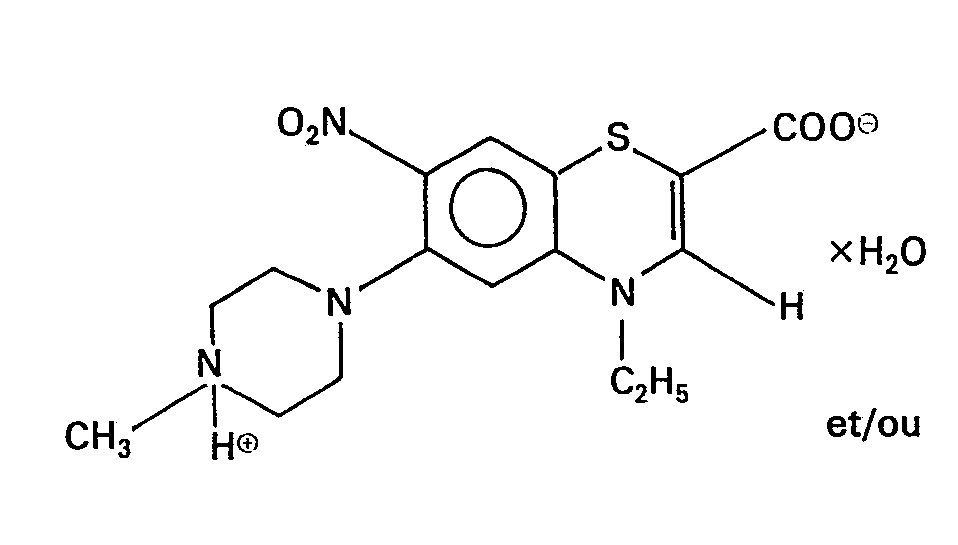
- 0 CCN(C=C(*C)Sc1c2)c1cc(N(CC1)CCN1NC)c2[N+]([O-])=O Chemical compound CCN(C=C(*C)Sc1c2)c1cc(N(CC1)CCN1NC)c2[N+]([O-])=O 0.000 description 4
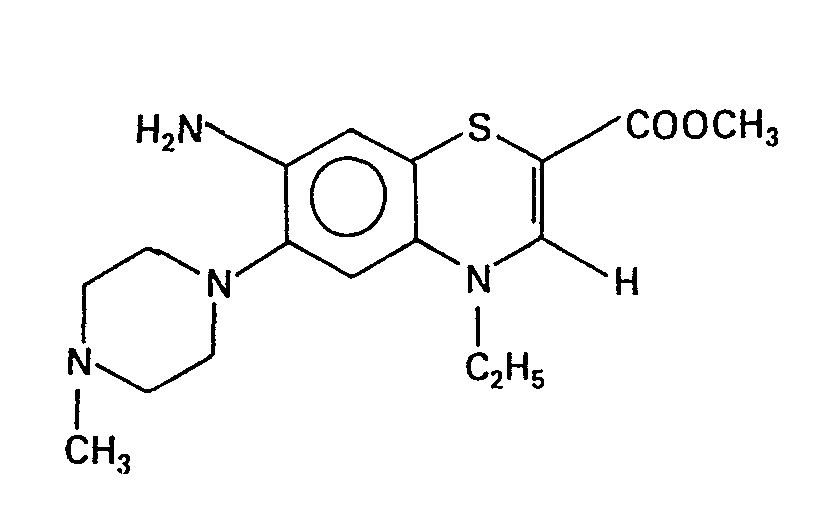
- SLFUQNHORKCXTB-UHFFFAOYSA-N CCN(C=C(C(OC)=O)Sc1c2)c1cc(N1CCN(C)CC1)c2N Chemical compound CCN(C=C(C(OC)=O)Sc1c2)c1cc(N1CCN(C)CC1)c2N SLFUQNHORKCXTB-UHFFFAOYSA-N 0.000 description 1
- RAOXHCTXBBGGGS-UHFFFAOYSA-N CCN(C=C(C(OC)=O)Sc1c2)c1cc(N1CCN(C)CC1)c2[N+]([O-])=O Chemical compound CCN(C=C(C(OC)=O)Sc1c2)c1cc(N1CCN(C)CC1)c2[N+]([O-])=O RAOXHCTXBBGGGS-UHFFFAOYSA-N 0.000 description 1
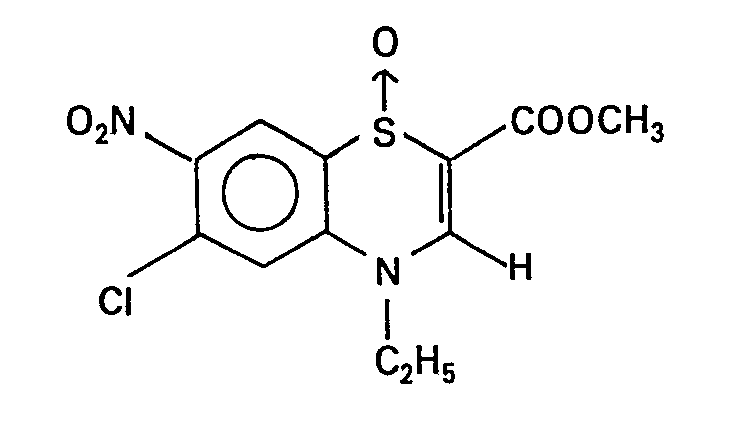
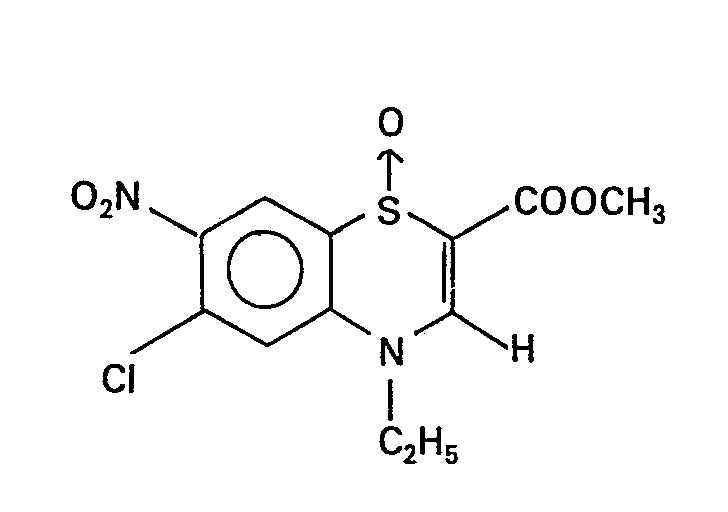
- DYPKCXBIXAAQKZ-UHFFFAOYSA-N CCN(C=C1C(OC)=O)c(ccc([N+]([O-])=O)c2)c2S1O Chemical compound CCN(C=C1C(OC)=O)c(ccc([N+]([O-])=O)c2)c2S1O DYPKCXBIXAAQKZ-UHFFFAOYSA-N 0.000 description 1
- WDSSVRRFORMSNN-UHFFFAOYSA-N CCN(C=C1C(OC)=O)c2cc(C)ccc2S1O Chemical compound CCN(C=C1C(OC)=O)c2cc(C)ccc2S1O WDSSVRRFORMSNN-UHFFFAOYSA-N 0.000 description 1
- PAJKDPBEABLDTF-UHFFFAOYSA-N CCN1c(ccc([N+]([O-])=O)c2)c2S(CC)C(C(OC)=O)=C1 Chemical compound CCN1c(ccc([N+]([O-])=O)c2)c2S(CC)C(C(OC)=O)=C1 PAJKDPBEABLDTF-UHFFFAOYSA-N 0.000 description 1
- WCYMTRDMEJAPLV-UHFFFAOYSA-N CN(C1)c2cc(Cl)ccc2S(O)=C1C(OC)=O Chemical compound CN(C1)c2cc(Cl)ccc2S(O)=C1C(OC)=O WCYMTRDMEJAPLV-UHFFFAOYSA-N 0.000 description 1
Classifications
-
- C—CHEMISTRY; METALLURGY
- C07—ORGANIC CHEMISTRY
- C07D—HETEROCYCLIC COMPOUNDS
- C07D279/00—Heterocyclic compounds containing six-membered rings having one nitrogen atom and one sulfur atom as the only ring hetero atoms
- C07D279/10—1,4-Thiazines; Hydrogenated 1,4-thiazines
- C07D279/14—1,4-Thiazines; Hydrogenated 1,4-thiazines condensed with carbocyclic rings or ring systems
- C07D279/16—1,4-Thiazines; Hydrogenated 1,4-thiazines condensed with carbocyclic rings or ring systems condensed with one six-membered ring
-
- A—HUMAN NECESSITIES
- A61—MEDICAL OR VETERINARY SCIENCE; HYGIENE
- A61P—SPECIFIC THERAPEUTIC ACTIVITY OF CHEMICAL COMPOUNDS OR MEDICINAL PREPARATIONS
- A61P11/00—Drugs for disorders of the respiratory system
-
- A—HUMAN NECESSITIES
- A61—MEDICAL OR VETERINARY SCIENCE; HYGIENE
- A61P—SPECIFIC THERAPEUTIC ACTIVITY OF CHEMICAL COMPOUNDS OR MEDICINAL PREPARATIONS
- A61P29/00—Non-central analgesic, antipyretic or antiinflammatory agents, e.g. antirheumatic agents; Non-steroidal antiinflammatory drugs [NSAID]
-
- A—HUMAN NECESSITIES
- A61—MEDICAL OR VETERINARY SCIENCE; HYGIENE
- A61P—SPECIFIC THERAPEUTIC ACTIVITY OF CHEMICAL COMPOUNDS OR MEDICINAL PREPARATIONS
- A61P35/00—Antineoplastic agents
-
- A—HUMAN NECESSITIES
- A61—MEDICAL OR VETERINARY SCIENCE; HYGIENE
- A61P—SPECIFIC THERAPEUTIC ACTIVITY OF CHEMICAL COMPOUNDS OR MEDICINAL PREPARATIONS
- A61P37/00—Drugs for immunological or allergic disorders
- A61P37/08—Antiallergic agents
-
- A—HUMAN NECESSITIES
- A61—MEDICAL OR VETERINARY SCIENCE; HYGIENE
- A61P—SPECIFIC THERAPEUTIC ACTIVITY OF CHEMICAL COMPOUNDS OR MEDICINAL PREPARATIONS
- A61P43/00—Drugs for specific purposes, not provided for in groups A61P1/00-A61P41/00
-
- A—HUMAN NECESSITIES
- A61—MEDICAL OR VETERINARY SCIENCE; HYGIENE
- A61P—SPECIFIC THERAPEUTIC ACTIVITY OF CHEMICAL COMPOUNDS OR MEDICINAL PREPARATIONS
- A61P7/00—Drugs for disorders of the blood or the extracellular fluid
- A61P7/02—Antithrombotic agents; Anticoagulants; Platelet aggregation inhibitors
-
- A—HUMAN NECESSITIES
- A61—MEDICAL OR VETERINARY SCIENCE; HYGIENE
- A61P—SPECIFIC THERAPEUTIC ACTIVITY OF CHEMICAL COMPOUNDS OR MEDICINAL PREPARATIONS
- A61P9/00—Drugs for disorders of the cardiovascular system
- A61P9/10—Drugs for disorders of the cardiovascular system for treating ischaemic or atherosclerotic diseases, e.g. antianginal drugs, coronary vasodilators, drugs for myocardial infarction, retinopathy, cerebrovascula insufficiency, renal arteriosclerosis
Definitions
- the present invention relates to 4H-1,4-benzothiazines for therapeutic use or for use as a medicament, in particular their use as lipoxygenase inhibitors, furthermore medicaments containing them and their preparation.
- Known lipoxygenase inhibitors such as nordihydroguaretic acid, 3-amino-1- (3-trifluoromethylphenyl) pyrazoline, phenindiones and 5,8,11,14-eikosatetraic acid are either simultaneously effective as cyclooxygenase inhibitors or only at very high concentrations.
- the inhibition of the enzyme cyclooxygenase of arachidonic acid metabolism leads to a global inhibition of prostaglandin synthesis and to a stimulation of the lipoxygenase pathway, which causes gastrotoxicity or pro-inflammatory and asthmatic effects.
- lipoxygenase inhibitors such as 3-amino-1- (m-trifluoromethylphenyl) pyrazoline-2 have toxic side effects when administered systemically (e.g. orally). There is therefore a need for orally active compounds that do not have these undesirable side effects.
- EP 0 061 082 describes a process for the preparation of benzothiazines which can be used as intermediates.
- the 4H-1,4-benzothiazines mentioned inhibit the lipoxygenase in such a concentration that the cyclooxygenase is little influenced.
- the compounds mentioned also surprisingly stimulate the synthesis of prostacyclin in arterial vessels in vitro, possibly as a result of their lipoxygenase-inhibiting properties.
- the compounds according to the invention are more potent than the known lipoxygenase inhibitor 3-amino-1- (m-trifluoromethylphenyl) pyrazoline-2 (Proc. Of British Pharmacological Society 920 P (1981).
- the compounds according to the invention also stimulate rabbit aorta strips prostacyclin synthesis.
- the compounds mentioned also have an anti-inflammatory effect in the carragenan-induced edema model if they are administered systemically, especially orally, and locally, particularly cutan. They also have an antimetastatic effect.
- the 4H-1,4-benzothiazines inhibiting lipoxygenase mentioned can thus be used as medicaments in the treatment of inflammatory and allergic processes. They can be used, in particular, as anti-inflammatory drugs, anti-rheumatic drugs, anti-atherosclerotic drugs, anti-thrombotic drugs, anti-arthro-drugs, anti-asthmatics tiallergika, antimetastatic and gastroprotective use.
- the substances of the general formula I can be prepared according to process variant 1 by reacting 2-aminothiophenols of the formula 11 with compounds of the formula III in dimethyl sulfoxide (cf. J. Chem. Soc. Perkin Trans. I, 1976, 1146- 49).
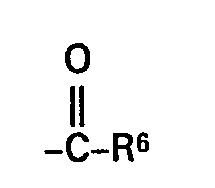
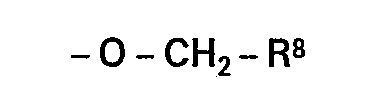
- the radicals R 1 to R 5 have the meanings given above.
- the compounds of the formulas II and III are either known from the literature or can be prepared analogously to compounds known from the literature.
- the reaction temperature can be between 50 ° C and 200 ° C, preferably between 100 ° C and 150 ° C. In some cases it is advisable to work in the absence of oxygen.
- the reaction can preferably also be carried out in the presence of an acid scavenger, such as, for example, triethylamine, K 2 CO 3 , Na 2 CO 3 , NaOH, NH 3 .
- an acid scavenger such as, for example, triethylamine, K 2 CO 3 , Na 2 CO 3 , NaOH, NH 3 .
- Possible solvents are: alcohols (e.g. methanol, ethanol), ethers (e.g. diethyl ether, THF, dioxane, dimethoxyethane, diethylene glycol dimethyl ether), hydrocarbons (e.g. benzene, toluene), chlorinated hydrocarbons (e.g. methylene chloride, chloroform, chlorobenzene), DMSO, DMF , Pyridine and water. In some cases it is advisable to work in the absence of oxygen.
- alcohols e.g. methanol, ethanol
- ethers e.g. diethyl ether, THF, dioxane, dimethoxyethane, diethylene glycol dimethyl ether
- hydrocarbons e.g. benzene, toluene
- chlorinated hydrocarbons e.g. methylene chloride, chloroform, chlorobenzene
- DMSO DMF
- Pyridine Pyr
- the reaction temperature can be between 0 ° C and 200 ° C, preferably between 35 ° C and 110 ° C.
- the substances of formula 1 can be prepared according to process variant 3 by reacting disulfides of formula V with carbonyl compounds of formula III [cf. Phosphorus and Sulfur 3, 308-314 (1977)] The reaction is catalyzed by acids (eg p-toluenesulfonic acid).
- Possible solvents are: benzene, toluene, pyridine, DMSO and DMF.
- the reaction temperature can be between 20 ° C and 180 ° C, preferably between 35 ° C and 110 ° C.
- reaction is usually carried out with equimolecular amounts of the starting materials, occasionally an excess (up to 110%) of carbonyl compound is used.
- the substances of formula 1 can be prepared according to process variant 4 by reacting disulfides of formula V with alkynes of formula VI [cf. J. Heterocyclic Chem. 17, 377 (1980)].
- the reaction is preferably carried out with equimolecular amounts of the starting materials, an excess (up to 110%) of alkyne (VI) is occasionally also used.
- Possible solvents are: alcohols (e.g. methanol, ethanol), ethers, hydrocarbons (e.g. benzene, toluene), chlorinated hydrocarbons, DMSO, DMF and pyridine.
- the reaction temperature is between 20 ° C and 180 ° C, preferably between 35 ° C and 120 ° C.
- Substances of the formula 1 in which R3 is alkyl (optionally substituted) can be prepared from the corresponding compounds in which R 3 is hydrogen by the customary alkylation methods, for example by reaction with CH 3 J, C 2 H 5 Br or ⁇ -bromoacetophenone.
- the detection of the lipoxygenase-inhibiting properties of the compounds according to the invention was carried out analogously to the method of Bailey et al., Journal of Biol. Chemistry 255, 5996, (1980) and according to Blackwell and Flower, Prostaglandins 16, 417 (1978).
- This test method uses the metabolism of radiolabelled arachidonic acid on washed human platelets.
- the radioactively labeled metabolites are extracted from the reaction mixture and separated by thin layer chromatography. The autoradiogram is evaluated on the thin-film scanner. Under these test conditions, the labeled metabolites are separated from the unreacted arachidonic acid and can then be evaluated quantitatively.
- TXB 2 cyclooxygenase products thromboxane B 2
- HHT 12-hydroxy-5,8, 10-heptadecatrienoic acid
- HETE lipoxygenase product 12-hydroxy-5,8,11,14-eikosatetraenoic acid formed during the metabolization
- the inhibition of lipoxygenase of the compound according to formula I can be measured by the inhibition of HETE synthesis. It can be seen that the synthesis of TXB 2 and HHT remains unaffected, while the arachidonic acid conversion decreases. As can be seen from the table below, compounds according to the formula significantly inhibit platelet lipoxygenase (HETE synthesis). (See Tab. 1)
- the lipoxygenase-inhibiting properties of the compounds of the formula can also be detected on leukocytes.
- the polymorphonuclear leukocytes of humans and rabbits metabolize arachidonic acid to 5-hydroxy-5,8,11,14-eikosatetraenoic acid (5-HETE) and leukotriene B 4 (5S, 12R-dihydroxy-6 cis, 8,10- trans-14 ciseicosatetraenoic acid).
- 5-HETE 5-hydroxy-5,8,11,14-eikosatetraenoic acid
- leukotriene B 4 5S, 12R-dihydroxy-6 cis, 8,10- trans-14 ciseicosatetraenoic acid.
- the inhibition of the release of 5-HETE and leukotriene B 4 from the leukocytes represents a measure of the lipoxygenase-inhibiting effect of the compounds according to formula I. (cf. Table 1)
- Prostacyclin-stimulating activity was demonstrated by determining the release of prostacyclin after incubation of rabbit aortic strips with the compounds according to the invention for one hour (analogously to Moncada et al., Lancet 1977, 18) and subsequent radioimmunological determination of the stable prostacyclin metabolite 6-keto-PGF 1 ( BM Peskar et al., FEBS Letters 121, 25, 1980).
- the compounds according to formula I are also active in vivo. This effect is demonstrated by measuring the inhibition of leukocyte migration according to methods known per se (cf. Higgs et al., Biochemical Pharmacology 28, 1959, (1979) and Eur. J. Pharmacol. 66, 81 (1981)).
- the active compounds according to the formula can be prepared in a known manner in the customary formulations, such as tablets, capsules, dragées, pills, granules, aerosols, syrups, emulsions, suspensions and solutions, using inert, non-toxic pharmaceutically suitable excipients Fe or solvents are transferred.
- the therapeutically active compound should in each case be present in a concentration of about 0.5 to 90% by weight of the total mixture, ie in amounts which are sufficient to achieve the desired dosage range.
- the formulations are prepared, for example, by stretching the active ingredients with solvents and / or carriers, optionally using emulsifiers and / or dispersants, e.g. if water is used as the diluent, organic solvents can optionally be used as auxiliary solvents.
- tablets can of course also contain additives such as sodium citrate, calcium carbonate and dicalcium phosphate together with various additives, such as starch, preferably potato starch, gelatin and the like, in addition to the carrier substances mentioned.
- Lubricants such as magnesium stearate, sodium lauryl sulfate and talc can also be used for tableting.
- the active ingredients can be mixed with various flavor enhancers or colored or coloring substances in addition to the abovementioned auxiliaries.
- solutions of the active ingredients can be used using suitable liquid carrier materials.
Landscapes
- Health & Medical Sciences (AREA)
- Chemical & Material Sciences (AREA)
- Organic Chemistry (AREA)
- Chemical Kinetics & Catalysis (AREA)
- General Chemical & Material Sciences (AREA)
- Medicinal Chemistry (AREA)
- Nuclear Medicine, Radiotherapy & Molecular Imaging (AREA)
- Pharmacology & Pharmacy (AREA)
- Life Sciences & Earth Sciences (AREA)
- Animal Behavior & Ethology (AREA)
- General Health & Medical Sciences (AREA)
- Public Health (AREA)
- Veterinary Medicine (AREA)
- Engineering & Computer Science (AREA)
- Bioinformatics & Cheminformatics (AREA)
- Pulmonology (AREA)
- Hematology (AREA)
- Vascular Medicine (AREA)
- Cardiology (AREA)
- Heart & Thoracic Surgery (AREA)
- Diabetes (AREA)
- Immunology (AREA)
- Pain & Pain Management (AREA)
- Rheumatology (AREA)
- Urology & Nephrology (AREA)
- Pharmaceuticals Containing Other Organic And Inorganic Compounds (AREA)
- Nitrogen- Or Sulfur-Containing Heterocyclic Ring Compounds With Rings Of Six Or More Members (AREA)
- Plural Heterocyclic Compounds (AREA)
- Nitrogen And Oxygen Or Sulfur-Condensed Heterocyclic Ring Systems (AREA)
- Dental Preparations (AREA)
- Optical Fibers, Optical Fiber Cores, And Optical Fiber Bundles (AREA)
- Measuring Pulse, Heart Rate, Blood Pressure Or Blood Flow (AREA)
- Heterocyclic Carbon Compounds Containing A Hetero Ring Having Nitrogen And Oxygen As The Only Ring Hetero Atoms (AREA)
Claims (12)











Priority Applications (1)
| Application Number | Priority Date | Filing Date | Title |
|---|---|---|---|
| AT83107419T ATE24724T1 (de) | 1982-08-04 | 1983-07-28 | 4h-1,4-benzothiazine zur verwendung als arzneimittel. |
Applications Claiming Priority (2)
| Application Number | Priority Date | Filing Date | Title |
|---|---|---|---|
| DE3229121 | 1982-08-04 | ||
| DE19823229121 DE3229121A1 (de) | 1982-08-04 | 1982-08-04 | 4h-1,4-benzothiazine, verfahren zu ihrer herstellung und ihre verwendung als arzneimittel |
Publications (2)
| Publication Number | Publication Date |
|---|---|
| EP0100527A1 EP0100527A1 (fr) | 1984-02-15 |
| EP0100527B1 true EP0100527B1 (fr) | 1987-01-07 |
Family
ID=6170116
Family Applications (1)
| Application Number | Title | Priority Date | Filing Date |
|---|---|---|---|
| EP83107419A Expired EP0100527B1 (fr) | 1982-08-04 | 1983-07-28 | 4H-benzothiazines-1,4 pour l'application comme médicaments |
Country Status (14)
| Country | Link |
|---|---|
| EP (1) | EP0100527B1 (fr) |
| JP (1) | JPS5944368A (fr) |
| KR (1) | KR840005727A (fr) |
| AT (1) | ATE24724T1 (fr) |
| AU (1) | AU1758683A (fr) |
| DE (2) | DE3229121A1 (fr) |
| DK (1) | DK354483A (fr) |
| ES (1) | ES524708A0 (fr) |
| FI (1) | FI832782A7 (fr) |
| GR (1) | GR79356B (fr) |
| IL (1) | IL69389A0 (fr) |
| NO (1) | NO832664L (fr) |
| PT (1) | PT77096B (fr) |
| ZA (1) | ZA835674B (fr) |
Families Citing this family (3)
| Publication number | Priority date | Publication date | Assignee | Title |
|---|---|---|---|---|
| DE3426564A1 (de) * | 1984-07-19 | 1986-01-30 | Bayer Ag, 5090 Leverkusen | Verwendung von 4h-1,4-benzothiazinen bei der prophylaxe und therapie von erkrankungen der atemwege, entzuendungen/rheuma, thromboembolischen erkrankungen, ischaemien und infarkten, herzrhythmusstoerungen, arteriosklerose und dermatosen, arzneimittel zu diesem zweck sowie wirkstoffe, die in diesen arzneimitteln enthalten sind |
| DE3540702A1 (de) * | 1985-11-16 | 1987-05-21 | Bayer Ag | 1h-pyrido-(2,3-b) (1,4)-thiazine |
| DE3545097A1 (de) * | 1985-12-19 | 1987-07-02 | Bayer Ag | 1-h-pyrido-(3,2-b)(1,4)-thiazine |
Family Cites Families (2)
| Publication number | Priority date | Publication date | Assignee | Title |
|---|---|---|---|---|
| US4397849A (en) * | 1980-12-30 | 1983-08-09 | Fujisawa Pharmaceutical Co., Ltd. | Benzothiazine derivatives |
| DE3111487A1 (de) * | 1981-03-24 | 1982-12-30 | Bayer Ag, 5090 Leverkusen | Verfahren zur herstellung von 2,3-dihydro-4h-1,4 dihydro-1,4-benzothiazinen |
-
1982
- 1982-08-04 DE DE19823229121 patent/DE3229121A1/de not_active Withdrawn
-
1983
- 1983-07-21 NO NO832664A patent/NO832664L/no unknown
- 1983-07-25 PT PT77096A patent/PT77096B/pt unknown
- 1983-07-28 AT AT83107419T patent/ATE24724T1/de not_active IP Right Cessation
- 1983-07-28 EP EP83107419A patent/EP0100527B1/fr not_active Expired
- 1983-07-28 DE DE8383107419T patent/DE3368925D1/de not_active Expired
- 1983-08-01 IL IL69389A patent/IL69389A0/xx unknown
- 1983-08-02 FI FI832782A patent/FI832782A7/fi not_active Application Discontinuation
- 1983-08-02 GR GR72111A patent/GR79356B/el unknown
- 1983-08-03 JP JP58141253A patent/JPS5944368A/ja active Pending
- 1983-08-03 DK DK354483A patent/DK354483A/da not_active Application Discontinuation
- 1983-08-03 ZA ZA835674A patent/ZA835674B/xx unknown
- 1983-08-03 ES ES524708A patent/ES524708A0/es active Granted
- 1983-08-04 AU AU17586/83A patent/AU1758683A/en not_active Abandoned
- 1983-08-04 KR KR1019830003655A patent/KR840005727A/ko not_active Withdrawn
Non-Patent Citations (3)
| Title |
|---|
| Immunology 40, 709 (1980) * |
| Liebigs Annalen der Chemie 744, 27 (1971) * |
| Medical Clinics of North America 65, 809 (1981) * |
Also Published As
| Publication number | Publication date |
|---|---|
| DK354483A (da) | 1984-02-05 |
| JPS5944368A (ja) | 1984-03-12 |
| ATE24724T1 (de) | 1987-01-15 |
| AU1758683A (en) | 1984-02-09 |
| DK354483D0 (da) | 1983-08-03 |
| KR840005727A (ko) | 1984-11-16 |
| FI832782L (fi) | 1984-02-05 |
| DE3368925D1 (en) | 1987-02-12 |
| ZA835674B (en) | 1984-04-25 |
| ES8404682A1 (es) | 1984-05-01 |
| IL69389A0 (en) | 1983-11-30 |
| GR79356B (fr) | 1984-10-22 |
| DE3229121A1 (de) | 1984-02-09 |
| NO832664L (no) | 1984-02-06 |
| FI832782A7 (fi) | 1984-02-05 |
| PT77096A (en) | 1983-08-01 |
| FI832782A0 (fi) | 1983-08-02 |
| EP0100527A1 (fr) | 1984-02-15 |
| PT77096B (en) | 1986-03-12 |
| ES524708A0 (es) | 1984-05-01 |
Similar Documents
| Publication | Publication Date | Title |
|---|---|---|
| EP0085881A2 (fr) | Pyrazolooxazines, -thiazines et -quinoléines, procédé pour leur préparation et leur utilisation comme médicament | |
| DE3784624T2 (de) | Benzimidazolderivate mit einer wirkung als ulkusmittel. | |
| EP0183159A2 (fr) | 1-Hétéroaryl-4-aryl-pyrazolin-5-ones pour application en tant que médicaments | |
| EP0041215B1 (fr) | Imidazoazolalkénylcarboxamides, intermédiaires pour leur préparation, leur préparation et leur application comme médicaments | |
| EP0185909B1 (fr) | Composés de 5-alkyl-1-phényl-2-pipérazinoalkylpyrazolin-3-one ainsi que procédés et produits intermédiaires pour leur préparation et médicaments comprenant ces composés | |
| EP0101898A1 (fr) | 4H-1,4-benzothiazines condensées, procédé pour leur préparation et leur application comme médicaments | |
| EP0004561B1 (fr) | Composés d'urée et d'amide, procédé pour leur préparation, compositions pharmaceutiques les contenant et leur utilisation pour préparer des compositions pharmaceutiques | |
| DE3927930A1 (de) | Cyclisch substituierte (chinolin-2-yl-methoxy)phenyl-essig-saeure-derivate | |
| DE2602643A1 (de) | 1,2-benzisothiazolinone-3, verfahren zu ihrer herstellung sowie ihre verwendung als arzneimittel | |
| DE3532279A1 (de) | 1,4-benzoxathiin-derivate | |
| EP0261478B1 (fr) | Dérivés de 4,5 dihydro-oxazoles, procédé de leur préparation et leur application | |
| EP0072960B1 (fr) | Composés 1,5-diphénylpyrazolin-3-one, ainsi qu'un procédé et produits intermédiaires pour leur fabrication et médicaments contenant ces composés | |
| EP0065658A2 (fr) | Utilisation de sulfénamides comme agent antilipoxygénase et médicaments qui les contiennent | |
| DE3246148A1 (de) | Pyrazolo(4.3-b)(1.4)oxazine, verfahren zu ihrer herstellung und ihre verwendung als arzneimittel | |
| DE3883164T2 (de) | Rhodanin-Derivate, Verfahren zu ihrer Herstellung, ihre Anwendung und pharmazeutische Zusammensetzungen, die sie enthalten. | |
| EP0100527A1 (fr) | 4H-benzothiazines-1,4 pour l'application comme médicaments | |
| DE602005002138T2 (de) | Pentensäurederivate, verfahren zu deren herstellung, pharmazeutische zusammensetzungen, die diese enthalten, und deren therapeutische anwendung | |
| EP0211157B1 (fr) | Derivés d'isoxazole, procédé de préparation et préparations pharmaceutiques les contenant | |
| EP0088323B1 (fr) | Amides d'acides imidazothiadiazolealcanecarboxyliques, produits intermédiaires pour leur fabrication, leur fabrication et leur application en médicaments | |
| DE3125059A1 (de) | Dioxybenzoletherderivate, diese enthaltende arzneimittel, verfahren zu ihrer herstellung und ihre verwendung | |
| EP0330940A2 (fr) | Amines trisubstituées, procédé de leur préparation et médicament contenant ces composés | |
| DE2431734A1 (de) | Beta-ketopropan-sultone und -sultame | |
| EP0110219B1 (fr) | Nitriles hétérocycliques substitués, leur procédé de préparation et leur application comme médicaments | |
| DE3020421A1 (de) | Imidazoazolalkensaeureamide, neue zwischenprodukte zu ihrer herstellung, ihre herstellung und ihre verwendung in arzneimitteln | |
| EP0158083A2 (fr) | Médicaments |
Legal Events
| Date | Code | Title | Description |
|---|---|---|---|
| PUAI | Public reference made under article 153(3) epc to a published international application that has entered the european phase |
Free format text: ORIGINAL CODE: 0009012 |
|
| 17P | Request for examination filed |
Effective date: 19830728 |
|
| AK | Designated contracting states |
Designated state(s): AT BE CH DE FR GB IT LI LU NL SE |
|
| GRAA | (expected) grant |
Free format text: ORIGINAL CODE: 0009210 |
|
| AK | Designated contracting states |
Kind code of ref document: B1 Designated state(s): AT BE CH DE FR GB IT LI LU NL SE |
|
| REF | Corresponds to: |
Ref document number: 24724 Country of ref document: AT Date of ref document: 19870115 Kind code of ref document: T |
|
| ET | Fr: translation filed | ||
| REF | Corresponds to: |
Ref document number: 3368925 Country of ref document: DE Date of ref document: 19870212 |
|
| ITF | It: translation for a ep patent filed | ||
| PG25 | Lapsed in a contracting state [announced via postgrant information from national office to epo] |
Ref country code: AT Effective date: 19870728 |
|
| PG25 | Lapsed in a contracting state [announced via postgrant information from national office to epo] |
Ref country code: SE Effective date: 19870729 |
|
| PG25 | Lapsed in a contracting state [announced via postgrant information from national office to epo] |
Ref country code: LU Free format text: LAPSE BECAUSE OF NON-PAYMENT OF DUE FEES Effective date: 19870731 Ref country code: LI Effective date: 19870731 Ref country code: CH Effective date: 19870731 |
|
| PLBE | No opposition filed within time limit |
Free format text: ORIGINAL CODE: 0009261 |
|
| STAA | Information on the status of an ep patent application or granted ep patent |
Free format text: STATUS: NO OPPOSITION FILED WITHIN TIME LIMIT |
|
| 26N | No opposition filed | ||
| BERE | Be: lapsed |
Owner name: BAYER A.G. Effective date: 19870731 |
|
| PG25 | Lapsed in a contracting state [announced via postgrant information from national office to epo] |
Ref country code: NL Effective date: 19880201 |
|
| NLV4 | Nl: lapsed or anulled due to non-payment of the annual fee | ||
| PG25 | Lapsed in a contracting state [announced via postgrant information from national office to epo] |
Ref country code: FR Free format text: LAPSE BECAUSE OF NON-PAYMENT OF DUE FEES Effective date: 19880331 |
|
| REG | Reference to a national code |
Ref country code: CH Ref legal event code: PL |
|
| PG25 | Lapsed in a contracting state [announced via postgrant information from national office to epo] |
Ref country code: DE Effective date: 19880401 |
|
| GBPC | Gb: european patent ceased through non-payment of renewal fee | ||
| REG | Reference to a national code |
Ref country code: FR Ref legal event code: ST |
|
| PG25 | Lapsed in a contracting state [announced via postgrant information from national office to epo] |
Ref country code: GB Free format text: LAPSE BECAUSE OF NON-PAYMENT OF DUE FEES Effective date: 19881122 |
|
| PG25 | Lapsed in a contracting state [announced via postgrant information from national office to epo] |
Ref country code: BE Effective date: 19890731 |
|
| EUG | Se: european patent has lapsed |
Ref document number: 83107419.0 Effective date: 19880901 |