EP0100634A2 - Verfahren und Vorrichtung zur Handhabung eines geladenen Teilchenbündels - Google Patents
Verfahren und Vorrichtung zur Handhabung eines geladenen Teilchenbündels Download PDFInfo
- Publication number
- EP0100634A2 EP0100634A2 EP83304268A EP83304268A EP0100634A2 EP 0100634 A2 EP0100634 A2 EP 0100634A2 EP 83304268 A EP83304268 A EP 83304268A EP 83304268 A EP83304268 A EP 83304268A EP 0100634 A2 EP0100634 A2 EP 0100634A2
- Authority
- EP
- European Patent Office
- Prior art keywords
- charged particle
- particle beam
- astigmatism
- signal
- movement
- Prior art date
- Legal status (The legal status is an assumption and is not a legal conclusion. Google has not performed a legal analysis and makes no representation as to the accuracy of the status listed.)
- Withdrawn
Links
Images


Classifications
-
- H—ELECTRICITY
- H01—ELECTRIC ELEMENTS
- H01J—ELECTRIC DISCHARGE TUBES OR DISCHARGE LAMPS
- H01J37/00—Discharge tubes with provision for introducing objects or material to be exposed to the discharge, e.g. for the purpose of examination or processing thereof
- H01J37/30—Electron-beam or ion-beam tubes for localised treatment of objects
- H01J37/304—Controlling tubes by information coming from the objects or from the beam, e.g. correction signals
-
- H—ELECTRICITY
- H01—ELECTRIC ELEMENTS
- H01J—ELECTRIC DISCHARGE TUBES OR DISCHARGE LAMPS
- H01J37/00—Discharge tubes with provision for introducing objects or material to be exposed to the discharge, e.g. for the purpose of examination or processing thereof
- H01J37/02—Details
- H01J37/04—Arrangements of electrodes and associated parts for generating or controlling the discharge, e.g. electron-optical arrangement or ion-optical arrangement
- H01J37/153—Electron-optical or ion-optical arrangements for the correction of image defects, e.g. stigmators
Definitions
- the present invention relates to a method of and an apparatus for handling a charged particle beam in a scanning electron microscope, X-ray microanalyzer, electron beam exposure system or the like.
- Another object of the present invention is to provide an apparatus for automatic correction of astigmatism.
- a method of and an apparatus for handling a charged particle beam whereby the focus of a charged particle beam on an object is varied with a relative movement thereof repeated in at least two directions thereby obtaining signal particles from the object, whereby the focal point or the condition for minimizing the cross-sectional component of the charged particle beam in the direction of its movement on the object is detected using the wave form of the signal particles with respect to the individual directions of the movements, and whereby computation is made on the basis of the detected values to obtain at least one of a signal representative of the astigmatism, a signal for correction of the astigmatism and a signal for exact focusing.
- FIG. 1 a charged particle beam 10 and a beam axis 11 are shown in the presence of an astigmatism wherein the beam 10 is elliptical.
- D6 denotes a component of the charged particle beam 10 projected onto a plane P which is inclined at an angle 8 to the X-axis of X-Y coordinates whose origins (0, 0) are on the beam axis 11;
- FIG. 2 shows a distribution of the beam component D ⁇ along the beam axis 11;
- FIG. 3 also shows a distribution of D8 along the axis 11, but at a different angle ⁇ .
- the astigmatism is correctable when its amount N L and direction ⁇ L are known in Eq. (1).
- the position FM is existent also when the angle 8 is further changed to 82, 83 .... 8n, and the distance ⁇ Z in each of such cases can be represented by Eq. (2) similarly..
- N L and ⁇ L are given by Since K L is a constant inherent in the apparatus and this value is already known by previous measurement, N L and ⁇ L can be found from Eqs. (9) and (10) by measuring the amount of Il, I2 and I3, hence achieving quantitative measurement of the astigmatism.
- desired correction can be executed by producing, through astigmatic correction coils, a corrective astigmatism which is equal in amount to the said astigmatism generated due to the focusing lens and has a directional difference of 90° therefrom. Therefore, the corrective amount Ns and the corrective direction ⁇ s are given by where ⁇ s denotes the direction of the correcting coil and has a known value. Accordingly, substituting Eqs. (9) and (10). for Eqs. (11) and (12),
- Io is the exciting current flowing in the lens when the focal point coincident with the focal plane Fo as mentioned previously. Therefore, with the values of Il, I2 and I3 measured, the astigmatism of the charged particle beam can be corrected according to Eqs. (13) and (14) while exact focusing is simultaneously executed according to Eq. (15).
- Io can be obtained by setting the image in such an isotropic state and measuring the exciting current I flowing at that moment. Subsequently, when the values of I measured with the angle 9 changed to two different degrees are substituted for one in Eq. (5), it evolves into simultaneous equations where Io is known and merely N L and ⁇ L are unknown, thereby facilitating the calculation. Although this method necessitates judgment of the image, it is relatively easy to judge the state of image with isotropic sharpness, so that the advantage of requiring only alteration of the angle 9 to two different degrees is still maintained.
- the focus of the charged particle beam on an object is varied with a relative movement thereof repeated in at least two directions.
- the focal point or the condition for minimizing the cross-sectional component of the charged particle beam in the direction of its movement on the object is detected using a wave form of the signal particles derived from the object with respect to the individual directions of the movement.
- computation is made on the basis of the values thus detected to obtain at least one of a signal representive of the astigmatism and a signal for correction of the astigmatism.
- the relative movement of the sample and the charged particle beam within a plane transverse to the beam axis is caused generally by deflecting, the particle beam to perform electrostatic or electro-magnetic scanning.
- the same effect is attainable also by moving the object itself in a direction to traverse the particle beam held in a stationary state.
- the focus of the charged particle beam on the object may be varied by adjusting the focusing lens excitation or by displacing the object along the beam axis.
- the signal particles may be those reflected from the object, secondary charged particles derived from the object, those having permeated through the object, those absorbed in the object, or non-charged particles such as X-ray or photons excited in the object.
- the rise of the waveform represents the cross-sectional component of the charged particle beam in the direction of its movement. Therefore, when the said rise becomes sharpest, it corresponds to the moment the cross-sectional component of the beam in the direction of its movement on the object is minimized.
- the focus adjusting condition that minimizes the cross-sectional beam component in the direction of its movement on the object may be detected in the form of a current value or a voltage value of the focusing lens excitation at the time of minimization or in the form of a position of the object along the axis of the beam.
- FIG. 4 is a block diagram of an exemplary charged particle-beam handling apparatus equipped with an astigmatic correction indicator or display and a manual astigmatism corrector.
- the apparatus comprises a beam generator or source 20 for emitting a charged particle beam 21 which is forwarded via an astigmatism correcting coil 22, a focusing lens 23 and a scanning coil 24 sequentially and then is irradiated to an object 25.
- the correcting coil 22 is furnished with currents from an astigmatism correction unit 26 which consists of an Ns control 27 for controlling the amount Ns of the astigmatism correction and a Xs control 28 for controlling the direction Xs of the astigmatism correction.
- an astigmatism correction unit 26 which consists of an Ns control 27 for controlling the amount Ns of the astigmatism correction and a Xs control 28 for controlling the direction Xs of the astigmatism correction.
- Each of the controls 27, 28 is so formed as to control the current by manually adjusting a variable resistor (not shown).
- the focusing lens 23 is excited by the current supplied from a lens power source 29, while the scanning coil 24 is excited by the current inputted from a scanning circuit 30 via a scanning-direction setter 31, thereby deflecting the charged particle beam in a scanning manner within a plane transverse to the axis of the charged particle beam 21.
- the lens power source 29 is so formed as to control the exciting current I by means of a variable resistor (not shown).
- the scanning-direction setter 31 is equipped with a switch (not shown) for selectively setting the scanning angle of the beam to 0, and .
- a central processing unit or an arithmetic control circuit 32 is connected to the lens power source 29 for detecting the exciting current I1, I2 and 13 supplied from the lens power source 29 to the focusing lens 23, then storing the detected values in a memory 33 and computing Eqs. (13) and (14) on the basis of the current values stored.
- Connected to the arithmetic control circuit 32 are an Ns display 34 for indicating the calculated amount Ns of the astigmatism and a ⁇ s display 35 for indicating the calculated direction ⁇ s of the astigmatism.
- the apparatus further includes a detector 36 for detecting signal particles 37 such as secondary electrons or reflected electrons from the object 25.
- a display unit 38 is connected to the detector 36 for displaying a line profile obtained by the output signal of the detector 36 while the charged particle beam 21 is scanned on the object.
- correction of the astigmatism is executed by:
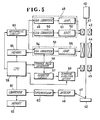
- FIG. 5 An apparatus according to another embodiment of the invention is shown in FIG. 5 and equipped with an automatic astigmatism correcting device and an automatic focusing device.
- the apparatus comprises a beam source 40 for emitting a charged particle beam.41 to an object 42, an astigmatism correcting coil 43, a focusing lens 44, a scanning coil 45 and a detector 46 for detecting signal particles 47 derived from the object 42, all the components 40-47 being the same as those 20-25, 36 and 37 of the apparatus shown in FIG. 4.
- the apparatus further includes an astigmatism correction power unit 48 having two control power sources for supplying an exciting current to the astigmatism correcting coil 43.
- the power sources consist of pairs of D/A converters 49, 50 and amplifiers 51, 52.
- a lens power source 53 consists of a D/A converter 54 and an amplifier 55 which are connected in series to the focusing lens 44 to vary the focus of the charged particle beam 41 and finally to produce a focusing current Io as an output.
- a trigger pulse generator 56 feeds a trigger pulse to both the D/A converter 54 and a scanning circuit 57 upon arrival of a start instruction from a central processing unit 58.
- the scanning circuit 57 feeds a scanning signal to the scanning coil 45 via a scanning-direction setter 59.
- a differentiator 60 differentiates an output of the detector and a comparator 61 compares the peak value of the differential waveform fed from the differentiator 60 with the peak value stored in a memory 62.
- An arithmetic circuit 63 is connected to all the D/A converters 49, 50, 54, and upon instruction from the unit 58, feeds them the result Ns, ⁇ s and Io of the calculations executed therein, respectively.
- a memory 64 is connected to the D/A converter 54 for storing the output therefrom.
- an electrostatic type using an electrode may also be adopted to perform the necessary control by the voltage applied thereto.
- the focus of a charged particle beam on an object is varied with a relative movement thereof repeated in at least two directions, and the focal point or the condition for minimizing the cross-sectional component of the charged particle beam in the direction of its movement on the object is detected using the waveform of the signal particles from the object with respect to the individual directions of the movements, and computation is made on the basis of the detected focus values to obtain at least one of a signal representive of the astigmatism, a signal for correction of the astigmatism and a signal for exact focusing.
- the lens power source needs to be adjusted in such a manner that the line- profile on the display unit has the sharpest rise, ready quantitative measurement of the astigmatism is rendered possible to eventually allow even a non-skilled user to achieve accurate correction with facility in a short period of time.
- astigmatic correction and focusing can be carried out. automatically, the necessary action for the user is mere depression of the start button and includes no judgment at all, hence ensuring fast and precise handling of the charged particle beam.
Landscapes
- Chemical & Material Sciences (AREA)
- Analytical Chemistry (AREA)
- Electron Beam Exposure (AREA)
- Electron Sources, Ion Sources (AREA)
Applications Claiming Priority (2)
| Application Number | Priority Date | Filing Date | Title |
|---|---|---|---|
| JP57128136A JPS5918555A (ja) | 1982-07-22 | 1982-07-22 | 荷電粒子線取扱方法および装置 |
| JP128136/82 | 1982-07-22 |
Publications (2)
| Publication Number | Publication Date |
|---|---|
| EP0100634A2 true EP0100634A2 (de) | 1984-02-15 |
| EP0100634A3 EP0100634A3 (de) | 1985-04-03 |
Family
ID=14977290
Family Applications (1)
| Application Number | Title | Priority Date | Filing Date |
|---|---|---|---|
| EP83304268A Withdrawn EP0100634A3 (de) | 1982-07-22 | 1983-07-22 | Verfahren und Vorrichtung zur Handhabung eines geladenen Teilchenbündels |
Country Status (3)
| Country | Link |
|---|---|
| US (1) | US4554452A (de) |
| EP (1) | EP0100634A3 (de) |
| JP (1) | JPS5918555A (de) |
Cited By (2)
| Publication number | Priority date | Publication date | Assignee | Title |
|---|---|---|---|---|
| US4710632A (en) * | 1984-05-18 | 1987-12-01 | Hitachi, Ltd. | Ion microbeam apparatus |
| EP0178129A3 (en) * | 1984-10-09 | 1988-01-20 | Seiko Instruments Inc. | Apparatus for and method of regulating the shape of a focused ion beam |
Families Citing this family (5)
| Publication number | Priority date | Publication date | Assignee | Title |
|---|---|---|---|---|
| JP2765829B2 (ja) * | 1986-09-29 | 1998-06-18 | 株式会社日立製作所 | 集束イオンビーム加工装置 |
| JPH06105601B2 (ja) * | 1986-10-08 | 1994-12-21 | 株式会社日立製作所 | 走査電子顕微鏡 |
| JPH03163739A (ja) * | 1989-11-21 | 1991-07-15 | Jeol Ltd | 非点状態、フォーカス状態モニタ方式 |
| US6025600A (en) * | 1998-05-29 | 2000-02-15 | International Business Machines Corporation | Method for astigmatism correction in charged particle beam systems |
| JP2005063678A (ja) * | 2003-08-11 | 2005-03-10 | Jeol Ltd | 荷電粒子ビーム装置における自動焦点補正方法および自動非点補正方法 |
Family Cites Families (6)
| Publication number | Priority date | Publication date | Assignee | Title |
|---|---|---|---|---|
| JPS5427703B2 (de) * | 1971-09-06 | 1979-09-11 | ||
| US3748467A (en) * | 1971-09-07 | 1973-07-24 | Nibon Denshi K K | Scanning electron microscope |
| JPS5026470A (de) * | 1973-07-09 | 1975-03-19 | ||
| GB1477030A (en) * | 1973-12-24 | 1977-06-22 | Jeol Ltd | Method and apparatus for the automatic focussing of electron beams in electron optical apparatus |
| GB2002547B (en) * | 1977-07-30 | 1982-01-20 | Tee W | Investigation of astigmatism in electron beam probe instruments |
| JPS5492050A (en) * | 1977-12-29 | 1979-07-20 | Jeol Ltd | Method and apparatus for astigmatic correction of scanning electronic microscope and others |
-
1982
- 1982-07-22 JP JP57128136A patent/JPS5918555A/ja active Pending
-
1983
- 1983-07-18 US US06/514,632 patent/US4554452A/en not_active Expired - Fee Related
- 1983-07-22 EP EP83304268A patent/EP0100634A3/de not_active Withdrawn
Cited By (2)
| Publication number | Priority date | Publication date | Assignee | Title |
|---|---|---|---|---|
| US4710632A (en) * | 1984-05-18 | 1987-12-01 | Hitachi, Ltd. | Ion microbeam apparatus |
| EP0178129A3 (en) * | 1984-10-09 | 1988-01-20 | Seiko Instruments Inc. | Apparatus for and method of regulating the shape of a focused ion beam |
Also Published As
| Publication number | Publication date |
|---|---|
| JPS5918555A (ja) | 1984-01-30 |
| EP0100634A3 (de) | 1985-04-03 |
| US4554452A (en) | 1985-11-19 |
Similar Documents
| Publication | Publication Date | Title |
|---|---|---|
| US7435960B2 (en) | Charged particle beam apparatus | |
| EP0400926B1 (de) | SEM Vergrösserungskompensation | |
| EP2463887A2 (de) | Verfahren zur Herstellung einer axialen Ausrichtung eines geladenen Teilchenstrahls und geladenes Teilchenstrahlsystem | |
| JP2005310602A (ja) | 荷電粒子線調整方法、及び荷電粒子線装置 | |
| US4554452A (en) | Method and apparatus for handling charged particle beam | |
| US7381951B2 (en) | Charged particle beam adjustment method and apparatus | |
| JPS6134221B2 (de) | ||
| JP2946537B2 (ja) | 電子光学鏡筒 | |
| JP4752138B2 (ja) | 荷電粒子線調整方法及び荷電粒子線装置 | |
| CN110364405B (zh) | 带电粒子束轴对准装置及方法、带电粒子束照射装置 | |
| JPH03138842A (ja) | 電子線描画装置 | |
| US4791295A (en) | Method and apparatus for automatically correcting astigmatism of scanning electron microscope or the like | |
| JP4431624B2 (ja) | 荷電粒子線調整方法、及び荷電粒子線装置 | |
| JPH0691001B2 (ja) | 荷電ビ−ム制御方法 | |
| JPH0547332A (ja) | 荷電粒子線装置 | |
| JPH10162760A (ja) | 電子ビーム装置 | |
| JPH0963937A (ja) | 荷電ビーム描画装置 | |
| JPH10256110A (ja) | 成形偏向器のオフセット調整方法及びこれを適用した荷電ビーム描画装置 | |
| JPH11101629A (ja) | 電子ビーム測長装置 | |
| JPS6312146A (ja) | パタ−ン寸法計測方法 | |
| JPS633258B2 (de) | ||
| JPH01239949A (ja) | 電子ビームプローブ装置 | |
| CN121768928A (zh) | 一种基于栅压控制的x射线管焦点偏移调节系统 | |
| JPH01183045A (ja) | 電子ビームの最適化自動設定装置 | |
| JPH03120818A (ja) | 荷電粒子ビームの焦点調整方法 |
Legal Events
| Date | Code | Title | Description |
|---|---|---|---|
| PUAI | Public reference made under article 153(3) epc to a published international application that has entered the european phase |
Free format text: ORIGINAL CODE: 0009012 |
|
| AK | Designated contracting states |
Designated state(s): DE FR GB |
|
| PUAL | Search report despatched |
Free format text: ORIGINAL CODE: 0009013 |
|
| AK | Designated contracting states |
Designated state(s): DE FR GB |
|
| 17P | Request for examination filed |
Effective date: 19850515 |
|
| 17Q | First examination report despatched |
Effective date: 19860730 |
|
| D17Q | First examination report despatched (deleted) | ||
| STAA | Information on the status of an ep patent application or granted ep patent |
Free format text: STATUS: THE APPLICATION IS DEEMED TO BE WITHDRAWN |
|
| 18D | Application deemed to be withdrawn |
Effective date: 19870813 |