EP0100768A2 - Radiateur en forme de panneau - Google Patents
Radiateur en forme de panneau Download PDFInfo
- Publication number
- EP0100768A2 EP0100768A2 EP83890126A EP83890126A EP0100768A2 EP 0100768 A2 EP0100768 A2 EP 0100768A2 EP 83890126 A EP83890126 A EP 83890126A EP 83890126 A EP83890126 A EP 83890126A EP 0100768 A2 EP0100768 A2 EP 0100768A2
- Authority
- EP
- European Patent Office
- Prior art keywords
- plate
- radiator
- openings
- convector
- areas
- Prior art date
- Legal status (The legal status is an assumption and is not a legal conclusion. Google has not performed a legal analysis and makes no representation as to the accuracy of the status listed.)
- Withdrawn
Links
Images


Classifications
-
- F—MECHANICAL ENGINEERING; LIGHTING; HEATING; WEAPONS; BLASTING
- F28—HEAT EXCHANGE IN GENERAL
- F28D—HEAT-EXCHANGE APPARATUS, NOT PROVIDED FOR IN ANOTHER SUBCLASS, IN WHICH THE HEAT-EXCHANGE MEDIA DO NOT COME INTO DIRECT CONTACT
- F28D1/00—Heat-exchange apparatus having stationary conduit assemblies for one heat-exchange medium only, the media being in contact with different sides of the conduit wall, in which the other heat-exchange medium is a large body of fluid, e.g. domestic or motor car radiators
- F28D1/02—Heat-exchange apparatus having stationary conduit assemblies for one heat-exchange medium only, the media being in contact with different sides of the conduit wall, in which the other heat-exchange medium is a large body of fluid, e.g. domestic or motor car radiators with heat-exchange conduits immersed in the body of fluid
- F28D1/03—Heat-exchange apparatus having stationary conduit assemblies for one heat-exchange medium only, the media being in contact with different sides of the conduit wall, in which the other heat-exchange medium is a large body of fluid, e.g. domestic or motor car radiators with heat-exchange conduits immersed in the body of fluid with plate-like or laminated conduits
- F28D1/0308—Heat-exchange apparatus having stationary conduit assemblies for one heat-exchange medium only, the media being in contact with different sides of the conduit wall, in which the other heat-exchange medium is a large body of fluid, e.g. domestic or motor car radiators with heat-exchange conduits immersed in the body of fluid with plate-like or laminated conduits the conduits being formed by paired plates touching each other
-
- F—MECHANICAL ENGINEERING; LIGHTING; HEATING; WEAPONS; BLASTING
- F28—HEAT EXCHANGE IN GENERAL
- F28F—DETAILS OF HEAT-EXCHANGE AND HEAT-TRANSFER APPARATUS, OF GENERAL APPLICATION
- F28F3/00—Plate-like or laminated elements; Assemblies of plate-like or laminated elements
- F28F3/02—Elements or assemblies thereof with means for increasing heat-transfer area, e.g. with fins, with recesses, with corrugations
- F28F3/025—Elements or assemblies thereof with means for increasing heat-transfer area, e.g. with fins, with recesses, with corrugations the means being corrugated, plate-like elements
- F28F3/027—Elements or assemblies thereof with means for increasing heat-transfer area, e.g. with fins, with recesses, with corrugations the means being corrugated, plate-like elements with openings, e.g. louvered corrugated fins; Assemblies of corrugated strips
Definitions
- the invention relates to a plate radiator, which is provided with at least one convector plate attached to a substantially flat radiator plate, which is wave-shaped and rests in strip-shaped connection areas on the radiator plate and is connected to it and between these connection areas protruding from the radiator plate which, together with the zones of the radiator plate bridged by these areas of the convector plate, form channels which, when the radiator is installed, run from bottom to top and are open at the bottom and top.
- Panel radiators of the aforementioned type are often provided with a two-layer coating in order to protect the surface against corrosion and to give the radiators an attractive appearance.
- the usual procedure is to first apply the primer and dry it, then apply a topcoat and then subject the lacquer to a baking process.
- drop formation usually occurs on the side of the plate radiator to which the convector plate is attached, which adversely affects the appearance of the radiator and also disrupt the homogeneity of the lacquer coating, so that it must be expected that corrosion will occur at these points at an early stage occur.
- drop formation usually occurs on the side of the plate radiator to which the convector plate is attached, which adversely affects the appearance of the radiator and also disrupt the homogeneity of the lacquer coating, so that it must be expected that corrosion will occur at these points at an early stage occur.
- Another object of the invention is a plate radiator to keep the heat emission as high as possible without enlarging the radiator dimensions and without additional components.
- the plate radiator of the type mentioned at the outset is characterized in that openings are provided in the convector plate in zones which are located in the connection areas next to the connection points and / or in the areas projecting from the radiator plate, the convector plate being provided instead of openings provided in the connection areas in addition to the connection points, zones can also be kept at a distance from the radiator plate and, in the areas of the convector plate which protrude from the radiator plate, form passages leading to the outside from the respective channel.
- the emergence of the primer varnish at the edges of the connection areas can be explained in such a way that the primer varnish penetrates into the capillary-narrow surface gaps, which are present in the connection areas outside the connection points between the radiator plate and the convector sheet, during application, which is usually done by immersion, and at subsequent drying of the primer is hardly solidified, because this drying process hardens the primer paint at the edge of the connection areas relatively quickly and thus when applied th drying temperature, the primer lacquer which has penetrated into the capillary gap between the convector plate and the radiator plate no longer takes place and solvent can no longer escape from this capillary gap in the course of the drying process of the primer.
- An advantageous embodiment of the plate radiator according to the invention is characterized in that openings are provided in the convector plate in the connection areas which extend essentially over the entire width of the connection areas. From the manufacturing point of view of the convector sheet, it is favorable to provide that the openings are slit-like cutouts, the longitudinal extent of these cutouts running in the width direction of the connecting areas. In this embodiment, particularly good effectiveness is achieved if the openings Conditions or cutouts extend into the flanks of the areas of the convector plate protruding from the radiator plate, since this also counteracts the formation of paint accumulations at the edge of the connection areas between the convector plate and radiator plate, where there is a wedge-like tapering gap.
- Another embodiment of the plate radiator which also has a good effectiveness in the sense of the desired prevention of undesired droplet formation, is characterized in that openings are located in the convector plate in the connecting areas, which are located in the width direction of the connecting areas, approximately in the middle of the connecting areas are.
- openings are located in the convector plate in the connecting areas, which are located in the width direction of the connecting areas, approximately in the middle of the connecting areas are.
- the openings have an elongated shape and that the longitudinal extension of these openings runs in the longitudinal direction of the connecting regions. It is favorable both for production reasons and in the interest of keeping the width of the remaining capillary gaps small if one chooses an embodiment in which a plurality of openings are provided between two connection points which follow one another in the longitudinal direction of a connection area.
- the upper edges of the openings are bent away from the radiator plate and that the openings are preferably placed just above the connection points. This prevents excess primer varnish, which after application of this varnish, which is usually done by dipping, from penetrating into the cutouts on the outside of the convector sheet as it runs away, and it also prevents the primer varnish from flowing out into the gap between Convector plate and radiator plate has penetrated, favors if in this configuration the cutouts are each at the lower end of a section of the capillary gap located between two connection points. This drainage is further promoted if it is provided that the lower edges of the openings are pressed in a wedge-like manner on the radiator plate.
- a further embodiment of the plate radiator according to the invention is characterized in that the convector plate is provided in the connection areas with elevations which take up part of the area of the connection areas and point towards the radiator plate.
- the elevations provided in the connection areas increase the width of the capillary gap in some places, so that penetrated primer lacquer can flow off or improved drying of the primer lacquer penetrated into the capillary gap is achieved.
- connection points lie on elevations of the convector plate, and it is also advantageous for compliance with the respectively intended geometry of the capillary gap, which is present in the connection area between the convector plate and the radiator plate, if one between connection points, the successive in a connection area, provides several elevations of the convector sheet, or uses an elongated elevation of the convector sheet extending in the longitudinal direction of the connection area.
- openings provided in the plate radiator according to the invention in most cases it is advantageous to provide that these openings are arranged in the flanks of the convector plate leading away from the radiator plate.
- This embodiment is advantageous both from the structural point of view and from the point of view of the desired improvement in the heat emission. Hiebei it is favorable if one provides that openings are arranged in each of the two flanks of the convector plate delimiting a channel. From the point of view of good mechanical stability as well as from the point of view of simple attachment of the openings and for fluidic considerations, it is also advantageous if the openings arranged in one flank are offset in height relative to the openings arranged in the other flank.
- openings provided in the convector sheet in the case of the plate radiator designed according to the invention there is relatively extensive freedom of movement; so you can provide circular, but also oval or slot-shaped openings. Openings with approximately the same height and width dimensions are easy to manufacture and place and also result in good flow conditions.
- a very effective promotion of the flow is also achieved in an embodiment of the plate radiator according to the invention, which is characterized in that the openings are formed by slots which in each case from the one into the other of the channels delimiting flanks over the intermediate, facing away from the radiator plate
- the apex of the convector plate runs. Hiebei it is convenient if the slots are substantially horizontal.
- the lower and / or the upper edge of the openings to be bent to the inclined position.
- Such a bending of the edges of the openings favors a flow through the openings and promotes the formation of movement components which run transversely to the longitudinal extent of the channels, as a result of which the overall heat emission is positively influenced.
- the plate radiator shown in FIGS. 1 to 3 has a radiator plate 1, in which flow channels la and webs lb follow one another.
- a convector plate 2 is attached to this radiator plate 1.
- the convector plate 2 and the radiator plate 1 are connected to one another in strip-shaped connecting areas 3, in which the main heat transfer from the radiator 1 to the convector plate 2 also takes place. It is in the verbin areas 3 connection points 4 are provided, which are formed in the present case in the form of spot welds.
- Areas 5 between which the convector plate 2 projects from the radiator plate 1 lie between the connection areas 3.
- the convector plate 2 is provided with openings 19 in zones 18, which are located in the connection areas 3 next to the connection points 4. These openings 19, which are designed as slot-like cutouts, improve the through-drying of the primer lacquer which, when the primer was applied, penetrated into the capillary gap 20 present in the connection region between the convector plate and the radiator plate, which penetration is indicated by the arrows 21. This can be explained by the fact that through the cut-outs 19, excess primer lacquer can flow off when the primer dries and also solvent, which is released when the primer dries, can easily escape from the capillary gap between the convector plate and the radiator plate.
- the cutouts 19 also give the possibility that primer paint, which migrates out of the capillary gap 20 in the course of the subsequent heat treatment which is carried out for baking the paint, collects in these cutouts 19 and does not flow away any further. This is also favored by the fact that the cutouts 19 extend essentially over the entire width of the connecting regions 3.
- the slot-like shape of the cutouts 19 facilitates their manufacture in the course of the production of the radiators.
- the openings or cutouts 19 extend into the flanks 9 of the areas 5 of the convector sheet 2 protruding from the radiator plate 1. This advantageously counteracts the formation of paint accumulations on the edges 23 of the connecting areas 3, at which the distance between the convector sheets 2 and the radiator plate 1 narrowed in a wedge shape towards the capillary gap 20. This too is in the sense of the intended prevention of droplet formation during the stoving process.
- the cutouts 19 have cut edges pointing towards the radiator plate 1, which protrude somewhat from the side of the convector plate 2 facing the radiator plate 1 and thus bear against the radiator plate 1 in a cutting-like manner; In this way, the wedge-shaped entrance to the capillary gap 20, in which paint can accumulate, is interrupted particularly effectively at each cutout. It is also very favorable to choose the shape of the convector plate 2 so that the connection areas 3 of the convector plate 2 extend to the side flanks 24 of the flow channels la of the radiator plate 1 and the cutouts 19 also extend to these side flanks.
- the cutouts 19 are preferably placed just above the connection points 20.
- FIGS. 5 and 6 are designed in such a way that the remaining width 32 of the capillary gaps 20 is kept as small as possible and thus on the one hand by the arrangement of the cutouts approximately in the middle of the connecting areas 3 (seen in the width direction 31 of these connecting areas 3) the amount of lacquer penetrating into the capillary gaps during the priming process remains small and, on the other hand, the drying of the lacquer which has penetrated into the capillary gaps is improved.
- a plurality of openings or cutouts 34 are provided between two successive connection points 4 in the longitudinal direction 33 of the connection area 3, which have approximately the same length and width, the shape of these openings or cutouts largely can be freely chosen.
- an elongated cutout 35 is provided between two successive connection points 4, the longitudinal extent of this cutout running in the longitudinal direction 33 of the relevant connection area 3.
- the convector plate 2 is provided in the connection areas with elevations which take up part of the area of the connection areas and point towards the radiator plate 1. This creates a better possibility for the drainage of primer lacquer which has penetrated into the connection areas when the primer is applied, and at the same time also improves the possibility of the primer lacquer penetrating into this area drying out, since evaporated solvent can easily flow off.
- connection points 4 lie on elevations 36 of the convector sheet 2. This is particularly advantageous from the standpoint of production.
- a plurality of elevations 37 of the convector sheet 2 are provided between successive connection points 4 in a connection area, which elevations run obliquely to the longitudinal direction 33 of the connection area 3.
- an elongate elevation which extends in the longitudinal direction 33 of the connecting region 3, can also be provided.
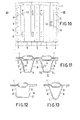
- the plate radiator shown in FIGS. 10 and 11 is provided with a convector plate 2 which is attached to the essentially flat radiator plate 1 and which is wave-shaped and rests in strip-shaped connecting regions 3 on the radiator plate 1 and is connected to it.
- This connection is usually designed as a welded connection and e.g. realized by a number of successively set welding spots 4.
- the convector plate 2 has areas 5 protruding from the radiator plate 1, which together with the zones 6 of the radiator plate 1 bridged by these areas 5 form air channels 7 which, when the radiator is installed, run from bottom to top and bottom and top are open.
- openings 8 are provided which form passages leading outwards from the respective channel 7.
- these openings 8 are arranged in the flanks 9 of the convector plate 2 leading away from the radiator plate 1, such openings being provided in each of the two flanks 9 of the convector plate 2 delimiting a channel.
- the openings 8 provided in the two flanks 9 of the convector sheet 2 each assigned to a channel 7 can be arranged opposite one another in pairs Place at the same height or, as shown on the right in FIG. 1, place the openings 8a arranged in one flank 9a offset in height relative to the openings 8b arranged in the other flank 9b, the latter embodiment in some cases both from seen in the manufacture and offers advantages in terms of the achievable flow conditions.
- the height dimensions 10 and the width dimensions 11 of the openings 8 can advantageously be chosen to be approximately the same in the interest of the simplest possible manufacture and also in the interest of accommodating the openings in the convector sheet.
- the areas of this sheet which protrude from the radiator plate, together with the radiator plate, include channels which run from bottom to top in the installed radiator and are open at the top and bottom.
- the corrugation of the convector plate can be designed in very different ways; so come e.g. In addition to the corrugation which is trapezoidal in cross-section and can be seen from FIG. 11, other corrugations such as those e.g. 12 and 13 are shown, in question.
- the openings 8 can also be made in very different ways, e.g. in the form of circular, oval, square, hexagonal or slit-shaped holes.
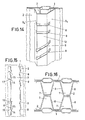
- the openings 8 provided in the convector sheet 2 are formed by slots, which each extend from the one flank 9a in the other flank 9b extends over the intermediate vertex 12 of the convector plate 2; the flanks 9a and 9b each delimit a channel 7, and the apex 12 lies on the side of the flanks 9a, 9b facing away from the radiator plate. It is possible to provide an essentially horizontal course of the slots 8, as is shown in the upper part of FIG. 14, or else an inclined course of these slots, as is shown in the lower part of FIG. 14.
- the lower and the upper edge of the openings 8 provided in the convector sheet are oriented bent toward the inclined position.
- a number of variants are possible with regard to the provision of such edge bends and with regard to the placement of openings of this type in the course of the channels 7. If, as shown in FIG. 15 at the bottom left, a bend in the lower edge 14 of an opening 8 to an inclined position pointing towards the interior of the channel 7, this favors, analogously to a bend in the bottom left of FIG. 15 upper edge 15 of an opening 8 to an outward-facing inclined position, the inflow of air into the channel 7, as symbolized by the arrow 16.
- FIG. 16 shows, it is also possible to combine a plurality of radiator plates provided with convector plates in accordance with the invention to form a plate radiator.
- passages are formed through the openings provided in the convector sheets 2, which lead from the channels 7 to the outside, and an improvement in the heat dissipation of the convector is also achieved in this case.
Landscapes
- Engineering & Computer Science (AREA)
- Physics & Mathematics (AREA)
- Thermal Sciences (AREA)
- Mechanical Engineering (AREA)
- General Engineering & Computer Science (AREA)
- Heat-Exchange Devices With Radiators And Conduit Assemblies (AREA)
- Domestic Hot-Water Supply Systems And Details Of Heating Systems (AREA)
Applications Claiming Priority (4)
| Application Number | Priority Date | Filing Date | Title |
|---|---|---|---|
| AT295282A AT376296B (de) | 1982-07-30 | 1982-07-30 | Plattenradiator |
| AT2952/82 | 1982-07-30 | ||
| AT3813/83 | 1982-10-15 | ||
| AT381382A AT380104B (de) | 1982-10-15 | 1982-10-15 | Plattenradiator |
Publications (2)
| Publication Number | Publication Date |
|---|---|
| EP0100768A2 true EP0100768A2 (fr) | 1984-02-15 |
| EP0100768A3 EP0100768A3 (fr) | 1984-05-30 |
Family
ID=25599335
Family Applications (1)
| Application Number | Title | Priority Date | Filing Date |
|---|---|---|---|
| EP83890126A Withdrawn EP0100768A3 (fr) | 1982-07-30 | 1983-07-28 | Radiateur en forme de panneau |
Country Status (1)
| Country | Link |
|---|---|
| EP (1) | EP0100768A3 (fr) |
Cited By (2)
| Publication number | Priority date | Publication date | Assignee | Title |
|---|---|---|---|---|
| WO1990013785A1 (fr) * | 1989-05-12 | 1990-11-15 | N D Marston Ltd | Radiateurs |
| FR2657422A1 (fr) * | 1990-01-25 | 1991-07-26 | Valeo Thermique Moteur Sa | Echangeur de chaleur a lames, en particulier pour vehicule automobile. |
Family Cites Families (2)
| Publication number | Priority date | Publication date | Assignee | Title |
|---|---|---|---|---|
| BE396650A (fr) * | ||||
| BE482849A (fr) * | 1946-06-18 |
-
1983
- 1983-07-28 EP EP83890126A patent/EP0100768A3/fr not_active Withdrawn
Cited By (2)
| Publication number | Priority date | Publication date | Assignee | Title |
|---|---|---|---|---|
| WO1990013785A1 (fr) * | 1989-05-12 | 1990-11-15 | N D Marston Ltd | Radiateurs |
| FR2657422A1 (fr) * | 1990-01-25 | 1991-07-26 | Valeo Thermique Moteur Sa | Echangeur de chaleur a lames, en particulier pour vehicule automobile. |
Also Published As
| Publication number | Publication date |
|---|---|
| EP0100768A3 (fr) | 1984-05-30 |
Similar Documents
| Publication | Publication Date | Title |
|---|---|---|
| DE2840317C2 (de) | Kontaktkörper für einen Verdunstungskühler, insbesondere Kühlturm | |
| DE102006048305B4 (de) | Plattenwärmetauscher | |
| DE2449045C3 (de) | Anordnung zur Verbindung der Rohrplatten, der Seitenteile und des Wasserkastens eines Wärmetauschers | |
| DE3504614C2 (fr) | ||
| DE2416188B2 (de) | Kühler | |
| CH685140A5 (de) | Kühleinrichtung für elektrische Bauelemente. | |
| EP0196672A2 (fr) | Panneaux pour recouvrir les murs extérieurs de bâtiments | |
| DE2449070C3 (de) | Wärmetauscher | |
| EP0153759A2 (fr) | Latte d'un volet à rouleau | |
| DE4039293A1 (de) | Waermeaustauscher | |
| EP0100768A2 (fr) | Radiateur en forme de panneau | |
| DE3432231A1 (de) | Waermetauscher | |
| DE202016104882U1 (de) | Ablaufeinheit und Ablaufvorrichtung zur Ableitung von Wasser | |
| DE2532544C3 (de) | Vorrichtung zum Abkühlen von Kühlwasser, in Naturzug-Kühltürmen | |
| AT376296B (de) | Plattenradiator | |
| DE19513201C1 (de) | Tropfenabscheider für eine dezentrale Heizungs-, Lüftungs- und/oder Kühlvorrichtung | |
| DE29823852U1 (de) | Wärmetauscher | |
| DE2009547A1 (de) | Heizelement | |
| AT380104B (de) | Plattenradiator | |
| DE2730087C2 (fr) | ||
| DE102019131048A1 (de) | Düse zum Auftragen von hochviskosem Material in Lagen auf einem Rohbauteil eines Kraftwagens | |
| DE19825908C1 (de) | Abdeckgitter für Plattenheizkörper | |
| EP0442284B1 (fr) | Plaque de cuisson électrique | |
| DE8713073U1 (de) | Abdeckgitter für Flachheizkörper | |
| DE19541803B4 (de) | Wärmeübertrager für gasbeheizte Wassererhitzer |
Legal Events
| Date | Code | Title | Description |
|---|---|---|---|
| PUAI | Public reference made under article 153(3) epc to a published international application that has entered the european phase |
Free format text: ORIGINAL CODE: 0009012 |
|
| AK | Designated contracting states |
Designated state(s): BE CH DE FR GB IT LI NL SE |
|
| PUAL | Search report despatched |
Free format text: ORIGINAL CODE: 0009013 |
|
| AK | Designated contracting states |
Designated state(s): BE CH DE FR GB IT LI NL SE |
|
| STAA | Information on the status of an ep patent application or granted ep patent |
Free format text: STATUS: THE APPLICATION IS DEEMED TO BE WITHDRAWN |
|
| 18D | Application deemed to be withdrawn |
Effective date: 19850131 |
|
| RIN1 | Information on inventor provided before grant (corrected) |
Inventor name: WANDERER, RAIMUND |