EP0101027A1 - An Siliciumdioxid als Träger gebundene Wirkstoffe, Verfahren zu ihrer Herstellung und ihre Verwendung - Google Patents
An Siliciumdioxid als Träger gebundene Wirkstoffe, Verfahren zu ihrer Herstellung und ihre Verwendung Download PDFInfo
- Publication number
- EP0101027A1 EP0101027A1 EP83107729A EP83107729A EP0101027A1 EP 0101027 A1 EP0101027 A1 EP 0101027A1 EP 83107729 A EP83107729 A EP 83107729A EP 83107729 A EP83107729 A EP 83107729A EP 0101027 A1 EP0101027 A1 EP 0101027A1
- Authority
- EP
- European Patent Office
- Prior art keywords
- formula
- active ingredient
- active
- compounds
- carrier
- Prior art date
- Legal status (The legal status is an assumption and is not a legal conclusion. Google has not performed a legal analysis and makes no representation as to the accuracy of the status listed.)
- Withdrawn
Links
- VYPSYNLAJGMNEJ-UHFFFAOYSA-N Silicium dioxide Chemical group O=[Si]=O VYPSYNLAJGMNEJ-UHFFFAOYSA-N 0.000 title claims description 61
- 239000000377 silicon dioxide Substances 0.000 title claims description 26
- 235000012239 silicon dioxide Nutrition 0.000 title claims description 12
- 238000004519 manufacturing process Methods 0.000 title description 8
- 229910052681 coesite Inorganic materials 0.000 title description 3
- 229910052906 cristobalite Inorganic materials 0.000 title description 3
- 229910052682 stishovite Inorganic materials 0.000 title description 3
- 229910052905 tridymite Inorganic materials 0.000 title description 3
- 150000002894 organic compounds Chemical group 0.000 title 1
- 150000001875 compounds Chemical class 0.000 claims abstract description 66
- 239000000126 substance Substances 0.000 claims abstract description 24
- XLYOFNOQVPJJNP-UHFFFAOYSA-N water Substances O XLYOFNOQVPJJNP-UHFFFAOYSA-N 0.000 claims abstract description 20
- 239000000645 desinfectant Substances 0.000 claims abstract description 5
- 239000004480 active ingredient Substances 0.000 claims description 54
- 239000013543 active substance Substances 0.000 claims description 33
- UHOVQNZJYSORNB-UHFFFAOYSA-N Benzene Chemical compound C1=CC=CC=C1 UHOVQNZJYSORNB-UHFFFAOYSA-N 0.000 claims description 28
- 125000006850 spacer group Chemical group 0.000 claims description 26
- 238000006243 chemical reaction Methods 0.000 claims description 25
- 238000002360 preparation method Methods 0.000 claims description 21
- 239000007795 chemical reaction product Substances 0.000 claims description 20
- FYSNRJHAOHDILO-UHFFFAOYSA-N thionyl chloride Chemical compound ClS(Cl)=O FYSNRJHAOHDILO-UHFFFAOYSA-N 0.000 claims description 20
- 238000004873 anchoring Methods 0.000 claims description 15
- KOPOQZFJUQMUML-UHFFFAOYSA-N chlorosilane Chemical group Cl[SiH3] KOPOQZFJUQMUML-UHFFFAOYSA-N 0.000 claims description 15
- 238000000034 method Methods 0.000 claims description 14
- 125000002887 hydroxy group Chemical group [H]O* 0.000 claims description 12
- 238000001179 sorption measurement Methods 0.000 claims description 12
- 229910004298 SiO 2 Inorganic materials 0.000 claims description 11
- 229940079593 drug Drugs 0.000 claims description 11
- 239000003814 drug Substances 0.000 claims description 11
- 125000004435 hydrogen atom Chemical group [H]* 0.000 claims description 10
- 239000002245 particle Substances 0.000 claims description 10
- 230000008569 process Effects 0.000 claims description 10
- 239000002243 precursor Substances 0.000 claims description 9
- 125000002496 methyl group Chemical group [H]C([H])([H])* 0.000 claims description 8
- 125000001424 substituent group Chemical group 0.000 claims description 8
- 229910052801 chlorine Inorganic materials 0.000 claims description 7
- -1 halogen anion Chemical class 0.000 claims description 7
- ZAMOUSCENKQFHK-UHFFFAOYSA-N Chlorine atom Chemical compound [Cl] ZAMOUSCENKQFHK-UHFFFAOYSA-N 0.000 claims description 6
- 239000000460 chlorine Substances 0.000 claims description 6
- 229910052757 nitrogen Inorganic materials 0.000 claims description 6
- 229910052717 sulfur Inorganic materials 0.000 claims description 6
- XUIMIQQOPSSXEZ-UHFFFAOYSA-N Silicon Chemical group [Si] XUIMIQQOPSSXEZ-UHFFFAOYSA-N 0.000 claims description 5
- 125000004432 carbon atom Chemical group C* 0.000 claims description 5
- 239000003153 chemical reaction reagent Substances 0.000 claims description 5
- 239000003589 local anesthetic agent Substances 0.000 claims description 5
- 125000004433 nitrogen atom Chemical group N* 0.000 claims description 5
- 229910052710 silicon Inorganic materials 0.000 claims description 5
- WSWCOQWTEOXDQX-MQQKCMAXSA-M (E,E)-sorbate Chemical compound C\C=C\C=C\C([O-])=O WSWCOQWTEOXDQX-MQQKCMAXSA-M 0.000 claims description 4
- 125000003545 alkoxy group Chemical group 0.000 claims description 4
- 125000002947 alkylene group Chemical group 0.000 claims description 4
- 125000001309 chloro group Chemical group Cl* 0.000 claims description 4
- 239000002270 dispersing agent Substances 0.000 claims description 4
- 229910052736 halogen Inorganic materials 0.000 claims description 4
- 239000001257 hydrogen Substances 0.000 claims description 4
- 229910052739 hydrogen Inorganic materials 0.000 claims description 4
- 229910052740 iodine Inorganic materials 0.000 claims description 4
- 229940075554 sorbate Drugs 0.000 claims description 4
- UFHFLCQGNIYNRP-UHFFFAOYSA-N Hydrogen Chemical compound [H][H] UFHFLCQGNIYNRP-UHFFFAOYSA-N 0.000 claims description 3
- 230000005494 condensation Effects 0.000 claims description 3
- 230000003111 delayed effect Effects 0.000 claims description 3
- 125000001301 ethoxy group Chemical group [H]C([H])([H])C([H])([H])O* 0.000 claims description 3
- PNDPGZBMCMUPRI-UHFFFAOYSA-N iodine Chemical compound II PNDPGZBMCMUPRI-UHFFFAOYSA-N 0.000 claims description 3
- 229960005015 local anesthetics Drugs 0.000 claims description 3
- 229910052760 oxygen Inorganic materials 0.000 claims description 3
- 229940124547 specific antidotes Drugs 0.000 claims description 3
- CPELXLSAUQHCOX-UHFFFAOYSA-M Bromide Chemical compound [Br-] CPELXLSAUQHCOX-UHFFFAOYSA-M 0.000 claims description 2
- 229910020175 SiOH Inorganic materials 0.000 claims description 2
- 150000001450 anions Chemical class 0.000 claims description 2
- 125000003118 aryl group Chemical group 0.000 claims description 2
- 239000003795 chemical substances by application Substances 0.000 claims description 2
- 238000009833 condensation Methods 0.000 claims description 2
- 150000002367 halogens Chemical class 0.000 claims description 2
- 239000004611 light stabiliser Substances 0.000 claims description 2
- 238000005406 washing Methods 0.000 claims description 2
- 239000012454 non-polar solvent Substances 0.000 claims 2
- 239000003960 organic solvent Substances 0.000 claims 1
- 239000007788 liquid Substances 0.000 abstract description 8
- 230000000694 effects Effects 0.000 abstract description 7
- 230000007062 hydrolysis Effects 0.000 abstract description 6
- 238000006460 hydrolysis reaction Methods 0.000 abstract description 6
- CWAFVXWRGIEBPL-UHFFFAOYSA-N ethoxysilane Chemical compound CCO[SiH3] CWAFVXWRGIEBPL-UHFFFAOYSA-N 0.000 description 14
- 239000000047 product Substances 0.000 description 14
- 125000005372 silanol group Chemical group 0.000 description 13
- YXFVVABEGXRONW-UHFFFAOYSA-N Toluene Chemical compound CC1=CC=CC=C1 YXFVVABEGXRONW-UHFFFAOYSA-N 0.000 description 11
- 239000005046 Chlorosilane Substances 0.000 description 10
- VEXZGXHMUGYJMC-UHFFFAOYSA-N Hydrochloric acid Chemical compound Cl VEXZGXHMUGYJMC-UHFFFAOYSA-N 0.000 description 10
- 238000003756 stirring Methods 0.000 description 10
- 229910002016 Aerosil® 200 Inorganic materials 0.000 description 9
- LFQSCWFLJHTTHZ-UHFFFAOYSA-N Ethanol Chemical compound CCO LFQSCWFLJHTTHZ-UHFFFAOYSA-N 0.000 description 9
- CTQNGGLPUBDAKN-UHFFFAOYSA-N O-Xylene Chemical compound CC1=CC=CC=C1C CTQNGGLPUBDAKN-UHFFFAOYSA-N 0.000 description 9
- 239000000969 carrier Substances 0.000 description 8
- 239000008096 xylene Substances 0.000 description 8
- NOOLISFMXDJSKH-UTLUCORTSA-N (+)-Neomenthol Chemical compound CC(C)[C@@H]1CC[C@@H](C)C[C@@H]1O NOOLISFMXDJSKH-UTLUCORTSA-N 0.000 description 7
- NOOLISFMXDJSKH-UHFFFAOYSA-N DL-menthol Natural products CC(C)C1CCC(C)CC1O NOOLISFMXDJSKH-UHFFFAOYSA-N 0.000 description 7
- 229940041616 menthol Drugs 0.000 description 7
- 125000000962 organic group Chemical group 0.000 description 7
- 239000002904 solvent Substances 0.000 description 7
- WEVYAHXRMPXWCK-UHFFFAOYSA-N Acetonitrile Chemical compound CC#N WEVYAHXRMPXWCK-UHFFFAOYSA-N 0.000 description 6
- 102000004190 Enzymes Human genes 0.000 description 6
- 108090000790 Enzymes Proteins 0.000 description 6
- 239000002253 acid Substances 0.000 description 6
- 239000000203 mixture Substances 0.000 description 6
- 239000000843 powder Substances 0.000 description 6
- WSLDOOZREJYCGB-UHFFFAOYSA-N 1,2-Dichloroethane Chemical compound ClCCCl WSLDOOZREJYCGB-UHFFFAOYSA-N 0.000 description 5
- VEXZGXHMUGYJMC-UHFFFAOYSA-M Chloride anion Chemical compound [Cl-] VEXZGXHMUGYJMC-UHFFFAOYSA-M 0.000 description 5
- 238000004140 cleaning Methods 0.000 description 5
- 238000000502 dialysis Methods 0.000 description 5
- 125000000524 functional group Chemical group 0.000 description 5
- DLRJIFUOBPOJNS-UHFFFAOYSA-N phenetole Chemical compound CCOC1=CC=CC=C1 DLRJIFUOBPOJNS-UHFFFAOYSA-N 0.000 description 5
- 238000010992 reflux Methods 0.000 description 5
- CFKMVGJGLGKFKI-UHFFFAOYSA-N 4-chloro-m-cresol Chemical compound CC1=CC(O)=CC=C1Cl CFKMVGJGLGKFKI-UHFFFAOYSA-N 0.000 description 4
- 239000012876 carrier material Substances 0.000 description 4
- 238000005660 chlorination reaction Methods 0.000 description 4
- 230000008030 elimination Effects 0.000 description 4
- 238000003379 elimination reaction Methods 0.000 description 4
- 239000000543 intermediate Substances 0.000 description 4
- 150000003856 quaternary ammonium compounds Chemical class 0.000 description 4
- 0 C*C1*C[C@@](C)*C1 Chemical compound C*C1*C[C@@](C)*C1 0.000 description 3
- 230000008901 benefit Effects 0.000 description 3
- 239000006185 dispersion Substances 0.000 description 3
- 238000001035 drying Methods 0.000 description 3
- 238000005516 engineering process Methods 0.000 description 3
- INQOMBQAUSQDDS-UHFFFAOYSA-N iodomethane Chemical compound IC INQOMBQAUSQDDS-UHFFFAOYSA-N 0.000 description 3
- 238000005342 ion exchange Methods 0.000 description 3
- 244000005700 microbiome Species 0.000 description 3
- 229940070805 p-chloro-m-cresol Drugs 0.000 description 3
- 239000007787 solid Substances 0.000 description 3
- 239000000243 solution Substances 0.000 description 3
- 239000000725 suspension Substances 0.000 description 3
- VZGDMQKNWNREIO-UHFFFAOYSA-N tetrachloromethane Chemical compound ClC(Cl)(Cl)Cl VZGDMQKNWNREIO-UHFFFAOYSA-N 0.000 description 3
- 210000001519 tissue Anatomy 0.000 description 3
- 238000000870 ultraviolet spectroscopy Methods 0.000 description 3
- WYTZZXDRDKSJID-UHFFFAOYSA-N (3-aminopropyl)triethoxysilane Chemical compound CCO[Si](OCC)(OCC)CCCN WYTZZXDRDKSJID-UHFFFAOYSA-N 0.000 description 2
- ZCYVEMRRCGMTRW-UHFFFAOYSA-N 7553-56-2 Chemical compound [I] ZCYVEMRRCGMTRW-UHFFFAOYSA-N 0.000 description 2
- IJGRMHOSHXDMSA-UHFFFAOYSA-N Atomic nitrogen Chemical compound N#N IJGRMHOSHXDMSA-UHFFFAOYSA-N 0.000 description 2
- OKTJSMMVPCPJKN-UHFFFAOYSA-N Carbon Chemical compound [C] OKTJSMMVPCPJKN-UHFFFAOYSA-N 0.000 description 2
- XDTMQSROBMDMFD-UHFFFAOYSA-N Cyclohexane Chemical compound C1CCCCC1 XDTMQSROBMDMFD-UHFFFAOYSA-N 0.000 description 2
- 239000004593 Epoxy Substances 0.000 description 2
- 241000588724 Escherichia coli Species 0.000 description 2
- 238000004566 IR spectroscopy Methods 0.000 description 2
- 238000005481 NMR spectroscopy Methods 0.000 description 2
- ISWSIDIOOBJBQZ-UHFFFAOYSA-N Phenol Chemical compound OC1=CC=CC=C1 ISWSIDIOOBJBQZ-UHFFFAOYSA-N 0.000 description 2
- LOUPRKONTZGTKE-WZBLMQSHSA-N Quinine Chemical compound C([C@H]([C@H](C1)C=C)C2)C[N@@]1[C@@H]2[C@H](O)C1=CC=NC2=CC=C(OC)C=C21 LOUPRKONTZGTKE-WZBLMQSHSA-N 0.000 description 2
- FAPWRFPIFSIZLT-UHFFFAOYSA-M Sodium chloride Chemical compound [Na+].[Cl-] FAPWRFPIFSIZLT-UHFFFAOYSA-M 0.000 description 2
- GWEVSGVZZGPLCZ-UHFFFAOYSA-N Titan oxide Chemical compound O=[Ti]=O GWEVSGVZZGPLCZ-UHFFFAOYSA-N 0.000 description 2
- 238000010521 absorption reaction Methods 0.000 description 2
- 125000002777 acetyl group Chemical group [H]C([H])([H])C(*)=O 0.000 description 2
- 239000003570 air Substances 0.000 description 2
- 230000003444 anaesthetic effect Effects 0.000 description 2
- 238000004458 analytical method Methods 0.000 description 2
- 150000001449 anionic compounds Chemical class 0.000 description 2
- 230000000845 anti-microbial effect Effects 0.000 description 2
- BLFLLBZGZJTVJG-UHFFFAOYSA-N benzocaine Chemical compound CCOC(=O)C1=CC=C(N)C=C1 BLFLLBZGZJTVJG-UHFFFAOYSA-N 0.000 description 2
- 210000001124 body fluid Anatomy 0.000 description 2
- 239000010839 body fluid Substances 0.000 description 2
- 239000002775 capsule Substances 0.000 description 2
- 229910052799 carbon Inorganic materials 0.000 description 2
- 238000012512 characterization method Methods 0.000 description 2
- 238000004587 chromatography analysis Methods 0.000 description 2
- OROGSEYTTFOCAN-DNJOTXNNSA-N codeine Chemical compound C([C@H]1[C@H](N(CC[C@@]112)C)C3)=C[C@H](O)[C@@H]1OC1=C2C3=CC=C1OC OROGSEYTTFOCAN-DNJOTXNNSA-N 0.000 description 2
- 238000004821 distillation Methods 0.000 description 2
- 238000009826 distribution Methods 0.000 description 2
- LQZZUXJYWNFBMV-UHFFFAOYSA-N dodecan-1-ol Chemical compound CCCCCCCCCCCCO LQZZUXJYWNFBMV-UHFFFAOYSA-N 0.000 description 2
- 238000000921 elemental analysis Methods 0.000 description 2
- 210000001035 gastrointestinal tract Anatomy 0.000 description 2
- 239000011630 iodine Substances 0.000 description 2
- 239000011159 matrix material Substances 0.000 description 2
- 230000002906 microbiologic effect Effects 0.000 description 2
- 150000002891 organic anions Chemical class 0.000 description 2
- 125000004430 oxygen atom Chemical group O* 0.000 description 2
- 150000002989 phenols Chemical class 0.000 description 2
- 229940002612 prodrug Drugs 0.000 description 2
- 239000000651 prodrug Substances 0.000 description 2
- 230000009257 reactivity Effects 0.000 description 2
- 238000007127 saponification reaction Methods 0.000 description 2
- 238000000926 separation method Methods 0.000 description 2
- 229910000077 silane Inorganic materials 0.000 description 2
- RMAQACBXLXPBSY-UHFFFAOYSA-N silicic acid Chemical compound O[Si](O)(O)O RMAQACBXLXPBSY-UHFFFAOYSA-N 0.000 description 2
- 229910010271 silicon carbide Inorganic materials 0.000 description 2
- FDNAPBUWERUEDA-UHFFFAOYSA-N silicon tetrachloride Chemical compound Cl[Si](Cl)(Cl)Cl FDNAPBUWERUEDA-UHFFFAOYSA-N 0.000 description 2
- 230000035943 smell Effects 0.000 description 2
- 239000002689 soil Substances 0.000 description 2
- 125000004434 sulfur atom Chemical group 0.000 description 2
- RTKIYNMVFMVABJ-UHFFFAOYSA-L thimerosal Chemical compound [Na+].CC[Hg]SC1=CC=CC=C1C([O-])=O RTKIYNMVFMVABJ-UHFFFAOYSA-L 0.000 description 2
- 229960004906 thiomersal Drugs 0.000 description 2
- MGSRCZKZVOBKFT-UHFFFAOYSA-N thymol Chemical compound CC(C)C1=CC=C(C)C=C1O MGSRCZKZVOBKFT-UHFFFAOYSA-N 0.000 description 2
- QQQSFSZALRVCSZ-UHFFFAOYSA-N triethoxysilane Chemical compound CCO[SiH](OCC)OCC QQQSFSZALRVCSZ-UHFFFAOYSA-N 0.000 description 2
- SCYULBFZEHDVBN-UHFFFAOYSA-N 1,1-Dichloroethane Chemical compound CC(Cl)Cl SCYULBFZEHDVBN-UHFFFAOYSA-N 0.000 description 1
- OPWQHYSPLFFRMU-UHFFFAOYSA-N 1-trimethoxysilylpropan-1-amine Chemical compound CCC(N)[Si](OC)(OC)OC OPWQHYSPLFFRMU-UHFFFAOYSA-N 0.000 description 1
- JMWOFFVPWILEBK-UHFFFAOYSA-N 5-triethoxysilylpentan-2-one Chemical compound CCO[Si](OCC)(OCC)CCCC(C)=O JMWOFFVPWILEBK-UHFFFAOYSA-N 0.000 description 1
- QTBSBXVTEAMEQO-UHFFFAOYSA-M Acetate Chemical compound CC([O-])=O QTBSBXVTEAMEQO-UHFFFAOYSA-M 0.000 description 1
- NLXLAEXVIDQMFP-UHFFFAOYSA-N Ammonium chloride Substances [NH4+].[Cl-] NLXLAEXVIDQMFP-UHFFFAOYSA-N 0.000 description 1
- VHUUQVKOLVNVRT-UHFFFAOYSA-N Ammonium hydroxide Chemical compound [NH4+].[OH-] VHUUQVKOLVNVRT-UHFFFAOYSA-N 0.000 description 1
- WKBOTKDWSSQWDR-UHFFFAOYSA-N Bromine atom Chemical compound [Br] WKBOTKDWSSQWDR-UHFFFAOYSA-N 0.000 description 1
- HQKQFFZIURGHPJ-UHFFFAOYSA-N CO[NH+](N=C=[IH])[O-] Chemical compound CO[NH+](N=C=[IH])[O-] HQKQFFZIURGHPJ-UHFFFAOYSA-N 0.000 description 1
- 241000819038 Chichester Species 0.000 description 1
- 235000001258 Cinchona calisaya Nutrition 0.000 description 1
- KRKNYBCHXYNGOX-UHFFFAOYSA-K Citrate Chemical compound [O-]C(=O)CC(O)(CC([O-])=O)C([O-])=O KRKNYBCHXYNGOX-UHFFFAOYSA-K 0.000 description 1
- FKLJPTJMIBLJAV-UHFFFAOYSA-N Compound IV Chemical compound O1N=C(C)C=C1CCCCCCCOC1=CC=C(C=2OCCN=2)C=C1 FKLJPTJMIBLJAV-UHFFFAOYSA-N 0.000 description 1
- KCXVZYZYPLLWCC-UHFFFAOYSA-N EDTA Chemical compound OC(=O)CN(CC(O)=O)CCN(CC(O)=O)CC(O)=O KCXVZYZYPLLWCC-UHFFFAOYSA-N 0.000 description 1
- 241000194032 Enterococcus faecalis Species 0.000 description 1
- KRHYYFGTRYWZRS-UHFFFAOYSA-N Fluorane Chemical compound F KRHYYFGTRYWZRS-UHFFFAOYSA-N 0.000 description 1
- PXGOKWXKJXAPGV-UHFFFAOYSA-N Fluorine Chemical compound FF PXGOKWXKJXAPGV-UHFFFAOYSA-N 0.000 description 1
- XUJNEKJLAYXESH-REOHCLBHSA-N L-Cysteine Chemical compound SC[C@H](N)C(O)=O XUJNEKJLAYXESH-REOHCLBHSA-N 0.000 description 1
- FEWJPZIEWOKRBE-JCYAYHJZSA-L L-tartrate(2-) Chemical compound [O-]C(=O)[C@H](O)[C@@H](O)C([O-])=O FEWJPZIEWOKRBE-JCYAYHJZSA-L 0.000 description 1
- JVTAAEKCZFNVCJ-UHFFFAOYSA-M Lactate Chemical compound CC(O)C([O-])=O JVTAAEKCZFNVCJ-UHFFFAOYSA-M 0.000 description 1
- NNJVILVZKWQKPM-UHFFFAOYSA-N Lidocaine Chemical compound CCN(CC)CC(=O)NC1=C(C)C=CC=C1C NNJVILVZKWQKPM-UHFFFAOYSA-N 0.000 description 1
- NHNBFGGVMKEFGY-UHFFFAOYSA-N Nitrate Chemical compound [O-][N+]([O-])=O NHNBFGGVMKEFGY-UHFFFAOYSA-N 0.000 description 1
- 229910019142 PO4 Inorganic materials 0.000 description 1
- 241000588770 Proteus mirabilis Species 0.000 description 1
- 229910018540 Si C Inorganic materials 0.000 description 1
- BLRPTPMANUNPDV-UHFFFAOYSA-N Silane Chemical compound [SiH4] BLRPTPMANUNPDV-UHFFFAOYSA-N 0.000 description 1
- 241000191967 Staphylococcus aureus Species 0.000 description 1
- QAOWNCQODCNURD-UHFFFAOYSA-L Sulfate Chemical compound [O-]S([O-])(=O)=O QAOWNCQODCNURD-UHFFFAOYSA-L 0.000 description 1
- NINIDFKCEFEMDL-UHFFFAOYSA-N Sulfur Chemical compound [S] NINIDFKCEFEMDL-UHFFFAOYSA-N 0.000 description 1
- 239000005844 Thymol Substances 0.000 description 1
- 229910010413 TiO 2 Inorganic materials 0.000 description 1
- 238000009825 accumulation Methods 0.000 description 1
- 150000007513 acids Chemical class 0.000 description 1
- 230000009471 action Effects 0.000 description 1
- 239000008186 active pharmaceutical agent Substances 0.000 description 1
- 150000001298 alcohols Chemical class 0.000 description 1
- 150000001348 alkyl chlorides Chemical class 0.000 description 1
- 150000001408 amides Chemical class 0.000 description 1
- 150000001412 amines Chemical class 0.000 description 1
- QGZKDVFQNNGYKY-UHFFFAOYSA-N ammonia Natural products N QGZKDVFQNNGYKY-UHFFFAOYSA-N 0.000 description 1
- 235000011114 ammonium hydroxide Nutrition 0.000 description 1
- 229940035674 anesthetics Drugs 0.000 description 1
- 239000000729 antidote Substances 0.000 description 1
- 230000001580 bacterial effect Effects 0.000 description 1
- 239000011324 bead Substances 0.000 description 1
- 229960005274 benzocaine Drugs 0.000 description 1
- 230000001588 bifunctional effect Effects 0.000 description 1
- 230000015572 biosynthetic process Effects 0.000 description 1
- 238000009835 boiling Methods 0.000 description 1
- GDTBXPJZTBHREO-UHFFFAOYSA-N bromine Substances BrBr GDTBXPJZTBHREO-UHFFFAOYSA-N 0.000 description 1
- 229910052794 bromium Inorganic materials 0.000 description 1
- 239000006227 byproduct Substances 0.000 description 1
- 150000001721 carbon Chemical group 0.000 description 1
- 230000015556 catabolic process Effects 0.000 description 1
- 210000002421 cell wall Anatomy 0.000 description 1
- 238000005119 centrifugation Methods 0.000 description 1
- 239000012320 chlorinating reagent Substances 0.000 description 1
- 238000013375 chromatographic separation Methods 0.000 description 1
- LOUPRKONTZGTKE-UHFFFAOYSA-N cinchonine Natural products C1C(C(C2)C=C)CCN2C1C(O)C1=CC=NC2=CC=C(OC)C=C21 LOUPRKONTZGTKE-UHFFFAOYSA-N 0.000 description 1
- 238000003776 cleavage reaction Methods 0.000 description 1
- 239000011248 coating agent Substances 0.000 description 1
- 238000000576 coating method Methods 0.000 description 1
- 229960004126 codeine Drugs 0.000 description 1
- 238000001816 cooling Methods 0.000 description 1
- XUJNEKJLAYXESH-UHFFFAOYSA-N cysteine Natural products SCC(N)C(O)=O XUJNEKJLAYXESH-UHFFFAOYSA-N 0.000 description 1
- 235000018417 cysteine Nutrition 0.000 description 1
- 238000006731 degradation reaction Methods 0.000 description 1
- 230000000249 desinfective effect Effects 0.000 description 1
- 238000001514 detection method Methods 0.000 description 1
- UCJHMXXKIKBHQP-UHFFFAOYSA-N dichloro-(3-chloropropyl)-methylsilane Chemical compound C[Si](Cl)(Cl)CCCCl UCJHMXXKIKBHQP-UHFFFAOYSA-N 0.000 description 1
- 238000004090 dissolution Methods 0.000 description 1
- 239000008298 dragée Substances 0.000 description 1
- 230000032050 esterification Effects 0.000 description 1
- 238000005886 esterification reaction Methods 0.000 description 1
- 150000002148 esters Chemical class 0.000 description 1
- LRMHFDNWKCSEQU-UHFFFAOYSA-N ethoxyethane;phenol Chemical compound CCOCC.OC1=CC=CC=C1 LRMHFDNWKCSEQU-UHFFFAOYSA-N 0.000 description 1
- 230000002349 favourable effect Effects 0.000 description 1
- 238000011049 filling Methods 0.000 description 1
- 239000011737 fluorine Substances 0.000 description 1
- 229910052731 fluorine Inorganic materials 0.000 description 1
- 239000007789 gas Substances 0.000 description 1
- 239000003193 general anesthetic agent Substances 0.000 description 1
- 239000011521 glass Substances 0.000 description 1
- 239000008187 granular material Substances 0.000 description 1
- 229910001385 heavy metal Inorganic materials 0.000 description 1
- 150000002430 hydrocarbons Chemical group 0.000 description 1
- OROGSEYTTFOCAN-UHFFFAOYSA-N hydrocodone Natural products C1C(N(CCC234)C)C2C=CC(O)C3OC2=C4C1=CC=C2OC OROGSEYTTFOCAN-UHFFFAOYSA-N 0.000 description 1
- 229910000040 hydrogen fluoride Inorganic materials 0.000 description 1
- 125000001165 hydrophobic group Chemical group 0.000 description 1
- 150000005165 hydroxybenzoic acids Chemical class 0.000 description 1
- 238000011065 in-situ storage Methods 0.000 description 1
- 238000010348 incorporation Methods 0.000 description 1
- 230000002401 inhibitory effect Effects 0.000 description 1
- 229910001412 inorganic anion Inorganic materials 0.000 description 1
- 230000003993 interaction Effects 0.000 description 1
- 239000013067 intermediate product Substances 0.000 description 1
- 150000002500 ions Chemical class 0.000 description 1
- 150000003951 lactams Chemical class 0.000 description 1
- 229960004194 lidocaine Drugs 0.000 description 1
- 239000007791 liquid phase Substances 0.000 description 1
- 238000004949 mass spectrometry Methods 0.000 description 1
- 229940126601 medicinal product Drugs 0.000 description 1
- 125000000956 methoxy group Chemical group [H]C([H])([H])O* 0.000 description 1
- 230000011987 methylation Effects 0.000 description 1
- 238000007069 methylation reaction Methods 0.000 description 1
- 238000002156 mixing Methods 0.000 description 1
- 239000002808 molecular sieve Substances 0.000 description 1
- 210000002200 mouth mucosa Anatomy 0.000 description 1
- 210000004400 mucous membrane Anatomy 0.000 description 1
- 239000002674 ointment Substances 0.000 description 1
- TWNQGVIAIRXVLR-UHFFFAOYSA-N oxo(oxoalumanyloxy)alumane Chemical compound O=[Al]O[Al]=O TWNQGVIAIRXVLR-UHFFFAOYSA-N 0.000 description 1
- 230000037361 pathway Effects 0.000 description 1
- 230000000144 pharmacologic effect Effects 0.000 description 1
- 239000012071 phase Substances 0.000 description 1
- NBIIXXVUZAFLBC-UHFFFAOYSA-K phosphate Chemical compound [O-]P([O-])([O-])=O NBIIXXVUZAFLBC-UHFFFAOYSA-K 0.000 description 1
- 239000010452 phosphate Substances 0.000 description 1
- 230000001766 physiological effect Effects 0.000 description 1
- 239000003755 preservative agent Substances 0.000 description 1
- 239000011164 primary particle Substances 0.000 description 1
- 125000006239 protecting group Chemical group 0.000 description 1
- ROSDSFDQCJNGOL-UHFFFAOYSA-N protonated dimethyl amine Natural products CNC ROSDSFDQCJNGOL-UHFFFAOYSA-N 0.000 description 1
- 238000000197 pyrolysis Methods 0.000 description 1
- 229960000948 quinine Drugs 0.000 description 1
- 239000000376 reactant Substances 0.000 description 1
- 230000009467 reduction Effects 0.000 description 1
- 230000002829 reductive effect Effects 0.000 description 1
- 230000000717 retained effect Effects 0.000 description 1
- 230000007017 scission Effects 0.000 description 1
- 230000035945 sensitivity Effects 0.000 description 1
- 238000007086 side reaction Methods 0.000 description 1
- 150000004756 silanes Chemical class 0.000 description 1
- URGAHOPLAPQHLN-UHFFFAOYSA-N sodium aluminosilicate Chemical compound [Na+].[Al+3].[O-][Si]([O-])=O.[O-][Si]([O-])=O URGAHOPLAPQHLN-UHFFFAOYSA-N 0.000 description 1
- 239000011780 sodium chloride Substances 0.000 description 1
- 239000007921 spray Substances 0.000 description 1
- 238000012619 stoichiometric conversion Methods 0.000 description 1
- KDYFGRWQOYBRFD-UHFFFAOYSA-L succinate(2-) Chemical compound [O-]C(=O)CCC([O-])=O KDYFGRWQOYBRFD-UHFFFAOYSA-L 0.000 description 1
- 239000011593 sulfur Substances 0.000 description 1
- 239000000829 suppository Substances 0.000 description 1
- 238000013268 sustained release Methods 0.000 description 1
- 239000012730 sustained-release form Substances 0.000 description 1
- 230000002889 sympathetic effect Effects 0.000 description 1
- 230000009897 systematic effect Effects 0.000 description 1
- 230000009885 systemic effect Effects 0.000 description 1
- 239000003826 tablet Substances 0.000 description 1
- 229940095064 tartrate Drugs 0.000 description 1
- 229960000790 thymol Drugs 0.000 description 1
- 239000004408 titanium dioxide Substances 0.000 description 1
- 230000001988 toxicity Effects 0.000 description 1
- 231100000419 toxicity Toxicity 0.000 description 1
- 238000009827 uniform distribution Methods 0.000 description 1
- 238000005303 weighing Methods 0.000 description 1
Classifications
-
- A—HUMAN NECESSITIES
- A61—MEDICAL OR VETERINARY SCIENCE; HYGIENE
- A61K—PREPARATIONS FOR MEDICAL, DENTAL OR TOILETRY PURPOSES
- A61K47/00—Medicinal preparations characterised by the non-active ingredients used, e.g. carriers or inert additives; Targeting or modifying agents chemically bound to the active ingredient
- A61K47/50—Medicinal preparations characterised by the non-active ingredients used, e.g. carriers or inert additives; Targeting or modifying agents chemically bound to the active ingredient the non-active ingredient being chemically bound to the active ingredient, e.g. polymer-drug conjugates
- A61K47/51—Medicinal preparations characterised by the non-active ingredients used, e.g. carriers or inert additives; Targeting or modifying agents chemically bound to the active ingredient the non-active ingredient being chemically bound to the active ingredient, e.g. polymer-drug conjugates the non-active ingredient being a modifying agent
- A61K47/52—Medicinal preparations characterised by the non-active ingredients used, e.g. carriers or inert additives; Targeting or modifying agents chemically bound to the active ingredient the non-active ingredient being chemically bound to the active ingredient, e.g. polymer-drug conjugates the non-active ingredient being a modifying agent the modifying agent being an inorganic compound, e.g. an inorganic ion that is complexed with the active ingredient
Definitions
- the invention relates to active substances bound to silicon dioxide as a carrier, processes for their preparation and their use.
- the present invention relates to carrier-bound active substances and processes for their preparation.
- Inorganic carrier materials of the type of amorphous silicas, amorphous titanium dioxide and aluminum oxide enjoy because of their favorable technological properties, such as. B. large specific surface area, manageable interactions, good processability, in the field of pharmaceutical technology a wide use. (Remington's Pharmaceutical Sciences 15th Ed., Mack Publishing Comp., Easton, Pa 1975).
- carrier-bound active ingredients is becoming increasingly popular in the field of chromatography and enzyme technology interpretation, and, as experience with carrier-bound organofunctional groups in chromatographic separation processes and in enzyme technology or to improve particle adhesion show (Salmona, M., Saronio, C., Garattini, S., "Insolubilized Enzymes", Weco York 1974; Unger, K., "Porous Silica”, Amsterdam, Oxford, New York 1979;), such a principle has many advantages: In addition to better chemical stability and increased separation performance both in enzymes and in chromatography, such carrier-bound substances come into production processes technically better counter. For example, the service life of carrier-bound enzymes often far exceeds that which shows enzymes in liquid reactors.
- the present invention has for its object to provide therapeutically effective, e.g. to provide antimicrobial or locally anesthetically active or diagnostically usable carrier-bound active substances and a method for producing such carrier-bound active substances.
- Carrier-bound active ingredients are expected to have a number of advantages over comparable soluble substances, which relate both to their stability and to their action.
- insoluble compounds according to the invention are intended to reduce the systematic load on the organism in that they are only locally active. This means that they only exert their effect in direct contact with receptors on the body or microorganisms, but do not enter the body by being split off from the carrier or by the total absorption of carrier and active ingredient.
- colloidal particle size of the carrier materials we use enables optimal distribution and stability in liquid dispersions as well as correspondingly good, even contact with the interfaces of the microorganisms (e.g. bacterial cell wall).
- the object of the present invention is thus pharma to chemically anchor ecologically active substances on amorphous inorganic carriers.
- the corresponding chemisorbates should develop their effect either by controlled elimination of the active substance (“pro-drug principle”) or locally by contact with the tissue or with body fluids with the active groups firmly anchored to the carriers.
- the aim here is to clearly characterize and standardize the carrier-bound pharmaceutical active ingredients produced, physico-chemically and biologically.
- the anchoring of active substances according to the invention on solid SiO 2 carriers can either take place in such a way that stable Si-C bridges serve as anchors to the carrier material, or in such a way that a cleavable Si-OC group or Si-NC- Group or Si-SC group is present.
- the corresponding chemisorbates should either be effective in contact with tissues or with body fluids when the active group is firmly anchored, or should enable the active compounds to be split off in a controllable manner in the case of the unstable latter groups.
- a "is the divalent radical of an active ingredient of the formula VII means, and in the case of anchoring to the carrier in the case of the active compounds of the formula IV or VI, a hydrogen atom has been replaced by the carrier and in the active compound of the formula VII two hydrogen atoms have been replaced by the carrier.
- the invention further relates to the use of the compounds according to claim 1 as a disinfectant, odor-binding substance, specific antidotes for oral use, local anesthetics, light stabilizers, as a drug with delayed release of active ingredient, as an agent in which the unpleasant taste or odor of the active ingredient is eliminated or reduced , and as a stabilized pharmaceutical form for active substances with high vapor pressure (volatile substances).
- the active ingredient, ie R 3 can mean the remainder of a disinfectant, an odor-binding substance, a pharmaceutical active substance, for example an antidote for oral use, for example for heavy metal bonds, or a local anesthetic.
- disinfectants are those for the skin, the mucous membrane, the gastrointestinal tract, such as e.g. quaternary ammonium compounds, phenols, hydroxybenzoic acid esters and organo-mercury compounds.
- odor-binding substances are quaternary ammonium compounds.
- specific antidotes for oral use are cysteine, EDTA.
- local anesthetics are polydocanol (Thesit®), benzocaine or lidocaine.
- the active ingredients of formulas II or III bound to Si0 2 as carriers are gradually released upon contact with water-containing liquid or with atmospheric moisture and then develop their effect as such.
- the active ingredients can have a cooling, disinfecting, odor-binding or odor-masking effect.
- M an can also apply the principle in order to achieve a delayed release of active substance in the case of oral and rectal pharmaceutical forms, for example with codeine. This principle can also be used to eliminate or alleviate the unpleasant smell or taste of active ingredients, such as quinine, p-chlorocresol, or to stabilize volatile substances in solid pharmaceutical forms, such as menthol and thymol.
- the active substances which are anchored in hydrolysis, have the advantage that they are not absorbed by the body and therefore there is no systemic stress. They only work on those parts of the body where they are actually applied.
- the chemisorbed active ingredients are excreted again (from the gastrointestinal tract) or removed when the skin is cleaned after they have developed their effect. accumulation in the body is not possible since they are firmly anchored to the wearer.
- the compounds according to the invention are defined compounds, and the structure of the individual groups can be precisely determined and standardized, for example by elemental analysis, IR spectroscopy, UV spectroscopy, exchange capacity, microbiological activity and identification in NMR after degradation of the matrix.
- the silicon dioxide was represented schematically in the compounds of the formulas I, II and III according to the invention.
- use is made of highly disperse particles preferably produced by flame pyrolysis, which have an SiO 2 content of over 99.8%. They have a primary particle size of 8 to 30 nm, preferably 10 to 20 nm, and a BET surface area of 50 to 500 m 2 , preferably 100 to 400 m 2 , particularly preferably 200 to 250 m 2 .
- the particles have SiOH groups on their surface, which are linked to one another via relatively weak hydrogen bonds.
- y and y 'mean the groups anchored per amount of the carrier in mol, the indication being, depending on the case, in mmol / g or mmol / m2.
- y is in the range from 0.1 to 1, preferably in the range from 0.2 to 0.6 and particularly preferably in the range from 0.3 to 0.5 mmol / g.
- Z in the compounds of the formula I a geradli- n ig e alkylene group of formula - (CH 2) n -, wherein n is 0 to 18, preferably 1 to 10 and particularly preferably 1 to 5, most preferably for 1 , 2 or 3.
- the number n can also stand for 0.
- the substituent R 3 is bonded directly to the silicon atom via one of its carbon atoms.
- Z can still be a remainder of the formulas or mean in which n 'is 1 to -3, preferably 1.
- the substituents R 1 and R 2 can be a methyl group or a hydroxyl group. Particularly preferred compounds are those in which R 1 and R 2 both represent a hydroxyl group or in which R 1 represents a methyl group and R 2 represents a hydroxyl group.
- R 3 denotes the monovalent radical of an active ingredient anchored to hydrolysis, preferably a pharmaceutical active ingredient, the active ingredient being able to be bonded to Z via a carbon atom, an oxygen atom, a nitrogen atom or a sulfur atom. If the compound of the formula IZ is not linked, the rest of the active ingredient, R 3 , must be linked directly to one of its carbon atoms with the silicon atom. Examples of R 3 are: In the compounds of the formulas II or III, K and K 'represent an oxygen atom or a sulfur atom or the grouping N-A'.
- A denotes the monovalent radical of an active ingredient of the formulas IV, V or VI: where A 'represents a hydrogen atom or wherein in formula VI A and A' together with the nitrogen atom to which they are attached mean the remainder of an active substance molecule.
- An example of an active ingredient of the formula IV is rhodane hydrogen of the formula
- Examples of active substances of the formula V are the following:
- Particularly preferred compounds according to the invention are compounds of the following formulas: wherein X e represents a halogen anion, such as an iodine, chlorine or bromine anion, or another pharmaceutically acceptable anion, such as an inorganic or organic anion.
- X e represents a halogen anion, such as an iodine, chlorine or bromine anion, or another pharmaceutically acceptable anion, such as an inorganic or organic anion.
- pharmaceutically acceptable inorganic anions are the sulfate, phosphate or nitrate anion, and.
- organic anions are acetate, tartrate, succinate, lactate and citrate.
- n represents 1 to 8, preferably 3, and R 1 and R 2 represent a methyl or hydroxyl group.
- Particularly preferred compounds are those in which R 1 and R 2 both represent a hydroxyl group.
- y can mean 0.1 to 0.7 mmol / g, preferably it means 0.3 to 0.5 mmol / g.
- a particularly preferred compound of formula VIII is the following compound of formula IX: wherein y means 0.1 to 0.5 mmol / g, preferably 0.2 to 0.4 mmol / g.
- Another class of preferred compounds are those of the formula X wherein y is 0.10 to 0.5, preferably 0.2 to 0.35 and particularly preferably 0.25, mmol / g and X e has the meaning given above in connection with the formula VIII.
- X e is particularly preferably iodine.
- n is 1 to 8, preferably 3, and R ', R "and R"' is hydrogen or conventional substituents on the aromatic ring, such as halogens, for example chlorine, fluorine, bromine or Iodine, C 1 -C 5 alkyl, preferably methyl, C 1 -C 2 alkoxy, preferably methoxy, -CHO, -OH, -CN or -NH 2 groups and y is 0.1 to 0.5 mmol / g means.
- halogens for example chlorine, fluorine, bromine or Iodine
- C 1 -C 5 alkyl preferably methyl, C 1 -C 2 alkoxy, preferably methoxy, -CHO, -OH, -CN or -NH 2 groups
- y is 0.1 to 0.5 mmol / g means.
- a particularly preferred compound of formula XI is the following compound of formula XII where y is 0.1 to 0.5 mmol / g.
- Further preferred compounds are the following compounds of the formulas XIII, XIV, XV and XVI: where y is 0.1 to 0.5 mmol / g, where n is 9 to 12 and .y is 0.1 to 0.4 mmol / g, wherein y is 0.1 to 0.5 mmol / g, and where y is 0.1 to 0.5 mmol / g.
- the sorbate is then removed from the equilibrium liquid by centrifugation and decanting or, if the amount in solution is negligible in the adsorption equilibrium, the dispersant is removed in vacuo.
- the chemisorption by raising the temperature to 80 to 220 ° C, preferably to 150 ° C, keeping under A B cleavage of ethanol at the ethoxysilanes or HCl at chlorosilanes an anchor on the stable Si-OC- Bridge is done.
- the ethanol or HCl released during the chemisorption step is continuously removed from the reaction equilibrium by distillation.
- approximately equal amounts of mono- and bifunctional anchoring of the ethoxysilanes and chlorosilanes with more than two ethoxy or chlorine groups per molecule run off the surface.
- An approximately equal distribution of both types of linkage can be assumed here, the surface capacity initially appearing to be limited.
- the space requirement of the organic residues is much larger than the average space requirement of the silanol groups on the surface at max.
- the chosen type of anchoring makes it possible to achieve a very uniform distribution of the reactive groups on the surface. While adjusting the physical adsorption equilibrium, all particles are their surfaces are evenly accessible to the reagent.
- Anchoring by means of ethoxysilanes is preferred in the reactions, since the less aggressive ethanol is split off, while in the chlorosilanes the undesirable side reactions are more likely due to the developed HCl.
- the active ingredient is first chemically bound to the ethoxysilane or chlorosilane via a reactive group, optionally with a spacer, and this compound is then reacted with the Si0 2 surface.
- Example of an interface-anchored polydocanol In the first reaction step, triethoxysilane is reacted with alkyl glycidyl epoxide in the presence of catalytically active hexachloroplatinic acid in toluene at 120 ° C in order to link a reactive spacer (epoxy) with the ethoxysilane.
- the ethoxysilane or chlorosilane with a reactive group is first anchored to the surface of the silicon dioxide and then linked in a further step to the drug via the reactive group.
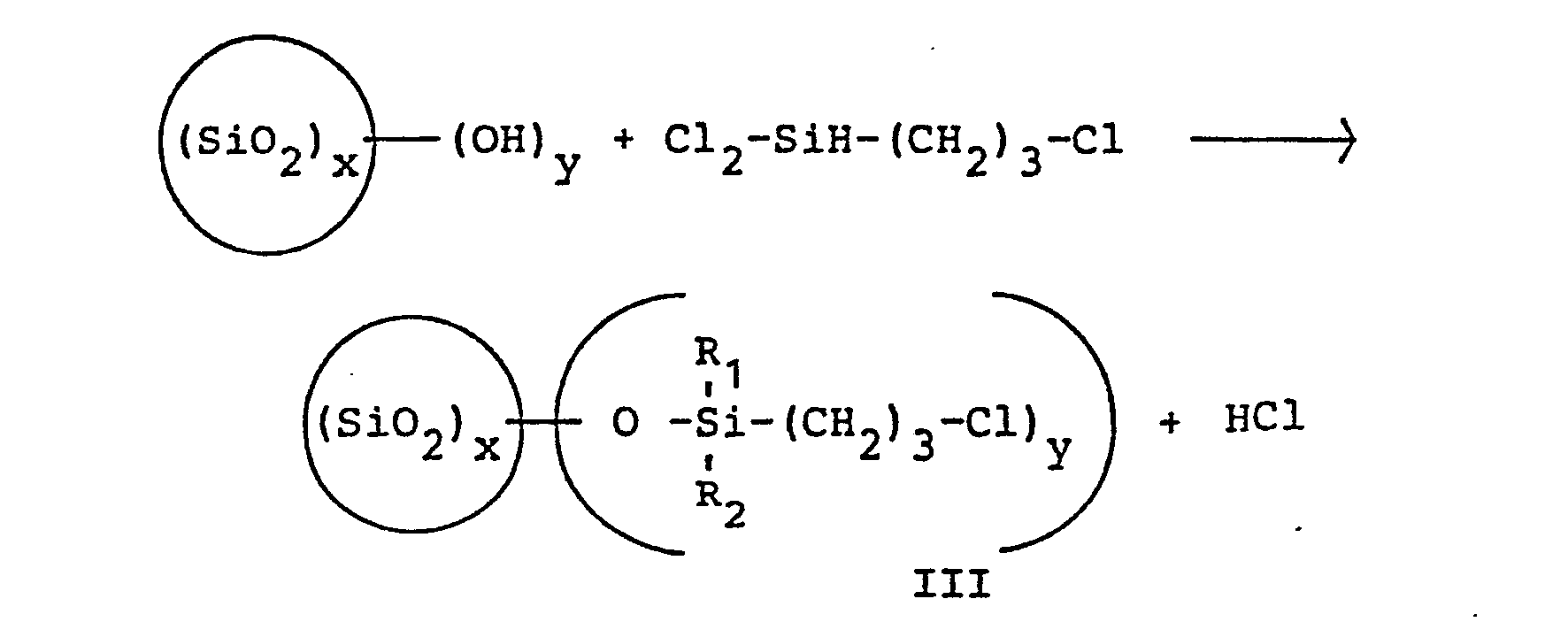
- the surface is linked with p-chloropropyldichlorosilane under anhydrous conditions in 1,2-dichloroethane after the establishment of a physical adsorption equilibrium at 120 ° C. with elimination of HCl.
- the phenol reacts with the alkyl chloride in the second step: producing a phenol ether (compound IV). This reaction takes place at 200 ° C for 4 h.
- dialysis against water the silane or chlorosilane groups denoted by R 1 and R 2 are hydrolyzed to hydroxyl groups (see formula V).
- thiomersalic acid is esterified with the alcohol on the surface (VII). This is done in xylene dispersion.
- the ethoxysilane or chlorosilane with a reactive group is first linked to a precursor of the active ingredient and then anchored to the surface in a further step.
- the anchored precursor is then - possibly in several stages - converted into the active substance molecule.
- the 3-aminopropyltriethoxysilane already has the functional group necessary for building up the N compound.
- methylation with methyl iodide to give the quaternary compound takes place, with as a counter ion iodine after ion exchange (treatment with sodium chloride) chloride ions are introduced first.
- the compounds prepared are cleaned in vacuo by washing with organic liquids.
- the cleaning is then completed by dialysis against water.
- E thoxy-or chlorosilane groups may optionally react to hydroxyl groups (substituents R 1 and R 2 in formula I of claim 1).
- the dialysis against water is continued until no organic groups can be detected in the restricted dialysate using customary analytical methods.
- the products After the cleaned preparations have dried, the products accumulate as colloidally dispersible powders and, depending on the chemical properties of the groups anchored to the surface and the density of the coating, show different wettability: when heavily coated with predominantly hydrophobic groups, the preparations are difficult to wet. Reduction of the coverage density to about 20% of the available reactive silanol groups on the surface leads to good wettability even with long hydrocarbon chains (C 8), so that the sorbates can be easily dispersed in water.
- C 8 hydrocarbon chains
- Solvents are stored over molecular sieve beads (3 ⁇ ), solid reagents are dried in a drying cabinet at 110 ° C or stored for 24 hours over P 2 O 5 in a desiccator.
- the silica (Aerosil 200, Degussa, specific surface 234 m 2 / g, BET with N 2 ) is dried at 200 ° C. for 5 hours.
- Aerosil 200 28.50 g ( 0.04 mol of silanol groups) Aerosil 200 are mixed with 16 g (0.07 mol) of 3-aminopropyltriethoxysilane with constant stirring for 1 h at room temperature and then refluxed for 8 h in xylene. The mixture is then distilled off and the residue is heated for 4 h at 473 ° K in vacuo (final pressure 0.1 Pa) in order to remove volatile reaction products.
- Aerosil 200 are refluxed with 5 g (0.02 mol) of 3-chloropropylmethyldichlorosilane with constant stirring for 8 hours in 1,2-dichloroethane. Thereafter distilled off and the residue for 4 hours at 393 0 K in vacuo (final pressure 0.1 Pa) annealed in order to remove volatile reaction products.
- the residue is then refluxed with 3.15 g of p-chloro-m-cresol (0.02 mol) with constant stirring in 1,2-dichloroethane for 8 hours.
- the solvent is then distilled off and the residue is heated for 4 h at '473 ° K in vacuo (final pressure 0.1 Pa) in order to remove volatile reaction products.
- the product dialyzed against water has a content of 0.64 mmol / g. It is a white powder that is difficult to wet.
- Aerosil 200 are heated with 15 g (0.06 mol) of o-acetyl-n-propyl-triethoxysilane with constant stirring in xylene for 8 hours at reflux. The mixture is then distilled off and the residue is heated for 4 h at 473 ° K in vacuo (final pressure 0.1 Pa) in order to remove volatile reaction products.
- the mixture is then distilled off and the residue is extracted with 100 ml of dichloroethane in order to separate off the soluble by-products and, after drying, with 200 ml of H 2 O.:and purified by dialysis.
- the product has a content of 0.58 mmol / g organic groups. Staphylococcus aureus, Streptococcus faecalis and Proteus mirabilis are completely inhibited by 0.1% sorbate in the Warburg test.
- Aerosil 200 are refluxed with 60 g (0.5 mol) of thionyl chloride with constant stirring for 8 hours in 240 g of benzene. The mixture is then distilled off and the residue is heated for 4 h at 473 ° K in vacuo (final pressure 0.1 Pa) in order to remove volatile reaction products.
- N (trimethylammoniumethyl) dimethylammonium propyl chemisorbate (28.50 g) on 0.04 mol of silanol groups Aerosil 200 are mixed with 6 g of N (- ⁇ -aminoethyl) ⁇ -aminopropyltrimethoxysilane with constant stirring for 1 h at room temperature and then refluxed for 8 h in xylene, 4 h at 473 ° K in vacuo (final pressure 0.1 Pa) to remove volatile reaction products.
Landscapes
- Health & Medical Sciences (AREA)
- Chemical & Material Sciences (AREA)
- Pharmacology & Pharmacy (AREA)
- Bioinformatics & Cheminformatics (AREA)
- Engineering & Computer Science (AREA)
- Medicinal Chemistry (AREA)
- Inorganic Chemistry (AREA)
- Epidemiology (AREA)
- Life Sciences & Earth Sciences (AREA)
- Animal Behavior & Ethology (AREA)
- General Health & Medical Sciences (AREA)
- Public Health (AREA)
- Veterinary Medicine (AREA)
Abstract
Description
- Die Erfindung betrifft an Siliciumdioxid als Träger gebundene Wirkstoffe, Verfahren zu ihrer Herstellung und ihre Verwendung.
- Die vorliegende Erfindung betrifft trägergebundene Wirkstoffe sowie Verfahren zu ihrer Herstellung.
- Anorganische Trägermaterialien vom Typ der amorphen Kieselsäuren, des amorphen Titandioxids und Aluminiumoxids erfreuen sich wegen ihrer günstigen technologischen Eigenschaften, wie z. B. große spezifische Oberfläche, überschaubare Wechselwirkungen, gute Verarbeitbarkeit, im Bereich der pharmazeutischen Technologie einer breiten Verwendung. (Remington's Pharmaceutical Sciences 15.Ed., Mack Publishing Comp., Easton, Pa 1975).
- In jüngster Zeit werden sie zunehmend zur Steuerung der Wirkstoffliberation, z.B. für peroral verabreichte Retardarzneimittel (Rupprecht, H., Unger, K., Kramer, H., Kircher W., "Microencapsulation", New Tech. Appl., Proc. Int. 3rd (1979)), oder als Aufziehsubstanzen für sehr niedrig dosierte Wirkstoffe (H. Rupprecht in "Topics in Pharmaceutical Sciences", D.D. Breimer, P. Speiser.Ed., Elsevier, Amsterdam, New York, Oxford 1981 p. 443 ff) oder zur Beschleunigung des Auflösevorgangs schwer löslicher Wirkstoffe eingesetzt. Die Arzneimittel behalten dabei nach mechanischer Abscheidung, physikalischer Adsorption oder Bindung über Ionenaustausch an den Träger ihre chemische Identität bei. Eine chemische Verankerung von Wirksubstanzen mit dem Ziel der Arzneisteuerung ist dagegen bisher auf anorganischen Trägern vom Typ des kolloiden Si02, TiO2 oder Al203 nicht vorgenommen worden.
- Das Prinzip trägergebundener Wirkstoffe hat im Bereich der Chromatographie und der Enzymtechnologie zunehmend an Bedeutung gewonnen, und, wie die Erfahrungen mit trägergebundenen organofunktionellen Gruppen bei chromatographischen Trennverfahren und in der Enzymtechnologie oder zur Verbesserung der Partikelhaftung zeigen (Salmona, M., Saronio, C., Garattini, S., "Insolubilized Enzymes", Weco York 1974; Unger, K., "Porous Silica", Amsterdam, Oxford, New York 1979;), weist ein solches Prinzip viele Vorteile auf: Neben einer besseren chemischen Stabilität und erhöhter Trennleistung sowohl bei Enzymen als auch in der Chromatographie kommen solche trägergebundenen Substanzen Produktionsprozessen technisch besser entgegen. So übertrifft z.B. die Standzeit trägergebundener Enzyme häufig bei weitem jene, die Enzyme in flüssigen Reaktoren zeigen.
- In jüngster Zeit finden sich in der Literatur auch Hinweise darauf, daß pharmazeutische Wirksubstanzen chemisch fest verankert gegenüber biologischen Modellen eine hohe Aktivität aufweisen .(Venter, J.C., Dissertation Univ. Calif., San Diego 1975; Wolfish, J.H., Janauer, G.E., Water, Air, Soil Pollut. 12, 477 (1979)): So lösen an Glasoberflächen verankerte Sympathikömimetikä an isolierten Geweben ähnliche physiologische Effekte aus wie die entsprechenden gelösten Arzneimittel.
- Auf der Basis organischer Resinate wurden antimikrobiell wirksame Prinzipien entwickelt, bei denen quartäre Ammoniumverbindungen, chemisch fest verankert, Mikroorganismen abzutöten vermögen. (Walfish J., Janauer G., Water, Air, Soil Pollut. 12, 477 (1979)).
- Über die Anwendung poröser oder kolloider anorganischer Substanzen - insbesondere vom Typ der amorphen Kieselsäuren - als Träger zur chemischen Verankerung von pharmazeutisch relevanten Wirksubstanzen liegen bisher noch keine Hinweise vor. Allerdingsfindet sich eine große Zahl von Angaben über Chemisorption verschiedener organischer funktioneller Gruppen an Kieselsäureoberflächen, insbesondere für chromatographische Zwecke (Unger, K., "Porous Silica", Amsterdam, Oxford, New York 1979; Brust, O.E., Halasz, J., J. Chromatogr. 83, 15 (1973)).
- Der vorliegenden Erfindung liegt die Aufgabe zugrunde, therapeutisch wirksame, z.B. antimikrobiell oder lokalanästhetisch wirksame oder diagnostisch einsetzbare, trägergebundene Wirkstoffe sowie ein Verfahren zur Herstellung solcher trägergebundener Wirkstoffe zur Verfügung zu stellen. Von trägergebundenen Wirkstoffen sind eine Reihe von Vorteilen gegenüber vergleichbaren löslichen Substanzen zu erwarten, die sowohl ihre Stabilität als .auch ihre Wirkung betreffen.
- Neben bequemer technologischer Handhabung, z..B. Verpreßbarkeit zu Tabletten, Einarbeitung in Suspensionen, Kapseln, Sprühprodukte, entfalten fest verankerte Gruppen nur lokal eine Wirkung. Durch die neuen erfindungsgemäßen unlöslichen Verbindungen soll die systematische Belastung des Organismus dadurch reduziert werden, daß sie nur lokal wirksam werden. Dies bedeutet, daß sie nur in unmittelbarem Kontakt mir Rezeptoren am Körper oder.Mikroorganismen ihre Wirkung entfalten, nicht aber durch Abspaltung vom Träger oder durch die Gesamtresorption von Träger und Wirkstoff in den Körper gelangen.
- Es ist bekannt, daß alle Konservierungsmittel und Lokal- .anästhetika eine nicht unbeträchtliche Toxizität besitzen, wodurch ihre Einsatzmöglichkeit gegebenenfalls erheblich beschränkt wird. Die kolloide Teilchengröße der von uns verwendeten Trägermaterialien ermöglicht eine optimale Verteilung und Stabilität in flüssigen Dispersionen sowie einen entsprechend guten, gleichmäßigen Kontakt mit den Grenzflächen der Mikroorganismen (z.B. Bakterienzellwand).
- Aufgabe der vorliegenden Erfindung ist es somit, pharmakologisch wirksame Substanzen an amorphen anorganischen Trägern chemisch zu verankern. Die entsprechenden Chemiesorbate sollen bei der Anwendung entweder durch kontrollierte Abspaltung des Wirkstoffs ("pro-drug-Prinzip") oder lokal durch Kontakt mit dem Gewebe bzw. mit Körperflüssigkeiten bei fester Verankerung der aktiven Gruppen an den Trägern ihre Wirkung entfalten. Hierbei wird angestrebt, die hergestellten trägergebundenen pharmazeutischen Wirkstoffe physikalisch-chemisch und biologisch eindeutig zu charakterisieren und zu normieren.
- Erfindungsgemäß soll somit eine chemische Verankerung von Wirkstoffen,insbesondere von pharmazeutisch wirksamen Stoffen, zur Verfügung gestellt werden.
- Die erfindungsgemäße Verankerung vor Wirkstoffen an festen Si02-Trägern kann entweder so erfolgen, daß stabile Si-C-Brücken als Anker zum Trägermaterial dienen, oder so, daß zwischen Trägeroberfläche und dem Wirkstoffmolekül eine spaltbare Si-O-C-Gruppe oder Si-N-C-Gruppe oder Si-S-C-Gruppe vorliegt. Die entsprechenden Chemisorbate sollen bei der Anwendung entweder in Kontakt mit Geweben bzw. mit Körperflüssigkeiten bei fester Verankerung der aktiven Gruppe wirksam werden oder bei den instabilen letztgenannten Gruppen eine kontrollierbare Abspaltung der Wirkstoffe ermöglichen.
- Die notwendigen erfindungsgemäßen Chemisorptionsreaktio- .nen gehen im Prinzip von zwei Wegen aus:
- a) Feste Verankerung: In einem ersten Schritt wird an die SiC2-Oberfläche ein Chlorsilan (oder Ethoxysilan) mit geeigneter funktioneller Gruppe (=Spacer) eingeführt, wie es im folgenden schematisch dargestellt ist:


- An reaktionsfähigen Gruppen dieser primär verankerten "Spacer" können weitere chemische Reaktionsschritte vollzogen werden.
- b) Für-die Xnüpfung spaltbarer Si-O-C-, Si-O-S- und Si-N-C-Bindungen wird in einem ersten Reaktionsschritt die Oberfläche der Kieselsäure aktiviert.

- An der reaktiven Oberfläche-Ist dann die Umsetzung von Substanzen mit geeigneten funktionellen Gruppen mög- . lich.


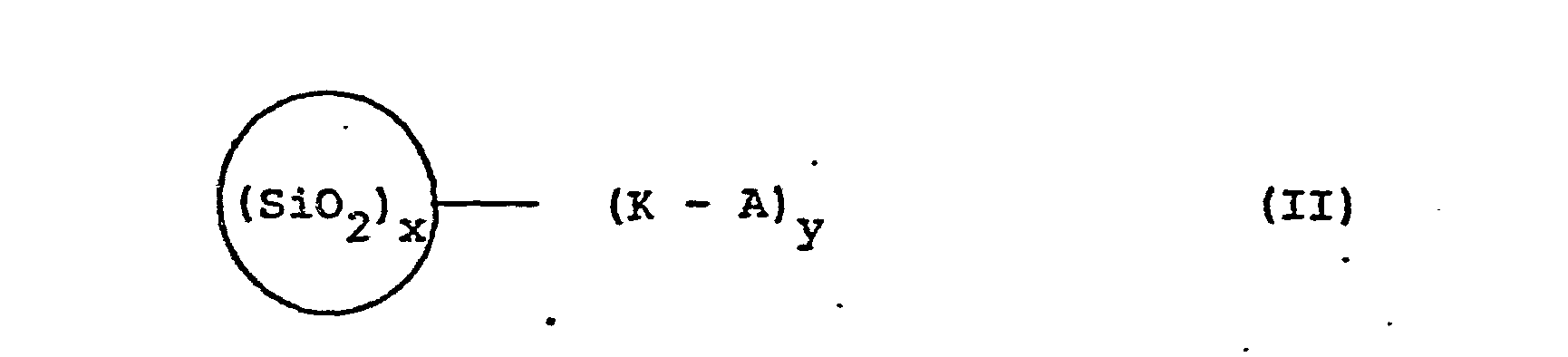


- R1 und R2 gleich oder verschieden sein können und eine Methyl- oder eine Hydroxylgruppe bedeuten, R3 den einwertigen Rest eines Wirkstoffs bedeutet, mit der Maßgabe, daß, wenn Z eine Alkylengruppe bedeutet, in der n für 0 steht, der Wirkstoff unmittelbar mit einem seiner Kohlenstoffatome mit dem Siliciumatom verknüpft ist,
- K und K' O, S oder N-A' bedeuten, wobei in der Formel III die beiden Substituenten K und K' gleich oder unterschiedlich sein können,
- A den einwertigen Rest eines Wirkstoffs der Formeln IV, V oder VI


- wobei A' ein Wasserstoffatom bedeutet oder wobei in der Formel VI A und A' zusammen mit dem Stickstoffatom, an das sie gebunden sind, den Rest eines Wirkstoffmoleküls bedeuten,
- A" den zweiwertigen Rest eines Wirkstoffs der Formel VII

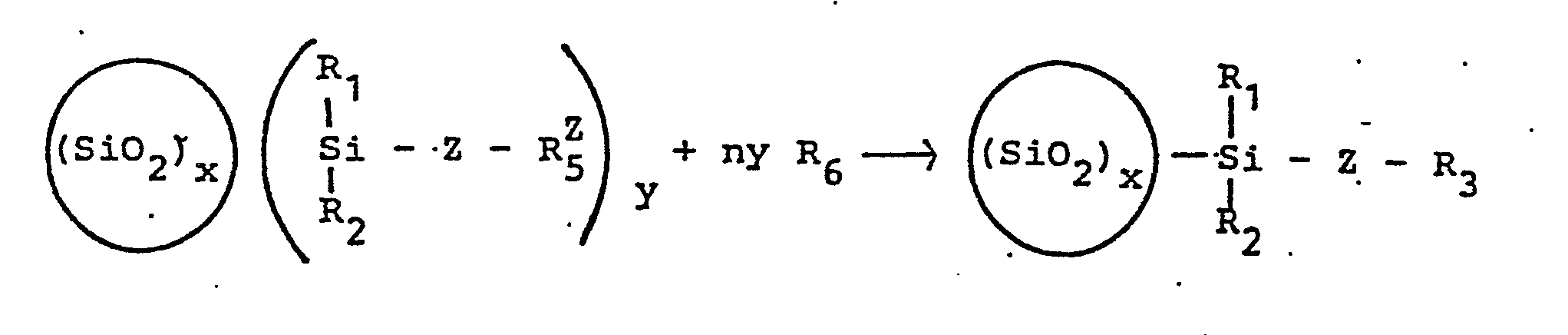
- Die Erfindung betrifft weiterhin ein Verfahren zur Herstellung der erfindungsgemäßen Verbindungen I, II oder,III, das dadurch gekennzeichnet ist, daß man
- 1) zur Herstellung von Verbindungen der Formel I
- a) eine Verbindung der Formel XVII

- b) einen reaktiven Spacer der folgenden Formel XVIII

- c) eine Vorstufe des Wirkstoffs, gegebenenfalls über einen geeigneten Spacer, mit der Oberfläche des SiO2 verknüpft und in einem weiteren Reaktionsschritt in die Wirkform umsetzt

- a) eine Verbindung der Formel XVII
- 2) zur Herstellung von Verbindungen der Formel II wasserfreie Kieselsäure in an sich bekannter Weise in Benzol mit Thionylchlorid gemäß folgender Gleichung 1 umsetzt

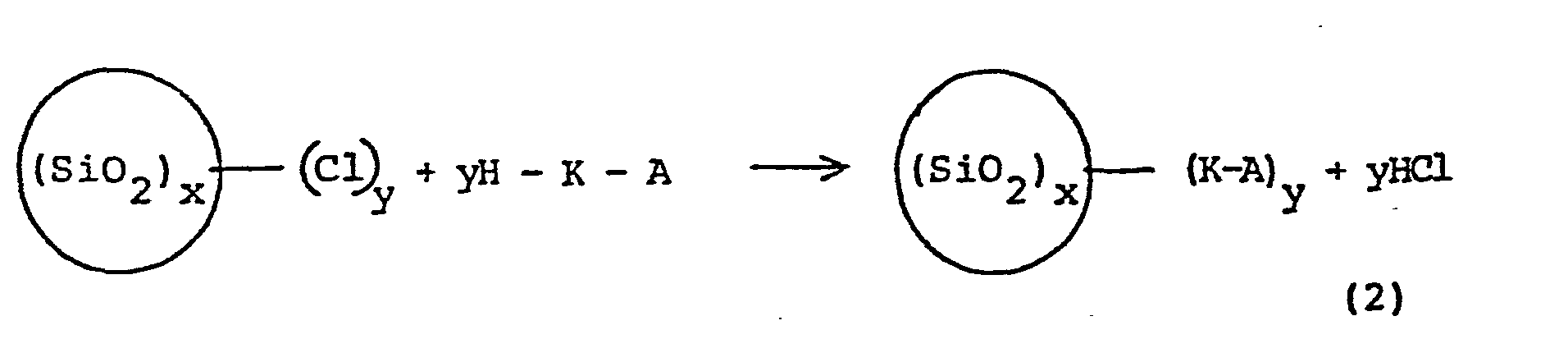
- 3) zur Herstellung von Verbindungen der Formel III Kieselsäure in an sich bekannter Weise in Benzol mit Thionylchlorid gemäß Gleichung 1 umsetzt und das erhaltene Reaktionsprodukt mit einer Verbindung der Formel gemäß folgender Gleichung 3

- Die Erfindung betrifft weiterhin die Verwendung der Verbindungen nach Anspruch 1 als Desinfektionsmittel, geruchsbindende Substanz, spezifische Antidote für den peroralen Gebrauch, Lokalanästhetika, Lichtschutzmittel, als Arzneimittel mit retardierter Wirkstoffreisetzung, als Mittel, bei dem der unangenehme Geschmack oder Geruch des Wirkstoffs beseitigt oder abgemildert ist, und als stabilisierte Arzneiform für Wirkstoffe mit hohem Dampfdruck (flüchtige Substanzen).
- überraschenderweise hat sich gezeigt, daß es möglich ist, Wirkstoffe an SiO2-Oberflächen entweder fest zu verankern oder so zu verankern, daß die wirksamen Gruppenlintakt, gegebenenfalls protrahiert abgespalten werden und daß die pharmakologische Wirksamkeit erhalten bleibt. Im folgenden ist eine Übersicht über Wirksteffe gegeben, die erfindungsgemäß an Siliciumdioxidträger gebnder werden können:
- I. Hydrolysestabil verankerte Wirkstoffe
- In den an Si02 als Träger gebundenen Wirkstoffen der Formel I ist das gesamte Molekül der Formel I wirksam. Der wirksame Bestandteil, d.h. R3, kann den Rest eines Desinfektionsmittels, einer geruchsbindenden Substanz, eines pharmazeutischen Wirkstoffs, beispielsweise eines Antidots für den peroralen Gebrauch, zum Beispiel für Schwermetallbindungen, oder eines Lokalanästhetikums bedeuten.
- Beispiele für Desinfektionsmittel sind solche für die Haut, die Schleimhaut, den gastrointestinalen Trakt, wie z.B. quaternäre Ammoniumverbindungen, Phenole, Hydroxybenzoesäureester und Organo-Quecksilberverbindungen.
- Beispiele für geruchsbindende Substanzen sind quaternäre Ammoniumverbindungen. Beispiele für spezifische Antidote für den peroralen Gebrauch sind Cystein, EDTA. Beispiele für Lokalanästhetika sind Polydocanol (Thesit®), Benzocain oder Lidocain.
- Die an Si02 als Träger gebundenen Wirkstoffe der Formeln II oder III werden bei Kontakt mit wasserhaltiger Flüssigkeit oder mit Luftfeuchtigkeit allmählich freigesetzt und entfalten dann als solche ihre Wirkung. Die Wirkstoffe können dabei kühlende, desinfizierende, geruchsbindende oder geruchsüberdeckende Wirkung haben. Man kann das Prinzip auch anwenden, um eine retardierte Wirkstoffreisetzung bei peroralen und rektalen Arzneiformeh zu erreichen, beispielsweise mit Codein. Dieses Prinzip ist auch anwendbar, um unangenehmen Geruch oder Geschmack von Wirkstoffen zu beseitigen oder abzumildern, wie zum Beispiel von Chinin, p-Chlorcresol, oder zur Stabilisierung flüchtiger Substanzen in festen Arzneiformen, wie zum Beispiel Menthol und Thymol.
- Die hydrolysestabil verankerten Wirkstoffe besitzen den Vorteil, daß sie vom Körper nicht resorbiert werden und dadurch eine systemische Belastung unterbleibt. Sie wirken nur an den Stellen im Körper, wo sie tatsächlich appliziert werden. Die chemisorbierten Wirkstoffe werden, nachdem sie ihre Wirkung entfaltet haben, wieder ausgeschieden (aus dem Gastro-Intestinal-Trakt) oder bei der Reinigung der Haut entfernt. eine Kumulation im Körper ist nicht möglich, da sie am Träger fest verankert-sind.
- Die erfindungsgemäßen Verbindungen sind definierte Verbindungen, und die Struktur der einzelnen Gruppen ist exakt erfaßbar und normierbar, zum Beispiel durch Elementaranalyse, IR-Spektroskopie, UV-Spektroskopie, Austauschkapazität, mikrobiologische Wirksamkeit und Identifizierung in NMR nach Abbau der Matrix.
- In den erfindungsgemäßen Verbindungen der Formeln I, II und III wurde das Siliciumdioxid schematisch dargestellt. Erfindungsgemäß verwendet man hochdisperse, vorzugsweise durch Flammenpyrolyse hergestellte Teilchen, die einen SiO2-Gehalt von über 99,8% aufweisen. Sie besitzen eine primäre Teilchengröße von 8 bis 30 nm, vorzugsweise 10 bis 20 nm, und eine BET-Oberfläche von 50 bis 500 m2, vorzugsweise 100 bis 400m2, besonders bevorzugt 200 bis 250 m2. Die Teilchen besitzen auf ihrer Oberfläche SiOH-gruppen, die über relativ schwache Wasserstoffbrücken miteinander verknüpft sind.
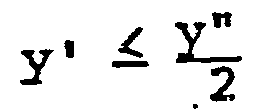
- In den Verbindungen der Formeln I, II und III bedeuten y und y' die pro Menge des Trägers verankerten Gruppen in Mol, wobei die.Angabe, je nachdem, in mMol/g oder mMol/m2 erfolgt. y und y' sind die maximalen Belegungswerte und werden durch den Platzbedarf und die funktionellen Ankergruppen bestimmt. y liegt im Bereich von 0,1 bis 1, vorzugsweise im Bereich von 0,2 bis 0,6 und besonders bevorzugt im Bereich von 0,3 bis 0,5, mMol/g. y' liegt im.Bereich von 0,1 bis 0,5, bevorzugt im Bereich von 0,1 bis 0,3 mMol/g.
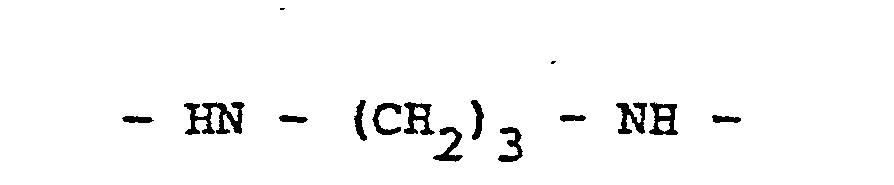
- Z bedeutet in den Verbindungen der Formel I eine geradli- nige Alkylengruppe der Formel -(CH2)n-, worin n für 0 bis 18, vorzugsweise für 1 bis 10 und besonders bevorzugt für 1 bis 5, am meisten bevorzugt für 1, 2 oder 3, steht. Die Zahl n kann auch für 0 stehen. In diesem Fall ist der Substituent R3 über eines seiner Kohlenstoffatome direkt an das Siliciumatom gebunden. Z kann weiterhin einen Rest der Formeln


- In der Formel I können die Substituenten R1 und R2 eine Methylgruppe oder eine Hydroxylgruppe sein. Besonders bevorzugte Verbindungen sind solche, worin R1 und R2 beide eine Hydroxylgruppe bedeuten oder worin R1 eine Methylgruppe und R2 eine Hydroxylgruppe bedeuten.
- R3 bedeutet den einwertigen Rest eines hydrolysestabil verankerten Wirkstoffs, vorzugsweise eines pharmazeutischen Wirkstoffs, wobei der Wirkstoff über ein Kohlenstoffatom, ein Sauerstoffatom, ein Stickstoffatom öder ein Schwefelatom an Z gebunden sein kann. Wenn in der Verbindung der Formel I Z nicht verbanden ist, muß der Rest des Wirkstoffs, R3, unmittelbar mit einem seiner Kohlenstoffatome mit dem Siliciumatom verknüpft sein. Beispiele für R3 sind:


- Ein Beispiel für einen Wirkstoff der Formel IV ist Rhodanwasserstoff der Formel


- Beispiele für Wirkstoffe der Formel VI sind die folgenden:




- Beispiele für Wirkstoffe der Formel VII sind die folgenden:
-











- Besonders bevorzugte erfindungsgemäße Verbindungen sind Verbindungen der folgenden Formeln:


- Eine weitere Klasse von bevorzugten Verbindungen sind solche der Formel X

- Eine weitere Klasse von bevorzugten Verbindungen sind solche der Formel XI

- Eine besonders bevorzugte Verbindung der Formel XI ist die folgende Verbindung der Formel XII

- Weitere bevorzugte Verbindungen sind die folgenden Verbindungen der Formeln XIII, XIV, XV und XVI:


- Im folgenden werden die Verfahren zur Herstellung der erfindungsgemäßen Verbindungen näher erläutert.
- Prinzip des Herstellungsverfahrens:
- Unter wasserfreien Bedingungen wird in einem unpolaren organischen Dispersionsmittel, wie beispielsweise Tetrachlorkohlenstoff, 1,2-Dichlorethan, Cyclohexan, Xylol, Toluol oder Gemischen dieser Flüssigkeiten, eine stöchiometrische Menge hochdisperser Kieselsäure mit definierter spezifischer Oberfläche und bekannter Zahl an reaktiven Silanolgruppen dispergiert und mit der Lösung eines reaktiven Alkoxy-, vorzugsweise Ethoxy-, -silans versetzt, das einen reaktiven Spacer oder bereits das chemisch verknüpfte Wirkstoffmolekül trägt.
- Im folgenden physikalischen Adsorptionsschritt, der bei Temperaturen zwischen -10°C und +30°C, vorzugsweise bei Raumtemperatur (20°C), erfolgt, wird ein definiertes Adsorptionsgleichgewicht eingestellt. Ausgehend von der Kenntnis der Adsorptionseigenschaften kann in einem weiten Bereich bis zur maximalen Belegung der Oberfläche Wirkstoff gebunden werden. Der maximale Belegungswert ergibt sich einmal aus dem Platzbedarf der Reaktanden und ist andererseits durch die Zahl 4 OH-Gruppen/1 nm2 am Träger begrenzt. (R.K. Iler, "The Chemistry of Silica", John Wiley & sons, New York, Chichester, Toronto 1979, Seiten 633 ff.) Das Sorbat wird anschließend durch Zentrifugieren und Dekantieren von der Gleichgewichtsflüssigkeit entfernt oder, falls im Adsorptionsgleichgewicht die in Lösung befindliche Menge vernachlässigbar klein ist, das Dispersionsmittel im Vakuum entfernt. Im folgenden Schritt wird die Chemisorption durch Erhöhen der Temperatur auf 80 bis 220°C, vorzugsweise auf 150°C, eingeleitet, wobei unter Ab-spaltung von Ethanol bei den Ethoxysilanen bzw. HCl bei Chlorsilanen eine Verankerung über die stabile Si-O-C-Brücke erfolgt.
- Als Beispiel für beide Schritte sind nachfolgend jeweils .ein mit dem Wirkstoff bereits verankertes Ethoxysilan mit der Spacer-Gruppe Z bzw. ein Chlorsilan mit der Spacer-Gruppe Z aufgeführt.
-
- a) Ethoxysilane

- b) Chlorsilane

- Chemisorption:

- Das während des Chemisorptionsschritts freiwerdende Ethanol bzw. HCl wird durch Destillation aus dem Reaktionsgleichgewicht laufend entfernt. Bezüglich der Verankerung mit der Oberfläche laufen etwa zu gleichen Teilen mono- und bifunktionelle Verankerungen der Ethoxysilane und.Chlorsilane mit mehr als zwei Ethoxy- bzw. Chlorgruppen pro Molekül mit der Oberfläche ab. Hierbei ist von einer etwa gleichen Verteilung beider Verknüpfungsarten auszugehen, wobei zunächst die Kapazität der Oberfläche beschränkt erscheint. Da jedoch der Platzbedarf der organischen Reste wesentlich größer ist als der durchschnittliche Platzbedarf der Silanolgruppen an der Oberfläche bei max. 4 OH/nm2 (0,25 nm2/Silanolgruppe, mindestens 0,40 nm2/ für organische Gruppen), wird die Aufnahmekapazität bezüglich der organischen Reste kaum verändert: Man kann davon ausgehen, daß maximal 2,5 organische Reste 1 nm 2 eingeführt werden können.
- Durch die gewählte Art der Verankerung ist es möglich - im Gegensatz zur Reaktion aus der Gasphase -, eine sehr gleichmäßige Verteilung der reaktiven Gruppen an der Oberfläche zu erreichen. Während des Einstellens des physikalischen Adsorptionsgleichgewichts sind alle Teilchen bwz. ihre Oberflächen für das Reagenz gleichmäßig zugänglich.
- Erfahrungsgemäß werden sehr gleichmäßig belegte Präparate erhalten, wenn bei der anschließenden Chemisorption der Siedepunkt des jeweiligen Reagenz nicht überschritten wird.
- Bei den Reaktionen wird die Verankerung mittels Ethoxysilanen bevorzugt, da hierbei der weniger aggressive Ethanol abgespalten wird, während bei den Chlorsilanen durch das entwickelte HCl eher mit unerwünschten Nebenreaktionen zu rechnen ist.
- Für den gesamten Verlauf der Verankerung der Chlorsilane bzw. der Ethoxysilane wurden drei Verfahrensvarianten entwickelt, die folgende Gesichtspunkte berücksichtigen:
- 1. Reaktivität der zu verankernden Wirksubstanz, der Spacer-Gruppe und des SiO2
- 2. Reinigung der Produkte
- 3. Charakterisierung der Zwischen- und Endprodukte
- Der Wirkstoff wird zunächst an das Ethoxysilan oder Chlorsilan über eine reaktive Gruppe, gegebenenfalls mit Spacer, chemisch gebunden und diese Verbindung dann mit der Si02-Oberfläche umgesetzt. Beispiele für Spacer der Formel VIII sind die folgenden:





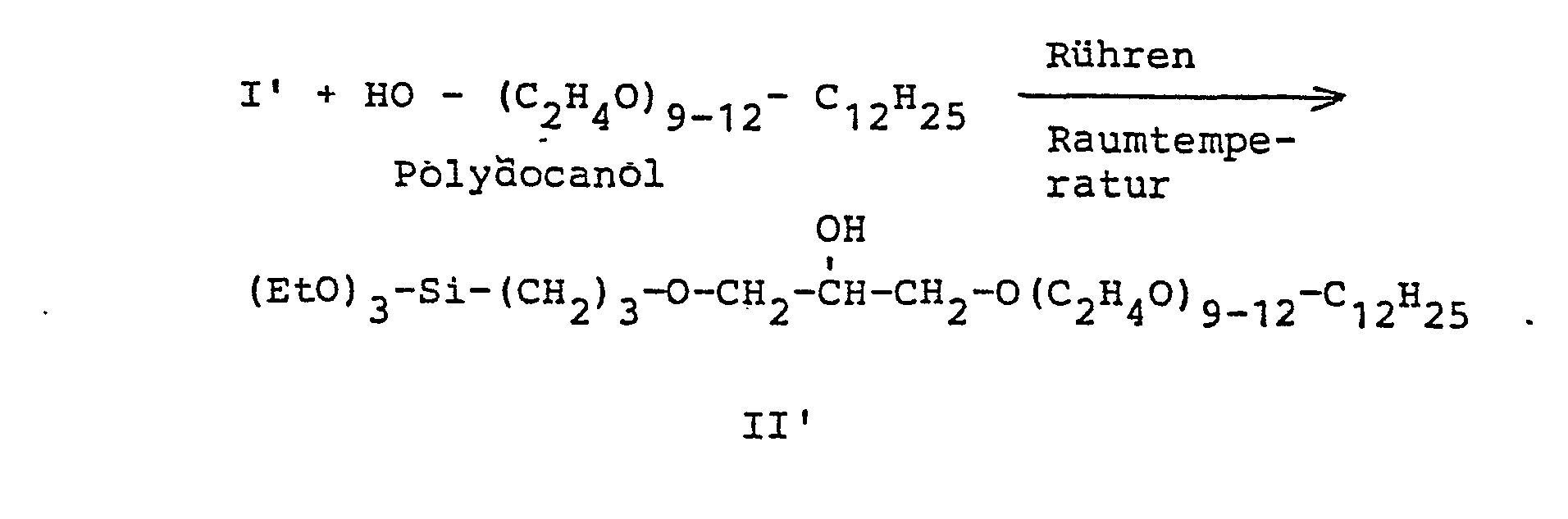
- Beispiel für ein grenzflächenverankertes Polydocanol: Im ersten Reaktionsschritt wird Triethoxysilan mit Alkylglycidylepoxid in Gegenwart von katalytisch wirkender Hexachloroplatinsäure in Toluol bei 120°C umgesetzt, um einen reaktiven Spacer (Epoxid) mit dem Ethoxysilan zu verknüpfen.

-
-

-

- Das Ethoxysilan bzw. Chlorsilan mit reaktiver Gruppe, gegebenenfalls mit Spacer, wird zuerst an der Siliciumdioxidoberfläche verankert und dann in einem weiteren Schritt über die reaktive Gruppe mit dem Arzneistoff verknüpft.
-


-

-


- Das Ethoxysilan oder Chlorsilan mit reaktiver Gruppe (Spacer) wird zuerst mit einer Vorstufe des Wirkstoffs verknüpft und dann in einem weiteren Schritt an der Oberfläche verankert. Die verankerte Vorstufe wird dann - gegebenenfalls in mehreren Stufen - zum Wirkstoffmolekül umgesetzt.
-


-
- Variante 1 ist vorzuziehen, wenn die Bedingungen während der Umsetzung mit der Trägeroberfläche ohne Einfluß auf die Stabilität und chemische Natur des Wirkstoffs sind. Dabei ist es möglich, in üblicher Weise Vor- und Zwischenstufen herzustellen, zu reinigen und zu charakterisieren.
- Variante 2 ist dann vorzuziehen, wenn der Wirkstoff oder die Bindung des Wirkstoffs an den Spacer durch die Reaktionsbedingungen bei der Verknüpfung mit dem Träger beeinfluß wird (z.B. Verseifung, Veresterung).
- Variante 3 ist vorzuziehen, wenn sich Vorstufen des Wirkstoffs an der Oberfläche leichter einführen lassen, zum Beispiel aus sterischen Gründen.
- Die hergestellten Verbindungen werden nach Entfernung flüchtiger Reaktionsprodukte im Vakuum durch Waschen mit organischen Flüssigkeiten gereinigt. Die Reinigung wird anschließend durch Dialyse gegen Wasser vervollständigt. Bei diesem Schritt können gegebenenfalls noch vorhandene Ethoxy-oder Chlorsilangruppen zu Hydroxylgruppen reagieren (Substituenten R1 und R2 in Formel I nach Anspruch 1). Die Dialyse gegen Wasser wird solange fortgesetzt, bis im einge- engten Dialysat keine organischen Gruppen mit üblichen analytischen Verfahren nachweisbar sind.
- Die Produkte fallen nach dem Trocknen der gereinigten Präparate als kolloiddispergierbare Pulver an und zeigen entsprechend den chemischen Eigenschaften der an der Oberfläche verankerten Gruppen und der Belegungsdichte unterschiedliche Benetzungsfähigkeit: Bei dichter Belegung mit vorwiegend hydrophoben Gruppen sind die Präparate schlecht benetzbar. Reduzierung der Belegungsdichte auf etwa 20% der verfügbaren reaktionsfähigen Silanolgruppen an der Oberfläche führt selbst bei langen Kohlenwasserstoffketten (C 8) zu einer guten Benetzbarkeit, so daß die Sorbate leicht in Wasser dispergiert werden können.
- Damit ist ihre weitere Verarbeitung zu Pulvern, Pudern, Granulaten, Kapseln, Tabletten, Dragees, Salben, Suppositorien und Suspensionen ohne weiteres möglich.
-
- Qualitativ: Nachweis der funktionellen Gruppen durch IR-und UV-Spektrometrie in situ (Suspensionstechnik, Preßlinge)
- Quantitativ: Elementaranalyse auf Kohlenstoff, gegebenenfalls Stickstoff und Schwefel
- Quantitative IR-, ggf. UV-Spektrometrie (auch nach Auflösen der Matrix in Lauge oder mit Fluorwasserstoff)
- Funktionsnachweise: z.B. Bestimmung der Ionenaustauschkapazität, der mikrobiologischen Hemmwirkung, der lokalanästhetischen Wirkung etc.
-
- Prinzip des Herstellungsverfahrens:
- Unter wasserfreien Bedingungen wird in an sich bekannter Weise die Oberfläche von Si02 mit Thionylchlorid oder einem anderen chlorierenden Agens chloriert. Das entstehende Produkt trägt an seiner Oberfläche anstelle der ursprünglichen Silanolgruppen Chlor, so daß formal ein Chlorid der Kieselsäure vorliegt. Diese Oberfläche ist äußerst reaktionsfähig und bindet Protonen liefernde Substanzen unter HCl-Abspaltung, wie zum Beispiel Wasser, Alkohole, Säuren, Amine, Amide, Lactame oder Phenole, wobei eine labile SiOC- bzw. SiNC-Bindung oder SiSC-Bindung zwischen Oberfläche und organischem Rest gebildet wird.
- Steuerung der Herstellung:
- Die maximale Belegbarkeit der Oberfläche wird zunächst durch den Grad der Chlorierung, vor allem aber durch Sperrigkeit (Platzbedarf) und Reaktionsfähigkeit der zu verankernden Gruppen bestimmt. Bei der Chlorierung mit Thionylchlorid in Benzol nach Boehm und Janßen wird ein maximal erreichbarer Austausch der Silanolgruppen durch Chlor erreicht. DieBelegungsdichte von 3 bis 4 Chlorgruppen/1 nm2 an der Kieselsäureoberfläche gewährleistet selbst bei kleinen organischen Gruppen eine hinreichende Dichte zu einer vollständigen Belegung. Organische Gruppen haben dabei mindestens einen Platzbedarf von 0,40 nm2, so daß maximal 2,5 organische Reste, in den meisten Fällen weniger wegen des höheren Platzbedarfs, gebunden werden können. Nicht umgesetztes Chlorid der Oberfläche wird beim ersten Kontakt mit Wasser in Form von HC1 abgespalten. Daher ist es zweckmäßig, die vollständige Chlorierung der Oberfläche zu vermeiden und die Präparate im ersten Reaktionsschritt so einzustellen, daß eine stöchiometrische Umsetzung gewährleistet ist. Da-
- Die folgenden Beispiele erläutern die Erfindung.
- Wegen der Hydrolyseempfindlichkeit der verwendeten Silane bzw. der chlorierten Oberfläche des SiO2 und zur besseren überschaubarkeit der Reaktionswege an der SiO2-Oberfläche wird unter.wasserfreien Bedingungen gearbeitet.
- Lösungsmittel werden über Molekularsiebperlen (3 Å) aufbewahrt, feste Reagenzien im Trockenschrank bei 110°C getrocknet oder 24 h über P2O5 im Exsiccator gelagert. Die Kieselsäure (Aerosil 200, Degussa, spezifische Oberfläche 234 m2/g, BET mit N2) wird 5.h bei 200°C getrocknet.
- Abfüll-, Wäge und Mischvorgänge werden in trockenem N2 in einer Glove-Box vorgenommen. Die Umsetzungen werden unter starkem Rühren durchgeführt (heterogene Reaktion).
- 28,50 g (0,04 Mol Silanolgruppen) Aerosil 200 werden mit 16 g (0,07 Mol) 3-Aminopropyltriethoxysilan unter ständigem Rühren 1 h bei Raumtemperatur gemischt und dann 8 h in Xylol am Rückfluß erhitzt. Danach wird abdestilliert und der Rückstand 4 h bei 473°K im Vakuum (Enddruck 0,1 Pa) ausgeheizt, um flüchtige Reaktionsprodukte zu entfernen.

- 10,0 g des Rückstands (3-Amino-n-propylsilyl-Chemisorbat, entspr. ca. 0,015 Mol) Werden mit 7 g Methyl jodid (0,05 Mol) in Acetonitril unter Rühren 1 h gemischt und dann. 2 h am Rückfluß erhitzt. Danach wird das Lösungsmittel abdestilliert und der Rückstand 4 h bei 473°K (Enddruck 0,1 Pa) ausgeheizt. Das gegen Wasser dialysierte Produkt wies einen Gehalt von 0,076 mMol g-1 organische Gruppen auf (C-Gehalt, Austauschkapazität). Escherichia coli wird von 0,1% des Produkts vollständig inhibiert (Warburg-Test).
- 28,50 g (0,04 Mol Silanolgruppen) Aerosil 200 werden mit 5 g (0,02 Mol) 3-Chlorpropylmethyldichlorsilan unter ständigem Rühren 8 h in 1,2-Dichlorethan am Rückfluß erhitzt. Danach wird abdestilliert und der Rückstand 4 h bei 3930K im Vakuum (Enddruck 0,1 Pa) ausgeheizt, um flüchtige Reaktionsprodukte zu entfernen.

- Danach wird der Rückstand mit 3,15 g p-Chlor-m-cresol (0,02 Mol) unter ständigem Rühren 8 h in 1,2-Dichlorethan am Rückfluß erhitzt. Anschließend wird das Lösungsmittel abdestilliert und der Rückstand 4 h bei '473°K im Vakuum (Enddruck 0,1 Pa) ausgeheizt, um flüchtige Reaktionsprodukte zu entfernen. Das gegen Wasser dialysierte Produkt weist einen Gehalt von 0,64 mMol/g auf. Es liegt als weißes, schwer benetzbares Pulver vor.
- 28,50 g (Δ0,04 Mol Silanolgruppen) Aerosil 200 werden mit 15 g (0,06 Mol) o-Acetyl-n-propyl-triethoxysilan unter ständigem Rühren 8 h in Xylol am Rückfluß erhitzt. Danach wird abdestilliert und der Rückstand 4 h bei 473°K im Vakuum (Enddruck 0,1 Pa) ausgeheizt, um flüchtige Reaktionsprodukte zu entfernen.
- Nach Abdestillieren des Lösungsmittels und Trocknen bei 4730K während 4 h bei 0,1 Pa wird mit 100 ml 12% wäßriger Ammoniaklösung 1 h am Rückfluß erhitzt. Nach Abdestillieren der flüssigen Phase wird bei 4730K und 0,1 Pa ausgeheizt (4 h).
- 7, 42 g (Δ unter 0,01 Mol) des so hergestellten Chemisorbats werden mit 4,35 g (0,01 Mol) Thiomersal ® -Säure unter ständigem Rühren 8 h in 100 ml Xylol am Rückfluß erhitzt.
- Danach wird abdestilliert und der Rückstand zum Abtrennen der löslichen Nebenprodukte mit 100 ml Dichlorethan und nach dem Trocknen mit 200 ml H20 extrahiert.:und mittels Dialyse gereinigt. Das Produkt weist einen Gehalt von 0,58 mMol/g organische Gruppen auf. Staphylococcus aureus, Streptococcus faecalis, Proteus mirabilis werden im Warburg-Test von 0,1% Sorbat vollständig inhibiert.
- 30 g (Δ 0,042 Mol Silanolgruppen) Aerosil 200 werden mit 60 g (0,5 Mol) Thionylchlorid unter ständigem Rühren 8 h in 240 g Benzol am Rückfluß erhitzt. Danach wird abdestilliert und der Rückstand 4 h bei 473°K-im Vakuum (Enddruck 0,1 Pa) ausgeheizt, um flüchtige Reaktionsprodukte zu entfernen.
- 25 g des Rückstands (oberflächengebundenes Kieselsäurechlorid, entspr. 0,04 Mol) werden mit 50 g Phenetol (0,4 Mol) 8 h in 240 g Benzol am Rückfluß erhitzt. Danach wird das Lösungsmittel abdestilliert und der Rückfluß 4 h bei 473°K im Vakuum (Enddruck 0,1 Pa) ausgeheizt. (Entfernung flüchtiger Reaktionsprodukte). Eigenschaften: weißes Pulver mit 0,65 Mol Phenolgruppen; Phenetol wird innerhalb einer Stunde abgespalten.
- Menthol-Chemisorbat
- 30.g (0,042 Mol Silanolgruppen) Aerosil 200 werden, wie bei Phenetol beschrieben (Beispiel 4), mit Thionylchlorid zum Oberflächen-Kieselsäurechlorid umgesetzt und gereinigt.

- 25,6 g des Rückstands (oberflächengebundenes Kieselsäurechlorid, entspr. ca. 0,04 Mol) werden mit 6,5 g Menthol (0,04 Mol) 8 h in 240 g Benzol am Rückfluß erhitzt.
- Danach wird das Lösungsmittel abdestilliert und der Rückstand 4 h bei 473°K im Vakuum (Enddruck 0,1 Pa) ausgeheizt. Eigenschaften: weißes Pulver, das bei Kontakt mit Wasser intensiv nach Menthol riecht. Gehalt an chemisorbiertem Menthol 0,67 mMol/g 1. In Wasser wird das chemisorbierte Menthol innerhalb einer Stunde vollständig abgegeben.
- N(Trimethylammoniumethyl)-dimethylammoniumpropyl-Chemisorbat (28,50 g) auf entsprechend 0,04 Mol Silanolgruppen Aerosil 200 werden mit 6 g N(-β-Aminoethyl)α-aminopropyl- trimethoxy-silan unter ständigem Rühren 1 h bei Raumtemperatur gemischt und dann 8 h in Xylol am Rückfluß, 4 h bei 473°K im Vakuum (Enddruck 0,1 Pa) ausgeheizt, um flüchtige Reaktionsprodukte zu entfernen.
- 20,0 g des Rückstands (Zwischenprodukt) werden mit 13 g Methyljodid in Acetonitril unter Rühren 1 h gemischt und dann 2 h am Rückfluß erhitzt. Danach wird das Lösungsmittel abdestilliert und der Rückstand 4 h bei 473°K (Restdruck 0,1 Pa) ausgeheizt. Das gegen Wasser dialysierte Produkt wies einen Gehalt von 0,057 mMol/g organische Gruppen auf (C-Gehalt). Die Austauschkapazität betrug 1,15 mval/g. Escherichia coli wird im Warburg-Test von 0,5% der Substanz vollständig inhibiert.
- 10 g Alkylglycidylepoxid wurden mit 8,7 g Triethxoysilan in Toluol gemischt und bei 120°C in Gegenwart von 100 ppm Hexachloroplatinsäure umgesetzt. Die Reinigung des Ethoxysilans erfolgte danach durch Destillation bei 3 mm Hg-Säule und einer Temperatur von 123°C.
- Zu 20 g des Zwischenprodukts wurden 11 g Polydocanol langsam zugemischt und bei maximal 110°C umgesetzt. Das Reaktionsprodukt (15 g) wurde anschließend mit 11 g Aerosil 200 in Xyloldispersion intensiv gemischt und bei 120°C zur Reaktion gebracht. Nach Reinigung des Endprodukts im Vakuum und anschließender Dialyse gegen Wasser wurde ein weißes pulverförmiges Produkt mit schwachem Geruch erhalten. Be-rechnet auf Polydocanol, wurde aus der C-Analyse ein Gehalt von 0,78 mMol/g berechnet. Das Produkt hat anästhesierende Wirkung auf die Zungen- und Mundschleimhaut.

Claims (15)


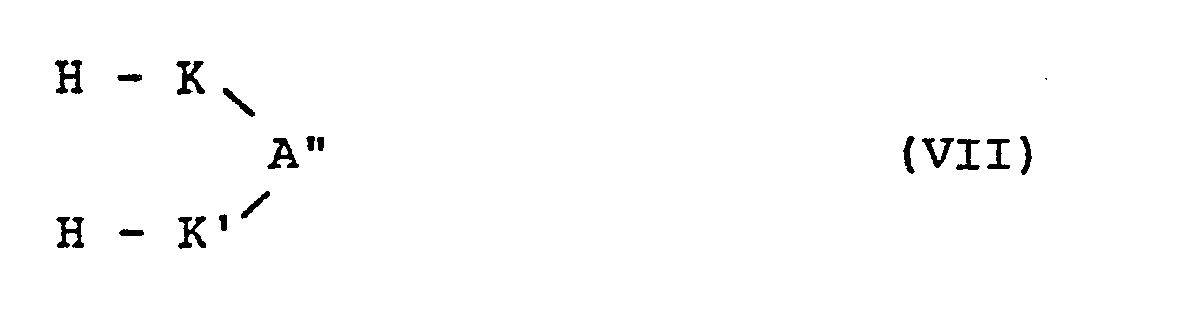
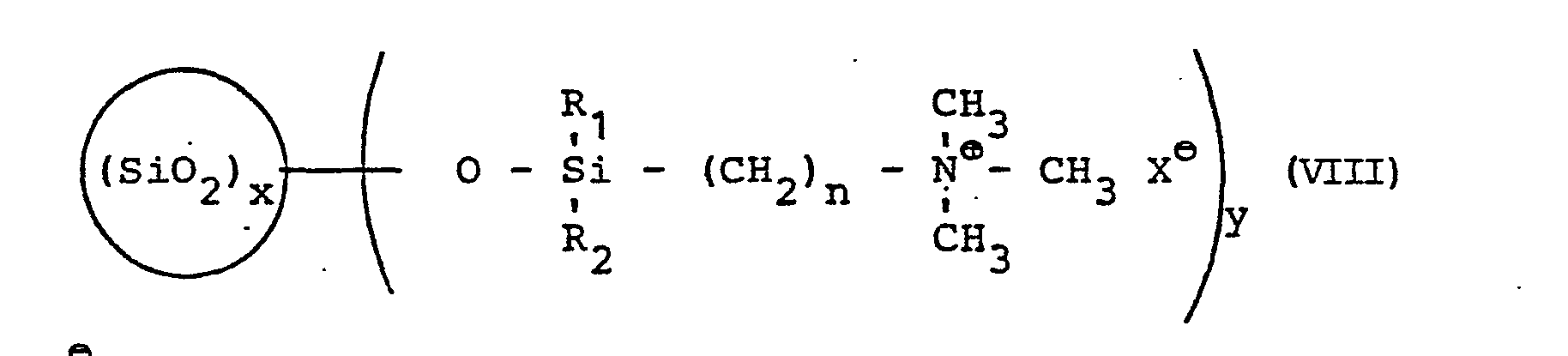


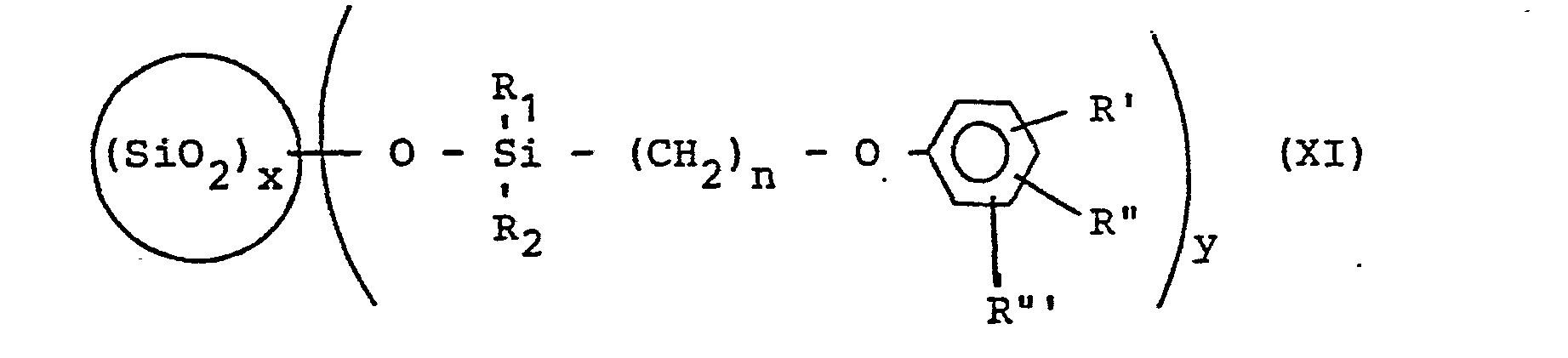


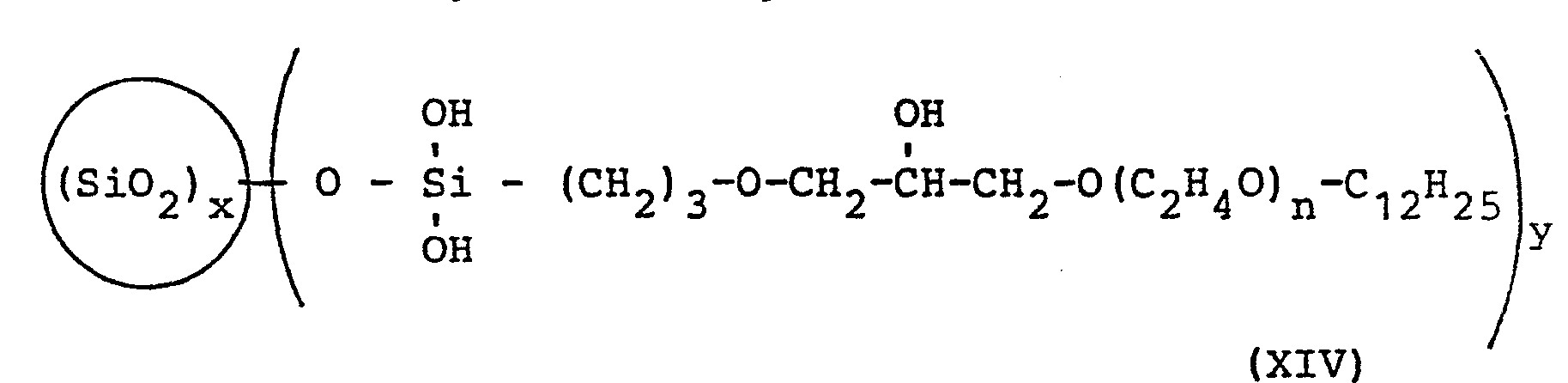

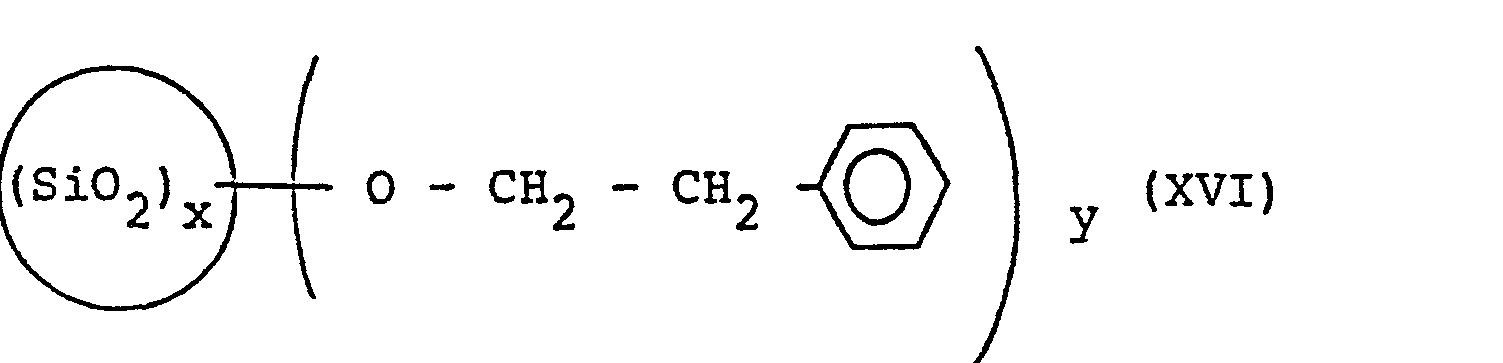

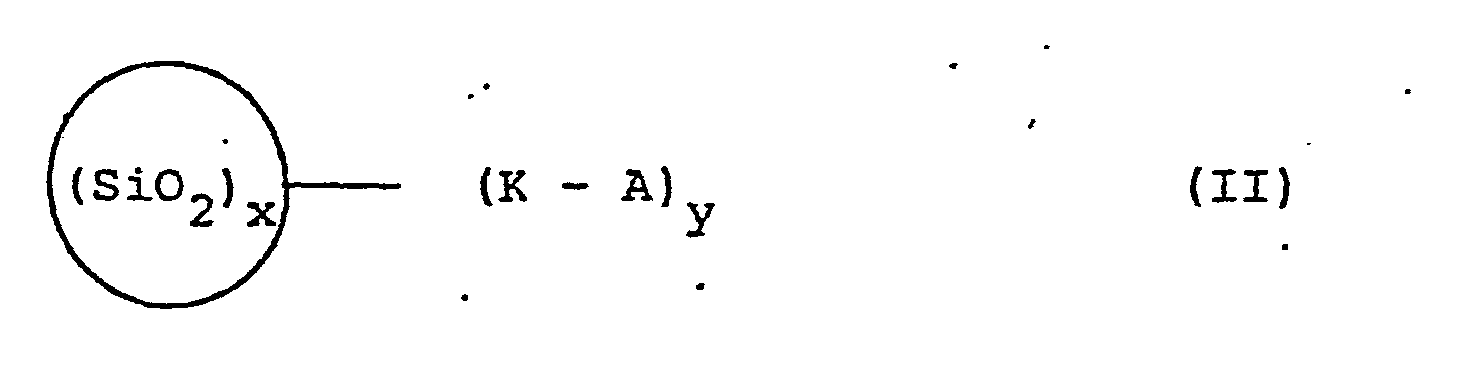

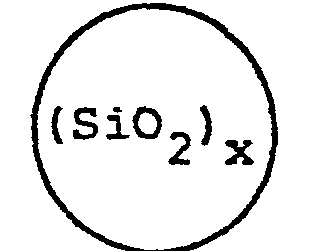




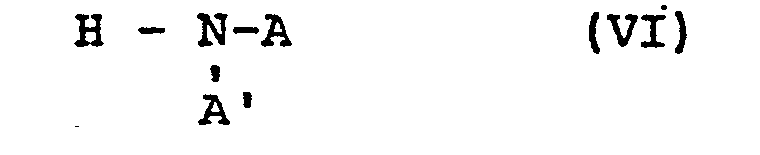





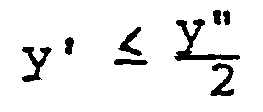
Applications Claiming Priority (2)
| Application Number | Priority Date | Filing Date | Title |
|---|---|---|---|
| DE3230736 | 1982-08-18 | ||
| DE3230736A DE3230736A1 (de) | 1982-08-18 | 1982-08-18 | An siliciumdioxid als traeger gebundene wirkstoffe, verfahren zu ihrer herstellung und ihre verwendung |
Publications (1)
| Publication Number | Publication Date |
|---|---|
| EP0101027A1 true EP0101027A1 (de) | 1984-02-22 |
Family
ID=6171144
Family Applications (1)
| Application Number | Title | Priority Date | Filing Date |
|---|---|---|---|
| EP83107729A Withdrawn EP0101027A1 (de) | 1982-08-18 | 1983-08-05 | An Siliciumdioxid als Träger gebundene Wirkstoffe, Verfahren zu ihrer Herstellung und ihre Verwendung |
Country Status (2)
| Country | Link |
|---|---|
| EP (1) | EP0101027A1 (de) |
| DE (1) | DE3230736A1 (de) |
Cited By (7)
| Publication number | Priority date | Publication date | Assignee | Title |
|---|---|---|---|---|
| EP0305968A3 (de) * | 1987-08-31 | 1989-04-05 | Yeda Research And Development Company Limited | Zusammensetzungen gegen Protozoenerkrankungen |
| EP0273266A3 (de) * | 1986-12-17 | 1990-06-20 | Dow Corning Corporation | Silikonderivat von Menthol als Medikament |
| EP0575137A1 (de) * | 1992-06-19 | 1993-12-22 | Sunstar Kabushiki Kaisha | Trägergebundene Mikrobizide enthaltende orale Zusammensetzung |
| WO1997049431A3 (en) * | 1996-06-21 | 1998-03-12 | Synsorb Biotech Inc | Use of oligosaccharides for neutralising e. coli toxins |
| US5849714A (en) * | 1996-06-21 | 1998-12-15 | Synsorb Biotech Inc. | Treatment of bacterial dysentery |
| CN101514243A (zh) * | 2008-02-21 | 2009-08-26 | 赢创戈尔德施米特有限公司 | 新型的带有烷氧基甲硅烷基的聚醚醇及其制备方法 |
| JP2017061439A (ja) * | 2015-09-25 | 2017-03-30 | 株式会社Kri | 界面活性シランカップリング剤 |
Families Citing this family (1)
| Publication number | Priority date | Publication date | Assignee | Title |
|---|---|---|---|---|
| DE3706860A1 (de) * | 1987-03-04 | 1988-09-15 | Byk Chemie Gmbh | Thixotrope zubereitungen, verwendung von polycarbonsaeureamiden zu ihrer herstellung und mit polycarbonsaeureamiden beschichtetes siliciumdioxid |
Citations (7)
| Publication number | Priority date | Publication date | Assignee | Title |
|---|---|---|---|---|
| FR2122529A1 (en) * | 1971-01-20 | 1972-09-01 | Richter Gedeon Vegyeszet | Peptide, polypeptide protein complexes with silicon cpds - with delayed and/or increased biological activity |
| US4046750A (en) * | 1974-09-30 | 1977-09-06 | California Institute Of Technology | Ionene modified small polymeric beads |
| FR2342740A1 (fr) * | 1976-03-02 | 1977-09-30 | Pharmaco Inc | Medicaments antimicrobiens et procede de leur preparation |
| FR2364686A1 (fr) * | 1976-09-18 | 1978-04-14 | Merck Patent Gmbh | Compositions contenant de l'anhydride silicique et procede pour leur preparation |
| FR2407937A1 (fr) * | 1977-11-04 | 1979-06-01 | Dynamit Nobel Ag | Procede pour l'immobilisation d'enzymes sur une matiere de support minerale et application des produits d'enzymes immobilises a la saponification enzymatique selective de n-acylaminoacides |
| US4284553A (en) * | 1980-06-20 | 1981-08-18 | North Carolina State University At Raleigh | Reversible method for covalent immobilization of biochemicals |
| EP0088818A1 (de) * | 1980-05-21 | 1983-09-21 | The Borden Company, Ltd. | Trägermatrix für Aminogruppen enthaltende biologisch aktive Substanzen |
-
1982
- 1982-08-18 DE DE3230736A patent/DE3230736A1/de not_active Withdrawn
-
1983
- 1983-08-05 EP EP83107729A patent/EP0101027A1/de not_active Withdrawn
Patent Citations (7)
| Publication number | Priority date | Publication date | Assignee | Title |
|---|---|---|---|---|
| FR2122529A1 (en) * | 1971-01-20 | 1972-09-01 | Richter Gedeon Vegyeszet | Peptide, polypeptide protein complexes with silicon cpds - with delayed and/or increased biological activity |
| US4046750A (en) * | 1974-09-30 | 1977-09-06 | California Institute Of Technology | Ionene modified small polymeric beads |
| FR2342740A1 (fr) * | 1976-03-02 | 1977-09-30 | Pharmaco Inc | Medicaments antimicrobiens et procede de leur preparation |
| FR2364686A1 (fr) * | 1976-09-18 | 1978-04-14 | Merck Patent Gmbh | Compositions contenant de l'anhydride silicique et procede pour leur preparation |
| FR2407937A1 (fr) * | 1977-11-04 | 1979-06-01 | Dynamit Nobel Ag | Procede pour l'immobilisation d'enzymes sur une matiere de support minerale et application des produits d'enzymes immobilises a la saponification enzymatique selective de n-acylaminoacides |
| EP0088818A1 (de) * | 1980-05-21 | 1983-09-21 | The Borden Company, Ltd. | Trägermatrix für Aminogruppen enthaltende biologisch aktive Substanzen |
| US4284553A (en) * | 1980-06-20 | 1981-08-18 | North Carolina State University At Raleigh | Reversible method for covalent immobilization of biochemicals |
Cited By (12)
| Publication number | Priority date | Publication date | Assignee | Title |
|---|---|---|---|---|
| EP0273266A3 (de) * | 1986-12-17 | 1990-06-20 | Dow Corning Corporation | Silikonderivat von Menthol als Medikament |
| EP0305968A3 (de) * | 1987-08-31 | 1989-04-05 | Yeda Research And Development Company Limited | Zusammensetzungen gegen Protozoenerkrankungen |
| EP0575137A1 (de) * | 1992-06-19 | 1993-12-22 | Sunstar Kabushiki Kaisha | Trägergebundene Mikrobizide enthaltende orale Zusammensetzung |
| WO1997049431A3 (en) * | 1996-06-21 | 1998-03-12 | Synsorb Biotech Inc | Use of oligosaccharides for neutralising e. coli toxins |
| US5849714A (en) * | 1996-06-21 | 1998-12-15 | Synsorb Biotech Inc. | Treatment of bacterial dysentery |
| US6121242A (en) * | 1996-06-21 | 2000-09-19 | Synsorb Biotech, Inc. | Treatment of bacterial dysentery |
| CN101514243A (zh) * | 2008-02-21 | 2009-08-26 | 赢创戈尔德施米特有限公司 | 新型的带有烷氧基甲硅烷基的聚醚醇及其制备方法 |
| EP2093244A1 (de) | 2008-02-21 | 2009-08-26 | Evonik Goldschmidt GmbH | Neue Alkoxysilylgruppen tragende Polyetheralkohole durch Alkoxylierung epoxidfunktioneller Alkoxysilane an Doppelmetallcyanid (DMC)-Katalysatoren, sowie Verfahren zu deren Herstellung |
| DE102008000360A1 (de) | 2008-02-21 | 2009-08-27 | Evonik Goldschmidt Gmbh | Neue Alkoxysilylgruppen tragende Polyetheralkohole durch Alkoxylierung epoxidfunktioneller Alkoxysilane an Doppelmetallcyanid (DMC)-Katalysatoren, sowie Verfahren zu deren Herstellung |
| DE202009019002U1 (de) | 2008-02-21 | 2015-05-15 | Evonik Degussa Gmbh | Neue Alkoxysilylgruppen tragende Polyetheralkohole |
| EP2918622A1 (de) | 2008-02-21 | 2015-09-16 | Evonik Degussa GmbH | Neue Alkoxysilylgruppen tragende Polyetheralkohole durch Alkoxylierung epoxidfunktioneller Alkoxysilane an Doppelmetallcyanid (DMC)-Katalysatoren, sowie Verfahren zu deren Herstellung |
| JP2017061439A (ja) * | 2015-09-25 | 2017-03-30 | 株式会社Kri | 界面活性シランカップリング剤 |
Also Published As
| Publication number | Publication date |
|---|---|
| DE3230736A1 (de) | 1984-02-23 |
Similar Documents
| Publication | Publication Date | Title |
|---|---|---|
| DE2313073C2 (de) | Verfahren zur chemischen Modifizierung von Oberflächen anorganischer Festkörper und deren Verwendung | |
| EP0098947B1 (de) | Polymere Mono-, Di-, Tri- und Tetrasulfidverbindungen, Verfahren zu ihrer Herstellung und Verwendung | |
| DE69804373T2 (de) | Verfahren zur Herstellung eines hydrophoben Kieselsäure Organosols | |
| DE69904239T2 (de) | Poröse polymethylsilsesquioxane mit adsorbierenden eigenschaften | |
| EP2535313B1 (de) | Fullerenderivat, verfahren zu seiner herstellung und allergen-adsorptionsmittel damit | |
| DE3888372T2 (de) | Verfahren zur Reinigung von Hexamethyldisiloxan. | |
| DE2516935A1 (de) | Mit silanen gepfropfte anorganische traegermaterialien | |
| EP0810822A1 (de) | Verwendung von aerogelen in der landwirtschaft | |
| EP0442143A1 (de) | Verfahren zur Herstellung von mit Organosiliciumverbindungen modifizierten Füllstoffen, die so hergestellten Füllstoffe und deren Verwendung | |
| EP0101027A1 (de) | An Siliciumdioxid als Träger gebundene Wirkstoffe, Verfahren zu ihrer Herstellung und ihre Verwendung | |
| EP0955302B1 (de) | Verfahren zur Herstellung von Gemischen von Organosiliciumoligosulfanen mit einem hohen Anteil an Organosiliciumdisulfanen | |
| DE2240014C3 (de) | Verfahren zur Hydrophobierung von hochdispersen Oxiden | |
| EP0839759A2 (de) | Sphärische Partikel auf der Basis von Metalloxiden, Verfahren zu deren Herstellung und deren Verwendung | |
| EP1716836B1 (de) | Oberflächenmodifizierte Füllstoffe | |
| WO1994012277A1 (de) | Oxidationskatalysatoren | |
| WO2009074512A1 (de) | Cyclodextrin-silankomplexe | |
| DE3518878C2 (de) | ||
| DE3518880C2 (de) | ||
| DE60012151T2 (de) | Deodorantzusammensetzungen | |
| DE112005000098T5 (de) | Hochbeständiges Packungsmaterial für die Flüssigchromatographie | |
| DE2542425C3 (de) | Verfahren zur Herstellung von Hexasiloxycyclosiloxanen | |
| DE60103134T2 (de) | Gastro-spezifische prodrugs | |
| DE69907467T2 (de) | Verfahren zur herstellung von einer nicht-kristallinen wasswerfreien form von paroxetin hydrochlorid | |
| DE102010042615A1 (de) | 1:1, 2:1- oder 3:1-Komplex bestehend aus einem Cyclodextrin oder Cyclodextrinderivat und einem halogeniertem Ether, seine Herstellung und seine Verwendung als Schlafmittel | |
| CN102774848A (zh) | 一种制备Ti-SBA-15分子筛的方法 |
Legal Events
| Date | Code | Title | Description |
|---|---|---|---|
| PUAI | Public reference made under article 153(3) epc to a published international application that has entered the european phase |
Free format text: ORIGINAL CODE: 0009012 |
|
| AK | Designated contracting states |
Designated state(s): BE CH DE FR GB IT LI NL SE |
|
| 17P | Request for examination filed |
Effective date: 19840622 |
|
| RAP1 | Party data changed (applicant data changed or rights of an application transferred) |
Owner name: DEGUSSA AKTIENGESELLSCHAFT |
|
| RIN1 | Information on inventor provided before grant (corrected) |
Inventor name: RUPPRECHT, HERBERT, PROF. DR. |
|
| 17Q | First examination report despatched |
Effective date: 19871113 |
|
| RAP1 | Party data changed (applicant data changed or rights of an application transferred) |
Owner name: RUPPRECHT, HERBERT, PROF. DR. |
|
| RIN1 | Information on inventor provided before grant (corrected) |
Inventor name: RUPPRECHT, HERBERT, PROF. DR. |
|
| STAA | Information on the status of an ep patent application or granted ep patent |
Free format text: STATUS: THE APPLICATION IS DEEMED TO BE WITHDRAWN |
|
| 18D | Application deemed to be withdrawn |
Effective date: 19881018 |