EP0101052A2 - Method for producing 2-substituted-thiazolidine-4-carboxylic acids - Google Patents
Method for producing 2-substituted-thiazolidine-4-carboxylic acids Download PDFInfo
- Publication number
- EP0101052A2 EP0101052A2 EP83107857A EP83107857A EP0101052A2 EP 0101052 A2 EP0101052 A2 EP 0101052A2 EP 83107857 A EP83107857 A EP 83107857A EP 83107857 A EP83107857 A EP 83107857A EP 0101052 A2 EP0101052 A2 EP 0101052A2
- Authority
- EP
- European Patent Office
- Prior art keywords
- ferm
- pseudomonas
- substituted
- atcc
- carboxylic acid
- Prior art date
- Legal status (The legal status is an assumption and is not a legal conclusion. Google has not performed a legal analysis and makes no representation as to the accuracy of the status listed.)
- Granted
Links
Classifications
-
- C—CHEMISTRY; METALLURGY
- C07—ORGANIC CHEMISTRY
- C07D—HETEROCYCLIC COMPOUNDS
- C07D277/00—Heterocyclic compounds containing 1,3-thiazole or hydrogenated 1,3-thiazole rings
- C07D277/02—Heterocyclic compounds containing 1,3-thiazole or hydrogenated 1,3-thiazole rings not condensed with other rings
- C07D277/04—Heterocyclic compounds containing 1,3-thiazole or hydrogenated 1,3-thiazole rings not condensed with other rings having no double bonds between ring members or between ring members and non-ring members
- C07D277/06—Heterocyclic compounds containing 1,3-thiazole or hydrogenated 1,3-thiazole rings not condensed with other rings having no double bonds between ring members or between ring members and non-ring members with carbon atoms having three bonds to hetero atoms with at the most one bond to halogen, e.g. ester or nitrile radicals, directly attached to ring carbon atoms
-
- C—CHEMISTRY; METALLURGY
- C12—BIOCHEMISTRY; BEER; SPIRITS; WINE; VINEGAR; MICROBIOLOGY; ENZYMOLOGY; MUTATION OR GENETIC ENGINEERING
- C12P—FERMENTATION OR ENZYME-USING PROCESSES TO SYNTHESISE A DESIRED CHEMICAL COMPOUND OR COMPOSITION OR TO SEPARATE OPTICAL ISOMERS FROM A RACEMIC MIXTURE
- C12P17/00—Preparation of heterocyclic carbon compounds with only O, N, S, Se or Te as ring hetero atoms
- C12P17/14—Nitrogen or oxygen as hetero atom and at least one other diverse hetero ring atom in the same ring
Definitions
- This invention relates to a method for producing a 2- substituted-thiazolidine-4-carboxylic acid (to be abbreviated as STC hereinafter), which is a condensation product of a carbonyl compound and cysteine.
- STC 2- substituted-thiazolidine-4-carboxylic acid
- the present inventors have made various investigations in order to develop a method for producing STC, and have found that STC can be formed in high yields by holding 2-amino- thiazoline-4-carboxylic acid (to be abbreviated as ATC) and a specified carbonyl compound in aqueous solution in the presence of an enzyme of a microorganism, which enzyme has the ability to convert ATC to L-cysteine.
- ATC 2-amino- thiazoline-4-carboxylic acid
- ATC 2-amino- thiazoline-4-carboxylic acid
- a specified carbonyl compound in aqueous solution in the presence of an enzyme of a microorganism, which enzyme has the ability to convert ATC to L-cysteine.
- the carbonyl compound used in this invention is a compound of the following general formula (1) which belongs to ketones or aldehydes.
- R 1 and R 2 are identical or different and each represents a hydrogen atom, a formyl group, a carboxyl group, a substituted or unsubstituted saturated or unsaturated alkyl group, or a substituted or unsubstituted aryl group.
- R 1 or R 2 represents a formyl group
- an example of the carbonyl compound of formula (1) is glyoxal.
- Examples of the carbonyl compound of formula (1) wherein R 1 , R 2 or both represent a carboxyl group include pyruvic acid, ⁇ -ketoglutaric acid, glucuronic acid, glyoxylic acid and ascorbic acid.
- Examples of the carbonyl compound of formula (1) in which R 1 , R 2 or both represent a substituted or unsubstituted saturated or unsaturated alkyl group include acetone, methyl ethyl ketone, diisobutyl ketone, fructose, glucose, arabinose, xylose, rhamnose, gluconolactone, pyruvic acid, ascorbic acid, acetaldehyde, glucuronic acid, benzaldehyde, and ⁇ -phenylpropionaldehyde.
- Examples of the carbonyl compound of formula (1) in which R 1 , R 2 or both represent a substituted or unsubstituted aryl group include phenyl methyl ketone, diphenyl ketone, salicyladehyde, and hydroxynaphthaldehyde.
- Formaldehyde as the above carbonyl compound inhibits an enzyme of a microorganism, which has the ability to convert ATC to L-cysteine. Hence, even when ATC and formaldehyde are held in aqueous solution in the presence of the enzyme, the corresponding STC, i.e. thiazolidine-4-carboxylic acid (thioproline), is not formed.
- DTC 2,2-dimethyl- thiazolidine-4-carboxylic acid
- MTC 2-methyl- thiazolidine-4-carboxylic acid
- METC 2-methyl-2-ethyl-thiazolidine-4-carboxylic acid
- such a compound can be produced by holding ATC and acetone, acetaldehyde or methyl ethyl ketone in aqueous solution in the presence of an enzyme of a microorganism, which has the ability to convert ATC to L-cysteine.
- STC Hydrolysis of STC under acidic conditions can produce L-cysteine quantitatively within a short period of time.
- This method is a superior method for producing L-cysteine to the method described in U.S. Patent No. 4,006,057.
- Reaction of STC with a halogenoacetic acid under alkaline conditions can give S-carboxymethyl-L-cysteine (to be abbreviated as SMC hereinafter).
- SMC can be produced efficiently within a short period of time if STC is DTC, MEC or METC.
- L-cysteine has various antidotal activities, and is used as an antidote. It is also used as an agent for treating bronchitis, a cosmetic and a hair nourishing agent. SMC is used as an agent for treating bronchitis, an expectorant, and an antidote. Many STC compounds obtained by the condensation of L-cysteine and carbonyl compounds are useful as medicines. For example, a cysteine-glucuronic acid condensate is used as an anticataract agent (see Japanese Laid-Open Patent Publication No. 18615/1982).
- condensates of sugars and cysteine can be used as an agent for preventing and treating radioactive ray troubles or as food fortifiers
- Japanese Patent Publication No. 23457/1968 Japanese Patent Publication No. 23457/1968
- 2-phenylthiazolidine-4-carboxylic acid which is a condensation product of benzaldehyde and L-cysteine can be used as an antitumor agent against solid tumors
- condensates of aromatic or aliphatic aldehydes and L-cysteins for example 2-(4'-methoxyphenyl)-thiazolidine-4-carboxylic acid and 2-heptylthiazolidine-4-carboxylic acid, can be used as anticancer agents (Japanese Laid-Open Patent Publication No. 128625/1982). It is further known that a glyoxal/cysteine condensate can be used as an antitumor agent (Japanese Laid-Open Patent Publication No. 167960/1982).
- the microorganisms used in this invention have a high ability to produce an enzyme capable of converting ATC to L-cysteine.
- Examples of the microorganism are those which have a high ability to produce an enzyme capable of converting ATC to L-cysteine and belong to genera Achromobacter, Alcaligenes, Bacillus, Brevibacterium, Enterobacter, Erwinia, Escherichia, Flabobacterium, Micrococcus, Mycoplana, Pseudomonas, Sarcina and Serratia described, for example, in U.S. Patent No. 4,006,057.
- microorganisms are the following strains.
- a culture medium which contains a carbon source, a nitrogen source and inorganic ions and if required, very small amounts of organic nutrients.
- the carbon source are sugars such as glucose, sucrose, xylose and molasses, organic acids such as acetic acid, and alcohols such as ethanol, glycerol and methanol.
- the nitrogen source are ammonium sulfate and ammonium chloride.
- the organic nutrients are yeast extract, peptone, meat extract and corn steep liquor.
- the inorganic ions are ions of magnesium, iron, manganese, potassium, sodium and phosphoric acid.
- the microorganism is cultivated in accordance with a conventional method. For example, it is cultivated aerobically in the culture medium kept at a pH of 6 to 9 and a temperature of 20 to 40°C.
- a small amount of ATC is added at the time of cultivation.
- a microorganism strain having a high ability to produce an enzyme capable of converting ATC to L-cysteine can be obtained.
- the enzyme that can be used in this invention may, for example, be the culture broth obtained by such cultivation, microbial cells separated from the culture broth, living cells obtained by washing, lyophilized cells, cells dried over acetone, chemically or biochemically broken cells, extracts, crude products, purified products, purified protein products, and fixed products of cells or purified cells.
- the starting ATC may be any of D-isomer, L-isomer, and a racemic mixture supplied by synthetic methods.
- concentrations of the starting ATC and carbonyl compound in the aqueous solution vary according to whether the method is operated batchwise or continuously. In the case of the batchwise method, their concentrations are generally about 0.1 to about 30 %, preferably about 0.5 to about 10 %, in the aqueous solution. In the continuous method, their concentrations are preferably a little bit lower than those in the batchwise method.
- the reaction is carried out in an aqueous solution containing 2 to 40 %, preferably 5 to 20 %, of the carbonyl compound.
- the addition of hydroxylamine or semicarbazide can increase the yield of the desired product.
- the reaction temperature is 15 to 60°C, preferably 30 to 50°C, and the pH is in the range of 6 to 10, preferably 7.0 to 9.5.
- cysteine is formed in the reaction mixture, and this cysteine is condensed with the carbonyl compound to form STC.
- the resulting STC does not at all inhibit hydrolysis of ATC to cysteine.
- the yield of STC is high, and a period of 1 to 25 hours is a sufficient raction time. This period is about one-half of the time required to hydrolyze ATC to cysteine which is 2 to 50 hours.
- the generation. of hydrogen sulfide by an enzyme detrimental to cysteine can be prevented. The method of this invention is therefore very advantageous industrially.
- a culture medium having the composition shown in Table 1 was prepared, dividedly put into 500 ml shaking flasks in a volume of 50 ml for each, and heated at 120°C for 10 minutes.
- Pseudomonas desmolytica AJ 3868,FERM-BP 323 was inoculated in the culture medium, and cultivated with shaking at 30°C for 24 hours.
- the culture broth was centrifuged and to collect the microbial cells, 5.0 g of the wetcells were added to 100 ml of a substrate solution having the composition shown in Table 2, and reacted for 16 hours at 30°C with occasional light stirring.
- Table 3 also shows the amounts of L-cysteine formed by adding hydrochloric acid to each of the reaction mixtures after the reaction to adjust its pH to 3.0.
- the recrystallized crystals showed the following elemental analysis values. C:44.82, H:6.86, N:8.77, S:19.89(%). They had a melting point of 134 to 134.5°C, and completely correspond to an authentical sample of DTC. Thus, the resulting crystals were determined to be DTC.
- Example 1 5.0 g of the wet cells obtained by the method of Example 1 were lyophilized (sample 1).
- Each of the microorganisms shown in Table 5 was cultivated in the culture medium shown in Table 1 by the method of Example 1.
- the culture broth was centrifuged to collect the microbial cells.
- 5.0 g of wet cells were taken, and added to 100 ml of a substrate solution having the same composition as shown in Table 2 (except that the amount of acetone was 5.0 %). They were reacted by maintaining the mixture at 30°C for 24 hours.
- DTC in the reaction mixture was quantitatively determined by the method described in Example 1. The results are shown in Table 5.
- a culture medium having the composition shown in Table 1 was prepared, dividedly put into 500 ml shaking flasks in a volume of 50 ml for each, and heated at 120°C for 10 minutes.
- Pseudomonas desmolvtica AJ 3868 FERM-Bp 323 was inoculated in the culture medium and cultivated at 30°C for 24 hours with shaking. The culture broth was centrifuged to collect the microbial cells. 5.0 g of the wet cells were added to 100 ml of a substrate solution having the composition shown in Table 6, and reacted for 16 hours by maintaining the mixture at 30°C with occasional light stirring.
- a culture medium having the composition shown in Table 1 was prepared, dividedly put into 500 ml shaking flasks in a volume of 50 ml for each, and heated at 120°C for 10 minutes.
- Pseudomonas desmolytica AJ 3868 FERM-BP 323 was inoculated in the culture medium, and cultivated at 30°C for 24 hours with shaking. The culture broth was centrifuged to collect the microbial cells. 5.0 g of wet cells were added to 100 ml of a substrate solution having.the composition shown in Table 2, and reacted for 16 hours by maintaining the mixture at 30°C with occasional light stirring;
- the reaction mixture obtained by performing the enzymatic reaction as above at an acetone concentration of 5.0 % was reacted in the same way as above except that monofluoroacetic acid, monoiodoacetic acid or monobromoacetic acid was used instead of sodium monochloroacetate.
- the amount of carboxymethylcysteine formed was 2.2 g, 2.2 g, or 2.3 g, respectively. There was scarcely any difference observed.
- Example A 5.0 g of the wet cells obtained by the method of Example 1 were lyophilized (sample A).
- each of samples A, B and C was added to 100 ml of a substrate solution having the same concentration as shown in Table 2 (except that the amount of acetone was 5.0 %), and enzymatically reacted by maintaining the mixture at 30°C for 16 hours. After the reaction, insoluble materials were removed from the reaction mixture, and 3.3 g of sodium monochloroacetate was added. The pH of the solution was adjusted to 13.5 by adding sodium hydroxide, and.it was reacted by maintaining it at 30°C for 1.0 hour. The amount of carboxymethylcysteine formed in the reaction mixture was shown in Table 9.
- Each of the microorganisms shown in Table 10 was cultivated in the culture medium shown in Table 1 by the method of Example 1.
- the culture broth was centrifuged to separate the microbial cells.
- 5.0 g of the wet cells were suspended in 100 ml of a substrate solution having the same composition as shown in Table 2 (except that the amount of acetone was 5.0 %), and reacted by maintaining the suspension at 30°C for 24 hours.
- 3.3 g of sodium monochloroacetate was added to adjust the pH of the reaction mixture to 13.0, and maintained at 30°C for 1 hour to form carboxymethylcysteine.
- the amount of carboxymethylcysteine was determined by high- performance liquid chromatography. The results are shown in Table 10.
- Each of the carbonyl compounds shown in Table 11 was added in an amount of 1.0 g/dl to an aqueous solution (pH 8.0) containing 1.0 g/dl each of DTC obtained at an acetone concentration of 5.0 % in Example 1 or by the method shown in Example 5 and MTC or METC obtained by a similar method.
- the mixture was maintained at 40°C for 2 hours to perform a substitution reaction.
- the condensate of L-cysteine and the carbonyl compound formed in the reaction mixture was identified and quantitatively determined. The results are shown in Tables 11 and 12.
Landscapes
- Organic Chemistry (AREA)
- Chemical & Material Sciences (AREA)
- Engineering & Computer Science (AREA)
- Zoology (AREA)
- Life Sciences & Earth Sciences (AREA)
- Wood Science & Technology (AREA)
- Chemical Kinetics & Catalysis (AREA)
- Microbiology (AREA)
- General Chemical & Material Sciences (AREA)
- Biotechnology (AREA)
- Health & Medical Sciences (AREA)
- Biochemistry (AREA)
- Bioinformatics & Cheminformatics (AREA)
- General Engineering & Computer Science (AREA)
- General Health & Medical Sciences (AREA)
- Genetics & Genomics (AREA)
- Preparation Of Compounds By Using Micro-Organisms (AREA)
Abstract
Description
- This invention relates to a method for producing a 2- substituted-thiazolidine-4-carboxylic acid (to be abbreviated as STC hereinafter), which is a condensation product of a carbonyl compound and cysteine.
- The present inventors have made various investigations in order to develop a method for producing STC, and have found that STC can be formed in high yields by holding 2-amino- thiazoline-4-carboxylic acid (to be abbreviated as ATC) and a specified carbonyl compound in aqueous solution in the presence of an enzyme of a microorganism, which enzyme has the ability to convert ATC to L-cysteine.
- The carbonyl compound used in this invention is a compound of the following general formula (1) which belongs to ketones or aldehydes.

- In general formula (1), R1 and R2 are identical or different and each represents a hydrogen atom, a formyl group, a carboxyl group, a substituted or unsubstituted saturated or unsaturated alkyl group, or a substituted or unsubstituted aryl group.
- When R1 or R2 represents a formyl group, an example of the carbonyl compound of formula (1) is glyoxal. Examples of the carbonyl compound of formula (1) wherein R1, R2 or both represent a carboxyl group include pyruvic acid, α-ketoglutaric acid, glucuronic acid, glyoxylic acid and ascorbic acid. Examples of the carbonyl compound of formula (1) in which R1, R2 or both represent a substituted or unsubstituted saturated or unsaturated alkyl group include acetone, methyl ethyl ketone, diisobutyl ketone, fructose, glucose, arabinose, xylose, rhamnose, gluconolactone, pyruvic acid, ascorbic acid, acetaldehyde, glucuronic acid, benzaldehyde, and α-phenylpropionaldehyde. Examples of the carbonyl compound of formula (1) in which R1, R2 or both represent a substituted or unsubstituted aryl group include phenyl methyl ketone, diphenyl ketone, salicyladehyde, and hydroxynaphthaldehyde.
- Formaldehyde as the above carbonyl compound, however, inhibits an enzyme of a microorganism, which has the ability to convert ATC to L-cysteine. Hence, even when ATC and formaldehyde are held in aqueous solution in the presence of the enzyme, the corresponding STC, i.e. thiazolidine-4-carboxylic acid (thioproline), is not formed. When it is desired to produce STC corresponding to a compound, such as formaldehyde, which inhibits an enzyme of a microorganism having the ability to convert ATC to L-cysteine, this inhibiting compound is reacted in aqueous solution with 2,2-dimethyl- thiazolidine-4-carboxylic acid (DTC for short), 2-methyl- thiazolidine-4-carboxylic acid (MTC for short) or 2-methyl-2-ethyl-thiazolidine-4-carboxylic acid (METC for short) to obtain the desired STC. DTC, MTC or METC can be efficiently produced by the method of this invention. Specifically, such a compound can be produced by holding ATC and acetone, acetaldehyde or methyl ethyl ketone in aqueous solution in the presence of an enzyme of a microorganism, which has the ability to convert ATC to L-cysteine.
- Hydrolysis of STC under acidic conditions can produce L-cysteine quantitatively within a short period of time. This method is a superior method for producing L-cysteine to the method described in U.S. Patent No. 4,006,057. Reaction of STC with a halogenoacetic acid under alkaline conditions can give S-carboxymethyl-L-cysteine (to be abbreviated as SMC hereinafter). SMC can be produced efficiently within a short period of time if STC is DTC, MEC or METC.
- L-cysteine has various antidotal activities, and is used as an antidote. It is also used as an agent for treating bronchitis, a cosmetic and a hair nourishing agent. SMC is used as an agent for treating bronchitis, an expectorant, and an antidote. Many STC compounds obtained by the condensation of L-cysteine and carbonyl compounds are useful as medicines. For example, a cysteine-glucuronic acid condensate is used as an anticataract agent (see Japanese Laid-Open Patent Publication No. 18615/1982). It is known that condensates of sugars and cysteine, particularly a condensate of glucose and L-cysteine, can be used as an agent for preventing and treating radioactive ray troubles or as food fortifiers (Japanese Patent Publication No. 23457/1968). It is also known that 2-phenylthiazolidine-4-carboxylic acid which is a condensation product of benzaldehyde and L-cysteine can be used as an antitumor agent against solid tumors (Japanese Laid-Open Patent Publication No. 167220/1980), and condensates of aromatic or aliphatic aldehydes and L-cysteins, for example 2-(4'-methoxyphenyl)-thiazolidine-4-carboxylic acid and 2-heptylthiazolidine-4-carboxylic acid, can be used as anticancer agents (Japanese Laid-Open Patent Publication No. 128625/1982). It is further known that a glyoxal/cysteine condensate can be used as an antitumor agent (Japanese Laid-Open Patent Publication No. 167960/1982).
- The microorganisms used in this invention have a high ability to produce an enzyme capable of converting ATC to L-cysteine. Examples of the microorganism are those which have a high ability to produce an enzyme capable of converting ATC to L-cysteine and belong to genera Achromobacter, Alcaligenes, Bacillus, Brevibacterium, Enterobacter, Erwinia, Escherichia, Flabobacterium, Micrococcus, Mycoplana, Pseudomonas, Sarcina and Serratia described, for example, in U.S. Patent No. 4,006,057.
- Specific examples of the microorganisms are the following strains.


- To cultivate the microorganism, there is used a culture medium which contains a carbon source, a nitrogen source and inorganic ions and if required, very small amounts of organic nutrients. Examples of the carbon source are sugars such as glucose, sucrose, xylose and molasses, organic acids such as acetic acid, and alcohols such as ethanol, glycerol and methanol. Examples of the nitrogen source are ammonium sulfate and ammonium chloride. Examples of the organic nutrients are yeast extract, peptone, meat extract and corn steep liquor. Examples of the inorganic ions are ions of magnesium, iron, manganese, potassium, sodium and phosphoric acid.
- The microorganism is cultivated in accordance with a conventional method. For example, it is cultivated aerobically in the culture medium kept at a pH of 6 to 9 and a temperature of 20 to 40°C.
- Desirably, a small amount of ATC is added at the time of cultivation. In this way, a microorganism strain having a high ability to produce an enzyme capable of converting ATC to L-cysteine can be obtained. The enzyme that can be used in this invention may, for example, be the culture broth obtained by such cultivation, microbial cells separated from the culture broth, living cells obtained by washing, lyophilized cells, cells dried over acetone, chemically or biochemically broken cells, extracts, crude products, purified products, purified protein products, and fixed products of cells or purified cells.
- The starting ATC may be any of D-isomer, L-isomer, and a racemic mixture supplied by synthetic methods.
- The concentrations of the starting ATC and carbonyl compound in the aqueous solution vary according to whether the method is operated batchwise or continuously. In the case of the batchwise method, their concentrations are generally about 0.1 to about 30 %, preferably about 0.5 to about 10 %, in the aqueous solution. In the continuous method, their concentrations are preferably a little bit lower than those in the batchwise method.
- The reaction is carried out in an aqueous solution containing 2 to 40 %, preferably 5 to 20 %, of the carbonyl compound.The addition of hydroxylamine or semicarbazide can increase the yield of the desired product. The reaction temperature is 15 to 60°C, preferably 30 to 50°C, and the pH is in the range of 6 to 10, preferably 7.0 to 9.5.
- By performing the reaction in this way, cysteine is formed in the reaction mixture, and this cysteine is condensed with the carbonyl compound to form STC. Unlike cysteine, the resulting STC does not at all inhibit hydrolysis of ATC to cysteine. Hence, the yield of STC is high, and a period of 1 to 25 hours is a sufficient raction time. This period is about one-half of the time required to hydrolyze ATC to cysteine which is 2 to 50 hours. Furthermore, according to the method of this invention,the generation. of hydrogen sulfide by an enzyme detrimental to cysteine can be prevented. The method of this invention is therefore very advantageous industrially.
- The following Examples illustrate the present invention more specifically.
- A culture medium having the composition shown in Table 1 was prepared, dividedly put into 500 ml shaking flasks in a volume of 50 ml for each, and heated at 120°C for 10 minutes.

- Pseudomonas desmolytica AJ 3868,FERM-BP 323 was inoculated in the culture medium, and cultivated with shaking at 30°C for 24 hours. The culture broth was centrifuged and to collect the microbial cells, 5.0 g of the wetcells were added to 100 ml of a substrate solution having the composition shown in Table 2, and reacted for 16 hours at 30°C with occasional light stirring.

- After the reaction, the reaction mixture was subjected to silica gelthin-layer chromatography (developing solvent, tertiary butanol:methyl ethyl ketone:water:NH4OH=4:3:2:1) and DTC was quantitatively determined by using a densitometer (210 nm). The results are shown in Table 3.
- Table 3 also shows the amounts of L-cysteine formed by adding hydrochloric acid to each of the reaction mixtures after the reaction to adjust its pH to 3.0.

- 5.0 g of the wet cells of Pseudomonas desmolytica FERM-BP 323 obtained by the method of Example 1 were added to 100 ml of a substrate solution having the same composition as shown in Table 2 (except that the amount of acetone was 5.0 %), and reacted by maintaining the mixture at 30°C for.16 hours.
- Sodium hydroxide was added to the reaction mixture to adjust its pH to 9.0, and it was concentrated to dryness under reduced pressure. The dried mixture was put into 500 ml of acetone, and after sufficient stirring, insoluble materials were separated by filtration. The solution was concentrated to 100 ml at 60°C. Hydrogen chloride gas was added to the solution to lower its pH to 3.0, and the solution was left to stand at 8°C for a day and night to precipitate crystals. The crystals were recrystallized by the same procedure to obtain 0.7 g of crystals.
- The recrystallized crystals showed the following elemental analysis values. C:44.82, H:6.86, N:8.77, S:19.89(%). They had a melting point of 134 to 134.5°C, and completely correspond to an authentical sample of DTC. Thus, the resulting crystals were determined to be DTC.
- 5.0 g of the wet cells obtained by the method of Example 1 were lyophilized (sample 1).
- 5.0 g of the same wet cells were suspended in 50 ml of a 0.1M phosphate buffer (pH 7.0)_and the suspension was subjected to an ultrasonication treatment (Model LIR-200P made by Tomy Seiko Co., Ltd.; 20 KC, 5 minutes) (sample 2).
- 5.0 g of the same wet cells were suspended in 20 ml of deionized water, and 3.8 g of acrylamide and 225 mg of methylenebis-acrylamide were added. N2 gas was passed through the mixture to remove oxygen, and 17.5 mg of ammonium persulfate and 40 µg of N',N'-dimethylaminopropionitrile were added to fix the cells (sample 3).
- Each of samples 1, 2 and 3 was added to 100 ml of a substrate solution having the same composition as shown in Table 2 (except that the amount of acetone was 5.0 %) and enzymatically reacted by maintaining the mixture at 30°C for 16 hours. After the reaction, insoluble materials were removed from the reaction mixture, and DTC was quantitatively determined by the same method as in Example 1. The results are shown in Table 4.

- Each of the microorganisms shown in Table 5 was cultivated in the culture medium shown in Table 1 by the method of Example 1. The culture broth was centrifuged to collect the microbial cells. 5.0 g of wet cells were taken, and added to 100 ml of a substrate solution having the same composition as shown in Table 2 (except that the amount of acetone was 5.0 %). They were reacted by maintaining the mixture at 30°C for 24 hours. After the reaction, DTC in the reaction mixture was quantitatively determined by the method described in Example 1. The results are shown in Table 5.

- A culture medium having the composition shown in Table 1 was prepared, dividedly put into 500 ml shaking flasks in a volume of 50 ml for each, and heated at 120°C for 10 minutes.
- Pseudomonas desmolvtica AJ 3868 FERM-Bp 323 was inoculated in the culture medium and cultivated at 30°C for 24 hours with shaking. The culture broth was centrifuged to collect the microbial cells. 5.0 g of the wet cells were added to 100 ml of a substrate solution having the composition shown in Table 6, and reacted for 16 hours by maintaining the mixture at 30°C with occasional light stirring.
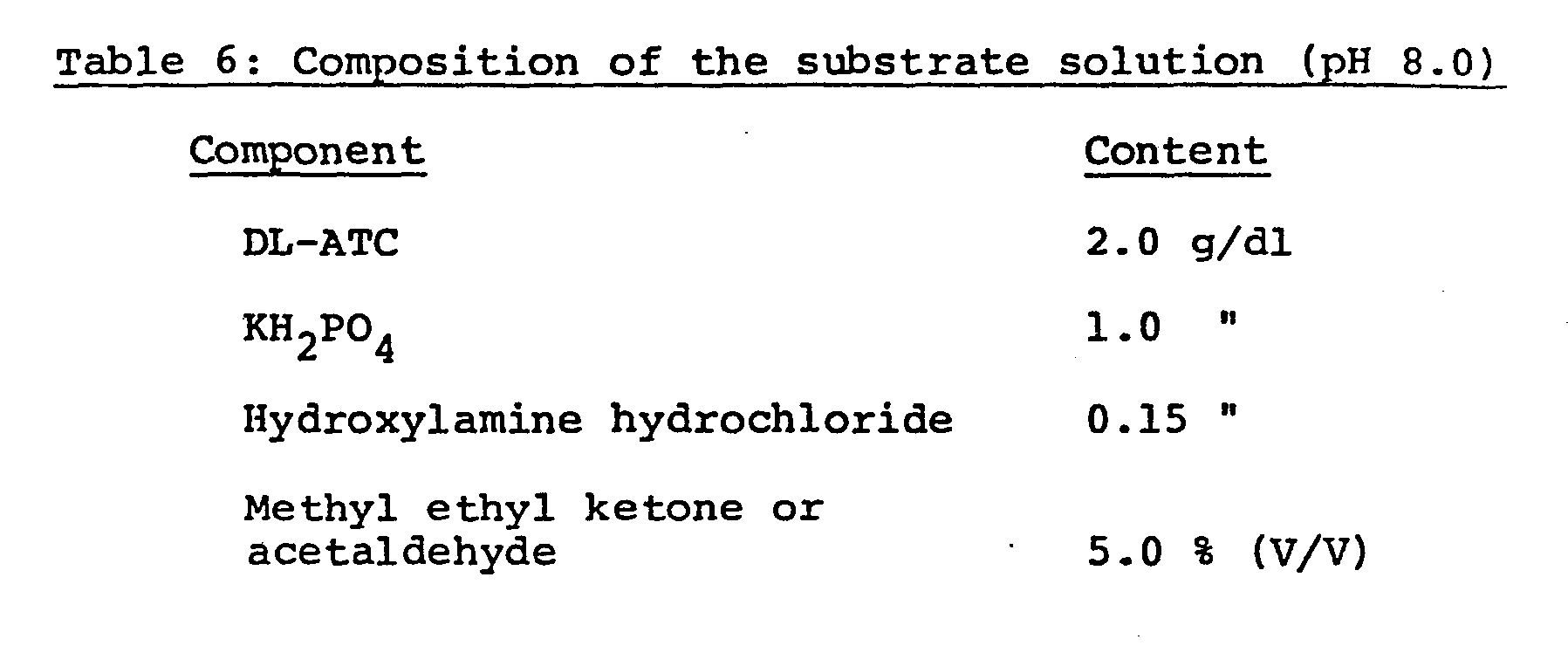
- After the reaction, the reaction mixture was subjected to silica gel thin-layer chromatography (developing solvent, tertiary butanol:methyl ethyl ketone: water:NH4OH=4:3:2:1), and DTC, METC or MTC was quantitatively determined by using a densitometer (210 nm). It was found that 1.23 g/dl of METC, or 1.41 g/dl of MTC was formed in the reaction mixture.
- A culture medium having the composition shown in Table 1 was prepared, dividedly put into 500 ml shaking flasks in a volume of 50 ml for each, and heated at 120°C for 10 minutes.
- Pseudomonas desmolytica AJ 3868 FERM-BP 323 was inoculated in the culture medium, and cultivated at 30°C for 24 hours with shaking. The culture broth was centrifuged to collect the microbial cells. 5.0 g of wet cells were added to 100 ml of a substrate solution having.the composition shown in Table 2, and reacted for 16 hours by maintaining the mixture at 30°C with occasional light stirring;
- After the reaction, 3.3 g of sodium monochloroacetate was added to the reaction mixture, and a solution of sodium hydroxide was added to adjust its pH to 13.5. The mixture was maintained at 30°C for 10 hours to form carboxymethylcysteine. The amount of carboxymethylcysteine was determined by high- performance liquid chromatography using a cation exchange resin "ZYPAX SCX". The results are shown in Table 7.

- The reaction mixture obtained by performing the enzymatic reaction as above at an acetone concentration of 5.0 % was reacted in the same way as above except that monofluoroacetic acid, monoiodoacetic acid or monobromoacetic acid was used instead of sodium monochloroacetate. The amount of carboxymethylcysteine formed was 2.2 g, 2.2 g, or 2.3 g, respectively. There was scarcely any difference observed.
- 1.3 g of DTC and 1.92 g of monochloroacetic acid were added to 70 ml of water, and the pH of the solution was adjusted to 6.0 - 14.0 by using a sodium hydroxide solution. The resulting solutions having the various pH values were each mixed with water to adjust the entire volume to 100 ml. Each of the solutions was maintained at 30°C for 1 hour, and the relation between the pH in the reaction and the amount of SMC formed was examined. The results are shown in Table 8.

- 5.0 g of the wet cells obtained by the method of Example 1 were lyophilized (sample A).
- 5.0 g of the same wet cells were suspended in 50 ml of a 0.1M phosphate buffer (pH 7.0) and the suspension was subjected to an ultrasonication treatment (Model LIR-200P made by Tomy Seiko Co., Ltd.; 20 KC, 5 minutes). (sample B).
- 5.0 g of the same wet cells were suspended in 20 ml of deionized water, and 3.8 g of acrylamide and 225 mg of methylenebis-acrylamide were added. N2 gas was passed through the mixture to remove oxygen, and 17.5 mg of ammonium persulfate and 40 ug of N;N'-dimethylaminopropionitrile were added to fix the cells (sample C).
- Each of samples A, B and C was added to 100 ml of a substrate solution having the same concentration as shown in Table 2 (except that the amount of acetone was 5.0 %), and enzymatically reacted by maintaining the mixture at 30°C for 16 hours. After the reaction, insoluble materials were removed from the reaction mixture, and 3.3 g of sodium monochloroacetate was added. The pH of the solution was adjusted to 13.5 by adding sodium hydroxide, and.it was reacted by maintaining it at 30°C for 1.0 hour. The amount of carboxymethylcysteine formed in the reaction mixture was shown in Table 9.

- Each of the microorganisms shown in Table 10 was cultivated in the culture medium shown in Table 1 by the method of Example 1. The culture broth was centrifuged to separate the microbial cells. 5.0 g of the wet cells were suspended in 100 ml of a substrate solution having the same composition as shown in Table 2 (except that the amount of acetone was 5.0 %), and reacted by maintaining the suspension at 30°C for 24 hours. After the reaction, 3.3 g of sodium monochloroacetate was added to adjust the pH of the reaction mixture to 13.0, and maintained at 30°C for 1 hour to form carboxymethylcysteine. The amount of carboxymethylcysteine was determined by high- performance liquid chromatography. The results are shown in Table 10.

- Each of the carbonyl compounds shown in Table 11 was added in an amount of 1.0 g/dl to an aqueous solution (pH 8.0) containing 1.0 g/dl each of DTC obtained at an acetone concentration of 5.0 % in Example 1 or by the method shown in Example 5 and MTC or METC obtained by a similar method. The mixture was maintained at 40°C for 2 hours to perform a substitution reaction. The condensate of L-cysteine and the carbonyl compound formed in the reaction mixture was identified and quantitatively determined. The results are shown in Tables 11 and 12.
- Identification of the reaction products (condensatesl was carried out by subjecting the reaction mixtures to silica gel thin-layer chromatography (n-propano1:1%NH4OH=2:1), and the amounts of the reaction products were determined by using a densitometer (210 nm).


Claims (4)

Applications Claiming Priority (12)
| Application Number | Priority Date | Filing Date | Title |
|---|---|---|---|
| JP138334/82 | 1982-08-09 | ||
| JP138335/82 | 1982-08-09 | ||
| JP57138335A JPS5928485A (en) | 1982-08-09 | 1982-08-09 | Preparation of l-cysteine |
| JP57138334A JPS5927867A (en) | 1982-08-09 | 1982-08-09 | Preparation of s-carboxymethyl-l-cysteine |
| JP57138336A JPS5928489A (en) | 1982-08-09 | 1982-08-09 | Preparation of 2,2-dimethylthiazolidine-4-carboxylic acid |
| JP138336/82 | 1982-08-09 | ||
| JP57138977A JPS5928486A (en) | 1982-08-10 | 1982-08-10 | Preparation of s-carboxymethyl-l-cysteine |
| JP138977/82 | 1982-08-10 | ||
| JP209156/82 | 1982-11-29 | ||
| JP57209156A JPS5998696A (en) | 1982-11-29 | 1982-11-29 | Preparation of thiazolidine-4-carboxylic acid derivative |
| JP228304/82 | 1982-12-28 | ||
| JP57228304A JPS59122480A (en) | 1982-12-28 | 1982-12-28 | Preparation of thiazolidine-4-carboxylic acid and its derivative |
Publications (3)
| Publication Number | Publication Date |
|---|---|
| EP0101052A2 true EP0101052A2 (en) | 1984-02-22 |
| EP0101052A3 EP0101052A3 (en) | 1984-12-27 |
| EP0101052B1 EP0101052B1 (en) | 1988-04-20 |
Family
ID=27552895
Family Applications (1)
| Application Number | Title | Priority Date | Filing Date |
|---|---|---|---|
| EP19830107857 Expired EP0101052B1 (en) | 1982-08-09 | 1983-08-09 | Method for producing 2-substituted-thiazolidine-4-carboxylic acids |
Country Status (2)
| Country | Link |
|---|---|
| EP (1) | EP0101052B1 (en) |
| DE (1) | DE3376341D1 (en) |
Cited By (1)
| Publication number | Priority date | Publication date | Assignee | Title |
|---|---|---|---|---|
| US5972663A (en) * | 1997-06-19 | 1999-10-26 | Consortium Fur Elektrochemische Industrie Gmbh | Microorganisms and processes for the fermentative preparation of L-cysteine, L-cystine, N-acetylserine or thiazolidine derivatives |
Family Cites Families (3)
| Publication number | Priority date | Publication date | Assignee | Title |
|---|---|---|---|---|
| FR8266M (en) * | 1968-12-31 | 1970-10-26 | ||
| US3796721A (en) * | 1972-01-12 | 1974-03-12 | Fmc Corp | Ethyl 4-carbomethoxy-2,2-dimethyl-thiazolidine-3-thiolocarboxylate |
| US4006057A (en) * | 1974-11-06 | 1977-02-01 | Ajinomoto Co., Inc. | Method of producing L-cysteine and L-cystine |
-
1983
- 1983-08-09 EP EP19830107857 patent/EP0101052B1/en not_active Expired
- 1983-08-09 DE DE8383107857T patent/DE3376341D1/en not_active Expired
Cited By (2)
| Publication number | Priority date | Publication date | Assignee | Title |
|---|---|---|---|---|
| US5972663A (en) * | 1997-06-19 | 1999-10-26 | Consortium Fur Elektrochemische Industrie Gmbh | Microorganisms and processes for the fermentative preparation of L-cysteine, L-cystine, N-acetylserine or thiazolidine derivatives |
| CN100347291C (en) * | 1997-06-19 | 2007-11-07 | 瓦克化学股份公司 | Microorganisms and processes for fermentative preparation of L-cysteine, L-cystine, N-acetylserine or thiazolidine derivatives |
Also Published As
| Publication number | Publication date |
|---|---|
| DE3376341D1 (en) | 1988-05-26 |
| EP0101052B1 (en) | 1988-04-20 |
| EP0101052A3 (en) | 1984-12-27 |
Similar Documents
| Publication | Publication Date | Title |
|---|---|---|
| US3871958A (en) | Biological method of producing serine and serinol derivatives | |
| US4094741A (en) | Process for preparing D-(-)-N-carbamoyl-2-(phenyl or substituted phenyl)glycines | |
| US5344768A (en) | Process for the preparation of pyrrolo-quinoline quinone | |
| EP0206471B1 (en) | Process for preparation of pyrrolo-quinoline quinone | |
| GB2042531A (en) | Process for preparing D-???-amino acids | |
| US4237227A (en) | Process for preparing D-N-carbamoyl-α-amino acids | |
| US4242452A (en) | Process for preparing N-carbamoyl-D-thienylglycines | |
| US3767528A (en) | Process for the manufacture of 3,4-disubstituted phenyl-l-alanines | |
| EP0101052B1 (en) | Method for producing 2-substituted-thiazolidine-4-carboxylic acids | |
| US5098835A (en) | Process for producing l-threonine by fermentation | |
| US3791924A (en) | Biological method of producing phenolic amino acids | |
| US4148688A (en) | Process for preparing L-methionine | |
| FI71167B (en) | FOERFARANDE FOER FRAMSTAELLNING AV D-MANDELSYRAKARBAMAT | |
| JP3116102B2 (en) | Method for producing L-3,4-dihydroxyphenylalanine | |
| US3152967A (en) | Process for preparing guanylic acid | |
| JPH0669387B2 (en) | Process for producing S-adenosylmethionine | |
| US3579427A (en) | Process for producing methionine decarboxylase | |
| US3698999A (en) | Fermentative preparation of coenzyme a | |
| US4123329A (en) | Process for producing L-lysine by fermentation | |
| JPS5928486A (en) | Preparation of s-carboxymethyl-l-cysteine | |
| JPH0353915B2 (en) | ||
| JPH0232278B2 (en) | ||
| JPH0313873B2 (en) | ||
| JPH0353917B2 (en) | ||
| JPH0353916B2 (en) |
Legal Events
| Date | Code | Title | Description |
|---|---|---|---|
| PUAI | Public reference made under article 153(3) epc to a published international application that has entered the european phase |
Free format text: ORIGINAL CODE: 0009012 |
|
| AK | Designated contracting states |
Designated state(s): CH DE FR GB IT LI |
|
| PUAL | Search report despatched |
Free format text: ORIGINAL CODE: 0009013 |
|
| AK | Designated contracting states |
Designated state(s): CH DE FR GB IT LI |
|
| 17P | Request for examination filed |
Effective date: 19841224 |
|
| 17Q | First examination report despatched |
Effective date: 19860418 |
|
| ITF | It: translation for a ep patent filed | ||
| GRAA | (expected) grant |
Free format text: ORIGINAL CODE: 0009210 |
|
| AK | Designated contracting states |
Kind code of ref document: B1 Designated state(s): CH DE FR GB IT LI |
|
| REF | Corresponds to: |
Ref document number: 3376341 Country of ref document: DE Date of ref document: 19880526 |
|
| ET | Fr: translation filed | ||
| PG25 | Lapsed in a contracting state [announced via postgrant information from national office to epo] |
Ref country code: LI Effective date: 19880831 Ref country code: CH Effective date: 19880831 |
|
| PLBE | No opposition filed within time limit |
Free format text: ORIGINAL CODE: 0009261 |
|
| STAA | Information on the status of an ep patent application or granted ep patent |
Free format text: STATUS: NO OPPOSITION FILED WITHIN TIME LIMIT |
|
| 26N | No opposition filed | ||
| REG | Reference to a national code |
Ref country code: CH Ref legal event code: PL |
|
| ITTA | It: last paid annual fee | ||
| PGFP | Annual fee paid to national office [announced via postgrant information from national office to epo] |
Ref country code: FR Payment date: 19980619 Year of fee payment: 16 |
|
| PGFP | Annual fee paid to national office [announced via postgrant information from national office to epo] |
Ref country code: GB Payment date: 19980624 Year of fee payment: 16 |
|
| PGFP | Annual fee paid to national office [announced via postgrant information from national office to epo] |
Ref country code: DE Payment date: 19980930 Year of fee payment: 16 |
|
| PG25 | Lapsed in a contracting state [announced via postgrant information from national office to epo] |
Ref country code: GB Free format text: LAPSE BECAUSE OF NON-PAYMENT OF DUE FEES Effective date: 19990809 |
|
| GBPC | Gb: european patent ceased through non-payment of renewal fee |
Effective date: 19990809 |
|
| PG25 | Lapsed in a contracting state [announced via postgrant information from national office to epo] |
Ref country code: FR Free format text: LAPSE BECAUSE OF NON-PAYMENT OF DUE FEES Effective date: 20000428 |
|
| PG25 | Lapsed in a contracting state [announced via postgrant information from national office to epo] |
Ref country code: DE Free format text: LAPSE BECAUSE OF NON-PAYMENT OF DUE FEES Effective date: 20000601 |
|
| REG | Reference to a national code |
Ref country code: FR Ref legal event code: ST |