EP0101066A2 - Système de pulvérisation de liquide - Google Patents
Système de pulvérisation de liquide Download PDFInfo
- Publication number
- EP0101066A2 EP0101066A2 EP83107899A EP83107899A EP0101066A2 EP 0101066 A2 EP0101066 A2 EP 0101066A2 EP 83107899 A EP83107899 A EP 83107899A EP 83107899 A EP83107899 A EP 83107899A EP 0101066 A2 EP0101066 A2 EP 0101066A2
- Authority
- EP
- European Patent Office
- Prior art keywords
- liquid
- conduit
- perforations
- phase
- interior
- Prior art date
- Legal status (The legal status is an assumption and is not a legal conclusion. Google has not performed a legal analysis and makes no representation as to the accuracy of the status listed.)
- Granted
Links
Images


Classifications
-
- B—PERFORMING OPERATIONS; TRANSPORTING
- B05—SPRAYING OR ATOMISING IN GENERAL; APPLYING FLUENT MATERIALS TO SURFACES, IN GENERAL
- B05B—SPRAYING APPARATUS; ATOMISING APPARATUS; NOZZLES
- B05B1/00—Nozzles, spray heads or other outlets, with or without auxiliary devices such as valves, heating means
- B05B1/14—Nozzles, spray heads or other outlets, with or without auxiliary devices such as valves, heating means with multiple outlet openings; with strainers in or outside the outlet opening
- B05B1/20—Perforated pipes or troughs, e.g. spray booms; Outlet elements therefor
- B05B1/205—Perforated pipes or troughs, e.g. spray booms; Outlet elements therefor characterised by the longitudinal shape of the elongated body
-
- B—PERFORMING OPERATIONS; TRANSPORTING
- B01—PHYSICAL OR CHEMICAL PROCESSES OR APPARATUS IN GENERAL
- B01D—SEPARATION
- B01D11/00—Solvent extraction
- B01D11/04—Solvent extraction of solutions which are liquid
- B01D11/0446—Juxtaposition of mixers-settlers
- B01D11/0449—Juxtaposition of mixers-settlers with stationary contacting elements
-
- B—PERFORMING OPERATIONS; TRANSPORTING
- B01—PHYSICAL OR CHEMICAL PROCESSES OR APPARATUS IN GENERAL
- B01D—SEPARATION
- B01D11/00—Solvent extraction
- B01D11/04—Solvent extraction of solutions which are liquid
- B01D11/0446—Juxtaposition of mixers-settlers
- B01D11/0453—Juxtaposition of mixers-settlers with narrow passages limited by plates, walls, e.g. helically coiled tubes
-
- B—PERFORMING OPERATIONS; TRANSPORTING
- B01—PHYSICAL OR CHEMICAL PROCESSES OR APPARATUS IN GENERAL
- B01D—SEPARATION
- B01D11/00—Solvent extraction
- B01D11/04—Solvent extraction of solutions which are liquid
- B01D11/0446—Juxtaposition of mixers-settlers
- B01D11/0473—Jet mixers, venturi mixers
-
- A—HUMAN NECESSITIES
- A61—MEDICAL OR VETERINARY SCIENCE; HYGIENE
- A61H—PHYSICAL THERAPY APPARATUS, e.g. DEVICES FOR LOCATING OR STIMULATING REFLEX POINTS IN THE BODY; ARTIFICIAL RESPIRATION; MASSAGE; BATHING DEVICES FOR SPECIAL THERAPEUTIC OR HYGIENIC PURPOSES OR SPECIFIC PARTS OF THE BODY
- A61H9/00—Pneumatic or hydraulic massage
- A61H9/0021—Hydraulic massage
- A61H2009/0035—Hydraulic massage with cabin for the whole body
-
- A—HUMAN NECESSITIES
- A61—MEDICAL OR VETERINARY SCIENCE; HYGIENE
- A61H—PHYSICAL THERAPY APPARATUS, e.g. DEVICES FOR LOCATING OR STIMULATING REFLEX POINTS IN THE BODY; ARTIFICIAL RESPIRATION; MASSAGE; BATHING DEVICES FOR SPECIAL THERAPEUTIC OR HYGIENIC PURPOSES OR SPECIFIC PARTS OF THE BODY
- A61H9/00—Pneumatic or hydraulic massage
- A61H9/0021—Hydraulic massage
- A61H2009/0042—Hydraulic massage with water recirculation
-
- A—HUMAN NECESSITIES
- A61—MEDICAL OR VETERINARY SCIENCE; HYGIENE
- A61H—PHYSICAL THERAPY APPARATUS, e.g. DEVICES FOR LOCATING OR STIMULATING REFLEX POINTS IN THE BODY; ARTIFICIAL RESPIRATION; MASSAGE; BATHING DEVICES FOR SPECIAL THERAPEUTIC OR HYGIENIC PURPOSES OR SPECIFIC PARTS OF THE BODY
- A61H33/00—Bathing devices for special therapeutic or hygienic purposes
- A61H33/06—Artificial hot-air or cold-air baths; Steam or gas baths or douches, e.g. sauna or Finnish baths
- A61H2033/068—Steam baths
Definitions
- This invention relates to a liquid-spraying system comprising
- tubular conduit means e.g. a hose
- tubular conduit means has two ends and an elongated conduit interior extending from one end of the conduit means to the other, that the tube wall surrounds the elongated conduit interior and has an external and an internal tube wall surface, and that the liquid feeding means are adapted for causing liquid to flow into the conduit interior.
- Liquid-spraying systems of the above-described kind are described, for instance in British patent 1,389,971 of Com- pagnie Nationale d'Am6nagement de la Region du Bas-Rhone et du Languedoc S.A., which patent describes a plant irregation system comprising a perforated water distribution grid or flexible tube, for instance of PVC or polyethylene, which has perforations or nozzles with an orifice of from about 7 to 20 mm 2 wide. From these nozzles water is not ejected in a free jet to the outside, but is led via small tubes of 6 mm internal diameter to a row of pots containing one or more plants.
- perforations having the small diameters required can be blocked in various ways, by small solid grains transported by the water, by organic debris, by deposition of salts dissolved in the water or by micro-organisms, algae etc, so that certain perforations will become clogged and the spraying effect of the whole system will become irregular and will no longer be uniform.
- each nozzle of this irrigation system delivers about 70 liters of water per hour, while a perforation delivering water dropwise is said to give an hourly discharge of between 3 and 10 liters.
- hoses for irrigation by trickling water and having the initially described features are also disclosed in German Offenlegungsschrift 28 35 117 by Sumitomo Chemical Co. Ltd.
- These hoses can be made from thermoplastic syn- thetio resin materials, and preferably from polyolefin resins, such as polyethylene, ethylene/vinyl acetate mixed polymeri- zate, polypropylene and the like and have a wall thickness of less than 0.5 mm and preferably from 0.05 to 0.3 mm.
- These hoses are made with two passages, a main duct into which the water is fed and from which it passes through connecting orifices into a parallel equalized-pressure duct.
- the perforations in this kind of hose should be elongated rectangular slots of about 2-8 mm in the case of the connecting orifices, while orifices of circular cross section and a diameter of 2 mm are said to deteriorate the self-cleaning effect achieved by using these hoses.
- the rectangular perforations should have a ratio of length to width of about 0.5 to 5, i.e. a perforation having a diameter of 2 mm should be 20 mm long and then has an opening of 40 mm 2 .
- the diameter of the trickling orifices is shown to be from about one half to approximately the same diameter as the connecting orifices.
- Sprinkler hoses are also available in the market which have slots cut into rubber or the like material in lieu of punched-out circular holes or rectangular slots.
- a spraying system of the initially described kind in which the tube wall is made of a liquid-tight, elastically resilient material which is non-swelling in contact with water of a temperature of 60°Cor higher and with organic extraction solvents, and wherein the perforations are uniform and have an outlet size of at most about 1.5 mm 2 , being small enough to produce capillary forces between water and the material of the surrounding tube wall sufficient to substantially prevent water filling the conduit interior from flowing out of the perforations while the water in the conduit interior is under ambient pressure, but being sufficiently large and of such configuration as to permit eject- tion of the liquid jet substantially free from trickling, when the liquid in the conduit interior is under excess pressure at least of the magnitude derived from a water main. Excess pressure in the water main fluctuates between 0.3 and 1.5 bar.
- the liquid remaining in the conduit interior should preferably be held back by the capillary forces active in the perforations due to their size and configuration, and to the interface tension between the liquid and the surrounding tube wall material.
- These capillary forces should be at least strong enough so that no more than a trickle of liquid should slowly emerge from the perforations, for instance when the spraying zone of the conduit means tube wall is very long, e.g. 10 to 20 meters or more and extends in vertical position, the number of perforations then being at least 150 to 300 or more.
- the perforations have a capillary diameter, i.e. that they open to eject a liquid jet, only when the conduit interior is connected to a low excess pressure source such as a water main, or to a similar source delivering another liquid at a pressure at least in the same range as that of the water main.
- the perforations are preferably uniformly distributed over the entire spraying zone of the conduit means tube wall.
- the tube wall material is an extruded thermo-plastic synthetic resin having a tensile modulus of from about 1000 to 6000 N/mm 2 and a flexural modulus at 23 0 C of from about 500 and up to 5000 N/mm 2 , in particular a polyamide, a poly-perfluoro-lower alkylene resin, a mixture of polyamide with at least one of polyethylene and polypropylene, a perfluoro alkoxy resin, or a lower alkylene/ lower perfluoro- lower alkylene copolymer.
- the extruded polyamide resins mentioned above, in particular Nylon 6, Nylon 66, Nylon 6/12, Nylon 11 or Nylon 12 were measured dry as molded, i.e. with a moisture content of about 0.2% by weight, and a 3 mm thick specimen of these resins showed a water absorption of about 0.2 to 0.6% by weight during 24 hours.
- the density of the above mentioned suitable polyamides ranged from 1.01 to 1.3 g/ml.
- the tensile modulus of Nylon 6 is given as 2620 N/mm 2 , that of Nylon 6/12 as 2000, Nylon 11 as 1276, Nylon 12 as 1241, and amorphous transparent aromatic polyamide 2620 to 2830 N/mm 2 .
- Preferred polyamides are Grilamid L 20 G, L 25 and L 20 WO, whose flexural modulus is 900, 900 and 1100 N/mm 2 ,respectively.
- the flexural modulus of these polyamides is the following: Nylon 6: 2690, Nylon 6/12: 2000, Nylon 11: 1034, Nylon 12: 1138, and amorphous transparent unreinforced aromatic polyamides 2206 to 2700 N/mm 2 .
- Teflon FEP poly-fluorinated ethylene-propylene
- Teflon PFA poly-perfluoro-alkoxy-ethylene
- Teflon PTFE poly tetrafluoroethylene
- Teflon FEP, PFA and PTFE have a tensile modulus of 2413, 4826 and 2413 to 5171 N/mm 2 , respectively.
- the thickness of the tube wall of the elongated conduit means of the liquid-spraying system according to the invention preferably ranges from 0.8 to 2.5 mm, it is preferably considerably greater than the thickness recommended for the perforated water trickling hose described by Sumitomo Chemical Co. Ltd. in German Offenlegungsschrift 28 35 117.
- Piercing the perforations with the aid of a fine needle leads to the formation of burr on the internal tube wall surface which obstructs the flow of liquid from the conduit interior into the perforation in an irregular manner.
- Piercing with heated needles leads to adhesion of the softened tube wall material to the needles and an irregular perforation.
- Perforations bored with a twist drill having a diameter of about 1 mm and a pitch of the drill thread of about 3 to 4 mm have proved to comply satisfactorily with the requirements set forth above.
- the perforations can also be satisfactorily produced with a somewhat larger drill having, for instance, a diameter of 2 mm, or a smaller drill, having a diameter of 0.5 mm may be required.
- jets of the liquid preferably have a diameter of 0.5 to 2 mm measured at a right angle to the longitudinal jet axis, in the vicinity of the tube wall, which diameter corresponds largely to the above-mentioned preferred diameter range of the perforations therein.
- a jet of discontinuous droplets is desirable.
- the perforations should be aligned in a single row extending linearly along the side of the tube wall, the row thus running parallel with the longitudinal axis of the tubular conduit means.
- a water temperature above 40°C -(104°F) is barely supported by the user.
- the shower also has a stimulating effect on blood circulation, however the bundle of water impinges in a relatively limited area of the user's body and still leaves areas of the skin un- attained which permits the user to register temperature differences which cause such person to stop the shower, usually without having reached transpiration.
- a shower is used by a person for less than 3 minutes.
- a spraying system having the various inventive features listed hereinbefore, in which the tubular conduit means have the configuration of a helix, the windings of the tubular conduit means extending about a central helix axis and defining an internal helix space in their interior.
- the helix is positioned with its axis disposed vertically; the diameter and height of said helix are such as to house a person standing or sitting within the internal space of the helix, and the perforations are located in a row on the inner side of the windings of tubular conduit means facing toward the internal helix space, whereby a plurality of fine liquid jets are directed into all zones of the said internal helix space.
- the vertical distance between two adjacent windings of said helix is preferably from about 10 to 20 cm; the diameter of a preferred embodiment of the helix is about 75 to 100 cm, and the number of perforations is about 200 to 400, which, at a rate of 15 perforations per meter of conduit length, requires a length of the conduit means of about 15 to 30 meters, depending on the size of the person using the shower installation.
- a particularly suitable material for the tube wall of the helically shaped conduit means according to this aspect of the invention is Grilamid, an at least partially aromatic polyamide and especially a poly-(phthalic amide) such as poly-(terephthalic amide) of the Perlon type.
- the above-described shower installation can be equipped with liquid flow control means and/or with temperature adjusting means for manually adjusting the flow rate and/or the temperature of the liquid being sprayed out of the perforations of the helix.
- These liquid flow control and/or temperature adjusting means are preferably arranged relative to the helix so as to be reachable by a person standing or sitting in the internal helix space.
- a person standing or sitting in the internal helix space of the above-described shower installation being sprayed from all sides by the fine sprays from the perforated conduit means according to the invention, supports water temperatures of 40°C and considerably higher which such person could consider unsupportably hot, when a hot spray from a conventional shower having nozzle openings punched or pierced in a circular shower area impinges on a limited area of his or her skin.
- the mantle of hot liquid uniformly covering the body of a person using the shower installation according to the invention at a water temperature above 40°C, e.g. 42 to 45°C, causes in the body of that person a long-lasting feeling of well being until such person begins to transpire. After a short intermediary cooling-off period, this treatment can be repeated.
- the quality of the therapeutical treatment offered by the helical shower installation according to the invention can be further enhanced or diversified by admixing suitable adjuvants with the water being sprayed.
- suitable adjuvants can be costly perfumes or the like because the water consumption by the novel shower installation is very restricted, e.g. from 120 to 180 liters during 10 minutes of treatment while a full bath in a bath tub requires about 200 to 400 liters of water.
- the temperature adjusting means such as a hot-and-cold water mixing valve can be reached by the person taking the shower in standing or sitting position. Intermediary showering with cold water thus becomes possible without having to leave the installation as one must do in a sauna.
- conduit means described hereinbefore, and also the helical embodiment thereof have been found most suitable for use in the fractionated extraction that can be employed for the separation of mixed reaction products, the recovery of useful substances from waste waters, the separation of physically and/or chemically closely related substances, and the extraction by spraying of vegetable substances or of inorganic substances such as ores.
- liquid-liquid extraction techniques provide for the extraction of a liquid from a solution by intimate contact of that solution, preferably in a counter- current manner, and usually in an extraction column, which is equipped with mechanical means for promoting intimate contact of the first-mentioned solution with another liquid phase in which one or more components of the first solution are readily soluble, and which second liquid phase, becoming a solution of at least one of the components of the first solution, must be immiscible, or have a wide immiscibility gap, with the solvent of the first solution.
- interface control means positioned at one or several interfaces in the column to detect a change in position of the liquid-liquid interface during operation of the column as well as another timing device in communication with the interface control means and with the first timing means to adjust the first mentioned timing means, which control the introduction and withdrawel of the light and heavy phases and the respective solutions, responsive to the detected interface position, so as to maintain the interface in substantially the same position throughout the extracting operation.
- the tubes are unperforated and each has a length of about 5 meters having about 100 windings.
- the throughput is about 0.075 to 0.75 liter and the output is about 10 to 100 mag per hour.
- the apparatus serves mainly for the extraction of very small amounts of biological material such as L-leucyl-L-turosine and other similar peptides (see also Chemical & Engineering News, March 21, 1983).
- the pressure in the second conduit must, of course, be sufficient to overcome the resistance to the ejection of liquid therefrom due to the capillary activity of these perforations and the interface tension of the liquid.
- the liquid-liquid extractor apparatus further comprises a plurality of separator units of which each unit is connected to a collecting vessel, each separator unit comprises a chamber for separated heavy-phase liquid and a chamber for separated light-phase liquid, as well as first pipe line means connecting the chamber for light-phase liquid with that one of the first and second conduits which is fed with light-phase liquid, and second pipe line means connecting the chamber for heavy-phase liquid with the other one of the first and second conduits which is fed with heavy-phase liquid, in the same zone of the said first and second conduits in which the perforations of the second conduit are located from which the liquid jets collected in the collecting vessel connected with the respective separator unit have been ejected.
- one of the two streams is an annular stream having a hollow longitudinal space in its interior, and the other stream is directed countercurrently thereto through the said hollow interior of the first-mentioned stream.
- the annular stream is a stream of heavy-phase liquid and the other stream is a stream of light-phase liquid.
- the annular stream of heavy-phase liquid can be directed from a higher level downward to a lower level, and the stream of light-phase liquid is directed through the interior of the annular stream, but from the lower level upward to the higher level, and preferably, the two streams follow a helical path. That channel through which the heavier one of the liquids is directed, is preferably filled with granules, inert toward the liquids, for instance with beads of Teflon PFA.
- At least a major portion or all of the volume of the light-phase liquid consists of a light-phase solvent
- at least a major portion of the volume of the heavy-phase liquid consists of a heavy-phase solvent, which light-phase and heavy-phase solvents are totally immiscible with one another, or are miscible with each other only with an immiscibilty gap.
- the apparatus and method according to the invention are particularly useful when two solute components having very similar solubility in a given heavy-phase solvent, have a slightly more different solubility in the light-phase solvent or viceversa.
- Such components can be fatty acids, acids, derived from resin, peptides, proteins, insulin produced with the aid of bacteria, m-cresol and p-cresol, heavy water and normal water, and many others (see “Difficult separations by extraction” by E.G. Scheibel, published in Chemical Engineering Progress, supra).
- the embodiment of a shower installation according to the invention as shown in Fig. 1 comprises a hose 1 of polyvinyl chloride having a nylon fiber reinforcement.
- the hose is preferably 15 m long and has a circular cross sectional area having an internal diameter of 15 mm.
- the hose is laid in the shape of a helix having a top ring 2 and a bottom ring 3 as well as six intermediate coil windings 11, with a pitch of about 15 cm.
- Vertically extending nylon strings which are suspended from the top ring 2 hold the windings in position as a helix.
- the ring 2 is preferably suspended from a bathroom ceiling or a frame (not shown) by means of suspension cords or rods 4.
- a water- supply tube 5 is connected to a tap 10 of the water main and the other end of tube 5 is connected by means of a hose coupling 8 to the upper end of the hose 1.
- the hose coupling 8 is firmly attached to the upper ring 2.
- the level of the helical hose 1 above the floor can be altered by lengthening or shortening the correspondingly devised suspension cords or rods 4.
- the hose 1 On the side lla of the windings 11 which faces toward the central space defined by them, the hose 1 is provided with perforations 12 which have been produced with a 2 mm drill at distances of about 5 cm from each other, resulting in 20 perforations per meter, or 300 distributed uniformly over the entire length of the hose 1.
- the lower end 9 of the last winding 11 of the hose 1 is attached to the lower ring 3 and closed, for instance by a ligature or stopper (not shown).
- An outlet valve (not shown) can be provided at this end 9, in order to empty the hose 1 rapidly when not used.
- the sprays 18 which are ejected from the perforations 12 have been shown in the second loop 11 of the hose, counting from the bottom end.
- a person standing or sitting in the helix space inside the windings 11 will be hit about 300 fine jets whose points of impingement will be distributed over his entire body.
- a temperature adjusting hot-and-cold water valve If in lieu of the tap 10, there is installed a temperature adjusting hot-and-cold water valve, then a person taking a shower inside the helix can easily reach such valve and adjust the temperature of the water, for instance changing rapidly from 40°C to 10°C and back, thus attaining the hydro- therapeutically valuable effect of an alternating hot-and-cold bath or of a sauna.
- a hot water reservoir is usually kept at a water temperature of 50 to 60°C, the user can go as high above 40°C as he finds supportable until he begins to transpire.
- the lower ring 3 In order to get in or out of the internal helix space the lower ring 3 can be lifted on one side high enough to enter the internal space or leave it comfortably.
- a hose made of Grilamid supra is preferred because the polyvinyl chloride hose is much heavier, it changes its form when filled with a liquid such as water, and is thus more complicated to hold in a frame, and requires a larger number of suspending elements.
- the heavier PVC helix may cause a slight claustrobia in some persons, which the much lighter appearing Grilamid hose is less likely to do so.
- This type of spraying system can also be used, for instance, for the extraction of finely ground plant material or the like which is moved upward and/or downward along the central helix axis, as desired, and the extraction medium being a mixture produced by the fine jets from both hoses 1 and 20 coalescing on the surface of the material to be extracted, flows downwardly and is gathered by collector means (not shown) in the bottom zone of the system underneath both hoses. The two phases are then separated in a conventional manner, and processed further to recover the different solutes contained therein.
- FIGS 2 to 7 there are illustrated various embodiments of the novel extractor according to the invention.
- two tubes having the perforations and other features described hereinbefore as being characteristic of the instant invention.
- a heavy-phase liquid preferably containing a mixture of solutes the components of which are to be separated from one another, is conveyed in a first direction, while in the second tube a light-phase solvent of the above-mentioned properties is conveyed, prferably in counter- current mode to the heavy-phase liquid.
- a first helical conduit 1 as illustrated in Fig. 1 is used as the first tube and a second similar helical conduit 19, of a smaller diameter, but most conveniently of equal length is used as the second tube and is placed in the internal space within the windings 11 of the first tube.
- the perforations 12 of the first tube 1 and the perforations (not shown) of the second tube 19 are both arranged in the same manner as shown in Fig. 1 and direct their jets toward a middle zone surrounding the commun central longitudinal axis of both helices.
- the two tubes 25' and 26' can be produced as an integral body 29, for instance by extrusion and are provided with the same perforations 22 through the common wall zone 27', and 28 in the wall zone of tube 26', opposite the perforations 22.
- the tube containing the perforations 28 leading to the outside is filled with granules or beads, preferably made of Teflon PFA, i.e. polyperfluoro-alkoxyethylene, marketed by E.I. DUPONT DE NEMOURS, Wilmington, Delaware or similar suitable material inert to chemicals occurring in liquid-liquid extraction.
- the preferred operation of the embodiments shown in Figures 3 and 4 comprises the steps of passing a heavy-phase solute containing liquid preferably through the tube 26 or 26' and most preferredly from the upper to the lower end of the tube when the latter is in inclined or vertical position. It is also possible to arrange the tubes in serpentine shape.
- a light-phase liquid is passed through the tube 25 or 25' at an at least slightly higher pressure than prevails in the tube 26 or 26'.
- light-phase liquid will penetrate through the perforations 22 from the interior of tube 25 into the interior of tube 26 (or correspondingly from the interior of tube 25' into the interior of tube 26') and will intermingle therein with the heavy-phase liquid.
- a mixture of heavy-phase and light-phase liquids in which some components of the solute have passed from the heavy-phase to the light-phase is then ejected in jet form.
- a double hose 100 comprises an inner tubular conduit 101 is surroundd by a tube wall 102 of poly-(perfluoroethylene-propylene (Teflon FEP, manufactured by E.I. DuPont de Nemours, supra) as the elastically resilient material.
- the inner conduit 101 is surrounded by an outer tubular conduit 110 which is in turn enclosed in an outer tube wall 111.
- a large number of perforations 104 for example 20 per meter, each of which has perferably a diameter of about 0.6 mm, produced by boring through the tube wall 102 with a twist drill having a bit diameter of 0.7 mm.
- the outer tube wall 111 is likewise provided with a large number of perforations 112.
- the amount of liquid to be ejected through these perforations 112 from the annular interior of the outer conduit 110 must be large enough so that there can be accomodated in the zone in which a given number of perforations 104 and 112 is provided, the amount of liquid added from the entry end of the conduit 110 plus the amount of liquid injected into that zone from the inner conduit 101 through the perforations 104.
- the annular space in the outer conduit about the tube wall 102 is preferably filled with granules 105 of Teflon PFA (supra) which favor . intermingling of the liquid flowing through the outer conduit 110 with the liquid from the inner conduit 101 injected through the perforations 104. Moreover, it reduced the flow rate of the liquid stream through this conduit 110.
- the ratio of the volume of the inner conduit to that of the outer conduit is 1:2, and the outer conduit has 50% of its volume occupied by the aforesaid granules, so that the effective volume ratio is 1:1, and when the number of the inner perforations 104 is equal to the number of the outer perforations 112, then it is suggested that the cross sectional area of the outer perforations 112 be approximately twice the cross sectional area of the inner perforations 104.
- perforations 112 having each a cross sectional area of 2.25 mm 2 , i.e. a diameter of about 0.85 mm, can be obtained by boring them with a twist drill having a bit diameter of 1 mm.
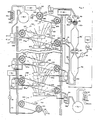
- Fig. 7 there is illustrated schematically a liquid-liquid extraction plant comprising a helix-shaped double tube conduit 120.
- the conduit 120 When built with the same dimensions as employed in the embodiment of a helix-shaped tube in Fig. 1, the conduit 120 will have in its outer tube wall 111 a total of 300 perfcra- tions 112.
- the pitch of the windings of the helix-shaped conduit 120 has been exaggerated in Fig. 7 for the sake of greater clarity. As in Fig. 1 the pitch would be about 15 or when the diameter of the helix windings, taken radially with regard to the longitudinal central helix axis HA is about 75 cm.
- the build-up of the double tube 120 is the same as in Figures 5 and 6 and like parts in Figures 5 to 7 are designated by like numerals.
- the portion of each helical winding situated in front of the paper plane is indicated by dashed lines, and the perforations 112 therein by dotted lines, while the rear sections are shown in full lines. While the length of the double tube 120 and the diameter, stated above, of such winding affords a number of six and one half windings, of which only four, namely windings 121, 1221 123 and 124 are shown in Fig. 7; one and a half of these windings are shown in the upper part, and two and a half windings in the lower part of the plant shown in that Figure. Each winding thus has a length of about 2.30 meters and contains 46 of the total of 300 perforations; of these 46 perforations only a few have been shown.
- collector vessels In a region about the axis HA of the helix interior, there are mounted several collector vessels of which only six are shown. Actually, if a collector vessel is provided for every three to six liquid jets directed from perforations 112 toward the central region of the helix, then there will be required one hundred to fifty such collector vessels in a somewhat different arrangement placing the dishes at points on a narrower helix of a pitch proportionate to that of the helix-shaped conduit 120, i.e. parallel with and slightly below that conduit at the inside thereof.
- the spacing of these collector vessels inwardly from the windings of the conduit 120 will be such that the impingement of a group of three to six jets adjacent each other on the floor of the respective collector vessel is assured.
- FIG. 7 only six such collector vessels 31 to 36 have been shown, and have been arranged along the helix axis HA for the sake of clarity.
- the uppermost vessel 31 has an outlet connected via a pipe 31a to the middle zone of a separator unit 41.
- a separator unit 42 to 46 connected to each collector vessel 32 to 36 via pipes 32a to 36a.
- the separator unit 42 has been shown enlarged on the right-hand side of Fig. 7. All other separator units have the same structure, but have been indicated only schematically.
- the separator unit 42 comprises a lift pump 47 which pumps the liquid mixture via a valve 48 from the vessel 32 into a funnel-shaped reservoir 49 and from there via a three-way valve 51 into an upper and a lower separator vessel 55 and 56 which are connected with each other via a shut-off cock 57.
- the upper separator vessel 55 is further equipped with a reservoir 50 for light-phase solvent with a pressure meter 52 in a pipe line 50a, leading into the vessel 55 from the reservoir 49 via the three-way valve 52.
- the separator vessel 56 is equipped with a heavy-phase solvent reservoir 53 from which heavy-phase solvent can be bled into the lower separator vessel 56 via a pressure meter 54 and a shut-off valve 58.
- the light-phase contents of the upper separator vessel 55 can be fed back via a line 60 and valve 61 into the same zone of the inner conduit 101 of the helical double tube winding 122 from which the liquid jets are being ejected that fill the collector vessel 32, while the heavy-phase contents of the lower separator vessel 56 can be fed back via a line 62 and valve 63 into the outer tubular conduit'110 of the aforesaid helical double tube winding 122 in the same zone.
- the collected liquid passes through line 31a which is equipped in a similar manner as line 32a in the separator unit 42, into the separator unit 41, but while the heavy-phase liquid which separated out in the lower separator vessel 41a is fed back via a line 160 into the outer conduit 110 of the same winding 121, the light phase gathered in the upper separator vessel 41b of this uppermost unit is conveyed by a suitable lift pump (not shown) into an evaporator 67 in which the solute contained in this light-phase liquid is recovered while the light-phase solvent vapors can be recovered in a condenser 68.
- a suitable lift pump not shown
- the collected liquid mixture is fed into the separator 46, from where the supranatant light phase in the upper separator vessel 46b is fed back into the inner conduit 101 in the same zone of winding 124 from which liquid was ejected from the outer conduit 110 into the collector vessel 36.
- the heavy phase obtained in the separator vessel 46a is conveyed through a line 166 to an evaporator 70 in which the solute of the heavy phase liquid is recovered, while the heavy phase solvent is recovered in a condenser 71.
- Fresh light phase solvent can be delivered from a reservoir 72 therefor via a feed line 73 and with the aid of a pump 74 into the lower end of the inner conduit 101.
- Residual heavy phase waste liquid not gathered in the collector vessel 36 can be discharged from the outer conduit 110 via a discharge valve 75, through which a cleaning fluid can also be injected into the conduit 110 after the same has been emptied from extraction liquid.
- Fig. 8 there is shown a preferred arrangement of the separator units 41 to 46 about the helix-shaped double tube extraction column 80.
- the apparatus and the method for liquid-liquid extraction according to this aspect of my invention as described hereinbefore affords a continuous countercurrent distribution involving an ierative extraction, in which a combination of cross-current and countercurrent techniques is employed.
- the extraction tube means are most simple and inexpensive to construct as compared with complicated columns in the prior art requiring the mounting of a number of baffles in an extraction tower, which in term requires interface control in order to prevent depletion. There is no danger of depletion in operating my novel extraction plant.
- Nozzles can be of any suitable material, e.g. hard synthetic resin material, for instance the same material as the tubular conduits, glass or a suitable metal such as V 2 A steel.
- Monitoring of the progress of solute distribution at the different separator units can be carried out in a conventional manner.
Landscapes
- Chemical & Material Sciences (AREA)
- Chemical Kinetics & Catalysis (AREA)
- Nozzles (AREA)
- Catching Or Destruction (AREA)
- Extraction Or Liquid Replacement (AREA)
Priority Applications (1)
| Application Number | Priority Date | Filing Date | Title |
|---|---|---|---|
| AT83107899T ATE39321T1 (de) | 1982-08-14 | 1983-08-10 | Fluessigkeitsverspruehungsvorrichtung. |
Applications Claiming Priority (2)
| Application Number | Priority Date | Filing Date | Title |
|---|---|---|---|
| CH4855/82 | 1982-08-14 | ||
| CH485582 | 1982-08-14 |
Publications (3)
| Publication Number | Publication Date |
|---|---|
| EP0101066A2 true EP0101066A2 (fr) | 1984-02-22 |
| EP0101066A3 EP0101066A3 (en) | 1985-10-02 |
| EP0101066B1 EP0101066B1 (fr) | 1988-12-21 |
Family
ID=4283717
Family Applications (1)
| Application Number | Title | Priority Date | Filing Date |
|---|---|---|---|
| EP83107899A Expired EP0101066B1 (fr) | 1982-08-14 | 1983-08-10 | Système de pulvérisation de liquide |
Country Status (4)
| Country | Link |
|---|---|
| US (2) | US4749130A (fr) |
| EP (1) | EP0101066B1 (fr) |
| AT (1) | ATE39321T1 (fr) |
| DE (1) | DE3378720D1 (fr) |
Families Citing this family (63)
| Publication number | Priority date | Publication date | Assignee | Title |
|---|---|---|---|---|
| ATE39321T1 (de) * | 1982-08-14 | 1989-01-15 | Utzinger Gustav E | Fluessigkeitsverspruehungsvorrichtung. |
| US5205306A (en) * | 1990-08-16 | 1993-04-27 | Peterson Mark D | Spraying equipment for removing hazardous materials from objects |
| FR2674125B1 (fr) * | 1991-03-20 | 1998-11-06 | Robert Antoine | Systeme de douche de massage et cabine de douche de massage d'un tel systeme. |
| PT710126E (pt) | 1993-07-30 | 2004-09-30 | Aruba Internat Pty Ltd | Sistema de deslipidacao do plasma |
| AUPN030794A0 (en) | 1994-12-22 | 1995-01-27 | Aruba International Pty Ltd | Discontinuous plasma or serum delipidation |
| US6439243B2 (en) | 1997-10-08 | 2002-08-27 | Laughlin Products, Inc. | Method of and apparatus for automatically coating the human body |
| US7082948B2 (en) * | 1997-10-08 | 2006-08-01 | Laughlin Products, Inc. | Method of and apparatus for automatically coating the human body |
| US6468508B1 (en) | 1997-10-08 | 2002-10-22 | Laughlin Products, Inc. | Method, apparatus, and composition for automatically coating the human body and skin preconditioning system for use therewith |
| US6886572B2 (en) | 1997-10-08 | 2005-05-03 | Laughlin Products, Inc. | Automated system for coating the human body: virtual motion |
| US6416747B1 (en) | 1997-10-08 | 2002-07-09 | Laughlin Products, Inc. | Method, apparatus, and composition for automatically coating the human body with plural components |
| US6199557B1 (en) | 1997-10-08 | 2001-03-13 | Laughlin Products, Inc. | Method of and apparatus for automatically coating the human body |
| US6881417B1 (en) | 1997-10-08 | 2005-04-19 | Laughlin Products, Inc. | Method, apparatus, and composition for automatically coating the human body with plural components |
| US7041089B2 (en) * | 1997-10-08 | 2006-05-09 | Laughlin Products, Inc. | Automated system for coating the human body: virtual motion |
| US6431180B2 (en) * | 1997-10-08 | 2002-08-13 | Laughlin Products, Inc. | Automated system for coating the human body |
| US6237167B1 (en) | 1999-01-26 | 2001-05-29 | Walter E. Hunden | Height-adjustable shower arc |
| US6802830B1 (en) * | 2000-06-16 | 2004-10-12 | Drew Waters | Device and method that generates a fog capable of altering the color of human skin |
| US20090017069A1 (en) | 2000-06-29 | 2009-01-15 | Lipid Sciences, Inc. | SARS Vaccine Compositions and Methods of Making and Using Them |
| US7407662B2 (en) | 2000-06-29 | 2008-08-05 | Lipid Sciences, Inc. | Modified viral particles with immunogenic properties and reduced lipid content |
| US7407663B2 (en) | 2000-06-29 | 2008-08-05 | Lipid Sciences, Inc. | Modified immunodeficiency virus particles |
| US7439052B2 (en) | 2000-06-29 | 2008-10-21 | Lipid Sciences | Method of making modified immunodeficiency virus particles |
| US6302122B1 (en) | 2000-09-22 | 2001-10-16 | Spectrum Products, Inc. | Apparatus for automatic application of compositions to the skin |
| US6443164B1 (en) | 2000-09-22 | 2002-09-03 | Spectrum Products, Inc. | Apparatus for automatic application of compositions to the skin |
| US6991727B2 (en) | 2001-06-25 | 2006-01-31 | Lipid Sciences, Inc. | Hollow fiber contactor systems for removal of lipids from fluids |
| US7033500B2 (en) * | 2001-06-25 | 2006-04-25 | Lipid Sciences, Inc. | Systems and methods using multiple solvents for the removal of lipids from fluids |
| US20060060520A1 (en) | 2001-06-25 | 2006-03-23 | Bomberger David C | Systems and methods using a solvent for the removal of lipids from fluids |
| US20030094509A1 (en) * | 2001-11-21 | 2003-05-22 | Ralph Venuto | Spray booth |
| US6554208B1 (en) | 2001-11-21 | 2003-04-29 | Hollywood Tanning Systems, Inc. | Tanning booth having automated spray |
| US20040232257A1 (en) * | 2001-11-21 | 2004-11-25 | Ralph Venuto | Spray booth |
| US20040073186A1 (en) * | 2002-10-15 | 2004-04-15 | Cameron Mickey G. | Apparatus for automatic application of compositions to the skin |
| US6622947B1 (en) | 2003-01-20 | 2003-09-23 | Joseph Rivera | Rain shower head device |
| CA2531227A1 (fr) | 2003-07-03 | 2005-02-10 | Lipid Sciences Inc. | Procedes et appareil de creation de derives particulaires de hdl a taux de lipides reduit |
| US7393826B2 (en) | 2003-07-03 | 2008-07-01 | Lipid Sciences, Inc. | Methods and apparatus for creating particle derivatives of HDL with reduced lipid content |
| US7360723B2 (en) * | 2003-11-06 | 2008-04-22 | Moty Lev | Showerhead system with integrated handle |
| RU2257882C1 (ru) * | 2004-04-23 | 2005-08-10 | Гой Владимир Леонтьевич | Циркулярный домашний душ |
| US8302887B2 (en) * | 2005-03-31 | 2012-11-06 | Rain Bird Corporation | Drip emitter |
| US7648085B2 (en) | 2006-02-22 | 2010-01-19 | Rain Bird Corporation | Drip emitter |
| DE202006008329U1 (de) * | 2006-03-30 | 2006-08-10 | Leica Microsystems Nussloch Gmbh | Mikrotom |
| US20100282873A1 (en) * | 2009-05-06 | 2010-11-11 | Mattlin Jeffrey L | Drip Emitter and Methods of Assembly and Mounting |
| US8127891B1 (en) * | 2009-06-18 | 2012-03-06 | Gudinas Jr Jerry S | Ladder mounted foot rinsing system |
| US9485923B2 (en) | 2012-03-26 | 2016-11-08 | Rain Bird Corporation | Elastomeric emitter and methods relating to same |
| US9877440B2 (en) | 2012-03-26 | 2018-01-30 | Rain Bird Corporation | Elastomeric emitter and methods relating to same |
| US10440903B2 (en) | 2012-03-26 | 2019-10-15 | Rain Bird Corporation | Drip line emitter and methods relating to same |
| US20130248622A1 (en) | 2012-03-26 | 2013-09-26 | Jae Yung Kim | Drip line and emitter and methods relating to same |
| US10369578B2 (en) | 2012-07-05 | 2019-08-06 | Gene R. Allard | Tubular shower apparatus, systems and methods |
| WO2014018564A1 (fr) | 2012-07-23 | 2014-01-30 | Zieger Claus Dieter | Procédés et système de répartition de proportions multiples |
| US9872444B2 (en) | 2013-03-15 | 2018-01-23 | Rain Bird Corporation | Drip emitter |
| US10631473B2 (en) | 2013-08-12 | 2020-04-28 | Rain Bird Corporation | Elastomeric emitter and methods relating to same |
| US10285342B2 (en) | 2013-08-12 | 2019-05-14 | Rain Bird Corporation | Elastomeric emitter and methods relating to same |
| USD811179S1 (en) | 2013-08-12 | 2018-02-27 | Rain Bird Corporation | Emitter part |
| US9883640B2 (en) | 2013-10-22 | 2018-02-06 | Rain Bird Corporation | Methods and apparatus for transporting elastomeric emitters and/or manufacturing drip lines |
| CN103550952B (zh) * | 2013-11-11 | 2015-09-09 | 江西稀有金属钨业控股集团有限公司 | 湿法萃取槽加温器和加温方法 |
| US10330559B2 (en) | 2014-09-11 | 2019-06-25 | Rain Bird Corporation | Methods and apparatus for checking emitter bonds in an irrigation drip line |
| US10375904B2 (en) | 2016-07-18 | 2019-08-13 | Rain Bird Corporation | Emitter locating system and related methods |
| US10010799B2 (en) * | 2016-08-10 | 2018-07-03 | Angela Williford-Young | Tunnel assembly |
| US11051466B2 (en) | 2017-01-27 | 2021-07-06 | Rain Bird Corporation | Pressure compensation members, emitters, drip line and methods relating to same |
| US10626998B2 (en) | 2017-05-15 | 2020-04-21 | Rain Bird Corporation | Drip emitter with check valve |
| US20190352922A1 (en) * | 2017-11-16 | 2019-11-21 | Jeffrey J Berrigan | Decontamination Ring |
| CA3083194A1 (fr) | 2017-11-22 | 2019-05-31 | Hdl Therapeutics, Inc. | Systemes et procedes pour amorcer des circuits fluides d'un systeme de traitement de plasma |
| USD883048S1 (en) | 2017-12-12 | 2020-05-05 | Rain Bird Corporation | Emitter part |
| AU2018396009A1 (en) | 2017-12-28 | 2020-07-16 | Hdl Therapeutics, Inc. | Methods for preserving and administering pre-beta high density lipoprotein extracted from human plasma |
| US11985924B2 (en) | 2018-06-11 | 2024-05-21 | Rain Bird Corporation | Emitter outlet, emitter, drip line and methods relating to same |
| US11002030B1 (en) * | 2019-03-06 | 2021-05-11 | Ryon De Jesus | Pool ladder with automatic wash-down system |
| US12207599B2 (en) | 2021-10-12 | 2025-01-28 | Rain Bird Corporation | Emitter coupler and irrigation system |
Family Cites Families (16)
| Publication number | Priority date | Publication date | Assignee | Title |
|---|---|---|---|---|
| US759874A (en) * | 1903-08-31 | 1904-05-17 | Orland C Fletcher | Shower-bath hose. |
| US1406070A (en) * | 1921-09-17 | 1922-02-07 | Louis R Patton | Shower attachment for bathtubs |
| US2060100A (en) * | 1935-02-28 | 1936-11-10 | Michelson Barnett Samuel | Shower bath attachment |
| US2565798A (en) * | 1947-10-21 | 1951-08-28 | Borzell John | Portable dishwasher |
| US2665171A (en) * | 1950-08-17 | 1954-01-05 | Willard C Stievater | Spray forming shower tube |
| US3170171A (en) * | 1962-10-08 | 1965-02-23 | Lawrence E Mayhew | Shower hoop for play yards |
| BE638262A (fr) * | 1962-10-18 | |||
| US3326551A (en) * | 1964-12-21 | 1967-06-20 | William A Clarke | Water driven hoop toy |
| FR2032014A5 (fr) * | 1969-02-14 | 1970-11-20 | Saerexi | |
| US3727841A (en) * | 1971-09-07 | 1973-04-17 | R Hengesbach | Multiple jet fluid sprinkling, spraying and diffusing device |
| DE2432126C3 (de) * | 1974-07-04 | 1981-07-02 | Hans A. Dipl.-Ing. 8400 Regensburg Wichmann | Automatisches Therapiegerät zur Behandlung durch Flüssigkeitsstrahlen |
| JPS5714036Y2 (fr) * | 1976-06-01 | 1982-03-23 | ||
| US4051025A (en) * | 1976-09-29 | 1977-09-27 | The United States Of America As Represented By The Department Of Health, Education And Welfare | Preparative countercurrent chromatography with a slowly rotating helical tube array |
| US4305907A (en) * | 1978-12-18 | 1981-12-15 | Artisan Industries, Inc. | Liquid-liquid extraction apparatus |
| JPS5863335A (ja) * | 1981-10-14 | 1983-04-15 | 三井化学株式会社 | 潅水用チューブ |
| ATE39321T1 (de) * | 1982-08-14 | 1989-01-15 | Utzinger Gustav E | Fluessigkeitsverspruehungsvorrichtung. |
-
1983
- 1983-08-10 AT AT83107899T patent/ATE39321T1/de not_active IP Right Cessation
- 1983-08-10 EP EP83107899A patent/EP0101066B1/fr not_active Expired
- 1983-08-10 DE DE8383107899T patent/DE3378720D1/de not_active Expired
-
1986
- 1986-04-16 US US06/852,633 patent/US4749130A/en not_active Expired - Fee Related
-
1988
- 1988-03-17 US US07/169,498 patent/US4879037A/en not_active Expired - Fee Related
Also Published As
| Publication number | Publication date |
|---|---|
| ATE39321T1 (de) | 1989-01-15 |
| EP0101066A3 (en) | 1985-10-02 |
| EP0101066B1 (fr) | 1988-12-21 |
| US4879037A (en) | 1989-11-07 |
| DE3378720D1 (en) | 1989-01-26 |
| US4749130A (en) | 1988-06-07 |
Similar Documents
| Publication | Publication Date | Title |
|---|---|---|
| EP0101066A2 (fr) | Système de pulvérisation de liquide | |
| US6257560B1 (en) | Fountain humidifier and air cleanser | |
| US3793809A (en) | Ventri-sphere high energy scrubber | |
| EP0510275B1 (fr) | Contacteur gaz-liquide et méthode pour contacter de gaz avec de liquide | |
| US20070193956A1 (en) | Aquarium protein skimmer | |
| JPH046416B2 (fr) | ||
| CA2041979A1 (fr) | Tubulure de distribution de vapeur | |
| US5385665A (en) | Apparatus for the foaming of organic components in water | |
| US4955539A (en) | Method and apparatus for converting pressurized low continuous flow to high flow in pulses | |
| US4707254A (en) | Apparatus for purifying water | |
| US2896620A (en) | Blood arterializing method and apparatus therefor | |
| CN208446303U (zh) | 一种栽培立柱及立式水培种植设备 | |
| US5024686A (en) | Recycle spray gas-liquid contactor | |
| CN2143241Y (zh) | 食用贮水池的高效保洁装置 | |
| US20070193955A1 (en) | Aquarium protein skimmer | |
| CN109482058A (zh) | 一种减少有害气体泄漏的高效酸雾吸附塔 | |
| CN110124927B (zh) | 一种便于清洁的喷泉装置 | |
| RU2026822C1 (ru) | Установка для насыщения жидкости кислородом | |
| GB2080696A (en) | Upflow water filtration with buoyant filter media | |
| CN107261768A (zh) | 微泡回折洗涤器 | |
| CN213202383U (zh) | 一种制盐装置 | |
| DE3442779A1 (de) | Spritzvorrichtung fuer eine haushaltgeschirrspuelmaschine | |
| CN221329748U (zh) | 一种灌溉装置 | |
| RU2051127C1 (ru) | Аппарат для обработки сточных вод | |
| KR860000472Y1 (ko) | 폐수열교환기의 공기 역세척장치 |
Legal Events
| Date | Code | Title | Description |
|---|---|---|---|
| PUAI | Public reference made under article 153(3) epc to a published international application that has entered the european phase |
Free format text: ORIGINAL CODE: 0009012 |
|
| AK | Designated contracting states |
Designated state(s): AT BE CH DE FR GB IT LI LU NL SE |
|
| 17P | Request for examination filed |
Effective date: 19840809 |
|
| PUAL | Search report despatched |
Free format text: ORIGINAL CODE: 0009013 |
|
| AK | Designated contracting states |
Designated state(s): AT BE CH DE FR GB IT LI LU NL SE |
|
| 17Q | First examination report despatched |
Effective date: 19870721 |
|
| GRAA | (expected) grant |
Free format text: ORIGINAL CODE: 0009210 |
|
| AK | Designated contracting states |
Kind code of ref document: B1 Designated state(s): AT BE CH DE FR GB IT LI LU NL SE |
|
| REF | Corresponds to: |
Ref document number: 39321 Country of ref document: AT Date of ref document: 19890115 Kind code of ref document: T |
|
| REF | Corresponds to: |
Ref document number: 3378720 Country of ref document: DE Date of ref document: 19890126 |
|
| ITF | It: translation for a ep patent filed | ||
| ET | Fr: translation filed | ||
| PLBE | No opposition filed within time limit |
Free format text: ORIGINAL CODE: 0009261 |
|
| STAA | Information on the status of an ep patent application or granted ep patent |
Free format text: STATUS: NO OPPOSITION FILED WITHIN TIME LIMIT |
|
| 26N | No opposition filed | ||
| PGFP | Annual fee paid to national office [announced via postgrant information from national office to epo] |
Ref country code: LU Payment date: 19910731 Year of fee payment: 9 Ref country code: GB Payment date: 19910731 Year of fee payment: 9 |
|
| PGFP | Annual fee paid to national office [announced via postgrant information from national office to epo] |
Ref country code: SE Payment date: 19910802 Year of fee payment: 9 |
|
| PGFP | Annual fee paid to national office [announced via postgrant information from national office to epo] |
Ref country code: AT Payment date: 19910805 Year of fee payment: 9 |
|
| PGFP | Annual fee paid to national office [announced via postgrant information from national office to epo] |
Ref country code: DE Payment date: 19910814 Year of fee payment: 9 |
|
| PGFP | Annual fee paid to national office [announced via postgrant information from national office to epo] |
Ref country code: BE Payment date: 19910819 Year of fee payment: 9 |
|
| PGFP | Annual fee paid to national office [announced via postgrant information from national office to epo] |
Ref country code: FR Payment date: 19910826 Year of fee payment: 9 |
|
| ITTA | It: last paid annual fee | ||
| PGFP | Annual fee paid to national office [announced via postgrant information from national office to epo] |
Ref country code: NL Payment date: 19910831 Year of fee payment: 9 |
|
| PGFP | Annual fee paid to national office [announced via postgrant information from national office to epo] |
Ref country code: CH Payment date: 19920103 Year of fee payment: 9 |
|
| EPTA | Lu: last paid annual fee | ||
| PG25 | Lapsed in a contracting state [announced via postgrant information from national office to epo] |
Ref country code: LU Free format text: LAPSE BECAUSE OF NON-PAYMENT OF DUE FEES Effective date: 19920810 Ref country code: GB Effective date: 19920810 Ref country code: AT Effective date: 19920810 |
|
| PG25 | Lapsed in a contracting state [announced via postgrant information from national office to epo] |
Ref country code: SE Effective date: 19920811 |
|
| PG25 | Lapsed in a contracting state [announced via postgrant information from national office to epo] |
Ref country code: LI Effective date: 19920831 Ref country code: CH Effective date: 19920831 Ref country code: BE Effective date: 19920831 |
|
| BERE | Be: lapsed |
Owner name: UTZINGER GUSTAV E. DR. PHIL Effective date: 19920831 |
|
| PG25 | Lapsed in a contracting state [announced via postgrant information from national office to epo] |
Ref country code: NL Effective date: 19930301 |
|
| GBPC | Gb: european patent ceased through non-payment of renewal fee |
Effective date: 19920810 |
|
| NLV4 | Nl: lapsed or anulled due to non-payment of the annual fee | ||
| PG25 | Lapsed in a contracting state [announced via postgrant information from national office to epo] |
Ref country code: FR Effective date: 19930430 |
|
| REG | Reference to a national code |
Ref country code: CH Ref legal event code: PL |
|
| PG25 | Lapsed in a contracting state [announced via postgrant information from national office to epo] |
Ref country code: DE Effective date: 19930501 |
|
| REG | Reference to a national code |
Ref country code: FR Ref legal event code: ST |
|
| EUG | Se: european patent has lapsed |
Ref document number: 83107899.3 Effective date: 19930307 |