EP0101529A1 - Procédé pour la réalisation d'un support s'adaptant à un corps humain - Google Patents
Procédé pour la réalisation d'un support s'adaptant à un corps humain Download PDFInfo
- Publication number
- EP0101529A1 EP0101529A1 EP82304494A EP82304494A EP0101529A1 EP 0101529 A1 EP0101529 A1 EP 0101529A1 EP 82304494 A EP82304494 A EP 82304494A EP 82304494 A EP82304494 A EP 82304494A EP 0101529 A1 EP0101529 A1 EP 0101529A1
- Authority
- EP
- European Patent Office
- Prior art keywords
- bag
- cushion
- recess
- particles
- person
- Prior art date
- Legal status (The legal status is an assumption and is not a legal conclusion. Google has not performed a legal analysis and makes no representation as to the accuracy of the status listed.)
- Ceased
Links
- 238000004519 manufacturing process Methods 0.000 title claims abstract description 7
- 239000000463 material Substances 0.000 claims abstract description 27
- 239000002245 particle Substances 0.000 claims abstract description 26
- 229920006328 Styrofoam Polymers 0.000 claims abstract description 14
- 239000008261 styrofoam Substances 0.000 claims abstract description 14
- 230000009969 flowable effect Effects 0.000 claims abstract description 6
- 239000012530 fluid Substances 0.000 claims abstract description 6
- 238000000034 method Methods 0.000 claims description 33
- 229920005989 resin Polymers 0.000 claims description 22
- 239000011347 resin Substances 0.000 claims description 22
- 239000003054 catalyst Substances 0.000 claims description 7
- 239000012858 resilient material Substances 0.000 claims description 7
- 239000011324 bead Substances 0.000 claims description 4
- 238000005520 cutting process Methods 0.000 claims description 4
- 230000015572 biosynthetic process Effects 0.000 claims description 3
- 239000007788 liquid Substances 0.000 claims description 2
- 230000000379 polymerizing effect Effects 0.000 claims description 2
- 230000037303 wrinkles Effects 0.000 claims description 2
- 239000004033 plastic Substances 0.000 abstract description 3
- 229920003023 plastic Polymers 0.000 abstract description 3
- 239000008188 pellet Substances 0.000 description 24
- ZOMBKNNSYQHRCA-UHFFFAOYSA-J calcium sulfate hemihydrate Chemical compound O.[Ca+2].[Ca+2].[O-]S([O-])(=O)=O.[O-]S([O-])(=O)=O ZOMBKNNSYQHRCA-UHFFFAOYSA-J 0.000 description 16
- OSGAYBCDTDRGGQ-UHFFFAOYSA-L calcium sulfate Inorganic materials [Ca+2].[O-]S([O-])(=O)=O OSGAYBCDTDRGGQ-UHFFFAOYSA-L 0.000 description 15
- 239000011507 gypsum plaster Substances 0.000 description 15
- 229920002635 polyurethane Polymers 0.000 description 6
- 239000004814 polyurethane Substances 0.000 description 6
- 210000002414 leg Anatomy 0.000 description 5
- 239000011505 plaster Substances 0.000 description 5
- 239000003795 chemical substances by application Substances 0.000 description 4
- 239000000178 monomer Substances 0.000 description 4
- 229920001971 elastomer Polymers 0.000 description 3
- 210000001217 buttock Anatomy 0.000 description 2
- 239000000203 mixture Substances 0.000 description 2
- 230000000284 resting effect Effects 0.000 description 2
- 239000004698 Polyethylene Substances 0.000 description 1
- 230000015556 catabolic process Effects 0.000 description 1
- 239000007795 chemical reaction product Substances 0.000 description 1
- 239000011248 coating agent Substances 0.000 description 1
- 238000000576 coating method Methods 0.000 description 1
- 238000010276 construction Methods 0.000 description 1
- 230000008878 coupling Effects 0.000 description 1
- 238000010168 coupling process Methods 0.000 description 1
- 238000005859 coupling reaction Methods 0.000 description 1
- 230000009189 diving Effects 0.000 description 1
- 230000000694 effects Effects 0.000 description 1
- 239000011152 fibreglass Substances 0.000 description 1
- 239000007789 gas Substances 0.000 description 1
- 239000003562 lightweight material Substances 0.000 description 1
- 210000005036 nerve Anatomy 0.000 description 1
- 239000011236 particulate material Substances 0.000 description 1
- 229920000728 polyester Polymers 0.000 description 1
- -1 polyethylene Polymers 0.000 description 1
- 229920000573 polyethylene Polymers 0.000 description 1
- 238000006116 polymerization reaction Methods 0.000 description 1
- 230000000630 rising effect Effects 0.000 description 1
- 239000007779 soft material Substances 0.000 description 1
- 239000007787 solid Substances 0.000 description 1
- 238000007711 solidification Methods 0.000 description 1
- 230000008023 solidification Effects 0.000 description 1
Images

Classifications
-
- A—HUMAN NECESSITIES
- A47—FURNITURE; DOMESTIC ARTICLES OR APPLIANCES; COFFEE MILLS; SPICE MILLS; SUCTION CLEANERS IN GENERAL
- A47C—CHAIRS; SOFAS; BEDS
- A47C7/00—Parts, details, or accessories of chairs or stools
- A47C7/36—Supports for the head or the back
- A47C7/40—Supports for the head or the back for the back
- A47C7/46—Supports for the head or the back for the back with special, e.g. adjustable, lumbar region support profile; "Ackerblom" profile chairs
-
- A—HUMAN NECESSITIES
- A47—FURNITURE; DOMESTIC ARTICLES OR APPLIANCES; COFFEE MILLS; SPICE MILLS; SUCTION CLEANERS IN GENERAL
- A47C—CHAIRS; SOFAS; BEDS
- A47C27/00—Spring, stuffed or fluid mattresses or cushions specially adapted for chairs, beds or sofas
- A47C27/08—Fluid mattresses
- A47C27/086—Fluid mattresses with fluid-like particles, e.g. filled with beads
-
- A—HUMAN NECESSITIES
- A47—FURNITURE; DOMESTIC ARTICLES OR APPLIANCES; COFFEE MILLS; SPICE MILLS; SUCTION CLEANERS IN GENERAL
- A47C—CHAIRS; SOFAS; BEDS
- A47C31/00—Details or accessories for chairs, beds, or the like, not provided for in other groups of this subclass, e.g. upholstery fasteners, mattress protectors, stretching devices for mattress nets
- A47C31/12—Means, e.g. measuring means, for adapting chairs, beds or mattresses to the shape or weight of persons
- A47C31/126—Means, e.g. measuring means, for adapting chairs, beds or mattresses to the shape or weight of persons for chairs
-
- A—HUMAN NECESSITIES
- A61—MEDICAL OR VETERINARY SCIENCE; HYGIENE
- A61F—FILTERS IMPLANTABLE INTO BLOOD VESSELS; PROSTHESES; DEVICES PROVIDING PATENCY TO, OR PREVENTING COLLAPSING OF, TUBULAR STRUCTURES OF THE BODY, e.g. STENTS; ORTHOPAEDIC, NURSING OR CONTRACEPTIVE DEVICES; FOMENTATION; TREATMENT OR PROTECTION OF EYES OR EARS; BANDAGES, DRESSINGS OR ABSORBENT PADS; FIRST-AID KITS
- A61F5/00—Orthopaedic methods or devices for non-surgical treatment of bones or joints; Nursing devices ; Anti-rape devices
- A61F5/01—Orthopaedic devices, e.g. long-term immobilising or pressure directing devices for treating broken or deformed bones such as splints, casts or braces
-
- A—HUMAN NECESSITIES
- A61—MEDICAL OR VETERINARY SCIENCE; HYGIENE
- A61G—TRANSPORT, PERSONAL CONVEYANCES, OR ACCOMMODATION SPECIALLY ADAPTED FOR PATIENTS OR DISABLED PERSONS; OPERATING TABLES OR CHAIRS; CHAIRS FOR DENTISTRY; FUNERAL DEVICES
- A61G7/00—Beds specially adapted for nursing; Devices for lifting patients or disabled persons
- A61G7/05—Parts, details or accessories of beds
- A61G7/057—Arrangements for preventing bed-sores or for supporting patients with burns, e.g. mattresses specially adapted therefor
- A61G7/05738—Arrangements for preventing bed-sores or for supporting patients with burns, e.g. mattresses specially adapted therefor with fluid-like particles, e.g. sand, mud, seeds, gel, beads
- A61G7/05753—Arrangements for preventing bed-sores or for supporting patients with burns, e.g. mattresses specially adapted therefor with fluid-like particles, e.g. sand, mud, seeds, gel, beads air-evacuated, e.g. in order to adapt to the form of the patient
-
- B—PERFORMING OPERATIONS; TRANSPORTING
- B29—WORKING OF PLASTICS; WORKING OF SUBSTANCES IN A PLASTIC STATE IN GENERAL
- B29C—SHAPING OR JOINING OF PLASTICS; SHAPING OF MATERIAL IN A PLASTIC STATE, NOT OTHERWISE PROVIDED FOR; AFTER-TREATMENT OF THE SHAPED PRODUCTS, e.g. REPAIRING
- B29C33/00—Moulds or cores; Details thereof or accessories therefor
- B29C33/38—Moulds or cores; Details thereof or accessories therefor characterised by the material or the manufacturing process
- B29C33/3821—Moulds or cores; Details thereof or accessories therefor characterised by the material or the manufacturing process composed of particles enclosed in a bag
-
- B—PERFORMING OPERATIONS; TRANSPORTING
- B29—WORKING OF PLASTICS; WORKING OF SUBSTANCES IN A PLASTIC STATE IN GENERAL
- B29C—SHAPING OR JOINING OF PLASTICS; SHAPING OF MATERIAL IN A PLASTIC STATE, NOT OTHERWISE PROVIDED FOR; AFTER-TREATMENT OF THE SHAPED PRODUCTS, e.g. REPAIRING
- B29C33/00—Moulds or cores; Details thereof or accessories therefor
- B29C33/38—Moulds or cores; Details thereof or accessories therefor characterised by the material or the manufacturing process
- B29C33/3842—Manufacturing moulds, e.g. shaping the mould surface by machining
- B29C33/3857—Manufacturing moulds, e.g. shaping the mould surface by machining by making impressions of one or more parts of models, e.g. shaped articles and including possible subsequent assembly of the parts
-
- B—PERFORMING OPERATIONS; TRANSPORTING
- B29—WORKING OF PLASTICS; WORKING OF SUBSTANCES IN A PLASTIC STATE IN GENERAL
- B29C—SHAPING OR JOINING OF PLASTICS; SHAPING OF MATERIAL IN A PLASTIC STATE, NOT OTHERWISE PROVIDED FOR; AFTER-TREATMENT OF THE SHAPED PRODUCTS, e.g. REPAIRING
- B29C44/00—Shaping by internal pressure generated in the material, e.g. swelling or foaming ; Producing porous or cellular expanded plastics articles
- B29C44/02—Shaping by internal pressure generated in the material, e.g. swelling or foaming ; Producing porous or cellular expanded plastics articles for articles of definite length, i.e. discrete articles
- B29C44/12—Incorporating or moulding on preformed parts, e.g. inserts or reinforcements
- B29C44/1204—Incorporating or moulding on preformed parts, e.g. inserts or reinforcements and giving the material during expanding the shape of a particular article to be supported, e.g. a human body-part
-
- B—PERFORMING OPERATIONS; TRANSPORTING
- B29—WORKING OF PLASTICS; WORKING OF SUBSTANCES IN A PLASTIC STATE IN GENERAL
- B29C—SHAPING OR JOINING OF PLASTICS; SHAPING OF MATERIAL IN A PLASTIC STATE, NOT OTHERWISE PROVIDED FOR; AFTER-TREATMENT OF THE SHAPED PRODUCTS, e.g. REPAIRING
- B29C33/00—Moulds or cores; Details thereof or accessories therefor
- B29C33/38—Moulds or cores; Details thereof or accessories therefor characterised by the material or the manufacturing process
- B29C33/3842—Manufacturing moulds, e.g. shaping the mould surface by machining
- B29C33/3857—Manufacturing moulds, e.g. shaping the mould surface by machining by making impressions of one or more parts of models, e.g. shaped articles and including possible subsequent assembly of the parts
- B29C2033/3871—Manufacturing moulds, e.g. shaping the mould surface by machining by making impressions of one or more parts of models, e.g. shaped articles and including possible subsequent assembly of the parts the models being organic material, e.g. living or dead bodies or parts thereof
-
- B—PERFORMING OPERATIONS; TRANSPORTING
- B29—WORKING OF PLASTICS; WORKING OF SUBSTANCES IN A PLASTIC STATE IN GENERAL
- B29C—SHAPING OR JOINING OF PLASTICS; SHAPING OF MATERIAL IN A PLASTIC STATE, NOT OTHERWISE PROVIDED FOR; AFTER-TREATMENT OF THE SHAPED PRODUCTS, e.g. REPAIRING
- B29C44/00—Shaping by internal pressure generated in the material, e.g. swelling or foaming ; Producing porous or cellular expanded plastics articles
- B29C44/02—Shaping by internal pressure generated in the material, e.g. swelling or foaming ; Producing porous or cellular expanded plastics articles for articles of definite length, i.e. discrete articles
- B29C44/12—Incorporating or moulding on preformed parts, e.g. inserts or reinforcements
- B29C44/14—Incorporating or moulding on preformed parts, e.g. inserts or reinforcements the preformed part being a lining
-
- B—PERFORMING OPERATIONS; TRANSPORTING
- B29—WORKING OF PLASTICS; WORKING OF SUBSTANCES IN A PLASTIC STATE IN GENERAL
- B29L—INDEXING SCHEME ASSOCIATED WITH SUBCLASS B29C, RELATING TO PARTICULAR ARTICLES
- B29L2031/00—Other particular articles
- B29L2031/58—Upholstery or cushions, e.g. vehicle upholstery or interior padding
-
- Y—GENERAL TAGGING OF NEW TECHNOLOGICAL DEVELOPMENTS; GENERAL TAGGING OF CROSS-SECTIONAL TECHNOLOGIES SPANNING OVER SEVERAL SECTIONS OF THE IPC; TECHNICAL SUBJECTS COVERED BY FORMER USPC CROSS-REFERENCE ART COLLECTIONS [XRACs] AND DIGESTS
- Y10—TECHNICAL SUBJECTS COVERED BY FORMER USPC
- Y10S—TECHNICAL SUBJECTS COVERED BY FORMER USPC CROSS-REFERENCE ART COLLECTIONS [XRACs] AND DIGESTS
- Y10S264/00—Plastic and nonmetallic article shaping or treating: processes
- Y10S264/30—Use of anatomy in making a mold or using said mold
-
- Y—GENERAL TAGGING OF NEW TECHNOLOGICAL DEVELOPMENTS; GENERAL TAGGING OF CROSS-SECTIONAL TECHNOLOGIES SPANNING OVER SEVERAL SECTIONS OF THE IPC; TECHNICAL SUBJECTS COVERED BY FORMER USPC CROSS-REFERENCE ART COLLECTIONS [XRACs] AND DIGESTS
- Y10—TECHNICAL SUBJECTS COVERED BY FORMER USPC
- Y10S—TECHNICAL SUBJECTS COVERED BY FORMER USPC CROSS-REFERENCE ART COLLECTIONS [XRACs] AND DIGESTS
- Y10S264/00—Plastic and nonmetallic article shaping or treating: processes
- Y10S264/78—Processes of molding using vacuum
-
- Y—GENERAL TAGGING OF NEW TECHNOLOGICAL DEVELOPMENTS; GENERAL TAGGING OF CROSS-SECTIONAL TECHNOLOGIES SPANNING OVER SEVERAL SECTIONS OF THE IPC; TECHNICAL SUBJECTS COVERED BY FORMER USPC CROSS-REFERENCE ART COLLECTIONS [XRACs] AND DIGESTS
- Y10—TECHNICAL SUBJECTS COVERED BY FORMER USPC
- Y10S—TECHNICAL SUBJECTS COVERED BY FORMER USPC CROSS-REFERENCE ART COLLECTIONS [XRACs] AND DIGESTS
- Y10S297/00—Chairs and seats
- Y10S297/03—Pneumatic
-
- Y—GENERAL TAGGING OF NEW TECHNOLOGICAL DEVELOPMENTS; GENERAL TAGGING OF CROSS-SECTIONAL TECHNOLOGIES SPANNING OVER SEVERAL SECTIONS OF THE IPC; TECHNICAL SUBJECTS COVERED BY FORMER USPC CROSS-REFERENCE ART COLLECTIONS [XRACs] AND DIGESTS
- Y10—TECHNICAL SUBJECTS COVERED BY FORMER USPC
- Y10S—TECHNICAL SUBJECTS COVERED BY FORMER USPC CROSS-REFERENCE ART COLLECTIONS [XRACs] AND DIGESTS
- Y10S5/00—Beds
- Y10S5/91—Beds with suction means
-
- Y—GENERAL TAGGING OF NEW TECHNOLOGICAL DEVELOPMENTS; GENERAL TAGGING OF CROSS-SECTIONAL TECHNOLOGIES SPANNING OVER SEVERAL SECTIONS OF THE IPC; TECHNICAL SUBJECTS COVERED BY FORMER USPC CROSS-REFERENCE ART COLLECTIONS [XRACs] AND DIGESTS
- Y10—TECHNICAL SUBJECTS COVERED BY FORMER USPC
- Y10S—TECHNICAL SUBJECTS COVERED BY FORMER USPC CROSS-REFERENCE ART COLLECTIONS [XRACs] AND DIGESTS
- Y10S5/00—Beds
- Y10S5/911—Bead containing
- Y10S5/913—Bead containing with suction means
Definitions
- This invention concerns a method of making a contoured cushion for a human body.
- a support that will conform generally to the contour of a desired portion of a patients body, has been effected by covering that portion of the body with plaster of parts bandages and holding them in a functional position for a sufficient length of time to let the plaster of paris set, removing the rigid plaster of paris from the patient's body, and, using the rigid plaster of paris as a form in which to pour a plaster of paris mixture, which mixture when set will be representative of the original portion of the patient's body.
- This plaster of paris form may be modified at the discretion of the fitter to a desired configuration.
- the solidified form now has plastic applied to the exterior surface thereof, with the plaster when it is polymerised conforming to the shape of the form, and also to the shape of a portion of the patient's body.
- Forming a support in the above- described manner requires a high degree of skill on the part of the fitter, and as a result there is no assurance that it will conform exactly to the contour of the patient and that there will not be pressure areas on the patient's body when he is sitting or supported therein.
- the chief object of the present invention is to provide a method of forming a contoured cushion in which the method can be carried out by a person having lesser skills in this regard in a relatively short length of time.
- a method of making a cushion in combination with a support defining a recess which cushion conforms to a portion of the body of a particular person and is capable of being removably disposed in said recess to hold said user which method includes the steps of disposing in the recess a pliable closed bag substantially filled with a plurality of particles capable of flowing relative to one another when subjected to pressure; positioning said person on said bag in said recess and subsequently causing said person to move relative to said recess, whereby the weight of said person induces said particles in said bag to flow relative to one another to cause a first portion of said bag in contact with said body of said person to conform to the contour thereof, and to cause a second portion of said bag in said recess to assume the shape of the recess; and then applying a partial vacuum to the interior of said bag to hold the same in the configuration to which it has been deformed by the weight of said person being supported thereon.
- the formation of the cushion may be completed in various ways.
- the method comprises the further steps of then applying a solidifiable material which is in a fluid condition to the exterior of said bag while maintaining said partial vacuum - thereon substantially to envelop said bag, said material being of a type that solidifies upon standing for a period of time; releasing said partial vacuum after said material has solidified and disposing said bag in said recess to serve as said cushion for said person to rest thereon.
- the method comprises the further steps of applying a film of fluid material to the exterior surface of said bag while maintaining said vacuum thereon to substantially envelop said bag, which material is adapted to solidify and form a rigid shell about the bag, releasing said vacuum, cutting an opening in said shell and bag, removing said bag and substantially all of said particles through said opening, pouring a liquid polymerizable resin together with a catalyst into the interior of said shell, allowing said resin to polymerize to define a non-flowable core, cutting said shell from said core, enveloping said core in a film of resilient material, and disposing said resilient film coated core in said recess to provide said cushion.
- a flexible bag which is sealed and partially filled with expanded styrofoam pellets or other suitable material that can be readily formed.
- the bag containing the soft pellets is placed under the desired support area of the patient's body and moved around appropriately so that the voids between the body and the structure on which the bag will be mounted, such as a wheelchair or other support, is filled.
- a slight vacuum is applied to the interior of the bag.
- the magnitude of the vacuum in the bag is increased, and the pellets interlock with one another to become a solid mass, such interlocking being of the type that occurs in a styrofoam cup or the like.
- the position of the patient's body resting on the bag containing the styrofoam pellets may now be readily evacuated, with X-rays being taken to check skeletal positioning.
- the operator has two choices in completing the method.
- the pellet containing bag that has been contoured to conform to the body of the patient, with a vacuum still applied to the interior thereof, may have a suitable release agent applied over its surface and has a build-up of plaster or other material applied to the exterior surface of the bag to minimize ridges, bumps and creases that may be formed therein.
- the bag may be wrapped with bandages that are impregnated with plaster of paris or like material. When the plaster of paris is set, the vacuum is released.
- the build-up is primarily for effecting a smooth external surface on the support that will conform to the contour of the patient that will use the same, and that will prevent portions of the patient's body being subjected to undue pressure. In other words, the body of the patient will be subjected to a minimum force, when all available areas of the body of the patient is in full contact with the external surface of the contoured support.
- the plaster When the plaster has set, the pellets or both the bag and the pellets are withdrawn from the rigid shell of plaster of paris or other solidified material.
- One technique is to cut a relatively small opening through the plaster.of paris shell to permit the pellets to be discharged from the interior of the bag, leaving the bag as a liner.
- the rigid plaster of paris shell that serves as a mould has a suitable release agent applied to the interior surface thereof after removal of the bag. Whether just the pellets or both the bag and the pellets are removed, the interior of the shell then serves as a mould and is then filled with a light weight material such as polyurethane and a catalyst, with the polyurethane polymerizing to a rigid mass that completely fills the interior of the shell. After the polyurethane has polymerized and become rigid, the external shell defined by the plaster of paris impregnated bandages is removed leaving the core of solidified polyurethane, which defines the contour conforming support for a patient or other user. A suitable covering is placed over the entire external surface of the solidified core, which covering may be a film of rubber or other material such as resin or fibreglass and the contour conforming support is now complete and ready for use.
- the second choice of completing the method includes utilizing the pellet containing bag with vacuum still applied thereto, and the external surface of the bags being smoothed with appropriate material then the whole rigidized by applying a polyester monomer with a catalyzing agent thereto, to form a rigid shell on the exterior surface of the contoured bag.
- a suitable film of a resilient material, selected rubber or the like is applied thereto, which has sufficient friction to prevent the patient or user inadvertently sliding from the completed contour conforming support. This high friction surface may not be required where patients have reasonable body control and a more appropriate surface is selected.
- the first and second choices in completing the method may both be carried out by inexperienced personnel, and with the end product namely the contour conforming support for a patient or user being the same.
- the mould In the first choice in completing the method the mould can be fed to a central fabrication area for completion. This process takes longer, but it eliminates the need to have supplies available at the local facility and the pellets and bags may be reused if desired.
- the methods above have been described primarily relative to the total body support system for the patient or user, it will be obvious that it may be used equally well to hold any desired portions of the body in a relatively fixed position, and with the weight of either the whole or part of the body being distributed over a maximum area of the contour conforming support.
- the contour conforming support may be one that is utilized in supporting the trunk, arms, hands, seating, prostheses, and other orthotic uses.
- the contour conforming support as above described when being formed to conform to the contour of the portions of the patient's body is also shaped in the lower portion thereof to conform to a recessed portion in a mobile unit or a dolly, and the resulting combination serving as an inexpensive wheelchair for use in hospitals and other institutions in which the same is required either for permanent or temporary use by patients.
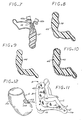
- the contour conforming support A shown in Figure 11 is preferably removably mounted on a mobile dolly B illustrated in both Figures 1 and 11.
- the support A is illustrated in Figure 11 with a patient C resting thereon, the portion of the support in contact with a selected part of the patient C conforming to the body contour of that part.
- the dolly B is defined by two spaced, parallel generally L-shaped side pieces 10 interconnected by spaced parallel cross-pieces 12.
- the side pieces 10 include forwardly disposed portions 10a that may rest on the floor 14.
- Two wheels 16 are rotatably supported from the lower rear portions of the side pieces 10 as shown in Figure 1.
- a closed flexible bag 18 is provided that may be formed from a suitable commercially available plastic of which a number are available, such as polyethylene or the like.
- the bag 18 has an opening 20 therein, preferably located in the lower rearward portion thereof as viewed in Figure 2. Particles of a flowable soft material 22, such as soft styrofoam beads or pellets are introduced into the bag 18 through the opening, and a patch 24 is then applied to the bag to cover the opening.
- the bag 18 has a first tube 26 extending outwardly from the lower rearward portion of the bag and communicating with the interior 19 of the bag. Tube 26 has its other end connected to a coupling 28 to which a second tube 30 is removably connected. The second tube 30 is connected to a power driven vacuum pump 32.
- the first step in forming the contour conforming support A for a patient is to place the particle containing bag 18 on the dolly B as shown in Figure 3.
- the patient C is then seated on the bag 18 and is moved laterally and vertically thereon to cause the particles 22 to flow relative to one another so that the surface portion 18a of the bag comes into conformity with the contour 34 of the portion of the patient's body in contact with the bag.
- the weight of the patient C sitting on the bag 18 forces the lower portion of the particle filled bag downwardly and rearwardly to contact the cross piece 12 and laterally against the side pieces 10.
- the particle filled bag 18 deformed to conform to the body contour 34 of the patient C in pressure contact with the bag, but also to provide a portion 18b that removably fits within the space 36 between the side pieces 10.
- the vacuum pump 32 is now actuated to create a slight vacuum within the interior 19, the patient C being moved laterally and vertically within a limited range to ensure maximum flow of the particles 22 relative to one another and to ensure that the surface 18a of the bag conforms to the contour 34 of patient C.
- the magnitude of the vacuum is then increased, and in co-operation with the weight of the patient C causes th the soft styrofoam particles to merge with one another, such as occurs in the particles that define a styrofoam cup.
- the patient C is now caused to rise from the bag 18, and the bag is removed from the dolly B while the vacuum is maintained in the interior 19 thereof.
- the deformed bag 18 is then wrapped and enveloped in bandages soaked in a plaster of paris solution or other material which will cause it to become rigid. After said plaster of paris or other material has set, the vacuum is discontinued.
- the rigid shell 38 resulting from this operation constitutes a form that closely conforms to the contour 34 of the patient C as shown in Figures 4, 5 and 6. Bumps and ridges in the patient contour conforming shell 38 may be smoothed out by a thin layer of plaster of paris applied thereto to mask the bumps and ridges.
- an opening 41 is cut through the rigid shell 38 and bag 18 to communicate with the interior 19 and the styrofoam particles 22 are removed from the interior 19 through opening 41.
- the bag 18 is also removed from the interior 19 of shell 38, and the inner surface of the shell is subsequently coated with a release agent.
- a polymerizable monomer 40 such as polyurethane being poured into the interior of the shell through the opening 41, together with a catalyst 42, from containers 40a and 42a.
- the monomer 40 and catalyst 42 react in the interior 19 to form a foamed resin core 44 of a desired degree of hardness.
- the hardness of the foamed core 44 is controlled by the amount of catalyst 42 used.
- the shell 38 is then cut into sections and separated from the core 44 of foamed resin.
- a resilient film 46 of rubber or the like is applied to the core 44 as shown in Figure 6, which film has a substantial coefficient of friccion ro prevent the patient C inadvertently sliding therefrom.
- the contour conforming support is complete and may be removably mounted in the dolly B as shown in Figure 11.
- the contouring of the particle holding bag 18 it may be desired to provide a downwardly disposed extension 18d that defines a confined space 45 as shown in Figure 4 into which excess particles 22 may be forced due to the weight of the patient C.
- the excess particles 22 in confined space 45 are separated from the balance of the pellets in bag 18 by severing the extension 18d from the latter prior to wrapping the contoured bag with plaster of paris impregnated bandages that upon solidification define shell 38.
- the alternative way of continuing the method from the intermediate step previously identified is as follows.
- the contour conforming particle containing bag 18 as shown in Figure 4 is enveloped in material which will become rigid, such as any one of the commercially available polymerizable resins, polyurethane or the like, while maintaining a vacuum in the interior 19 of the bag.
- the polymerizable resin when set defines a resilient contour conforming shell 38 that has the same configuration as the shell defined by plaster of paris. After the polymerizable resin has set the portion 18b is severed from bag 18.
- the way of continuing the method from the intermediate step may be accomplished faster than the first way and can be carried out by inexperienced personnel.
- a film of the resilient material 45 is applied thereto to complete the formation of the cushion.
- An alternate method of forming a contour conforming support S for the patient C is to utilize a pliable bag 100 as shown in Figure 12 formed from a relatively thick sheet material I02 such as the polymerized resin used in forming skin diving suits. Due to the thickness and pliability of such sheet material 102, it has a minimum tendency to wrinkle on the exterior surface thereof when the bag 100 is deformed.
- the bag 100 is at least partially filled with styrofoam beads 104 that are intimately mixed with a polymerizable resin 106, and the bag is then placed on the dolly in the same manner as described in connection with bag 18.
- the patient C is now seated on the dolly supported bag 100, and moved laterally and vertically relative to the bag to cause the latter to conform to the portion of the patient's body in pressure contact therewith.
- the polymerizable resin 106 After the polymerizable resin 106 has polymerized it will bond the beads 104 into the shape it has been deformed, as well as bonding the interior of sheet 102 thereto.
- the bag 100 may be provided with a vent (not shown) to permit escape of gases that may be generated as the resin polymerizes.
- the bag 100 as may be seen in Figure 12 is elongate in shape and of such size as to be contacted by the back, buttocks and rear portion of the legs of the patient C in the same manner as shown in Figure ll.
- the support S is not limited to this use.
- the support S if desired may be used to conform only to a portion of the body of the patient C, such as an arm or leg, and in this case the support S need not be held in the dolly B.
- the support S is adapted to form all or a portion of a cast for an arm or leg of the patient C.
- the support S may be formed as two abutting halves that completely envelop an arm or leg of a patient C, and held in this abutting position by encircling bands (not shown) or other conventional holding means.
- contour conforming supports A and S have been previously described in detail as well as the use of the supports in the mobile unit B or apart therefrom if desired.
- the lower and rearward portions of the support A are adapted to be removably disposed between side pieces 10 to rest on cross pieces 12 of the dolly B. Due to the support A having been partially formed in contact with cross pieces 12, the completed support A has a number of spaced elongate recesses 18c therein that removably engage the cross pieces to prevent the support A inadvertently being displaced from the dolly B.
- the contour conforming support A has been illustrated as being in contact with substantial portions of the back, buttocks and the legs of the patient C, but may be used equally well in affording full contour support to any desired portion of the human body.
Landscapes
- Health & Medical Sciences (AREA)
- Engineering & Computer Science (AREA)
- Public Health (AREA)
- Veterinary Medicine (AREA)
- Nursing (AREA)
- Life Sciences & Earth Sciences (AREA)
- Animal Behavior & Ethology (AREA)
- General Health & Medical Sciences (AREA)
- Manufacturing & Machinery (AREA)
- Mechanical Engineering (AREA)
- Orthopedic Medicine & Surgery (AREA)
- Biomedical Technology (AREA)
- Heart & Thoracic Surgery (AREA)
- Vascular Medicine (AREA)
- Materials For Medical Uses (AREA)
- Invalid Beds And Related Equipment (AREA)
Priority Applications (2)
| Application Number | Priority Date | Filing Date | Title |
|---|---|---|---|
| US06/134,981 US4347213A (en) | 1980-03-28 | 1980-03-28 | Method of forming contoured cushion |
| EP82304494A EP0101529A1 (fr) | 1980-03-28 | 1982-08-25 | Procédé pour la réalisation d'un support s'adaptant à un corps humain |
Applications Claiming Priority (2)
| Application Number | Priority Date | Filing Date | Title |
|---|---|---|---|
| US06/134,981 US4347213A (en) | 1980-03-28 | 1980-03-28 | Method of forming contoured cushion |
| EP82304494A EP0101529A1 (fr) | 1980-03-28 | 1982-08-25 | Procédé pour la réalisation d'un support s'adaptant à un corps humain |
Publications (1)
| Publication Number | Publication Date |
|---|---|
| EP0101529A1 true EP0101529A1 (fr) | 1984-02-29 |
Family
ID=41647013
Family Applications (1)
| Application Number | Title | Priority Date | Filing Date |
|---|---|---|---|
| EP82304494A Ceased EP0101529A1 (fr) | 1980-03-28 | 1982-08-25 | Procédé pour la réalisation d'un support s'adaptant à un corps humain |
Country Status (2)
| Country | Link |
|---|---|
| US (1) | US4347213A (fr) |
| EP (1) | EP0101529A1 (fr) |
Cited By (6)
| Publication number | Priority date | Publication date | Assignee | Title |
|---|---|---|---|---|
| EP0507709A1 (fr) * | 1991-04-05 | 1992-10-07 | Centre Technique Cuir Chaussure Maroquinerie | Procédé, dispositif de détermination du chaussant d'un article chaussant et appareil de détermination du chaussant de l'avant-pied dudit article |
| WO1996002402A1 (fr) * | 1994-07-15 | 1996-02-01 | Parrish Milton E | Systeme de support conformable multicouche |
| FR2737433A1 (fr) * | 1995-08-02 | 1997-02-07 | Maillet Orthopedie Sarl | Procede de fabrication par moulage d'un siege notamment d'un siege orthopedique et siege obtenu |
| RU2144302C1 (ru) * | 1999-06-03 | 2000-01-20 | Канторов Дмитрий Аскольдович | Эргономическое ложе |
| RU2244503C2 (ru) * | 2003-01-04 | 2005-01-20 | Педдер Валерий Викторович | Лечебный массажно-гимнастический стол |
| CN113288612A (zh) * | 2021-04-28 | 2021-08-24 | 陈晨翔 | 一种癌症用护理床 |
Families Citing this family (75)
| Publication number | Priority date | Publication date | Assignee | Title |
|---|---|---|---|---|
| US4615856B1 (en) * | 1983-08-19 | 1993-12-29 | Pin Dot Products | Method for forming an individually contoured corrective seat for a wheelchair |
| US4622185A (en) * | 1985-04-15 | 1986-11-11 | Smithers Medical Products, Inc. | Method and apparatus for molding and accurately repositioning selected portions of the human anatomy |
| US5195945A (en) * | 1985-10-04 | 1993-03-23 | Minnesota Mining And Manufacturing Company | Orthotic pads and methods |
| US5042464A (en) * | 1985-10-04 | 1991-08-27 | Minnesota Mining And Manufacturing Company | Off-the shelf custom knee brace |
| US5203764A (en) * | 1985-10-04 | 1993-04-20 | Minnesota Mining And Manufacturing Company | Foam pads useful in wound management |
| US4946726A (en) * | 1985-10-04 | 1990-08-07 | Minnesota Mining And Manufacturing Company | Orthopedic splinting articles and methods |
| US5002047A (en) * | 1986-09-03 | 1991-03-26 | Minnesota Mining And Manufacturing Company | Orthotic pads and methods |
| US4888225A (en) * | 1985-10-04 | 1989-12-19 | Minnesota Mining And Manufacturing Company | Resin-impregnated foam materials and methods |
| US4836215A (en) * | 1985-10-11 | 1989-06-06 | Lee Arnold St J | Method for preparing a ballistocardiogram |
| US4926866A (en) * | 1985-10-11 | 1990-05-22 | Lee Arnold St J | System for gathering physiological data |
| US4889130A (en) * | 1985-10-11 | 1989-12-26 | Lee Arnold St J | Method for monitoring a subject's heart and lung sounds |
| US4889123A (en) * | 1985-10-11 | 1989-12-26 | Lee Arnold St J | Method for determining heart rate |
| US4893633A (en) * | 1985-10-11 | 1990-01-16 | Lee Arnold St J | Method of temperature measurement |
| US4848350A (en) * | 1985-10-11 | 1989-07-18 | Lee Arnold St J | Method for recording an electrocardiogram |
| US4895155A (en) * | 1985-10-11 | 1990-01-23 | Lee Arnold St J | Method for estimating blood oxygen saturation |
| US4817610A (en) * | 1985-10-11 | 1989-04-04 | Lee Arnold St J | Method of determining center of gravity and body weight |
| US4838275A (en) * | 1985-11-29 | 1989-06-13 | Lee Arnold St J | Home medical surveillance system |
| US4828325A (en) * | 1986-05-16 | 1989-05-09 | University Of Tennessee Research Corporation | Method of making a custom fitted composite foamed cushion, a preform kit and the resultant product of the process |
| DE3739752A1 (de) * | 1987-11-24 | 1989-06-08 | Porsche Ag | Sitz fuer ein fahrzeug, flugzeug oder dergleichen |
| US4903690A (en) * | 1988-09-14 | 1990-02-27 | Campbell Clayton J | Spinal orthotic device and method of using same |
| US5142757A (en) * | 1989-06-26 | 1992-09-01 | Christian Thary | Method of making an upholstered cushion article |
| US5643513A (en) * | 1994-03-15 | 1997-07-01 | Searle; David H. | Method of using a form fit system for shell-type seats as used in high-performance vehicles |
| US5454993A (en) * | 1994-05-31 | 1995-10-03 | Kostich; Jeffrey V. | Method for immobilizing the inferior portion of the human anatomy |
| US5618131A (en) * | 1995-06-07 | 1997-04-08 | Weber; Edward A. | Modified artificial surface and method and apparatus of making the same |
| US5782244A (en) * | 1996-02-08 | 1998-07-21 | Kostich; Jeffrey Vincent | Method and apparatus for immobilizing the head, shoulder and torso of the human anatomy |
| US5707572A (en) * | 1996-02-08 | 1998-01-13 | Kostich; Jeffrey Vincent | Method for immobilizing the central nervous system of the human anatomy |
| CA2270974A1 (fr) * | 1996-11-08 | 1998-05-14 | William W. Chow | Siege suspendu a usage therapeutique |
| US5781943A (en) * | 1997-03-13 | 1998-07-21 | Moenning; Stephen P. | Medical table and method for moving a patient from a first position to a second position |
| US5855207A (en) * | 1997-05-29 | 1999-01-05 | Moenning; Stephen P. | Medical table assembly having a restrainment apparatus mounted thereto and an associated method of immobilizing object |
| US6713001B1 (en) * | 1997-12-29 | 2004-03-30 | Lear Corporation | Surface imaging method for a vehicle seat |
| AU9587098A (en) | 1998-02-20 | 1999-09-06 | Sand Therapeutic, Inc. | Therapeutic support for the reduction of decubitus ulcers |
| DE19860611C1 (de) * | 1998-12-29 | 2000-03-23 | Fraunhofer Ges Forschung | Verfahren zur Herstellung von Formkörpern aus Polymer-Schaumpartikeln |
| US6226820B1 (en) * | 1999-07-12 | 2001-05-08 | Polymer Concepts, Inc. | Gel pad with integral shape retainer |
| US20030121103A1 (en) * | 2000-02-04 | 2003-07-03 | Wempe Patrick L. | Method for forming a molded cushion |
| CA2334125A1 (fr) | 2000-02-04 | 2001-08-04 | Patrick Wempe | Coussin faconne sur mesure et methode de fabrication |
| US6666509B2 (en) * | 2000-03-17 | 2003-12-23 | Honda Access Corp. | Body support tool and seat cover holding body support tool |
| WO2003039212A1 (fr) | 2001-10-30 | 2003-05-08 | Loma Linda University Medical Center | Procede et dispositif de radiotherapie |
| WO2003049578A1 (fr) * | 2001-12-11 | 2003-06-19 | Honda Access Corporation | Dispositif de support pour le corps |
| US6733710B2 (en) * | 2002-07-16 | 2004-05-11 | Bald Spot Racing, Llc | Vehicle passenger restraint and method of producing same |
| JP3099294U (ja) * | 2003-07-17 | 2004-04-02 | ニッセー工業株式会社 | クッション |
| US20050023872A1 (en) * | 2003-07-28 | 2005-02-03 | Hetzel Thomas R. | Modular seat cushion with interlocking human support and base portions and method of creating and using a seat cushion |
| US7140057B2 (en) * | 2003-07-28 | 2006-11-28 | Aspen Seating, Llc | Reinforced and adjustable contoured seat cushion and method of reinforcing and adjusting the contoured seat cushion |
| US7216388B2 (en) | 2003-07-28 | 2007-05-15 | Aspen Seating, Llc | Contoured seat cushion and method for offloading pressure from skeletal bone prominences and encouraging proper postural alignment |
| US6990744B2 (en) * | 2003-07-28 | 2006-01-31 | Aspen Seating, Llc | Apparatus and method for evaluating clearance from a contoured seat cushion |
| US7220376B2 (en) | 2003-07-28 | 2007-05-22 | Aspen Seating, Llc | Individually-contoured seat cushion and shape capturing and fabricating method for seat cushion |
| US7373678B2 (en) * | 2003-07-28 | 2008-05-20 | Aspen Seating, Llc | Seat cushion with adjustable contour and method of adjusting the contour of a seat cushion |
| US7173265B2 (en) | 2003-08-12 | 2007-02-06 | Loma Linda University Medical Center | Modular patient support system |
| US7073508B2 (en) * | 2004-06-25 | 2006-07-11 | Loma Linda University Medical Center | Method and device for registration and immobilization |
| US7334844B2 (en) * | 2005-01-06 | 2008-02-26 | The Boeing Company | Composite shell spacecraft seat |
| DE102005011514A1 (de) * | 2005-03-10 | 2006-09-21 | Bernhard Bornitz | Orthopädisches Sitzschalensystem |
| US7380886B1 (en) | 2005-03-24 | 2008-06-03 | David John Copello | Pivot column for a chair armrest or similar mechanism |
| EP2095374A4 (fr) | 2006-11-21 | 2012-05-30 | Univ Loma Linda Med | Dispositif et procédé d'immobilisation des patientes pour radiothérapie mammaire |
| US7943213B2 (en) * | 2007-07-05 | 2011-05-17 | Jane L. Weber, legal representative | Artificial surface |
| US9314187B2 (en) * | 2007-11-12 | 2016-04-19 | Trek Bicycle Corporation | Bicycle seat sizer and positioning device |
| WO2009088947A2 (fr) | 2008-01-02 | 2009-07-16 | Arcscan, Inc. | Composants pour un appareil de balayage en arc ultrasonore |
| US10531859B2 (en) | 2008-01-02 | 2020-01-14 | Arcscan, Inc. | Components for a precision ultrasonic scanning apparatus for body parts |
| US8496588B2 (en) * | 2008-04-03 | 2013-07-30 | Arcscan, Inc. | Procedures for an ultrasonic arc scanning apparatus |
| WO2009146434A1 (fr) * | 2008-05-29 | 2009-12-03 | Arcscan, Inc. | Tête de balayage composée pour un appareil d’échographie |
| US9149254B2 (en) | 2008-12-15 | 2015-10-06 | Arcscan, Inc. | Alignment and imaging of an eye with an ultrasonic scanner |
| US8510883B2 (en) * | 2009-10-30 | 2013-08-20 | Arcscan, Inc. | Method of positioning a patient for medical procedures |
| US10925790B2 (en) | 2011-06-09 | 2021-02-23 | Mölnlycke Health Care Ab | System and method for patient turning and repositioning |
| US9504621B2 (en) | 2011-06-09 | 2016-11-29 | Molnlycke Health Care Usa, Llc | System and method for patient turning and repositioning with simultaneous off-loading of the bony prominences |
| US9597059B2 (en) | 2012-05-17 | 2017-03-21 | Arcscan, Inc. | Correcting for unintended motion for ultrasonic eye scans |
| US9320427B2 (en) | 2012-07-09 | 2016-04-26 | Arcscan, Inc. | Combination optical and ultrasonic imaging of an eye |
| US8777879B2 (en) * | 2012-08-28 | 2014-07-15 | Zoll Medical Corporation | Method and apparatus for immobilizing subjects undergoing mechanical CPR |
| US10736605B2 (en) | 2014-02-24 | 2020-08-11 | Arcscan, Inc. | Disposable eyepiece system for an ultrasonic eye scanning apparatus |
| US10363185B2 (en) * | 2014-09-04 | 2019-07-30 | Mölnlycke Health Care Ab | System and method for off-loading of the body in the prone position and for patient turning and repositioning |
| US9812100B1 (en) * | 2015-03-09 | 2017-11-07 | David Mobley, LLC | Individually customized musical instrument supports, customized elements, and methods for forming the same |
| WO2017066460A1 (fr) | 2015-10-13 | 2017-04-20 | Arcscan, Inc | Appareil de balayage à ultrasons |
| US11426611B2 (en) | 2015-10-13 | 2022-08-30 | Arcscan, Inc. | Ultrasound therapeutic and scanning apparatus |
| US10813461B2 (en) | 2016-05-06 | 2020-10-27 | Equipements Sportifs Keku Inc. | Method for fabricating anatomical cushion and device to capture pressure controlled shape |
| WO2018057878A1 (fr) * | 2016-09-23 | 2018-03-29 | Center For Disability Services | Fauteuil roulant |
| US20180168288A1 (en) * | 2016-12-16 | 2018-06-21 | Glenn M. Gilbertson | Foot impression device, system, and related methods |
| US11109687B1 (en) * | 2020-02-13 | 2021-09-07 | The Boeing Company | Configurable ergonomic pad |
| CN120731044A (zh) * | 2023-03-03 | 2025-09-30 | 利奥癌症治疗公司 | 患者支撑板 |
Citations (8)
| Publication number | Priority date | Publication date | Assignee | Title |
|---|---|---|---|---|
| FR1456231A (fr) * | 1964-11-27 | 1966-10-21 | Shell Int Research | Procédé de production d'objets creux |
| FR2162020A1 (fr) * | 1971-12-01 | 1973-07-13 | Hagglund Lars | |
| FR2187269A1 (fr) * | 1972-06-08 | 1974-01-18 | Contourpedic Corp | |
| DE2250681A1 (de) * | 1972-10-16 | 1974-04-18 | Hermann Buhlinger | Verfahren zur herstellung fuer an koerperteile von lebewesen anschmiegsame flexible flaechengebilde wie liegen, rueckenlehnen von stuehlen u. dgl. sowie nach diesem verfahren hergestellte liegen, stuehle und flexible verbands- bzw. halteteile fuer medizinische zwecke |
| FR2271805A1 (en) * | 1974-05-21 | 1975-12-19 | Ieram Sarl | Vacuum-type immobilisation mattress - is shaped to allow accommodation of body in any position |
| DE2832026A1 (de) * | 1978-07-21 | 1980-01-31 | Eurocom Ets | Sitzschale fuer koerperbehinderte |
| GB1591024A (en) * | 1977-09-20 | 1981-06-10 | Burnett J S | Support device |
| GB2069917A (en) * | 1980-02-07 | 1981-09-03 | Burnett J S | Support device |
Family Cites Families (1)
| Publication number | Priority date | Publication date | Assignee | Title |
|---|---|---|---|---|
| US3905376A (en) * | 1971-07-23 | 1975-09-16 | Amos N Johnson | Pedicure prosthesis for the metatarsal arch of the foot |
-
1980
- 1980-03-28 US US06/134,981 patent/US4347213A/en not_active Expired - Lifetime
-
1982
- 1982-08-25 EP EP82304494A patent/EP0101529A1/fr not_active Ceased
Patent Citations (8)
| Publication number | Priority date | Publication date | Assignee | Title |
|---|---|---|---|---|
| FR1456231A (fr) * | 1964-11-27 | 1966-10-21 | Shell Int Research | Procédé de production d'objets creux |
| FR2162020A1 (fr) * | 1971-12-01 | 1973-07-13 | Hagglund Lars | |
| FR2187269A1 (fr) * | 1972-06-08 | 1974-01-18 | Contourpedic Corp | |
| DE2250681A1 (de) * | 1972-10-16 | 1974-04-18 | Hermann Buhlinger | Verfahren zur herstellung fuer an koerperteile von lebewesen anschmiegsame flexible flaechengebilde wie liegen, rueckenlehnen von stuehlen u. dgl. sowie nach diesem verfahren hergestellte liegen, stuehle und flexible verbands- bzw. halteteile fuer medizinische zwecke |
| FR2271805A1 (en) * | 1974-05-21 | 1975-12-19 | Ieram Sarl | Vacuum-type immobilisation mattress - is shaped to allow accommodation of body in any position |
| GB1591024A (en) * | 1977-09-20 | 1981-06-10 | Burnett J S | Support device |
| DE2832026A1 (de) * | 1978-07-21 | 1980-01-31 | Eurocom Ets | Sitzschale fuer koerperbehinderte |
| GB2069917A (en) * | 1980-02-07 | 1981-09-03 | Burnett J S | Support device |
Cited By (8)
| Publication number | Priority date | Publication date | Assignee | Title |
|---|---|---|---|---|
| EP0507709A1 (fr) * | 1991-04-05 | 1992-10-07 | Centre Technique Cuir Chaussure Maroquinerie | Procédé, dispositif de détermination du chaussant d'un article chaussant et appareil de détermination du chaussant de l'avant-pied dudit article |
| FR2674731A1 (fr) * | 1991-04-05 | 1992-10-09 | Centre Tech Cuir Chaussure | Procede et dispositif de mesure du volume interne d'un article chaussant. |
| WO1996002402A1 (fr) * | 1994-07-15 | 1996-02-01 | Parrish Milton E | Systeme de support conformable multicouche |
| US5556169A (en) * | 1994-07-15 | 1996-09-17 | Parrish; Milton E. | Multi-layer conformable support system |
| FR2737433A1 (fr) * | 1995-08-02 | 1997-02-07 | Maillet Orthopedie Sarl | Procede de fabrication par moulage d'un siege notamment d'un siege orthopedique et siege obtenu |
| RU2144302C1 (ru) * | 1999-06-03 | 2000-01-20 | Канторов Дмитрий Аскольдович | Эргономическое ложе |
| RU2244503C2 (ru) * | 2003-01-04 | 2005-01-20 | Педдер Валерий Викторович | Лечебный массажно-гимнастический стол |
| CN113288612A (zh) * | 2021-04-28 | 2021-08-24 | 陈晨翔 | 一种癌症用护理床 |
Also Published As
| Publication number | Publication date |
|---|---|
| US4347213A (en) | 1982-08-31 |
Similar Documents
| Publication | Publication Date | Title |
|---|---|---|
| EP0101529A1 (fr) | Procédé pour la réalisation d'un support s'adaptant à un corps humain | |
| US4385024A (en) | Method for making a molded article from a curable material and a curing agent, the curing agent being in a container initially flexible and infrangible which is made frangible | |
| US4272898A (en) | Resin-coated fiber mass containing catalyst-filled hollow fibers | |
| US3830896A (en) | Apparatus and process for forming contoured impressions of the human body | |
| US3048169A (en) | Method of forming casts made with plastic foam material | |
| US4716662A (en) | Insole and method for producing same | |
| US4842330A (en) | Protective seat cushion | |
| US5376127A (en) | Prosthesis cover and method of producing | |
| US4888225A (en) | Resin-impregnated foam materials and methods | |
| US5888231A (en) | Custom-molded liner for artificial limb socket | |
| US5405405A (en) | Prosthetic socket containing inflatable means | |
| US4060075A (en) | Splint and body-support device | |
| EP0486241A1 (fr) | Orthèse du genou adaptable prête à l'emploi | |
| US5932046A (en) | Cushion manufacturing method | |
| US20020193878A1 (en) | Two-layer external breast prosthesis with self-shaping feature and process for the manufacture thereof | |
| US5042100A (en) | Method for producing an insole | |
| US4275923A (en) | Vehicle cushion | |
| US5095570A (en) | Method for producing an insole | |
| JP2000514337A (ja) | 発泡材―空気セル型ハイブリッド式クッション及びその製造方法 | |
| WO1995005106A1 (fr) | Systeme d'assise auto-reglable | |
| US5527359A (en) | Method of making positive and negative models for artificial breasts | |
| GB2195256A (en) | Limb prosthesis production and materials therefor | |
| US5993487A (en) | Integrated keel-pylon prosthesis | |
| US20050025953A1 (en) | Individually-contoured seat cushion and shape capturing and fabricating method for seat cushion | |
| US5836025A (en) | Gel containing positioning cushion for infirm patients |
Legal Events
| Date | Code | Title | Description |
|---|---|---|---|
| PUAI | Public reference made under article 153(3) epc to a published international application that has entered the european phase |
Free format text: ORIGINAL CODE: 0009012 |
|
| AK | Designated contracting states |
Designated state(s): AT BE CH DE FR GB IT LI LU NL SE |
|
| 17P | Request for examination filed |
Effective date: 19840802 |
|
| STAA | Information on the status of an ep patent application or granted ep patent |
Free format text: STATUS: THE APPLICATION HAS BEEN REFUSED |
|
| 18R | Application refused |
Effective date: 19861018 |