EP0101532A1 - Vorrichtung zur Durchflussmessung mit potentialfreiem Endkontaktschalter - Google Patents
Vorrichtung zur Durchflussmessung mit potentialfreiem Endkontaktschalter Download PDFInfo
- Publication number
- EP0101532A1 EP0101532A1 EP83104534A EP83104534A EP0101532A1 EP 0101532 A1 EP0101532 A1 EP 0101532A1 EP 83104534 A EP83104534 A EP 83104534A EP 83104534 A EP83104534 A EP 83104534A EP 0101532 A1 EP0101532 A1 EP 0101532A1
- Authority
- EP
- European Patent Office
- Prior art keywords
- measuring tube
- diameter
- protective gas
- contact
- contact switch
- Prior art date
- Legal status (The legal status is an assumption and is not a legal conclusion. Google has not performed a legal analysis and makes no representation as to the accuracy of the status listed.)
- Granted
Links
- 239000007789 gas Substances 0.000 claims abstract description 41
- 230000001681 protective effect Effects 0.000 claims abstract description 35
- 230000035945 sensitivity Effects 0.000 claims abstract description 7
- 238000005259 measurement Methods 0.000 claims abstract description 5
- 239000007788 liquid Substances 0.000 claims abstract description 4
- 239000000463 material Substances 0.000 claims description 15
- 229910017052 cobalt Inorganic materials 0.000 claims description 9
- 239000010941 cobalt Substances 0.000 claims description 9
- GUTLYIVDDKVIGB-UHFFFAOYSA-N cobalt atom Chemical compound [Co] GUTLYIVDDKVIGB-UHFFFAOYSA-N 0.000 claims description 9
- 239000011521 glass Substances 0.000 claims description 7
- XEEYBQQBJWHFJM-UHFFFAOYSA-N Iron Chemical compound [Fe] XEEYBQQBJWHFJM-UHFFFAOYSA-N 0.000 claims description 4
- PXHVJJICTQNCMI-UHFFFAOYSA-N Nickel Chemical compound [Ni] PXHVJJICTQNCMI-UHFFFAOYSA-N 0.000 claims description 4
- 229910045601 alloy Inorganic materials 0.000 claims description 4
- 239000000956 alloy Substances 0.000 claims description 4
- VYZAMTAEIAYCRO-UHFFFAOYSA-N Chromium Chemical compound [Cr] VYZAMTAEIAYCRO-UHFFFAOYSA-N 0.000 claims description 2
- 229910052772 Samarium Inorganic materials 0.000 claims description 2
- 229910052782 aluminium Inorganic materials 0.000 claims description 2
- XAGFODPZIPBFFR-UHFFFAOYSA-N aluminium Chemical compound [Al] XAGFODPZIPBFFR-UHFFFAOYSA-N 0.000 claims description 2
- 229910052804 chromium Inorganic materials 0.000 claims description 2
- 239000011651 chromium Substances 0.000 claims description 2
- 229910052742 iron Inorganic materials 0.000 claims description 2
- 229910052759 nickel Inorganic materials 0.000 claims description 2
- KZUNJOHGWZRPMI-UHFFFAOYSA-N samarium atom Chemical compound [Sm] KZUNJOHGWZRPMI-UHFFFAOYSA-N 0.000 claims description 2
- 229910052751 metal Inorganic materials 0.000 claims 1
- 239000002184 metal Substances 0.000 claims 1
- 150000002739 metals Chemical class 0.000 claims 1
- 229920003023 plastic Polymers 0.000 description 6
- 235000014676 Phragmites communis Nutrition 0.000 description 5
- 239000004033 plastic Substances 0.000 description 5
- 230000000694 effects Effects 0.000 description 4
- 150000001875 compounds Chemical class 0.000 description 3
- 230000007274 generation of a signal involved in cell-cell signaling Effects 0.000 description 3
- 239000002033 PVDF binder Substances 0.000 description 2
- 238000000034 method Methods 0.000 description 2
- 239000006223 plastic coating Substances 0.000 description 2
- BASFCYQUMIYNBI-UHFFFAOYSA-N platinum Chemical compound [Pt] BASFCYQUMIYNBI-UHFFFAOYSA-N 0.000 description 2
- -1 polytetrafluoroethylene Polymers 0.000 description 2
- 229920002981 polyvinylidene fluoride Polymers 0.000 description 2
- 239000011253 protective coating Substances 0.000 description 2
- 229920005989 resin Polymers 0.000 description 2
- 239000011347 resin Substances 0.000 description 2
- 239000010948 rhodium Substances 0.000 description 2
- 230000006641 stabilisation Effects 0.000 description 2
- 238000011105 stabilization Methods 0.000 description 2
- 210000002105 tongue Anatomy 0.000 description 2
- RYGMFSIKBFXOCR-UHFFFAOYSA-N Copper Chemical compound [Cu] RYGMFSIKBFXOCR-UHFFFAOYSA-N 0.000 description 1
- 239000004952 Polyamide Substances 0.000 description 1
- 239000004698 Polyethylene Substances 0.000 description 1
- 238000010521 absorption reaction Methods 0.000 description 1
- 239000000853 adhesive Substances 0.000 description 1
- 230000001070 adhesive effect Effects 0.000 description 1
- 238000005266 casting Methods 0.000 description 1
- 239000011248 coating agent Substances 0.000 description 1
- 238000000576 coating method Methods 0.000 description 1
- 229910052802 copper Inorganic materials 0.000 description 1
- 239000010949 copper Substances 0.000 description 1
- 230000006698 induction Effects 0.000 description 1
- 238000009434 installation Methods 0.000 description 1
- 230000005415 magnetization Effects 0.000 description 1
- 238000004519 manufacturing process Methods 0.000 description 1
- 229910001092 metal group alloy Inorganic materials 0.000 description 1
- 230000003287 optical effect Effects 0.000 description 1
- 229910052697 platinum Inorganic materials 0.000 description 1
- 230000010287 polarization Effects 0.000 description 1
- 229920002647 polyamide Polymers 0.000 description 1
- 229920000573 polyethylene Polymers 0.000 description 1
- 229920001296 polysiloxane Polymers 0.000 description 1
- 229920001343 polytetrafluoroethylene Polymers 0.000 description 1
- 239000004810 polytetrafluoroethylene Substances 0.000 description 1
- 229920000915 polyvinyl chloride Polymers 0.000 description 1
- 239000004800 polyvinyl chloride Substances 0.000 description 1
- 238000004382 potting Methods 0.000 description 1
- 229910052761 rare earth metal Inorganic materials 0.000 description 1
- 150000002910 rare earth metals Chemical class 0.000 description 1
- 229910052703 rhodium Inorganic materials 0.000 description 1
- MHOVAHRLVXNVSD-UHFFFAOYSA-N rhodium atom Chemical compound [Rh] MHOVAHRLVXNVSD-UHFFFAOYSA-N 0.000 description 1
- 238000007789 sealing Methods 0.000 description 1
- 238000005507 spraying Methods 0.000 description 1
- 238000003860 storage Methods 0.000 description 1
- 229920003002 synthetic resin Polymers 0.000 description 1
- 239000000057 synthetic resin Substances 0.000 description 1
- XLYOFNOQVPJJNP-UHFFFAOYSA-N water Substances O XLYOFNOQVPJJNP-UHFFFAOYSA-N 0.000 description 1
Images


Classifications
-
- G—PHYSICS
- G01—MEASURING; TESTING
- G01F—MEASURING VOLUME, VOLUME FLOW, MASS FLOW OR LIQUID LEVEL; METERING BY VOLUME
- G01F1/00—Measuring the volume flow or mass flow of fluid or fluent solid material wherein the fluid passes through a meter in a continuous flow
- G01F1/05—Measuring the volume flow or mass flow of fluid or fluent solid material wherein the fluid passes through a meter in a continuous flow by using mechanical effects
- G01F1/20—Measuring the volume flow or mass flow of fluid or fluent solid material wherein the fluid passes through a meter in a continuous flow by using mechanical effects by detection of dynamic effects of the flow
- G01F1/22—Measuring the volume flow or mass flow of fluid or fluent solid material wherein the fluid passes through a meter in a continuous flow by using mechanical effects by detection of dynamic effects of the flow by variable-area meters, e.g. rotameters
- G01F1/24—Measuring the volume flow or mass flow of fluid or fluent solid material wherein the fluid passes through a meter in a continuous flow by using mechanical effects by detection of dynamic effects of the flow by variable-area meters, e.g. rotameters with magnetic or electric coupling to the indicating device
Definitions
- the invention relates to a device for flow rate measurement according to the variable area principle, with which very small amounts of gases or liquids can be measured and which has a switch with a potential-free end contact.
- Flowmeters according to the float principle in which a measuring body with an axially magnetized magnet is arranged in a tube with a measuring section and which contain a longitudinally displaceable protective gas contact switch outside the measuring tube, are known.
- the devices have so far not been able to be produced for small flow rates because the miniaturization of floats containing switches and magnets was not possible because of the lack of suitable materials and miniaturized embodiments.
- Due to the technical development, subminiature contact switches (so-called Rith contacts) with low sensitivity were initially available, but the downsizing of the measuring device with the float encountered considerable difficulties because correspondingly small magnets with sufficient field strength were not available.
- the object of the invention is to provide a structural design of a flow meter for flow measurement of very small quantities, which has a switch with a potential-free end contact.
- a device for flow measurement of gases or liquids with a measuring body arranged in a narrow measuring tube, which contains an axially magnetized magnet and a protective gas contact switch arranged to the side of the measuring tube, which is characterized in that the measuring tube has an inner diameter of 3.0 - 10 mm, the float has a diameter-length ratio of 1: 1 to 1: 3 and the magnet contained in it has a diameter of 1 to 5 mm and a length of 1 to 8 mm with a diameter-length ratio of 0.2: 1 to 1: 3 and the protective gas contact switch has a subminiature switch with a glass tube diameter of 1 to 3 , 5 mm and a response sensitivity of 5 to 120 AW and in an at least partially encompassing the measuring tube. Holding device is arranged.
- the device consists of a measuring tube with an inner diameter of 3.0 mm to 10 mm, preferably 3.0 to 7 mm, and an outer diameter of 7. mm to 16 mm, the measuring tube being equipped at the ends with a connection for piping.
- the inside diameter of the measuring tube is 6.0 to 6.5 mm.
- the measuring tube length is preferably 150 mm or 100 mm, it can also be shorter or longer, z. B. from 30 mm to 500 mm and more, or 30 to 100 mm or 30 to 150 mm.
- the float arranged in the measuring section within the tube has a diameter-length ratio of 1: 1 to 1: 3, preferably 1: 1.5 to 1: 3, in which an axially magnetized miniature magnet is contained.
- This can be in the float be encapsulated.
- the miniature magnet with a plastic coating made of polytetrafluoroethylene, polyvinylidene fluoride or polyamide in the form of a coating or a shrink tube for the purpose of reducing the weight of the float.
- Limiting devices for the float are provided in the measuring tube at the ends of the measuring section.
- the preferably transparent tube allows an optical reading of the position of the float, which is raised by the medium flowing through in the vertically arranged measuring instrument.
- the magnet has a diameter-length ratio of 0.2: 1 to 1: 3, preferably from 1: 1 to 1: 2 with a length of 1 mm to 8 mm and a diameter of 1 to 8 mm, preferably length and diameter 1 to 5 mm.
- It preferably consists of a deformable permanent magnet material, for example sintered materials based on chromium / cobalt / iron or Aluminum / nickel / cobalt or cobalt / samarium (Co 5 Sm) or cobalt / rare earth or platinum / cobalt containing alloys. They are anisotropic alloys with high remanence from 0.55 to 1.05 Tesla. However, isotropic alloys can also be used to manufacture the magnets.
- the magnets used have a maximum energy product (WxH) max of 60 to 220 kilojoules / m 3 .
- the coercive field strength of the induction is approximately 500 to 800 kA / m, that of the polarization 1500 to 2500 kA / m.
- the measuring tube is made of glass or correspondingly stable, transparent plastics, which is inserted tightly into a mounting frame in order to enable installation in pipelines. If the measuring device according to the invention is to be used only as a flow monitor, the tube in which the float moves can also be made from an opaque antimagnetic material, for example plastics, antimagnetic metal alloys.
- a protective gas contact switch with a correspondingly low response sensitivity is required next to the measuring tube.
- Such subminiature contact switches with response sensitivity of 5 to 120 AW (ampere turns) or 5 - 60 AW or 5 - 32.5 AW or 5 - 20 AW, a response sensitivity of 7.0 to 12 AW is very particularly preferred
- Glass tubes melted on contacts that enable a switching capacity of up to 10 watts at 220 volts, for example a switching capacity of 3 watts at 28 volts switching DC voltage or at 0.11 A switching DC current.
- the glass tubes have a diameter of 1 mm to 3.5 mm and a glass body length of 15 mm to 30 mm.
- the switching time including bounce time is max. 0.5 m / sec., Preferred 0.3 m / sec.
- the contact material is rhodium (Rh), the resonance frequency is 4000 Hz.
- This holding device or contact carrier for the contact switch can be made of a square material that is not electrically conductive. Since the material also has a low water or Plastic should be the preferred material for moisture absorption. Polyvinyl chloride, polyethylene or polyfluorinated materials such as PVDF are particularly suitable.
- the material block for receiving the switch can be a cube or a cuboid with an edge length of approximately 20 to 30 mm, preferably a cuboid with 20 mm edge length of the square cross section and 25 mm in length.
- the square block has a preferably asymmetrically arranged bore, the inside diameter of which is the same or slightly smaller than the outside diameter of the measuring tube.
- the wall material of the asymmetrically drilled hole near the outer edge is cut out to form a narrow, about 1 to 5 mm wide gap at the thinnest point in the longitudinal direction of the hole.
- the holding block can be designed to be longitudinally displaceable with respect to the measuring tube or can be firmly fixed in one position.
- the elongated opening in the wall of the block ensures that the measuring scale underneath is legible, i.e. there is a significant advantage compared to a closed holder, for example a ring.
- the relatively small float is visible at all times.
- the holding block is designed so that it at least partially surrounds the measuring tube. This is achieved by a correspondingly strongly asymmetrical arrangement of the longitudinal bore for the measuring tube. For example, up to half or more of the circumference of the measuring tube can already lie outside the holding block.
- the block Opposite the opening on the visible side, the block has a continuous longitudinal groove in the bore wall with a groove width greater than or equal to (Z) the outer diameter of the protective gas contact.
- the groove depth is such that when the holder is pushed on or fixed, the reed contact is in direct contact with the measuring tube, but no compressive stress in the measuring tube is yet transmitted to the reed contact glass tube.
- Two horizontal, outward bores in the holding block accommodate the angled contact lugs of the reed contact, which in turn are connected to two insulated, suitable copper wires or strands, which enables the electrical connection to be made to a switch housing to be connected.
- the diameter of the horizontal bores is larger than the diameter of the two connecting lines, so that after assembly, pouring or spraying out can be carried out with an insulating synthetic resin or silicone compound.
- the holding device or the holding block can also be formed by enclosing the protective gas contact switch in a cast resin compound while maintaining the required external shape.
- the switching tongues are made as a result of the magnetic field when the closing contact is made closed. Any height of the float position within the measuring tube section can be displayed by moving the clamp holding device. In this way, signal generation is ensured as soon as a certain flow quantity has been reached and opposite signal generation as soon as this quantity is undershot or exceeded.
- Two miniature contacts arranged in the holding block are required for bistable switching behavior, which are connected in a certain way in the circuit for signal generation.
- the contacts in the holder are monostable and switch impulsively.
- Contact 1 (lower contact) resets the digital switching element (delete). Contact 2 sets the switching element.
- the process can also be exchanged, i.e. Set contact 1, reset contact 2 (delete), depending on whether the subsequent relay, actuated by amplifying electronics, should work according to the closed-circuit or open-circuit principle.
- the holding device with two switching contacts arranged one behind the other in the longitudinal direction can be infinitely adjusted to any point in the display area.
- the float raised from its rest position by flow through the measuring tube magnetically actuates contact 1 (lower contact) and thus triggers the resetting of a digital switching element.
- the float With increasing flow rate, the float moves on and closes contact 2 (upper contact), whereby contact 1 previously opened; this triggers the setting of the digital switching element and triggers a relay by the electronically amplified signal.
- a corresponding storage behavior of the digital switching element preserves this signal, even if the float can no longer keep contact 2 closed due to the magnet being too far apart, for example because the flow has increased further. Only after the float sinks due to lower flow rates and actuates contact 1, the digital switching element is reset and the output relay drops out.
- the advantage of the constructive design according to the invention is that its extraordinarily low flow rates can still be measured in a reproducible manner and a potential-free contact switch is present which triggers a signal when the desired amount is desired.
- a bistable switching behavior can also be achieved by an appropriate configuration of the circuit and with two protective gas contacts.
- FIG. 1 shows how the flow measuring device according to the invention is principally installed in a pipe 1 in a vertical position.
- the device consists of a housing 2 with a measuring tube 3 arranged therein, in which in turn the floating body 4 is located.
- a miniature magnet 6 is enclosed in the floating body 4.
- the miniature magnet can also have a shape that is largely approximated to the shape of the measuring body and is then provided with a plastic coating. This design with a direct protective coating enables the weight of the float to be reduced, so that even smaller flow rates can be detected.
- a miniature protective gas contact switch 5 is arranged to be longitudinally displaceable or fixed and its height can be determined. In the figure, the contact switch 5 is again greatly enlarged given to make the structure more recognizable.
- a voltage is applied to the contacts of the protective gas contact switch 5 via a signal device S.
- the signal device which can be, for example, a lamp or a relay or the like.
- the protective gas contact switch can also be connected directly to circuits, for example an analog computer or the like.
- the asymmetrical position of the longitudinal bore 8 in the block-shaped holding device 7 for the measuring tube 3 and the groove 9 emanating therefrom for the protective gas contact switch 5 can be seen from FIG.
- the longitudinal bore 8 need not be arranged asymmetrically, but this arrangement improves the clamping effect of the block 7 for the measuring tube 3 inserted into the longitudinal bore 8.
- the floating body 4 is arranged within the measuring tube.
- the diameter of the longitudinal bore 8 is the same or slightly smaller than the outer diameter of the measuring tube 3; for example 1/10 - 1/13 mm smaller in order to achieve a good clamping effect. With 10 the longitudinal gap on the front of the holding device 7 is designated.
- the block has, for example, an edge length of approximately 20 mm.
- Wall material for the longitudinal gap 10 is separated out on one side of the longitudinal bore 8.
- the longitudinal gap 10 can be 1 to 5 mm wide, but is preferably narrower, but always so wide that the measuring body 4 remains visible when it reaches this area of the measuring tube 3.
- the groove 9 for receiving the protective gas contact switch 5 is arranged on the wall side of the longitudinal bore 8 opposite the longitudinal gap 10. This is cemented into the groove 9, and its connecting wires are led out laterally through holes not shown in the figure.
- FIG. 3 shows the same arrangement in longitudinal section along the line IV-IV of FIG. 2 with the measuring tube 3 passed through the bore 8.
- the longitudinal gap 10 is formed on one side of the bore and the groove 9 opposite for receiving the protective gas contact switch 5. In this figure, the horizontal holes in the assembled state in block 7 for carrying out the connecting wires of the contact switch 5 are shown.
- Figure 4 shows the holding device 7 from the front in section along the line II - II of Fig. 3 with the protective gas contact switch 5 arranged in the groove 9. Above and below the protective gas contact switch 5, the laterally extending bores for carrying out the connections of the contact switch 5 are arranged.
- the block 7 is shown as a cuboid with a square cross section as in Figure 2.
- the cuboid length can be, for example, 25 to 30 mm with a side edge length of 20 mm.
- the protective gas contact switch in this case has an outer diameter of approximately 2 mm, so that the groove 9 must be approximately 2.5 mm wide and deep.
- the cementing into the groove is carried out using suitable adhesives or potting compounds.
- the holding device can also be formed in that the protective gas contact switch 5 is embedded in a casting resin, the outer shape of the resulting body of the holding device at least partially encompassing the measuring tube 3 or lying outside of the field of view on the front side of the measuring tube 3.
- FIGS. 5 and 6 show the design of the holding device 7 with two protective gas contact switches 5 in order to enable a bistable switching behavior of the device.
- Figure 5 is a longitudinal section comparable to Figure 4 from the front
- Figure 6 is a longitudinal section comparable to Figure 3 from the side.
- FIG. 5 shows the groove 9 for receiving the two protective gas contacts 5 and the longitudinal gap 10 running on the end face of the block 7.
- the transverse bores for the passage of the connecting wires to the contact switches 5 are shown, but their passage to the rear can be clearly seen in FIG. 6.
- 8 denotes the longitudinal bore, which has the longitudinal gap 10 on the front side and the groove on the opposite side.
- FIG. 7 shows the arrangement and circuit for monostable switching behavior of the measuring device according to the innovation.
- a medium flows through the measuring tube 3 from bottom to top and the flow lifts the float 4 with the miniature magnet 6 arranged therein.
- the holding device 7 is clamped to the measuring tube 3 in a stroke height corresponding to the desired flow rate.
- the contact protection relay 11 As soon as the float 4 has reached the height of the protective gas contact 5, its contacts are closed by the magnetic force and the contact protection relay 11 is excited. This relay in turn actuates the potential-free switching contact 12 as a relay output.
- a direct or alternating voltage can be applied to the contact protection relay 11.
- FIG. 8 shows the design for bistable switching behavior with two protective gas contact switches 5 within the block-shaped holding device 7, which is pushed over the measuring tube 3.
- the float 4 although raised by the flow, is still below the switching point. It contains an axially magnetized miniature magnet 6, cemented in.
- Both protective gas contacts so-called reed contacts, are connected to an electronic switching element 13.
- the electronic switching element 13 is supplied with a control pulse which resets the switching element or leads to the zero position.
- the measuring body 4 reaches the second protective gas contact 5 and triggers a second signal in the electronic switching element. This switches the potential-free contact 12.
- the electronic switching element is designed so that this state is maintained until the electronic switching element is returned to the zero position by actuation of the first contact.
- the electronic switching element is supplied with a suitable voltage from a DC voltage or AC wave.
- the contacts 12 of the switching element are designed as a potential-free switching contact.
- Figure 9 shows the float 4 in longitudinal section with the inserted magnet 6. This is inserted into a corresponding hole in the float 4 and secured by a plug 14.
- the float 4 has a cylindrical cross section and is tapered conically at the lower end. At the other end, an extended outer edge is provided for stabilization.
- the floating body has a throughput 'diameter of 6 mm and is 10 mm long, wherein the upper edge is 1 mm thick and the conical portion 5 mm long.
- the float 4 can also have a cylindrical cross section, each with an enlarged outer edge at both ends for stabilization. Such shapes are preferred if the magnet is only provided with a protective coating made of plastic.
- the encapsulated magnet in the case shown has a diameter of 3 mm and is 3 mm long.
- the magnetization of the magnets is axial in order to be able to exert a force on the protective gas contacts on the side in the assembled state.
- the measuring tube provided with a scale is not inserted into a special frame, but instead has ends for line connections, with locking inserts for the float only slightly changing within the measuring tube at both ends of the measuring section.
- the block-shaped holding device is pushed onto the measuring tube. It is longitudinally displaceable and encompasses the measuring tube like a spring clip due to the elastic properties of the plastic block.
- the measuring tube and the block are connected to one another in a suitable manner, for example by common arrangement within a housing or frame or by holding clips. This attachment fixes the position of the protective gas contact switch or the two switches on the measuring tube.
- a longitudinally displaceable design for the holding block is also possible with this design.
Landscapes
- Physics & Mathematics (AREA)
- Fluid Mechanics (AREA)
- General Physics & Mathematics (AREA)
- Measuring Volume Flow (AREA)
- Level Indicators Using A Float (AREA)
- Measurement Of Current Or Voltage (AREA)
Abstract
Description
- Gegenstand der Erfindung ist eine Vorrichtung zur Durchflußmengenmessung nach dem Schwebekörperprinzip, mit der sehr geringe Mengen an Gasen oder Flüssigkeiten gemessen werden können und die einen Schalter mit einem potentialfreien Endkontakt aufweist.
- Durchflußmeßgeräte nach dem Schwebekörperprinzip, bei denen in einem Rohr mit einer Meßstrecke ein Meßkörper mit einem axial magnetisierten Magneten angeordnet ist und die außerhalb des Meßrohres einen längs verschiebbaren Schutzgaskontaktschalter enthalten, sind bekannt. Für kleine Durchflußmengen konnten die Vorrichtungen bisher jedoch nicht hergestellt werden, weil die Miniaturisierung von Schalter und Magneten enthaltenden Schwebekörpern wegen des Fehlens geeigneter Werkstoffe und miniaturisierter Ausführungsformen nicht möglich war. Durch die technische Weiterentwicklung wurden zunächst Subminiaturkontaktschalter (sogenannte Rith-Kontakte) mit niedriger Ansprechempfindlichkeit verfügbar, jedoch stieß die Verkleinerung der Meßvorrichtung mit dem Schwebekörper auf erhebliche Schwierigkeiten, weil entsprechend kleine Magneten mit ausreichender Feldstärke nicht verfügbar waren.
- Aufgabe der Erfindung ist es, eine konstruktive Gestaltung eines Strömungsmessers zur Durchflußmessung von sehr geringen Mengen zu schaffen, der einen Schalter mit potentialfreiem Endkontakt aufweist.
- Diese Aufgabe wird gelöst durch eine Vorrichtung zur Durchflußmessung von Gasen oder Flüssigkeiten nach dem Schwebekörperprinzip, mit einem in einem engen Meßrohr angeordneten Meßkörper, der einen axial magnetisierten Magneten enthält und einen seitlich neben dem Meßrohr angeordneten Schutzgaskontaktschalter, die dadurch gekennzeichnet ist, daß
das Meßrohr einen Innendurchmesser von 3,0 - 10 mm aufweist,
der Schwebekörper ein Durchmesser-Längenverhältnis von 1:1 bis 1:3 und
der in ihm enthaltene Magnet einen Durchmesser von 1 bis 5 mm und eine Länge von 1 bis 8 mm aufweisen bei einem Durchmesser-Längenverhältnis von 0,2:1 bis 1:3 und der Schutzgaskontaktschalter ein Subminiaturschalter mit einem Glas-Rohrdurchmesser von 1 bis 3,5 mm und einer Ansprechempfindlichkeit von 5 bis 120 AW ist und in einer das Meßrohr zumindest teilweise umfassenden . Haltevorrichtung angeordnet ist. - In den Unteransprüchen sind bevorzugte Ausführungsformen der Erfindung beschrieben.
- Die Vorrichtung besteht aus einem Meßrohr mit einem Innendurchmesser von 3,0 mm bis 10 mm, vorzugsweise 3,0 bis 7 mm, und einem Außendurchmesser von 7.mm bis 16 mm, wobei das Meßrohr an den Enden mit Anschlußmöglichkeit für Rohrleitung ausgestattet ist. Im Ausführungsbeispiel beträgt der Innendurchmesser des Meßrohres 6,0 bis 6,5 mm.
- Die Meßrohr -Länge beträgt vorzugsweise 150 mm bzw. 100 mm, sie kann ebenso kürzer als auch länger sein, z. B. von 30 mm bis 500 mm und mehr, oder 30 bis 100 mm oder 30 bis 150 mm.
- Der in der Meßstrecke innerhalb des Rohres angeordnete Schwebekörper hat ein Durchmesser-Längenverhältnis von 1:1 bis 1:3, vorzugsweise 1:1,5 bis 1:3, in dem ein axial magnetisierter Miniaturmagnet enthalten ist. Dieser kann in dem Schwebekörper
eingekapselt sein. Es ist auch möglich, den Miniaturmagneten zum Zwecke der Gewichtsverminderung des Schwebekörpers mit einem Kunststoffüberzug aus Polytetrafluorethylen, Polyvinylidenfluorid oder Polyamid in Form einer Beschichtung oder einem Schrumpfschlauch zu versehen. Im Meßrohr sind an den Enden der Meßstrecke Begrenzungseinrichtungen für den Schwebekörper vorhanden. Das vorzugsweise durchsichtige Rohr erlaubt eine optische Ablesung der Stellung des Schwebekörpers dieser durch das hindurchströmende Medium in dem senkrecht angeordneten Meßinstrument angehoben wird. Der Magnet hat ein Durchmesser-Längenverhältnis von 0,2:1 bis 1:3, vorzugsweise von 1:1 bis 1:2 bei einer Länge von 1 mm bis 8 mm und einen Durchmesser von 1 bis 8 mm, vorzugsweise betragen Länge und Durchmesser 1 bis 5 mm. Er besteht vorzugsweise aus einem verformbaren Dauermagnetwerkstoff, beispielsweise gesinterten Werkstoffen auf der Basis von Chrom/Kobalt/Eisen- oder Aluminium/Nickel/Kobalt- oder Kobalt/Samarium (Co5Sm)-oder Kobalt/seltene Erden- oder Platin/Kobalt-enthaltenden Legierungen. Es handelt sich um anisotrope Legierungen mit hoher Remanenz von 0,55 bis 1,05 Tesla. Es können jedoch auch isotrope Legierungen zur Herstellung der Magnete verwendet werden. Die verwendeten Magnete haben ein maximales Energieprodukt (BxH)max von 60 bis 220 Kilojoule/m3. Die Koerzitivfeldstärke der Induktion beträgt etwa 500 bis 800 kA/m, die der Polarisation 1500 bis 2500 kA/m. - Beim erfindungsgemäßen Strömungsmesser mit Kontakteinrichtung ist das Meßrohr aus Glas oder entsprechend stabilen, durchsichtigen Kunststoffen hergestellt, das dicht in ein Halterungsgestell eingefügt ist, um den Einbau in Rohrleitungen zu ermöglichen. Wenn die erfindungsgemäße Meßvorrichtung lediglich als Strömungswächter verwendet werden soll, so kann das Rohr, in dem sich der Schwebekörper bewegt, auch aus einem undurchsichtigen antimagnetischen Werkstoff hergestellt sein, beispielsweise Kunststoffen, antimagnetischen Metallegierungen.
- Um durch die kleinen Magnete schaltbar zu sein, ist die Anordnung eines Schutzgaskontaktschalters mit entsprechend niedriger Ansprechempfindlichkeit neben dem Meßrohr erforderlich. Derartige Subminiaturkontaktschalter mit Ansprechempfindlichkeit von 5 bis 120 AW (Ampere-Windungen) bzw. 5 - 60 AW oder 5 - 32,5 AW oder 5 - 20 AW, ganz besonders bevorzugt ist eine Ansprechempfindlichkeit von 7,0 bis 12 AW, weisen in engen Glasröhren eingeschmolzene Kontakte auf, die eine Schaltleistung bis zu 10 Watt bei 220 Volt ermöglichen, beispielsweise eine Schaltleistung von 3 Watt bei 28 Volt Schaltgleichspannung bzw. bei 0,11 A Schaltgleichstrom. Die Glasröhren haben einen Durchmesser von 1 mm bis 3,5 mm und eine Glaskörper-Länge von 15 mm bis 30 mm. Die Schaltzeit incl. Prellzeit beträgt max. 0,5 m/Sek., vorzugs
weise 0,3 m/Sek. Das Kontaktmaterial ist Rhodium (Rh), die Resonanzfrequenz beträgt 4000 Hz. - Der Schutzgaskontakt kann sein
- a) ein Schließkontakt, d. h. die Kontakte sind ohne Magnetkraft geöffnet,
- b) ein Öffnungskontakt, d. h. die Kontakte sind ohne Magnetkraft geschlossen,
- c) ein Wechselkontakt, d. h. ein Kontakt ist ohne Magnetkraft geschlossen, ein zweiter offen, und mit Magnetkraft erfolgt ein Wechsel.
- Diese Miniaturkontaktschalter sind im Handel erhältlich und werden für den erfindungsgemäßen Zweck in eine
- Haltevorrichtung eingebettet. Diese Haltevorrichtung oder Kontaktträger für den Kontaktschalter kann aus einem Vierkantmaterial, das elektrisch nicht leitend ist, gefertigt sein. Da das Material darüber hinaus auch ein geringes Wasser- nzw. Feuchtigkeitsaufnahmeverhalten aufweisen soll, ist Kunststoff der bevorzugte Werkstoff. Besonders geeignet sind Polyvinylchlorid, Polyethylen oder polyfluorierte Materialien wie PVDF.
- Der Materialblock zur Aufnahme des Schalters kann ein Würfel oder ein Quader sein mit einer Kantenlänge von etwa 20 bis 30 mm, vorzugsweise ein Quader mit 20 mm Kantenlänge des quadratischen Querschnitts und 25 mm Länge. Der Vierkantblock weist eine vorzugsweise asymetrisch angeordnete Bohrung auf, deren Innendurchmesser gleich oder geringfügig kleiner als der Außendurchmesser des Meßrohres ist. Das Wandmaterial der asymetrisch in der Nähe des äußeren Randes angebrachten Bohrung ist zur Ausbildung eines schmalen, etwa 1 bis 5 mm breiten Spaltes an der dünnsten Stelle in Längsrichtung der Bohrung herausgetrennt. Durch die Elastizität der verwendeten Materialien, wie Kunststoffen, ergibt sich für das eingeschobene Meßrohr eine Klammerhalterung, die sich selbständig am Meßrohr durch die elastische Spannung hält bzw. (und darüber hinaus in Längsrichtung beliebig verschiebbar ist). Es ist somit eine stabile Selbsthaltewirkung gegeben, so daß eine weitere Arretiervorrichtung, wie sie üblich ist, nicht vorgesehen werden muß. Der Halteblock kann bezüglich des Meßrohres längs verschiebbar ausgebildet oder in einer Stellung fest fixiert sein.
- Durch die längliche Öffnung in der Wand des Blockes ist gewährleistet, daß die darunter befindliche Meßskala ungehindert ablesbar ist, d.h. es ist ein wesentlicher Vorteil vorhanden im Vergleich zu einem geschlossenen Halter, beispielsweise einem Ring. Darüber hinaus ist der relativ kleine Schwebekörper jederzeit sichtbar.
- Um den Schwebekörper besser sichtbar zu machen, ist der Halteblock so ausgebildet, daß er das Meßrohr zumindest teilweise umfaßt. Dies wird durch entsprechend stark asymmetrische Anordnung der Längsbohrung für das Meßrohr verwirklicht. So kann beispielsweise das Meßrohr bis zur Hälfte oder mehr seines Umfanges bereits außerhalb des Halteblockes liegen.
- Wegen der entfallenden Selbsthaltewirkung des Blockes bei dieser Gestaltung ist es erforderlich, den Halteblock in geeigneter Weise am Meßrohr zu fixieren, beispielsweise durch Einbringen in ein Gehäuse oder Befestigen mittels Klammern.
- Der Öffnung auf der Sichtseite gegenüberliegend, weist der Block in der Bohrungswandung eine durchgehende Längsnut auf mit einer Nutbreite größer/ gleich (Z) dem Außendurchmesser des Schutzgaskontaktes. Die Nuttiefe ist derart, daß bei aufgeschobener oder fixierter Halterung der Reed-Kontakt unmittelbar am Meßrohr anliegt, jedoch noch keine Druckspannung im Meßrohr auf das Reed-Kontakt-Glasröhrchen übertragen wird. Zwei horizontale, nach außen führende Bohrungen im Halteblock nehmen die abgewinkelten Kontaktfahnen des Reed-Kontaktes auf, die ihrerseits mit zwei isolierten, geeigneten Kupferdrähten bzw. Litzen verbunden sind, wodurch die elektrische Verbindung an ein nachzuschaltendes Schaltgehäuse erfolgen kann.
- Die horizontalen Bohrungen sind vom Durchmesser größer ausgeführt als die Durchmesser der beiden Verbindungsleitungen, damit nach der Montage ein Ausgießen bzw. Ausspritzen mit einem isolierenden Kunstharz oder Silikonmasse erfolgen kann.
- Die Haltevorrichtung oder der Halteblock kann auch dadurch gebildet werden, daß der Schutzgaskontaktschalter unter Einhaltung der erforderlichen Außenform in eine Gießharzmasse eingeschlossen wird.
- Sobald der innerhalb des Meßrohres angeordnete Schwebekörper mit dem eingelagerten Subminiaturmagnet in den Bereich der Schaltzungen des mit der Halterung außen am Meßrohr anliegenden Subminiatur-Reed-Kontaktes kommt, werden bei Schließkontaktausführung die Schaltzungen infolge des Magnetfeldes geschlossen. Durch Verschieben der Klammer-Haltevorrichtung kann jede beliebige Höhe der Schwebekörperstellung innerhalb der Meßrohrstrecke angezeigt werden. Auf diese Weise ist eine Signalerzeugung gesichert, sobald eine bestimmte Strömungsmenge erreicht ist und eine gegenteilige Signalerzeugung, sobald diese Menge unter- bzw. überschritten wird.
- Diese konstruktive Gestaltung ergibt ein monostabiles Schaltverhalten, d.h. nur bei einer bestimmten Stellung des Meßkörpers und des Kontaktes zueinander ist der Kontakt geschlossen und es wird ein Signal durchgelassen bzw. erzeugt.
- Für ein bistabiles Schaltverhalten sind zwei, in dem Halteblock angeordnete Miniaturkontakte erforderlich, die in bestimmter Weise in den Schaltkreis für Signalerzeugung angeschlossen werden.
- Die im Halter befindlichen Kontakte sind monostabil und schalten impulsartig.
- Kontakt 1 (unterer Kontakt) setzt das digitale Schaltglied zurück (Löschen). Kontakt 2 setzt das Schaltglied.
- Alternativ kann der Vorgang auch getauscht werden, d.h. Kontakt 1 setzen, Kontakt 2 rücksetzen (Löschen), je nachdem, ob das nachfolgende, durch verstärkende Elektronik betätigte Relais in Ruhe- oder Arbeitsstromprinzip arbeiten soll.
- Die Haltevorrichtung mit zwei in Längsrichtung hintereinander angeordneten Schaltkontakten kann auf jeden Punkt des Anzeigebereiches stufenlos eingestellt werden. Der durch Durchfluß durch das Meßrohr aus seiner Ruhelage angehobene Schwebekörper betätigt magnetisch Kontakt 1 (unterer Kontakt) und löst damit das Zurücksetzen eines digitalen Schaltgliedes aus.
- Mit steigender Durchflußmenge bewegt sich der Schwebekörper weiter und schließt Kontakt 2 (oberer Kontakt), wobei Kontakt 1 sich vorher öffnete; dadurch wird das Setzen des digitalen Schaltgliedes ausgelöst und durch das elektronisch verstärkte Signal ein Relais zum Ansprechen gebracht.
- Durch ein entsprechendes Speicherverhalten des digitalen Schaltgliedes bleibt dieses Signal erhalten, auch wenn der Schwebekörper den Kontakt 2 wegen zu großem Abstand des Magneten nicht mehr geschlossen halten kann, da z.B. der Durchfluß weiter gestiegen ist. Erst nachdem der Schwebekörper durch niedrigere Durchflußmengen absinkt und den Kontakt 1 betätigt, wird das digitale Schaltglied zurückgesetzt und das Ausgangsrelais fällt ab.
- Der Vorteil der erfindungsgemäßen konstruktiven Gestaltung besteht darin, daß mit ihr außerordentlich geringe Durchflußmengen noch reproduzierbar zu messen sind und ein potentialfreier Kontaktschalter vorhanden ist, der bei einer gewünschten Sollmenge ein Signal auslöst. Durch eine entsprechende Ausgestaltung des Schaltkreises und mit zwei Schutzgaskontakten ist auch ein bistabiles Schaltverhalten erreichbar.
- Mögliche Meßbereiche für Durchflußmengen sind beispielsweise :
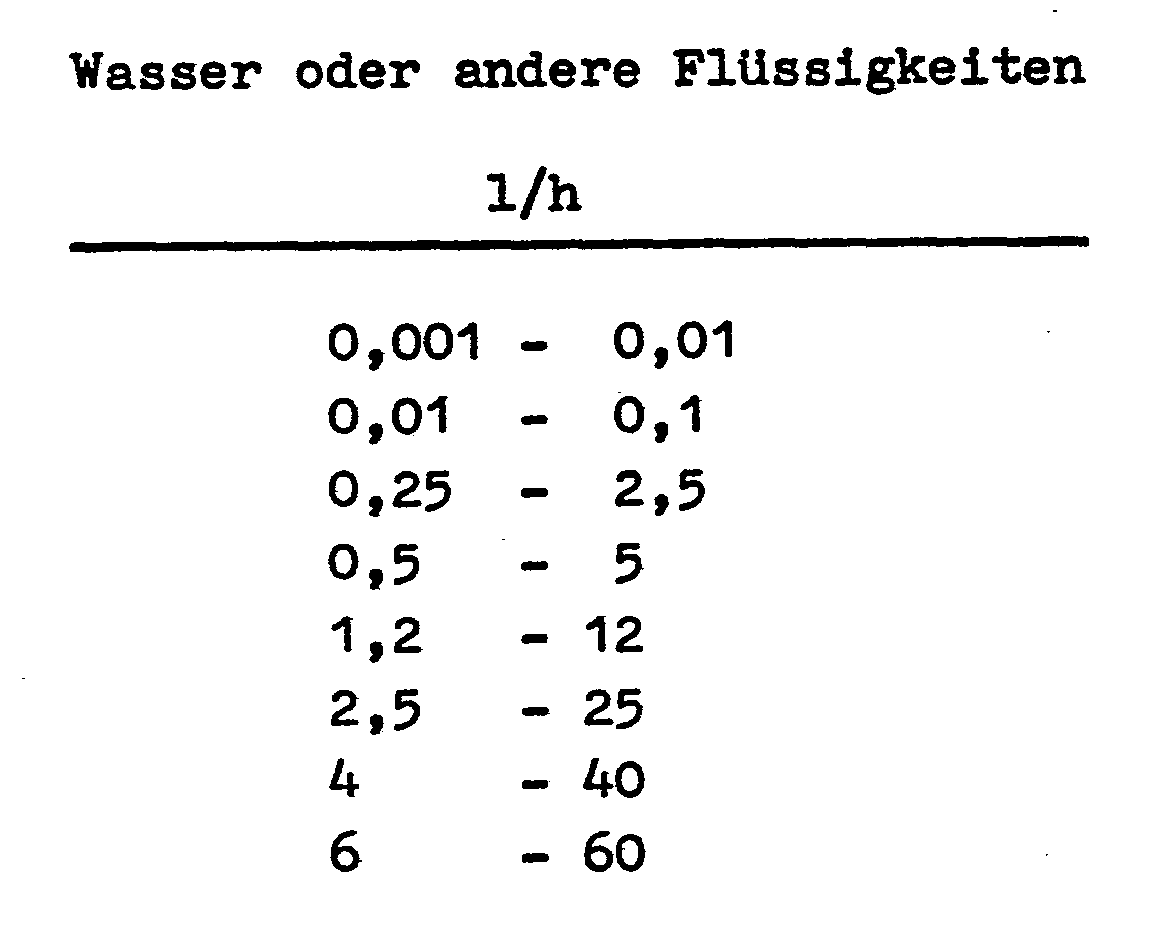

- Die Erfindung wird nun anhand der Figuren noch näher beschrieben:
- Figur 1 zeigt schematisch die Ausbildung der Vorrichtung und ihre Anordnung innerhalb eines Schaltkreises.
- Figur 2 zeigt einen Querschnitt von oben durch die Haltevorrichtung für den Schutzgaskontakt.
- Figur 3 zeigt einen Längsschnitt entlang der Linie IV - IV von Fig. 2 durch die Haltevorrichtung.
- Figur 4 zeigt einen Längsschnitt entlang der Linie II - II von Fig. 3 durch die Haltevorrichtung.
- Figur 5 zeigt einen Längsschnitt durch die Haltevorrichtung von vorn mit zwei Schutzgaskontakten.
- Figur 6 zeigt einen Längsschnitt durch die Haltevorrichtung von der Seite mit zwei Schutzgaskontakten.
- Figur 7 zeigt die Ausbildung der Vorrichtung mit monostabilem Schaltverhalten.
- Figur 8 zeigt die Ausbildung der Vorrichtung mit bistabilem Schaltverhalten.
- Figur 9 zeigt vergrößert einen Längsschnitt durch einen Meßkörper mit eingekapseltem Magneten.
- In Figur 1 ist wiedergegeben, wie die erfindungsgemäße Strömungsmeßvorrichtung prinzipiell in eine Rohrleitung 1 in senkrechter Stellung eingebaut ist. Die Vorrichtung besteht aus einem Gehäuse 2 mit darin angeordnetem Meßrohr 3, in dem sich seinerseits wieder der Schwebekörper 4 befindet. In den Schwebekörper 4 ist ein Miniaturmagnet 6 eingeschlossen. Der Miniaturmagnet kann jedoch auch eine der Form des Meßkörpers weitgehend angenäherte Form haben und ist dann mit einer Kunststoffbeschichtung versehen. Durch diese Ausbildung mit direkter Schutzbeschichtung ist eine Verminderung des Gewichts des Schwebekörpers möglich, so daß noch kleinere Durchflußmengen erfaßbar sind. Neben dem Meßrohr ist ein Miniaturschutzgaskontaktschalter 5 längs verschiebbar oder fest fixiert und in der Höhe feststellbar angeordnet. In der Abbildung ist der Kontaktschalter 5 stark vergrößert wiedergegeben, um den Aufbau besser erkennbar zu machen. An die Kontakte des Schutzgaskontaktschalters 5 ist über eine Signaleinrichtung S eine Spannung angelegt. Bei Schließen der Kontakte durch die Magnetkraft liegt die Spannung an der Signaleinrichtung an, die beispielsweise eine Lampe oder ein Relais oder dergleichen sein kann. Der Schutzgaskontaktschalter kann auch direkt an Schaltkreise,beispielsweise eines Analogrechners oder dergl. angeschlossen werden. Aus Figur 2 sind die asymmetrische Lage der Längsbohrung 8 in der blockfQrmigen Haltevorrichtung 7 für das Meßrohr 3 und die davon ausgehende Nut 9 für den Schutzgaskontaktschalter 5 zu erkennen. Grundsätzlich braucht die Längsbohrung 8 nicht asymmetrisch angeordnet zu sein, jedoch verbessert diese Anordnung die Klammerwirkung des Blockes 7 für das in die Längsbohrung 8 eingeführte Meßrohr 3. Innerhalb des Meßrohres ist der Schwebekörper 4 angeordnet. Der Durchmesser der Längsbohrung 8 ist gleich oder geringfügig kleiner als der Außendurchmesser des Meßrohres 3; beispielsweise 1/10 - 1/13 mm kleiner,um eine gute Klemmwirkung zu erreichen. Mit 10 ist der Längsspalt auf der Vorderseite der Haltevorrichtung 7 bezeichnet.
- Bei 10 mm Durchmesser der Längsbohrung 8 hat der Block beispielsweise eine Kantenlänge von etwa 20 mm. An der einen Seite der Längsbohrung 8 ist Wandmaterial für den Längsspalt10 herausgetrennt. Der Längsspalt 10 kann 1 bis 5 mm breit sein, ist jedoch vorzugsweise enger, jedoch stets so breit, daß der Meßkörper 4 sichtbar bleibt, wenn er in diesem Bereich des Meßrohres 3 gelangt. Auf der dem Längsspalt 10 gegenüberliegenden Wandseite der Längsbohrung 8 ist die Nut 9 zur Aufnahme des Schutzgaskontaktschalters 5 angeordnet. Dieser ist in die Nut 9 eingekittet, und seine Anschlußdrähte sind durch in der Abbildung nicht gezeigte Bohrungen seitlich herausgeführt. Figur 3 zeigt die gleiche Anordnung im Längsschnitt entlang der Linie IV - IV von Fig. 2 mit dem durch die Bohrung 8 hindurchgeführten Meßrohr 3. Auf der einen Seite der Bohrung ist der Längsspalt 10 ausgebildet und gegenüberliegend die Nut 9 zur Aufnahme des Schutzgaskontaktschalters 5. In dieser Abbildung sind die im montierten Zustand horizontalen Bohrungen im Block 7 zur Durchführung der Anschlußdrähte des Kontaktschalters 5 wiedergegeben.
- Figur 4 zeigt die Haltevorrichtung 7 von vorn im Schnitt entlang der Linie II - II von Fig. 3 mit dem in der Nut 9 angeordneten Schutzgaskontaktschalter 5. Oberhalb und unterhalb des Schutzgaskontaktschalters 5 sind die seitlich verlaufenden Bohrungen zur Durchführung der Anschlüsse des Kontaktschalters 5 angeordnet.
- In den Figuren 3 und 4 ist der Block 7 als Quader mit einem quadratischen Querschnitt wie in Figur 2 wiedergegeben. Die Quaderlänge kann beispielsweise 25 bis 30 mm betragen bei einer seitlichen Kantenlänge von 20 mm. Der Schutzgaskontaktschalter hat in diesem Falle einen Außendurchmesser von etwa 2 mm, so daß die Nut 9 etwa 2,5 mm breit und tief ausgearbeitet sein muß. Das Einkitten in die Nut erfolgt mittels geeigneter Klebstoffe oder Vergußmassen.
- Die Haltevorrichtung kann aber auch dadurch ausgebildet werden, daß der Schutzgaskontaktschalter 5 in ein Gießharz eingebettet wird, wobei die äußere Form des entstehenden Körpers der Haltevorrichtung das Meßrohr 3 zumindest teilweise umfaßt oder außerhalb des Sichtfeldes auf der Frontseite am Meßrohr 3 anliegt.
- Figuren 5 und 6 zeigen die Ausbildung der Haltevorrichtung 7 mit zwei Schutzgaskontaktschaltern 5, um ein bistabiles Schaltverhalten der Vorrichtung zu ermöglichen. Figur 5 ist ein mit Figur 4 vergleichbarer Längsschnitt von vorn,und Figur 6 ist ein mit Figur 3 vergleichbarer Längsschnitt von der Seite.
- In Figur 5 ist die Nut 9 zur Aufnahme der beiden Schutzgaskontakte 5 und der auf der Stirnseite des Blockes 7 verlaufende Längsspalt 10 wiedergegeben. Die Querbohrungen zur Durchführung der Anschlußdrähte zu den Kontaktschaltern 5 sind wiedergegeben, ihre Durchführung nach hinten ist jedoch in Figur 6 deutlich zu erkennen. In dieser Figur ist mit 8 die Längsbohrung bezeichnet, die auf der Stirnseite den Längsspalt 10 und auf der gegenüberliegenden Seite die Nut aufweist.
- In Figur 7 ist die Anordnung und Schaltung für monostabiles Schaltverhalten der neuerungsgemäßen Meßvorrichtung gezeigt. Das Meßrohr 3 wird von einem Medium von unten nach oben durchströmt und die Strömung hebt den Schwebekörper 4 mit dem darin angeordneten Miniaturmagneten 6 an. Die Haltevorrichtung 7 ist in einer der gewünschten Durchflußmenge entsprechenden Hubhöhe am Meßrohr 3 festgeklemmt. Sobald der Schwebekörper 4 die Höhe des Schutzgaskontaktes 5 erreicht hat, werden dessen Kontakte durch die magnetische Kraft geschlossen und das Kontaktschutzrelais 11 erregt. Dieses Relais betätigt seinerseits den potentialfreien Schaltkontakt 12 als Relaisausgang. An das Kontaktschutzrelais 11 kann eine Gleich- oder Wechselspannung, wie gezeigt, angelegt sein.
- Figur 8 zeigt die Ausbildung für bistabiles Schaltverhalten mit zwei Schutzgaskontaktschaltern 5 innerhalb der blockförmigen Haltevorrichtung 7, die über das Meßrohr 3 geschoben ist. Der Schwebekörper 4 befindet sich,durch die Strömung zwar angehoben, noch unterhalb des Schaltpunktes. Er enthält eingekittet einen axial magnetisierten Miniaturmagneten 6. Beide Schutzgaskontakte, sogenannte Reed-Kontakte, sind mit einem-elektronischen Schaltglied 13 verbunden. Kontakt 1 mit dem ersten Kontaktschalter und Kontakt 2 mit dem zweiten Kontaktschalter. Bei Erreichen des ersten Kontaktes wird das elektronische Schaltglied 13 mit einem Steuerimpuls versorgt, der das Schaltglied zurücksetzt oder in die Nullstellung führt. Mit steigender Strömungsgeschwindigkeit erreicht der Meßkörper 4 den zweiten Schutzgaskontakt 5 und löst ein zweites Signal im elektronischen Schaltglied aus. Dieses schaltet den potentialfreien Kontakt 12. Das elektronische Schaltglied ist so ausgebildet, daß dieser Zustand erhalten bleibt, bis durch Betätigung des ersten Kontaktes das elektronische Schaltglied in die Nullstellung zurückgeführt wird. Das elektronische Schaltglied wird aus einer Gleichspannungs- oder Wechselstromwelle mit geeigneter Spannung versorgt. Die Kontakte 12 des Schaltgliedes sind als potentialfreier Schaltkontakt ausgebildet.
- Figur 9 zeigt den Schwebekörper 4 im Längsschnitt mit dem eingefügten Magneten 6. Dieser ist in eine entsprechende Bohrung des Schwebekörpers.4 eingefügt und durch einen Verschlußstopfen 14 gesichert. Der Schwebekörper 4 hat einen zylindrischen Querschnitt und ist am unteren Ende kegelförmig verjüngt. Am anderen Ende ist ein erweiterter Außenrand zur Stabilisierung vorgesehen. Bei einer bevorzugten Ausführungsform weist der Schwebekörper einen Durch-,' messer von 6 mm auf und ist 10 mm lang, wobei der obere Rand 1 mm stark ist und das kegelförmige Stück 5 mm lang.
- Der Schwebekörper 4 kann jedoch auch zylindrischen Querschnitt mit jeweils einem erweiterten Außenrand an beiden Enden zur Stabilisierung aufweisen. Derartige Formgestaltungen sind dann bevorzugt, wenn der Magnet nur mit einem Schutzüberzug aus Kunststoff versehen wird.
- Der im abgebildeten Falle eingekapselte Magnet hat einen Durchmesser von 3 mm und ist 3 mm lang. Die Magnetisierung der Magnete ist axial, um eine Kraft auf die in montiertem Zustand seitlich liegenden Schutzgaskontakte ausüben zu können.
- 3ei einer vereinfachten Ausführungsform ist das mit einer Skala versehen Meßrohr nicht in ein besonderes Gestell eingefügt, sondern weist Enden für Leitungsanschlüsse auf, wobei innerhalb des Meßrohres den Querschnitt nur geringfügig verändernde Sperreinsätze für den Schwebekörper an beiden Enden der Meßstrecke vorhanden sind. Die blockförmige Haltevorrichtung wird auf das Meßrohr aufgeschoben. Sie ist Längs verschiebbar und umfaßt das Meßrohr wie eine federnde Klammer aufgrund der elastischen Eigenschaften des Kunststoffblocks. Bei der Ausführungsform mit nur teilweiser Umfassung des Meßrohres durch den Halteblock werden das Meßrohr und der Block in geeigneter Weise miteinander verbunden, beispielsweise durch gemeinsame Anordnung innerhalb eines Gehäuses oder Gestelles oder durch Halteklammern. Diese Befestigung fixiert die Stellung des Schutzgaskontaktschalters oder der beiden Schalter am Meßrohr. Grundsätzlich ist auch bei dieser Gestaltung eine längs verschiebbare Ausbildung für den Halteblock möglich.
-
- 1 Rohrleitung
- 2 Gehäuse
- 3 Meßrohr
- 4 Schwebekörper, Meßkörper
- 5 Schutzgaskontaktschalter, Schutzgaskontakt
- 6 Magnet
- 7 blockförmige Haltevorrichtung, Block
- 8 Längsbohrung
- 9 Nut
- 10 Längsspalt
- 11 Kontaktschutzrelais
- 12 Relaisausgang, potentialfreier Schaltkontakt
- 13 elektronisches Schaltglied
- 14 Verschlußstopfen
- S Signaleinrichtung/Lampe
Claims (10)
daß der Schwebekörper (4) ein Durchmesser-Längenverhältnis von 1:1 bis 1:3 und der in ihm enthaltene Magnet (6) einen Durchmesser von 1 bis 8 mm aufweisen, bei einem Durchmesser-Längenverhältnis von 0,2:1 bis 1:3 und
der Schutzgaskontaktschalter (5) ein Subminiaturschalter mit einem Glasrohr-Durchmesser von 1 bis 3,5 mm und einer Ansprechempfindlichkeit von 5 bis 120 AW ist und in einer das Meßrohr (3) zumindest teilweise umfassenden Haltevorrichtung (7) angeordnet ist.
dadurch gekennzeichnet, daß der Innendurchmesser des Meßrohres (3) 3,0 bis 7 mm beträgt.
dadurch gekennzeichnet, daß die Meßrohrlänge 30 bis 500 mm, vorzugsweise 30 bis 150 mm, beträgt.
dadurch gekennzeichnet, daß der im Meßkörper (4) enthaltene Magnet ein Durchmesser-Längenverhältnis von 1:1 bis 1:2 aufweist.
dadurch gekennzeichnet, daß der im Meßkörper (4) enthaltene Magnet (6) aus einem verformbaren Dauermagnetwerkstoff auf der Basis von Chrom/Kobalt/Eisen- oder Aluminium/ Nickel/Kobalt- oder Kobalt/Samarium (C05Sm)- oder Kobalt/seltene Erdmetalle-enthaltenden Legierungen besteht.
dadurch gekennzeichnet, daß der Schutzgaskontaktschalter (5) in einem würfel- oder quaderförmigen Block (7) als Haltevorrichtung, der eine Längsbohrung (8) zur Aufnahme des Meßrohres (3) aufweist, in einer von der Längsbohrung (8) ausgehenden Nut (9) derart angeordnet ist, daß er unmittelbar am Meßrohr (3) anliegt.
dadurch gekennzeichnet,
daß die Längsbohrung (8) einen Durchmesser aufweist, der gleich oder geringfügig enger ist als der Außendurchmesser des Meßrohres (3) und im Block (7) asymmetrisch angeordnet ist und das Wandmaterial an der dünnsten Stelle zwischen Bohrung (8) und Außenoberfläche des Blockes (7) in Längsrichtung zur Ausbildung eines 1 bis 5 mm breiten Spaltes (10) herausgetrennt ist.
dadurch gekennzeichnet, daß in der Nut (9) zwei Kontaktschalter (5) in Längsrichtung hintereinander mit einem Abstand von 1 bis 5 mm angeordnet sind.
Priority Applications (1)
| Application Number | Priority Date | Filing Date | Title |
|---|---|---|---|
| AT83104534T ATE22617T1 (de) | 1982-08-11 | 1983-05-09 | Vorrichtung zur durchflussmessung mit potentialfreiem endkontaktschalter. |
Applications Claiming Priority (2)
| Application Number | Priority Date | Filing Date | Title |
|---|---|---|---|
| DE8222641U | 1982-08-11 | ||
| DE19828222641U DE8222641U1 (de) | 1982-08-11 | 1982-08-11 | Vorrichtung zur durchflussmessung mit potentialfreiem endkontaktschalter |
Publications (2)
| Publication Number | Publication Date |
|---|---|
| EP0101532A1 true EP0101532A1 (de) | 1984-02-29 |
| EP0101532B1 EP0101532B1 (de) | 1986-10-01 |
Family
ID=6742661
Family Applications (1)
| Application Number | Title | Priority Date | Filing Date |
|---|---|---|---|
| EP83104534A Expired EP0101532B1 (de) | 1982-08-11 | 1983-05-09 | Vorrichtung zur Durchflussmessung mit potentialfreiem Endkontaktschalter |
Country Status (4)
| Country | Link |
|---|---|
| US (1) | US4611105A (de) |
| EP (1) | EP0101532B1 (de) |
| AT (1) | ATE22617T1 (de) |
| DE (2) | DE8222641U1 (de) |
Cited By (2)
| Publication number | Priority date | Publication date | Assignee | Title |
|---|---|---|---|---|
| RU2137093C1 (ru) * | 1997-02-05 | 1999-09-10 | Российский Федеральный Ядерный Центр - Всероссийский Научно-Исследовательский Институт Экспериментальной Физики | Ротаметр |
| US6214239B1 (en) * | 1996-12-09 | 2001-04-10 | Renau Corporation | Water filter usage monitoring apparatus |
Families Citing this family (6)
| Publication number | Priority date | Publication date | Assignee | Title |
|---|---|---|---|---|
| DE8710768U1 (de) * | 1987-08-06 | 1987-09-24 | Meister Strömungstechnik GmbH, 6464 Linsengericht | Schwebekörperdurchflußmesser |
| US5327789A (en) * | 1992-04-03 | 1994-07-12 | Rosemount, Inc. | Electromagnetic detection system for variable area flowmeter |
| DE19620699C1 (de) * | 1996-05-23 | 1997-11-20 | Hanno Dipl Ing Schmitz | Strömungswächter mit Warnvorrichtung |
| ITMI20010632A1 (it) | 2001-03-23 | 2002-09-23 | Pettinaroli Flii Spa | Misuratore ottico di portata |
| US8627728B2 (en) | 2012-01-31 | 2014-01-14 | Hammonds Technical Services, Inc. | System for determining the flow rate in a fluid with liquid additives using reciprocating positive-displacement flow meter |
| JP2015155845A (ja) * | 2014-02-20 | 2015-08-27 | サーパス工業株式会社 | 差圧式流量計およびそれを備えた流量コントローラ |
Citations (3)
| Publication number | Priority date | Publication date | Assignee | Title |
|---|---|---|---|---|
| DE2517429A1 (de) * | 1974-11-04 | 1976-05-06 | Wenderoth Peter Wolf | Magnetsensor fuer fluessigkeitsstroemungen |
| DE2546303A1 (de) * | 1975-10-16 | 1977-04-21 | Willi Tiefenbach | Vorrichtung zur durchflussmessung von fluessigkeiten |
| EP0050400A2 (de) * | 1980-10-16 | 1982-04-28 | Abex Corporation | Detektorschalter für das Verhältnis eines vertikalen Gefälles |
Family Cites Families (3)
| Publication number | Priority date | Publication date | Assignee | Title |
|---|---|---|---|---|
| DE1071359B (de) * | 1959-12-17 | |||
| US3224270A (en) * | 1963-02-12 | 1965-12-21 | Rca Corp | Flow gauges |
| GB1604247A (en) * | 1978-05-26 | 1981-12-02 | Morgan G | Switch assembly responsive to fluid flow |
-
1982
- 1982-08-11 DE DE19828222641U patent/DE8222641U1/de not_active Expired
-
1983
- 1983-05-09 EP EP83104534A patent/EP0101532B1/de not_active Expired
- 1983-05-09 AT AT83104534T patent/ATE22617T1/de not_active IP Right Cessation
- 1983-05-09 DE DE8383104534T patent/DE3366543D1/de not_active Expired
-
1985
- 1985-08-08 US US06/763,632 patent/US4611105A/en not_active Expired - Lifetime
Patent Citations (3)
| Publication number | Priority date | Publication date | Assignee | Title |
|---|---|---|---|---|
| DE2517429A1 (de) * | 1974-11-04 | 1976-05-06 | Wenderoth Peter Wolf | Magnetsensor fuer fluessigkeitsstroemungen |
| DE2546303A1 (de) * | 1975-10-16 | 1977-04-21 | Willi Tiefenbach | Vorrichtung zur durchflussmessung von fluessigkeiten |
| EP0050400A2 (de) * | 1980-10-16 | 1982-04-28 | Abex Corporation | Detektorschalter für das Verhältnis eines vertikalen Gefälles |
Cited By (2)
| Publication number | Priority date | Publication date | Assignee | Title |
|---|---|---|---|---|
| US6214239B1 (en) * | 1996-12-09 | 2001-04-10 | Renau Corporation | Water filter usage monitoring apparatus |
| RU2137093C1 (ru) * | 1997-02-05 | 1999-09-10 | Российский Федеральный Ядерный Центр - Всероссийский Научно-Исследовательский Институт Экспериментальной Физики | Ротаметр |
Also Published As
| Publication number | Publication date |
|---|---|
| DE8222641U1 (de) | 1982-11-18 |
| EP0101532B1 (de) | 1986-10-01 |
| ATE22617T1 (de) | 1986-10-15 |
| US4611105A (en) | 1986-09-09 |
| DE3366543D1 (en) | 1986-11-06 |
Similar Documents
| Publication | Publication Date | Title |
|---|---|---|
| EP0101532B1 (de) | Vorrichtung zur Durchflussmessung mit potentialfreiem Endkontaktschalter | |
| DE1175745B (de) | Elektromagnetischer Wandler | |
| DE1909940B2 (de) | Elektromagnetisches umschaltrelais mit geschuetztem kontakt system | |
| DE3447312A1 (de) | Magnetfeldsensor | |
| DE1243271B (de) | Elektromagnetisches Umschaltrelais mit geschuetztem Kontaktsystem | |
| DE1698038A1 (de) | Tastkopf,insbesondere fuer elektromagnetische Durchflussmesser | |
| EP0438616B1 (de) | Strom-Spannungswandler für elektronische Haushaltszähler | |
| DE10119939A1 (de) | Magnetspulenanordnung | |
| DE2433536B2 (de) | Elektromagnetisches Schaltgerät mit Klappanker | |
| DE8226199U1 (de) | Vorrichtung zur durchflussmessung von fluessigkeiten und gasstroemen | |
| DE10329223B4 (de) | Kurzschlußstromsensor | |
| DE2043422B2 (de) | Durch die Trägheitskräfte eines Massekörpers betätigbarer elektrischer Schalter | |
| DE19843522A1 (de) | Vergußgekapselte Vorrichtung | |
| DE3329309C2 (de) | Bistabiles elektromagnetisches Anzeigeelement | |
| DE7427261U (de) | Berührungsloser Magnetschalter | |
| CH412025A (de) | Relais für koaxiale Verbindungen | |
| DE2913813A1 (de) | Leckfuehler fuer ein elektronisches fluessigkeits-leckueberwachungsgeraet | |
| AT93230B (de) | Elektrodynamische Gewichtsausgleich- bzw. Anzeigevorrichtung. | |
| DE1182749B (de) | Polarisiertes elektromagnetisches Schutzrohrkontaktrelais | |
| AT281973B (de) | Haftrelais | |
| DE1125076B (de) | Relais mit in Schutzrohren angeordneten Ankerkontakten | |
| AT280399B (de) | Haftrelais mit in einer hermetisch verschlossenen Glasröhre befindlichen Kontaktzungen aus einem Material mit mehreren Remanenzzuständen | |
| DE2717451C2 (de) | Elektromagnetisches Relais | |
| DE2155836C3 (de) | Neigungsmeßgerät, insbesondere Zimmerrrtanns-Waage, mit Signalgebung durch Kontaktschluß mittels schwerkraftorientierten Körpers | |
| DE1210474B (de) | In einem Schutzrohr eingebetteter magnetisch steuerbarer Kontakt |
Legal Events
| Date | Code | Title | Description |
|---|---|---|---|
| PUAI | Public reference made under article 153(3) epc to a published international application that has entered the european phase |
Free format text: ORIGINAL CODE: 0009012 |
|
| AK | Designated contracting states |
Designated state(s): AT BE CH DE FR GB LI NL |
|
| 17P | Request for examination filed |
Effective date: 19840307 |
|
| GRAA | (expected) grant |
Free format text: ORIGINAL CODE: 0009210 |
|
| AK | Designated contracting states |
Kind code of ref document: B1 Designated state(s): AT BE CH DE FR GB LI NL |
|
| REF | Corresponds to: |
Ref document number: 22617 Country of ref document: AT Date of ref document: 19861015 Kind code of ref document: T |
|
| REF | Corresponds to: |
Ref document number: 3366543 Country of ref document: DE Date of ref document: 19861106 |
|
| ET | Fr: translation filed | ||
| PLBE | No opposition filed within time limit |
Free format text: ORIGINAL CODE: 0009261 |
|
| STAA | Information on the status of an ep patent application or granted ep patent |
Free format text: STATUS: NO OPPOSITION FILED WITHIN TIME LIMIT |
|
| 26N | No opposition filed | ||
| REG | Reference to a national code |
Ref country code: GB Ref legal event code: IF02 |
|
| PGFP | Annual fee paid to national office [announced via postgrant information from national office to epo] |
Ref country code: GB Payment date: 20020415 Year of fee payment: 20 |
|
| PGFP | Annual fee paid to national office [announced via postgrant information from national office to epo] |
Ref country code: NL Payment date: 20020517 Year of fee payment: 20 Ref country code: FR Payment date: 20020517 Year of fee payment: 20 |
|
| PGFP | Annual fee paid to national office [announced via postgrant information from national office to epo] |
Ref country code: AT Payment date: 20020523 Year of fee payment: 20 |
|
| PGFP | Annual fee paid to national office [announced via postgrant information from national office to epo] |
Ref country code: CH Payment date: 20020524 Year of fee payment: 20 Ref country code: BE Payment date: 20020524 Year of fee payment: 20 |
|
| PGFP | Annual fee paid to national office [announced via postgrant information from national office to epo] |
Ref country code: DE Payment date: 20020724 Year of fee payment: 20 |
|
| PG25 | Lapsed in a contracting state [announced via postgrant information from national office to epo] |
Ref country code: LI Free format text: LAPSE BECAUSE OF EXPIRATION OF PROTECTION Effective date: 20030508 Ref country code: GB Free format text: LAPSE BECAUSE OF EXPIRATION OF PROTECTION Effective date: 20030508 Ref country code: CH Free format text: LAPSE BECAUSE OF EXPIRATION OF PROTECTION Effective date: 20030508 |
|
| PG25 | Lapsed in a contracting state [announced via postgrant information from national office to epo] |
Ref country code: NL Free format text: LAPSE BECAUSE OF EXPIRATION OF PROTECTION Effective date: 20030509 Ref country code: AT Free format text: LAPSE BECAUSE OF EXPIRATION OF PROTECTION Effective date: 20030509 |
|
| REG | Reference to a national code |
Ref country code: GB Ref legal event code: PE20 |
|
| REG | Reference to a national code |
Ref country code: CH Ref legal event code: PL |
|
| BE20 | Be: patent expired |
Owner name: *KOBOLD KLAUS Effective date: 20030509 |
|
| NLV7 | Nl: ceased due to reaching the maximum lifetime of a patent |
Effective date: 20030509 |