EP0102032B1 - Compositions stabilisées d'aspartame - Google Patents
Compositions stabilisées d'aspartame Download PDFInfo
- Publication number
- EP0102032B1 EP0102032B1 EP83108144A EP83108144A EP0102032B1 EP 0102032 B1 EP0102032 B1 EP 0102032B1 EP 83108144 A EP83108144 A EP 83108144A EP 83108144 A EP83108144 A EP 83108144A EP 0102032 B1 EP0102032 B1 EP 0102032B1
- Authority
- EP
- European Patent Office
- Prior art keywords
- aspartame
- sugar
- aspartyl
- methyl ester
- water
- Prior art date
- Legal status (The legal status is an assumption and is not a legal conclusion. Google has not performed a legal analysis and makes no representation as to the accuracy of the status listed.)
- Expired
Links
- IAOZJIPTCAWIRG-QWRGUYRKSA-N aspartame Chemical compound OC(=O)C[C@H](N)C(=O)N[C@H](C(=O)OC)CC1=CC=CC=C1 IAOZJIPTCAWIRG-QWRGUYRKSA-N 0.000 title description 107
- 235000010357 aspartame Nutrition 0.000 title description 107
- 108010011485 Aspartame Proteins 0.000 title description 105
- 239000000605 aspartame Substances 0.000 title description 105
- 229960003438 aspartame Drugs 0.000 title description 105
- 239000000203 mixture Substances 0.000 title description 19
- 235000003599 food sweetener Nutrition 0.000 claims description 45
- 239000003765 sweetening agent Substances 0.000 claims description 45
- 235000000346 sugar Nutrition 0.000 claims description 44
- XLYOFNOQVPJJNP-UHFFFAOYSA-N water Substances O XLYOFNOQVPJJNP-UHFFFAOYSA-N 0.000 claims description 42
- 239000002270 dispersing agent Substances 0.000 claims description 29
- 235000013305 food Nutrition 0.000 claims description 29
- 238000000034 method Methods 0.000 claims description 28
- 230000008569 process Effects 0.000 claims description 18
- YZQCXOFQZKCETR-UWVGGRQHSA-N Asp-Phe Chemical compound OC(=O)C[C@H](N)C(=O)N[C@H](C(O)=O)CC1=CC=CC=C1 YZQCXOFQZKCETR-UWVGGRQHSA-N 0.000 claims description 14
- 230000008878 coupling Effects 0.000 claims description 13
- 238000010168 coupling process Methods 0.000 claims description 13
- 238000005859 coupling reaction Methods 0.000 claims description 13
- 239000002002 slurry Substances 0.000 claims description 13
- 238000002156 mixing Methods 0.000 claims description 12
- 239000007864 aqueous solution Substances 0.000 claims description 11
- 229920002472 Starch Polymers 0.000 claims description 8
- 239000008107 starch Substances 0.000 claims description 8
- 235000019698 starch Nutrition 0.000 claims description 8
- 235000015243 ice cream Nutrition 0.000 claims description 7
- 235000010627 Phaseolus vulgaris Nutrition 0.000 claims description 6
- 244000046052 Phaseolus vulgaris Species 0.000 claims description 6
- CZMRCDWAGMRECN-UGDNZRGBSA-N Sucrose Chemical compound O[C@H]1[C@H](O)[C@@H](CO)O[C@@]1(CO)O[C@@H]1[C@H](O)[C@@H](O)[C@H](O)[C@@H](CO)O1 CZMRCDWAGMRECN-UGDNZRGBSA-N 0.000 claims description 6
- 229930006000 Sucrose Natural products 0.000 claims description 6
- 239000012047 saturated solution Substances 0.000 claims description 6
- 239000005720 sucrose Substances 0.000 claims description 6
- 150000005846 sugar alcohols Chemical class 0.000 claims description 5
- 239000005715 Fructose Substances 0.000 claims description 4
- 229940112822 chewing gum Drugs 0.000 claims description 4
- 235000015218 chewing gum Nutrition 0.000 claims description 4
- 235000015110 jellies Nutrition 0.000 claims description 4
- 239000008274 jelly Substances 0.000 claims description 4
- 230000000087 stabilizing effect Effects 0.000 claims description 4
- 229930091371 Fructose Natural products 0.000 claims description 3
- RFSUNEUAIZKAJO-ARQDHWQXSA-N Fructose Chemical compound OC[C@H]1O[C@](O)(CO)[C@@H](O)[C@@H]1O RFSUNEUAIZKAJO-ARQDHWQXSA-N 0.000 claims description 3
- WQZGKKKJIJFFOK-GASJEMHNSA-N Glucose Natural products OC[C@H]1OC(O)[C@H](O)[C@@H](O)[C@@H]1O WQZGKKKJIJFFOK-GASJEMHNSA-N 0.000 claims description 3
- 235000009508 confectionery Nutrition 0.000 claims description 3
- 239000008103 glucose Substances 0.000 claims description 3
- 235000015094 jam Nutrition 0.000 claims description 3
- 241000195940 Bryophyta Species 0.000 claims description 2
- 238000011049 filling Methods 0.000 claims description 2
- 235000011929 mousse Nutrition 0.000 claims description 2
- 235000011962 puddings Nutrition 0.000 claims description 2
- 125000002791 glucosyl group Chemical group C1([C@H](O)[C@@H](O)[C@H](O)[C@H](O1)CO)* 0.000 claims 1
- 239000007788 liquid Substances 0.000 description 32
- FBPFZTCFMRRESA-FSIIMWSLSA-N D-Glucitol Natural products OC[C@H](O)[C@H](O)[C@@H](O)[C@H](O)CO FBPFZTCFMRRESA-FSIIMWSLSA-N 0.000 description 9
- 239000000600 sorbitol Substances 0.000 description 9
- 235000010356 sorbitol Nutrition 0.000 description 9
- 239000000047 product Substances 0.000 description 8
- 238000003860 storage Methods 0.000 description 8
- 235000013361 beverage Nutrition 0.000 description 7
- 239000000243 solution Substances 0.000 description 7
- 235000020357 syrup Nutrition 0.000 description 7
- 239000006188 syrup Substances 0.000 description 7
- 239000007858 starting material Substances 0.000 description 6
- 239000000796 flavoring agent Substances 0.000 description 5
- 235000019634 flavors Nutrition 0.000 description 5
- 239000000843 powder Substances 0.000 description 5
- 229920006395 saturated elastomer Polymers 0.000 description 5
- LFQSCWFLJHTTHZ-UHFFFAOYSA-N Ethanol Chemical compound CCO LFQSCWFLJHTTHZ-UHFFFAOYSA-N 0.000 description 4
- 239000006071 cream Substances 0.000 description 4
- 238000000354 decomposition reaction Methods 0.000 description 4
- 230000000694 effects Effects 0.000 description 4
- 238000010438 heat treatment Methods 0.000 description 4
- 235000008960 ketchup Nutrition 0.000 description 4
- 239000000126 substance Substances 0.000 description 4
- 241000227653 Lycopersicon Species 0.000 description 3
- 235000007688 Lycopersicon esculentum Nutrition 0.000 description 3
- UEDUENGHJMELGK-HYDKPPNVSA-N Stevioside Chemical compound O([C@@H]1[C@@H](O)[C@H](O)[C@@H](CO)O[C@H]1O[C@]12C(=C)C[C@@]3(C1)CC[C@@H]1[C@@](C)(CCC[C@]1([C@@H]3CC2)C)C(=O)O[C@H]1[C@@H]([C@@H](O)[C@H](O)[C@@H](CO)O1)O)[C@@H]1O[C@H](CO)[C@@H](O)[C@H](O)[C@H]1O UEDUENGHJMELGK-HYDKPPNVSA-N 0.000 description 3
- 235000005911 diet Nutrition 0.000 description 3
- 230000037213 diet Effects 0.000 description 3
- 238000004090 dissolution Methods 0.000 description 3
- 239000004615 ingredient Substances 0.000 description 3
- 239000000845 maltitol Substances 0.000 description 3
- 235000010449 maltitol Nutrition 0.000 description 3
- VQHSOMBJVWLPSR-WUJBLJFYSA-N maltitol Chemical compound OC[C@H](O)[C@@H](O)[C@@H]([C@H](O)CO)O[C@H]1O[C@H](CO)[C@@H](O)[C@H](O)[C@H]1O VQHSOMBJVWLPSR-WUJBLJFYSA-N 0.000 description 3
- 229940035436 maltitol Drugs 0.000 description 3
- 238000004519 manufacturing process Methods 0.000 description 3
- 235000019204 saccharin Nutrition 0.000 description 3
- CVHZOJJKTDOEJC-UHFFFAOYSA-N saccharin Chemical compound C1=CC=C2C(=O)NS(=O)(=O)C2=C1 CVHZOJJKTDOEJC-UHFFFAOYSA-N 0.000 description 3
- 229940081974 saccharin Drugs 0.000 description 3
- 239000000901 saccharin and its Na,K and Ca salt Substances 0.000 description 3
- 238000004062 sedimentation Methods 0.000 description 3
- 229940013618 stevioside Drugs 0.000 description 3
- OHHNJQXIOPOJSC-UHFFFAOYSA-N stevioside Natural products CC1(CCCC2(C)C3(C)CCC4(CC3(CCC12C)CC4=C)OC5OC(CO)C(O)C(O)C5OC6OC(CO)C(O)C(O)C6O)C(=O)OC7OC(CO)C(O)C(O)C7O OHHNJQXIOPOJSC-UHFFFAOYSA-N 0.000 description 3
- 235000019202 steviosides Nutrition 0.000 description 3
- 239000011550 stock solution Substances 0.000 description 3
- 229920001817 Agar Polymers 0.000 description 2
- FBPFZTCFMRRESA-JGWLITMVSA-N D-glucitol Chemical compound OC[C@H](O)[C@@H](O)[C@H](O)[C@H](O)CO FBPFZTCFMRRESA-JGWLITMVSA-N 0.000 description 2
- 239000008272 agar Substances 0.000 description 2
- 230000008901 benefit Effects 0.000 description 2
- WQZGKKKJIJFFOK-VFUOTHLCSA-N beta-D-glucose Chemical compound OC[C@H]1O[C@@H](O)[C@H](O)[C@@H](O)[C@@H]1O WQZGKKKJIJFFOK-VFUOTHLCSA-N 0.000 description 2
- 235000008504 concentrate Nutrition 0.000 description 2
- 239000012141 concentrate Substances 0.000 description 2
- 239000013078 crystal Substances 0.000 description 2
- 238000011161 development Methods 0.000 description 2
- 239000000284 extract Substances 0.000 description 2
- 238000009472 formulation Methods 0.000 description 2
- 238000002844 melting Methods 0.000 description 2
- 230000008018 melting Effects 0.000 description 2
- 235000014593 oils and fats Nutrition 0.000 description 2
- 150000007524 organic acids Chemical class 0.000 description 2
- 238000002360 preparation method Methods 0.000 description 2
- 238000012545 processing Methods 0.000 description 2
- 150000003839 salts Chemical class 0.000 description 2
- 238000003756 stirring Methods 0.000 description 2
- 150000008163 sugars Chemical class 0.000 description 2
- 239000000230 xanthan gum Substances 0.000 description 2
- 229920001285 xanthan gum Polymers 0.000 description 2
- 235000010493 xanthan gum Nutrition 0.000 description 2
- 229940082509 xanthan gum Drugs 0.000 description 2
- OWEGMIWEEQEYGQ-UHFFFAOYSA-N 100676-05-9 Natural products OC1C(O)C(O)C(CO)OC1OCC1C(O)C(O)C(O)C(OC2C(OC(O)C(O)C2O)CO)O1 OWEGMIWEEQEYGQ-UHFFFAOYSA-N 0.000 description 1
- SERLAGPUMNYUCK-YJOKQAJESA-N 6-O-alpha-D-glucopyranosyl-D-glucitol Chemical compound OC[C@H](O)[C@@H](O)[C@H](O)[C@H](O)CO[C@H]1O[C@H](CO)[C@@H](O)[C@H](O)[C@H]1O SERLAGPUMNYUCK-YJOKQAJESA-N 0.000 description 1
- 244000291564 Allium cepa Species 0.000 description 1
- 235000002732 Allium cepa var. cepa Nutrition 0.000 description 1
- GUBGYTABKSRVRQ-XLOQQCSPSA-N Alpha-Lactose Chemical compound O[C@@H]1[C@@H](O)[C@@H](O)[C@@H](CO)O[C@H]1O[C@@H]1[C@@H](CO)O[C@H](O)[C@H](O)[C@H]1O GUBGYTABKSRVRQ-XLOQQCSPSA-N 0.000 description 1
- OYPRJOBELJOOCE-UHFFFAOYSA-N Calcium Chemical compound [Ca] OYPRJOBELJOOCE-UHFFFAOYSA-N 0.000 description 1
- 229920001353 Dextrin Polymers 0.000 description 1
- 239000004375 Dextrin Substances 0.000 description 1
- 102000004190 Enzymes Human genes 0.000 description 1
- 108090000790 Enzymes Proteins 0.000 description 1
- 108010010803 Gelatin Proteins 0.000 description 1
- 229920002907 Guar gum Polymers 0.000 description 1
- CKLJMWTZIZZHCS-REOHCLBHSA-N L-aspartic acid Chemical class OC(=O)[C@@H](N)CC(O)=O CKLJMWTZIZZHCS-REOHCLBHSA-N 0.000 description 1
- GUBGYTABKSRVRQ-QKKXKWKRSA-N Lactose Natural products OC[C@H]1O[C@@H](O[C@H]2[C@H](O)[C@@H](O)C(O)O[C@@H]2CO)[C@H](O)[C@@H](O)[C@H]1O GUBGYTABKSRVRQ-QKKXKWKRSA-N 0.000 description 1
- FYYHWMGAXLPEAU-UHFFFAOYSA-N Magnesium Chemical compound [Mg] FYYHWMGAXLPEAU-UHFFFAOYSA-N 0.000 description 1
- GUBGYTABKSRVRQ-PICCSMPSSA-N Maltose Natural products O[C@@H]1[C@@H](O)[C@H](O)[C@@H](CO)O[C@@H]1O[C@@H]1[C@@H](CO)OC(O)[C@H](O)[C@H]1O GUBGYTABKSRVRQ-PICCSMPSSA-N 0.000 description 1
- MUPFEKGTMRGPLJ-RMMQSMQOSA-N Raffinose Natural products O(C[C@H]1[C@@H](O)[C@H](O)[C@@H](O)[C@@H](O[C@@]2(CO)[C@H](O)[C@@H](O)[C@@H](CO)O2)O1)[C@@H]1[C@H](O)[C@@H](O)[C@@H](O)[C@@H](CO)O1 MUPFEKGTMRGPLJ-RMMQSMQOSA-N 0.000 description 1
- MUPFEKGTMRGPLJ-UHFFFAOYSA-N UNPD196149 Natural products OC1C(O)C(CO)OC1(CO)OC1C(O)C(O)C(O)C(COC2C(C(O)C(O)C(CO)O2)O)O1 MUPFEKGTMRGPLJ-UHFFFAOYSA-N 0.000 description 1
- 239000002253 acid Substances 0.000 description 1
- 230000002411 adverse Effects 0.000 description 1
- 229940024606 amino acid Drugs 0.000 description 1
- 150000001413 amino acids Chemical class 0.000 description 1
- GUBGYTABKSRVRQ-QUYVBRFLSA-N beta-maltose Chemical compound OC[C@H]1O[C@H](O[C@H]2[C@H](O)[C@@H](O)[C@H](O)O[C@@H]2CO)[C@H](O)[C@@H](O)[C@@H]1O GUBGYTABKSRVRQ-QUYVBRFLSA-N 0.000 description 1
- 230000015572 biosynthetic process Effects 0.000 description 1
- 239000004067 bulking agent Substances 0.000 description 1
- 239000011575 calcium Substances 0.000 description 1
- 229910052791 calcium Inorganic materials 0.000 description 1
- 150000001720 carbohydrates Chemical class 0.000 description 1
- 235000014171 carbonated beverage Nutrition 0.000 description 1
- 230000008859 change Effects 0.000 description 1
- UHZZMRAGKVHANO-UHFFFAOYSA-M chlormequat chloride Chemical compound [Cl-].C[N+](C)(C)CCCl UHZZMRAGKVHANO-UHFFFAOYSA-M 0.000 description 1
- 239000011248 coating agent Substances 0.000 description 1
- 238000000576 coating method Methods 0.000 description 1
- 239000003086 colorant Substances 0.000 description 1
- 238000007796 conventional method Methods 0.000 description 1
- 238000001816 cooling Methods 0.000 description 1
- 230000037123 dental health Effects 0.000 description 1
- 235000011850 desserts Nutrition 0.000 description 1
- 235000019425 dextrin Nutrition 0.000 description 1
- 238000010790 dilution Methods 0.000 description 1
- 239000012895 dilution Substances 0.000 description 1
- 150000002016 disaccharides Chemical class 0.000 description 1
- PXEDJBXQKAGXNJ-QTNFYWBSSA-L disodium L-glutamate Chemical compound [Na+].[Na+].[O-]C(=O)[C@@H](N)CCC([O-])=O PXEDJBXQKAGXNJ-QTNFYWBSSA-L 0.000 description 1
- 239000006185 dispersion Substances 0.000 description 1
- 238000001035 drying Methods 0.000 description 1
- 238000011156 evaluation Methods 0.000 description 1
- 238000002474 experimental method Methods 0.000 description 1
- 239000012467 final product Substances 0.000 description 1
- 238000005187 foaming Methods 0.000 description 1
- 235000011194 food seasoning agent Nutrition 0.000 description 1
- -1 for example Chemical compound 0.000 description 1
- 239000003205 fragrance Substances 0.000 description 1
- 235000011389 fruit/vegetable juice Nutrition 0.000 description 1
- 239000008273 gelatin Substances 0.000 description 1
- 229920000159 gelatin Polymers 0.000 description 1
- 235000019322 gelatine Nutrition 0.000 description 1
- 235000011852 gelatine desserts Nutrition 0.000 description 1
- 150000004676 glycans Chemical class 0.000 description 1
- 235000010985 glycerol esters of wood rosin Nutrition 0.000 description 1
- 239000008187 granular material Substances 0.000 description 1
- 230000005484 gravity Effects 0.000 description 1
- 239000000665 guar gum Substances 0.000 description 1
- 235000010417 guar gum Nutrition 0.000 description 1
- 229960002154 guar gum Drugs 0.000 description 1
- 230000036541 health Effects 0.000 description 1
- 230000006872 improvement Effects 0.000 description 1
- 239000002198 insoluble material Substances 0.000 description 1
- 239000008101 lactose Substances 0.000 description 1
- 230000007774 longterm Effects 0.000 description 1
- 239000011777 magnesium Substances 0.000 description 1
- 229910052749 magnesium Inorganic materials 0.000 description 1
- 150000007522 mineralic acids Chemical class 0.000 description 1
- 238000012986 modification Methods 0.000 description 1
- 230000004048 modification Effects 0.000 description 1
- 150000002772 monosaccharides Chemical class 0.000 description 1
- 231100000252 nontoxic Toxicity 0.000 description 1
- 230000003000 nontoxic effect Effects 0.000 description 1
- 239000002773 nucleotide Substances 0.000 description 1
- 239000007764 o/w emulsion Substances 0.000 description 1
- 229920001542 oligosaccharide Polymers 0.000 description 1
- 150000002482 oligosaccharides Chemical class 0.000 description 1
- 235000005985 organic acids Nutrition 0.000 description 1
- 238000010979 pH adjustment Methods 0.000 description 1
- 239000002245 particle Substances 0.000 description 1
- 239000001814 pectin Substances 0.000 description 1
- 229920001277 pectin Polymers 0.000 description 1
- 235000010987 pectin Nutrition 0.000 description 1
- BXRNXXXXHLBUKK-UHFFFAOYSA-N piperazine-2,5-dione Chemical class O=C1CNC(=O)CN1 BXRNXXXXHLBUKK-UHFFFAOYSA-N 0.000 description 1
- 229920001282 polysaccharide Polymers 0.000 description 1
- 239000005017 polysaccharide Substances 0.000 description 1
- 108090000765 processed proteins & peptides Proteins 0.000 description 1
- 102000004196 processed proteins & peptides Human genes 0.000 description 1
- 230000002035 prolonged effect Effects 0.000 description 1
- 108090000623 proteins and genes Proteins 0.000 description 1
- 102000004169 proteins and genes Human genes 0.000 description 1
- MUPFEKGTMRGPLJ-ZQSKZDJDSA-N raffinose Chemical compound O[C@H]1[C@H](O)[C@@H](CO)O[C@@]1(CO)O[C@@H]1[C@H](O)[C@@H](O)[C@H](O)[C@@H](CO[C@@H]2[C@@H]([C@@H](O)[C@@H](O)[C@@H](CO)O2)O)O1 MUPFEKGTMRGPLJ-ZQSKZDJDSA-N 0.000 description 1
- 235000015067 sauces Nutrition 0.000 description 1
- 229960002920 sorbitol Drugs 0.000 description 1
- 235000013599 spices Nutrition 0.000 description 1
- 239000003381 stabilizer Substances 0.000 description 1
- 235000019605 sweet taste sensations Nutrition 0.000 description 1
- 230000008719 thickening Effects 0.000 description 1
- 235000015113 tomato pastes and purées Nutrition 0.000 description 1
- 150000004043 trisaccharides Chemical class 0.000 description 1
- 239000011782 vitamin Substances 0.000 description 1
- 229940088594 vitamin Drugs 0.000 description 1
- 229930003231 vitamin Natural products 0.000 description 1
- 235000013343 vitamin Nutrition 0.000 description 1
- 239000007762 w/o emulsion Substances 0.000 description 1
- 238000010792 warming Methods 0.000 description 1
Images


Classifications
-
- A—HUMAN NECESSITIES
- A23—FOODS OR FOODSTUFFS; TREATMENT THEREOF, NOT COVERED BY OTHER CLASSES
- A23L—FOODS, FOODSTUFFS OR NON-ALCOHOLIC BEVERAGES, NOT OTHERWISE PROVIDED FOR; PREPARATION OR TREATMENT THEREOF
- A23L27/00—Spices; Flavouring agents or condiments; Artificial sweetening agents; Table salts; Dietetic salt substitutes; Preparation or treatment thereof
- A23L27/30—Artificial sweetening agents
- A23L27/31—Artificial sweetening agents containing amino acids, nucleotides, peptides or derivatives
- A23L27/32—Artificial sweetening agents containing amino acids, nucleotides, peptides or derivatives containing dipeptides or derivatives
-
- Y—GENERAL TAGGING OF NEW TECHNOLOGICAL DEVELOPMENTS; GENERAL TAGGING OF CROSS-SECTIONAL TECHNOLOGIES SPANNING OVER SEVERAL SECTIONS OF THE IPC; TECHNICAL SUBJECTS COVERED BY FORMER USPC CROSS-REFERENCE ART COLLECTIONS [XRACs] AND DIGESTS
- Y10—TECHNICAL SUBJECTS COVERED BY FORMER USPC
- Y10S—TECHNICAL SUBJECTS COVERED BY FORMER USPC CROSS-REFERENCE ART COLLECTIONS [XRACs] AND DIGESTS
- Y10S426/00—Food or edible material: processes, compositions, and products
- Y10S426/804—Low calorie, low sodium or hypoallergic
Definitions
- This invention relates to sweetened foods and to liquid sweetening agents which contain Aspartame.
- a-L-Aspartyl-L-phenylalanine methyl ester (hereafter referred to as Aspartame) is a low calorie sweetening agent which has a sweetness of good quality and a sweetening intensity about 200 times that of sucrose. Hence, Aspartame is of great utility in the preparation of food.
- Aspartame be applied in the form of an aqueous solution as a sweetening agent.
- an aqueous sweetening solution and in foods and beverages containing water particularly having a pH of 5.5 or higher or a pH of 2.0 or less, however, Aspartame is subject to decomposition to form a diketopiperazine derivative having no sweet taste, although this decomposition product is nontoxic and completely safe.
- decomposition it is impossible to store Aspartame containing aqueous foods during an appropriate time. Similar decomposition takes place in food during a long-term storage.
- Aspartame has been covered with gelatin or with a component having a high melting point or with a water insoluble material. Furthermore, it is known to adjust the pH of the composition containing Aspartame to the range in which Aspartame is most stable. These methods are illustrated by chewing gum compositions containing Aspartame in which Aspartame is incorporated in the gum together with an ester gum coating and in which the pH of the water extract of the gum is adjusted within the stable range for Aspartame.
- CH-A-571 830, US-A-4 007 288 and US-A-4 001 456 relate to a process for producing a dry pulverized easily soluble sweetening agent according to which an aqueous solution which comprises APM and a bulking agent (such as a dextrin or a sugar) is dried.
- DE-A-2 525 421 describes a sweetening agent having increased cold water solubility, which is produced by drying an aqueous slurry containing an L-aspartic acid derivative and a water-insoluble carrier salt.
- aqueous solution of APM is not solved by the prior art.
- sweetening agents such as isomerized sugar, coupling sugar, sorbitol, maltitol, stevioside, saccharin, and the like have been developed and employed.
- these sweetening agents have inherent drawbacks.
- isomerized sugar, coupling sugar, sugar alcohol which are satisfactory with regard to the quality of sweetness and diet, have problems such as a low degree of sweetness.
- stevioside, saccharin, and the like have a poor quality of sweetness although the degree of sweetness is high.
- a process for stabilizing an aqueous solution of a-L-aspartyl-L-phenylalanine methyl ester which is characterized in that additional undissolved a-L-aspartyl-L-phenylalanine methyl ester is added in excess of the amount necessary for forming a saturated solution, and
- a process for stabilizing a-L-aspartyl-L-phenylalanine methyl ester in a water-containing sweetened food which is characterized in that a-L-aspartyl-L-phenylalanine methyl ester is added in excess of the amount necessary for forming a saturated solution thereof in the water content of said food.
- This invention also provides a process for producing a stabilized aqueous sweetening agent on the basis of a-L-aspartyl-L-phenylalanine methyl ester which comprises preparing a slurry containing a-L-aspartyl-L-phenylalanine methyl ester at a concentration higher than its solubility in a dispersing agent and mixing said slurry with additional dispersing agent.
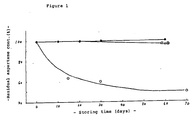
- Figures. 1-3 show the percent Aspartame remaining in the liquid sweetening agents of this invention (Examples 1 and 2) and in an aqueous Aspartame solution (50 mg/dl) at 24°C (Figure 1), 34°C ( Figure 2), and 44°C ( Figure 3).
- the compositions are identified in these graphs as follows: In the following the invention is described by means of preferred embodiments.
- the present inventors have studied the stability of Aspartame in water taking into account the previously described situation involving pH and storage temperature and the effect of these conditions on the stability of Aspartame. They have further studied additional factors which influence the stability of Aspartame in water, namely the concentration of Aspartame and the co-presence of additional components, especially sugars.
- the dispersing agent employed in this invention refers to an aqueous solution which may contain alcohol in the amount ranging from 0 to 95%.
- the viscosity of the aqueous solution can range from low to high; i.e., the aqueous solution may be in the form of a cream as well as a liquid.
- examples of dispersing agents are water and aqueous solutions containing ethanol, isomerized sugar, sorbitol, reduced starch hydrolyzate, coupling sugar.
- aqueous solution containing them may contain any hydrophilic ingredient such as a sugar, a soluble starch or protein, an organic or inorganic acid, a soluble salt, an oleophilic ingredient, or any other substance suitable for use in the preparation of a food.
- hydrophilic ingredient such as a sugar, a soluble starch or protein, an organic or inorganic acid, a soluble salt, an oleophilic ingredient, or any other substance suitable for use in the preparation of a food.
- a sugar in the dispersing agent for further improving the degree of sweetness and the stability of Aspartame
- a sugar in the dispersing agent for further improving the degree of sweetness and the stability of Aspartame
- an aqueous sugar solution having a low degree of sweetness such as isomerized sugar, sugar alcohol, reduced starch hydrolyzate, coupling sugar, or the like
- the sweetening intensity of such a sweetening agent is reinforced and a product having a high degree of sweetness may be obtained.
- Aspartame is rendered extremely stable even in a liquid system when a sugar is included, and, even on use, Aspartame crystals are uniformly dispersed and floated in the dispersing agent and hence show excellent water dispersibility and solubility.
- a sweetening agent having a high practical value as a starting material for beverages, desserts, ice cream, and the like may be produced.
- the viscosity of the liquid sweetening agent may be low without any problem if, for example, it is shaken prior to use.
- a dispersing agent having a viscosity at least sufficient to maintain the floating stability of Aspartame should be used or the dispersion and floating stability of Aspartame in the dispersing agent should be enhanced by adding a thickening stabilizer; a specific gravity increasing component, such as, for example, gums such as xanthan gum, guar gum; a polysaccharide; or the like.
- the amount of Aspartame to be added to the dispersing agent is such that at least a part of the Aspartame is maintained in the undissolved state. More particularly, if the dispersing agent is already in the saturated or supersaturated state as the result of the presence of another component or components, most of the added Aspartame remains undissolved. In such cases it is sufficient to add only a very small amount of Aspartame. However, it is also possible to add a large amount of Aspartame to prepare a composition having an extremely high degree of sweetness. Furthermore, when the dispersing agent is not saturated, it is necessary to add Aspartame in an amount at least equal to the saturation solubility in the liquid dispersing agent.
- the lower limit for the amount of Aspartame to be added is the amount required for making Aspartame supersaturated at any temperature from storing temperature to room temperature, while the upper limit therefor is the amount of Aspartame required according to the intended degree of sweetness.
- the amounts of Aspartame to be added are 0.45%, 0.35%, 0.35% and 0.33% or more respectively, but it should be noted that these are only guidelines and as long as at least a part of Aspartame remains undissolved, amounts lower than these limits may well be regarded as sufficient.
- the aforesaid dispersing agents may be employed either singly or in combination of two or more thereof, and further other seasoning components (for example, flavoring substances, such as sodium L-glutamate, 5'-nucleotide; sweetening substances such as stevioside, saccharin; organic acids; amino acids; peptides; extracts; fragrance; spices; coloring agents; inorganic substances such as calcium, magnesium; vitamins; and oils and fats) may also be present.
- seasoning components for example, flavoring substances, such as sodium L-glutamate, 5'-nucleotide; sweetening substances such as stevioside, saccharin; organic acids; amino acids; peptides; extracts; fragrance; spices; coloring agents; inorganic substances such as calcium, magnesium; vitamins; and oils and fats
- oils and fats are co-present, it is possible to present a product as an oil-in-water or water-in-oil emulsion.
- the method of producing a liquid sweetening agent of this invention is not particularly restricted.
- a process which simply comprises directly adding Aspartame to a dispersing agent and mixing to prepare a slurry may be employed, or of course a process which comprises warming a dispersing agent, then adding Aspartame thereto, mixing, and cooling may also be employed.
- the following process is desirable. That is, a slurry comprising Aspartame and water (and/or a part of a dispersing agent) is prepared and then mixed with the total amount (or the rest) of the dispersing agent.
- the slurry is preferably prepared beforehand by directly mixing and homogenizing with a part of the dispersing agent, or by homogenizing Aspartame and water, then mixing and homogenizing with a part of the dispersing agent. Thereafter, this is combined with the rest of the dispersing agent in a large amount and vacuum mixed.
- a liquid sweetening agent in which Aspartame particles are uniformly dispersed may be produced while preventing the formation of bubbles.
- the liquid sweetening agent as used in this invention is meant to include all the flowing to semi-flowing types, such as a liquid, paste, soft or hard cream form.
- a liquid, paste, soft or hard cream form for example, in the case of a paste or cream form, the workability on mixing with highly viscous starting materials is excellent, and the composition is suitable for the production of ice cream, etc.
- the liquid sweetening agent according to this invention has an extremely high storage stability of Aspartame compared with a solution in which Aspartame is dissolved at a low concentration, the loss in sweetness is small, and the composition may be presented as a liquid sweetening agent of a high degree of sweetness.
- the dispersibility and solubility in water are remarkably improved over the Aspartame single product, a wide range of applications as sweetening agents may be expected such as the use in beverages, ice cream, syrups, vending machines, etc.
- this invention also provides sweetened foods in which Aspartame is present in a semi-dissolved state in the inherent water content of the food. That Aspartame is present in the semi-dissolved state in the inherent water content of a food means that Aspartame is present in an amount more than can be dissolved in the water present, and hence at least a part thereof is undissolved and dispersed. More specifically, there may be mentioned a case where the water content is saturated or supersaturated with other soluble components, and thus most of the Aspartame is undissolved and dispersed. Likewise, a system may exist in which the water content is not saturated with other components. Here Aspartame is present in an amount more than required for saturation, and thus a part of Aspartame is dissolved while the rest is undissolved and dispersed.
- sugar there may be employed monosaccharides and oligosaccharides such as disaccharides, trisaccharides and higher saccharides, including glucose, fructose, sucrose, maltose, lactose, raffinose; a sugar alcohol such as sorbitol, isomaltitol, maltitol, a mixed sugar such as isomerizes sugar, coupling sugar, a starch hydrolyzate prepared by acid or enzyme and its reduced product; and similar sugars.
- monosaccharides and oligosaccharides such as disaccharides, trisaccharides and higher saccharides, including glucose, fructose, sucrose, maltose, lactose, raffinose
- a sugar alcohol such as sorbitol, isomaltitol, maltitol
- a mixed sugar such as isomerizes sugar, coupling sugar, a starch hydrolyzate prepared by acid or enzyme and its reduced product
- a sugar having a low degree of sweetness as compared with sucrose i.e., a so-called low sweet sugar
- the sweetening intensity is reinforced by Aspartame, and a high stability of Aspartame may be obtained without adverse effects.
- a sugar containing no glucose or fructose such as, for example, a sugar alcohol, a reduced starch hydrolyzate, a coupling sugar, or the like, is employed, browning does not proceed, and the stability of Aspartame in water is enhanced.
- the sweetened foods of this invention include all which contain water. Examples thereof include chewing gum, jelly, jam, juice, filling, bean jam, cream, pudding, sweet jelly of beans, mousse, ice cream, sauce.
- the application of this invention to foods having a high degree of sweetness (10 g/dl or higher calculated as sucrose) is preferable.
- the method of adding Aspartame is not particularly restricted, it is desired that the dissolved part and undissolved part of Aspartame are uniformly dispersed and that the undissolved part is dispersed in a state in which its degree of sweetness is diluted with a suitable dispersing agent. More specifically, there may be mentioned, for example, a method which comprises adding Aspartame to water, liquid sugar and other aqueous starting materials to form a saturated solution or a slurry, and then mixing it with the rest of the starting materials. Depending on necessity, Aspartame may then be added and mixed in a powder or granule form which had been adjusted to a suitable sweetening intensity with an appropriate dispersing agent.
- a method which comprises dispersing a solution of Aspartame and sugar and then mixing with other starting materials may be used as well as any other suitable method.
- the addition of Aspartame is carried out after the end of the heating step or during the heating step so as to minimize the heating of Aspartame, and the rest of the method may be conducted in a conventional manner.
- sweetened foods of this invention there is no loss in sweetness, since Aspartame is stable for a prolonged time even when water is co-present. Further, since Aspartame has a good quality of sweetness, a flavor improving effect is obtained as is, in the case of chewing gum, an effect of increasing the time of sweetness. Thus, various sweetened foods satisfactory in taste, flavor, etc., may be obtained according to the present invention.
- the liquid sweetening agent was placed in a 20 ml cylinder and left at room temperature for 30 days, at which time it was observed for the occurrence of sedimentation.
- the viscosity of the liquid sweetening agent was 425 cp, and no sedimentation of Aspartame was found.
- the percent Aspartame remaining at 24°C and 34°C was measured. At 24°C, 100% remained after 30 days and 100% even after 60 days. At 34°C, 94.2% remained after 30 days and 88.5% after 60 days. On the other hand, in the case of a 0.05% aqueous Aspartame solution (control), the percents Aspartame remaining were 22.7% and 15.3% after 60 days at 24°C and 34°C respectively.
- liquid sweetening agent content of Aspartame 0.85 g
- stirring 200 rpm
- time for complete dissolution was measured (70 seconds).
- 0.85 g of Aspartame undiluted powder was added to 500 ml of warm water, and the time to complete dissolution was measured as above to find that dissolution required 360 seconds.
- the liquid sweetening agent of this invention was excellent in storage stability, solubility, had a degree of sweetness 5.9 times that of the "FUJIFURAKUTO" single product; and exhibited a quality satisfactory as a liquid sweetening agent.
- Liquid sweetening agents were prepared using the same conditions and procedures as in Example 1 except that the "FUJIFURAKUTO” was replaced by "Sorbitol” (produced by Ajinomoto Co., Inc.), "SE 100” (reduced starch hydrolyzate produced by Matsutani Kagaku Kogyo K.K.) and "Coupling Sugar” (produced by Hayashi Genseibutsu Kagaku Kenkyusho) respectively, and their properties were measured.
- sucrose and 50 parts by weight of water were heated to 60°C and then homogenized with 4 parts by weight of Aspartame and 8 parts by weight of water to obtain a slurry, to which was added 0.2 parts by weight of xanthan gum.
- the resulting composition was homogenized to obtain a liquid sweetening agent.
- the agar which had been dipped in water beforehand was washed with water and then squeezed and heated with added water to dissolve the agar, after which the maltitol was added.
- the resulting mixture was passed once through a sieve after which heating was continued.
- the unsweetened bean jam was added, kneaded, and then cooled to 90°C while stirring was continued.
- Aspartame was added, and the composition was adequately stirred to dissolve and then was poured into a mold and cooled.
- This tomato ketchup and (as a control) another tomato ketchup obtained without adding the coupling sugar but increasing the amount of the pectin to adjust the viscosity were stored at 34°C for 90 days.
- the percents Aspartame remaining were measured, the product of this invention shows 87.0% while the control showed 76.7%.
- the ketchup of the invention was evaluated to be preferred because it had refreshing sweetness and, especially from the aspect of flavor, it had a straight mild taste.
Landscapes
- Life Sciences & Earth Sciences (AREA)
- Proteomics, Peptides & Aminoacids (AREA)
- Health & Medical Sciences (AREA)
- Nutrition Science (AREA)
- Chemical & Material Sciences (AREA)
- Engineering & Computer Science (AREA)
- Food Science & Technology (AREA)
- Polymers & Plastics (AREA)
- Seasonings (AREA)
Claims (8)
Applications Claiming Priority (4)
| Application Number | Priority Date | Filing Date | Title |
|---|---|---|---|
| JP142275/82 | 1982-08-17 | ||
| JP142274/82 | 1982-08-17 | ||
| JP57142275A JPS5931656A (ja) | 1982-08-17 | 1982-08-17 | 甘味食品 |
| JP57142274A JPS5931669A (ja) | 1982-08-17 | 1982-08-17 | 液状甘味料及びその製造法 |
Publications (3)
| Publication Number | Publication Date |
|---|---|
| EP0102032A1 EP0102032A1 (fr) | 1984-03-07 |
| EP0102032B1 true EP0102032B1 (fr) | 1986-12-17 |
| EP0102032B2 EP0102032B2 (fr) | 1990-06-20 |
Family
ID=26474333
Family Applications (1)
| Application Number | Title | Priority Date | Filing Date |
|---|---|---|---|
| EP83108144A Expired - Lifetime EP0102032B2 (fr) | 1982-08-17 | 1983-08-17 | Compositions stabilisées d'aspartame |
Country Status (4)
| Country | Link |
|---|---|
| US (1) | US4722844A (fr) |
| EP (1) | EP0102032B2 (fr) |
| CA (1) | CA1206370A (fr) |
| DE (1) | DE3368378D1 (fr) |
Families Citing this family (51)
| Publication number | Priority date | Publication date | Assignee | Title |
|---|---|---|---|---|
| US4574091A (en) * | 1984-06-28 | 1986-03-04 | Nabisco Brands, Inc. | Aspartame-sweetened gelatin dessert and sweetening composition therefor |
| US4767631A (en) * | 1984-11-21 | 1988-08-30 | Nabisco Brands, Inc. | Process for sweetening baked comestible and product produced thereby |
| US4738854A (en) * | 1984-12-04 | 1988-04-19 | Nabisco Brands, Inc. | Comestible containing moisture and shelf storage stabilized L-aspartic acid derivative |
| GB2167641B (en) * | 1984-12-04 | 1988-06-15 | Nabisco Brands Inc | Comestible containing moisture and shelf storage stabilized l-aspartic acid derivative |
| AU586231B2 (en) * | 1985-03-29 | 1989-07-06 | Nabisco Brands Incorporated | Flexible sugarless chewing gum |
| US4753806A (en) * | 1985-03-29 | 1988-06-28 | Nabisco Brands, Inc. | Flexible sugarless chewing gum |
| US4774094A (en) * | 1985-03-29 | 1988-09-27 | Nabisco Brands, Inc. | Stabilized APM in comestibles |
| US4800095A (en) * | 1985-03-29 | 1989-01-24 | Nabisco Brands, Inc. | Stabilized APM in comestibles |
| FR2581515B1 (fr) * | 1985-05-07 | 1991-01-18 | Polive Wuhrlin Sa Laboratoires | Procede pour incorporer une substance hygroscopique et faiblement soluble dans l'eau, notamment l'aspartame dans un produit alimentaire a base de sucre |
| US4770889A (en) * | 1986-03-25 | 1988-09-13 | Ajinomoto Co., Inc. | Sweetener |
| US4772482A (en) * | 1986-05-27 | 1988-09-20 | Finnish Sugar Company, Limited | Heat stabilized dipeptide sweetening composition and method |
| BE1001556A4 (fr) * | 1988-03-30 | 1989-12-05 | Raffinerie Tirlemontoise Sa | Produits a base de saccharose contenant des edulcorants a haut pouvoir sucrant et procedes pour leur obtention. |
| FR2634355B1 (fr) * | 1988-07-25 | 1990-09-14 | Beghin Say Sa | Nouveau produit edulcorant alimentaire a base de saccharose et d'edulcorant intense et son procede de preparation |
| US4940589A (en) * | 1988-12-06 | 1990-07-10 | Wm. Wrigley Jr. Company | Use of aqueous thaumatin to enhance sweetness of chewing gum |
| US5126158A (en) * | 1990-08-07 | 1992-06-30 | Pepsico Inc. | Beverage compositions comprising a dipetide sweetener, saccharin salt and hydrocolloidal polysaccharide |
| ES2034895B1 (es) * | 1991-09-23 | 1993-12-16 | Pepsico Inc | Composicion bebible que contiene por lo menos un dipeptido edulcorante, una sal de sacarina y un polisacarido hodrocoloidal. |
| WO1992008368A1 (fr) * | 1991-09-30 | 1992-05-29 | Wm. Wrigley Jr. Company | Gomme a macher contenant des fructooligosaccharides |
| WO1992008371A2 (fr) * | 1991-12-20 | 1992-05-29 | Wm. Wrigley Jr. Company | Chewing-gum contenant de l'oligofructose |
| AU683713B2 (en) * | 1993-12-07 | 1997-11-20 | Nutrasweet Company, The | Stable aqueous dipeptide suspensions |
| US5431929A (en) * | 1994-07-28 | 1995-07-11 | Wm. Wrigley Jr. Company | Chewing gum products using oligofructose |
| US5536510A (en) * | 1994-12-29 | 1996-07-16 | Wm. Wrigley Jr. Company | Chewing gum products containing a liquid aspartame dispersion |
| US6245372B1 (en) | 1999-02-12 | 2001-06-12 | Walden Farms, Inc. | Process for preparing food dressings |
| US7326430B2 (en) * | 2000-07-18 | 2008-02-05 | The Nutrasweet Company | Method of preparing liquid compositions for delivery of N-[N- (3,3-dimethylbutyl-L-α-aspartyl]-L-phenylalanine 1-methyl ester in food and beverage systems |
| US8956677B2 (en) * | 2005-11-23 | 2015-02-17 | The Coca-Cola Company | High-potency sweetener composition with glucosamine and compositions sweetened therewith |
| US8993027B2 (en) * | 2005-11-23 | 2015-03-31 | The Coca-Cola Company | Natural high-potency tabletop sweetener compositions with improved temporal and/or flavor profile, methods for their formulation, and uses |
| US8956678B2 (en) * | 2005-11-23 | 2015-02-17 | The Coca-Cola Company | High-potency sweetener composition with preservative and compositions sweetened therewith |
| US20070134391A1 (en) * | 2005-11-23 | 2007-06-14 | The Coca-Cola Company | High-Potency Sweetener Composition for Treatment and/or Prevention of Autoimmune Disorders and Compositions Sweetened Therewith |
| US20070116833A1 (en) * | 2005-11-23 | 2007-05-24 | The Coca-Cola Company | High-Potency Sweetener Composition with Calcium and Compositions Sweetened Therewith |
| US20070116831A1 (en) * | 2005-11-23 | 2007-05-24 | The Coca-Cola Company | Dental Composition with High-Potency Sweetener |
| US20070116836A1 (en) * | 2005-11-23 | 2007-05-24 | The Coca-Cola Company | High-Potency Sweetener Composition for Treatment and/or Prevention of Osteoporosis and Compositions Sweetened Therewith |
| US8435587B2 (en) * | 2005-11-23 | 2013-05-07 | The Coca-Cola Company | High-potency sweetener composition with long-chain primary aliphatic saturated alcohol and compositions sweetened therewith |
| US20070116825A1 (en) * | 2005-11-23 | 2007-05-24 | The Coca-Cola Company | Confection with High-Potency Sweetener |
| US8524303B2 (en) * | 2005-11-23 | 2013-09-03 | The Coca-Cola Company | High-potency sweetener composition with phytosterol and compositions sweetened therewith |
| US20070116839A1 (en) * | 2005-11-23 | 2007-05-24 | The Coca-Cola Company | High-Potency Sweetener Composition With C-Reactive Protein Reducing Substance and Compositions Sweetened Therewith |
| US9144251B2 (en) * | 2005-11-23 | 2015-09-29 | The Coca-Cola Company | High-potency sweetener composition with mineral and compositions sweetened therewith |
| US20070116829A1 (en) * | 2005-11-23 | 2007-05-24 | The Coca-Cola Company | Pharmaceutical Composition with High-Potency Sweetener |
| EP1965667A2 (fr) * | 2005-11-23 | 2008-09-10 | The Coca-Cola Company | Compositions d'edulcorants synthetiques a profil temporel et/ou de sapidite ameliore(s), procedes destines a leur formulation, et utilisations correspondantes |
| US8512789B2 (en) * | 2005-11-23 | 2013-08-20 | The Coca-Cola Company | High-potency sweetener composition with dietary fiber and compositions sweetened therewith |
| US8524304B2 (en) * | 2005-11-23 | 2013-09-03 | The Coca-Cola Company | High-potency sweetener composition with probiotics/prebiotics and compositions sweetened therewith |
| US8377491B2 (en) * | 2005-11-23 | 2013-02-19 | The Coca-Cola Company | High-potency sweetener composition with vitamin and compositions sweetened therewith |
| US9101160B2 (en) * | 2005-11-23 | 2015-08-11 | The Coca-Cola Company | Condiments with high-potency sweetener |
| US20070116822A1 (en) * | 2005-11-23 | 2007-05-24 | The Coca-Cola Company | High-potency sweetener composition with saponin and compositions sweetened therewith |
| US20070116800A1 (en) * | 2005-11-23 | 2007-05-24 | The Coca-Cola Company | Chewing Gum with High-Potency Sweetener |
| US8017168B2 (en) * | 2006-11-02 | 2011-09-13 | The Coca-Cola Company | High-potency sweetener composition with rubisco protein, rubiscolin, rubiscolin derivatives, ace inhibitory peptides, and combinations thereof, and compositions sweetened therewith |
| US20080107787A1 (en) * | 2006-11-02 | 2008-05-08 | The Coca-Cola Company | Anti-Diabetic Composition with High-Potency Sweetener |
| US9101161B2 (en) * | 2006-11-02 | 2015-08-11 | The Coca-Cola Company | High-potency sweetener composition with phytoestrogen and compositions sweetened therewith |
| JP5117148B2 (ja) * | 2007-09-11 | 2013-01-09 | サントリーホールディングス株式会社 | アスパルテームを含有する酸性飲料 |
| US11357857B2 (en) | 2014-06-20 | 2022-06-14 | Comera Life Sciences, Inc. | Excipient compounds for protein processing |
| WO2015196091A1 (fr) | 2014-06-20 | 2015-12-23 | Reform Biologics, Llc | Composés excipient réduisant la viscosité pour formulations à base de protéines |
| US10478498B2 (en) | 2014-06-20 | 2019-11-19 | Reform Biologics, Llc | Excipient compounds for biopolymer formulations |
| BR102019021864A8 (pt) * | 2019-10-17 | 2022-11-08 | Tecbio Invert Servicos E Ind De Acucar E Amido Modificados S A | Composição, processo de produção e uso de adoçantes nutritivos e blendas |
Family Cites Families (9)
| Publication number | Priority date | Publication date | Assignee | Title |
|---|---|---|---|---|
| US4007288A (en) * | 1970-07-16 | 1977-02-08 | General Foods Corporation | Low calorie sweetening composition and method for making same |
| US4001456A (en) * | 1970-07-16 | 1977-01-04 | General Foods Corporation | Low calorie sweetening composition and method for making same |
| US3982023A (en) * | 1972-10-05 | 1976-09-21 | General Foods Corporation | Chewing gums of longer lasting sweetness and flavor |
| CH571830A5 (en) * | 1973-08-16 | 1976-01-30 | Gen Foods Corp | Artificial sweetening compsns - based on low alkyl esters of aspartylphenylalanine |
| US4059706A (en) * | 1974-03-07 | 1977-11-22 | General Foods Corporation | Spray-dried L-aspartic acid derivatives |
| US3962468A (en) * | 1974-03-07 | 1976-06-08 | General Foods Corporation | Spray-dried L-aspartic acid derivatives |
| CA1057568A (fr) * | 1974-06-10 | 1979-07-03 | General Foods Corporation | Edulcorant soluble et methode d'emploi |
| US3955000A (en) * | 1974-09-23 | 1976-05-04 | General Foods Corporation | Cereal process and product |
| US4439460A (en) * | 1982-06-01 | 1984-03-27 | G. D. Searle & Co. | Dipeptide sweetener sulfate and sulfonate salts |
-
1983
- 1983-08-16 CA CA000434671A patent/CA1206370A/fr not_active Expired
- 1983-08-17 EP EP83108144A patent/EP0102032B2/fr not_active Expired - Lifetime
- 1983-08-17 DE DE8383108144T patent/DE3368378D1/de not_active Expired
-
1985
- 1985-08-28 US US06/769,778 patent/US4722844A/en not_active Expired - Lifetime
Also Published As
| Publication number | Publication date |
|---|---|
| CA1206370A (fr) | 1986-06-24 |
| US4722844A (en) | 1988-02-02 |
| DE3368378D1 (en) | 1987-01-29 |
| EP0102032B2 (fr) | 1990-06-20 |
| EP0102032A1 (fr) | 1984-03-07 |
Similar Documents
| Publication | Publication Date | Title |
|---|---|---|
| US4722844A (en) | Process of stabilizing aspartame sweetness in water-containing foods | |
| US4619833A (en) | Process for producing a rapidly water-soluble, free-flowing, sugar-free dry beverage mix | |
| JP4199005B2 (ja) | ゼロまたは低カロリー飲料および食品におけるエリスリトールおよびd−タガトースの使用 | |
| US6468576B1 (en) | Frozen slush liquid concentrate and method of making same | |
| DE60208908T2 (de) | Geschmacksverbessernde zusammensetzungen und ihre anwendung | |
| EP0889694B1 (fr) | Procede de mise en suspension d'inclusions | |
| US4292336A (en) | Sweetening compositions containing peptide sweeteners and a method for their manufacture | |
| CA2309503A1 (fr) | Melange sec pour barbotine a basse teneur en calories | |
| JP3475713B2 (ja) | 低カロリーデザート食品プレミックス | |
| CA2072060A1 (fr) | Produit alimentaire sous forme d'emulsion | |
| CN1291868A (zh) | 增甜剂 | |
| JPS6188857A (ja) | 甘味剤組成物及び食用製品 | |
| EP0097950B1 (fr) | Composition stabilisée d'aspartame, procédé pour sa production et denrée alimentaire aqueuse | |
| EP0122400B1 (fr) | Composition dulcifiante et méthode de dulcification | |
| JPH0541958A (ja) | スクロースおよびフルクトースを含有する食品用配合物と方法 | |
| JPH05192118A (ja) | 貯蔵安定性の還元糖含有食品ミックスとその製造方法 | |
| US4857352A (en) | Low calorie ice pop | |
| GB2104369A (en) | Aspartame concentrates stabilised by caramel | |
| JPH1014547A (ja) | 酸性乳飲料用組成物 | |
| JP2002218917A (ja) | 不溶性固形物が分散されたゲル組成物及びその応用 | |
| US5478589A (en) | Stable gum system for very low calorie table syrup applications | |
| JP3688659B2 (ja) | アイスキャンデー | |
| JPS5931656A (ja) | 甘味食品 | |
| JPH0460623B2 (fr) | ||
| CA1253739A (fr) | Procede de production d'un melange a boisson en poudre, sans sucre et se dissolvant rapidement dans l'eau |
Legal Events
| Date | Code | Title | Description |
|---|---|---|---|
| PUAI | Public reference made under article 153(3) epc to a published international application that has entered the european phase |
Free format text: ORIGINAL CODE: 0009012 |
|
| AK | Designated contracting states |
Designated state(s): CH DE FR GB IT LI NL SE |
|
| 17P | Request for examination filed |
Effective date: 19840807 |
|
| ITF | It: translation for a ep patent filed | ||
| GRAA | (expected) grant |
Free format text: ORIGINAL CODE: 0009210 |
|
| AK | Designated contracting states |
Kind code of ref document: B1 Designated state(s): CH DE FR GB IT LI NL SE |
|
| ET | Fr: translation filed | ||
| REF | Corresponds to: |
Ref document number: 3368378 Country of ref document: DE Date of ref document: 19870129 |
|
| PLBI | Opposition filed |
Free format text: ORIGINAL CODE: 0009260 |
|
| 26 | Opposition filed |
Opponent name: NABISCO BRANDS INC. Effective date: 19870901 |
|
| NLR1 | Nl: opposition has been filed with the epo |
Opponent name: NABISCO BRANDS INC. |
|
| PUAH | Patent maintained in amended form |
Free format text: ORIGINAL CODE: 0009272 |
|
| STAA | Information on the status of an ep patent application or granted ep patent |
Free format text: STATUS: PATENT MAINTAINED AS AMENDED |
|
| ITF | It: translation for a ep patent filed | ||
| 27A | Patent maintained in amended form |
Effective date: 19900620 |
|
| AK | Designated contracting states |
Kind code of ref document: B2 Designated state(s): CH DE FR GB IT LI NL SE |
|
| NLR2 | Nl: decision of opposition | ||
| ET3 | Fr: translation filed ** decision concerning opposition | ||
| NLR3 | Nl: receipt of modified translations in the netherlands language after an opposition procedure | ||
| ITTA | It: last paid annual fee | ||
| EAL | Se: european patent in force in sweden |
Ref document number: 83108144.3 |
|
| REG | Reference to a national code |
Ref country code: GB Ref legal event code: IF02 |
|
| PGFP | Annual fee paid to national office [announced via postgrant information from national office to epo] |
Ref country code: SE Payment date: 20020625 Year of fee payment: 20 |
|
| PGFP | Annual fee paid to national office [announced via postgrant information from national office to epo] |
Ref country code: CH Payment date: 20020628 Year of fee payment: 20 |
|
| PGFP | Annual fee paid to national office [announced via postgrant information from national office to epo] |
Ref country code: FR Payment date: 20020722 Year of fee payment: 20 |
|
| PGFP | Annual fee paid to national office [announced via postgrant information from national office to epo] |
Ref country code: GB Payment date: 20020725 Year of fee payment: 20 |
|
| PGFP | Annual fee paid to national office [announced via postgrant information from national office to epo] |
Ref country code: NL Payment date: 20020726 Year of fee payment: 20 |
|
| PGFP | Annual fee paid to national office [announced via postgrant information from national office to epo] |
Ref country code: DE Payment date: 20020916 Year of fee payment: 20 |
|
| PG25 | Lapsed in a contracting state [announced via postgrant information from national office to epo] |
Ref country code: LI Free format text: LAPSE BECAUSE OF EXPIRATION OF PROTECTION Effective date: 20030816 Ref country code: GB Free format text: LAPSE BECAUSE OF EXPIRATION OF PROTECTION Effective date: 20030816 Ref country code: CH Free format text: LAPSE BECAUSE OF EXPIRATION OF PROTECTION Effective date: 20030816 |
|
| PG25 | Lapsed in a contracting state [announced via postgrant information from national office to epo] |
Ref country code: NL Free format text: LAPSE BECAUSE OF EXPIRATION OF PROTECTION Effective date: 20030817 |
|
| REG | Reference to a national code |
Ref country code: GB Ref legal event code: PE20 |
|
| REG | Reference to a national code |
Ref country code: CH Ref legal event code: PL |
|
| EUG | Se: european patent has lapsed | ||
| NLV7 | Nl: ceased due to reaching the maximum lifetime of a patent |
Effective date: 20030817 |