EP0102207A2 - Méthode d'immobilisation d'enzymes - Google Patents
Méthode d'immobilisation d'enzymes Download PDFInfo
- Publication number
- EP0102207A2 EP0102207A2 EP83304550A EP83304550A EP0102207A2 EP 0102207 A2 EP0102207 A2 EP 0102207A2 EP 83304550 A EP83304550 A EP 83304550A EP 83304550 A EP83304550 A EP 83304550A EP 0102207 A2 EP0102207 A2 EP 0102207A2
- Authority
- EP
- European Patent Office
- Prior art keywords
- cells
- substrate
- enzyme
- reactor
- cell
- Prior art date
- Legal status (The legal status is an assumption and is not a legal conclusion. Google has not performed a legal analysis and makes no representation as to the accuracy of the status listed.)
- Withdrawn
Links
Images
Classifications
-
- C—CHEMISTRY; METALLURGY
- C12—BIOCHEMISTRY; BEER; SPIRITS; WINE; VINEGAR; MICROBIOLOGY; ENZYMOLOGY; MUTATION OR GENETIC ENGINEERING
- C12N—MICROORGANISMS OR ENZYMES; COMPOSITIONS THEREOF; PROPAGATING, PRESERVING, OR MAINTAINING MICROORGANISMS; MUTATION OR GENETIC ENGINEERING; CULTURE MEDIA
- C12N11/00—Carrier-bound or immobilised enzymes; Carrier-bound or immobilised microbial cells; Preparation thereof
- C12N11/02—Enzymes or microbial cells immobilised on or in an organic carrier
- C12N11/04—Enzymes or microbial cells immobilised on or in an organic carrier entrapped within the carrier, e.g. gel or hollow fibres
-
- C—CHEMISTRY; METALLURGY
- C12—BIOCHEMISTRY; BEER; SPIRITS; WINE; VINEGAR; MICROBIOLOGY; ENZYMOLOGY; MUTATION OR GENETIC ENGINEERING
- C12P—FERMENTATION OR ENZYME-USING PROCESSES TO SYNTHESISE A DESIRED CHEMICAL COMPOUND OR COMPOSITION OR TO SEPARATE OPTICAL ISOMERS FROM A RACEMIC MIXTURE
- C12P1/00—Preparation of compounds or compositions, not provided for in groups C12P3/00 - C12P39/00, by using microorganisms or enzymes
-
- C—CHEMISTRY; METALLURGY
- C12—BIOCHEMISTRY; BEER; SPIRITS; WINE; VINEGAR; MICROBIOLOGY; ENZYMOLOGY; MUTATION OR GENETIC ENGINEERING
- C12P—FERMENTATION OR ENZYME-USING PROCESSES TO SYNTHESISE A DESIRED CHEMICAL COMPOUND OR COMPOSITION OR TO SEPARATE OPTICAL ISOMERS FROM A RACEMIC MIXTURE
- C12P13/00—Preparation of nitrogen-containing organic compounds
- C12P13/04—Alpha- or beta- amino acids
- C12P13/20—Aspartic acid; Asparagine
Definitions
- the present invention is directed to a method for immobilizing enzymes for reaction with substrates to produce desirable enzymatically modified products.
- the present invention is directed to a method for immobilizing enzymes which are produced by cells confined in a restricted volume by a membrane.
- the present invention provides a method of contacting a substrate with an enzyme to produce an enzymatically modified product, comprising the steps of a) growing cells which produce the desired enzyme whereby the cells are confined in a restricted volume by a membrane which is permeable to the substrate; b) contacting the cells with a lysing agent to permit the enzyme to be exposed to the substrate; and c) contacting the desired substrate with the membrane entrapped enzyme to affect the desired biocatalytic reaction.
- the products which may be produced by the practice of the present invention include a variety of products which may be produced by the action of an enzyme on a specific substrate.
- the present invention may utilize various enzymes, including oxido-reductases which catalyze specific oxidation and/or reduction reactions, transferases which transfer functional groups from one molecular site to another, hydrolases which hydrolyze esters, glycosides, peptides, anhydrides and other types of bonds, lyases which catalyze addition to double bonds, isomerases, ligases and the like.
- the specific activity of the enzymes may be utilized to modify naturally occurring products to produce useful biological products or intermediates to other useful products.
- I Enzymes may also be utilized to affect specific reaction in non-naturally occurring chemical compounds having reactive sites which are modifiable by enzymatic action.
- microorganisms and cell types may be utilized provided ) such microorganisms or cell types contain or produce the enzyme of interest.
- These cells may be microorganisms such as bacteria, yeast, fungi, plants and the like, or proliferative cells derived from tissue, tumors, and hybridomas, and the like. These may be naturally ) occurring strains or cell lines, or those modified by conjugation or other known genetic engineering techniques.
- the membranes utilized in the present invention include fibrous membranes having interstices in which a plurality of cells may be grown. Interstices should communicate with a porous wall which is permeable to the desired substrate.
- the substrate may then be contacted with the outside of the porous wall, preferably by a fluid stream, so that the substrate may diffuse or connectively flow through the pores and the product may reverse diffuse or connective flow through the porous wall back into the substrate stream and be carried away from the membrane. In this manner, the macroscopic environment of the enzyme and its cofactors remain relatively undisturbed by the flow and convection current of the substrate containing stream outside the porous wall.
- a particularly preferred class of membranes comprises hollow fibers, which generally may be isotropic or asymmetric hollow fiber membranes.
- Such isotropic hollow fibers have a uniform tight mesh structure throughout the entire membrane whereas the asymmetric hollow fibers have a thin microporous inner lumen wall supported generally by a concentric thick macroporous matrix.
- a preferred class of hollow fibers may be constructed of polymeric materials which may be hydrophobic, hydrophilic, positively or negatively charged, neutral or combinations thereof.
- the outside diameter of such fibers may be greater than 300 microns and less than 1500 microns.
- the inside diameter of such fibers may be at least 25% of the total diameter, however, the range of this dimension may be as high as approximately 90% of the total diameter.
- the wall thickness of hollow fibers may be greater than 15 microns and less than 500 microns.
- fibers examples include XM-50, PM-30, PW-10 and VITAFIBER, all manufactured by Amicon Corporation; cellulose acetate and silicone polycarbonate hollow fibers made by Dow Chemical Corporation, Celgard made by Celanese Corporation and Biofiber 80-50 made by Bio-Rad Laboratories. Isotropic fibers are available from Ghia-Membrana.
- Such membranes may be utilized in known microbiological reactor systems.
- a continuously stirred tank reactor known as a chemostat which accommodates both an inlet and outlet for continuous nutrient supply and product removal may be utilized.
- the invention may be practiced by initial use of a medium for the growth of the cells followed by a gradual or substantially instantaneous change to the medium containing the substrate.
- the desired product may be retrieved either from the effluent liquid or, in the case of products sequestered intracellularly from either the disruption of cells washed out of the reactor or the I batchwise disruption of all or part of the cell population.
- microbiological reactors which are useful for the practice of the present invention include concentric airlift fermentors, tubular loop fermentors, S tower fermentors, fluidized-bed fermentors, pressure cycle fermentors, semibatch fermentors, fermentors coupled to dialysis membranes, cells immobilized in or on a fiber matrix including hollow fiber membranes.
- the cells are grown 5 on the membrane to achieve a high cell density within the reactor system. Since a wide range of prokaryotic or eukaryotic cells may be utilized in the present invention, the specific growth environment used to grow the cells will depend upon the particular type of cell being cultured.' In this respect the choice of growth environment is readily determined by those of ordinary skill in the art of growing the particular cell type or microorganism.
- cell densities in the range of 10 9 -10 10 cells per ml may be obtained, when organisms such as yeast are used. In cultures of E. coli, cell densities as high as 1011-1012 cells per ml are obtainable.
- the cells producing the enzyme of interest are grown on the membrane which confines the cell culture to a restricted volume, the cells are lysed in situ by contacting the cells with a lysing agent.
- the lysis may be accomplished by conventional cell lysing agents.
- the cells according to the present invention may be utilized to lyse the cells according to the present invention such as, hypotonic lysis.
- Methods of cell lysis include use of conventional reagents such as magnesium chloride, SDS (sodium dodecyl sulfate) and sodium chloride.
- the cell lysing agent also comprise the substrate which is to be modified by the enzyme.
- ammonium fumarate is both the lysing agent and the substrate for the aspartase which is present in the E. coli cells.
- the substrates which may be modified by the action of enzymes, as described above, include both naturally occurring and non-naturally occurring chemical compounds.
- the substrate-containing medium is flowed through the lumen of the fiber, whereby the substrate may diffuse into the interstices containing the lysed cells and immobilized enzyme with its cofactors.
- the product of the enzyme-catalyzed reaction may be collected either by diffusion of the product through the porous membrane into the flow of the substrate-containing medium and collected or by flowing the substrate-containing medium through the reactor for a period of time and then removing the contents of the shell space within the reactor, including the products and cell ) materials and isolating the products therefrom.
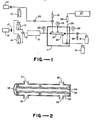
- FIGURE 1 is a flow diagram of a microbiological reactor useful in accordance with the present invention.
- the microbiological reactor 10 containing hollow fiber membranes is located within gravity convection incubator ; 11 which maintains the environment of the reactor 10 at a constant temperature.
- switching valve 12 either a growth medium contained in the vial 13 or a substrate and/or lysing medium in vial 14 may be pumped through the reactors through pump 15, which is preferably a i peristaltic pump.
- the media in vial 13 and 14 may be kept under inert atmosphere, preferably helium, which is bubbled into the vial from inert gas containing tank 16 which is filtered through a sterile filter 17.
- the liquid effluents from reactor 10 may be collected into reservoirs 18 and 19.
- Reservoir 18 is a liquid effluent from the lumen of the hollow fibers and reservoir 19 collects the liquid effluent from the shell space surrounding the lumen. Small samples of the lumen effluent may be taken off through sample tube 20.
- the reactor 10 may be inoculated with appropriate cell cultures through inoculating syringe 21. Following inoculation the same port may be used for flushing sterile, humidified air from tank 22 through humidifier 23 into reactor 10.
- the shell space outlet port 24 is located below the level of reactor 10 to allow extraneous fluid to drain from the fiber bundle. If air flow into the shell space is required, a micrometric capillary valve 25 is located upstream of the reactor 10 to control the air flow rate through the shell space.
- Shell space fluid or air samples may be directed from the shell space effluent stream via line 26 into a gas or liquid chromatograph 27 through rotameter or pump 28. Various pressures may be monitored by manometers 29 located in various lines throughout the system.
- FIGURE 2 The design of a reactor with a single hollow fiber is schematically represented in FIGURE 2.
- Cell innoculum is introduced into the shell space 31 of reactor 30 through an inoculation port, which may conveniently be 36 or 37.
- Chemotactic microorganisms are capable of moving through large diameter pores on the fiber surface into the macroporous wall matrix 32 following inoculation. This movement into the wall matrix may be enhanced by pulling a slight suction on the fiber lumen 33 if necessary to establish non-motile microbes.
- the introduction of at least one viable cell into a macropore will eventually lead to a dense cell packing as cells continue to grow and divide within the pore volume, essentially immobilizing and entrapping the actively growing cells within the wall matrix.
- Liquid phase nutrients are introduced into one end of the lumen and flow through the lumen and penetrate the lumen membrane 34 to enter the macroporous region containing the cells.
- metabolic products excreted into the extra-cellular space within the fiber wall, diffuse or convect radially in the reverse direction across the membrane 34 into the fiber lumen where they are subsequently swept from the fiber through an exit port of the fiber lumen 35.
- the substrate or lysing agent diffuses across lumen membrane. 34 into the cellular space 31.
- FIGURE 2 has been described in connection with an asymmetric hollow fiber, the design of the reactor containing an isotropic hollow fiber is essentially the same as shown in FIGURE 2 except that the cells grow on the outer fiber surface 32 rather than within the fiber wall.
- the reactor contained Dynel asymetric hollow fibers (Amicon Corporation) having dimensions of 200 micrometers I.D. x 300-500 micrometers O.D.
- the fibers were epoxied into a 5.7 centimeter by 7mm I.D. polycarbonate casing. Both ends of the reactor were sealed with epoxy leaving only the fiber lumens open to flow.
- the shell volume (total volume minus lumen volume) was 2.60 ml.
- the shell space was inoculated with aspartase synthesizing E. coli B (ATCC 1303).
- the culture was anaerobically grown to densities of 10 12 cells per cubic centimeter within and around the porous walls of the asymmetric hollow fiber membrane on a glycerol-fumarate casamino acids medium (0.086 M fumarate, 0.078 M. glycerol, 3 g. casamino acids/liter, pH 6.5-7.0, 37°C). Following the cell growth phase (usually 25-48 hrs. after inoculation).
Landscapes
- Chemical & Material Sciences (AREA)
- Organic Chemistry (AREA)
- Life Sciences & Earth Sciences (AREA)
- Engineering & Computer Science (AREA)
- Zoology (AREA)
- Wood Science & Technology (AREA)
- Genetics & Genomics (AREA)
- Health & Medical Sciences (AREA)
- Bioinformatics & Cheminformatics (AREA)
- Biotechnology (AREA)
- Biochemistry (AREA)
- General Engineering & Computer Science (AREA)
- General Health & Medical Sciences (AREA)
- Microbiology (AREA)
- Chemical Kinetics & Catalysis (AREA)
- General Chemical & Material Sciences (AREA)
- Dispersion Chemistry (AREA)
- Biomedical Technology (AREA)
- Mycology (AREA)
- Immobilizing And Processing Of Enzymes And Microorganisms (AREA)
- Preparation Of Compounds By Using Micro-Organisms (AREA)
- Micro-Organisms Or Cultivation Processes Thereof (AREA)
- Apparatus Associated With Microorganisms And Enzymes (AREA)
Applications Claiming Priority (2)
| Application Number | Priority Date | Filing Date | Title |
|---|---|---|---|
| US40804882A | 1982-08-13 | 1982-08-13 | |
| US408048 | 1999-09-29 |
Publications (2)
| Publication Number | Publication Date |
|---|---|
| EP0102207A2 true EP0102207A2 (fr) | 1984-03-07 |
| EP0102207A3 EP0102207A3 (fr) | 1986-03-26 |
Family
ID=23614641
Family Applications (1)
| Application Number | Title | Priority Date | Filing Date |
|---|---|---|---|
| EP83304550A Withdrawn EP0102207A3 (fr) | 1982-08-13 | 1983-08-05 | Méthode d'immobilisation d'enzymes |
Country Status (5)
| Country | Link |
|---|---|
| EP (1) | EP0102207A3 (fr) |
| JP (1) | JPS5995890A (fr) |
| AU (1) | AU1763083A (fr) |
| BR (1) | BR8304342A (fr) |
| CA (1) | CA1210719A (fr) |
Cited By (2)
| Publication number | Priority date | Publication date | Assignee | Title |
|---|---|---|---|---|
| EP0200069B1 (fr) * | 1985-04-27 | 1991-07-10 | Südzucker Aktiengesellschaft Mannheim/Ochsenfurt | Procédé continu pour la préparation enzymatique d'isomaltulose |
| US5916782A (en) * | 1996-03-29 | 1999-06-29 | Kyowa Hakko Kogyo Co., Ltd. | Process for producing aspartase and process for producing L-aspartic acid |
Family Cites Families (2)
| Publication number | Priority date | Publication date | Assignee | Title |
|---|---|---|---|---|
| JPS50100285A (fr) * | 1974-01-07 | 1975-08-08 | ||
| ZA824805B (en) * | 1981-10-15 | 1983-04-27 | Genex Corp | Production of aspartase |
-
1983
- 1983-08-05 AU AU17630/83A patent/AU1763083A/en not_active Abandoned
- 1983-08-05 EP EP83304550A patent/EP0102207A3/fr not_active Withdrawn
- 1983-08-05 CA CA000433986A patent/CA1210719A/fr not_active Expired
- 1983-08-12 JP JP14790683A patent/JPS5995890A/ja active Pending
- 1983-08-12 BR BR8304342A patent/BR8304342A/pt unknown
Cited By (3)
| Publication number | Priority date | Publication date | Assignee | Title |
|---|---|---|---|---|
| EP0200069B1 (fr) * | 1985-04-27 | 1991-07-10 | Südzucker Aktiengesellschaft Mannheim/Ochsenfurt | Procédé continu pour la préparation enzymatique d'isomaltulose |
| US5916782A (en) * | 1996-03-29 | 1999-06-29 | Kyowa Hakko Kogyo Co., Ltd. | Process for producing aspartase and process for producing L-aspartic acid |
| AU708588B2 (en) * | 1996-03-29 | 1999-08-05 | Kyowa Hakko Kogyo Co. Ltd. | Process for producing aspartase and process for producing L-aspartic acid |
Also Published As
| Publication number | Publication date |
|---|---|
| AU1763083A (en) | 1984-02-16 |
| EP0102207A3 (fr) | 1986-03-26 |
| BR8304342A (pt) | 1984-03-20 |
| CA1210719A (fr) | 1986-09-02 |
| JPS5995890A (ja) | 1984-06-02 |
Similar Documents
| Publication | Publication Date | Title |
|---|---|---|
| US4442206A (en) | Method of using isotropic, porous-wall polymeric membrane, hollow-fibers for culture of microbes | |
| US4440853A (en) | Microbiological methods using hollow fiber membrane reactor | |
| US5081035A (en) | Bioreactor system | |
| Yokoi et al. | Hydrogen production by immobilized cells of aciduric Enterobacter aerogenes strain HO-39 | |
| JPH07121216B2 (ja) | 撹拌型バイオリアクター及び培養器 | |
| Chang | Membrane bioreactors: engineering aspects | |
| Roy et al. | Microbial hollow fiber bioreactors | |
| Paterson et al. | Sorbitol and gluconate production in a hollow fibre membrane reactor by immobilized Zymomonas mobilis | |
| Heath et al. | Membranes and bioreactors | |
| JPH0698758A (ja) | 培養方法及び培養装置 | |
| CA1210719A (fr) | Methode d'immobilisation d'enzymes | |
| WO1984001959A1 (fr) | Production rapide de produits biologiques par fermentation dans un reacteur a membranes microbiennes a garniture dense | |
| JPH0640815B2 (ja) | バイオリアクター | |
| Hwang et al. | Continuous production of acrylamide by Brevibacterium sp. immobilized in a dual hollow fiber bioreactor | |
| CA1206433A (fr) | Production de produits biologiques a l'aide de cellules au repos | |
| Sode et al. | Continuous asymmetric reduction of 4-oxoisophorone by thermophilic bacteria using a hollow fiber reactor | |
| Yoshida et al. | Production of monoclonal antibodies with a radial-flow bioreactor | |
| Giorno | Membrane bioreactors | |
| De Araújo et al. | Aerobic immobilized cells in alginate gel particles of variable density | |
| Rucka et al. | Hollow fiber modules as a tool for enzyme and cell immobilization | |
| David et al. | Cyanobacterial biofilms in natural and synthetic environments | |
| Inloes | Immobilization of bacterial and yeast cells in hollow-fiber membrane bioreactors | |
| CA1178225A (fr) | Reacteurs microbiologiques constitues d'une membrane de fibres creuses | |
| KR890004018B1 (ko) | 전세포 효소를 세포 성장과 동시에 고정화하는 방법 | |
| Mori et al. | Vinegar production in a bioreactor with chitosan beads as supports of immobilized bacteria |
Legal Events
| Date | Code | Title | Description |
|---|---|---|---|
| PUAI | Public reference made under article 153(3) epc to a published international application that has entered the european phase |
Free format text: ORIGINAL CODE: 0009012 |
|
| AK | Designated contracting states |
Designated state(s): AT BE CH DE FR GB IT LI LU NL SE |
|
| PUAL | Search report despatched |
Free format text: ORIGINAL CODE: 0009013 |
|
| AK | Designated contracting states |
Kind code of ref document: A3 Designated state(s): AT BE CH DE FR GB IT LI LU NL SE |
|
| STAA | Information on the status of an ep patent application or granted ep patent |
Free format text: STATUS: THE APPLICATION IS DEEMED TO BE WITHDRAWN |
|
| 18D | Application deemed to be withdrawn |
Effective date: 19861127 |
|
| RIN1 | Information on inventor provided before grant (corrected) |
Inventor name: SMITH, WILLIAM JOHN Inventor name: ROBERTSON, CHANNING REX Inventor name: INLOES, DOUGLAS SCOTT Inventor name: MATIN, ABDUL Inventor name: COHEN, STANLEY NORMAN |