EP0102249A2 - Zementierung von Bohrlöchern mittels durch Scherung verdickender Polyacrylsäure-Zusammensetzungen - Google Patents
Zementierung von Bohrlöchern mittels durch Scherung verdickender Polyacrylsäure-Zusammensetzungen Download PDFInfo
- Publication number
- EP0102249A2 EP0102249A2 EP83305032A EP83305032A EP0102249A2 EP 0102249 A2 EP0102249 A2 EP 0102249A2 EP 83305032 A EP83305032 A EP 83305032A EP 83305032 A EP83305032 A EP 83305032A EP 0102249 A2 EP0102249 A2 EP 0102249A2
- Authority
- EP
- European Patent Office
- Prior art keywords
- shear
- emulsion
- conduit
- composition
- thickening
- Prior art date
- Legal status (The legal status is an assumption and is not a legal conclusion. Google has not performed a legal analysis and makes no representation as to the accuracy of the status listed.)
- Withdrawn
Links
Images
Classifications
-
- C—CHEMISTRY; METALLURGY
- C09—DYES; PAINTS; POLISHES; NATURAL RESINS; ADHESIVES; COMPOSITIONS NOT OTHERWISE PROVIDED FOR; APPLICATIONS OF MATERIALS NOT OTHERWISE PROVIDED FOR
- C09K—MATERIALS FOR MISCELLANEOUS APPLICATIONS, NOT PROVIDED FOR ELSEWHERE
- C09K8/00—Compositions for drilling of boreholes or wells; Compositions for treating boreholes or wells, e.g. for completion or for remedial operations
- C09K8/50—Compositions for plastering borehole walls, i.e. compositions for temporary consolidation of borehole walls
- C09K8/501—Compositions for plastering borehole walls, i.e. compositions for temporary consolidation of borehole walls using spacer compositions
-
- C—CHEMISTRY; METALLURGY
- C04—CEMENTS; CONCRETE; ARTIFICIAL STONE; CERAMICS; REFRACTORIES
- C04B—LIME, MAGNESIA; SLAG; CEMENTS; COMPOSITIONS THEREOF, e.g. MORTARS, CONCRETE OR LIKE BUILDING MATERIALS; ARTIFICIAL STONE; CERAMICS; REFRACTORIES; TREATMENT OF NATURAL STONE
- C04B28/00—Compositions of mortars, concrete or artificial stone, containing inorganic binders or the reaction product of an inorganic and an organic binder, e.g. polycarboxylate cements
- C04B28/001—Compositions of mortars, concrete or artificial stone, containing inorganic binders or the reaction product of an inorganic and an organic binder, e.g. polycarboxylate cements containing unburned clay
-
- C—CHEMISTRY; METALLURGY
- C09—DYES; PAINTS; POLISHES; NATURAL RESINS; ADHESIVES; COMPOSITIONS NOT OTHERWISE PROVIDED FOR; APPLICATIONS OF MATERIALS NOT OTHERWISE PROVIDED FOR
- C09K—MATERIALS FOR MISCELLANEOUS APPLICATIONS, NOT PROVIDED FOR ELSEWHERE
- C09K8/00—Compositions for drilling of boreholes or wells; Compositions for treating boreholes or wells, e.g. for completion or for remedial operations
- C09K8/42—Compositions for cementing, e.g. for cementing casings into boreholes; Compositions for plugging, e.g. for killing wells
- C09K8/426—Compositions for cementing, e.g. for cementing casings into boreholes; Compositions for plugging, e.g. for killing wells for plugging
-
- C—CHEMISTRY; METALLURGY
- C09—DYES; PAINTS; POLISHES; NATURAL RESINS; ADHESIVES; COMPOSITIONS NOT OTHERWISE PROVIDED FOR; APPLICATIONS OF MATERIALS NOT OTHERWISE PROVIDED FOR
- C09K—MATERIALS FOR MISCELLANEOUS APPLICATIONS, NOT PROVIDED FOR ELSEWHERE
- C09K8/00—Compositions for drilling of boreholes or wells; Compositions for treating boreholes or wells, e.g. for completion or for remedial operations
- C09K8/50—Compositions for plastering borehole walls, i.e. compositions for temporary consolidation of borehole walls
- C09K8/502—Oil-based compositions
-
- C—CHEMISTRY; METALLURGY
- C09—DYES; PAINTS; POLISHES; NATURAL RESINS; ADHESIVES; COMPOSITIONS NOT OTHERWISE PROVIDED FOR; APPLICATIONS OF MATERIALS NOT OTHERWISE PROVIDED FOR
- C09K—MATERIALS FOR MISCELLANEOUS APPLICATIONS, NOT PROVIDED FOR ELSEWHERE
- C09K8/00—Compositions for drilling of boreholes or wells; Compositions for treating boreholes or wells, e.g. for completion or for remedial operations
- C09K8/50—Compositions for plastering borehole walls, i.e. compositions for temporary consolidation of borehole walls
- C09K8/516—Compositions for plastering borehole walls, i.e. compositions for temporary consolidation of borehole walls characterised by their form or by the form of their components, e.g. encapsulated material
Definitions
- blow-outs occur when the drill bit cuts into a high pressure zone of gas, oil, or water which can blow out the drilling mud and sometimes even the drill stem, bit and surface equipment resulting in their loss and destruction also.
- Underground blow-outs occur when a fluid in one porous formation flows into the well bore and then out of the well bore into another porous formation.
- Lost circulation of drilling mud occurs when the drill bit cuts through a porous formation at a pressure such that drilling mud coming down the drill stem flows into the porous structure instead of being forced back up to the surface between the drill stem and well casing.
- Channeling occurs when a fluid in one porous formation flows through continuous passages in cement behind well casing into another porous formation at a different.. depth in the well.
- a number of methods and compositions have been employed in order to solve these problems, none of which has met with complete success and, in fact, most have not been too successful.
- One method of trying to stop blow-outs involves loading up the well with a slurry of barite under pressure and under conditions such that the barite is able to settle uniformly at the bottom of the well to form a hard plug which may then be followed up with a cement slurry in order to make the plug more or less permanent.
- Various methods employed to stop lost circulation include slurries of barite along with fibrous, lumpy or flakey materials which it is hoped will ultimately form a filter cake and then a mat over the porous formation and thus plug it up.
- gunk is a slurry of dry, powdered bentonite in diesel oil.
- the bentonite will hydrate yielding a stiff paste. If formed at the right time and at the right place, this sometimes works as an effective lost circulation and well-plugging material.
- This type of material and method for its use is disclosed, for example, in U.S. 3,082,823.
- U.S. 3,082,823 U.S. 3,082,823.
- the slurry must be kept dry until it reaches the desired formation in the well bore at which time it must be mixed with the proper amount of water in order to form a paste and not an emulsion or a slurry of hydrated benetonite.
- U.S. 3,448,800 discloses a plugging method for restoring lost circulation in a well wherein a suspension or slurry of a particulate, water-soluble polymer in a non-aqueous medium is injected into a well.
- U.S. 2,836,555 discloses a well plugging composition for restoring lost circulation in wells which comprises compressed, dehydrated pellets of bentonite encapsulated within a solid, water-insoluble polymeric coating which has a tiny hole drilled through the surface thereof.
- U.S. 2,890,169 discloses another well control or lost circulation fluid which is made by forming a slurry of an organophilic bentonite and cement in oil.
- This slurry is mixed with a surfactant and water to form a composition
- a surfactant and water to form a composition
- a surfactant and water to form a composition
- a surfactant and water to form a composition
- a surfactant and water to form a composition
- a surfactant and water to form a composition
- a surfactant and water to form a composition
- a surfactant and water to form a composition
- the oil expands and flocculates the bentonite which, under the right conditions, forms a filter cake on the well bore surface in the porous area.
- U.S. 3,909,421 discloses a high viscosity fluid useful in secondary oil recovery processes. This fluid is made by physically blending a dry, powdered polyacrylamide with bentonite followed by mixing the powder blend with water.
- 4,128,598 claims a powdered bentonite- polyacrylamide thickening composition prepared by mixing a water-in-oil emulsion with bentonite to form a damp, free-flowing powdered composition which rapidly forms a viscous, stiff material when mixed with water.
- This invention relates to a process for plugging or sealing a porous earth formation which comprises contacting said porous formation with a shear thickening fluid or composition under conditions of shear sufficient to form a paste from the shear thickening composition which plugs or seals the porous formation.
- the shear thickening composition useful in the process of this invention comprises a water-in-oil emulsion having particles of hydrophilic, water swellable clay dispersed in the continuous, oily phase thereof, wherein said oily phase comprises a hydrocarbon liquid having an amine derivative surfactant dissolved therein and the dispersed aqueous phase of the emulsion comprises an aqueous solution of a polyacrylamide and polyacrylic acid.
- the combination of amine derivative surfactant in the oil phase and polyacrylamide polymer and polyacrylic acid in the dispersed aqueous phase results in an unexpected formation of a coating or membrane film around each droplet of dispersed aqueous phase.
- the pH of the aqueous phase is above about 4.5, then the coating or membrane will not form.
- an important feature of this invention is that the pH of the dispersed aqueous phase must be no greater than about 4.5. It is preferred that the pH of this aqueous phase be between from about 2.5 to 4.5.
- the shear thickening composition When used as a well control fluid, the shear thickening composition will be pumped down into the well through a conduit, such as drill pipe, until it reaches the portion of the well bore that is to be plugged. At that point it will be subject to conditions of relatively high shear to form a paste to plug the well bore.
- the high shear may be achieved by forcing the shear thickening composition through the holes of a drill bit at the end of the drill pipe.
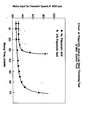
- the attached Figure is a graph illustrating how the presence of polyacrylic acid in the aqueous phase increases the low shear thickening time of the shear thickening composition useful in the process of this invention.
- shear thickening composition is meant that the application of shear to the composition useful in the process of this invention will result in the formation of a sticky, rubber-like paste or solid, whose strength and integrity is a function of the intensity and duration of the shear forces employed as well as the particular formulation utilized. The greater the shear rate the faster the paste is-formed and the stronger it will be.
- the clay When the clay is mixed or dispersed into the emulsion it slowly starts to adsorb water. Thus, if one mixes or disperses the clay into the emulsion very gently, using relatively low shear forces and then allows the so-formed composition of this invention to remain undisturbed, the clay will settle out on the bottom and slowly start to adsorb water and ultimately congeal. If sufficient time has elapsed and the settled clay starts to congeal, the shear force required to redisperse the clay will rapidly form a paste. Thus, it is preferred to use the composition of this invention as soon as possible after preparing same.
- shear thickening is a term of art and is difficult to quantify with precision. If one intends to use the process of this invention for well control, one may use low shear devices such as those normally used for mixing cement at a well site (i.e., for cementing behind well casing) to form the shear-thickening composition useful in this invention. Illustrative, but non-limiting examples of such devices include Halliburton ribbon or turbine blenders and cement mixers. After the shear thickening composition has been formed it will be pumped down the drill pipe at a rate broadly ranging from about 0.1 to 10 barrels per minute (bpm) wherein it will be subject to relatively low shear rates broadly ranging from less than about 1 to about 1,000 sec.- I .
- bpm barrels per minute
- the shear strength of the paste formed from the shear thickening fluid or composition is expressed in pounds per 100 ft. 2 as opposed to pounds per ft. 2 , because 100 ft. 2 roughly corresponds to the internal-area of-a 90--ft-. string of drill pipe having an inside diameter of about 4 inches.
- this shear strength may be determined by forming between about 400 or 500 grams of the shear thickening composition and then placing same in a low shear mixing cell for evaluation.
- This mixing cell is a jacketed glass beaker with internal dimensions of approximately three and one-half inches deep and two and one-half inches wide.
- the beaker is fitted with a Plexiglass cover through which a hole is drilled to receive the shaft of an egg beater impeller.
- the egg beater impeller has a diameter of one and a half inches, is two and a quarter inches long and is placed in the beaker so that it just clears the bottom. Sufficient composition is placed in the beaker so that it just covers the top of the impeller.
- Hot water is circulated through the jacket of the beaker in order to maintain the contents thereof at a temperature of about 120 o C.
- the egg beater impeller is rotated at a speed of 500 rpm until the composition starts to gel.
- the point at which the fluid abruptly thickens is defined as the low shear thickening time. This point is quite reproducible and the impeller shaft at this point requires an abrupt increase in input of 90 mv in order to maintain the 500 rpm. In most instances the point of low shear thickening is accompanied by an obvious change in the physical appearance of the dispersion.
- the composition After the composition starts to gel, it is then placed in a high shear test cylinder containing a floating piston.
- the cylinder has a one quarter inch ball valve opening at one end and the other end is pressurized by nitrogen at about 1500 psi.
- the sample is placed in the high shear piston cell, the -floating piston placed behind the sample, the cell is sealed and then pressurized with nitrogen at about 1500 psi behind the piston.
- the ball valve After the chamber is pressurized, the ball valve is opened and the sample is forced through the one quarter inch opening in considerably less than one second which forms a stiff paste substantially instantaneously.
- the shear strength of the so-formed paste is measured by noting the distance that a hollow, aluminum cylinder 3.5 inches long x 1.4 inches wide with a wall thickness of .01 inches sinks into the paste under the force of-,various weights after a period of 20 seconds.
- The. shear strength is then calculated from the following expression:
- shear strength is expressed in pounds per 100 ft. 2 as opposed to pounds per ft. 2 , because 100 ft. 2 roughly corresponds to the internal area of a 90 ft. string of drill pipe having an inside diameter of about 4 inches.
- clays useful in the composition of this invention are hydrophilic, water- swellable clays. This includes those clays which are well known to those skilled in the art as useful in well drilling and well control operations. Particularly preferred are montmorillonite and bentonite clays. Species of these clays include beidellite, nontronite, hectorite, and saponite. As a practical matter, cost considerations may dictate that the clays used in this invention will be the sodium montmorillonite or bentonite clays. A commercially available clay that has been found to be useful in this invention are Volclays available from the American Colloid Company. These clays are 90% montmorillonite with about 70-75% of the montmorillonite in the sodium form.
- Granular clay is preferred to powdered clay. It has been found that the larger the clay particle size used in the shear thickening composition useful in the process of this invention, the longer will be the low shear thickening time and the more clay can be used at a given viscosity. In well control processes, the upper limit of the clay particle size will be limited to that which can pass through the holes in the drill bit. For most applications, it will be preferred to use granular clay having a particle size ranging between about 10 to 200 Tyler mesh and, preferably 40 to 200 mesh although 10-60 mesh clay has also been successfully used in the practice of this invention. If this invention is to be used for well control purposes, then granular clay should be used and preferably granular clay that has had fines removed. Hydrophobic clays, such as those made by reacting bentonite with one or more long chain hydrocarbon quaternary ammonia compounds, are not included in the scope of this invention.
- the continuous, oily phase of the emulsion will be a liquid which is immiscible with water and with the interior aqueous phase of the emulsion.
- this will comprise any oil or hydrocarbon liquid, typically a mineral oil.
- oily liquids that have been tried and found to work as the oily phase include paraffinic hydrocarbons such as Low Odor Paraffin Solvent (LOPS) available from the Exxon Chemical Company and Norpan 13 and Solvent 100 Neutral (S-100N) available from Exxon Company U.S.A., respectively, as well as solvents having an appreciable aromatic content such as Mentor 28 and Mentor 32 which are available from the Exxon Company U.S.A.
- LOPS Low Odor Paraffin Solvent
- S-100N Solvent 100 Neutral
- kerosene and diesel fuel will also work, but not as well as the others. That is, the use of kerosene and diesel fuel will result in a reduction of the low shear thickening time and pumpability of the shear thickening fluid and result in a weaker paste. Further, it should be emphasized again that the exact nature of the oil is not critical as long as it is not miscible with the aqueous internal phase of the emulsion and does not react with the clay or any of the other components of the composition.
- the continuous, oily, water immiscible phase of the emulsion must contain one or more oil soluble amine derivative and preferably polyamine derivative surfactants for forming and stabilizing the emulsion.
- Surfactants that have been found to be particularly useful in the composition of this invention comprise alkylene polyamine derivatives of polyalkenyl succinic anhydrides. These materials are known to those skilled in the art and are taught, for example, in U.S. Patent No. 3,172,892, the disclosures of which are incorporated herein by reference. Also useful are borated and carboxylated derivatives of these materials such as those disclosed in U.S. 4,173,540 and British Patent 1,018,982, respectively, the disclosures of which are also incorporated herein by reference.
- the polyalkenyl succinic anhydrides useful in preparing these surfactants will generally comprise those wherein the polyalkenyl group has a M n , number average molecular weight, of about 700 to 5,000, preferably 900 to 2;000.
- the methods of preparation are well known in the art, i.e., reaction of maleic anhydride with either the polyolefin itself or with a chlorinated polyolefin which in either case provides the desired polyalkenyl succinic anhydride.
- Polyisobutylene is preferred but other polymers of C 3 or C 4 olefins such as polybutene-1 and polypropylene are suitable, including mixtures of such polyolefins.
- Polyisobutylene succinic anhydride is referred herein as PIBSA.
- Preferred alkylene polyamines are also well-known and are represented by the formula NH 2 (CH 2 ) n -(NH(CH 2 ) n ) m NH 2 , wherein n is 2 to 3 and m is 0 to 10.
- Illustrative are ethylene diamine, diethylene triamine, triethylene tetramine, tetraethylene pentamine, pentaethylene hexamine, and the like.
- the aqueous phase of the emulsion must comprise an aqueous solution of both a polyacrylamide polymer and a polyacrylic acid.
- Both anionic or partially hydrolyzed polyacrylamide and nonionic or unhydrolyzed polyacrylamide will work in this invention, but nonionic polyacrylamide is preferred.
- a wide variety of commercially available polyacrylic acids with molecular weights ranging from about 30,000 to 4,000,000 have been found to work effectively in this invention. Illustrative, but non-limiting examples include Acrysol A-I, A-3 and A-5 available from the Rohm & Haas Company as well as Polysciences, Inc.'s Nos. 3326, 3312 and 6501 and Colloids, Inc.'s X-0067-66A, X-0098-NK-99A and X-0102-NK-25.
- Polyacrylamides having molecular weights ranging from 100,000 to 6,000,000 have been successfully used in the shear thickening composition of this invention. It has been found that higher molecular weight polyacrylamides impart a more rubbery, elastomeric character to the pastes formed by subjecting the compositions of this invention to relatively high shear. That is, the higher the molecular weight of the water soluble polyacrylamide used in the composition of this invention, the greater will be both the shear strength and integrity of the so-formed paste, even in the presence of flowing fluids, such as gas, oil, brine, water, etc. However, the higher the molecular weight of the polyacrylamide used the higher will be the viscosity of the resulting solution. On the other hand, lower molecular weight polyacrylamides give lower viscosities, but require the use of more polyacrylic acid.
- shear-thickening composition useful in the process of this invention will vary somewhat depending upon the nature and molecular weight of the amine derivative surfactant, polyacrylamide, polyacrylic acid, the nature of the oil, etc.
- the following table based on 100 parts by weight of 10-60 mesh (Tyler) granular KWK clay, illustrates the general and preferred ranges of the various ingredients to each other of the shear thickening composition of this invention.
- a number of different methods may be employed to prepare the composition useful in the process of this invention, the. precise method used being dictated by the convenience of the user.
- one may form a dispersion of the clay in the surfactant containing oil.
- an aqueous solution of polyacrylamide and polyacrylic acid may be added to the oily dispersion to form a water-in-oil emulsion wherein the aqueous solution is emulsified in the clay-containing continuous oily phase.
- this method one may mix the oil, surfactant and clay in any order without affecting the performance of the composition of this invention before the aqueous solution is emulsified into the oily phase.
- the emulsion of this invention is not stable inasmuch as the coating or film around each droplet of dispersed aqueous phase slowly disappears as time progresses. As this film disappears or dissolves into the emulsion, the low shear thickening time enhancement declines. Agitation and elevated temperature both accelerate this aging process.
- a laboratory sample rolled in an 8 oz. jar for 5 days at 120°F resulted in a total loss of low shear thickening time enhancement. Examination of the emulsion in a microscope at the end of the 5 days revealed no more polymeric film remaining on the surface of the dispersed microdroplets of aqueous phase.
- the size of the microdroplets of dispersed aqueous phase is larger (i.e., 10-500 microns) than those of similar emulsions without polyacrylic acid in the aqueous phase (10-100 microns).
- Emulsions of this invention have been made with dispersed droplets as big as 5,000 microns and work satisfactorily in the shear thickening composition of this invention. It is preferred that the average droplet size be greater than 100 microns. Laboratory tests have shown that the larger the droplet size of the dispersed aqueous phase, the greater will be the strength of the paste. This is in marked contrast to the same type of shear thickening composition, but without containing polyacrylic acid where the smaller droplet sizes are preferred.
- the aqueous phase of the composition useful in the process of this invention may also contain one or more low molecular weight alcohols or glycols as antifreezes to prevent the aqueous phase of the emulsion from freezing at low temperatures. This may be particularly desirable if one intends to use the composition of this invention in cold weather. Any of the commonly used antifreezes may be employed in the aqueous phase of the composition of this invention such as methanol, isopropanol, ethylene glycol, propylene glycol, etc. When an antifreeze is employed in the aqueous phase of this emulsion, it will generally be employed in said aqueous phase in an amount broadly ranging from about 10 to 35 wt. % thereof.
- a little more than one drum (about 460 lbs) of a PIBSA-polyamine derivative surfactant will be dissolved into twelve drums (about 4100 Ibs) of oil such as Norpar 13.
- oil such as Norpar 13.
- an oil external emulsion or water-in-oil emulsion will then be formed by slowly adding the aqueous polymer solution to the oil while mixing with a marine propeller or the like.
- the rate of addition of polymer water to the oil will be no greater than about 1 bbl. (42 gallons) per minute.
- the resulting emulsion will be circulated several times through a triplex pump to ensure complete emulsification.
- Drilling mud will then be used to displace or push the shear-thickening fluid through the drill pipe to the zone desired to be plugged in the well bore.
- the drilling mud will be pumped into the drill pipe at a rate of about three barrels per minute.
- the drilling mud will then be pumped into the drill pipe at a rate of about .six barrels per minute so that the shear-thickening fluid is sheared through the drill bit nozzles at a rate of about six barrels per minute.
- This example demonstrates the low shear-thickening time enhancement of the composition of this invention using polyacrylic acid in the dispersed aqueous phase, compared to the same composition without invention.
- Acrysol A-3 is a 25 wt.% aqueous solution of polyacrylic acid which has a molecular weight of less than 150,000.
- Another sample of shear-thickening composition was made using the same ingredients and procedure used to form the shear-thickening composition of this invention, except that the aqueous phase did not contain any polyacrylic acid.
- This experiment demonstrates the effect of the polyacrylic acid concentration in the aqueous phase of the shear thickening composition and its relation to both low shear thickening time and the strength of the paste formed from the shear-thickening composition.
- the shear thickening composition of this invention was made by dissolving 8 grams of the borated PIBSA-polyamine derivative surfactant, referred to in Example 1, into 72 grams of solvent 100 Neutral oil followed by dispersing the aqueous phase into the oil using a lab type propeller mixer at a speed of 1,000 rpm to form the water-in-oil emulsion, followed by dispersing 120 grams of the clay in the so-formed emulsion using a spatula.
- the aqueous phase in all cases was 200 grams of an aqueous solution annular space between the drill pipe and well casing after being, pumped through the drill bit nozzles.
- the well contained about 13,000 feet of casing having an I.D.
- a shear-thickening fluid of this invention having the following composition was prepared using the procedure outlined in the description on pages 15 and 16.
- Polymer A was American Cyanamid's P-250 polyacrylamide
- polymer B was Rohm and Haas's Acrysol A-3 polyacrylic acid
- the oil used was-Norpan 13 from Exxon Company U.S.A.
- the surfactant was a borated derivative of the reaction product of polyisobutylene which was prepared by condensing 2.1 moles of polyisobutenyl succinic anhydride having a Saponification Number of 112 and a number average molecular wt. (M n ) of about 900 dissolved in a neutral mineral oil to provide a 50 weight percent solution, with one mole of said alkylene polyamine.
- the procedure used to prepare this surfactant was the same procedure used in Example 2 of U.S. 4,173,540.
- the clay was a 40-200 Tyler mesh MX-80 clay obtained from the American Colloid Company.
- Twenty-two barrels of the emulsion were prepared, fourteen of which were used to prepare the shear thickening fluid with the remaining eight barrels of the emulsion set aside for use as spacers and transferred to a tank on a pump truck. Thirteen sacks (1300 lbs.) of the clay were. added to the remaining emulsion in a Halliburton turbine blender to form the 15 barrels of the shear-thickening fluid. After the shear-thickening fluid was prepared, twenty barrels of water were pumped into the drill pipe to insure that the pump lines and drill pipe were not plugged and to clean the lines.
- the twenty barrel water flush was followed by three barrels of the emulsion spacer, fifteen barrels of the shear thickening fluid, five barrels of emulsion spacer and, finally twenty barrels of water post flush.
- the viscosity of the emulsion used as spacers has been incr.eased by circulating same through a Triplex pump several times using the procedure set forth on page 15.
- the viscosity of the emulsion spacer was less than that of the shear thickening fluid, but greater than that of the drilling mud. It should be noted that there was drilling mud in the pipe prior to the introduction of the water flush, emulsion spacer and shear-thickening fluid.
- the shear-thickening fluid and emulsion spacers were pumped into the drill pipe using a triplex pump. After the water flush, the emulsion spacers and shear-thickening fluid were pumped into the drill pipe at a rate of about 3 barrels per minute. The shear-thickening fluid and spacers were displaced or pushed down through the drill pipe with drilling mud which was pumped at a rate of about 5 barrels per minute. The shear-thickening fluid was pumped out through the drill bit to form the paste and plug the annular space between the drill pipe and well casing. The so-formed plug (paste column) had a strength greater than 1000 lb/ 100 ft 2 .
Landscapes
- Chemical & Material Sciences (AREA)
- Life Sciences & Earth Sciences (AREA)
- General Life Sciences & Earth Sciences (AREA)
- Engineering & Computer Science (AREA)
- Materials Engineering (AREA)
- Organic Chemistry (AREA)
- Ceramic Engineering (AREA)
- Inorganic Chemistry (AREA)
- Chemical Kinetics & Catalysis (AREA)
- Dispersion Chemistry (AREA)
- Structural Engineering (AREA)
- Oil, Petroleum & Natural Gas (AREA)
- Colloid Chemistry (AREA)
- Lubricants (AREA)
- Excavating Of Shafts Or Tunnels (AREA)
- Drilling Tools (AREA)
- Soil Working Implements (AREA)
Applications Claiming Priority (4)
| Application Number | Priority Date | Filing Date | Title |
|---|---|---|---|
| US41345582A | 1982-08-31 | 1982-08-31 | |
| US413455 | 1982-08-31 | ||
| US51690583A | 1983-07-25 | 1983-07-25 | |
| US516905 | 1983-07-25 |
Publications (2)
| Publication Number | Publication Date |
|---|---|
| EP0102249A2 true EP0102249A2 (de) | 1984-03-07 |
| EP0102249A3 EP0102249A3 (de) | 1984-05-23 |
Family
ID=27022191
Family Applications (1)
| Application Number | Title | Priority Date | Filing Date |
|---|---|---|---|
| EP83305032A Withdrawn EP0102249A3 (de) | 1982-08-31 | 1983-08-31 | Zementierung von Bohrlöchern mittels durch Scherung verdickender Polyacrylsäure-Zusammensetzungen |
Country Status (2)
| Country | Link |
|---|---|
| EP (1) | EP0102249A3 (de) |
| NO (1) | NO162395B (de) |
Cited By (2)
| Publication number | Priority date | Publication date | Assignee | Title |
|---|---|---|---|---|
| EP0165560A3 (en) * | 1984-06-19 | 1986-02-05 | Basf Aktiengesellschaft | Process for improving the properties of aqueous solutions of polymers used in oil recovery by flooding |
| RU2157880C1 (ru) * | 1999-03-10 | 2000-10-20 | Евстифеев Сергей Владиленович | Состав для изоляции водопритоков в скважине |
Family Cites Families (3)
| Publication number | Priority date | Publication date | Assignee | Title |
|---|---|---|---|---|
| FR2396791A1 (fr) * | 1977-07-08 | 1979-02-02 | Elf Aquitaine | Microemulsions utilisables comme " spacers " de cimentation |
| CA1139928A (en) * | 1979-09-27 | 1983-01-25 | Evelyn N. Drake | Shear thickening fluid |
| CA1137739A (en) * | 1979-09-27 | 1982-12-21 | Donald J. Mintz | Thickener composite from a water swellable material, oil-surfactant phase and a polymer |
-
1983
- 1983-08-30 NO NO833113A patent/NO162395B/no unknown
- 1983-08-31 EP EP83305032A patent/EP0102249A3/de not_active Withdrawn
Cited By (2)
| Publication number | Priority date | Publication date | Assignee | Title |
|---|---|---|---|---|
| EP0165560A3 (en) * | 1984-06-19 | 1986-02-05 | Basf Aktiengesellschaft | Process for improving the properties of aqueous solutions of polymers used in oil recovery by flooding |
| RU2157880C1 (ru) * | 1999-03-10 | 2000-10-20 | Евстифеев Сергей Владиленович | Состав для изоляции водопритоков в скважине |
Also Published As
| Publication number | Publication date |
|---|---|
| NO833113L (no) | 1984-03-01 |
| EP0102249A3 (de) | 1984-05-23 |
| NO162395B (no) | 1989-09-11 |
Similar Documents
| Publication | Publication Date | Title |
|---|---|---|
| US4445576A (en) | Method of using a spacer for well control fluid | |
| US4442241A (en) | Shear thickening composition | |
| US4475594A (en) | Plugging wellbores | |
| US4542791A (en) | Method for plugging wellbores with polycarboxylic acid shear thickening composition | |
| CA2455994C (en) | Shear-sensitive plugging fluid for plugging and a method for plugging a subterranean formation zone | |
| US5407909A (en) | Earth support fluid composition and method for its use | |
| US6518224B2 (en) | Drilling fluids | |
| US4397354A (en) | Method of using a well treating fluid | |
| US4663366A (en) | Shear thickening composition with polycarboxylic acid | |
| US6818598B2 (en) | Shear-sensitive plugging fluid for plugging and a method for plugging a subterranean formation zone | |
| US20050113260A1 (en) | Drilling fluids | |
| OA10197A (en) | Plugging liquid for plugging a subterranean formation zone | |
| US4683953A (en) | Shear thickening compositions containing polyacrylic acid and polyacrylamide, their preparation and use | |
| JPH04505026A (ja) | ユーインタアイト含有水濡れ性穿孔用泥漿添加物 | |
| EP1646702B1 (de) | Verzögertes phasenwechsel-additiv für inverte emulsions bohrflüssigkeitem | |
| US3196619A (en) | Method for disposing of harmful organic waste materials | |
| CA1241828A (en) | Shear thickening composition with polyacrylic acid | |
| CA2371122C (en) | Shear-sensitive plugging fluid for plugging and a method for plugging a subterranean formation zone | |
| EP0037418B1 (de) | Durch scherkraft verdickende flüssigkeit | |
| EP0038817B1 (de) | Durch scherkraft verdickendes bohrschacht-behandlungsmittel | |
| US3738934A (en) | Oil base drilling fluid composition and process | |
| WO1994002567A1 (en) | Earth support fluid composition and method for its use | |
| CA2518747A1 (en) | Improved drilling fluids |
Legal Events
| Date | Code | Title | Description |
|---|---|---|---|
| PUAI | Public reference made under article 153(3) epc to a published international application that has entered the european phase |
Free format text: ORIGINAL CODE: 0009012 |
|
| AK | Designated contracting states |
Designated state(s): AT CH DE FR GB LI NL SE |
|
| PUAL | Search report despatched |
Free format text: ORIGINAL CODE: 0009013 |
|
| AK | Designated contracting states |
Designated state(s): AT CH DE FR GB LI NL SE |
|
| 17P | Request for examination filed |
Effective date: 19841115 |
|
| STAA | Information on the status of an ep patent application or granted ep patent |
Free format text: STATUS: THE APPLICATION HAS BEEN WITHDRAWN |
|
| 18W | Application withdrawn |
Withdrawal date: 19860605 |
|
| RIN1 | Information on inventor provided before grant (corrected) |
Inventor name: DRAKE, EVELYN NOBLES Inventor name: CALCAVECCHIO, PETER |