EP0102302B1 - Beutel für medizinischen Gebrauch, insbesondere bestimmt für parenterale Ernährung - Google Patents
Beutel für medizinischen Gebrauch, insbesondere bestimmt für parenterale Ernährung Download PDFInfo
- Publication number
- EP0102302B1 EP0102302B1 EP83401732A EP83401732A EP0102302B1 EP 0102302 B1 EP0102302 B1 EP 0102302B1 EP 83401732 A EP83401732 A EP 83401732A EP 83401732 A EP83401732 A EP 83401732A EP 0102302 B1 EP0102302 B1 EP 0102302B1
- Authority
- EP
- European Patent Office
- Prior art keywords
- bag
- frame
- sheets
- flat
- Prior art date
- Legal status (The legal status is an assumption and is not a legal conclusion. Google has not performed a legal analysis and makes no representation as to the accuracy of the status listed.)
- Expired
Links
- 230000003014 reinforcing effect Effects 0.000 claims abstract description 6
- 239000000463 material Substances 0.000 claims description 21
- 229920003023 plastic Polymers 0.000 claims description 20
- 239000004033 plastic Substances 0.000 claims description 20
- 239000000203 mixture Substances 0.000 claims description 12
- -1 polyethylene Polymers 0.000 claims description 9
- 239000004698 Polyethylene Substances 0.000 claims description 8
- 229920000573 polyethylene Polymers 0.000 claims description 8
- 230000004888 barrier function Effects 0.000 claims description 5
- 239000007789 gas Substances 0.000 claims description 5
- 229920002689 polyvinyl acetate Polymers 0.000 claims description 5
- 239000011118 polyvinyl acetate Substances 0.000 claims description 5
- 239000000725 suspension Substances 0.000 claims description 5
- 229920001328 Polyvinylidene chloride Polymers 0.000 claims description 4
- 239000005033 polyvinylidene chloride Substances 0.000 claims description 4
- 231100000331 toxic Toxicity 0.000 claims description 4
- 230000002588 toxic effect Effects 0.000 claims description 4
- 229910052782 aluminium Inorganic materials 0.000 claims description 3
- XAGFODPZIPBFFR-UHFFFAOYSA-N aluminium Chemical compound [Al] XAGFODPZIPBFFR-UHFFFAOYSA-N 0.000 claims description 3
- 238000003856 thermoforming Methods 0.000 claims description 3
- 238000003466 welding Methods 0.000 claims description 3
- 238000001746 injection moulding Methods 0.000 claims description 2
- 238000003860 storage Methods 0.000 claims description 2
- 239000004411 aluminium Substances 0.000 claims 1
- 229910052751 metal Inorganic materials 0.000 claims 1
- 239000002184 metal Substances 0.000 claims 1
- 230000001473 noxious effect Effects 0.000 claims 1
- 239000004014 plasticizer Substances 0.000 claims 1
- 239000003440 toxic substance Substances 0.000 claims 1
- 239000010410 layer Substances 0.000 description 19
- 238000004519 manufacturing process Methods 0.000 description 8
- 150000001413 amino acids Chemical class 0.000 description 7
- WQZGKKKJIJFFOK-GASJEMHNSA-N Glucose Natural products OC[C@H]1OC(O)[C@H](O)[C@@H](O)[C@@H]1O WQZGKKKJIJFFOK-GASJEMHNSA-N 0.000 description 5
- 239000008103 glucose Substances 0.000 description 5
- 230000000050 nutritive effect Effects 0.000 description 5
- XLYOFNOQVPJJNP-UHFFFAOYSA-N water Substances O XLYOFNOQVPJJNP-UHFFFAOYSA-N 0.000 description 5
- 239000011521 glass Substances 0.000 description 4
- 238000001802 infusion Methods 0.000 description 4
- 239000007788 liquid Substances 0.000 description 4
- 235000016236 parenteral nutrition Nutrition 0.000 description 4
- 239000002985 plastic film Substances 0.000 description 4
- 235000016709 nutrition Nutrition 0.000 description 3
- 229920000915 polyvinyl chloride Polymers 0.000 description 3
- 239000004800 polyvinyl chloride Substances 0.000 description 3
- 238000003973 irrigation Methods 0.000 description 2
- 230000002262 irrigation Effects 0.000 description 2
- 238000005304 joining Methods 0.000 description 2
- 230000035764 nutrition Effects 0.000 description 2
- 239000000654 additive Substances 0.000 description 1
- 239000012736 aqueous medium Substances 0.000 description 1
- QVGXLLKOCUKJST-UHFFFAOYSA-N atomic oxygen Chemical compound [O] QVGXLLKOCUKJST-UHFFFAOYSA-N 0.000 description 1
- WQZGKKKJIJFFOK-VFUOTHLCSA-N beta-D-glucose Chemical compound OC[C@H]1O[C@@H](O)[C@H](O)[C@@H](O)[C@@H]1O WQZGKKKJIJFFOK-VFUOTHLCSA-N 0.000 description 1
- 230000015572 biosynthetic process Effects 0.000 description 1
- 239000008280 blood Substances 0.000 description 1
- 210000004369 blood Anatomy 0.000 description 1
- 150000001720 carbohydrates Chemical class 0.000 description 1
- 235000014633 carbohydrates Nutrition 0.000 description 1
- 238000004040 coloring Methods 0.000 description 1
- 150000001875 compounds Chemical class 0.000 description 1
- 239000000470 constituent Substances 0.000 description 1
- 238000005520 cutting process Methods 0.000 description 1
- 239000003814 drug Substances 0.000 description 1
- 229940079593 drug Drugs 0.000 description 1
- 239000003792 electrolyte Substances 0.000 description 1
- 239000000839 emulsion Substances 0.000 description 1
- 238000000605 extraction Methods 0.000 description 1
- 239000004744 fabric Substances 0.000 description 1
- 239000012530 fluid Substances 0.000 description 1
- 210000001035 gastrointestinal tract Anatomy 0.000 description 1
- 239000004615 ingredient Substances 0.000 description 1
- 239000007924 injection Substances 0.000 description 1
- 238000002347 injection Methods 0.000 description 1
- 150000002632 lipids Chemical class 0.000 description 1
- 230000004048 modification Effects 0.000 description 1
- 238000012986 modification Methods 0.000 description 1
- 235000015097 nutrients Nutrition 0.000 description 1
- 235000008935 nutritious Nutrition 0.000 description 1
- 150000002894 organic compounds Chemical class 0.000 description 1
- 239000001301 oxygen Substances 0.000 description 1
- 229910052760 oxygen Inorganic materials 0.000 description 1
- 239000000123 paper Substances 0.000 description 1
- 239000002245 particle Substances 0.000 description 1
- 239000002504 physiological saline solution Substances 0.000 description 1
- 229920006255 plastic film Polymers 0.000 description 1
- 238000002360 preparation method Methods 0.000 description 1
- 230000001681 protective effect Effects 0.000 description 1
- 102000004169 proteins and genes Human genes 0.000 description 1
- 108090000623 proteins and genes Proteins 0.000 description 1
- 238000007789 sealing Methods 0.000 description 1
- 229920002379 silicone rubber Polymers 0.000 description 1
- 235000000346 sugar Nutrition 0.000 description 1
- 150000008163 sugars Chemical class 0.000 description 1
- 239000002344 surface layer Substances 0.000 description 1
- 239000011573 trace mineral Substances 0.000 description 1
- 235000013619 trace mineral Nutrition 0.000 description 1
- 235000013343 vitamin Nutrition 0.000 description 1
- 239000011782 vitamin Substances 0.000 description 1
- 229940088594 vitamin Drugs 0.000 description 1
- 229930003231 vitamin Natural products 0.000 description 1
Images
Classifications
-
- A—HUMAN NECESSITIES
- A61—MEDICAL OR VETERINARY SCIENCE; HYGIENE
- A61J—CONTAINERS SPECIALLY ADAPTED FOR MEDICAL OR PHARMACEUTICAL PURPOSES; DEVICES OR METHODS SPECIALLY ADAPTED FOR BRINGING PHARMACEUTICAL PRODUCTS INTO PARTICULAR PHYSICAL OR ADMINISTERING FORMS; DEVICES FOR ADMINISTERING FOOD OR MEDICINES ORALLY; BABY COMFORTERS; DEVICES FOR RECEIVING SPITTLE
- A61J1/00—Containers specially adapted for medical or pharmaceutical purposes
- A61J1/05—Containers specially adapted for medical or pharmaceutical purposes for collecting, storing or administering blood, plasma or medical fluids ; Infusion or perfusion containers
- A61J1/10—Bag-type containers
-
- Y—GENERAL TAGGING OF NEW TECHNOLOGICAL DEVELOPMENTS; GENERAL TAGGING OF CROSS-SECTIONAL TECHNOLOGIES SPANNING OVER SEVERAL SECTIONS OF THE IPC; TECHNICAL SUBJECTS COVERED BY FORMER USPC CROSS-REFERENCE ART COLLECTIONS [XRACs] AND DIGESTS
- Y10—TECHNICAL SUBJECTS COVERED BY FORMER USPC
- Y10S—TECHNICAL SUBJECTS COVERED BY FORMER USPC CROSS-REFERENCE ART COLLECTIONS [XRACs] AND DIGESTS
- Y10S215/00—Bottles and jars
- Y10S215/90—Collapsible wall structure
Definitions
- the present invention relates to bags for medical use, and more specifically relates to bags intended for parenteral feeding.
- Parenteral feeding is an artificial mode of nutrition which consists in bringing intravenously to a patient, who can no longer eat totally or partially using the physiological digestive tract, all the elements necessary for his nutrition.
- parenteral nutrition must be total, it is desirable to rationally combine the three types of nutrients: carbohydrates, in the form of glucose most often, proteins, in the form of balanced mixtures of amino acids, lipids, as well as additives such as electrolytes, trace elements, and vitamins, which are in the form of emulsions, solutes, and suspensions in water, which are injectable.
- the industrial association of glucose and amino acids within the same aqueous medium is difficult because of the Maillard reaction.
- the combination of reducing sugars with amino acids leads to the formation of new organic compounds whose coloring ranges from yellow to dark brown, and this reaction has other drawbacks, in particular the appearance of active or non-metabolizable compounds , even toxic, and above all a modification of the nutritional value of the mixture.
- the nutritive mixture is generally prepared extemporaneously, or in the 24 hours which precede the administration to the patient.
- a set has long been used comprising a small glass vial filled with amino acids and capped under vacuum, a larger volume vial partially filled with glucose and capped under vacuum, as well as a tube provided with a end of a perforator and a built-in air intake, and at the other end of a perforation needle.
- this tubing and its perforators the operator transfers the amino acids from the small bottle into the glucose contained in the large bottle, thanks to the vacuum in the latter.
- handling errors are relatively frequent, that handling of the vials is not carried out under good aseptic conditions, and that a non-negligible part of the amino acids does not transfer into glucose. so that it is necessary to add an air intake to the bottle to be emptied.
- these glass bottles have the disadvantages of being awkward to store and delicate to transport.
- Reusable bags made of silicone elastomer, which were initially replaced by glass bottles, have recently been replaced by disposable plastic bags, most often polyvinyl chloride, or polyethylene polyvinylacetate, inspired by the production of bags of liquids usually used in infusion.
- Such a pocket is most often made up of two rectangular sheets of plastic material welded flat one on the other on four sides, so as to delimit between the two sheets and the four welded sides, a tank whose volume is zero until it is filled under pressure.
- a reinforcing element also made of plastic, is inserted between the two opposite faces of the two sheets and welded to the latter, and this reinforcing element has perforations through which it is possible to hang or hang the pocket.
- one or more tubes are introduced between the two sheets and welded to the latter in a sealed manner to allow the filling or emptying of the pocket, as well as the extemporaneous addition of additional medication to the nutritious mixture possibly contained in this pocket.
- a pocket of this type is described. in U.S. patents 3,788,369 and FR. 2,431,289, and pockets of neighboring structure are described in U.S. Patents 3,740,770 and 3,342,326.
- plastic sheets used have a relatively large thickness, which is generally between 300 and 400 microns.
- the production of these pockets therefore results in a significant consumption of plastic materials, and, in their application to parenteral nutrition, the nutritive mixtures must be prepared in these pockets, extemporaneously or shortly before administration to the patient, because, as has already been specified, and unlike fluids usually used in infusion, parenteral feeding mixtures are fragile and the amino acids they include are easily oxidizable by oxygen in the air.
- these bags in their application to parenteral nutrition, are used as a means of administration of a nutritive mixture prepared extemporaneously, and not as a means of storing a ready-to-use nutritive mixture, prepared industrially and also carried in his pocket.
- the invention aims to provide a bag having a vacuum of practically zero volume, therefore easy to store, which can be filled without the need to exercise significant pressure on its faces, and therefore on the welds, so that the bag is less fragile to transport when filled.
- Another object of the invention is also a pocket which has sufficient mechanical strength, although the plastic sheets used for the production of these faces are much less thick than in the prior art.
- Another object of the invention is to produce a bag having no sealing problem at the level of the passages of the pipes.
- the object of the invention is to produce ready-to-use bags, prepared and filled on an industrial scale with nutritive mixtures intended for parenteral nutrition, and in which it is possible to store and transport these mixtures, these bags can finally also be used as a means of administration.
- a bag according to the invention intended to contain injectable products, and which has two faces each consisting of a flexible sheet comprising at least one layer of plastic material, is characterized in that it comprises a frame of semi-rigid plastic frame with flat faces, and in that the two sheets, each of which is shaped and rounded, for example by thermoforming, and has substantially the shape of at least one bowl with a flat bottom, are secured in a sealed manner, for example by press welding, by parts of sheets which surround the concave part of each bowl, on either side of the frame, each on one of the two flat faces of the latter, so that the sheets are nested one inside the other at rest, on the same side of the plane of symmetry passing through the thickness of the frame, in order to delimit, between the two sheets and in at least one opening of the frame, a variable volume chamber, and the volume is practically zero when the pocket is at rest.
- the latter which open on the one hand outside the pocket and, on the other hand, inside the pocket between the two sheets of the latter, pass through the thickness of one side of the frame and preferably extend towards the outside of the frame by end caps.
- the frame of a pocket according to the invention is advantageously produced in one piece by injection molding under press.
- the two sheets of a pocket each have at least one part which extends beyond at least one side of the frame crossed by at least one tube, and which delimits with the corresponding part of the other sheet , and to which it is preferably secured, an annex pocket for protecting the pipes, and possibly the ends of the latter. It is thus essential to open the additional protective pocket, either by tearing it, possibly at a part of less resistance provided for this purpose, or by cutting it, in order to access the pipes.
- the bag according to the invention comprises at least two tubes, one of which is definitively closed after filling the bag,
- one of the sides of the frame which is not crossed by pipes has at least one hooking and / or hanging pocket opening and / or at least one 'hooking member and / or hanging from the pocket.
- each sheet of the pouch consists of a complex film of materials in thin layers, comprising at least one layer which constitutes a barrier impermeable to atmospheric gases and to water vapor, for example made of polyvinylidene chloride, sandwiched between at least two layers, at least one of which, located towards the inside of the pocket, is made of a compatible material with the contents of the bag, and does not contain harmful, toxic or plasticizing elements which are extractable by this content, for example made of polyethylene polyvinylacetate.
- the assembly formed by these three layers can itself be sandwiched between two layers of a plastic material, for example polyethylene.
- each complex film constituting one of the sheets of the pocket comprises at least one thin metallic layer, for example aluminum.
- the latter is preferably made of the same plastic material as the layer of the complex film with which it comes into contact through its flat faces.
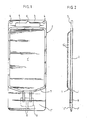
- the pocket shown in Figures 1 and 2 comprises two transparent sheets 1, each consisting of a complex film of thin layers of plastic.
- This complex film which always comprises at least one layer constituting a tight barrier to atmospheric gases and water vapor, comprises in a first embodiment, a central layer of polyvinylidene chloride sandwiched between two layers of polyethylene polyvinylacetate .
- This set of three layers, in which the central layer of polyvinylidene chloride constitutes the waterproof barrier can itself be sandwiched between two layers of another plastic material, for example polyethylene, or any other plastic material compatible with the contents of the bag, and containing no plasticizing elements such as polyvinyl chloride, nor harmful or toxic ingredients which can be extracted by the contents of the bag.
- the complex films in which the sheets 1 are cut do not necessarily have a symmetrical structure, and this structure can not only comprise a greater or lesser number of plastics in thin layers but also a thin metallic layer, for example a layer of aluminum, which will not be placed on one side of the film.
- the two flexible sheets 1 which constitute the faces of the pocket each have an initial planar and rectangular shape. On most of their surfaces, each of these two sheets 1 is shaped and curved by thermoforming, so that it has substantially the shape of a dish with a flat bottom 1 ', surrounded by a flat rim, and adjacent along a part of this rim to the flat, undeformed part 1 "of the sheet 1.
- the depth of the flat-bottomed bowl 1 ′ is limited to a few centimeters and chosen according to the final volume of the pocket that the 'we wish to obtain.
- the pocket also includes a semi-rigid frame frame 2, the two lateral faces of which are flat, and which has a single central opening, the shape of which in plan corresponds substantially to that of the dished portion in a flat-bottomed bowl 1 'of each sheet 1.
- the width of the flat edges of the frame 2 which surround its central opening is substantially equal to that of the flat rim of each sheet 1 which surrounds the part of the latter shaped as a flat-bottomed bowl 1' , except at an enlarged side 3 of the frame 2.
- This enlarged side 3 has two circular lateral perforations 4, intended to allow the suspension and the attachment of the frame 2 to a bracket or the passage of suspension members and d hooking the frame 2 to a bracket, as well as an elongated central perforation 5 which delimits a grip and transport handle for the user and which has a central notch 6 on the side opposite to the opening of the frame, in order to allow also t the attachment and suspension of the frame 2 either directly or using an attachment member.
- the frame 2 has on its side 7 opposite to the enlarged side 3 two tubes made up of tubular end pieces 8 projecting relative to the side 7 towards the outside of the frame 2, in the direction opposite to the central opening of the latter, and the axial passage conduits of the end pieces 8 extend in the thickness of the side 7 and open into the central opening of the frame 2.
- the frame 2 is produced by injection under press of a plastic material which is that of the surface layers of the complex films of the sheets 1 against which the frame 2 comes into contact, during assembly of the bag.
- This assembly is carried out by press welding of the flat rim of each of the sheets 1 "which surrounds the part in the form of a flat-bottomed bowl 1 'against one of the flat faces of the frame 2, around the central opening of the latter. so that the two sheets 1 are tightly joined to the frame 2 on either side of the latter 2.
- the sheets 1 are welded to the frame 2 asymmetrically, being arranged so that the two concave parts substantially in the form of a flat-bottomed bowl 1 ′ are nested one inside the other, as is clearly shown in FIG. 2.
- the sheets 1 Facing the opening of the frame 2, the sheets 1 are therefore not arranged symmetrically l 'vis-à-vis the other relative to the plane of symmetry which passes through the thickness of the frame 2, but on the same side of this plane of symmetry, and the pocket at rest therefore has a volume practically no.
- the bag has a large volume, of the order of 40% of its maximum volume, which can be filled without exerting pressure and without any notable stress is applied to the sheets 1 and therefore to the welds.
- This notably reduces the risks of rupture of the sheets 1 and of the welds of these sheets on the frame 2.
- the filling of the pocket can then be completed to its maximum volume by stretching the sheets, but at equal maximum volume, a pocket thus produced is considerably less stressed at the welds and the films of the faces than a pocket of the prior art, so that the risks of permanent deformation and rupture are reduced.
- the hanging or hanging devices of the pocket are only connected to the frame 2 by its enlarged side 3, the mechanical resistance of the pocket is improved, because all the pressure stresses are transmitted by the frame 2 to the members hanging.
- the thickness of the films used to make the sheets 1 can be limited to 100 microns, while it often reaches 400 microns in the pockets of the prior art.
- a pocket according to FIGS. 1 and 2 offers a volume much greater than that of the pockets of the state of the art with the same surface in plan. At equal maximum volume, the surface of the frame can therefore be reduced, and this also constitutes an advantage insofar as the consumption of plastic film is reduced.
- the flat parts 1 "of the sheets 1, which extend beyond the side 7 of the frame 2 through which the pipes 8 pass, are welded to each other along their edge and envelop the pipes 8 in an annex protection pocket, whose closure guarantees inviolability.
- a flap 9, delimited in one of the parts 1 "by a line of least resistance, allows, by tearing, to open this annex pocket and access at least one of the pipes 8, for example that which is not permanently blocked after filling the bag, if the latter is sold ready to use.
- the bags according to the invention can advantageously be used as parenteral feeding bags, filled on an industrial scale, then stored and transported and finally distributed ready for use for administration to a patient.
- the reinforcing frame has several openings, it is possible to produce multiple pockets if the sheets of complex film are welded to the frame so that they delimit with the frame several chambers with variable volume.
- these bags can also be used as bags for blood, for bladder irrigation, infusion, transfusion, etc.
Landscapes
- Health & Medical Sciences (AREA)
- Hematology (AREA)
- Pharmacology & Pharmacy (AREA)
- Life Sciences & Earth Sciences (AREA)
- Animal Behavior & Ethology (AREA)
- General Health & Medical Sciences (AREA)
- Public Health (AREA)
- Veterinary Medicine (AREA)
- Medical Preparation Storing Or Oral Administration Devices (AREA)
- Infusion, Injection, And Reservoir Apparatuses (AREA)
- Bag Frames (AREA)
Claims (11)
Priority Applications (1)
| Application Number | Priority Date | Filing Date | Title |
|---|---|---|---|
| AT83401732T ATE21028T1 (de) | 1982-09-02 | 1983-09-01 | Beutel fuer medizinischen gebrauch, insbesondere bestimmt fuer parenterale ernaehrung. |
Applications Claiming Priority (2)
| Application Number | Priority Date | Filing Date | Title |
|---|---|---|---|
| FR8215008A FR2532550B1 (fr) | 1982-09-02 | 1982-09-02 | Poches a usage medical, et en particulier destinees a l'alimentation parenterale |
| FR8215008 | 1982-09-02 |
Publications (3)
| Publication Number | Publication Date |
|---|---|
| EP0102302A2 EP0102302A2 (de) | 1984-03-07 |
| EP0102302A3 EP0102302A3 (en) | 1984-04-04 |
| EP0102302B1 true EP0102302B1 (de) | 1986-07-30 |
Family
ID=9277194
Family Applications (1)
| Application Number | Title | Priority Date | Filing Date |
|---|---|---|---|
| EP83401732A Expired EP0102302B1 (de) | 1982-09-02 | 1983-09-01 | Beutel für medizinischen Gebrauch, insbesondere bestimmt für parenterale Ernährung |
Country Status (7)
| Country | Link |
|---|---|
| US (1) | US4559053A (de) |
| EP (1) | EP0102302B1 (de) |
| JP (1) | JPS5964060A (de) |
| AT (1) | ATE21028T1 (de) |
| CA (1) | CA1192867A (de) |
| DE (1) | DE3364955D1 (de) |
| FR (1) | FR2532550B1 (de) |
Families Citing this family (22)
| Publication number | Priority date | Publication date | Assignee | Title |
|---|---|---|---|---|
| US4732299A (en) * | 1986-02-10 | 1988-03-22 | Hoyt Earl E | Collapsible container |
| US5017338A (en) * | 1986-04-11 | 1991-05-21 | The Center For Blood Research, Inc. | Platelet concentrates |
| CH686778A5 (fr) * | 1987-05-29 | 1996-06-28 | Vifor Medical Ag | Récipient destiné au stockage séparé de composés actifs et à leur mélange subséquent. |
| US4943287A (en) * | 1989-07-17 | 1990-07-24 | Miles Inc. | Red blood cell storage system |
| US5257985A (en) * | 1989-12-04 | 1993-11-02 | Richard Puhl | Multi-chamber intravenous bag apparatus |
| US5364385A (en) * | 1990-05-09 | 1994-11-15 | Lifesource Advanced Blood Bank Systems, Inc. | Storage bag for blood and blood components |
| EP0515896B1 (de) * | 1991-05-16 | 1996-09-11 | Cellpack Ag | Beutel |
| US6872197B1 (en) * | 1997-11-14 | 2005-03-29 | Schering Ag | Tank for administering flowable substances |
| JP2001522708A (ja) * | 1997-11-14 | 2001-11-20 | シエーリング アクチエンゲゼルシヤフト | 流動性物質を投与するためのリザーバ |
| US6464666B1 (en) * | 1999-10-08 | 2002-10-15 | Augustine Medical, Inc. | Intravenous fluid warming cassette with stiffening member and integral handle |
| US7048132B2 (en) * | 2002-08-28 | 2006-05-23 | Yoshino Kogyosho Co., Ltd. | Synthetic resin bottle |
| WO2008153718A1 (en) * | 2007-05-29 | 2008-12-18 | Cdi Seals, Inc. | One-piece blow-molded container with rigid fitment |
| USD622375S1 (en) * | 2007-07-19 | 2010-08-24 | Otsuka Pharmaceutical Factory, Inc. | Portion of an infusion solution bag |
| BRPI0909323B1 (pt) * | 2008-03-10 | 2020-05-12 | N.V. Nutricia | Embalagem para alimentação gota a gota e método para produzir uma embalagem de alimentação gota a gota |
| FR2929253B1 (fr) * | 2008-03-28 | 2013-09-13 | Sartorius Stedim Biotech Sa | Cadre rigide pour conteneur 3d a contenant au moins partiellement deformable |
| EP2421951B1 (de) * | 2009-04-23 | 2013-07-17 | Hemarina | Bioreaktor mit sauerstoffhaltigen Molekulen |
| WO2011083055A1 (en) | 2010-01-05 | 2011-07-14 | Novo Nordisk A/S | Method for forming collapsible reservoir |
| USD703548S1 (en) | 2011-07-11 | 2014-04-29 | Applesauce Project Inc. | Energy drink package |
| BR112014029427A2 (pt) * | 2012-06-08 | 2017-06-27 | Nutricia Nv | recipiente para um produto nutricional líquido; embalagem estéril previamente preenchida; e método de provisão de embalagem estéril previamente preenchida contendo nutrição enteral |
| EP2916799A1 (de) * | 2012-11-07 | 2015-09-16 | Sanofi-Aventis Deutschland GmbH | Schutzverpackung für einen behälter |
| US10576018B2 (en) * | 2016-07-19 | 2020-03-03 | Carefusion 303, Inc. | Reconstitution device for IV fluids and method of use |
| JP7613004B2 (ja) * | 2020-06-03 | 2025-01-15 | ニプロ株式会社 | 経腸栄養剤用のパウチ容器 |
Family Cites Families (14)
| Publication number | Priority date | Publication date | Assignee | Title |
|---|---|---|---|---|
| US1494950A (en) * | 1921-11-17 | 1924-05-20 | David H Clark | Container |
| US2950029A (en) * | 1956-10-29 | 1960-08-23 | Hedwin Corp | Container |
| US3028863A (en) * | 1959-10-14 | 1962-04-10 | Roger P Mattson | Disposable enema units |
| US3278109A (en) * | 1963-06-14 | 1966-10-11 | E S & A Robinson Holdings Ltd | Bag, carton and package |
| US3342326A (en) * | 1965-10-22 | 1967-09-19 | Johnson & Johnson | Sterile flexible package |
| US3520471A (en) * | 1968-10-09 | 1970-07-14 | Union Carbide Corp | Flexible plastic container |
| ES113075Y (es) * | 1970-02-25 | 1975-04-16 | Kalle A. G. | Un recipiente en forma de bolsa de hoja bastante flexible ysuficientemente autosustentadora. |
| US3788369A (en) * | 1971-06-02 | 1974-01-29 | Upjohn Co | Apparatus for transferring liquid between a container and a flexible bag |
| US3740770A (en) * | 1971-06-21 | 1973-06-26 | Kendall & Co | Integral edge structure for urine collection bag |
| DE7526045U (de) * | 1975-08-16 | 1975-12-11 | Hoechst Ag | Beutel mit Einstichstelle |
| US4191231A (en) * | 1977-07-22 | 1980-03-04 | Baxter Travenol Laboratories, Inc. | Flexible collapsible containers, and method of molding |
| US4248223A (en) * | 1978-03-20 | 1981-02-03 | Turner Charles R | Self-priming parenteral administering apparatus |
| IT1097040B (it) * | 1978-07-20 | 1985-08-26 | Montedison Spa | Sacca in films termoplastici composti per il prelievo e la conservazione di sangue da trasfusione |
| US4411364A (en) * | 1982-01-19 | 1983-10-25 | Stone Container Corporation | Skin-packaged pouches of the retort or like type |
-
1982
- 1982-09-02 FR FR8215008A patent/FR2532550B1/fr not_active Expired
-
1983
- 1983-08-11 CA CA000434342A patent/CA1192867A/en not_active Expired
- 1983-08-12 US US06/522,669 patent/US4559053A/en not_active Expired - Fee Related
- 1983-09-01 DE DE8383401732T patent/DE3364955D1/de not_active Expired
- 1983-09-01 EP EP83401732A patent/EP0102302B1/de not_active Expired
- 1983-09-01 AT AT83401732T patent/ATE21028T1/de not_active IP Right Cessation
- 1983-09-02 JP JP58162486A patent/JPS5964060A/ja active Pending
Also Published As
| Publication number | Publication date |
|---|---|
| US4559053A (en) | 1985-12-17 |
| CA1192867A (en) | 1985-09-03 |
| DE3364955D1 (en) | 1986-09-04 |
| JPS5964060A (ja) | 1984-04-11 |
| ATE21028T1 (de) | 1986-08-15 |
| FR2532550A1 (fr) | 1984-03-09 |
| EP0102302A2 (de) | 1984-03-07 |
| FR2532550B1 (fr) | 1986-01-17 |
| EP0102302A3 (en) | 1984-04-04 |
Similar Documents
| Publication | Publication Date | Title |
|---|---|---|
| EP0102302B1 (de) | Beutel für medizinischen Gebrauch, insbesondere bestimmt für parenterale Ernährung | |
| CA2841030C (fr) | Kit pour la conservation d'un produit biologique comprenant une poche tridimensionnelle et une enveloppe tridimensionnelle adaptee | |
| EP0427588B1 (de) | Anlage zur Verabreichung steriler Flüssigkeiten, insbesondere pharmazeutischer, nahrhafter oder energetischer Flüssigkeiten | |
| US6652144B2 (en) | Beverage container pouch | |
| EP2645981B1 (de) | Beutel zum verteilen eines produkts zur biopharmazeutischen verwendung im allgemeinen zustand einer flüssigkeit oder paste über mehrere auslassports | |
| FR2698852A1 (fr) | Distributeur de liquide, et cartouche pour ce distributeur. | |
| EP0816252B1 (de) | Verpackung für biologische Flüssigkeiten mit aufreissbarer Folie zur Einführung einer Sonde | |
| FR2622675A1 (fr) | Enceinte destinee a contenir des fluides de maniere etanche | |
| EP2542474A1 (de) | Verfahren zur herstellung von sterilen flexiblen mit einem produkt gefüllten beuteln, im besonderen mit einer therapeutischen flüssigkeit, und entsprechende beutel | |
| EP1799174B1 (de) | Speicheranordnung für kontrastmedien | |
| US20040118859A1 (en) | Fluid container pouch | |
| FR2962901A1 (fr) | Tubulure pour le conditionnement d'une solution de perfusion prete a l'emploi destinee a etre administree par voie parenterale | |
| EP1722840B1 (de) | Automatische transfusionsvorrichtung für die konsekutive abgabe von zwei lösungen | |
| FR2752410A1 (fr) | Recipient non rigide tel que sachet ou poche permettant plusieurs ponctions ou injections sans perdre son etancheite | |
| EP0358001A1 (de) | Vorrichtung zum Stillen | |
| FR3027220A1 (fr) | Ensemble pour le stockage de produits a usage medical | |
| EP2193775A1 (de) | Flexibler Behälter für den medizinischen Einsatz | |
| FR2925465A1 (fr) | Emballage souple pour produit alimentaire fluide. | |
| WO2023020858A1 (fr) | Emballage étanche d'un produit alimentaire fluide | |
| EP0363272A1 (de) | Verpackung | |
| JP6650815B2 (ja) | 包装袋セット | |
| FR2618682A1 (fr) | Dispositif pour la fermeture et le raccordement de recipients pour liquides de perfusion | |
| FR2707161A1 (fr) | Système d'alimentation pour bébés et nourrissons à éléments nettoyables ou jetables, permettant de limiter l'aérophagie après tétée. | |
| WO2006090025A1 (fr) | Recipient etanche destine a former tout ou partie d'un biberon | |
| FR2505189A1 (fr) | Sac en pellicules thermoplastiques composites pour extraire et conserver des solutions de perfusion, en particulier du sang de transfusion et procede pour la fabrication de ce sac |
Legal Events
| Date | Code | Title | Description |
|---|---|---|---|
| PUAI | Public reference made under article 153(3) epc to a published international application that has entered the european phase |
Free format text: ORIGINAL CODE: 0009012 |
|
| PUAL | Search report despatched |
Free format text: ORIGINAL CODE: 0009013 |
|
| AK | Designated contracting states |
Designated state(s): AT BE CH DE GB IT LI LU NL SE |
|
| AK | Designated contracting states |
Designated state(s): AT BE CH DE GB IT LI LU NL SE |
|
| 17P | Request for examination filed |
Effective date: 19840907 |
|
| GRAA | (expected) grant |
Free format text: ORIGINAL CODE: 0009210 |
|
| AK | Designated contracting states |
Kind code of ref document: B1 Designated state(s): AT BE CH DE GB IT LI LU NL SE |
|
| REF | Corresponds to: |
Ref document number: 21028 Country of ref document: AT Date of ref document: 19860815 Kind code of ref document: T |
|
| ITF | It: translation for a ep patent filed | ||
| REF | Corresponds to: |
Ref document number: 3364955 Country of ref document: DE Date of ref document: 19860904 |
|
| PG25 | Lapsed in a contracting state [announced via postgrant information from national office to epo] |
Ref country code: LU Free format text: LAPSE BECAUSE OF NON-PAYMENT OF DUE FEES Effective date: 19860930 |
|
| PLBE | No opposition filed within time limit |
Free format text: ORIGINAL CODE: 0009261 |
|
| STAA | Information on the status of an ep patent application or granted ep patent |
Free format text: STATUS: NO OPPOSITION FILED WITHIN TIME LIMIT |
|
| 26N | No opposition filed | ||
| PGFP | Annual fee paid to national office [announced via postgrant information from national office to epo] |
Ref country code: LU Payment date: 19890809 Year of fee payment: 7 |
|
| PGFP | Annual fee paid to national office [announced via postgrant information from national office to epo] |
Ref country code: SE Payment date: 19890810 Year of fee payment: 7 |
|
| PGFP | Annual fee paid to national office [announced via postgrant information from national office to epo] |
Ref country code: CH Payment date: 19890828 Year of fee payment: 7 |
|
| PGFP | Annual fee paid to national office [announced via postgrant information from national office to epo] |
Ref country code: GB Payment date: 19890831 Year of fee payment: 7 |
|
| PGFP | Annual fee paid to national office [announced via postgrant information from national office to epo] |
Ref country code: BE Payment date: 19890908 Year of fee payment: 7 |
|
| PGFP | Annual fee paid to national office [announced via postgrant information from national office to epo] |
Ref country code: AT Payment date: 19890928 Year of fee payment: 7 |
|
| ITTA | It: last paid annual fee | ||
| PGFP | Annual fee paid to national office [announced via postgrant information from national office to epo] |
Ref country code: NL Payment date: 19890930 Year of fee payment: 7 Ref country code: DE Payment date: 19890930 Year of fee payment: 7 |
|
| PG25 | Lapsed in a contracting state [announced via postgrant information from national office to epo] |
Ref country code: GB Effective date: 19900901 Ref country code: AT Effective date: 19900901 |
|
| PG25 | Lapsed in a contracting state [announced via postgrant information from national office to epo] |
Ref country code: SE Effective date: 19900902 |
|
| PG25 | Lapsed in a contracting state [announced via postgrant information from national office to epo] |
Ref country code: LI Effective date: 19900930 Ref country code: CH Effective date: 19900930 Ref country code: BE Effective date: 19900930 |
|
| BERE | Be: lapsed |
Owner name: SYNTHELABO Effective date: 19900930 |
|
| PG25 | Lapsed in a contracting state [announced via postgrant information from national office to epo] |
Ref country code: NL Effective date: 19910401 |
|
| GBPC | Gb: european patent ceased through non-payment of renewal fee | ||
| NLV4 | Nl: lapsed or anulled due to non-payment of the annual fee | ||
| REG | Reference to a national code |
Ref country code: CH Ref legal event code: PL |
|
| PG25 | Lapsed in a contracting state [announced via postgrant information from national office to epo] |
Ref country code: DE Effective date: 19910601 |
|
| EUG | Se: european patent has lapsed |
Ref document number: 83401732.9 Effective date: 19910527 |