EP0102594A2 - Verfahren zur Herstellung von Olefinen - Google Patents
Verfahren zur Herstellung von Olefinen Download PDFInfo
- Publication number
- EP0102594A2 EP0102594A2 EP83108396A EP83108396A EP0102594A2 EP 0102594 A2 EP0102594 A2 EP 0102594A2 EP 83108396 A EP83108396 A EP 83108396A EP 83108396 A EP83108396 A EP 83108396A EP 0102594 A2 EP0102594 A2 EP 0102594A2
- Authority
- EP
- European Patent Office
- Prior art keywords
- stage
- polyaromatic
- hydrocarbon fraction
- bar
- hydrogenation
- Prior art date
- Legal status (The legal status is an assumption and is not a legal conclusion. Google has not performed a legal analysis and makes no representation as to the accuracy of the status listed.)
- Granted
Links
Classifications
-
- C—CHEMISTRY; METALLURGY
- C10—PETROLEUM, GAS OR COKE INDUSTRIES; TECHNICAL GASES CONTAINING CARBON MONOXIDE; FUELS; LUBRICANTS; PEAT
- C10G—CRACKING HYDROCARBON OILS; PRODUCTION OF LIQUID HYDROCARBON MIXTURES, e.g. BY DESTRUCTIVE HYDROGENATION, OLIGOMERISATION, POLYMERISATION; RECOVERY OF HYDROCARBON OILS FROM OIL-SHALE, OIL-SAND, OR GASES; REFINING MIXTURES MAINLY CONSISTING OF HYDROCARBONS; REFORMING OF NAPHTHA; MINERAL WAXES
- C10G65/00—Treatment of hydrocarbon oils by two or more hydrotreatment processes only
- C10G65/02—Treatment of hydrocarbon oils by two or more hydrotreatment processes only plural serial stages only
- C10G65/04—Treatment of hydrocarbon oils by two or more hydrotreatment processes only plural serial stages only including only refining steps
- C10G65/08—Treatment of hydrocarbon oils by two or more hydrotreatment processes only plural serial stages only including only refining steps at least one step being a hydrogenation of the aromatic hydrocarbons
-
- C—CHEMISTRY; METALLURGY
- C10—PETROLEUM, GAS OR COKE INDUSTRIES; TECHNICAL GASES CONTAINING CARBON MONOXIDE; FUELS; LUBRICANTS; PEAT
- C10G—CRACKING HYDROCARBON OILS; PRODUCTION OF LIQUID HYDROCARBON MIXTURES, e.g. BY DESTRUCTIVE HYDROGENATION, OLIGOMERISATION, POLYMERISATION; RECOVERY OF HYDROCARBON OILS FROM OIL-SHALE, OIL-SAND, OR GASES; REFINING MIXTURES MAINLY CONSISTING OF HYDROCARBONS; REFORMING OF NAPHTHA; MINERAL WAXES
- C10G2400/00—Products obtained by processes covered by groups C10G9/00 - C10G69/14
- C10G2400/20—C2-C4 olefins
Definitions
- the invention relates to a process for the production of low molecular weight olefins from heavy hydrocarbons with a hydrogenating pretreatment and a subsequent thermal cleavage of at least part of the hydrogenation product.
- Light feedstocks are required for the splitting of hydrocarbons for the production of olefins, i.e. Hydrocarbons with a boiling point below 200 ° C, for example naphtha, are particularly suitable. They lead to high splitting yields and result in few undesirable by-products.
- the invention has for its object to design a method of the type mentioned in such a way that it can be operated under particularly favorable economic conditions and in which the conversion in the low-polyaromatic hydrocarbon fraction is also as low as possible.
- This object is achieved in that the hydrogenation is carried out in two stages, the polyaromatic content of a first, polyaromatic-rich hydrocarbon fraction being selectively degraded in the first stage, and the hydrocarbons being refined in the second stage, and a second stage in addition heavy, low-aromatic hydrocarbon fraction is fed ..
- the procedure according to the invention leads to high olefin yields which are equivalent to those of naphtha.
- the partially joint processing of a polyaromatic rich and a low polyaromatic hydrocarbon fraction results in significantly better product qualities in the hydrogenated fractions.
- the quality of the product portion achieved with a boiling point higher than 340 ° C corresponds to products in conventional processes for which considerably higher hydrogenation pressures are required.
- the invention is based on the knowledge that the refining on at least partially split (cracked) molecules takes place considerably better than on uncracked molecules (polyaromatics). It is believed that this is due to the fact that in the hydrogenation of the polyaromatic-rich hydrocarbon fraction, essentially only the polyaromatic compounds are hydrogenated and cracked (selective degradation), but not the monoaromatic compounds. Thus, in the second hydrogenation stage, the double bonds are hydrated and, at the same time, further desulphurization of the insert takes place under conditions which are considerably easier than in conventional processes. As a result of the dilution of the hydrogenated product fraction from the first stage by a fraction low in polyaromatics, the thermodynamic equilibrium is also favorably influenced.
- the space velocity in the first stage is advantageously 0.5 to 4 h -1 , preferably 1 to 2 h -1 , and in the second stage 1 to 6 h, preferably 2 to 4 h
- vacuum gas oil is used as the polyaromatic-rich hydrocarbon fraction and atmospheric gas oil as the polyaromatic-poor hydrocarbon fraction.
- vacuum gas oil (VGO) was used as the polyaromatic-rich hydrocarbon fraction and atmospheric gas oil (AGO) with the properties according to Table 1 as the low-polyaromatic hydrocarbon fraction.
- Table 4 lists the product yields of the first and second stage in the inventive common GO AGO + V H ydrie- tion are combined and the product distributions for the separate AGO VGO and workup.
- the yields of product fractions are given in% by weight based on the use.
- the two-stage joint hydrogenation of AGO and VGO shows very great advantages with regard to the achievable degradation rates compared to the single-stage, separate mode of operation.
- 99.36% sulfur compounds, 99.8% N-base degradation, 86.18% polyaromatic and 88.2% bromine number degradation are achieved in two stages in the VGO cut. These values are excellent for a 100 bar hydrogenation and far exceed the values of the single-stage, separate hydrogenation treatment.
- the differences that can be achieved at AGO are smaller, since the refining of this cut is much easier.
- the process according to the invention achieves a hydrogenation yield at 100 bar, which corresponds to a hydrogenation product which is achieved at a pressure which is higher than 50 bar.
Landscapes
- Chemical & Material Sciences (AREA)
- Oil, Petroleum & Natural Gas (AREA)
- Engineering & Computer Science (AREA)
- Chemical Kinetics & Catalysis (AREA)
- General Chemical & Material Sciences (AREA)
- Organic Chemistry (AREA)
- Organic Low-Molecular-Weight Compounds And Preparation Thereof (AREA)
- Production Of Liquid Hydrocarbon Mixture For Refining Petroleum (AREA)
- Catalysts (AREA)
Abstract
Description
- Die Erfindung betrifft ein Verfahren zur Herstellung niedermolekularer Olefine aus schweren Kohlenwasserstoffen mit einer hydrierenden Vorbehandlung und einer nachfolgenden thermischen Spaltung mindestens eines Teiles des Hydrierproduktes.
- Für die Spaltung von Kohlenwasserstoffen zur Herstellung von Olefinen sind leichte Einsatzmaterialien, d.h. Kohlenwasserstoffe mit einem Siedepunkt unterhalb von 200 °C, beispielsweise Naphtha, besonders geeignet. Sie führen zu hohen Spaltausbeuten und ergeben wenig unerwünschten Nebenprodukte.
- Der große Bedarf derartiger günstiger Spalteinsätze kann zu einer Verknappung öder Preissteigerung dieser Stoffe führen. Es wird deshalb seit einiger Zeit der Versuch unternommen, Verfahren zu entwickeln, die auch die günstige Verwertung eines höher siedenden Einsatzmaterials erlauben.
- Die Verwertung höher siedender Einsätze führt grundsätzlich zu geringeren Ausbeuten an wertvollen Spaltprodukten, während gleichzeitig in zunehmendem Maße eine nur schwer verwertbare, über 200 °C siedende Kohlenwasserstofffraktion anfällt. Daneben entstehen noch weitere Schwierigkeiten dadurch, daß höher siedende Einsätze zu verstärkten Koks-und Teerbildungen in der-Spaltanlage führen. Diese Produkte, die sich an den Wänden der Leitungselemente, beispielsweise Rohrleitungen und Wärmetauscher, ablagern, bedingen damit eine Verschlechterung der Wärmeübertragung und führen außerdem zu Querschnittsverengungen. Es ist deshalb erforderlich, häufiger Entfernungen dieser Ablagerungen durchzuführen als bei einer Verwendung leichter Kohlenwasserstoffe.
- Zur Lösung dieses Problems ist aus der DE-OS 21 64 951 ein Verfahren bekannt, bei dem schwere Kohlenwasserstoffe vor der thermischen Spaltung katalytisch hydriert werden. Dadurch wird der'Gehalt an aromatischen, insbesondere polyzyklischen aromatischen, Verbindungen, die im wesentlichen zu den unerwünschten Spaltprodukten führen, im Einsatzmaterial verringert. Darüberhinaus findet auch eine Entschwefelung des Einsatzmaterials statt.
- Der Erfindung liegt die Aufgabe zugrunde, ein Verfahren der eingangs genannten Art so auszugestalten, daß es unter besonders günstigen wirtschaftlichen Bedingungen betrieben werden kann und bei dem überdies die Konversion bei der polyaromatenarmen Kohlenwasserstofffraktion möglichst gering ist.
- Diese Aufgabe wird erfindungsgemäß dadurch gelöst, daß die Hydrierung in zwei Stufen durchgeführt wird, wobei in der ersten Stufe der Polyaromatengehalt einer ersten, polyaromatenreichen Kohlenwasserstofffraktion selektiv abgebaut wird, und in der zweiten Stufe eine Raffination der Kohlenwasserstoffe erfolgt, und der zweiten Stufe überdies eine zweite schwere, polyaromatenarme Kohlenwasserstofffraktion zugeführt wird..
- Die erfindungsgemäße Verfahrensweise führt zu hohen Olefinausbeuten, die denen von Naphtha gleich kommt. Durch die teilweise gemeinsamen Verarbeitung einer polyaromatenreichen und einer polyaromatenarmen Kohlenwasserstofffraktion werden wesentlich bessere Produktqualitäten in den hydrierten Fraktionen erzielt. Insbesondere die erzielte Qualität des Produktanteils mit einem Siedepunkt höher als 340 °C entspricht bei herkömmlichen Verfahren Produkten, für die erheblich höhere Hydrierdrücke erforderlich sind. Durch die gemeinsame Aufarbeitung einer polyaromatenreichen und einer polyaromatenarmen Kohlenwasserstofffraktion entfällt bei äußerst geringem Schwefelgehalt in den hydrierten Produktfraktionen überdies gegenüber den konventionellen Verfahren ein Hochdruckreaktor für die Entschwefelung der polyaromatenarmen Fraktion.
- Die Erfindung beruht auf der Erkenntnis, daß die Raffination an zumindest teilweise gespaltenen (gecrackten) Molekülen erheblich besser erfolgt als an ungecrackten Molekülen (Polyaromaten). Es wird angenommen, daß dies darauf zurückzuführen ist, daß bei der Hydrierung der polyaromatenreichen Kohlenwasserstofffraktion im wesentlichen nur die polyaromatischen Verbindungen hydriert und gecrackt werden (selektiver Abbau), nicht aber die monoaromatischen Verbindungen. Somit erfolgt in der zweiten Hydrierstufe die Aufhydrierung der Doppelbindungen und gleichzeitig eine weitergehende Entschwefelung des Einsatzes unter im Vergleich zu herkömmlichen Verfahren wesentlich erleichterten Bedingungen. Dabei wird infolge der Verdünnung der hydrierten Produktfraktion aus der ersten Stufe durch eine polyaromatenarme Fraktion überdies das thermodynamische Gleichgewicht in günstiger Weise beeinflußt.
- Als besonders günstig hat es sich erwiesen, den Abbau des Polyaromatengehaltes in der ersten Stufe bei Drücken von 50 bis 150 bar, vorzugsweise 70 bis 120 bar und bei Temperaturen von 350 bis 420 °C, vorzugsweise 380 bis 400 °C, und die Raffination in der zweiten Stufe bei Drücken von 50 bis 150 bar, vorzugsweise 40 bis 120 bar, und bei Temperaturen von 300 bis 420 °C, vorzugsweise 330 bis 350 °C, durchzuführen. Die unter diesen milden Bedingungen erzielte Produktqualität entspricht bei dem herkömmlichen Verfahren Produkten, für die beispielsweise ein um 50 bar höherer Hydrierdruck notwendig ist. Vorteilhaft beträgt dabei die Raumgeschwindigkeit in der ersten Stufe 0,5 bis 4 h-1, vorzugsweise 1 bis 2 h-1, und in der zweiten Stufe 1 bis 6 h , vorzugsweise 2 bis 4 h
- In einer besonders vorteilhaften Ausgestaltung der erfindungsgemäßen Verfahrens werden als polyaromatenreiche Kohlenwasserstofffraktion Vakuumgasöl und als polyaromatenarme Kohlenwasserstofffraktion atmosphärisches Gasöl eingesetzt.
- Die nachfolgend angeführten Beispiels zeigen, wie mit Hilfe des erfindungsgemäßen Verfahrens eine im Vergleich zu einem Verfahren, bei dem eine polyaromatenreiche und eine polyaromatenarme Kohlenwasserstofffraktion getrennt voneinander jeweils einer Hydrierung unterworfen werden (in Folgendem kurz "getrennte Behandlung"), wesentlich verbesserte Produktqualität erzielt wird.
- Bei allen Beispielen wurden als polyaromatenreiche Kohlenwasserstofffraktion Vakuumgasöl (VGO) und als polyaromatenarme Kohlenwasserstofffraktion atmosphärisches Gasöl (AGO) mit den Eigenschaften gemäß Tabelle.1 eingesetzt.

- Die Hydrierbedingungen bei der AGO/VGO-Hydrierung waren wie folgt: .

- Der chemische Wasserstoffverbrauch ist in Tabelle 3 zusammengestellt.

- Wie der Tabelle zu entnehmen ist, war der Wasserstoff-Verbrauch bei dem erfindungsgemäßen Verfahren beträchtlich größer, was auf eine weitergehende Hydrierung schließen läßt.
- In Tabelle 4 sind die Produktausbeuten der ersten und zweiten Stufe bei der erfindungsgemäßen, gemeinsamen AGO+VGO-Hydrie- rung und die Produktverteilungen bei der getrennten AGO- und VGO-Aufarbeitung zusammengefaßt.
- Die Ausbeuten an Produktfraktionen sind dabei in Gew% bezogen auf Einsatz angegeben.

- Auch hier ergibt sich aus dem Vergleich der beiden Verfahren, daß das erfindungsgemäße Verfahren günstiger ist, insbesondere verbesserte Produktionsbeuten ermöglicht.
- Die Abbauraten der Heterokomponenten bzw. typischen Kennzahlen (S, N-Basen, Polyaromaten, Bromzahl) (in Rel%) sind in Tabelle 5 zusammengefaßt. Hier wurden die Einsätze (AGO bzw. VGO) mit den entsprechenden Produktfraktionen verglichen.
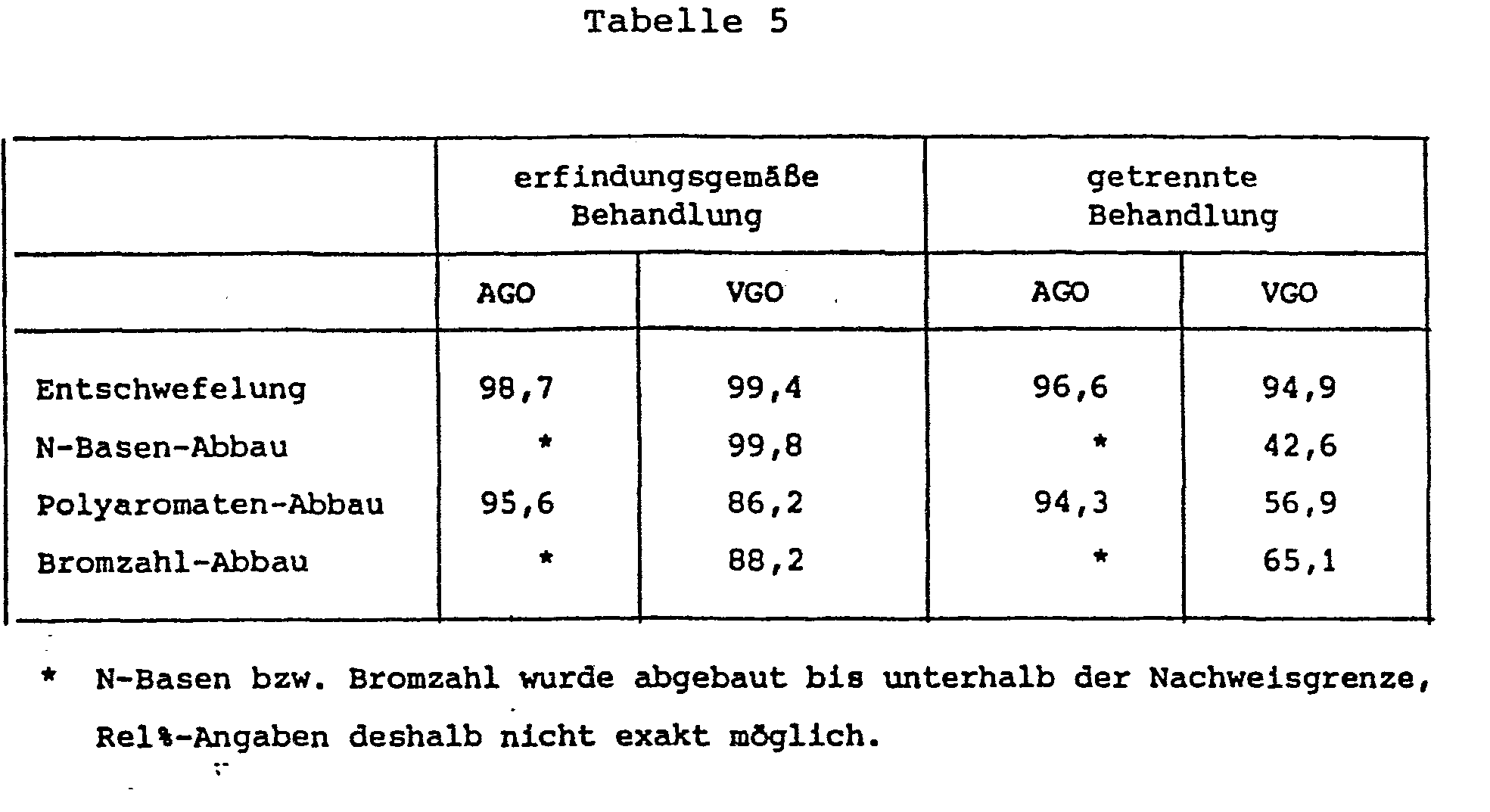
- Zusammenfassend läßt sich sagen, daß die erfindungsgemäß zweistufige, gemeinsame Hydrierung von AGO und VGO bezüglich der erzielbarer Abbauraten gegenüber der einstufigen, getrennten Fahrweise sehr große Vorteile zeigt. So werden zweistufig beim VGO-Schnitt 99,36 % Schwefelverbindungen, 99,8 % N-Basen-Abbau, 86,18 % Polyaromaten- und 88,2 % Bromzahlabbau erzielt. Diese erzielten Werte sind für eine 100 bar Hydrierung hervorragend und übertreffen die Werte der einstufigen, getrennten Hydrierbehandlung bei weitem. Bei AGO sind die erzielbaren Unterschiede geringer, da die Raffination dieses Schnittes wesentlich leichter erfolgt.
- Schließlich wurden noch Vergleichsversuche durchgeführt, bei denen VGO einer zweistufigen Hydrierung unterzogen wurde, und zwar zuerst einer Raffination und anschließend einem Polyaromatenabbau.
- Diese Versuche wurden bei zwei verschiedenen Drücken, nämlich 100 und 160 bar, unter sonst gleichen Bedingungen durchgeführt. Dabei ergab sich ein Gesamtverbrauch an chemischem Wasserstoff bei 100 bar von 168 Nl/kg Einsatz und bei 160 bar von 204 Nl/kg Einsatz.
- Wie aus diesen Werten hervorgeht, wird mit dem erfindungsgemäßen Verfahren eine Hydrierausbeute bei 100 bar erreicht, die einem Hydrierprodukt entspricht, das bei einem über 50 bar höheren Druck erreicht wird.
Claims (4)
Priority Applications (1)
| Application Number | Priority Date | Filing Date | Title |
|---|---|---|---|
| AT83108396T ATE16713T1 (de) | 1982-08-31 | 1983-08-26 | Verfahren zur herstellung von olefinen. |
Applications Claiming Priority (2)
| Application Number | Priority Date | Filing Date | Title |
|---|---|---|---|
| DE19823232395 DE3232395A1 (de) | 1982-08-31 | 1982-08-31 | Verfahren zur herstellung von olefinen |
| DE3232395 | 1982-08-31 |
Publications (3)
| Publication Number | Publication Date |
|---|---|
| EP0102594A2 true EP0102594A2 (de) | 1984-03-14 |
| EP0102594A3 EP0102594A3 (en) | 1984-07-25 |
| EP0102594B1 EP0102594B1 (de) | 1985-11-27 |
Family
ID=6172161
Family Applications (1)
| Application Number | Title | Priority Date | Filing Date |
|---|---|---|---|
| EP83108396A Expired EP0102594B1 (de) | 1982-08-31 | 1983-08-26 | Verfahren zur Herstellung von Olefinen |
Country Status (5)
| Country | Link |
|---|---|
| US (1) | US4619757A (de) |
| EP (1) | EP0102594B1 (de) |
| JP (1) | JPS5959788A (de) |
| AT (1) | ATE16713T1 (de) |
| DE (2) | DE3232395A1 (de) |
Cited By (3)
| Publication number | Priority date | Publication date | Assignee | Title |
|---|---|---|---|---|
| WO1991014754A1 (en) * | 1990-03-21 | 1991-10-03 | Exxon Chemical Patents Inc. | Process for the production of heartcut distillate resin precursors |
| WO1998006795A1 (en) * | 1996-08-15 | 1998-02-19 | Exxon Chemical Patents Inc. | Hydrocarbon conversion process |
| WO1999019424A1 (en) * | 1997-10-15 | 1999-04-22 | Equistar Chemicals, Lp | Method of producing olefins from petroleum residua |
Families Citing this family (10)
| Publication number | Priority date | Publication date | Assignee | Title |
|---|---|---|---|---|
| FR2725381B1 (fr) * | 1994-10-07 | 1996-12-13 | Eurecat Europ Retrait Catalys | Procede de pretraitement hors site d'un catalyseur de traitement d'hydrocarbures |
| US6210561B1 (en) | 1996-08-15 | 2001-04-03 | Exxon Chemical Patents Inc. | Steam cracking of hydrotreated and hydrogenated hydrocarbon feeds |
| US5906728A (en) * | 1996-08-23 | 1999-05-25 | Exxon Chemical Patents Inc. | Process for increased olefin yields from heavy feedstocks |
| US5720872A (en) * | 1996-12-31 | 1998-02-24 | Exxon Research And Engineering Company | Multi-stage hydroprocessing with multi-stage stripping in a single stripper vessel |
| US5705052A (en) * | 1996-12-31 | 1998-01-06 | Exxon Research And Engineering Company | Multi-stage hydroprocessing in a single reaction vessel |
| EP1401792A1 (de) * | 2001-05-25 | 2004-03-31 | Shell Internationale Researchmaatschappij B.V. | Verfahren zur herstellung geradkettiger olefine und deren verwendung zur herstellung geradkettiger alkohole |
| US8821713B2 (en) | 2009-12-17 | 2014-09-02 | H R D Corporation | High shear process for processing naphtha |
| CN103160320B (zh) * | 2011-12-15 | 2014-11-26 | 中国石油天然气股份有限公司 | 一种提高石油馏分芳烃含量的加工方法 |
| CN103160318B (zh) * | 2011-12-15 | 2014-11-26 | 中国石油天然气股份有限公司 | 一种提高石油馏分芳烃含量的工艺方法 |
| CN103160319B (zh) * | 2011-12-15 | 2014-11-26 | 中国石油天然气股份有限公司 | 一种提高石油馏分芳烃含量的方法 |
Family Cites Families (8)
| Publication number | Priority date | Publication date | Assignee | Title |
|---|---|---|---|---|
| US3161586A (en) * | 1962-12-21 | 1964-12-15 | Universal Oil Prod Co | Hydrorefining of coke-forming hydrocarbon distillates |
| GB1383229A (en) * | 1972-11-08 | 1975-02-05 | Bp Chem Int Ltd | Production of gaseous olefins from petroleum residue feedstocks |
| US3944481A (en) * | 1973-11-05 | 1976-03-16 | The Dow Chemical Company | Conversion of crude oil fractions to olefins |
| FR2268860B1 (de) * | 1974-04-24 | 1977-06-24 | Inst Francais Du Petrole | |
| FR2337195A1 (fr) * | 1976-01-05 | 1977-07-29 | Inst Francais Du Petrole | Procede de traitement catalytique, en trois etapes, sous pression d'hydrogene de coupes lourdes tres fortement insaturees |
| FR2364879A1 (fr) * | 1976-09-16 | 1978-04-14 | Inst Francais Du Petrole | Procede de fabrication d'hydrocarbures olefiniques a deux et trois atomes de carbone par molecule |
| FR2390493B1 (fr) * | 1977-05-12 | 1985-04-26 | Linde Ag | Procede de preparation d'olefines |
| DE2941851A1 (de) * | 1979-10-16 | 1981-05-14 | Linde Ag, 6200 Wiesbaden | Verfahren zur hydrierung schwerer kohlenwasserstoffe |
-
1982
- 1982-08-31 DE DE19823232395 patent/DE3232395A1/de not_active Withdrawn
-
1983
- 1983-08-26 DE DE8383108396T patent/DE3361350D1/de not_active Expired
- 1983-08-26 EP EP83108396A patent/EP0102594B1/de not_active Expired
- 1983-08-26 AT AT83108396T patent/ATE16713T1/de not_active IP Right Cessation
- 1983-08-29 JP JP58156566A patent/JPS5959788A/ja active Pending
-
1984
- 1984-12-19 US US06/683,764 patent/US4619757A/en not_active Expired - Fee Related
Cited By (5)
| Publication number | Priority date | Publication date | Assignee | Title |
|---|---|---|---|---|
| WO1991014754A1 (en) * | 1990-03-21 | 1991-10-03 | Exxon Chemical Patents Inc. | Process for the production of heartcut distillate resin precursors |
| WO1998006795A1 (en) * | 1996-08-15 | 1998-02-19 | Exxon Chemical Patents Inc. | Hydrocarbon conversion process |
| WO1998006794A1 (en) * | 1996-08-15 | 1998-02-19 | Exxon Chemical Patents Inc. | Hydrocarbon conversion process |
| WO1999019424A1 (en) * | 1997-10-15 | 1999-04-22 | Equistar Chemicals, Lp | Method of producing olefins from petroleum residua |
| US6303842B1 (en) | 1997-10-15 | 2001-10-16 | Equistar Chemicals, Lp | Method of producing olefins from petroleum residua |
Also Published As
| Publication number | Publication date |
|---|---|
| DE3232395A1 (de) | 1984-03-01 |
| US4619757A (en) | 1986-10-28 |
| ATE16713T1 (de) | 1985-12-15 |
| JPS5959788A (ja) | 1984-04-05 |
| EP0102594B1 (de) | 1985-11-27 |
| DE3361350D1 (en) | 1986-01-09 |
| EP0102594A3 (en) | 1984-07-25 |
Similar Documents
| Publication | Publication Date | Title |
|---|---|---|
| DE2805179C2 (de) | ||
| DE2215664C3 (de) | ||
| DE60105688T2 (de) | Hydrokrackverfahren | |
| DE69424247T2 (de) | Verfahren zur gleichzeitigen Produktion von Mitteldestillaten und Schmierölen aus Schwerölfraktionen | |
| EP0009809B1 (de) | Verfahren zur Erzeugung von Olefinen | |
| DE2601875C2 (de) | Gesamtverfahren zur Erzeugung von unter Normalbedingungen gasförmigen Olefinen mittels Dampfcracken eines hydrierten Erdöleinsatzmaterials | |
| DE69707709T2 (de) | Verfahren zur umwandlung von kohlenwasserstoffen | |
| DE69012526T2 (de) | Verfahren zur herstellung von benzin mit verbesserten oktanzahlen. | |
| EP0102594B1 (de) | Verfahren zur Herstellung von Olefinen | |
| DE69724125T2 (de) | Verfahren zur hydroumwandlung von raffinat | |
| DE2454197A1 (de) | Verfahren zur herstellung eines synthetischen schmieroels mit hohem viskositaetsindex | |
| DE2164951B2 (de) | Verfahren zur Herstellung gasförmiger Olefine | |
| DE2927251C2 (de) | ||
| DE2041219B2 (de) | Verfahren zum hydrokracken hoch- siedender kohlenwasserstoffe | |
| EP0009807B1 (de) | Verfahren zum Spalten von schweren Kohlenwasserstoffen | |
| DE1770575A1 (de) | Verfahren zum Hydrieren von Kohlenwasserstoffen | |
| DE2054940A1 (de) | Verfahren zur Verbesserung des Visko sitatsindex und der UV Beständigkeit von Schmieröl | |
| DE1543195A1 (de) | Verfahren zur Herstellung von Benzol hoher Reinheit | |
| DE3782545T2 (de) | Verfahren zur erzeugung von leichten produkten und brennstoffen fuer herkoemmliche nutzung aus schwermetall- und schwefelreichen erdoelrueckstaenden. | |
| DE3787710T2 (de) | Verfahren zur Fabrikation von Kerosin und/oder Gasölen. | |
| DE69309729T2 (de) | Verfahren zur Aufarbeitung eines Kohlenwasserstoffeinsatzes | |
| DE10297760T5 (de) | Verbessertes Hydrocrackverfahren | |
| DE1959869B2 (de) | Verfahren zur Herstellung einer Schmierölfraktion mit erhöhtem Viskositätsindex | |
| DE1806606A1 (de) | Verfahren zur Herstellung von Duesentreibstoffen | |
| DE2555625C2 (de) |
Legal Events
| Date | Code | Title | Description |
|---|---|---|---|
| PUAI | Public reference made under article 153(3) epc to a published international application that has entered the european phase |
Free format text: ORIGINAL CODE: 0009012 |
|
| AK | Designated contracting states |
Designated state(s): AT BE DE FR GB IT NL |
|
| PUAL | Search report despatched |
Free format text: ORIGINAL CODE: 0009013 |
|
| AK | Designated contracting states |
Designated state(s): AT BE DE FR GB IT NL |
|
| 17P | Request for examination filed |
Effective date: 19840609 |
|
| GRAA | (expected) grant |
Free format text: ORIGINAL CODE: 0009210 |
|
| AK | Designated contracting states |
Designated state(s): AT BE DE FR GB IT NL |
|
| PG25 | Lapsed in a contracting state [announced via postgrant information from national office to epo] |
Ref country code: NL Effective date: 19851127 Ref country code: IT Free format text: LAPSE BECAUSE OF FAILURE TO SUBMIT A TRANSLATION OF THE DESCRIPTION OR TO PAY THE FEE WITHIN THE PRESCRIBED TIME-LIMIT;WARNING: LAPSES OF ITALIAN PATENTS WITH EFFECTIVE DATE BEFORE 2007 MAY HAVE OCCURRED AT ANY TIME BEFORE 2007. THE CORRECT EFFECTIVE DATE MAY BE DIFFERENT FROM THE ONE RECORDED. Effective date: 19851127 Ref country code: BE Effective date: 19851127 |
|
| REF | Corresponds to: |
Ref document number: 16713 Country of ref document: AT Date of ref document: 19851215 Kind code of ref document: T |
|
| REF | Corresponds to: |
Ref document number: 3361350 Country of ref document: DE Date of ref document: 19860109 |
|
| ET | Fr: translation filed | ||
| NLV1 | Nl: lapsed or annulled due to failure to fulfill the requirements of art. 29p and 29m of the patents act | ||
| PGFP | Annual fee paid to national office [announced via postgrant information from national office to epo] |
Ref country code: AT Payment date: 19860821 Year of fee payment: 4 |
|
| PLBE | No opposition filed within time limit |
Free format text: ORIGINAL CODE: 0009261 |
|
| STAA | Information on the status of an ep patent application or granted ep patent |
Free format text: STATUS: NO OPPOSITION FILED WITHIN TIME LIMIT |
|
| 26N | No opposition filed | ||
| GBPC | Gb: european patent ceased through non-payment of renewal fee | ||
| PG25 | Lapsed in a contracting state [announced via postgrant information from national office to epo] |
Ref country code: GB Free format text: LAPSE BECAUSE OF NON-PAYMENT OF DUE FEES Effective date: 19881122 |
|
| PG25 | Lapsed in a contracting state [announced via postgrant information from national office to epo] |
Ref country code: AT Effective date: 19890826 |
|
| PG25 | Lapsed in a contracting state [announced via postgrant information from national office to epo] |
Ref country code: FR Effective date: 19900427 |
|
| REG | Reference to a national code |
Ref country code: FR Ref legal event code: ST |
|
| PGFP | Annual fee paid to national office [announced via postgrant information from national office to epo] |
Ref country code: DE Payment date: 19900928 Year of fee payment: 8 |
|
| PG25 | Lapsed in a contracting state [announced via postgrant information from national office to epo] |
Ref country code: DE Effective date: 19920501 |