EP0102674A2 - Münzbetätigte Ausgabevorrichtung - Google Patents
Münzbetätigte Ausgabevorrichtung Download PDFInfo
- Publication number
- EP0102674A2 EP0102674A2 EP83201255A EP83201255A EP0102674A2 EP 0102674 A2 EP0102674 A2 EP 0102674A2 EP 83201255 A EP83201255 A EP 83201255A EP 83201255 A EP83201255 A EP 83201255A EP 0102674 A2 EP0102674 A2 EP 0102674A2
- Authority
- EP
- European Patent Office
- Prior art keywords
- channel
- lever
- balls
- arm
- extraction means
- Prior art date
- Legal status (The legal status is an assumption and is not a legal conclusion. Google has not performed a legal analysis and makes no representation as to the accuracy of the status listed.)
- Granted
Links
- 238000000605 extraction Methods 0.000 claims abstract description 28
- 230000000149 penetrating effect Effects 0.000 claims abstract description 3
- 230000000717 retained effect Effects 0.000 claims description 11
- 230000000284 resting effect Effects 0.000 claims description 2
- 230000000694 effects Effects 0.000 description 6
- 241001076195 Lampsilis ovata Species 0.000 description 1
- 238000009825 accumulation Methods 0.000 description 1
- 239000011324 bead Substances 0.000 description 1
- 230000000903 blocking effect Effects 0.000 description 1
- 230000006835 compression Effects 0.000 description 1
- 238000007906 compression Methods 0.000 description 1
- 230000008878 coupling Effects 0.000 description 1
- 238000010168 coupling process Methods 0.000 description 1
- 238000005859 coupling reaction Methods 0.000 description 1
- 230000009191 jumping Effects 0.000 description 1
- 239000002184 metal Substances 0.000 description 1
- 230000035515 penetration Effects 0.000 description 1
- 239000011435 rock Substances 0.000 description 1
- 238000005096 rolling process Methods 0.000 description 1
- 230000000007 visual effect Effects 0.000 description 1
Images





Classifications
-
- G—PHYSICS
- G07—CHECKING-DEVICES
- G07F—COIN-FREED OR LIKE APPARATUS
- G07F5/00—Coin-actuated mechanisms; Interlocks
- G07F5/02—Coin-actuated mechanisms; Interlocks actuated mechanically by coins, e.g. by a single coin
- G07F5/08—Coin-actuated mechanisms; Interlocks actuated mechanically by coins, e.g. by a single coin wherein the use of two or more coins or an equivalent single coin is optional for each transaction; wherein the use of two or more coins or an alternative equivalent combination of coins is optional for each transaction
Definitions
- the subject of the present invention is a prepaid dispenser capable of receiving coins of different values, comprising a box intended to contain the objects to be sold, a coin mechanism sorting the coins according to their value, extraction means locked by a locking device unlockable by unlocking means implemented by the introduction of a prescribed amount of coins.
- Prepaid distributors of the type defined above are known for the sale of various articles, for example tickets or parking tokens. These dispensers include delicate and expensive electronic or electro-mechanical counting means. They must therefore be connected to a source of electric current and cannot be used anywhere, especially in the open air, far from any source of current.
- the present invention aims to achieve a fully mechanical distributor, robust and capable of being installed outdoors far from any power source.
- the dispenser according to the invention is characterized in that the locking device essentially comprises a tilting lock and that the unlocking means comprise a means for deflecting the coins according to their value, a means for counting the currency units consisting essentially a set of balls stored in a first oblique channel, and a set of rockers retaining the balls in this first channel, connected in cascade one behind the other and each provided with a lever placed - respectively on the deflected trajectory of a sort of coin so that the fall of a coin on one of the levers actuates the rocker secured to this lever and all the previous rockers being downstream and releases at least one ball, a second inclined channel being provided to receive the released balls, this second channel comprising a movable stop, adjustable as a function of the prescribed amount, against which the b illes, as well as a lateral hole in front of which is disposed a finger capable of penetrating this hole, this finger cooperating with the end of a lever pivoted at an intermediate point on an axis capable of moving against
- the lever can be actuated directly by a zipper, a push button or a lever actuated by a user.
- a particularly simple means consists in kinematically connecting the movable stopper to the pull tab, push button or extraction lever to raise the balls in an extension of the second channel leading to the entry of the first channel.
- the newspaper dispenser shown in FIG. 1 comprises a frame 1 on which walls such as 2 are mounted forming a box housing on the one hand the mechanism of the dispenser and on the other hand the newspapers 3 to be distributed. These are stacked on a floor not shown supported by a cross 4.
- the locking and unlocking mechanism is mounted on a vertical frame 5.
- the extraction is done by means of a pull tab 6 provided with a ball-shaped handle 7.
- the coins are introduced into a vertical slot located in face of a chute 8.
- a money sorter 9 known per se, and which is found in commerce. This sorter is able to sort coins according to their values.
- the rejected coins or tokens can be recovered by an opening 10 in a manner known per se.
- This mechanism comprises a vertical shaft 11 pivoted at its ends in two bearings 12 and 13. On this shaft 11 is mounted a support 14 capable of sliding freely on the shaft 11, but integral in rotation with the latter.
- This support 14 is provided with a radial arm 15 on which is mounted a support roller 16, near the support 14 and at the end of which is mounted a radial arm 17, free to rotate on the arm 15 and provided with its end with a pointed oblique needle 18.
- the shaft 11 is further provided with a radial arm 19 to which is attached the end of a cord 20 passing over two references 21 and 22 and the other end 23 of which is connected to the pull tab 6.
- a return spring 24 which tends to keep it in the rest position, shown in Figure 1. In this rest position the cord 20 is relaxed.
- the extractor operates as follows: when the user pulls on the pull tab 6, the cord 20 tightens after a certain stroke of the pull tab corresponding to the gauging which will be discussed below. If the locking device has been unlocked, the user can then pull the pull tab beyond the gauging distance, which has the effect of causing the shaft 11 to rotate by its arm 19.
- the movable support 14 is freely supported by the roller 16 on the stack of newspapers 3 and the arm 15 is rotated, the roller 16 rolling or sliding on the newspapers.
- the oblique needle 18 tends to sink into the newspaper on the stack, which has the effect of driving this newspaper in a rotating movement.
- a rotation of an angle of about 20 ° is enough to bring out the corner 3a of the newspaper on the stack and to tip it into a vacuum.
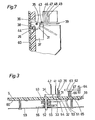
- the locking and unlocking mechanism is shown in Figures 2 to 7.
- the frame 5 consists of a plate in the thickness of which is hollowed out a first oblique channel 25, on the rear face of the plate 5, referring to the drawing .
- This first channel communicates with an oblique discharge channel 26, on the front face of the plate 5.
- This channel 26 communicates, by a valve 27, with a second circular channel 28, extending below the channels 25 and 26.
- This channel 28 is extended, above the valve 27 by a circular channel 29 connecting the channel 28 to the first oblique channel 25, through the plate 5, by a passage 30.
- the lower part of the channel 25 is closed by a set of flip-flops 31, 32, 33 and 34 mounted in cascade on an axis 35 (fig. 7).
- a clearance 36 is provided in the plate 5 to the flip-flops on a support 3. 7
- Each of these rockers has a rectangular groove 38 open downwards. All the grooves of the scales are aligned and their opening extends both over the extension of the channel 25 and partly above the discharge channel 26.
- These scales are provided with an arm 39, respectively 40,41, and 42, the length of these arms going upwards from the rocker 31 to the rocker 34. In the rest position of the rockers, these arms are retained by a stop 43 constituted by a rod parallel to the axis 35.
- Each of the rockers 32 , 33 and 34 has an extension engaging in the neighboring flip-flop located downstream, in such a way that the tilting of any one of these flip-flops causes the tilting of all the flip-flops located downstream thereof.
- the grooves 38 of the four rockers form an inverted channel in which is contained a set of balls 44 retained by a front wall 45.
- the diameter of these balls and the width of the rockers are such that the rockers 31 and 32 have each a width corresponding to the diameter of a ball, the width of the lever 33 representing three balls and the width of the lever 34 representing five balls.
- the money sorter 9 of the trade is provided with its outlet of deflector channels 46, 47, 48 and 49 respectively directing the 10 cent, 20 cent, 50 cent and 1 franc coins on the arms 39, 40, 41 and 42.
- the balls evacuated by the evacuation channel 26 roll in the second channel 28 by spreading the valve 27 where they are retained by a stop 50 constituted by a finger fixed at the end of an arm 51 mounted rotatably about an axis 52 and secured to a pulley 53 on which a cord 54 is wound, the end of which is fixed to this pulley.
- the arm 51 comes to bear against a stop 55 mounted on a second arm 56 rotatably mounted on the same axis 52.
- This flexible arm 56 is provided with an indexing finger 57 coming from engage in one of the holes in a series of holes 58 arranged in an arc on a sheet metal 59 (see also FIG. 3) fixed at a certain distance from the plate 5 on the latter.
- Channels 26, 28 and 29 are closed laterally by a plate 60, preferably transparent.
- channel 25 is also closed by a plate.
- the plate 5 has a lateral hole 61 opening into the channel 28. This hole is less than the diameter of a ball but lets a finger 62 pass, perpendicular to the plate 5, pushed by an arm 63, secured to a vertical lever 64
- the finger 62 is guided by a tube 65 fixed to the plate 5 around which is disposed a light spring 66 working in compression between the plate 5 and a washer 67 retained axially on the finger 62.
- the lever 64 is pivoted at a point 68 (fig.4) on a mobile support 69 mounted on two rods 70 and 71 (fig.2) on which is further mounted a plate 77, the support 69 being normally supported against the plate 5 by two springs 72 mounted around of each of the rods 70 and 71 between the plate 77 and the plate 5.
- the upper end of the lever 64 is provided with a finger 73 engaging perpendicularly in an opening 74 of the plate 5 in which a ball is freely housed 75. This ball engages, at rest, in a narrowing b iconic 76 of the pull tab 6.
- a finger 78 secured to a rocking lock 79 pivoted on a vertical axis 80.
- the support is supported by a spring 81 between the lock and the plate 5.
- the tilting latch 79 has at its other end a conical head 81 serving as a locking stop against which abuts a stop plate 82 secured to the pull tab 6.
- This pull pull carries a second stop plate 83 to which the other end of the cord 54 which passes over a reference 84.
- To the plate 82 is attached a return spring 85, the other end of which is fixed to the plate 5.
- the plates 82 and 83 are themselves provided with stops 86, 87, 88 and 89, the stops 86 and 88 being constituted by screws and therefore adjustable. These stops cooperate with two crossed levers 90 and 91 mounted on an axis 92 and provided with rollers at their ends.
- the two upper rollers cooperate with an eccentric cam 93 resting at rest by a finger 94 against a stop 95 mounted on the plate 5.
- the cam 93 is located, at rest, opposite a narrowing 96 of the pull tab 6.
- the cam 93 is intended to block the pull tab 6 by jamming during a new extraction attempt without having returned to the starting position of the pull tab.
- the cam 93 is striated for this purpose.
- the stops 87 and 89 serve to reverse the eccentric at the end of the stroke of the levers 90 and 91, the upper rollers of these levers cooperate with the cam 93 and the stops 86 and 88 cooperate directly with the cam 92, that is to say -to say that the stop 88 passes next to the lever 91.
- the hole 61 is not obstructed by a ball.
- the finger 62 can then pass freely through the hole 61 and the lever 64 can pivot on its support 69 without driving the latter, so that the rocking latch 79 is not actuated and that the stop 82 of the pull tab abuts the lock 81. It can be noted that the collection of an amount greater than the amount necessary absolutely does not disturb the operation of the device.
- This distributor is susceptible of numerous variants, as regards both the shape and the inclination of the channels for the balls as well as the shape of the levers and tilting latches and the execution of the connecting means.
- the channel 28 could be rectilinear and vertical, the rotary arm 51 then being replaced by a support animated by a vertical translational movement.
- FIG. 8 An embodiment variant, particularly interesting, by its simplicity, of the anti-fraud security device, is shown in FIG. 8.
- the pull tab 6 Over a distance corresponding to its complete stroke, the pull tab 6 is provided with a rack-like toothing 123 s extending between the end of the pull tab 6 and a clearance 124 formed by a countersink in the pull tab.
- This rack 123 is intended to cooperate with a pawl 125 of rectangular shape and freely suspended around a horizontal axis 126 carried by a fixed bearing secured to the frame 5.
- the pawl 125 hangs freely in the release 124 of the pull tab. When the latter is pulled, the pawl 125 rocks to the left and retains this oblique position along the rack 123.
- the pawl 125 comes to brace against one of the teeth of rack 123 and locks the pull tab.
- the end of the zipper arrives at position 6 ′, the pawl 125 can then return to the vertical position and the zipper can be released by tilting the pawl 125 to the right, the latter jumping freely on the teeth of the rack 123.
- the pawl 125 again comes to rest on the rack 123 by blocking it. It is only when the end of the rack 123 has passed the pawl 125 (as shown in FIG. 8) that the pawl may fall back into the clearance 124. In this position the pull tab 6 is however again locked by the latch tilting 81.
- the biconical part of the pull tab cooperating with the ball 75 of the locking device is constituted here by a biconical cam 127 located on an intermediate part of the pull tab.
- FIG. 9 An advantageous variant of the extraction mechanism is shown in FIG. 9.
- the vertical shaft 11 of FIG. 1 is replaced here by two U-shaped profiles 128 and 129 placed vertically opposite one another and rigidly connected between them. These two sections form a rail for a carriage 130 which can move freely vertically.
- a radial arm 131 similar to the arm 15 of FIG. 1, is rigidly fixed to the carriage 130.
- This arm 131 is provided with two rollers 132 and 133 intended to roll on the stack of newspapers 3. Between the rollers 132 and 133 is mounted an arm 134 free in all directions as indicated by the double arrows F1 and F2, by means of a ball joint.
- the frolic of the arm 134 is however limited by two wings 135 and 136 fixed at its end and which abut respectively against the rollers 132 and 133.
- the arm 134 is provided with an oblique needle 137 which is stuck in the log 3 to be driven. Thanks to the freedom of the arm 134, the newspaper to be extracted is no longer driven in a rotational movement during the rotation of the sections 128 and 129 around the axis 138, so that the newspaper can move in translation according to arrow F3 to then fall in free fall according to arrow F4 to exit in a vertical position through a slot located at the bottom of the distributor.
- This device makes it possible to eject any flat article such as newspapers, magazines, magazines, pocket books, etc.
- the penetration depth of the needle 137 in the flat article is proportional to the advancing resistance offered by the latter. There is therefore no risk of slipping.
- the device also works for any thickness of logs without any adjustment being necessary.
- FIG. 10 shows a first variant of the device for lifting the balls.
- the first channel is formed by the oblique edge of a vertical plate 139 and the vertical plate 5 of the frame.
- the edge 138 is a plane inclined laterally in the direction of the plate 5 so as to retain the balls laterally.
- Parallel to the plate 139 is mounted a vertical plate 140 articulated around a horizontal axis 141.
- the upper edge of the plate 140 constitutes the second channel and it is for this purpose inclined slightly to the right.
- This edge is formed by an inclined plane 142 inclined in the direction of the plate 139.
- the balls 44 are therefore retained laterally on one side by the inclined plane 142 and on the other hand by the plate 139.
- the free vertical face of the plate 140 is extended upwards by a plate 143 preventing the balls from accidentally escaping and also serves as a support for a stop 144 movable along a slide 145 and used to determine the amount to be collected, that is to say the number of balls necessary to close a gauging hole 146 provided in the plate 139, hole whose role is the same as that of hole 61 of the main embodiment.
- the plate 140 is held in the position shown in the drawing by a stop not shown.
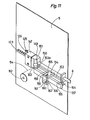
- FIG. 11 An alternative embodiment of the locking mechanism of the pull tab 6 is shown in FIG. 11.
- the pull tab 6 is supported by two fixed bearings 147 and 148, as in the first embodiment.
- the anti-fraud mechanism is that shown in FIG. 13.
- the pull tab 6 is integral with a stud 149 having a clearance 150, below the pull tab and an oblique vertical face 151. To the stud 149 is attached the cord 54 actuating the ball rise. This cord 54 is wound around a pulley 152 on which its end is attached.
- the gauging lever 157 carries a roller 163 cooperating with the oblique face 151 of the stud 149 which takes the place of a cam.
- the gauging lever 157 carries a gauging finger 164 identical to finger 62 of the first embodiment and cooperates, like it, with the balls 44.
- the gauging lever 157 further carries a finger 165, the l the end comes approximately in contact with the locking lever 153.
- This mechanism operates in a similar manner to the mechanism shown in FIGS. 1 to 6: when the user pulls the pull tab the stud 149 moves the roller 163 away from the gauging lever 157. If the amount received is insufficient, the gauging finger 164 does not meet ball and the lever 157 pivots freely around its axis 158 which does not move. By pivoting the lever 157 switches the lock 153 whose end 153a is then placed on the path of the stud 149 and locks the pull tab 6. If the amount received is sufficient, the gauging finger 164 meets a ball 44 and the lever Gauge 157 then switches on this support joint by compressing the springs 162 by its axis 158: the bolt 153 remains stationary and the stud 149 moves without meeting its end 153a.
- FIG. 12 shows a second alternative embodiment of the mechanism for raising the balls 44.
- the accumulation and gauging channel here consists of a vertical channel 166 into which opens said second oblique channel 26 into which fall the balls released by the flip-flops 31 to 34.
- the balls 44 are retained in this vertical channel 166 by a horizontal finger 167 secured to a carriage 168 guided by a vertical bar 169 and retained by a finger 170 secured to a slide 171 whose position is vertically adjustable on a small column 172, depending on the amount to be collected.
- the height of the column of stored beads allows you to have a visual check of the amount paid.
- the carriage 168 is attached the end of a cord 173 passing over two rollers 174 and 175 the first mounted on the bar 169 and the second on the panel 5.
- the other end of the cord 173 is fixed on a pulley 176 integral in rotation of its axis, itself integral either with the pulley 152 ( Figure 11) or with the pulley 53 ( Figure 2).
- the vertical channel 166 is closed by a bypass valve 177 which can tilt upward to allow the balls 44 to pass. When this valve falls, it deflects the balls 44 in an oblique channel 178 which opens into the storage channel. 25.
- This mechanism works in a similar manner to the mechanism shown in FIG. 2: when the pull tab 6 is unlocked, its traction drives the pulley 53, respectively the pulley 152, and with it the pulley 176 on which the cord 173 is wound which rises the carriage 168 and with it the balls accumulated in the channel 166 against the finger 167.
- the stroke of the carriage is calculated so that the finger 167 does not exceed the spout of the bypass valve 177.
- the channel 166 and the guide bar 169 could be oblique. They do not necessarily have to be straight.
- the dispenser is equipped with a reader for banknotes or cards controlling electromagnets associated with each of the flip-flops 31 to 34.
Landscapes
- Physics & Mathematics (AREA)
- General Physics & Mathematics (AREA)
- Vending Machines For Individual Products (AREA)
- Detergent Compositions (AREA)
- Adhesives Or Adhesive Processes (AREA)
Priority Applications (1)
| Application Number | Priority Date | Filing Date | Title |
|---|---|---|---|
| AT83201255T ATE27868T1 (de) | 1982-09-06 | 1983-09-01 | Muenzbetaetigte ausgabevorrichtung. |
Applications Claiming Priority (2)
| Application Number | Priority Date | Filing Date | Title |
|---|---|---|---|
| CH5284/82 | 1982-09-06 | ||
| CH528482 | 1982-09-06 |
Publications (3)
| Publication Number | Publication Date |
|---|---|
| EP0102674A2 true EP0102674A2 (de) | 1984-03-14 |
| EP0102674A3 EP0102674A3 (en) | 1984-12-27 |
| EP0102674B1 EP0102674B1 (de) | 1987-06-16 |
Family
ID=4291001
Family Applications (1)
| Application Number | Title | Priority Date | Filing Date |
|---|---|---|---|
| EP83201255A Expired EP0102674B1 (de) | 1982-09-06 | 1983-09-01 | Münzbetätigte Ausgabevorrichtung |
Country Status (3)
| Country | Link |
|---|---|
| EP (1) | EP0102674B1 (de) |
| AT (1) | ATE27868T1 (de) |
| DE (1) | DE3372142D1 (de) |
Cited By (1)
| Publication number | Priority date | Publication date | Assignee | Title |
|---|---|---|---|---|
| GB2487102B (en) * | 2011-09-23 | 2013-08-28 | Rhys Thomas James | Mechanical money evaluating apparatus for a vending machine |
Family Cites Families (10)
| Publication number | Priority date | Publication date | Assignee | Title |
|---|---|---|---|---|
| US1833724A (en) * | 1930-01-10 | 1931-11-24 | Siegfried J Schwegler | Prepayment meter |
| US2428231A (en) * | 1946-01-25 | 1947-09-30 | Internat Vending Machine Corp | Dispensing unit |
| GB753266A (en) * | 1953-04-25 | 1956-07-18 | Soren Wistoft & Co S Fabriker | Improvements in and relating to coin releases for vending machines |
| FR1223578A (fr) * | 1959-01-30 | 1960-06-17 | Fr De Metallurg Et De Mecaniqu | Appareil distributeur d'objets plats |
| DE1774573A1 (de) * | 1968-07-18 | 1972-01-13 | Buschky Rudolf | Durch ein elektrisches Muenzwerk gesteuerter Zeitungsautomat |
| GB1286847A (en) * | 1969-08-26 | 1972-08-23 | Vendit Inc | Article dispenser |
| US3709405A (en) * | 1970-10-29 | 1973-01-09 | C Harris | Vending machine for periodicals having arcuate path ejection |
| US3760923A (en) * | 1972-06-26 | 1973-09-25 | H Voegeli | Readily adjustable coin-operated mechanism |
| AT325333B (de) * | 1972-08-28 | 1975-10-10 | Czajkowski Walter | Vorrichtung zur ausgabe von zeitungen |
| FR2444980A1 (fr) * | 1978-12-20 | 1980-07-18 | Guinois Gerard | Dispositif pour la distribution automatique de cassettes contenant des bandes sonores |
-
1983
- 1983-09-01 DE DE8383201255T patent/DE3372142D1/de not_active Expired
- 1983-09-01 AT AT83201255T patent/ATE27868T1/de not_active IP Right Cessation
- 1983-09-01 EP EP83201255A patent/EP0102674B1/de not_active Expired
Cited By (1)
| Publication number | Priority date | Publication date | Assignee | Title |
|---|---|---|---|---|
| GB2487102B (en) * | 2011-09-23 | 2013-08-28 | Rhys Thomas James | Mechanical money evaluating apparatus for a vending machine |
Also Published As
| Publication number | Publication date |
|---|---|
| EP0102674A3 (en) | 1984-12-27 |
| DE3372142D1 (en) | 1987-07-23 |
| ATE27868T1 (de) | 1987-07-15 |
| EP0102674B1 (de) | 1987-06-16 |
Similar Documents
| Publication | Publication Date | Title |
|---|---|---|
| FR2546649A1 (fr) | Machine pour trier, encartoucher et distribuer des pieces de monnaie | |
| FR2817377A1 (fr) | Appareil securise a pieces de monnaie | |
| FR2678595A1 (fr) | Machine de reception et de distribution de billets. | |
| EP0632917B1 (de) | Automatische ausgeber für zeitungen u.d. mit auswahlmöglichkeiten | |
| FR2577912A1 (fr) | Distributeur automatique d'articles plats | |
| EP0102674B1 (de) | Münzbetätigte Ausgabevorrichtung | |
| CA1327185C (en) | Newspaper dispenser | |
| FR2664802A1 (fr) | Appareil de distribution automatique de produits en bidons ou autres. | |
| EP0052043B1 (de) | Münzen auswerfende Münzenspeicher- und Kassiereinrichtung | |
| FR2583189A1 (fr) | Distributeur automatique d'objets cylindriques comportant un chariot anime d'un mouvement rectiligne alternatif | |
| BE1009279A3 (fr) | Dispositif de reception et de tri d'objets divers, notamment de recipients a mettre au rebut. | |
| WO1989012873A1 (fr) | Distributeur a prepaiement pour des articles conditionnes dans des emballages | |
| FR2634636A1 (fr) | Dispositif de distribution automatique de bouteilles de gaz liquefie a section circulaire | |
| EP1107925B1 (de) | Automatische vorrichtung zur abgabe von gegenständen auf gleitschienen | |
| BE473481A (de) | ||
| FR3147510A1 (fr) | Babyfoot et procédé de libération de balle correspondant | |
| EP0714841A1 (de) | Verfahren und Vorrichtung zum Ausgeben von Gegenständer | |
| BE368353A (de) | ||
| BE369500A (de) | ||
| EP1954904B1 (de) | Gesicherter einnahmensammelbehälter | |
| FR3018176A1 (fr) | Distributeur d'articles, en particulier pour la distribution controlee des plateaux utilises en restauration collective. | |
| FR2624439A1 (fr) | Dispositif de pliage de rabat d'enveloppes | |
| FR2707966A1 (fr) | Dispositif et procédé de délivrance de produits plats. | |
| BE628447A (de) | ||
| FR2484112A1 (fr) | Appareil distributeur de pieces de monnaie ou analogues |
Legal Events
| Date | Code | Title | Description |
|---|---|---|---|
| PUAI | Public reference made under article 153(3) epc to a published international application that has entered the european phase |
Free format text: ORIGINAL CODE: 0009012 |
|
| AK | Designated contracting states |
Designated state(s): AT BE CH DE FR GB IT LI NL SE |
|
| PUAL | Search report despatched |
Free format text: ORIGINAL CODE: 0009013 |
|
| AK | Designated contracting states |
Designated state(s): AT BE CH DE FR GB IT LI NL SE |
|
| 17P | Request for examination filed |
Effective date: 19850614 |
|
| 17Q | First examination report despatched |
Effective date: 19860528 |
|
| GRAA | (expected) grant |
Free format text: ORIGINAL CODE: 0009210 |
|
| ITF | It: translation for a ep patent filed | ||
| AK | Designated contracting states |
Kind code of ref document: B1 Designated state(s): AT BE CH DE FR GB IT LI NL SE |
|
| REF | Corresponds to: |
Ref document number: 27868 Country of ref document: AT Date of ref document: 19870715 Kind code of ref document: T |
|
| REF | Corresponds to: |
Ref document number: 3372142 Country of ref document: DE Date of ref document: 19870723 |
|
| PGFP | Annual fee paid to national office [announced via postgrant information from national office to epo] |
Ref country code: NL Payment date: 19870930 Year of fee payment: 5 |
|
| PLBE | No opposition filed within time limit |
Free format text: ORIGINAL CODE: 0009261 |
|
| STAA | Information on the status of an ep patent application or granted ep patent |
Free format text: STATUS: NO OPPOSITION FILED WITHIN TIME LIMIT |
|
| 26N | No opposition filed | ||
| PG25 | Lapsed in a contracting state [announced via postgrant information from national office to epo] |
Ref country code: GB Effective date: 19890901 Ref country code: AT Effective date: 19890901 |
|
| PG25 | Lapsed in a contracting state [announced via postgrant information from national office to epo] |
Ref country code: SE Effective date: 19890902 |
|
| PG25 | Lapsed in a contracting state [announced via postgrant information from national office to epo] |
Ref country code: LI Effective date: 19890930 Ref country code: CH Effective date: 19890930 Ref country code: BE Effective date: 19890930 |
|
| BERE | Be: lapsed |
Owner name: JUNOD PIERRE-ALEXIS Effective date: 19890930 Owner name: PULVER JEAN-EMILE Effective date: 19890930 |
|
| PG25 | Lapsed in a contracting state [announced via postgrant information from national office to epo] |
Ref country code: NL Effective date: 19900401 |
|
| GBPC | Gb: european patent ceased through non-payment of renewal fee | ||
| NLV4 | Nl: lapsed or anulled due to non-payment of the annual fee | ||
| PG25 | Lapsed in a contracting state [announced via postgrant information from national office to epo] |
Ref country code: FR Effective date: 19900531 |
|
| REG | Reference to a national code |
Ref country code: CH Ref legal event code: PL |
|
| PG25 | Lapsed in a contracting state [announced via postgrant information from national office to epo] |
Ref country code: DE Effective date: 19900601 |
|
| REG | Reference to a national code |
Ref country code: FR Ref legal event code: ST |
|
| EUG | Se: european patent has lapsed |
Ref document number: 83201255.3 Effective date: 19900521 |