EP0102923B1 - Détergent approprié pour le post-lavage de teintures réactives et procédé de lavage correspondant - Google Patents
Détergent approprié pour le post-lavage de teintures réactives et procédé de lavage correspondant Download PDFInfo
- Publication number
- EP0102923B1 EP0102923B1 EP83810384A EP83810384A EP0102923B1 EP 0102923 B1 EP0102923 B1 EP 0102923B1 EP 83810384 A EP83810384 A EP 83810384A EP 83810384 A EP83810384 A EP 83810384A EP 0102923 B1 EP0102923 B1 EP 0102923B1
- Authority
- EP
- European Patent Office
- Prior art keywords
- acid
- detergent composition
- mol
- composition according
- component
- Prior art date
- Legal status (The legal status is an assumption and is not a legal conclusion. Google has not performed a legal analysis and makes no representation as to the accuracy of the status listed.)
- Expired
Links
- 0 C*=CC1N=C1 Chemical compound C*=CC1N=C1 0.000 description 1
Classifications
-
- C—CHEMISTRY; METALLURGY
- C11—ANIMAL OR VEGETABLE OILS, FATS, FATTY SUBSTANCES OR WAXES; FATTY ACIDS THEREFROM; DETERGENTS; CANDLES
- C11D—DETERGENT COMPOSITIONS; USE OF SINGLE SUBSTANCES AS DETERGENTS; SOAP OR SOAP-MAKING; RESIN SOAPS; RECOVERY OF GLYCEROL
- C11D3/00—Other compounding ingredients of detergent compositions covered in group C11D1/00
- C11D3/02—Inorganic compounds ; Elemental compounds
- C11D3/12—Water-insoluble compounds
- C11D3/124—Silicon containing, e.g. silica, silex, quartz or glass beads
- C11D3/1246—Silicates, e.g. diatomaceous earth
- C11D3/128—Aluminium silicates, e.g. zeolites
- C11D3/1286—Stabilised aqueous aluminosilicate suspensions
-
- C—CHEMISTRY; METALLURGY
- C11—ANIMAL OR VEGETABLE OILS, FATS, FATTY SUBSTANCES OR WAXES; FATTY ACIDS THEREFROM; DETERGENTS; CANDLES
- C11D—DETERGENT COMPOSITIONS; USE OF SINGLE SUBSTANCES AS DETERGENTS; SOAP OR SOAP-MAKING; RESIN SOAPS; RECOVERY OF GLYCEROL
- C11D1/00—Detergent compositions based essentially on surface-active compounds; Use of these compounds as a detergent
- C11D1/66—Non-ionic compounds
- C11D1/83—Mixtures of non-ionic with anionic compounds
-
- C—CHEMISTRY; METALLURGY
- C11—ANIMAL OR VEGETABLE OILS, FATS, FATTY SUBSTANCES OR WAXES; FATTY ACIDS THEREFROM; DETERGENTS; CANDLES
- C11D—DETERGENT COMPOSITIONS; USE OF SINGLE SUBSTANCES AS DETERGENTS; SOAP OR SOAP-MAKING; RESIN SOAPS; RECOVERY OF GLYCEROL
- C11D3/00—Other compounding ingredients of detergent compositions covered in group C11D1/00
- C11D3/16—Organic compounds
- C11D3/20—Organic compounds containing oxygen
- C11D3/2003—Alcohols; Phenols
- C11D3/2006—Monohydric alcohols
-
- C—CHEMISTRY; METALLURGY
- C11—ANIMAL OR VEGETABLE OILS, FATS, FATTY SUBSTANCES OR WAXES; FATTY ACIDS THEREFROM; DETERGENTS; CANDLES
- C11D—DETERGENT COMPOSITIONS; USE OF SINGLE SUBSTANCES AS DETERGENTS; SOAP OR SOAP-MAKING; RESIN SOAPS; RECOVERY OF GLYCEROL
- C11D3/00—Other compounding ingredients of detergent compositions covered in group C11D1/00
- C11D3/16—Organic compounds
- C11D3/37—Polymers
- C11D3/3703—Macromolecular compounds obtained otherwise than by reactions only involving carbon-to-carbon unsaturated bonds
- C11D3/373—Macromolecular compounds obtained otherwise than by reactions only involving carbon-to-carbon unsaturated bonds containing silicones
-
- C—CHEMISTRY; METALLURGY
- C11—ANIMAL OR VEGETABLE OILS, FATS, FATTY SUBSTANCES OR WAXES; FATTY ACIDS THEREFROM; DETERGENTS; CANDLES
- C11D—DETERGENT COMPOSITIONS; USE OF SINGLE SUBSTANCES AS DETERGENTS; SOAP OR SOAP-MAKING; RESIN SOAPS; RECOVERY OF GLYCEROL
- C11D3/00—Other compounding ingredients of detergent compositions covered in group C11D1/00
- C11D3/16—Organic compounds
- C11D3/37—Polymers
- C11D3/3746—Macromolecular compounds obtained by reactions only involving carbon-to-carbon unsaturated bonds
- C11D3/3757—(Co)polymerised carboxylic acids, -anhydrides, -esters in solid and liquid compositions
- C11D3/3765—(Co)polymerised carboxylic acids, -anhydrides, -esters in solid and liquid compositions in liquid compositions
-
- D—TEXTILES; PAPER
- D06—TREATMENT OF TEXTILES OR THE LIKE; LAUNDERING; FLEXIBLE MATERIALS NOT OTHERWISE PROVIDED FOR
- D06P—DYEING OR PRINTING TEXTILES; DYEING LEATHER, FURS OR SOLID MACROMOLECULAR SUBSTANCES IN ANY FORM
- D06P1/00—General processes of dyeing or printing textiles, or general processes of dyeing leather, furs, or solid macromolecular substances in any form, classified according to the dyes, pigments, or auxiliary substances employed
- D06P1/44—General processes of dyeing or printing textiles, or general processes of dyeing leather, furs, or solid macromolecular substances in any form, classified according to the dyes, pigments, or auxiliary substances employed using insoluble pigments or auxiliary substances, e.g. binders
- D06P1/52—General processes of dyeing or printing textiles, or general processes of dyeing leather, furs, or solid macromolecular substances in any form, classified according to the dyes, pigments, or auxiliary substances employed using insoluble pigments or auxiliary substances, e.g. binders using compositions containing synthetic macromolecular substances
- D06P1/5207—Macromolecular compounds obtained by reactions involving only carbon-to-carbon unsaturated bonds
- D06P1/525—Polymers of unsaturated carboxylic acids or functional derivatives thereof
-
- D—TEXTILES; PAPER
- D06—TREATMENT OF TEXTILES OR THE LIKE; LAUNDERING; FLEXIBLE MATERIALS NOT OTHERWISE PROVIDED FOR
- D06P—DYEING OR PRINTING TEXTILES; DYEING LEATHER, FURS OR SOLID MACROMOLECULAR SUBSTANCES IN ANY FORM
- D06P5/00—Other features in dyeing or printing textiles, or dyeing leather, furs, or solid macromolecular substances in any form
- D06P5/02—After-treatment
- D06P5/10—After-treatment with compounds containing metal
-
- C—CHEMISTRY; METALLURGY
- C11—ANIMAL OR VEGETABLE OILS, FATS, FATTY SUBSTANCES OR WAXES; FATTY ACIDS THEREFROM; DETERGENTS; CANDLES
- C11D—DETERGENT COMPOSITIONS; USE OF SINGLE SUBSTANCES AS DETERGENTS; SOAP OR SOAP-MAKING; RESIN SOAPS; RECOVERY OF GLYCEROL
- C11D1/00—Detergent compositions based essentially on surface-active compounds; Use of these compounds as a detergent
- C11D1/02—Anionic compounds
- C11D1/12—Sulfonic acids or sulfuric acid esters; Salts thereof
- C11D1/29—Sulfates of polyoxyalkylene ethers
-
- C—CHEMISTRY; METALLURGY
- C11—ANIMAL OR VEGETABLE OILS, FATS, FATTY SUBSTANCES OR WAXES; FATTY ACIDS THEREFROM; DETERGENTS; CANDLES
- C11D—DETERGENT COMPOSITIONS; USE OF SINGLE SUBSTANCES AS DETERGENTS; SOAP OR SOAP-MAKING; RESIN SOAPS; RECOVERY OF GLYCEROL
- C11D1/00—Detergent compositions based essentially on surface-active compounds; Use of these compounds as a detergent
- C11D1/02—Anionic compounds
- C11D1/34—Derivatives of acids of phosphorus
- C11D1/345—Phosphates or phosphites
-
- C—CHEMISTRY; METALLURGY
- C11—ANIMAL OR VEGETABLE OILS, FATS, FATTY SUBSTANCES OR WAXES; FATTY ACIDS THEREFROM; DETERGENTS; CANDLES
- C11D—DETERGENT COMPOSITIONS; USE OF SINGLE SUBSTANCES AS DETERGENTS; SOAP OR SOAP-MAKING; RESIN SOAPS; RECOVERY OF GLYCEROL
- C11D1/00—Detergent compositions based essentially on surface-active compounds; Use of these compounds as a detergent
- C11D1/66—Non-ionic compounds
- C11D1/72—Ethers of polyoxyalkylene glycols
-
- C—CHEMISTRY; METALLURGY
- C11—ANIMAL OR VEGETABLE OILS, FATS, FATTY SUBSTANCES OR WAXES; FATTY ACIDS THEREFROM; DETERGENTS; CANDLES
- C11D—DETERGENT COMPOSITIONS; USE OF SINGLE SUBSTANCES AS DETERGENTS; SOAP OR SOAP-MAKING; RESIN SOAPS; RECOVERY OF GLYCEROL
- C11D1/00—Detergent compositions based essentially on surface-active compounds; Use of these compounds as a detergent
- C11D1/66—Non-ionic compounds
- C11D1/74—Carboxylates or sulfonates esters of polyoxyalkylene glycols
Definitions
- the present invention relates to an aqueous detergent which can be used when washing prints or dyeings with reactive dyes on cellulose-containing textile materials, and to a corresponding washing process.
- the detergent according to the invention is particularly suitable if the after-washing is carried out with mineral-rich, "hard" water.
- composition B which contain an alkali aluminum silicate, an anionic surfactant, alkylene oxide adducts of aliphatic monoalcohols with 14-18 C atoms and a water-soluble polyacrylate.
- Composition B additionally contains sodium polyphosphate, perborate and other electrolytes.
- DE-A-2910583 discloses detergents which contain alkali aluminum silicates together with anionic and / or nonionic surfactants, water-soluble polyvinylpyrrolidone having a molecular weight of 5,000 to 1,000,000 also being present.
- Components (A), (B), (C) and (D) can be present as individual compounds or as mixtures with one another.
- Such aluminosilicates expediently have a particle size of 1 to 12 ⁇ m, preferably 2 to 8 ⁇ m. As a rule, they have a calcium binding capacity of 100 to 200 mg Ca0 per gram of anhydrous active substance.
- the alkali aluminum silicates used as component (A) can be prepared synthetically in a simple manner, for example by reaction of water-soluble silicates with water-soluble aluminates in the presence of water.
- aqueous solutions of the starting materials are mixed with one another or a component present in the solid state is reacted with the other component present as an aqueous solution.
- Mixing the two components in the solid state also gives the desired aluminum silicates in the presence of water.
- Alkali aluminum silicates can also be produced from Al (OH) 3 , Al 2 0 3 or Si0 2 by reaction with alkali silicate or aluminate solutions. Finally, such substances can also form from the melt.
- the alkali aluminum silicates prepared by precipitation or converted into aqueous suspension in a finely divided state by other processes can be converted from the amorphous to the aged or to the crystalline state by heating to temperatures of 50 to 200 ° C.
- the amorphous or crystalline alkali aluminum silicate present in aqueous suspension can be separated from the remaining aqueous solution by filtration and, if desired, at temperatures of e.g. Dry 50 to 800 ° C. As a rule, however, moist filter cakes or free-flowing suspensions of the alkali aluminum silicates are used.
- Precipitation conditions can already contribute to the formation of small particle sizes of 1-12 ⁇ m, whereby the mixed aluminate and silicate solutions - which can also be fed into the reaction vessel at the same time - are exposed to strong shear forces, for example by stirring the suspension intensively.
- Alkaline aluminum silicates obtained in the coarser state which have been ground to the desired grain size, can also be used.
- Mills and / or air classifiers or their combinations Further details on the nature of the alkali aluminum silicates which are suitable as component (A), including their preparation and preparation, are described in DE-A-27 14 954.
- the anionic surfactants of component (B) are preferably acidic derivatives of nonionic or cationic alkylene oxide adducts, such as e.g. addition products containing acidic ether groups or preferably ester groups of inorganic or organic acids of 2 to 100 mol of alkylene oxides, especially ethylene oxide and / or propylene oxide or also styrene oxide onto aliphatic hydrocarbon radicals with a total of at least 4, preferably 12, organic hydroxyl, carboxyl, amino having carbon atoms and / or amido compounds or mixtures of these substances.
- acidic ethers or esters can be used as free acids or as salts, e.g. Alkali metal, alkaline earth metal, ammonium or amine salts are present.
- anionic surfactants are prepared by known methods, e.g. at least 2 moles, preferably more than 2 moles, e.g. Adds 10 to 100 mol, ethylene oxide or propylene oxide or alternating in any order ethylene oxide or propylene oxide and then etherifies or esterifies the adducts and, if appropriate, converts the ethers or the esters into their salts.
- Higher fatty alcohols i.e.
- Alkanols or alkenols each having 8 to 22 carbon atoms, di- to hexavalent aliphatic alcohols having 2 to 9 carbon atoms, alicyclic alcohols, phenylphenols, benzylphenols, alkylphenols with one or more alkyl substituents which, or which together have at least 4 carbon atoms, fatty acids with 8 up to 22 carbon atoms, amines which have aliphatic and / or cycloaliphatic hydrocarbon radicals of at least 8 carbon atoms, in particular fatty amines containing such radicals, hydroxyalkylamines, hydroxyalkylamides and aminoalkyl esters of fatty acids or dicarboxylic acids and higher alkylated aryloxycarboxylic acids.
- Highly suitable anionic polyalkylene oxide adducts are acidic esters or their salts of a polyadduct of 2 to 100 mol, preferably up to 50 mol, of ethylene oxide with 1 mol of fatty alcohol with 8 to 22 carbon atoms or with 1 mol of a phenol which has at least one benzyl group, one phenyl group or preferably one Has alkyl group with at least 4 carbon atoms, such as Benzylphenol, Dibenzylphenol, Dibenzyl- (nonyl) -phenol, o-Phenylphenol, Butylphenol, Tributylphenol, Octylphenol, Nonylphenol, Dodecylphenol or Pentadecylphenol, whereby these acidic esters can be used individually or as a mixture.
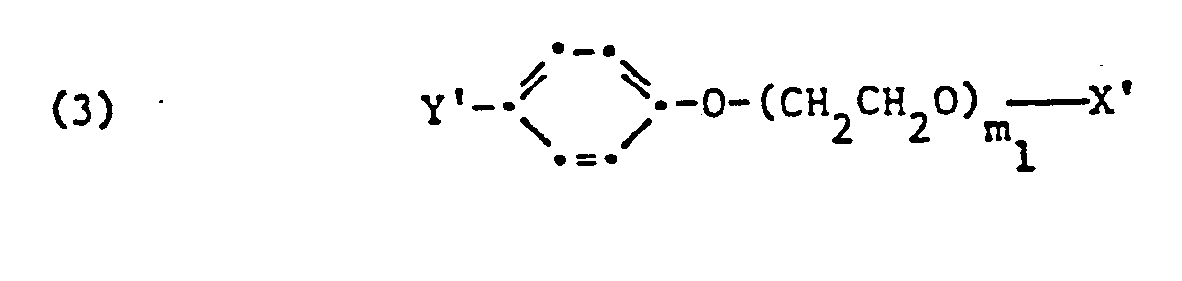
- the fatty alcohols for the preparation of the anionic surfactants of formula (2) are e.g. those with 8 to 22, in particular 8 to 18 carbon atoms, such as octyl-decyl, lauryl, tridecyl, myristyl, cetyl, stearyl, oleyl, arachidyl or behenyl alcohol.
- the acid residue X is derived, for example, from low molecular weight dicarboxylic acids, such as of maleic acid, succinic acid or sulfosuccinic acid, and is connected to the ethyleneoxy part of the molecule via an ester bridge.
- X is derived from inorganic polybasic acids, such as sulfuric acid or orthophosphoric acid.
- the acid residue X can be in the form of a free acid or in salt form, i.e. e.g. as an alkali metal, ammonium or amine salt.
- alkali metal, ammonium or amine salt examples of such salts are lithium, sodium, potassium, ammonium, trimethylamine, ethanolamine, diethanolamine or triethanolamine salts.
- Anionic surfactants of the formula are particularly preferred wherein Y 'is octyl or nonyl, m is 2 to 15 and X' is an acid residue derived from sulfuric acid or from o-phosphoric acid, and the surfactants are present as free acids, sodium or ammonium salts.
- Y ' is octyl or nonyl
- m is 2 to 15
- X' is an acid residue derived from sulfuric acid or from o-phosphoric acid
- the surfactants are present as free acids, sodium or ammonium salts.
- the acidic sulfuric acid ester of the adduct of 2 to 12 moles of ethylene oxide with 1 mole of p-nonylphenol.
- the anionic alkylene oxide adducts can be used to prepare the new Post-washing agents can be used individually or as mixtures with one another.
- component (C) e.g. aliphatic monoalcohols with at least 5, preferably 8 to 18 carbon atoms.
- These alcohols can be saturated or unsaturated and branched or straight-chain and can be used alone or in a mixture.
- Natural alcohols such as e.g. Amyl alcohol, lauryl alcohol, myristyl alcohol, cetyl alcohol, stearyl alcohol or oleyl alcohol or synthetic alcohols, e.g. Oxo alcohols such as, in particular, 2-ethylbutanol, 2-ethylhexanol, isooctyl alcohol, trimethylhexanol, trimethylnonyl alcohol, hexadecyl alcohol or alfoles can be used.
- the reaction products of fatty acids having 12 to 18 carbon atoms are preferred.
- alkanolamine one can e.g. Use ethanolamine, diethanolamine, propanolamine, isopropanolamine or di-isopropanolamine.
- Dialkanolamines, especially diethanolamine, are preferred.
- the molar ratio between fatty acid and dialkanolamine can be 1: 1 to 1: 2.
- Examples of fatty acids are: decenic acid, lauric acid, coconut oil fatty acid, myristic acid, palmitic acid, tallow fatty acid, oil acid, ricinoleic acid, linoleic acid, linolenic acid, stearic acid, arachic acid or behenic acid.
- component (C) are alkylene oxide, in particular ethylene oxide, adducts from the above-mentioned fatty acid-alkanolamine reaction products, it being possible for individual ethylene oxide units to be replaced by substituted epoxides, such as propylene oxide.
- the number of alkylene oxide groups in these glycol ethers can be 1 to 8 and preferably 1 to 4. Addition products of 1 to 4 moles of ethylene oxide with 1 mole of reaction product of 1 mole of coconut fatty acid, stearic acid and / or palmitic acid with 1 mole of diethanolamine are preferred.
- reaction products which are suitable as component (C) are addition products of preferably 2 to 15 mol of alkylene oxide, e.g. Ethylene oxide and / or propylene oxide, on optionally substituted phenols, trihydric to hexavalent aliphatic alcohols of 3 to 9 carbon atoms or on the aforementioned fatty acids.
- alkylene oxide e.g. Ethylene oxide and / or propylene oxide
- Suitable optionally substituted phenols are, for example, phenol, benzylphenol, o-phenylphenol or alkylphenols, the alkyl radical of which advantageously has a total of 4 to 16, preferably 4 to 12, carbon atoms.
- alkylphenols are butylphenol, tributylphenol, octylphenol and especially nonylphenol.
- the trihydric to hexavalent alcohols preferably contain 3 to 6 carbon atoms and are in particular glycerol, trimethylolpropane, erythritol, mannitol, pentaerythritol or sorbitol.
- the three to hexavalent alcohols are preferably reacted with ethylene oxide or preferably with propylene oxide or mixtures of these alkylene oxides.
- the fatty acids preferably have 8 to 22 carbon atoms and can be saturated or unsaturated, e.g. capric, lauri-n, myristic, palmitic or stearic acid or decenic, dodecenic, tetradecenic, hexadecenic, oleic, linoleic, linolenic or preferably ricinoleic acid.
- Preferred components (C) consist of an aliphatic monoalcohol of 8 to 18 carbon atoms, an above-mentioned fatty acid / alkanolamine reaction product or in particular a mixture of these substances. If desired, the mixture can additionally contain an adduct of 5 to 12 moles of ethylene oxide with a C 4 -C 12 alkylphenol.
- component (C) is present alone or as a mixture of two, three or more components in the detergent range from 1 to 20 percent by weight, preferably 1 to 5 percent by weight, based on the total detergent.
- the polymers containing carboxyl groups present as component (D) in the detergent according to the invention are expediently used in the form of 0.5 to 35%, preferably 0.5 to 5%, aqueous solutions or dispersions, based on the solution or dispersion.
- These polymers are advantageously polymerized ethylenically unsaturated mono- or dicarboxylic acids of 3 to 5 carbon atoms, such as, for example, polyacrylic acid or polymers of methacrylic acid, crotonic acid, itaconic acid, teraconic acid, maleic acid or their anhydride, fumaric acid, citraconic acid or mesaconic acid, copolymers of olefins, for example ethylene or Propylene, diketenes, acrylic acid esters, methacrylic acid esters or acrylamides and the abovementioned monomers including acrylic acid or copolymers of acrylic acid with methacrylic acid, methacrylonitrile or vinyl monomers, such as vinylphosphoric acid, copolymers of maleic acid and styrene, maleic acid and a vinyl ether or maleic acid and one Vinyl esters are, for example, vinyl acetate.
- Poly (N, N-bis-carboxymethyl) vinylamine, poly (N, N-bis-carboxymethyl) acrylamide, poly (N-carboxymethyl) ethylenediamine or polyhydroxycarboxylic acids can also be used as component (D).
- the polymers containing carboxyl groups present as component (D) in the detergent according to the invention can at the same time also be used as thickeners.
- the aqueous solutions or dispersions of the polymers mentioned, insofar as they form usable thickenings, can be used as such, ie in the acidic pH range, or they can be converted into the corresponding salts by adding alkalis or ammonia and used in this form as a thickening. They are preferably adjusted to a pH of 6.5 to 7.
- these thickeners have a viscosity which is advantageously at least 5000 mPas, preferably 8000 to 35000 mPas at 20 ° C. If desired, these thickeners can also be pseudoplastic.
- the carboxyl-containing polymers which form thickeners can have a molecular weight of 1/2 to 6 million.
- a partially hydrolyzed polymaleic anhydride is particularly preferred as component (D).
- component (D) is usually partly in the form of a water-soluble salt and has a molecular weight that is preferably between 300 and 5000.
- Polymaleic anhydride is a homopolymer of maleic anhydride and can be hydrolyzed very easily, for example by heating in water, to form a polymeric product which contains free carboxylic acid groups and optionally still intact anhydride groups on a main carbon chain.
- the product is not a pure polymaleic acid.
- This polymeric product formed by hydrolysis of polymaleic anhydride is referred to as hydrolyzed polymaleic anhydride.
- This can be prepared by addition polymerization of a starting monomer consisting essentially of maleic anhydride under conditions of bulk polymerization or by solution polymerization.
- Maleic anhydride is preferably polymerized in an inert organic solvent, e.g.
- Toluene or xylene in the presence of a polymerization catalyst, in particular a radical initiator, such as e.g. Benzoyl peroxide, di-tertiary-butyl peroxide or mono-butyl hydroperoxide, at temperatures up to 150 ° C, preferably 120 ° to 145 ° C.
- a polymerization catalyst in particular a radical initiator, such as e.g. Benzoyl peroxide, di-tertiary-butyl peroxide or mono-butyl hydroperoxide
- a radical initiator such as e.g. Benzoyl peroxide, di-tertiary-butyl peroxide or mono-butyl hydroperoxide
- the main chain of the primary polymer is essentially formed by non-hydrolyzable bonds.
- the unhydrolyzed polymer product is then hydrolyzed with water or an aqueous base after separation of the unreacted monomer and by-
- the molecular weight of the hydrolyzed polymaleic anhydride is in the specified low range.
- Polymaleic anhydride having a molecular weight which does not exceed 2000 and is preferably in the range from 350 to 1000 is preferably used.
- hydrolyzed polymaleic anhydride is e.g. in GB-A-1 369 429, GB-A-1 411 063, GB-A-1 491 978 and CH-A-624256.
- alkali metal salts are the sodium or potassium salt and preferably ammonium (NH 4 + ), alkylammonium or alkanolammonium salts, such as, for example, the trimethylammonium, monoethanolammonium, diethanolammionium or triethanolammonium salt as ammonium salts.
- the sodium and ammonium (NH 4 + ) salts are particularly suitable.
- the hydrolyzed polymaleic anhydride is used as component (D) in the form of an aqueous 40 to 60 percent by weight solution, based on the solution.
- the detergent according to the invention preferably contains as component (D) 1.5 to 10 percent by weight of this aqueous solution, based on the total detergent.
- the detergent according to the invention preferably additionally contains a thickener to increase the stability.
- suitable thickeners are, for example, polysaccharides, such as, for example Carboxymethyl cellulose, methyl cellulose, methyl hydroxyethyl cellulose, locust bean gum ether or starch ether, as well as alginates or metal stearates, such as aluminum, calcium or zinc stearate or finely divided silica.
- polysaccharides such as, for example Carboxymethyl cellulose, methyl cellulose, methyl hydroxyethyl cellulose, locust bean gum ether or starch ether, as well as alginates or metal stearates, such as aluminum, calcium or zinc stearate or finely divided silica.
- the amounts of these additional ingredients are generally between 0.1 to 5 percent by weight, preferably 0.3 to 2 percent by weight, based on the total detergent.
- the new detergent may additionally contain a silicone oil or a mixture of the silicone oils as component (E).
- silicone oils of component (E) are used in the agents according to the invention in particular in order to strive for an extremely foam-suppressing effect. However, silicone oils can also further improve the wetting effect of the agents used.
- the silicone oils can be present in amounts of up to 15, for example 1 to 15, in particular up to 5, and in some cases only up to 2 percent by weight, based on the detergent. Silicone oils are understood to mean organopolysiloxanes (optionally blocked with hydroxyl at the ends) such as, for example, polydimethylsiloxanes, polymethylphenylsiloxanes and polymethylhydrogen siloxanes with average molecular weights of about 1000 to 100000, preferably 5000 to 40,000.
- Alkyl polysiloxanes which have a viscosity of at least 0 7 mPas at 25 ° C. are particularly suitable.
- the alkyl radical can contain 1 to 6 carbon atoms.
- Preferred are, for example, the methylpolysiloxanes which have a viscosity of 50 to 15,000, preferably 100 to 1000 mPas at 25 ° C.
- Suitable methylpolysiloxanes can be represented by the formula are reproduced, wherein R, is methyl or methoxy and x is an integer greater than 1, preferably 50 to 1200 or more.
- silicone oils As a rule, these are known commercial products which, in addition to the silicone oil, may also contain conventional additives, such as colloidal silica or emulsifiers based on polyethylene glycol.
- the higher molecular weight silicone oils are preferred. They are preferably used in relatively small amounts, for example to avoid the silicone oils (hydrophobicity) having their own effects.
- component (E) may be present alone or as a mixture in the detergent advantageously range from 0 to 5 percent by weight, preferably from 0 to 3 percent by weight, based on the detergent as a whole.
- the after-washing agents according to the invention can be prepared by simply stirring the above-mentioned components (A), (B), (C), (D) and optionally (E) and / or thickening agents in water. Homogeneous, clear mixtures are obtained which are very stable in storage and free of sedimentation at room temperature.
- such mixtures can additionally contain neopentyl glycol, benzyl alcohol, furfuryl alcohol, acetic acid esters, malonic acid diesters, succinic acid diesters, adipic acid diesters, tetralin, decalin, alkylbenzenes and in particular paraffin oils, and also fatty amine-alkylene oxide adducts.
- the detergents according to the invention are used in particular when washing dyeings or Printing on cellulose fibers or blended fabrics made of cellulose and synthetic organic material, for example linear polyesters or modified cellulose (cellulose esters), the cellulose material being that of natural or regenerated cellulose, such as hemp, linen, jute, viscose silk, cellulose or especially cotton and any polyester content, if necessary, is dyed before or after the cellulose.
- Cellulose dyeings or cellulose prints here are understood to mean the dyeings or prints produced by any process using reactive dyes, the detergents according to the invention being used as aftertreatment.
- the coloring material can be at any stage of processing, e.g. as loose material (flake), as doubled, pre-stretched staple fiber tape or in the form of threads, yarns, but especially woven or knitted fabrics.
- Reactive dyes are understood to be the usual anionic dyes which form a chemical bond with the cellulose, e.g. the "Reactive Dyes” listed in the Color Index, 3rd Edition (1971) Vol. 3 on pages 3391-3562.
- the detergent according to the invention makes it possible to carry out the usual washing operations of the abovementioned prints or dyeings produced with reactive dyes with hard water (process water), as is directly available from the water pipe, with good success.
- This eliminates water hardness without the usual addition of electrolytes, ion exchangers and especially without the use of phosphorus-containing compounds such as phosphonic acids or inorganic phosphates, which have recently been increasingly restricted by the ecological and legislative requirements for phosphorus-free products.
- the invention thus further relates to a method for washing prints or dyeings produced with reactive dyes on cellulose-containing textile materials using the detergents according to the invention.
- This process consists in treating the printed or dyed textiles at a temperature of 60 to 100 ° C. in an aqueous washing liquor which contains the detergent according to the invention, preferably in amounts of 1-10 g / l.
- the textiles are then removed from the wash liquor and rinsed with fresh water until the wash liquor components have been completely removed. This gives printing dyeings, the white base of which is not stained, and dyeings from the exhaust process which have the desired wet fastness properties, especially fastness to washing.
- the following products are examples of the anionic surfactants or alkylene oxide adducts used as components (B) and (D).
- the polymer is mixed with 15 g of 2-butanone or 1,4-dioxane as a diluent and further purified as follows.
- the polymer is precipitated by adding the polymer solution to 430 g of toluene in a rapid homogenizer. After filtering off and drying in vacuo at 50 ° C., 78 g of powdery polymer are obtained.
- the polymaleic anhydride obtained When measured in 2-butanone using a vapor pressure osmometer, the polymaleic anhydride obtained has a molecular weight of 580.
- hydrolyzed polymaleic anhydride solution is mixed with 4.5 g of a 25% aqueous ammonia solution and enough water to form a 50% aqueous solution of the hydrolyzed polymaleic anhydride, which is partially present as the ammonium salt.
- washing liquors 2 and 3 With washing liquors 2 and 3, a product is obtained which has no staining on unprinted parts. In contrast, the white portion of the print treated with wash liquor 1 is strongly stained.
- the individual wash samples are then rinsed together in cold permutite water for 10 minutes.
- the treated dyed samples are spun onto 100% water absorption and tested for wet ironing in accordance with SNV standard 19832.
- a white section of cotton is wetted in distilled water and spun to 100% water absorption.
- the damp colored tricot section is placed on a dry white cotton section and covered with the moist white section.
- the washing samples are then pressed together for 2 minutes in an ironing press set at 180 ° C.
- the white, pre-wetted accompanying fabric is then assessed for fastness to ironing.
- the dyed sections obtained according to washing tests 2 and 3 do not stain the white section when testing the fastness to ironing, while the white cotton is strongly stained by the section obtained according to washing test 1.
Landscapes
- Chemical & Material Sciences (AREA)
- Engineering & Computer Science (AREA)
- Chemical Kinetics & Catalysis (AREA)
- Life Sciences & Earth Sciences (AREA)
- Oil, Petroleum & Natural Gas (AREA)
- Wood Science & Technology (AREA)
- Organic Chemistry (AREA)
- Textile Engineering (AREA)
- Health & Medical Sciences (AREA)
- Emergency Medicine (AREA)
- Inorganic Chemistry (AREA)
- Detergent Compositions (AREA)
Claims (19)
caractérisé en ce qu'il est exempt d'électrolytes, échangeurs d'ions, acides phosphoniques et phosphates inorganiques supplémentaires.


Applications Claiming Priority (4)
| Application Number | Priority Date | Filing Date | Title |
|---|---|---|---|
| CH5175/82 | 1982-08-31 | ||
| CH517582 | 1982-08-31 | ||
| CH157383 | 1983-03-23 | ||
| CH1573/83 | 1983-03-23 |
Publications (2)
| Publication Number | Publication Date |
|---|---|
| EP0102923A1 EP0102923A1 (fr) | 1984-03-14 |
| EP0102923B1 true EP0102923B1 (fr) | 1986-10-15 |
Family
ID=25688034
Family Applications (1)
| Application Number | Title | Priority Date | Filing Date |
|---|---|---|---|
| EP83810384A Expired EP0102923B1 (fr) | 1982-08-31 | 1983-08-25 | Détergent approprié pour le post-lavage de teintures réactives et procédé de lavage correspondant |
Country Status (3)
| Country | Link |
|---|---|
| US (1) | US4545919A (fr) |
| EP (1) | EP0102923B1 (fr) |
| DE (1) | DE3366960D1 (fr) |
Families Citing this family (17)
| Publication number | Priority date | Publication date | Assignee | Title |
|---|---|---|---|---|
| AU3215784A (en) * | 1983-08-22 | 1985-03-29 | Aktien Henkel Kommanditgesellschaft Auf | Stabilisierte wasrige zeolith-suspension |
| US4746455A (en) * | 1986-06-27 | 1988-05-24 | Kao Corporation | Liquid detergent composition for clothing articles |
| GB8625475D0 (en) * | 1986-10-24 | 1986-11-26 | Unilever Plc | Detergent composition |
| EP0287514A1 (fr) * | 1987-04-15 | 1988-10-19 | Ciba-Geigy Ag | Détergent pour le postlavage de teintures réactives, son procédé de préparation et son emploi |
| US4808191A (en) * | 1987-06-04 | 1989-02-28 | Milliken Research Corporation | Process for pattern dyeing of textile materials |
| FR2652818B1 (fr) * | 1989-10-09 | 1994-04-01 | Rhone Poulenc Chimie | Suspension de zeolite comprenant une resine silicone. |
| EP0596184B1 (fr) * | 1992-11-06 | 1998-04-15 | The Procter & Gamble Company | Compositions détergentes avec additifs pour empêcher le transfert de colorant |
| EP0596185A1 (fr) * | 1992-11-06 | 1994-05-11 | The Procter & Gamble Company | Détergents liquides stables inhibant le transfert de couleur |
| US5633225A (en) * | 1992-07-15 | 1997-05-27 | The Procter & Gamble Company | Detergent compositions inhibiting dye transfer |
| US5560858A (en) * | 1992-07-15 | 1996-10-01 | The Procter & Gamble Company | Dye transfer inhibiting compositions containing a metallocatalyst, a bleach and polyamine N-oxide polymer |
| US5783548A (en) * | 1992-11-06 | 1998-07-21 | The Procter & Gamble Company | Stable liquid detergent compositions inhibiting dye transfer |
| US5466802A (en) * | 1993-11-10 | 1995-11-14 | The Procter & Gamble Company | Detergent compositions which provide dye transfer inhibition benefits |
| US5804543A (en) * | 1994-10-11 | 1998-09-08 | The Procter & Gamble Company | Detergent compositions with optimized surfactant systems to provide dye transfer inhibition benefits |
| DE19525870A1 (de) * | 1995-07-15 | 1997-01-16 | Grueter Hans Jochen | Verfahren zur Herstellung einer Polysaccharid-Suspension |
| US6093258A (en) * | 1998-01-29 | 2000-07-25 | Mc Lean; Ildiko M. | Tint stain remover |
| US9376648B2 (en) | 2008-04-07 | 2016-06-28 | The Procter & Gamble Company | Foam manipulation compositions containing fine particles |
| JP2019510272A (ja) * | 2016-03-16 | 2019-04-11 | アグファ・ナームローゼ・フェンノートシャップAgfa Nv | 平版印刷版の処理方法 |
Family Cites Families (15)
| Publication number | Priority date | Publication date | Assignee | Title |
|---|---|---|---|---|
| AT330930B (de) * | 1973-04-13 | 1976-07-26 | Henkel & Cie Gmbh | Verfahren zur herstellung von festen, schuttfahigen wasch- oder reinigungsmitteln mit einem gehalt an calcium bindenden substanzen |
| AR208392A1 (es) * | 1973-05-07 | 1976-12-27 | Henkel & Cie Gmbh | Composicion para lavar blanquear o limpiar materiales resistentes especialmente textiles adicional a la patente no 201687 adicional a la no 253286 |
| AT335035B (de) * | 1974-10-10 | 1977-02-25 | Henkel & Cie Gmbh | Stabile suspensionen wasserunloslicher, zum binden von calciumionen befahigter silikate und deren verwendung zur herstellung von wasch- und reinigungsmitteln |
| GB1516848A (en) * | 1974-11-13 | 1978-07-05 | Procter & Gamble Ltd | Detergent composition |
| GB1491978A (en) * | 1975-06-10 | 1977-11-16 | Ciba Geigy Ag | Detergent compositions |
| US4083794A (en) * | 1975-06-10 | 1978-04-11 | Ciba-Geigy Corporation | Detergent composition |
| US4018720A (en) * | 1975-07-14 | 1977-04-19 | The Procter & Gamble Company | Laundry detergent compositions in emulsion/suspension |
| AT362481B (de) * | 1976-02-06 | 1981-05-25 | Henkel Kgaa | Stabile, pumpfaehige, als vorratssuspension geeignete waesserige suspension von wasserun- loeslichen, zum binden von calcium befaehigten silikaten |
| AT375974B (de) * | 1977-05-13 | 1984-09-25 | Henkel Kgaa | Verwendung feinteiliger, wasserunloeslicher alkalialuminiumsilikate als seifhilfsmittel zur nachbehandlung von faerbungen und drucken mit naphtolfarbstoffen, reaktivfarbstoffen, schwefelfarbstoffen, kuepenfarbstoffen und dispersionsfarbstoffen auf zellulosefasermaterial und synthesefasermischungen |
| GB2040981B (en) * | 1977-06-21 | 1982-08-25 | Procter & Gamble | Low-phosphate detergent composition for fabric washing |
| DE2824443A1 (de) * | 1978-06-03 | 1979-12-13 | Basf Ag | Lagerstabile und fliessfaehige silikatsuspensionen |
| CH624256GA3 (fr) * | 1979-01-10 | 1981-07-31 | ||
| DE2910583A1 (de) * | 1979-03-17 | 1980-09-25 | Henkel Kgaa | Verwendung feinteiliger wasserunloeslicher alkalialuminiumsilikate als seifhilfsmittel fuer faerbungen und drucke auf textilmaterial |
| US4265777A (en) * | 1980-04-17 | 1981-05-05 | The Procter & Gamble Company | Detergent compositions containing an aluminosilicate detergency builder and an unsaturated fatty acid soap |
| US4405483A (en) * | 1982-04-27 | 1983-09-20 | The Procter & Gamble Company | Stable liquid detergents containing aluminosilicate ion exchange material |
-
1983
- 1983-08-24 US US06/525,842 patent/US4545919A/en not_active Expired - Fee Related
- 1983-08-25 DE DE8383810384T patent/DE3366960D1/de not_active Expired
- 1983-08-25 EP EP83810384A patent/EP0102923B1/fr not_active Expired
Also Published As
| Publication number | Publication date |
|---|---|
| US4545919A (en) | 1985-10-08 |
| EP0102923A1 (fr) | 1984-03-14 |
| DE3366960D1 (en) | 1986-11-20 |
Similar Documents
| Publication | Publication Date | Title |
|---|---|---|
| EP0102923B1 (fr) | Détergent approprié pour le post-lavage de teintures réactives et procédé de lavage correspondant | |
| EP0098803B1 (fr) | Polymères greffés solubles ou dispersables dans l'eau, leur fabrication et utilisation | |
| EP0490819B1 (fr) | Dispersion aqueuse d'absorbant U.V. difficilement solubles | |
| DE2625707C3 (de) | Netz- und Schaumdämpfungsmittel für wäßrige Systeme auf der Basis von anionischen Tensiden und Propylenoxidumsetzungsprodukten | |
| DE3017877C2 (fr) | ||
| CH651581A5 (de) | Waessrige zusammensetzungen enthaltend polymere auf acrylsaeurebasis, sowie verfahren zu deren herstellung. | |
| DE2528743C2 (de) | Verfahren zum Färben und Bedrucken von Cellulose-Fasern oder Gemischen von Cellulose-Fasern mit synthetischen Fasern | |
| DE2943754A1 (de) | Schaumdaempfungsmittel und ihre verwendung zum entschaeumen waessriger systeme | |
| EP0764695B1 (fr) | Mélanges de tensio-actifs | |
| DE2816539A1 (de) | Waessrige farbstoffpraeparate | |
| DE3120697A1 (de) | Anionische verbindungen auf basis modifizierter novolack-oxalkylate, ihre herstellung und ihre verwendung als schaumfreie grenzflaechenaktive mittel | |
| DE2848447B2 (de) | Färbeverfahren | |
| EP0360736B1 (fr) | Composition aqueuse mouillante et détergente, stable dans l'eau dure, sa préparation et utilisation dans le prétraitment des matières textiles | |
| EP0042355B1 (fr) | Préparations tinctoriales pouvant être aisément dispersées | |
| EP0143077B1 (fr) | Procédé de teinture de matière textile hydrophobe | |
| AT335587B (de) | Wasch-, netz- und farbereihilfsmittel | |
| EP0000137B1 (fr) | Esters polyglycoliques; procédé de préparation et utilisation comme agents tensioactifs | |
| EP0204656A1 (fr) | Procédé de teinture de matiére textile hydrophobe | |
| DE3000382C2 (fr) | ||
| EP0287514A1 (fr) | Détergent pour le postlavage de teintures réactives, son procédé de préparation et son emploi | |
| DE2524243A1 (de) | Verfahren zum faerben und bedrucken von cellulose-fasern oder gemischen von cellulose-fasern mit synthetischen fasern | |
| DE2132403B2 (de) | Dispergiermittel für die Feinverteilung und Stabilisierung von Farbstoffen und Pigmenten | |
| EP0274350A1 (fr) | Adjuvant textile aqueux, stable au stockage et à l'eau dure | |
| DE3641700C2 (fr) | ||
| CH637432A5 (en) | Dyeing assistant suitable for use in the dyeing of synthetic fibre materials |
Legal Events
| Date | Code | Title | Description |
|---|---|---|---|
| PUAI | Public reference made under article 153(3) epc to a published international application that has entered the european phase |
Free format text: ORIGINAL CODE: 0009012 |
|
| 17P | Request for examination filed |
Effective date: 19830827 |
|
| AK | Designated contracting states |
Designated state(s): CH DE FR GB IT LI |
|
| GRAA | (expected) grant |
Free format text: ORIGINAL CODE: 0009210 |
|
| AK | Designated contracting states |
Kind code of ref document: B1 Designated state(s): CH DE FR GB IT LI |
|
| REF | Corresponds to: |
Ref document number: 3366960 Country of ref document: DE Date of ref document: 19861120 |
|
| ITF | It: translation for a ep patent filed | ||
| ET | Fr: translation filed | ||
| PLBE | No opposition filed within time limit |
Free format text: ORIGINAL CODE: 0009261 |
|
| STAA | Information on the status of an ep patent application or granted ep patent |
Free format text: STATUS: NO OPPOSITION FILED WITHIN TIME LIMIT |
|
| 26N | No opposition filed | ||
| PGFP | Annual fee paid to national office [announced via postgrant information from national office to epo] |
Ref country code: FR Payment date: 19890628 Year of fee payment: 7 |
|
| PGFP | Annual fee paid to national office [announced via postgrant information from national office to epo] |
Ref country code: GB Payment date: 19890630 Year of fee payment: 7 |
|
| PGFP | Annual fee paid to national office [announced via postgrant information from national office to epo] |
Ref country code: DE Payment date: 19890710 Year of fee payment: 7 |
|
| PGFP | Annual fee paid to national office [announced via postgrant information from national office to epo] |
Ref country code: CH Payment date: 19890815 Year of fee payment: 7 |
|
| ITTA | It: last paid annual fee | ||
| PG25 | Lapsed in a contracting state [announced via postgrant information from national office to epo] |
Ref country code: GB Effective date: 19900825 |
|
| PG25 | Lapsed in a contracting state [announced via postgrant information from national office to epo] |
Ref country code: LI Effective date: 19900831 Ref country code: CH Effective date: 19900831 |
|
| GBPC | Gb: european patent ceased through non-payment of renewal fee | ||
| PG25 | Lapsed in a contracting state [announced via postgrant information from national office to epo] |
Ref country code: FR Effective date: 19910430 |
|
| REG | Reference to a national code |
Ref country code: CH Ref legal event code: PL |
|
| PG25 | Lapsed in a contracting state [announced via postgrant information from national office to epo] |
Ref country code: DE Effective date: 19910501 |
|
| REG | Reference to a national code |
Ref country code: FR Ref legal event code: ST |