EP0103071B1 - Gewindeschneidkopf mit verschiedenen axialen Werkzeugwegen - Google Patents
Gewindeschneidkopf mit verschiedenen axialen Werkzeugwegen Download PDFInfo
- Publication number
- EP0103071B1 EP0103071B1 EP83105337A EP83105337A EP0103071B1 EP 0103071 B1 EP0103071 B1 EP 0103071B1 EP 83105337 A EP83105337 A EP 83105337A EP 83105337 A EP83105337 A EP 83105337A EP 0103071 B1 EP0103071 B1 EP 0103071B1
- Authority
- EP
- European Patent Office
- Prior art keywords
- thread
- die head
- wedge
- tool
- blocks
- Prior art date
- Legal status (The legal status is an assumption and is not a legal conclusion. Google has not performed a legal analysis and makes no representation as to the accuracy of the status listed.)
- Expired
Links
Images



Classifications
-
- B—PERFORMING OPERATIONS; TRANSPORTING
- B23—MACHINE TOOLS; METAL-WORKING NOT OTHERWISE PROVIDED FOR
- B23G—THREAD CUTTING; WORKING OF SCREWS, BOLT HEADS, OR NUTS, IN CONJUNCTION THEREWITH
- B23G1/00—Thread cutting; Automatic machines specially designed therefor
- B23G1/22—Machines specially designed for operating on pipes or tubes
-
- B—PERFORMING OPERATIONS; TRANSPORTING
- B23—MACHINE TOOLS; METAL-WORKING NOT OTHERWISE PROVIDED FOR
- B23G—THREAD CUTTING; WORKING OF SCREWS, BOLT HEADS, OR NUTS, IN CONJUNCTION THEREWITH
- B23G5/00—Thread-cutting tools; Die-heads
- B23G5/08—Thread-cutting tools; Die-heads with means for adjustment
- B23G5/10—Die-heads
Definitions
- the present invention relates to a rotary die head in general and to a rotary die head having thread cutting tools simultaneously moving in paths of different angularity relative to the workpiece, in particular.
- Rotary die heads having a plurality of circumferentially spaced, radially movable cutting tools are well known in the art. Reference may be had for example to U.S. Patent Nos. 3,082,446; 3,645,638 and 3,812,548. These rotary die heads cut threads of uniform and continuous groove configuration in the workpiece in one pass.
- the principal object of the present invention isto provide a rotary die head capable of cutting a dual lead tapered thread in one pass of the workpiece.
- At least one tool e.g. a chaser block must be committed to cutting the stab flank of the thread at a given lead while at least one other tool, e.g. a chaser block must be committed to cutting the load flank of the thread at a different lead.
- the stab and load flank tools cooperate to commonly generate the thread roots and either or both may generate the thread crests.
- the stab and load flank tools may be driven by simultaneously actuated wedge blocks having tongue and groove camming connections with the respective chaser blocks carrying the cutting chasers.
- the tongue and groove connections have varying angularity in accordance with the related angularity of the tool being driven thereby to provide rectilinear reciprocation of the respective tools in their respective guide slots of different relative angularity.
- another chaser block may be committed to being a root finishing chaser.
- the rootfinishing chaser block path relative to the workpiece may be inclined at angle having one half of the axial change per revolution that the stab flank chaser block has.
- the multiple tooth chasers are configured for the specific thread configuration being cut and may be used, in conjunction with additional power, to cut deeper dual lead tapered threads in one pass.
- the chasers may be mounted on their respective chaser blocks in axially displaced positions relative to one another with the axial displacement and tooth configuration being selected for the specific dual lead tapered thread being formed.
- one or more of the chaser blocks may have a seal turning tool cartridge mounted axially ahead of and radially outwardly from the chaser tool. If this cannot be done because of clearance and/or stability problems, one or more of the circumferentially spaced chaser blocks may have the auxiliary tool mounted thereon and be operated by a reverse wedge to move in an opposite radial direction from the thread cutting chasers.
- wedge blocks driving the chaser blocks may each be independently adjustable and the chaser blocks are enclosed in quick change cover plates.
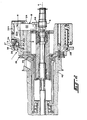
- the rotary die head indicated generally at 1, includes a generally cylindrical body 2 having a central bore 3 with a longitudinal axis 4.
- a workpiece 5, such as a length of pipe or the like, may be coaxially inserted into bore 3 on mandrel 6 of the die head for threading and finishing by the circumferentially spaced, reciprocally driven tools mounted in the die head.
- the position and number of the tools may be selected and dedicated as required by the specific thread and operational parameters presented. In the example shown, six tools have been selected with two load flank tools, two stab flank tools, one mid flank tool and the reverse wedge sealing tool being respectively generally indicated in Fig. 1 by the reference numerals 8, 9, 10 and 11.
- These circumferentially spaced tools are oriented and commonly driven in such fashion as to cut a dual lead tapered thread in one pass.
- the dual lead tapered thread has a load flank 13 and stab flank 14 of different radial depths.
- the dual lead tapered thread has a changing pitch diameter and pitch from one end to the other and has a different load flank lead 13A than stab flank lead 14A.
- the thread geometry thus has a radial change per revolution of Ax and a root width change per revolution of Az.
- the axial root width change Az per revolution may be determined, of course, by subtracting the stab flank lead 14A from load flank lead 13A.
- the respective root widths become successively smaller along the thread as seen by comparing the root widths 15 through 19 in Fig. 3B.
- the dual lead tapered thread section when mated with a corresponding threaded female section provides wedge type locking characteristics in radial and axial directions between the two pipe sections so threaded.
- This wedge lock has both the stab and load flank in contact with the mating thread flanks.
- U.S. Patent No. 3,989,284 for specific dual lead tapered thread configurations including threads having dove tailed flanks.
- at least one pass of a chaser must be committed to cutting the load flank 13 at one selected lead, and at least one pass of another chaser must be committed to cutting the stab flank 14 at a different lead.
- two diametrically opposed load flank slots 21 are provided at the end of body 2 and extend radially outwardly from bore 3.
- a load flank chaser block 22 carrying a multiple tooth chaser 23 on its radially inner end is selectively reciprocally driven in each slot 21 for guided sliding movement relative thereto.
- a front cover plate 24, discussed in more detail hereinafter, is removably connected to the end surface of body 2 to close each slot 21 to provide retention and guidance functions.
- Two diametrically opposed stab flank slots 26 with removable covers 27 are provided at the end of body 2 and are circumferentially spaced from the load flank slot 21. Each of the stab flank slots 26 extends outwardly from bore 3 at an angle A relative to longitudinal axis 4.
- the angle A is chosen to match the ratio of the radial change per revolution (Ax) of the thread to the root width change per revolution (Az) of the thread.
- a stab flank chaser block 29 carrying a multiple tooth chaser 30 at its radially inner end is selectively reciprocally driven in each stab flank slot 26 for guided sliding movement relative thereto.
- the two load flank chaser blocks 22 and the two stab flank chaser blocks 29 are commonly driven for equal radial movements but different axial movements because of their different paths of angularity relative to axis 4.
- two load flank chasers and two stab flank chasers have been described for exemplary purposes, different numerical combinations of load flank and stab flank chaser tools may be used if required by the operating parameters, as long as the stab and load flank chasers are commonly driven in the above described relative relationship.
- the body 2 has a plurality of axially oriented and circumferentially spaced slots 32A-F in its outer annular surface generally in respective circumferential alignment with but slightly offset from the chaser slots, as shown and described in U.S. Patent 3,082,446, which is incorporated herein by reference thereto.
- a plurality of wedge blocks 33A-F are respectively individually received in slots 32A-F and are retained therein by removable cover plates 34A-F.
- the wedge blocks are axially reciprocated in the covered slots by a common drive assembly indicated generally at 36.
- such drive assembly 36 includes a plurality of wedge block adjustment clamp assemblies 37 respectively adjustably securing the individual wedge blocks 33A-F to a common annular drive ring 38, as described in more detail hereinafter.
- This wedge ring is secured to a wedge ring support sleeve 39 that is axially reciprocally driven in conventional manner relative to the spindle 40.
- This axial reciprocal movement causes each of the wedge blocks 33A-F to be axially reciprocated in equal magnitudes to drive the respective chaser blocks.
- the driving interconnections between the respective wedge blocks 33A-F and the chaser blocks generally aligned therewith consist of sliding tongue and groove connections indicated generally at 41.
- tongue and groove connections have been used in die heads before (as shown, for example, by U.S. Patent Nos. 3,082,446; 3,645,638 and 3,812,548)
- the angularity of the tongue and groove connections is varied in accordance with the respective angularity of the chaser slots as shown by comparing the difference between angles B and C in Fig. 3. This selected variance in tongue and groove angularity provides rectilinear drive for each of the chaser blocks in its respective slot.
- a workpiece 5 is inserted into the bore 3 of body 2 along axis 4.
- the spindle 40 and the die head 1 connected thereto are rotated at relatively high speeds in conventional manner.
- the drive ring 38 is advanced axially to the right as viewed in Fig. 2 to drive the wedge blocks 33A-F to the right.
- This wedge block movement provides relative sliding movement of the tongue and groove connections 41 to cam the chaser blocks 22 and 29 radially inwardly toward the inserted workpiece.
- the different angularity between the respective tongue and groove sliding connections makes the chaser blocks 22 and 29 move at effectively equal radial rates and thus equal radial distances but the stab flank chaser blocks 29 are moving faster by the hypotenuse function to provide their axial component of movement relative to the load flank block. Therefore, the multiple teeth of chasers 23 and 30 will cut the load and stab flanks 13 and 14, respectively, to proper depths in one pass upon their simultaneous radial advancement.
- the teeth of chasers 23 and 30 commonly generate the thread roots and one or both of the chasers simultaneously generate the thread crests. This crest generation is performed by the chaser cutting surfaces between or adjacent the projecting teeth.
- the present die head may cut relatively deeper thread roots in one pass if sufficient horsepower is available.
- the right teeth 23A and 30A on the chasers 23 and 30 make the initial stock removal from pipe 5.
- Teeth 23A and 30A are not radially as long as their respective next adjacent teeth 23B and 30B on chasers 23 and 30, respectively.
- Teeth 23B and 30B subsequently finish the stock removal begun by teeth 23A and 30A to complete the thread root.
- the number of chaser teeth may be varied and staggered relative to one another as required by the thread configuration and stock material being cut.
- the chasers may be relatively axially staggered on their respective blocks as required by operating conditions and parameters.
- the cutting width of the individual chaser teeth cannot be greater than the narrowest thread root being formed, in this case 19.
- the narrowest thread root has the largest finished root diameter, and the stab flank tool cutting plane moves closer to the load flank tool cutting plane as the tools recede radially outwardly in cutting the dual lead tapered thread. If required for the thread being cut, the cutting planes of the load and stab flank tools may merge for the narrowest thread root having the greatest finished root diameter. Therefore, the number of die head revolutions necessary for the common root and crest generations by the chasers is dependent upon the cutting tooth size and root width change for the particular thread being cut. However, this thread generation can be accomplished by one axial pass of the workpiece relative to the die head requiring only one set up procedure.
- the magnitude of sleeve movement 39 is varied in controlled fashion in accordance with the thread being formed and the relative location of the workpiece to cut the dual lead tapered thread in one pass of the workpiece.
- the thread forming operation may be expedited by committing one or more additional chaser blocks to such generation.
- a mid flank tool 10 has been committed to this purpose.
- the mid flank tool 10 has a chaser block 43 with a mid flank or root finishing chaser 44 being mounted on its radially inner end.
- the mid flank chaser block 43 is selectively reciprocally driven in a covered slot 45 in the end of the die head body 2.
- the covered slot 45 is inclined at an angle having about one half the axial change per revolution that the stab flank chaser block has.
- the angle for the root finishing slot 45 is approximately 72-1/2° relative to the axis 4 of body 2.
- the mid flank chaser block 43 is reciprocally cammed in its slot 45 through a tongue and groove connection with its wedge block being driven by the drive assembly 36.
- This tongue and groove connection 41 as shown in Fig. 3A, is inclined at a complimentary angle to the angle of slot 45 to rectilinearly drive the chaser block 43 in slot 45 for selective reciprocation therein.
- the chaser block 43 is simultaneously driven in and out with the stab and load flank chaser blocks and has equal radially inwardly and outwardly directed motion at equal rates, but has different axial movement because of the hypotenuse function.
- mid flank chaser 44 may have multiple teeth, and these teeth cut the workpiece material between the load and stab flanks.
- the above described die head structure can form a dual lead tapered thread in one pass of the workpiece.
- auxiliary operations must be performed on the workpiece, such as forming a conical sealing surface 47 at the end of the workpiece 5 or a thread relief surface at the terminal end of the thread.
- the present invention may perform these auxiliary operations before or after the thread forming to permit the entire workpiece to be finished in one pass.
- one or more chaser blocks may be a turning tool cartridge 48 mounted on the front face thereof.
- the turning tool cartridge 48 is located axially ahead of and radially outwardly from load flank chaser 23.
- the workpiece is inserted into bore 3 only far enough to have its end engaged by the cutting edge of turning tool cartridge 48 when the latter is advanced into operative engagement.
- the sleeve 38 is advanced farther to the right as viewed in Fig. 1 than it is for the above described thread forming operation.
- the chasers 23, 30 and 44 would clear the end of the workpiece 5 to permit cartridge 48 to form sealing surface 47 without obstruction or interference.
- the turning tool cartridge 48 is positioned radially outwardly from the workpiece to avoid interference.
- a turning tool cartridge may not always be usable with the present invention because of clearance and/or stability considerations.
- a reverse wedging concept may be used for driving the turning tool.
- the reverse wedge sealing tool indicated generally at 11 includes a turning tool block 49 received for reciprocal movement in a covered radially oriented guide slot 50.
- the turning tool block 49 has a turning tool 51 mounted on its radially inner end.
- This turning tool 51 is advanced toward and retracted from the workpiece by the reciprocal movement of block 49 controlled by a sliding tongue and groove camming connection indicated generally at 41A.
- This tongue and groove interconnection converts the axial reciprocation of wedge block 33E to radial reciprocation of turning tool block 49.
- the tongue and groove interconnection 41A for the turning tool block 49 is reversed in its angularity relative to the tongue and groove camming interconnection employed for the thread forming chaser blocks, i.e.
- the turning tool chaser block will be radially retracted when the stab flank, load flank and mid flank chaser blocks are radially advanced and vice-a-versa.
- the turning tool may be used to form a sealing surface before threading by moving the drive ring 38 in the opposite axial direction than that described above to advance or extend the turning tool 51 and retract the thread forming tools.
- the turning tool chaser could again be advanced or extended to form a second seal or thread relief if necessary.
- Figs. 1 through 4 have illustrated chasers having multiple teeth for the die head of the present invention, it will be appreciated that chasers having single teeth may also be used. To illustrate this possibility, Fig. 4 has been included showing load flank and stab flank chaser having single teeth, identified by 23C and 30C, respectively. The number of teeth on the individual chasers can be varied relative to one another as required by the operational parameters presented.
- the above described die head can form a dual lead tapered thread in one pass.
- This one pass thread formation saves time in tool set-up and in actual operation.
- T6 further enhance the efficiency of this die head, ease of maintenance has been provided for quick field repairs and adjustments.
- the wedge blocks driving the chaser blocks are each independently adjustable as shown in Figs. 2, 2A and 2B, and the chaser blocks are enclosed in quick change cover plates as shown in Figs. 1 and 1A.
- each of the wedge blocks 33A through F has a wedge block adjustment clamp assembly indicated generally at 37.
- Each wedge block adjustment clamp assembly includes a retaining clamp 54 and an adjustment wedge 55.
- the retaining clamp 54 is adjustably mounted to shoulder 56 on drive ring 38 by two spaced cap screws 58 as best shown in Fig. 2B.
- the threads on both screws 58 respectively mate with threads in spaced tapped holes 59 in retaining clamp 54. With such thread interconnection, rotation of the screws 58 in one direction will axially loosen retaining clamp 54 relative to wedge 55 while rotation in the opposite direction will tighten the retaining clamp 54 relative to wedge 55.
- the retaining clamp 54 has a downwardly projecting flange 61 received in a transverse groove 62 in the associated wedge block 33A.
- This groove 62 is axially wider than the flange 61 on retaining clamp 54 to permit some freedom of axial movement for the retaining clamp 54 as described in more detail below.
- the adjustment wedge 55 is sandwiched between the retention clamp 54 and the shoulder 56 on drive ring 38.
- the adjustment wedge has an inclined camming surface 64 slidingly engaging a similarly inclined cam follower surface at the back of the associated wedge block 33A. With such camming relationship, radially inwardly directed movement of the adjustment wedge will be translated into axial movement to the right for the associated wedge block as viewed in Fig. 2A while radially outwardly directed movement for the adjustment wedge will permit the wedge block to be moved to the left as viewed in Fig. 2A. This radial movement of the adjustment wedge 55 is closely controlled for accuracy in adjustment.
- the adjustment wedge 55 has side guides 65 which are secured to shoulder 56 as best shown in Fig. 2B. These guides 65 form channels 66 slidably receiving opposed flanges 67 on the adjustment wedge 55 rectilinearly to guide the same in its radial movement.
- This radial movement is controlled by an adjustment screw 67 rotably mounted in a bracket 68 which is fixed to wedge 55 by fastener 69.
- Adjustment screw 67 has its thread mated with the internal thread in tapped hole 70 in shoulder 56, so that rotation of such screw will radially drive the bracket 68 and thus the adjustment wedge 55.
- the bracket 68 is received in guide channel 72 in shoulder 56, with the channel sidewalls laterally containing and thus guiding the bracket 68 in its radial movements.
- the radial movement of the adjustment wedge 55 is not obstructed or hindered by the cap screws 58, which have their shanks received in radially elongated holes 73 in the adjustment wedge, as best shown in Fig. 2.
- the wedge blocks 33A through F may be individually or collectively adjusted by clamp assemblies 37. If adjustment of wedge block 33A to the right is required as viewed in Figs. 2 and 2A, the screws 58 are initially rotated to move the retaining clamp 54 to the right, thereby loosening the wedge 55. The adjustment screw 67 may then be rotated to drive adjustment wedge 55 radially inwardly the desired amount. The screws 58 are then tightened to secure the wedge 55. Wedge block adjustment in the opposite direction is implemented by first loosening the screws 58, then moving the adjustment wedge radially outwardly the desired amount, and tightening the screws 58. Indicia may be associated with the heads of the screws to provide a ready indication of the wedge block location and relative adjustment.
- This wedge block adjustment maintenance can be coordinated with maintenance on the chaser block and/or chaser if required.
- the chaser blocks each move in guide slots enclosed by quick change cover plates 24 permitting ready removal for maintenance or set up purposes.
- the lateral inclined edges 74 of each cover plate 24 are respectively slidably received in right wedge retainer 75 and left wedge clamp 76.
- the right wedge retainer 75 is substantially coextensive with the associated guide slot in body 2 and is permanently secured to body 2 by spaced fasteners 77.
- the left wedge clamp 76 is of limited radial extent and is secured to body 2 by fastener 79.
- left wedge clamp 76 The inner face of left wedge clamp 76 is provided with a socket 80 receiving one end of a spring 81 positioned between body 2 and left wedge clamp 76.
- the spring 81 biases the left wedge clamp 76 away from body 2.
- the cover plate 24 may be radially inserted over the guide slot, with its inclined marginal edges 74 being received in the inclined surfaces on the two wedge clamps.
- the fastener 79 is then tightened to hold the left wedge clamp 76 securely against the cover plate 24.
- the cover plate installation is then completed by threading fastener 83 through plate 24 into body 2.
- cover plate 24 To remove cover plate 24, fastener 83 is removed and fastener 79 is then loosened to provide clearance between clamp 76 and body 2 caused by spring 81 urging clamp 76 away from body 2. The cover plate 24 is then free from lateral restraint so that such plate may be radially withdrawn to expose the guide slot in body 2 for maintenance purposes.
- the cover plate 24 has a cover 85 removably positioned over a cut-out portion of plate 24.
- the left margin of cover 85 is secured to cover plate 24 by spaced fasteners 86.
- the right margin of cover 85 has two projecting flanges 87 with semicircular cutouts received around and embraced by raised fastener heads 88 in right wedge retainer 75.
Landscapes
- Engineering & Computer Science (AREA)
- Mechanical Engineering (AREA)
- Turning (AREA)
- Heating, Cooling, Or Curing Plastics Or The Like In General (AREA)
- Forging (AREA)
- Magnetic Heads (AREA)
- Milling Processes (AREA)
- Moulds For Moulding Plastics Or The Like (AREA)
Claims (15)
Applications Claiming Priority (2)
| Application Number | Priority Date | Filing Date | Title |
|---|---|---|---|
| US06/407,085 US4485511A (en) | 1982-08-11 | 1982-08-11 | Die head with different axial tool paths |
| US407085 | 1982-08-11 |
Publications (2)
| Publication Number | Publication Date |
|---|---|
| EP0103071A1 EP0103071A1 (de) | 1984-03-21 |
| EP0103071B1 true EP0103071B1 (de) | 1986-09-10 |
Family
ID=23610526
Family Applications (1)
| Application Number | Title | Priority Date | Filing Date |
|---|---|---|---|
| EP83105337A Expired EP0103071B1 (de) | 1982-08-11 | 1983-05-30 | Gewindeschneidkopf mit verschiedenen axialen Werkzeugwegen |
Country Status (4)
| Country | Link |
|---|---|
| US (1) | US4485511A (de) |
| EP (1) | EP0103071B1 (de) |
| JP (1) | JPS5930618A (de) |
| DE (2) | DE103071T1 (de) |
Cited By (1)
| Publication number | Priority date | Publication date | Assignee | Title |
|---|---|---|---|---|
| EP4570406A1 (de) * | 2023-12-11 | 2025-06-18 | Tenaris Connections B.V. | Schneidwerkzeug und verfahren zum schneiden eines gewindes |
Families Citing this family (8)
| Publication number | Priority date | Publication date | Assignee | Title |
|---|---|---|---|---|
| US5868051A (en) * | 1997-08-28 | 1999-02-09 | Pakos Group | Method and apparatus for machining with a pivoting cutting tool |
| CN1133842C (zh) * | 1998-07-31 | 2004-01-07 | 川崎制铁株式会社 | 油井管用螺纹连接器、螺纹切削方法及其装置 |
| JP5779989B2 (ja) * | 2010-06-30 | 2015-09-16 | Jfeスチール株式会社 | ねじ切削方法 |
| JP5779990B2 (ja) * | 2010-06-30 | 2015-09-16 | Jfeスチール株式会社 | ねじ切削方法 |
| CN102717156A (zh) * | 2012-06-15 | 2012-10-10 | 天津钢管集团股份有限公司 | 油井管连接用双线管螺纹单刀一次成型加工方法 |
| US11047413B2 (en) | 2016-04-27 | 2021-06-29 | Hydril Company | Threaded and coupled tubular goods connection |
| JP6633214B2 (ja) | 2016-09-16 | 2020-01-22 | 日本製鉄株式会社 | ねじ継手 |
| CH718197B1 (fr) * | 2020-12-21 | 2024-12-30 | Esco Sa | Unité d'usinage à tête rotative. |
Family Cites Families (6)
| Publication number | Priority date | Publication date | Assignee | Title |
|---|---|---|---|---|
| US3082446A (en) * | 1959-12-22 | 1963-03-26 | William L Benninghoff | Taper thread cutting die head with radially removable wedge elements for controllingthe chasers |
| US3645638A (en) * | 1970-09-08 | 1972-02-29 | Pipe Machinery Co The | Method and apparatus for cutting threads |
| DE2239854A1 (de) * | 1972-08-12 | 1974-02-14 | Erwin Nann | Gewindeschneidmaschine |
| US3812548A (en) * | 1972-12-14 | 1974-05-28 | Pipe Machining Co | Tool head with differential motion recede mechanism |
| US3829920A (en) * | 1973-07-05 | 1974-08-20 | Pipe Machinery Co | Tool head with multiple tools and common oscillatable recede and collapse cam mechanism |
| US4118140A (en) * | 1977-07-11 | 1978-10-03 | Hamilton Eddie J | Combination die head and chamfering tool |
-
1982
- 1982-08-11 US US06/407,085 patent/US4485511A/en not_active Expired - Fee Related
-
1983
- 1983-05-30 DE DE198383105337T patent/DE103071T1/de active Pending
- 1983-05-30 EP EP83105337A patent/EP0103071B1/de not_active Expired
- 1983-05-30 DE DE8383105337T patent/DE3366026D1/de not_active Expired
- 1983-07-20 JP JP58131121A patent/JPS5930618A/ja active Granted
Cited By (2)
| Publication number | Priority date | Publication date | Assignee | Title |
|---|---|---|---|---|
| EP4570406A1 (de) * | 2023-12-11 | 2025-06-18 | Tenaris Connections B.V. | Schneidwerkzeug und verfahren zum schneiden eines gewindes |
| WO2025125321A1 (en) * | 2023-12-11 | 2025-06-19 | Tenaris Connections B.V. | Cutting tool and method for cutting a thread |
Also Published As
| Publication number | Publication date |
|---|---|
| JPH0314574B2 (de) | 1991-02-27 |
| EP0103071A1 (de) | 1984-03-21 |
| US4485511A (en) | 1984-12-04 |
| DE103071T1 (de) | 1984-07-05 |
| JPS5930618A (ja) | 1984-02-18 |
| DE3366026D1 (en) | 1986-10-16 |
Similar Documents
| Publication | Publication Date | Title |
|---|---|---|
| US5542792A (en) | Cutting device with removable nosepiece | |
| DE19607230C1 (de) | Verfahren zur Herstellung bogenförmiger Nuten und Werkzeug dazu | |
| DE69228796T2 (de) | Nockenachsebearbeitungsmethode und Gerät | |
| EP0103071B1 (de) | Gewindeschneidkopf mit verschiedenen axialen Werkzeugwegen | |
| CN101462183B (zh) | 用于去屑加工的铣削刀具及其切削本体 | |
| EP0614716B1 (de) | Spannfutter zur Bearbeitung von gerillten Werkstücken | |
| US2816770A (en) | Tool holder and adapter | |
| US4123194A (en) | Profiled chip breaker | |
| US3219356A (en) | Quick-change chuck jaw | |
| US20180369976A1 (en) | Cooling system and method for machine tools | |
| EP0474774B1 (de) | Schneideeinsatz für gewindeschneiden und einstechen | |
| GB2346823A (en) | Reamer and method of using the same | |
| US5857813A (en) | Boring tool | |
| EP0204671A2 (de) | Werkzeugkupplungsvorrichtung | |
| US4102539A (en) | Power-actuated chuck, especially for turning machines such as lathes | |
| US2477153A (en) | Milling tool | |
| US1916253A (en) | Device for rotary cutting and the like | |
| US6487946B1 (en) | Threading device | |
| EP0127594B1 (de) | Automatische Vorrichtung zum Vorschub von drehenden mechanischen Elementen | |
| GB2158374A (en) | Machine tool socket and spigot coupling | |
| US4141279A (en) | Method and apparatus for cutting circumferential grooves on the interior of a workpiece | |
| US2466197A (en) | Toolholder | |
| US2574260A (en) | Die head for cutting threads | |
| US4966058A (en) | Automatic threading device for lathes | |
| US6062777A (en) | Machining threaded tubular goods |
Legal Events
| Date | Code | Title | Description |
|---|---|---|---|
| PUAI | Public reference made under article 153(3) epc to a published international application that has entered the european phase |
Free format text: ORIGINAL CODE: 0009012 |
|
| AK | Designated contracting states |
Designated state(s): DE GB IT |
|
| ITCL | It: translation for ep claims filed |
Representative=s name: BARZANO' E ZANARDO ROMA S.P.A. |
|
| DET | De: translation of patent claims | ||
| 17P | Request for examination filed |
Effective date: 19840911 |
|
| ITF | It: translation for a ep patent filed | ||
| GRAA | (expected) grant |
Free format text: ORIGINAL CODE: 0009210 |
|
| AK | Designated contracting states |
Kind code of ref document: B1 Designated state(s): DE GB IT |
|
| REF | Corresponds to: |
Ref document number: 3366026 Country of ref document: DE Date of ref document: 19861016 |
|
| PLBE | No opposition filed within time limit |
Free format text: ORIGINAL CODE: 0009261 |
|
| STAA | Information on the status of an ep patent application or granted ep patent |
Free format text: STATUS: NO OPPOSITION FILED WITHIN TIME LIMIT |
|
| 26N | No opposition filed | ||
| ITTA | It: last paid annual fee | ||
| PGFP | Annual fee paid to national office [announced via postgrant information from national office to epo] |
Ref country code: GB Payment date: 19940519 Year of fee payment: 12 |
|
| PGFP | Annual fee paid to national office [announced via postgrant information from national office to epo] |
Ref country code: DE Payment date: 19940520 Year of fee payment: 12 |
|
| PG25 | Lapsed in a contracting state [announced via postgrant information from national office to epo] |
Ref country code: GB Effective date: 19950530 |
|
| GBPC | Gb: european patent ceased through non-payment of renewal fee |
Effective date: 19950530 |
|
| PG25 | Lapsed in a contracting state [announced via postgrant information from national office to epo] |
Ref country code: DE Effective date: 19960201 |