EP0103338A2 - Compositions céramiques diélectriques à basse température de frittage - Google Patents
Compositions céramiques diélectriques à basse température de frittage Download PDFInfo
- Publication number
- EP0103338A2 EP0103338A2 EP83201287A EP83201287A EP0103338A2 EP 0103338 A2 EP0103338 A2 EP 0103338A2 EP 83201287 A EP83201287 A EP 83201287A EP 83201287 A EP83201287 A EP 83201287A EP 0103338 A2 EP0103338 A2 EP 0103338A2
- Authority
- EP
- European Patent Office
- Prior art keywords
- weight percent
- approximately
- ceramic dielectric
- ceramic
- palladium
- Prior art date
- Legal status (The legal status is an assumption and is not a legal conclusion. Google has not performed a legal analysis and makes no representation as to the accuracy of the status listed.)
- Granted
Links
Images
Classifications
-
- C—CHEMISTRY; METALLURGY
- C04—CEMENTS; CONCRETE; ARTIFICIAL STONE; CERAMICS; REFRACTORIES
- C04B—LIME, MAGNESIA; SLAG; CEMENTS; COMPOSITIONS THEREOF, e.g. MORTARS, CONCRETE OR LIKE BUILDING MATERIALS; ARTIFICIAL STONE; CERAMICS; REFRACTORIES; TREATMENT OF NATURAL STONE
- C04B35/00—Shaped ceramic products characterised by their composition; Ceramics compositions; Processing powders of inorganic compounds preparatory to the manufacturing of ceramic products
- C04B35/01—Shaped ceramic products characterised by their composition; Ceramics compositions; Processing powders of inorganic compounds preparatory to the manufacturing of ceramic products based on oxide ceramics
- C04B35/46—Shaped ceramic products characterised by their composition; Ceramics compositions; Processing powders of inorganic compounds preparatory to the manufacturing of ceramic products based on oxide ceramics based on titanium oxides or titanates
- C04B35/462—Shaped ceramic products characterised by their composition; Ceramics compositions; Processing powders of inorganic compounds preparatory to the manufacturing of ceramic products based on oxide ceramics based on titanium oxides or titanates based on titanates
- C04B35/465—Shaped ceramic products characterised by their composition; Ceramics compositions; Processing powders of inorganic compounds preparatory to the manufacturing of ceramic products based on oxide ceramics based on titanium oxides or titanates based on titanates based on alkaline earth metal titanates
- C04B35/468—Shaped ceramic products characterised by their composition; Ceramics compositions; Processing powders of inorganic compounds preparatory to the manufacturing of ceramic products based on oxide ceramics based on titanium oxides or titanates based on titanates based on alkaline earth metal titanates based on barium titanates
- C04B35/4682—Shaped ceramic products characterised by their composition; Ceramics compositions; Processing powders of inorganic compounds preparatory to the manufacturing of ceramic products based on oxide ceramics based on titanium oxides or titanates based on titanates based on alkaline earth metal titanates based on barium titanates based on BaTiO3 perovskite phase
-
- H—ELECTRICITY
- H01—ELECTRIC ELEMENTS
- H01G—CAPACITORS; CAPACITORS, RECTIFIERS, DETECTORS, SWITCHING DEVICES, LIGHT-SENSITIVE OR TEMPERATURE-SENSITIVE DEVICES OF THE ELECTROLYTIC TYPE
- H01G4/00—Fixed capacitors; Processes of their manufacture
- H01G4/002—Details
- H01G4/018—Dielectrics
- H01G4/06—Solid dielectrics
- H01G4/08—Inorganic dielectrics
- H01G4/12—Ceramic dielectrics
- H01G4/1209—Ceramic dielectrics characterised by the ceramic dielectric material
- H01G4/1218—Ceramic dielectrics characterised by the ceramic dielectric material based on titanium oxides or titanates
- H01G4/1227—Ceramic dielectrics characterised by the ceramic dielectric material based on titanium oxides or titanates based on alkaline earth titanates
Definitions
- the invention relates to ceramic dielectric materials which can be fired at relatively low temperatures.
- the invention also relates to multilayer capacitors utilizing such dielectric materials in layers separated by electrodes.
- the electrodes are made of alloys which remain solid at the firing temperature and which remain substantially metallic (nonoxidized) throughout firing.
- the invention relates to a method of manufacturing such dielectric materials and multilayer capacitors.
- ceramic capacitors have been made in various forms. These forms include disc capacitors and multilayer capacitors.
- disc capacitors preparation and firing of the ceramic dielectric precedes and is separate from the step of applying the electrodes to the dense ceramic dielectric.
- the electrodes are applied to a green ceramic, after which the entire ceramic/electrode combination is fired.
- multilayer capacitors impose additional constraints on capacitor production.
- the electrodes In multilayer capacitors the electrodes must be able to withstand firing (i) without reacting with the ceramic, (ii) without reacting with the firing atmosphere, and (iii) without melting.
- a general purpose ceramic dielectric composition is disclosed in U.S. Patent 3,529,978.
- This composition is made up essentially of BaTi0 3 with Bi 2 O 3 , Nb 2 O 5 , TiO 2 , and Zn0 or MgO.
- the resulting compositions have dielectric constants generally above 1000 at room temperature, and the temperature coefficient of capacitance is relatively small.
- the ceramic is fired in a temperature range of 2140-2340 o F (1170-1280 0 C) depending upon the particular composition used.
- the electrodes may be made of golk, platinium of palladfum.
- the palladium tends to chemically react with the bismuth in the ceramic to produce microcracks and/or voids in the ceramic and to produce discontinuous electrodes. These defects reduce the reliability, insulation resistance, and breakdown voltage of the capacitors.
- One possible way of overcoming the problems of the high cost of noble metal electrodes, the bismuth-palladium reaction, and the low melting temperature of silver is by using, for example, silver-palladium alloy electrodes.
- the bismuth-palladium reaction is reportedly suppressed when the palladium content of such electrodes is less than thirty-five atomic percent (see, Amin et al, supra).
- silver-palladium alloys having less than thirty-five atomic percent palladium are less expensive than either pure palladium or alloys having a higher palladium content.
- silver-palladium alloys having no more than thirty-five atomic percent palladium melt at temperatures below approximately 1190°C (see, Constitution of Binary Alloys, M.
- a ceramic dielectric composition consists essentially of a reacted mixture of 83 to 91 weight percent BaTiO 3 , 8 to 13 weight percent Bi 2 O 3 , up to 4 weight percent Nb 2 O 5 , 0 to 1.8 weight percent TiO 2 or SnO 2 , and 0.04 to 0.18 weight percent MnC0 3 .
- the ceramic dielectric composition consists essentially of 88.8 weight percent BaTi0 3 , 8.4 weight percent Bi 2 O 3 , 1.6 weight percent Nb 2 O 5 , 1.0 weight percent TiO 2 , and 0.17 weight percent MnCO 3 .
- the. ceramic composition further includes up to 1.8 weight percent PbO.
- a multilayer capacitor according to the invention includes at least two layers of a ceramic dielectric composition separated by an electrode layer.
- the ceramic dielectric composition consists essentially of the reacted mixture described above.
- the electrode layer consists essentially of a mixture of at least 65 weight percent silver and not more than 35 weight percent palladium.
- a method of manufacturing a multilayer capacitor according to the invention includes the steps of forming a stack of layers of a ceramic dielectric composition seaparated by layers of an electrode, and firing the ceramic and electrode layers in air at a temperatureof 1150°C or less,
- the ceramic dielectric composition consists essentially of the prereacted mixture described above, and the electrode layer consists essentially of 65 weight percent silver and not more than 35 weight percent palladium.
- the ceramic and electrode layers are fired at a temperature in the range of 1070-1150 C.
- the ceramic dielectric composition, multilayer capacitor made therefrom, and method of manufacture accord- ng to the invention are advantageous because the resulting multilayer capacitor meets EIA specification X7R.
- the multilayer capacitor can be produced by sintering at a relatively low firing temperature, which means that the process. consumes less fuel, the capacitors can utilize less expensive silver-palladium alloy electrodes, and there will be no excessive bismuth-palladium reaction to reduce the yields of acceptable products below an economical level.
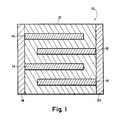
- Figure 1 is a cross-sectional view of a multilayer capacitor according to the invention.
- FIG. 1 shows a cross-sectional view of a multilayer capacitor 10 according to the invention.
- Multilayer capacitor 10 is made up of several ceramic dielectric layers 12. The ceramic dielectric layers 12 are separated by electrodes 14 and 16. Alternate electrodes 14 are connected to a single termination 18 on one end of the capacitor. The remaining alternate electrodes 16 are connected to termination 20 on the other end of the capacitor. In this way, the opposite sides of each ceramic dielectric layer 12 are electrically connected to terminations 18 and 20. The structure thus produces a stack of ceramic capacitors which are electrically connected in parallel.
- a multilayer capacitor 10 can be manufactured in the following manner. First BaTi0 3 (or its precursors) plus the various modifier compounds according to the invention are either wet or dry mixed. Next, the mixture is preferably prereacted. While prereaction is not necessary, it produces a better distribution of the various constituents. In all of the examples, below, the constituents were prereacted for 16 hours at 900°C ⁇ 50°C.
- the prereacted ceramic is then preferably ball milled for 10-24 hours to produce a fine powder.
- the resulting powder is then mixed with any conventional organic binder to produce a slurry.
- the slurry is tape cast using known techniques.
- the tape cast slurry After the tape cast slurry has been dried, it is screen printed with an electrode pattern. Except where indicated otherwise, in all of the examples below the electrode consisted of a mixture of 70 weight percent silver and 30 weight percent palladium in an organic binder. After the electrode has been dried, tapes are stacked, pressed and diced to produce a multilayer structure. This structure-is fired in air to increase the density of the ceramic. In the following examples, the green ceramics were fired at temperatures below 1150°C for 1 to 2 1/2 hours at the desired temperature.
- Tables I and II show a series of experiments which were designed to determine the influences of ZnO, NB 2 O 5 and TiO 2 in conjunction with Bi 2 O 3 on the sintering behavior and dielectric properties in modified BaTi0 3 ceramics. All of these compositions were made with ten electrode layers, each consisting of 70 weight percent silver and 30 weight percent palladium. The multilayer structures were fired at 1115°C to 1120°C for two hours in air.
- the data from Table I indicates that the temperature variation of the capacitance of each part, namely the temperature coefficient of capacitance (TCC), can be made relatively low. This is reflected in the relatively low percentage changes in capacitance, ⁇ C T , at -55°C and at +125°C.
- these materials also have low dielectric constants, K F , and unacceptably low resistance-capacitance (RC) products.
- RC resistance-capacitance
- K F is the fired dielectric constant of each multilayer capacitor. These figures have been approximated, based upon measurements of the unfired or green dielectric constant of each capacitor. The calculation of K F was based upon a 20% volume shrinkage on firing, and is accurate to within approximately ⁇ 15% of the calculated shrinkage ( ⁇ 3% of the total value of K F ) .
- microstructural examination of multilayer capacitors made from the compositions of Table I revealed the presence of a second phase which increases in concentration with increasing Nb 2 0 5 concentration and which becomes more finely distributed with decreasing ZnO concentration.
- the second phase was almost eliminated in composition T15, although the RC products and temperature coefficient of capacitance of the composition were unacceptable.
- Table II provides data for compositions T17 through T22. This series was designed to mimic the trends defined by compositions Tll through Tl6, but with one half the Nb 2 O 5 replaced by Ti0 2 .
- the data shown in Table II indicates that the TiO 2 substitution is effective in increasing the dielectric constant, raising the room temperature RC product, and in rotating the temperature characteristics (the change in capacitance verses temperature curve) in a counterclockwise direction. Unfortunately, these materials have inferior hot RC products and/or unacceptably large values of ⁇ C T .
- composition T17 through T22 closely correspond to those observed in Tll through T16. Decreased and more finely distributed second phase concentrations were observed as ZnO concentrations were decreased.
- Composition T23 (Table II) was prepared to determine whether modifiers other than Bi 2 0 3 are needed to produce a low-firing composition with good dielectrical properties.
- the data shown in Tables I and II indicate that Nb 2 0 5 or Nb 2 O 5 /TiO 2 additions are required to attain good sinterability.
- a source of small cations ionic radii less than 0.85 angstroms
- Sn0 2 can be substituted for TiO 2 . It has also been found that Ta 2 O 5 can be substituted for Nb 2 O 5 . These substitutions, however, have been found to require somewhat higher sintering temperatures.
- compositions T24, T26 through T28, and T31 through T34 show the effect of MnC03 additions to the modified BaTiO 3 .
- the make-up of these compositions and their resulting properties are shown in Tables III and IV.
- the compositions shown in Table III were fired at 1100°C for 2 hours.
- the electrodes were 70% silver/30% palladium.
- the compositions shown in Table IV were fired at 1150°C for 2 hours.
- the electrodes used were 60% silver and 40% palladium, because 70% silver and 30% palladium internal electrodes would not survive this higher firing temperature.
- Table V shows electrical and compositional data or compositions T37 through T44. These compositions were ired between 1100 and 1105°C for two hours, with 70% silver und 30% palladium internal electrodes. These compositions show that higher modifier content compositions can be used rithout any detrimental effects other than reducing the lielectric constant. These materials can be fired to full Lensity at 1080°C.
- compositions T37, T41, T44, and T54 shown in Table VI were fired between 1070 and 1085°C,
- the internal electrodes were 80% silver and 20% palladium. These materials were fired to full density in this temperature range without damaging the high silver-content electrodes. All of these capacitors exceeded the X7R specification.
- Table VII includes compositions T46, T47, T49, T50, and T53 through T56. All of these compositions were fired at 1105°C for two hours with 70% silver and 30% palladium electrodes.
- the preferred composition, T50 does not contain any ZnO and has half the Nb 2 O 5 replaced with TiO 2 . MnC0 3 is present as a dopant.
- Comparison with T49 shows that the addition of ZnO serves only to increase the temperature variation of capacitance. Improved temperature characteristics are observed in compositions T53 and T54 Where ZnO is replaced with PbO. However, these latter materials have lower dielectric constants than does T50.
- the ceramic dielectric compositions included quantities of Bi 2 0 3 ranging from 5.8 weight percent to 13 weight percent. These compositions were used to make multilayer capacitors having silver- palladium electrodes ranging from 40% palladium to 75% palladium. Finally, the multilayer capacitors were fired at temperatures from 1100°C to 1250°C.
- the magnitude of the bismuth-palladium reaction appears to be related not so much to the palladium content of the electrodes but more importantly to the temperature at which the multilayer capacitor is fired. By lowering the firing temperature the magnitude of the reaction is lessened.
- the bismuth-palladium reaction can be suppressed by compensating the bismuth- ions with small (ionic radii less than 0.85 angstroms) cations such as niobium and titanium in the ceramic.
- small (ionic radii less than 0.85 angstroms) cations such as niobium and titanium in the ceramic.
- Higher uncompensated Bi 2 O 3 conbnts appeared to promote the bismuth-palladium reaction and the consequent destruction of the internal electrodes.
Landscapes
- Engineering & Computer Science (AREA)
- Chemical & Material Sciences (AREA)
- Ceramic Engineering (AREA)
- Materials Engineering (AREA)
- Manufacturing & Machinery (AREA)
- Power Engineering (AREA)
- Microelectronics & Electronic Packaging (AREA)
- Inorganic Chemistry (AREA)
- Structural Engineering (AREA)
- Organic Chemistry (AREA)
- Ceramic Capacitors (AREA)
- Compositions Of Oxide Ceramics (AREA)
- Inorganic Insulating Materials (AREA)
Applications Claiming Priority (2)
| Application Number | Priority Date | Filing Date | Title |
|---|---|---|---|
| US06/417,258 US4459364A (en) | 1982-09-13 | 1982-09-13 | Low-fire ceramic dielectric compositions |
| US417258 | 1982-09-13 |
Publications (3)
| Publication Number | Publication Date |
|---|---|
| EP0103338A2 true EP0103338A2 (fr) | 1984-03-21 |
| EP0103338A3 EP0103338A3 (en) | 1984-10-31 |
| EP0103338B1 EP0103338B1 (fr) | 1986-05-07 |
Family
ID=23653215
Family Applications (1)
| Application Number | Title | Priority Date | Filing Date |
|---|---|---|---|
| EP83201287A Expired EP0103338B1 (fr) | 1982-09-13 | 1983-09-07 | Compositions céramiques diélectriques à basse température de frittage |
Country Status (4)
| Country | Link |
|---|---|
| US (1) | US4459364A (fr) |
| EP (1) | EP0103338B1 (fr) |
| JP (1) | JPS5964573A (fr) |
| DE (1) | DE3363409D1 (fr) |
Cited By (3)
| Publication number | Priority date | Publication date | Assignee | Title |
|---|---|---|---|---|
| EP0169636A1 (fr) * | 1984-05-23 | 1986-01-29 | Tam Ceramics Inc. | Composition céramique diélectrique à basse température de frittage et à caractéristique de température plate |
| EP0205137A3 (fr) * | 1985-06-14 | 1987-11-04 | E.I. Du Pont De Nemours And Company | Compositions diélectriques |
| RU2413325C1 (ru) * | 2009-11-03 | 2011-02-27 | Открытое Акционерное Общество "НИИ "Гириконд" | Сегнетокерамический конденсаторный диэлектрик для изготовления керамических конденсаторов температурно-стабильной группы |
Families Citing this family (12)
| Publication number | Priority date | Publication date | Assignee | Title |
|---|---|---|---|---|
| US4638401A (en) * | 1984-10-29 | 1987-01-20 | At&T Technologies, Inc. | Ceramic compositions and devices |
| US5223462A (en) * | 1985-03-18 | 1993-06-29 | Kyocera Corporation | Dielectric ceramic composition |
| US4816430A (en) * | 1987-06-09 | 1989-03-28 | Tam Ceramics, Inc. | Dielectric ceramic composition |
| DE3913117A1 (de) * | 1989-04-21 | 1990-10-25 | Du Pont Deutschland | Verfahren zur herstellung von elektrisch leitfaehigen mustern |
| US4988650A (en) * | 1989-06-23 | 1991-01-29 | Murata Manufacturing Co., Ltd. | Auxiliary agent for sintering ceramic material |
| US5296426A (en) * | 1990-06-15 | 1994-03-22 | E. I. Du Pont De Nemours And Company | Low-fire X7R compositions |
| US5650367A (en) * | 1994-01-28 | 1997-07-22 | Kyocera Corporation | Dielectric ceramic composition |
| US5550092A (en) * | 1995-02-10 | 1996-08-27 | Tam Ceramics Inc. | Ceramic dielectrics compositions |
| US6268054B1 (en) | 1997-02-18 | 2001-07-31 | Cabot Corporation | Dispersible, metal oxide-coated, barium titanate materials |
| US6309993B1 (en) * | 1999-04-28 | 2001-10-30 | National Science Council Of Republic Of China | Low-fire microwave dielectric compositions |
| JP5294441B2 (ja) * | 2006-03-30 | 2013-09-18 | 双信電機株式会社 | 電子部品 |
| JP6112438B1 (ja) | 2016-10-31 | 2017-04-12 | 住友電気工業株式会社 | アルミニウム合金線、アルミニウム合金撚線、被覆電線、及び端子付き電線 |
Family Cites Families (12)
| Publication number | Priority date | Publication date | Assignee | Title |
|---|---|---|---|---|
| US2992929A (en) * | 1957-01-31 | 1961-07-18 | Csf | Ceramic dielectric substances of high dielectric constant and low temperature coefficient |
| US3268783A (en) * | 1965-10-05 | 1966-08-23 | Murata Manufacturing Co | Capacitor comprising an nu-type semiconductor metallic oxide and a layer of compensated material |
| US3529978A (en) * | 1969-09-23 | 1970-09-22 | Globe Union Inc | General purpose batio3 ceramic dielectric compositions |
| DE2150101A1 (de) * | 1971-10-07 | 1973-04-12 | Nl Industries Inc | Keramische dielektrische zusammensetzung |
| DE2150173A1 (de) * | 1971-10-07 | 1973-04-12 | Nl Industries Inc | Monolithischer kondensator |
| SU429472A1 (ru) * | 1972-02-07 | 1974-05-25 | Способ изготовления сегнетокерамического материала | |
| JPS594803B2 (ja) * | 1974-12-27 | 1984-02-01 | 松下電器産業株式会社 | 高誘電率磁器 |
| JPS5210599A (en) * | 1975-07-15 | 1977-01-26 | Seiko Epson Corp | Ceramic piezo-electric material |
| US4027209A (en) * | 1975-10-02 | 1977-05-31 | Sprague Electric Company | Ceramic capacitor having a silver doped dielectric of (Pb,La)(Zr,Ti)O3 |
| FR2439171A1 (fr) * | 1978-10-18 | 1980-05-16 | Thomson Csf | Ceramique dielectrique a basse temperature de frittage et son application a la fabrication de composants electroniques |
| US4283753A (en) * | 1979-09-28 | 1981-08-11 | Sprague Electric Company | Low firing monolithic ceramic capacitor with high dielectric constant |
| US4379854A (en) * | 1981-02-06 | 1983-04-12 | Erie Technological Products, Inc. | Low temperature firing (1800°-2100° F.) of barium titanate with flux (lead titanate-bismuth titanate-zinc oxide and boron oxide) |
-
1982
- 1982-09-13 US US06/417,258 patent/US4459364A/en not_active Expired - Fee Related
-
1983
- 1983-09-07 DE DE8383201287T patent/DE3363409D1/de not_active Expired
- 1983-09-07 EP EP83201287A patent/EP0103338B1/fr not_active Expired
- 1983-09-13 JP JP58167691A patent/JPS5964573A/ja active Pending
Cited By (3)
| Publication number | Priority date | Publication date | Assignee | Title |
|---|---|---|---|---|
| EP0169636A1 (fr) * | 1984-05-23 | 1986-01-29 | Tam Ceramics Inc. | Composition céramique diélectrique à basse température de frittage et à caractéristique de température plate |
| EP0205137A3 (fr) * | 1985-06-14 | 1987-11-04 | E.I. Du Pont De Nemours And Company | Compositions diélectriques |
| RU2413325C1 (ru) * | 2009-11-03 | 2011-02-27 | Открытое Акционерное Общество "НИИ "Гириконд" | Сегнетокерамический конденсаторный диэлектрик для изготовления керамических конденсаторов температурно-стабильной группы |
Also Published As
| Publication number | Publication date |
|---|---|
| EP0103338A3 (en) | 1984-10-31 |
| JPS5964573A (ja) | 1984-04-12 |
| DE3363409D1 (en) | 1986-06-12 |
| US4459364A (en) | 1984-07-10 |
| EP0103338B1 (fr) | 1986-05-07 |
Similar Documents
| Publication | Publication Date | Title |
|---|---|---|
| KR100313232B1 (ko) | 유전체 세라믹 조성물 및 적층 세라믹 커패시터 | |
| US5117326A (en) | Monolithic ceramic capacitor | |
| KR100256199B1 (ko) | 적층 세라믹 커패시터 | |
| EP0785561B1 (fr) | Composition diélectrique céramique et son utilisation dans un condensateur monolithique céramique | |
| US4767732A (en) | High dielectric constant ceramic material and method of manufacturing the same | |
| EP0605904B1 (fr) | Composition céramique diélectrique non-réductible | |
| EP0817216B1 (fr) | Composition diélectrique céramique et condensateur céramique monolithique utilisant celle-ci | |
| EP0780349B1 (fr) | Composition céramique diélectrique et son utilisation comme condensateur monolithique | |
| EP0103338B1 (fr) | Compositions céramiques diélectriques à basse température de frittage | |
| US4266265A (en) | Ceramic capacitor and method for making the same | |
| EP0534378A1 (fr) | Composition céramique diélectrique non-réductible | |
| KR980009197A (ko) | 적층 세라믹 커패시터 | |
| US5672378A (en) | Method for making a BaTiO3 powder mixture the powder mixture and method for making a Y5V ceramic body therefrom | |
| US4379854A (en) | Low temperature firing (1800°-2100° F.) of barium titanate with flux (lead titanate-bismuth titanate-zinc oxide and boron oxide) | |
| US6727200B2 (en) | High dielectric constant very low fired X7R ceramic capacitor, and powder for making | |
| US4753905A (en) | Dielectric ceramic composition | |
| EP0360008B1 (fr) | Composition céramique diélectrique | |
| US4985381A (en) | Dielectric ceramic composition | |
| EP0180132A2 (fr) | Composition céramique à constante diélectrique élevée | |
| US4499521A (en) | Low-fire ceramic dielectric compositions for multilayer ceramic capacitors | |
| JPH05304043A (ja) | 導体形成用貴金属系組成物 | |
| US5202814A (en) | Nonreducing dielectric ceramic composition | |
| EP0446814B1 (fr) | Composition céramique diélectrique non-réductrice | |
| KR910001347B1 (ko) | 초저온에서 소결되는 세라믹 조성물 및 그 제조방법 | |
| JPH0528448B2 (fr) |
Legal Events
| Date | Code | Title | Description |
|---|---|---|---|
| PUAI | Public reference made under article 153(3) epc to a published international application that has entered the european phase |
Free format text: ORIGINAL CODE: 0009012 |
|
| AK | Designated contracting states |
Designated state(s): BE DE FR GB NL |
|
| PUAL | Search report despatched |
Free format text: ORIGINAL CODE: 0009013 |
|
| AK | Designated contracting states |
Designated state(s): BE DE FR GB NL |
|
| 17P | Request for examination filed |
Effective date: 19841220 |
|
| GRAA | (expected) grant |
Free format text: ORIGINAL CODE: 0009210 |
|
| AK | Designated contracting states |
Kind code of ref document: B1 Designated state(s): BE DE FR GB NL |
|
| REF | Corresponds to: |
Ref document number: 3363409 Country of ref document: DE Date of ref document: 19860612 |
|
| ET | Fr: translation filed | ||
| PLBE | No opposition filed within time limit |
Free format text: ORIGINAL CODE: 0009261 |
|
| STAA | Information on the status of an ep patent application or granted ep patent |
Free format text: STATUS: NO OPPOSITION FILED WITHIN TIME LIMIT |
|
| 26N | No opposition filed | ||
| PGFP | Annual fee paid to national office [announced via postgrant information from national office to epo] |
Ref country code: NL Payment date: 19870930 Year of fee payment: 5 |
|
| PG25 | Lapsed in a contracting state [announced via postgrant information from national office to epo] |
Ref country code: GB Effective date: 19890907 |
|
| PG25 | Lapsed in a contracting state [announced via postgrant information from national office to epo] |
Ref country code: BE Effective date: 19890930 |
|
| BERE | Be: lapsed |
Owner name: NORTH AMERICAN PHILIPS CORP. Effective date: 19890930 |
|
| PG25 | Lapsed in a contracting state [announced via postgrant information from national office to epo] |
Ref country code: NL Effective date: 19900401 |
|
| GBPC | Gb: european patent ceased through non-payment of renewal fee | ||
| NLV4 | Nl: lapsed or anulled due to non-payment of the annual fee | ||
| PG25 | Lapsed in a contracting state [announced via postgrant information from national office to epo] |
Ref country code: FR Effective date: 19900531 |
|
| PG25 | Lapsed in a contracting state [announced via postgrant information from national office to epo] |
Ref country code: DE Effective date: 19900601 |
|
| REG | Reference to a national code |
Ref country code: FR Ref legal event code: ST |