EP0103406A2 - Sucroseextraktion - Google Patents
Sucroseextraktion Download PDFInfo
- Publication number
- EP0103406A2 EP0103406A2 EP83304649A EP83304649A EP0103406A2 EP 0103406 A2 EP0103406 A2 EP 0103406A2 EP 83304649 A EP83304649 A EP 83304649A EP 83304649 A EP83304649 A EP 83304649A EP 0103406 A2 EP0103406 A2 EP 0103406A2
- Authority
- EP
- European Patent Office
- Prior art keywords
- adsorbent
- zone
- sucrose
- stream
- desorbent
- Prior art date
- Legal status (The legal status is an assumption and is not a legal conclusion. Google has not performed a legal analysis and makes no representation as to the accuracy of the status listed.)
- Granted
Links
Images
Classifications
-
- C—CHEMISTRY; METALLURGY
- C13—SUGAR INDUSTRY
- C13B—PRODUCTION OF SUCROSE; APPARATUS SPECIALLY ADAPTED THEREFOR
- C13B35/00—Extraction of sucrose from molasses
- C13B35/02—Extraction of sucrose from molasses by chemical means
- C13B35/06—Extraction of sucrose from molasses by chemical means using ion exchange
-
- C—CHEMISTRY; METALLURGY
- C13—SUGAR INDUSTRY
- C13B—PRODUCTION OF SUCROSE; APPARATUS SPECIALLY ADAPTED THEREFOR
- C13B20/00—Purification of sugar juices
- C13B20/14—Purification of sugar juices using ion-exchange materials
- C13B20/148—Purification of sugar juices using ion-exchange materials for fractionating, adsorption or ion exclusion processes combined with elution or desorption of a sugar fraction
Definitions
- the field of art to which this invention pertains is solid bed adsorptive separation. More specifically, the invention relates to a process for separating sucrose from an aqueous solution.
- Sucrose which is a common form of sugar, is widely used in the food industry.
- the usual source for this compound is found in the juice of sugar cane, sugar beets and other sucrose-containing materials.
- the mother liquors which are generally termed "molasses” will still contain a relatively large amount of sucrose along with other sugars such as glucose, fructose, raffinose, etc.
- the latter compounds along with salts, amino acids, betaine, pyrollidone, carboxylic acid, etc. constitute crystallization inhibitors which make the recovery of the remaining sucrose difficult to accomplish and thus make the further recovery of the sucrose economically impractical.
- the impurities which are present impart a taste to the molasses which renders the same inedible for human consumption.
- Sugar beet molasses may contain approximately 50% sucrose and, therefore, it is highly desirable to extract this sucrose from the aforesaid molasses.
- the molasses is bitter to human taste, the residual molasses is used in animal feed or as a fertilizer, and therefore a relatively low sucrose content is an acceptable feature of the molasses.
- One such process which is utilized is the Steffan's process in which the beet molasses is diluted to about 20% solids, refrigerated, and treated with a calcium compound such as calcium oxide.
- sucrose may be separated and recovered from an aqueous solution, particularly molasses, by an adsorption-desorption technique utilizing a solid adsorbent selective for sucrose and an alcohol desorbent.
- the invention is, in its primary embodiment, a process for separating sucrose from an aqueous solution of sucrose and at least one of the compounds comprising betaine and a mineral salt which process comprises contacting at adsorption conditions the mixture with a solid adsorbent exhibiting selectivity for the sucrose, which process comprises the steps of: (a) maintaining net fluid flow through a column of the adsorbent in a single direction, which column contains at least three zones having separate operational functions occurring therein and being serially interconnected with the terminal zones of the column connected to provide a continuous connection of the zones; (b) maintaining an adsorption zone in the column, the zone defined by the adsorbent located between a feed inlet stream at an upstream boundary of the zone and a raffinate outlet stream at a downstream boundary of the zone; (c) maintaining a purification zone immediately upstream from the adsorption zone, the purification zone defined by the adsorbent located between an extract outlet stream at an upstream boundary of the purification zone and the
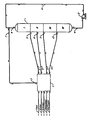
- the Figure represents, in schematic form, the simulated moving bed comprising the present invention, hereinafter described, including adsorption column 1, manifold system 3 and various interconnecting lines.
- This invention relates to a process for separating sucrose from an aqueous solution of sucrose and at least one of the compounds comprising betaine and a mineral salt. More specifically, the invention is concerned with a process for separating and recovering sucrose from a sugar source and still permitting the source such as molasses to be utilized in other fields such as for fertilizers or animal feed.
- the presence of other components which act as crystallization inhibitors make the recovery of sucrose relatively difficult to accomplish in a process based on crystallization.
- the presence of another sugar such as raffinose (comprising about 1 wt.% of a molasses having a sucrose content of 51 wt.%), presents no problem since the other sugar will be separated with the sucrose and the product stream will comprise the sugar mixture.
- Other components of molasses, such as the color imparting bodies will also be separated with the sucrose.
- the raffinose may be removed from the feed or product streams by methods known to the art, such as enziomatic conversion which cleaves the trisaccharide raffinose structure to the more desirable mono- and disaccharides.
- the color bodies may be removed by high capacity activated carbon filters.
- the process of the present invention comprises passing the feed mixture over an adsorbent of the type hereinafter set forth in greater detail.
- the passage of the feed stream over the adsorbent will result in the adsorption of sucrose while permitting the other components of the feed stream to pass through the treatment zone in an unchanged condition.
- the sucrose will be desorbed from the adsorbent by treating the adsorbent with a desorbent material.
- Preferred adsorption and desorption conditions include a temperature in the range of from about 20°C to about 200°C and a pressure in the range of from about atmospheric to about 500 psig to ensure a liquid phase.
- feed mixture is a mixture containing one or more extract components and one or more raffinate components to be separated by the process.
- feed stream indicates a stream of a feed mixture which passes to the adsorbent used in the process.
- extract component is a compound or type of compound that is more selectively adsorbed by the adsorbent while a “raffinate component” is a compound or type of compound that is less selectively adsorbed.
- desorbent material shall mean generally a material capable of desorbing an extract component.
- desorbent stream or “desorbent input stream” indicates the stream through which desorbent material passes to the adsorbent.
- raffinate stream or “raffinate output stream” means a stream through which a raffinate component is removed from the adsorbent.
- the composition of the raffinate stream can vary from essentially 100% desorbent material to essentially 100% raffinate components.
- extract stream or "extract output stream” shall mean a stream through which an extract material which has been desorbed by a desorbent material is removed from the adsorbent.
- the composition of the extract stream likewise, can vary from essentially 100% desorbent material to essentially 100% extract components.
- At least a portion of the extract stream and preferably at least a portion of the raffinate stream from the separation process are passed to separation means, typically fractionators, where at least a portion of desorbent material is separated to produce an extract product and a raffinate product.
- separation means typically fractionators
- One adsorbent which may be employed to selectively adsorb sucrose from an aqueous solution containing betaine and mineral salts comprises activated carbon.
- An activated carbon contemplated for use may be acquired from Pittsburgh Activated Carbon, a division of Calgon Corporation, a subsidiary of Merck & Co., Inc., and is known as "Calgon Activated Carbon”.
- This activated carbon comprises high temperature steam activated coal. It is in a granular form of from 20 to 40 mesh size and has an ash content of 8 wt.%.
- Carbonaceous pyropolymers useful as adsorbents in this invention, comprise shaped replications of particle aggregates containing recurring units of at least carbon and hydrogen atoms.
- the shaped replications are prepared by treating an inorganic support of the desired shape such as spheres, plates, pellets, rods, fibers, monoliths, etc., with a pyropolymer precursor and thereafter pyropolymerizing said precursor by treatment at an elevated temperature which may range from about 400° to about 1200°C to form at least a monolayer of a carbonaceous pyropolymer possessing recurring units containing at least carbon and hydrogen atoms on the surface of said inorganic support.
- the carbonaceous pyropolymer will adopt the shape of the inorganic support and thus be a replication of the starting inorganic support material. It is preferred that the inorganic support material be characterized as having a surface area of from 1 to about 500 m 2 /g.
- Illustrative examples of refractory oxides which may be employed include alumina in various forms such as gamma-alumina, eta-alumina, theta-alumina, or mixtures of inorganic refractory oxides such as zeolites, silica- alumina, silica-zirconia, zirconia-titania, zirconia-alumina, etc.
- the feed mixtures which are charged to the process of the present invention will comprise sugar sources, a specific source which is utilized in the present invention comprising molasses.
- Molasses is the mother liquor remaining from the juice of sugar cane or beet, i.e. "thick juice", after removal by crystallization of most of the sucrose therefrom.
- molasses such as cane molasses or sugar beet molasses will contain about 50% sucrose as well as other sugars such as glucose, fructose, raffinose as well as mineral salts and alkaloids, betaine, said other sugars and compounds being present in varying amounts in the sugar source.
- the most prevalent mineral salt in molasses is potassium chloride.
- the adsorbent of the present invention is chosen to selectively adsorb sucrose while allowing the betaine and the mineral salts in the sugar source to pass through the system unchanged, i.e., the adsorbent of this invention possesses the necessary adsorbent character in the ability of the adsorbent to separate components of the feed, that is, that the adsorbent possesses adsorptive selectivity for one component as compared to other components.
- Relative selectivity can be expressed not only for one feed compound as compared to another but can also be expressed between any feed mixture component and the desorbent material.
- the selectivity, (B), as used throughout this specification is defined as the ratio of the two components of the adsorbed phase over the ratio of the same two components in the unadsorbed phase at equilibrium conditions. Relative selectivity is shown as Equation 1, below.
- Equation 1 where C and D are two components of the feed represented in weight percent and the subscripts A and U represent the adsorbed and unadsorbed phases respectively.
- the equilibrium conditions are determined when the feed passing over a bed of adsorbent does not change composition-after contacting the bed of adsorbent. In other words, there is no net transfer of material occurring between the unadsorbed and adsorbed phases.
- selectivity of two components approaches 1.0, there is no preferential adsorption of one component by the adsorbent with respect to the other; they are both adsorbed (or non-adsorbed) to about the same degree with respect to each other.
- the (B) becomes less than or greater than 1.0, there is a preferential adsorption by the adsorbent for one component with respect to the other.
- a (B) larger than 1.0 indicates preferential adsorption of component C within the adsorbent.
- a (B) less than 1.0 would indicate that component D is preferentially adsorbed leaving an unadsorbed phase richer in component C and an adsorbed phase richer in component D.
- desorbent materials should have a selectivity equal to about 1 or slightly less than 1 with respect to all extract components so that all of the extract components can be desorbed as a class with reasonable flow rates of desorbent material, and so that extract components can displace desorbent material in a subsequent adsorption step. While separation of an extract component from a raffinate component is theoretically possible when the selectivity of the adsorbent for the extract component with respect to the raffinate component is greater than 1, it is preferred that such selectivity approach a value of 2. Like relative volatility, the higher the selectivity, the easier the separation is to perform. Higher selectivities permit a smaller amount of adsorbent to be used.
- the third important characteristic is the rate of exchange of the extract component of the feed mixture material or, in other words, the relative rate of desorption of the extract component.
- This characteristic relates directly to the amount of desorbent material that must be employed in the process to recover the extract component from the adsorbent; faster rates of exchange reduce the amount of desorbent material needed to remove the extract component and therefore permit a reduction in the operating cost of the process. With faster rates of exchange, less desorbent material has to be pumped through the process and separated from the extract stream for reuse in the process.
- Desorbent materials used in various prior art adsorptive separation processes vary depending upon such factors as the type of operation employed.
- desorbent selection is not as critical and desorbent material comprising gaseous hydrocarbons such as methane, ethane, etc., or other types of gases such as nitrogen or hydrogen, may be used at elevated temperatures or reduced pressures or both to effectively purge the adsorbed feed component from the adsorbent.
- desorbent material must be judiciously selected to satisfy many criteria.
- the desorbent material should displace an extract component from the adsorbent with reasonable mass flow rates without itself being so strongly adsorbed as to unduly prevent an extract component from displacing the desorbent material in a following adsorption cycle.
- the selectivity it is preferred that the adsorbent be more selective for all of the extract components with respect to a raffinate component than it is for the desorbent material with respect to a raffinate component.
- desorbent materials must be compatible with the particular adsorbent and the particular feed mixture. More specifically, they must not reduce or destroy the critical selectivity of the adsorbent for an extract component with respect to a raffinate component.
- desorbent materials should not chemically react with or cause a chemical reaction of either an extract component or a raffinate component. Both the extract stream and the raffinate stream are typically removed from the adsorbent in admixture with desorbent material and any chemical reaction involving a desorbent material and an extract component or a raffinate product or both. Since both the raffinate stream and the extract stream typically contain desorbent materials, desorbent materials should additionally be substances which are easily separable from the feed mixture that is passed into the process.
- the concentration of an extract component in the extract product and the concentration of a raffinate component in the raffinate product would not be very high, nor would the desorbent material be available for reuse in the process. It is contemplated that at least a portion of the desorbent material will be separated from the extract and the raffinate streams by distillation or evaporation, but other separation methods such as reverse osmosis may also be employed alone or in combination with distillation or evaporation. Since the raffinate and extract products are foodstuffs intended for human consumption, desorbent materials should also be non-toxic. Finally, desorbent materials should also be materials which are readily available and therefore reasonable in cost.
- the desorbent material found to be most effective in desorbing the sucrose comprises alcohol, particularly alcohol in aqueous solution in which the alcohol comprises from about 10 to about 70 vol.% of the solution.
- the most preferred alcohols are methanol and ethanol, but ethanol is particularly preferred because it is safe to use with food products, i.e., the products obtained from the process of the present invention are likely to be used for human or animal consumption.
- the problem when alcohol is so used is that the adsorbent has a high affinity for alcohol and as a result the sucrose is unable to effectively displace the alcohol, particularly ethanol, from the adsorbent when the adsorbent is reused in the adsorption step. This inability results in a substantial loss of sucrose into the raffinate.
- the present invention is based on this observation plus the observation that water will not efficiently displace sucrose from the adsorbent.
- the present invention comprises a novel way of exploiting these phenomena to the maximum advantages in the hereinafter described countercurrent simulated moving bed scheme.
- a liquid flow down the adsorbent chamber may be provided by a pump.
- the chamber circulation pump moves through different zones which require different flow rates.
- a programmed flow controller may be provided to set and regulate these flow rates.
- the active liquid access points effectively divide the adsorbent chamber into separate zones, each of which has a different function. In this embodiment of the process, it is generally necessary that three separate operational zones be present in order for the process to take place although in some instances an optional fourth zone may be used.
- zones I, II, III and IV are shown as well as manifold system 3, pump 2, which maintains the net positive fluid flow, and line 4 associated with pump 2. Also shown and identified are the inlet and outlet lines to the process which enter or leave via manifold system 3.
- zone I is defined as the adsorbent located between the feed inlet stream 5 and the raffinate outlet stream 7.
- zone I the adsorbent located between the feed inlet stream 5 and the raffinate outlet stream 7.
- the feedstock contacts the adsorbent, an extract component is adsorbed, and a raffinate stream is withdrawn. Since the general flow through zone I, in accordance with the direction of fluid flow throughout the column, is from the feed stream which passes into the zone to the raffinate stream which passes out of the zone, the flow in this zone is considered to be a downstream direction when proceeding from the feed inlet to the raffinate outlet streams.
- zone II Immediately upstream with respect to fluid flow in zone I is the purification zone, zone II.
- the purification zone is defined as the adsorbent between the extract outlet stream 11 and the feed inlet stream 5.
- the basic operations taking place in zone II are the displacement from the non-selective void volume of the adsorbent of any raffinate material carried into zone II by the shifting of adsorbent into this zone and the desorption of any raffinate material adsorbed within the selective pore volume of the adsorbent or adsorbed on the surfaces of-the adsorbent particles.
- Purification is achieved by passing a portion of extract stream material leaving zone III into zone II at zone II's upstream boundary, the extract outlet stream, to effect the displacement of raffinate material.
- the flow of material in zone II is in a downstream direction from the extract outlet stream to the feed inlet stream.
- zone III Immediately upstream of zone II with respect to the fluid flowing in zone II is the desorption zone or zone III.
- the desorption zone is defined as the adsorbent between the desorbent inlet stream 13 and the extract outlet stream 11.
- the function of the desorption zone is to allow a desorbent material which passes into this zone to displace the extract component which was adsorbed upon the adsorbent during a previous contact with feed in zone I in a prior cycle of operation.
- the flow of fluid in zone III is essentially in the same direction as that of zones I and II.
- zone IV an optional buffer zone, zone IV, may be utilized.
- This zone defined as the adsorbent between the raffinate outlet stream 7 and the desorbent inlet stream 13, if used, is located immediately upstream with respect to the fluid flow to zone III.
- Zone IV would be utilized to conserve the amount of desorbent utilized in the desorption step since a portion of the raffinate stream which is removed from zone I can be passed into zone IV to displace desorbent material present in that zone out of that zone into the desorption zone.
- Zone IV will contain enough adsorbent so that raffinate material present in the raffinate stream passing out of zone I and into zone IV can be prevented from passing into zone III thereby contaminating extract stream removed from zone III.
- the raffinate stream passed from zone I to zone IV must be carefully monitored in order that the flow directly from zone I to zone III can be stopped when there is an appreciable quantity of raffinate material present in the raffinate stream passing from zone I into zone III so that the extract outlet stream is not contaminated.
- a cyclic advancement of the input and output streams through the fixed bed of adsorbent can be accomplished by utilizing a manifold system 3 in which the valves in the manifold are operated in a sequential manner to effect the shifting of the input and output streams thereby obtaining the effect of a flow of fluid with respect to a moving bed of solid adsorbent in a countercurrent manner although the bed itself is actually stationary.
- Another mode of operation which can effect the countercurrent flow of solid adsorbent with respect to fluid involves the use of a rotating disc valve in which the input and output streams are connected to the valve and the lines through which feed input, extract output, desorbent input and raffinate output streams are advanced in the same direction through the adsorbent bed.
- one operational zone will contain a much larger quantity of adsorbent than some other operational zone.
- the buffer zone can contain a minor amount of adsorbent as compared to the adsorbent required for the adsorption and purification zones. It can also be seen that in instances in which desorbent is used which can easily desorb extract material from the adsorbent that a relatively small amount of adsorbent will be needed in a desorption zone as compared to the adsorbent needed in the buffer zone or adsorption zone or purification zone or all of them. Since it is not required that the adsorbent be located in a single column, the use of multiple chambers or a series of columns is within the scope of the invention.
- the apparatus which can be utilized to effect the process of this invention can also contain a series of individual beds connected by connecting conduits upon which are placed input or output taps to which the various input or output streams can be attached and alternately and periodically shifted to effect continuous operation.
- the connecting conduits can be connected to transfer taps which during the normal operations do not function as a conduit through which material passes into or out of the process.
- At least a portion of the extract output stream will pass into a separation means wherein at least a portion of the desorbent material can be separated to produce an extract product containing a reduced concentration of desorbent material.
- at least a portion of the raffinate output stream will also be passed to a separation means wherein at least a portion of the desorbent material can be separated to produce a desorbent stream which can be reused in the process and a raffinate product containing a reduced concentration of desorbent material.
- the separation means will typically be a fractionation column, the design and operation of which is well known to the separation art.
- liquid-phase operation is preferred for this process because of the lower temperature requirements and because of the higher yields of extract product that can be obtained with liquid-phase operation over those obtained with vapor-phase operation.
- Adsorption conditions will include a temperature range of from about 20° to about 200 o C, with about 20 0 to about 100°C being more preferred and a pressure range of from about atmospheric to about 500 psig (3450 kPa gauge) with from about atmospheric to about 250 psig (1725 kPa gauge) being more preferred to ensure liquid phase.
- Desorption conditions will include the same range of temperatures and pressures as used for adsorption conditions.
- the size of the units which can utilize the above flow scheme as well as the process of this invention can vary anywhere from those of pilot plant scale (see for example U.S. Patent No. 3,706,812) to those of commercial scale and can range in flow rates from as little as a few cc an hour up to many thousands of gallons per hour.
- the present invention uses water flush line 9 which introduces water into zone II upstream of the introduction of feed inlet stream 5 and in an amount sufficient to cause the magnitude of the net positive fluid flow in column 1 at the point of introduction of the water to be not greater than zero.
- a barrier is thus created to the flow of alcohol containing fluid from zone III into zones II and I and, in fact, there may even be a slight reversal of flow at the line 9 inlet with a small amount'of the water introduced exiting via line 11 as part of the extract stream.
- zone I the flushing of alcohol from the adsorbent of zone I (present because of a shift of adsorbent from the upstream zones with respect to solid adsorbent flow (simulated countercurrent flow, relative to fluid flow) into zone I) with water is still accomplished because substantially all of the water introduced into zone II will flow up through the column, through zones II and I, and leave as part of the raffinate stream via line 4.
- the flush water access line will be incorporated into manifold system 3 so as to obtain cyclic advancement and maintenance of the relationship of that line with the other lines.
- This example presents the results of actual testing of the invention in a continuous countercurrent liquid-solid contacting device.
- the general operating principles of such a device have been previously described and are found in Broughton U.S. Patent No. 2,985,589 and a specific laboratory-size apparatus utilizing these principles is described in deRosset et al U.S. Patent No. 3,706,812.
- the equipment comprises multiple adsorbent beds with a number of access lines attached to distributors within the beds and terminating at a rotary distributing valve. At a given valve position, feed, desorbent and water flush are being introduced through three of the lines and raffinate and extract are withdrawn through two more.
- the equipment was set up to illustrate the preferred embodiment of the present invention in which a buffer zone, zone IV, is employed.
- a first setup was to illustrate a prior art process wherein the water flush stream was introduced at the upstream boundary of the buffer zone (zone IV).
- the equipment was then set up to illustrate the present invention, with the water flush stream introduced at an upstream portion of zone II.
- the feedstock comprised an aqueous solution of 70 wt.% solids which on a dry basis contained 94 wt.% sucrose, 2-3 wt.% KC1, and 3-4 wt.% betaine.
- the adsorbent used was the aforementioned Calgon Activated Carbon.
- the desorbent used was 50 vol.% ethanol in water. Other details of the operation were as follows:
- the results of the first test was a product (extract) purity of 99.5% sucrose which was obtained at a yield of 96.5%.
- the second test that involving the process of the present invention, achieved a product purity of 99.9% at the same yield.
Landscapes
- Chemical & Material Sciences (AREA)
- Biochemistry (AREA)
- Organic Chemistry (AREA)
- Life Sciences & Earth Sciences (AREA)
- Chemical Kinetics & Catalysis (AREA)
- General Chemical & Material Sciences (AREA)
- Treatment Of Liquids With Adsorbents In General (AREA)
- Saccharide Compounds (AREA)
- Organic Low-Molecular-Weight Compounds And Preparation Thereof (AREA)
- Seasonings (AREA)
- Extraction Or Liquid Replacement (AREA)
- Pharmaceuticals Containing Other Organic And Inorganic Compounds (AREA)
- Electroluminescent Light Sources (AREA)
- Ink Jet (AREA)
- Preparation Of Compounds By Using Micro-Organisms (AREA)
Priority Applications (1)
| Application Number | Priority Date | Filing Date | Title |
|---|---|---|---|
| AT83304649T ATE30743T1 (de) | 1982-08-12 | 1983-08-11 | Sucroseextraktion. |
Applications Claiming Priority (2)
| Application Number | Priority Date | Filing Date | Title |
|---|---|---|---|
| US06/407,682 US4404037A (en) | 1982-08-12 | 1982-08-12 | Sucrose extraction from aqueous solutions featuring simulated moving bed |
| US407682 | 1982-08-12 |
Publications (3)
| Publication Number | Publication Date |
|---|---|
| EP0103406A2 true EP0103406A2 (de) | 1984-03-21 |
| EP0103406A3 EP0103406A3 (en) | 1986-03-05 |
| EP0103406B1 EP0103406B1 (de) | 1987-11-11 |
Family
ID=23613093
Family Applications (1)
| Application Number | Title | Priority Date | Filing Date |
|---|---|---|---|
| EP83304649A Expired EP0103406B1 (de) | 1982-08-12 | 1983-08-11 | Sucroseextraktion |
Country Status (7)
| Country | Link |
|---|---|
| US (1) | US4404037A (de) |
| EP (1) | EP0103406B1 (de) |
| AT (1) | ATE30743T1 (de) |
| DE (1) | DE3374418D1 (de) |
| FI (1) | FI832890A7 (de) |
| MX (1) | MX7576E (de) |
| PH (1) | PH17703A (de) |
Cited By (1)
| Publication number | Priority date | Publication date | Assignee | Title |
|---|---|---|---|---|
| DE19726151B4 (de) * | 1997-06-20 | 2010-02-04 | Merck Patent Gmbh | Verwendung monolithischer Sorbentien für "Simulated Moving Bed" Trennverfahren |
Families Citing this family (24)
| Publication number | Priority date | Publication date | Assignee | Title |
|---|---|---|---|---|
| US5656094A (en) * | 1987-02-02 | 1997-08-12 | A.E. Staley Manufacturing Company | Integrated process for producing crystalline fructose and a high-fructose, liquid phase sweetener |
| US5230742A (en) * | 1987-02-02 | 1993-07-27 | A. E. Staley Manufacturing Co. | Integrated process for producing crystalline fructose and high-fructose, liquid-phase sweetener |
| US5234503A (en) * | 1987-02-02 | 1993-08-10 | A.E. Saley Manufacturing Co. | Integrated process for producing crystalline fructose and a high-fructose, liquid-phase sweetener |
| FI86416C (fi) | 1988-06-09 | 1992-08-25 | Suomen Sokeri Oy | Foerfarande foer tillvaratagande av betain ur melass. |
| US5102553A (en) * | 1988-12-16 | 1992-04-07 | The Amalgamated Sugar Company | Time variable simulated moving bed process |
| US5156736A (en) * | 1991-05-07 | 1992-10-20 | Schoenrock Karlheinz W R | Simulated moving bed apparatus using a single sorbent bed for separating components from a fluid stream |
| US5176832A (en) * | 1991-10-23 | 1993-01-05 | The Dow Chemical Company | Chromatographic separation of sugars using porous gel resins |
| FI96225C (fi) | 1993-01-26 | 1996-05-27 | Cultor Oy | Menetelmä melassin fraktioimiseksi |
| US6663780B2 (en) | 1993-01-26 | 2003-12-16 | Danisco Finland Oy | Method for the fractionation of molasses |
| US6258993B1 (en) | 1993-09-29 | 2001-07-10 | Regents Of The University Of Minnesota | Simulated countercurrent moving bed chromatographic reactor and method for use thereof |
| US5795398A (en) * | 1994-09-30 | 1998-08-18 | Cultor Ltd. | Fractionation method of sucrose-containing solutions |
| US6224776B1 (en) | 1996-05-24 | 2001-05-01 | Cultor Corporation | Method for fractionating a solution |
| DE19842550B4 (de) * | 1998-09-17 | 2004-08-05 | Universität Dortmund | Methode zur on-line Parameterschätzung und Prozeßbeobachtung für SMB-Chromatographieprozesse |
| US6451123B1 (en) | 1999-01-14 | 2002-09-17 | Board Of Supervisors Of Louisiana State University And Agricultural And Mechanical College | Process for the separation of sugars |
| US6740243B2 (en) | 2000-11-15 | 2004-05-25 | Purdue Research Foundation | Systems and processes for performing separations using a simulated moving bed apparatus |
| AT412258B (de) * | 2000-11-28 | 2004-12-27 | Vogelbusch Gmbh | Verfahren zur trennung von stoffgemischen |
| FI20010977L (fi) | 2001-05-09 | 2002-11-10 | Danisco Sweeteners Oy | Kromatografinen erotusmenetelmä |
| JP5112859B2 (ja) * | 2004-06-04 | 2013-01-09 | ホリズン サイエンス ピーティーワイ リミテッド | 天然甘味料 |
| US8021697B2 (en) * | 2005-06-03 | 2011-09-20 | Horizon Science Pty. Ltd. | Substances having body mass redistribution properties |
| US9364016B2 (en) * | 2006-09-19 | 2016-06-14 | The Product Makers (Australia) Pty Ltd | Extracts derived from sugar cane and a process for their manufacture |
| CN103561585B (zh) | 2011-02-08 | 2016-05-25 | 产品制造者(澳大利亚)有限公司 | 糖提取物 |
| US10130899B2 (en) * | 2012-01-20 | 2018-11-20 | Lawrence Livermore National Security, Llc | Separating components of mixed fluid using a functionally graded material |
| AU2013308395C1 (en) | 2012-08-28 | 2018-03-15 | Poly Gain Pte Ltd | Extraction method |
| AU2014306366B9 (en) | 2013-08-16 | 2020-03-26 | Poly Gain Pte Ltd | Sugar cane derived extracts and methods of treatment |
Family Cites Families (10)
| Publication number | Priority date | Publication date | Assignee | Title |
|---|---|---|---|---|
| US2985589A (en) * | 1957-05-22 | 1961-05-23 | Universal Oil Prod Co | Continuous sorption process employing fixed bed of sorbent and moving inlets and outlets |
| US2954305A (en) * | 1959-06-22 | 1960-09-27 | American Sugar Refining Co | Purification of sugar solutions |
| US3194683A (en) * | 1963-07-10 | 1965-07-13 | American Sugar | Purification of liquids, such as sugar solutions, by treatment with an adsorbent |
| US4226977A (en) * | 1976-05-27 | 1980-10-07 | Uop Inc. | Process for separating a ketose from an aldose by selective adsorption |
| JPS5326336A (en) * | 1976-08-24 | 1978-03-11 | Toray Industries | Method of fractional absorption for saccharides |
| FI69248C (fi) * | 1976-12-21 | 1986-01-10 | Mitsubishi Chem Ind | Foerfarande foer reglering av operationsprocessen av en simulerad roerlig baedd |
| AU540231B2 (en) * | 1978-11-02 | 1984-11-08 | Mitsubishi Kasei Corporation | Adsorption separation method and apparatus |
| US4319929A (en) * | 1979-11-19 | 1982-03-16 | Uop Inc. | Simulated countercurrent sorption process employing ion exchange resins with periodic backflushing |
| US4313015A (en) * | 1980-02-07 | 1982-01-26 | Uop Inc. | Separation process |
| US4333770A (en) * | 1980-09-08 | 1982-06-08 | Uop Inc. | Extraction of sucrose from molasses |
-
1982
- 1982-08-12 US US06/407,682 patent/US4404037A/en not_active Expired - Fee Related
-
1983
- 1983-08-03 MX MX83101998U patent/MX7576E/es unknown
- 1983-08-08 PH PH29367A patent/PH17703A/en unknown
- 1983-08-11 DE DE8383304649T patent/DE3374418D1/de not_active Expired
- 1983-08-11 EP EP83304649A patent/EP0103406B1/de not_active Expired
- 1983-08-11 FI FI832890A patent/FI832890A7/fi not_active Application Discontinuation
- 1983-08-11 AT AT83304649T patent/ATE30743T1/de not_active IP Right Cessation
Cited By (1)
| Publication number | Priority date | Publication date | Assignee | Title |
|---|---|---|---|---|
| DE19726151B4 (de) * | 1997-06-20 | 2010-02-04 | Merck Patent Gmbh | Verwendung monolithischer Sorbentien für "Simulated Moving Bed" Trennverfahren |
Also Published As
| Publication number | Publication date |
|---|---|
| PH17703A (en) | 1984-11-14 |
| FI832890A0 (fi) | 1983-08-11 |
| EP0103406A3 (en) | 1986-03-05 |
| MX7576E (es) | 1989-11-16 |
| DE3374418D1 (en) | 1987-12-17 |
| FI832890L (fi) | 1984-02-13 |
| US4404037A (en) | 1983-09-13 |
| FI832890A7 (fi) | 1984-02-13 |
| ATE30743T1 (de) | 1987-11-15 |
| EP0103406B1 (de) | 1987-11-11 |
Similar Documents
| Publication | Publication Date | Title |
|---|---|---|
| EP0103406B1 (de) | Sucroseextraktion | |
| US4519845A (en) | Separation of sucrose from molasses | |
| US4570029A (en) | Process for separating isoprene | |
| US4293346A (en) | Simulated countercurrent sorption process employing ion exchange resins with backflushing | |
| US4720579A (en) | Separation of citric acid from fermentation broth with a neutral polymeric adsorbent | |
| US4851573A (en) | Separation of citric acid from fermentation broth with a weakly basic anionic exchange resin adsorbent | |
| EP0047518B1 (de) | Extraktion von Saccharose aus einem Zuckergemisch | |
| US4337156A (en) | Adsorptive separation of contaminants from naphtha | |
| US4319929A (en) | Simulated countercurrent sorption process employing ion exchange resins with periodic backflushing | |
| US4533398A (en) | Extraction of sucrose | |
| US4238243A (en) | Technique to reduce the zeolite molecular sieve solubility in an aqueous system | |
| US4797233A (en) | Process for separating mono-, di- and triglycerides | |
| US4837315A (en) | Process for separating glucose and mannose with CA/NH4 - exchanged ion exchange resins | |
| US4461649A (en) | Desorption technique | |
| US4373025A (en) | Process for the isomerization of glucose | |
| US4902829A (en) | Process for the adsorptive separation of hydroxy paraffinic dicarboxylic acids from olefinic dicarboxylic acids | |
| US4405377A (en) | Process for the separation of monosaccharides | |
| US4226977A (en) | Process for separating a ketose from an aldose by selective adsorption | |
| US4851574A (en) | Separation of citric acid from fermentation broth with a strongly basic anionic exchange resin adsorbent | |
| US4426232A (en) | Extraction of sucrose | |
| US4312678A (en) | Extraction of sucrose from molasses | |
| US4382001A (en) | Use of activated carbon for separation of ethanol from water | |
| US4358322A (en) | Process for separating a ketose from an aldose by selective adsorption | |
| US7241918B1 (en) | Separation of citric acid from gluconic acid in fermentation broth using a weakly or strongly basic anionic exchange resin adsorbent | |
| EP0324210B1 (de) | Abtrennung von Zitronensäure aus Fermentationsbrühen |
Legal Events
| Date | Code | Title | Description |
|---|---|---|---|
| PUAI | Public reference made under article 153(3) epc to a published international application that has entered the european phase |
Free format text: ORIGINAL CODE: 0009012 |
|
| AK | Designated contracting states |
Designated state(s): AT BE CH DE FR GB IT LI NL SE |
|
| PUAL | Search report despatched |
Free format text: ORIGINAL CODE: 0009013 |
|
| AK | Designated contracting states |
Kind code of ref document: A3 Designated state(s): AT BE CH DE FR GB IT LI NL SE |
|
| 17P | Request for examination filed |
Effective date: 19860207 |
|
| 17Q | First examination report despatched |
Effective date: 19861126 |
|
| GRAA | (expected) grant |
Free format text: ORIGINAL CODE: 0009210 |
|
| AK | Designated contracting states |
Kind code of ref document: B1 Designated state(s): AT BE CH DE FR GB IT LI NL SE |
|
| REF | Corresponds to: |
Ref document number: 30743 Country of ref document: AT Date of ref document: 19871115 Kind code of ref document: T |
|
| REF | Corresponds to: |
Ref document number: 3374418 Country of ref document: DE Date of ref document: 19871217 |
|
| ET | Fr: translation filed | ||
| ITF | It: translation for a ep patent filed | ||
| PLBE | No opposition filed within time limit |
Free format text: ORIGINAL CODE: 0009261 |
|
| STAA | Information on the status of an ep patent application or granted ep patent |
Free format text: STATUS: NO OPPOSITION FILED WITHIN TIME LIMIT |
|
| 26N | No opposition filed | ||
| PGFP | Annual fee paid to national office [announced via postgrant information from national office to epo] |
Ref country code: GB Payment date: 19900731 Year of fee payment: 8 |
|
| PGFP | Annual fee paid to national office [announced via postgrant information from national office to epo] |
Ref country code: SE Payment date: 19900807 Year of fee payment: 8 Ref country code: FR Payment date: 19900807 Year of fee payment: 8 |
|
| PGFP | Annual fee paid to national office [announced via postgrant information from national office to epo] |
Ref country code: AT Payment date: 19900809 Year of fee payment: 8 |
|
| PGFP | Annual fee paid to national office [announced via postgrant information from national office to epo] |
Ref country code: CH Payment date: 19900824 Year of fee payment: 8 |
|
| ITTA | It: last paid annual fee | ||
| PGFP | Annual fee paid to national office [announced via postgrant information from national office to epo] |
Ref country code: NL Payment date: 19900831 Year of fee payment: 8 |
|
| PGFP | Annual fee paid to national office [announced via postgrant information from national office to epo] |
Ref country code: BE Payment date: 19900904 Year of fee payment: 8 |
|
| PGFP | Annual fee paid to national office [announced via postgrant information from national office to epo] |
Ref country code: DE Payment date: 19900927 Year of fee payment: 8 |
|
| PG25 | Lapsed in a contracting state [announced via postgrant information from national office to epo] |
Ref country code: GB Effective date: 19910811 Ref country code: AT Effective date: 19910811 |
|
| PG25 | Lapsed in a contracting state [announced via postgrant information from national office to epo] |
Ref country code: SE Effective date: 19910812 |
|
| PG25 | Lapsed in a contracting state [announced via postgrant information from national office to epo] |
Ref country code: LI Effective date: 19910831 Ref country code: CH Effective date: 19910831 Ref country code: BE Effective date: 19910831 |
|
| BERE | Be: lapsed |
Owner name: UOP INC. Effective date: 19910831 |
|
| PG25 | Lapsed in a contracting state [announced via postgrant information from national office to epo] |
Ref country code: NL Effective date: 19920301 |
|
| GBPC | Gb: european patent ceased through non-payment of renewal fee | ||
| NLV4 | Nl: lapsed or anulled due to non-payment of the annual fee | ||
| PG25 | Lapsed in a contracting state [announced via postgrant information from national office to epo] |
Ref country code: FR Effective date: 19920430 |
|
| REG | Reference to a national code |
Ref country code: CH Ref legal event code: PL |
|
| PG25 | Lapsed in a contracting state [announced via postgrant information from national office to epo] |
Ref country code: DE Effective date: 19920501 |
|
| REG | Reference to a national code |
Ref country code: FR Ref legal event code: ST |
|
| EUG | Se: european patent has lapsed |
Ref document number: 83304649.3 Effective date: 19920306 |