EP0103449A1 - Catalyseur polymétallique de reformage sur un support unique et procédé de reformage utilisant ce catalyseur - Google Patents
Catalyseur polymétallique de reformage sur un support unique et procédé de reformage utilisant ce catalyseur Download PDFInfo
- Publication number
- EP0103449A1 EP0103449A1 EP83305126A EP83305126A EP0103449A1 EP 0103449 A1 EP0103449 A1 EP 0103449A1 EP 83305126 A EP83305126 A EP 83305126A EP 83305126 A EP83305126 A EP 83305126A EP 0103449 A1 EP0103449 A1 EP 0103449A1
- Authority
- EP
- European Patent Office
- Prior art keywords
- catalyst
- platinum
- rhenium
- iridium
- reforming
- Prior art date
- Legal status (The legal status is an assumption and is not a legal conclusion. Google has not performed a legal analysis and makes no representation as to the accuracy of the status listed.)
- Granted
Links
- 239000003054 catalyst Substances 0.000 title claims abstract description 120
- 238000002407 reforming Methods 0.000 title claims abstract description 47
- 238000000034 method Methods 0.000 title claims abstract description 38
- 239000002245 particle Substances 0.000 title claims description 31
- 230000008569 process Effects 0.000 title claims description 13
- BASFCYQUMIYNBI-UHFFFAOYSA-N platinum Chemical compound [Pt] BASFCYQUMIYNBI-UHFFFAOYSA-N 0.000 claims abstract description 95
- 229910052697 platinum Inorganic materials 0.000 claims abstract description 45
- 229910052702 rhenium Inorganic materials 0.000 claims abstract description 40
- WUAPFZMCVAUBPE-UHFFFAOYSA-N rhenium atom Chemical compound [Re] WUAPFZMCVAUBPE-UHFFFAOYSA-N 0.000 claims abstract description 40
- 229910052741 iridium Inorganic materials 0.000 claims abstract description 35
- GKOZUEZYRPOHIO-UHFFFAOYSA-N iridium atom Chemical compound [Ir] GKOZUEZYRPOHIO-UHFFFAOYSA-N 0.000 claims abstract description 34
- 229910052751 metal Inorganic materials 0.000 claims abstract description 34
- 239000002184 metal Substances 0.000 claims abstract description 34
- 150000002739 metals Chemical class 0.000 claims abstract description 19
- 239000000203 mixture Substances 0.000 claims abstract description 19
- PNEYBMLMFCGWSK-UHFFFAOYSA-N aluminium oxide Inorganic materials [O-2].[O-2].[O-2].[Al+3].[Al+3] PNEYBMLMFCGWSK-UHFFFAOYSA-N 0.000 claims description 69
- CURLTUGMZLYLDI-UHFFFAOYSA-N Carbon dioxide Chemical compound O=C=O CURLTUGMZLYLDI-UHFFFAOYSA-N 0.000 claims description 68
- 229910002092 carbon dioxide Inorganic materials 0.000 claims description 42
- 239000001569 carbon dioxide Substances 0.000 claims description 29
- NINIDFKCEFEMDL-UHFFFAOYSA-N Sulfur Chemical compound [S] NINIDFKCEFEMDL-UHFFFAOYSA-N 0.000 claims description 22
- 229910052717 sulfur Inorganic materials 0.000 claims description 22
- 239000011593 sulfur Substances 0.000 claims description 22
- 238000005470 impregnation Methods 0.000 claims description 10
- 239000002131 composite material Substances 0.000 claims description 9
- 239000011148 porous material Substances 0.000 claims description 5
- 239000003863 metallic catalyst Substances 0.000 claims description 3
- 238000009827 uniform distribution Methods 0.000 abstract description 10
- TVMXDCGIABBOFY-UHFFFAOYSA-N octane Chemical compound CCCCCCCC TVMXDCGIABBOFY-UHFFFAOYSA-N 0.000 abstract description 3
- 239000003208 petroleum Substances 0.000 abstract description 2
- UHOVQNZJYSORNB-UHFFFAOYSA-N Benzene Chemical compound C1=CC=CC=C1 UHOVQNZJYSORNB-UHFFFAOYSA-N 0.000 description 21
- 239000011324 bead Substances 0.000 description 18
- 229910052736 halogen Inorganic materials 0.000 description 18
- 150000002367 halogens Chemical class 0.000 description 18
- 229910052739 hydrogen Inorganic materials 0.000 description 10
- 239000002253 acid Substances 0.000 description 9
- 239000001257 hydrogen Substances 0.000 description 9
- UFHFLCQGNIYNRP-UHFFFAOYSA-N Hydrogen Chemical compound [H][H] UFHFLCQGNIYNRP-UHFFFAOYSA-N 0.000 description 8
- 230000008901 benefit Effects 0.000 description 8
- 238000006243 chemical reaction Methods 0.000 description 8
- VNWKTOKETHGBQD-UHFFFAOYSA-N methane Chemical compound C VNWKTOKETHGBQD-UHFFFAOYSA-N 0.000 description 8
- 238000002360 preparation method Methods 0.000 description 8
- 239000002585 base Substances 0.000 description 7
- IJGRMHOSHXDMSA-UHFFFAOYSA-N Atomic nitrogen Chemical compound N#N IJGRMHOSHXDMSA-UHFFFAOYSA-N 0.000 description 6
- 238000007792 addition Methods 0.000 description 6
- 239000007864 aqueous solution Substances 0.000 description 6
- 238000009826 distribution Methods 0.000 description 6
- 230000000694 effects Effects 0.000 description 5
- 239000007789 gas Substances 0.000 description 5
- VLKZOEOYAKHREP-UHFFFAOYSA-N n-Hexane Chemical compound CCCCCC VLKZOEOYAKHREP-UHFFFAOYSA-N 0.000 description 5
- 239000000243 solution Substances 0.000 description 5
- NLXLAEXVIDQMFP-UHFFFAOYSA-N Ammonia chloride Chemical compound [NH4+].[Cl-] NLXLAEXVIDQMFP-UHFFFAOYSA-N 0.000 description 4
- 238000001354 calcination Methods 0.000 description 4
- 150000001875 compounds Chemical class 0.000 description 4
- 238000001035 drying Methods 0.000 description 4
- 229930195733 hydrocarbon Natural products 0.000 description 4
- 150000002430 hydrocarbons Chemical class 0.000 description 4
- 238000004519 manufacturing process Methods 0.000 description 4
- 239000000463 material Substances 0.000 description 4
- 238000005406 washing Methods 0.000 description 4
- XLYOFNOQVPJJNP-UHFFFAOYSA-N water Substances O XLYOFNOQVPJJNP-UHFFFAOYSA-N 0.000 description 4
- QSHYGLAZPRJAEZ-UHFFFAOYSA-N 4-(chloromethyl)-2-(2-methylphenyl)-1,3-thiazole Chemical compound CC1=CC=CC=C1C1=NC(CCl)=CS1 QSHYGLAZPRJAEZ-UHFFFAOYSA-N 0.000 description 3
- 239000004215 Carbon black (E152) Substances 0.000 description 3
- ZAMOUSCENKQFHK-UHFFFAOYSA-N Chlorine atom Chemical compound [Cl] ZAMOUSCENKQFHK-UHFFFAOYSA-N 0.000 description 3
- VEXZGXHMUGYJMC-UHFFFAOYSA-N Hydrochloric acid Chemical compound Cl VEXZGXHMUGYJMC-UHFFFAOYSA-N 0.000 description 3
- 229910052801 chlorine Inorganic materials 0.000 description 3
- 239000000460 chlorine Substances 0.000 description 3
- -1 cubes Substances 0.000 description 3
- 229910000041 hydrogen chloride Inorganic materials 0.000 description 3
- IXCSERBJSXMMFS-UHFFFAOYSA-N hydrogen chloride Substances Cl.Cl IXCSERBJSXMMFS-UHFFFAOYSA-N 0.000 description 3
- 229910052757 nitrogen Inorganic materials 0.000 description 3
- 239000002244 precipitate Substances 0.000 description 3
- 150000003839 salts Chemical class 0.000 description 3
- 238000012216 screening Methods 0.000 description 3
- 238000012360 testing method Methods 0.000 description 3
- QGZKDVFQNNGYKY-UHFFFAOYSA-O Ammonium Chemical compound [NH4+] QGZKDVFQNNGYKY-UHFFFAOYSA-O 0.000 description 2
- VHUUQVKOLVNVRT-UHFFFAOYSA-N Ammonium hydroxide Chemical compound [NH4+].[OH-] VHUUQVKOLVNVRT-UHFFFAOYSA-N 0.000 description 2
- VEXZGXHMUGYJMC-UHFFFAOYSA-M Chloride anion Chemical compound [Cl-] VEXZGXHMUGYJMC-UHFFFAOYSA-M 0.000 description 2
- XDTMQSROBMDMFD-UHFFFAOYSA-N Cyclohexane Chemical compound C1CCCCC1 XDTMQSROBMDMFD-UHFFFAOYSA-N 0.000 description 2
- LFQSCWFLJHTTHZ-UHFFFAOYSA-N Ethanol Chemical compound CCO LFQSCWFLJHTTHZ-UHFFFAOYSA-N 0.000 description 2
- KRHYYFGTRYWZRS-UHFFFAOYSA-N Fluorane Chemical compound F KRHYYFGTRYWZRS-UHFFFAOYSA-N 0.000 description 2
- CPELXLSAUQHCOX-UHFFFAOYSA-N Hydrogen bromide Chemical compound Br CPELXLSAUQHCOX-UHFFFAOYSA-N 0.000 description 2
- KDLHZDBZIXYQEI-UHFFFAOYSA-N Palladium Chemical compound [Pd] KDLHZDBZIXYQEI-UHFFFAOYSA-N 0.000 description 2
- VYPSYNLAJGMNEJ-UHFFFAOYSA-N Silicium dioxide Chemical compound O=[Si]=O VYPSYNLAJGMNEJ-UHFFFAOYSA-N 0.000 description 2
- 229910052782 aluminium Inorganic materials 0.000 description 2
- XAGFODPZIPBFFR-UHFFFAOYSA-N aluminium Chemical compound [Al] XAGFODPZIPBFFR-UHFFFAOYSA-N 0.000 description 2
- VSCWAEJMTAWNJL-UHFFFAOYSA-K aluminium trichloride Chemical compound Cl[Al](Cl)Cl VSCWAEJMTAWNJL-UHFFFAOYSA-K 0.000 description 2
- 235000019270 ammonium chloride Nutrition 0.000 description 2
- 239000000908 ammonium hydroxide Substances 0.000 description 2
- NOWPEMKUZKNSGG-UHFFFAOYSA-N azane;platinum(2+) Chemical compound N.N.N.N.[Pt+2] NOWPEMKUZKNSGG-UHFFFAOYSA-N 0.000 description 2
- 230000003197 catalytic effect Effects 0.000 description 2
- 229910052593 corundum Inorganic materials 0.000 description 2
- 238000001914 filtration Methods 0.000 description 2
- 229910052731 fluorine Inorganic materials 0.000 description 2
- 239000000017 hydrogel Substances 0.000 description 2
- 229910000040 hydrogen fluoride Inorganic materials 0.000 description 2
- 239000007788 liquid Substances 0.000 description 2
- 239000008188 pellet Substances 0.000 description 2
- 239000012071 phase Substances 0.000 description 2
- 238000012545 processing Methods 0.000 description 2
- 239000000376 reactant Substances 0.000 description 2
- 230000009467 reduction Effects 0.000 description 2
- 239000007787 solid Substances 0.000 description 2
- 229910001845 yogo sapphire Inorganic materials 0.000 description 2
- 229910003158 γ-Al2O3 Inorganic materials 0.000 description 2
- BNGXYYYYKUGPPF-UHFFFAOYSA-M (3-methylphenyl)methyl-triphenylphosphanium;chloride Chemical compound [Cl-].CC1=CC=CC(C[P+](C=2C=CC=CC=2)(C=2C=CC=CC=2)C=2C=CC=CC=2)=C1 BNGXYYYYKUGPPF-UHFFFAOYSA-M 0.000 description 1
- KPZGRMZPZLOPBS-UHFFFAOYSA-N 1,3-dichloro-2,2-bis(chloromethyl)propane Chemical compound ClCC(CCl)(CCl)CCl KPZGRMZPZLOPBS-UHFFFAOYSA-N 0.000 description 1
- VBWYZPGRKYRKNV-UHFFFAOYSA-N 3-propanoyl-1,3-benzoxazol-2-one Chemical compound C1=CC=C2OC(=O)N(C(=O)CC)C2=C1 VBWYZPGRKYRKNV-UHFFFAOYSA-N 0.000 description 1
- DDFHBQSCUXNBSA-UHFFFAOYSA-N 5-(5-carboxythiophen-2-yl)thiophene-2-carboxylic acid Chemical compound S1C(C(=O)O)=CC=C1C1=CC=C(C(O)=O)S1 DDFHBQSCUXNBSA-UHFFFAOYSA-N 0.000 description 1
- ZCYVEMRRCGMTRW-UHFFFAOYSA-N 7553-56-2 Chemical compound [I] ZCYVEMRRCGMTRW-UHFFFAOYSA-N 0.000 description 1
- ATRRKUHOCOJYRX-UHFFFAOYSA-N Ammonium bicarbonate Chemical compound [NH4+].OC([O-])=O ATRRKUHOCOJYRX-UHFFFAOYSA-N 0.000 description 1
- WKBOTKDWSSQWDR-UHFFFAOYSA-N Bromine atom Chemical compound [Br] WKBOTKDWSSQWDR-UHFFFAOYSA-N 0.000 description 1
- RYGMFSIKBFXOCR-UHFFFAOYSA-N Copper Chemical compound [Cu] RYGMFSIKBFXOCR-UHFFFAOYSA-N 0.000 description 1
- PXGOKWXKJXAPGV-UHFFFAOYSA-N Fluorine Chemical compound FF PXGOKWXKJXAPGV-UHFFFAOYSA-N 0.000 description 1
- 229910002621 H2PtCl6 Inorganic materials 0.000 description 1
- TWRXJAOTZQYOKJ-UHFFFAOYSA-L Magnesium chloride Chemical compound [Mg+2].[Cl-].[Cl-] TWRXJAOTZQYOKJ-UHFFFAOYSA-L 0.000 description 1
- KJTLSVCANCCWHF-UHFFFAOYSA-N Ruthenium Chemical compound [Ru] KJTLSVCANCCWHF-UHFFFAOYSA-N 0.000 description 1
- BQCADISMDOOEFD-UHFFFAOYSA-N Silver Chemical compound [Ag] BQCADISMDOOEFD-UHFFFAOYSA-N 0.000 description 1
- ATJFFYVFTNAWJD-UHFFFAOYSA-N Tin Chemical compound [Sn] ATJFFYVFTNAWJD-UHFFFAOYSA-N 0.000 description 1
- ZXWYBYITTCTHQM-UHFFFAOYSA-N [Ge].[Ir] Chemical compound [Ge].[Ir] ZXWYBYITTCTHQM-UHFFFAOYSA-N 0.000 description 1
- JUWPYOOYEVUNET-UHFFFAOYSA-N [Ir].[Re].[Pt] Chemical compound [Ir].[Re].[Pt] JUWPYOOYEVUNET-UHFFFAOYSA-N 0.000 description 1
- GPWHDDKQSYOYBF-UHFFFAOYSA-N ac1l2u0q Chemical compound Br[Br-]Br GPWHDDKQSYOYBF-UHFFFAOYSA-N 0.000 description 1
- HDYRYUINDGQKMC-UHFFFAOYSA-M acetyloxyaluminum;dihydrate Chemical compound O.O.CC(=O)O[Al] HDYRYUINDGQKMC-UHFFFAOYSA-M 0.000 description 1
- 230000002378 acidificating effect Effects 0.000 description 1
- 150000007513 acids Chemical class 0.000 description 1
- 230000009471 action Effects 0.000 description 1
- 230000000274 adsorptive effect Effects 0.000 description 1
- 230000032683 aging Effects 0.000 description 1
- 238000013019 agitation Methods 0.000 description 1
- 150000001350 alkyl halides Chemical class 0.000 description 1
- AZDRQVAHHNSJOQ-UHFFFAOYSA-N alumane Chemical class [AlH3] AZDRQVAHHNSJOQ-UHFFFAOYSA-N 0.000 description 1
- WNROFYMDJYEPJX-UHFFFAOYSA-K aluminium hydroxide Chemical compound [OH-].[OH-].[OH-].[Al+3] WNROFYMDJYEPJX-UHFFFAOYSA-K 0.000 description 1
- 229940009827 aluminum acetate Drugs 0.000 description 1
- 239000001099 ammonium carbonate Substances 0.000 description 1
- 235000012501 ammonium carbonate Nutrition 0.000 description 1
- 125000004429 atom Chemical group 0.000 description 1
- QVGXLLKOCUKJST-UHFFFAOYSA-N atomic oxygen Chemical compound [O] QVGXLLKOCUKJST-UHFFFAOYSA-N 0.000 description 1
- JLIGOPWLDBRXCZ-UHFFFAOYSA-L azane;dichloroplatinum Chemical compound N.Cl[Pt]Cl JLIGOPWLDBRXCZ-UHFFFAOYSA-L 0.000 description 1
- QEDCEMKTASAIQH-UHFFFAOYSA-O azanium;platinum;nitrate Chemical compound [NH4+].[Pt].[O-][N+]([O-])=O QEDCEMKTASAIQH-UHFFFAOYSA-O 0.000 description 1
- 230000009286 beneficial effect Effects 0.000 description 1
- BAYKJZHHWGTAJU-UHFFFAOYSA-L benzyl(trimethyl)azanium;dichloroplatinum Chemical compound Cl[Pt]Cl.C[N+](C)(C)CC1=CC=CC=C1 BAYKJZHHWGTAJU-UHFFFAOYSA-L 0.000 description 1
- 238000009835 boiling Methods 0.000 description 1
- GDTBXPJZTBHREO-UHFFFAOYSA-N bromine Substances BrBr GDTBXPJZTBHREO-UHFFFAOYSA-N 0.000 description 1
- 229910052794 bromium Inorganic materials 0.000 description 1
- 238000001833 catalytic reforming Methods 0.000 description 1
- 239000003153 chemical reaction reagent Substances 0.000 description 1
- 239000003795 chemical substances by application Substances 0.000 description 1
- 230000000052 comparative effect Effects 0.000 description 1
- 229910052802 copper Inorganic materials 0.000 description 1
- 239000010949 copper Substances 0.000 description 1
- 238000005336 cracking Methods 0.000 description 1
- 238000006356 dehydrogenation reaction Methods 0.000 description 1
- 238000004821 distillation Methods 0.000 description 1
- 238000010894 electron beam technology Methods 0.000 description 1
- 230000001747 exhibiting effect Effects 0.000 description 1
- 238000002474 experimental method Methods 0.000 description 1
- 239000011737 fluorine Substances 0.000 description 1
- 125000001153 fluoro group Chemical group F* 0.000 description 1
- 238000005194 fractionation Methods 0.000 description 1
- 239000012634 fragment Substances 0.000 description 1
- 239000000499 gel Substances 0.000 description 1
- 239000007863 gel particle Substances 0.000 description 1
- PCHJSUWPFVWCPO-UHFFFAOYSA-N gold Chemical compound [Au] PCHJSUWPFVWCPO-UHFFFAOYSA-N 0.000 description 1
- 229910052737 gold Inorganic materials 0.000 description 1
- 239000010931 gold Substances 0.000 description 1
- 239000008187 granular material Substances 0.000 description 1
- 238000010438 heat treatment Methods 0.000 description 1
- 230000036571 hydration Effects 0.000 description 1
- 238000006703 hydration reaction Methods 0.000 description 1
- 150000002431 hydrogen Chemical class 0.000 description 1
- 229910000042 hydrogen bromide Inorganic materials 0.000 description 1
- 229910000039 hydrogen halide Inorganic materials 0.000 description 1
- 239000012433 hydrogen halide Substances 0.000 description 1
- XMBWDFGMSWQBCA-UHFFFAOYSA-N hydrogen iodide Chemical compound I XMBWDFGMSWQBCA-UHFFFAOYSA-N 0.000 description 1
- 229910000043 hydrogen iodide Inorganic materials 0.000 description 1
- 230000006872 improvement Effects 0.000 description 1
- 239000012535 impurity Substances 0.000 description 1
- 238000010348 incorporation Methods 0.000 description 1
- 229910052809 inorganic oxide Inorganic materials 0.000 description 1
- 238000011835 investigation Methods 0.000 description 1
- 229910052740 iodine Inorganic materials 0.000 description 1
- 239000011630 iodine Substances 0.000 description 1
- 150000002504 iridium compounds Chemical class 0.000 description 1
- 150000002736 metal compounds Chemical class 0.000 description 1
- 238000002156 mixing Methods 0.000 description 1
- 150000004682 monohydrates Chemical class 0.000 description 1
- 238000009828 non-uniform distribution Methods 0.000 description 1
- 238000005457 optimization Methods 0.000 description 1
- 150000004045 organic chlorine compounds Chemical class 0.000 description 1
- 229910052762 osmium Inorganic materials 0.000 description 1
- SYQBFIAQOQZEGI-UHFFFAOYSA-N osmium atom Chemical compound [Os] SYQBFIAQOQZEGI-UHFFFAOYSA-N 0.000 description 1
- 229910052760 oxygen Inorganic materials 0.000 description 1
- 239000001301 oxygen Substances 0.000 description 1
- 229910052763 palladium Inorganic materials 0.000 description 1
- 239000006187 pill Substances 0.000 description 1
- DBJYYRBULROVQT-UHFFFAOYSA-N platinum rhenium Chemical compound [Re].[Pt] DBJYYRBULROVQT-UHFFFAOYSA-N 0.000 description 1
- 239000000843 powder Substances 0.000 description 1
- 238000000079 presaturation Methods 0.000 description 1
- 239000000047 product Substances 0.000 description 1
- 230000001737 promoting effect Effects 0.000 description 1
- 229910052703 rhodium Inorganic materials 0.000 description 1
- 239000010948 rhodium Substances 0.000 description 1
- MHOVAHRLVXNVSD-UHFFFAOYSA-N rhodium atom Chemical compound [Rh] MHOVAHRLVXNVSD-UHFFFAOYSA-N 0.000 description 1
- 238000007363 ring formation reaction Methods 0.000 description 1
- 229910052707 ruthenium Inorganic materials 0.000 description 1
- 229920006395 saturated elastomer Polymers 0.000 description 1
- 239000000377 silicon dioxide Substances 0.000 description 1
- 229910052709 silver Inorganic materials 0.000 description 1
- 239000004332 silver Substances 0.000 description 1
- 239000011949 solid catalyst Substances 0.000 description 1
- 150000003464 sulfur compounds Chemical class 0.000 description 1
- 238000010408 sweeping Methods 0.000 description 1
- NBRKLOOSMBRFMH-UHFFFAOYSA-N tert-butyl chloride Chemical compound CC(C)(C)Cl NBRKLOOSMBRFMH-UHFFFAOYSA-N 0.000 description 1
- FBEIPJNQGITEBL-UHFFFAOYSA-J tetrachloroplatinum Chemical compound Cl[Pt](Cl)(Cl)Cl FBEIPJNQGITEBL-UHFFFAOYSA-J 0.000 description 1
- 239000011135 tin Substances 0.000 description 1
- 229910052718 tin Inorganic materials 0.000 description 1
- 239000012808 vapor phase Substances 0.000 description 1
Images



Classifications
-
- B—PERFORMING OPERATIONS; TRANSPORTING
- B01—PHYSICAL OR CHEMICAL PROCESSES OR APPARATUS IN GENERAL
- B01J—CHEMICAL OR PHYSICAL PROCESSES, e.g. CATALYSIS OR COLLOID CHEMISTRY; THEIR RELEVANT APPARATUS
- B01J23/00—Catalysts comprising metals or metal oxides or hydroxides, not provided for in group B01J21/00
- B01J23/38—Catalysts comprising metals or metal oxides or hydroxides, not provided for in group B01J21/00 of noble metals
- B01J23/54—Catalysts comprising metals or metal oxides or hydroxides, not provided for in group B01J21/00 of noble metals combined with metals, oxides or hydroxides provided for in groups B01J23/02 - B01J23/36
- B01J23/56—Platinum group metals
- B01J23/64—Platinum group metals with arsenic, antimony, bismuth, vanadium, niobium, tantalum, polonium, chromium, molybdenum, tungsten, manganese, technetium or rhenium
- B01J23/656—Manganese, technetium or rhenium
- B01J23/6567—Rhenium
-
- C—CHEMISTRY; METALLURGY
- C10—PETROLEUM, GAS OR COKE INDUSTRIES; TECHNICAL GASES CONTAINING CARBON MONOXIDE; FUELS; LUBRICANTS; PEAT
- C10G—CRACKING HYDROCARBON OILS; PRODUCTION OF LIQUID HYDROCARBON MIXTURES, e.g. BY DESTRUCTIVE HYDROGENATION, OLIGOMERISATION, POLYMERISATION; RECOVERY OF HYDROCARBON OILS FROM OIL-SHALE, OIL-SAND, OR GASES; REFINING MIXTURES MAINLY CONSISTING OF HYDROCARBONS; REFORMING OF NAPHTHA; MINERAL WAXES
- C10G35/00—Reforming naphtha
- C10G35/04—Catalytic reforming
- C10G35/06—Catalytic reforming characterised by the catalyst used
- C10G35/085—Catalytic reforming characterised by the catalyst used containing platinum group metals or compounds thereof
- C10G35/09—Bimetallic catalysts in which at least one of the metals is a platinum group metal
Definitions
- This invention relates to a catalyst composition containing platinum, rhenium and iridium where all three metals are contained on a single refractory support, a method for preparing such a catalyst and a reforming process using this catalyst.
- the present invention provides a single particle multi-metallic reforming catalyst comprising a porous refractory oxide support having uniformly distributed throughout from 0.05 to 5 weight percent each of platinum, iridium and rhenium.
- the present invention further provides a method for preparing a single particle multi-metallic catalyst composite which comprises the steps of (1) contacting a porous refractory oxide support with gaseous carbon dioxide in an amount and for a pressure and time sufficient to substantially saturate the pores of the support with carbon dioxide and thereafter effecting impregnation of the carbon dioxide contacted support with a platinum, rhenium and iridium such that the metals are substantially uniformly distributed throughout the support.
- the present invention also provides a reforming process which comprises contacting a reforming charge stock under reforming conditions with the catalyst composition described above.
- Catalysts intended for use in reforming operations wherein hydrocarbon fractions such as naphthas or gasolines or mixtures thereof are treated to improve the anti-knock characteristics thereof are well known in the petroleum industry and have been the' subject of intensive investigation in both the patent and technical literature.
- multi-metallic reforming catalysts have been the subject of patent and technical literature. These catalysts contain platinum together with one or more additional metals, such as ruthenium, germanium iridium, palladium, rhenium, osmium, rhodium, copper, silver, tin or gold deposited on a refractory support which also contains a specified amount of halogen.
- additional metals such as ruthenium, germanium iridium, palladium, rhenium, osmium, rhodium, copper, silver, tin or gold deposited on a refractory support which also contains a specified amount of halogen.
- Representative of these multi-metallic reforming catalysts are those containing platinum and rhenium or platinum and iridium such as described in U.S. Patent Nos. 2,848,377, 3,415,737 and 3,953,368. The latter patent reports certain advantages when platinum and iridium are present on a refractory support as highly
- trimetallic catalysts are also known in the reforming art and, in fact, single particle platinum, rhenium, and iridium catalysts on an alumina support are specifically taught in U.S. Patent Nos. 3,578,583, 3,617,520, and 3,487,009.
- Patents of this general type are U.S. Patent No. 4,288,348 as well as U.S. Patent No. 4,264,475. All of the above catalysts, while possessing certain advantages, are nevertheless subject to improvement with regard to the provision of a reforming catalyst which provides a high yield of gasoline of high octane number over an extended period of time.
- reforming of a hydrocarbon charge such as naphtha can be effectively carried out over an extended period of time under conditions of high severity to produce a high yield of gasoline of high octane number when the reforming is conducted in the presence of a single particle, multi-metallic reforming catalyst prepared such that the metals are uniformly distributed throughout the support.
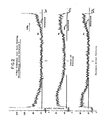
- Figures 1 to 4 are plots of L alpha intensity of platinum, rhenium, and iridium and platinum and rhenium catalysts as a function of the distance across the respective catalyst particles.
- One catalyst contains 0.3 weight percent platinum and 0.3 weight percent rhenium and the other catalyst contained 0.3 weight percent each of platinum, rhenium and iridium.
- Such alpha intensity is derived by focusing an electron beam on the catalyst samples.
- Figure 1 is directed to a plot for a platinum, rhenium, iridium/alumina catalyst subjected to CO 2 saturation and Figure 2 is a plot of such catalyst prepared without CO 2 saturation.
- Figure 3 is specifically directed to such plots for a platinum rhenium/alumina catalyst subjected to CO 2 to saturation.
- Figure 4 is specifically directed towards such a catalyst which has not been subject to CO 2 saturation.
- the multi-metallic single particle catalysts of this invention comprise platinum, rhenium and iridium on an appropriate support.
- Each of the metals individually can range from 0.05 to 5 percent by weight based on the total composition.
- the particularly preferred catalyst contains 0.3 percent by weight of each of platinum, rhenium and iridium.
- the refractory support for utilization in the present invention is a porous adsorptive material having a surface area exceeding 20 square meters per gram and preferably greater than about 100 square meters per gram.
- Refractory inorganic oxides are preferred supports, particularly alumina or mixtures thereof with silica.
- Alumina is particularly preferred and may be used in a large variety of forms including alumina precipitate or gel, alumina monohydrate and sintered alumina.
- Various forms of alumina either singly or in combination, such as eta, chi, gamma, theta, delta or alpha alumina may be suitably employed as the alumina support.
- the alumina is gamma alumina and/or eta alumina.
- alumina has a preferred particle size of at least 0.01 microns and generally not exceeding about 3000 microns.
- the alumina may be employed in massive form but generally will be in the form of a powder or in particle form, either irregularly shaped or uniformly shaped as beads, cubes, tablets and extruded pellets.
- an alumina hydrosol is prepared by intimate admixture of suitable reactants and the hydrosol is introduced in the form of globules to a water-immiscible medium, the depth and temperature of which is controlled so that the hydrosol globules set for spheroidal particles of hydrogel during passage through the medium.
- the resulting hydrogel particles are thereafter withdrawn from the forming zone and conducted to suitable washing, drying and/or calcining equipment as described.
- Alumina in the form of a precipitate, may be prepared by adding a suitable reagent such as ammonium hydroxide or ammonium carbonate to an aluminum salt such as aluminum chloride, aluminum nitrate and aluminum acetate in an amount to form aluminum hydroxide which, upon drying, is converted to alumina. After the alumina has been formed, it is generally washed to remove soluble impurities. Washing procedures ordinarily involve washing with water, either in combination with filtration or as separate operations. It has been found that filtration of the alumina is improved when the wash water contains a small amount of ammonium hydroxide. The extent of washing will depend to some extent on the nature of the reactants initially employed in preparation of the alumina precipitate.
- Halogen may be added to the support, preferably alumina, in a form which will readily react therewith in order to obtain the desired results.
- One feasible method of adding the halogen is in the form of an acid such as hydrogen fluoride, hydrogen bromide, hydrogen chloride and/or hydrogen iodide.
- Other suitable sources of halogen include volatile salts such as ammonium fluoride and ammonium chloride. When such salts are used, the ammonium ions will be removed during subsequent heating of the catalyst.
- Halogen may also be added as fluorine, chlorine, bromine or iodine or by treatment in gaseous hydrogen halide.
- the halogen preferably a chlorine or fluorine moiety, may be incorporated into the catalyst at any suitable stage in the catalyst manufacture.
- halogen may be added before, after or during incorporation of the metal or metals. It is preferred to introduce halogen during impregnation with the metal or metals after the alumina has undergone carbon dioxide treatment.
- One method to accomplish this is to use halogen-containing metal compounds such as chloroplatinic acid or chloroiridic acid. Additional amounts of halogen may be incorporated in the catalyst by contacting it with materials such as hydrogen fluoride and hydrogen chloride, either prior to or subsequent to the metal impregnation step.
- Halogen may also be incorporated by contacting the catalyst with a gaseous stream containing the halogen such as chlorine or hydrogen chloride.
- halogenate the alumina is by the addition of an alkyl halide such as tertiary butyl chloride during the reforming operation.
- the amount of halogen introduced into the support is such that the halogen content of the overall catalyst is between 0.1 and 5 weight percent.
- the alumina base be pretreated with gaseous carbon dioxide prior to impregnation with a solution containing the desired metal or metals.
- the alumina base either with or without halogen is dried to a water content preferably of less than 30 percent by weight. It is particularly preferred that the alumina base, after drying, be calcined before contact thereof with gaseous carbon dioxide.
- the dried and/or calcined alumina is thereafter, in accordance with the process of this invention, treated with gaseous carbon dioxide.
- Such treatment is generally effected under room temperature conditions utilizing a carbon dioxide pressure in the range of between about 100 kPa (0 psig) and 450 kPa (50 psig).
- the alumina is generally treated with carbon dioxide for a period between one minute and 48 hours and more usually between one minute and 3 hours. It is to be noted that the time of gas treatment and the gauge pressures set forth above are not considered critical, it being only necessary that the alumina base be exposed to a gaseous carbon dioxide atmosphere for a sufficient period of time and under sufficient pressure to become substantially saturated.
- the gas initially contained in the pores of the alumina base which will ordinarily be air, may be replaced by sweeping the alumina particles with gaseous carbon dioxide for a sufficient period of time to replace substantially all of the air in the pores of the alumina with carbon dioxide.
- the porous alumina base is subjected to a vacuum, thereby removing the air or other gas contained therein and subsequently to contact the evacuated particles with gaseous carbon dioxide.
- the alumina, after treatment with carbon dioxide is thereafter impregnated with a solution of a suitable compound(s) of the desired metal or metals.
- the alumina, after pretreatment is maintained in an atmosphere of gaseous carbon dioxide during the subsequent impregnation.
- the alumina which has undergone pretreatment with gaseous carbon dioxide should be brought into contact with the impregnating solution containing compound(s) of the desired metal or metals immediately after such pretreatment to insure the optimum results of this invention.
- a particularly effective method of impregnating the carbon dioxide treated alumina support comprises the use of an aqueous solution of metal containing acids such as chloroplatinic acid, bromoplatinic acid, chloroiridic acid and perrhenic acid (HRe0 4 ).
- a particularly preferred embodiment of this invention involves the preparation of a tri-metallic catalyst comprising platinum, rhenium and iridium on alumina.
- an aqueous solution of chloroplatinic acid, chloroiridic acid and perrhenic acid is comingled with the carbon dioxide-treated alumina particles and the resulting mixture is permitted to stand, preferably with or after suitable agitation, so that thorough mixing is obtained and even distribution of the platinum, iridium, and rhenium solutions throughout the alumina support is attained.
- This period of contact will generally be in the approximate range of between 10 minutes and 48 hours, and more generally between 10 minutes and 2 hours.
- Solutions of other compounds which may also be suitably employed for impregnation include platinum tetrachloride, ammonium platinum chloride, trimethyl benzyl ammonium platinum chloride, tetraamineplatinum (II) chloride, ammonium platinum nitrate, dinitrodiamineplatinum (II), ammonium perrhenate, perrhenic acid (HRe0 4 ), ammonium perrhenate (NH 4 Re0 4 ) and iridium compounds such as the ammonium chloride double salt, tribromide, trichloride, tetrachloride or chloroiridic acid. Iridium amine complexes may also be suitably employed.
- the resulting composite of alumina and the metal(s) with the combined halogen is dried at a temperature of from 93°C (200°F) to 260°C (500°F) for a period of time of from 0.5 hours to 24 hours or longer and thereafter the composite is calcined in the presence of an oxygen-containing gas, e.g. air, at a temperature of from 430°C (800°F) to 540°C (1000°F) for a period of time of from 0.5 hour to 12 hours or more.
- an oxygen-containing gas e.g. air
- the calcination may occur in nitrogen in lieu of air.
- the composite may be exposed in a hydrogen atomosphere to reduce a substantial portion of the metal components to the elemental state. Such reduction is generally conducted at temperatures not in excess of 540°C (1000°F).
- each individual metal component is from 0.05 to 5.0 percent by weight, the remaining weight of the catalyst being support material with some halogen content.
- the single particle trimetallic catalysts of this invention result in enhancement in catalytic activity, particularly dehydrocyclization activity for reasons that are not completely understood but are as a result of the uniform metal distribution.
- alumina beads are pretreated with gaseous carbon dioxide, then, while the beads are mixed by continuous rotation, the beads are impregnated with an aqueous solution containing a compound (or complex or complexes) of the three desired metals followed by drying and calcination.
- Post impregnation carbon dioxide treatment may be utilized as a precaution.
- the catalyst prepared according to the novel method of the instant invention is particularly useful in the reforming of hydrocarbons.
- Charge stocks undergoing reforming, using the catalyst described herein, are contemplated as those conventionally employed. These include virgin naphtha, cracked naphtha, gasoline, including FCC gasoline, or mixtures thereof boiling within the approximate range of from 20°C (70°F) to 260°C (500°F) and, preferably within the range of from 50°C (120°F) to 235°C (450°F).
- the charge stock is contacted in the vapor phase with the catalyst at a liquid hourly space velocity of from 0.1 to 10 and preferably from 0.5 to 4.
- Reaction temperature is within the approximate range of from 370°C (700°F) to 590°C (1100°F) and preferably from 430°C (800°F) to 565°C (1050°F).
- Hydrogen may be added to the reaction zone at a range corresponding to a mole ratio of hydrogen to hydrocarbon charge of from 0.5 to 20 and preferably from 2 to 12.
- Reaction pressure is maintained between 450 kPa (50 psig) and 7000 kPa (1000 psig), preferably between 795 kPa (100 psig) and 4935 kPa (700 psig). Since the reforming process produces large quantities of hydrogen, at least a portion thereof may be conveniently employed for the introduction of hydrogen with the feed.
- the resultant catalyst of the method of the instant invention may be employed in any of the conventional types of processing equipment.
- the catalyst may be used in the form of pills, pellets, extrudates, spheres, granules, broken fragments or various other shapes dispersed as a fixed bed within a reaction zone.
- the charge stock may be passed through the catalyst bed as a liquid, vapor or mixed phase in either upward or downward flow.
- the catalyst may also be used in a form suitable for moving beds. In such instance, the charge stock and catalyst are contacted in a reforming zone wherein the charge stock may be passed in concurrent or countercurrent flow to the catalyst.
- a suspensoid-type process may be employed in which the catalyst is slurried in the charge stock and the resulting mixture conveyed to the reaction zone.
- the reforming process is generally carried out in a series of several reactors. Usually, three to five reactors are used.
- the catalyst prepared according to the method of the invention may be employed in just one of the reactors, e.g. the first reactor or in several reactors or in all reactors. After reaction, the product from any of the above processes is separated from the catalyst by known techniques and conducted to distillation columns where the various desired components are obtained by fractionation.
- a particularly preferred embodiment of the process of this invention resides in its use for the reforming of highly paraffinic naphthas with feed sulfur levels up to 15 ppm.
- the single particle multi-metallic reforming catalyst of this invention having a uniform distribution of the three metals permits the optimization of the C 5 + yields from processing such highly paraffinic naphthas, even though the naphtha has significantly high sulfur levels.
- deliberate addition of sulfur is advantageous. This is in contrast to existing commercial catalysts which lose their activity and yield stability rapidly at feed sulfur levels near 1 ppm.
- the supports used in the following examples were commercially obtained spheroidal 0.159 cm (1/16 inch) gamma alumina beads. Typical analytical properties of these beads is given below in Table 1.
- the supports were humidified before each preparation by storing over water in a closed vessel for at least four hours. This humidification step can be combined with the carbon dioxide pretreatment step, if so desired.
- the humidification step is not essential to achieve the beneficial results afforded by the present invention.
- the use of humidification depends on the state of hydration of the support.
- This example will illustrate the preparation of the single particle trimetallic catalyst of this invention.
- the catalyst composite contains 0.3 weight percent platinum, 0.3 weight percent rhenium, and 0.3 weight percent iridium on alumina with carbon dioxide presaturation of the alumina support.
- a double cone blender was filled with 150 g of humidified ⁇ -Al 2 O 3 beads.
- the blender was attached to a rotary evaporator and was evacuated and backfilled with C0 2 .
- the blender was then rotated and, under a partial vacuum, the beads were impregnated with 150 ml of an aqueous solution of H 2 PtCl 6 , HReO 4 , and H 2 IrC1 6 containing the equivalent of 0.45 g each of metallic platinum, rhenium and iridium.
- the impregnated beads were held under a CO 2 atmosphere for one hour and then dried for 18 hours in a forced air draft oven at 121.1°C (250°F).
- the platinum-rhenium-iridium-containing beads were then calcined for one hour at 454.4°C (850°F) in nitrogen.
- a composite was prepared containing 0.3 weight percent platinum, 0.3 weight percent rhenium, and 0.3 weight percent iridium on alumina without carbon dioxide pretreatment of the support.
- a double cone blender was filled with 100 g of humidified ⁇ -Al 2 O 3 beads.
- the blender was attached to a rotary evaporator and rotated.
- the beads were impregnated with 50 ml of an aqueous solution of H 2 PtC1 6 , HReO 4 and H 2 IrCl 6 containing the equivalent of 0.3 g each of metallic platinum, rhenium and iridium.
- the impregnated beads were dried for 18 hours in a forced air oven at 121.1°C (250°F) and calcined for one hour at 454.4°C (850°F) in nitrogen.
- a bimetallic composite was prepared containing 0.3 weight percent platinum, and 0.3 weight percent rhenium on alumina with carbon dioxide pretreatment of the support.
- a flask filled with 15 g of humidified Al 2 O 3 beads were evacuated and backfilled with C0 2 .
- the beads were impregnated with 13.5 ml of an aqueous solution of H 2 PtC1 6 and HRe0 4 containing an equivalent of 0.045 g of metallic platinum and 0.045 g of metallic Re.
- the impregnation technique was that described in Example 1.
- the impregnated beads were held under a CO 2 atmosphere for one hour.
- the beads were then dried at 121.1°C (250°F) and calcined for two hours at 482.2°C (900°F) in air.
- Humidified ⁇ -Al 2 O 3 beads (15 g) were impregnated, dried and calcined identically to that described in Example 3 with the exception that the CO 2 treatment was omitted.
- Catalyst E A commercially prepared platinum/rhenium reforming catalyst containing 0.3 weight percent platinum and 0.3 weight percent rhenium on extruded gamma alumina was identified as Catalyst E.
- the catalyst contained 0.3 weight percent platinum, 0.3 weight percent rhenium, and 0.3 weight percent iridium prepared with C0 2 pretreatment of the support.
- This catalyst was labeled Catalyst F and, as is obvious, is not a single particle catalyst within the scope of this invention.
- This example describes the preparation of separate particle platinum/rhenium on alumina and iridium on alumina catalysts physically mixed together without C0 2 pretreatment of the support.
- the catalyst contains 0.3 weight percent platinum, 0.3 weight percent rhenium, and 0.3 weight percent iridium based on total alumina.
- This catalyst which is not within the scope of the present invention is identified as Catalyst G.
- Catalyst H a commercially prepared platinum/iridium reforming catalyst comprising 0.3 weight percent platinum, 0.3 weight percent iridium on extruded gamma alumina was identified as Catalyst H.
- the catalysts prepared according to the general procedures of Examples 1 to 8 each underwent a catalyst dehydrogenation/dehydro- cyclization screening test using n-hexane and cyclohexane as charge stocks.
- the conditions for such screening tests were as follows:
- the screening test was conducted by first reducing the catalyst sample with hydrogen at 454°C. After such reduction, cyclohexane was passed over the catalyst sample at the above-stated conditions for 10 minutes. After this 10 minutes contact, the sample was flushed with hydrogen and the temperature was raised from 300°C to 470°C and then n-hexane was passed over the catalyst sample at the above-stated conditions for 60 minutes.
- the methane make and the benzene make were determined.
- the benzene make is a direct measure of the dehydrocyclization activity of the catalyst and, of course, the methane make determines the practical significance of a catalyst in a reforming process since too high a methane make significantly reduces reformate yield and hydrogen production and can accelerate catalyst aging.
- Example 14 Comparing the results of Example 9 with Example 14, it can be seen that a single particle catalyst produced higher yields of benzene than a multi-particle catalyst even though the metal distribution was the same, i.e. uniform. Note that the methane make on Example 14 was very high. With regard to multi-particle catalysts, i.e. Examples 14 and 15, note that the catalyst of Example 14, i.e. uniform distribution, produced less benzene than the catalyst of Example 15 having a shell distribution. Thus, no analogy can be made with regard to desirability of having uniform metal distribution as between single particle and multi-particle catalysts with regard to benzene make.
- Reforming of the above charge was carried out in an adiabatic three reactor system with recycle. Alcohol, organochloride, and sulfur were added to the naphtha as indicated below to simulate exact commercial conditions. The other operating parameters are listed below with the comparisons.
- Catalyst A when compared to Catalyst E, run identically and under the following conditions: produced the yields as shown below:
- the feed employed was a full range naphtha as employed in Examples 17 to 21.
- the experiment was conducted in a manner similar to that of Examples 17 to 21 in that it was carried out in an adiabatic three reactor system with recycle, alcohol, organic chloride, and sulfur was added to the naphtha as indicated below to simulate exact commercial operations and conditions.
- the other operating parameters will be set forth in the Table which follows. Sulfur was added in the form of untreated naphtha at 2, 5, 10 and 15 ppm level. The operating conditions and yields are shown in the following Table. In all cases the catalyst employed was catalyst A from Example 1.
- an important embodiment of this invention involves the deliberate addition of sulfur to a feed in order to enhance the yield advantage when using the novel catalysts of this invention.
- the yield is equal to 0 ppm sulfur, i.e. there is no longer a yield advantage.
- the sulfur can be added to the feed in any convenient manner such as by the separate addition of sulfur compounds or unpretreated naphtha or the severity of the hydrotreating step which precedes reforming can be'reduced to provide the desirable levels of sulfur, i.e. 410 ppm.
Landscapes
- Chemical & Material Sciences (AREA)
- Engineering & Computer Science (AREA)
- Chemical Kinetics & Catalysis (AREA)
- Oil, Petroleum & Natural Gas (AREA)
- Organic Chemistry (AREA)
- General Chemical & Material Sciences (AREA)
- Materials Engineering (AREA)
- Catalysts (AREA)
- Production Of Liquid Hydrocarbon Mixture For Refining Petroleum (AREA)
Applications Claiming Priority (2)
| Application Number | Priority Date | Filing Date | Title |
|---|---|---|---|
| US41776182A | 1982-09-13 | 1982-09-13 | |
| US417761 | 1989-10-06 |
Publications (2)
| Publication Number | Publication Date |
|---|---|
| EP0103449A1 true EP0103449A1 (fr) | 1984-03-21 |
| EP0103449B1 EP0103449B1 (fr) | 1989-08-09 |
Family
ID=23655306
Family Applications (1)
| Application Number | Title | Priority Date | Filing Date |
|---|---|---|---|
| EP83305126A Expired EP0103449B1 (fr) | 1982-09-13 | 1983-09-05 | Catalyseur polymétallique de reformage sur un support unique et procédé de reformage utilisant ce catalyseur |
Country Status (6)
| Country | Link |
|---|---|
| EP (1) | EP0103449B1 (fr) |
| JP (1) | JPS5966346A (fr) |
| AU (1) | AU1895983A (fr) |
| CA (1) | CA1218982A (fr) |
| DE (1) | DE3380355D1 (fr) |
| ZA (1) | ZA836794B (fr) |
Cited By (2)
| Publication number | Priority date | Publication date | Assignee | Title |
|---|---|---|---|---|
| EP0200559A1 (fr) * | 1985-05-02 | 1986-11-05 | Exxon Research And Engineering Company | Procédé de reformage catalytique |
| EP0252605A1 (fr) * | 1986-06-12 | 1988-01-13 | Exxon Research And Engineering Company | Procédé de réformage catalytique et catalyseur de réformage |
Citations (5)
| Publication number | Priority date | Publication date | Assignee | Title |
|---|---|---|---|---|
| FR2017701A1 (fr) * | 1968-09-10 | 1970-05-22 | Chevron Res | |
| US3617520A (en) * | 1969-06-25 | 1971-11-02 | Chevron Res | Sulfiding of low platinum content catalyst |
| US3953368A (en) * | 1971-11-01 | 1976-04-27 | Exxon Research And Engineering Co. | Polymetallic cluster compositions useful as hydrocarbon conversion catalysts |
| US4288348A (en) * | 1980-01-17 | 1981-09-08 | Mobil Oil Corporation | Separately supported polymetallic reforming catalyst |
| EP0036703A2 (fr) * | 1980-02-13 | 1981-09-30 | Mobil Oil Corporation | Préparation de catalyseurs contenant un métal |
-
1983
- 1983-08-31 CA CA000435773A patent/CA1218982A/fr not_active Expired
- 1983-09-05 DE DE8383305126T patent/DE3380355D1/de not_active Expired
- 1983-09-05 EP EP83305126A patent/EP0103449B1/fr not_active Expired
- 1983-09-08 AU AU18959/83A patent/AU1895983A/en not_active Abandoned
- 1983-09-13 JP JP58167628A patent/JPS5966346A/ja active Pending
- 1983-09-13 ZA ZA836794A patent/ZA836794B/xx unknown
Patent Citations (5)
| Publication number | Priority date | Publication date | Assignee | Title |
|---|---|---|---|---|
| FR2017701A1 (fr) * | 1968-09-10 | 1970-05-22 | Chevron Res | |
| US3617520A (en) * | 1969-06-25 | 1971-11-02 | Chevron Res | Sulfiding of low platinum content catalyst |
| US3953368A (en) * | 1971-11-01 | 1976-04-27 | Exxon Research And Engineering Co. | Polymetallic cluster compositions useful as hydrocarbon conversion catalysts |
| US4288348A (en) * | 1980-01-17 | 1981-09-08 | Mobil Oil Corporation | Separately supported polymetallic reforming catalyst |
| EP0036703A2 (fr) * | 1980-02-13 | 1981-09-30 | Mobil Oil Corporation | Préparation de catalyseurs contenant un métal |
Cited By (2)
| Publication number | Priority date | Publication date | Assignee | Title |
|---|---|---|---|---|
| EP0200559A1 (fr) * | 1985-05-02 | 1986-11-05 | Exxon Research And Engineering Company | Procédé de reformage catalytique |
| EP0252605A1 (fr) * | 1986-06-12 | 1988-01-13 | Exxon Research And Engineering Company | Procédé de réformage catalytique et catalyseur de réformage |
Also Published As
| Publication number | Publication date |
|---|---|
| CA1218982A (fr) | 1987-03-10 |
| DE3380355D1 (en) | 1989-09-14 |
| JPS5966346A (ja) | 1984-04-14 |
| AU1895983A (en) | 1984-03-22 |
| EP0103449B1 (fr) | 1989-08-09 |
| ZA836794B (en) | 1985-04-24 |
Similar Documents
| Publication | Publication Date | Title |
|---|---|---|
| RU1797496C (ru) | Катализатор дл риформинга лигроинового сырь и способ каталитического риформинга лигроинового сырь | |
| US3953368A (en) | Polymetallic cluster compositions useful as hydrocarbon conversion catalysts | |
| US4174298A (en) | Activated multimetallic catalytic composite | |
| US5015614A (en) | Novel alumina support materials | |
| US4124490A (en) | Hydrocarbon reforming process | |
| CA2214550C (fr) | Melange catalytique multimetallique, bifonctionnel et selectif pour la conversion d'hydrocarbures; methode pour l'utiliser | |
| US5166121A (en) | Catalytic compositions | |
| EP0034228B1 (fr) | Procédé de reformage | |
| EP0009309A1 (fr) | Catalyseur de reformage comprenant des particules contenant du platine et des particules séparées contenant de l'iridium, et procédé de reformage utilisant ce catalyseur | |
| US4963249A (en) | Reforming using novel platinum-tin alumina catalysts | |
| US3296119A (en) | Catalytic reforming process and catalyst therefor | |
| US4477590A (en) | Separately supported polymetallic reforming catalyst | |
| EP0036703B1 (fr) | Préparation de catalyseurs contenant un métal | |
| US4210561A (en) | Activated and attenuated multimetallic catalytic composite | |
| US4865719A (en) | Trimetallic reforming catalyst | |
| US4966880A (en) | Novel platinum-tin-alumina reforming catalysts | |
| US3867314A (en) | Process for the preparation of a supported iridium catalyst | |
| US4288348A (en) | Separately supported polymetallic reforming catalyst | |
| EP0103449B1 (fr) | Catalyseur polymétallique de reformage sur un support unique et procédé de reformage utilisant ce catalyseur | |
| US4966879A (en) | Novel platinum-iridium reforming catalysts | |
| US3038865A (en) | Activated aluminum catalyst carriers and catalysts prepared therewith | |
| US4737483A (en) | Trimetallic reforming catalyst | |
| US4966682A (en) | Reforming with modified alumina catalysts | |
| US4714538A (en) | Trimetallic reforming catalyst | |
| US4493764A (en) | Separately supported polymetallic reforming catalyst |
Legal Events
| Date | Code | Title | Description |
|---|---|---|---|
| PUAI | Public reference made under article 153(3) epc to a published international application that has entered the european phase |
Free format text: ORIGINAL CODE: 0009012 |
|
| AK | Designated contracting states |
Designated state(s): BE DE FR GB IT NL |
|
| 17P | Request for examination filed |
Effective date: 19840331 |
|
| GRAA | (expected) grant |
Free format text: ORIGINAL CODE: 0009210 |
|
| AK | Designated contracting states |
Kind code of ref document: B1 Designated state(s): BE DE FR GB IT NL |
|
| REF | Corresponds to: |
Ref document number: 3380355 Country of ref document: DE Date of ref document: 19890914 |
|
| ET | Fr: translation filed | ||
| PG25 | Lapsed in a contracting state [announced via postgrant information from national office to epo] |
Ref country code: FR Effective date: 19890930 Ref country code: BE Effective date: 19890930 |
|
| PG25 | Lapsed in a contracting state [announced via postgrant information from national office to epo] |
Ref country code: GB Effective date: 19891009 |
|
| ITF | It: translation for a ep patent filed | ||
| BERE | Be: lapsed |
Owner name: MOBIL OIL CORP. Effective date: 19890930 |
|
| PG25 | Lapsed in a contracting state [announced via postgrant information from national office to epo] |
Ref country code: NL Effective date: 19900401 |
|
| NLV4 | Nl: lapsed or anulled due to non-payment of the annual fee | ||
| PG25 | Lapsed in a contracting state [announced via postgrant information from national office to epo] |
Ref country code: DE Effective date: 19900601 |
|
| GBPC | Gb: european patent ceased through non-payment of renewal fee | ||
| PLBE | No opposition filed within time limit |
Free format text: ORIGINAL CODE: 0009261 |
|
| STAA | Information on the status of an ep patent application or granted ep patent |
Free format text: STATUS: NO OPPOSITION FILED WITHIN TIME LIMIT |
|
| 26N | No opposition filed | ||
| REG | Reference to a national code |
Ref country code: FR Ref legal event code: ST |
|
| APAH | Appeal reference modified |
Free format text: ORIGINAL CODE: EPIDOSCREFNO |