EP0103797B1 - Substituierte Benzoxazin-Derivate - Google Patents
Substituierte Benzoxazin-Derivate Download PDFInfo
- Publication number
- EP0103797B1 EP0103797B1 EP83108716A EP83108716A EP0103797B1 EP 0103797 B1 EP0103797 B1 EP 0103797B1 EP 83108716 A EP83108716 A EP 83108716A EP 83108716 A EP83108716 A EP 83108716A EP 0103797 B1 EP0103797 B1 EP 0103797B1
- Authority
- EP
- European Patent Office
- Prior art keywords
- formula
- diluent
- appropriate
- derivatives
- substituted
- Prior art date
- Legal status (The legal status is an assumption and is not a legal conclusion. Google has not performed a legal analysis and makes no representation as to the accuracy of the status listed.)
- Expired
Links
- 150000005130 benzoxazines Chemical class 0.000 title claims abstract description 14
- UFHFLCQGNIYNRP-UHFFFAOYSA-N Hydrogen Chemical compound [H][H] UFHFLCQGNIYNRP-UHFFFAOYSA-N 0.000 claims abstract description 16
- 239000001257 hydrogen Substances 0.000 claims abstract description 16
- 229910052739 hydrogen Inorganic materials 0.000 claims abstract description 16
- 239000001301 oxygen Substances 0.000 claims abstract description 16
- 229910052760 oxygen Inorganic materials 0.000 claims abstract description 16
- 239000002253 acid Substances 0.000 claims abstract description 13
- QVGXLLKOCUKJST-UHFFFAOYSA-N atomic oxygen Chemical group [O] QVGXLLKOCUKJST-UHFFFAOYSA-N 0.000 claims abstract description 11
- 125000004093 cyano group Chemical group *C#N 0.000 claims abstract description 7
- 229910052736 halogen Inorganic materials 0.000 claims abstract description 7
- 150000002367 halogens Chemical class 0.000 claims abstract description 7
- 150000002431 hydrogen Chemical group 0.000 claims abstract description 6
- 238000000034 method Methods 0.000 claims description 51
- 239000003085 diluting agent Substances 0.000 claims description 20
- 239000003054 catalyst Substances 0.000 claims description 14
- LPXPTNMVRIOKMN-UHFFFAOYSA-M sodium nitrite Chemical compound [Na+].[O-]N=O LPXPTNMVRIOKMN-UHFFFAOYSA-M 0.000 claims description 13
- 239000003795 chemical substances by application Substances 0.000 claims description 10
- 238000002360 preparation method Methods 0.000 claims description 10
- WYKWUPMZBGOFOV-UHFFFAOYSA-N 1,2,3,4-tetrahydroquinolin-8-ol Chemical class C1CCNC2=C1C=CC=C2O WYKWUPMZBGOFOV-UHFFFAOYSA-N 0.000 claims description 9
- NINIDFKCEFEMDL-UHFFFAOYSA-N Sulfur Chemical group [S] NINIDFKCEFEMDL-UHFFFAOYSA-N 0.000 claims description 9
- 239000003153 chemical reaction reagent Substances 0.000 claims description 8
- 229910052500 inorganic mineral Inorganic materials 0.000 claims description 7
- 239000011707 mineral Substances 0.000 claims description 7
- 125000000449 nitro group Chemical group [O-][N+](*)=O 0.000 claims description 6
- 235000010288 sodium nitrite Nutrition 0.000 claims description 6
- 239000011230 binding agent Substances 0.000 claims description 5
- CYQAYERJWZKYML-UHFFFAOYSA-N phosphorus pentasulfide Chemical compound S1P(S2)(=S)SP3(=S)SP1(=S)SP2(=S)S3 CYQAYERJWZKYML-UHFFFAOYSA-N 0.000 claims description 5
- 239000004606 Fillers/Extenders Substances 0.000 claims description 4
- 239000012954 diazonium Substances 0.000 claims description 4
- 239000012434 nucleophilic reagent Substances 0.000 claims description 4
- IZDNNHOZVXRIGA-UHFFFAOYSA-N 2h-1,2-benzoxazin-3-amine Chemical class C1=CC=C2ONC(N)=CC2=C1 IZDNNHOZVXRIGA-UHFFFAOYSA-N 0.000 claims description 3
- PXJXMTNJGPSLRJ-UHFFFAOYSA-N 4h-1,2-benzoxazine-3-thione Chemical class C1=CC=C2ONC(=S)CC2=C1 PXJXMTNJGPSLRJ-UHFFFAOYSA-N 0.000 claims description 3
- 150000001450 anions Chemical class 0.000 claims description 3
- 238000007045 Balz-Schiemann reaction Methods 0.000 claims description 2
- 238000000297 Sandmeyer reaction Methods 0.000 claims description 2
- 150000001989 diazonium salts Chemical class 0.000 claims description 2
- 125000002924 primary amino group Chemical group [H]N([H])* 0.000 claims description 2
- 239000004094 surface-active agent Substances 0.000 claims description 2
- 241000607479 Yersinia pestis Species 0.000 claims 5
- 239000005864 Sulphur Chemical group 0.000 claims 3
- 150000004820 halides Chemical class 0.000 claims 1
- 150000001875 compounds Chemical class 0.000 abstract description 24
- -1 akylthio Chemical group 0.000 abstract description 16
- 230000000855 fungicidal effect Effects 0.000 abstract description 3
- 230000000694 effects Effects 0.000 abstract description 2
- 125000003545 alkoxy group Chemical group 0.000 abstract 1
- 125000000217 alkyl group Chemical group 0.000 abstract 1
- 125000003435 aroyl group Chemical group 0.000 abstract 1
- 125000001589 carboacyl group Chemical group 0.000 abstract 1
- 125000001188 haloalkyl group Chemical group 0.000 abstract 1
- YMWUJEATGCHHMB-UHFFFAOYSA-N Dichloromethane Chemical compound ClCCl YMWUJEATGCHHMB-UHFFFAOYSA-N 0.000 description 21
- 238000006243 chemical reaction Methods 0.000 description 19
- 239000000203 mixture Substances 0.000 description 17
- RTZKZFJDLAIYFH-UHFFFAOYSA-N Diethyl ether Chemical compound CCOCC RTZKZFJDLAIYFH-UHFFFAOYSA-N 0.000 description 13
- 239000002904 solvent Substances 0.000 description 13
- 241000196324 Embryophyta Species 0.000 description 10
- VZGDMQKNWNREIO-UHFFFAOYSA-N tetrachloromethane Chemical compound ClC(Cl)(Cl)Cl VZGDMQKNWNREIO-UHFFFAOYSA-N 0.000 description 10
- CSCPPACGZOOCGX-UHFFFAOYSA-N Acetone Chemical compound CC(C)=O CSCPPACGZOOCGX-UHFFFAOYSA-N 0.000 description 9
- 238000009472 formulation Methods 0.000 description 9
- 239000007858 starting material Substances 0.000 description 9
- WYURNTSHIVDZCO-UHFFFAOYSA-N Tetrahydrofuran Chemical compound C1CCOC1 WYURNTSHIVDZCO-UHFFFAOYSA-N 0.000 description 8
- 239000000843 powder Substances 0.000 description 8
- 239000003995 emulsifying agent Substances 0.000 description 7
- 238000002844 melting Methods 0.000 description 7
- 230000008018 melting Effects 0.000 description 7
- 239000011541 reaction mixture Substances 0.000 description 7
- XLYOFNOQVPJJNP-UHFFFAOYSA-N water Substances O XLYOFNOQVPJJNP-UHFFFAOYSA-N 0.000 description 7
- WFDIJRYMOXRFFG-UHFFFAOYSA-N Acetic anhydride Chemical compound CC(=O)OC(C)=O WFDIJRYMOXRFFG-UHFFFAOYSA-N 0.000 description 6
- WEVYAHXRMPXWCK-UHFFFAOYSA-N Acetonitrile Chemical compound CC#N WEVYAHXRMPXWCK-UHFFFAOYSA-N 0.000 description 6
- LFQSCWFLJHTTHZ-UHFFFAOYSA-N Ethanol Chemical compound CCO LFQSCWFLJHTTHZ-UHFFFAOYSA-N 0.000 description 6
- ZMXDDKWLCZADIW-UHFFFAOYSA-N N,N-Dimethylformamide Chemical compound CN(C)C=O ZMXDDKWLCZADIW-UHFFFAOYSA-N 0.000 description 6
- YXFVVABEGXRONW-UHFFFAOYSA-N Toluene Chemical compound CC1=CC=CC=C1 YXFVVABEGXRONW-UHFFFAOYSA-N 0.000 description 6
- 239000004480 active ingredient Substances 0.000 description 6
- MVPPADPHJFYWMZ-UHFFFAOYSA-N chlorobenzene Chemical compound ClC1=CC=CC=C1 MVPPADPHJFYWMZ-UHFFFAOYSA-N 0.000 description 6
- 239000008187 granular material Substances 0.000 description 6
- 239000000243 solution Substances 0.000 description 6
- HQQTZCPKNZVLFF-UHFFFAOYSA-N 4h-1,2-benzoxazin-3-one Chemical class C1=CC=C2ONC(=O)CC2=C1 HQQTZCPKNZVLFF-UHFFFAOYSA-N 0.000 description 5
- MYMOFIZGZYHOMD-UHFFFAOYSA-N Dioxygen Chemical compound O=O MYMOFIZGZYHOMD-UHFFFAOYSA-N 0.000 description 5
- VEXZGXHMUGYJMC-UHFFFAOYSA-N Hydrochloric acid Chemical compound Cl VEXZGXHMUGYJMC-UHFFFAOYSA-N 0.000 description 5
- 241000209094 Oryza Species 0.000 description 5
- 239000007868 Raney catalyst Substances 0.000 description 5
- 208000037265 diseases, disorders, signs and symptoms Diseases 0.000 description 5
- 235000010755 mineral Nutrition 0.000 description 5
- 239000003960 organic solvent Substances 0.000 description 5
- 239000007787 solid Substances 0.000 description 5
- 239000000725 suspension Substances 0.000 description 5
- QTBSBXVTEAMEQO-UHFFFAOYSA-N Acetic acid Chemical compound CC(O)=O QTBSBXVTEAMEQO-UHFFFAOYSA-N 0.000 description 4
- ZAMOUSCENKQFHK-UHFFFAOYSA-N Chlorine atom Chemical compound [Cl] ZAMOUSCENKQFHK-UHFFFAOYSA-N 0.000 description 4
- HEDRZPFGACZZDS-UHFFFAOYSA-N Chloroform Chemical compound ClC(Cl)Cl HEDRZPFGACZZDS-UHFFFAOYSA-N 0.000 description 4
- IAZDPXIOMUYVGZ-UHFFFAOYSA-N Dimethylsulphoxide Chemical compound CS(C)=O IAZDPXIOMUYVGZ-UHFFFAOYSA-N 0.000 description 4
- NPXOKRUENSOPAO-UHFFFAOYSA-N Raney nickel Chemical compound [Al].[Ni] NPXOKRUENSOPAO-UHFFFAOYSA-N 0.000 description 4
- 229910000564 Raney nickel Inorganic materials 0.000 description 4
- 239000000969 carrier Substances 0.000 description 4
- 239000000460 chlorine Substances 0.000 description 4
- 229910052801 chlorine Inorganic materials 0.000 description 4
- 201000010099 disease Diseases 0.000 description 4
- 238000005984 hydrogenation reaction Methods 0.000 description 4
- 238000005554 pickling Methods 0.000 description 4
- BWHMMNNQKKPAPP-UHFFFAOYSA-L potassium carbonate Chemical compound [K+].[K+].[O-]C([O-])=O BWHMMNNQKKPAPP-UHFFFAOYSA-L 0.000 description 4
- VYPSYNLAJGMNEJ-UHFFFAOYSA-N silicon dioxide Inorganic materials O=[Si]=O VYPSYNLAJGMNEJ-UHFFFAOYSA-N 0.000 description 4
- 239000002689 soil Substances 0.000 description 4
- 239000000126 substance Substances 0.000 description 4
- YLQBMQCUIZJEEH-UHFFFAOYSA-N tetrahydrofuran Natural products C=1C=COC=1 YLQBMQCUIZJEEH-UHFFFAOYSA-N 0.000 description 4
- ZWEHNKRNPOVVGH-UHFFFAOYSA-N 2-Butanone Chemical compound CCC(C)=O ZWEHNKRNPOVVGH-UHFFFAOYSA-N 0.000 description 3
- IJGRMHOSHXDMSA-UHFFFAOYSA-N Atomic nitrogen Chemical compound N#N IJGRMHOSHXDMSA-UHFFFAOYSA-N 0.000 description 3
- UHOVQNZJYSORNB-UHFFFAOYSA-N Benzene Chemical compound C1=CC=CC=C1 UHOVQNZJYSORNB-UHFFFAOYSA-N 0.000 description 3
- VGCXGMAHQTYDJK-UHFFFAOYSA-N Chloroacetyl chloride Chemical compound ClCC(Cl)=O VGCXGMAHQTYDJK-UHFFFAOYSA-N 0.000 description 3
- XEKOWRVHYACXOJ-UHFFFAOYSA-N Ethyl acetate Chemical compound CCOC(C)=O XEKOWRVHYACXOJ-UHFFFAOYSA-N 0.000 description 3
- 241001330975 Magnaporthe oryzae Species 0.000 description 3
- OKKJLVBELUTLKV-UHFFFAOYSA-N Methanol Chemical compound OC OKKJLVBELUTLKV-UHFFFAOYSA-N 0.000 description 3
- GRYLNZFGIOXLOG-UHFFFAOYSA-N Nitric acid Chemical compound O[N+]([O-])=O GRYLNZFGIOXLOG-UHFFFAOYSA-N 0.000 description 3
- 235000007164 Oryza sativa Nutrition 0.000 description 3
- ZMANZCXQSJIPKH-UHFFFAOYSA-N Triethylamine Chemical compound CCN(CC)CC ZMANZCXQSJIPKH-UHFFFAOYSA-N 0.000 description 3
- 150000001338 aliphatic hydrocarbons Chemical class 0.000 description 3
- 125000002877 alkyl aryl group Chemical group 0.000 description 3
- 239000012141 concentrate Substances 0.000 description 3
- 238000001816 cooling Methods 0.000 description 3
- DOBRDRYODQBAMW-UHFFFAOYSA-N copper(i) cyanide Chemical compound [Cu+].N#[C-] DOBRDRYODQBAMW-UHFFFAOYSA-N 0.000 description 3
- 239000013078 crystal Substances 0.000 description 3
- 239000000839 emulsion Substances 0.000 description 3
- 150000002170 ethers Chemical class 0.000 description 3
- 239000000417 fungicide Substances 0.000 description 3
- 239000007788 liquid Substances 0.000 description 3
- 238000004519 manufacturing process Methods 0.000 description 3
- 238000006396 nitration reaction Methods 0.000 description 3
- 229910017604 nitric acid Inorganic materials 0.000 description 3
- 229920000151 polyglycol Polymers 0.000 description 3
- 239000010695 polyglycol Substances 0.000 description 3
- 235000009566 rice Nutrition 0.000 description 3
- 239000011435 rock Substances 0.000 description 3
- JHJLBTNAGRQEKS-UHFFFAOYSA-M sodium bromide Inorganic materials [Na+].[Br-] JHJLBTNAGRQEKS-UHFFFAOYSA-M 0.000 description 3
- 238000005507 spraying Methods 0.000 description 3
- 238000003756 stirring Methods 0.000 description 3
- 229910052717 sulfur Inorganic materials 0.000 description 3
- 239000011593 sulfur Substances 0.000 description 3
- LBUJPTNKIBCYBY-UHFFFAOYSA-N 1,2,3,4-tetrahydroquinoline Chemical compound C1=CC=C2CCCNC2=C1 LBUJPTNKIBCYBY-UHFFFAOYSA-N 0.000 description 2
- BMYNFMYTOJXKLE-UHFFFAOYSA-N 3-azaniumyl-2-hydroxypropanoate Chemical compound NCC(O)C(O)=O BMYNFMYTOJXKLE-UHFFFAOYSA-N 0.000 description 2
- UGAJAVOEVQVMMT-UHFFFAOYSA-N 3-nitro-2h-1,2-benzoxazine Chemical class C1=CC=C2ONC([N+](=O)[O-])=CC2=C1 UGAJAVOEVQVMMT-UHFFFAOYSA-N 0.000 description 2
- IQXODTOLPHMAJF-UHFFFAOYSA-N 5-chloro-1,2,3,4-tetrahydroquinolin-8-ol Chemical compound C1CCNC2=C1C(Cl)=CC=C2O IQXODTOLPHMAJF-UHFFFAOYSA-N 0.000 description 2
- 150000004325 8-hydroxyquinolines Chemical class 0.000 description 2
- WKBOTKDWSSQWDR-UHFFFAOYSA-N Bromine atom Chemical compound [Br] WKBOTKDWSSQWDR-UHFFFAOYSA-N 0.000 description 2
- OKTJSMMVPCPJKN-UHFFFAOYSA-N Carbon Chemical compound [C] OKTJSMMVPCPJKN-UHFFFAOYSA-N 0.000 description 2
- CURLTUGMZLYLDI-UHFFFAOYSA-N Carbon dioxide Chemical compound O=C=O CURLTUGMZLYLDI-UHFFFAOYSA-N 0.000 description 2
- FILSNTLRJUKHBW-UHFFFAOYSA-N Cc(cc1OC2)cc(CCC3)c1N3C2=O Chemical compound Cc(cc1OC2)cc(CCC3)c1N3C2=O FILSNTLRJUKHBW-UHFFFAOYSA-N 0.000 description 2
- 229910021589 Copper(I) bromide Inorganic materials 0.000 description 2
- XDTMQSROBMDMFD-UHFFFAOYSA-N Cyclohexane Chemical compound C1CCCCC1 XDTMQSROBMDMFD-UHFFFAOYSA-N 0.000 description 2
- LYCAIKOWRPUZTN-UHFFFAOYSA-N Ethylene glycol Chemical compound OCCO LYCAIKOWRPUZTN-UHFFFAOYSA-N 0.000 description 2
- DGAQECJNVWCQMB-PUAWFVPOSA-M Ilexoside XXIX Chemical compound C[C@@H]1CC[C@@]2(CC[C@@]3(C(=CC[C@H]4[C@]3(CC[C@@H]5[C@@]4(CC[C@@H](C5(C)C)OS(=O)(=O)[O-])C)C)[C@@H]2[C@]1(C)O)C)C(=O)O[C@H]6[C@@H]([C@H]([C@@H]([C@H](O6)CO)O)O)O.[Na+] DGAQECJNVWCQMB-PUAWFVPOSA-M 0.000 description 2
- 206010061217 Infestation Diseases 0.000 description 2
- QZRGKCOWNLSUDK-UHFFFAOYSA-N Iodochlorine Chemical compound ICl QZRGKCOWNLSUDK-UHFFFAOYSA-N 0.000 description 2
- XEEYBQQBJWHFJM-UHFFFAOYSA-N Iron Chemical class [Fe] XEEYBQQBJWHFJM-UHFFFAOYSA-N 0.000 description 2
- UQSXHKLRYXJYBZ-UHFFFAOYSA-N Iron oxide Chemical compound [Fe]=O UQSXHKLRYXJYBZ-UHFFFAOYSA-N 0.000 description 2
- KFZMGEQAYNKOFK-UHFFFAOYSA-N Isopropanol Chemical compound CC(C)O KFZMGEQAYNKOFK-UHFFFAOYSA-N 0.000 description 2
- LRHPLDYGYMQRHN-UHFFFAOYSA-N N-Butanol Chemical compound CCCCO LRHPLDYGYMQRHN-UHFFFAOYSA-N 0.000 description 2
- CTQNGGLPUBDAKN-UHFFFAOYSA-N O-Xylene Chemical compound CC1=CC=CC=C1C CTQNGGLPUBDAKN-UHFFFAOYSA-N 0.000 description 2
- 241000233654 Oomycetes Species 0.000 description 2
- KDLHZDBZIXYQEI-UHFFFAOYSA-N Palladium Chemical compound [Pd] KDLHZDBZIXYQEI-UHFFFAOYSA-N 0.000 description 2
- 229920003171 Poly (ethylene oxide) Polymers 0.000 description 2
- ATUOYWHBWRKTHZ-UHFFFAOYSA-N Propane Chemical compound CCC ATUOYWHBWRKTHZ-UHFFFAOYSA-N 0.000 description 2
- 241000231139 Pyricularia Species 0.000 description 2
- JUJWROOIHBZHMG-UHFFFAOYSA-N Pyridine Chemical compound C1=CC=NC=C1 JUJWROOIHBZHMG-UHFFFAOYSA-N 0.000 description 2
- 206010039509 Scab Diseases 0.000 description 2
- CDBYLPFSWZWCQE-UHFFFAOYSA-L Sodium Carbonate Chemical compound [Na+].[Na+].[O-]C([O-])=O CDBYLPFSWZWCQE-UHFFFAOYSA-L 0.000 description 2
- PMZURENOXWZQFD-UHFFFAOYSA-L Sodium Sulfate Chemical compound [Na+].[Na+].[O-]S([O-])(=O)=O PMZURENOXWZQFD-UHFFFAOYSA-L 0.000 description 2
- QAOWNCQODCNURD-UHFFFAOYSA-N Sulfuric acid Chemical compound OS(O)(=O)=O QAOWNCQODCNURD-UHFFFAOYSA-N 0.000 description 2
- 229960000583 acetic acid Drugs 0.000 description 2
- 150000001298 alcohols Chemical class 0.000 description 2
- GDTBXPJZTBHREO-UHFFFAOYSA-N bromine Substances BrBr GDTBXPJZTBHREO-UHFFFAOYSA-N 0.000 description 2
- CODNYICXDISAEA-UHFFFAOYSA-N bromine monochloride Chemical compound BrCl CODNYICXDISAEA-UHFFFAOYSA-N 0.000 description 2
- 229910052794 bromium Inorganic materials 0.000 description 2
- 150000008280 chlorinated hydrocarbons Chemical class 0.000 description 2
- NKNDPYCGAZPOFS-UHFFFAOYSA-M copper(i) bromide Chemical compound Br[Cu] NKNDPYCGAZPOFS-UHFFFAOYSA-M 0.000 description 2
- JHIVVAPYMSGYDF-UHFFFAOYSA-N cyclohexanone Chemical compound O=C1CCCCC1 JHIVVAPYMSGYDF-UHFFFAOYSA-N 0.000 description 2
- 239000002270 dispersing agent Substances 0.000 description 2
- 238000001035 drying Methods 0.000 description 2
- 239000000975 dye Substances 0.000 description 2
- 150000002148 esters Chemical class 0.000 description 2
- 238000001704 evaporation Methods 0.000 description 2
- 239000000284 extract Substances 0.000 description 2
- 239000007789 gas Substances 0.000 description 2
- 239000012362 glacial acetic acid Substances 0.000 description 2
- 150000008282 halocarbons Chemical class 0.000 description 2
- 230000002140 halogenating effect Effects 0.000 description 2
- 238000011081 inoculation Methods 0.000 description 2
- 230000000802 nitrating effect Effects 0.000 description 2
- 235000015097 nutrients Nutrition 0.000 description 2
- 239000003921 oil Substances 0.000 description 2
- 239000006072 paste Substances 0.000 description 2
- VLTRZXGMWDSKGL-UHFFFAOYSA-N perchloric acid Chemical compound OCl(=O)(=O)=O VLTRZXGMWDSKGL-UHFFFAOYSA-N 0.000 description 2
- BASFCYQUMIYNBI-UHFFFAOYSA-N platinum Chemical compound [Pt] BASFCYQUMIYNBI-UHFFFAOYSA-N 0.000 description 2
- IOLCXVTUBQKXJR-UHFFFAOYSA-M potassium bromide Chemical compound [K+].[Br-] IOLCXVTUBQKXJR-UHFFFAOYSA-M 0.000 description 2
- 229910000027 potassium carbonate Inorganic materials 0.000 description 2
- 239000000047 product Substances 0.000 description 2
- 239000011814 protection agent Substances 0.000 description 2
- 230000001681 protective effect Effects 0.000 description 2
- 239000002002 slurry Substances 0.000 description 2
- 239000011734 sodium Substances 0.000 description 2
- 229910052938 sodium sulfate Inorganic materials 0.000 description 2
- 235000011152 sodium sulphate Nutrition 0.000 description 2
- 230000009885 systemic effect Effects 0.000 description 2
- 239000008096 xylene Substances 0.000 description 2
- RYHBNJHYFVUHQT-UHFFFAOYSA-N 1,4-Dioxane Chemical compound C1COCCO1 RYHBNJHYFVUHQT-UHFFFAOYSA-N 0.000 description 1
- OCJBOOLMMGQPQU-UHFFFAOYSA-N 1,4-dichlorobenzene Chemical compound ClC1=CC=C(Cl)C=C1 OCJBOOLMMGQPQU-UHFFFAOYSA-N 0.000 description 1
- SGUVLZREKBPKCE-UHFFFAOYSA-N 1,5-diazabicyclo[4.3.0]-non-5-ene Chemical compound C1CCN=C2CCCN21 SGUVLZREKBPKCE-UHFFFAOYSA-N 0.000 description 1
- CFUNINVUEREFSP-UHFFFAOYSA-N 5-bromo-1,2,3,4-tetrahydroquinolin-8-ol Chemical compound C1CCNC2=C1C(Br)=CC=C2O CFUNINVUEREFSP-UHFFFAOYSA-N 0.000 description 1
- OFVGWDKFFVOKAX-UHFFFAOYSA-N 5-chloro-1,2,3,4-tetrahydroquinolin-8-ol;hydrochloride Chemical compound Cl.C1CCNC2=C1C(Cl)=CC=C2O OFVGWDKFFVOKAX-UHFFFAOYSA-N 0.000 description 1
- 244000215068 Acacia senegal Species 0.000 description 1
- RGCKGOZRHPZPFP-UHFFFAOYSA-N Alizarin Natural products C1=CC=C2C(=O)C3=C(O)C(O)=CC=C3C(=O)C2=C1 RGCKGOZRHPZPFP-UHFFFAOYSA-N 0.000 description 1
- 241000235349 Ascomycota Species 0.000 description 1
- 241000221198 Basidiomycota Species 0.000 description 1
- ZOXJGFHDIHLPTG-UHFFFAOYSA-N Boron Chemical compound [B] ZOXJGFHDIHLPTG-UHFFFAOYSA-N 0.000 description 1
- 0 CC(CC1=C2*3CC=C1)(C=C2OCC3=O)C#N Chemical compound CC(CC1=C2*3CC=C1)(C=C2OCC3=O)C#N 0.000 description 1
- 229910021532 Calcite Inorganic materials 0.000 description 1
- 229920002134 Carboxymethyl cellulose Polymers 0.000 description 1
- VEXZGXHMUGYJMC-UHFFFAOYSA-M Chloride anion Chemical compound [Cl-] VEXZGXHMUGYJMC-UHFFFAOYSA-M 0.000 description 1
- 241000760356 Chytridiomycetes Species 0.000 description 1
- 244000060011 Cocos nucifera Species 0.000 description 1
- 235000013162 Cocos nucifera Nutrition 0.000 description 1
- RYGMFSIKBFXOCR-UHFFFAOYSA-N Copper Chemical compound [Cu] RYGMFSIKBFXOCR-UHFFFAOYSA-N 0.000 description 1
- 229910021591 Copper(I) chloride Inorganic materials 0.000 description 1
- VMQMZMRVKUZKQL-UHFFFAOYSA-N Cu+ Chemical class [Cu+] VMQMZMRVKUZKQL-UHFFFAOYSA-N 0.000 description 1
- 229920000084 Gum arabic Polymers 0.000 description 1
- 239000005909 Kieselgur Substances 0.000 description 1
- 241000530268 Lycaena heteronea Species 0.000 description 1
- NTIZESTWPVYFNL-UHFFFAOYSA-N Methyl isobutyl ketone Chemical compound CC(C)CC(C)=O NTIZESTWPVYFNL-UHFFFAOYSA-N 0.000 description 1
- UIHCLUNTQKBZGK-UHFFFAOYSA-N Methyl isobutyl ketone Natural products CCC(C)C(C)=O UIHCLUNTQKBZGK-UHFFFAOYSA-N 0.000 description 1
- ZOKXTWBITQBERF-UHFFFAOYSA-N Molybdenum Chemical compound [Mo] ZOKXTWBITQBERF-UHFFFAOYSA-N 0.000 description 1
- FXHOOIRPVKKKFG-UHFFFAOYSA-N N,N-Dimethylacetamide Chemical compound CN(C)C(C)=O FXHOOIRPVKKKFG-UHFFFAOYSA-N 0.000 description 1
- 244000061176 Nicotiana tabacum Species 0.000 description 1
- 235000002637 Nicotiana tabacum Nutrition 0.000 description 1
- CCNOKRSKRDRWEA-UHFFFAOYSA-N O=C1N(CCCc2c(cc3)Cl)c2c3OC1 Chemical compound O=C1N(CCCc2c(cc3)Cl)c2c3OC1 CCNOKRSKRDRWEA-UHFFFAOYSA-N 0.000 description 1
- 241001503460 Plasmodiophorida Species 0.000 description 1
- 239000004372 Polyvinyl alcohol Substances 0.000 description 1
- ZLMJMSJWJFRBEC-UHFFFAOYSA-N Potassium Chemical compound [K] ZLMJMSJWJFRBEC-UHFFFAOYSA-N 0.000 description 1
- 239000004113 Sepiolite Substances 0.000 description 1
- UIIMBOGNXHQVGW-DEQYMQKBSA-M Sodium bicarbonate-14C Chemical compound [Na+].O[14C]([O-])=O UIIMBOGNXHQVGW-DEQYMQKBSA-M 0.000 description 1
- LSNNMFCWUKXFEE-UHFFFAOYSA-N Sulfurous acid Chemical compound OS(O)=O LSNNMFCWUKXFEE-UHFFFAOYSA-N 0.000 description 1
- GWEVSGVZZGPLCZ-UHFFFAOYSA-N Titan oxide Chemical compound O=[Ti]=O GWEVSGVZZGPLCZ-UHFFFAOYSA-N 0.000 description 1
- BZHJMEDXRYGGRV-UHFFFAOYSA-N Vinyl chloride Chemical class ClC=C BZHJMEDXRYGGRV-UHFFFAOYSA-N 0.000 description 1
- 240000008042 Zea mays Species 0.000 description 1
- 235000005824 Zea mays ssp. parviglumis Nutrition 0.000 description 1
- 235000002017 Zea mays subsp mays Nutrition 0.000 description 1
- HCHKCACWOHOZIP-UHFFFAOYSA-N Zinc Chemical compound [Zn] HCHKCACWOHOZIP-UHFFFAOYSA-N 0.000 description 1
- 239000000205 acacia gum Substances 0.000 description 1
- 235000010489 acacia gum Nutrition 0.000 description 1
- 230000000895 acaricidal effect Effects 0.000 description 1
- 239000000642 acaricide Substances 0.000 description 1
- 150000007513 acids Chemical class 0.000 description 1
- 239000000853 adhesive Substances 0.000 description 1
- 230000001070 adhesive effect Effects 0.000 description 1
- 239000000443 aerosol Substances 0.000 description 1
- HFVAFDPGUJEFBQ-UHFFFAOYSA-M alizarin red S Chemical compound [Na+].O=C1C2=CC=CC=C2C(=O)C2=C1C=C(S([O-])(=O)=O)C(O)=C2O HFVAFDPGUJEFBQ-UHFFFAOYSA-M 0.000 description 1
- 239000003513 alkali Substances 0.000 description 1
- 150000003973 alkyl amines Chemical group 0.000 description 1
- 150000008055 alkyl aryl sulfonates Chemical class 0.000 description 1
- 150000008051 alkyl sulfates Chemical class 0.000 description 1
- 229940045714 alkyl sulfonate alkylating agent Drugs 0.000 description 1
- 150000008052 alkyl sulfonates Chemical class 0.000 description 1
- 235000012211 aluminium silicate Nutrition 0.000 description 1
- 150000001408 amides Chemical class 0.000 description 1
- 125000000129 anionic group Chemical group 0.000 description 1
- 230000000844 anti-bacterial effect Effects 0.000 description 1
- 239000000010 aprotic solvent Substances 0.000 description 1
- 239000003125 aqueous solvent Substances 0.000 description 1
- 150000004945 aromatic hydrocarbons Chemical class 0.000 description 1
- 150000003975 aryl alkyl amines Chemical class 0.000 description 1
- 125000003118 aryl group Chemical group 0.000 description 1
- 229960000892 attapulgite Drugs 0.000 description 1
- 239000003899 bactericide agent Substances 0.000 description 1
- 238000009835 boiling Methods 0.000 description 1
- 229910052796 boron Inorganic materials 0.000 description 1
- 239000001273 butane Substances 0.000 description 1
- 239000001569 carbon dioxide Substances 0.000 description 1
- 229910002092 carbon dioxide Inorganic materials 0.000 description 1
- 150000004649 carbonic acid derivatives Chemical class 0.000 description 1
- 239000001768 carboxy methyl cellulose Substances 0.000 description 1
- 235000010948 carboxy methyl cellulose Nutrition 0.000 description 1
- 239000008112 carboxymethyl-cellulose Substances 0.000 description 1
- 239000012876 carrier material Substances 0.000 description 1
- 239000007795 chemical reaction product Substances 0.000 description 1
- 150000008422 chlorobenzenes Chemical class 0.000 description 1
- 239000003245 coal Substances 0.000 description 1
- 239000008199 coating composition Substances 0.000 description 1
- 239000010941 cobalt Substances 0.000 description 1
- 229910017052 cobalt Inorganic materials 0.000 description 1
- GUTLYIVDDKVIGB-UHFFFAOYSA-N cobalt atom Chemical compound [Co] GUTLYIVDDKVIGB-UHFFFAOYSA-N 0.000 description 1
- 230000000052 comparative effect Effects 0.000 description 1
- 229910052802 copper Inorganic materials 0.000 description 1
- 239000010949 copper Substances 0.000 description 1
- OXBLHERUFWYNTN-UHFFFAOYSA-M copper(I) chloride Chemical compound [Cu]Cl OXBLHERUFWYNTN-UHFFFAOYSA-M 0.000 description 1
- XTVVROIMIGLXTD-UHFFFAOYSA-N copper(II) nitrate Chemical compound [Cu+2].[O-][N+]([O-])=O.[O-][N+]([O-])=O XTVVROIMIGLXTD-UHFFFAOYSA-N 0.000 description 1
- 235000005822 corn Nutrition 0.000 description 1
- GUJOJGAPFQRJSV-UHFFFAOYSA-N dialuminum;dioxosilane;oxygen(2-);hydrate Chemical compound O.[O-2].[O-2].[O-2].[Al+3].[Al+3].O=[Si]=O.O=[Si]=O.O=[Si]=O.O=[Si]=O GUJOJGAPFQRJSV-UHFFFAOYSA-N 0.000 description 1
- IJGRMHOSHXDMSA-UHFFFAOYSA-O diazynium Chemical compound [NH+]#N IJGRMHOSHXDMSA-UHFFFAOYSA-O 0.000 description 1
- 229940117389 dichlorobenzene Drugs 0.000 description 1
- 235000014113 dietary fatty acids Nutrition 0.000 description 1
- 238000010790 dilution Methods 0.000 description 1
- 239000012895 dilution Substances 0.000 description 1
- XXBDWLFCJWSEKW-UHFFFAOYSA-N dimethylbenzylamine Chemical compound CN(C)CC1=CC=CC=C1 XXBDWLFCJWSEKW-UHFFFAOYSA-N 0.000 description 1
- 238000007598 dipping method Methods 0.000 description 1
- 239000010459 dolomite Substances 0.000 description 1
- 229910000514 dolomite Inorganic materials 0.000 description 1
- 238000010410 dusting Methods 0.000 description 1
- 230000008030 elimination Effects 0.000 description 1
- 238000003379 elimination reaction Methods 0.000 description 1
- 230000001804 emulsifying effect Effects 0.000 description 1
- 238000005538 encapsulation Methods 0.000 description 1
- 238000005516 engineering process Methods 0.000 description 1
- 238000011156 evaluation Methods 0.000 description 1
- 230000008020 evaporation Effects 0.000 description 1
- 239000000194 fatty acid Substances 0.000 description 1
- 229930195729 fatty acid Natural products 0.000 description 1
- 239000000706 filtrate Substances 0.000 description 1
- 235000013312 flour Nutrition 0.000 description 1
- 229910052731 fluorine Inorganic materials 0.000 description 1
- 125000001153 fluoro group Chemical group F* 0.000 description 1
- 239000006260 foam Substances 0.000 description 1
- 239000004088 foaming agent Substances 0.000 description 1
- 239000000446 fuel Substances 0.000 description 1
- 239000003502 gasoline Substances 0.000 description 1
- 238000005658 halogenation reaction Methods 0.000 description 1
- 239000004009 herbicide Substances 0.000 description 1
- GNOIPBMMFNIUFM-UHFFFAOYSA-N hexamethylphosphoric triamide Chemical compound CN(C)P(=O)(N(C)C)N(C)C GNOIPBMMFNIUFM-UHFFFAOYSA-N 0.000 description 1
- XMBWDFGMSWQBCA-UHFFFAOYSA-N hydrogen iodide Chemical compound I XMBWDFGMSWQBCA-UHFFFAOYSA-N 0.000 description 1
- WGCNASOHLSPBMP-UHFFFAOYSA-N hydroxyacetaldehyde Natural products OCC=O WGCNASOHLSPBMP-UHFFFAOYSA-N 0.000 description 1
- 229910001502 inorganic halide Inorganic materials 0.000 description 1
- 239000001023 inorganic pigment Substances 0.000 description 1
- 239000002917 insecticide Substances 0.000 description 1
- 229910052742 iron Inorganic materials 0.000 description 1
- 238000002955 isolation Methods 0.000 description 1
- 150000002576 ketones Chemical class 0.000 description 1
- 229920000126 latex Polymers 0.000 description 1
- 229920005610 lignin Polymers 0.000 description 1
- WPBNNNQJVZRUHP-UHFFFAOYSA-L manganese(2+);methyl n-[[2-(methoxycarbonylcarbamothioylamino)phenyl]carbamothioyl]carbamate;n-[2-(sulfidocarbothioylamino)ethyl]carbamodithioate Chemical class [Mn+2].[S-]C(=S)NCCNC([S-])=S.COC(=O)NC(=S)NC1=CC=CC=C1NC(=S)NC(=O)OC WPBNNNQJVZRUHP-UHFFFAOYSA-L 0.000 description 1
- 239000004579 marble Substances 0.000 description 1
- 229910052751 metal Inorganic materials 0.000 description 1
- 239000002184 metal Substances 0.000 description 1
- 229920000609 methyl cellulose Polymers 0.000 description 1
- 239000001923 methylcellulose Substances 0.000 description 1
- 235000010981 methylcellulose Nutrition 0.000 description 1
- 230000003641 microbiacidal effect Effects 0.000 description 1
- 244000005700 microbiome Species 0.000 description 1
- 150000007522 mineralic acids Chemical class 0.000 description 1
- 238000002156 mixing Methods 0.000 description 1
- 229910052750 molybdenum Inorganic materials 0.000 description 1
- 239000011733 molybdenum Substances 0.000 description 1
- 229910052901 montmorillonite Inorganic materials 0.000 description 1
- IJDNQMDRQITEOD-UHFFFAOYSA-N n-butane Chemical compound CCCC IJDNQMDRQITEOD-UHFFFAOYSA-N 0.000 description 1
- JIKUXBYRTXDNIY-UHFFFAOYSA-N n-methyl-n-phenylformamide Chemical compound O=CN(C)C1=CC=CC=C1 JIKUXBYRTXDNIY-UHFFFAOYSA-N 0.000 description 1
- OFBQJSOFQDEBGM-UHFFFAOYSA-N n-pentane Natural products CCCCC OFBQJSOFQDEBGM-UHFFFAOYSA-N 0.000 description 1
- 229920005615 natural polymer Polymers 0.000 description 1
- 239000005645 nematicide Substances 0.000 description 1
- 150000002825 nitriles Chemical class 0.000 description 1
- 229910052757 nitrogen Inorganic materials 0.000 description 1
- JCXJVPUVTGWSNB-UHFFFAOYSA-N nitrogen dioxide Inorganic materials O=[N]=O JCXJVPUVTGWSNB-UHFFFAOYSA-N 0.000 description 1
- 239000012038 nucleophile Substances 0.000 description 1
- 150000007524 organic acids Chemical class 0.000 description 1
- 239000011368 organic material Substances 0.000 description 1
- TWNQGVIAIRXVLR-UHFFFAOYSA-N oxo(oxoalumanyloxy)alumane Chemical compound O=[Al]O[Al]=O TWNQGVIAIRXVLR-UHFFFAOYSA-N 0.000 description 1
- 229910052763 palladium Inorganic materials 0.000 description 1
- 229910052625 palygorskite Inorganic materials 0.000 description 1
- 239000000575 pesticide Substances 0.000 description 1
- 239000003208 petroleum Substances 0.000 description 1
- 239000001007 phthalocyanine dye Substances 0.000 description 1
- 229910052697 platinum Inorganic materials 0.000 description 1
- 239000002798 polar solvent Substances 0.000 description 1
- 229920000642 polymer Polymers 0.000 description 1
- 239000011118 polyvinyl acetate Substances 0.000 description 1
- 229920002689 polyvinyl acetate Polymers 0.000 description 1
- 229920002451 polyvinyl alcohol Polymers 0.000 description 1
- 239000011591 potassium Substances 0.000 description 1
- 229910052700 potassium Inorganic materials 0.000 description 1
- 239000010970 precious metal Substances 0.000 description 1
- 239000001294 propane Substances 0.000 description 1
- 239000003380 propellant Substances 0.000 description 1
- FVSKHRXBFJPNKK-UHFFFAOYSA-N propionitrile Chemical compound CCC#N FVSKHRXBFJPNKK-UHFFFAOYSA-N 0.000 description 1
- 239000003531 protein hydrolysate Substances 0.000 description 1
- 239000008262 pumice Substances 0.000 description 1
- UMJSCPRVCHMLSP-UHFFFAOYSA-N pyridine Natural products COC1=CC=CN=C1 UMJSCPRVCHMLSP-UHFFFAOYSA-N 0.000 description 1
- 238000000197 pyrolysis Methods 0.000 description 1
- 239000010453 quartz Substances 0.000 description 1
- 238000010992 reflux Methods 0.000 description 1
- 150000003839 salts Chemical class 0.000 description 1
- 229910052624 sepiolite Inorganic materials 0.000 description 1
- 235000019355 sepiolite Nutrition 0.000 description 1
- 150000004760 silicates Chemical class 0.000 description 1
- 239000000377 silicon dioxide Substances 0.000 description 1
- 230000000391 smoking effect Effects 0.000 description 1
- 229910052708 sodium Inorganic materials 0.000 description 1
- 229910000029 sodium carbonate Inorganic materials 0.000 description 1
- 238000003892 spreading Methods 0.000 description 1
- HXJUTPCZVOIRIF-UHFFFAOYSA-N sulfolane Chemical compound O=S1(=O)CCCC1 HXJUTPCZVOIRIF-UHFFFAOYSA-N 0.000 description 1
- 229920001059 synthetic polymer Polymers 0.000 description 1
- 239000000454 talc Substances 0.000 description 1
- 229910052623 talc Inorganic materials 0.000 description 1
- 238000005979 thermal decomposition reaction Methods 0.000 description 1
- OGIDPMRJRNCKJF-UHFFFAOYSA-N titanium oxide Inorganic materials [Ti]=O OGIDPMRJRNCKJF-UHFFFAOYSA-N 0.000 description 1
- IMNIMPAHZVJRPE-UHFFFAOYSA-N triethylenediamine Chemical compound C1CN2CCN1CC2 IMNIMPAHZVJRPE-UHFFFAOYSA-N 0.000 description 1
- 238000010626 work up procedure Methods 0.000 description 1
- 229910052725 zinc Inorganic materials 0.000 description 1
- 239000011701 zinc Substances 0.000 description 1
Classifications
-
- C—CHEMISTRY; METALLURGY
- C07—ORGANIC CHEMISTRY
- C07D—HETEROCYCLIC COMPOUNDS
- C07D498/00—Heterocyclic compounds containing in the condensed system at least one hetero ring having nitrogen and oxygen atoms as the only ring hetero atoms
- C07D498/02—Heterocyclic compounds containing in the condensed system at least one hetero ring having nitrogen and oxygen atoms as the only ring hetero atoms in which the condensed system contains two hetero rings
- C07D498/04—Ortho-condensed systems
-
- A—HUMAN NECESSITIES
- A01—AGRICULTURE; FORESTRY; ANIMAL HUSBANDRY; HUNTING; TRAPPING; FISHING
- A01N—PRESERVATION OF BODIES OF HUMANS OR ANIMALS OR PLANTS OR PARTS THEREOF; BIOCIDES, e.g. AS DISINFECTANTS, AS PESTICIDES OR AS HERBICIDES; PEST REPELLANTS OR ATTRACTANTS; PLANT GROWTH REGULATORS
- A01N43/00—Biocides, pest repellants or attractants, or plant growth regulators containing heterocyclic compounds
- A01N43/90—Biocides, pest repellants or attractants, or plant growth regulators containing heterocyclic compounds having two or more relevant hetero rings, condensed among themselves or with a common carbocyclic ring system
-
- C—CHEMISTRY; METALLURGY
- C07—ORGANIC CHEMISTRY
- C07D—HETEROCYCLIC COMPOUNDS
- C07D215/00—Heterocyclic compounds containing quinoline or hydrogenated quinoline ring systems
- C07D215/02—Heterocyclic compounds containing quinoline or hydrogenated quinoline ring systems having no bond between the ring nitrogen atom and a non-ring member or having only hydrogen atoms or carbon atoms directly attached to the ring nitrogen atom
- C07D215/16—Heterocyclic compounds containing quinoline or hydrogenated quinoline ring systems having no bond between the ring nitrogen atom and a non-ring member or having only hydrogen atoms or carbon atoms directly attached to the ring nitrogen atom with hetero atoms or with carbon atoms having three bonds to hetero atoms with at the most one bond to halogen, e.g. ester or nitrile radicals, directly attached to ring carbon atoms
- C07D215/20—Oxygen atoms
- C07D215/24—Oxygen atoms attached in position 8
- C07D215/26—Alcohols; Ethers thereof
- C07D215/28—Alcohols; Ethers thereof with halogen atoms or nitro radicals in positions 5, 6 or 7
Definitions
- the invention relates to substituted benzoxazine derivatives, several processes for their preparation and their use as crop protection agents.
- Formula (1) provides a general definition of the substituted benzoxazine derivatives according to the invention.
- reaction sequence of the 1st step of process d) according to the invention can be represented by the following formula :
- reaction sequence of the second step can of process d) according to the invention can be represented by the following formula:
- electrophilic reagents also required as starting materials for process a) according to the invention are also known.
- Halogenating agents such as e.g. Chlorine, bromine or interhalogen compounds such as e.g. Bromine chloride or iodine chloride, nitrating agents such as nitric acid.
- Formula (111) provides a general formulation of the 8-hydroxy-1,2,3,4-tetrahydroquinolines which are also required as starting materials for process b) according to the invention.
- the 8-hydroxy-1,2,3,4-tetrahydroquinoline of the formula (V) is also known (cf. Chem. Ber. 14, 1368 (1881).
- the mineral acids of the formula HA which are furthermore required as starting materials for process d) according to the invention in the second step are also generally known.
- Hydrochloric acid hydrobromic acid, sulfuric acid, nitric acid, perchloric acid, tetrafluoroboric acid are preferably used.
- nucleophiles which are also required as starting materials for process d) according to the invention are also generally known.
- Inorganic cyanides such as sodium, potassium or copper cyanide
- inorganic halides such as sodium or potassium bromide, chloride or iodide
- inorganic tetrafluoroborates e.g. Ammonium tetrafluoroborate.
- Organic or aqueous solvents are suitable as diluents for the reaction according to process a) according to the invention.
- chlorinated hydrocarbons such as carbon tetrachloride, chloroform or dichloromethane.
- Some of the reactions of process a) according to the invention are preferably carried out in the presence of a suitable catalyst. Copper nitrate or acetic anhydride are used in particular for the nitration reactions.
- reaction temperatures in process a) according to the invention can be varied within a wide range.
- the procedure is generally between -80 ° C and + 80 ° C, preferably between -40 ° C and +40 0 C.
- Inert organic solvents are suitable as diluents for the reaction according to the invention according to process b).
- Hiezru in particular include dioplar-aprotic solvents, such as acetonitrile or propionitrile; furthermore amides, such as dimethylformamide or dimethylacetamide or N-methylformanilide, and also also dimethyl sulfoxide, sulfolane and the highly polar hexamethylphosphoric triamide.
- Process b) according to the invention is carried out in the presence of acid binders.
- acid binders which are customarily used.
- alkali carbonates such as sodium carbonate, potassium carbonate and sodium bicarbonate
- tertiary alkylamines such as sodium carbonate, potassium carbonate and sodium bicarbonate
- cycloalkylamines or arylalkylamines such as triethylamine, N, N-dimethylbenzylamine, pyridine and 1,4-diazabicyclo (2,2,2) - octane and 1,5-diazabicyclo (4,3,0) non-5-ene.
- the reaction temperature can be varied within a substantial range when carrying out process b) according to the invention. Generally one works between 0 ° C and 100 ° C, preferably between 10 ° C and 80 ° C.
- Process b) according to the invention is generally carried out at normal pressure.
- 1 mol of 8-hydroxyn, 1,2,3,4-tetrahydroquinoline of the formula (III) is generally from 1.0 to 1.5 mol, preferably 1.0 to 1.2 mol, of chloroacetyl chloride a.
- the reaction is preferably carried out using one of the abovementioned acid binders in one of the abovementioned diluents.
- the reaction mixture is stirred for several hours at the required temperature.
- the reaction mixture is worked up and the reaction products of the formula (I) according to the invention are isolated in a generally customary manner.
- Inert organic solvents are suitable as diluents for the reaction according to the invention according to process c). These preferably include chlorinated hydrocarbons, e.g. Carbon tetrachloride, chlorobenzene or dichlorobenzene.
- reaction temperatures can be varied within a substantial range when carrying out process c) according to the invention. In general, one works between + 30 ° C and + 150 ° C, preferably at the boiling point of the solvent used.
- Process c) according to the invention is generally carried out at normal pressure.
- Inert organic solvents are also suitable as diluents for process d) according to the invention.
- These preferably include aliphatic or aromatic hydrocarbons, such as gasoline, benzene, toluene or xylene; halogenated hydrocarbons, such as methylene chloride, chloroform, carbon tetrachloride or chlorobenzene; Ethers such as diethyl ether, dioxane or tetrahydrofuran; Esters such as ethyl acetate; or alcohols, such as methanol, ethanol or isopropanol.
- aliphatic or aromatic hydrocarbons such as gasoline, benzene, toluene or xylene
- halogenated hydrocarbons such as methylene chloride, chloroform, carbon tetrachloride or chlorobenzene
- Ethers such as diethyl ether, dioxane or tetrahydrofuran
- Esters
- Suitable catalysts for process d) according to the invention are all customary hydrogenation catalysts.
- Raney catalysts such as e.g. Raney nickel or precious metal catalysts such as e.g. Platinum or palladium, optionally on a suitable carrier material, e.g. Coal.
- reaction temperatures can also be varied within a substantial range when carrying out process d) according to the invention. Generally one works between + 20 ° C and + 120 ° C, preferably between + 60 ° C and + 100 ° C.
- Process d) according to the invention can be carried out under increased pressure.
- Water is particularly suitable as a diluent for the second step of process d) according to the invention.
- Copper (1) salts such as, for. B. copper (1) cyanide or copper (I) bromide or copper (I) chloride.
- reaction temperatures can also be varied within a substantial range in the further implementation of the process according to the invention. Generally one works between + 20 ° C and + 100 ° C, preferably between + 40 ° C and + 100 ° C.
- 1 to 1.5 mol of sodium nitrite, preferably 1 to 1.2 mol of sodium nitrite, 2 to 5 mol of mineral acid, are preferably used per mol of aminobenzoxazine derivative of the formula (Id) 2 to 3 mol of mineral acid and 1 to 5 mol of nucleophilic reagent, preferably 1 to 3 mol of nucleophilic reagent.
- the active compounds according to the invention have a strong microbicidal action and can be used practically to combat unwanted microorganisms.
- the active ingredients are suitable for use as pesticides.
- Fungicidal agents in crop protection are used to control Plasmodiophoromycetes, Oomycetes, Chytridiomycetes, Zygomycetes, Ascomycetes, Basidiomycetes, Deuteromycetes.
- the active compounds according to the invention can be used with particularly good results in combating rice diseases, such as can be used against the pathogen Pyricularia oryzae.
- the active ingredients can be converted into the customary formulations, such as solutions, emulsions, wettable powders, suspensions, powders, dusts, foams, pastes, soluble powders, granules, aerosols, suspension emulsion concentrates, seed powders, active ingredient-impregnated natural and synthetic substances, very fine encapsulations in polymers
- formulations are made in a known manner, e.g.
- extenders that is to say liquid solvents, pressurized liquefied gases and / or solid carriers, if appropriate using surface-active agents, that is to say emulsifiers and / or dispersants and / or foam-generating agents.
- surface-active agents that is to say emulsifiers and / or dispersants and / or foam-generating agents.
- water e.g. organic solvents can also be used as auxiliary solvents.
- aromatics such as xylene, toluene, or alkyl naphthalenes
- chlorinated aromatics or chlorinated aliphatic hydrocarbons such as chlorobenzenes, chlorethylenes or methylene chloride
- aliphatic hydrocarbons such as cyclohexane or paraffins, e.g.
- Petroleum fractions Petroleum fractions, alcohols, such as butanol or glycol, and their ethers and esters, ketones, such as acetone, methyl ethyl ketone, methyl isobutyl ketone or cyclohexanone, strong polar solvents, such as dimethylformamide and dimethyl sulfoxide, and water;
- liquefied gaseous extenders or carriers mean liquids which are gaseous at normal temperature and pressure, e.g. Aerosol propellants, such as halogenated hydrocarbons and butane, propane, nitrogen and carbon dioxide; solid carriers are possible: e.g.
- natural rock powders such as kaolins, clays, talc, chalk, quartz, attapulgite, montmorillonite or diatomaceous earth and synthetic rock powders such as highly disperse silica, aluminum oxide and silicates; as solid carriers for granules are possible: e.g. broken and fractionated natural rocks such as calcite, marble, pumice, sepiolite, dolomite and synthetic granules from inorganic and organic flours and granules from organic material such as sawdust, coconut shells, corn cobs and tobacco stems; as emulsifying and / or foaming agents are possible: e.g.
- nonionic and anionic emulsifiers such as polyoxyethylene fatty acid esters, polyoxyethylene fatty alcohol ethers, e.g. Alkylaryl polyglycol ethers, alkyl sulfonates, alkyl sulfates, aryl sulfonates and protein hydrolyzates;
- Possible dispersants are: e.g. Lignin sulfite liquor and methyl cellulose.
- Adhesives such as carboxymethyl cellulose and natural and synthetic polymers in the form of powders, granules or latices, such as gum arabic, polyvinyl alcohol and polyvinyl acetate, can be used in the formulations.
- Dyes such as inorganic pigments, e.g. Iron oxide, titanium oxide, ferrocyan blue and organic dyes such as alizarin, azo and metal phthalocyanine dyes and trace nutrients such as salts of iron, manganese, boron, copper, cobalt, molybdenum and zinc can be used.
- the formulations generally contain between 0.1 and 95% by weight of active compound, preferably between 0.5 and 90%.
- the active compounds according to the invention can be present in the formulations or in the various use forms in a mixture with other known active compounds, such as fungicides, bactericides, insecticides, acaricides, nematicides, herbicides, bird repellants, growth agents, plant nutrients and agents which improve soil structure.
- active compounds such as fungicides, bactericides, insecticides, acaricides, nematicides, herbicides, bird repellants, growth agents, plant nutrients and agents which improve soil structure.
- the active compounds can be used as such, in the form of their formulations or in the use forms prepared therefrom by further dilution, such as ready-to-use solutions, emulsions, suspensions, powders, pastes and granules. They are used in the usual way, e.g. by pouring, dipping, spraying, spraying, atomizing, evaporating, injecting, slurrying, spreading, dusting, scattering, dry pickling, wet pickling, wet pickling, slurry pickling or incrusting.
- the active compound concentrations in the use forms can be varied within a substantial range. They are generally between 1 and 0.0001% by weight, preferably between 0.5 and 0.001%.
- active ingredient 0.001 to 50 g per kilogram of seed, preferably 0.01 to 10 g, are generally required.
- active ingredient concentrations of 0.00001 to 0.1% by weight, preferably 0.0001 to 0.02% by weight, are required at the site of action.
- reaction mixture is stirred for 2 hours at 20 ° C to 25 ° C, then mixed with 100 ml of water and extracted several times with a total of 600 ml of dichlorometham.
- the combined organic extracts are dried over sodium sulfate and concentrated in vacuo.
- the remaining brown oil crystallizes in yellow crystals when triturated with ether.
- 19 g (80% of theory) of 7-nitro-4,5-trimethylene-1,4-benzoxazin-3-one with a melting point of 103 to 105 ° C. are obtained.
- reaction solution is added dropwise at 0 ° C. to a solution of 14.3 g (0.1 mol) of copper (I) bromide and 10.3 g (0.1 mol) of sodium bromide in 50 ml of water.
- the mixture is heated until the evolution of gas has ended.
- the mixture is extracted several times with dichloromethane, the combined organic extracts are dried over sodium sulfate, the solvent is removed in vacuo and the solid thus obtained is recrystallized from cyclohexane.
- 13.4 g (50% of theory) of 7-bromo-4,5-trimethylene-1,4-benzoxazin-3-one are obtained in the form of yellow crystals with a melting point of 168 ° C.
- the disease infestation is evaluated 4 days after the inoculation.
- the disease infestation is evaluated 4 days after the inoculation.
Landscapes
- Organic Chemistry (AREA)
- Chemical & Material Sciences (AREA)
- Life Sciences & Earth Sciences (AREA)
- Health & Medical Sciences (AREA)
- Environmental Sciences (AREA)
- Engineering & Computer Science (AREA)
- Dentistry (AREA)
- General Health & Medical Sciences (AREA)
- Wood Science & Technology (AREA)
- Zoology (AREA)
- Plant Pathology (AREA)
- Pest Control & Pesticides (AREA)
- Agronomy & Crop Science (AREA)
- Heterocyclic Carbon Compounds Containing A Hetero Ring Having Nitrogen And Oxygen As The Only Ring Hetero Atoms (AREA)
- Agricultural Chemicals And Associated Chemicals (AREA)
- Nitrogen And Oxygen Or Sulfur-Condensed Heterocyclic Ring Systems (AREA)
- Pharmaceuticals Containing Other Organic And Inorganic Compounds (AREA)
Description
- Die Erfindung betrifft substituierte Benzoxazin-Derivate, mehrere Verfahren zu ihrer Herstellung sowie ihre Verwendung als Pflanzenschutzmittel.
- Es ist bereits bekannt, daß bestimmte substituierte bzw. unsubstituierte Benzoxazinone, wie z.B. 4,5-Tri- methylenbenzoxazin-3-on, 6-Methyl- und 6-Ethyl-4,5-tri-methylen-benzoxazin-3-on, fungizide Eigenschaften besitzen (vgl. US-PS 4 133 954). Die Wirkung dieser Verbindungen ist jedoch insbesondere bei niedrigen Aufwandmengen und -konzentrationen nicht immer voll befriedigend. Die Herstellung von weiteren Benzoxazinon-Derivaten, wie z.B. 6-Butyl- oder 6-Acetyl-4,5-tri-methylen-1,4-benzoxazin-3-on, ist bekannt (vgl. C.R. Acad. Sc. Paris, Ser. C 1970, 270,495-501). Über eine Wirkung auf dem Pflanzenschutzgebiet gibt es keine Angaben.
- Es wurden neue substituierte Benzoxazin-Derivate der allgemeinen Formel (I)

- X, für Sauerstoff oder Schwefel steht und
- RI und R2 unabhängig voneinander für Wasserstoff, Halogen, Cyano oder Nitro stehen, mit der Einschränkung, daß R2 und Rl nicht gleichzeitig für Wasserstoff stehen, wenn X für Sauerstoff steht,
- Weiterhin wurde gefunden, daß man die neuen substituierten Benzoxazin-Derivate der Formel (I)

- X für Sauerstoff oder Schwefel steht und R1 und R2 unabhangig voneinander fur Wasserstoff, Halogen, Cyano oder Nitro stehen, mit der Einschränkung, daß R2 und R1 nicht gleichzeitig für Wasserstoff stehen, wenn X für Sauerstoff steht,
- erhält, wenn man
- a) 4,5-Trimethylenbenzoxazinon der Formel (II)

- b) 8-Hydroxy-1,2,3,4-tetrahydrochinoline der Formel (III)

- Rl und R2 die oben angegebene Bedeutung haben,
- mit einem Halogenacetylhalogenid gegebenenfalls in Gegenwart eines Säurebindemittels und gegebenenfalls in Gegenwart eines Verdünnungsmittels cyclisiert, oder wenn man
- c) die nach Verfahren a) oder b) erhaltenen erfindungsgemäßen Benzoxazinone der Formel (la)

- R1 und R2 die oben angegebene Bedeutung haben,
- mit Phosphorpentasulfid oder anderen Schwefelungsmitteln gegebenenfalls in Gegenwart eines Verdünnungsmittels in die entsprechenden Benzoxazinthione der Formel (Ib)

- R1 und R2 die oben angegebene Bedeutung haben,
- überführt, oder wenn man
- d) die nach Verfahren a), b) oder c) erhaltenen erfindungsgemäßen Nitrobenzoxazin-Derivate der Formel (Ic)

- X für Sauerstoff oder Schwefel steht und
- n für 1 oder 2 steht,
- mit Wasserstoff in Gegenwart eines Katalysators und in Gegenwart eines Verdünnungsmittels gegebenenfalls unter Druck zu den entsprechenden Aminoverbindungen der Formel (Id) reduziert,

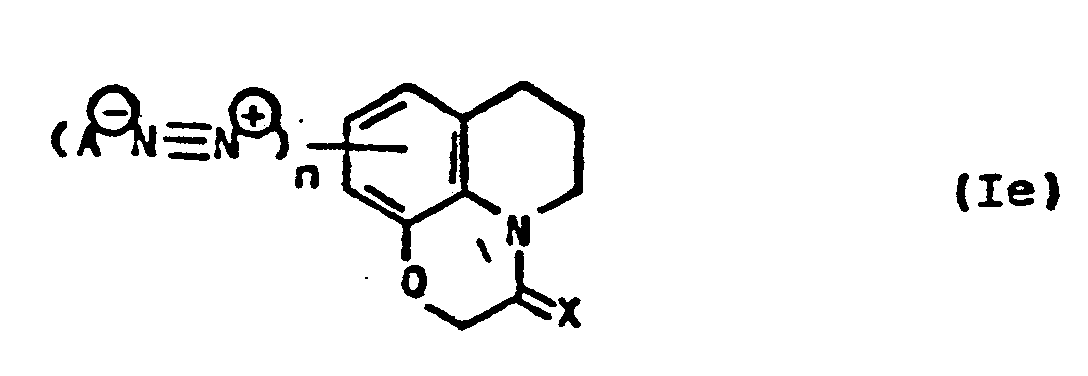
- n und X die oben angegebene Bedeutung haben, und die so erhaltenen Aminobenzoxazin-Derivate der oben angegebenen Formel (Id) mit Natriumnitrit und einer Mineralsäure der Formel HA in Gegenwart eines Verdünnungsmittels diazotiert und die so erhaltenen Diazoniumsalze der Formel (le)

- n und X die oben angegebene Bedeutung haben und
- A6 für das Anion einer starken Mineralsäure steht,
- mit geeigneten nukleophifen Reagenzien in Gegenwart eines Verdünnungsmittels und gegebenenfalls in Gegenwart eines Katalysators nach der Art der sogenannten Sandmeyer-Reaktion unter Stickstoffabspaltung substituiert, oder die sogenannte Balz-Schiemann-Variante, d.h. thermische Zersetzung der entsprechenden Diazonium-tetrafluoroborat-Verbindung, zur Einführung eines Fluoratoms anwendet. Auch die Einführung der CN-Gruppe läßt sich durch Pyrolyse der trockenen Diazoniumtetracyanocuprate bewerkstelligen.
- a) 4,5-Trimethylenbenzoxazinon der Formel (II)
- Es wurde weiterhin die neue Verwendung der substituierten Benzoxazin-Derivate der Formel (I), in der R1, R2 und X die oben angegebene Bedeutung haben, als Fungizide gefunden. Dabei zeigen die erfindungsgemäßen Verbindungen überraschenderweise eine bessere fungizide Wirksamkeit insbesondere bei systemischer Anwendung als die nach dem Stand der Technik bekannten Benzoxazinone (vgl. US-A-4 133 954) Die erfindungsgemäßen Stoffe stellen somit eine Bereicherung der Technik dar.
- Die erfindungsgemäßen substituierten Benzoxazin-Derivate sind durch die Formel (1) allgemein definiert.
- Im einzelnen seien außer den bei den Herstellungsbeispielen genannten Verbindungen die folgenden Verbindungen der Formel (I) genannt:


- Vervendet man beispielsweise 4,5-Trimethylen-1,4-benzoxazin-3-on und Chlor als Ausgangsstoffe, so kann der Reaktionsablauf des erfindungsgemäßen Verfahrens a) durch das folgende Formelschema wiedergegeben werden:

- Verwendet man beispielsweise 5-Chlor-8-hydroxy-1,2,3,4-tetrahydrochinolin und Chloracetylchlorid als Ausgangsstoffe, so kann der Reaktionsablauf des erfindungsgemäßen Verfahrens b) durch das folgende Formelschema wiedergegeben werden:

- Verwendet man beispielsweise 6-Chlor-4,5-trimethylen-1,4-benzoxazin-3-on und Phosphorpentasulfid als Ausgangsstoffe, so kann der Reaktionsablauf des erfindungsgemäßen Verfahrens c) durch das folgende Formelschema wiedergegeben werden:

- Verwendet man beispielsweise 7-Nitro-4,5-trimethylen-1,4-benzoxazin-3-on und Wasserstoff als Ausgangsstoffe im 1. Reaktionsschritt, so kann der Reaktionsablauf des 1. Schrittes des erfindungsgemäßen Verfahrens d) durch das folgende Formelschema wiedergegegeben werden:

- Verwendet man im 2. Reaktionsschritt des Verfahrens d) das so hergestellte 7-Amino-5,6-trimethylen-1,4-benzoxazin-3-on und Natriumnitrit/Salzsäure sowie Kupfercyanid als weitere Reagenzien, so kann der Reaktionsablauf des 2. Schrittes des erfindungsgemäßen Verfahrens d) durch das folgende Formelschema wiedergegeben werden:

- Das als Ausgangsstoff für das erfindungsgemäße Verfahren a) benötigte 4,5-Trimethylenbenzoxazin-3-on der Formel (II) ist bekannt (vgl. US-A-4133 954).
- Die weiterhin als Ausgangsstoffe für das erfindungsgemäße Verfahren a) benötigten elektrophilen Reagenzien sind ebenfalls bekannt.
- Bevorzugt verwendet man Halogenierungsmittel, wie z.B. Chlor, Brom oder Interhalogenverbindungen, wie z.B. Bromchlorid oder Jodchlorid, Nitrierungsmittel, wie Salpetersäure.
- Es handelt sich hierbei um allgemein bekannte Verbindungen.
- Die weiterhin als Ausgangsstoffe für das erfindungsgemäße Verfahren b) benötigten 8-Hydroxy-1,2,3,4-tetra- hydrochinoline sind durch die Formel (111) allgemein formuliert.
- Die 8-Hydroxy-1,2,3,4-tetrahydrochinoline der Formel (III) sind teilweise bekannt (vgl. z.B. Ind. J. Chem. 12 (1974), 252).
- Man erhält sie z.B., indem man die entsprechend substituierten 8-Hydroxychinoline der Formel (IV)

- R1 und R2 die oben angegebene Bedeutung haben,
- nach bekannten Verfahren mit Wasserstoff und einem geeigneten Hydrierkatalysator; wie z.B. Raney-Nickel, in einem Verdünnungsmittel, wie z.B. Tetrahydrofuran, bei Temperaturen zwischen 30°C uhd 180°C, gegebenenfalls unter Druck partiell hydriert, oder indem man 8-Hydroxy-1,2,3,4-tetrahydrochinolin der Formel (V)

- mit geeigneten elektrophilen Reagenzien in bekannter und üblicher Weise gegebenenfalls in Gegenwart eine Verdünnungsmittels im aromatischen Teil substituiert.
- Die substituierten 8-Hydroxychinoline der Formel (IV) sind bekannt (vgl. z.B. J. Amer. Chem. Soc. 66, 1927 (1944)).
- Das 8-Hydroxy-1,2,3,4-tetrahydrochinolin der Formel (V) ist ebenfalls bekannt (vgl. Chem. Ber. 14, 1368 (1881).
- Die weiterhin als Ausgangsstoffe für das erfindungsgemäße Verfahren d) im 2. Schritt benötigten Mineralsäuren der Formel HA sind ebenfalls allgemein bekannt.
- Vorzugsweise verwendet man Chlorwasserstoffsäure, Bromwasserstoffsäure, Schwefelsäure, Salpetersäure, Perchlorsäure, Tetrafluorborsäure.
- Die weiterhin als Ausgangsstoffe für das erfindungsgemäße Verfahren d) benötigten Nukleophile sind ebenfalls allgemein bekannt.
- Vorzugsweise verwendet man anorganische Cyanide, wie beispielsweise Natrium-, Kalium- oder Kupfercyanid, anorganische Halogenide, wie beispielsweise Natriumoder Kaliumbromid, -chlorid oder -jodid, oder anorganische Tetrafluoroborate, wie z.B. Ammoniumtetrafluoroborat.
- Für die erfindungsgemäße Umsetzung nach Verfahren a) kommen als Verdünnungsmittel organische oder wäßrige Lösungsmittel in Frage.
- Hierzu gehören insbesondere chlorierte Kohlenwasserstoffe, wie beispielsweise Tetrachlorkohlenstoff, Chloroform oder Dichlormethan.
- In einzelnen Fällen kommen auch spezielle Lösungsmittel in Frage, so z.B. im Fall der Nitrierungsreaktion insbesondere Eisessig.
- Einige der Reaktionen des erfindungsgemäßen Verfahrens a) werden vorzugsweise in Gegenwart eines geeigneten Katalysators durchgeführt. Für die Nitrierungsreaktionen verwendet man insbesondere Kupfernitrat oder auch Acetanhydrid.
- Die Reaktionstemperaturen können bei dem erfindungsgemäßen Verfahren a) in einem weiten Bereich variiert werden. Im Fall der Nitrierungs- und Halogenierungsreaktionen arbeitet man im allgemeinen zwischen -80°C und + 80°C, vozugsweise zwischen -40°C und +400C.
- Zur Durchführung des erfindungsgemäßen Verfahrens a) setzt man auf 1 Mol der Benzoxazin-Verbindung der Formel (11) im allgemeinen 1 bis 2 Mol, vorzugsweise 1 bis 1,5 Mol Nitrierungs- oder Halogenierungsmittel ein. Die Aufarbeitung erfolgt-jewwils in bekannter und üblicher Art und Weise.
- Für die erfindungsgemäße Umsetzung nach Verfahren b) kommen als Verdünnungsmittel inerte organische Lösungsmittel in Frage. Hiezru gehören insbesondere dioplar-aprotische Solventien, wie beispielsweise Acetonitril oder Propionitril; ferner Amide, wie Dimethylformamid oder Dimethylacetamid oder N-Methylformanilid, und außerdem auch Dimethylsulfoxid, Sulfolan sowie das hochpolare Hexamethylphosphorsäuretriamid.
- Das erfindungsgemäß Verfahren b) wird in Gegenwart von Säurebindern vorgenommen. Man kann alls üblicherweise verwendbaren anorganischen und organischen Säurebinder zugeben. Hierzu gehören vorzugsweise Alkalicarbonate, wie beispielweise Natriumcarbonat, Kaliumcarbonat und Natriumhydrogencarbonat, ferner niedere tertiäre Alkylamine, Cycloalkylamine oder Arylalkylamine, wie beispielweise Triethylamin, N,N-Dimethyl-benzylamin, weiterhin Pyridin sowie 1,4-Diazabicyclo (2,2,2)-octan und 1,5-Diazabicyclo (4,3,0)-non-5-en.
- Die Reaktionstemperatur kann bei der Durchführung des erfindungsgemäßen Verfahrens b) innerhalb eines größeren Bereichs variiert werden. Im allgemeinen arbeitet man zwischen 0°C und 100°C, vorzugsweise zwischen 10°C und 80°C.
- Das erfindungsgemäße Verfahren b) wird im allgemeinen bei Normaldruck durchgeführt.
- Zur Durchführung des erfindungsgemäßen Verfahrens b) setzt man auf 1 Mol 8-Hydroxyn 1,2,3,4-tetrahydrochinolin der Formel (III) im allgemeinen 1,0 bis 1,5 Mol, vorzugsweise 1,0 bis 1,2 Mol Chloracetylchlorid ein.
- Die Umsetzung wird vorzugsweise unter Verwendung eines der obengenannten Säurebinder in einem der obengenannten Verdünnungsmittel durchgeführt. Das Reaktionsgemisch wird mehrere Stunden bei der erforderlichen Temperatur gerührt. Die Aufarbeitung der Reaktionsmischung und die Isolierung der erfindungsgemäßen Reaktionsproduke der Formel (I) erfolgt in allgemein üblicher Art und Weise.
- Für die erfindungsgemäße Umsetzung nach Verfahren c) kommen als Verdünnungsmittel inerte organische Lösungsmittel in Frage. Hierzu gehören vorzugsweise chlorierte Kohlenwasserstoffe, wie z.B. Tetrachlorkohlenstoff, Chlorbenzol oder Dichlorbenzol.
- Die Reaktionstemperaturen können bei der Durchführung des erfindungsgemäßen Verfahrens c) innerhalb eines größeren Bereiches variiert werden. Im allgemeinen arbeitet man zwischen +30°C und +150°C, vorzugsweise bei der Siedetemperatur des verwendeten Lösungsmittels.
- Das erfindungsgemäße Verfahren c) wird im allgemeinen bei Normaldruck durchgeführt.
- Zur Durchführung des erfindungsgemäßen Verfahrens c) setzt man auf 1 Mol Benzoxazin-Derivat der Formel (la) vorzugsweise 0,5 Mol Phosphorpentasulfid ein. Das Reaktionsgemisch wird 10 Minuten bei der erforderlichen Temperatur gerührt, dann vom festen Rückstand abdekantiert und wie üblich aufgearbeitet.
- Als Verdünnungsmittel für das erfindungsgemäße Verfahren d) kommen ebenfalls inerte organische Solventien in Frage. Hierzu gehören vorzugsweise aliphatische oder aromatische Kohlenwasserstoffe, wie Benzin, Benzol, Toluol oder Xylol; halogenierte Kohlenwasserstoffe, wie Methylenchlorid, Chloroform, Tetrachlorkohlenstoff oder Chlorbenzol; Ether, wie Diethylether, Dioxan oder Tetrahydrofuran; Ester, wie Ethylacetat; oder Alkohole, wie Methanol, Ethanol oder Isopropanol.
- Als Katalysatoren kommen für das erfindungsgemäße Verfahren d) alle üblichen Hydrierkatalysatoren in Frage. Vorzugsweise verwendet man Raney-Katalysatoren, wie z.B. Raney-Nickel oder Edelmetallkatalysatoren, wie z.B. Platin oder Palladium, gegebenenfalls auf einem geeigneten Trägermaterial, wie z.B. Kohle.
- Die Reaktionstemperaturen können bei der Durchführung des erfindungsgemäßen Verfahrens d) ebenfalls in einem größeren Bereich variiert werden. Im allgemeinen arbeitet man zwischen +20°C und +120°C, vorzugsweise zwischen +60°C und +100°C.
- Das erfindungsgemäße Verfahren d) kann unter erhöhtem Druck durchgeführt werden. Im allgemeinen arbeitet man zwischen 1 und 100 bar, vorzugsweise zwischen 1 und 80 bar.
- Bei der Durchführung des erfindungsgemäßen Verfahrens d) setzt man auf 0,1 Mol Nitrobenzoxazinderivat der Formel (Ic) 0,5 bis 5,0 g, vorzugsweise 1 bis 3 g Hydrierkatalysator zu. Die Hydrierung und Aufarbeitung sowie die Isolierung der Verbindungen der Formel (Id) erfolgt nach bekannten und üblichen Methoden.
- Als Verdünnungsmittel für den 2. Schritt des erfindungsgemäßen Verfahrens d) kommt insbesondere Wasser in Frage.
- Das erfindungsgemäße Verfahren kann gegebenenfalls in Gegenwart eines geeigneten Katalysators durchgeführt werden. Vorzugsweise verwendet man Kupfer(1)salze, wie z. B. Kupfer-(1)-cyanid oder Kupfer-(I)bromid oder Kupfer-(I)-chlorid.
- Die Reaktionstemperaturen können bei der weiteren Durchführung des erfindungsgemäßen Verfahrens ebenfalls in einem größeren Bereich variiert werden. Im allgemeinen arbeitet man zwischen +20°C und + 100°C, vorzugsweise zwischen +40°C und + 100°C.
- Bei der Durchführung des 2. Schrittes des erfindungsgemäßen Verfahrens d) setzt man pro Mol Aminobenzoxazin-Derivat der Formel (Id) im allgemeinen 1 bis 1,5 Mol Natriumnitrit, vorzugsweise 1 bis 1,2 Mol Natriumnitrit, 2 bis 5 Mol Mineralsäure, vorzugsweise 2 bis 3 Mol Mineralsäure sowie 1 bis 5 Mol nukleophiles Reagenz, vorzugsweise 1 bis 3 Mol nukleophiles Reagenz ein.
- Die Durchfürung und Aufarbeitung erfolgt in bekannter und üblicher Art und Weise.
- Die erfindungsgemäßen Wirkstoffe weisen eine starke mikrobizide Wirkung auf und können zur Bekämpfung von unerwünschten Mikroorganismen praktisch eingesetzt werden. Die Wirkstoffe sind für den Gebrauch als Pflanzenschutzmittel geeignet.
- Fungizide Mittel im Pflanzenschutz werden eingesetzt zur Bekämpfung von Plasmodiophoromycetes, Oomycetes, Chytridiomycetes, Zygomycetes, Ascomycetes, Basidiomycetes, Deuteromycetes.
- Die gute Pflanzenverträglichkeit der Wirkstoffe in den zur Bekämpfung von Pflanzenkrankheiten notwendigen Konzentrationen erlaubt eine Behandlung von oberirdischen Pflanzenteilen, von Pflanz- und Saatgut, und des Bodens.
- Als Pflanzenschutzmittel können die erfindungsgemäßen Wirkstoffe mit besonders gutem Erfolg zur Bekämpfung von Reiskrankheiten, wie z.B. gegen den Erreger Pyricularia oryzae eingesetzt werden.
- Auch die Bekämpfung von Oomyceten und Schorferkrankungen, wie z.B. von Apfelschorf ist möglich.
- Die Wirkstoffe können in die üblichen Formulierungen übergeführt werden, wie Lösungen, Emulsionen, Spritzpulver, Suspensionen, Pulver, Stäubemittel, Schäume, Pasten, lösliche Pulver, Granulate, Aerosole, Suspensions-Emulsionskonzentrate, Saatgutpuder, Wirkstoffimprägnierte Natur- und synthetische Stoffe, Feinstverkapselungen in polymeren Stoffen und in Hüllmassen für Saatgut, ferner in Formulierungen mit Brennsätzen, wie Räucherpatronen, -dosen, -spiralen u.ä. sowie ULV-Kalt- und Warmnebel-Formulierungen. Diese Formulierungen werden in bekannter Weise hergestellt, z.B. durch Vermischen der Wirkstoffe mit Streckmitteln, also flüssigen Lösungsmitteln, unter Druck stehenden verflüssigten Gasen und/oder festen Trägerstoffen, gegebenenfalls unter Verwendung von oberflächenaktiven Mitteln, also Emulgiermitteln und/oder Dispergiermitteln und/oder schaumerzeugenden Mitteln. Im Falle der Benutzung von Wasser als Streckmittel können z.B. auch organische Lösungsmittel als Hilfslösungsmittel verwendet werden. Als flüssige Lösungsmittel kommen im wesentlichen in Frage: Aromaten, wie Xylol, Toluol, oder Alkyl-naphthaline, chlorierte Aromaten oder chlorierte aliphatische Kohlenwasserstoffe, wie Chlorbenzole, Chlorethylene oder Methylenchlorid, aliphatische Kohlenwasserstoffe, wie Cyclohexan oder paraffine, z.B. Erdölfraktionen, Alkohole, wie Butanol oder Glykol sowie deren Ether und Ester, Ketone, wie Aceton, Methylethylketon, Methylisobutylketon oder Cyclohexanon, starke polare Lösungsmittel, wie Dimethylformamid und Dimethylsulfoxid, sowie Wasser; mit verflüssigten gasförmigen Streckmitteln oder Trägerstoffen sind solche Flüssigkeiten gemeint, welche bei normaler Temperatur und unter Normaldruck gasförmig sind, z.B. Aerosol-Treibgase, wie Halogenkohlenwasserstoffe sowie Butan, Propan, Stickstoff und Kohlendioxid; als feste Trägerstoffe kommen in Frage: z.B. natürliche Gesteinsmehle, wie Kaoline, Tonerden, Talkum, Kreide, Quarz, Attapulgit, Montmorillonit oder Diatomeenerde und synthetische Gesteinsmehle, wie hochdisperse Kieselsäure, Aluminiumoxid und Silikate; als feste Trägerstoffe für Granulate kommen in Frage: z.B. gebrochene und fraktionierte natürliche Gesteine wie Calcit, Marmor, Bims, Sepiolith, Dolomit sowie synthetische Granulate aus anorganischen und organischen Mehlen sowie Granulate aus organischem Material, wie Sägemehl, Kokosnußschalen, Maiskolben und Tabakstengeln; als Emulgier- und/oder schaumerzeugende Mittel kommen in Frage: z.B. nichtionogene und anionische Emulgatoren, wie Polyoxyethylen-Fettsäureester, polyoxyethylen-Fettalkohol-ether, z.B. Alkylarylpolyglykol-ether, Alkylsulfonate, Alkylsulfate, Arylsulfonate sowie Eiweißhydrolysate; als Dispergiermittel kommen in Frage: z.B. Lignin-Sulfitablaugen und Methylcellulose.
- Es können in den Formulierungen Haftmittel wie Carboxymethylcellulose, natürliche und synthetische pulvrige, körnige oder latexförmige Polymere verwendet werden, wie Gummiarabicum, Polyvinylalkohol, Polyvinylacetat.
- Es können Farbstoffe wie anorganische Pigmente, z.B. Eisenoxid, Titanoxid, Ferrocyanblau und organische Farbstoffe, wie Alizarin-, Azo- und Metallphthalocyaninfarbstoffe und Spurennährstoffe wie Salze von Eisen, Mangan, Bor, Kupfer, Kobalt, Molybdän und Zink verwendet werden.
- Die Formulierungen enthalten im allgemeinen zwischen 0,1 und 95 Gew.-% Wirkstoff, vorzugsweise zwischen 0,5 und 90 %.
- Die erfindungsgemäßen Wirkstoffe können in den Formulerungen oder in den verschiedenen Anwendungsformen in Mischung mit anderen bekannten Wirkstoffen vorliegen, wie Fungiziden, Bakteriziden, Insektiziden, Akariziden, Nematiziden, Herbiziden, Schutzstoffen gegen Vogelfraß, Wuchsstoffen, Pflanzennährstoffen und Bodenstrukturverbesserungsmittetn.
- Die Wirkstoffe können als solche, in Form ihrer Formulierungen oder der daraus durch weiteres Verdünnen bereiteten Anwendungsformen, wie gebrauchsfertige Lösungen, Emulsionen, Suspensionen, Pulver, Pasten und Granulate angewendet werden. Die Anwendung geschieht in üblicher Weise, z.B. durch Gießen, Tauchen, Spritzen, Sprühen, Vernebeln, Verdampfen, Injizieren, Verschlämmen, Verstreichen, Stäuben, Streuen, Trockenbeizen, Feuchtbeizen, Naßbeizen, Schlämmbeizen oder Inkrustieren.
- Bei der Behandlung von Pflanzenteilen können die Wirkstoffkonzentrationen in den Anwendungsformen in einem größeren Bereich variiert werden. Sie liegen im allgemeinen zwischen 1 und 0,0001 Gew.-%, vorzugsweise zwischen 0,5 und 0,001 %.
- Bei der Saatgutbehandlung werden im allgemeinen Wirkstoffmengen von 0,001 bis 50 g je Kilogram Saatgut, vorzugsweise 0,01 bis 10 g, benötigt.
- Bei Behandlung des Bodens sind Wirkstoffkonzentrationen von 0,00001 bis 0,1 gew.-%, vorzugsweise von 0,0001 bis 0,02 Gew.-%, am Wirkungsort erforderlich.
-

- 18,9 g (0,1 Mol)4,5-Trimethylen-1,4-benzoxazin-3-on werden in 250 ml Tetrachlorkohlenstoff gelöst und bei 0°C tropfenweise unter Rühren mit 7,1 g (0,1 Mol) Brom in 50 ml Tetrachlorkohlenstoff versetzt.
- Die Reaktionsmischung wird bis zum Ende der HCI-Entwicklung (ca. 6 Stunden) bei 60°C gerührt, nach dem Abkühlen filtriert und im Vakuum eingeengt. Das zurückbleibende Öl kristallisiert beim Verreiben mit Ether. Nach Absaugen und Trocknen erhält man 12 g (53 % der Theorie) an 6-Brom-4,5-trimethylen-1,4-benzoxazin-3- on vom Schmelzpunkt 1330C.
-

- (Verfahren a) Zu einer Lösung von 18,9 g (0,1 Mol) 4,5-Trimethylen-1,4-benzoxazin-3-on in 250 ml Dichlormethan tropft man bei -78°C eine Lösung von 18,6 g (0,1 Mol) Jodchlorid in 10 ml Dichlormethan.
- Nach erfolgter Zugabe läßt man die Reaktionsmischung auf Raumtemperatur kommen, entfernt das Lösungsmittel im Vakuum und wäscht den kristallinen Rückstand mit kalten Ethanol. Nach dem Trocknen erhält man 12,7 g (40 % der Theorie) an 6-Jod-4,5-trimethylen-1,4-benzoxazin-3-on vom Schmelzpunkt 191°C.
-

- 18,9 g (0,1 Mol) 4,5-Trimethylen-1,4-benzoxazin-3-on werden in einem Gemisch aus 200 ml Eisessig und 20 g (0,1 Mol) Acetanhydrid gelöst und bei 10°C tropfenweise unter Rühren mit 10 g (0,1 Mol) 66 %iger Salpetersäure versetzt.
- Die Reaktionsmischung wird 2 Stunden bei 20°C bis 25°C gerührt, dann mit 100 ml Wasser versetzt und mit insgesamt 600 ml Dichlormetham mehrfach extrahiert. Die vereinigten organischen Extrakte werden über Natriumsulfat getrocknet und im Vakuum eingeengt. Das zurückbleibende braune ÖI kristallisiert beim Verreiben mit Ether in gelben Kristallen. Man erhält 19 g (80 % der Theorie) an 7-Nitro-4,5-trimethylen-1,4-benzoxazin-3-on vom Schmelzpunkt 103 bis 105°C.
-
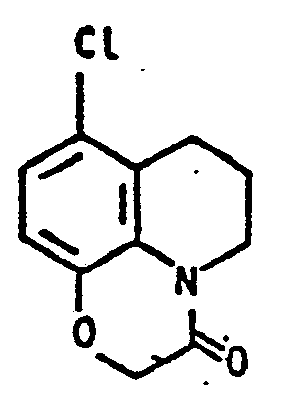
- 22 g (0,1 Mol) 5-Chlor-8-hydroxy-1,2,3,4-tetrahydro-chinolinhydrochlorid, 11,3 g (0 1 Mol) Chloracetylchlorid und 41,4 g (0,3 Mol) Kaliumcarbonat werden in 300 ml Acetonitril 5 Stunden am Rückfluß gekocht.
- Man läßt die Reaktionsmischung abkühlen, filtriert und engt das Filtrat im Vakuum ein, wobei das Produkt auskristallisiert. Man erhält 19 g (85 % der Theorie) an 6-Chlor-4,5-trimethylen-1,4-benzoxazin-3-on vom Schmelzpunkt 98°C.
-

- Zu 14,g g (0,1 Mol) 8-Hydroxy-1,2,3,4-tetrahydro-chinolin in 100 ml Dichlormethan leitet man bei -78°C 7,1 g (0,1 Mol) Chlor ein.
- Man läßt den Ansatz auf Raumtemperatur kommen, rührt 10 Minuten mit Aktivkohle, filtriert und engt im Vakuum ein. Man erhält so 16,5 g (75 % der Theorie) an 5°Chlor-8-hydroxy-1,2,3,4-tetrahydrochinolin.
- In analoger Weise erhält man mit 11,5 g (0,1 Mol) Bromchlorid statt Chlor 14,5 g (55 % der Theorie) an 5-Brom-8-hydroxy-1,2,3,4-tetrahydrochinolin (III-2).
-

- Zu 18,9 g (D,1 Mol) 4,5-Trimethylen-1,4-benzoxazin-3-on in 200 ml Chlorbenzol gibt man unter Rühren portionsweise 11,1 g (0,05 Mol) Phosphorpentasulfid..
- Man erhitzt 10 Minuten auf Rückflußtemperatur, läßt die Mischung abkühlen und dekantiert vom ungelösten Rückstand ab. Durch Abdampfen des Lösungsmittels erhält man 19,5 g (95 % der Theorie) an 4,5-Trimethylen-1,4-Benzoxazin-3-thion vom Schmelzpunkt 103°C.
-

- 5,8 g (0,025 Mol) 7-Nitro-4,5-trimethylen-1,4-benzoxazin-3-on werden in 50 ml Tetrahydrofuran gelöst, mit 1 g Raney-Nickel versetzt und 2 Stunden mit Wasserstoff unter Druck (80 bar) auf 60° C erhitzt.
- Nach beendeter Reaktion wird der Katalysator abfiltriert und das Lösungsmittel im Vakuum eingedampft. Der zurückbleibende Kristallbrei wird mit 100 ml Ether ausgekocht, nach dem Abkühlen abgesaugt und getrocknet. Man erhält 3,3 g (64 % der Theorie) an 7-Amino-4,5-trimethylen-1,4-benzoxazin-3-on vom Schmelzpunkt 170° C.

- 20,4 g (0,1 Mol) 7-Amino-4,5-trimethylen-1,4-benz-oxazin-3-on werden in 50 ml (0,3 Mol) 50 %iger Bromwasserstoffsäure mit 6,9 g (0,1 Mol) Natriumnitrit versetzt.
- Die Reaktionslösung wird bei 0°C zu einer Lösung von 14,3 g (0,1 Mol) Kupfer-(I)-bromid und 10,3 g (0,1 Mol) Natriumbromid in 50 ml Wasser getropft. Man erwärmt bis zum Ende der Gasentwicklung. Nach dem Abkühlen extrahiert man mehrmals mit Dichlormethan, trocknet die vereinigten organischen Extrakte über Natriumsulfat, entfernt das Lösungsmittel im Vakuum und kristallisiert den so erhaltenen Feststoff aus Cyclohexan um. Man erhält 13,4 g (50 % der Theorie) an 7-Brom-4,5-trimethylen-1,4-benzoxazin-3-on in Form gelber Kristalle vom Schmelzpunkt 168°C.
- In entsprechender Weise erhält man die folgenden Verbindungen der allgemeinen Formel (I):


- Bei den nachstehenden Anwendungsbeispielen wird die hier angegebene Substanz als Vergleichsbeispiel herangezogen:

-
- Pyricularia-Test (Reis) / systemisch
- Lösungsmittel: 12,5 Gew:-Teile Aceton
- Emulgator: 0,3 Gew.-Teil Alkylarylpolyglykolether
- Zur Herstellung einer zweckmäßigen Wirkstoffzubereitung vermischt man 1 Gew.-Teil Wirkstoff mit der angegebenen Menge Lösungsmittel und verdünnt das Konzentrat mit Wasser und der angegebenen Menge Emulgator auf die gewünschte Konzentration.
- Zur Prüfung auf systemische Eigenschaften werden 40 ml der Wirkstoffzubereitung auf Einheitserde gegossen, in der junge Reispflanzen angezogen wurden. 7 Tage nach der Behandlung werden die Pflanzen mit einer wäßrigen Sporensuspension von Pyricularia oryzae inokuliert. Danach verbleiben die Pflanzen in einem Gewächshaus bei einer Temperatur von 25° C und einer rel. Luftfeuchtigkeit von 100 % bis zur Auswertung.
- 4 Tage nach der Inokulation erfolgt die Auswertung des Krankheitsbefalls.
- Eine deutliche Überlegenheit in der Wirksamkeit gegenüber dem Stand der Technik zeigen bei diesem Test z.B. die Verbindungen gemäß folgender Herstellungsbeispiele:1, 3, 4.
-
- Pyricularia-Test (Reis) / protektiv
- Lösungsmittel: 12,5 Gew.-Teile Aceton
- Emulgator: 0,3 Gew.-Teile Alkylarylpolyglykolether
- Zur Herstellung einer zweckmäßigen Wirkstoffzubereitung vermischt man 1 Gew.-Teil Wirkstoff mit der angegebenen Menge Lösungsmittel und verdünnt das Konzentrat mit Wasser und der angegebenen Menge Emulgator auf die gewünschte Konzentration.
- Zur Prüfung auf protektive Wirksamkeit bespritzt man Junge Reispflanzen mit der Wirkstoffzubereitung bis zur Tropfnässe. Nach dem Abtrocknen des Spritzbelages werden die Pflanzen mit einer wäßrigen Sporensuspension von Pyricularia oryzae inokuliert. Anschließend werden die pflanzen in einem Gewächshaus bei 100 % rel. Luftfeuchtigkeit und 25° C aufgestellt.
- 4 Tage nach der Inokulation erfolgt die Auswertung des Krankheitsbefalls.
- Eine gute Wirksamkeit zeigen bei diesem Test z.B. die Verbindungen gemäß folgender Herstellungsbeispiele: 1, 3,4.
gefunden.
Claims (6)


dadurch gekennzeichnet, daß man


Priority Applications (1)
| Application Number | Priority Date | Filing Date | Title |
|---|---|---|---|
| AT83108716T ATE23861T1 (de) | 1982-09-17 | 1983-09-05 | Substituierte benzoxazin-derivate. |
Applications Claiming Priority (2)
| Application Number | Priority Date | Filing Date | Title |
|---|---|---|---|
| DE19823234529 DE3234529A1 (de) | 1982-09-17 | 1982-09-17 | Substituierte benzoxazin-derivate |
| DE3234529 | 1982-09-17 |
Publications (3)
| Publication Number | Publication Date |
|---|---|
| EP0103797A2 EP0103797A2 (de) | 1984-03-28 |
| EP0103797A3 EP0103797A3 (en) | 1984-11-07 |
| EP0103797B1 true EP0103797B1 (de) | 1986-11-26 |
Family
ID=6173501
Family Applications (1)
| Application Number | Title | Priority Date | Filing Date |
|---|---|---|---|
| EP83108716A Expired EP0103797B1 (de) | 1982-09-17 | 1983-09-05 | Substituierte Benzoxazin-Derivate |
Country Status (16)
| Country | Link |
|---|---|
| US (1) | US4537888A (de) |
| EP (1) | EP0103797B1 (de) |
| JP (1) | JPS5973588A (de) |
| KR (1) | KR840006250A (de) |
| AT (1) | ATE23861T1 (de) |
| AU (1) | AU1900683A (de) |
| BR (1) | BR8304992A (de) |
| CA (1) | CA1227198A (de) |
| DE (2) | DE3234529A1 (de) |
| DK (1) | DK424283A (de) |
| ES (1) | ES525691A0 (de) |
| HU (1) | HU193654B (de) |
| IL (1) | IL69723A (de) |
| PH (1) | PH19381A (de) |
| PT (1) | PT77300B (de) |
| ZA (1) | ZA836894B (de) |
Families Citing this family (4)
| Publication number | Priority date | Publication date | Assignee | Title |
|---|---|---|---|---|
| JPS62238288A (ja) * | 1986-04-04 | 1987-10-19 | Nippon Tokushu Noyaku Seizo Kk | 環状カルバメ−ト及び農園芸用殺菌剤 |
| JPH0228178A (ja) * | 1988-04-23 | 1990-01-30 | Toyama Chem Co Ltd | 新規なピリドンカルボン酸誘導体およびその塩並びにそれらの製造法 |
| DE3922847A1 (de) * | 1989-07-07 | 1991-01-17 | Schering Ag | Substituierte benzoxazolinon- und benzoxazinon-derivate, verfahren zu ihrer herstellung und ihre verwendung als mittel mit herbizider wirkung |
| JPH0499375U (de) * | 1991-09-12 | 1992-08-27 |
Family Cites Families (1)
| Publication number | Priority date | Publication date | Assignee | Title |
|---|---|---|---|---|
| US4133954A (en) * | 1976-11-16 | 1979-01-09 | Ciba-Geigy Corporation | Pyrrolo- and pyrido-1,4-benzoxazin-3-(2H)-one derivatives as microbicides |
-
1982
- 1982-09-17 DE DE19823234529 patent/DE3234529A1/de not_active Withdrawn
-
1983
- 1983-08-29 US US06/527,442 patent/US4537888A/en not_active Expired - Fee Related
- 1983-09-05 AT AT83108716T patent/ATE23861T1/de not_active IP Right Cessation
- 1983-09-05 EP EP83108716A patent/EP0103797B1/de not_active Expired
- 1983-09-05 DE DE8383108716T patent/DE3367920D1/de not_active Expired
- 1983-09-07 PT PT77300A patent/PT77300B/de unknown
- 1983-09-09 AU AU19006/83A patent/AU1900683A/en not_active Abandoned
- 1983-09-14 IL IL69723A patent/IL69723A/xx unknown
- 1983-09-15 CA CA000436812A patent/CA1227198A/en not_active Expired
- 1983-09-15 BR BR8304992A patent/BR8304992A/pt unknown
- 1983-09-16 HU HU833216A patent/HU193654B/hu unknown
- 1983-09-16 DK DK424283A patent/DK424283A/da not_active Application Discontinuation
- 1983-09-16 ES ES525691A patent/ES525691A0/es active Granted
- 1983-09-16 ZA ZA836894A patent/ZA836894B/xx unknown
- 1983-09-16 KR KR1019830004354A patent/KR840006250A/ko not_active Ceased
- 1983-09-16 JP JP58169513A patent/JPS5973588A/ja active Pending
- 1983-09-19 PH PH29557A patent/PH19381A/en unknown
Also Published As
| Publication number | Publication date |
|---|---|
| US4537888A (en) | 1985-08-27 |
| AU1900683A (en) | 1984-03-22 |
| BR8304992A (pt) | 1984-09-04 |
| EP0103797A2 (de) | 1984-03-28 |
| PT77300B (de) | 1986-03-11 |
| PT77300A (de) | 1983-10-01 |
| CA1227198A (en) | 1987-09-22 |
| JPS5973588A (ja) | 1984-04-25 |
| ZA836894B (en) | 1984-05-30 |
| ES8405408A1 (es) | 1984-06-01 |
| EP0103797A3 (en) | 1984-11-07 |
| KR840006250A (ko) | 1984-11-22 |
| DE3234529A1 (de) | 1984-03-22 |
| PH19381A (en) | 1986-04-07 |
| ES525691A0 (es) | 1984-06-01 |
| DK424283D0 (da) | 1983-09-16 |
| IL69723A0 (en) | 1983-12-30 |
| ATE23861T1 (de) | 1986-12-15 |
| DK424283A (da) | 1984-03-18 |
| IL69723A (en) | 1986-07-31 |
| DE3367920D1 (de) | 1987-01-15 |
| HU193654B (en) | 1987-11-30 |
Similar Documents
| Publication | Publication Date | Title |
|---|---|---|
| EP0072528B1 (de) | (Thio-) Harnstoffe, ein Verfahren zu ihrer Herstellung und ihre Verwendung als Pflanzenschutzmittel | |
| EP0040740A2 (de) | Aminopropanol-Derivate, Verfahren zu ihrer Herstellung und ihre Verwendung als Fungizide | |
| EP0029542A2 (de) | Hydroxybutyl-imidazol-Derivate, Verfahren zu ihrer Herstellung, zu letzterer benötigte Zwischenprodukte sowie ihre Verwendung als Fungizide | |
| EP0103797A2 (de) | Substituierte Benzoxazin-Derivate | |
| EP0080103A1 (de) | Azolylvinyldithioacetale, Verfahren zu ihrer Herstellung und ihre Verwendung als Fungizide | |
| EP0093908A1 (de) | Heteroarylthiovinyl-Verbindungen, ein Verfahren zu ihrer Herstellung und ihre Verwendung als Schädlingsbekämpfungsmittel | |
| EP0003520B1 (de) | Spiro-Derivate von 3-(3,5-Dihalogenphenyl)-oxazolidin-2,4-dionen, Verfahren zu ihrer Herstellung sowie ihre Verwendung als Fungizide | |
| EP0154273B1 (de) | Fungizide Mittel | |
| EP0198191B1 (de) | Piperazinylmethyl-1,2,4-triazolylmethyl-carbinole | |
| EP0161455A1 (de) | Beta-naphthylalkylamine | |
| EP0022531B1 (de) | 1-(2,4-Dichlorphenyl)-1-(2,6-dihalogenbenzylmercapto)-2-(1,2,4-triazol-1-yl)-ethane, Verfahren zu ihrer Herstellung und ihre Verwendung als Fungizide | |
| EP0012261B1 (de) | Substituierte Spiro-Derivate von 3-(3,5-Dichlorphenyl)-oxazolidin-2,4-dionen, Verfahren zu ihrer Herstellung sowie ihre Verwendung als Fungizide | |
| EP0046931A2 (de) | N-Oxiamide, Verfahren zu ihrer Herstellung sowie ihre Verwendung als Fungizide | |
| EP0014887B1 (de) | Spiro-Derivate von 3-(3,5-Dihalogenphenyl)-oxazolidin-2-thion-4-onen, Verfahren zu ihrer Herstellung sowie ihre Verwendung als Fungizide | |
| EP0097280B1 (de) | Azolsubstituierte Oximino-cyan-acetamid-Derivate | |
| EP0075167B1 (de) | N-(1-Alkenyl)-carbonsäureanilide, Verfahren zu ihrer Herstellung sowie ihre Verwendung als Fungizide | |
| EP0003975B1 (de) | Dichlormaleinsäurediamid-Derivate, Verfahren zu ihrer Herstellung und ihre Verwendung als Fungizide | |
| EP0127047A2 (de) | N-Sulfenylierte Pyrano-pyrazol-Derivate | |
| EP0096280A2 (de) | Alkylen(cycloalkylen)-bis-heterocyclyl-biguanide | |
| EP0123218A2 (de) | Azolylethyl-benzyl-ether-Derivate, Verfahren zu ihrer Herstellung und ihre Verwendung als Fungizide | |
| EP0110243A1 (de) | Pyrano-pyrazol-Derivate | |
| EP0154274A2 (de) | Verfahren zur Herstellung von 3-Hydrazino-1,2-benzisothiazol-1,1-dioxiden | |
| DE3314190A1 (de) | Fungizide mittel | |
| DE2758021A1 (de) | Glykolsaeure-derivate, verfahren zu ihrer herstellung sowie ihre verwendung als fungizide | |
| EP0013322A1 (de) | Neue 3,4-Dioxo-1,2,5-thiadiazolidin-1-oxide (I), ihre Herstellung und Verwendung als Fungizide, die Verbindungen (I) enthaltende fungizide Mittel und deren Herstellung |
Legal Events
| Date | Code | Title | Description |
|---|---|---|---|
| PUAI | Public reference made under article 153(3) epc to a published international application that has entered the european phase |
Free format text: ORIGINAL CODE: 0009012 |
|
| 17P | Request for examination filed |
Effective date: 19830905 |
|
| AK | Designated contracting states |
Designated state(s): AT BE CH DE FR GB IT LI NL |
|
| PUAL | Search report despatched |
Free format text: ORIGINAL CODE: 0009013 |
|
| AK | Designated contracting states |
Designated state(s): AT BE CH DE FR GB IT LI NL |
|
| GRAA | (expected) grant |
Free format text: ORIGINAL CODE: 0009210 |
|
| AK | Designated contracting states |
Kind code of ref document: B1 Designated state(s): AT BE CH DE FR GB IT LI NL |
|
| REF | Corresponds to: |
Ref document number: 23861 Country of ref document: AT Date of ref document: 19861215 Kind code of ref document: T |
|
| ET | Fr: translation filed | ||
| ITF | It: translation for a ep patent filed | ||
| REF | Corresponds to: |
Ref document number: 3367920 Country of ref document: DE Date of ref document: 19870115 |
|
| PG25 | Lapsed in a contracting state [announced via postgrant information from national office to epo] |
Ref country code: AT Effective date: 19870905 |
|
| PLBE | No opposition filed within time limit |
Free format text: ORIGINAL CODE: 0009261 |
|
| STAA | Information on the status of an ep patent application or granted ep patent |
Free format text: STATUS: NO OPPOSITION FILED WITHIN TIME LIMIT |
|
| PGFP | Annual fee paid to national office [announced via postgrant information from national office to epo] |
Ref country code: NL Payment date: 19870930 Year of fee payment: 5 |
|
| 26N | No opposition filed | ||
| PG25 | Lapsed in a contracting state [announced via postgrant information from national office to epo] |
Ref country code: GB Effective date: 19880905 |
|
| PG25 | Lapsed in a contracting state [announced via postgrant information from national office to epo] |
Ref country code: LI Effective date: 19880930 Ref country code: CH Effective date: 19880930 Ref country code: BE Effective date: 19880930 |
|
| BERE | Be: lapsed |
Owner name: BAYER A.G. Effective date: 19880930 |
|
| PG25 | Lapsed in a contracting state [announced via postgrant information from national office to epo] |
Ref country code: NL Effective date: 19890401 |
|
| NLV4 | Nl: lapsed or anulled due to non-payment of the annual fee | ||
| PG25 | Lapsed in a contracting state [announced via postgrant information from national office to epo] |
Ref country code: FR Free format text: LAPSE BECAUSE OF NON-PAYMENT OF DUE FEES Effective date: 19890531 |
|
| REG | Reference to a national code |
Ref country code: CH Ref legal event code: PL |
|
| GBPC | Gb: european patent ceased through non-payment of renewal fee | ||
| REG | Reference to a national code |
Ref country code: FR Ref legal event code: ST |
|
| PG25 | Lapsed in a contracting state [announced via postgrant information from national office to epo] |
Ref country code: DE Effective date: 19900601 |